From conference to project
Miller Center conference spawns project aiming to reshape American presidency
Americans across party lines are increasingly concerned about the growth of presidential power. Recent presidents from both parties have significantly expanded executive authority. At the same time, presidents have become more prone to failure, challenged by major crises and dwindling public trust.
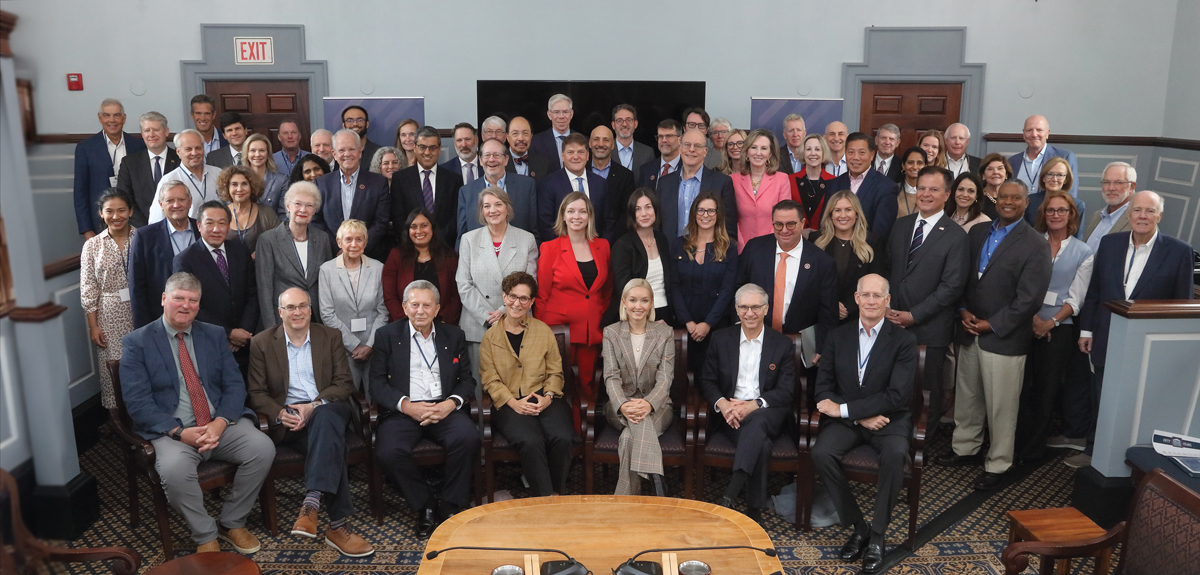
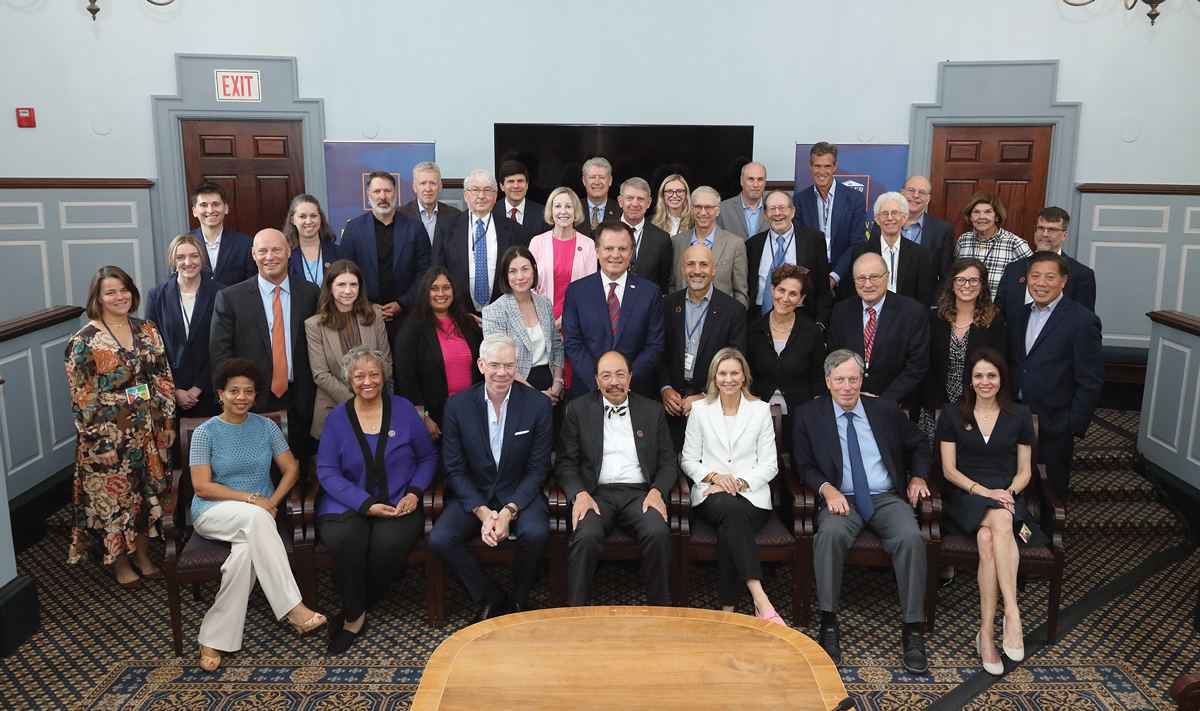
On September 24–25, 2025, more than 80 presidential experts scrutinized this paradox at the nonpartisan Miller Center’s second Conference on the American Presidency. Building on discussions from the Center’s 2023 conference, senior officials of Democratic and Republican administrations, presidential scholars, and Washington journalists proposed answers to the event’s central question: How can the nation foster a more responsible and effective presidency? That two-day conference has now spawned a project aimed at helping reshape the American presidency.
DEMOCRACY AND BUREAUCRACY
Panelists opened the conference by examining issues facing what some experts regard as the most important place in government: the Office of Management and Budget (OMB).
OMB reflects “the president’s priorities through the most powerful mechanism that the president has,” explained Joshua Bolten, who served as OMB director under President George W. Bush before becoming Bush’s White House Chief of Staff. In addition to assisting the president in preparing and implementing the federal budget, OMB reviews and coordinates legislative proposals, regulations, and testimony across executive agencies, ensuring they align with the president’s agenda.
Are you going to invest long term in the agency and in building institutions within it if you’re maybe not going to be there for a while?
Rachel Augustine Potter, associate professor of politics at the University of Virginia and a Miller Center faculty senior fellow, warned that the Trump administration’s effort to convert positions at OMB and other federal agencies—traditionally occupied by nonpartisan civil servants—into political appointments could undermine their effectiveness.
“If this is more of a political position, are you going to tell the boss what they don’t want to hear?” Potter asked. “Are you going to invest long term in the agency and in building institutions within it if you’re maybe not going to be there for a while?”
“So much expertise resides there,” added Bolten, “that politicizing those appointments undermines the president’s own ability to effectively control the government through OMB, because there’s a lot less capacity there.”
If you do everything by fiat through executive order, the country has no continuity
Several panelists noted that concerns surrounding OMB predate the Trump administration. As recent presidents have expanded executive power, the “power of the purse” has increasingly shifted from Congress to the White House, primarily through executive orders.
“If you do everything by fiat through executive order, the country has no continuity,” cautioned Shalanda Young, who served as OMB director under President Joe Biden.
SHARING POWERS
Some panelists urged Congress to take back its constitutional authority by making political compromises during the budgetary process and by passing individual appropriations bills promptly to avoid government shutdowns.
“It is hard to talk about the presidency and this consolidation without talking about a Congress that has refused to answer the moment,” said Young. “Congress has to decide on a bipartisan basis what they’re going to do about it.”
Discussing the controversy surrounding President Donald Trump’s Department of Government Efficiency (DOGE), several speakers analyzed Trump’s concerns with bureaucracy and his drastic cuts to the federal workforce, as well as the difficulty in getting nominees through Congress.
It is hard to talk about the presidency and this consolidation without talking about a Congress that has refused to answer the moment
“It has become incredibly burdensome to get nominees through the process and to get your policies in place,” said Everett Eissenstat, the Miller Center’s James R. Schlesinger Distinguished Professor, who served as deputy assistant to the president for international economic affairs in the first Trump administration.
“[Trump’s] sense is that the bureaucracy or career officials are ‘holding me back from doing what I was elected to do,’” Eissenstat said.
“Many of the people who elected [Trump] were unemployed, felt unhappy with the way the economic system had served them since the early 2000s, and were looking, themselves, for a massive change in Washington, D.C.,” added Robert Blair, who served in the first Trump administration as special representative for international telecommunications policy.
Many of the people who elected [Trump] were unemployed, felt unhappy with the way the economic system had served them since the early 2000s, and were looking, themselves, for a massive change in Washington, D.C.
Instead of trying to eliminate the bureaucracy and the accompanying checks on executive power, presidents should seek to reform the bureaucracy to better serve the country’s needs, argued Alexander Bick, a Miller Center faculty senior fellow who served as director for strategic planning at the National Security Council in the Biden administration.
DOGE “is the theater of reform,” argued Bick. “The actual impact—budgetary, personnel, and organizational—has been minimal.”
Various speakers suggested Congress could counter-balance this growing increase in unilateral presidential authority, including by strengthening its resources to compete with the “expertise” within the executive branch, said Eissenstat.
The actual impact—budgetary, personnel, and organizational—has been minimal
But no change will occur without the public holding Congress accountable, some panelists stressed. Miller Center Practitioner Senior Fellow Mara Rudman, who held senior national security positions in the Obama and Clinton administrations and, before that, worked as chief counsel at the House Foreign Affairs Committee under chairman Lee Hamilton (D-IN), urged understanding of the powerful motivation of reelection, and the competing pulls of primary and general election processes.
“Until they are more worried about winning a general election than they are about being primaried or losing a primary, that balance isn’t going to change,” Rudman said.
POLARIZATION AND PUBLIC TRUST
Further scrutinizing the growth in executive power, several panelists traced the birth of the modern presidency back to the New Deal, which created the network of executive departments and agencies that became the “administrative state.” However, the presidency did not become highly polarized until the 1960s, according to Sidney Milkis, the Miller Center’s White Burkett Miller Professor of Governance and Foreign Affairs.
“Social issues coming from the culture wars of the 1960s—civil rights, sexual identity, immigration, law and order—[are] more polarizing and less subject to compromise,” said Milkis. “Both parties begin to look to the presidency [to] cut the Gordian knot of partisan gridlock and advance partisan causes.”
Polarization led to political parties being defined almost entirely by presidents—instead of by individual lawmakers connecting with their geographic constituencies, noted Philip Wallach, a senior fellow at the American Enterprise Institute.
Both parties begin to look to the presidency [to] cut the Gordian knot of partisan gridlock and advance partisan causes
Some speakers underscored the dangers of today’s polarized environment in Congress. Power is no longer centered inside congressional committees but rather among party leaders, who do not encourage their members to negotiate. And many members prioritize social media over legislating.
“Both sides feel they have to demonstrate to their constituents, special interests, and their base that they are fighting really hard,” said Louisa Terrell, a Miller Center practitioner senior fellow who served as director of the White House Office of Legislative Affairs under President Biden.
Other panelists warned against relying on the judicial branch to check executive power. “Americans have to disenthrall themselves from their dependence on the presidency” and not look to the president “to be their savior,” argued Milkis.
Americans have to disenthrall themselves from their dependence on the presidency
Meanwhile, Congress needs legislators “who have a different vision and are willing to stand up for it and make it appealing to the American people—apart from any ambitions on the presidency,” asserted Wallach. Generational change, Terrell hoped, could also help heal division across the government.
Closing out the conference, participants highlighted the dangers of unchecked emergency powers. As Congress has failed to challenge presidential emergency actions, the meaning of “emergency” has shifted from urgent national crisis to long-term political issues, including immigration, trade, and drug trafficking.
Pointing to more than 100 statutes that presidents of both parties have used to justify emergency actions, several speakers called on Congress to explicitly define what constitutes an emergency and to impose strict time limits for emergency declarations.
When there’s a real emergency, Congress presumably will act
“We have emergencies [continuing] from 40 years ago,” said Saikrishna Prakash, a Miller Center faculty senior fellow and a professor in the UVA School of Law. “What Congress ought to do is say that all these emergency declarations last no more than six months. Then Congress can decide whether they ought to continue or not.”
“When there’s a real emergency, Congress presumably will act,” Prakash continued. “And when there isn’t, the policy will no longer apply.”
THE PRESIDENCY PROJECT
Over the coming months, the Miller Center plans an ongoing initiative, “The Presidency Project: Toward a Responsible and Effective Executive,” focused on three issues that emerged from the conference.
Participants identified presidential emergency powers as a top priority for further research and convenings, to better define the proper balance between a president’s constitutional responsibility to act on urgent challenges and the equally clear requirement for congressional support.
Most conference participants also felt that Congress was being reduced to a mere advisory council on a range of issues, meriting further investigation into potential reforms. And participants urged further exploration of the complex relationship between presidential performance and public trust.