Experts

Saikrishna Prakash

Fast Facts

Areas Of Expertise

  • Foreign Affairs
  • Domestic Affairs
  • Law and Justice
  • Governance
  • Political Parties and Movements
  • Politics
  • The Presidency
  • Supreme Court

Saikrishna Prakash, faculty senior fellow, is the James Monroe Distinguished Professor of Law and Albert Clark Tate, Jr., Professor of Law at the University of Virginia Law School. His scholarship focuses on separation of powers, particularly executive powers. He teaches constitutional law, foreign relations Law and presidential powers at the University of Virginia Law School.

Prakash majored in economics and political science at Stanford University. At Yale Law School, he served as senior editor of the Yale Law Journal and received the John M. Olin Fellowship in Law, Economics and Public Policy. After law school, he clerked for Judge Laurence H. Silberman of the U.S. Court of Appeals for the District of Columbia Circuit and for Justice Clarence Thomas of the U.S. Supreme Court. After practicing in New York for two years, he served as a visiting professor at the University of Illinois College of Law and as an associate professor at Boston University School of Law. He then spent several years at the University of San Diego School of Law as the Herzog Research Professor of Law. Prakash has been a visiting professor at the Northwestern University School of Law and the University of Chicago Law School. He also has served as a James Madison Fellow at Princeton University and Visiting Research Fellow at the Hoover Institution at Stanford University.

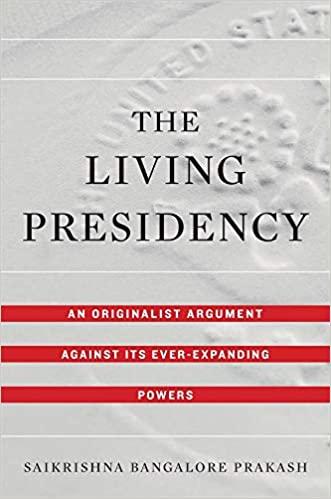
Among Prakash's articles are "50 States, 50 Attorneys General and 50 Approaches to the Duty to Defend," published in the Yale Law Journal; "The Imbecilic Executive," published in the Virginia Law Review; and "The Sweeping Domestic War Powers of Congress," published in the Michigan Law Review. He is the author of The Living Presidency: An Originalist Argument against Its Ever-Expanding Powers and Imperial from the Beginning: The Constitution of the Original Executive.

Saikrishna Prakash News Feed

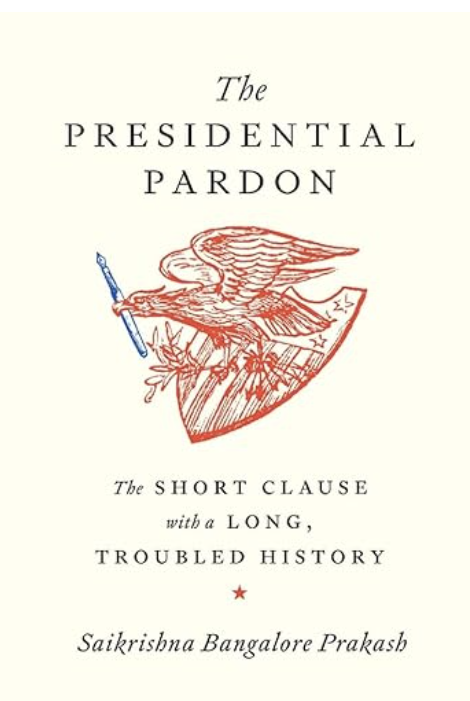
How did a short clause tucked in the middle of Article II of the Constitution become one of the most controversial powers of the modern presidency? This question is at the heart of a new book from Professor Saikrishna Prakash of the University of Virginia School of Law. In “The Presidential Pardon: The Short Clause with a Long, Troubled History,” Prakash chronicles how the pardon has been transformed in recent years.
Saikrishna Prakash UVA Law
Many originalists and textualists disdain the consideration of consequences to determine a law’s meaning. Yet interpreters have long weighed consequences, particularly inconvenient ones, to decode the law. In the eighteenth century, the argumentum ab inconvenienti—the claim that a reading of the law was mistaken due to its adverse consequences—was a familiar technique, perhaps almost as common as an argument grounded on the letter of the law. This Article excavates the remarkably widespread invocation of consequences to defeat opposing readings and to decipher a law’s meaning. Commentators, including William Blackstone and Justice Joseph Story, discussed the practice, and legislators, executives, and judges regularly utilized it. The practice was scarcely controversial, as there seems to have been no one at the Founding who highlighted its drawbacks, much less rejected it. Instead, the likes of Chief Justice John Marshall, Alexander Hamilton, and James Madison invoked consequences to fix the meaning of federal and state law. What is an epithet today—result-oriented—was almost an apt description of the practices of the era. These rather unexpected findings have moved me to reconsider—and ultimately abandon—my prior conviction that interpreters have no business considering consequences.
Saikrishna Prakash Stanford Law Review
The Supreme Court should extricate us from this misreading of the International Emergency Economic Powers Act and the burgeoning rule by executive fiat.
Saikrishna Prakash The Hill
Prakash describes how and why radical constitutional change occurs and the vertigo that it precipitates.
Saikrishna Prakash Virginia Law Review
UVA’s nonpartisan Miller Center of Public Affairs convenes presidential experts—dozens of leading Democrats and Republicans, scholars from across the country, and top journalists—for the second biennial Conference on the American Presidency, a series of constructive conversations about the modern presidency.
Guian McKee, Rachel Potter, Andrew Rudalevige, William Antholis, Alexander Bick, Everett Eissenstat, Mara Rudman, Sarah Wilson, Sidney Milkis, Louisa Terrell, Ashley Deeks, Eric Edelman, Saikrishna Prakash, Russell Riley, Allan Stam, and Philip Zelikow Miller Center Presents
In her new book, Making the Presidency: John Adams and the Precedents that Forged the Republic, Lindsay Chervinsky explores how John Adams defended essential political norms, including the peaceful transfer of power. Chervinsky joins Miller Center Faculty Senior Fellow Sai Prakash to discuss how the Constitution and the presidency were shaped by the demands of the times and how both continue to evolve.
Lindsay Chervinsky, Saikrishna Prakash, William Antholis Miller Center Presents