Experts

Todd Sechser

Fast Facts

  • Professor of politics and public policy at the University of Virginia
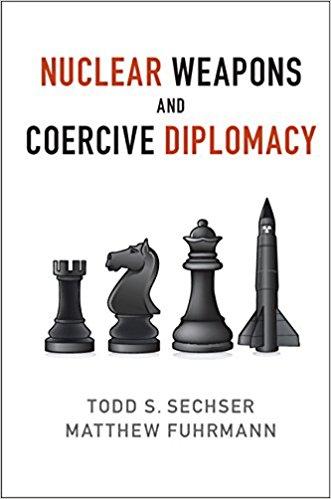
  • Coauthor of Nuclear Weapons and Coercive Diplomacy
  • Nonresident scholar, Nuclear Policy Program, Carnegie Endowment for International Peace
  • Expertise in international relations, foreign policy, nuclear security, emerging technologies

Areas Of Expertise

  • Foreign Affairs
  • American Defense and Security
  • War and Terrorism
  • World Happenings

Todd S. Sechser is professor of politics and a faculty senior fellow at the Miller Center of Public Affairs at the University of Virginia. He is also a nonresident scholar in the Nuclear Policy Program at the Carnegie Endowment for International Peace. His research focuses on coercive diplomacy, nuclear security, emerging military technologies, and foreign policy.

Sechser is coauthor of Nuclear Weapons and Coercive Diplomacy (Cambridge University Press) and coeditor of Emerging Technologies and International Stability (Routledge). His work has appeared in the American Journal of Political Science, International Organization, International Studies Quarterly, Journal of Conflict Resolution, Journal of Experimental Psychology: Applied, and the Journal of Strategic Studies, among other journals, and his policy writing has been published in The Washington Post, The Wall Street Journal, Boston Globe, and other media venues. He previously directed the multi-university Program on Strategic Stability Evaluation, a nuclear strategy study group, and was the founding director of the UVA Karsh Institute’s Democratic Statecraft Lab.

Secher's research has been supported by the Carnegie Corporation of New York, the U.S. Air Force, and the Stanton Foundation, and he regularly consults for several government and military agencies.

Sechser was previously a Stanton Nuclear Security Fellow at the Council on Foreign Relations and a postdoctoral fellow at the Olin Institute for Strategic Studies at Harvard University. He received his PhD in political science from Stanford University, where his dissertation won the Walter Isard Award for the Best Dissertation in Peace Science. Before entering academia, Sechser worked as a nuclear policy analyst at the Carnegie Endowment for International Peace.

He has received multiple awards for teaching, including the All-University Teaching Award and the inaugural Cory Family Teaching Award. He currently directs the Politics Honors Program.

Todd Sechser News Feed

Co-author of the book “Nuclear Weapons and Coercive Diplomacy,” Todd Sechser is the Pamela Feinour Edmonds and Franklin S. Edmonds Jr. Discovery Professor of Politics and Public Policy and a senior fellow at the Miller Center. “The nuclear alert is an extraordinary escalation. But it suggests that Putin is running out of coercive options,” he said. “Russia has been turning up the pressure on Ukraine for years, and now it has launched a full-scale invasion.”
Todd Sechser UVA Today
Todd Sechser heads UVA’s Democratic Statecraft Lab, which addresses the problems posed by the twin challenges of authoritarianism and great power competition. “Democracy is at the heart of this conflict,” said Sechser, the Pamela Feinour Edmonds and Franklin S. Edmonds Jr. Discovery Professor of Politics. “Putin does not recognize the legitimacy of Ukraine’s democratic government, and it appears that regime change is a core objective of the invasion. The rivalry between Russia and the West is not only about power; it is about what form of government will prevail in the 21st century. This war is the clearest illustration of that struggle.”
Todd Sechser UVA Today
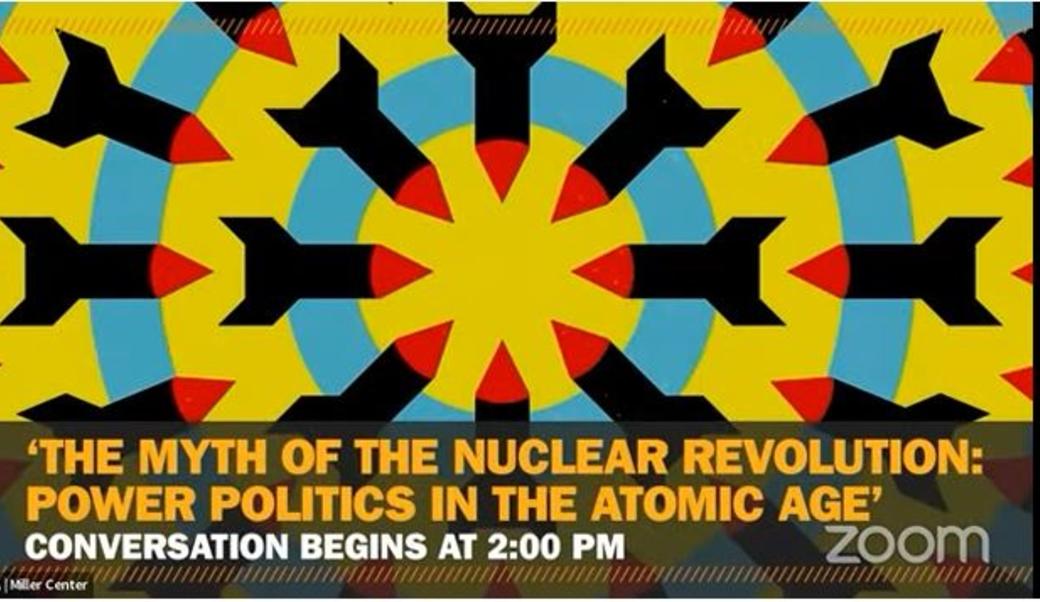
Keir A. Lieber and Daryl G. Press discuss their new book, The Myth of the Nuclear Revolution, which tackles the central puzzle of the nuclear age: the persistence of intense geopolitical competition in the shadow of nuclear weapons. They explain why the Cold War superpowers raced so feverishly against each other; why the creation of "mutual assured destruction" does not ensure peace; and why the rapid technological changes of the 21st century will weaken deterrence in hotspots around the world. Ultimately, Lieber and Press discover answers to critical questions: how much capability is required for a reliable nuclear deterrent, how conventional conflicts may become nuclear wars, and how to prevent new technology from ushering in an age of nuclear instability.
Todd Sechser Miller Center Presents
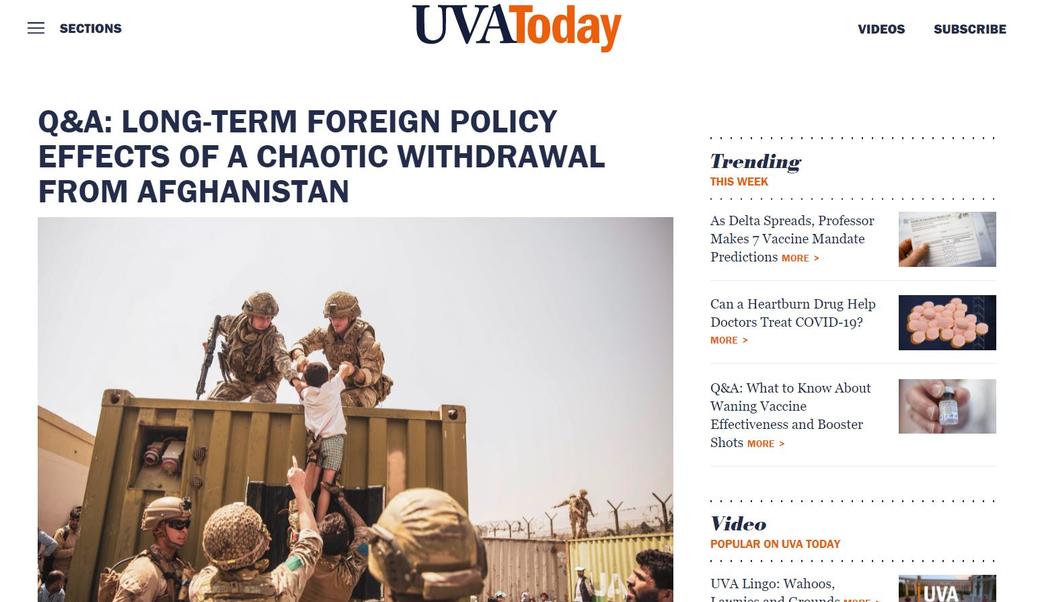
We asked three faculty members in the University of Virginia’s Democratic Statecraft Lab to weigh in on the geopolitical concerns. The Democratic Statecraft Lab is part of UVA’s Democracy Initiative and examines global threats to democracy, from the COVID-19 pandemic to the rise of authoritarian populism or instances of regime change like the Taliban’s takeover of Afghanistan. Politics professor Todd Sechser, who studies coercive diplomacy, nuclear security and political violence, directs the lab. He is joined here by politics professors Dale Copeland, who focuses on international relations theory, and John Owen, who studies American influence around the world and has written about political Islam. All three are also senior fellows at UVA's Miller Center of Public Affairs.
Todd Sechser UVA Today
Senior Fellow and UVA professor Todd Sechser discusses what needs to be done now about the Iran nuclear deal.
Todd Sechser News Radio WINA
A panel of experts examines the future of U.S. alliances, issues related to NATO, and whether NATO can serve as a model for other alliance networks in the future. As America’s foreign policy landscape continues to evolve in response to China, Russia, and other challenges, the panel will place current events in the context of the Biden administration’s likely vision of America’s role in the world.
Todd Sechser Miller Center Presents