Transcript
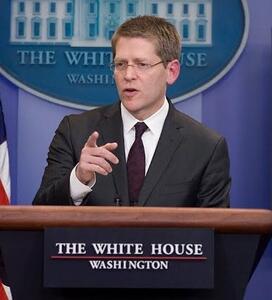
Barbara A. Perry
We will officially begin now. We usually do that by saying welcome, in this case, to Jay Carney for the Barack Obama presidential oral history project at the Miller Center at UVA [University of Virginia]. Paul [Freedman] has the first question on Carney One, Carney Two, and then we’ll circle back to our usual beginning.
Paul Freedman
This seems like a fitting opening question. Tell us, if you will, about “Carney One” and “Carney Two.”
Jay Carney
After I became press secretary—I don’t think it was prior to that, when I was working for the vice president—I relied heavily on the Navy mess for my caffeine intake. I would get, in the morning, basically a full cup of coffee with a couple of shots of espresso, a large one. My assistant would always get that for me when I was coming in at 7:00, or whatever, 7:15. Then in the afternoon, before the briefing usually, there was the Carney Two. Carney Two was essentially four shots of espresso but two regular, two decaf because I didn’t want to go crazy. And then mostly foam on top. The men and women in the mess, they were all rotating Navy people. Every 6 or 8 or 10 months, somebody new would come in. To keep it straight, they just posted it next to the machine —Carney One and Carney Two, with instructions so they didn’t have to learn it again and again.
Perry
Let’s go to the beginning. You were just telling us about your recent move to Virginia, where you did spend a good deal of time as a youngster, but you said you were born in Georgetown?
Carney
I was born at the Georgetown Hospital in D.C. My father was a foreign service officer and a native Virginian from Norfolk. He was stationed in D.C. at the time, so I happened to be born there. My sister, who’s a year older, was born in Germany, where he had been stationed. He quit the State Department, quit the Foreign Service maybe three years after I was born, so he never got reposted. Hence, I grew up in the D.C. area. We lived in Northern Virginia, and I grew up mostly in McLean until I went away to school.
Perry
How about your mother?
Carney
My mother’s from New York, grew up in New York City. I guess they met at some mixer or something. My father went to Yale [University]. My mother was at Connecticut College. They split up when I was eight or nine. My mother was a lifelong Republican, my father a lifelong Democrat, my mother a New Yorker, my father a Virginian. But my mother was a New York Republican, and she moved, later in her life—she spent the last 15 years or 20 years in Charleston, South Carolina. In the 2008 election, because of me, she’d gotten to know John McCain reasonably well, met him a few times when she was up in D.C. I was pretty close to McCain, and she’d always been a Republican.
But in 2008, she voted for the first Democrat in her life, Barack Obama, not knowing I was going to go work for him—I didn’t know, either. Then when I went to work for him, she adopted the zeal of the convert. [laughter] She became the Obama tribune in Charleston, which—a liberal oasis within South Carolina context is no liberal oasis. Yes, she would stick up for me.
Perry
Your dad, being a Democrat from Virginia, was he a Southern Democrat?
Carney
No, he was relatively progressive. He was very progressive certainly for his time. Apparently—I never heard this much from him but from a friend, Al From. Do you know who Al From is?
Perry
Oh, sure, yes.
Carney
They were pals when I was little. According to Al, he and my father used to talk about how my father was going to run for office at some point here in Virginia as, again, within the Virginia Democratic Party in the 1960s, on a more progressive Democratic agenda. But my father—the 1970s hit him hard in a sense culturally. He grew a beard and grew his hair kind of long and wore puka-shell necklaces and basically didn’t change his attire until he passed away four years ago. He was actually a longtime management consultant who did a lot of great work through USAID [United States Agency for International Development] overseas, in Africa, Southeast Asia. But he lost his political interest pretty early, at least in terms of running for office himself.
Perry
Growing up, was there dinnertime conversation about politics?
Carney
Some. Not a ton that I recall. Growing up here, the Civil War was obviously something you learned a lot about and you were aware of very consciously. I remember, because my family on my father’s side was Virginian but liberal, feeling “hooray” for the Union side, and even when I had little toy soldiers, always picking the blues over the grays. [laughter] My grandfather, my father’s father, who lived his whole life in Norfolk, I remember hearing him say something pretty racist once, and my father yelling, getting angry at him and being really appalled that he had said it in front of me. I don’t know if my brother and sister were there. So there was some of that kind of politics.
The one thing I do remember growing up in McLean, I have an early memory of discovering, beside a curb in my neighborhood, what was I guess either an eight-track or maybe cassette tape—this was in ’73 or ’74, I’ll try to get my year right—and bringing it home and telling my mother, “Maybe this is the missing seven minutes.” [laughter] So I was conscious of the hearings and vaguely about Watergate. Even though my mother was Republican, [I remember] both of them sort of being disgusted with [Richard M.] Nixon. But it didn’t change my mother’s voting patterns, again, until 2008.
Mike Nelson
You were born in ’65, ’66?
Carney
May of ’65, yes.
Nelson
So you were precocious if you were watching Watergate hearings at that age.
Carney
Watching may be overstating it, but I was aware of it. And probably aware of it just because I would hear my parents talk about it. I don’t know. I also remember a Nixon bumper sticker on a stop sign in my neighborhood that somebody had crossed out. That was in McLean. But that’s all really I remember.
Russell Riley
Did you say you had older siblings?
Carney
I have an older sister and a younger brother, four years younger. My sister’s a year older.
Perry
And you said she was born in Germany because your dad was still in the foreign service.
Carney
Yes, in Bremerhaven. He was, I guess, in the consulate in Bremerhaven.
Perry
And then you said he did a lot of work as a consultant with USAID. Growing up, was there an international component? Did you all travel?
Carney
We didn’t travel. I never left the country until I was in college. I never left the East Coast until I was in college. But he would travel a lot. My parents split up, and both my siblings and I went back and forth [between them]. I didn’t live with my father very often after eighth grade, but he was always overseas a lot for work. I remember the Philippines a lot, various parts of sub-Saharan Africa, some other spots. He did a lot of interesting development work. He did a lot of wildlife management work in, I think, Botswana and Kenya. He loved what he did. It wasn’t highly compensated, but it was meaningful to him.
Nelson
When did you decide you wanted to be a reporter?
Carney
I had pretensions in high school of being a writer. I had an uncle, actually a UVA grad, Henry [S.] Taylor, who won the Pulitzer [Prize] for poetry in 1986. He was married to my father’s sister, and I was close to them. I remember talking to him then. I thought I was a writer. I did a little journalism in high school. I remember talking to him after I was accepted into college, spring of my senior year in high school, and talking to Henry about whether—I had a girlfriend from Northern Virginia, she was going to UVA, but we were both talking about taking a gap year, which was very rare back then—I talked to my uncle about whether he would teach me how to write, maybe give me sort of a seminar in writing, which my parents thought was crazy, so I didn’t do that.
Then I got to college and started doing magazine journalism. Not the Yale Daily News but a thing called The New Journal and longer-form journalism. And concurrently and serendipitously I started studying Russian, which was odd because—I ended up being a Russian Studies major, but I didn’t take any Russian until the summer after my freshman year, which was late because, in order to be a Russian Studies major, I needed four college years of Russian language study. So I took an intensive first-year course at Columbia [University] in the summer over eight weeks while I was waiting tables and then intensive second- and third-year my sophomore year in college. So, three years of college Russian in 12 months. And I’d never been. That class was really hard.
I got interested in that because I was interested in the Soviet Union and détente. I had read [Fyodor] Dostoevsky and thought he was really cool and then also got really interested in the Soviet Union. The reason why the threads come together is at some point when I was in college, probably because of [Mikhail] Gorbachev, I can remember I was—I digress now, I said earlier that the first time I ever left the East Coast was when I was in college. One of my best friends from college, we went out on spring break my sophomore year to California. He was from the [San Francisco] Bay Area. His father was a professor at [University of California] Berkeley.
I remember going to the bus stop one morning and seeing—I’m sure it was the [San Francisco] Chronicle but maybe the [San Francisco] Examiner –the front page with a big story about Gorbachev being appointed the new general secretary. Later I got to thank Gorbachev for [laughter] everything he did for me personally because that’s when the place got really exciting.
I can remember early on, when I started studying Russian in college, a friend of mine who was very cool and artsy telling me, “Why are you studying Russian? Why are you interested in the Soviet Union? It’s so boring. Nothing ever changes there.” Then, of course, everything started to change dramatically. Sometime in there, maybe my junior year, I thought, Well, I don’t know what I’m going to do with my life. I’m kind of a journalist, and I really want to go to the Soviet Union. I want to go be a reporter there. Coming out of college, that was my idea.
Riley
At this point, are you considering yourself a Democrat or a Republican?
Carney
Yes, I was a Democrat. My first election was ’84. I voted for [Walter] Mondale.
Riley
Because there’s a lot of [Ronald] Reagan Republicanism deeply intertwined with Russian developments at that point, at least by the Republican Party.
Carney
Sure. My views of the Soviet Union and the Cold War and détente—they were kind of disassociated from politics at home. It was more fascination—I had taken a class in high school called “Cold War and Détente,” an elective my senior year, and thought that was interesting, the history of it. And then the literature, and I was just interested in the place and its peculiarity as a country, as a people because of its unsure identity as whether they’re European or Asian or just Russian and special, which is the mostly dominant self-identity. I was fascinated by the explosion of literary accomplishment and musical accomplishment without really a renaissance.
That interested me, but it wasn’t really about politics at the time. I probably had a notion that we, in the Reagan years—I’m sure I did, that saber-rattling and risking nuclear war was a bad idea and that some attempt at cohabitation and reconciliation was worthwhile. But I never had any illusions about the system. I never grew up thinking, It’s being misrepresented. It was pretty clear to me even from afar that it was oppressive. Of course, when I got there, sure enough it was.
I was pretty liberal politically for the time. One of the things I did in college that was kind of defining: there was a pink-collar workers strike at Yale my sophomore year. In solidarity, all the dining hall workers went out on strike too, so basically the campus was in chaos. We all got rebate checks for our dining hall meal plans—we had to use that money to eat in the local establishments. $72.80 a week. I had a friend who ate only hot dogs for months and months and saved a bunch of money.
I remember it was not very popular, the strike, because it was so disruptive, but I was out there with some friends on the picket lines. I felt connected to that, that these people are getting a raw deal and we should be out there supporting them. We’re all privileged and take them for granted. I remember being out there with only a few other students marching around singing “We Shall Overcome.” [laughter]
Perry
Did you write a senior thesis?
Carney
Yes. This is something that was more a happy coincidence than incredible foresight or wisdom. My senior thesis was a comparison between the “Thaw” under [Nikita] Khrushchev and what was happening contemporaneously under Gorbachev. Perestroika and Glasnost were just getting underway. I remember, at that time, the Russia scholars or Soviet scholars at Yale were very old guard—they thought the Soviet system was immutable and were pretty dismissive of Gorbachev.
I asked a young guy in the political science department, Peter Hauslohner, to be my advisor because he actually bought that what was happening under Gorbachev was significant. Ironically, he left Yale. He was an associate professor. He ended up, not that many years later, being an advisor joining the State Department—the Policy Planning Council, I think—under Bush senior [George H. W. Bush], and being an advisor to—
Riley
[James A.] Jim Baker [III]?
Carney
No, to the ambassador, the guy who—
Perry
[Thomas R.] Pickering?
Carney
No, after [Jack F.] Matlock [Jr.]. [Robert S.] Bob Strauss, whom Bush appointed, who literally arrived in Moscow a few weeks before the coup [d’état]. My old professor, Peter Hauslohner, was his political advisor. And I was there, too. It was fascinating.
Nelson
The long-form stuff you were writing as a student, did any of it involve reporting?
Carney
Yes.
Nelson
Interviews or anything?
Carney
No, it wasn’t just thumb-sucking. [laughter] In fact, it was aggressively reporting-based. The New Journal, which to this day is a pretty impressive publication. Hampton Sides wrote for The New Journal. Also Rich Blow [Richard Bradley], who then changed his name after he wrote a book. He was the editor of George magazine for a while and then got in trouble with the Kennedy family after John [F.] Kennedy [Jr.] died, changed his name. Anne Applebaum was there, a year or two ahead of me. James Bennet was the year behind me. There were a number of good people at The New Journal, and its focus was real reporting, at length, either on New Haven or on Yale. I had stories about both. Not that many because they were long and took a long time, but I ended up being the managing editor my last year.
Nelson
Did you think of yourself as sort of newspaper bound or magazine?
Carney
No, I thought magazine writing was more erudite, I guess. What was interesting, I had this idea, which may be unfair, that at that time in college, the Daily News was one of those places you went to pad your résumé to help you get into law school. A lot of folks never went into journalism who worked at the Daily News. It’s not, obviously, that simple. Jacob Weisberg was there a year ahead of me and had been at the Daily News. [Abigail] Abi Pogrebin, I think, was my year and was at the Daily News. So, it wasn’t universally true, but I think more of the folks at The New Journal actually did some journalism after college.
Very fortunately, I applied for and got an internship, a Time Inc. internship, for the summer between my junior and senior year in New York. It was one of those things that I’m not sure exists anymore, where a Yale student always got one of the internships, one of the spots. So, it was basically a competition within Yale for who would be put forward. I don’t even remember the process. We had to submit stuff, and I don’t know who ran it at Yale to submit to Time Inc. There was that one and then there was the American Society of Newspaper Editors internship.
Robin Pogrebin, sorry, not Abi. Both of the twins went to Yale and were classmates of mine, but Robin was at the Daily News, maybe they both were. Anyway, Robin, whom I saw not that long ago, came in first for both internships, and I came in second. [laughter] I got second place for both. She chose the ASNE [American Society of Newspaper Editors] one, and so I got the Time one.
The internship was for all of Time Inc.—including Fortune and Sports Illustrated and People—and there were only a handful of us from different schools. It wasn’t clear where I would land. But on the first day, I sit down at the intern lunch next to somebody who I think is another intern, a young-looking guy, and it turns out it’s Walter Isaacson. [laughter] And he’s the Nation section editor at Time. We start talking and he says, “I need some help in the Nation section, so you should come work for me.” He’s been a friend and mentor ever since. That’s how I had the Time connection coming out of college. That summer was amazing—I got to write, get my byline in Time magazine, I wrote several stories. They sent me on this Mississippi Peace Cruise down the Mississippi River on the Delta Queen with a Soviet delegation and this group of American peace activists, and I got to write—
Perry
Starting where?
Carney
I got on in La Crosse, Wisconsin, and got off in Des Moines, but it went on from there.—
Perry
All the way to New Orleans?
Carney
I forget how far they were going. Maybe St. Louis. I only stayed on for a couple days because I had to write the story. I should dig it up. It was one of those they had in the front of the magazine, this feature called “American Scene.”
Interestingly enough, I’m still friends with somebody I met on that trip, a Russian translator. He was the translator for that trip. Dimitri Agratchev. There also was a cosmonaut and a milkmaid. It was a crazy—
Jennifer Lawless
It sounds like a joke. [laughter]
Perry
Yes, they go into a bar.
Carney
Georgy Grechko, I think was his name, was the cosmonaut. He was incredibly jovial. But Dimitri and I—his English was beautiful and my Russian was so-so—we were playing Scrabble one night on the boat. I put this in the story, this moment in the Scrabble game when he says, “It’s not a nice word, but I’ll use it,” and he puts the letters down for “purge.” If you know anything about [Joseph] Stalin and the purges [Great Purge], you know how meaningful that word is for him. I put that in the story, and later he said doing that was risky for him. I remember him telling me. He was worried he’d get in trouble.
His story is amazing because he was an incredibly talented linguist and went up through the Institute of Foreign Language, or whatever it’s called, in Moscow. But he was Jewish and never got the top jobs, and so he ended up doing assignments like that [cruise]. Not that long later, when I was living in Moscow, he met Michael Eisner and was his translator when Eisner was the CEO [chief executive officer] of Disney visiting Moscow. And then Dimitri ended up working for Disney for years, immigrated with his wife. He lived in Vienna for a while, working for the UN. I was supposed to see him if I was going to come to New York this week, but he lives in California. Yes, it’s an amazing story.
Lawless
What was the first story that you wrote, whether at Yale or at Time, where you felt like, Oh, I’m an actual reporter, I’m good at this?
Carney
Probably that one. I had a few bylines—which was a big deal because there weren’t that many bylines, especially in magazines back then—that summer. That was the one that I thought was pretty cool and I liked. There are so many stories that I wrote that I couldn’t bear to read. That one, I haven’t read it in a long time, but I think it holds up. It was pretty good. There are just a handful of those, honestly.
Nelson
This was such a great age for magazines, and I wonder, were there magazines or magazine writers that you aspired to be, to end up with?
Carney
James [R.] Agee was my—he had written at Time and Fortune, beautiful, just the grace of the writing and the storytelling. I remember thinking of him. I’m still a magazine reader. I was looking at one of my interviews, and I remember mentioning what was true back then [when I was in the White House] is that Barack Obama—I remember thinking he was the last mass consumer of highbrow magazines in print form. He would just cruise through all these magazines when we were flying. I don’t know what drew me to it, but it’s like the formula of a newspaper lead always left me a little cold.
So going back to my story. I go back to college after my internship. It’s senior year. I’m trying to figure out what I’m going to do. I remember reaching out to Walter. I don’t know if it was a phone call or letter, or maybe I was in New York and I came to see him and some others. And he’s like, “Oh, sorry, we don’t hire anybody out of college. You should go get newspaper experience.” I took him very seriously. Years later, he said I was the only one who ever listened to him. [laughter] I applied for this position you could get at the Miami Herald. You had to have graduated. It was basically a 12-week apprenticeship, and if they liked you, you got the full-time job, which I did. So that’s how I ended up at the Herald.
But I always wanted, the whole time I was at the Herald—I wrote something like 300 stories in 11 months. It was crazy, a crash course in newspaper writing. Some of them were 8-inch things straight out of the police blotter. I learned a lot very quickly there, but I really—things were happening in the Soviet Union, and I was telling myself, I’ve got to go, I’ve got to go. I remember writing letters to and sending clips to different news organizations—the AP [Associated Press], New York Times, others. But I had the Time connection, and they hired me. It was very serendipitous. They needed somebody in Miami because they had just lost their Miami bureau chief, back when they had Miami bureau, but they knew they wanted to send me to Moscow eventually.
Perry
So off you go, and that’s in ’88?
Carney
I started in December of ’88 for Time as Miami bureau chief. The summer of ’89 they sent me to Moscow to fill in for somebody in the bureau. I spent the summer of ’89 there, was back in Miami for Time in the fall of ’89, and then I moved to Moscow full-time in May of ’90 and lived there for three years.
Perry
What was that like? Tell us.
Carney
I don’t think you have the time. [laughter]
Perry
Oh, yes, we do.
Carney
One incredibly cool thing about the Miami job is—you guys all remember when Gorbachev visited Washington. On that trip, I think that was the same trip where he went to see [Fidel] Castro in Cuba, and I got to go. Castro let in American journalists. I was Miami based, so I got to go. It was an incredible trip. That was the first time I ever saw Gorbachev in person. I got to meet Castro, Fidel. It was this crazy few days where we go to Havana on this charter, these journalists. They let us in. At the time, Gorbachev was probably, after Michael Jackson, the most famous person in the world and was a rock star. He was coming to tell Castro that the USSR was cutting him off.
Castro, because Gorbachev was on the island, let all of the human rights activists do what they wanted to do, including meet with reporters. I remember there was a press conference on the rooftop of an apartment building in Havana, and we foreign journalists all went there that evening. I remember at the bottom, on the street, some really thuggish-looking people milling around. I’m sure they were secret police. Going up to the rooftop, and there were these human rights activists who were not asking for much. They weren’t saying, End communism. Bring democracy. We love America. Not at all. Their demands were pretty minimal. They wanted Castro to emulate Gorbachev.
What I remember about that is the week after we all left, the activists were all arrested and some of them were in jail for the rest of their lives. Elizardo Sánchez was the most famous one. But I remember on that trip—and I brought some friend I had made in the American press corps with me—going to the Soviet Embassy and just knocking on the door, figuring, this was a day or two before Gorbachev arrived, They probably know what’s going on. They actually let us in, and I sat down with them. I’m sure they were KGB [Soviet Committee for State Security] but one had the title of political director at the embassy. They were surprisingly frank. They intimated that the days of the Soviet Union propping up Castro were over because it was financially not feasible anymore. And that’s sure enough what happened.
It was an incredible time. Moscow, every day was history then. It was shocking. Every time you went to a rally, or when I would go to the Baltics, which was often—the forward-leaning republics where they were really testing the limits. It was unbelievably exciting. You felt anything could happen, and it did. I had a great extended run in journalism, but there was nothing quite like that again. Washington and political coverage and policy coverage is so incremental and it’s so hypercompetitive, and everybody would fight like, “Who had that anecdote?” It’s very challenging. But when you get to write about an epic change like we saw happening in the Soviet Union, and you get to do it in broad strokes, try to explain it and talk about it, you don’t get that opportunity very often. It was super exciting.
Perry
So you’re getting there, summer of ’89, Tiananmen Square is happening on the other side of the world and in the communist world. What are you hearing from the person in the street?
Carney
It depended on where. Mostly still in ’89, Gorbachev was still—he was never super popular, mostly because of his anti-alcohol campaign, which Russians really resented. In the cities, there was a lot of excitement among younger people, a lot of excitement that things were liberalizing. Art was changing. There was independence in the newspapers. People weren’t being sent to jail. But in the rural countryside and provincial cities, it was still very conservative.
Perry
In what way?
Carney
Conservative in the sense that the serious instability hadn’t happened yet, but the fear of instability and the sudden change made a lot of people nervous, a lot of pensioners and things, understandably, especially when you see what happened. Then in the republics—
Perry
Jay, was that for fear of the instability of the loss of this controlled economy and social guarantees?
Carney
I remember I wrote—this was later, I think it was in ’93, so after the Soviet Union had collapsed but during those sort of wild years, maybe it was late ’92 or early ’93—I wrote this story, probably my favorite story I ever wrote for Time, about this taxi driver and just riding around the city with him. You could sit in the front because everything was basically operated on a barter economy then. You sat in the front and nobody cared, and passengers would get in the cab and they’d start talking. It was stories, conversations that he had with his fares. There was so much inflation, and the meter was meaningless. He negotiated a fare every time he pulled over. Basically every car in Moscow at the time became a taxi, even though his was actually a taxi.
This would happen a lot. Once he gave a ride to an older couple. They had come from a funeral, and he gave them a break on the price. The person they had gone to the funeral for had fought in the Great War, and then they started complaining bitterly about what was happening in Russia. I think I quoted him, but from memory it was like, “Under [Leonid] Brezhnev there were three types of cheese in the store. Now there’s not even one.”
So there was that kind of sentiment, and there was, I think, a lot of frustration and anger about the diminishment of the sense of themselves as a major player in the world, as an important country, a superpower—the price that Russians and other Soviet citizens had paid for superpower status was so high. The idea that it was all collapsing, I think, was hard for a lot of people to take, especially older Russians. You began to see the seeds of that as I was leaving in ’92, ’93.
The first time I met Vladimir Putin, in ’91 or ‘92, I had no idea. He was an aide to Anatoly Sobchak, who was the first-ever democratically elected mayor of what was still then Leningrad. Sobchak was a very pro-Western, pro-democracy activist. He and Gavriil Popov, who was the mayor of Moscow, were like twins in that sense in those early years. And Putin was in this room. I never thought twice about him except later when he rose on the national scene. But he was novel because it was pointed out by somebody—it might have been Sobchak—that he had been a former top guy for the KGB in Leningrad.
I remember Putin said nothing. It was unremarkable because I was there with some other reporters to interview Sobchak. Later, when he rose on the scene as [Boris] Yeltsin’s handpicked successor, my first instinct was to think, Well, he can’t be terrible because he was a Sobchak guy. Sobchak, to his dying days, was a pro-Western, pro-democracy activist. I couldn’t have been more wrong about that. Yes, those were unbelievable years.
Nelson
A couple of semi-related questions. What did American politics look like from the vantage point of Moscow?
Carney
In ’92, I saw Reagan speak—I had never seen him before. I think he came to Moscow, I want to say—I could be wrong about this—one of the last times he spoke in public, when I was there sometime before I left in ’93, and I heard him speak. I guess to answer your question, I remember in ’92—Strauss arrives, Bob Strauss, whom I had never met but we instantly hit it off. He’s a fantastic guy, just wonderful. Back then—this is pre-9/11 [September 11 attacks]—reporters, the American community in Moscow was small enough that we had passes into the [U.S.] embassy.
We could go into the embassy and eat in the cafeteria, which was a salvation, and was not that far from the Time bureau. I would go in a lot, and I would see Strauss. We would sit down, and we had the old rolls of paper that the wires would print out on. I would bring these stories and all this polling data that would spit out from the AP. We would sit and go over the polls and the ’92 election and talk about [William J.] Clinton. We thought he was great. That was fun. But that’s all I remember about it, being excited that Clinton had won. Even though I didn’t dislike [George H. W.] Bush, I was enamored with the idea of a younger president. And that the Democrats had figured out this formula, nominating a southerner who was going to be more centrist.
Nelson
Was there an expectation that you’d be reassigned to Washington from Moscow?
Carney
I mean, my expectation, yes. It was pretty exhausting, Moscow. Even though I was young, so I didn’t really have an excuse. We were still only a weekly—but we were just wrung out, this small bureau with basically three of us. Every week we had to write about such a big story, and then suddenly the focus and interest level just dropped. By ’93, the tension was moving to American politics. There was a sort of exhaustion with foreign affairs after the first Iraq War, the collapse of the Soviet Union, everything that happened in Eastern Europe. And then there was what turned out to be a pretty mild recession.
So there wasn’t that sort of intensity anymore by ‘93, and I was getting antsy. The next thing, obviously, seemed to be Washington. That’s the next thing you do. So, yes, I had asked the editors if I could be sent to D.C., and they said yes. I ended up arriving into what was a big bureau back then. I was put half-time on the White House and half-time on Congress when I first got there. Although my first story from the Washington bureau was on Marion Barry’s redemption campaign, which he won.
Perry
Tell us about the start here in Washington covering the White House and Congress.
Carney
I didn’t know what I was doing. I made the mistake that a lot of reporters make, as a result of the hyperfocus on the White House that’s just increased over the years, of being more drawn to the White House than Congress. I pretty quickly ended up being full time on the Clinton White House. I probably would’ve been a better reporter if I’d spent more time in Congress first because that’s actually where people talked, and you could learn a lot about the White House if you spent more time focused on Congress. But I was very excited. I got there a few months before Vince [W.] Foster [Jr.] killed himself, and so it was at the beginning of what became a long-running, dark current in politics and political coverage, with all the scandals and the sinister nature of some of the opposition.
Perry
He killed himself in summer of ’93.
Carney
Yes. I literally got there in May, so it was a few weeks after I clocked in for the first time in the Washington bureau. I remember driving out to Fort Marcy Park, which I’d known from growing up, with a colleague of mine to look around, like we were going to find anything. That began what was the whirlwind of covering that era of politics and the [Newt] Gingrich Congress and—what seems quaint in terms of its tameness now.
Lawless
Around the Vince Foster death, did you get a sense that this was the beginning of conspiracy theories, or did it just seem like a one-off and this is a weird way that people are talking?
Carney
I didn’t have some sort of foreboding, although—I remember the “Troopergate” stuff. I remember thinking it was pretty sordid and disappointing. And this is not to exonerate Clinton but just that our politics had gotten so small. It was a big contrast from what I had come from in terms of the kind of coverage we did in Russia and how you were trying to advance the ball. There was that. I went off the White House beat for a while and focused on Congress. It was only briefly, probably against my will, although it turned out to be great, covering the Gingrich Congress, and I developed a relationship with John Boehner, who was in the leadership.
I used to smoke back then, and the two of us used to crush butts together, and he would fill me in on what was happening in that crazy time in ’95, ’96, after Gingrich became speaker. It was all very interesting, but it was just kind of tawdry. I look back on it—and I’m not the only one who thinks this—Gingrich really represents, I think, the tipping point that led to [Donald J.] Trump in many ways. Because with him everything was slash and burn, everything was histrionic, everything was turned up to 11.
Nelson
One of the things you said in the Charlie Rose interview was that White House reporters know maybe 15 to 20 percent of what’s actually going on. Having been a White House reporter, having been on the other side, what’s in that 15 to 20 percent, and what’s in the 80 percent they don’t know?
Carney
Part of it is just volume. When you’re a reporter and there’s whatever the focus of the day or the week or the month is, you think that everybody that you might call or were lucky enough to have as a source would be clued into that. But White Houses, it’s the top level of a big executive branch that runs a lot of things. There’s a lot of work that goes on that I don’t think reporters are aware of or think about or concentrate on. I also re-read that interview, and I was like, I still think that. [laughter]
There’s the assumption that everything is sort of crassly political. I think that was an assumption I made as a reporter, partly because it’s easy to make it, when I was covering both the Clinton and the [George W.] Bush White Houses, with obvious exceptions around 9/11 and other things.
One of the things I said there, which is true too, is that it’s just so easy to cover politics as opposed to policy—we all, as reporters, found ourselves taking the easy way out and framing things around what it meant for the next election—or who was up, who was down. Of course these decisions weren’t made in a vacuum that never took into consideration politics. But what I learned on the inside—I do think it was true of White Houses before the one I worked in, I know it was—is that most times, on serious matters, politics wasn’t the top issue. Politics wasn’t driving everything in the way that, I think, reporters always think it is, and all of that just got worse as time passed, I thought.
And then I got to be on the receiving end. It was almost just desserts because I do look back and, having learned what I learned about covering a president, once I went into the White House as a staffer, there was part of me that thought, God, I wish I could go back and do it again because I’d be better at it now. I’d be less reactive and would resist the temptation to cover the same stupid thing that everybody else is covering that we would all hype and then forget about.
Nelson
I’m guessing that back then, Time and other major news organizations had reporters at the Pentagon and State and so on. Now, from one of your comments, everything falls on the White House reporter to cover the entire executive branch, which makes it even harder.
Carney
Right. It’s not universally true. I think the major organizations, a handful of them still have congressional reporters and Pentagon reporters and State Department reporters, but it’s fewer than ever. With the exception of those handful of news organizations, not only is everything run through the lens that the White House reporter applies to it, but that White House reporter is often 25 [years old] and could be brilliant but can only know so much. I know I didn’t know anything when I was 25 when I got there, or however old I was [28]. It’s hard to feel old when you’re only in your forties. You would make some reference to a recent political event and there would be this blank look, and you’re like, Oh, my God. It’s not their fault. Somebody offers you that job, you’re going to take it. But it has made the coverage even more superficial.
Riley
I have a question for you. It occurs to me, listening to you talk, that you’re also in Washington, where the media environment is changing dramatically. We talk a lot about with people who will understand that from the White House perspective, but I don’t recall ever interviewing somebody who’s been on the journalism side of this. How is that manifesting itself to you? I’m thinking of all of the developments. The particular instance that comes to mind is the Matt Drudge thing.
Carney
Oh yes, that’s a great example.
Riley
Is that a factor? Are you recognizing it in real time?
Carney
As a reporter, yes. It was exciting because in those early years, notwithstanding Drudge and the way he played it, there was this excitement around the idea of this medium that could democratize information. At Time—we’re not the first, but we’re relatively early given that it was such a traditional publication—we launched a blog called Swampland. It was me, I think John [F.] Dickerson, Ana Marie Cox, and Mike Allen. I hired Mike Allen away from The Washington Post. A number of years later, he came to me and said he was going to go do this thing called Politico. John [F.] Harris and Jim VandeHei and Mike actually tried to—I talked to Rick Stengel about it. First, they tried to get the Post to own them and fund it. Post said no. Then they tried to get Time to do it. Rick said no, and I’m sure he regrets that.
The irony is, when I got Mike to come from the Post, he came to Time magazine because he wanted to be a magazine writer. So, when we started the blog, he was kind of resistant to the idea of this short form, which turned out to be his great strength. Anyway, he’s still a great friend and amazing guy. I remember thinking about the blog, This is kind of stupid and just also really risky. Even then, you would get incredible blowback—you were sort of encouraged to be attitudinal by your editors and to make it relevant and edgy. Ana was an expert at that already, and so she would lead the way in pushing the envelope for us.
But I was such an old-school reporter that I was uncomfortable with it. Then when I did do it and thought I’d written something clever, I got a lot of pushback. It was a bracing experience and only early days. In retrospect, you could see where it was headed, which was you got much more reward for that kind of thing than for the more substantive work.
Riley
Reward in?
Carney
Just attention. Another thing is—and this is pre-internet—I would toil away, like a lot of my colleagues in print, and write all these stories I thought were great and probably nobody read. I learned very early on that the way to develop recognition in Washington and also to develop sources, most importantly, was to go on TV. I was a young reporter. It was in my first few years, in ’93, ’94, I would do C-SPAN or whatever. John [E.] McLaughlin saw me on something, maybe local news. I don’t remember what it was, because Time wanted us to do TV to get Time in the mix.
We would do these TV hits, and then McLaughlin saw me and called me up and asked me to start doing his show, The McLaughlin Group. I did that off and on for a long time. I barely survived it. That was always a balancing act for me because I was not an advocate. It was really, really hard to navigate that and not be anything but boring, which I’m sure I was. But what I found is once I started going on TV, suddenly members of Congress would talk to me, White House staffers would—it opened the doors for sourcing, sadly.
Riley
But it makes it more difficult for you to do the old style?
Carney
It makes it more difficult because you have to be so careful, and you inevitably fail in your effort to not be an advocate or partisan in an environment that really elevates and rewards partisanship. Also, it was negative because I think for a lot of us who were trying to do that, trying to not be accused of partisanship, the safe harbor was to just criticize both sides. That became a cheap out. Blaming both sides.
Nelson
I heard Walter Isaacson say once that the original sin was for news organizations to give it away for free.
Carney
To give news away for free, like their product?
Nelson
Their product.
Carney
Online?
Nelson
Yes.
Carney
Yes. You can see why they did because they’re wondering if anybody’s going to read this stuff, so they put it out there.
Freedman
Is it going to catch on?
Carney
That’s a classic marketing thing. You offer it for free, and then when you get folks interested you start charging. But he’s probably right. Who knows if the models could’ve been different? Remember early on, there were a lot more paywalls. People tried it. I know we did. But there were so many other interesting things you could do and get free that it didn’t seem sustainable.
Freedman
This is so exciting because if you think about it, you start your career as a journalist at this time when there are these world historic events and really these tectonic shifts, and then that is replicated in terms of the medium itself and the media and journalism landscape. You started out at the end of the old era but then were right there.
I want to, as we move along, maybe just put a marker because one of the things I hope we’ll talk about in a little bit is, once you get to the White House, how you negotiate this changing landscape in terms of these new media. And in particular, we forget that Barack Obama was our first Twitter President, and so I definitely want to hear more of that. But, Barbara, I don’t want to get us into the White House before we’re there.
Carney
I’ll tell you one story—I woke up on a Monday morning, August 18th or 19th of 1991, to a phone call actually from the same taxicab driver that I later wrote about. I had gotten to know him already. He was a former [Soviet] army veteran and not particularly educated but was wise in many ways. He called early in the morning. In Russian, “Jay, there’s been a coup. Gorbachev’s arrested.” I didn’t realize it was Artyom. I thought it was my colleague Yuri [Zarakhovich] who always played jokes. I was like, “Fuck you, you’re full of shit,” [laughter] and hung up. Not funny. But he called right back. He was serious.
Because Gorbachev went on vacation, John Cohen, the Time bureau chief, had also gone on vacation. So I was running the shop in the Time bureau. Artyom came. My girlfriend at the time was an American photographer. She had developed a working relationship with him, and he would drive her around. So he came to get her, and I got in my car. I was living in this crappy Khrushchev era apartment that was totally illegal. But back then when there was this influx of foreigners, they didn’t have space in official foreigner housing, so the authorities would let you live elsewhere even though there was no legal structure around it. You could rent an apartment, even though renting was illegal.
On this big avenue that would lead into the city from this concrete apartment building, I pulled out, and the street was clogged with tanks and APCs [armored personnel carriers], half of them breaking down, which was a sign of what was really happening. I’m driving into town to the bureau. I remember pounding the steering wheel of my Zhiguli station wagon, a real piece of crap. It was the main road that became Kutuzovsky Prospekt, where the bureau was, which ends at the river where the Ukraine Hotel is and right across from the Russian White House. If you keep going, the street takes you right into Red Square. I go to the bureau. [laughs] The reason why I’m telling this story is, it was Monday morning. We had a week to produce an issue of the magazine. There was no blog back then, nothing online.
There was a question about whether we would do a special issue, which happened once every four or five years at Time magazine. But we had a whole week. The whole thing, the coup, it began on Monday morning. And then it was over and done by Friday night when we were closing the magazine – perfect! [laughter] So on Monday morning, I knew I had time. I went to the bureau to check in. The Russian staff were terrified.
I remember Yuri Zarakhovich, he had a daughter who was in high school who was literally supposed to fly the next day on an exchange program in Atlanta. Her name was Masha. Yuri was terrified that she wouldn’t get out of the country because of the coup. But they hadn’t closed the airports because the coup plotters were all idiots. So I went to our petty cash drawer and gave Yuri all the cash we had, and he took Masha to Sheremetyevo [A.S. Pushkin International Airport] and bought her way onto a plane. My thinking was, Yuri’s not going to be any use to me if he doesn’t get his only child out of the country. So then he came back and he was amazing for the rest of the week.
Then I get in the car and drive down to Red Square and park not far from Red Square. I get to Red Square and it’s just tourists. Troops hadn’t arrived yet. It’s all mostly Soviet tourists at that point. It was still pretty early in the morning. I start asking people did they know what was happening, that Gorbachev had been arrested, and none of them knew what I was talking about. Then as I’m talking to them, these troops start filing in to Red Square. None of it is violent. A little later, I remember talking to some of these 18-year-old conscripts. They had no idea why they were there. They thought it was an exercise.
Freedman
Are you in touch with the embassy at this point? How concerned are you? Did you think, Oh my goodness, we have to get out?
Carney
No. This is August of ’91. In January I happened to be, because that’s where the action was, in Vilnius [Lithuania] when the troops moved in—that’s the first time I ever saw somebody killed, it was in Vilnius. Then I was in Riga [Latvia] literally a few nights later, when people were killed there. You always thought you were going to be rounded up, and it hadn’t happened. After I left Red Square, I went down to Manege [Manezhnaya Square], which is the square right next to Red Square, and there were all these troops lining up and all this activity, and people were wondering what the hell’s going on. There was the main Moscow telephone and telegraph building. I guess, in pre-modern coups, seizing the telegraph building is a priority, so they seize it. I follow them in there and they seize it.
Again, I remember that’s when I started interviewing the conscripts, and they had no idea what they were doing. And this guy who had seen me interviewing these young soldiers came up to me. He was wearing an oversized leather bomber jacket, and he pulls out his ID [identification] and flips it open. He’s KGB. I was thinking, Oh, I guess they’re rounding me up. Even though I’d been speaking Russian to the young soldiers, he spoke to me in very accented, broken English. He says, “I just want you to know that not all of my colleagues think this is a good idea.” That’s it. And then he walks away. But he had shown me his badge with his name, which I wrote down. Yes, it was crazy.
Freedman
This explains a lot because once you’ve been through this, probably the [press] gaggle [informal briefing by the White House press secretary] isn’t that scary. [laughter]
Carney
Actually, it’s funny. I hadn’t even thought about it in that sense. Later when I went into the corporate world, people wonder what you bring to this kind of thing. It’s not a lot, I guess, but one thing is you have a sense of what a real crisis is and what’s not and how to keep your calm.
Lawless
Thinking about the reporting and the fact that you had that whole week, and then looking at news cycles now, which aren’t even a cycle, it’s instantaneous. How do you reconcile that with the kind of information that we get nowadays? If you would’ve had to print that first day—I guess my question is, when you look at the news coming out of Ukraine, for example, how much of it are you like, That’s probably not what’s actually happening today. Maybe on Friday we’ll know what happened Monday.
Carney
It’s true. Especially in a breaking-news environment like when something dramatic is happening, we crave detail and information. We become pretty indiscriminate about what we take in, and we don’t necessarily run it through the filter of, This may not turn out to be true, because you don’t really know what’s going to turn out to be true or not. But so much I would’ve gotten wrong. I remember being a little frustrated that week that my colleagues at the Times and the Post and Financial Times, they were all writing about it, and I was just gathering reporting. I was grateful for that too. But it is true that you just don’t have any time for reflection, and worse, you don’t even check your facts. It’s not like I didn’t get anything wrong because I was working for a weekly. Sure I did. But I had a little more time for corroboration and reflection.
Riley
My only question on this, and then I know we’ve got to move ahead—
Carney
We’ve got to get to that Obama guy.
Riley
Yes we do. [laughter] We’ll get there. We haven’t gotten to 9/11 yet. Did you ever contemplate writing a book?
Carney
Yes. I joked to President Obama about it before he came out with his book—he was still working on it—that when I was in the White House, I was this outsider journalist. I think everybody assumed that I would be one of those people who wrote a book. I think I assumed that too. But then I joked with him, “You and I are going to be the last people in the White House to ever get a book out,” and he finally did. Then I guess Cody [Keenan] was last.
I still have boxes of stuff from Moscow that have been unopened since I moved here in ’93. I’ll get to it, hopefully. I’m a little daunted by it. I shouldn’t be. I was a magazine writer, but 5,000 words is enough. I think it’s always been hard to figure out what it would be. What I am coming to realize is that I have to put aside any focus on or worry about whether people would want to read it and not let that freeze me up and just write and see where it takes me, write it for my kids.
Riley
Well, let us know. We have to move on now because we’ve got other things to do, but if we could be useful to you in any way and just talking you through it.
Carney
Thank you. Funnily enough, just reading this, it’s like, Oh, yes, I remember that. [laughter]
Perry
And it’s interesting.
Carney
It is. I find myself endlessly interesting. [laughter]
Perry
Before we get out of the Clinton years, how he dealt with the press. I don’t think we should get beyond them without asking about how the press covered him and Mrs. [Hillary Rodham] Clinton.
Carney
I found it really—this is probably easy to say in retrospect—frustrating how superficial the coverage was and how reporters at that time, not even that long after Watergate, were turning everything into a “gate” when it so clearly wasn’t. But I also went to Arkansas and worked on Whitewater. I found it unbelievably dense and boring, honestly, and I think I disappointed my editors with how crappy my stories were. It never felt to me like much of a scandal.
I did think that the Clintons, they were not perfect in how they did things. There were some of the ways that they went about things that should’ve been scrutinized. It’s not like they were perfect, but I think they got net-net a raw deal. The [Clinton-]Lewinsky scandal, obviously, Clinton brought it on himself, so you can’t blame anybody but him for it. It highjacked the presidency, and presidencies should be about more than that.
Remember—what’s his name—William [H.] Ginsburg, the lawyer? I remember spending some time with William Ginsburg, and he was so pompous. My wife and I, we were both having to cover this stuff. We took him out to dinner, and then he came to our apartment. Literally this is in the heat of Lewinsky, and he would call Monica from our apartment and then put her on the phone. She’d be like, “Hi, it’s Monica.” I was like, “Can I talk to you?” “No, my lawyer won’t let me do that.” It was so weird. He was a perfect emblem of how unserious it was, which is not to say, her experience—I admire her a lot—just awful, unbelievably bad. Again, ultimately Clinton’s to blame for that. But it shouldn’t have threatened the presidency, I don’t think.
Lawless
The first time that you heard the name Monica Lewinsky, did you think this was going to be anything?
Carney
Interestingly enough, I met her—I’m going to do this. I met her during the—I don’t really remember this, but she was staffing the chief of staff’s office during the shutdown.
Lawless
Because I’m obsessed, so this is the best thing that’s ever happened to me. [laughter]
Carney
All I have to do is Monica Lewinsky and Jay Carney in the old Google. I do “images,” and here is a famous photograph. It was in her book, which was the first time I saw it.
Lawless
I own that book. [laughter]
Carney
If you see—and you can pass it around—that’s Monica shaking his hand in a receiving line.
Riley
Of course, it’s a famous picture.
Carney
That’s me and my grandmother.
Freedman
Oh my gosh.
Riley
Hold it up. You have to hold it up to the camera. [laughter]
Carney
I remember taking my grandmother to one of the White House press parties, Christmas parties, and Monica was right behind us. It was that famous photo where she shakes his hand and Hillary’s. We’re talking to Hillary at that moment. I was vaguely aware of who she was. My grandmother was still alive. This was my mother’s mother, a lifelong Republican who never switched her spots, but I remember I brought her. She was amazing. She was 6 feet tall and very glamorous.
Clinton was mad at me that day about—I had heard from [Donald A.] Don Baer, who was the communications director at that time. He called me up and was like, “What did you say on TV? The President came in and he was like, ‘That goddamn Jay Carney.’” [laughter] It something about Haiti. And I was like, “I said this and that.” I remember Don saying, “Well, you’re right, but he was really mad.” [laughter]
So then in that receiving line—again, I only knew about this years later when my grandmother called me to say a friend of hers had pointed out that she was in Monica’s book. In that receiving line, I remember I go first because I’m bringing my grandmother, and I say, “Mr. President,” and he’s like, “Jay, Merry Christmas.” Very coolly. He was still mad because it was the same day. [laughter] Then I said, “Mr. President, Merry Christmas. Thanks so much. I want you to meet my grandmother. She lives in Florida.” At that his eyes light up. Florida, right? Important state. And he’s like, “Oh, Mrs. Newell, it is so nice to meet you. You should be so proud of your grandson. He is such a good journalist, and he is especially good on TV.” [laughter] I thought, This guy’s amazing. Yes, Monica—I didn’t clock that I knew her, but I had seen her around.
Lawless
Did you think when the initial allegations came out that there was anything there? It was so many years of finding scandal after scandal, so when did it seem real?
Carney
I remember I had back surgery, a laminectomy. I think the story broke the day that I had the surgery. I came out from anesthesia and my wife was like, “You’re not going to believe this, but I’ve got to go.” [laughter] I was literally incapacitated, so I couldn’t go into work that week. I remember it was the Super Bowl week, right?
Nelson
Yes, Super Bowl Sunday that it broke.
Carney
My wife was working at NBC [National Broadcasting Company], was a White House correspondent. By then, I was recuperated enough I could watch the Super Bowl—having some friends over to our apartment to watch the Super Bowl. Claire [Shipman] was, during the halftime of the Super Bowl, doing a live shot from the North Lawn. It was probably the most watched live shot from the White House ever. It was crazy. I remember thinking about Clinton—you definitely sensed it. I remember once I brought my sister—I can’t remember if it was the year before or year after, probably year before—to the White House Christmas press party. She’s obviously older now but tall and beautiful, and Clinton was very charming, let’s say, with her. He just exuded it. It’s not like that’s indictable, but it certainly wasn’t surprising.
Perry
And Mrs. Clinton?
Carney
Long-suffering at the time. I remember really admiring her. I went on one of her trips back then when Time had time to throw money at stuff. I went on one of her First Lady trips to South America and got a little time with her and I remember feeling like she was incredibly smart. And probably not fully appreciating but understanding how hard it must have been to be her in that role, especially as—the world had changed so much in terms of women’s roles and women in work and women in power, but that institution hadn’t changed at all. It was hard.
Perry
How did you cover the healthcare initiative?
Carney
That was politics. I tried. I remember working on a long, long cover story with our healthcare reporter, Dick Thompson, and trying to understand exchanges and just the whole system because when you grow up here, you don’t really focus on it. But I did the politics of it. I remember it falling apart and buying the argument, which I think is still true, that they tried to do too much. They probably should’ve taken the—what is it? It was the [Bob] Dole bill that ended up being the model for Obamacare—and just gone with it. But I admire the effort.
Nelson
Did you write “The Incredible Shrinking President” cover story?
Carney
No. That was right before I started, before I got to D.C. They were mad about that, the Clinton White House, understandably. It’s a perfect example of Time trying—How could you judge that so quickly? Clearly it was a mess. I started there right around then—going over to the White House right when [David R.] Gergen started and was there to try to bring, at the time, what was phrased as “adult supervision” over there. It definitely got better quickly, I think. They messed up a lot, but it was also so superficial to write him off like that.
Nelson
As a reporter interacting with press secretaries, what was your understanding at the time of what the press secretary’s job ought to be? Is it representing reporters as well as White House?
Carney
It’s hard for me to remember what I thought at the time because I learned more about it later when I did it, but it’s the idea that you kind of serve both. I never thought, whether it was [Mike D.] McCurry or [Joseph P.] Lockhart or Ari [Fleischer], that they worked for me as much as they worked for the President. I thought that was a naive construct. They were basically trying to keep the wolves at bay, and to do that you had to provide information. There was an understanding that was highly institutionalized that the press was there, and if you didn’t give the press some of what it asked for, there would be hell to pay.
What we learned under Trump is that a lot of what we thought was true wasn’t in terms of what the consequences of lying might be, for example, or of just ignoring the press might be. Maybe that was part of the time and place, so maybe it wouldn’t have been true under previous White Houses. I thought McCurry was great. I liked them all, Dee and McCurry and Lockhart. [Richard] Jake [Siewert] was only there very briefly at the end. I always thought it was cool what they did and admired them. It seemed they were pretty smart. But I never thought I would do that.
Perry
Should we cover anything on impeachment and, if not, move on to the 2000 campaign? Did you cover that?
Carney
The only thing I’d say, a couple things about impeachment. It was on a Saturday when [Richard] Dick Gephardt—I was in the Reporter’s Gallery when Gephardt got up and called on [Robert] Bob Livingston to resign, and then Bob Livingston got up and said, “I resign.” We were like, “Holy shit.” [laughter] This was unbelievable because stuff like that never happened—it was rarely that surprising.
I remember there were all these reporters and scrums. And one of the hideaway offices in the Capitol and whoever Livingston’s paramour was. I forget what her name was. We had all been trying to find her and report on her because he was going to be Speaker. I remember in this crowded area near one of the hideaway offices somewhere in the Capitol, suddenly this woman taps me on the shoulder. I turn around, and it’s her. She says—I forget her name—“I hear you’ve been looking for me.” I was like, “Uh, uh, uh,” and then she went in and opened the door and closed it, and it was locked. I was like, What? [laughter] I forget her name, but what a crazy time that was. That’s my story from impeachment.
Perry
Somehow you are sort of a Forrest Gump figure when it comes to paramours of powerful men in Washington.
Carney
I know. [laughter]
Perry
Well, 2000 and the campaign.
Carney
So much fun. That was great.
Perry
Do tell.
Carney
When I was back covering Congress again—after I had done some White House stuff, then I started focusing on Congress. I got to know McCain writing about campaign finance reform and fell hard, like a lot of reporters did, because he was so appealing and accessible and so iconoclastic. We all thought that campaign finance reform was a great idea, and his antismoking thing was a great thing. He was unlike any major political figure around in that he would let you sit in meetings with him, hang out with him. He’d say stuff you couldn’t believe, and he was just super appealing. So I got to know him.
Of course when he ran, I remember the first time I went to New Hampshire with him, it must have been early in 1999. We were on a small plane—me, McCain, John Weaver, and a handful of others. It was a commercial flight, but it was a super small plane. I remember it was on a Sunday, and he’s running this longshot bid for the presidency. He needs press. I’m a reporter, whom he knew for sure, and I’m sitting across the aisle from him. He had The New York Times, and instead of talking to me, he just ignored me the whole time and read the Sunday Times. I thought, That’s awesome, [laughter] because, of course, he was always super accessible.
That was a lot of fun, that campaign, in the early days with the “Straight Talk Express,” just because it was so refreshing. In that cycle, after a while I basically took myself off of McCain coverage because I felt like I couldn’t be unbiased and so I moved to doing Bush permanently.
Dickerson, who was my partner in crime, he went on McCain through the end of the primaries and then he joined me on Bush after Bush won the nomination. I had a lot of fun. I was reading a story about Alexandra Pelosi, or saw there was one, today—Nancy’s [Pelosi] youngest daughter, who’s a documentarian. She just did this documentary about her mom that I think culminates in January 6 [U.S. Capitol attack] or probably culminates with her announcement recently. Alexandra was on that campaign plane with Bush in 2000 and filmed it all and did a documentary about it.
Nelson
A wonderful documentary.
Carney
She was hilarious. I loved her. She was wonderful, and he loved her. That was a lot of fun, those days. The Bush campaign was great because, God bless him, he didn’t work that hard. [laughter] Or he paced himself, I think is the nice way to say it. He didn’t work a single weekend. He didn’t campaign a single weekend—except for two, the weekend after he got shellacked in New Hampshire and then the weekend before the general election.
Other than that, we took every weekend off, which meant—often, Dickerson and I would alternate weeks on the road—hanging out in Austin for the weekend, which wasn’t bad. We always had pretty early nights where we would land somewhere and then have plenty of time to go drinking and have dinner. Bush was super entertaining. I have a lot of time for him. He’s a good person. I think he made some of the most tragic decisions as a President that you could make, but I think he is a fundamentally good person.
Perry
What were you making of the contest between him and [Al] Gore [Jr.]? What had you seen of Gore in your coverage of the president?
Carney
I had gotten to know Gore too. I traveled with Gore to the Middle East once. It was just me and Terry [Hunt], the great AP reporter who was so fun. I forget why there were just a couple of reporters. I spent a lot of time with Gore and liked him a lot. I guess my personal politics wanted him to win, but I was also not so partisan that I thought the world was going to end if Bush won. I remember that night my wife, Claire—I’m sure you’ve read about her. She and I split up, but we’re still close and talk a lot. She was covering Gore for NBC. Of course, they worked 24 hours a day, and so she’d be so mad. They’d do red-eyes [overnight flights], this and that, crisscrossing the country, while we took it easy. Then I was in Austin for election night and she was in Nashville, and it never ended. It was insane. We actually had a book contract coming out of the election.
Perry
You and Claire?
Carney
Claire and I did because it seemed so interesting at the time: She covered Gore and he covered Bush, so exciting. I guess we sold that idea pretty easily and got an advance that seemed like a lot of money at the time. And thank God for two things. One is, a lot of people ended up announcing they were writing books, including Bob Woodward, and we’re like, Oh, that’s kind of stiff competition. Then Claire got pregnant, and we gave the money back.
Already by the spring of 2001—this is even before 9/11—it just seemed super boring, like who wanted to read about that already. When there was a presidency happening, then obviously the world changed dramatically. It would’ve been an unread book for sure. But we had to give that money back and never wrote that. By the way, our marriage would’ve ended a lot earlier if we’d had to write a book together. [laughter] I can’t think of anything harder. We were super glad we didn’t have to do that.
Perry
President Clinton was right about Florida when he spoke to your grandmother.
Carney
Yes, he was. Was she still alive then? Yes, she was. If he had persuaded her, that would’ve been 534. [laughter] Yes, it was tight. I can’t believe, in retrospect given what’s become of Florida, that we won it twice, Obama did.
Nelson
Given where you ended up after the 2008 election, was it tough for you, given what you knew about McCain and the experience you’d had with McCain, to see him lose?
Carney
It was, and he was so bitter for a while. I remember having dinner with John McCain at TenPenh, at 10th [Street] and Pennsylvania Avenue, that first year that Bush was president before—no, it might’ve been after 9/11. I’d have to go back and look. It might have been early 2002. But it was before he had reconciled with Bush. It was just the two of us, and people were just coming up to him and thanking him and saying things like, “I’m a Democrat. You should run for President. Run against Bush.” He didn’t tell me one way or the other, but his, certainly, sentiment at the time was that he was considering it.
I think he was just really mad about how he was treated. South Carolina was pretty ugly. I remember being there because I was covering it. My mother, who lived in Charleston, was on the receiving end of one of those leaflets on her car that accused McCain of fathering a black child—who, of course, was his adopted daughter. It was pretty horrible. Again, no disrespect to former President [George W.] Bush, but they played dirty when they had to. I’m not saying McCain would’ve been a great president because I think he might not have been. But he definitely felt victimized and to some degree had a right to. But it’s also not beanbag, politics.
What is interesting is that given how large the margin was out of New Hampshire—if it had been the way it is now, if South Carolina had been just a few days after New Hampshire—McCain probably would’ve won South Carolina because he was leading in the polls when we landed. And if he had won South Carolina, it would’ve been over. You never know. These things are always so small.
Freedman
Did you maintain your friendship with him when you were in the White House?
Carney
I did, yes. You mean when I went to work in the White House?
Freedman
Yes.
Carney
I wouldn’t spend that much time with him, but I’d see him once in a while. Once he came to talk to President Obama with Lindsey [O.] Graham and we hugged. I can’t remember if I was working for [Joseph R.] Biden then or President Obama. We always had a good relationship, although once I stopped being a reporter I wouldn’t see him that much. I was super hurt, really, or frustrated—hurt’s sort of stupid. After I left the White House, I did that brief stint, as I was looking for real work, as a talking head.
They had me on with McCain, and he just started wailing on Obama, which is fine, over Iraq, Afghanistan—I can’t remember—both. And he kept calling me—when I was taking it, I was politely saying, “With all due respect, sir”—he just kept calling me “Mr. Carney.” He was so angry. It was about withdrawing from Iraq, and I kept saying, “Sir, President Bush signed the agreement to withdraw troops from Iraq. Obama is just sticking to it.” He was super pissed. I never really talked to him again, I don’t think. That would’ve been in 2014. I went to his funeral, though, and sat with Walter Isaacson.
[BREAK]
Perry
So George W. Bush comes in, Bush 43, as we call him. What changes from your perspective in how he and his administration deal with the press?
Carney
It was fairly traditional. It wasn’t a huge break initially, I think. There’s an assumption that Democratic—because the mainstream media, that reporters tend to skew more Democratic than Republican and that Democratic presidencies and administrations are more favorable towards the press, believe more deeply in the institutions—there’s this fallacy that there’s a great relationship between the press and Democratic White Houses. And, of course, Republicans think it’s collusion. And yet I never witnessed more hostility between a briefing room and a podium than in the Clinton White House, certainly more than I ever saw in the Bush White House. And I, obviously, felt it on the other side when I was at the podium.
Setting aside what is probably true about the political leanings of the mainstream press, I think a lot of that is left by the wayside when you’re reporting, that the natural tension and adversarial relationship win out all the time. Having said that, in his early days, notwithstanding how close the election was and the recount, Bush got a pretty decent welcome from the press corps, as I recall. People were sort of waiting to see how it would unfold, and new is always interesting.
I think Gore really suffered for that in that it seemed like, just in terms of coverage, people were kind of bored with him. I remember the late Tim Russert feeling that way. Talking to him with my wife, who worked for NBC at the time, he was pretty hostile to Gore because, you could tell, it seemed like more of the same, like an extension of the Clinton administration. And notwithstanding his father, President Bush seemed new and different and fresh. There was that.
I do remember those early months of being struck by the slow pace of things in that White House. It was consistent with how the campaign had been, the President spending a lot of time in Waco and taking it easy. I remember on September 10th—back in those days, Time magazine rotated a seat on Air Force One with Newsweek and U.S. News [& World Report], the “magazine seat.” To maintain our obligation—and we had to pay for it—somebody had to travel in that seat at least once every third trip. Short trips, we would rotate by trip with Newsweek and U.S. News. For overseas trips, we would rotate legs of the trip because everybody would go.
I’m pretty sure for that Florida trip, I just happened to be the pooler for the magazine seat. I can’t remember, but I don’t think Newsweek or U.S. News was even on the trip because it was one of those short trips, so I covered it. But I remember the night before—it was a kind of a resort we were staying at, but I had dinner with Dan [J.] Bartlett.
Perry
It was over on one of the [Florida] Keys off of Sarasota, was it?
Carney
Sarasota, yes.
Perry
Lido Key?
Carney
Something like that, yes. I’m not that familiar with that part of Florida. I had dinner with Dan Bartlett, whom I really liked and am still good friends with. The focus of the conversation, as a reporter, was, I think, a recent story about how Bush’s presidency had become the “A-4 presidency,” which I think Ron Brownstein coined, which was basically that he was content with not being on the front page, that there was not much happening, things were moving very slowly. He had gotten his tax cuts through Congress, but then [James] Jeffords announced he was becoming—and Bush lost the Senate. The prevailing narrative was that he was frittering away his presidency, and it was kind of sleepy. The next morning, things changed dramatically. I’m happy to talk about that if you want.
Perry
Please.
Riley
I’d like for you to talk about the event. That’s important for us to talk about.
Carney
The things I remember are being in the press van going to the school. When we arrived in the lobby of whatever building we went into, the school building, some junior press wrangler or advance person said, “Hey guys, just so you know”—and this is a paraphrase—“a plane hit one of the World Trade Center towers. We think it was a Cessna.” That’s what I remember. It was a Cessna. OK, that’s crazy. We file into the classroom. You wait there behind the rope, and it was super small. Bush was as far away as that camera, maybe a little farther, with the kids, and we’re behind a rope line. It’s probably an expanded pool, so maybe 20 people.
Back then, people still had pagers. I think if people had phones, everybody had to be on vibrate because Bush was famously intolerant of things going off, understandably. I just remember watching this event. It’s just another event, the kind we used to do on the campaign. It’s cute and the kids are cute, and Bush is reading. And then suddenly there’s this humming [imitates humming sound], and it’s the sound of everybody’s pager going off. Nobody really knew why because you couldn’t look at your phone. We didn’t have smartphones. But everybody was getting these emergency pages, including me. I was like, Something’s happening. Something’s going on.
I do remember [Andrew] Andy Card coming in, leaning over Bush’s shoulder—nobody heard what he said, I only know from the pictures that Bush, the way he looked, but I don’t remember clocking that at the time—and then Bush continuing the event. After that, we get pushed off into a holding room, and that’s where we find out. We’re waiting and we’re waiting, and we find out that both towers had been hit. It was unbelievable. People are like, “Holy shit.” And then a lot of chaos and confusion, but then we get hustled into—I think it was the cafeteria, wherever the event was that he was going to give this education speech. It was set up and it had an audience and it had the full press corps.
We get up on the risers, and he gives those brief comments saying America’s been attacked and says he’s going back to Washington. I’m pretty sure he said that at that event. Then you could just tell, obviously, we knew we had at least an outline of what had happened and then heard the President speak. But basically, all protocols were going out the window because with no mags [magnetometers], no nothing. Even though we were just mixed with a more general public that had all been security swept and with the press, they loaded us up on the vans. We took off in the motorcade, headed for the airport, and got on Air Force One. Everything was just like, Go, go, go, go, go, and we loaded up.
I remember we took off almost vertically. What you know about the plane and its capacities is those engines can rock. We were just [imitates sound of airplane] like that. On the flight at some point, we had what was relatively uncommon then. We had live television. If we were over the States, we could pick up a signal, so we saw the towers burning. The sequence I can’t quite remember. The towers coming down—we definitely saw that when we were on the plane. At one point, Ari [Fleischer, Bush’s press secretary] comes back and tells everybody to take the batteries out of their phones. In case our phones are being tracked and give away our location. We’re watching TV and the anchors are saying the President’s coming back to Washington.
You could see the coast out the window, and then suddenly we banked left. We’re like, OK, I guess we’re not going back to Washington, or if we are we’re taking some circuitous route. We were looking out the windows to see if there were fighter jets. We didn’t see any. Not long before we landed in Louisiana, Ari came back and said—And I remember at some point, one of the Secret Service agents, not the big guys who sat right in front of the press thing, but one of the other guys coming back and we asked him, “What’s going on?” And he’s like, “We have no idea.” I just can’t imagine, later having worked in the White House, what that must’ve been like and the chaos and fear.
Ari came back and said where we were landing and don’t turn on your phones, which is how you knew they really didn’t know. Are we targeted? I remember as we were landing, that’s when we saw fighter jets. We land at Barksdale Air Force Base. We’re on the plane, and they take us out the back pretty quickly. We’re standing there, and there’s armored personnel carriers, fully armed combat troops surrounding the plane, and we’re at this landlocked base in the middle of Louisiana. At one point, they lowered the lower stairs—not the high ones--for the President to come down. They brought up a—I think it was a van. I can’t remember what they were going to put him in.
Then there was suddenly all this commotion and they drove it the van away, and then they brought dogs and they sniffed the van. You could just tell they had no idea—Where was the enemy? What was happening? Then the President loads up, and we get escorted with, I think, APCs to whatever buildings we were going to. I’m not sure if it was before or after, but the President came in and did a brief taped statement—because, obviously, he couldn’t do it live—in a small room, maybe this size. He came and they makeshift held us at bay while he looked in the camera and gave a statement. He looked pretty shaken, which I appreciate. He then goes away.
I remember I was able to call Claire and tell her where I was and what was happening. I don’t know how long we were there because, obviously, he was getting briefed, but we just sat in the room. Then eventually they said, “We’re leaving.” We come out, and we were on the tarmac when they tell us that we’re getting booted, most of us including most of the staff and everybody but a handful of reporters. Who stayed with them? The wire reporter—
Perry
Ann Compton.
Carney
Ann Compton and just a few—which, I’m completely sympathetic to it, but it’s a decision I’d like to say we wouldn’t have made. It wasn’t necessary, so I remember being super pissed. I think in Ari’s book, he recounts me yelling at him on the phone as Air Force One is taxiing away. I felt bad about that because, again, I now have a lot of sympathy for that situation. I still think it was the wrong call, but it was an understandable call. Interestingly, they send a plane for us. We get back before they do because they go to Nebraska, and they send a plane for us.
I remember whatever his name was that wrote that book, The Only Plane in the Sky [:An Oral History of 9/11]. It’s like, Well, there were two. [laughter] Because they sent, I think it was one of the [Boeing] 737s, the VP [vice president] planes or secretary of state planes. Judy Keen and I, we worked on that pool report—the most read pool report I ever cowrote—on the flight back. Everywhere in the country maybe, but certainly on the East Coast it was gorgeous everywhere. I remember landing at [Joint Base] Andrews, and it was dusk and you could see the Pentagon smoking.
Back then in those early days, you drove to Andrews and parked. Security was, in retrospect, pretty lax. My car was there, and I drove into town. There were military police all over D.C. So, this was September 11th [2001]. Claire had been co-anchoring or maybe being the newsreader for Good Morning America—she’d gone to ABC [American Broadcasting Company]—and had to do it from D.C. because she was eight months pregnant. ABC had a studio in the Hay-Adams [Hotel], with the White House as a backdrop. She had been in the chair all day being the newsreader—Diane [Sawyer] and Charlie [Gibson] were the anchors, and then they would toss to Claire and she does the news. And then, of course, 9/11 happens, they end up on the air most of the day.
She told me about it, and I remember seeing it later, the moment when they’re talking about the towers in New York and then Charlie says, “Claire, is that smoke behind you? Is the White House on fire?” It was the Pentagon that had just happened beyond. There are great pictures of her, still photos, from that day where she’s at the desk all made up, looks very glamorous. She’s very pregnant, and just outside of the camera view is this giant thing of Maalox. At the end of the day, I get to the Hay-Adams. These are still early cell phone days, so we hadn’t talked that much. I see her down the hall, she sees me. I run to her, she kind of waddles to me, we hug and we’re crying. It was just so awful what happened.
Then, this is very funny. I tell this story a lot, so she’ll appreciate it. She’s says, “I just can’t believe this happened on our anniversary.” [laughter] And then I start laughing because she was terrible with dates, and we got married on September 12th, not the 11th, so it was a good thing. [laughter] It was an incredible day. I’ll tell you a story of one of the personal reasons that I like President Bush so much. [pauses, tears up] You have kids, right? My son was born on October 15th, 2001. I get home from the hospital. I think it’s day 2. My wife had a C-section, so they’re still in the hospital. There’s a FedEx propped up on the front door of our house. I open it up. It’s a handwritten note from Bush, to my son.
Freedman
That is sweet.
Perry
That is wonderful.
Carney
He’s 21 now. Bush is very thoughtful. It’s like the world is ending—that was in the middle of anthrax, too—and he took the time. I still have it, “Hugo,” he wrote, “welcome to the world.”
Riley
We spent a lot of time talking with the Bush people too, obviously, about that day and lots of emotions on both sides of the aisle. But we haven’t had the luxury of talking to somebody who was sort of outside the inner family there.
Carney
As I said earlier, I think he made some terrible policy mistakes. But I never had much time for the critics of his actions on that day. I thought that movie was ridiculous. [Fahrenheit 9/11] You didn’t want to terrify the kids. And the slow-motion thing to make it seem like it was forever? It was not forever, and he did the right thing. He’s a good guy. One of my—I’m going to spin way forward—favorite trips working for President Obama was for a sad occasion, although also joyous; it was for Nelson Mandela’s funeral. He invited former presidents and First Ladies to come with, and I think Bill was already in Africa. So Hillary came with us, and George W. and Laura Bush came with us.
It was so fun for a number of reasons because we all just sat in the conference room. I always sat in the conference room with President Obama, and George and Laura were in there with us, and Hillary, too. President Bush was showing off his art on his iPad. It was just so nice. I remember as we’re getting close to landing, President Bush is sitting in the hallway there outside the conference room on the bench there and he says, “Jay Boy”—that’s what he called me, or maybe he just said, “Jay.” I think McCain called me Jay Boy. Anyway, he goes, “Is this an on-time operation?” [laughter] “Sir, I’ll tell you this,” I said, “More or less. This is not like the Clinton administration or the Democratic Party. We’re not like Bill Clinton. We’re pretty on-time. But I can’t say we were as punctual as you are.” And he’s like, “That’s good to know.”
Then he told me this story about how he was doing these things with Bill Clinton, both of them as ex-presidents. He was like, “Once he showed up so late, I told him I’m never doing this again with you.” [laughter] Yes, he got real frustrated with Clinton being late all the time. Obama was pretty punctual, not on the minute. But President Bush was obsessed with punctuality, obsessed with it. I remember hearing about that when I covered him as governor. Not everything is about punctuality. But it was very funny. He’s a good man.
Riley
It matters. But Clinton time was something entirely different.
Carney
Yes, I think Bush felt—and I get it—that it’s disrespectful to keep everybody waiting. He wanted to know, “Is this an on-time operation?” “Yes, sir.”
Riley
Your Bush is just as good as your Clinton. I’m looking forward to your Obama.
Carney
It’s my musical ear. [laughter]
Riley
Oh, that’s right.
Carney
We saw a picture, the Situation Room for [Osama] bin Laden. [Antony J.] Tony [Blinken] is in there, and Tony’s one of my best friends.
Riley
The garage band.
Carney
The terrible garage band.
Riley
What instrument?
Carney
Golden larynx, [laughter] mostly because I’m the worst of a pretty bad set of musicians. Somebody has to sing.
Riley
Just the vocals?
Carney
We haven’t done anything in a long time, partly because Tony’s busy. But we have a band chat that is active every day.
Freedman
Do you perform?
Carney
We never performed. We stayed one step ahead of any fans. [laughter] It was just a way to—we’re all music obsessives with varying degrees of talent. This one guy, Eli Attie—we were all in D.C. when it started, and Eli lives in LA [Los Angeles] now and has for years. He’s a super-talented guitarist. He was Gore’s speechwriter and then he went off to be a Hollywood screenwriter. Then Tony and I and this guy Dave McKenna, who’s a sportswriter in D.C., he was at City Paper. He’s the guy Dan Snyder famously sued for defamation, made my friend McKenna famous in a joke lawsuit. Then David Segal, who sadly has been in London for a number of years - another reason why we don’t get together. He writes for The New York Times, terrific writer. We used to just do it as lark, and we’d get together and go places and record terrible music.
Freedman
That’s fun. Originals, or are you covering?
Carney
Yes, we do originals. That’s partly why it was so bad. We often would go to a place and write and record as many songs as we could in one day starting from scratch, so quality was not high. [laughter]
Perry
It’s not the Beatles documentary from the studio?
Carney
No. McKenna jokes that we have the best press, the quality of the press versus the quality of music, of any band. [laughter]
Freedman
Did Barack Obama ever hear the band?
Carney
He’s one of the few adults who have ever heard it because mostly we only let our children listen. I had left the White House. The next year I turned 50, and my then-wife had a party. There was a video that she put together, a surprise video, that was a spoof. It was built around the idea that when I was press secretary, my band members had pulled the strings and bribed me to say certain things or else they were going to release our music. [laughter] She spliced it this way, and she did interviews. But it ended—and I’m still actually, and the other members are, upset about this—it ends with Obama on Air Force One in the conference room, and I think they’re flying. You can hear the engines. Marvin [Nicholson] and Pete [Souza] play him our absolutely worst song.
Perry
What is the title?
Carney
“Moo Shu Wharf,” recorded in New Orleans in 2005, I think, or ’04. It was right before [Hurricane] Katrina. Was that ’04?
Perry
It was ’05.
Carney
Yes, ’05. Anyway, it’s awful. In the video, Obama appropriately says, “That’s Carney? That’s terrible.” [laughter]
Riley
Well, I’m glad we’ve got that on the record. Let me see if I can draw us back to the finishing pieces. Since we talked about the changing media environment in the 1990s, in the war on terror you’re in a different media environment. Talk with us about the challenges of reporting and covering a White House in a global war.
Carney
A couple of things about that. I was caught up in, I don’t want to say patriotic fervor, but I was affected in the way so many of us, most of us, were by that. And I think that was very, not for that long but for a while, part of the general feeling that was nonpartisan and just supporting the country, supporting our leaders, supporting the President. I remember the thing that began to irk me was Fox News turning it into a litmus test of who could wear more flags on their lapels. I began to recoil at the commercialization of patriotism and the litmus-testing that went with it.
I don’t remember thinking that President Bush or the people immediately around him were responsible for that directly. They had better and more important things to focus on. But they rode that wave, and it culminated in “Mission Accomplished” [banner and speech]. For a while, I was caught up in it and probably didn’t have all of my skepticism about or wasn’t looking at things through a critical-enough lens—critical in the classic sense, in terms of my reporting. It’s all such a blur. I don’t really remember how that evolved.
Like all of us, it all seemed to be going well, so to speak. So much so that Claire, I remember she went and did a story for Good Morning America on [L.] Paul Bremer and flew to Iraq. I remember she flew there—and I think this ended up in one of her stories, I remember her telling me about it—literally with pallets of American dollars in a plane that was flying into the country, and she does this story about Paul Bremer. We have an infant at home, a one-year-old. She comes back, and it was not long after that when the UN representative, what was his name? Sergio [Vieira de Mello], the one who was killed in Baghdad? When that happened, it was the beginning of what became an awful, awful situation.
I remember they sent her again back to Iraq. I know she interviewed that woman who had been Saddam Hussein’s lover, in Lebanon. I remember being super nervous about that just because we had Hugo, our son. He was such a young age. Anyway, the reason why I thought about that, there was that period, and I time it to Claire going and coming back. Then suddenly what seemed like, Oh, it’s all fine and safe, then it wasn’t and it got bad quickly, this slow unraveling of that [Iraq] policy. And then more and more skepticism about the rationale behind it and the whole preemption doctrine and some of the terrible, faulty thinking that went into that decision.
Lawless
What was the reaction—At the beginning, the chipping away at civil liberties seemed like, Well, this is just what we do. How long did it take before that became the narrative?
Carney
It’s weird. As we get further in time, it condenses. I can’t remember when, but it happens. I remember initially the folks who were speaking out about it were seen as outliers. I remember a time that I wasn’t bureau chief yet, but I feel like we were pretty levelheaded about it and taking it seriously and beginning to ask the right questions. But, no, we weren’t in the vanguard, I don’t think, on civil liberties but also on skepticism about the rationale for the war and the invasion.
Perry
Were you on the trip to the [USS Abraham] Lincoln on the “Mission Accomplished,” now so-called?
Carney
No. But I remember talking to my friend, Dan Bartlett, afterwards and saying, “Man, that looked good. That was quite an event. He probably locked up the election.” I think I said something like that to him, and he laughed.
Perry
But at the time, you did literally think that it was good symbolism?
Carney
I remember being slightly annoyed by Bush’s kind of macho sort of moment. It just seemed a little unbecoming, I thought, maybe cranking it a little too far. But also, as an optic at a time when it felt like the war was going to end, at the just pure politics level—because, again, that’s how we looked at stuff as reporters. It wasn’t like, Was the policy right, or Was it the right thing to do, or Was it too crass? It was, Is this going to win you votes or not, unfortunately. Through that lens, I thought, nicely done.
Perry
And Abu Ghraib was about this time, I think.
Carney
Yes. I was not on the front lines of this at all, but we had some really good people at Time reporting on. Also, my colleague Michael Weisskopf was in Iraq and had his hand blown off. He was doing great work both before and after. Then Adam Zagorin did—I think it was a story about [Mohammed] al-Qahtani. He got hold of a transcript of an interrogation that was a huge deal. It won Time some awards. I think as a news organization, we did pretty well, all things considered.
Nelson
During the 1990s, early 2000s, did you have any encounters with Biden or form any impressions of Biden?
Carney
Very funny that things just happen and serendipity is everything. Of course he was there, and I covered the Congress. I talked to him in the hall a few times probably. I remember once going up to interview him in Wilmington [Delaware] on a flier [chance] because he was one of the people talked about maybe running for President. I want to say to challenge Clinton in ’96 or maybe in the 2000 race, probably for the 2000 race.
Nelson
It must have been 2000.
Carney
So maybe I went up in ’97 or something, ’98. I had a classic sort of Biden experience where we talked for a long time. Back then, we would invest in things that we didn’t have to necessarily write about, which is what you want it to be. It was just a relationship builder in case he did decide to run. I remember coming back and telling my colleagues, “I don’t think he’s [running]—didn’t feel like it,” but that was it. So, I never wrote a word about him, which meant I hadn’t written anything disqualifying [laughter] years later, and same with Obama. It was kind of amazing how that played out.
Years later in 2008 when I was helping run our political coverage, that [election] cycle everybody wanted to cover the Democrats because that race was more interesting. It had been the opposite in 2000. It wasn’t a partisan thing. It was just like in 2000 the Democrats were boring. It was Gore and [Bill] Bradley, but McCain versus Bush was more interesting. In ’08, conversely, the excitement was Hillary, John Edwards, and this guy Obama, who was probably thought of in the beginning of the cycle as the least likely of the three to win. Everyone wanted to cover that race. I was a generous boss and so I didn’t cover Obama. I backstopped on McCain, instead.
I wrote one story about Obama the entire cycle, which was because one of our Obama reporters, for whatever reason, couldn’t do the story. I got drafted to write the story about his race speech in Philadelphia, which I gave a good review, which I think is still fair. It holds up. It was a great speech. That’s all I wrote, so I didn’t have anything that would’ve been problematic, at least that I had written. And that was just by chance.
Nelson
During the time you were a reporter, did you get a sense that some forms of media were becoming more important to the White House and politicians and some, including maybe the news magazines, were becoming less important?
Carney
Totally, yes. It was a particularly stark realization when I actually got to the White House and realized nobody was reading Time magazine. [laughter] When we started covering Bush [in 1999], he called us “the Slicks,” which was pretty clever, this sort of vestige from previous presidencies. The Clinton White House did read the magazine, and I know that the Bush 41 White House did, too. We would go in and get to talk to the President, just the Slicks, the three reporters [from Time, Newsweek, and U.S. News & World Report].
The first time I ever met Clinton was—it was me, Michael [W.] Duffy, and Margaret Carlson. It was super nice of them to bring me along in ’93. I think [George W.] Bush cared about them and us, and of course we made him “Person of the Year” [in 2000]. We went long on him after 9/11 too, Dickerson and I, and the White House was very accommodating. We got into these mostly Potemkin meetings with the President. But I remember sitting in the Oval [Office] when he was meeting with Ted Kennedy—super cool. And, of course, in the end we made [Rudy] Giuliani “Person of the Year” that year [2001].
By the time I went to work for Vice President Biden and was inside the White House, you just got the sense that the magazines were less impactful. The cover still mattered, and it certainly mattered—I had seen it from the outside, putting Obama on the cover a lot. I remember being slightly annoyed by it when I was bureau chief when we put a Joe Klein piece on Obama on the cover very early on, maybe in ’06, before he announced, saying that Obama could be president. Then, of course, we made him “Person of the Year” a lot. Those kinds of things mattered. But honestly, by the time I got to the White House in 2009, you could tell it didn’t have the impact and people weren’t really reading it.
Nelson
Are you finding as a reporter that it’s harder to get phone calls returned or you’re not getting phone calls?
Carney
I guess you don’t know what you don’t know. Also, towards the end, I was more management. To the extent that I was reporting in that cycle, I was mostly doing longer-form pieces on McCain. I actually knew McCain and his team pretty well, so they’d return my calls. I used to have on my wall, in both my office when I was working for the vice president and in the press secretary’s office, a framed Time cover—I had two. One was of Obama, from when he was “Person of the Year” in 2008. What’s the artist’s name? [Shepard Fairey] The famous Obama image that they got him to do a cover of, I think it was when he was elected or “Person of the Year.” I can’t remember.
And then also a cover story I wrote about McCain. I had that on the wall. Some of the Obama people were like [gestures]. [laughter] But we had just started, at the end of my time at Time magazine, putting writers’ names on the cover. I had written not a ton but some cover stories over my time at Time magazine, but it was the first time it ever said, “By James Carney” right on the cover, so I framed that.
Nelson
When you became press secretary, how did you assess the importance of your relationships with the news magazines, with other forms of media?
Carney
By then, early 2011, I knew that they weren’t deciding our fate, but I certainly had a lot of friends and former colleagues and was respectful. We had to mostly deal with the jackals in the front two rows, including some of my friends. I say that affectionately. So, yes, they weren’t really a factor. Whenever somebody wanted to come see me, of course I would try to help. I knew how starved they were for the killer anecdote, and I’d try to help, but they weren’t that meaningful. It’s kind of sad.
Freedman
Just to back up to ’07, ’08, and this idea of the shifting media landscape, are you tweeting at the time?
Carney
No. Twitter, I think, only existed in ’08, ’09.
Freedman
Obama as a senator had some, late in 2007, Twitter itself.
Carney
Twitter, really?
Freedman
Yes.
Carney
That’s amazing.
Perry
It says starts in ’07.
Freedman
So he’s here, his first tweet is May 10, 2007, “In Indianola, Iowa, heading to Des Moines.” That’s his first.
Carney
That’s amazing.
Freedman
I’m really interested in when—you were at the tail end of journalists—
Carney
I was not aware of Twitter—I mean, I was aware of it. I knew it existed before I ever used it. In those early days in the White House when I was comms [communications] director for Biden, it became a thing. I was aware of it, watching [Robert L.] Gibbs, that it was beginning to drive some news coverage. At the time when I took over as press secretary, there were three handles: @POTUS [President of the United States], @WhiteHouse, @PressSec. One of the decisions we made when I was press secretary, that then expanded afterwards when Josh [Earnest] was, was that—and they were highly controlled, @PressSec less so—but as press secretary, he or she should know how to “handle” himself or herself.
We decided to expand the number of accounts and to have other—because you had to be on the field, and there were risks involved and sometimes they were realized. It was an environment that if you weren’t participating, the attention was going elsewhere, so we got more involved. I’ll tell you what, and I’m pretty sure Josh would say this is true for the last two and a half years: At no time when he was president did Barack Obama ever tweet himself. Never.
Perry
Who did?
Carney
He would review what he—but on the occasions when he tweeted, it was either written by or edited by and put out by the press office.
Perry
He would typically check each one?
Carney
I don’t know that he even would. I guess maybe. I can’t really remember.
Nelson
They were pretty anodyne.
Carney
We didn’t take any risks with Twitter, at least when I was press secretary. I was encouraged to do more from @PressSec. I remember once, my first instance of going down a rabbit hole with critics. It was so enervating. It didn’t take me long to realize I’m giving these people oxygen. It was still early days, so they weren’t bots or anything. But you look closely and nobody follows them, but now they do, thanks to me. You just realized that it would raise your blood pressure and not provide you any nutrition. But we were very careful with the official accounts, including the President’s. I think that was true through the end.
Nelson
I’m really struck by the contrast between 2001, when pagers are going off in people’s pockets, and 2011, when you’re conducting a press briefing and reporters are asking you questions about tweets that have just been posted.
Carney
Super annoying and just challenging because you could spend all the time in the world getting up to speed on news of the day and various issues and the things we’re saying about them in the prep session, which I would do. But you don’t know what’s going to come over a reporter’s phone. And, of course, you don’t know whether it’s true or what the context is. It’s so risky in that situation. I found, as I know Robert did before me, and then me even more so, and I’m sure Josh more than me, that it was super hard. During the healthcare.gov debacle, I remember Jake Tapper, “Well, I’m looking at this right now [laughter] and so-and-so from Wisconsin can’t log in.” Of course he was right, but I didn’t know what to say.
So, yes, it definitely changed stuff because you could prepare for most things. We would spend the morning, the press office would get a lot of incoming and we’d know what was on reporters’ minds, and obviously we knew what the big topics were. I would often get asked, when I was there and afterwards, What were the hardest days?
Sometimes they’re beating you up for 45 minutes or an hour. Often, those days were when there was just one dominant story that maybe had us on our heels. Those were easy days because it was the same subject and it was like there were no surprises, and it was just sort of like, OK, punch me again. I’m ready. It was the random stuff that was always hard because those were the times when you were most at risk of getting it wrong or letting somebody get under your skin and creating a nice news cycle for Fox or something, and Twitter just enhanced that potential.
Riley
I wonder if it’s time to get him into the office.
Perry
Right. Well, yes, the campaign of ’08, also the financial—the collapse that is occurring at the same time. Please tell us how you were covering all of that.
Carney
Like I said, we had a team, and folks were covering Obama, and I was covering Senator McCain with Michael Scherer, not Michael Shear. There are three reporters with the same name at New York Times and Time magazine. Anyway, wonderful guy and he was doing more of the on-the-bus kind of thing, although the McCain campaign of ’08 had changed dramatically from what it had been in 2000. One thing I remember keenly about that is when we were doing our big preview of the Republican [National] Convention, big McCain cover. It’s basically a huge opportunity—huge depending on the importance of the magazines. But it’s kind of guaranteed good real estate. Unless a campaign is in flames going into the convention, it’s going to be an opportunity for a pretty clean hit.
I remember being on the plane with McCain and my colleague Michael Scherer to do the interview piece for this, and McCain was in a terrible mood. Everything was different from 2000. The press was nowhere to be seen in the way press normally was sort of roped off. He was in a bad mood. We sit down and start talking to him as we’re flying. It’s hardly novel, we said the thematic around this coverage and what we wanted to talk to him about was honor. His concept of honor, which is of course a theme that is so important to McCain, both what he aspired to and when he felt he fell short. He was like, “You can read my books. I don’t want to talk about honor.” I was like, “Senator?” He was just pissed.
Maybe he was pissed because he knew that he had gotten this nomination, he had done what he had to do to get right with the Republican Party, and now he was just going to get thumped. Maybe he knew that already and was going into the convention—it was before he had picked Sarah Palin but that was obviously a Hail Mary [gamble]. Or maybe he felt like his friends in the press had betrayed him or whatever, but it was a really unpleasant interview. I remember talking to Michael afterwards, who said, “Yes, he’s been like that a lot lately.” I remember that clearly. I remember him [McCain] saying—I wasn’t there when it happened—“the fundamentals of our economy are strong,” which was not a great. That was a disaster.
Perry
Were you there at the White House covering the famous summit on the economy?
Carney
I think I wasn’t, no. I can’t even remember if I went or not. But that didn’t go well for McCain. I do remember just watching the coverage of it and recalling what was so impressive and honorable about him when he was with some audience at some event and he defended Obama. Some crazy woman was yelling racist stuff. I thought that was good to see.
Obviously, his remarks the night Obama won were classic McCain. I remember I was in the bureau that night. I kind of feel like everybody had left because I think I remember being in that office alone. When Obama was declared the winner pretty early, I just remember hearing on the streets of D.C. people shouting happily. It was a pretty emotional moment. It wasn’t my moment, I wasn’t part of that world. But just for an American, it was incredible.
Lawless
I’ve got coverage of the Sarah Palin question. I remember watching, and the reporter when I was watching saying that it rhymes with Van Halen. No one knew who she was, so I guess two parts to the question. First, did you guys know anything about—were you completely shocked? Second, how did you navigate the, She’s not qualified so we need to call that to voters’ attention, but she’s a woman so we need to thread that needle?
Carney
That’s an interesting question. I do remember being, I think, on my plane from—because the Democrats went first, right, that cycle and then the Republicans’ convention?
Lawless
Yes, because they announced Palin at the end of the Democratic convention.
Carney
Right. I’m literally physically on my plane on the tarmac when I find out that it’s Palin. I remember being like, Who? I can’t remember if I was sitting with a colleague. It might’ve been Dickerson. I can’t remember. Anyway, I’m like, What? Who? Michael Weisskopf might have known a little bit about her, but nobody really knew. But it also felt like, Well, that’s interesting. Because you don’t know in those cycles what—the polls were probably still relatively close and anything could happen, and maybe this will be the thing that does it, this new dynamic. The first few clips you see of her, she seems pretty impressive. Who knew, right? It seemed desperate, but also you’re willing to think maybe it’s a genius move. You immediately, of course, look at it through the political lens and ask, can it help him win?
I think there was some, Wow. And he got a bump initially. Then as it went on, I don’t really think about the hands-off nature of it being—were we being careful because she was a woman—I can’t really remember, but there was some reluctance to declare her a disaster because, of course, they could’ve won, right? There was, you don’t want to look stupid because politics can be surprising. That’s the only reason why they’re still interesting to cover, the campaigns. You didn’t want to write his campaign off because of that. There was enough dissonance in the polls that it was pretty clear Obama was going to win, but as you all know better than I do, in our elections, 2008 was a landslide and it was less than 7 points. That’s a landslide in American general elections, just popular vote. We don’t have 1984s and 1964s anymore, right? After all, a Democratic nominee was a black guy named Barack Hussein Obama. He wasn’t going to win, right? [laughter]
Anything seemed possible, so I think that was more hedging—if there was a restraint, it was both because you don’t want to get out over your skis and turn out to be wrong. But also because, if they win, we have to cover Vice President Palin. I would have to go back and look at what we wrote. I’m sure we followed the evolution of that storyline, which was a pretty quick evolution.
Perry
Thinking of Sarah Palin, I can’t help but think of UVA alum Tina Fey portraying her on Saturday Night Live.
Carney
Genius.
Perry
She is genius. For somebody who then ends up working for a vice president and a president, how do you deal with that? How do you deal with the comedy and the satire and the caricatures of your boss?
Carney
You have to accept it because you can’t defeat it. I worked for Vice President Biden. When I came in, part of the project was to establish him as a serious, involved player in the administration and advisor and counselor to the President. And that was against the backdrop from a campaign in which he had, obviously, not had a very good primary campaign. Then the gaffe narrative was dominant, and this sort of open, I think, lazy question was, is he a liability and this belief that he’s not going to be a serious player. We had to deal with the comedic presentations of him, and we tried to roll with it.
The Onion, which was still pretty new then, did brilliant stuff [on Biden] that we were like, “That’s funny, it’s great,” partly because I liked it. And we played it up to show that we could take the joke because it was funny in a different way. It wasn’t diminishing of him. They created this alter ego character. It was this Camaro-driving guy who was hiding out south of the border until things blow over. It was fantastic. We loved it.
When I became press secretary, or was named press secretary, Dana Milbank wrote a column—I think this is the sequence of it—about how I had yelled at him really loudly over some column he wrote denigrating Biden and how people shouldn’t assume I was going to be nice just because I had been a reporter. I remember that distinctly because—I love Dana, he’s a very funny guy—but I remember feeling it was just cheap and stupid, the sort of caricatures of [Biden] he had used.
The fact is—and I say this earnestly, not just because of where I come from—the vice president, obviously, the way he communicated back then, there was some risk associated with it but it was overall a net-plus. I know the President came to feel that way, and then the President’s top advisors did too. It took a while, but they did. He was a tremendous asset, and they became very close. You watched it evolve because—the way these things work, Obama had been in the Senate very briefly. When he’s picked, the way you do it is, you say thanks a lot and you and your running mate head off separately to maximize your impact.
Then during the transition, Biden’s in Delaware, President’s in Chicago for a while there in that transition office. It wasn’t until they were in office that they really spent time together, so the relationship took time. But they became close. There were moments. I remember that photograph—I was there for that—where they’re laughing. I remember a moment, I can’t remember what the issue was, but there was some meeting in the Roosevelt Room. I had just started working for the President. I had been in those meetings representing the VP, but I had just started working for the President, so I got to be at the big boy’s table more often.
The subject was some policy issue, and afterward, everybody stood up. The meeting ended, and people left the room. I looked back—I was at the door heading back towards the hallway to the press secretary’s office. I looked over, and they [Obama and Biden] were the only two people still sitting at the table. They had their arms around each other and they were laughing. There was no press. I remember thinking, Phew, I guess when I told reporters that, I was telling the truth. Because part of that was, I didn’t see it as much. I would hear about it from [Ronald A.] Ron Klain and others, but I was glad to see it was true.
Nelson
I know we’re going to be turning a corner after lunch. But that moment you mentioned of McCain and the woman saying, “He’s an Arab”—that turned out to be a foretaste of what a lot of grassroots Republican voters were wanting to hear and waiting to hear and weren’t getting from McCain, weren’t getting from [Mitt] Romney or Paul Ryan. But, boy, they got it from Trump.
Carney
They did. I did an event last year, I guess. When was it? It was at the historical society, I think. I forget who was putting it on. I’ll go back and find it for you. I think it was last year, certainly since Trump’s been out of office. I’m too busy to do many of these sorts of things. I don’t do these kinds of things often, but I said yes because I was going to be on a panel. It was about White Houses and advising the President. I was on a panel with [Thomas F.] “Mack” McLarty, Josh Bolten—so Clinton, Bush 43—and Kellyanne [Conway], and me. I said yes because Kellyanne was going to be there, and I had a few things I wanted to get off my chest. [laughter] I’ve known Kellyanne since 1993 when I first got here to D.C., when she was just a young pollster and definitely a finger-in-the-wind political advisor.
Look, I think Trump’s embrace of birtherism was so corrosive, and they all knew it was bullshit and they all did it anyway. I remember I brought it up during the panel discussion. We had some question that was about consequential decisions that you look back on and analyze that the President made. Mine was the decision early on not to take birtherism seriously, and I think we all regretted it, the President included. Then I very calmly gave my feelings about that, sitting on stage next to Kellyanne. There’s a direct line to it, and it’s still happening.
I got in trouble when I was working for Amazon early on. I remember doing something where I was speaking for Amazon but I got asked about this, or maybe I was doing something with Scott McClellan. It was out in Seattle. I was asked and I said that as a reporter and certainly as a White House staffer, I’d always felt, setting aside the policy decisions, that the people I’d covered and the people I had worked with were always there for the right reasons and thought they were doing the right things. They put the American people first and made decisions and chose policies that they thought were best. I said I didn’t think that anymore, and I and Amazon got a load of shit for that from Eric Trump, I think, or Donald Jr.—and others. But it was true.
Anyway, I know—you guys aren’t partisan, but it’s just so qualitatively different. When I was named press secretary, in the few weeks between being named and my first briefing, I reached out to every living predecessor. I knew most of them, even Marlin Fitzwater. I can’t remember if I reached everybody, but I reached out to everybody. Spin forward—because there’s so much in common. Who was Nixon’s guy?
Perry
[Ronald] Ziegler.
Carney
Yes. If he’d still been alive, I’m not sure I would’ve reached out to him. But it really is, you have a lot to learn from them, and Marlin was one of the greatest. There’s a transition and Trump wins. I just happen to be in the West Wing—it’s a week or so before Trump’s inauguration—because I’m coming with my family, my wife and two kids, to go say goodbye to President Obama as President. I’m wandering around and Sean Spicer’s there. It’s his day coming to meet with Josh [Earnest. I had vaguely known the name when I was a reporter, when he was still an RNC [Republican National Committee] operative, but I hadn’t known him personally. I was like, “Congratulations, this is an amazing job.” I gave him my contact information, “I’m always here if you need anything.” Never heard from him. So different.
Perry
What did he say at the moment?
Carney
Oh yes, great, thanks. [laughter] I can’t remember, but I might’ve emailed Sarah Huckabee Sanders, too. I think I did. I remember getting her email address from Mike Allen to do that. I certainly never heard from her. After that, I was just like, Why bother?
Nelson
Unlike Sarah Huckabee Sanders, you don’t have any aspirations to run for governor of Arkansas, do you?
Carney
I do not, [laughter] or any governor of anywhere.
Perry
We’re about ready, I think, for lunch. Why don’t we pause?
Riley
It’s a good time, and then we’ll come back and ask you how you made the transition.
Carney
OK, sounds good.
[BREAK]
Afternoon Session
Perry
We got you through the election. You talked about election night of 2008. You became assistant to Vice President Biden and his director of communications. You talked about having a short interview with him at some point when he was in the Senate. You went out to Delaware. But had you had other contact with him?
Carney
No.
Perry
So how did you come to have that position?
Carney
The day after the election, I was talking to my friend Tony Blinken. We’d gotten to know each other in ’93 or ’94 when I got to D.C. and fell in with this group of friends I’m still very close to. He was, at the time, a young guy in the Clinton National Security Council [NSC] doing speeches. Then, through the Clinton years, he rose up to be senior director for Europe at the NSC. In the Bush 43 years, he, I think, briefly did a think tank thing and didn’t like it, so he went to work as the staff director for the Democrats on the Senate Foreign Relations Committee, which meant working for Joe Biden.
I remember talking to him during the campaign, when Biden was on various short lists to be Obama’s running, and Tony was like, Yes, I don’t think so, but maybe. And then, of course, Biden was picked. The next day after the election, I call him [Blinken] to congratulate him, tell him how great it is, knowing that he was going to be the foreign policy advisor to the vice president. We started talking and I said, “Hey, do you think maybe I can do something with my Russian? You think maybe something at the State Department?” And he’s like, “Yes, that’s interesting, but my boss is going to be looking for a communications director. Would you be interested?” I said, “Yes, I think so.”
That began a conversation. Tony couldn’t get me the job or anything, but it began a conversation that had me speaking with Ron Klain, who was going to be the vice president’s incoming chief of staff. I had known Ron a bit as a reporter and always liked him. I can’t remember if I spoke with Mike Donilon before or after I got the offer, but a few weeks later I was on a train heading to Wilmington. I went and had a late-afternoon, into-the-evening meeting with Vice President-elect Biden. Really, we didn’t know each other before then. But we just hit it off.
My understanding is that they were willing to do this, and he was enamored with the idea because, unlike maybe some of his peers at the time and certainly even fewer people now, he had a high regard for what he thought of as serious journalists. He thought being Washington bureau chief of Time magazine was reputable and impressive, I think. Also, we just hit it off. It doesn’t hurt to have the last name Carney when you’re talking to Joe Biden. It was a great, compelling conversation. I remember leaving that night from his house and thinking, I think I want to do this, because before that I wasn’t really sure.
Perry
But you were thinking enough about making a change and speaking to Tony Blinken. What was causing you to have that sense?
Carney
Because I had been at Time for 20 years, and the last job left was to be editor of Time. I knew I didn’t want to do that because it was already clear it was an institution in decline. I say that with great respect for my friends and colleagues who stayed. I knew I wasn’t going to move to New York to preside over the slow unraveling of Time magazine, so I was thinking of doing something else. I knew I wasn’t going to do that job. I’m not saying I would’ve gotten it, but it was the last promotion available if I had stayed at Time.
I was also quietly and privately taken with the Obama candidacy and the excitement around it and the change and was very supportive privately. I will note that when I was named communications director to the vice president—and I think it was a New York Times article—Joe Klein, my colleague at Time magazine, was quoted as saying, “I always thought Jay was a Republican.” I think it was a reflection of the fact that I was not and had never been an advocate publicly for one side, but privately I had been very supportive. Even though I had a great relationship with John McCain, on policy and history I was very supportive of Obama. So I was open to it, and then it all happened so quickly. It was the first week of December when I was announced. I remember I wrote—I wish I could find it—some document that I gave to Ron about my thinking on a communications plan for the vice president. I’m sure it was super naive or obvious, or both.
Perry
What had the vice president-elect said to you about his expectations?
Carney
I don’t remember in detail. My general memory, if not from that conversation but just in general of those early days, was that they were very focused on having him get to work and then, from a communications perspective, showing that—that he was working. It was important that it be clear that he was going to be a consequential vice president. Not for ego reasons, although I’m sure it sucked having some of the press that he had, but also, because it was better for the President. You had to validate the decision this person [Obama] had made.
One of the things that was always the case with Ron and with the vice president and Mike Donilon and the whole team there, including Tony—the operating premise was, from the very beginning, you cannot be a successful vice president in an unsuccessful presidency. You don’t create distance between the OVP [Office of the Vice President] and the main office. You work in tandem with the President and his goals. You get out there and you do substantive and serious things, which was the part of the bargain that President Obama had to uphold.
The nature of the conversation [during my interview] was, we talked about family a lot, the vice president and I. We talked about my past as a journalist. He talked about how challenging it was going to be and the things that then President-elect Obama had told him he wanted Biden to help run. I think he was telling me at the time, I’m going to work hard, and I’m going to matter. He didn’t have to sell me on it, obviously, but I think that was part of it.
What struck me about him then, and it was true the whole time I worked for him and the whole time I knew him back then—I still know him now—was the extraordinary amount of energy he had for somebody who had been doing it for so long, not just his chronological age. I think one of the reasons why he was able to retain his normalcy, to the extent that anybody can be a senator for that long and can be normal, was because of the tragedy that happened when he was young. He never lived in D.C. He wasn’t cynical about it. There was nothing cynical about him. He really believe we could do great things. I walked out excited. I wanted to be a part of that. It wasn’t about position me this way so I can run in the—none of that. It was all about getting really important work done. It was certainly grand, the vision.
I think if you know Biden now, as we all do even better, he talks a lot about inflection points. Of course, when you’ve been doing it for a long time, there are a lot of inflection points. He was obviously conscious of the history associated with Obama’s election but also the economic crisis and the need for leadership. I walked out of there thinking, God, I hope I get this. And then it was touch and go. It was very quiet, and I was like, Oh, I think they’re going to go in another direction, somebody who’s sort of vaguely connected to the Biden team—then Ron called me, and then Biden called me. I was elated, and suddenly I was there. It was great.
Lawless
Did you talk to [Dick] Cheney’s communications director?
Carney
I didn’t. That’s a funny thing. I certainly had known a lot of people in Cheney’s world. One of the things that’s distinct about that job is, you’re not a public spokesman. You certainly shouldn’t be. I think I benefited from that a lot. It would’ve been near impossible if somebody had been crazy enough to give me, or anybody else who had been a working journalist, the podium right away. It would’ve been a disaster. I really benefited from those two years of working sort of behind the scenes. Very few people should ever, honestly, know who the communications director of the vice president is. And that was fine with me. I learned and learned a lot, and it was incredibly fun. But, yes, it’s funny. I didn’t talk to them.
I did find in my desk, which was part of the suite of offices for the VP staff—this was true in a number of desks—all these packets of salt, which apparently Cheney’s staff would hold for him. I don’t know if this is true, but this was the lore. Lynne Cheney, Mrs. Cheney, did not want her husband consuming salt because of his health and so would make sure there was none in his desk. [laughter] Lots of desks with lots of salt packets. Serious, it’s crazy.
Riley
Did you want to repeat on the record what you told us when we were looking—?
Carney
I can’t remember. What was it?
Riley
About your conversation with [a prominent national security figure in the Republican Party].
Carney
Well, since it was off the record, I would want to say that I was reporting on a long story about Dick Cheney when he was vice president that I had hoped—I knew it was a long shot—would make him “Person of the Year” for Time at the end of 2002, because of the run-up to the Iraq War, and the story was built around the idea that he, Cheney, was the propellant that was driving us to that war. I remember speaking to as many people as I could, including [this person]. He was not a Cheney fan by then, and he was concerned about Cheney’s turn to what he saw as excessive hawkishness. I was struck by that. Unfortunately, he wouldn’t tell me that on the record. But just on deep background could I say former colleagues of his from previous presidencies.
Nelson
I can imagine there being a suspicion on the part of the White House Communications Office about what is it that the vice president’s communicating that might somehow be intentioned with our overall sense of communications.
Carney
Oh, yes, I think there’s always that concern in any White House, that’s my understanding of it. The way that we tried to avoid that tension, and Ron [Klain] was very intentional about this and focused on it, was that he was in all the meetings with the chief of staff, with Rahm [Emanuel], and I was in meetings with my counterparts, Obama’s communications director and press secretary. We were working together, and following their lead. Ron was the one who was making sure on behalf of the vice president, but therefore on behalf of all of us, that we were getting in the right meetings and getting the right information so that he could do his job and the vice president could do his job. But there was always tension.
There were some well-publicized moments early on with Vice President Biden that caused heartburn, I think, when he said—I’m trying to remember. I think it was at an event, like a Democratic retreat, where he said something along the lines of, “At best, if we get everything, we’ll get 70 percent right,” or some completely fair assessment maybe about the Recovery Act [American Recovery and Reinvestment Act of 2009] or about policies in this crisis situation with the Great Recession and then a potential for economic collapse. Of course, Republicans made a lot of hay out of that. I know that caused the West Wing a lot of heartburn.
There was the swine flu situation. I don’t know if you remember that. I forget why we were out, “we” being the vice president, doing TV. It might’ve been a Supreme Court nominee, either [Sonia] Sotomayor or [Elena] Kagan. Periodically, he would do the morning shows and stuff in support of—often the Supreme Court nominee or whatever, some big event. We would do them, and he was always very good at it. But at some point, he was doing TV and it was in the middle of the swine flu issue. He was asked about it and said that he wouldn’t want any of his children on a plane, which was, of course, not the message. [laughter]
I remember that was a challenging time because it caused—you know, when you’re on the other side, in the West Wing, you don’t want the unnecessary churn. It definitely caused churn, and the West Wing was frustrated. We put out some kind of clarifying statement. So it wasn’t great, but I think all in all as time elapsed, the folks around President Obama got more comfortable with Vice President Biden and more comfortable with the fact that he might go off message at times but that he netted out as an asset.
Not long after I started for the President, there was the moment where he [Biden] announced that his evolution had completed and he was fine with same-sex marriage, which was definitely not planned. It was a classic situation where Biden was just being honest. He was answering the question and said what he had come to believe, but it was ahead of what the President had already decided he was going to say. I was working for President Obama, and I got a call from I forget who—it might’ve been [David] Plouffe or somebody—saying, “Do you know what your former boss just said?” They were definitely frustrated. The person who was least exercised about that was Obama, as I recall. He was like, “I get it. That was just Joe saying what he believes.” It all worked out.
Of course at that moment, we didn’t know how much of a risk the President taking this position would be. And, of course, the country had moved so quickly, so far on the issue that it turned out to be not a risk at all, really. You have to remember, this was when we were looking at the reelect in 2012. Eight years earlier, the Bush campaign had done a very good job using antigay stuff in Ohio to drive vote totals down for [John] Kerry. But the world had changed dramatically in that short time. The President’s political team, including me, was conscious of the challenge there, but in the end, it was fine. And it helped that by then, Obama and Biden were pretty tight.
Lawless
And some of it was endearing, like the “big fucking deal” for Obamacare.
Carney
That was awesome. I was working for Biden still and I remember I wanted to hug Gibbs because of what he said. It ended any discussion about whether that was a problem because he tweeted, “Yes it is, Mr. Vice President, yes it is.” And I was like, Thank you, Robert. It was Michael [E.] Kinsley who said, “A gaffe is when a politician tells the truth.” Biden could be unguarded, but it was part of his appeal. It was part of who he was. There’s an authenticity to him that is deep.
I remember doing some event for Barbara Mikulski. We had been traveling, and we’re at some dark and cold church in Baltimore. I don’t know what the event was, but it was with Mikulski, whom Biden loved. I just wanted to get home. We all did. But Biden would not leave until the last person who wanted to shake his hand had shaken his hand, including the staff who were stacking chairs after everyone else had left. There was no press left. But Biden was still there. He was that kind of decent.
Freedman
Can we stay on the evolution question, the Darwinian question? The President isn’t angry. You all realize this is the vice president being the vice president. What were those conversations like? At that point, was it clear that Obama’s evolution gets completed now? Did it pave the way? Did it make everybody’s job easier at that point? Or were you really thinking about, Can we dial this back?
Carney
I remember there were some stories and things about whether Obama’s reelection campaign had tested other names [for new running mates]. Campaigns test everything. There was nothing that I ever picked up, including once I became close to everybody in “Obama world,” that ever suggested they seriously thought about it. Certainly, once I started working for President Obama, he would share with me how he felt about the vice president. I would see them interact and realize that it was genuine and it wasn’t just for the cameras or for my sake. It just kept getting better as they got closer and he got more comfortable. Remember, Joe Biden had never had a boss. Not since he was, I guess, in—I forget what he did.
Perry
Lifeguard.
Carney
Lifeguard, and then—I don’t know if he was in a prosecutor’s office. There was some point in his brief legal career before he ran for public office that maybe he had a boss. It was not an obvious thing for him to follow a leader. Not in an egotistical way, but he just hadn’t been scripted in that way and hadn’t coordinated with anyone else. Certainly, with something that highly visible and that scrutinized, there are so many opportunities for screwing it up. If you think about it, in the end, there weren’t that many.
What he did do was deliver, in my view and I think the record will show, on the Recovery Act, and he delivered on Iraq to the extent that that could be delivered on. But Lord knows, I went a lot with him and he worked it hard. He delivered, I think, on Afghanistan, where he played an important role that was sincere in terms of his own beliefs but that gave the President decision-making space.
The vice president would basically be the skeptic in those meetings [on Afghanistan] with the generals and with [Robert] Bob Gates and Secretary Clinton. He would be the one who would pour cold water on what the military was saying about basically war in perpetuity and tens of thousands, if not 100,000, U.S. troops there forever. I remember not long after I became press secretary—I don’t know if [Denis] McDonough was, he wasn’t chief of staff yet so he was still in the NSC—I remember him saying to me, “Your former boss did a great thing for the President through that Afghanistan review,” and he was right.
Nelson
Do you think it mattered that Obama had been raised by an old white man, that dealing with Biden was something—?
Carney
I don’t know. That’s a great question. What’s true about President Obama, he’s so extraordinary but so American. There are elements of that Midwestern—in some of his inflections and mannerisms, you sense it and you feel it. I don’t know culturally if that was—he never talked about it in that way, but it could be true.
Perry
Here’s another cultural question, a follow-up to Mike’s. You mentioned sharing your Irish heritage with the vice president when you went for the interview, Carney to Biden. And then we’ve talked about his volubility.
Carney
I’ll tell you a funny story. One of my first jobs, I had to hire him a speechwriter when I was working for him. There was a guy on the outside he liked but he didn’t want to come in, and so I was literally taking applications. This guy Matt Teper, who’s lovely and unbelievably long-suffering, had cleared the bar to get an interview with the vice president and went in to see him in the vice president’s office. I can’t remember if I advised him of this, but I know that he got the job when he started quoting [William Butler] Yeats. [laughter] Matt wasn’t Irish. He was Jewish. He was great, terrific guy.
Perry
My cultural question goes to the persona and the personality of Joe Biden. It links to your story about the Mikulski event and staying until the last person’s last hand is shaken when there’s no press there. I think of him as like an old-style northeastern, Irish pol [politician], like a [John F.] “Honey Fitz” Fitzgerald, Irish American mayor of Boston. Is that fair?
Carney
I think there are some aspects of him that are like that. But one thing to remember is that he was part of a reformist wave when he was elected and so was not a machine pol, so not in that sense.
Perry
No, no, just in personality.
Carney
Yes, he believes in personal politics and personal connection. He believed that he could work with Mitch McConnell and believed that he could get stuff done. He did on behalf of the Obama administration, on a number of occasions, and did with the first infrastructure deal as President beyond what many people thought was possible. Some people would say he was naive and he was imagining the Senate was like it was when he got there, and there’s no question that it’s less and less that way. He does have this approach where he not only assumes the best of everyone he meets but assumes there’s some way to find common ground with that person. That’s a style of politics that maybe is less in fashion, but it’s always been who he is.
I think it helps, it’s both his temperament but also the size of the state [Delaware] —when you can literally meet every voter if you try hard, and he did. Really, there’s almost no Delaware adult resident of long standing who hasn’t met Joe Biden. That’s because he put in the work, too. But the other side is, he took the idea that he was part of that post-Nixon reformist wave pretty seriously. Was he elected in ’72 or ’74? I can’t remember.
Nelson
Seventy-two.
Carney
Seventy-two, so during Nixon but also that sort of Young Turk; obviously, very young. He was never an establishment Democrat, to the point where he was too conservative often by some corners of the party. But he’s definitely all about personal politics, he believed in them. He believed in them in Iraq with [Jalal] Talabani and [Nouri al-]Maliki, that he could work those relationships. There were limits to that, obviously, because there were other forces at play, but he was very effective at them. On a number of occasions, the President turned to him to execute a strategy with Congress that would be very difficult in all the showdowns and the grand bargains and the shutdowns that required personal relationships, and Biden had them.
Perry
Which people on the Hill [Congress] did he seem to reach out to the most while you were with him?
Carney
When I was with him, unfortunately I guess, we had to deal with McConnell a lot, so he was on the phone with McConnell a lot and even after that. He was super close to the older senators, the ones who had been around a while. Obviously, Teddy Kennedy didn’t last that long after that, but Mikulski he loved. I’m trying to think who else was around. Jay Rockefeller, was he still there? I can’t even remember. [Patrick J.] Pat Leahy, both of the California senators [Feinstein and Boxer], Debbie Stabenow he loved. He always had time for senators, too. There were a lot of senators coming into his office when I was working for him who wanted to see him, Democrats and Republicans.
Perry
Did he do that for the two Supreme Court appointments?
Carney
Oh, yes. He would go up a lot too. Also, he felt like that was home. He would go work out in the Senate gym. But he also thought that was a way to show respect—go to them, don’t make them come to you. He was up on the Hill doing meetings.
Perry
What do you think was his, is his best communication style and what venues and what formats?
Carney
Biden?
Perry
Yes.
Carney
I would say he can deliver a really strong speech, but he tends to believe every speech can be improved until the last minute, including as he’s delivering it, so there is risk. He would often make them better, but he would also sometimes do a great digression that got a big round of applause but would lengthen the speech or take him off topic. Clinton used to do that too. I just think he was a great small-room politician. He was so human and appealing and warm in person. People really liked him. And it was real. It wasn’t a put-on.
One story that I think tells you a lot about Joe Biden is—when I was working for Obama, he [Obama] would pretty religiously go home for dinner. So, on most nights when we were in town, the West Wing was vacated by the President by 6:30 p.m. That meant that staffers could give tours of the West Wing. It had become basically restricted to only staffers being able to do it post–9/11, but staffers could. So there were always, after hours, people milling about, showing family members or friends or whomever—small groups, sometimes ones and twos—the West Wing.
I was working in the press secretary’s office. It was next to the Roosevelt Room. Across the hall and then behind the desk, there’s a door that actually opens up right into that hallway where the stairs go down to the lower level and the Situation Room, or if you go to the left you can go to the Rose Garden or the Briefing Room. But there’s that door and nobody ever used it. It was always closed. It’s behind the press secretary’s desk because the main door used was near the fireplace. I’m sitting at my desk, it’s after hours. It’s probably 7:30, 8:00 at night. I hear crying from behind me—through the door. I was like, God, what is that? It’s just sobbing almost, and so I go out. I have to walk the long way. Go out to the front of my office, leave that door, come down the narrow hallway.
When I get to the end of the hallway, behind that door near the Secret Service desk is the vice president. He’s with two women, and he’s hugging one woman and they’re both in tears. It turns out somebody in the White House staff was giving a tour to a woman who had lost her husband in either Iraq or Afghanistan. I can’t remember which. The vice president was working late. I think he was coming up from the Situation Room or something, headed to his office. He happened to use those stairs instead of the other ones, and so this woman got to meet the vice president because he was there. He learned about her husband, and it was one of those grief moments consoling her. And there was nobody there, obviously, just two people. The time he spent, the emotion, genuine.
I remember he, years later—so this was 2018 when my father passed away. I don’t know if it was that year or the next year. Anyway, he ran into my son at Sidwell Friends [School] because his youngest granddaughter was still there. My son knew her a bit. She was a year older. But my son always loved him, and he loved my son.
Biden was watching Maisy [Biden] play sports and my son also happened to be there. They started talking, and he learned from Hugo, my son, that my father had died. Of course, I wish I had answered the phone. I didn’t, but I got this incredible voicemail from him—he instantly picked up the phone and called me, expressed his condolences. It’s just immediately what he does. It’s nice. That’s not a big deal, I worked for him. But he would do that for a lot of people. One thing he would do, because he knew it was meaningful but he also meant it, would be if he met somebody and somebody would say something like, “My mom, she’s in the hospital. She loves you.” He’d be like, “Call her,” [laughter] and he’d get on the phone. It was great.
Nelson
The first kerfuffle, I guess, in the Obama administration was the arrest of Henry Louis Gates culminating in the “Beer Summit.”
Carney
My biggest memory of that is that we had to find O’Doul’s for the vice president. He’s never had a drink. He doesn’t drink, and so at the Beer Summit the vice president had O’Doul’s.
Nelson
Why was Biden there?
Carney
That’s a great question. I was working for Biden. I wasn’t part of the conversation so much—I don’t remember what Ron told me or the vice president told me. But he’s the old white guy and because of the racial issue, it made obvious sense to all of us that the four of them should have the Beer Summit. Again, my biggest memory is Elizabeth Alexander—who’s now working for the First Lady, but she was the press secretary for Biden and I was comms director, so we worked hand in hand a lot. She’s wonderful. She’s like, “We’ve got to find some O’Doul’s. The White House doesn’t have any.” [laughter] You can’t have water at the Beer Summit.
Riley
It doesn’t have the same resonance, does it, “Water Summit”?
Carney
No.
Perry
You traveled a lot, obviously, with the vice president, including a lot of trips abroad and in the war zones.
Carney
Yes, that was something. I remember having to tell my kids we were going to Iraq. Obviously by 2009, it was very dicey. I would later do those kinds of trips with the President, but we never spent the night because he was President. It was too risky. We never left the base. With Biden, we would go and we would either be at whatever the main base that—it was a foreign palace area [Camp Victory], or we would be downtown at the embassy compound. I remember one trip—it wasn’t the first. It was well into the trips that we took, where there was—at the embassy—there was shelling and stuff while we were there.
I don’t know if this is true or not. I think it was true. It’s my memory. What they discovered later was that somehow a schedule had been lifted off a phone and so they knew where the vice president was. We were in the hotel-like structures on the new embassy, and they all had reinforced windows and walls. Jill [Biden] was with us on that trip, and there was incoming [shelling]. We’re all in the hallway. The vice president and Jill are in their bathrobes, and the whole thing is just, oh God. [laughter] Somebody got killed just outside the fence, an Iraqi in an apartment building, during that but nobody within the compound got hurt. You never knew what was going to happen.
It on our first trip when I first met Beau [Biden]. He was still stationed there during the first few times we went to Iraq. I think Beau was stationed there at Camp Victory. We got in that night and I remember I got to meet him for the first time. We stayed up talking, just an amazing guy, wonderful. Ray Odierno was the commanding general at the time, and we were staying at Camp Victory, but then the vice president and I were going to go see [al-]Maliki. Of course, the vice president’s position was, “I’m going to pay him the respect of not making him come to me. We’re going to go down [into Baghdad].”
We were supposed to take a helicopter down. We get up in these helos. We’re in this helicopter and it’s me, Tony—who’s the vice president’s national security advisor—General Odierno, and the vice president. There’s a sandstorm, and you can’t even see but the general’s like, “It’s fine. It’s fine.” We go up, and it’s just like [gestures at the sky]—[laughter] it’s just beige. We’re up in the air for a while, and finally Ray—Ray, that’s what the vice president would call him—but the general’s like, “No, coming down.” Probably the pilot said, “I can’t do it.” So then we landed back on the ground. The vice president, Tony and I were still going, so we loaded into a motorcade, which was a little scary—especially, you don’t know. It’s my first time in Iraq. It’s a little scary.
These armored personnel carriers, these things called the “ice cream trucks” that staff were in, they look like little ice cream trucks. They were heavily armored vehicles. We were going to see the prime minister, and so I was in a suit and a tie. It had to be 110 [degrees] inside those things. And we were in armor. I remember you could wring the sweat out of my tie when we got to the compound. We drive, which is obviously dicier, and at one point we had to turn around because some of our vehicles were too tall for this underpass. So I’m just like, Oh my God, we’re sitting ducks.
Freedman
I had a good job at Time. [laughter]
Carney
Of course, we were fine. I can’t remember how many times I went—it was a lot—to Iraq and then once with Biden to Afghanistan, I think.
Nelson
What was your function on those trips, because you weren’t meeting with reporters, or were you meeting with reporters?
Carney
Well, some reporters would travel with us. It was mostly to manage the press.
Nelson
So you weren’t behind a podium in that role?
Carney
No, but I would always be the conduit, and Elizabeth would come, too. We had traveling press and had to take care of them basically, feed them information. I remember once traveling, it was the first time I’d ever seen Tony when he briefed the press. I don’t know if we were in Iraq or Pakistan or wherever it was. We briefed together. It was all on background, I think, or maybe he was on the record as Biden’s national security advisor and I sort of turned it over to him. Afterward, I was like, God, you’re good. You actually know what you’re talking about. He was so professional and smooth and expert on these issues. But, yes, it was all press stuff.
Nelson
This is your first time interacting with reporters as opposed to being a reporter interacting with—any memories of what that was like, being on the other side?
Carney
It’s funny. I was reading through some of these clips, and there was some quote from Ron Klain saying, “You never know what you’re going to get. If you try to hire somebody from journalism, can they do it?” Then in the first few days, he heard me yelling at a reporter, [laughter] and I’m pretty sure it was Carol Lee, who went on to a distinguished career at The Wall Street Journal. Then she went to NBC. I don’t know where she is now, although I saw her not that long ago. A very good reporter.
At the time, during the transition, she was at Politico, and we all hated Politico because we thought it was all about the horse race, all about the game, it’s all superficial. She had written—this was during the transition, so we’re in the transition offices in this nondescript GSA [General Services Administration] building in downtown D.C.—some assessment about Biden as senator or candidate in which she relied entirely on a conservative or even right-wing think tank for expertise. And, bless her, at the time she clearly didn’t know that that’s what they were and didn’t identify it as such. I remember giving her a piece of my mind.
It was funny. I felt liberated in a way. I can’t imagine doing those jobs if you didn’t believe in the people you’re working for, because you need to. And those were early days so I could’ve been surprised, but I had a real sense of the integrity of both men, and how leadership matters to the whole enterprise, and I felt pretty comfortable advocating, and especially in that case.
Here’s something I know. I know how you report a story. I know how you identify your sources. I know how careful you have to be about carrying water for advocates. Carol and I ended up being friendly and we still are, even though she was such a pain when I was press secretary because she was really good. She had great sourcing. When she was at the Wall Street Journal, it was terrible. But I admire her. She was good. In that case, during the transition she was a very young reporter, was covering the vice president-elect for Politico, and she gave me an opening to yell at her.
Riley
Do you remember anything more that you want to say about the transition period? I’d forgotten that you were there that early.
Carney
The one thing I do remember—I didn’t really know Obama. I had met him a few times over the years. Mostly because my editors were all very interested in him, and so they’d come down and we’d have to go see him, but it was just a few times. When Rick Stengel was named editor of Time, at the magazine we were trying to save money, so we threw that party for him in D.C., but held it at my house. We had to pull out the stops, [my then-wife] Claire and I. It was an amazing party. I had Hillary Clinton and Tom DeLay hugging in my kitchen—John Edwards, Karl Rove, [laughter] Barack Obama, John Kerry. It was amazing.
Obama came, and I remember [David] Axelrod came. They were coming because I’m sure Axe [Axelrod] told him, “You’ve got to do this,” or Gibbs. “He’s the new editor of Time.” That kind of thing. He was great. He was very charming. I remember a few years later, my daughter, who was very young then because this would’ve been in 2006 maybe—it was before Obama had announced. She was born in 2005, so she was little. She would say—and it’s true, I think the senator held her briefly in his arms—she’s like, “When I was a baby, Barack Obama held me in his arms.” [laughter] She got to know him later, but it was very sweet.
Perry
College essay, that’s college essay material, opening line.
Riley
So that’s the transition.
Carney
Anyway, the reason why I was saying that is I remember running into Obama in the hallway in that transition office. He’s like, “Hey, I’m so glad you joined. You’re really going to be so helpful with the vice president. Welcome to the team.” He was just super nice. But I, again, didn’t have a relationship with him yet. I slowly would be in meetings with him, just staffing the vice president, over time but didn’t spend a ton of time with him until the process of them selecting a successor to Gibbs.
Perry
What were you seeing about him in meetings?
Carney
Super substantive, serious, respectful, never lost his temper. We were in a world of hurt in those first few years. Unemployment was terrible. His poll numbers were great for a while, then they started going south. The debacle in Massachusetts with the Senate race after Ted Kennedy died. Things were not great. I remember once being in a meeting when I was staffing the vice president. We were in the Roosevelt Room, and the President went around the table asking people for their thoughts or ideas.
I said a super classic reporter thing, “Well, I think you might want to think about things that are surprising that are unpopular in the short term but show that you’re making decisions that are the right decisions on behalf of the American people.” I remember Obama looking at me and saying, “Because bailing out the auto industry—bailing out Detroit and passing this, this whole thing, because those things were so popular?” I was like, “Yes, sir, Mr. President.” [laughter] It’s amazing I survived that.
Perry
You talked about seeing, up close and personal, the Clinton healthcare debate. Now you’re seeing up close the ACA [Affordable Care Act] debate.
Carney
That was interesting from the perspective of working for the vice president. Obviously, he was very much involved in vote wrangling for that, but it was not one of his substantive policy issues because he was doing implementation of the Recovery Act and Iraq, the Middle Class Task Force, and Supreme Court stuff and was a sort of all-around foreign policy advisor. In the formulation of the Obamacare policy—I’d be in some of the general communicators meetings and things that we would do with the President’s staff.
I don’t have much memory of getting engaged directly in it until it came time to get votes, which was when the vice president was mostly engaged. I have a vague memory of the debate about whether we should cut our losses and go for a smaller package, which I think Rahm was pushing, and hearing the President didn’t want to do that, didn’t think it was the right thing to do. I don’t really know where Vice President Biden was on that. But in the end, he did what he was very good at, which was trying to get people to vote “yes,” just enough.
Riley
I wanted to ask if you could give us an interior portrait of the dynamics within the Vice President’s Office. One of the things that we’re always interested in is working relationships and who the key figures are, both public and off the record.
Carney
It’s a small shop. In fact, Vice President Biden very purposefully downsized it from what it had been under Cheney because there was a sense, or fact, that Cheney had built up basically a parallel national security team. There were two NSCs, one run by Cheney, one run by President Bush. As part of the operating theory that he was going to be working directly with and for the President and didn’t have a separate agenda, we shrank it. Not to say it wasn’t substantive, but it was pretty lean.
The OVP was basically Klain, Alan [L.] Hoffman was the deputy. I think Alan had been chief of staff for a while to Biden as a senator, he was a very good guy. Cynthia [C.] Hogan, who was amazing, was his counsel and had been his top counsel at one point in the Senate. They had all these former counsels to Biden from when he was on Judiciary [Committee], including Klain. But I think Cynthia Hogan had done the Violence Against Women Act and also had been through a lot of Supreme Court nominee battles, as had Klain, so they were very engaged in that. Terrell McSweeny was the domestic policy advisor. I think she went on to be an FTC [Federal Trade Commission] commissioner. She was very good. And then Tony, in foreign policy, as the VP’s national security adviser. He [Biden] had enormous respect for—as we all know now—and faith in Tony. And then there was me and the comms shop, which was just a few people. It was kind of lean.
We would plug in with our counterparts on the President’s staff. I would be at meetings when Gibbs was press secretary in what later became my office. There would be 20 people in the room, and there’d be one, just me, representing the vice president. You definitely got the sense that it’s not an equal partnership, of course. There’s one President and one team that is leading it, and you just wanted to plug in and do your part. I think Klain is extraordinary. He absorbed a lot of the tension on behalf of everybody else. He worked so hard to make it work and to make it work for Vice President Biden and for President Obama. He worked so hard. I see it now too as chief of staff [to President Biden]. I worry about his health. But he could do a lot.
He was a great coach for me as I figured out communications from the inside. It’s not what he did. He was incredibly strong on the legal stuff, incredibly strong on the political stuff, on Congress. I remember reporters asking me, “Klain—” because he had a reputation, I guess when he was working for Gore, as being abrasive and kind of a jerk. Not when I worked for him. He was smart as hell and wasn’t always super patient but was always respectful and actually very funny, very self-effacing at times.
Riley
Hearing “abrasive” and “jerk” brings me to Rahm Emanuel. How were working relations with the chief of staff?
Carney
I love Rahm. He was so fun. This is a funny story, which I have told before. I don’t know if any of it has been published. Right after the election in 2008, I had been talking to the Biden people but I was still at Time, and I was on TV. The rumors were out there that Rahm was going to be Obama’s chief of staff. We had talked about it briefly. During a commercial break, Joe Scarborough was like, “Hey, Jay—” I was at the table with Joe and somebody else, and I think [Mike] Barnicle was on the set somewhere. Maybe he was there for this [he was remote]. I can’t remember.
Anyway, we start talking during the break, and I was like, “Oh, I’ve got to tell you a funny Rahm Emanuel story from back when I was a young reporter.” It was ’93 or ’94, he was political director [in the Clinton White House]. I was driving home from work one day and I picked up the phone. I’m driving, and cell phones were still pretty new. I’m like, “Hello,” and he says, really stern, “Jay.” I was like, “Rahm, is that you?” I’m a young reporter, and he’s young and he’s like, “Yes, it’s me.” And then Rahm is like, “Fuck you! Fuck you! Fuck you!”—really loud. [laughter] I’m driving and I’m like, “Rahm?” and he’s like, “Fuck you! Fuck you what you wrote,” or something. He’s just yelling at me, “Fuck you, fuck you, fuck you.” And then Rahm’s like, “So, what are you doing? You want to get a drink?” All the anger was gone. [laughter] That was Rahm, all bark and no bite.
So I tell this story. Commercial break ends, we go back on the air, and Scarborough recounts it on air, [everyone gasps] gets himself suspended from MSNBC for two weeks because of it. He would later say to me, “You got me kicked off the air!” [laughter] As Joe’s recounting it, he’s like, “Do we really want as the chief of staff somebody who yells at reporters and says ‘Fuck you, fuck you’?” I’m looking at Barnicle like, Oh my God. Anyway, that’s Rahm. I remember him calling me once after I’d been picked by the VP’s office—I think I talked to him briefly when I was being considered and just like, “Hey, Rahm, I don’t know if you know but they’re talking to me. I’m so excited.” I didn’t want him to block me or something. But we had always had a pretty good relationship, and he was fine. He was noncommittal, but he was fine.
Then later when I was working for Biden but, I think, during the transition before we took office, he called me. I answered the phone and I was like, “Hello.” And he goes, “This is your chief of staff speaking.” [laughter] “Rahm?” But, yes, he was great. Biden really liked him because he loved that he’d been in Congress and he was an operator on the congressional stuff.
Riley
Right. The working relationship was workable.
Carney
Between Biden and Emanuel?
Riley
Well, yes, and between your staff and Rahm.
Carney
Oh, totally. From being a reporter, like I said before, you only have a little bit of a window into it when you’re covering it, but I think it was pretty darn good. Not perfect. There were certainly frustrations, and I’m sure Rahm in particular would express them to Klain, so Rahm to Ron, at times during those years, but generally it was pretty smooth. As time went on and people saw that Biden was doing some pretty heavy lifting and doing it well, then it was that balanced against the general West Wing fear that, We just don’t want any stray voltage so the vice presidency should just disappear, probably. And then to this sort of, OK, that’s a useful tool in our toolkit here to deploy him and that office in ways that they can help the cause.
Nelson
During the transition or afterward, did Biden have any communications with the previous Democrat who had served as vice president who was still alive, Al Gore? Or did you with any of Gore’s staff?
Carney
Yes, I know he did. I don’t know how often they spoke, but I remember going to an event—it was probably a campaign event, it must’ve been in Tennessee—where they both spoke. It must’ve been in the 2010 cycle -- not a great cycle. I still have the poster from that because it was Al Gore! Joe Biden! I meant to get them both to sign it, but I didn’t. They had served in the Senate together. I didn’t hear a lot of talk from the vice president about conversations he had had with Vice President Gore, but I think they did speak on occasion.
Certainly Klain had worked for him, so my sense is—and he should speak for himself here—that he learned lessons from that experience too. I remember, actually, Klain talking about this. One of the things that they didn’t want to do that he felt Gore had done as vice president—and obviously he was a significant, substantive vice president—but he had taken these second-tier “boutique” issues, reinventing government and climate change. Climate’s a main issue now but not back then. Klain wanted Biden to, and Biden wanted to, be involved in the main issues of the day.
With the exception of healthcare on the substance, he really was involved in the major economic issues and the major foreign policy issues. I don’t think that stopped Biden from consulting with Gore. Again, I don’t remember any time when I was in the room and he was talking to him. I do remember the time we saw him when we were campaigning. I never heard him say anything much about Gore but certainly nothing negative.
Nelson
Mondale was still alive, and he was really—
Carney
Yes, he liked Mondale too, especially that old guard. He loved that.
Perry
They had served in the Senate together.
Carney
And I think that was the model for the vice presidency, the modern model that I remember Klain talking about and that they followed with Gore and they followed it with the vice president. I remember the vice president being quite enamored with the spaciousness of the [Vice President’s] Ceremonial Office in the EEOB [Eisenhower Executive Office Building] and hearing him ruminate out loud once about, “Maybe I should just work out of here,” and Klain was like, “No way, sir! [laughter] You are not going to give up what Walter Mondale successfully acquired on behalf of every vice president,” so he didn’t, obviously.
Riley
Where was your office?
Carney
When I was working for the VP, it was across the street [in the EEOB]. A great office with a balcony overlooking the West Wing, it was beautiful. You had great space there, but you were across the street.
Nelson
You mentioned 2010. Did Biden do a lot of campaigning for Democrats that year?
Carney
A ton, to no apparent avail. [laughter] I’m sure it was helpful, but the wave was powerful. Those were grim days, politically speaking, although it’s funny. You don’t feel it as much on the inside. There’s such an avalanche of stuff that you just keep going. Obviously, we’d gotten shellacked, as Obama said. It’s probably one of the reasons why I became press secretary.
Nelson
Was there ever a time when he was vice president when tie votes in the Senate were impending and he needed to be around?
Carney
Not that I recall.
Nelson
Yes, I don’t recall either.
Carney
We were up there a fair amount, but I can’t remember if that was ever for a vote.
Nelson
Yes, I don’t think it was ever.
Perry
It’s 60.
Freedman
Over 60 votes, yes.
Carney
For a while, yes.
Nelson
And even when it flipped Republican, it flipped significantly Republican.
Carney
When we finally got Al Franken in there, yes, we had 60. Remember, it took a while—it was in March, or something, before he took office.
Lawless
Oh, with Norm [Norman B.] Coleman, with competing—
Carney
Yes, and in Franken’s race there was a recount.
Lawless
That was the first time that I saw they put all the contested ballots—you could look at them online.
Carney
Oh, wow. I didn’t know that. It’s funny. I knew Franken already through my friend Eli who was in my band. There are existing recordings of Al singing with us.
Nelson
Did Biden and Obama have any understanding about what would happen if there was a question of the President being disabled?
Carney
Oh, I’m sure they did but not that I remember. It was all very—whatever the protocol was.
Lawless
Was there ever any tension that you could see between Biden and Obama in terms of cajoling the Senate or Congress to go along with something? Was Biden more patient because he had been there?
Carney
Yes. I can’t remember any moments, but there’s no question. Notwithstanding the fact that he served in the Senate, President Obama had a kind of frustrated relationship with that experience and wondered why anybody would want [to be in Congress]—not why they would do it, obviously it was an honor. But it’s just enormously frustrating and it’s hard to get things done. All they do is talk and fight. So, he kind of famously wasn’t in love with Congress, and Biden did love Congress and did see how it could be worked and could make important change. Obviously, the President got that, but it’s one of the reasons why he [Biden] was such a good partner to Obama.
You can say that was one of President Obama’s weaknesses or faults, and I think that’s true. Of course, if he hadn’t been that guy, the guy who wasn’t from Washington, the guy who had been nobody until a few years before he ran for President, who was literally paying off loans. And because he was a full-fledged adult with kids before anybody said, You’re going to be President, he carried that with him into office, and that’s why he became President in large part, I think. If you had said, “Well, if he just spent some more time in the Senate,” it’s like, well, then he just would’ve been another senator. So you get the good and the bad. But there’s no question President Obama found Congress very frustrating and would lean on Vice President Biden to leverage his relationships and his patience for the process.
Lawless
Was your sense that Congress felt slighted by that or no because they had good relationships with Biden?
Carney
That they felt slighted by Obama’s impatience?
Lawless
Obama sort of pushing them off to Biden.
Carney
I think the press was more obsessed with this than anything else. The idea that a few more meals or golf outings was going to change what had become of the Republican Party, I think, was incredibly naive but constantly written.
Lawless
Well, it’s when Obama famously said, “You have drinks with Mitch McConnell.”
Carney
I’ll tell you a story. When I was press secretary and it was during the “Grand Bargain” negotiations, there were multiple times when I would take a lot of incoming [flack] from the press about, “Why isn’t the President negotiating with John Boehner?”—including one time when, at the very moment I was at the podium, Boehner was down the hall in the Oval Office, secretly. The only reason why I couldn’t say the President was talking to John Boehner at that very moment was because the Speaker had made it clear that that couldn’t be known because he would’ve been knifed in the back if his people had known about it. All I could say was, “I don’t have any scheduling announcements to make today.” And Boehner was down the hall probably smoking cigarettes outside. [laughter]
Riley
Both of them?
Carney
No, by then Obama had definitely quit. I know for a fact he quit after healthcare and chewed a lot of Nicorette but never had a cigarette. Having been a Nicorette user myself, I could appreciate it.
Riley
My follow-up about this is about the typical ways of working Congress. [Philip] Phil Schiliro, I guess, was a CL [congressional liaison] at the time. I’m wondering if you detected frustrations on the part of that shop when you’ve got the vice president with all of his connections and the White House chief of staff with all of his connections. Typically when you talk with a CL, one of the problems is that you’re trying to police the avenues of communication to the Hill.
Carney
I didn’t work directly with Phil that much when I was working for Biden. I knew him and we talked, but I never heard him complain about it. I can imagine maybe. My sense was that both with Rahm and with the vice president, it was like another soldier on the field. This was hard work. Actually, it’s funny. I never really thought about it until now. I don’t remember ever getting wind of concern that he was freelancing or anything like that, which is interesting given that the rap against him is that he’s undisciplined. But I feel like there was generally full appreciation for the role he played in working with and lobbying members of Congress.
Riley
In that regard—it may not be the time to answer this question, if it’s better to hold off on it. With a vice president, there is typically a sense that, OK, this is maybe a President in waiting at some point, which can create its own sense of tension. Was that extant at any point?
Carney
No. Interestingly, Biden had said during the campaign, before I worked for him, that he saw the vice presidency as the capstone of his career. Something that he greatly regretted saying and that Ron Klain regretted him saying, and that as a project we undid as quickly as we could once we were in office because it was politically emasculating. You stole your potency if you were announcing you weren’t going to be a player. Not so much because he imagined he’d be running in 2016, at the time in 2009, at all. That never came up. But it was a project. The first major profile of Vice President Biden by Mark Leibovich in The New York Times, I made sure that there was a paragraph that clarified that he was not taking running for President off the table for that reason.
Perry
How did you do that?
Carney
I told Mark. [laughter] Of course—because everybody’s obsessed with politics. I think we put it on the record, and then he had to run with it. He still gives me shit about this. I would not let him interview the vice president for that piece. I think they talked on background or off the record. But he got to everybody else, Klain and me and others, and I’m sure talked to a bunch of people. It was a good piece. We were fine with it.
Freedman
Why the decision not to let him interview the vice president?
Carney
It’s funny. As a reporter coming in, you think all interviews are good -- talk to the press, whatever. Then you realize it’s high risk, not because of Joe Biden, but just in general. I proudly say that—this is still true to this day—the last Sunday show I’ve ever watched was the last one I staffed Joe Biden for because Obama never did one when I was press secretary. It’s like, what is the point? It’s all risk, no reward. Nobody really watches them. They just hammer you with questions. Obama was better at other kinds of long-form interviews, so we just didn’t do it. But Biden liked doing them, and there was an appetite for the administration to do them, and so we did them a fair amount.
But I never watched them. Again, that was largely because I had kids and Sunday was the one day we were usually off—plus, if somebody said something important, you’d hear about it quickly. You didn’t have to wait and watch. I think it was just risk. We felt early on, let’s get one of these [profiles] under our belts before we start putting him out for interviews. Also, at that time, it’s early on and you don’t want the vice president giving interviews when the focus is on the President.
So it wasn’t just about the risk factor. It also would’ve seemed self-important. You want to write about Biden? Fine. But he’s working. He’s too busy to talk to you. Ron and I discussed it for two minutes like, “No, we’re not going to do this,” and it was sort of implied that that was the reason. It seemed too self-important because Leibo [Mark Leibovich] was already a big deal and it was going to be a major profile. When people speak for their own profiles, you always are like, Mmm, you know?
Lawless
When you were working for Biden, was there ever anything where you thought you guys dodged a bullet? Like if you had been a reporter, you would have further dug into something?
Carney
Honestly, that’s a great question because it’s not one I’ve ever had that I can think of. [long pause] I don’t know if we dodged a bullet, but he was probably more optimistic than turned out to be merited about the impact that the Recovery Act spending would have. The economy obviously was slower than we wanted, but on public opinion, partly it was his assignment to go out there and implement it and sell it and promote it. But I think you could’ve written some stories that went back and looked at all the things he said about it and then be like [winces], given how durable unemployment was and how much the economy continued to struggle. But not really. I can’t really think of anything else that comes to mind.
When it mattered, he definitely delivered. I remember thinking that when I was working for the President. The President would tell you if he were sitting here today, President Obama, he delivered a disastrous first debate performance that really terrified all of us. Then the vice president, as he had done in ’08 and as he tended to do, did what needed to be done in his vice presidential debate and put us back on track. I know the President appreciated that. He rose to the occasion. I remember staffing him for the Gridiron Dinner. I was terrified like, How is this going to go? It’s always hard to be funny.
Nelson
What year is this?
Carney
I think 2009. It might’ve been the first one, ’09 or ’10, staffing the vice president because I think they would alternate them. Obama would do it, then Biden would do it. Obama didn’t want to do it every year, which I understood. He would do the Alfalfa [Club] or the Gridiron and Biden would do the other. I was terrified. We’re doing the prep and, Oh my God, how’s this going to turn out?
Then—Joe, he’s up at the podium. I’m sitting there watching him, and he ad-libs the first line and he nails it. He nailed it. He’s like, “Right before I got up here, I got a call from David Axelrod. He said, ‘You ready to give your speech? Is your speech in order?’ And I said, ‘I’m just going to wing it.’” [laughter] He brought the house down and then nailed it for the rest of the night. I was like, Oh my God. He starts talking and I was like, That’s not in the speech. [laughter] He killed. He was great.
Nelson
Are we ready to get you into the press secretary’s job?
Riley
I was just trying to think if there’s anything else.
Carney
I’ve got a great story about that. I’m giving you this, so I guess I won’t write my book. [laughter] Gibbs had let it be known he was stepping down. It’s late in the year, I guess, in 2010. I think I saw it in the press the first time that I was on somebody’s list, but I just thought it was a bullshit—you know, who knew? On my own initiative, I went to see Pete Rouse because I don’t know if this was real or not, but I would be interested if you want to talk to me or whatever. We talked. Then spin forward again, I had no idea whether it was going to happen or not. I remember still not knowing.
I went in on a Saturday and sat with the President in the Oval Office. Again, I was pretty new. I’d been around him now for some time, but I remember sitting there in one of the two chairs. When you sit with him, I’m in this chair and he’s in that and the fireplace is behind you, and then over his right shoulder is the Emancipation Proclamation. You’re just like, This is unbelievable. I still think about it. It is incredible that he’s President of the United States, and the portrait of [Abraham] Lincoln. He was amazing. We hit it off, and we had a great conversation. He was very interested in what I had done working for the vice president and what I thought the dynamic was like. I knew the interview went well, but I didn’t know [what that meant]. I probably was interviewed by Plouffe and Axelrod, mostly Plouffe, and also Dan Pfeiffer, and then the President.
There was some article I was reading that said I reported to Dan Pfeiffer as press secretary, which was not true. I reported to the chief of staff like everybody else, and really, to the President. What’s amazing about the vice president is he did not mind his people being poached because he knew it reflected well on him, so he was an advocate. I remember he called me, I think it was the day before the announcement. He was calling from his West Wing office, or maybe from the residence. He was like, “I talked to him today. We had lunch. I think it’s going to be you, but I don’t know. He could change his mind, but I think it’s good.” I was like, “Oh, thank you, Mr. Vice President. We’ll see.”
That night, there was some terrible ice storm in D.C. I stayed late, and I had parked beyond the gate on South Exec [South Executive Drive] next to the EEOB so you had to go through the turnstile. I wasn’t senior enough yet to be on West Exec [West Executive Avenue]. I’m leaving, and it’s super icy and slippery. I go through the turnstile and I immediately slip and fall down. It’s dark out and it’s raining. I guess I had my keys in my hand because suddenly I get up and I can’t find my keys. It’s dark and it’s sleeting. The Secret Service, they can’t come out of their box to help me look. I look everywhere. I can’t find my keys, so I can’t drive home.
I walk out to Connecticut [Avenue] or 17th [Street]. There are no taxis, barely any cars. So I’m like, What am I going to do? I’m wearing dress shoes and it’s gross out. I trudge to the Mayflower Hotel, a pretty good hike in that weather. I get there, and I find some black-car driver who’s—this is pre-Uber really—and I say, “Here’s where I’m going.” I lived in the Palisades. He’s like, “OK, I’ll try.” And it’s a rear-wheel drive disaster, but he was so nice.
We started making our way really slowly across town. At one point, I’m out pushing the car to get him up some hill. I’m soaking wet and I’m freezing. Then we’re on New Mexico Avenue, near Tunlaw [Road] and New Mexico, right around there, and he’s like, “I can’t go any further. I’ve got to head back to town.” I was like, “That’s fine. I can make it from here.” I’m about a mile from my house, and I walked the rest of the way.
It’s so slippery, and tree limbs are coming down because of the ice. [laughter] I’m walking in the middle of the street in my dress shoes, walking and walking and walking, walking down Foxhall Road in the middle of the street. There’s one car maybe every five minutes. I finally get home. My mother was staying with us—the one who lived in Charleston. She’s like, “Oh my God, you’re a disaster. What’s happening?” I had to throw away the shoes and everything. The next morning, having survived that experience, of course it’s cleared up and it’s perfectly nice weather, but I don’t have a car.
So I decide I’m going to take the bus on MacArthur Boulevard to work, but then, of course, I get impatient waiting for the bus, so I hitchhike. [laughter] I stick out my thumb, and some guy pulls over. He’s lovely. I think it was a Mercedes-Benz, nice guy. He’s like, “Where are you headed?” I was like, “I’m going downtown, 17th and Penn [Pennsylvania Avenue].” He’s like, “OK.” We’re talking and he’s very nice. He asked me what I do, and I explained I work for the vice president. We exchanged our information. Spin forward a few hours. Later that morning, I find out that I’m going to be press secretary—I think [William M.] Daley called me. It’s put out on paper and it’s announced. And then I get a call from the guy who picked me up. He was like, “Oh my God.” [laughter] It was so nice. But, yes, I almost died the night before I became press secretary. It was terrible. I never found those keys.
Another great story about that is my son, I mentioned, was—everybody adored the vice president. He was so nice. My son traveled with him. My poor daughter didn’t get to because she was too little, but she got to do some cool stuff with Obama. But once my son, Hugo, came on a trip with us with the vice president to New York, flew on Air Force Two, rode in the limo [limousine] with us, the whole thing. He just adored Biden. Claire was with Hugo in New York for some reason, and they were coming home on the train. Daley had told me that I was going to be press secretary but it wasn’t announced yet.
I think I was emailing with Claire. I was like, “Can’t say anything, but this is happening.” She emailed back and she goes, “I told Hugo. I told him he couldn’t tell anybody. He started crying. He was like, ‘Oh, I’m never going to see the vice president again.’” [laughter] There’s a great photograph of me walking in the EEOB with Biden, which he later framed and wrote a caption on for me, and I’m showing him my phone. I’m showing this text about how Hugo had started crying when he’d heard the news.
Nelson
Did you get to move across from one building to the other?
Carney
Yes, moved into the big office. It’s a hell of an office. Fireplace doesn’t work very well though, gets really smoky.
Nelson
This is reflected in Biden using the West Wing Office. The lore is that there’s a huge difference if you’re a staff member in the West Wing or a staff member in the EEOB. Did you find that to be the case?
Carney
Well, sure. A lot of the subject matter experts are over in the EEOB and all the OMB [Office of Management and Budget] folks and NSC folks. There’s a lot of respect for those. But in terms of proximity is power and influence, people would die for a little cubby or just a desk in a hallway in the West Wing. The best example I use of that is that I was only press secretary for—well, it was a long time for press secretary—three and a half years. I had three assistants in that time, not because I drove them away but because they were all three incredibly talented young people who, of course, they didn’t care what job it was, they were a secretary, but they were in the West Wing. They just wanted to be there.
Marissa Hopkins [Secreto], who for years has now worked for Steve [M.] Case; Howli Ledbetter [Pfeiffer], who was amazing and went on to—thanks to me hiring her, she met and married Dan Pfeiffer. They have two kids. They live in California. She’s incredible. Then Jeff Tiller, who was my last one, he was at the White House until the end, and he later went on to work for [Jonathan] Jony Ive at Apple. He was the person who had the idea to light up the White House in multicolor when gay marriage was affirmed by the Supreme Court.
These were hard jobs with long hours and very little pay, but it was pretty great to be in the West Wing, just the things you got to see even if you were low level. So, yes, you had those offices. But people have to remember—that’s what I always told folks, especially then, still schooled on this through the television show The West Wing. The West Wing was nothing like how it appeared in the show because they made it seem really big and full of hubbub. As you all know, I’m sure, it’s very quiet and small. Most people who work for the President work across the street.
If you think about the main parlor floor, the four corners are the Oval, the chief of staff, the national security advisor, and the press secretary. Then there’s the communications director, and a couple of other press offices; the deputy national security advisor, which is like a closet but still highly coveted. I remember when Tony did that job for President Obama. Tiny, tiny, little offices, including the communications director’s office is tiny. Deputy press secretary, that was tiny, and then the vice president had a big office.
I remember Mike Donilon when he was the vice president’s senior advisor had—I think his office might have been windowless. It was terrible, and tiny, but it was right there next to the vice president’s office. Then there were those ones on the back between the dining room and the chief of staff office. There was the deputy chief of staff, I think Bruce Reed is there now, and [Steven J.] Ricchetti, a couple of those are nice offices, but not big. They’re the ones that Axe and Plouffe used. There’s not a lot of great real estate.
Nelson
Are the benefits of being there intangible? Or can you think of an example where it actually made a difference to your ability to do the job that you were right there?
Carney
It definitely made a difference because, thanks to Richard Nixon, the press was there, ironically. If you were accredited, any journalist could walk up and knock on my door at any time. You know how small it is. Couldn’t go left toward the Oval but they could go up that hallway. My assistant would be there—they’d be like, “Is he available?” And either my door would be open and he or she would say, “Sure, go in,” or the door was closed and they’d come in and say, “[Mark] Landler’s here and wants to talk to you,” and they’d come in. Sometimes we’d have groups of press in for me to talk to. That mattered.
The President was very cognizant of the fact that if he crossed that line, he could run into a reporter, so he didn’t come over often. He would come by sometimes, carefully. That’s just not going to happen if you’re across the street. Most of the hubbub happened—all of our senior meetings are either in the Situation Room or the Roosevelt Room. Those are not big rooms. Or in the chief of staff’s office or my office because the press secretary’s office, as one of the big ones—that’s where we did all our comms office meetings unless we had a really big one and we could get the Roosevelt Room. But mostly people would pile into the press secretary’s office, all the comms staffers.
Nelson
I guess I’m looking for the kind of example where you’re in your office and Obama’s out restless and wanders around and says, “Come on in here, Jay,” and you decide to kill Osama.
Carney
Yes, that would happen, but normally I would just get a call to come see him. I remember there was a day Obama came by once. There’s a photograph I love that I have somewhere. It was a Pete Souza photo because he would always wander around with Obama. I guess it was 2012. I literally need to review this again because I get so confused about all the showdowns we had with Congress, all the shutdowns and fiscal cliffs. It was one of those where we “won.” [air quotes] Boehner had to relent but, of course, paid a huge price with his people. Obama came in, and it was finally over, and he was like, “I can’t believe it. I was talking to John, and I just felt like I was like, ‘Stop making me punch you.’” [laughter]
He really liked John Boehner a lot. He was probably the last person in the West Wing to believe that we could get a deal on immigration reform because Boehner wanted all that stuff. He was middle of the road and was not an ideologue, but he also was, unfortunately, never willing to risk his job for it. In the end, he lost his job anyway. But they got along well, and he really liked him and thought we could do more than we ended up doing with him. But, yes, there was Plouffe and me and Pfeiffer and Obama and just guffawing in the office. He would come by. I remember once he came by when [John O.] Brennan was in his confirmation hearings, and we watched them together for a while. It was on the TV in my office.
Freedman
I wanted to hear a little bit more about the relations with your former colleagues.
Carney
The press colleagues?
Freedman
Yes. The guy in the Mercedes wasn’t the only guy to call that day and say congratulations. Was there elation, Our former colleague is now the press secretary?
Carney
I think there was some of that, some excitement. People were super nice. They thought it was great. The ones that I had been close to—I remember Tapper calling me or emailing or something, and he’s like, “Do you ever not get what you want?” [laughter] People were terrific about it. Obviously, it was in their interest to be terrific and be pleasant about it. There were lots of silly stories about, “Oh, well, what is”—not silly, I guess they’re legit—but, How much access is he going to have? Clearly, I wasn’t an Obama intimate and hadn’t been on the campaign, so it was going to be different.
I think Ann Compton was responsible for some of these, “He’s not reporting to the President or the chief of staff.” She was spreading a rumor that I wasn’t going to get the press secretary’s office. She had some sort of institutional affection for the past that was very intense. It was like, Well, no, that’s not true. Part of it was just going to be how it played out. What I said to Obama when he interviewed me and what I said when I started was, “I need to have the opportunity to give my view, and I need to be in the room to know what I’m talking about. I’m not your foreign policy advisor or your domestic policy advisor. I’m just one of many voices who will offer a view. But I can’t do the job if I’m not in the know.” And I never had a problem.
Freedman
In these conversations early on, did it ever come up, He’s married to a prominent political journalist?
Carney
Not really, but that issue was already my issue because of my past. For Claire, it was definitely a challenge. When I started working for Biden, she had to stop covering the White House. She went part time in 2008 because she had wanted to because of our young kids. For a long time, ABC said no—David [L.] Westin, whom I actually just saw over Thanksgiving—because they had invested a lot in her. Then the financial crisis happened and they were like, “Oh, wait, you’ll give back a big chunk of your salary? OK,” [laughter] so she went part time. She was already part time but still doing a lot. Then they let her do politics but not the White House, not the President or vice president. That seemed fine. Nobody seemed bent out of shape about it.
Then when I became press secretary, they said no more politics. It was kind of hard. She didn’t necessarily love that stuff, but it was definitely a sacrifice for her. But, compared to what we would see later, we were so serious about it. When I joined the White House as the comms director for the vice president, we took ethics rules seriously.
I remember Mike Donilon and I somehow ended up in the auditorium in the first wave of people, and it was all televised, with the President and the vice president where we all took the oath in front of the cameras because we were so ethical. I was like, This is so cool. I had AOL–Time Warner founders grant stock options from when that tragic merger happened that were worthless, worth zero dollars, that I still had to divest myself of. That’s really hard, by the way, getting rid of something that’s worthless. [laughter] It turned out to be really complicated.
Riley
Or crypto.
Carney
Yes. But the ethics people were like, “You have to—” I was like, “My financial advisor doesn’t really know how to do that because he can’t sell them. Nobody’s going to buy them.” We ended up getting them off my sheet because we took all that stuff very seriously. I think the general thing was, if there was something serious involving ABC, I would consult with my colleagues. But she wasn’t doing it. I know the conservative press and operatives would like to say, “Oh, proof that the press is in bed with Obama is Carney.” But it never really became an issue.
Nelson
You took the place of Robert Gibbs, who had been, in contrast to you, a sort of longtime political associate of Obama’s, had not been a journalist. Was there a conscious sense, either in the President’s mind or among the staff, that you were going to be a different kind of press secretary than Gibbs had been?
Carney
Sure. I hadn’t been through the campaign battles. Gibbs was fantastic and super smart and, together with Axe and Plouffe and others, was a key advisor to the President during the campaign. What’s different about Obama, and it’s what I was saying before about part of his appeal, is “long-time” means five years. Nobody—well, not nobody, only Valerie [Jarrett]. Maybe Axe for a little longer. I think Gibbs went to work for him in ’04, so it had been five years when he became press secretary, if that—four and a half, maybe. So it wasn’t like Bush and Baker or Reagan and his people. Obama didn’t have those people because he wasn’t really in politics for that long.
There’s no question it was different. Part of the goal initially from Daley and others was, Let’s right-set this. Jay’s coming in. He’s going to help us hopefully with his relations with the press, fresh start. Because I think things had gotten pretty contentious with Robert, which always happens, and at this time of dealing with the Republican Congress, they though maybe it would be good to have me. I wasn’t going to have, initially anyway, the same kind of relationship that Robert had [with Obama]. Then the kind of relationship I had with him was going to depend on what happened. Not by design, but I just think for reasons of temperament and affection, we became pretty close.
It was always a thing that I marveled at, partly because I was older than a lot of the young folks in the White House—press staff especially, not necessarily the other senior leaders. But the President wasn’t that much older than I was, and we both had young kids. The great thing about America was his dad was Kenyan and he grew up in Hawaii, and I was this WASPy guy from Virginia. But there were so many similarities in temperament and education and just the way that we process stuff that we really connected, and I spent a lot of time with him.
Riley
Did you play basketball?
Carney
No, nor golf. I used to moan every time we had to watch golf. [laughter] This is off the record, but I’ve talked to him as recently as the last time I sat down with him, which was earlier this year, when he was telling me about some of his golf exploits. I was like, “You know, half these clubs wouldn’t have accepted you until a few years ago. Some of them wouldn’t have accepted you now if you weren’t a former President.” He’s like, “I know.” But he loves it. I just found it so boring. No, our thing was, if we were at some event and there was a basketball hoop I would—I like to shoot baskets. I just wasn’t very good at it. I never played in a game with him.
We were mostly about playing cards. He was obsessed with cards, Spades. That’s the only game we ever played - Spades. I was his partner after [Reginald L.] Reggie Love left. Reggie had been Obama’s partner, so not long after I started as press secretary, I was drafted. I had never played Spades. I think Souza or Marvin Nicholson came in, and he said, “The President wants to see you. You’re going to learn how to play Spades.” We were on the plane, and I was like, “Oh shit, OK.”
Riley
No, that’s a different game. [laughter]
Carney
We would go on these trips to the Middle East or Asia, and we’d have these eight-hour marathons.
Perry
How did you learn to play?
Carney
Much to his frustration—
Perry
On the job, you learned.
Carney
In those early months, there weren’t really, at least that I knew of, smartphone games. But I would try to get better at the game because we played for money, and he was very competitive. Honestly, when we lost, it was as much his fault as mine because he would be reading a briefing book or taking a call. He’d be frustrated, and I’d be like, Well, maybe put that down? [laughter] But it was always my fault, believe me.
Riley
Did he count cards?
Carney
No. But he was good. He would say about Spades, it was the perfect game because it required just enough attention and skill but not too much. Most the time, we’d be sitting in the conference room. The idea that he was super antisocial is ridiculous because he had a big office and a big bedroom, and he was never in either of them. He was always in the conference room, with people. With us, mostly. We would wait desperately for him to go to bed on these long trips. We would just sit in the conference room for hours and hours, playing cards. People would come in and talk to him. It was just me, Marvin, Pete, and the President. He would get briefed, or he would do a call, or he was always looking in his briefing book, sometimes reading magazines. I’m like, Could you focus on the game please? It’s $20 a game here.
We would tell stories. We’d keep it light. The goal was, with those guys, not to make it about work. I tried to keep the conversations I needed to have with him that were work related away from the game, usually, unless it was really pressing. It was fun. The hard part was we would travel, and, of course, the President lives in a cocoon. He can’t go out.
I remember once being in the limo with him, and I think we were in Colorado. We drove by some kind of downtown area. I don’t know if it was Denver, or I don’t know where we were. There was a nice outdoor café, so it must’ve been a nice time of year. He was like, “Aw, man, I wish I could go there,” the President said. I was like, “I know. I’m going there later.” [laughter] Often that wasn’t the case because I would get the call, “President wants to play cards.” Most people would go out or do something, and we would go to his suite and play because he couldn’t do anything. It was boring for him.
Riley
But it would only be the four of you guys?
Carney
Yes. I think Josh did some afterwards. Joe came in and Josh, and then when Marvin left I think they kept playing.
Riley
And it was always Spades?
Carney
Only Spades, yes.
Riley
It’s interesting because we hear these stories from Clinton too.
Carney
He played Hearts, right?
Riley
Hearts and Oh Shit! and other games as well.
Carney
Claire told me—I didn’t ever play. She played once with Clinton when she was a reporter. I guess the game’s somewhat similar and you have a partner, Hearts. They went on a winning streak. She hadn’t even played that much but she knew the game, and Clinton thought she was cheating. [laughter] She barely know how to play this game.
Perry
Tell us about how the President viewed the press and how he talked to you about dealing with them.
Carney
Nobody in that office is in love with the press or ever is frustration free. He had a lot of respect for and sometimes too much concern about the serious press. To the extent that we would sometimes—“we” being Plouffe and Pfeiffer and then Jen Palmieri—we would get, “God, he’s reading again. We’ve got to get that iPad away from him.” A few times we would, at his request, usher in The New York Times editorial board. They would come down and meet with him. It’d be like, Why are you bothering? They’re just going to kick the shit out of you anyway. He earnestly believed that these were serious people who were very smart, and if he could just sit down with them and explain himself, that they would see it his way and give him a better break.
I always found—both when I was in the Office of the Vice President and working for the President—that our biggest frustration, especially in those first few years when we had Congress, was the Left. There was constant complaining. Not enough of this, not enough of that, what about single payer option? The President was like, “I didn’t campaign on single payer. Why is that now like, If you’re not doing that you’re not delivering on the promise?” He was like, “That wasn’t my promise, and it’s also politically impossible, by the way.” Just picking on them a little bit, but the op-ed, all the folks from The New York Times, the opinion pages represented sort of the epicenter of that thinking of mainstream liberal dissatisfaction. Guantanamo [Bay Detention Camp], Gitmo, or whatever it was that he was not delivering on, they were always giving him the business.
He read a lot. He appreciated serious reporters and quality thinking. He had no time for TV, no time. Not disdainful, but I never once saw him watching television news, never. On Air Force One, it was always ESPN or some terrible golf tournament or a better basketball game. It would just be on when we were flying over the States. Like that time I mentioned when he came by and we were watching the Brennan hearings, that’s because it wasn’t on in his office or in the Dining Room. He never watched TV news, but he consumed a lot of news.
Perry
Polling? Did he talk to you about polling?
Carney
He didn’t. I would be around when he’d get briefed on polls. He had very smart people around him who told him, but he knew what the political environment was. He would reject, in my time—and I’m sure this was true with Gibbs and Axe before me. Axe was there and then Plouffe replaced him. So in my first few years, it was Plouffe and me and Pfeiffer and then Jen. Plouffe would travel more than those other two. I always traveled with the President. We would always tell him we’re going to march up and tell him, “You have to say this. You have to do this.” And the President would be like, “No, I’m not going to do that.” We would be frustrated sometimes because in the near term, we thought for political reasons or press-political reasons, it was the right thing to do or say.
Perry
Can you give an example of that?
Carney
It would be to take some shot at Republicans for some bill. It was always crassly sort of superficial. I mean that in the sense that it was always sort of the thing to do or say to switch the narrative for that day. He wasn’t very comfortable doing that. It just wasn’t him, which was to his credit. Although there were short-term costs, there was probably long-term benefit. He was very long term. He always would talk in a way that you think you’re watching a movie or something: It’s not a sprint, it’s a marathon. You pass the baton, the whole thing. You’d be like, Really? You actually believe that? [laughter] But he did.
He was competitive. When he botched the first debate with Romney, nobody was madder at Obama than Obama. So he upped his game and he made sure he was totally prepared, and he knocked it out of the park at the next debate because he wasn’t going to lose. If he did lose, it wasn’t going to be because of something he did. There was something about him that was refreshingly calm about the whole enterprise. It was like, There are forces here that are greater than all of us, and we’re doing our best. In the end, that’s what we should focus on.
I was in journalism, which is an autonomous enterprise even if you’re working for an institution. I’d never really been on a team before, and I certainly didn’t understand leadership culture, which I now understand a lot more having seen it and experienced it in the corporate world, how meaningful it is. It’s very interesting to me that Obama benefited immensely from the fact that there had been a Democratic administration only eight years earlier. Unlike Clinton when he came in, when it had been 12 years since [Jimmy] Carter was in office and the Carter team was only there for 4 years, so there wasn’t much of a bench. Obama had this great bench of people who were ready for the next job up the ladder who had a lot of experience, and he tapped a lot of those people.
Now, a lot of those people had been in the Clinton administration, which was constantly dealing with scandal. Whatever you say about the Obama administration, we were not constantly dealing with scandal. And I think that’s about Obama. It’s not about the people. It’s about the fact that nobody wanted to disappoint him. He set the tone, and people were like, “I’m not going to—if he finds out—.” That was his ethos, and so that’s how people operated. I’m sure, obviously, there were some people who didn’t abide by that, but he really set the tone. Leadership matters. He was highly ethical, a person of high integrity, conservative with a lowercase c.
Having covered presidents and covered the conservative movement, I’m like, who’s more Ozzie and Harriet than Barack and Michelle [Obama]? Who went home to his kids every night? Who, by the way, would have Hollywood starlets throw themselves at him and never gave them the time of day? Barack Obama. Some beautiful women. He was very much a guy, but he was very disciplined and committed and family oriented. That’s really where we connected, was over family. He was so good to my kids, and we would trade stories. Good human.
Perry
Speaking of family, you mentioned his grandfather. Did he talk about his grandparents and his mother and father?
Carney
He would tell stories and he would reminisce about things, but nothing specifically comes to mind. He would talk about his mother and his upbringing. He also had this thing where he would—he was hard on himself in the sense—you don’t see it because he’s so calm and cool. I think it’s why he always delivered and was so successful, because he would be hard on himself. He had this thing where he’s like, I grew up in Hawaii and everybody’s so laid-back, and I sometimes think I’m too lazy. We’d be like, Really? You? I think he pushed himself hard, but he was never grasping. He was always pretty centered. It was pretty amazing what a sense of self somebody like that has, given his upbringing.
Perry
Yes, very difficult.
[BREAK]
Riley
I heard that they’re going to let you talk on airplanes, which I think is a horrible idea.
Perry
I do too. I can’t think of anything worse.
Carney
Right. Not for safety reasons, but just annoyance. [laughter]
Perry
Yes. But also, they don’t know. They admitted, the experts about planes and their technology, they really don’t know.
Carney
They don’t know. All I would say is on Air Force One, nobody ever told you to turn off your phone. I figured they knew that it was OK.
Perry
That’s a good point. It probably is OK is how I’m going to think of it.
Carney
But also, people would stand up on takeoff and landing, so there weren’t a lot of rules.
Riley
Surf down the middle of the aisle.
Carney
Some people would do that, yes. Press would do—that was something, not once I was on the staff side.
Riley
Only the young press would.
Carney
I kind of remember that was not on Air Force One but on campaign planes because you would get the full aisle.
Riley
You never surfed the aisle?
Carney
I never did. I’ve seen it happen though. I think it’s probably all different now, fewer reporters who are on the plane consistently throughout the campaign. But 2000, for the reasons I mentioned before, that was kind of a party plane on the Bush campaign. The photographers and cameramen, still and video, they were all in the back. They decorated that place, and they had a blender. [laughter]
Riley
Margaritaville.
Carney
We were on our last stop, last event, relatively early and then fly wherever he needed to be the next morning, and so it was like work’s done and it was quite a party. I remember Bush coming once back to talk to the reporters who were toward the front of the reporter section on the campaign plane. At one point, he starts walking towards us. This is when he was governor. Alexandra Pelosi was probably with me and others. He keeps going and we’re like, “Where are you going, Governor?” He says, coming to talk to us, he’s like, “I don’t want to talk to you. I want to go talk to the drunk people. I like drunk people. I used to be one.” [laughter] So he was going to go hang out with the photographers.
Perry
Margaritaville?
Riley
I was going to tell him that, but it’s not my oral history. But since I have the microphone, you’ve talked a lot about the uncanny ability of this President [Obama] to maintain his stability and his no-drama aspect through things. I’m wondering, the flip side of the coin—did you have observations about places where you felt his leadership style was weak or had gaps? Or were there gaps in his knowledge about things that occasionally were problematic? Nobody’s perfect.
Carney
That’s a very good question. Somewhat along the lines of what I was mentioning earlier, his frustration with Congress and his experience there probably didn’t always serve him well. Sure, he had the vice president, but not to the extent that—the press probably thought that if he had just been more social or whatever, which wasn’t the case and was ludicrous—that if he had spent more time either there or more time understanding it and putting in the time there, that it might’ve been beneficial on the margins. I think that’s probably a blind spot or a weakness. I think he evolved. I know this now, having been in the corporate world for some time.
He came into power during an epic economic crisis. There was no question about who was responsible for some of the policy decisions that were made by White Houses of both parties that had allowed for some of these things to happen. But the bad practices were definitely one industry in particular, and he was enormously frustrated. I remember being on his side when people were like, “I can’t believe he criticized us”—the bankers— “villainized us.” Like, Well. [laughter]
I think that our White House didn’t, especially early on, have a great relationship with the business world. Obviously, he didn’t come from the business world. But it was his White House and he could’ve done more to improve that relationship, and I think he did over time. I think it got better while I was there, and he worked harder at it and understood more. Over the years, I’ve stayed in pretty close touch with him, and he has a really keen understanding of things. I think that wasn’t intentional, but it was a missing piece of what would have given him more insight into how to govern.
It’s hard to answer because most of what I know about the world I learned afterwards myself. Looking back at it, I think that’s true. Honestly, I’ve seen it now from this perspective with the current administration, with the Biden administration, and finding it to be—I’m a Democrat, as we discussed, and pretty progressive. But I’m also pro-growth and believe strongly in capitalism, as I know President Biden and President Obama do. With the exception of Secretary [Gina M.] Raimondo and Brian Deese and a handful of others, there’s a paucity of people [in the Biden administration] who actually get how business works and the economy works. It doesn’t make you not a Democrat or not a progressive to at least understand and be able to work with the business world. I’d say that was a weakness.
Riley
We’ve heard from multiple sources, particularly around the early years with the financial crisis, that Secretary [Timothy F.] Geithner was always pushing against the idea of executing “Old Testament justice” against those who had been responsible. I guess the counterargument is the only thing that was standing between that community and the pitchforks was the President and what he was doing.
Carney
Yes, and with Geithner also. He was listening to Geithner, as he should have. It’s hard because you want accountability, but you also have to have a higher goal, like, We should save the economy. For better or worse, things had to be done by both the Bush administration and the Obama administration that let some of the perpetrators off the hook in order to save the economy and prevent it from getting even worse. I think President Obama understood that. Like I said, I was enormously frustrated that when he did take a shot at—what was it—fat cat bankers and stuff, how much whining there was from them.
I feel like there was always that element of the Democratic Party, throughout his presidency and then later during the 2016 and 2020 primaries, who thought that Obama was too moderate and too pro-business and too in bed with them, which is ridiculous. It’s counterproductive for the economy and also politically a loser, eventually, to stake out that anti-business ground and anti-growth ground because for all its imperfections, and I certainly believe—and it’s a very Republican thing to say, but it’s true—there’s been no better anti-poverty program in the history of the world than capitalism. But it has to be regulated. The folks who don’t want to be regulated have to suck it up and deal with it because they need to be, including in the tech world.
I don’t think Biden’s this way at all. He wasn’t that way when I worked for him. I don’t think he is this way, but early on, this administration took a little too much to heart the vanguard of the Democratic Party. I think what we learned with him being nominated with some of the moderates who were elected when he was elected and some of the—who prevented them from losing the Senate. The Far Left—that’s not where the party actually is, and it’s certainly not where the American people are.
Nelson
During your first year as press secretary, Obama becomes a candidate for reelection. Was there any tension between being the President’s press secretary and being the candidate’s press secretary?
Carney
At some point, [Jennifer R.] Jen Psaki joined as the traveling campaign spokesperson. The way that we did it was as sort of a tag team. Whenever he traveled, he was always President, so there was official business to be done and I would always be with him. But when he was doing campaign swings, we would go back and brief the press together. She would take the purely campaign-focused questions or political questions, and I would turn whatever question was asked, which was always political anyway, and pretend it was a policy question and then answer it. I would always be like, “From a policy perspective,” and then I would go in and be pretty aggressive.
But we took that seriously, that it wasn’t helpful in the end, to the institution and therefore to the President, for me to become a partisan warrior. Obviously if you look at the briefings, I would lament the Republican agenda as I was promoting the President’s. I would say, “No, the American people, as we all know, don’t want Medicare to be voucherized,” and that kind of stuff. So it wasn’t without edge, but we reserved the pure campaign stuff for the campaign. It worked. There was some fig leaf aspect to it. We did it to make sure we didn’t run afoul [of the law]. I was one of the White House staffers who were allowed to do politics, the way it worked. We just thought, institutionally, it would erode the credibility of the press secretary for those moments when it wasn’t about politics at all if I was seen as the campaign spokesperson.
Nelson
I’m sure there’ll be more 2012 questions, but one that occurs to me is after he’s reelected and now, constitutionally, he will not be on the ballot again. When did it become clear that Biden was really interested in running in ’16, and did that create any awkwardness?
Carney
Well, I left in ’14 from the White House, so it was after that. I’ll tell you a couple things. First, before I forget. The first time I ever wrote a check for a political candidate was for my boss, and he was running for reelection as president. I’d never donated before because I’d been a journalist. Being part of that and being part of the reelection and seeing him reelected was so unbelievably cathartic and gratifying. Not just because it was my team and my job, but if he hadn’t won reelection and he hadn’t been the first guy to win 50 percent of the vote twice in a row in a long time—since [Dwight D.] Eisenhower I think, right? Maybe Nixon.
Perry
Nixon in ’68 wouldn’t have gotten 50 percent.
Carney
No. So, Reagan, did he do it twice? I can’t remember. Oh, John [B.] Anderson, right? I used to know this stat. It was way back—it’s been a long time.
Perry
It probably was Eisenhower.
Carney
And, by the way, he’s a black guy. But if he hadn’t won reelection, his first win would’ve been written off as an anomaly. It was a relief. I remember that night and that day in Chicago. We were getting bad information about this anomaly and numbers that weren’t great—and I was terrified. I remember walking around the streets, and there’s nothing to do. We did these quick-hit, satellite, Election Day “Get Out the Vote” interviews, and it was so tense. The President did them, and I staffed him. It was awful. That night was such a relief and so important. That’s how I view the reelection. The first time I ever got to visibly take sides on one and contribute, but also how meaningful it was for him to be reelected. The fact of the matter is, it was just not talked about—2016 was not talked about right up through my departure.
I was working for Biden, and I’d gotten to know Beau in Iraq. He came back, and I was with Biden. We were doing, I think, the Elena Kagan nomination. We were in Delaware at his house outside of Wilmington. He had spent the weekend there, and he was doing morning shows on that Monday morning in support of the nomination. It was one of the two. I think it was Kagan. I think it was the second one. He goes to the studio in Wilmington, does these satellite hits on three, four, five morning shows. I can’t remember. All goes great. Elizabeth [Alexander] and I and Klain probably had come up the day before and briefed him, spent the night, and then went out in the morning with him to do the shows, and then I was going to drive back.
We’re pulling up in the motorcade. I get out. It’s a small little motorcade. With Vice President Biden, it was always the smallest possible motorcade. We pull into his driveway. I get out. I get into my car, and I’m going to give Elizabeth Alexander a ride back to D.C. Suddenly, Frannie, Fran Person, who was Biden’s body guy, was pounding on the passenger window. He’s like, “Beau’s down. Something happened to Beau. Something happened to Beau.” We’re like, “What?” I look in my rearview mirror because my car’s pointed away from the driveway and the house was on the right, and the cars are peeling out.
We’re no longer with the motorcade. Right when the vice president got back to the house, a Secret Service agent had said that Beau had collapsed. They didn’t know if he was dead or alive, and they were taking him to the hospital. He lived not far from there. We caught up to the vice president at the hospital. I remember there was a moment where we were in the waiting room. We definitely didn’t know if he was going to survive. We didn’t know what had happened, clearly some kind of stroke or something. I remember looking at Joe Biden and Jill sitting there by themselves, and I just felt so terrible. It was so unfair. How could this be happening to him again? Then Beau recovered, or seemed to, and it was a miracle. I remember talking to him on the phone a week later. He was tired but he sounded good.
Anyway, the reason why I’m thinking about that is that it was after I left that Beau got sick again and eventually died, obviously. I know for a fact it was late in the cycle when the vice president began to think again about whether he should run. Because of Beau’s health, he was not going to, and then Beau passed. It was just awful, awful. I went to the funeral, and it was unimaginable. Then I did go see Biden a couple of times when he was vice president when he was thinking about the decision to run. The first time he called me in, I was working for Amazon. I guess it was before Amazon was toxic. He was not himself. He was subdued and just listening and quiet. I didn’t think he was going to run.
I’ve never told anybody this. Then I called back and, again, to see him, and I did a memo for him about what it would look like if he ran and what the press would say—he wanted my assessment, how the press would react if he ran. I remember sitting with him and doing that memo. He was different. He was feeling better. I’d have to go back and look, but I assume this was in 2015. It was before the primaries, before he announced he wasn’t running. I remember walking out that time thinking, I think he’s going to do it.
One of the things, because of the way he was talking, I said, “If you’re prepared to lose—because you’ll probably lose in the primary to Hillary, given all her advantages—sure, you should run. Why not?” I remember walking out thinking he was going to run. Of course, a few days later he announced he wasn’t running, so I was wrong. I think it was really hard for him, that decision. I think it’s highly likely—notwithstanding the idea that Hillary had the best chance, she should be the nominee—had Beau not been sick, that he would’ve run and would’ve challenged Hillary. I think she would’ve been formidable and hard to beat, but that’s what everybody thought about her in ’08, so you never know. But he didn’t.
Nelson
Did he talk with you about the nudging that he was getting from Obama?
Carney
No, he didn’t. I certainly read about it, but he didn’t. I think Obama had, very much having battled with her in the primary, made her secretary of state and came to really respect her and think highly of her—as he did the vice president—but I think he thought she had a better shot. The President’s interest, for the sake of the country, not just his own legacy, was in having the most successful nominee possible. I know he thought highly of the vice president. Because of Beau, it seemed like it was moot. It seemed it was off the table, and he wouldn’t run. By the time he was making that decision, it would have been so hard to run and succeed, but you never know. She was vulnerable, for sure.
Perry
How did he survive that horror and bounce back from it?
Carney
I don’t know. I would see him or talk to him very episodically. I can’t even imagine except that he’d been through it before. I think it really just devastated him, as it would anybody.
Perry
Did he talk to you about his religious faith?
Carney
Some over the years when I was working for him, not afterwards that I can remember. He definitely believed deeply, and I think he believed that God had helped him and his faith had helped him through his many trials and all the moments of grief. It was a support for him for sure. But I think anybody who looked at him was like, Why was this guy dealt this deck? It was terrible. Beau was such an incredible guy. He was such a great version of his dad and so earnest, so decent.
Perry
Do you think it brought the vice president and the President even closer?
Carney
Definitely. I remember when I was talking to the vice president during that period, he talked about how amazing President Obama had been and how supportive and how he’d offered Biden money to buy the house to help—Biden never had any money to speak of. I think some of this came out because I obviously wasn’t the only person Biden told. But he was deeply appreciative. To see somebody you care about in that much pain and to go through that kind of unthinkable suffering. Anybody who’s a parent, you just can’t—and to see that happen again, terrible.
Perry
We jumped ahead of a few things. One is the bin Laden raid. Could you talk us through that?
Carney
Sure. Somebody was asking me if I was in the photograph. I wasn’t because nobody in the political world knew about it. Not Plouffe, not me, not Pfeiffer, not Valerie. I got a call on Sunday, or maybe an email. I think it was an email from Ben Rhodes saying, “We need you to come in.” I was pissed. I was like, Really, on a Sunday? But I also knew something was up because Sunday was the day that generally, with few exceptions, the President tried not to work, tried to get some down time and play basketball or golf or whatever.
Perry
And the night before had been the White House Correspondents’ Dinner.
Carney
Yes. Amazing moment during that, I’m up there on the stage with him because I was press secretary. There’s no cell reception there, to this day. I went for the first time since Obama was President earlier this year, and I was like, God, they still have no cell reception. [laughter] But I guess there was enough because at one point Tom Donilon, who was national security advisor—I have to remember. Maybe it was via text, via email, or something. Somehow he’d gotten a message to me that he needed me to tell the President something important. There’s a moment—and there are photographs of this—where I get up on stage, during dinner or whatever when there’s no program, and I whisper in the President’s ear.
Afterwards, people were asking me, “Was that about bin Laden?” I was like, “No, it was about [Muammar] Gaddafi’s son being killed.” I remember saying, “Tom wanted me to tell you that”—I forget what his name was—“he was killed.” And you know what Obama’s reaction was? It was like, “I’m sure he was a terrible guy, but he’s also—” something to the effect of, “He never had a chance because of who his father was.” There was empathy. It’s like this guy, who was probably terrible given he was Gaddafi’s son, was just doomed to be a tyrant most likely because of who his father was. I remember being taken by that at the moment, of course having no idea about what was going on.
I did know, though, the day before [on Friday, April 29], we had traveled. I think that was the day we went to—I’d have to go back and look. There was supposed to be a shuttle launch in Florida, and we went down. Mark [E.] Kelly was on it. Then it got scrubbed for weather, but we were down there anyway. I remember the President brought his daughters. I’m pretty sure this was the same day trip. We also went to Alabama, because there had been tornadoes, to do the thing that Obama did so well.
I’ll never forget Jeff Sessions, what a creep. The President of the United States is coming. There’s been a terrible natural disaster in your home state. The senators both are already in the state, [Richard] Shelby and Sessions. Air Force One lands, and they’re both at the bottom of the stairs on the tarmac to welcome the President. The minute there was a photographer, Sessions would get out of the picture. Shelby would have his arm draped around the President. Sessions would not have his picture taken, I think because it was a black President, because it was Obama. He was a creep, and [points and looks at camera] you can put that on the record.
I think that was all the same day. The Correspondents’ Dinner was the following night. The reason why I was going to bring it up is I do remember that morning in the Dip [Diplomatic] Room, when we were leaving from the residence as opposed to the West Wing to get on the helicopter, Denis coming up, and maybe Tom, and talking privately to Obama. I could tell something was going on. I didn’t know what. It happened a lot, but in retrospect, it was clearly about the raid.
Perry
You said a d—?
Carney
The Dip Room, the Diplomatic Room.
Perry
Then you said someone came—
Riley
Denis.
Carney
Denis McDonough who was chief of staff.
Perry
I thought you said a dentist, in which case that would’ve made sense given what was going to happen and how corpses would be identified. [laughter]
Jay Carney
Oh, no, no. At that point, the mission had not been launched yet. So, the next night, we do the Correspondents’ Dinner. He always complained about having to the Correspondents’ Dinner, but then he always ended up being good. He had great timing. Invariably as we were leaving, he would say, “That went pretty well, didn’t it” “Yes, sir.”
Perry
Was that the Trump one, when Trump was there in the audience?
Freedman
No, not that year.
Perry
Eleven?
Carney
I can’t remember. It was definitely when I was there and still press secretary. I was on stage for the dinner in ’11, ’12, ’13, and ’14.
Perry
Right, it could’ve been any one of those.
Carney
But that was my first year as press secretary.
Perry
But you didn’t have to worry about telling jokes on such a serious weekend because you didn’t know.
Carney
No, and none of the joke writers knew either. None of them knew. Nobody knew. So anyway, I get there. I kind of drag my feet to go in on Sunday, and I get there. Rhodes had Plouffe and Pfeiffer come into my office, closed the door, sat us down, and told us. We were like, “What? Holy shit, are you kidding me?” And it was like, “We think we got him. We’re waiting for confirmation.” This is early afternoon on Sunday. It was stunning. I knew something was going on because I was called in on a Sunday but, of course, this hadn’t occurred to me.
So the day goes by. I remember going down to the Situation Room and seeing all the pizza boxes and doing more meetings from there after that. Seeing the President—he went back to the residence, seeing him in and out, and then being with him later. My job was to get anchors in their seats that night without telling them why. I remember I was really mad at Brian [Williams]—one of them, I don’t know if it was Brian Williams, or whoever, intimated that I told him, which is outright bullshit. I told nobody. I remember talking to George [Stephanopoulos]. When I was thinking about going to work for Biden in the White House, he was one of the few people I talked to, besides my family at the time, and he had been helpful. That night George was like, “Who—what is this?” I was like, “George, I can’t tell you, but I promise you you’re going to want to be there.”
People would guess, and a lot of the time they’d guess it was Gaddafi because I think Gaddafi was still at large. His son had been nailed the day before. Nobody was really speculating about bin Laden that I recall, or at least during that late afternoon/early evening time. Then I remember being over in the Oval and outside the Oval when the President was calling President Clinton and President Bush, calling—I can’t remember who the leader was at the time in Pakistan—as well as Prime Minister [David] Cameron, sort of the key people, before he announced.
I do remember this, and there’s also a great photograph that Pete took that helps fill in the memory. In classic Obama style, when—the President has to give a lot of speeches, but he obviously is pretty good with the pen. But he was super disciplined. He would not try to edit every speech. But the ones he cared about, of course, as Cody can tell you and he writes about it in his book, he would rewrite top to bottom. For the remarks to announce bin Laden’s death, I remember the President sitting down in the outer Oval. I think it was Brian Mosteller’s desk, so not his executive assistant but the head of Oval [Office Operations]—and sitting down there with a yellow pad, left-handed writing, writing out what he was going to say. I remember that in part, and I’ll show you the picture.
There’s this great photograph that makes it look like it’s—he’s got the yellow pad, or maybe he’s just writing on a printed-out draft of the speech, and he’s just crossing out and marking it. But the photograph is he’s at that desk in the foreground, and then Biden’s sitting in the chair next to the television and I’m standing and we’re both looking at the draft. On the television, the news has just broken that it’s bin Laden, so there’s a picture of bin Laden on the TV. It’s very cool. I’ve got to see if I have it here. [looks on phone] It’s one of my favorite photos. There were some other people there, but it looks like it’s just us. There it is. So if you see, that’s him rewriting the remarks and you can see bin Laden in this.
Perry
What a photo. Pass that around too. It struck me in reading the briefing book [background material] that it was a little bit like the fall of the Berlin Wall and the discussions that went on with President Bush 41 about how to react to it, and how does that appear in the press, and how does that appear to the world. Were there conversations about that?
Carney
The original plan was to wait until the next day, but it became obvious pretty clearly, because we had violated Pakistani airspace, that it wasn’t going to hold, so we had to rush. And then, of course, it was leaking. There were a lot of sensitivities around how we framed it, both that immediate day and the day after. The body and how it was disposed of, and just to be very somber about it. Focus on the justice of it but also the original cause here, which was 9/11 and what he was guilty of, and not try to celebrate. Even though I remember distinctly, not long after that photo was taken, when we walked over to the residence where he gave the remarks, you could just hear the people outside chanting, “U.S.A.! U.S.A.!” It was so amazing, outside from even back in the Rose Garden.
But he was very sober. What is so definitive about him, there was no high-fiving, no celebrating, no locker room bullshit. He didn’t relish giving the orders to kill anybody, but he also knew it was a hugely important thing to do and symbolic as well as substantive. It was a big deal. I remember those phone calls that he was doing and getting readouts from him a little bit of the calls and the conversations. We were, obviously, elated - “we” being his staff. But he was all business, that walking over when it was over, getting to bed because he just went upstairs. It was like, I can’t believe it. What a day.
I remember walking out afterwards, because there were still all those young people on Pennsylvania Avenue cheering, with Tommy Vietor, just to hear them. We walked out the front of the north door on the front of the West Wing, where the Marines stand when the President is in the office, and just standing there and being amazed by the whole thing.
Freedman
One last question on the immediate aftermath, and what became a little bit contentious was the decision not to release any kind of photographic documentation. I’m wondering who made that decision. When was it made? What are your thoughts? Was it the right thing in retrospect?
Carney
I think it was, in that the risk of not doing it is that there would be some contention that he wasn’t dead—but al-Qaeda confirmed it quickly, and that never happened. So I think it was the right thing, and the reason—I saw the photographs. It was what violent death looks like. I remember I didn’t review them with Obama. We were in the chief of staff’s office, I guess, the next morning at that staff meeting. He [the chief of staff] felt and [Thomas E.] Tom [Donilon] felt, and I think the President felt, it seems like you’re relishing in this death. It just was not the right thing to do.
I remember hearing about it, and of course not being sophisticated enough about these issues to know at the time, but the decision that went into burying him at sea and giving him that respectful burial in an effort not to inflame the Muslim world. I think the way it played out was probably—ask those guys, Brennan and Denis, Tony, and others, and Tom—but I think it played out even better than we expected. There wasn’t that kind of churn, in the Muslim world anyway, about his death that we thought there might be or things that we had to prove or disprove. I think it was the right call, but it’s easy to say because it played out well.
Riley
Were the features recognizable in the pictures?
Carney
Yes, definitely.
Nelson
Apart from these occasional events when the country wants to hear from their President, the ability of a President to command a national audience is much lower than it used to be. But there are these hardwire events—the convention acceptance speech, the inaugural address, the State of the Unions—that are on the calendar and you know are going to command a big audience, maybe the biggest audience that you can count on. I wonder about your involvement in any or all of those big speeches.
Carney
I was involved in all of them as a broader enterprise, from the general framing of the message with Plouffe, [Jon] Favreau, then Cody, Ben Rhodes who took the pen mostly for foreign policy sections of those speeches. The State of the Union addresses were such nightmares because they were always such laundry lists and they weren’t elegant. Those guys did a great job at making them as listenable as they could. They tended to be long and filled with details, and everybody had to get their four sentences for their policy issues. I know the speechwriters were made miserable by all the fact-checking and the complaints and things.
I had one experience when I was working for Biden where we were flying on a short trip and the speechwriter didn’t come. He had drafted the speech and he wasn’t on the trip. Then the vice president was like, “I don’t like this speech,” and I was like, “OK.” So I open up my laptop and he dictated and I rewrote it. It was harrowing. I’m finishing it as we’re landing. We’re loading it into the teleprompter moments before he’s about to deliver it. He had made it better. There’s no question. Biden was actually really good at that. But then the speech he gave was not the speech that we had rewritten—it was a fine speech, but it was sort of notional. And I was like, I’m not doing this again. [laughter]
I wrote for a living for 21 years, and it was hard every time I had to write a story. I consciously chose not to opine too much about the speech writing. They were talented and obviously Obama was talented, so there wasn’t a lot to critique. But I was more involved in the message shaping and what we were going to say about it and what points we wanted as opposed to the actual text—that was for Favreau or Cody or Ben.
Perry
This is a follow-up to Mike’s on, as you say, those events or those yearly addresses or a crisis or the bin Laden situation, where you know the President needs to go out and be there for the American people. Can you talk about how other decisions were made when it’s not those things? A prime-time address, a press conference, a town hall. I’m thinking of relating this to the “Mission Accomplished.” I’m always fascinated by the settings and the imagery and the symbolism that go into preparing to get the President out on a stage if he’s not in the White House. And even when he’s in the White House, do you do it from the Oval? Do you do it from the desk? Do you do it from the East Room or the State Dining Room? Were you involved in those decisions, and how do you make them?
Carney
I was. Again, we had folks who were more skilled at it than I was because I hadn’t spent my time in politics and thinking about backdrops and what step-and-repeat is going to be behind the podium. But it was also sort of the message you wanted to send, the Oval versus—he was better standing than sitting, President Obama was, so we tended not to—I’m trying to think. I can’t remember doing the Oval much, if ever.
Perry
What does that mean, he was better standing than sitting?
Carney
His delivery was better standing. I think a lot of people are, honestly. You just had more energy. You project better. He was just better standing than sitting at a desk. I know Reagan was really good at it [sitting], but if you’re standing up you’re kind of—
Perry
Presidential.
Carney
Right. I think the East Room, for those big moments, with the red carpet, was always a good one. You had risks when you tried to do it out of cycle, not for the set pieces. What are the networks going to cover? What if it’s deemed too political? There were times when they didn’t. We didn’t go to that well too often.
But imminent shutdown of the government or healthcare or big, big moments that we were at least modestly confident that they would give us the coverage, for those kinds of things, like the prime-time trying to get actual eyeballs and direct communication. Because, as you were saying, it was a diminishing currency—most people who go to vote never hear the President speak at length; they hear maybe a sound bite if they’re watching the news. They certainly never hear a full speech. Very few. I mean, what’s the audience that listens to an entire State of the Union? Or maybe they hear one or two. Mostly they get their news filtered in some way, or edited, if they get it at all.
I remember both Obama and Biden took speech-giving very seriously. Obama was enormously talented, as Michelle Obama is. They were so talented. That kind of broke through on its own in a way, but mostly I remember with Obama and with Vice President Biden—especially because Biden was sort of old-school and he cared so much about oratory—you’re putting all this energy into something that actually isn’t going to be heard except by the people in the room because nobody’s carrying this thing live. Especially if you’re vice president. But even 80 or 90 percent of the speeches Obama gave as President during the day at some event, nobody covered. The cameras were out and they’d record it for history and maybe a sound bite would appear somewhere or a few sentences on cable, but the full speech? Very rare or pretty infrequent, and less and less frequent as time went on.
We talked about the evolving media. I remember when I was covering the Clinton White House for Time, sometimes I would talk to Mike McCurry in the evening because he was basically done with his day at seven o’clock because they would all gather in the press secretary’s office and watch the evening news, and then they were done, have a drink. I was the magazine guy, so I wasn’t a priority, so I thought maybe I’d get them then.
I never watched the evening news once when I was press secretary. Again, not to diminish it, but the news was constant. If somebody had a story, you could see the clip pretty quickly. There was no end to the day. The cycle never ended. Cable, Twitter, everything, it was nonstop. There were cadences where Reagan and his predecessors and successors, when they nailed it. They were masters of using the handful of media outlets and knowing what kind of audience they would get and could command and knowing the rhythms of the news cycle.
Our biggest challenge—which, of course, has just gotten more and more challenging—was having to make snap judgments about a fire that was burning either on cable or Twitter and deciding, were we going to react? Or could we afford to wait and see if it was going to burn out? Because a lot of times they would burn out. You just didn’t know. Everything seemed like a disaster or urgent or politically problematic, but things didn’t always stick. You didn’t want to give fuel to a negative story or oxygen to a negative story if it was going to die out on its own, so you had to be careful about making those judgments. That was much harder than making sure we landed the first five minutes of the Today show.
Freedman
I have a question about some of the criticism that you received, particularly—
Carney
What? [laughter]
Freedman
The one piece, this kind of scathing review from Len [Leonard] Downie [Jr.] in his Committee to Protect Journalists report that came out in October of 2013. It was pretty relentless. He cites all of these former colleagues, including our own Ann Compton, friend of the Miller Center and UVA, talking about what they perceived as a lack of transparency and this resistance. In some of the briefing materials, clearly you and President Obama both pushed back against this. I’m just wondering, your thoughts now and at the time. Was any of it fair? How do you think about it? What kind of follow-up was there, particularly between you and Downie?
Carney
That’s interesting. There are a couple things to unpack here. Len Downie, I have enormous respect for him. I remember to this day that the day he came to see me as part of his report and laid out all his complaints, The Washington Post was on the coffee table in my office with some unbelievably horrific, terrible leak. His argument was, our approach had a chilling effect on the press. I was like, “It’s not working. [laughter] By the way, it doesn’t work five days out of seven.” Sympathetically, I love my former colleagues in the press, and especially I felt a lot of profound empathy for photographers, for whom it was really challenging the way the new systems were working and the internet and the wire report.
The problem with the folks who were there every day—not the problem with them but the challenge of their jobs—is that they needed to be fed, to put it mildly. They would take a handout and turn it into a story. Now I don’t mean this cynically. It’s not critical. My feeling was, if you need the press release to be an effective reporter at the White House, first of all, you’re not. Steve Holland is one of my favorite people in the world, and he’d be like, “Jay, why didn’t you do the [press] gaggle more?” He’s like, “I need something to write.” I get it, but I’ve got to look at this from our perspective too.
I think a lot of the complaints were from the sort of denizens of the everyday, because there was so much volume and it was so competitive, who needed that constant product being pushed out, like photo ops. Obama—it was not his strength. It wasn’t that he didn’t like the press. He was not great at the photo spray because he didn’t speak in short sentences or sound bites. He tried to explain and he was very articulate, spoke in paragraphs, was detailed and substantive. But that style was terrible for the moment. They had learned that lesson during the ’08 campaign and early years when I was working for Biden. When I was press secretary, we didn’t do that [the short photo-op pressers].
I would always go back to—what’s her name—Martha [Joynt] Kumar. She would show me these stats, but she would also say, “Minute for minute, Obama gave more time to the press than Bush had and certainly Clinton second term,” for reasons that were obvious. But he was better at long-form interviews. They were like, “Why are you doing 60 Minutes again?” It’s like, “Because we’re trying to succeed here, and that’s when he’s at his best.” Still, I was sympathetic.
That’s different from the chilling-effect investigative stuff. Having been in the press, I’m very sensitive to this and it is an issue. What was also true is that the administration inherited a number of investigations that came to fruition while Obama was President. It wasn’t like he came in and had an agenda to crack down on leaks. This is where Obama was sophisticated enough to know, in some ways that many of his predecessors and successors may not have been, “We’re going to end these leaks.” He knew that was never going to happen. I never heard him say anything like that.
What is also true is when you’re in the government, and obviously you deal with a lot of former senior government officials— when you’re a reporter on the receiving end of this leaked stuff, it’s great. I had been, and I knew that was an important part of my job. But somebody somewhere was breaking the law and violating their oath when it was truly consequential. Is the government supposed to say, “Oh, it’s OK”? It’s a hard balance. I remember Obama, when he was criticized about this, he took it to heart. It was challenging for him because he was very much a pro–First Amendment, pro–free press President. But he was also sensitive to the consequences of a decision to leak classified information. Maybe in retrospect, Pentagon Papers, whatever, it was the right thing to do.
During the whole [Edward] Snowden stuff, he was pissed about what he was learning about some of these programs that he didn’t realize or hadn’t been told about, that it had just mushroomed and gotten out of control in many ways under Bush and then in the early years of his presidency. I haven’t talked about this with him in a long time, but I know how I feel about the deification of Edward Snowden—are you kidding me? Do you know who just got Russian citizenship? Really? Great. If you think this was the right thing to do, stand in the town square and then accept the consequences of your actions as [Daniel] Ellsberg did.
I think this is a hard issue, but I know that the President’s goal—and I can’t even remember now because I didn’t do enough of the reading. We tried to come down in a way that protected the press and made it a last resort kind of thing to try to get information about these kinds of serious leaks to the press. Because I think it’s really important that you not do that. As a reporter—I covered two White Houses. I really think a lot of the complaints were about that day-to-day stuff.
The photographers, they were super frustrated that Pete was uploading photographs. I remember some of these guys, Brooks Kraft—love these guys. It was like, “I know it’s terrible. This is happening on our watch.” I said, “But every White House from now, it would be malpractice not to do this. You have this ability to put this stuff up and communicate directly with the American people. Everybody’s going to do this. If it’s not us, it’s the next guy.” Of course Pete’s going to have more access to the President. There were times when we definitely should’ve done better by them. I get that. But times when he’s with his daughter on Robben Island [South Africa], it’s like, OK, you don’t get that picture but Pete does. I know it’s hard because it was their livelihood, but what were we supposed to do? Not tweet it out? Because then we weren’t—
I remember when I first started covering the White House, they still put paper in little bins, and they put photographs in bins, from the White House press office, and then the AP and The New York Times, they would decide whether they would cover it or not, or use it or not, whether the world would ever see them. It’s a hard call. I’m sympathetic to both sides. I guess I would say that I never relied on the press office when I covered the White House. I know some people have to because, especially the wire reporters, the best stories are coming from there. But the people who work sources and get the leaks, the Carol Lees, who was a White House reporter, I never heard her complain about it, and she was a righteous pain in the butt. [laughter] I say that with an incredible amount of respect because I’d be like, “I can’t believe she got this. Who’s talking to her?”
By the way, nobody ever looked into who was talking to her. There was no investigation. No, we never did. I remember, for the first time, I was proud to say I’ve never had to have a lawyer, never deposed. I got deposed this summer by that crackpot—sorry, this is dangerous. I shouldn’t say it. That could be off the record, but by the reporter—she was at CBS and then—
Perry
Lara Logan?
Carney
Not Lara Logan, the other one. She did a lot of Benghazi stuff and she did [Operation] Fast and Furious [Bureau of Alcohol, Tobacco, Firearms, and Explosives gunwalking scandal], and then she sued the government and then she became a right-wing darling. I know it sounds like Lara Logan, but—
Riley
[Laura] Poitras.
Carney
No. Hold on. I can tell you because my lawyer is Beth Wilkinson, who’s a friend. So back during Benghazi, she was like, “If you need a lawyer, I’ll—” I was like, “Thanks,” and I never did. Then I called her up. I said, “You’re not going to believe this. [laughter] In July of 2022, I have this—” hold on, I know I can find this. What was her name? She went off the deep end, I think. It was like she did a bunch of junk lawsuits. It was basically a fishing expedition. I guess she changed offices, yes. Here we go. [pause while searching] Here’s the transcript of my deposition. Anyway, I don’t want to slow us down. I will let you know.
Nelson
You can always insert it.
Perry
You can insert it when you get the transcript.
Carney
Sharyl Attkisson. She was a CBS news reporter. She had sued the government for tapping because she claimed they tapped her phones. I looked it up.
It [her suit] was tossed a bunch of times because there was no actual defendant, so she sued an individual former Secret Service agent and former FBI [Federal Bureau of Investigation] person. I was just on the witness list I guess to try to—but it was a ridiculous deposition, and Beth was like, “Don’t get angry.” But it was like, “Is it true, Mr. Carney, that there was an office run by the communications shop to shut down leaks?” And I was like, “No. And by the way, I would’ve known. [laughter] No. We couldn’t have shut them down.” We wouldn’t have bothered because we were too smart. We’d get frustrated. But, yes, it was crazy. Anyway, I think I’m fine on this one.
Lawless
So there’s beginning to be an even more adversarial relationship in terms of access. If you had known then that you could have basically just shut the press out entirely and there would’ve been no political consequences in terms—
Carney
Would I have done that?
Lawless
Or would you have—
Carney
Entertained it? [laughter] I think every President I know—I’ve heard about it from Clinton’s people, heard about it from Bush’s people. It’s a nuisance and especially hard when you’re trying—you’re just on a weekend or whatever and just like, Really? They’re taking pictures of your golf swing and they’re following you, and you’re getting ice cream with your daughter. It’s exhausting. I never heard Obama say this, but people would be like, “I can’t believe that Richard Nixon is the one who brought these hyenas into the West Wing.” I think one of the reasons why I brought any value, certainly why I was a candidate for the job, and maybe what they thought they might get, was an appreciation and understanding for the press.
The attitude I tried to take was, you’re under attack a lot and you’re being criticized constantly, but you can’t forget that, for the most part, they’re not the enemy. They’re just doing their job, and it’s not personal. Even when they get it wrong, they’re not executing somebody’s agenda. Now there are exceptions to that obviously, Fox News and others. But it was easy to get—and I would get this way, too—so frustrated. You feel that they’re working with the opposition. This is ironic, of course, because of the way the Republicans think about how Democrats deal with the press.
I think I may have said this earlier, maybe that’s why we should wrap at some point because I’ll be repeating myself. But the most hostile press White House atmosphere I ever witnessed was in the Clinton White House, early days, ’93, right after that “Incredible Shrinking President” cover. There were certainly moments under Bush when I would go and there were tense times. Even though at first, Plouffe and Jen and I would’ve been like, “That sounds like a great idea,” and even the President. Because fundamentally we were of a culture that believed in the institution, knew that it was important. And that as frustrating and imperfect as it was, it was the best thing we had and made us better than other systems.
Lawless
So was there a sense that it was important to tell the truth because it was just a given?
Carney
This is what got me in trouble when we had this thing when I was at Amazon. The idea that you would actually get up and knowingly lie from the podium, that would never occur to me. I’d be terrified to do anything like that. Not because I didn’t want to sometimes but because I knew it would be bad for the boss. It would be bad for the overall enterprise. You’d lose your credibility. And if you lost your credibility, you were of no use to the White House or the President. Not to say I didn’t make mistakes and say things that turned out to be wrong, either because I was guessing or I just got my facts wrong in my head. But we’d always correct them, and I never did it intentionally.
If I knew there was something I couldn’t say, I just would say, “I can’t answer that,” or “Interesting question, I’ll get back to you.” Of course, then we had no answer for them, which I know is frustrating. But lying knowingly, it just seems like a reckless and stupid thing to do. I get that they [the Trump White House] did it all the time, but I don’t think it worked for them. There was zero credibility from that press office for a reason. They didn’t earn any from the first day. It’s like, why lie about that? I get that the boss was telling them to.
Lawless
When you watched Sean Spicer, what was your reaction?
Carney
I was like, What is happening? It was evident pretty early on that it was because Trump was telling him to say this. It was so unfathomable to me to be in that circumstance, to have a President who would tell you to go out—either tell you that was the biggest crowd ever, and then you’d have to think, I’m working for somebody who’s insane or delusional. Or he knows that it’s not true and he’s telling me this, and he wants me to go out and lie. None of it is worth it. Again, as opposed to holding us up on some pedestal and saying that we’re so virtuous, it’s a failing strategy and far better to just take your lumps and be careful. If you can’t answer, don’t answer. Call on somebody in the back row to break up the narrative. It’s crazy to me.
The thing that was so upsetting to me was, as a reporter covering White Houses of both parties and then getting to serve in one, I never lost my awe for the place. I still couldn’t believe—every time I got to park on West Exec, I was like, What am I doing here? It was so deeply meaningful. The idea of going in every day and sullying the place, the way the Trump people did, I can’t—because I know the Bush people didn’t do that, Bush 1 or 2. I know the Clinton people didn’t. I just didn’t get it. And I certainly know the Biden people aren’t doing it. It was very sad to see, honestly.
Perry
Of course, that strategy got that President to the White House.
Carney
It did barely, but yes.
Perry
I guess he thought he had a winning strategy for that reason. But also, we had mentioned the birther movement, and that’s still ongoing during your time in serving the President.
Carney
Oh, very much so.
Perry
Tell us what that was like. Did you ever see the President become angry over that or frustrated?
Carney
I didn’t see him become angry. This was happening really early after I became press secretary. It was becoming an issue. It was sometime that spring that we finally—because we weren’t taking it seriously. I can remember joking from the podium—it’s not a very good one-liner but it was instantaneous, I hadn’t planned it—somebody asked me a Trump question, and I said, “I’m not going to comb over that question.” Not great, but it was—but that was our approach, to make light of it, because if we engage, we would give it oxygen, and it was so pernicious and crazy. This was a tone set by the President, but others—it hadn’t prevented him from becoming President. There were crazies out there saying it then. To engage in it was to be distracted by something stupid when there were far more serious things to be focused on. But then it became such an issue.
I do remember once, an early trip—I can’t remember where—being with the President and with David Plouffe. Plouffe was traveling with us. Being in the President’s suite and him—I don’t know if he wrote about this in his book. This was before he had asked for the long form, but he had found this ceremonial birth certificate. I remember him showing it to me and Plouffe. I should get my facts straight and maybe ask him about it. I remember him thinking should we give the press this because it was something you got at the hospital. It was different from the short form that already had come out. It had some Polynesian Hawaiian notable, I guess, image on it. That’s all I remember. But it had all the information.
Politics is a tough business, and I’m not particularly partisan—but those people [the birthers] are terrible. They did a terrible thing. What they did was corrosive to the institution, corrosive to our democracy, and incredibly damaging. There were still people after he was reelected—the numbers were shocking, about the percentage of self-identified Republicans who said Obama wasn’t born in the U.S. and wasn’t a Christian. Why? I mean, I know why, but it’s just awful. I don’t have any time for people who, “Well, you know—” the folks who went and worked for Trump and supposedly did it for the right reasons. I’m like, What reasons were right? I don’t buy that.
Perry
Paul, did you have a question awhile back?
Freedman
No, you just asked my version of it. I’m waiting to hear the story where President Obama gets mad.
Carney
Twice, but pretty subtle. I remember being in the Roosevelt Room after the epic disaster of healthcare.gov, which I remember reading in some of the materials that Josh said it was the worst time in the White House. It’s like I was the guy at the podium at that time, [laughter] and it sucked. It was unending. It was totally our fault. Most things you have to answer for, you don’t control. But that was our signature thing, and we had built it, and it wasn’t working. It was terrifying for a while, and there was real doubt about whether it could be saved.
I remember early on after it was clear that it wasn’t working—more than a few glitches—being in a meeting in the Roosevelt Room. Kathleen Sebelius was there and the other folks. I’ve never seen the President so mad. He didn’t raise his voice, but wow; it was his eyes, just the frustration in them, the disappointment. Then very quickly he’s like, “OK, we’ve got to fix this.” I never saw anything like it. That was pretty early, and I never saw anything like it afterwards.
Nelson
Who was he mad at?
Carney
I don’t want to say just Secretary Sebelius because it wasn’t just her, but that team that had the responsibility. They were all there. He wasn’t yelling at anybody in particular, but he was just like, “Tell me again. What happened? How did this happen?”
Perry
Profanity?
Carney
No, I don’t think so. It wasn’t beyond him certainly when we were playing cards, [laughter] but not in those circumstances. He was super professional in those circumstances. The other time I remember him getting angry in a way that was a little surprising—not that he shouldn’t have—I would’ve been righteously pissed. He was doing some event in the Rose Garden, I think. I don’t even think I was out there; maybe I was just standing in the background. He was just giving a statement. The press had gathered. I don’t know what the policy issue was, but he was giving a statement.
The guy—I’m trying to remember his name—from The Daily Caller started heckling him while he’s giving a statement, interrupting him and asking him very hostile questions. I think they were about immigration, very pointed partisan questions. But not letting the President finish his statement. He [Obama] came into my office afterwards, and he was mad. Maybe just a slight increase in decibel, but he was pissed. He’s like, What the hell? You shouldn’t quote me because I don’t remember the quotes. He conveyed—and I don’t remember the words—they wouldn’t do that to just any President. Maybe he was right, he probably was. But it was a rare moment when I think he was sensitive to that.
And, look, that was Tucker Carlson’s outfit. I had been friends with Tucker, had traveled to Vietnam with Tucker and John McCain years earlier. I called him up, and he was a complete asshole about it. I was like, “Hey Tucker, it’s Jay. I get shouting questions to the President, but it seemed inappropriate to—” and he had no time for me and told me to go jump in a lake. That guy’s gone crazy.
Nelson
What was it like when you had a change of chief of staff during the time you were press secretary? Did Daley and his successor have different styles?
Carney
Oh, my gosh, hugely different. [Jacob J.] Jack Lew, so different. Daley was Daley. I’d known him since the Clinton years, and he’s great, but old-school, and Jack’s very cerebral and soft-spoken, incredibly smart. I think the Daley experiment didn’t work. It wasn’t a great fit in the end. But the difference was pretty profound. Jack was much more—he was, obviously, temporary. It wasn’t a long-term thing, but he was just what we needed, I think, to calm the waters and help us get through a hard time.
It’s hard to remember now because, of course, we won reelection and we won reasonably handily. But we were in a bad place in 2011, and these were hard times, politically speaking. Even as things were getting better economically, fortunately, and other good things were happening like bin Laden and healthcare surviving its first Supreme Court test and other things. But it was a long way from a foregone conclusion that we were going to win. We needed Jack. He was great, so thoughtful. He wasn’t a pushover but he wasn’t an autocrat. He was good.
Nelson
Another institutional question. You’re White House press secretary. There are press secretaries in different departments. I’m thinking in particular State Department, Hillary Clinton’s. Were there tensions there?
Carney
One thing I was aware of—I didn’t really hear it directly from folks at the agencies, but there was always frustration that we controlled everything. We had talked about that earlier. That wasn’t really this White House. That was what had been happening for years, where there’s a concentration of messaging, and the place that was supposed to have all the answers was the White House. I saw it with Clinton, I saw it with Bush—we tried, and White Houses in general tried, to not have what we would call “stray voltage.” Like, “Please, here’s what we’re saying today. Try not to screw it up.” So I think there was frustration.
You would hear about Cabinet secretaries who felt frustrated by White House control, so it might have been more about them. That the policy was being set in the White House and decided in the White House. Again, I remember writing those stories about previous White Houses, so it wasn’t unique to us. But I’m sure it intensified, the evolution continued. In foreign policy, we had such strong secretaries of state that they were pretty independent in both cases. Hillary certainly was. The President had a lot of respect for her. She was really smart and good and onside. I don’t remember, at least in my time as press secretary, having problems.
I remember when I was working for Biden that she was very allied with the hawks on things and with [Robert] Gates in the military, and Biden was not. But that was a fine position to take. It was good company. I don’t remember people complaining about folks leaking on her behalf or the State Department. It felt pretty good. Certainly with Kerry when Jen was there, it was great. We never had any issues that I can remember. Except I think everybody gets a little frustrated with the White House being heavy-handed.
Perry
You made two references earlier today—we’re circling back—to the first debate for the 2012 reelect and how poorly it went for the President and that he himself was unhappy with his performance. To what do you attribute the poor performance?
Carney
I think he didn’t prepare well. He would say, and I think he did say in private some of this afterwards, that he wasn’t—he didn’t realize quite that he was in the fight, and he just thought he had a better argument, and he had the attitude, I’ve got this. I was there physically when we were doing debate prep camp, but I wasn’t in the room for a lot of it. I would hear reports that he was kind of mailing it in during prep and would argue with the person who was playing Romney. He’s like, “That’s not how it’s going to work,” or with the moderator. It was an important wake-up call to him that Romney was taking this seriously, that they knew where his vulnerabilities were and they knew what their points were going to be.
What was amazing about it, I remember watching and thinking, OK, this is going to be great, and then I was like, Ooh, this doesn’t feel so good. I wasn’t the professional that Axe was. I remember looking at Axelrod, and he looked like death. Then President Obama comes offstage, and I remember standing there. It was me and Axe and the First Lady, and I remember the President was like, “That went OK.” I was not part of the “come to Jesus” conversation [laughter] Axe had with him and, I think, Michelle had with him, but it did not go OK. It gave Romney terrific momentum. But I remember the President on Air Force Once, on our way to our first event after that—it might’ve been the next morning. It must’ve been. He was like—I’m paraphrasing here—I screwed up, and I’m not going to do it again.
Nelson
Has any President had a good first debate?
Carney
That’s a great question, an incumbent.
Nelson
Reagan—
Carney
Terrible, yes.
Nelson
Bush, Clinton.
Carney
It’s this process they must go through. It’s like, Wait, I’m President. Who are you?
Nelson
Yes, exactly.
Carney
I think that if you had told President Obama that was his thinking going in, he would’ve said, “Of course not.” But I think that was probably what he was suffering from. It’s like, I know what this job requires. I’ve seen you on the campaign trail, and I’ve got this. He was very self-confident and always powerfully—he believed in what he was saying, and the policies, and that he was very good at explaining and persuading why they were the right ones. But, of course, that’s not how these things work.
He delivered exactly zero quality one-liners, and that’s unfortunately what people remember in those debates. But he buckled down, and he felt it keenly. That’s when you really saw he’s laid-back but not really. There was a competitiveness, and he felt really guilty and responsible. I remember him saying, “I feel like I let people down”—that was in the conference room—and “I have to do better.”
Perry
How did you spin it that night?
Carney
He was great! [laughter] I can’t even remember. After the debate, it was so late, I’m sure I talked to reporters—there’s that gathering afterwards and we spun it the best we could. It wasn’t like there was some egregious screw-up. It was just Romney looked prepared and the President looked kind of not happy to be there.
Lawless
Didn’t he say he wasn’t happy to be there? It was his anniversary or something, and he opened by saying, “I’d rather be at dinner with my wife.” That was not so good.
Carney
It’s funny. I don’t even remember finding out. My guess is he had been planning to and been briefed to say, “I just want to say it’s my anniversary and I love my wife,” a great moment. [laughter] Instead he complains about it and blows it entirely. Yes, I had forgotten that.
Riley
I had a change-of-pace question that I want to get you to reflect more broadly on, and that is about race. It’s bubbled up once or twice here in our discussions. Obviously, I think it underlies the birther question. Scholars are really grappling with what this presidency means about race relations and the development of American politics. The discussions for a while were, we were in a postracial era, which seems—
Carney
Yes, we were so optimistic and naive.
Riley
What can you tell us about that generally and about the President himself and race? How did he view himself on this matter?
Carney
These are great questions. A day didn’t go by where we didn’t remember that we had a black President and how meaningful that was, and in some corners how controversial or maybe frustrating for folks who didn’t want that. I think this came out in the campaign, in the brilliant campaign that they ran [in 2008]. They didn’t run away from his race, but they consciously made sure that they didn’t run as a black candidate. Not just because the majority of voters are going to be white, but it was who he was and it was politically the right thing to do. We didn’t talk about it a lot in that context, although he would talk a lot about being black even in private. But it didn’t inform a lot of the policy conversations we had. It would occur with birtherism.
One of my assignments when I became press secretary was to try to repair the relationship with Fox News because it had gotten really toxic under Gibbs. I forget who had said—was it Anita Dunn? I can’t remember. Somebody was on the record saying something about them being an arm of the Republican Party, all of it true as it turned out. I was the guy who had to go out and do the Fox News hits from the briefing room. It was terrible. I remember being so naive. I got their sort of general orientation, but I also knew some folks at Fox who were serious reporters and that it wasn’t, at least at that time, always a partisan shop and certainly not one that had that underlying race stuff.
But then I became more aware, working for Obama, of some of the tone of their coverage. There would be moments where they would do stuff that was so blatantly racist in how they covered Obama. I would call up—what was his name? Mike [Clemente]—he was head of news for Fox. He had been at ABC, had produced [Peter] Jennings for a long time, and he was head of the news shows for Fox.
Riley
Again, you can put it in when we—
Carney
Yes, Mike something. I had known him, of course, because he had been at ABC and through Claire. I thought I was dealing with a reasonable person. I remember there was one really loaded segment that somebody had drawn my attention to and I watched. It was really terrible. I don’t even remember what the subject was. I could dig it up somewhere. And I called him and he’s like, “Oh, yes, I looked at that. We’ll get that fixed. I’m sorry.” Then it would happen again, and it would happen again.
Spinning forward, I remember this was the guy once when I was calling and expressing frustration about—I think it was the Benghazi coverage. He’s like, “Oh, we have the goods on Benghazi.” He didn’t say, You’re going down, but like, “You just sit tight and wait.” I was like, OK, I kind of wonder what you’re going to get because whatever you’re going to say is not going to be true, [laughter] because I happen to know. Of course, it never happened. Republican committee after Republican committee tried hard to prove that something happened that was political, and it wasn’t true. It was so dispiriting.
But the race stuff was the worst because whether it was Jeff Sessions or all that, it was so destructive and corrosive to the broader American project here of trying—and maybe that’s a naive statement—to reckon with and get past that past. I remember I saw in the questions about Trayvon Martin. That was one of the moments when it was particularly clear, when I worked for him, about how this was a different presidency and just how thoughtful he was about these issues. I remember going in to brief him. I think Valerie was there and others. We told him whatever it was we thought he should say, and he’s like, “Yes, thanks, but I know what I’m going to say.” He may have said something like, “You may not think it’s the right thing,” but whatever. And he went out and said what he said.
Perry
This is the Trayvon Martin—
Carney
“He could’ve been my son,” yes.
Perry
“If I had a son, he would look like Trayvon Martin.”
Carney
Whenever he came out and it was just the briefing room, I would sit on the side there. There were these times where I was like, I’ve got to remember this. This is an amazing moment. He was just so thoughtful about it and not angry. He used to say—and he would not just say it in public, because he would say it in public during the ’08 campaign and whenever he was asked again, but he also said it in private. He was like, “Look, yes, are there people out there who would never vote for me because I’m black and didn’t vote for me only because I’m black? Sure. But there are also people who voted for me because I’m black and for no other reason than I’m black.”
He had a very well-thought-through idea about the progress that the country had seen on race issues and, while not at all complacent about it, wanted everybody to know that he recognized and honored that progress. As he used to say, “Only in America would my story be possible.” It was extraordinary that he was President. He was just the most obvious example of the kind of progress that had been made. He had an enormous capacity not to be bitter about anything and not to feel victimized.
But there were times when it was just, especially on birtherism and on some of the other issues, I couldn’t believe how disappointing it was. Then, of course, what we saw afterwards with the shootings and the upheaval and Trump. I think we all were pretty naive about what his election meant—his election is still incredibly meaningful. And the way I know he thinks about it—and I talked to him a lot afterwards—was just like, It’s not a straight line. We’re going to get there. He’s an optimist. It’s not a foregone conclusion we’re going to get there, but he believes we’re going to get there, meaning get to a better place eventually, even though this moment is hard, whether it’s Trump or the horrible incidents of racism or other things.
I remember once somebody asking me after I went to work for Jeff Bezos, “You work for the richest person in the world. You worked for the President. Compare and contrast.” It’s like, “Well, basically different in every way. [laughter] One of them shouldn’t be the CEO of a big company and one should never be President. Both are really good at what they do.” I would always say, “One thing that is very similar is they’re both long-view thinkers.”
Jeff is famous for—and to the frustration of investors, at least early on—saying, “We don’t run this company by the quarter. I don’t care if we make a loss or not. We’re piling this investment back into the company.” It was always, In the long-term, this is going to work out. They had some near-death experiences, long before my time, with the first dot-com bust. Obama was that way too. He was always, OK, we got our asses kicked today, but this is what we’re thinking about going forward.
Lawless
Do you have a sense of how much Obama thought that there was progress made on race because McCain had been a decent person? You can imagine if he was running against Trump, it would’ve been—
Carney
Oh, that’s a great question. In some ways, maybe. I don’t know his thinking, so I can’t speak for him. I know he respected McCain a lot. I never had that conversation with him because it, obviously, happened when I wasn’t working for him. I’m sure I heard from Plouffe or Axe, or whatever, and Valerie that that was an important moment for the country when he wouldn’t go down that path and then said all those great things on election night. I think that he believed that there were McCains everywhere. That that’s what our country is about. Trump is the aberration, and the people who exploit racial divisions are in a minority. Unfortunately, they’re a bigger minority than, I think, we realized. And thanks to Trump and that movement, they’re getting a lot of oxygen.
I haven’t had this conversation with him in the last few months, but I think he’s still an optimist. I remember talking to him at some point last year, going over and seeing him in his office. He planned to do what Bush had done, which was hand over the keys and go very quietly into the background. And, of course, he thought he was going to be doing that for Hillary. He was engaged reluctantly during the Trump years, but there were just moments when he felt he had to speak out. The party had no leader, and he had to engage.
REDACTEDTEXT REDACTEDTEXT REDACTEDTEXT REDACTEDTEXT REDACTEDTEXT REDACTEDTEXT REDACTEDTEXT REDACTEDTEXT REDACTEDTEXT REDACTEDTEXT REDACTEDTEXT REDACTEDTEXT REDACTEDTEXT REDACTEDTEXT REDACTEDTEXT REDACTEDTEXT REDACTEDTEXT REDACTEDTEXT REDACTEDTEXT REDACTEDTEXT
Perry
We are almost at our appointed time, but is there anything else that you want to add or anything we didn’t ask?
Nelson
The decision to step down.
Perry
The decision to leave?
Carney
It was really hard. I loved every minute of that job. One of the more gratifying moments was when I went in to tell him and he was really upset. I would’ve stayed to the last day. But I told my wife and kids that it’d be two years, and it was five and a half. It was grueling. I was probably getting worn out and wasn’t that effective anymore, maybe. I don’t know. If I didn’t have a family, I would’ve stayed for sure. I loved it, loved every minute of it and relished it. And loved not just being at the center of power and getting—some people are like, “I could never go up and do that.” But I was like, “I love that stuff,” doing the back and forth from the podium. Some people aren’t cut out for it or it’s just not their thing. So there was that part of it, which is more loving the limelight and being at the center of things.
Also, I just had made friendships there that you don’t get to make later in life that often. I wasn’t that old. I’m older now. Really, I count some of those folks I worked with as really close friends who I experienced something extraordinary with. I was so lucky, so lucky, that it all happened. It was such an accident, so serendipitous. You always get a young person and they’re like, “I’m graduating from college, and I’m interested. I want to be press secretary one day. What should I do?” I was like, “I don’t know. Go to Russia.” [laughter]
I’m so blessed and lucky that both of those incredible people put faith in me. I really was so excited to see Vice President Biden become President Biden, for the country and for him after everything he’s been through, and was cheering him on and everybody on through these remarkable midterms. It’s tough. This is tough work. I’m sure they’re all fried, but it’s such an honor and so important. I would do it again in a heartbeat.
Perry
Chair’s prerogative—it did make me think we talked about Hillary Clinton and you mentioned Michelle Obama briefly. But Michelle Obama and Jill Biden, since you have observed them. As someone who studies First Ladies, I feel duty bound, and maybe that’s our last question.
Carney
Two extraordinary women, different. Jill is such a wonderful, real person. She was such an asset when I was working for the vice president and so fun. I remember if she traveled with him, he was so much happier. He adores her. When he was going through his issues about his old-school thing during the campaign and was he too touchy, I was like, Look, maybe, whatever. But there is nobody who ever was more devoted to his spouse than Joe Biden and who never even said anything about [other women], let alone entertained anything besides incredible fidelity. I think he feels like she saved him. She was so normal, and I love that she worked—and she’s funny.
There’s a great story. I’ll tell this story. Once, we were doing a trip and she was coming with us. I think he was coming from maybe the residence—for some reason, I wasn’t with him to get to Andrews, so I was just in a van with staff. Jill was coming too, and so she was there. Maybe she came separately. We were waiting for the vice president to arrive, and she was already there. They may kill me for telling this story. We’re on the plane, and Anthony [Bernal], who still works for her now—I think he’s her chief of staff. If I’m not mistaken, it was him who had this idea of surprising the vice president by stuffing Jill into the overhead compartment. [laughter] She’s pretty little. She was like, “This is a great idea.”
We get her into the overhead compartment. The vice president comes on, and—I forget. It was Fran Person, who was the vice president’s body person—he later ran for Congress in South Carolina. He had played football for South Carolina. I remember Frannie, when the vice president came on, he’s like, “Oh, Mr. Vice President, can you—I left something up there.” Maybe he said it was popcorn or my jacket. He opened the door and she was like, “Ahhhh!” I think he almost had a heart attack. [laughter] He loved it. He loved her. That’s the kind of person she was.
And then Michelle, the First Lady—it’s always hard for me. He always emails me, “Jay, it’s Barack.” I’m like, “Sir.” [laughter] And same with Michelle, “Ma’am,” or, “Mrs. Obama.” What I love about her is she’s—we used to get him going for the convention and stuff, when there are set pieces and she was also speaking, by saying, “I guess you’re the second best speaker in the family.” [laughter] She’s just extraordinarily talented and hadn’t done it, certainly in the way she started doing it in ’08. It was just like, Holy crap, she’s good. Maybe you get these questions. I certainly do. It’s like, “Oh, she should run.” And it’s like, there is not a chance in a million years she has any interest. She has zero interest in ever being directly involved in elected politics. It’s just not her thing. She’s wonderful too.
Perry
But too tall to put in the overhead.
Carney
Definitely too tall to put in the overhead. [laughter] Maybe on Air Force One, not Air Force Two. There are big overheads on Air Force One. But, yes, Jill’s fantastic.
Perry
Those were two wonderful stories on which to conclude today. But we always conclude by thanking you for coming down. First of all, thanking our interviewees for being here but also thank you for your service to our country. We view this that you did today as a continuation of that service because you are informing history, and you’re informing students and professors and teachers and educators and biographers and journalists and practitioners. So that student who says to you, “How do I become press secretary?” We’ll say, when you’re cleared, “Read Jay Carney.”
Lawless
Or go to Russia.
Perry
And go to Russia. That’ll be the first thing we say. Thank you, Jay, so much.
Carney
Absolutely. Thank you. I really enjoyed this, I don’t want to say more than I expected to. [laughter] I didn’t know what to expect. I guess we all have fun reminiscing, so thank you. I appreciate it.
Freedman
Thank you.
Nelson
Thank you.
Riley
This was great.
[END OF INTERVIEW]