Transcript
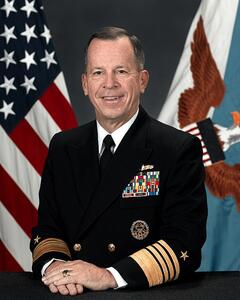
Barbara A. Perry
Thank you again not only for scheduling this extra time but doing it so expeditiously. We know that when we ended our last conversation you mentioned that you wanted to talk about “Don’t Ask, Don’t Tell” among, perhaps, a few other extra items.
Mike Mullen
I think that’s really the principal one because it’s more significant than I realized, I guess is how I would say it, at the time. John [F.] Kirby, who was my public affairs officer when I came out of that hearing—I think it was February 2, 2010. When I came out of that hearing, Kirby said to me, “That’s your legacy.” I think I mentioned before, I’m not someone that focused on legacy. In fact, one of the gals that worked for me mentioned my legacy early in my tour, and I really turned on her and said, “Look, my legacy’s going to be what my legacy is. It’s not something I focus on”—maybe in a naïve way, particularly in a town where some large percentage of people focus on that almost before anything else.
Just quickly, the background. When [Barack] Obama was running—so that was the summer of ’08, maybe spring of ’08, sometime in that time frame—he’s on the road. and he makes a speech of some sort that if he wins, he’s going to basically overturn Don’t Ask, Don’t Tell. I had plenty to do. I wasn’t paying a lot of attention to the campaign at the time, except I picked up on that. My perspective was, in 1993, when Don’t Ask, Don’t Tell was put in place, I’m a Navy O-6 midgrade officer, Navy captain. I’m in command of a ship in Norfolk and paying precious little attention to what’s going on in Washington at the time. Other than carry out the law, which I was doing and had done—the previous version of that if you will—I wasn’t involved in that at all. When that came out, essentially my position was, OK, I’ll carry out the new law.
Fifteen years later, 2008, things had changed because of the position I was in. I believed immediately that if any President was going to change this, they weren’t going to be able to do it without the military and military leadership. And because I’m the senior military leader in the country, that fell right in my lap. I didn’t have a problem with that, it’s just that’s where it was. Civilian leadership just wasn’t going to be able to deliver this. I had a small group that took tough issues to go research and study them for me. There was, at the time, a Coast Guard captain by the name of [Samuel M.] Sam Neill that worked in this group. Essentially, I tapped Sam to go put together the literature, the background, what happened in ’93, who’s around that still was involved in that, have there been any additional studies, et cetera. Not too long after that—let’s say the summer of ’08, maybe the fall of ’08—essentially, I put that group together to start to go look at it. And then they would update me occasionally over the course of the next couple of years. A couple of things shocked me. One, there hadn’t been much work done on it in those 15 years. Secondly, I think the only “study”—by what I would call a little more objective, nonpartisan outfit—was a study in 2003 put together by RAND. But other than that, there was no substantive study on how it had gone, the viability, where we were, and where we ought to go. That became the baseline for me.
Obviously, Obama wins, and so my expectation is at some point in time we’re going to pick this up. Over the course of that couple years, particularly after Obama got in, I would have my own focus groups from very junior people to very senior people, active duty people to retired people or discharged people, depending on where I was and what I was doing. There were a couple things that came out of that. Well, there was also the backdrop. At that point in time, I’ve got a very good relationship with Congress, both sides of the aisle.
There was a congresswoman from California, San Francisco area, Ellen Tauscher, who was in a pretty senior position on the House Armed Services Committee, and she just beat me over the head. And I don’t mean that critically. She just said, “Look, you are way out of step with the American people in terms of support for gays in the military specifically.”
Perry
By “you,” she meant the military writ large?
Mullen
Writ large, yes. “You are nowhere. You are way behind. The country has moved on. They’re very supportive now, and here you are.” Now, where I also was, 2008, I was in the middle of the two wars in Iraq and Afghanistan. I also had a fairly significant part of my force chasing down terrorists, so it wasn’t like we were waiting for more things to handle at the time. And that, of course, got used very much in the discussion and debate—that the force can’t afford to do this right now because it’s a distraction.
But one of the main themes of the time was, as I would pulse various troops, whether it was in-theater in Iraq and Afghanistan, or around the country, or around the world—and I didn’t statistically analyze this—but I couldn’t get anybody under 30 years old to express much interest in this subject. As I’ve said, if not here, many times before, the average age of every unit in the military is 21 years old. These kids from 20 to 30 that were actually in the fight, they have grown up in different times. It goes back to what Ellen Tauscher said. They have lived with this. They had accepted it. They were used to it.
I don’t want to say that was universal, but by and large, this was not a—I used to describe this in a way, when I’d have engagements with troops, and I did it all the time to try to find out what was on their mind, whether it was parts that they needed to fix a helicopter in theater or it was their pay. My whole life, there are a handful of things you talk to troops about that they want to talk about. They want to talk about their pay. They want to talk about their leave. They want to talk about promotion. They want to talk about getting better training. They want to talk about education. And they want to talk about how their families are doing and how we, in total, are able to support them and take care of them. And then there is some mission-specific stuff. I mentioned the helicopter in Afghanistan or medical support in the field hospitals in Afghanistan and Iraq. Those are the issues.
Essentially, what they would say in these discussions when I would bring up gays in the military is, “Why are we even talking about this? I want to talk about the standard six or seven issues,” and those were always very robust discussions. This goes back to me strategically. What I wanted to do, when I took over as chairman, was know that those young men and women knew they had somebody at the top that actually understood their issues and could very possibly do something about them and would take their concerns into consideration as I made decisions every day that affected their lives. The thrust of the Don’t Ask, Don’t Tell discussion was that. It didn’t mean they didn’t have a view, but they didn’t want to spend much time on it. That was one group.
The best example I can give of that—I was in a foreign country, and it’s not important which one. I was having lunch with a Marine [Corps Embassy] Security Group—I think it was five or six Marines. We have them at embassies around the world, and it was just myself and these five or six Marines. There was this sergeant, so E-5, had been to Iraq for a couple tours, who was the senior guy. Sometime during lunch—this would’ve been 2009—I said, “What do you think about this ‘gays in the military’ stuff?” Of course, when you ask a question like that—because he’s probably 25, and then everybody else is early twenties—there’s just complete silence.
I wait, and then one of them starts talking. But this sergeant said to me, “Chairman, look, I have two tours in Iraq. My best friend, my battle buddy, saved my butt so many times in Iraq and Afghanistan, and then got out and then came out. It turns out he was gay. I had no idea.” He said, “I don’t care about his sex life. I don’t care about his sexual orientation. He was a great Marine that saved my life more than once. That’s what it’s all about.” I use that example. That really is a very powerful example of what I got across the board from that young group.
The second group was what I would call the “retired group.” These are senior captains, colonels, junior flag officers who came to see me, and it was about a half dozen of them, spent 25, up to 26 years in the military. And as they said, in their own way, every single day they were in, they didn’t know if that was going to be their last day. This was, in most cases, before Don’t Ask, Don’t Tell. But even with Don’t Ask, Don’t Tell, if they were outed, they were gone. And so every single day—I knew a couple of them, I didn’t know all of them—they were dedicated professionals who served their country exceptionally well, and yet, every day, basically, they had to lie about who they were in order to serve.
When that light went on, that’s when it really hit me. It may seem more obvious now in reflection, but it was really in those fireside chats, or discussions with them, or focus groups, whatever you want to call them, that was the second message. And then I talked to a number who’d gotten discharged because of that, who badly wanted to serve their country. It was sort of in the summation of that that I then came to the conclusion that this was a complete conflict in values. This wasn’t about sex or sexual orientation. This was about a complete conflict in our values. I say this in a short summary here. This was culminating a couple years’ worth of work.
I teach young people now—it’s not only young people—that for big decisions, you really need to do a lot of hard work. There’s never an easy path, and there are a lot of views. I’m also someone at a very senior level that says the more views in the room, the better decision I can make. That diversity of views has always helped me, and this was one example.
We worked it for the better part of almost two years, when it turns out there hadn’t been much work done in the literature and there hadn’t been many studies. Now there were a couple of outfits that supported gays and lesbians. When we’re talking right now in 2023, the whole transgender issue is a very hot issue, not just in the military but also nationally, but the trans piece was a pretty quiet piece back then. We didn’t spend a lot of time on that. I can come back to an example of that in a second. But there were outfits, the Palm Center being one, which had been up and running since Don’t Ask, Don’t Tell. Its main goal and the funders that were behind it wanted to undo Don’t Ask, Don’t Tell became law. I understood there were people that had worked on it, but it wasn’t people that were heavily embedded or that could deliver it to the mainstream military.
The third group was—I went to a gal, I think her name was Elizabeth Birch. She was an important leader in the gay and lesbian community. I met with her and I said, “Look”—and I knew where I was, and it wasn’t public at the time—“if we’re going to get through this, I need responsible leadership from individuals who lead in the LGBTQ world to help lead us through this. Because if we’re not careful and you just come out in demonstrations, or parades, or whatever the case might be, you’ll spook the herd, and we’ll never get there.” So I had engaged Elizabeth and her organization and others as we started to move this through.
In the background, I’m getting feedback after Obama comes in. Of course, he’s getting beat to death on this from his base. They’re not beating on me—that doesn’t do any good—but they’re beating on him. I know that from my engagements with the White House and with others who were in this space. I give President Obama an enormous amount of credit, who wanted to hold out for a law and not an executive order because an executive order, as we’ve seen in spades, can be undone by the next administration. That push from his base, who doesn’t trust the military writ large for lots of reasons, was enormously difficult for him to resist, but he did that, and he did it throughout.
I can’t remember the exact sequence of events, but not too long after, the House—I think [Nancy] Pelosi got this passed—the House repeal of Don’t Ask, Don’t Tell, in the previous year’s lame duck [session]. It would’ve been before the midterms. It would’ve been the lame duck, I think, in 2009. Essentially, for the remainder of that Congress, the goal was to get it through the Senate. [Carl] Levin calls a hearing. Levin was the chair of the Senate Armed Services Committee. He calls that hearing in early 2010.
One of the things that happened that really ticked me off, and it ticked [Robert] Bob Gates off, is Obama mentions this in the 2010 State of the Union Address very strongly. We were blindsided by that. Now, I wouldn’t say completely blindsided because I think we found out the day of or the day before, but boom. Of course, on something like this, as soon as this gets announced, the klieg lights go on. Everybody’s going, “Well, where are you, Gates? Where are you, Mullen?” And it goes back to what I said. Knowing this can’t be done without the military, Where am I in particular? I don’t appreciate that to this day. It’s one of those things that happened, and we dealt with it.
Then the testimony on February 2, 2010. I’m a decent consensus builder. I had a good team of chiefs, the Joint Chiefs [of Staff]. But we’d been through a lot, even as a service chief for two years with them before I took over as chairman. And then Kirby basically wrote that testimony for me. He wrote all my opening statements. Normally, I would share that draft statement with my peers and others in the building and up the chain. We didn’t do that at all.
I think in something I saw in the background material that you prepared, I think it said that we had given this to the White House in advance. If we did, it was probably to Denis McDonough and it didn’t go any further. I’m sure he told the President. Maybe he did, maybe he didn’t. I don’t know. And then the specific opening statement. The reason I put this in my opening statement is because, as best I could, I wanted to control the narrative initially, to get it out. I didn’t want it to be leaked to the media before the hearing. I thought all that was important in terms of impact of me making that statement publicly.
The other thing—and this is an inside baseball issue—every three-star and four-star appointment that goes to the White House that the President sends to the Hill [Congress] for confirmation by the Senate, you sign a letter saying, “If asked, I’ll give my personal opinion on something.” That is routinely used, typically across the aisle, against the sitting President. In this case, Obama is sitting, and [John] McCain or [Jeff] Sessions or [Saxby] Chambliss would ask for my personal opinion on something which they think might be counter to the President’s position. I’m working for the President, and I’m carrying out his orders. But signing that personal statement that says, “If asked, I will,” is a big deal.
Normally, you don’t use that unless somebody asks you. This is what has become the [National] War College case study. I chose to answer the question before it was asked. When you look at that testimony, I specifically said, “It is my personal opinion that—” and then go on to that statement, which is that this is a conflict of values and it’s the right thing to do to change the law. I was virtually certain Levin would ask me. I don’t know, he hadn’t told me, but I was virtually certain Levin would ask me that question. When you go back and look at that statement, it was this personal statement, which you normally don’t say until someone asks you a question, that was so powerful. But I also wanted to give it at a time where, to a degree, I could control it, and the only time you have in a hearing to do that is your opening statement because you’ll have the chairman make a statement, you’ll have ranking member make a statement, and then he’ll turn it over to the witnesses. Bob Gates makes a statement, and then I make a statement, and then the Q&As start. To me, that’s when the show starts. What I didn’t want to do was try to discuss this at length in the show because they run the show. It is their stage. I learned that a long time ago. All of that was part of the calculus of saying it when I said it. Of course, when I said it, it took the air out of the room. There was no question about that, which was fine. I was extremely comfortable with it.
I get, even to this day, thanks from—obviously, it was almost 13 years ago, but I’ll run into individuals whose lives it affected, and they will say “Thanks” and “You were really courageous.” I didn’t think it was courageous at all. The reason I say that is because I had looked at this for almost two years, one. Two, it was a values-based decision on my part, and it was a fundamental issue for us as a military, where we value integrity above all, actually, in terms of what we do. At that point, it was a personal belief that I thought it was time, it was right, and it wasn’t going to affect the military.
The lesson for me is, you do all that work, you get to the right place. It’s not courage anymore. You know it’s the right thing to do, so you just do it. Now, clearly, you’re going to get hit—there’s no question about that—which I did. I will say, the previous summer, summer of ’09, this issue was starting to bubble. I went to see McCain and one of his staffers. This was just a catch-up call. He asked me, he said, “What do you think about this Don’t Ask, Don’t Tell stuff?” At that point in time, I said to Senator McCain, “I’m closing in on this, but this has become an issue of integrity and values for me.” It startled him when I said that because clearly he hadn’t thought about it that way. Here was a man of great integrity and impeccable values, but he just hadn’t put it in that perspective.
From the moment I gave that testimony, no one ever could take that issue on again. I never heard a discussion in terms of criticism of values. That testimony fundamentally changed the terms of reference for the debate. That didn’t mean they still didn’t talk about sex or who you’re living with or what’s your orientation—but it mitigated and muted that in so many different ways because the values thing was so difficult to overcome in terms of the reality of what was really there. That was in February.
I know that the base continued to beat on Obama. We wanted to go out and make sure that troops weren’t going to turn upside down. I didn’t think they would. But that’s when Bob Gates put General Carter [F.] Ham—who I’ve got all the faith in the world in terms of supporting him—and Jeh Johnson, who was the DoD [Department of Defense] general counsel, Gates’s general counsel, to go out and have interviews for a number of months and come back and tell him what the impact’s going to be. They came back with the same answer. The studies are out there, the numbers are out there, but some two-thirds didn’t think it was going to have a big impact.
Again, I give great credit to President Obama because it wasn’t until I read your stuff that I was reminded that in that time frame, sometime that fall, there was a law passed that was going to require myself and Gates and Obama to sign off together. And for the President to—I don’t want this to sound the wrong way, but for the President to descend to our level to sign a document on an equal basis, it’s just unheard of. I was stunned that he was willing to do that. Obviously, we greatly appreciated it because that’s certifying the force, if you will, in having done the work.
Two other aspects of this. One is, I mentioned the chiefs. When my testimony hit the street, they were not happy because they didn’t know anything about it—back to being blindsided. I’ve explained why I didn’t, but they were not happy, and over the course of the next many months, I wasn’t going to demand this outcome. We worked this issue in the tank a lot, and they worked it in their own services. In the end, I actually didn’t know where each of them was going to be.
[James F.] Jim Amos, who was a dear friend, had recently taken over the Marine Corps as the commandant. He had been the number two, so he moved up from number two to take over and then become a member of the Joint Chiefs in November of 2010. The poor guy was put in a tough position. Of course, he was asked immediately—I can assure you, almost no matter how he felt personally, and I didn’t know—What’s the first thing you do when you take over the Marine Corps as the commandant? You’re going to endorse gays in the Marine Corps? “That ain’t going to happen,” and he said that. He was pretty frank with me, and he was frank with the President about it. But he did say, “Look, if this law changes, the Marine Corps will be the first to get through the training and get certified,” which, in the end, true to his word, that’s exactly what happened.
The other service chiefs came around. They weren’t overly supportive. At the same time, during that sort of six months or eight months, whatever it was, I’ve got McCain coming to the building, writing letters, getting service chiefs and others to write letters. You go through that whole mosh pit, if you will, of how legislation gets made. That was all ongoing. I just think the strength of that statement and the strength of the values piece and, quite frankly, the work that Jeh Johnson and Carter Ham did gave us the strength to get to the end.
Then the other group that I actually pulsed was my counterparts around the world—in Israel, in Australia, in the UK [United Kingdom]. I’ll use the UK as a great example. The UK had gotten through this about 10 years earlier. A very good friend of mine, Jock Stirrup, air chief marshal who was the CHOD [chief of defense] in the UK—I talked to Jock about this. Basically, he said there was great hubbub before the law changed. And then I said, “What happened when the law changed?” He goes, “It was a nothing sandwich.” That’s pretty much what happened to us as well. That didn’t mean we didn’t have some incidents; I’m sure we did. But by and large, back to what those kids under 30 were saying, “Can you talk to me about something that’s important, please?”
Lastly, I would go in the theater once a quarter, and I would take a USO [United Service Organizations] show with me, entertainers and athletes, in the spirit of what the USO has been doing forever. I would go into theater and work, and they’d go off and do their shows. I would see some of their shows, et cetera. The week we went in was early December 2010. This was the second time I’d taken Robin Williams in. I took him the first year in ’07 and this was ’10. This was a Christmas show, which was a bigger show, higher-end athletes, higher-end stars, et cetera. I can remember leaving—I think it was about December third or December eighth. We’d go for a week basically. This legislation, at that point, was completely dead in the Senate. I had no hopes. I’d been following it all year, but it just didn’t have the votes. We get up and we’re flying over to—I think it was Iraq in theater, whatever it was. And all of a sudden, somebody picks up on text—I don’t know who it was, but it was Susan [Margaret] Collins or it was the then-senator from Massachusetts who was a Republican, Senator [Scott] Brown—but all of a sudden, we had one or two public supporters for Don’t Ask, Don’t Tell, and then, boom! Two or three more hit, and they had a vote and it was over. It was law. It’s one of those things—it’s almost like in great situations. You almost have to die to live. It was no chance, and then all of a sudden, one vote breathes life into it. A couple more happen, and boom, it’s passed and it’s law. That’s December of ’10, I think. And then we have work to do to certify, et cetera, and we get that done.
The last thing I’d say about it is, Obama wants to sign this legislation. He couldn’t do it in the White House. There were too many groups, too many advocates, too many that wanted to participate. I get invited to go, which was fine. It was over at the Department of Interior, big building. One, I’m a sports guy, but I’ve been in and out of lots of big buildings. I walked into that place, and it was like walking into an electrical firestorm. That place was so energized. It was unbelievable. Obama was, obviously, going to be there. [Joseph] Biden was going to be there. Joe Lieberman, who was an early supporter of this, I think Susan Collins, et cetera. There were 8 or 10 of us that were onstage in this place. They introduced Obama, and the place explodes.
One of the things you never want to do—you learn this in Washington as well—is you never want to upstage the President. You just get out of the way. There’s one star in the room. That’s POTUS [President of the United States], period, any venue, anytime. Obama did this, to his credit. I ended up getting two standing ovations standing next to the President. I was in the back row of this group as this whole thing started. He called me out to do that, and it was pretty remarkable. Then, as I was coming back from the second one, Joe Lieberman leans over and says, “I guess you never thought you’d be the most popular guy in Gay America, did you?” [laughter] I said, “No Senator, that was not one of my goals.” A pretty remarkable journey with great uncertainty.
The extension of this in the last year I was there, I watched Obama—and this was just because I was in the meeting, not that I was involved—but Obama basically kicked in hard on DOMA, the Defense of Marriage Act. He never said this. My take on that is that Don’t Ask, Don’t Tell became a bridge for that. If he could get that, then he was going to go after the other one. One of my—what’s the right way to say this—probably least understood outfits was the office of OLC [Office of Legal Counsel], which I had never heard of until I was chairman. I would cynically say, “Gee, I thought Congress passed laws, not the OLC.” But I know Obama got the OLC to give him a very strong read on DOMA, and then they were going to take that on. The dam broke on that actually, I think, after I was gone, when Biden basically came out to support it a year or two later.
The other thing that I didn’t understand—I’ve been approached so many times by individuals about the change in their lives. A midshipman here at the Naval Academy in Annapolis [Maryland], a gal who’s here three years, said now she doesn’t have to hide anymore. I went to a Navy one-star’s home, where he got married in Alexandria [Virginia], just to be there. The human side of this, it was a tidal wave in terms of how their lives changed and how they felt so much more free and accepted in ways they never had.
I’ll tell you one other story because it’s a powerful lesson for me as well. I retire October 1, 2011. This gal, Elizabeth Birch, she calls me in October, and she says, “Next month, Veterans Day in New York, we’re going to have a celebration of Don’t Ask, Don’t Tell, and you have to come. We’re going to have lots of people that want to say thank you.” I said, “Elizabeth, I’m tired. I’m going to bed. I’m not coming.” In the spring, she calls me again. They hadn’t had the event. She says, “Look, we’re going to have this upcoming November, and you and Deb [Deborah Mullen] have to come.” I said, “Why is that?” She’s talking to me, “One of the things you don’t understand, in so many of these people’s lives, you are the first person in an authoritative position, from their families to their schools to their workplaces, that has validated who they are. They want to say thank you.” I said, “OK, we’ll come.”
We went to that celebration, 1,100 people on the Intrepid [Sea, Air, and Space Museum in New York City]. Like the Department of Interior count, it was unbelievable. The joy and happiness and electricity that was in that celebration was validation of all the work, among other things, including a World War II vet who came up to me. He had been in the 82nd Airborne, I think. He was an Airborne guy. He was literally crying, and he just wanted to say thanks. Finally someone acknowledged who he was. It was a pretty extraordinary journey. I think we’ve talked about this, but I give Obama a lot of credit for making a call on [Osama] bin Laden. He stayed with this to get this right and changed the law while he was getting pressured by his base. Without that, we wouldn’t be where we are. I won’t spend a lot of time on it because I didn’t in the job, but there’s a significant extension of that in the transgender discussion which has taken place since that time.
Perry
Do you want to mention anything more about that, sir, right now?
Mullen
The only thing I’d say about that is maybe 2012, so the first year I retired, I got called by the Palm Center to go to Chicago and give a speech. Many of the same advocates for the lesbians and gays were also in the trans space, and they wanted me to come out. They wanted me to do the same thing, “Please repeat this. Repeat it again.” I said to them, I said, “When I got involved with the gay and lesbian issue, I’d been around gay guys in the Navy my whole life.” Everybody knew who they were, not all of them. I wasn’t unfamiliar with the issues. I didn’t know all of them. I wasn’t deep, per se, but I had a pretty decent—I used to say on a scale of 1–10, I was sort of a 6 or a 7 on gays and lesbians.
I said to that group when I gave the speech, “In the transgender world, I’m probably a 0.6 or a 0.7.” I just don’t know much about the issues, and I need to be educated. There’s an education piece here that must take place, particularly in terms of the medical impacts, the number of surgeries, all of that— it turns out, it’s a very small percentage that actually have surgery. I wasn’t prepared to do that.
A few years later, when this thing got hot in the [Donald J.] Trump administration, I did speak publicly about it and was very supportive. But my own education difference was huge. I consider myself, by and large—I mean, I’ve had a good life and I’ve been very lucky. One of the senses I’ve always been able to have is for what’s going on in the trenches for the average person, either by having been through some of it myself or being in touch with them and trying to represent, in my understanding of what they’re going through, the needs that they have in areas that I might be involved in decisions that affect them. Again, I was way behind the power curve in the trans space, even though I’d spent all this time on the gay and lesbian issues.
Perry
Where were you in 1993? You began with a mention of that and now, just tied to it, that you had known gays in the service and had served with them. Because we in the public were hearing, particularly for the Navy, that people work and serve in such close quarters, ships and submarines and that sort of thing, did you have a fairly well-developed sense, when it came up particularly in the early [William J.] Clinton months of that administration in ’93, about where you thought it should go?
Mullen
Those who use that argument, they’ve been showering and living in close quarters with gays and lesbians their whole life. If you really squeezed them, they know who they are. Does it make a huge difference now that it’s known? They might want to try to make that case. I was commanding officer, USS Yorktown. That’s a cruiser, 350 to 400 crew with staff when we had the staff embarked. I’d been serving since ’68 on ships. Occasionally, we would get individuals identified as gay and we’d kick them out. That was the law. That’s what you did. I’m not very proud of this, but I honestly never gave that much thought because that was the law. That’s just what we did.
Even as a more senior officer, in 1993, where I’m the captain of Yorktown, I guess I would go so far as to say it was too bad that you got caught, but now you’re caught and you’re gone. Back then, not handled well, it could be pretty disruptive if it wasn’t handled well in a unit. Yes, I get ships and it is close quarters. Same drill, in its own way, with women on ships. And then I’d go back to the modern young men or women. They’d been dealing with this their whole life as they’d come up through middle school and high school and college, and they figured out how to live with it.
I worked hard to integrate women in the Navy before I became chairman. And I may have mentioned this before, but I thought we, the Navy, were very slow getting women on the submarines. The big resisters, quite frankly, of that were the spouses, because Deb would pulse that on occasion, and the semiretired admirals who were submariners. Now we’re way beyond that at this particular point in time. That also started to change publicly. I worked the Navy pretty hard when I was chairman, to open up the door, and that’s what happened, I think, in 2010 or 2011. Ironically, the guy who was the head of the Navy’s personnel department—a three-star at the time—said that year out of NROTC [Naval Reserve Officers Training Corps], out of the top 100 applicants for nuclear power and for submarines—the top 100—the top 5 were women. They were the top NROTC students in the country, having nothing to do with nuclear power, which is what always drove me crazy because you had this incredible talent pool that we were keeping out of nuclear power and submarines.
Perry
That makes me feel good.
Mullen
I’d say this off the record, but one of my speechwriters was a female nuke [nuclear] lieutenant commander, and we were talking about this when I was chairman. I mentioned the spouses, and she said to me, and I’ll always remember this, “What do they think? Every single one of them is married to Clark Gable, for crying out loud?” [laughter]
Perry
That’s a very good line coming from your Hollywood years. I do have one question about, and I can see why this, as you’ve described it, has become a case study for leadership and how things work in Washington. As you’ve said through our discussions over these last couple of times about not being of Washington and not having spent a lot of time in Washington, how did you have such a good sense, on this issue particularly, about not just to say, “Well, I knew what was right and so then that’s the time to say my personal view,” but it sounded like you had a strategy moving forward that covered a number of different elements of the legislative and executive branch and military options.
Mullen
I think I may have mentioned this before, that I’m also doing my own oral history. It was one of those things that, I didn’t come to town until I was a Navy captain. My first job was just as I made captain, and I was in the Pentagon in the bowels, in a directorate that was a relatively minor directorate. I was really just ticket punching, getting what we called a “joint job,” because you had no future in terms of being a flag officer if you didn’t have that ticket. But that job also started to expose me to the Hill because I was writing reports to the Hill and mostly Hill staffers at that point.
Then I went from there to Yorktown and returned to town as a detailer, a personnel type in the Bureau of Naval Personnel, which is located in Washington but it’s not really of Washington. What was enormously instructive when I did that was that it was right in the throes of the Navy’s Tailhook scandal. This is 1994. My aviation colleague is spending his whole life on the Hill defending junior officers whose careers were in jeopardy because they had attended Tailhook, and most of them had nothing to do with anything untoward. I’m watching this with my eyes wide open.
I’m now trying to figure out that job. I’m handling the careers of about 8,000 officers and I can’t remember how many hundreds and hundreds of O-6's in my surface community, some of whom happen to be flag officers. So I want to know how you make a flag officer, which I hadn’t spent any time on. I’m studying that. That part I started to understand. I make flag. I go over to the Pentagon really on the OPNAV [Office of the Chief of Naval Operations], the Navy staff, in the budgeting and programming world for the first time. I was there less than a year, and then I went to sea. In either that tour or when I came back, I was called in to see the vice chief. I think it was in the first tour. I did something on the Hill that ticked somebody off, some staffer. The vice chief called me in, [Donald L.] Don Pilling. He became a mentor of mine and a great friend and, sadly, passed away many years ago now. But he said, “In your personal life, do you try to tick off your banker?” [laughter] I said, “No, because I want the banker to give me the money.” He says, “Well, you need to think about that here as well because everybody over there, 535 of them and however many staffers, they’re our bankers. You need to have relationships on both sides of the aisle, and in particular not just with the members but the staffers.” That was late 1990s.
From that time on, I spent a lot of time on the Hill. I came back for two and a half years, and I ran surface directorate. I had shipbuilding and its roughly $15 billion/year budget. I spent a lot of time on the Hill with members and staffers, and I learned that well. And then when I came back after 9/11 [September 11, 2001, attacks]—I was back a week and the plane hit the building—I took over the Navy budget and program from [Edmund P.] Giambastiani. Same thing, tons of time on the Hill. Then I was the vice chief and CNO [chief of naval operations]. I had spent an enormous amount of my life at that point on the Hill and trying to understand the inner workings and hidden mechanisms of the whole puzzle, to include my own bosses and how does it work down on the third deck [office level of the secretary of defense].
[Donald H.] Rumsfeld as secretary of defense was particularly instructive. We’ve all got views of him. He’s a very controversial guy; he did his things his own way. I got deeply embedded on the budget side of him in Bush 43 [George W. Bush] with the players, which eventually got me, quite frankly, into [Richard B.] Cheney’s office with—I got tangentially involved in Gitmo [Guantanamo Bay detention camp]. That’s when I started, really—it was a Rumsfeld tour, then I really started to pick up on the totality of the politics and the political environment under 43. I wasn’t involved in the Iraq War per se, other than I needed to fund things for the Navy, and became more so when I came back a couple years later to be a chief.
It was in that time frame that I really—I was good at developing relationships and engaging people and trying to understand their problems. It was that facility that I, in fact, developed over time. I’d testified at dozens of hearings, including many with Levin and McCain, before that Don’t Ask, Don’t Tell hearing. At that point, I had rich experience in town, having had virtually none until I was a pretty senior guy, a Navy captain.
Spencer Bakich
Do you mind if I take you back to your statement really quickly, your opening testimony? I read it a few times, and it’s masterful.
Mullen
That’s John [F.] Kirby, by the way. I’m actually serious. He’s the best speechwriter I’ve ever been around.
Bakich
The way he parsed that, and I’m sure—
Mullen
Yes, we worked it a lot.
Bakich
What you didn’t say in your testimony is what you’re hearing from the troops, which is, being gay is not a big deal. You didn’t say that, and I’m wondering, did you ever have that discussion with Kirby? You said that there’s a values conflict. You said that it’s corrosive to the institution of the military. But did you ever have the discussion as to whether or not saying something along the lines of being gay isn’t a big deal?
Mullen
I know we iterated this statement, as you typically would. We did it over the course of probably a week or 10 days. For something like this, it may have been from the moment Levin announced he wanted to have the hearing. It was a bit of a surprise in one way. In the other way, with Obama coming out in the State of the Union, I suppose it wasn’t that much of a surprise.
One, he [Kirby] knew me really well. He knew what we had been through. He was very close to this Coast Guard captain, Sam Neill, who was involved in the drafting of this throughout the process. Kirby really knew where I was, and then it just became a matter of trying to put the words together to send the right message. My reaction goes back to what I said earlier, no President could do this without the military leadership. That’s where I was, and my inclination is to take it on as such. I wanted to take that on. And I was very comfortable at that point representing the men and women in uniform far and wide, all 2 million of them. And this is far beyond just this issue. But because of the way I had approached the job and what I had been involved in, I was very comfortable representing them and taking it on as my responsibility at this point in time. It goes back to the last question: it was going to become a lot about politics to deliver it.
Marc Selverstone
Can I take you back to the moment just before that? You had mentioned the State of the Union Address. This is fairly mundane given how extraordinary the whole moment was and the significance of it, as you’ve retold, for your life but particularly for the lives of everybody who was affected. I am interested in the process of what happened between essentially commissioning some studies during the course of 2009, perhaps expecting something to come, but then, wham, the State of the Union comes about and Obama makes that statement. Is there a story in there about civil-military relations? You and the White House, military and the White House, had just come through some challenging times at the end of the previous year regarding the Afghanistan Review. Is there a little bit of a hangover going on there? How do you explain the drama of that moment?
Mullen
I never gave it that thought. We’d been through the Afghanistan thing, the decision had been made, and I was moving on. I did not think of it that way. As you ask that question, it’d probably almost be inhuman to say there wasn’t. If there was resentment writ large in the White House as a result of all that, it was very clear to me it was not the President. It was the rest. It was Rahm [Emanuel] and it was others. I think Denis was the deputy national security advisor at the time. I never got a sense at that point in time that it was Denis, et cetera. It’s not my style to think about it that way. It was just kind of a shock.
Usually, we’ll get a—I’m trying to remember, actually, how it works. The State of the Union isn’t widely distributed. It’s held pretty close. Nor was there an expectation that they would run that by us per se. The opposite is not true. There was an expectation for stuff we did that we’d run it by the White House. In that regard, it was just a complete surprise. What I would have expected in the relationship is someone calling us and say, “Hey, he’s going to make this statement,” or basically say, “He’s going to seek repeal of Don’t Ask, Don’t Tell, just to give you a heads up.” But nothing, at that point, that I can recall.
One of the things—McDonough wasn’t the deputy national security advisor because Tom Donilon still was, because [James L.] Jim Jones was still there. Jim went through the whole Afghanistan surge thing as national security advisor. I think Jim called me the day after that testimony and basically said something along the lines of, “OK, as ticked off as everybody was with what happened on Afghanistan surge, you really got to a great place as a result of that testimony,” or something like that. I would phrase that or tie that more to the staff writ large than the President himself.
Bakich
As this entire process is unfolding from January to December of 2010, President Obama is asking, on a number of occasions, about the possibility of suspending or putting into moratorium the separations from the military, folks caught up in this. A couple of things. Number one, I want to get your take on whether or not the law should be enforced. And then, secondly, and I guess related to that, how involved were you on tightening the regulations as the process went forward? The types of evidence that was being brought became much more stringent, the supervising officer that went higher and higher up the chain. I wonder if you could speak to that.
Mullen
It’s a great question. I need to give Bob Gates a lot of credit here too. It goes back to the response of having been in Washington or not been in Washington. One of the facts was Gates had made this change at the CIA [Central Intelligence Agency] in 1993. He and I never talked a lot about that, I just knew he was supportive. What he had to deal with, more than I, was the politics of this at a difficult time. But he was a real partner in all this. Even though he gave a supportive statement in that same testimony on February second, it was back to what I said. The military leadership was the one that they really wanted to hear from. That was one aspect of it.
There couldn’t have been a better guy to work this from a legal standpoint than [DoD General Counsel] Jeh Johnson, in my view. He was extraordinary. The courts then started to make decisions related to Don’t Ask, Don’t Tell, various courts in various parts of the country. We were very much in up-and-down mode over the course of the better part of that year, in which time I think Jeh Johnson helped Bob Gates get to, my view, a better place with respect to the restrictions and the signatures required up in the chain, which was how all of that evolved.
I can’t remember the exact sequence, but honestly, in that time frame, we are getting pressure personally from Obama at that point to possibly make some of these—to suspend it, which, to me, is a logical thing to do, particularly if you know the law’s going to change. Obama had to still certify along with Gates and I as well. Gates did a masterful job resisting that, not disobeying it but resisting it.
My overall take was it seemed as though there were court orders and stays which came in an ordinary sequence that allowed us to proceed as we did. There was not one that hit the wall that said now we’ve got to change this thing or now we’ve got to suspend it. There were a handful of courts that were active, Ninth [Circuit] out in California, I think, was one. But it wasn’t just the Ninth. There were a couple others that seemed to move this back and forth. I can just remember, as I talk about leaving on that USO trip in early December, it was pretty quiet at that particular moment. There’d maybe been two weeks since we’d had a court decision or something like that. It turns out the stage was set, and then obviously the votes came in to change the law.
Gates and Johnson handled most of that stuff from a legal standpoint. Now, I would be brought in, “What do you think about this?” They concluded correctly that given my public position, I wasn’t going to come down on the side of “Let’s put more restrictions out here for gays.” I was going to support the other side. That’s where they moved over time, less and less restrictions, so we could get to a point to see if the law was ever going to change. Honestly, we’re in a real pickle if the law didn’t change because then we’re back to one court after another. I can’t remember the exact sequence, but it was a pretty disruptive time.
Perry
Anything else, sir, in this space before we move on?
Mullen
I don’t think so.
Bakich
I’ve got one question. It’s a fishing expedition, if you wouldn’t mind. Did you ever hear from former Secretary of Defense Cheney on the issue?
Mullen
No. Publicly.
Bakich
But not—OK, great.
Perry
Spencer, I know that you have some topics lined up.
Bakich
When we last spoke, we had about 15 minutes toward the end, and we covered Russia and China to a certain extent. There are a couple of issues that we didn’t have a chance to talk about in great detail, one of which, the tick-tock [timeline] of the bin Laden raid we didn’t cover, the Iraq withdrawal as well. I’ll put it to you. Which do you think occupied most of your concern, your time as chairman?
Mullen
They both occupied a lot of my time. Pakistan, overall, and I spent a lot of time in Iraq. I would almost put them on an equal footing. I think the tick-tock on the bin Laden raid I can do relatively quickly. This is more than specifically public, probably in more detail than I can recall. But it turns out Admiral Eric [T.] Olson, who was running SOCOM [United States Special Operations Command] at the time, I think he came to see me in the summer of ’09. He had a longitude and latitude where they thought they may have something, and he was going to run it into the system. I said, “Fine.” It wasn’t like it was the first one. I didn’t pay a lot of attention to it honestly. Even in this moment, I can’t say for sure that turned out to be the one because we’d been looking for a long time for this guy. The resources expended were extraordinary, and rightfully so as far as I was concerned.
I think it was in August of ’09 when Leon [E. Panetta] first went to see the President and was given very specific direction by Obama. When Leon came in, Bob Gates told me that—and I may have mentioned this—he told Obama, the one person you want to be close to, the person you want to have the best relationship with, the person you want to trust the most is your director of the CIA. Thus, Leon fit that. He had been given very specific direction from Obama on finding bin Laden and upping the game in that regard, as well as, quite frankly, killing the terrorists, which Leon did and did exceptionally well.
I think Leon had something in the late summer of ’09. Obama, in terms of what I read, directed more and more focus in that regard but then decided not to bring Gates and I in on this, I think, until January. And so we started to have more detailed meetings. I then engaged [William H.] McRaven. McRaven was JSOC [Joint Special Operations Command] at the time, so he was in charge of all special forces—Joint Special Operations Command, obviously—under his command, including special forces in Iraq and Afghanistan. I engaged McRaven routinely at that point.
My own history there was deep into special forces in these wars, before the wars with the SEALs [Navy Sea, Air, and Land teams]. I knew a lot of them, and I had made numerous trips into theater both in Iraq and Afghanistan, particularly in Afghanistan, where literally my first stop would be Bagram [Airfield], which is where all the special forces were. I met the young leaders, the young lieutenant colonels and commanders and majors who were going out on these raids night after night after night. I had a relationship with them. I engaged McRaven and did for the next several months to include eventually going out to a dress rehearsal, which has been given a lot of press. I wanted to be that close to it because I wanted to understand what I was going to tell the President and have confidence in the team.
That all took place over the course of my involvement, from January until we killed him and buried him. A lot of my time, very closely held. Myself, I think [James] Cartwright, Gates, [Michèle] Flournoy, and I think that was it in the Pentagon, and rightfully so because we all knew if this leaked, he was gone. We knew that if it leaked, if he was there, he was gone. We confirmed that later on, but that was the paranoia quite frankly. We go through multiple meetings with Obama, including bringing the model of the compound over—which you can now see at the CIA, if you haven’t—with the same group of analysts time and time again and the highest level of intel people we have in the United States.
Obama, rightfully so, asked a thousand questions, and we would come back to the next meeting with answers, et cetera, and all the things that have been talked about publicly about trying to draw him out, those kinds of things to confirm. The big deal was we had no smoking gun. To the day that we killed him, we had no smoking gun. I give Obama an awful lot of credit for a courageous decision. I really do believe it was a “bet the presidency” decision. If that had gone badly—and if you go back and look at the poll numbers mid-2010, because a year later he’s running for reelection—that would’ve really been laid on him, and he could’ve been in trouble for reelection.
I can remember in the last week when he finally decided to do it. I can’t remember whether it was a Wednesday meeting, but I can remember him—after all of this, now he’s going around the room saying, “What do you think? What do you think? What do you think?” mostly to the intel types. There was this “maybe it’s a 40 percent shot,” or “80 percent shot,” from someone else. The result of that is—Obama said this: “I thought it was a 50-50 shot.” My own take on that is in the integrated view of all the intel types in particular. That’s kind of how it came down. And because you don’t have the smoking gun, nobody really knew for sure. We had a lot of circumstantial evidence which was good.
In that same time period, we go through the three options. Do you send a team in? Do you essentially send B-52s in? Or do you do it remotely? I am sensitive to the fact that somehow someone there thought I had an idea that the remote piece would work, because it didn’t. My background on that is not just this particular remote weapon. It was brand new. I’d been through this with the SEALs in special forces for years. They would buy stuff fast and move it into the fleet to use, but they didn’t test it very well. Oftentimes, when they did test the weapon, the testing didn’t go very well. This particular weapon, as I recall, had been tested just once or twice, and it had some problems. I wasn’t even close to supporting the use of that remote weapon.
The other mover for me was if we didn’t physically get him—literally if we didn’t have him, have his body, have his DNA—then the enemy could have said forever it was a fake, that you didn’t get the right guy. To me, that’s where I was from the beginning. I had tremendous confidence in the team to go in and succeed. I’d been with my counterpart in Pakistan a lot. From the first dinner I had with General [Ashfaq Parvez] Kayani when I was with the Bush administration, I said, “Look, if there’s a President that finds [Ayman al-] Zawahiri or bin Laden in your country, they’re coming in. They’re going to come and get them.” He knew that, and I repeated that time and time again.
We had what was the last meeting, I think it was Thursday, and you go around the tick-tock, “OK, yes or no?” It’s one of Washington’s favorite games, who voted yes and who voted no. One of the things that I point out in that story is I think having dissenting views is one of the greatest strengths of any decision-maker. Who said “yes” and who said “no”—I had fun with Gates on that because Gates voted with Biden. And Gates has famously said more than once, “Last 40 years, Biden never got anything right in foreign policy.” I remember riding back in the car with Gates—and I may have mentioned this the other day. We had decided something else the day before. The only two who voted against it were Gates and Biden. Because he had told me this 40-year thing two or three times, and I said, “What’s going on here?” [laughter] We had a good laugh about that. But I also understood Bob Gates. Bob Gates was sitting in that Sit Room [Situation Room] in the 1980 mishap in Iran, so I didn’t have any problem with it. It was his judgment.
Anyway, Obama typically would not make a visible decision in the room. He leaves the room, I think sleeps on it Thursday night, and then calls Donilon Friday morning and says, “It’s a go.” I may be off by a day because part of the drill was darkness and light. Originally, McRaven wanted to go on Saturday night. That’s why it may have been a day earlier. I can’t remember. But anyway, that day got called off because of weather. The other thing is, we only had a small window to hit him because the weather was going to change. We had a good situational awareness on the Paks [Pakistanis] and what we thought they could do and what they couldn’t do. We were comfortable with that, so it was delayed 24 hours.
Many of us went to the White House Correspondents Dinner in D.C. Saturday night. There was some discussion in the White House about not going, which would have possibly signaled that something was up. It was a brief discussion. We all decided to go. In fact, Obama that night in his remarks made some of his humor tied to killing bin Laden. And then around noon the next day, I go into the White House, which I just told my wife, I said, “We’re going over there.” It’s not the first time I’d done that on a Sunday, for sure. And then that’s when it unfolded.
At that point in time, my main goal in life was to not get in the way of McRaven by the White House reaching in with a 10,000-mile screwdriver to somehow change the operation. I was in a position, which is normal for me, of, OK, the operation’s been approved. I know the timeline, and I know the movement of everything. The only thing I expect to hear from McRaven is if something’s off. I never heard anything from Saturday night on. We’re rolling forces starting Friday actually. And then, obviously, the specifics of what happened in the side room to the Sit Room, the famous picture, et cetera, which, for a couple years, I would never even talk about.
I’ll always be stunned. I think I may have mentioned this before. The next day, John [O.] Brennan is on C-SPAN laying out chapter and verse. Gates and I are in our offices by ourselves watching Brennan lay out the details of this operation. I was slack-jawed that he was talking so much about it. It does fit this theme that I learned at that level: you can never say enough good things about the President. Here he’s killed the number one enemy in the world. Wouldn’t that do in and of itself? Doesn’t that speak volumes? No, no, staff’s got to somehow make it, again, stronger. I saw that more than once on more than one issue.
Then, just kind of a fun story. That night, we discussed for two or three hours who would call whom. The White House had playbooks depending on what happened, and then we go through this debate of two or three hours, “Who’s going to talk to General Kayani in Pakistan?” It made no sense that anybody but me was going to do that because we were going to call [Asif Ali] Zardari, the president. There were calls to be made to various countries, as is typical. Anyway, it ends up with me being given the task to call Kayani. Michèle Flournoy picks up the phone to listen and take notes. Kayani’s reaction was—he’s a pretty strategic guy actually, but he had two reactions. One was, “I understand congratulations are in order.” And then secondly, “You guys have to get this thing out on the street because we’re starting to wake up around here.” It’s two o’clock in the morning his time, roughly, and maybe four by the time I talk to him. The sun was starting to come up. He’s going to have a lot of questions to answer, and he needed answers. I went back and told the President that.
In my view, that’s what finally made the decision, if you will, or the weight of that say, “OK, we’ve got to go public.” Obama then goes public. There are just a handful of us in the East Room. When I say handful, I mean six of us, seven of us. Leon came over from the CIA. Hillary [Rodham Clinton] was there, myself, Biden, POTUS—Gates had gone home—maybe one or two other staffers in the Sit Room after we killed him. During the raid, I look over, and I’m standing right above where Biden is, who’s right in front of the President. Biden, as you know, is Catholic. I carry a rosary ring with me because I’m Catholic as well. Have I told you this story yet?
Bakich
No.
Mullen
I look down and I see Biden, who I didn’t know carried a rosary ring. Anyway, I see him taking off a rosary ring, getting his wallet out to put the rosary ring back in his wallet. I said, “Mr. Vice President, I’ve got 47 troops illegally in a foreign country. They just killed our number one enemy in the world, and I’ve got a 90-minute transit. They’ve got to refuel. I need to get them back into Afghanistan. I then have to transfer them to an [Bell Boeing V-22] Osprey, fly them through contested Pakistani airspace, get them out to the carrier, and get him buried in accordance with Islamic religious customs. Would you please put that rosary ring back on?” [laughter] Biden looked up and he said, “OK.”
Later, after the POTUS speech, the cameras were shut down. Everybody’s feeling pretty good. Biden walks up to me, pulls out his rosary ring, and shows it to me on his finger. I show him mine. Obama sees that. He walks over, and Obama literally reaches in his pocket and he pulls out a crucifix. That story is not known. And then Leon, who’s Catholic, he circles in, pulls out his rosary out of his pocket. He’d been moving the rosary beads during the whole thing as well. That was a pretty neat part of all of that. Buried him safely. I told Kayani, I said, “I’m flying him through your airspace. Stay away from him,” and he did. That was part of the relationship building over years that I had with Kayani, who then, in his own country a week later, had the worst week of his life.
Perry
As a fellow Catholic, Admiral, I was going to add that I chalk up my three science fair wins in junior high [laughter] to mine and my mother’s at home praying a rosary. On a more serious point, any other times in your service as chair of the Joint Chiefs that you turned to your rosary?
Mullen
It was constant. Actually, what I did—and I did it for a couple reasons, not every day. We had the 9/11 chapel [St. Paul’s Chapel] in the Pentagon that was built after that tragedy and located where the plane entered the building. I would go to mass at noon. Mass was 15, 20 minutes. I’d put it on my calendar. And, of course, those calendars, as you probably know, they go a thousand different places. And I don’t want to overstate this because there were a lot of times I didn’t get there. But when I could, I’d walk myself—and it was a pretty good walk from my office—one, just to leave me alone, give me a little time to think by myself. Same thing when I would go to that mass and then come back. That was much more regular than me pulling out the rosary ring—it’s one of those things. I carry the rosary ring with me, and every time I touch it, I say a Hail Mary. It’s a reminder. There were a lot of tough situations about how things were going to come out. It’s amplified by that Biden story as well.
Perry
Thank you for sharing that.
Bakich
I’m compelled to ask. Do you believe the Pakistanis knew that bin Laden was in their country?
Mullen
I do believe someone in Pak, probably in the ISI [Inter-Services Intelligence], knew. I don’t think Kayani did. This is just a human reaction when he said, “I understand congratulations are in order.” We never found anything to lead to that, but I’m hard-pressed to believe, knowing the ISI as well as I do and the dark side of the ISI, that somebody didn’t know that. My saying Kayani didn’t know stretches credulity as well because Kayani had run the ISI. The three-star job he had was the head of the ISI. And there were some really bad guys in the shadows of the ISI that they couldn’t control. I knew that. That’s kind of where I come down.
Bakich
At the moment of decision, I’m curious. The President decides to sleep on it, and he comes back. Did you have a gut feeling as to how the President was going to decide?
Mullen
Yes, gut, I thought he’d go.
Bakich
Was that based on—
Mullen
Well, we’d been looking for so long. This was no smoking gun—I’ve said that a lot—but it was more credible than anything we’d had in 10 years. It wasn’t even close, mostly, in my view, because we had the videos of him pacing. And then you start to stack up the wall, the size of the house, the isolation. All that stuff just started to—And you worry about, what’s the term? It’s what happened in Afghanistan just as we were leaving: “confirmation bias.” You worry about starting to feed that which just reinforces your decision. But my take on it is, if I were a betting man, I would’ve bet that he would’ve gone. I will just say from my perspective sitting around that table for as long as I did, I would’ve been in the 60 to 70 percent level, not 50-50. But the President’s been pretty public that’s what he thought.
Perry
What went through your mind when you saw and knew about the hard landing of the one copter?
Mullen
Two things. I mentioned the rehearsal. And this is just my style because I knew I was going to have to give a recommendation to the President, so I wanted to see the rehearsal personally. First, at the end of the rehearsal, the one thing we missed, which is what caused this helicopter to come down, was the temperature of the air inside the compound. The guy that saved that mission was that helicopter pilot. I have met him. The two guys that piloted those helicopters had, I want to say, over 6,000 hours in helicopters very similar. They had joined JSOC after Desert One [Operation Eagle Claw to rescue U.S. hostages in Iran] failed in 1980. I think they arrived there in ’89 when we stood up Special Operations Command. They’d been flying tough missions their whole life. That experience carried the day. This was a special helicopter, but we missed the temperature. It was hotter than expected and the pilot ran out of air to fly the helo [helicopter]. He then crash-landed it, brilliantly positioning the helo in the upward position with the tail wheel resting on top of the wall, which allowed the mission to proceed. He literally saved the mission.
Second, I had seen the rehearsal compound. In fact, I can remember talking to the Seabee chief, I think, who built it, who was proud as heck that he could build this thing in the middle of the desert. At the end of that night when we did the rehearsal—and McRaven had done lots of rehearsals, I’m just talking about this one that I went to, which was the final one. I wanted to look anybody that was going in the eye. There were roughly 50 SEALs there at that particular point in time. I went to every single one of them, met every single one of them, and gave them a coin and looked them in the eye.
I’d been around a lot of special force types and a lot of SEALs. I was really struck at two things. One is how senior they were. They were [E-]7s, 8s, and 9s. They’re all chiefs except one. I think there was one E-6. I was struck by their seniority. And the other, I was struck by their size. They were tight end and linebacker size. I’d seen a bunch of small, wiry SEALs who were as tough as anybody I’d been around, but these were big boys, which surprised me that they were all that way. But I wanted to look them in the eye. I wanted to tell them they had the confidence of the military leadership behind them should they get called to do this. Technically, they didn’t really know what they were doing yet. They suspected, but they didn’t know for sure even then. That was a few days before they actually went.
Then I wanted to be able to take that, having seen the rehearsal, and turn that into, Here’s my recommendation for you, Mr. President. Based on what I’ve seen, they’re ready to go, which is why I thought this was the best possible option for the President. If he [bin Laden] was there, they’d figure out a way to get him and they did. I had ultimate confidence in that regard, but that’s also just part of my style. I wanted to make sure that I could give the President the best recommendation based on the best information I had.
Perry
The temperature, that was the one—
Mullen
It was hot. It was a degree or two hotter than anticipated inside the compound walls. There’s less air. He can’t fly the helicopter inside the compound, so he starts to basically autorotate the helo and figures out a way to land the tail on top of the wall and keep it upright. Now, if he had crashed, that mission would’ve been over. We couldn’t have done it with one helicopter. Secondly, it would’ve fully alerted bin Laden. While we had a spare helicopter—which I’m reminded I want to give Obama credit for. That spare helicopter, actually, Obama put in place. I didn’t. I’m the one that was supposed to do that. But he wanted to mitigate that risk, which was another helicopter with a bunch of troops in it inside Pakistan. The President added that helicopter. And in a way, that saved the mission as well because we couldn’t take this downed helicopter out. Again, I give Obama a lot of credit for that.
I had resisted personally going into that side room because I didn’t want anybody to be able to start to control the mission, or “What about coming right 10 degrees?” or, “Have you thought about this, Admiral McRaven?” I didn’t want any of that. The only one I wasn’t going to get in the way of was the President, obviously, if he wanted to do something. But that was not his style either. He would make a decision and then he’d let the troops run with it.
But when there were so many people that had disappeared from the main Sit Room, I said, “I guess I’ll go in there.” That’s when I went in, and that one slot was open back in the corner, which is where that picture is. That’s where I watched the mission from. I literally walked in, and the helo had already crashed, so I didn’t see it. I looked immediately at Gates, who’s off to my left, going, God, I wonder what he’s thinking. But McRaven said something along the lines of, “We practiced this. The game’s still on.” You could then see the SEALs egress from that helicopter. They just adjusted on the fly because they’d looked at and practiced alternatives, and then they executed the mission.
I did tell Kayani, because it was a special helicopter, I said, “I need the tail rotor back.” When we blew the helo up, the tail rotor fell outside the wall and it was special material. I told Kayani, “I need that tail rotor back.” Again, to his credit, he sent it back. That was also part of the conversation I had with him. That gets back to relationships over a couple years. We almost lost the whole operation, but again, they pulled it off.
There’s been a lot given to the fact that the place was so close to their military academy. That’s like telling me this house I’m in, literally, which is five minutes from the Naval Academy—somehow the military installation of the Naval Academy would have an idea about my house. They are not an operational unit over there. They don’t have intel. They don’t have scout teams. It’s their academy. To me, that was given way too much, “How could it be so close to such an important military installation?” It’s a training and education place. They would know nothing about what’s going on around them in general. We had worked through various options of, What happens if the military shows up? Are you going to fight your way out? Are you going to put your hands up and be arrested? Et cetera. Back to playbooks, we had done this a thousand different ways. Fortunately, we didn’t have to execute any of those.
Perry
May I ask? This will be my last question on this. As someone with no military experience whatsoever, and there will be people reading this someday who will be like me, I know these are SEALs and special forces. But how do you train to run into a house in the dark when, by the time you get there, now people are alerted and find the subject you want to find? How do you do that?
Mullen
The best example I can give you is the following summer, summer of 2011—I saw Admiral Eric Olson do an interview at the Aspen Institute. One of the things Eric said, and it dropped my jaw a little bit, was, “What you didn’t know is, in Afghanistan that same night, there were 14 other operations just like that, none of them as strategically significant, several of them physically tougher—tougher homes, tougher terrain, tougher logistics, whatever the case might be.” We had done thousands and thousands of these kinds of operations.
That goes back to what I said, which I had learned when I would, in particular, go into Afghanistan. My first stop would be at midnight when the special forces are getting up. I’d go to Bagram to the headquarters where the missions were planned. I had watched those missions executed time and time again. I knew the leaders down to a pretty junior level and had tremendous confidence in their ability to carry this out. There was no question this mission was strategically the most significant they’d ever carried out. Physically, it was not overly demanding per se. And they had been into countless homes. Not like that, but countless buildings, homes, et cetera, chasing these bad guys down for years.
Bakich
Is it correct to say that this capacity really got stood up by General [Stanley A.] McChrystal in Iraq, or do we need to date it earlier?
Mullen
Well, I think you really date it from ’89 when SOCOM stood up. Although, when I was asked about this, that was a pretty grim time, Desert One in 1980. Coming out of the [Jimmy] Carter years, we were decimated as a military, not just our special forces. We were in bad shape across the map. I was a lieutenant commander. I was a chief engineer on a ship, and I can remember somehow blaming the White House because I couldn’t get parts. Literally, I couldn’t get parts to make the engines turn so we could get the ship underway. We were in bad shape, so when I talk about that day, yes, it was a pinnacle for special operations. But in many ways, it was the pinnacle for our military coming back from where we were coming out of Vietnam and in the seventies and eighties and been rebuilt.
In 2004, when I was first in Iraq, we were behind the enemy. These IEDs [improvised explosive device] were killing us. We couldn’t keep up with the enemy tactics. We weren’t fast enough. McChrystal basically integrated speed into the process in 2004. And I watched this evolve. By 2006 we were well ahead of the enemy. Not just in the special forces, but then I watched the same integrated, rapid capability develop in the conventional forces, particularly the ground forces. The Marines and the Army on the ground learned lessons from how do you go after the enemy, and how do you turn the information acquired in one attack quickly into the next attack. I think history will look at McChrystal and McRaven as the two individuals who impacted our military in these wars far beyond just special forces, and particularly in the conventional sense. And in fact, even as we now face threats, what’s going on with Russia and certainly potentially what’s going on in the western Pacific. Hopefully we never get into a war out there. But all of that has served as a basis and a baseline for improvements that we made in that regard.
Bakich
I would so much like to follow you down that thread that you opened up, but I have to probably insist that we talk about the Iraq withdrawal. The degree to which the politics of renegotiating a status of forces agreement [SOFA] under Obama, that the charges were that we didn’t push hard enough, the Iraqis, to see if we could get some longer-term presence. I was wondering if you could shed some light on that.
Mullen
A lot of this happened after I was gone. I was there when Bush made the decision. I thought Bush made more than one decision to, quote-unquote, give the next President ample running room, which is why he picked the end of 2011. Bush understood a lot about Iraq at that point. You weren’t going to get anything done quickly in Iraq, not just by way of culture but also by way of the chaotic politics that existed in that country. That was part of it. And then Obama campaigned on leaving Iraq. I’m not enough of a presidential historian to know how many campaign promises actually get executed, but clearly this was one. With the flexibility that a President has in the foreign policy world, there’s a lot that a President can do. My expectations were that we were going to be out one way or another. He handed the Iraq portfolio over to Biden. He ran the meetings. At this point in time, Donilon had taken over as national security advisor. And so we had a bunch of meetings—myself, Gates, maybe a handful of others—looking at different options.
We had a series of meetings with Tom. My recollection was we came over from DoD initially with a number of about 25,000. That’s what we wanted to leave there to be able to carry out the mission beyond the SOFA limit of the end of ’11, whatever that was going to be. I’d also been through a big drill during the Bush administration with SOFAs. I know SOFAs around the world.
I believed we weren’t going to need a classic SOFA in Iraq because it wasn’t like we were going to be enjoying liberty in downtown Baghdad for the troops and needed to provide all the protections we normally would for bad behavior on liberty and things like that, or incidents where we would want our people back as opposed to have them thrown in jail, et cetera. We didn’t need that kind of substance in our signed agreement. The big idea was that Bush was going to leave that for Obama.
The vice president was working this. In fact, Lloyd Austin was my director on the joint staff at the time. The reason I brought Lloyd in was because he was so knowledgeable about Iraq on-the-ground warfighting. One meeting after another, and Donilon was coming up with these ideas of what to do: Is there a way to physically get the troops out of Iraq, put them in other countries, and then bring them in so it wouldn’t count against the footprint? Politically, in other places but particularly in Iraq and Afghanistan, the press loves—and they headline stuff, and it’s all about numbers—they love numbers, and they want to know how many troops are on the ground, how many wounded, how many killed. Those become the leading stories.
It was very clear early on in my meetings with Donilon that they wanted fewer numbers. And this is a conversation Lloyd and I had before I’d come over to the White House. At some point in time—and I think I’ve mentioned this before—below a certain number, it’s zero. Our floor was 10,000, which isn’t a small number, by the way, but you just couldn’t carry out much of the mission, particularly where the State Department footprint was at that point in time and what we were trying to get done, you couldn’t do it in Iraq with fewer than 10,000 troops. If it wasn’t going to be 10,000 or more, the number was zero.
What I don’t remember a whole lot about, other than—We had meetings with the vice president. He was going back and forth to Iraq and was working out the political side of this. It was very clear in my time during 2011 that we weren’t closing in on answer because of the difference in the views. There were strong SOFA requirements on the part of America that Iraq was not going to come around to. I thought early on, We’ll be out, period. And then I think I told you the story about—[Douglas] Lute?
Bakich
In the context of Afghanistan, yes, but not Iraq.
Mullen
In my own view, Lute sold his soul during the Obama administration and was thus rewarded as a future NATO [North Atlantic Treaty Organization] ambassador. But there was an Army three-star I knew well who was going to be the last senior officer in Iraq. He was going into the ODC, the Office of Defense Cooperation, which is where you oversee the acquisitions for a country, particularly weapon sales, those kinds of things. Our senior officers had not been in the ODC, literally, almost since the war started. The senior officer on the ground was placed well outside that office.
I was told that Lute picks up the phone and calls this officer. They were roughly peers. They knew each other pretty well. Basically, I was told Lute told him, “Just remember the answer is zero.” This would’ve been in the time before the decision as to how many troops on the ground would remain in Iraq was finalized. To me, that was the campaign answer. This is a really important point to me because if the answer was zero as we started this process, would you just please tell me that so we don’t have to have all these meetings? But the reality was, and I knew this as well, the White House had to go through the process where they engaged the military. Literally, as Donilon was going through this, changing the mission, which would set to a lower number each time so that that can be part of your “selling it to America,” et cetera, selling it politically here as well as in Iraq and in the region because if you don’t do it this way and that gets found out, your opposition, in this case McCain and Lindsey Graham, would just beat you to death. But at least the White House has been through a process, and you can say, “Hey, the military signed up to this.” That’s a really important part of the process.
The military, we don’t vote. We don’t express our political views. But it goes back to what I learned in the job is, you’ve got whatever the number is in the White House—a thousand people—all working for a political agenda, trying to generate a political outcome or an outcome that doesn’t negatively impact their politics. And when the military, not knowingly, gets in the way of that outcome, it doesn’t make them happy. They would try to manipulate you, and you would never know that, to get to their right answer and recommendation so their politics work.
The gal that bore the brunt of this inside DoD from Tom Donilon was Michèle Flournoy. We would make a recommendation, Gates and I, and most of the time it was the same one and it wouldn’t fit the desirable political outcome. It would negatively impact “the politics.” Donilon would call her and crush her, “Why can’t you do a, b, and c?” to generate a more supportive outcome. To give Michèle credit, she stood up, particularly on one instance where I had made a recommendation, which nobody in the White House wanted to hear. And as Michèle said, “The chairman of the Joint Chiefs of Staff has a legal responsibility to give you his best advice.” She made that case, and they knew that.
The same thing worked politically: “This is Mike Mullen’s assessment.” If the opposition found out that I could be routinely politically manipulated, one, I would get killed. Two, the military would lose. And three, the White House would get killed by the opposition. They’re going to get killed by the opposition no matter what. But the reason for it is they’re manipulating the United States military for political outcome. In their hearts they knew that, but they just didn’t want the difficulty of sometimes the military getting in the way of where they wanted to go.
Bakich
You’ve spoken on numerous occasions of the political influence of the White House, individuals in particular but also the system. If you wouldn’t mind addressing, in our last few minutes, how did you understand this political dimension to your job as chairman? You wanted to fight against it. You push back against it as best you can. But in retrospect, do you see this as a particular feature of the Obama White House or is this baked into the cake? Is this the way the system works?
Mullen
I think it’s baked in since 1776. [laughter] I think the cake is being baked in more heavily in recent decades with this. This is in the division that’s there and the reality of the political climate and it’s getting worse. I tell the story this way. It has always been thus. The White House is trying to generate political outcomes, and they don’t like anybody to get in the way. What I believe—This is, again, how I saw it during the Obama administration, the willingness to hang onto the political results they want longer than others before them. It’s almost trended. In the current divisive world—I kind of go to ’88 or ’92 or ’94, that’s when it really started to divide heavily. But it’s almost like they hang on longer and longer and longer and do more and more and more to generate the political outcome, which makes it harder and harder for someone like me or my successors to give balanced, apolitical, military advice. Not harder to carry it out, but—it’s baked in. It’s just a lot more in the cake than it used to be, if that makes sense.
I go back to the question earlier, “How did you get ready for this stuff?” I think my time on the Hill over the course of a decade gave me certainly a much greater sense for politics. I learned that pretty early once I started that. There were certain things, politically, I wasn’t going to stop. Even if I, one, didn’t support it or, two, made a recommendation against it, I wasn’t going to get in the way, and I consider that part of the process. It’s a conversation I had at great length with [Martin] Marty Dempsey, who relieved me; [Joseph F.] Joe Dunford, who went after him; Mark [A.] Milley, who relieved him; [James] Jim Mattis, when he went in; Lloyd Austin, when he went in, because we don’t have the background. We haven’t grown up in that environment.
The only individual I know that had a significant depth in that regard that served as chairman was Colin Powell, and that’s because he was 41’s [George H. W. Bush’s] national security advisor. He’d worked in that environment before. None of us had at that level, and there’s no training for it other than whatever your background is. I came to understand it and see it pretty quickly. I could certainly recognize when the—And I’d be mute on political discussions in the Sit Room or even in the Oval [Office]. If the President said one way or another—either overtly or implied or otherwise—“This is a really tough political issue,” I’m mute. That’s what he’s getting paid for, quite frankly. He understood that. What was hard is, it was less the President than it was his staff who were trying to work this. Back to Donilon: he was a master at it.
Perry
We’re coming to the very end. I would just want to put out Benghazi [Libya], knowing that you were gone for that. But some top thoughts that you might want to leave us with about it and the review? First of all, your thoughts outside but as you’re seeing it in real time, and then your review.
Mullen
I saw it happen. And I knew a lot about Libya because I was chairman when we went in there, certainly a lot more than I had before. I didn’t know the details of the Benghazi tragedy. The tragic loss of [John] Chris Stevens, who was known as a really, really good guy and an Arabist. He was a fluent Arabic speaker, he served in many Arab countries. A lot of people thought highly of him. Not too long after it happened, Cheryl Mills called me, who was Clinton’s chief of staff, and said, “Would you do this ARB [accountability review board] for the secretary?” I said I would. I didn’t even know what an ARB was honestly. And then it turns out we’ve had 19 of them previously. It’s an accountability review board. I love that word even though it can be strained in terms of how something like that is actually executed.
[Thomas R.] Tom Pickering, who I had known, six- or seven-time ambassador, terrific guy, was the chairman and I was the vice chair of the ARB. This was just one year after I had retired. We did this over the course of several months with a guy—I can’t remember his name, easy to find out—who was a buildings guy basically in the State Department, knew an awful lot about how all of that worked, and then a gal from the outside who was also terrific. We concluded what we concluded. The big deal was going to be, what did Hillary know? I didn’t know much about DSS, the Defense Security Service. Basically, they’re the Secret Service of all things State Department in the diplomatic world. I learned a lot about that. I’m inclined to dig into personnel professional development and how careers go, et cetera.
I did know, right away, it was hugely challenging politically. I was able to provide enough expertise from the military standpoint. Could we have done anything with our military that was stationed in and around the area to change the outcome? And the answer was no. Chris Stevens was dead before we could’ve actually gotten anybody even close. This was true with the tragic loss of the other three individuals as well. In our hearing, I was questioned by Jim Jordan. I was familiar with the Oversight Committee. I knew [Darrell] Issa, who ran the government Oversight Committee. I knew of [Jason] Chaffetz. Issa’s a former Marine. He’s from California. He takes care of the Marine Corps in many ways from his political position, so I had a relationship with him. But [Trey] Gowdy, Chaffetz, and Jordan I didn’t know at all.
The question was going to be what did the secretary know and should it have been any different? From an operational standpoint, there’s no question she did the right thing. The way decisions were made significantly below her paygrade, quite frankly, by a gal who was tasked with doing that and who I wanted, inside our deliberations, to hold much more accountable than we actually did.
I won’t spend a lot of time on that. But it was very clear to me where the responsibility lay and where the accountability lay inside the secretary’s organization, and it was well below her in terms of decisions that were made, which led to the lack of security, which was causal to the outcome, including, which isn’t widely discussed and probably shouldn’t be, that Chris was not risk averse. He was out there mostly by himself, as an ambassador can be in any country in the world that they’re ambassador for. They can go all over that country and they don’t report in, contrary to what people might believe. He had work to do. He knew the country, and that’s why he was out there. In my own view, he took too much risk and, sadly, he paid for it with his life.
On two occasions I engaged the Pentagon, the [Operations] J3 to say, “I want to go over every asset, where it was, and what could you have done,” just to reaffirm that there was nothing that they could’ve done to get them in time to help. That quickly became highly political when particularly the Republicans in the House went after the secretary. I had worked around Secretary Clinton a lot. I had no background with her when she was First Lady, nothing at all. I had a lot of time for her in how she handled her business. She was smart, ready, prepared, you name it. Once this thing happened, from an operational standpoint, she was very engaged in the decisions that got made because she was concerned in trying to get it right as well. She was in the right place at the right time doing all she could to help.
I was very comfortable with the recommendations that the ARB made, which did not include any kind of harsh recommendation with respect to what she did, which is what then fed the political furor. When Pickering and I testified, Jordan took my skin off. I was shocked. Usually the military, we can get grilled over there, but this was—And I was out of uniform, so I’m a civilian. He just took my skin off, which was a little bit of a surprise. I’d never been treated like that. That’s very much his style.
[Oliver] Ollie North is a classmate of mine. And I can remember in the Iran-Contra hearings in the 1980s, seeing Ollie North defended by some high-powered civilian attorney in Washington. I think it was Brendan Sullivan. Thirty years later, I’m there with my own civilian attorney advising me, and where I want to speak a lot to try to answer questions, he was advising me on the other end that shorter answers are better. The irony did not escape me.
Perry
As you can imagine, sir, that is not the case in oral history. You’ve not only gone over again with your characteristic generosity but with lengthy and insightful answers, and that’s the point of oral history. With that, we want to thank you once again not only for your long service to our country in military service but, as we said last time, we think of this as extending that service to the nation and to history. Thank you for that again.
Mullen
Thanks for all your work as well.
Bakich
Thank you, Admiral.
Perry
It’s our pleasure and our honor.
Selverstone
Thank you, sir.
[END OF INTERVIEW]