Transcript
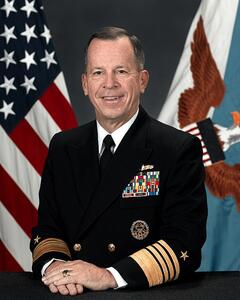
Barbara A. Perry
Good morning, Admiral [Mike] Mullen.
Spencer Bakich
Good morning, sir.
Marc Selverstone
Good morning, Admiral.
Mike Mullen
How are we?
Perry
We are good, good to see you. Welcome, virtually, to Charlottesville and the University of Virginia [UVA] and the Miller Center. You’re in Annapolis [Maryland], I understand?
Mullen
I am.
Perry
Good. I am Barbara Perry, and I had the honor of speaking with you, as you might recall, last spring. I’m joined today by my colleagues, Spencer Bakich, who is a professor of defense and national security policy and international relations at the Virginia Military Institute, and my colleague Marc Selverstone, who is a professor at the Miller Center at UVA and is a historian of foreign policy. We are very excited to have you today. Thank you for—I believe we have two hours with you, sir.
Mullen
Right.
Perry
Very good. I’m going to turn our leadership today over to Professor Bakich because he and Marc are the experts in this field. I’ll jump in if necessary, but I’m going to turn things over to them. Spencer, it’s yours and Marc’s.
Bakich
Good morning, sir. Thank you, Admiral Mullen, for joining us today. This is a real privilege and an honor. Why don’t we start, I guess, at the very beginning? This is obviously your oral history, but it’s also the project for the President. Why don’t I begin with this question: when was the first opportunity that you had to meet Barack Obama and what were the circumstances?
Mullen
I met him when he was in the Senate in an elevator leaving a hearing, as I recall. I think I was a CNO [chief of naval operations] at the time, so it would’ve been 20052007. We were both leaving the building, and I jumped in an elevator and really just said hi. I’m in uniform, so I’m not sure he knew who I really was per se until I introduced myself. The one comment I can remember from that was how much he appreciated the Navy flying him around, particularly Africa, which I didn’t know. It was like, I knew that. I didn’t know that. Like any organization, the Navy’s a big outfit, and I certainly wasn’t privy to everything it was doing. But clearly, we did fly congressional delegations around and that was one. That, I recall, was the first time I ever met him.
Bakich
Actually, I was planning on going around the horn here with the senior national security folks in the Obama administration. What about Secretary [Robert] Gates?
Mullen
Gates, I met when he came into town. He came into town to take over from Secretary [Donald H.] Rumsfeld, I want to say in December, maybe November of ’06? That’s the first time I met him, when we started to sit down and have discussions about what was going on at the time. Frame of reference here is really important. The heavy emphasis was on Iraq. Gates had actually been a member of the Iraq Study Group, which I didn’t know much about, quite frankly. I learned a lot more about them down the road from that point. He was familiar with Iraq. At the same time, those initial conversations were more a scene-setting kind of thing. I met him, clearly, as I was head of the Navy. I was one of the Joint Chiefs, but I was the chief of naval operations at the time. That’s when I first met him.
Bakich
Did you have any opinion about him? He obviously had served in multiple administrations, long history.
Mullen
I really didn’t have an opinion one way or another. That’s part of my, maybe I’d call it my strength and my weakness. I was not a Washington [D.C.] product, if you will. I didn’t get to Washington until very late in my career. Really, the first substantial tour I had in Washington was as a flag officer. I either stayed away or was kept away forever. The “this is what you do in Washington” or “this is who you are” is something I just didn’t have the background, so I really didn’t know him. I could look at his CV [curriculum vitae] and see what he’d done. I knew he’d been in and out of Washington a lot, obviously heavy in the intelligence world because of his background at the CIA [Central Intelligence Agency]. I knew he had come from Texas A&M [University] as president there, but I didn’t know much about that.
Everybody’s focused on who the new boss is, and we’d been through a lot with Rumsfeld. Rumsfeld made things happen, whether you liked him or not or his policies or not. It was pretty apparent early on that it was going to be a significant shift, but I didn’t know Gates well enough or even of him well enough to know exactly where that was going when he showed up.
Bakich
I’ve got two more for you. How about Vice President [Joseph] Biden?
Mullen
Biden, probably as vice president. I may have met him when he was running SFR, Senate Foreign Relations Committee, but it really would’ve been in passing. I think any kind of significant initial meeting took place when he was vice president.
Bakich
And finally the secretary of state [Hillary Rodham Clinton].
Mullen
I didn’t know her, but I certainly had engaged her because she was a member of the Senate Armed Services Committee. Even in that job, her reputation was significant, particularly in terms of representing New York, representing our people. She was ferocious on the issues. She studied, did her homework, and was a tough questioner in hearings. That’s how I initially met her. It was as the—I can’t remember. It may have been when I was vice chief [of naval operations] so that was 2003. That would’ve been the first time I was doing hearings in the Senate Armed Services Committee. I’m pretty sure that’s when I met her initially.
Bakich
I’d like to turn your attention if we could—Go ahead, Marc, please.
Selverstone
Good morning, Admiral. Again, thanks for joining us. I’d be interested in hearing your thoughts about the transition process itself. Your meetings with President-elect Obama, the conversations you had about his priorities, your expectations, the expectations that emerged as a result of the conversations that the two of you had. It’s a pretty essential point in any administration, as the first opportunity to really set the table. I’m wondering about your reflections on that moment.
Mullen
I came in to take over the Navy under the Bush administration in 2005. I knew, typically as the head of the Navy, these chiefs jobs, they’re four years. I knew when I took over that I would go through a transition to a new President in 2009, having no idea who that would be or what party it would be. I actually had put together a transition team for the Navy early to start to piece it together, to basically create a set of briefings and take advantage of an opportunity that you’re presented as a chief with a new administration—not just the new President him- or herself but the entire new administration team. Transition had been on my mind for several years before 2008.
Clearly, when I got the chairman’s job, that was very much on my mind, and it was in a much different and a much more significant position. It was pretty easy for me, when I took over as chairman, to put together a small group to start to think about transition again, in 2007, not having any idea who it would be. So it’d been on my mind for some time. I wasn’t a Washington creature, so I hadn’t been around for other transitions per se. I hadn’t spent a lot of time on this, but there are rumors they can be pretty challenging, presidential transitions. I would assume there’s a body of work that’s looked at that. But they can be very, very stressful for obvious reasons.
In the chairman’s job, I watched President [George W.] Bush, in the last seven, eight, or nine months of the job, really send the message that this transition was going to be a smooth one. He saved some big decisions for the new President because he knew those decisions would be hugely impactful. One of those, I’m sure we’ll talk about this, was what became the initial deployment of troops under the Obama administration to Afghanistan. When Obama chose Gates to stay and Gates agreed to stay, that settled the waters in the Pentagon in terms of transition. Whatever the specifics were going to be, it was going to make it a whole lot easier. We all knew that. In fact, that’s what happened.
The other thing that [Bush] 43 and [Obama] 44 did was they were shoulder-to-shoulder early and sent the message to the staffs, “We’re going to make this a smooth transition.” That was counter to all the lore that I had heard with respect to transitions, whether they were not just a new administration but a new party, or whether it was a new administration with the same party, which could be difficult as well. By and large, the set up for transition that both Bush and Obama created, I consider that to be hugely impactful for a smooth transition. That’s one thought.
After President Obama won the election—I wasn’t tracking the specific dates—shortly thereafter, I got a call to go to Chicago. I went with one of my aides to meet and sit down with him for the first time. I met Rahm Emanuel, who was sitting there at his offices in Chicago. I met with just President Obama and Mark Lippert, who was one of the close staffers to President Obama. He was a Navy intel [intelligence] reserve, so Mark knew a lot about the Navy. But it was just the three of us, and we probably sat for, I would say, two to three hours discussing—As I recall, essentially, what President Obama said was, OK, I’ve been running after this bus. I caught the bus. Now, I need to find out what’s on it. My response was, “The bus is loaded. It is full.”
We covered a host of issues. As there always are, there were lots of them. The three that were at the top of the list in the national security world were Iraq, which he campaigned on to get out of; Afghanistan, which he called the “good war”—in my view, there is no such thing as a good war; and then the continuing threat of terrorism, post-9/11 kinds of terrorist attacks. Those were the big three, although there were many other issues as well. My view was, it was a very comfortable meeting. It was very open in terms of the discussion and the kind of thing that, from my perspective, got us off to a good start. I didn’t stay on that good start the whole time I was there, but from my perspective, it was a good initial meeting.
Selverstone
If I could just follow up on that and particularly your last comment. You mentioned that it didn’t stay a good start, and perhaps you can speak about when the friction developed. Could you see those spots or kind of intuit what the dynamics would be at that time in that transition meeting, where you might run into trouble?
Mullen
No, not at that point, not early at all. It peaked, or it hit its nadir, I guess, in the Afghanistan Review, which was roughly a year later. September of ’09 is when it really hit rock bottom. I assume we’ll talk about that. At least initially, there were no strong indications that it was going to go south. When I say south, I mean really between the military and the White House. I use that term, “the White House,” broadly, not just the President. It was something that I was aware of.
I’m not a young guy. I’m in my early sixties at the time, and I came up through Vietnam [War]. I was here for all of that. That’s clearly in my head in terms of, how is the President and how is the Democratic administration going to approach these wars, particularly when he had campaigned to leave Iraq and Iraq was in such bad shape at the time. Although when Obama came in, it had, in many ways, turned around because of the surge, et cetera. It was really in the fall of ’09 where the relationship was at its worst, from my perspective.
Perry
Going into that meeting in Chicago, obviously Bush 43 didn’t have a lot of international experience coming in nor did Obama, except for some of his personal life. But by the time you were working directly with Bush 43, he had gotten up to speed, I presume. Did you have concerns going into that initial meeting with President-elect Obama about, one, his lack of experience in Washington, but also his lack of defense or foreign policy experience?
Mullen
Part of it for me, Barbara, I just—and this is us—we just kick into the new boss. We don’t talk about it much. We’re going to work for whoever is the President. In that regard, it’s whatever they bring. Obama was actually known to have traveled somewhat. But the background is, and it’s as true today as it was then and has been historically, very few Presidents have come in with any kind of significant international experience. Bush 41 [George H. W. Bush] had it and you could say [Richard] Nixon had it, obviously because he’d been vice president, but it’s pretty rare. And Cheney had it by way of his service as secretary of defense.
Part of it, and this is just my view of Washington, there’s not a single vote cast in the election based on foreign policy, so they don’t spend any time on it. They don’t have to spend any time on it to get elected, and then it’s straight uphill. It’s back to what President-elect Obama said: “I caught the bus. What’s here?” And it’s loaded. In my view, I don’t know what the right percentage is. As much as they’d like to get stuff done in the country, in the domestic political world if you will, at least half their life is going to be taken up by what’s going on from a foreign policy, diplomatic, national security world, outside the bounds of our shore. That’s just a fact. I sort of accepted that, and I felt it was my responsibility to help bring both him and his team up to speed as rapidly as possible on these really challenging issues.
Bakich
Did you find him, in that initial meeting, to be knowledgeable, to ask penetrating questions?
Mullen
Yes. He’s terribly bright. Well, the initial meeting, yes, but I mean throughout. He asked very penetrating questions. He clearly is a deep thinker about probably all issues, but certainly in the world I was involved in, absolutely. That was evident. At the same time, back to this initial meeting, it was very pleasant conversation. It was serious but pleasant and thoughtful. He didn’t know the details of how full that bus was, but he quickly accepted that it was full. And then he was going to have to figure out what his priorities were as he took the mantle a few weeks later.
Bakich
Terrific. Perhaps maybe we could turn our attention to Afghanistan. One of the first issues that the administration has to deal with is an outstanding request from General [David D.] McKiernan for about 30,000 additional troops. I was wondering if you could contextualize that a bit for us because it’s separate from the Riedel report and it’s separate from the Afghanistan Review, which is going to kick in in September. I was wondering if you could talk about General McKiernan’s request, why he’s made it, what he’s looking for?
Mullen
Actually, just before I hop in, I think there was an initial question about the first meeting we had as a group back in Chicago a few weeks later. This was at a time, you may recall, certainly the media was on this “team of rivals” stuff. The team of rivals meets in Chicago two or three weeks after my initial meeting with him, and everybody was there. That was a pretty difficult meeting. It was a pretty strained meeting. I didn’t find it to be very helpful, and I didn’t think anybody was particularly forthcoming at that meeting.
He had led that, and this isn’t about him from my point of view. It was pretty stiff, and I didn’t think it accomplished much. In my own mind, this “team of rivals”—I had read that book [Team of Rivals: The Political Genius of Abraham Lincoln], Doris Kearns Goodwin’s book, which was a great book—particularly with Hillary in the room, there was certainly some of that or potentially some of that, but I didn’t find it to be a very productive session. That was the initial meeting.
Perry
When you said that people were not particularly forthcoming, what did you mean by that?
Mullen
I just didn’t think we accomplished much. People were holding their cards pretty close, which is not an uncommon phenomenon in Washington, D.C. And it was much different than the meeting I had with him three weeks before that in terms of engagement. Again, he talked a fair amount about what his priorities were and how we were going to handle them. It was the initial meeting. To me, it was just kind of stilted. Personally, I didn’t find it very worthwhile. He may have, for all I know, but I didn’t.
Selverstone
That wasn’t a result of the meeting not being structured right or the agenda not being established the right way? It was just much more of a personal—
Mullen
I’m not sure. Certainly, up front, I couldn’t have told you. Maybe in retrospect, it wasn’t structured very well or the agenda wasn’t good. To me, it turned out that way. Others may have seen it differently. I just didn’t find it very helpful.
Perry
Is there anything the President-elect—he was still President-elect at this point?
Mullen
Correct, yes. I think it was in early December, as I recall on the timeline.
Perry
Two things. Is there anything he could’ve done to pull from people or, let’s say, have them show their cards? Or is this the nature, as you say, of Washington, and particularly with a President-elect and a new team, that everyone’s trying to take the measure of everyone else? These are all powerful people who have been in powerful positions. I’m just trying to determine why people wouldn’t want to say what they’re thinking. Are they just sizing up the new President-elect?
Mullen
I probably would put it, and this is just in my opinion, more in that last category. Yes, powerful people in powerful positions but not him. I don’t want to overstate. He was a junior senator from Illinois, and he hadn’t been in the Senate very long. I don’t say this to in any way disparage him, but in terms of the people in the room, he was probably the least experienced. And now he was the most powerful person—people would say the most powerful person—in the world. Some of it could’ve been trying to figure that out and adapting to that. I don’t want to overstate it. I just didn’t find it to be a very productive meeting.
Bakich
To Afghanistan.
Mullen
Yes, and McKiernan.
Bakich
McKiernan, yes.
Mullen
This is one of those decisions that President Bush put off. He didn’t make the decision because it was going to be a big deal for the new President. I admired Bush for that and do to this day. Secondly, we are driven—and I never liked the term, but there was a fact on the ground that we were driven, particularly in Afghanistan, to something called the “fighting season.” The fighting season really was the spring, summer, and fall. In the dead of winter, the Taliban leadership basically went home, or they went back to their headquarters, most of which were in Pakistan, and so the fighting was down dramatically. The idea was that we needed to make a decision relatively early if we were going to get the new troops in place and ready to fight with any kind of reasonable timeline to have an impact on that next year [2009], first of all.
Secondly, there were presidential elections scheduled initially for May of 2009. We were going to need security for that as well, although my recollection was not overly specified how we were going to lay all that in. But clearly we needed to get them there. People talk about moving brigades around, which is approximately 4,000 men and women and all their stuff, as if it were a cartoon. On one page you’ve got them in the U.S., and you turn the page and there they are, all set. It is a huge logistics challenge to do that, to get them from point A to point B, so we needed time. That was the urgency, and that’s the urgency I felt as a senior military advisor. That’s the second point.
The third point is Afghanistan was badly underresourced for years. President Obama knew that, and he knew it before he was elected. I had testified as early as—I took over the job October 1, 2007, and I went to a House Armed Services Committee hearing that Ike Skelton chaired in December. Basically, my quote that got everybody’s attention was, “In Iraq, we do what we must. In Afghanistan, we do what we can.” That got a lot of people’s attention. Skelton made me repeat that, but basically, we all knew that Afghanistan was an “economy of force” operation, et cetera. McKiernan had a mission, and he laid it out for that additional 30,000 [troops] in terms of “that’s what we needed.” That was the essence of that request.
Then when it came in, Obama asked [Thomas] Donilon and [Bruce] Riedel, I think, to scrub it. Donilon was the deputy national security advisor. They came up with 17,000, which my recollection was two brigades plus all of the enablers. So, 10,000 would be the brigades and then another 7,000 for enablers. What gets lost in the deployment issue are things like the enablers.
That was a really serious issue for Gates and the President almost the whole time Gates was there because you can’t very effectively put a brigade in place without all the other things that it needs to enable their success. But that was the main focus at the time. And I give President Obama a lot of credit. He was brand new. My sense was, against the advice of his inside team, he decided to deploy those things. He basically took what my recommendation was and he deployed them. Obviously, the Riedel study was going to occur, which became the predicate for the Afghanistan Review later that year.
Selverstone
I was going to stay with the McKiernan request again for a second. Admiral, you mentioned how the program was underresourced. I’m interested in the strategy as well. There are passages in the readings that we had that indicate it was fairly muddled, and that’s the predicate, in many ways, for the Riedel review. But if you could say something about the thinking at the time, about what the status of the strategy was and where people thought it was strongest and where people thought it was weakest.
Mullen
I don’t think there was much of a strategy actually. It was difficult. Even if we had a well-thought-through strategy from a national perspective, it was so badly underresourced that—this is ways, means, and ends. You weren’t tying your resources, because you had so few, to some endgame where there was an overarching strategy. That became a key issue for [Stanley A.] McChrystal when he finally went in: OK, what is the strategy? And then, What’s the mission that’s associated with that? Honestly, I think in Afghanistan at the time, because Iraq had just sucked off so many resources, so much focus for so long, it was one of these things we were doing the best we could, but that was about it.
Bakich
The Riedel report, or the study, that is the predicate for the full-blown review, that is—as best I understand it—something that isn’t conducted through the Pentagon. It’s not something that’s conducted through ISAF [International Security Assistance Force]. It is born out of the National Security Council [NSC]. I was wondering if you could comment on the process as you saw it and, in particular, if you and your staff had any input into that creature.
Mullen
I didn’t, for sure. I don’t think I was interviewed, as I recall. I didn’t know Riedel. Gates clearly knew him because Riedel worked for Gates when he was at the CIA. And I think in Gates’s book, in one of the readings that you provided, Bob thought a lot of Riedel. That in and of itself carries a lot of weight for me because I have a lot of time for Gates. At this point in time in my relationship with Gates, I had a lot of time for Gates because I knew him pretty well. That’s one thing.
You can figure out the timing of this. The other—I wouldn’t say it’s in the shadows, but it’s in the background—was the general concern about not getting bogged down in a war, the quagmire piece. One of the books that was sort of making the rounds at the time was McGeorge Bundy’s book, Lessons in Disaster, which Rahm Emanuel was handing out like popcorn. Essentially the message is, “Hey, we do not want to end up like this.” There was that kind of pull on the backside of everything that we did. I think that sort of ran through that year as well. I can’t remember exactly when Rahm was handing that out, but it was in that time frame. That was one of the messages. We do not want to get pulled into anything close to, like, Vietnam. We want out of Iraq, and we want to make sure we’re not in a quagmire forever in Afghanistan. That’s the backdrop of it.
I thought Riedel’s report was a good report. I don’t take particular issue with it. That’s to say, how much he passed it through the Pentagon or used the Pentagon, I honestly don’t know. I was not privy to it. But it was very clear that President Obama had made up his mind that Riedel was going to do this, before I ever heard of it, to try to get some relatively independent view of what we were doing there, which I thought was fine quite frankly. I had no problem with that. And then I thought the work that Riedel did was pretty good in that regard.
Bakich
Would it be fair to characterize that report’s conclusion as advocating for a fully resourced counterinsurgency strategy?
Mullen
I honestly can’t remember. If that’s what he did, it was certainly along the lines of a well-resourced COIN [counterinsurgency] effort. This is something that researchers can look at over time. It was very clear, and it’s clear now to me, that coming out of Iraq with COIN being as effective as it was there, to turn around that disaster—I was intimately involved in that—that that became the natural follow-on for, “If it works there, then that’s probably what we ought to be doing here.”
In my view, looking back on it now, what we didn’t do well—which we never do well in wars—we didn’t really understand the differences between Iraq and Afghanistan, the cultural differences, et cetera. That doesn’t mean that COIN wouldn’t have worked there. But there was too much of a direct translation from Iraq to Afghanistan, where we didn’t pick apart Afghanistan well enough to understand the deep background there to adjust a COIN strategy accordingly.
Selverstone
Can I jump on that notion of the Bundy memoir that you mentioned? Gordon [M.] Goldstein brings those reflections of Bundy together in the book, and I think he publishes it in late ’08 and it becomes kind of a cause célèbre in ’09. The literature indicates that that book is certainly passed around the White House and gets a lot of people’s attention, particularly in the NSC.
But at the same time, in what has come to be known as the “battle of the books,” there’s another book supposedly making its way around the Pentagon. That’s [Lewis] Bob Sorley’s A Better War, which is his description of how things went in Vietnam from essentially ’69 through ’72, in which he makes the case that the war actually was going pretty well and that if it had not been for a variety of actors on the domestic side, we might’ve been able to achieve higher levels of success. Is that an accurate picture, given your memory of that summer of ’09, in which these two competing versions of the past were duking it out for the soul of America’s Afghanistan policy going forward?
Mullen
If I’m honest with you, I have never heard of that book even as you speak, which would be an indication that obviously it was not making the rounds in the Pentagon, certainly not at my level. No idea. The other thing is—and this is me, because I was there for Vietnam—I deployed there. I grew up in that time frame. I was there when the military got blamed for the wars, all that turmoil, sixties, seventies, et cetera. I know who Bundy was, I didn’t know him. But I’m familiar with that team and how poorly they were able to put the strategy together to make sense of it over time. To me, that’s the overriding message of something like Lessons in Disaster.
My take on it was—again, back to Rahm, and I’ve got a lot of time for Rahm. We’re good friends. We weren’t good friends at the time, but we’ve become good friends. There was this “we can’t go here” aspect of this, whatever we do. From my perspective, in many ways, it set the backdrop for what Afghanistan was going to become under the Obama administration. I didn’t say it this way. You talked about 30,000. What’s on the front page every day is how many troops are there, and how many have died, and how many have been wounded. That’s bad news in the political world for any administration but particularly the Obama administration.
As much as, over time, I would try to drive the discussion in the Situation Room away from the number of troops that were deployed. Everybody at the table is an expert. I’m the only military guy at the table, by the way, but everybody there is an expert. [James L.] Jim Jones was there. Jim had a lot of experience in this regard. But as I would try to drive the conversation to corruption or rule of law or governance, it would just drive right back to the headlines kind of thing. I was never very successful in getting those issues front and center, which were absolutely critical, to execute the strategy if we were going to have any kind of success starting with the 30,000, which is where we started this conversation today.
Bakich
One of the other, I think, major differences between Iraq and Afghanistan is the role of Pakistan. You, as the chairman, I’m sure, had ample occasion to talk with your counterparts in Pakistan. This is clearly an issue for the Obama administration. We get the AfPak [Afghanistan-Pakistan] label that pops up right about this time. How concerned are you about the role of sanctuary that the Taliban is having and its likely effect on any counterinsurgency effort?
Mullen
Hugely concerned, and it almost makes what we were doing unwinnable. For me, this does go to Vietnam, and it goes to Laos and Cambodia. You can’t win a war if you’ve got a country next door that’s essentially covering for and providing sanctuary for the enemy. As I got deeper and deeper into Pakistan—in the four years, I think I made 27 trips to Pakistan and then met with [Ashfaq Parvez] Kayani, who was the chief of staff of the army, not just those 27 times but probably a dozen more times in various places in that part of the world. What I was trying to do was have as much impact on the Pakistanis, minimizing the safe havens or the sanctuaries, to give us a fighting chance in Afghanistan.
You’ve hit on two really key issues. This is in retrospect, but between the sanctuaries in Pakistan and the lack of effort on these other aspects of Afghanistan—rule of law, governance, corruption, et cetera—it almost made it unwinnable even though we went through a strategy and tried to support the strategy. That was Pakistan for me. I came to know them exceptionally well. It’s an incredibly complex country with a very complex history.
I can’t remember when it was when I was chairman. I had a really bright guy that was running my study group—we call them CAG, chairman’s advisory group—that would go off and look at hard problems and try to pull a study together in a relatively short period of time. After a number of trips to Pakistan—and this started in the Bush administration—I came back and told [James H.] Jim Baker, who led this group, “Take what Pakistan has executed over the last 5 or 10 years, and from the execution, piece together a strategy that you would say, ‘OK, if this is their strategy, this is what they would’ve done.’ From execution you can do that, and then come back and tell me where they’re headed.”
He went off and studied that for three or four months, came back, and briefed me. The briefing was set up where I would be General Kayani, so I’m the chief of staff of the Army, and Baker is briefing as the three-star corps commanders, who are the individuals that basically run the country in Pakistan. Essentially, the title of the brief—I didn’t need to go a whole lot farther—but the title of the brief was “The Fourth Betrayal.” That was true because all Pakistan was doing—because we weren’t there in ’65 for them, we weren’t there in ’71 for them, we left in ’89 —they were just waiting for us to leave again. Overcoming that is an extraordinarily difficult problem. We didn’t overcome it, even to this day. What I was trying to do was get Pakistan as far onside as I could to protect my people who were fighting this war in Afghanistan.
Bakich
Sir, if I could, thinking as a scholar, in 25 years when I go back and read this transcript, you used the word “unwinnable” or “almost unwinnable” twice. I want to be absolutely clear about this, were you thinking that at the time or is that a retrospective judgment that you’re thinking?
Mullen
No, it was almost unwinnable because of Vietnam for me. You can’t do it. That’s the correlation, which I think is a—it may not be a perfect correlation, but it’s pretty close.
Bakich
Thank you very much. Then in May of 2009, a decision is made to relieve General McKiernan and instate or appoint General McChrystal. Can you talk about the decision-making that went into that? Where you were on the change in command?
Mullen
The day that I actually remember vividly was—and I think you pointed it out here. I can’t remember how often. Every couple of weeks we would have a VTC [video teleconference] with McKiernan, Gates, myself, and [David] Petraeus, who was CENTCOM [Central Command] at the time. I didn’t know McKiernan well. I had recommended him a year before at the behest of George [W.] Casey [Jr.], who knew him well—George is a good friend, and I had a lot of time for George, chief of staff of the Army—that he was the right guy to go in there. I actually knew Dan [K.] McNeill. I’d gotten to know Dan pretty well because Dan was McKiernan’s predecessor.
At this particular point in time, I was sitting with Gates, and Petraeus was down at CENTCOM on VTC. The questions that were asked, I can’t specifically remember; but at the end of that particular session, I was really uneasy with the answers that we were getting from McKiernan. I literally left the meeting, called Petraeus, and said, “Here I am. What do you think?” He said exactly the same thing. I said, “Well, then we’ve got to go to Gates and say we’ve got to move McKiernan.” That’s what we did very quickly. I don’t know if it was that day, but it was within a very short period of time. Bob Gates has said it well. I had the same feeling: I’m losing kids every day. I have to be able to sleep at night knowing I’ve got the best person in that job that I could possibly have. I didn’t feel that way, Bob didn’t feel that way, and neither did Dave Petraeus. That was it.
Much has been made of the first time we’d taken a four-star out since [Douglas] MacArthur. In fact, I didn’t even know that until well after it was done that that was the case. That was irrelevant as far as I was concerned. I’m driven by having the right people in the right job at the right time. I’m decent at it, I know that. And it was very obvious to me, even as a sailor at this point in time—now I’ve been dealing in ground wars for a couple of years, and I just knew he wasn’t the right guy. For me, it wasn’t like there was a big prior buildup to that, but it was literally that day—whenever it was—that I decided he was the wrong guy for it. Petraeus did as well. We went to Gates, he agreed, and that’s when we started the trains moving to make that change.
Bakich
Was it a matter of timidity or lack of strategic perspective?
Mullen
It was a combination of things. I’d have to go back and look at the questions we asked and the answers. We just weren’t getting answers that were taking us in a direction that we thought was the right direction. It wasn’t that he was going in the wrong direction, he just wasn’t moving quickly enough. I just knew it in my soul that he wasn’t the right guy. Gates has said it more than once. It wasn’t anything against him. What I would call in my world, it was a bad detail. It was a bad assignment. That doesn’t mean he couldn’t have been a great four-star somewhere else. He wasn’t the right guy at the right time in the right place, and we had to move him because, as I said, young ones are dying.
Bakich
General McChrystal has a reputation of being one of the most effective counterterrorism operators on the planet at the time. Did you have any concerns about General McChrystal’s appointment, or did you, to borrow your phrase, “know it in your soul” that he was probably the right person for the job?
Mullen
I thought he was the right person for the job. There was no question about that. I had brought McChrystal to my staff in from Iraq and Afghanistan where he was running the special operations world. I had watched him from the time I was CNO, actually, because I had SEALs [Navy Sea, Air, Land teams] who were involved in that. I thought McChrystal had, particularly for a SOF [Special Operations Forces] guy, and I had spent a fair amount of my life around SEALs and SOF, I watched McChrystal open up the aperture to be much more inclusive throughout his AOR [area of responsibility] than I’d ever seen any SOF commander do. He was extraordinary.
I also watched him—when I first went to Iraq in 2004, I was actually stationed in Italy. I had a NATO [North Atlantic Treaty Organization] four-star hat, and I went to Iraq for the first time. That’s when I first met McChrystal. I knew how far behind we were in the IED [improvised explosive device] world in particular. From 2004 to roughly 2006 or so, or the next couple years, I watched McChrystal take that speed issue when we were way behind, catch up with the enemy, and actually get ahead of the enemy. He was extraordinary in that regard. I watched what he did, not just focused on Special Forces, but I watched his influence implemented by conventional forces as well because he was so spectacular on the ground.
I brought him in to be the director of the Joint Staff, which is where he was when we decided to move McKiernan, to see him up close and personal. I told him, “I want you to do with the Joint Staff what you’ve done with the SOF community, open it up,” because we were pretty stovepiped. I had great confidence in Stan in that regard.
There’s irony here. I can’t tell you the amount of time I spent with Stan talking about his public posture. And this, again, was back to my focus on developing younger people. I never saw a three-star that went to a four-star job that didn’t have to grow immensely. The challenge for Stan was he was going to have to grow under the klieg lights because he was going to Afghanistan. We spent a significant amount of time—and here’s a community that isn’t inclined to talk to the press. They’re told from day one in SOF, “Stay away from the press.” He was going to have to figure out how to talk to the press, and he was going to have to figure out how to grow literally under the bright, shining lights of the world because of where he was going. Several months later, sadly, that became his downfall.
Bakich
Secretary Gates writes that General McChrystal goes to Afghanistan, and it doesn’t take long for him to report back, “Things are much worse than I feared.” What is he initially reporting back? What are the types of things that he’s finding are problematic, troubling, all that?
Mullen
First, there’s a lot more Taliban. Secondly, the effectiveness of their campaign, in terms of the totality of the country that was infested by them, and that it was going to take a lot more resources, particularly because we started going down the COIN path pretty quickly. If we were going to do a fully resourced COIN campaign, it was going to take a lot of troops to do that. My view anyway, and this is fairly standard stuff, but the biggest mistake we made was to tell Stan to give us a written report. In retrospect, I wouldn’t have done that. I wouldn’t say, “Write it down,” because that became very visible and eventually it leaked.
I would go into Iraq and Afghanistan about once every quarter. On one of my trips—it may have been the first trip, certainly no more than the second trip after Stan got there, but probably the first time to just sit down with him. I knew a little bit about how he was doing this assessment, et cetera. But I can remember the two of us sitting down on that trip, and he said, “I think I need 80,000 troops.” It stopped the conversation at this point, back to numbers, if you will. That was going to be untenable. Literally, when Stan told me that, I got up from the table. I called Gates, and I said, “Just to let you know, this is where Stan is right now.” I said 80,000, and the other end of the phone just went dead. He didn’t hang up, but—we quickly got to 40,000 because we reduced the mission size that we were going to try to effect. That became the pivot point for the 30,000 versus 40,000, 30 eventually that got to 30 plus 7 or 8 from our allies that got pretty close to 40. That initial, Holy criminy, I had no idea that it was going to require that many troops given where we were. Basically, 80,000 was going to be impossible for this administration.
Bakich
If I could, the way you talk about pushing the 80 to 40 is to change or downgrade the mission set. Can you clarify that please?
Mullen
Basically, there were parts of the country we were just going to not pay—they’re all dangerous but were less dangerous and less of a priority than we would’ve covered with the 80. That’s how we did it. That issue, because this becomes an issue in Iraq as well when President Obama wants to leave Iraq, I went through I don’t know how many meetings. I think this was mostly 2010. Afghanistan was 2009, and then we turned our focus on Iraq and downsizing and leaving Iraq.
My approach to this, both in Afghanistan and Iraq, was, This is the mission you’ve given us. This is what we need to do it. If you want that number to be less, we’ve got to change the mission. I went through I don’t know how many meetings on Iraq, same thing: to get to, I think, initially 25,000, then down to 10,000. And you get into this situation, in both countries quite frankly, and essentially in Iraq—we’ll probably come to this. But in Iraq, if you get below 10,000, it should be zero because all you’re doing is protecting yourself. You’re not accomplishing any mission. But we really always tried to focus on, OK, what’s the mission and what’s it going to take to carry out that mission?
Selverstone
With those 40,000 that you were looking at, there’s still a sense—and this is something of a holdover perhaps from Riedel as well—that while you’re going to leave certain areas of the country more or less untouched, you’re not going to focus on them. With those 40,000 and the areas they were going into, you were still pursuing something close to a fully resourced counterinsurgency.
Mullen
I would argue, Marc, that in the areas where we were going to put troops, that was still the goal, fully resourced there.
Selverstone
And then inkblot out and try to connect.
Mullen
Yes.
Bakich
It’s around this time, I believe, that you get an alternative to a fully resourced COIN model, and this is the so-called “counterterrorism plus” idea championed by Vice President Biden. Do you have anything to say in particular as to the merits or demerits of that approach? Was it as big a divide as, subsequently, folks had made it out to be?
Mullen
I don’t think it was as big a divide in terms of both its discussion and the likelihood of it occurring—in other words, being chosen. Biden was pretty much out there by himself, first of all. Secondly, because I’ve got the leading CT [counterterrorism] guy in the world on the ground in Afghanistan who was saying, “This just isn’t going to work,” beyond that I didn’t pay much attention to it. It was fairly divisive inside the process because it was essentially done behind my back and behind Gates’s back. Gates talks a little bit about this in terms of how he describes my deputy, [James] Hoss Cartwright who played very much to the senior White House staff because he was giving them what they wanted, which was a smaller footprint. And it was an additional option. The President took me apart more than once, saying, “I need more options here.” I didn’t have any problem putting an option together. But the idea, given the mission, that there were a dozen options to carry out the mission, that wasn’t the case. There were two or three of “how to do this.” This is where Biden was from the beginning. Biden wasn’t overly supportive of us being there in the first place. My own opinion on that is that this was a way to get the footprint down as much as possible, and it goes back to this backdrop of Lessons in Disaster—we don’t want to get into quagmire, all of that kind of thing. It was part of the conversation, but my own view, as I recall, is we didn’t spend a lot of time on it.
Perry
Admiral, I’m really struck by the growth in leadership from a three-star to a four-star general or admiral. Were you seeing in the commander in chief by this time, as you’re going through all of these various options, are you seeing growth in him from President-elect to President?
Mullen
Yes. It’s a great question. Probably the easiest way for me to answer that is, it just was never questioned in my mind because he worked his tail off. He was known to study. He asked a thousand questions—deeply reflective, terribly bright. Part of it, again for me, is he didn’t have a lot of choice. There was no place else to go. He is the President. From my perspective, I saw him very well matched for that growth requirement.
Perry
Thinking as well beyond all of the things on the defense and foreign policy bus, but I noted at one point you had said that your view of the U.S. debt was one of the most dangerous elements to our national security. At the same time that President Obama and his administration are having to do all of this in the defense policy, war policy area, there’s also this worldwide financial meltdown they’re having to deal with. Just your thoughts about that.
Mullen
The main thought is, Why would anybody want this job? It’s impossible. I know the scope and scale of my world in the national security side. I don’t know what the right percentage is, but I’ve sort of divided it into 50-50. I literally never sat in on a domestic policy discussion, but that’s got to be at least half his life or any President’s life. That statement is ringing true even today. The question was, a reporter said to me—I can’t remember exactly what the venue was, but I was walking down a passageway. I had a good relationship with the Pentagon press corps. One of them asked me what the biggest, most significant threat was, and I said our debt. Of course, that’s not what the military guy is supposed to say. He’s supposed to say China or Russia, or you pick the weapons. But it wasn’t a flippant statement. It’s something I’d given a lot of thought to.
Philosophically for me, I had grown to understand and believe that growing economies around the world generally makes my work a lot easier. If economies are going south year after year, that part of the world becomes much more unstable. In that instability, that’s where, quite sadly, the military oftentimes has to go to work. I’ve always believed that if you can lead with a strong economy, you can almost do anything else. That was the backdrop of this.
Now, because I’m curious about this stuff at the end of the Bush administration and I knew [Henry M.] Hank Paulson [Jr.] fairly well, I just had a sense—and Paulson would become part of the national security apparatus on occasion in terms of the meetings in the Situation Room—I knew that this was not going well. Although I didn’t know the details, as the economy was coming to a crash, but I was infinitely curious about the details of it because I just was. At the same time, Obama’s trying to put it all back together after he takes over with what was going on as well. To this day, it’s one of these things that I don’t know how you do the job when you look at the totality of the requirements. They’re just staggering.
Bakich
Any strategist who knows means-ways-ends looks at the means and they’ve cratered. There’s not much there to work with.
In September of 2009, we begin this very long strategic review process. The way you’ve described it is, a lot of the different options are already on the table. I was wondering, rather than march through this day by day, perhaps you could give us a sense of how that review process unfolded, whether you thought that it was particularly effective in uncovering the core issues at stake, and then perhaps maybe we could get into the nature of civil-military relations as this process unfolds.
Mullen
We’ve set a little bit of this backdrop at the beginning of the discussion about the relationship. You’ve got a new President. We’re working for the new President—You tell us what you want us to do, and we’ll go carry it out. We’re not going to fight you on it. We want to support the new administration—that’s the approach. We get into this review, which was unbelievably intense, exhaustive, and thorough over a couple months. I think you said there were 10 meetings. It felt like, to me, there were a lot more than that. But it was also tied to the President. It’s what he wanted to do because I think he knew the significance of the decision that he was being asked to make. And this was going to be, Am I in for Afghanistan or not?
I never had a problem with the amount of time because I understood the seriousness of it. It was less about the detailed review, which was extraordinary, and it did cover every single dimension of what we were doing, and it included the commanders. It included Petraeus. It included commanders on the ground. It included CENTCOM, et cetera. And we’d obviously been through the McChrystal change-out at this particular point in time when this hit. Now it’s [James N.] Mattis and Petraeus. I thought the level of depth and the level of detail was fine. I am inclined in that direction myself, meaning I don’t want a 10,000-mile screwdriver, but I want to understand the situation and the details well enough to be able to make a good decision. I didn’t have any problem with it.
What really broke it apart was the leak of the assessment that McChrystal had done that [Bob] Woodward got. In fact, the weekend that it leaked, I was overseas somewhere. I think as Gates points out in his book, he and [Michèle] Flournoy and Cartwright spent a fair amount of time trying to get as much of the potential front-page story off the front page as they could with Woodward. It was the headline in terms of what was coming. It became de facto what Rahm Emanuel had been talking about with the military: “boxing in” the President. How we got there—and I can talk a lot about that—it’s almost irrelevant. Like it or not, the President was boxed in when that thing hit the street. One of the things you don’t want to do to the President, any President, is box him in. You want to give him as much space to make decisions as you possibly can. Gates writes about this, but there was never any intent to do that. In fact that’s what we did.
I can remember coming back from that meeting after it broke in the press. I came back from overseas. I can remember coming back from that meeting and talking to the chiefs that essentially our relationship with the President has hit bottom. We have boxed him in, and he’s going to wear the scars of that for the rest of the time he’s President. And I would argue that he did. I don’t mean that in an overly critical fashion. That’s just the human nature of it. He did. Also, at the same time, there’s the [Michael] Gerson interview that Petraeus gave. I was going to the Hill [Congress] to testify for my second term to Senate Armed Services Committee. I’ve been to a lot of hearings, so I understand the rules there. [John] McCain worked me over hard in terms of, “Do you need additional resources?” I said, “Yes, we need additional resources for Afghanistan.” I wasn’t, in any way, shape, or form, trying to influence what was going on in terms of our review, but that was my view at the time, that we needed additional resources there.
I can remember coming back from the Hill—and we had a meeting in the Situation Room later that day—I can remember standing outside waiting for whatever group was in the Situation Room at the time. Rahm Emanuel’s standing there, and he is beet red, boiling. He said something along the lines of, “That’s going to be double black print headlines in the New York Times tomorrow, what you said.” There was never any strategic intent to do that. Effectively, we boxed him in. In the end, Gates took a lot of heat from all of that as well. I tried to mitigate it, if you will, that there wasn’t any strategic intent. We didn’t do this intentionally. When I talked about the relationship, which was, I thought, good when I met him by myself, it had now gotten to this point where it was not. It was exactly where I didn’t want it to be because part of it for relationships for me is, do you trust each other? The answer to that question is certainly, at that point, no.
Bakich
Rahm Emanuel is mad. The vice president, I’m sure, is voicing his displeasure. What are you getting from the President to suggest that he is looking at you specifically or perhaps maybe the military community from a distrustful perspective?
Mullen
Very little. Obama was not one that paralleled his staff very much. My own view is he was his own guy. He was pretty cool. I never saw him lose his temper. He understood these were extraordinarily complex issues, so it was much more a staff reaction. Honestly, while I knew Biden was ticked off, I never saw much of that. Biden didn’t relay that personally or anything like that. To give the Obama team credit, in however many sessions we had in the Situation Room over the two and a half years that I was chairman, we had good debates and good discussions about what the issues were. Then Obama would go back to the Oval [Office] with whatever part of his team he wanted to try to come to grips with the political implications of whatever the major decision was.
While Rahm is Rahm—and you get Rahm, boom, Rahm is out there—you know exactly what he’s thinking right when he’s thinking it. One of the guys who was in the room for all this was David Axelrod, but Axelrod never engaged in the Situation Room. He took it all in, and then he and Obama—I use David, and I like and respect David a lot because he did handle it that way—he and Obama and the team would figure out what they were going to do. By and large, Obama was pretty much his own guy. Again, he didn’t either parallel or reflect sometimes the disdain that the staff would reflect back towards the Pentagon. Obama never did that that I saw or felt.
Perry
Could you contrast that approach of Obama to his staff and the one generally with President Bush 43?
Mullen
There’s a fun story. Right when Obama came in, Gates and I did—two weeks in or three weeks into the Obama administration, he and I do separate Sunday morning shows. I do Meet the Press, he does [George] Stephanopoulos, or vice versa. Of course, one of the questions that comes up, “OK, you’ve been with the new President for a month. How about comparing the two?” I demurred. Gates, who lived in quarters right next to me, by the way, in a compound across the street from the State Department—Gates decided to answer the question. This was Sunday morning. I saw Bob that afternoon on his porch, where we would often spend some time talking about all the issues that we had and where we were going with them. And I said to Bob, “Why did you answer that question?” He said, “I have no idea why I answered that question,” because the White House was not happy when he answered the question.
I’m loath to do that. I’ve not compared the two ever. Clearly two different individuals, two patriots, two different styles, and quite frankly two different times. I come into the Bush administration in ’07. Iraq has just sucked all the oxygen out of the room for at least four years at that point. He’s thrown this Hail Mary called “the surge.” As I take over as chairman, we’re in the middle of the surge. In many ways, Iraq turns around. They were beaten down as an administration. One of the reasons I got into the chairman’s job was because Bush, who wanted [Peter] Pace to come in for the second two years, Bush didn’t—Gates goes to the Hill to see [Carl] Levin and McCain and said, “OK, this is what we’re going to do.” Both of them say neither one of them is going to support Pace. Gates—who didn’t come to town to throw gasoline on fires, he came to town to put them out—comes back. And Bush doesn’t have enough lift on the Hill at this point to get Pace across the line. Gates and Bush decide to ask me to take that job. It was such a different time in the two administrations that it’s almost unfair to compare the two. And then you have Obama, Hope and change and here we go. We’re going to make the world a better place. Again, just totally different environments in which I was working.
Perry
Just a quick question on media because you’ve mentioned that and the press several times. You said you had typically good relations with the people who covered the Pentagon. Typically, when we do these [interviews] for a day or day and a half, we go back to the person’s roots. I was reading the oral history that you did about your youth and your early life—which is fascinating, by the way—but you come from a completely different world. As you’ve said, you weren’t of Washington. You didn’t grow up in that realm. Yet, both of your parents were in this kind of a PR [public relations] setting in Hollywood. Does that have an impact on how you view the press? And as you use the term “klieg lights,” having to do your daily job in the klieg lights or knowing that everything you’re doing and all the decisions you’re making are going to end up under the klieg lights and the microscope.
Mullen
Big time. Integrated into that, including where I was from, was Vietnam. That was very much a part of my life because I served there, I did a tour on the gun line there, and all that we’ve talked about tied to what was going on in the country back then. My dad was a big-time publicist in Hollywood and was a journalism major from the University of Illinois. My mom lost her farm. They were [Great] Depression kids, went to California to follow their dreams. They both ended up working at Republic Studios. My dad got his first job in the 1940s when he graduated from University of Illinois on the road with Gene Autry, who was a famous cowboy at the time, and then turned that into a really successful, very high-end public relations career. You’ve seen some of the names that he handled. He handled the whole Gunsmoke show. He handled Ann-Margret, Julie Andrews, Rod Steiger.
Perry
Cliff Robertson?
Mullen
He ran Cliff Robertson’s Academy Award–winning campaign for Charly. He didn’t have him normally, but he got hired to run the campaign. As it is today, the deal is you get so much compensation if you get into the finals (the top five), and then you get so much more compensation if you win it. What struck me about that was Robertson was up against as tough a group as has ever been put up—Peter O’Toole, Alan Arkin, Alan Bates. It was one of those years where every single performance deserved it. And by and large, Robertson was handicapped five of five, and he won the thing.
I was raised on the fourth estate. My dad was a great writer, and so messaging was important. I absorbed that. I love reading. I love writing. I was very comfortable with the press. It doesn’t mean it was a holiday every time I was in front of the press for sure. But I also—and this was true on the Hill for me as well—I’m one of the few individuals I know that actually enjoyed going to the Hill to testify. In great part, it was because with the press as well as on the Hill, there was an opportunity for me to message a lot of people on these issues. I could answer their mail and, at the same time, message troops around the world, troops who are fighting, families who are suffering, the American people.
A big part of it for me was the American people. I wanted the American people to know that we were at war, that we were losing kids. I tried to put a face and a name on the machine that was in charge of all that. That was me. My wife and I went to countless funerals at Arlington National Cemetery with these particularly young families. I argued for—and I give Obama and Gates a lot of credit—opening up Dover [Air Force Base] because I wanted the American people to see what we were doing and say, in this democratic society, “Yes, we want to keep doing this,” or, “No, it’s too much, we’ve got to stop.” All that goes back to Vietnam for me, where nobody wanted to be in touch with what was going on there. We got blamed as a military for the wars, et cetera. There was a lot that I grew up with that impacted me, and I wear the scars of that time literally to this day.
Bakich
We reached the end of the review process. We’re in December. We have an agreement, or a decision is reached. We’re looking at three brigade combat teams from the United States, another brigade from NATO. The President is insistent that there is a one-year time limit on the surge. How did you feel about that setting of a public date certain?
Mullen
I was pretty comfortable with it. I know he got beat up pretty hard for it, but I supported it. It wasn’t just because that’s what the President decided. I actually was fine with that. When you look at the ticktock and when forces got in—and Gates talks about this in his book—Jim Conway is running the Marine Corps. Marines are sitting in western Iraq with nothing to do because Iraq was very quiet at that point. Conway said, “I want the Marine Corps to go where the fight is,” so we had moved, my recollection was 10,000 marines, into Helmand Province in Afghanistan. They had gotten there, I want to say, summer of ’09.
My strategic take on this was between summer ’09 and summer ’11, that’s two years, and if this isn’t working by that point in time, then we need another strategy. That’s why I was comfortable with his decision. We can all agree or disagree on whether that was a smart decision or not. It almost, from the perspective which has always been the issue there, is that the Taliban can outwait us all, and that’s true ad infinitum. I didn’t have any problem with it. I thought we were going to have to change the calculus within that—at that point it was 18 months but within 24 months from the time that we had put a significant number of troops into Helmand. And if we didn’t, we needed a different approach.
Selverstone
Admiral, was it your sense that this was also a politically attractive time horizon for the administration?
Mullen
Yes, I think it was in some sense. Honestly, my take on that, Marc, is it was more the reality of, Obama just wasn’t going to do it a whole lot longer than that.
Selverstone
On that, I’m thinking about the remarks that Obama made on the campaign trail initially and then as well when he became President about this being—and you had mentioned it yourself—the “good war” as opposed to the “bad war,” and also a “war of necessity” as opposed to a “war of choice.” Do you think that Obama started to think that it maybe wasn’t as much of a war of necessity?
Mullen
We never really talked about that. I never heard him talk about that. He dropped the “good war” discussion relatively early, I think, in his tour. Even to this day, as bad as the Iraq War decision was, I believed then and clearly believe now, we had to go into Afghanistan because of 9/11 [September 11, 2001, attacks]. How you manage it beyond that, once you go in, is certainly open for debate. In that sense, I think it was a war of necessity. I’m one who has learned that if we’re going to go to war, by and large we should have limited objectives, well thought through, and then stick to those limited objectives. Bush 41 did that in Kuwait and Iraq in 1991. That’s kind of the model for me, is to not overreach. Clearly, we overreached in both places.
Selverstone
Spencer, I don’t know if you now want to move past the West Point speech, but if I could just bracket this point for a second by going back to this dynamic of the President being boxed in, whether it was intentional or not. Admiral, is it your sense that the reality of Obama being boxed in—the extent to which that compromised the process perhaps on the one hand but then the outcome of the review on the other?
Mullen
In the end, and I give the President credit for this, I think he didn’t allow it to, quite frankly. It was much more a staff reaction, including the vice president, than it was anything else. I think he trusted Gates, there’s no question about that. As I think most of us know, Gates was working for his eighth President at the time. I think he used Bob in that regard exceptionally well and drew his conclusions, in many ways, based on what Gates specifically either talked to him about, wrote him about, or recommended.
One of the nice things about having—back to the initial question on Gates, I didn’t know him, but Gates and I, we saw a lot of the world the same way. I could be around the world, something would go south badly, and within about 90 or 95 percent probability, I would know what his reaction was going to be, and he would know mine as well. I think that decision that Obama made, one, to keep him—back to his inexperience level—was a brilliant decision, and that helped Obama evolve rapidly in this job from a national security perspective.
Bakich
June 21, 2010, the Rolling Stone article comes out.
Mullen
Lousy day.
Bakich
Why don’t you go ahead and describe it for us, and tell us what you thought needed to be done?
Mullen
Maybe 30 minutes, I’d had the article on my desk. This is midday. My staff had walked in and said, “You’ve got to read this.” I was about halfway through it when McChrystal calls me from Afghanistan. I told him, “Look, I’m about halfway through this.” As I recall, he goes, “Do you think I should come back?” I said, “Yes.” “Do you think I should write my resignation letter?” I said, “Yes.” We just hung up. He didn’t offer any excuses. I’ve got a lot of time for Stan because he took full responsibility for it, even though in the end his staff is the one—I mean, he’s in charge of his staff, he gets that—but his staff is the one that essentially undid him.
I think it does go back to what I said earlier about Stan and the naivete about the press because this guy was known as a pretty harsh critic and, yes, investigative reporter. That and the combination of sitting down in a bar with him with the staff in Paris on a trip was his undoing. But yes, that really threw a wrench into the works after everything that we had done to get Stan to that point.
He’s on his way back, and Petraeus and I are on the—I’ve talked to Gates about it at this point. I went up to see Gates, but there were no decisions at this point. We certainly knew that he was in jeopardy in terms of staying in the job, instantly. I can remember going back to the office and essentially getting Petraeus on the phone. We started talking about who we might put in there. We need to give that some thought if the President makes a decision to relieve Stan.
At the end of that conversation, one of the things I said to Dave—and we were talking about a handful of people—I said, “You need to think about whether or not it ought to be you and whether you’re willing to do that.” I had seen Dave come out of Iraq with no gas in the tank, literally no gas in the tank. I knew how exhausting these jobs were. He’d been back a while now running CENTCOM. If the President decided to put him in there, I thought he was ready to go. But when I said that to Dave, to me, there was a sort of pause on the end of the phone line. In the end, he was the one that the President picked to go do it. Stan came back, I saw him, Gates saw him, he saw the President. The President made a decision to relieve him.
Honestly, I think the President could’ve—he was in a position, even though it was a really bad situation, where he could have done either. He could’ve not relieved Stan and essentially never worried about Stan again in his life and take advantage of his background in what is the most critical undertaking of his administration. Or you can relieve him, put somebody else in there. I think he was under a fair amount of pressure to take that step. Gates and I both separately spoke with the President, “Call me and talk to me about it,” and I recommended he not relieve him. I think that’s true for Bob as well. I don’t know if Bob addressed that in his book or not, but I think that was Bob’s recommendation as well not to relieve him.
Bakich
Yes, he said that he felt that the White House gave General McChrystal the bum-rush.
Mullen
That certainly could be true. I don’t know. My own view of that is, in many ways, Obama was his own guy. Despite the bum-rush, he made that decision, I think, by and large by himself. It was a pretty quick decision, but at the same time, he thought it through. I knew he would because I’d dealt with him enough now. He wasn’t just going to off-the-cuff this stuff. But then that also gets back to the lack of experience. Is he experienced? Does he know? We talked about that early in this interview today. Some of that may have been just because he needed to show who the boss was.
Bakich
General Petraeus is tapped. Just out of curiosity, did Petraeus ever tell you, I don’t want this job?
Mullen
No.
Bakich
He goes to Afghanistan. Does he make any substantive changes to the strategy, to the approach that McChrystal had instituted?
Mullen
He didn’t make any substantive changes to the strategy. I think he made some changes to how it was being executed, where it was being executed, the prioritization or timing, those kinds of things. He’d been in on the conversations about the strategy initially, so it was as much his as it was anybody else’s. That’s kind of how I’d say he took it over and executed it that way.
Bakich
Summer of 2010. How are you looking at Afghanistan? Are you seeing progress? Do you believe the surge is delivering on some of the things that it was intended to do?
Mullen
Yes. Actually, I think that summer through that fall, going into the nonfighting season, my recollection was we actually were making the kind of progress that we needed to make on the ground in the fight. Now, we had extraordinary challenges with the Afghan Army, but even more challenging than the army was the Afghan National Police, the ANP. That never got a whole lot better or a whole lot easier. We knew that was something we really had to put our shoulder to the grindstone and stay with that if we were going to be able to execute the strategy. By and large, certainly I could see that there had been progress.
That said, we really didn’t get the troops there until that summer. You’re talking about another 30,000 or 40,000. I talked earlier about the cartoonish aspect of it. It takes time to get them there, to get them up to speed, and to get them going. But by and large, it was moving in the right direction with the exception of those other areas that I talked about—the corruption area, the governance area, the rule of law area, which—and I’ll be critical of the administration—the administration did not seem overly interested in it in terms of this comprehensive counterinsurgency strategy.
Bakich
Are you seeing progress made on the issues that you flagged as making the war particularly difficult—rule of law, corruption, Pakistan?
Mullen
No.
Bakich
It’s purely on the military effort where you’re seeing maybe an uptick in the trendlines, but on the other stuff it’s not?
Mullen
Gates makes a big deal, rightfully so, because we all did, about we needed a lot more State Department employees there. That was squeezing blood out of a turnip. It just wasn’t going to happen. That had been fairly long-standing. We couldn’t get the kind of numbers and capabilities. I had seen documents that had a corruption charge for [Hamid] Karzai’s family that were prosecutable in the Southern District of New York. Actually, I went over to see Eric Holder and say, “What? Why aren’t we pressing this?” Essentially, I got the Heisman. The Heisman stayed on that particular issue the whole time I was there. Not for me to make a decision on, but quite frankly not much of an effort was put into coming to grips with that.
What happens in Afghanistan, there is—We ride in on our horses. We say, “We’re the good guys. We want to help.” And then 6 months later or 12 months later in the villages that I’m out there in, the leaders say, “I thought you were here to help.” I say, “I am.” “How come you’re still supporting this incredibly corrupt regime top to bottom?”
Bakich
I’d heard, specifically in the case of Hamid Karzai’s brother—
Mullen
[Ahmed] Wali [Karzai], yes.
Bakich
Thank you. That to a considerable extent, the Central Intelligence Agency wanted to make sure that it had influence in the government, and so perhaps maybe we don’t have a fully aligned interagency on a lot of these issues.
Mullen
Perhaps.
Bakich
If the surge troops are getting there in the summer, I guess it’s in October, just a few short months later, you start to get the initial papers that are going to inform the following surge review. There’s a question as to the extent to which certain folks in the National Security Council staff are attempting to influence and put their thumb on the scale. And in particular, I’ve read in numerous places that [Douglas] Doug Lute attempted to have significant influence on this. I was wondering if you could reflect on the relationship between the White House staff and campaign planning and these types of things.
Mullen
The totality of the White House staff, I can’t. I can talk about Lute. Essentially, when Lute went over there—he went over there under the Bush administration, a U.S. Army three-star. He was extraordinarily helpful to me in terms of my engagement with the White House initially. Obama comes in. He stays that way for a while and then at some point in time in that first year, so maybe through the review, he drinks the Kool-Aid.
My view is he essentially becomes a political. Our relationship stops completely. This, again, is my view. He looks to put himself in a much better light with the President. Very knowledgeable guy, very capable guy. Although as the Chief of Staff of the Army George [W.] Casey [Jr.] said to me when I talked about Lute originally, Lute was never a division commander. I’m a command guy. That’s how I grew up. Lute never had that command. George told me originally, “And there were good reasons for that.” I think that played itself out. The longer-term aspect of it was that Lute got heavily engaged, really influenced Obama, and in the end was rewarded with an ambassadorship to NATO. He virtually became a political at that point in time, and I didn’t have much time for him.
That said, part of my view when people ask me about my job, what I think a lot of people—the way I’ve answered that question, “Well, what’s it like to be chairman?” Great job, middle-class kid from Southern California can get to this job, isn’t it a great country? Yes. And as Gates and I spoke, every time you go in the White House, the hair on the back of your neck ought to stand up because it’s a great privilege, and it is.
That said, when I walked into the White House, it’s the moon. You’ve got people in every White House, going back from the time we were founded, working politics 24/7, 365. That’s what they do. They, in their own way, either overtly or covertly, are working to generate good political outcomes. When I get in the way of their view of a good political outcome, that really makes their life that much more difficult. I don’t do it consciously, but here’s my advice, and it may or may not align with their political views or where they like it to come out. That’s where, in my view, somebody like Lute just got lost because he basically became part of the machine, with legitimacy from his standpoint because he was a military guy, to generate a better political outcome for that team.
Bakich
We need to talk about the ultimate withdrawal, the drawdown of the surge forces.
Selverstone
I think we can move ahead, but I also want to be cognizant of what the admiral had stated at the outset, that there were a bunch of matters that he himself wanted to raise.
Mullen
I can do it in two sentences. One was the threat to POTUS [President of the United States] on Inauguration Day. I think [John O.] Brennan’s book laid that out. I had no idea. I wasn’t in that meeting. If he said I was in the room—and I typically didn’t get involved in that sort of internal-to-the-United States threat per se, one that was supposedly here. Then the UBL [Usama (Osama) bin Laden] raid, and I am sensitive about this, where someone said I advocated for the drone hit. Nothing could be further from the truth. That was Cartwright from beginning to end. I advocated for the ground force, again, from beginning to end. Those were the only things that I noted.
Bakich
Actually, let’s pause there. Is there anything in particular about the bin Laden raid that stands out? It’s been extremely well covered in the years. Apart from your particular recommendation, is there a particular way we should think about that raid or that operation?
Mullen
Two things about it. One is, and this is Washington 101, the press always wants to know for a big event who said “yes” and “no” around the table. I think one of the biggest strengths of the system is to have dissenting views because I think it forces the decision-maker—in this case, the President—to make a much better, well-informed decision. I don’t give much credence to the idea that Gates said he didn’t want to do the raid and that Biden didn’t want to do the raid. In fact, Gates and I had some fun with that because Gates very famously has said, “Biden didn’t get anything right for the last 40 years.” There was that one, and then there was another one. The previous day or the next day after the bin Laden NSC meeting, we had an NSC meeting on another subject. Gates and Biden agreed again. I’m riding back from the White House to the Pentagon and said, “Come on, you told me he [Biden] didn’t get anything right the last 40 years. The last two days, you’ve agreed with him. What’s going on there?” We just laughed about that.
The other is that I thought the decision that Obama made to go was a “bet the presidency” decision, a very courageous decision. We didn’t have a smoking gun. Everybody knows that. That’s been exhaustively reviewed. If he hadn’t been there or if we had gotten the mission screwed up—again, this is ’10, and we’re 18 months away from a new election, and he’s not doing that well in the polls at that particular time—I argue that if it had gotten screwed up, it would’ve undone him. He deserves credit for that. It was a heroic, courageous decision to go.
Bakich
Did you see him make the decision or did he make that decision in private?
Mullen
He always made those decisions in private. The style was, we would debate them. “Always” is probably too strong, but by and large, the big decisions, we would have these debates. He would go off, think about it, and in this case, he called Tom Donilon, who at this point was the national security advisor, and said, “Tell them to execute.”
Bakich
We can turn our attention then to the drawdown of the surge troops.
Mullen
In?
Bakich
The review, I’ve got January 2011.
Mullen
This is Iraq.
Bakich
Afghanistan, I was thinking. Trying to time the 18-month window for how long the surge troops are coming, when they’re going to be cycling out.
Mullen
This is when Obama said, “How come it takes so long?”
Bakich
Exactly. The question that I have is that there was some discussion as to whether or not the bulk of the force was going to begin to move out in July versus December. I was wondering if you had any perspective to add.
Mullen
The only perspective would’ve been the same. That in fact keeping them there—first of all, to me, this wasn’t that big a deal, but you’re obviously focused on it. He did push hard to accelerate certain aspects of it, actually on both ends: Why does it take so long to get there, and then why does it take so long to get out? It would’ve been driven, more than anything else, again, by the weather, by the fighting season. The summer was sort of peak fighting season. Starting in the fall, late September, October, fighting really started typically to wind down, mostly in the north and in the east. But also even in Kandahar [Afghanistan], even down south, because the Taliban leadership would go off for their winter break. To me, I don’t recall it being that big a deal.
Bakich
Fair enough. Excellent.
Selverstone
Before we move off of that, I did want to focus on a comment that was attributed to you that appeared in the press in the summer of 2011. You were reported as distancing yourself from the withdrawal plan, both you and Petraeus, the withdrawal that was going to take place throughout the rest of the year but then really into 2012, and then finally with the idea of getting all U.S. forces out totally by the end of 2014, which is a date that Karzai sets and that the administration then needs to consider. I want to give you the opportunity to reflect on the way that your thinking has been characterized here, whether you distanced yourself from the withdrawal plan.
Mullen
I don’t recall that. I think something that was sort of that far out, out to 2014, these sometimes arbitrary deadlines, I wouldn’t have thought very much of. I was pretty much driven—and I think Dave Petraeus as well—by conditions on the ground that would signal one way or the other. Now that could easily be overtaken by political priorities that say, We’re just going to stop, we’re not going to do this anymore. It does fit that overarching narrative of “we’re not going to get bogged down here,” which eventually turns into—I can’t remember when this happened, but which eventually turns into these “forever wars,” et cetera.
I’d almost say—this is knowing myself—it would probably be easy to characterize me as distancing it by not being overly overtly supportive of the decision. I just don’t remember that as being much of a big deal to me. Quite frankly, I didn’t have much time for Karzai and anything he said at that point, so I wouldn’t have been paying much attention to him.
Bakich
Well, we can go in one of four ways. Let me ask you this, sir. China, Russia, and the Arab Spring. Of those three issue areas, or baskets, which, as chairman, occupied most of your time, your bandwidth, your thinking?
Mullen
I think the most significant in the Obama presidency would’ve been the Arab Spring. Russia, I can actually do relatively quickly. China was a priority for me just because China was coming and we had no communications with them. I worked hard to set up visits by both my counterpart here and then I went to China, which I had also done when I was head of the Navy, where my counterpart visited me and I—because I thought it was a priority—visited him. Russia, I met my counterpart there on the phone as he invaded Georgia. The poor guy had been there a month. He’d been 20 years in Siberia in command out there. I don’t mean he’d been banned out there. That’s where he was stationed. I think he came into town headquarters in July, and the first of August, boom, they’re invading Georgia.
Bush had no communications with [Dmitry] Medvedev or with [Vladimir] Putin. [Condoleezza] Condi Rice had no communications with [Sergey] Lavrov, and Steve Hadley had no communications with his counterpart at the NSC. I get a call to get on the phone with my counterpart, who’s brand new. Over the course of that weekend, I have seven conversations with him. At the end of each conversation, he kind of said, “Let’s leave the lights on here.” He was off script, and so we did. Subsequently, two and a half years later, I end up at the negotiating table for the New START [Strategic Arms Reduction Treaty] treaty with him.
I actually called him in the Arab Spring and said, “Don’t fly in and get your people. Don’t fly into Tripoli [Libya] because you’ll get shot down. It’s just as easy to go over land through Tunisia to get your people out,” which he did. He actually kept one of his helo [helicopter] squadrons in Sudan there an extra month because I was due to get a squadron down there and I was going to be a month late. In fact, in the end, he paid his own way to come to my retirement. That’s the relationship that we had. After he went into Georgia, he said, “Come and visit me in Moscow.” I said, “I can’t come to Moscow to visit you. You just invaded a sovereign country for crying out loud.”
Subsequent to that, we had an all-day meeting in Helsinki [Finland], which started to cement the relationship. I had gotten to the point where my communicator actually went to his office and installed communication gear where I could have a VTC with him to discuss the challenges that we had, which were many. Needless to say, that’s changed dramatically from 2008, 2009, and ’10 to where we are right now. [Nikolai Yegorovich] Makarov was his name. That’s Russia.
Arab Spring, I had hopes, just like a lot of people, when Obama came in and he was going to give his speech, which I think you highlight. I think he gave it in June of ’09. My concern after the speech was, OK, where’s the meat? And then when it started to come undone with respect to particularly Libya and Egypt, I was heavily involved in that, as was Bob Gates. I was fairly critical, both internally in the Sit Room [Situation Room] as well as somewhat externally, saying, “Tell me where this is going. Give me some idea on end state here and what we’re trying to do.”
Libya, honestly, we didn’t have much information. Libya was not a priority country for us. I would argue it shouldn’t have been a priority country. We’ve got a lot of other challenges. Again, this was at the same time that Egypt came undone. This is one thing where I do think the staff moved Obama, quite frankly, which was to dump [Hosni] Mubarak, which I didn’t support. Not that anybody asked me my view. But if I heard Ben Rhodes say one more time, “You’ve got to be on the right side of history,” I was ready to scream because it was almost like that was the reason for being as opposed to doing the right thing, whatever that was. That’s a quote.
I don’t have any evidence about Samantha Power, Susan Rice, and Hillary Clinton really influencing Obama to force him to make the decision to go. But it was a real mess there with respect to [Muammar] Gaddafi in Libya and where that was going. This is 2011. Also at the same time it’s when Syria’s starting to come undone.
Then it was after my time, but I think the biggest mistake that the President made in the eight years he was there from a national security standpoint was the Syria piece, which he let go. That rolls into Syria coming undone, the refugee crisis, a lot of which has happened in Europe, et cetera. I wasn’t there for that. As you lay out in some of this background material, I did jump back in on the Benghazi [Libya] piece a year later. I did strongly support Obama, who got beat up for letting the Europeans take the lead. This is in Europe’s backyard. I thought Europe should lead this. I had no problem with that. There were aspects of it that the U.S. was going to have to support broadly. I thought how we did that was basically turn it over to NATO, the commander. The issue of no-fly zone seems to come up. It’s come up again here in Ukraine. The no-fly zone became, in my view, basically a political piece because it included some Arab aircraft, some Arab countries, which was important even though they had no weapons on their planes. But the political piece of putting them in was a big deal and getting the Arab League to support that. But Gaddafi didn’t have anything in the air, so it wasn’t like we were going to take action against his air force.
What stunned me was a year later I get back into it because I’m doing the ARB [Accountability Review Board] that Secretary Clinton asked me to do with [Thomas R.] Tom Pickering. I hadn’t paid much attention to Libya, but in that interim, Libya has had “free and fair” elections. At the end of those elections, it seems we all just left. Here you’ve got a country that hasn’t had an institution of governance for 40 years, run by this madman, and we just sort of expect good governance, after elections, to take hold. It wasn’t just the U.S., everybody had left. Libya has now turned into basically an ungoverned territory for an awful lot of terrorists. That’s kind of a quick summary there.
Bakich
That’s very good. Ambassador [Ryan] Crocker said in a television interview, I think it was Frontline, that the way the Obama administration handled the Iraq pullout was to—I think his metaphor was essentially ripping the wiring out. We were so hardwired into Iraqi politics, and when it was time to withdraw, it was a brute-force, wholesale get-out with very bad consequences. It sounds to me like what you’re describing here in the Libya situation is a very similar type of approach.
Mullen
Yes. What I would say about Iraq because I was there for all of that, Tom Donilon is now the national security advisor. Essentially, my own take on that was, how many troops are we going to leave in Iraq? I was there when Bush made the decision to make a decision at the end of 2011, and I thought that was a mature, wise decision because it would give a new President some time to get his feet on the ground and then figure out what he wanted to do. At the same time, it was very clear, and Obama said, “We’re leaving Iraq.” He campaigned on that. And I’m mindful of that, as Biden did in Afghanistan, campaigned for leaving Afghanistan. We need to pay attention to some of those campaign promises.
This goes back to Lute. One of the officers that I know well, Army three-star who was, at the end of ’11, going into Iraq to serve in the Office of Defense Cooperation and was going to be the senior officer in Iraq. Lute, who he knew well—they were colleagues and contemporaries—Lute called him and said, “Just remember, the answer is zero troops on the ground.” I watched us go through that process to get to zero. Now, part my thinking was, “Do I have to have a hundred meetings? If you want it to be zero, just tell me and we’ll do that.” That’s part of, Gee, I wish it were that way. I also, certainly at this point, was smart enough to know he just couldn’t do that. He had to have the military onside. Otherwise, the Republicans, McCain and [Lindsey] Graham in particular, would’ve killed him because he [Obama] couldn’t say the military is aboard.
Then we descoped the mission, descoped the mission to get the numbers down. As I said earlier, if you got below 10,000, the answer was zero because we’d just be doing self-protection. I don’t know this for a fact, but my own belief is that’s what the President wanted. That’s what Biden was going to deliver, despite the rhetoric that we couldn’t get [Nouri al-] Maliki or the government of Iraq onside. That all fit where they wanted to go, which was zero and get out.
Bakich
Well, I’m very mindful of our time, so I’d like to hand it over to my dear friend Barbara.
Perry
Thank you, Spencer and Marc. Admiral, we want to thank you for your long service to our country. We can’t thank you enough, and we hope that we’ll see you maybe at the Miller Center one of these days.
Mullen
The one area that we didn’t get to spend any time on, and maybe you have what you need, is the whole issue of “Don’t Ask, Don’t Tell,” which was—
Perry
Yes, that was actually on my list. We’re happy to circle back to you for a few minutes if you want to do that at some point.
Mullen
Yes, happy to do that. That was a big deal.
Perry
I’m sure it was. Thank you so much. All the best.
Mullen
Thanks, Spencer and Marc.
Bakich
Thank you, sir.
Selverstone
Thank you, sir.
[END OF INTERVIEW]