Transcript
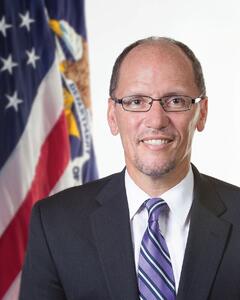
Russell L. Riley
We appreciate your time. What we would love to do, with your permission, is to talk a little bit about your autobiography. We’re always interested, in these presidential interviews, about the sociology of an administration, who these people are that come together and work for a particular President. So I wonder if you would tell us a little bit about your upbringing. How is it that you got to be interested in politics in the first place?
Tom Perez
I got interested in politics because politics is what brought my family to this country. My parents came here from the Dominican Republic. My mother’s father, my maternal grandfather, was in the diplomatic service. He lived a number of places around the world, and in the early 1930s, he was appointed ambassador to the United States by the newly enshrined head of the country, [Rafael L.] Trujillo [Molina].
Trujillo was trained by the U.S. Marines when the Marines occupied the Dominican Republic from 1916 to 1924, so there was an internal debate in the United States about whether to recognize him because they were concerned about authoritarian tendencies. They decided to recognize him and try to work with him, and my grandfather did the same until he realized that he was a thug, and he spoke out against him and was declared non grata in, about 90-some-odd years ago, 1935 or so.
That’s when my mom’s family came to the country. My dad was what we would probably call part of the student movement, so he had to leave, and so my mom settled in Washington Heights [New York City]—that was mecca for all Dominicans. [laughter] My mother’s male siblings all served as part of America’s Greatest Generation. She was one of nine. Actually, four of her five brothers served. And my father served, as an immigrant, in the U.S. Army. After he got out, he came to Buffalo, New York, because he got a job at the VA [Veterans Affairs] hospital. By then my sister and I were born in Buffalo, and we were numbers four and five.
So our story starts there, and I was 12 when my dad passed away, unfortunately, too young. Buffalo is called the “city of good neighbors.” I had a lot of folks who took care of us and looked after us, and my mom was kind of chronically ill a lot, and so that was a little bit of a challenge, to say the least. And with the help of Pell Grants and various jobs during college and before college—and Buffalo is a pretty working-class town, which is why I love it. I worked for a few summers at Sears. Worked one summer on the back of a trash truck, which is one thing that sort of intrigued the President, that the secretary of labor potentially was someone who worked on the back of a trash truck. I didn’t have a lot of time with my dad but enough time to know that a big part of what he wanted to impart—and my mom, as well—is the sense that this is a land of opportunity, and a land of compassion, and the ladder should always be down.
So I always kind of wanted to change the world and thought being a lawyer and a public servant was the best way to do it. I never dreamed that I’d be able to work at the Justice Department, in a variety of capacities, and then Senator [Edward M.] Kennedy and the Labor Department and now here. It’s just something I feel very blessed to have had the opportunity to do, and the same with my siblings—they’re all doctors, I was the black sheep [laughter]—but the service gene was something that was a big part of us.
Barbara A. Perry
I was just going to say, Tom, I was pulling for your team yesterday. I was pulling for the Bills, and I don’t even want to bring up how it all ended, but I like [Joshua P.] Josh Allen a lot, so I was pulling for you.
Perez
That was a bad day.
Perry
Oh, and they came so close, they almost had it. But before we leave Buffalo, I remember reading that one of the people who helped care for you was a man who was in the Teamsters Union. Is that correct? And that that gave you an early experience in dealing with labor unions.
Perez
Yes, yes, absolutely. I mean, Buffalo—
Perry
Tell us about that.
Perez
A lot of my friends’ parents embodied the spirit of Buffalo, and that was my best friend’s dad that you’re referring to. He lost both his parents by the time he was, I think, 17 or 18. He was a Teamster. He may have gotten through 10th grade. He was the wisest person I ever met. I have often wondered whether there’s an inverse correlation between the number of years of formal education you get and your wisdom. Because I had the privilege to go to some fancy-pants schools, [laughter] and I met a number of people who didn’t have an iota of EQ [emotional quotient] and an iota of—they had some IQ [intelligence quotient], and I think their parents had some coin.
But the EQ and the common sense weren’t quite there, and my friend’s dad was just one of the wisest people I met. Buffalo had some bad decades when I was there. He lost his job—he lost his home, actually—and a lot of struggles, but a man of great faith, strength, character, resilience. And those are the life lessons that you learn in Buffalo. That’s why I’ll always have a great affinity for the union movement, because the union movement prevented him from becoming totally destitute. It’s been such a source of upward mobility for folks, and I’m so heartened that public attitudes on the labor movement now are at their highest levels since I was in diapers, quite literally.
Riley
How did you decide where to go to college?
Perez
My brother mowed the lawn of a guy around the corner who went to Brown [University] and was a lawyer, and he did interviews, like when you apply for college you can have an alumni interview. And he loved Brown and encouraged me to apply, and, I’m sure, went to bat for me because I was the first kid in my school to go to Brown in forever, and I don’t recall anyone going after me for a while. So it was a lot of fun.
Riley
Did you continue any political interests there, or develop them, either in a major or in campus politics?
Perez
I was an international relations/political science major, so I went to a lot of events on campus. Actually, the events I liked the most were people who, I had a hypothesis, were going to have a worldview that was very different from mine. I wanted to hear them out so that I could figure out why they thought what they thought.
Unfortunately, at times, the culture of political correctness there reared its ugly head. And I remember when the CIA [Central Intelligence Agency] director spoke—William Casey, I still remember his name—and he got shouted down to the point where he just left the stage. I just thought that was cowardly and unfair to people who wanted to have an engagement with him and challenge him on why he said what he said and thought what he thought. And I just thought it was a really stupid thing to do, to shout someone off the stage. “Stupid” is one word to describe it. It’s antidemocratic.
My work-study job my senior year was working at the Rhode Island Commission for Human Rights, which was a state agency that investigated discrimination cases. They had lost a lot of funding because in the [Ronald W.] Reagan years they’d cut funding for a lot of offices like that. I worked there 20 hours a week, and they needed people like me because it was either me or no one. I looked like Howdy Doody, [laughter] but I was able to just see people’s struggles: a 60-year-old guy who’s high school educated, worked at a place for 30 years, and lost a job because they wanted to hire someone younger. Things like that inspire you to want to try to do something with your life and help folks like that. That was a big motivator for me to want to go to law school, so I could maybe change the world in some small but hopefully meaningful way.
Riley
And Harvard [University] came right on the heels of your undergraduate work?
Perez
Yes, I went straight through. I got a joint degree at Harvard Law School and the Kennedy School [of Government], although in the middle of my first year I had a little bit of an existential crisis of whether I would want to be a lawyer forever. At the suggestion of a friend, I applied to the Kennedy School the day before the application was due, and got in, and then, in the middle of August, was hemming and hawing on whether I was going to do it, and I decided to do it. I didn’t make much use of the degree for the first 10 years of my career, and I’ve gotten invaluable use out of it since, so I’m really glad I did it.
Riley
The law degree or the Kennedy School degree?
Perez
Kennedy School.
Riley
Kennedy School degree, yes.
Perez
I was a straight-up prosecutor for the first 10 years or so of my career. I was prosecuting civil rights cases, so police misconduct, racial violence, human trafficking cases, and then I was a first-line supervisor, so straight-up lawyering. Then, actually, what really changed my life was Newt Gingrich, somewhat paradoxically, which is in 1994, when the Republicans swept the House and Senate, with his Contract on America, or for America, whatever—
Perry
[laughs] I always say “on,” but go ahead.
Perez
What happens, as you probably know, is Senate staffing ratios are a function of whether you’re in the majority or the minority, so a bunch of Democratic staffers lost their job after the ’94 election, and senior senators had an opportunity to compensate for that in the context of getting detailees from the executive branch, and it’s true for Republicans and Democrats.
So [William J.] Bill Clinton was President at the time, and there was a call out, Senator [Ted] Kennedy was looking for a person to do his civil rights work, and I wasn’t looking for a job, but the person in the front office of the Civil Rights Division called me up and said, “Yes, put in for this,” and I was like, Damn, civil rights, Ted Kennedy? Hard to say no to that. I, miraculously, got it, and next thing I knew I spent two and a half years there, and real privilege of a lifetime. And once you work for Senator Kennedy, you’re part of the diaspora—the extended family, I guess I would call it.
That changed my life because then I got offered the job of deputy AAG [assistant attorney general], which is the number two position in the division. I was a first-line career prosecutor. There’s like nine sections in the division. I was a career prosecutor in one of the sections. Then I came back as a political appointee, the number two person not in the section but in the whole division, so it was kind of a double promotion at once. Hard to say no to that.
So that’s why I say Newt Gingrich changed my life, because it just took me on a totally different track. I didn’t expect to be a career prosecutor for the rest of my life. I was very happy, but that was just too good to pass up. And it kept me home because we had small kids at the time, and when I was trying cases regularly, I was gone 150 days a year.
Riley
Tom, is there a pattern to the cases that you were prosecuting when you were there as a career official?
Perez
Yes, Rodney King–type cases, on the police front. I prosecuted an LAPD [Los Angeles Police Department] officer pre–Rodney King [before 1991], to give you a sense of how long ago. I did a number of hate crimes cases. In Lubbock, Texas, there was a group of neo-Nazis who wanted to start a race war, and they, within about a 30-minute period, targeted three different black men walking along the streets of Lubbock. They’d lure them to the car and shoot them at point-blank range with a sawed-off shotgun. There were three kids in the car, and they took turns, so they each shot one of them.
That was about two years of my life, down in Lubbock. Border stuff, border patrol agents who did some nasty things at the border. I spent two years of my life, on and off, in Nogales, Arizona, which is right on the Mexican border. That was the border patrol agent who shot an immigrant and then hid the body.
So I saw America at its worst, but I also saw communities at their best, because in the aftermath I’d invariably see folks say, “This isn’t who we are.” So those were invaluable experiences, and learning how to try a case, and almost every case I was involved in was kind of a front-page story because of the nature of the charges.
Perry
And this was at the time, getting the timeline correct, that you’re in the Civil Rights Division of DOJ [U.S. Department of Justice] as its prosecutor during the [George H. W.] Bush 41 years.
Perez
Yes. I—
Perry
So I’ve got from ’89 to ’95?
Perez
I was actually hired into the division when Reagan was President. I began my job in April of ’89, when Bush 1 was President. So I served as a career civil servant for both Republican and Democratic administrations. The AAG for civil rights under Bush was a guy named John [R.] Dunne, a man of impeccable integrity, and a good guy. I never dreamed that someday I’d sit in his chair, and when I was nominated, years later, he came to my hearing to testify on my behalf.
It doesn’t always have to be partisan like it is today, and it’s very regrettable how polarized we have become. But that’s sort of the career pathway, in terms of both Republican and Democratic administrations.
Perry
And you felt supported, then, it sounds like, despite the fact that there were Republicans in the White House and heading up that division.
Perez
Yes, absolutely, is the short answer. The slightly longer answer is, I explicitly chose the section I was in because it was relatively impervious to the political machinations of the moment. I remember we were prosecuting that Lubbock case. You’re not going to get a lot of pushback. Why are you doing this? Why are you prosecuting white supremacists?
So I clerked as a summer clerk during the Reagan administration in the housing section of the Civil Rights Division. They were still doing some good work, but there was other work there that I would have preferred to avoid. [laughter] I was a public defender during law school—that was my experiential learning—and so I was on a criminal track by the time I graduated law school. So the criminal section, for me, was the perfect job in the Civil Rights Division.
Perry
And you’re still in that position, then, when Clinton comes in, correct?
Perez
Correct. I was a trial attorney when Bill Clinton came into office. I got promoted to a first-line supervisor in early ’95, and then later in ’95, I went out on the detail.
Perry
Then maybe not because of the kinds of cases you were prosecuting, but I’m thinking back to about that time. As we know, Bill Clinton came in as a more moderate Democrat, and on the issue of affirmative action, for example, “mend it, don’t end it.” Were you seeing any pushback in a Democratic administration because it was more moderate, perhaps, on civil rights?
Perez
We did a lot of good things on the civil rights front. The “mend it, don’t end it” was a response to the Adarand [Constructors, Inc. v. Peña] decision, and that was a smart move. [Christopher F.] Chris Edley [Jr.] led that charge, if my memory serves me.
Perry
I think that’s right.
Perez
I’m trying to think of other things. We did a lot of work in the predatory lending space, which was very impactful. Started up a testing program in the housing section, where match-paired testers would go into an apartment building. They had an identical profile except one was black and one was white. Invariably, the white person would be shown an apartment, or four apartments, in the building and given a choice, and here’s a bonus, and the black person was told there’s no room at the inn.
That testing program was really impactful and kind of caught a lot of folks red-handed because discrimination is a little more subtle these days. They don’t put up signs, “No Irish need apply,” like the old days. But President Clinton was a great President to work for, both at the Civil Rights Division and then, the last two years of Clinton, I went over to HHS [Department of Health and Human Services] and ran their Office for Civil Rights.
Riley
So you were at HHS, then, the final two years of the Clinton term?
Perez
Right, yes.
Riley
What were the basic issues you were working on there, Tom?
Perez
I was hired to lead the Office for Civil Rights. In the 1980s, the Department of Health, Education, and Welfare [HEW] split up, and HHS and Ed [U.S. Department of Education] were established. There were two civil rights offices, and the civil rights work at HEW, the heavy lifting was in the education space, so a lot of the folks went over there. The civil rights office at HHS was a little bit of an afterthought.
So the reality was, they called me and asked if I was interested in running it, and they were very transparent, saying, “We inherited an office that was underperforming. That wasn’t our fault. Six years later, it continues to underperform. That is our fault, and we would like for you to take responsibility for trying to change that.” And that’s what I did, and healthcare and civil rights—if you go to a hospital and you don’t speak English and you’re trying to get help, they have a legal obligation to make sure that you can meaningfully access programs.
A very robust disability rights docket, and when I was there, one of the most important healthcare disability rights cases came down from the Supreme Court, so I was actively involved in implementing that. Basically a lot of people with disabilities over the years, they’d get warehoused in institutions. They could thrive in the community if they had some supports. In 1999, the Supreme Court, in a decision, said that the unnecessary institutionalization of people with disabilities is a form of discrimination under the ADA [Americans with Disabilities Act]. Preparing for that for a while was a big part of my job there.
An equally big part was just simply turning around an organization where there were a lot of underperforming people who were retired in place, and so I learned a lot about leadership and management and things like that.
Riley
I’m wondering, during the Clinton years—you said earlier that Gingrich changed your life. There’s a sort of evolution, if you will, in the Republican Party. Is the Republican Party you’re dealing with at the end of the Clinton years substantially different from the Republican Party that you were seeing when you first came to Washington?
Perez
Boy, I wax nostalgic for George W. Bush some days, [laughter] quite seriously. When we were working on immigration reform for Senator Kennedy in 1996, there was a provision in the version of the bill that passed the U.S. House that would have codified a thing called Proposition 187 from California. That was a ballot initiative that gave, basically, teachers the authority to become immigration cops in schools, and it passed the House of Representatives by a veto-proof margin.
My senator that I was working for thought it was a horrifically bad idea, and there was a remarkable coalition that a bunch of us—and I was not the leader of this coalition, let me be very, very clear about that. There was a guy named Michael Myers, who I worked for, that did the heavy lifting. This coalition was built of cops, faith leaders, and educators that said, No way, no how, I’m a teacher, I’m not a cop. And that bill never saw the light of day in the Senate.
The reason I bring this up is because one of the most important pieces of paper we got was a letter from a governor named George W. Bush saying, “This is a stupid idea, and if I had the authority to do this in Texas, I wouldn’t do it because kids have a constitutional right, regardless of immigration status, to a free public education, and that makes sense.”
So it’s a long-winded answer to your question, but I do wax nostalgic for George W. Bush. And, frankly, to fast-forward to 2021—and we’ll go back to 1999 here in a minute [laughter]—I was at the inauguration, which was in a fortress in 2021, a couple short weeks after the insurrection [January 6 U.S. Capitol attack]. And the thing that inspired me the most, on an otherwise surreal day, was the interaction of Presidents Bush, [Barack] Obama, and Clinton. I think they were at Arlington [National Cemetery] having a conversation about the peaceful transition of power. It wasn’t scripted. It was authentic, and it was kind of an elixir at the moment where we were so divided, and it was a moment of sanity. The day after that, on DNC [Democratic National Committee] letterhead, I wrote a thank you note to President Bush, and then he responded, by the way.
When I was at the DNC, his father passed, and I went to pay my respects because I knew Senator Kennedy would’ve done that. I heard a couple 20-somethings in the background who saw me and sort of recognized me and asked, “What’s he doing here?” I wanted to get out of line and say something to them, but I decided not to. What I was doing here was what everyone should do. If you’re a Republican, you ought to get on a plane and go down to Plains, Georgia, today and pay your respects to Rosalynn Carter, who was a person of integrity and accomplishment. But that’s sort of been lost. That’s a different—
Riley
No, it’s—
Perry
But—go ahead, Russell.
Riley
Oh, I was just going to say it’s exceedingly important to get you to speak to this because some of us are old enough to have lived the same history that you lived, and we are in a very different environment, and it didn’t have to be this way, I don’t think. It strikes me that if two or three of the, by chronology, “grown-ups” in this country today acted like grown-ups, we would have a very different kind of political environment than we have now.
Perez
Yes, no doubt. You saw the attempted insurrection down in Brazil maybe a year ago, [Jair] Bolsonaro? Where’d they get that playbook from? You don’t need a PhD to figure that one out. [laughter] And I look at the incoming president in Argentina, who’s kind of a Bolsonaro wannabe. And I look at the relationships between Haiti and the Dominican Republic, which is a place that’s near and dear to my heart. He’s building a wall down there, the president of DR [Dominican Republic], and we don’t quite have the moral authority to tell him, “Oh my God, you shouldn’t do that,” even though the Dominican mistreatment of Haitians is the moral Achilles heel of that country, just like our mistreatment of Native Americans and African Americans is our moral Achilles heel.
But we’ve reached a moment in time where it’s hard for us to speak with that authority, which I why I really do appreciate [Joseph R.] Joe Biden [Jr.], because he’s trying to restore—democracy is about rules-based order, and respecting that, and putting country before party. Your goal to get elected is not retribution; it’s helping people. And, unfortunately, for better or for worse, we set an example for the world.
Riley
Barbara and I have the privilege of having conducted interviews across administrations over a fairly long period of time, and one of the great benefits of doing this work is the opportunity to hear from people on both sides who will voice very much the same sentiments that you’ve just said, both Republicans and Democrats, who feel that we’re at a terrible inflection point and testify from their own experience to what can happen when people of goodwill get together and try to solve problems. So it’s immensely helpful to have you on the record talking about it.
Perez
Well, I’m happy to do so, and one of my close friends is Michael [S.] Steele, and we try to do a lot of this together. I don’t know when this global virus will abate, but it will not abate if people just sit on the sidelines.
Riley
I think you’re right. Now, so we got you to the end of the Clinton administration, and then you spent some time outside of D.C. after that, right?
Perez
I did. I live in Maryland and have lived in Maryland, right on the D.C. border, since 1989. I was involved in local nonprofit work there, president of the board of the largest immigrant-serving nonprofit in the D.C. area now. I went to work after the Clinton administration, teaching at Maryland Law School, and then I decided at the time to run for local office because I thought it would be a great way to make a difference. My wife said to me once, and it resonated, “You go around fixing other communities that have encountered challenges. Why don’t you do something in your own community?” I thought, It’s not a bad idea, and we had small kids, so I could actually come home at night.
It was an honor to serve in local government for four years, and it helped me become a better fed [federal government representative], by the way, because when I was working for Senator Kennedy, and we’d be debating a bill that had fiscal impact on state and local governments, and they came in to object, I would say—under my breath, not to them, because I tried to be respectful—but I’d be often thinking, Stop whining, figure it out. [laughter]
I hadn’t sat in their shoes, so I had a blind spot. And the Americans [Individuals] with Disabilities Education Act is one of the largest unfunded mandates in government. If you look at the statutory language, the feds are supposed to cover at least half of the cost of educating kids with disabilities, and they don’t get anywhere near that. In my county, when I served, it was an honor to go to some of the schools that I saw in Montgomery County that provide world-class service to kids with disabilities, some of whom had profound special needs, and it was an honor to do that. We paid every penny, and it was worth every penny, but it wasn’t fair. So being in local government made me a better fed when I came back in because I did have that appreciation.
Riley
Were there temptations to come back in before 2008, or were you pretty well—
Perez
No.
Riley
No. [laughter]
Perez
No.
Riley
So you were pretty well committed to your local gig at that point.
Perez
Also, in 2007, I became Maryland labor secretary. I ran unsuccessfully for AG [attorney general] in Maryland in ’06, so I gave up my seat. I had never expected to run locally anyway, and it was a wonderful experience, but it wasn’t going to be an Article III [lifetime] appointment for me. I’m a baseball guy, and the only memory I have of Willie [H.] Mays [Jr.] was Willie Mays at the end of his career, where he could barely walk, and he was a shadow of his former self, and so I’m a big believer that you leave too soon. Don’t ever leave too late, in whatever you do in life.
So I took a chance, didn’t quite work out, and I was stronger for it. I did start working for [Governor] Martin [J.] O’Malley, and that was ’07 when I started. The presidential campaign was ramping up, and I was an Obama guy from the start. I talked to a person who was working for him, and I told her, “Hey, I want to be helpful, but I’ve got this situation.” You don’t do anything that could be hurtful. “I’m on team O’Malley. I’m proud of it. So there’s things I can do below the radar screen, but can we have that understanding?” And she’s like, “Absolutely.”
So I did a number of things. Then, when it was over, and I told the governor that I had been doing some work for them, he was like, “Thank God, because I picked the wrong horse. [laughter] And so you do whatever you need to do. Keep helping them out.” So it was pretty funny.
Perry
Tom, how did you decide in 2007, ’08, given that you had—maybe this is the answer—obviously worked in the Clinton administration? How did you get to that decision, to go, from the beginning, with Senator Obama?
Perez
Oh, it was a hard choice because I love the Clintons. And by the way, they’ve been so good to me. They’re always there for me, and I still talk to both of them. I talked to the President about a month ago. She’s [Hillary Rodham Clinton] hosting a big event tonight that I did when I was at her place, when I was DNC chair.
But this was one of those once-in-a-lifetime things. I think part of the challenge we have right now with people—“Eh, I don’t like Joe Biden”—is that the President [Obama] just set such a high bar. Everyone needs to be inspired beyond belief in order to support someone, and that’s the Obama effect. I try to explain to my kids, that doesn’t happen all the time.
By the way, I don’t need to be inspired by my leader. I need to know that my leader is getting stuff done for me that really matters, and getting stuff done not as much for me, because I’m going to be OK, but for the folks that aren’t going to be OK, that he’s doing stuff for them. I just thought that Senator Obama was potentially one of those once-in-a-lifetime candidates, and I think that’s proving to be the case. So it was hard to say no.
Riley
Are you at liberty to talk about the few things that you were tending to on their behalf? What are the kinds of things that you were able to do under the radar that got their attention?
Perez
Well, getting other people onboard, especially in labor and in the communities where I had a pretty good footprint, immigrant communities. It’s not just Latinos. The second largest population of Ethiopians outside Addis Ababa [Ethiopia] is Silver Spring, Maryland, the heart of my district, and similar with a number of other African nations, Ghana being one example. So I was able to do stuff like that because it was really engaging a lot of friends, getting them to find friends, and then connecting them to the relevant person at the campaign. I wasn’t going out and going to rallies. But every campaign has folks who are outward-leaning and folks who are behind the curtain, so to speak, and I stayed behind the curtain until the end.
Riley
Tom, explain to us how is it that you become acquainted with those communities. You said that they were in your district. This is something that you were doing apart from political campaigning, or when you were campaigning? Or these were communities that you’re nourishing relationships with on an ongoing basis, just because of your community-spirited nature?
Perez
Well, life is a chapter book, and the work I did for President Obama, I called on relationships I had in all the chapters of my life. Working for Senator Kennedy opened up my world to a whole new universe of people who were, frankly, connected nationally. It opened up my world to a whole new universe of union leaders. I had all the unions when I was in local government and when I ran for AG, so I had those relationships. I was state labor secretary at the time, so I had a lot of those relationships. It was all about taking those relationships and putting them to bear.
Perry
Senator Kennedy’s and Caroline [Bouvier] Kennedy’s endorsement of Senator Obama were pretty crucial there in the winter of—
Perez
That’s an understatement, I would argue. [laughter]
Perry
I will accept that and agree to it. Did you talk to Senator Kennedy at all about that choice that he was making and his encouragement of Senator Obama to run?
Perez
I did not, actually, and I wish I had. The thing about Senator Kennedy that’s just so remarkable was his attention to things like this. I know he didn’t do this lightly because I did talk to people who were still with him, and he had profound respect for Hillary Clinton. This was one of those true moments. We’re in such a dour moment that I think if Mother Teresa got in the race and were still alive, people would be like, “Well, but she’s too short,” [laughter] or, “She’s too religious.”
And for Senator Kennedy in ’06 or ’05, this was an embarrassment of riches. That’s how I felt. If I had decided to support Hillary, I would have done it with enthusiasm. I was told by the campaign in ’16 that I was the third or fourth most used surrogate in the Clinton campaign, and I did it with enthusiasm. It was like, Oh, yes, I guess I’ve got to do this. Because my two oldest are young women now, and she set such a remarkable example for them. We had just made history one way, and I was pretty convinced we were going to make history again. [pause] I was wrong.
Perry
Transition? Anything else on the ’08 campaign? Well, I guess one question I have is, did you anticipate, both in ’08 and in ’16, the virulence of the blowback against Senator Clinton, and then Secretary Clinton?
Perez
I did not. I really didn’t. I traveled a lot internationally when I was labor secretary, and I would ask people after they would let their guard down a little bit—these are Foreign Service officers—“You’ve been here 25 years, or you’ve been in the State Department 25 years. Who are your favorites?” She was always in the top two or three, and it wasn’t because she was there right then. She remembered people’s names. She said thank you. She really engaged people. I don’t allow myself to reflect on the “how would the world be different” question because it’s a totally unproductive conversation to have with my head, and it depresses me. And I mean what I say.
The thing I have to give the other side diabolical credit for is, there was a 25-year campaign. They identified her back in ’93. It starts with [Vincent W.] Vince Foster [Jr.]. This woman’s going somewhere, and you just look at all those things, and it was just a parade of those things and some self-inflicted wounds. Frankly, if I were her, I probably would have kind of closed ranks as well, because so many people seem to be going after me. But they built a caricature of her that worked. White, college-educated women—the majority of white, college-educated women in 2016 voted for Donald [J.] Trump. That is a fact. That’s nuts.
Perry
Could she have done anything different in ’08 or ’16 to end up with a different result?
Perez
I don’t know about ’08. Obama ran a better campaign. He went to a lot of these small states that the delegates just kept adding up and adding up, and he caught the wave, and he really embodied the moment. There were definitely things in ’16 she could’ve done better. She never went to Wisconsin. It wasn’t a coincidence that I chose Milwaukee for the convention. People said, “Oh, you did that because you got married there.” No, I did that because we didn’t show up there for the campaign. That was political malpractice because if you look at the data, for the last three cycles in the run-up to 2016, Wisconsin was razor thin, and you knew that was going to be the case. How she thought that she didn’t need to go there, it was beyond me.
So there were undeniably things. Again, Obama set such a high bar that people weren’t thrilled with her, so, OK, I’ll go with Jill [E.] Stein, because she’s [Hillary’s] going to win anyway, all the polling says it, so this is my little protest. Then all of a sudden, you look at the margin, Jill Stein got something like 28,000 votes in Wisconsin, and Hillary lost by 21,000. I’m off by a couple thousand on that, but my point is accurate. Same thing in Michigan.
For the ’24 campaign I have said—the news media writes the same old, same old stuff all the time. Go to November 3rd, 2011, New York Times magazine cover. “Is Obama toast?” Go to 1983, “[Walter F.] Mondale nipping at Reagan’s heels.” Yeah, that was a real nip. [laughter] Yeah, Massachusetts, baby!
So this is a lot of the same old, same old, but at the same time, all these third-party folks getting in. One thing I’ve also learned about politics is, people’s memories are short. This is a chaotic moment right now. Young people are very angry at the President [Biden] on the Middle East, or some young people are, in electorally relevant states like Michigan, and I just hope over time they see that elections are not referenda. They’re choices.
And you no longer have to speculate. My favorite focus group I saw in 2017 was a focus group of white, college-educated women who voted for Trump, and they were asked the following question: “Are you worried that he’s going to undo a woman’s right to choose?” And the answer was like, “Stop fear-mongering. That’s well settled.” Go figure.
I bring that up because you don’t have to speculate on what Trump is going to do because, number one, you’ve got four years of history, and then you have what he’s saying now. I’m not the one saying, “I am your retribution.” That’s him. So 328 days, or whatever it is, is a lifetime in politics, and we’ll see what happens.
Riley
Let me take you back to more pleasant times, [laughter] and this would be the transition in, although that was a—
Perez
The Great Recession, “more pleasant times.” [laughter] Oh, my.
Riley
It was tumultuous, but in the timeline you’re recorded as being on one of the transition teams. You have any recollections of that?
Perez
Oh, yes. You’ll recall I said Governor O’Malley, when he had heard I’d been working on the campaign, he was like, Thank God. He didn’t say that, [laughter] but he said, “Do whatever you want, no problem. Totally respect it.” I started in roughly May as a result of a call I got from a woman named Melody [C.] Barnes, who was working with two other people, [Donald H.] Don Gips and Lisa Brown.
They were running the agency review process for all the agencies, and they brought on four or five of us, and in my role I oversaw the agency review process for roughly 10 agencies ranging in size from the VA to a couple independent agencies. The VA’s got something like 350,000 employees.
Riley
Forgive me for interrupting, but I want to make sure I’ve got the timing on this right. You said that Melody had contacted you in May to begin—
Perez
Of 2008.
Riley
This must have been very quiet, behind-the-scenes, immediate—
Perez
Yes, there was a full-on transition operation in place by June of 2008, and I’m sure it was earlier than that, but my involvement—I remember a really fun meeting we had of our group in Denver, at the convention, and there were a number of rules of engagement. Number one: nobody knows you’re doing this. Number two: there are no promises. This is not about a job interview for you, so if at the end of this nothing happens, just want to be transparent. And it’s going to be a lot of time and effort.
That was true. I was probably working 30 hours a week, something like that. It was a lot of time. What we were doing was, first of all, building teams for each agency. One of the agencies I had was DOJ, and so you had a chair, or cochairs, for each agency. DOJ’s my favorite example because I had worked there a long time, so I knew the place. I didn’t have Labor—Seth [D.] Harris did Labor—and I had never been at the Labor Department. Seth Harris was a much better person to do the Labor Department than Tom Perez at that point.
So I brought on a guy named David [W.] Ogden, who subsequently—and this wasn’t the plan—was hired on as the deputy attorney general. David and I built a team of roughly a dozen people, and I did this for all the agencies—HUD [Department of Housing and Urban Development], VA, et cetera—and pre-election, the rule was no contact with the agency. So they were getting public documents and gathering intel [intelligence] on what are the problems, what are the opportunities. We put together memos for all of these agencies on Here’s an overview of the agency, here are immediate opportunities, here are 90-day opportunities, here are 180-day opportunities, here are year-from-now opportunities, here’s our best sense of immediate stuff that you’ve got to deal with or else the fertilizer’s going to hit the window.
I remember vividly the DOJ document was probably 50 pages. There was an executive summary, but DOJ is a pretty complex organization, so there was a subdocument for the Civil Rights Division, for the Criminal Division, for all the other agencies, DEA [Drug Enforcement Agency]. That was a very, very labor-intensive effort.
Then, after the election, these teams were ready to go in and talk to people. I remember vividly Veterans Day ’08, David and I—it was my first trip back to DOJ, and I left DOJ pre-9/11 [September 11 attacks], and just the physical layout of the building, that was my biggest shock. David and I had a meeting with the AG, Judge [Michael B.] Mukasey, and his chief of staff, who, by the way, were a thousand percent professional, and the process began.
Then teams came in to talk to people in the Civil Rights Division, talk to people elsewhere. It was a very brief chapter of my life, but a most memorable and most exciting because I was part of history. This guy, man, the first black President—and in the aftermath of what seemed like existential crises under Bush, which, again, with hindsight, your perspective gets a little bit different—but it sure seemed like a big deal back then. And that was a lot of work. Again, I reported to Don and Melody and—who else did I say? Don, Melody, Lisa.
Riley
What were your discussions with Mukasey about? Are you trying to get a sense of their amenability to cooperation, or is this more substantive about, We think these next five things are going to be top of the problem agenda for the Justice Department?
Perez
Right. We obviously did not share the document with them. In DOJ, there were two finalists for AG, Eric [H.] Holder [Jr.] and Janet [A.] Napolitano. We did share the document with the two of them, David and I, and then we briefed them on the document and answered any questions they had.
Riley
How quickly did that happen?
Perez
Oh, very quickly. I’m trying to think—I went in on Veterans Day. There was a separate group of people who were on personnel.
Riley
Right, and I’m trying to figure out where these things mesh.
Perez
Yes. Yes. We would get direction from them, “Give this to the following two people, and then answer any questions they have.” I’m sure we gave it to them within a week of the election. I think they had identified the 50 most important positions in government, Cabinet and sub-Cabinet, and they had lists of people that had populated those. Obviously, if you ask for the top 10, DOJ would be on that list. So DOJ was the first one where we were really moving, and it was pretty interesting. The meeting that we had with each of them was really quite different, [laughter] because they just have different styles, the two of them.
Riley
Want to elaborate on that?
Perez
Well, in a word, Janet read the document, and Eric skimmed the document. [laughter] So hers was rabbit-eared, and there were 28, maybe 50 stickies, “On this thing, tell me more about this”—and Eric’s was more like, “Tell me at 30,000 feet.” He’d been the deputy attorney general, in fairness to him. She’d been a U.S. attorney, so she also knew the department, but it was sort of different. Eric ended up getting the job, so his approach worked just fine. [laughter] That was a really important use for that document.
And the Mukasey meeting, just to answer your question directly, we weren’t asking him any substantive questions. It was more of a process, and the most important thing that came out of that is, “We will cooperate in any way, shape, or form, because this is not about ‘us versus them.’ This is about the United States of America.”
There wasn’t anybody on our teams that was encountering any sort of resistance that I knew of, and I never participated in a meeting where they were like, “Hey, that agency, they’re hiding documents,” or something like that. So it was how transitions should work, and I think there were a number of Kennedy School–type reports written afterward about the smoothness of this transition. This is how it ought to work, and, again, President Bush set the tone.
Riley
Exactly. Barbara, you have anything on this?
Perry
So after then you speak to the Cabinet head, the secretaries of these agencies, or the attorney general, then do you go back? You said you weren’t going to be speaking substantively, I guess, in terms of policy or positions, necessarily, with Mukasey. But going forward, then do you look at policy, law, in terms of the Justice Department, process, and structure? About where you and where the new President will want to take these agencies?
Perez
Yes. Oh, yes, we didn’t talk to the AG about that, but we outlined what we hoped to do. We want to talk to the Criminal Division, some folks from there. We’d like to talk to people in component A, B, C, D, et cetera, and they facilitated that, and they did it very professionally. I did participate in a number of meetings. Most of the meetings I participated in were in the Civil Rights Division because the people that we then hired on to do the transition, we wanted to make sure they had subject matter expertise. So when you went into the Antitrust Division meetings, it wasn’t Tom Perez, because I know what the Sherman [Antitrust] Act [of 1980] is but that’s about it, OK? [laughter] We had a really good group of subject matter experts.
I have a very vivid memory of a couple of my Civil Rights Division meetings, and the one lesson I learned after my first one was, every time we went—and I’m not being flippant—I had a box of Kleenex next to me because invariably at least one of the people would break down, because the Civil Rights Division over the preceding eight years had been a real challenging environment. One of my predecessors was recommended for criminal prosecution because they had done some bad things. God bless the folks who stuck it out for eight years. They deserve [laughs] combat pay. It was not a good situation. When I talk about Kleenex, I learned that lesson. In the meetings I didn’t participate in, I said, “Make sure you have Kleenex in the room.”
Perry
I was going to ask you about that very specific thing, but, first of all, what happens in a division, in a section? What causes that? Not just one person, or maybe it’s one bad—
Perez
Oh, it’s from the top. They hired terrible people—and, by the way, I came in during Reagan, and they had a guy named [William B.] Brad Reynolds whose worldview was qualitatively different, but if you talk to career people there, he listened. He disagreed more often than not, but sometimes he was persuadable. And elections have consequences. Everybody always felt like they were heard.
These folks, they were looking at résumés, and, among other things, they were colossally stupid, because they would say things on email that were—they were hoisted by their own petard. He’s not a loyal enough person. He was in this organization. I just couldn’t believe that they would say something like that. [laughs] It was not only wrong, but it was colossally stupid, and it is what it is.
Anyway, that was a really important part of the process, though, because the person who came in—and it turned out that the next AG was me. [laughs] I didn’t realize that when I was doing the interviews, because no promises, and I wasn’t offered the job until the following April or May. I had long since left transition and was back in Maryland. But the Obama folks did it the right way, and the Bush folks helped facilitate that, and that’s what we tried to do as well when I was labor secretary, although the problem was they never came to see us.
Riley
Tom, before we get too far down the road on Justice, I want to ask you, because you said you were handling—I don’t remember the exact number—8 to 10 other departments as a part of the transition. Could you enumerate those again? I don’t need a full array of them, but I’m just wondering if there may be questions about the transition in those other areas.
Perez
I remember HUD vividly because HUD was another agency that had a lot of challenges, and we had a remarkable team there, many of whom are still good friends, people I met for the first time who I’ve stayed in touch with. HUD has had an unfortunate history in Democratic and Republican administrations. HUD and Labor will often be the last two agencies, and you save them for the end, and it’s like musical chairs: “Oh, so-and-so is a good friend, and we need to put him somewhere.” “Ah, throw him at HUD.” I don’t know if you remember when Reagan mistook the HUD secretary for the ambassador to Nigeria. [laughter]
Anyway, so the HUD folks were great because that needed a big overhaul, and a big thing they were really trying to push on was, HUD has so many challenges—Please don’t use the Reagan model. It was a model that was used in both Democrats and Republicans, so I don’t want this to be a partisan critique. When Shaun [L. S.] Donovan was selected—Shaun was on the transition team for HUD, and then he quietly didn’t participate anymore, and nobody knew why. Then, when they found out, they were over the moon, [laughter] just over the moon. So HUD was another.
VA, which I think, after DoD [Department of Defense], has the most number of employees. Social Security Administration. The guy who ran that has become a close friend. His name is [James] Jim Roosevelt [III], just a wonderful human being, grandson of FDR [Franklin D. Roosevelt]. And EEOC [Equal Employment Opportunity Commission]. A lot of the civil rights agencies. I think the biggest agencies, though, would’ve been DOJ, HUD, and VA, probably the three in terms of employees.
Oh, and I had HHS—I’m sorry, that would’ve been a fourth—because I worked at HHS. That was an easy one to do because I just recruited all the people I reported to at the end of the Clinton administration. [laughter] That was a fun one. They didn’t take it on the chin as much as other places, because scientists don’t put up with that. I don’t know if that’s true or not but that’s what it seemed to be. A lot of those agencies were able to withstand it. But it was fun to go back into that building. That was one of the funnest chapters of my life, and it was a real honor to do it. Incredibly time-consuming.
Riley
It’s important to get your reflections on this because the paper record is not going to be very available to people.
Perez
The importance of hiring the right people stems from the following reality: people in a number of these agencies had endured really bad stuff for eight years. I saw this in ’93, by the way, except I was a career person. I had none of this political exposure. I just had head down, trying cases, getting on a plane, try another case.
One of the things I learned from having the privilege of working in Republican and Democratic administrations was that some of the best leaders I met—now I’m referring to political appointees—I met some of the best people who were Republican-appointed, and some of the best people I met were Democratic appointees. Some of the worst people I met were Republican appointees, and some of the worst people I met were Democratic appointees.
The mistake in the category of the ones who were not good, one of the most common mistakes was just a fundamental lack of respect for the career folks, who are the spine of every agency. If you think you can work around them—how the hell can you work around 17,000 people at the Labor Department when you’ve got a crew of 150 political appointees? Really?
And the fact that I was a summer clerk in the Civil Rights Division—I had every job a lawyer or law student could have in that division, and I think it really helped me. And it helped me at the Labor Department because one of the most common mistakes people make, not just in government but in so many organizations, is supervisors are bad listeners, and they think they know it all. The most important question you can ask in any work environment, I think, is, “What do you think?”
We got a long way by just doing some active listening. If you’re a lawyer representing a client and you’re not listening to your client, you’re not going to be a good lawyer. It’s kind of similar when you’re a supervisor. I always tried to tell folks, and in my current job I did a call with Cabinet secretaries, and I said, “Hey, let me just give you a few insights from my own experience, and mistakes I made, and things like that,” and these were some of the things I said to them. A lot of it is the Golden Rule, but sometimes there were a number of people who got to where they got and they actually thought they earned it, and it leads to bad outcomes.
But the reason I’m bringing this up is, expectations were super high, especially at DOJ. We’ve endured eight years, and part of what I really tried to do was understand that. That didn’t mean I’m just going to do whatever they say, but you had to have a lot of empathy and understanding and inclusion.
And the President—and I know this is a little self-serving—he was, by and large, pretty damn good at finding people. Shaun Donovan’s a great example. He listened. “Please, HUD, we want to be at the grown-ups table, and we have to be at the grown-ups table,” and they got to the grown-ups table because not only was Shaun good, but the people he hired were good because he had a good network.
The thing I’m most proud of, and the thing if someone asked me, “What do you think you do best?” Building teams is something I do pretty well because I’m not afraid to hire people smarter than me, and it’s not very hard to do. [laughter] Also, I like to have people who have complementary skill sets, and I had a model where we had a bunch of people who had overlapping subject matter expertise. Now the Harvard Business School doesn’t like that because that might lead to unhealthy competition, but I also was pretty good at finding people who scored well in “plays well with others.”
I also knew that if we did our job well, I was going to get a lot of my people poached by the White House and other agencies because this is not my first rodeo, and that’s exactly what happened. When that happened, I didn’t lose a beat because I had other people who could slide in seamlessly. That’s what, I think, the Obama folks—we got a lot done, and a lot of these agencies had problems like we did. That’s where you’re going to put points on the board is in these agencies and getting a lot of stuff done.
Riley
My next question: you mentioned when you went into DOJ that the physical environment had profoundly changed because of 9/11, and I want to ask you that question as it relates to the governing situation that you encountered. You left the government before terrorism was issue number one. How thoroughgoing a difference is it in the agencies you were looking at, that terrorism was on the agenda in a way that it had not been before?
Perez
For me, it wasn’t a huge change except in the criminal setting. We actually built an engagement model—I should say I inherited it, and it was a good model. We honed it and improved it, but we were working off of a pretty solid foundation and that was an engagement model of quarterly meetings with a group of about 60 folks from a very diverse cadre of communities, religious communities. We had Sikh leaders, we had Muslim leaders, we had Hindu leaders, we had Catholic leaders, we had NGOs [nongovernmental organizations], et cetera, because the spike in anti-Semitic violence was significant post-9/11. The first backlash murder post-9/11 was the tragic murder of a Sikh gas station owner in Phoenix [Arizona], whom the idiot assailant—well, The guy wears a turban, he must be Muslim.
The way to have meaningful engagement with communities is to build relationships early. If you wait until you’re at DEFCON 1 [defense readiness condition 1] to start bringing people together, you’re going to have a lot of trouble building trust. So I inherited that, and we did some things to further hone it, but those were really important things to do that were very much post-9/11. We had religious violence before—I’d prosecuted a lot of bad things that folks did—but we had it at scale post-9/11. So I’m really glad we did that.
I’ll give you a very concrete example of why it was important. I was working in partnership with the U.S. attorney in Detroit [Michigan], a wonderful human being named [Barbara L.] Barb McQuade. If you watch MSNBC, she’s a commentator there now. Barb built a really incredibly important table of inclusion with Arab, Muslim, other faith leaders because there was a lot of distrust between the communities and the government, especially post-9/11, like, “Are you surveilling our mosque?” Things of that nature. I attended a couple of those meetings with her, and there were really authentic relationships. And the relationship was tested in the following circumstance.
There was an imam who, as it turned out, had a night job fencing stolen goods. And there was an incident where there was federal law enforcement involved with local law enforcement, and he was armed, and he was fatally shot by a federal law enforcement officer. Now imagine if you had no relationships with the community, and their headline is “Imam Fatally Shot by Federal Agent.” That’s the definition of a bad day.
Because that structure had been set up, it was challenging, but when we explained things to the community, and we were as transparent as the rules would permit during the investigation, and when we closed the case, we did some extraordinary things to make sure that the report wasn’t 80 percent redacted. Those relationships survived because they had been built prior to the incident. And that’s something we had to do in the aftermath of 9/11.
The bigger issue when I got there, depending on the section I was working on—but the recession had a host of impacts, including we had a subprime meltdown. I settled the two largest fair lending cases in the history of the Fair Housing Act. So we had to build new structures and coalitions and just working groups within the department to deal with the crises of the moment. The fair lending crisis, again, to this day, those were the two largest settlements in the history of the Fair Housing Act because Countrywide [Financial], which was the industry bottom-feeder, purchased by Bank of America in one of their worst decisions they ever made, they just did some provably horrific things to black and brown borrowers, and we held them to account. But that’s, I don’t think, the question you’re really asking. You were really asking about the post-9/11 world.
Riley
Exactly. Well, thanks, because that’s helpful information. I didn’t know, particularly when you were doing the transition planning, whether you were encountering, unexpectedly, dimensions of terrorism in other agencies or across the board. It makes sense that Justice would’ve had its own commitment to dealing with this issue that would’ve been different from before.
But tell us about how you get approached to go back into the Justice Department. You’ve talked a little bit about the generic transition planning that you were organizing, but at some point somebody has to pick up a phone and call Tom Perez and say, “Guess what: you’re it.”
Perez
My pathway back to the Civil Rights Division was circuitous.
Riley
OK.
Perez
Originally, about a month after the election, I was approached by the transition—the President-elect was in Chicago, so he conducted final interviews at their Chicago office, and I was asked if I was interested in being considered for labor secretary, so I said, “Sure.” And they, “Can you go there tomorrow?” I said, “No, I can’t, because Bonanza’s on, and I can’t miss the last episode.” [laughter] I just loved the brothers, the Cartwrights. So I went there and had a nice interview with the President-elect at the time.
Riley
Had you met President Obama before?
Perez
Oh, yes, I’d met him, but I’d never had a conversation of any import like that. I wasn’t a staffer for him. I had left [Capitol] Hill. Again, I’m a Maryland guy at this point, and I’d been out of the federal side for eight years, mercifully. So for about a week, it was looking like you’re going to be the person, and then again, they had only a couple left, and it is a chessboard.
There were some advocates who weren’t against me, but they were concerned about certain diversity metrics in the Cabinet, gender especially. Then I was told Probably not going to happen. And, again, remember what I told you before: there are no promises. There’s no expectation for nothing. And I accepted that. I really did. So Secretary [Hilda L.] Solis—or Congresswoman Solis at the time—was nominated, and I had a conversation with her, at their request, and they ultimately went with Seth Harris. If I had been them, I would have absolutely gone with Seth Harris over Tom Perez because she was not on any list. This is where I will excise it when I’m reviewing it; I’m just giving you full context.
Riley
Terrific.
Perez
She wasn’t on any list, but they were trying to be responsive to some of the stuff. She was a friend of labor, so that was an important test that she passed with flying colors, but governance at the Labor Department, it’s unclear whether she had ever been in the building. Again, I don’t mean that disrespectfully. So they needed someone who knew the building, and Seth Harris knew more about the Labor Department than anyone in America, I would argue.
So that ended, and I was going about my merry way back in Maryland, and then a week or so later Janet Napolitano called me in. I had done a lot of work with her. You know that case I mentioned in Arizona? She was the U.S. attorney. The Republicans in the Senate, when I worked for Kennedy, identified her early on as an up-and-comer, and they concocted some bullshit complaint that needed to be investigated, alleging that she was soft on something. I actually represented her in the depositions that were taken. She wasn’t deposed but a lot of her people were, and it was BS [bullshit]. So we were friends.
So she asked if I was interested in leading USCIS, United States Citizenship and Immigration Services. I had never thought about it, but I took a look at their office and their mission, and it was like, Wow, that’d be kind of cool. And I said, “Sure.” I also like her a lot, and I’m a big believer. I want to work for a boss I believe in.
So I was vetted for that, and I was approved. It had gone so far as there used to be this thing in the Washington Post, the federal page, where they’d—“All the rumors that are fit to print”—but that was basically what the transition would use to kind of let people know. And, yes, my name appeared as USCIS.
Then I was driving home from a hearing in Annapolis—I was labor secretary in Maryland at the time—and my phone rings, and it’s Eric Holder. “Tom, I want to offer you a job in the Civil Rights Division.” I was like, “Well, I appreciate that, but I thought [Thomas A.] Tom Saenz got that two months ago, because you told me.” [laughter] The long story short is he didn’t pass the vet. So they had called him that day to say he didn’t pass the vet, and, understandably, he didn’t take it well. The phone was ringing off the hook at the White House, like, “What’s going on?” Tom runs MALDEF, Mexican American Legal Defense and Education Fund, and still does, I think, to this day.
I said, “I accepted a job. I’m about to get nominated for USCIS.” And he said, “I know. I talked to Janet. She said it would be OK.” I said, “Well, I haven’t talked to Janet, and I don’t go back on my word. When I say yes, I mean yes, and I need to talk to her, and I’d like to think about it.” So he said, “Totally understand.” But they gave like me a day, or two days.
The phone hangs up, and then the phone rings again. It’s Cecilia Muñoz, who’s already at the White House and actually working in the office where I am currently sitting, and says, “Tom, here’s the backstory,” and she tells me what happened. “We need a qualified person who has already been vetted, who is, ideally, a qualified Latino, because that’s who we had nominated. Now we can go with someone else, but the universe of people who fit that right now is a small universe. We knew that you were once interested, and that’s why this is what it is. It would be really, really, really helpful if you would do this, but only if you want to.” I said, “Well, I’d like to think about it because, first of all, I still haven’t talked to Janet. Secondly, I would like to talk to my wife because we’re a team.” She said, “Of course,” then hangs up.
The phone rings like two minutes later, and it’s Janet Napolitano. I’m like, “I didn’t cause this.” [holds hands up] [laughter] And she was remarkable. She said, “Tom, they told me what happened. They’re in a jam, and you should do this, and if you decide to do this, the only thing I would ask is can you find me someone who’d be really qualified for the job.” I said, “Let me think about that, and if I decide to do this—and I’ll let you know by the morning—I will absolutely find someone for you whom you will really like.”
I went home, talked to my wife, and this job was—I’ve been there, come of age there, and so I decided to do it. The person I talked to that night from home was a friend of mine who had had a similar set of experiences with jobs, where he thought he had it and then something happened, and his name’s [Alejandro N.] Ale Mayorkas. So Ale ended up being hired to lead USCIS, and the rest is history. He did such a good job that he got promoted. So, as I said to Janet when he came, I said, “I just want to note, for the record, you traded up.” [laughter]
The beauty was we had a lot of work that was cross-cutting when I ended up being at the Civil Rights Division, so she sort of had a free ally at DOJ who wasn’t on her payroll, and I had an ally at DHS [Department of Homeland Security], and Ale’s been a great friend since. So that’s how it happened.
Riley
Well, that’s terrific. Thanks for telling us all that. Had you known Eric very well before?
Perez
He was deputy AG when I was there, so I knew him and obviously respected him. So I wasn’t going into a blank slate.
Perry
Tom, do I remember your saying that when you were called out to Chicago to speak with the President-elect that that was the first time you’d had a lengthy conversation with him, with Barack Obama?
Perez
Correct.
Perry
So could you just tell us a little bit more about that? Because we always like to get people’s first impressions. And obviously, as you say, you had met him but you hadn’t had a longer conversation with him. So what were your first impressions of having a longer conversation with the historic Barack Obama, President-elect?
Perez
Well, he had just met with one of the college basketball coaches because he had a basketball on his desk, [laughter] and I had coached basketball for 15 years. So our first conversations were about basketball. And he’s a left-handed basketball player, and I’m a left-handed basketball player. He’s, I’m sure, a much better basketball player than I was. So that’s where it started, but then we jumped into the labor things, and what am I doing now, and how it would relate. It was just a neat conversation, and it’s one of those things that didn’t work out, but it was like, Damn, that was kind of neat. [laughter] That’s something you can tell your kids about.
Again, I took to heart the initial admonition of nobody’s promised anything, and I had a “zen-ness” about it. If it doesn’t happen, this will have been a really cool chapter. And what was cool about it in the end was, fast forward to 2012, when they call me again to say, “Can you talk to the boss about the possibility of being labor secretary?” I said, “Of course,” and I was really upfront with him. I was like, “I just want to be transparent with you: if you choose me to be labor secretary, I did some edgy stuff at the Civil Rights Division, and there’s a good chance you’ll have to withdraw some political capital. You need to make a judgment in your team of whether I’m worth that withdrawal because I did edgy stuff. If the answer is no, I totally respect that, because I enjoy my work.”
His response was, I remember it very clearly, “I want you for this position precisely because you were doing edgy stuff.” Because the Labor Department had not been firing on all cylinders, and that was not a state secret. And the Civil Rights Division hadn’t been firing on all cylinders, and that was not a state secret.
So one thing I was proud of is, sometimes when you do well in a job, it doesn’t mean you get rewarded because life ain’t always fair. I mean, I think they thought I was the best person for the job, and they also wanted, as an ancillary benefit, to send a message to folks that when you do well, there are other opportunities. And I appreciate that, and I tried to promote people who were doing good things as well and show them that, We really appreciate you.
Perry
So we back up. Do we need to do your thoughts about the nomination process?
Perez
Oh, in the Civil Rights Division?
Perry
Yes.
Perez
Yes, I was told I would be confirmed by the July 4th recess, and I was confirmed on October 6th. The only reason I remember it, it was the day before my birthday. So I took my birthday off, and I reported to work on October 8th, 2009. That’s just the nature of the process. Jeff Sessions was the person on the Republican side, and the Civil Rights Division wasn’t his favorite place.
What was interesting, which I’m not sure would happen now, but I had a lot of latitude in building the team. I worked very closely with a guy named Paul [D.] Miller at the White House who was doing PPO [Presidential Personnel Office]. Paul has since passed away, unfortunately. Wonderful human being.
And we had a great team. They all started July 1st, because they thought I was going to be starting July 1st, and then they were there for two months or so before I got there. I’m not sure that’s the best practice, by the way, but there was nothing we could do about it. But it was a great team, and we still get together, and we still talk. One of the people I hired just got confirmed to be an Article III judge, and she’s just a remarkable human being. She was probably 30 years old when I hired her.
Perry
Who is that, Tom?
Perez
Her name is Mónica Ramírez. Mónica grew up in the barrio in LA [Los Angeles, California]. Her folks were, I think, undocumented when they came here from Mexico. She got a scholarship to Harvard, and her parents put her on a plane because they couldn’t afford to take her off to college, that rite of passage that we all assume every parent can do. They put her on a plane, she takes the T [subway] to Harvard Square. She tells me the story. She goes into the Au Bon Pain, which I spent a lot of time in—there was an Au Bon Pain in Harvard Square—she walks in, and she’s like, Wow. She sees this sign for something that she had no idea what it was. It was a croissant. [laughter] Not a lot of croissants [said in French accent] in the barrio.
And she kicked butt at Harvard. She went to Stanford Law School. A friend of mine named [Derek A.] Tony West, who you may have talked to—he was at DOJ, as well. I was really looking for a really superqualified and diverse team, and I did not have a Latina on the team, and I had one spot left. I talked to Tony, and he gave me her résumé. She was in California at the time and couldn’t afford to fly out, and I didn’t have the capacity to fly her out, and we didn’t have this thing [points at computer camera]. So we just had a phone conversation. I’ve never hired someone sight unseen, but she just so impressed me that I just took a leap of faith and she was wonderful.
Then, like I said about half an hour ago, she was so wonderful that, fast forward a year and a half, the deputy attorney general calls me up, a guy named [James M.] Jim Cole, nice guy, great guy. “Tom, want to talk to you about Mónica,” and the next thing I know she’s there. The next thing I know, she’s deputy chief of staff down there like a year later, and boom, boom, boom, boom, boom.
She went to the U.S. Attorney’s Office in LA, then she ran a nonprofit for a while. She’s got a couple of kids now, married. She was single at the time. We got really close because she just was really one of these people I wanted to make sure succeeded. She didn’t really need my help, other than to get her in the door. We just had a wonderful chat. She just got confirmed maybe two, three weeks ago and asked me to speak at her swearing in, so I was very honored to be asked, and I said, “Damn right, I will.” [laughter] She’s a wonderful story of the American dream.
Riley
That’s terrific. I wonder if you could flesh out for us some of the other people that you had as senior members of your team there at Justice.
Perez
Well, boy, Matthew Colangelo was another great example of someone. I had filled my team. Matthew wasn’t in the first wave of hires, but a guy named [Theodore M.] Ted Shaw, who used to run the Legal Defense Fund, called me and said, “Tom, you need to really talk to this guy. Would you do that for me?” I was like, “Well, Ted, I don’t have an opening right now, but I trust your judgment, so absolutely.” So we met at Au Bon Pain. [laughter]
Perry
For a croissant.
Perez
For a croissant, yes, right. And he was just spectacular. I said, “Give me some time and let me figure this out.” So we figured out a way to bring him on, and he was underemployed for about six months. It was a nice-to-do thing, and I knew I was going to have attrition in a few months, and I didn’t want to have him take something else. I asked him to be patient. Three of the people I had in the Civil Rights Division—I’ve hired a lot of people over 30 years, and if you ask me for my top five list, three of them were people I hired in the Civil Rights Division. I just mentioned Mónica.
Matthew ended up taking over our voting docket, which was the most challenged docket in the department. The thing to remember about voting is that the most important year in voting in any decade is the year that ends in a one. The reason is because every 10 years we do the census, and then you redistrict. So in the year 2011, a lot of lines are being drawn, and a lot of stuff happening, and the Civil Rights Division is a bulwark in defending voting rights, and Matthew took over at that time. He argued a case—and, by the way, Matthew was not a voting rights attorney. He was an LDF [Legal Defense Fund] attorney who didn’t do voting rights. But he was just so damn smart, and he was so adept at playing well with others that I just took a leap of faith.
He ended up arguing our most important case. It was a voter ID [identification] case out of Texas, and it gets argued in front of a three-judge panel in D.C., in the D.C. Circuit. The presiding judge in that case, he was appointed by [Jimmy] Carter. Really, really impressive judge. And we win the case. Fast forward a year. I see him at a social event, and the case is over, so I can just sort of say, “I watched you, Judge, in that case.” He immediately said, “Who argued that case?” I said, “Matthew Colangelo.” He said, “I’ve been on the bench for a little while. That was the best presentation I ever saw.” Actually, “witnessed” is what he said. He’s actually blind, the judge.
Perry
Is this Judge [David S.] Tatel?
Perez
Tatel, David Tatel. And I shared that story with Matthew. By the way, Matthew is currently one of the prosecutors in the DA’s [District Attorney] Office in New York of a guy named Donald Trump, so Matthew keeps doing fun things.
Then another guy, Sam Bagenstos, became my principal deputy early on, and when you say so-and-so wrote the book on something, it’s usually a figure of speech. Sam literally wrote the book on disability rights. If you’re at any law school and you’re taking disability rights, you’d probably use Sam’s book. And the thing about Sam is he has been involved in a number of civil rights disciplines, so he’s not simply a disability rights lawyer. He did a lot of voting cases, did a lot of housing cases, and just whip smart, brilliant, and everybody scored well in “plays well with others.”
Now, I guess my last story I’ll tell is when the Republicans took over in 2011, it was kind of a pain in the neck because the way you slow down enforcement is you just do oversight request after oversight request after oversight request. That happened a lot. One of the things that happened is all my emails got subpoenaed. I lived a long time ago by the adage “Don’t be stupid.” [laughter] And if I had an issue with someone, I’d just say, “Can we discuss an issue?”
The other thing is we worked pretty hard, but we had a good team, and we kind of liked each other. I’m a big believer that when you like each other, you need to have a little fun once in a while. One of the staffers who was reviewing my documents said, “You have a very boring set of things, and I say that as a compliment, Tom. And you seem to be very thoughtful, also, because you do a lot of strategic planning.” I was like, “Oh.” “Yes, read some of your emails about ‘We need to do some strategic planning.’” “Strategic planning” was code for We’ve been working hard, we need to go out and drink tonight. [laughter] It’s really important to have the right words.
Riley
Well, we’ll know how to read your emails.
Perez
Statute of limitations has expired for that, so I guess I can tell you that story. [laughter]
Riley
Thank you very much because those are fascinating sketches of the people who work with you, and it’s really revealing about the operating culture, I think, within your office. One of the things is—Barbara may know this, and I don’t because I don’t study the judiciary and lawmaking very much—I know that there are assistant attorneys general, but I don’t know whether there is the same commitment to teamwork from the attorney general to the next level, as you’ve described it within your office. I wonder if you could talk a little bit about that. Do you actually meet as a group very frequently? If you do, are those just get-acquainted sessions, or are these truly strategy sessions?
Perez
Yes, it’s a good question. We met as a department, so all the AAGs, the deputy AG, the associate AG, we met every Friday morning. We had huddles more frequently, but Friday morning was a little bit more substantive. Then, as issues arose, we met.
I’ll give you another—this is a Mónica story. There was a bill out of Arizona that passed, and there was this virus that spread from Arizona elsewhere. It was an effort by a number of states to give local law enforcement the authority to be immigration cops. SB 1070 was the bill name. We thought it was patently unconstitutional because there’s a pretty well-developed body of case law that says the federal government has plenary authority in immigration matters.
There was a really important meeting that we had one Friday afternoon around—the attorney general’s conference room is a wonderful historic room. [Robert F.] Bobby Kennedy’s portrait is there and the whole nine years, although I’m guessing Trump took it down. And the meeting was a lot of components because what had happened was, private plaintiffs filed a lawsuit to strike it down, and the question presented was, Should we get involved? It was a remarkable set of opportunities.
There were a substantial number of components in the room that wanted to just wait and let it play out, and figure out whether we wanted to do it at the appellate level. There were a couple people who said, “Well, let’s intervene on this section and this section, but the heart of it, let’s just sort of sit that one out.” We got to us, and we were like, “With all due respect, so what happens when the judge asks you, ‘Well, the heart and soul of this law is Section 4. What’s your position on that, government?’ ‘Well, we have no position.’” Well, that’s no good! [laughter] There are some babies that can’t be split.
I remember leaving that meeting with Mónica—and, by the way—I’ll get back to Mónica in a minute. I remember leaving that meeting. I was like, If this is just majority rules, we’re screwed. This was a case out of Arizona, so that weekend I had a chat with Janet Napolitano. I was like, “Janet, we have a situation here.” She was in contact with Eric, and I think a few others at her behest were in contact with Eric. And as a tribute, in fairness to Eric, the beauty of this was, as a judge, he understood that—he was a superior court judge in D.C. for a number of years—so he understood this isn’t the buffet line, like, I’ll take this, I’ll take the carrots, I’ll take the peas, but I don’t do broccoli. He understood that you’re either in or you’re out.
Luckily for me, the only vote in the room that counted was him, but Mónica was so helpful that we took the unprecedented step of putting her on the trial team. And she tried the case, along with this guy who was a big skeptic of the case. His name is [Edwin S.] Ed Kneedler. Ed Kneedler has argued more cases in front of the U.S. Supreme Court than I think anybody in American history. And if I’m off, I’m off by two or three. You definitely only need one hand. He’s on that list.
And because he’s a very thoughtful and analytical guy, he’s like, “Eh, this has trouble, this has trouble.” I don’t think Ed had been in a trial courtroom in decades because he’s just in the rarefied air of SCOTUS [Supreme Court of the United States], and he ended up trying the case. By the end of it, he was so just impressed and persuaded by Mónica that Ed became our biggest ally. So Ed tried the case, argued it at the circuit court, and argued it at the Supreme Court, which might be the only case Ed ever did that on. I’m prepared to bet that.
We ended up winning. And by the way, we thought we were going to lose, and then we read the opinion, and the thing I did the day we won that case was I was calling all of our groups, our friends out in the advocacy world, had all these statements ready to blast the Court and blast the process, and you had to read the case twice before you figured out that we basically won. We got 98 percent of the loaf. So I was calling all these folks, like, “Hold the presses! [laughter] New press release. Declare victory.”
Again, this is an Obama history, and when you’ve got a boss who understands these things and the importance of this, it makes the job a lot more fun because you have a lot of latitude. We did a lot of edgy stuff, and it was good edgy. It was John [R.] Lewis edgy, “good trouble.” And that’s what the Civil Rights Division’s supposed to be doing: making sure that when you apply for a loan, it’s your FICO score and all that that determines it, not the color of your skin. That’s what it’s all about, and that’s why it was fun to work for the boss.
Riley
Well, let me push that one step further and ask this question: was it the case that, because your President was the person he was, that you felt like you were getting more both attention and good attention from the White House than would be typical of somebody in your position of a typical President?
Perez
Well, actually, we got no attention from the White House—and I say that as a compliment—when I was in the Civil Rights Division because they drew a very clear line between DOJ and the White House. We didn’t ask permission to file this case. We didn’t ask permission to notify the Supreme Court that we were no longer going to defend the Defense of Marriage Act. We didn’t say, “Mr. President, can we do that? Is that OK?” That was a decision that we informed them about, but we didn’t beg permission, for reasons that became incredibly evident from 2017 to 2021.
But that’s why personnel is policy. You asked a lot of questions about personnel, and that is what it really is about. We were able to do the stuff we did because we had good people there. In a somewhat ironic twist, I firmly believe that a turning point for us in the Civil Rights Division—we were getting stuff done from the get-go, but we were able to hit overdrive, ironically, after [Operation] Fast and Furious. Probably somebody else, other folks have told you about Fast and Furious, when the AG got censured. It was a bullshit thing. I should use better language, and I apologize.
It forced the attorney general, I think, to have a reflective conversation with himself. I said, “Civil rights is at your core, and what’s your legacy? And I’ll be dad-gummed if I’m going to let Fast and Furious be my legacy.” I’ll tell you, for the remainder of my tenure there—I think I got confirmed July of 2013, so I was there for a pretty good period of time, at least half a year into the second term—I don’t ever recall him saying “no” to me.
Again, we did some edgy stuff. It was all good stuff, these fair lending suits, the voting cases. We just put it on overdrive because we had so much ground to make up. The police docket. They brought one pattern-and-practice case in eight years; we brought 35 in four. I might be off by a little bit, but we brought more cases in the four years I was there than in the—the statute was passed in ’94. From 1994 to 2008, we brought more cases in four years than there was brought in the preceding whatever that is, 14 years, that the statute had been in existence. The demand was there. The need was there. And he didn’t say “no.”
Perry
Well, speaking, then, on that specific topic, did you see changes as a result of the suits, the successful suits, on police behavior?
Perez
Oh, absolutely. The first major pattern-and-practice case—those are the civil jurisdiction—the first major case was LAPD. I prosecuted an LAPD officer pre–Rodney King. That place was a cesspool. The culture was terrible. It did not reflect the diversity of the community. Daryl [F.] Gates set a terrible example. He’s everything that was wrong about law enforcement. And we succeeded in my case, which was obviously much smaller in scope than Rodney King. We succeeded. We secured a conviction. Did we change the culture of the department? Heck no.
Now, fast forward. The consent decree was reached in 2001, I think. It was negotiated in the Clinton administration. I think it was signed by the career person who took over during the ensuing months. But it was our decree. There were experts at the Kennedy School, led by a guy named [Christopher] Chris Stone, who used to run the Vera Institute [of Justice] and is one of the nation’s preeminent people on criminal justice issues. They did a really in-depth study to address the question you just asked: Did the consent decree make a difference? Did it change culture? They looked at a number of metrics. Crime was down. Public confidence in the LAPD went up significantly, by every demographic measure. Now there were still disparities in public confidence, but public confidence went up significantly.
They studied the phenomenon of depolicing, which is, OK, you’ve got all these new requirements, are you simply going to sit in your car and do nothing? Which would be a perverse response or result. No evidence of depolicing. And the most important tool, I learned a long time ago, that a police officer has in their arsenal is the trust of the community because they are your eyes and ears. You can only be in so many places at once. So that showed that it really did work. And, yes, I could give other examples of it.
The challenge is, it doesn’t happen overnight. It didn’t take overnight to create these problems, and it’s not going to get solved overnight, like an on/off switch. By the way, the pattern-and-practice authority that I’m discussing right now was part of the infamous [1994] Crime Bill, so there are some things that turned out to be kind of bad from the Crime Bill, but there was at least one thing that was—there was more than one thing. The COPS [Community Oriented Policing Services] Office was another thing that turned out to be really good stuff. See, the problem with policing when I first got to the department was, if you had a bad department, the only tool I had was a criminal prosecution.
Perry
That was my question. Yes, that was my question.
Perez
That would trigger resentment because I would talk to cops, like, This department has a bevy of problems, and you think you’re solving a problem by prosecuting one cop who did one bad thing? That’s a problem. And that didn’t mean you shouldn’t prosecute them, but that person and those people who said that to me repeatedly had a point. This enables you to get at the root causes, like hiring, training.
In Seattle [Washington], for instance, when I led the Civil Rights Division, we reached a consent decree out there, and it turned out in our investigation that something like 90 percent of the uses of force in the department, which is a sizable department, involved something like 18 officers, but they didn’t collect data. They didn’t have an early warning system in place. Data can be your best friend.
Think about that—18, 20 officers involved in 90 percent of your uses of force? That was not a yellow flag, that’s like, Wow, how could you do that? So when you start doing stuff like that and when you start having—a lot of these departments didn’t have any sort of civilian or community involvement. If the only people figuring out if anything went wrong are the people inside the department, you’re going to have trouble getting communities to buy into “Oh, no, he did nothing wrong.” So we were able to do a lot of things that really, really helped.
Perry
Therefore, you see some cultures changing across the country—not just, as you say, you prosecute one police officer.
Perez
Yes, I can give you a host of examples there. People were shocked—when people saw George Floyd [Jr.], that shocked the nation, period, hard stop. Footnote: didn’t shock Tom Perez. I’ve been to the movie. I don’t mean to be so flippant about it, but, again, I was prosecuting that LAPD officer pre–Rodney King. We still have a long way to go on policing, and my abiding, initial thought there was the more things change, the more things stay the same. So anyway, it’s a work in progress, but I take great pride in community examples that I can cite of lives that we’ve saved.
Portland [Oregon] had something like six or seven fatal shootings of men, mostly black men, in a 13-month period, who were in mental health crisis. The reason was, officers used to encounter people in mental health crisis sparingly. Now it was like 40 percent of their encounters, but they weren’t collecting data. There was no community mental health infrastructure because we deinstitutionalized, so your choice was the ER [hospital emergency room] or the county jail. The largest mental health facility in America is probably the LA County Jail.
So a cop was left with some really bad choices. Our consent decree in that case, which we reached in a very collaborative process, involved building out a community mental health infrastructure, building out what we call “ACT teams,” which are Assertive Community Treatment teams. If you have a person in crisis, you have people who are trained to deescalate.
About a year after the settlement in that case, I was actually at the Labor Department. I got a call from a friend that I worked on that case with, and he said, “Tom, guess what just happened? You saved a life today because those systems worked, and a person who was suicidal, or possibly homicidal, is now in treatment, which is where he belongs.” That’s the definition of a good day.
Perry
Could I combine your understanding of, obviously, the law and policy? You have mentioned now this gathering of data by the Kennedy School, and you said for the first 10 years or so of your career you weren’t really using that policy background, but it certainly sounds like in this position that you were. Would you say that is the case? Then, taking your politics background now, what should be the bumper sticker for Democrats on this issue? Obviously for some it’s “Defund the Police,” and there are people who criticize that. So I just thought, taking all of your experience—law, policy, and politics, putting that together—your thoughts.
Perez
If I had to do a bumper sticker, I’d say we should be “smart on crime.” Now people will look at that bumper sticker, “That’s ambiguous.” I get that. [laughter] But if the only tool in your toolbox is a hammer, pretty soon everything starts looking like a nail. And the things we did, the people I prosecuted in Lubbock, the case I talked about, the neo-Nazis, they’re still in jail, and they’re going to be in jail for the rest of their lives. Do I lose any sleep over that? Hell no. I am proud of that because they took lives. Well, they took one life, and they tried to take three.
We have a fentanyl crisis right now. That’s why the President [Biden] met with President Xi [Jinping], because if the Chinese don’t do anything about it, we’re going to continue to have challenges. It’s why we’re meeting with our foreign actors, and that’s why we have a budget request for all sorts of technologies that can detect even trace amounts of fentanyl crossing the border. That’s smart on crime. Show me a 10-foot wall, I’ll show you an 11-foot ladder. That’s the debate we’re having on a lot of these things.
The challenge right now in our society is that media consumption patterns are such, and algorithms are such, that the algorithms reward negativity and sensationalism. Under the leadership of President Biden, we reduced childhood poverty by 40 percent in one year with one public policy intervention, the childcare tax credit. Unfortunately, childhood poverty is back up. Why? Because it was a one-year tax credit, and we couldn’t get enough votes to make it permanent. How many people know that we reduced childhood poverty by 40 percent? Well, the three of us, and probably my family because I’ve told them, [laughter] but not a lot more.
What else could I tell you? I could show you a spray chart I have here. A spray chart is a polling device where people are asked “What’s on your mind?” and the bigger the font, the more it was on their mind. The number one word for two or three weeks in July of this year [2023] on that spray chart was “cocaine.” Why? Because someone went on a White House tour and had a baggie of cocaine, and they’re like, Ooh, that was not smart, I’m in the White House, so they dropped it somewhere. It gets found, and for the next month on the Fox News echo chamber it was, “Hunter Biden, Hunter Biden, Hunter Biden, cocaine, cocaine, cocaine.” If it wasn’t the biggest font, it was the second biggest font, for a month. The childcare tax credit never made it.
That’s what makes today a lot harder. The capacity to disseminate misinformation at scale instantaneously makes life really hard. I grew up 20 minutes from the [Niagara Falls International] Rainbow Bridge. You probably never heard of the Rainbow Bridge until last Friday, when a car drove toward it. When I used to go to Canada, we’d cross the Rainbow Bridge. It’s right at Niagara Falls.
A car drives into it, and if you watched Fox News that day, for the next six hours, it was a terrorist incident, another Biden failure, blah, blah, blah, blah, blah. The Speaker of the House had to get a briefing from folks here because, obviously, he’d been watching Fox News. These challenges are very real, and media consumption patterns being what they are, I’m pretty confident that that spray chart for the next couple weeks is going to have something about—maybe it’ll say “Bentley” on it or something, because I think it turned out to be a Bentley. [laughter]
Riley
I was thinking, when you went over the bridge, you probably did not go over it in a Bentley, did you?
Perez
No, I went over in a 1969 Pontiac Catalina.
Riley
There you go. [laughter] Barbara, do you have anything else?
Perry
Well, I know we just have a few minutes left. May I circle back, Tom, to your references to the Lubbock, Texas, three—the trio now—in jail, I hope, for the rest of their lives, and sounds classic hate crime. Am I correct in noting that that’s one of the topics that you pick up for the hate crime legislation? I know Senator Kennedy worked really hard on that. Thoughts to share with us about it?
Perez
Yes, one of the privileges of my service with him is I was doing the civil rights and the criminal justice docket for him, and the reason they like bringing detailees in is you have folks who have real-life experience. And I prosecuted a number of cases. The original civil rights law relating to hate crimes required you to prove that a person murdered the person, they did it because of their race, and because they were exercising a federally protected right. Those rights were enumerated but in a very ambiguous way.
Let’s take the example of Burlington, Vermont, a very contemporary example. It is unclear at the moment, according to the law enforcement officers, what the motive was for this crime. Under the old law, we would have had to prove he did it because of their race or religion or national origin, and then we’d have to figure out what was the federally protected right. Were they voting? No. Were they using a place of accommodation? No. They were walking down the street.
The hate crime law [Matthew Shepard and James Byrd, Jr., Hate Crimes Prevention Act of 2009]—and I had the privilege of actually codrafting the first version of that law in 1995 or ’96—probably ’96—and it passed in 2009. When it passed, I had been confirmed for three weeks, and I remember a very bittersweet signing ceremony because I could not help but think of the fact that Senator Kennedy had died three months earlier, and he was the original architect of this.
One of the reasons being a Hill [congressional] staffer was really cool was you got to work for people like him, and that was a really meaningful piece of legislation. It was kind of like a marathon relay, and I had the first leg, and I got to participate in the last leg of it. Unfortunately, there were 14 years of legs in between, and that was truly unfortunate. But it has made it a lot easier for the feds to come in and prosecute these cases now, and that’s really important.
Perry
And this was pushed forward in the name of Matthew Shepard, right, and James Byrd.
Perez
Matthew Shepard was still alive when we first introduced the bill. Judy and Dennis [Shepard], Matthew’s parents, have become friends over the years. Matthew’s now interned at the [National] Cathedral.
Perry
That’s right, in D.C., right? The National Cathedral. I had forgotten that.
Perez
Yes. Yes, they’re wonderful people, Dennis and Judy. They belong to a club nobody wants to be a member of, but they have made purpose out of tragedy, and they are two of my favorite people.
Riley
Well, Tom, you’ve been very generous with your time today. We’ve reached our appointed hour. I understand we will get another couple hours with you in January, and we’re grateful for that. This has been genuinely enlightening and a great joy for us to have this time with you, especially when you’re coming to us from the place that we spend all of our waking hours thinking about.
Perez
Well, appreciate it.
Riley
Thanks for granting us this favor, and we’ll look forward to seeing you again in January.
[END OF INTERVIEW]