Transcript
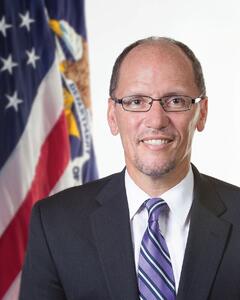
Russell L. Riley
Hello, Tom.
Tom Perez
How are you doing?
Riley
I’m great. How are you?
Perez
Doing well, can’t complain.
Riley
You sure are kind to take another hour with us today. You good until 4:30?
Perez
Yes, sir.
Riley
All right. Well, I’ll give you a chance to get settled. Barbara’s [A. Perry] recollection, and mine, was that we were going to talk about your time at the DNC [Democratic National Committee] today. Does that comport with your recollection?
Perez
Yes.
Riley
Terrific. This is actually a little bit off the beaten path for us. Because of the nature of our projects, which are oriented toward individual presidencies, we almost never have the privilege of talking to somebody who was in a position you were in outside of presidential administrations. So we’re in a little bit of terra incognita. [laughter]
Tell us about how you got there, when you decided you wanted to do that, and how you went about winning the position.
Perez
I gave zero thought to it prior to the November 2016 election, and I gave zero thought to it at any point in my life, because my life, if you look at the career pathway, has been about being in government. Yes, you’ve got to have a political radar to do the jobs that I did, but that was ancillary to the law enforcement/labor enforcement agenda.
So the election hit. After we all started to process that, my first thought was the 150 political appointees in the Labor Department, many of whom were 21-year-old volunteers for [Barack] Obama in ’07. Nine years later, a number of them were married with a small kid, and they told me, as one did, “I thought Democrats always win.” [laughter] I had to explain to them this thing called Bush v. Gore.
During the course of this—I don’t even remember who it was, I’m not sure I know or ever knew—someone said to the President, “You ought to talk to Tom about the DNC, because the party—” We were in a bad way.
Riley
Yes.
Perez
I went to the [Democratic National] Convention. I’m told I was one of Hillary’s [Rodham Clinton] four or five—in terms of the number of surrogate events, I was way up there. I did not go to New York on election night because I had abandoned my son for so long, I promised him that he and I would watch election night returns at home. Best decision I ever made.
So David [M.] Simas talked to me one day. He was the President’s political advisor. I’m sure you’ve talked to him in connection with this. I had honestly given no thought to it, and I have a fair amount of loyalty to the boss, and I think he recognized—he was a great President, and he will go down in history as a great President.
His “brand,” if you will, was somewhat distinct from the brand of the Democratic Party. He was a proud Democrat, but his brand was a little bit distinct, and that was part of, I think, what enabled him to win as convincingly as he won. He didn’t use the party apparatus in 2008. He built OFA [Organizing for Action]. I would respectfully observe that once he won, he was the head of the Democratic Party too. But let’s just say, I thought nothing about the DNC before, and—this is not a judgmental observation—it just wasn’t my wheelhouse.
Knowing what I learned, as I did some due diligence, it was abundantly clear that we had to rebuild infrastructure and rebuild trust. I’ll be really curious to read his second set of memoirs and what is said about this because the party infrastructure was undeniably neglected. The hack that took place could have been done by an undergraduate computer science cybersecurity major. That’s how easy it was.
Barbara A. Perry
Tom, could I ask you, is there a linkage—well, let me put it this way: Was there a downside to your description of President Obama being outside of the party apparatus and tradition to some extent? Was there a downside to that after eight years of the brand?
Perez
Sustainability. The goal is to win elections up and down the ballot, and when you don’t really have a party infrastructure to do that, it makes it a lot harder. When your voter file is as primitive as it was—the voter file is a list of things about people that enable you to make certain judgments. Sometimes the judgments are wrong, but the more info you have on a person, the better off you’re going to be.
I’ll give you one very concrete example as it relates to Latinos. If you meet a guy named Perez down in Florida and you want that person to vote Democratic, the most important question is not just your name, Perez, but where ‘ya from? Because Perez from Cuba, there’s a good chance, sees the world much differently than Perez from Puerto Rico or Perez from DR [Dominican Republic]. We didn’t have the capacity to ethnicity model when I got there. I don’t know how you do outreach to Latinos if you don’t know where they’re from. You can take an address and figure out, Well, maybe probably Puerto Rican because they’re in the Orlando area, but that’s not what you want. When you ignore the investments in infrastructure, you do that to your detriment.
In politics, one of the three or four top lessons I’ve learned about the business of politics is, politics and political campaigns are sort of a game of leapfrog. They win. They build OFA. They do all that stuff. Republicans lose. [Mitt] Romney loses again in 2012. There was a report that they [Republican National Committee] put out, which got much maligned, but, actually, there were some things they did that reflected some real thoughtfulness. They built a lot of infrastructure, post-2012 especially, when we were doing nothing of note, that enabled them to get a decided advantage in 2016.
Perry
Was this the famous “autopsy” after the Romney loss in 2012?
Perez
Yes. Some would say infamous, some would say famous. But infamous—
Perry
Well, I didn’t want to make a value judgment. [laughter]
Perez
Yes, infamous in some of, We’ve got to be nicer to people. That—give me a break.
Perry
Especially minorities and women.
Perez
Yes. But I’ll give you a very concrete example of something that they did, which was—in politics you have the hard side and the soft side. The hard side is the DNC, the parties. There were laws that prevent—it’s supposed to be hermetically sealed. All our data we get from our outreach at the party, we can’t share it with the A-B-C PAC [political action committee]. That would be a violation.
Well, they figured out a way, in 2013, 2014, to build an entity that enabled the real-time sharing of information from the soft side to the hard side and vice versa. There was a lawsuit filed by the DNC, I think, and it was thrown out. I used to coach basketball, and it’s not a foul if the ref [referee] doesn’t call it. It looked like a foul to me, but the ref didn’t call it.
As a result, fast forward to 2016, we were still in analog in our campaigns. But you go down to Florida, and if you’re knocking on a door of someone, they [the Republicans] had the benefit of not only the knowledge that had been gained by the party work but also the knowledge that had been gleaned from the independent side. So they also had a capacity to better identify sporadic voters who might be Republican. These are people we don’t really touch very often. We tend to hyperfocus on the folks that are more likely to come out. This new entity that was built was pretty important. They knew so much more about their voters in Florida than we knew about ours, and they won Florida.
We started the Democratic Data Exchange in 2018 because we studied what they did, and part of why we won in 2020, I believe, is we did to them what they did to us post-2012. Now the key is to leapfrog and sustain it by constantly refreshing and iterating and getting better. So, yes, that’s a long-winded answer to your question, but there are real consequences to doing nothing. Think about your computer. What was the technology you were using eight years ago? Would you think about using it now? Let me go get my PalmPilot [personal digital assistant device]. [laughter]
That’s really what it was. Our voter file—you may recall, in 2016, there was a big to-do between the [Bernard “Bernie”] Sanders and the [Hillary] Clinton campaigns at the DNC, an allegation that Bernie got into her files and was basically purloining them. The problem that enabled that to happen was just a colossal technological shortcoming. None of our information was on the cloud [internet-delivered computing services]. I’m not a computer expert, but that was just like “101” [basic] kind of stuff. That’s all on Obama’s watch. All of the atrophy was—I would say they were accountable.
Now, you can ask the question: Why were you dumb enough to take that job on? I don’t know the answer to that. [laughter]
Riley
That was my question, Tom—
Perry
Yes, go ahead, Russell.
Riley
—I’ll check it off the list. Go ahead.
Perez
The answer to that question is, throughout my career, I asked the question, Where do I make the biggest difference? I have all these ideas in various policy areas, but it’s hard to implement them if you’re not in control of government, and so you’ve got to start winning elections again. If you’re going to be the head of the DNC or run to be the head of the DNC, by far, in my opinion—no disrespect to anyone who’s done the job—the most fulfilling and fun time to do it is when you’re not in power because you have a lot more authority.
Riley
What was the process, then, that led you to make the decision to put your hat in the ring?
Perez
Well, certainly I talked to the President, or he talked to me, I would say. We were having a holiday party, and he was coming down from the [Executive] Residence. I happened to be walking in at the same time. We made eye contact, and he said, “Hey, can you come here?” We went upstairs for a little while, and that’s when we had—I don’t know if that was our first conversation but one of the early ones, and that’s when my wife knew, Oh boy, this isn’t going to be good. [laughter]
Perry
Without revealing confidences of the President, can you reveal any of the major points that he raised with you?
Perez
I think he had a situational awareness that—I mean, nobody expected us to lose. I woke up on Election Day with a 99 percent confidence interval that we were going to win. Really, obviously, I drank the Kool-Aid, with hindsight. He had a vested interest in at least trying to do something to move forward to help in the rebuilding, and so he certainly encouraged me to do it. There were some other people around him doing the same thing.
A number of us got in, and it never got anywhere below the belt. It was pretty clear very early on that while there were seven or eight people in the race, it was going to be a two-person race between myself and Keith [Ellison]. We had the benefit of being good friends, and I just talked to him yesterday. We will always be good friends.
In fact, the election was on a Saturday. The maybe Tuesday of that week, so, whatever, four days before the election, he and I went out to dinner together. I don’t expect [Donald J.] Trump and [Joseph R.] Biden [Jr.] will go out to dinner the week before the November election. And the reason we did is we both knew at that point—and I don’t mean to belittle any of the other candidates—we were all counting votes. One thing I did learn a little bit about is how to count votes, and we knew it was going to be one of us. I couldn’t say at that point, Oh, it’s definitely going to be me, and he couldn’t say it was definitely going to be him.
What we also knew and shared was that it wasn’t about him or me. It was about something bigger. And if 49 percent of the people in the room walked out feeling really disappointed, then we’ve just violated what I call the “doctrine of holes”: When you’re in a hole, stop digging. [laughter] So we talked about, how do we make sure? Because at this point, the Bernie/Hillary divide was palpable, and the recriminations were legion, and we had to stop the bleed. We had agreed, whoever wins is going to make sure—not just a week later, but a minute later—that the other person is brought into the fold.
It took two ballots. After the first round of balloting, I was one vote short of a majority. Then we had a really good operation, frankly, and we had about 25 people who said, “I’ll vote for you on the second ballot,” and so we knew exactly where to go. We felt pretty confident after the first ballot. But literally 60 seconds, if you were to watch the video—it might’ve been less—that’s when I made a motion to have him be the deputy DNC chair, and it was approved instantaneously.
Then the question was—and it was a fair question—was this just a bullshit thing to make me feel good for a day? The only way to answer that question was to say, just watch our actions together. We did a lot of stuff together. We were different in material ways, but I think there’s a synergy that comes from our different approaches. And it didn’t take that long for people to realize that, actually, this is the real deal.
So, again, the mission was to rebuild infrastructure and rebuild trust and, in so doing, win elections up and down the ballot. I can tell you that the place was in shambles. It was not a pretty picture. The election was on a Saturday. I went in the office two days later, and we had a skeleton crew, needed to hire a bunch of people, needed a technology infrastructure, small-dollar digital infrastructure. None of it was A-team stuff, but one thing I do have a little experience in is building teams, and I’m really proud of the team we were able to build. It was really talented, motivated folks and very reflective of the diversity of the party. If I just brought in all the Hillary people, that would have been a problem. If I just brought in the Bernie people, that would have been a problem. So we were able to do a lot of things.
The most prolific small-dollar fundraiser in politics is a guy named Joe Biden. That’s always a surprise to folks, and it’s one of the things we’re pretty proud of, because we built a pretty good digital operation, and then once he won that nomination, we were able to make progress. And we’d never had a larger field for President than 2020. I hope nobody ever has to deal with that again. But one of the things I am proud of is everybody kept their promise because they all said, “I’m going to run, I’m going to run hard, I’m going to run fair, and if I don’t win”—we had everyone take a pledge that they were going to support the winner. By the way, the Republicans just tried to do that, and it didn’t quite work.
Part of the reason I think it worked is because we were assiduously fair, to the point where I got a lot of crap from some people. You had to get to x percent in three polls to qualify for the debate. [Stephen C.] Steve Bullock got mad at me because he only had two, and he was like, “Can’t you just cut me some slack?” Well, the moment I cut you some slack, who else do I have to cut slack to? And, by the way, you needed to get 1 percent in three polls. One percent! I could have gone lower, and it could have been 0 percent, I guess, [laughter] but 1 percent. Not a high bar!
Steve and I have since made up. I have profound respect for him, and I understand why he was angry, but I used to be a baseball umpire—that was one of my summer jobs—and you’ve got to make the rules and then enforce the rules. You can’t make new rules up because your friend didn’t succeed.
Riley
Let me ask you a general question about your time at the party. To what extent are you focused on building this apparatus and, on the positive side, focusing on refining Democratic principles, and to what extent are you focused on being an opposition force to a Republican administration? It may be artificial to characterize it that way, but it strikes me that there are at least those two dimensions to the job. I don’t know that I have a very clear understanding about, particularly in a leadership role, how you allocate your time and your focus.
Perez
The answer is yes and yes. [laughter] In February and March, we were at airports because we had to be with the opposition. That was the right thing to do—not just the politically right thing to do—it was the morally right thing to do. People thought the party had lost its way, so we had to demonstrate what our values were. We had to walk delicate balances at times because we are a proud, big-tent party, and our platform is pretty clear on [reproductive] choice issues, for instance. I met with the Catholic Democrats, who had some issues with some of the things in the platform. I am a Democrat who happens to be Catholic as well, and a practicing Catholic.
There were challenges sometimes. I remember being approached by a number of people: “We can’t support John Bel Edwards. He’s against a woman’s right to choose.” I’m like, OK, so let’s just sort of follow the bouncing ball on that. Let’s not support him because he doesn’t abide by a part of our platform. So the Republican will win, and the anti-choice agenda will be implemented pretty seriously. Medicaid expansion will be reneged. The minimum wage expansions will be reversed. The death penalty will come back into play, because he has spoken out against the death penalty. Hmm, you think that’s a good idea?
A lot of the times you’ve got to—I mean, if your goal is to expand your holiday card list, don’t ever run to be DNC chair. I say that quite seriously. [laughter] Because when we helped John Bel—and I would help John Bel a thousand times over, a thousand times over, because look at the alternative.
By the way, they just executed someone this week, someone whom something like—no, that was in Missouri, the other one, but the difference between the current governor and the former governor is night and day. Those are the balances you always have to negotiate. And right now, the situation in the Middle East is fraught with so much sadness and challenge, and the degree of the challenge right now is off the charts. The challenges existed when I was at the DNC, and because there is—[when] we don’t control the presidency, those conversations tend to occur more frequently in those moments.
A big part of our process of rebuilding trust was, in the run-up to the 2020 election, to make sure we had a very inclusive process on things like platform. If the party’s platform didn’t reflect your position, I didn’t want anyone to be able to say, Well, you never gave me a seat at the table. We were able to work through a lot of knotty issues. Our convention and our platform—2016 was a debacle. That was just one of the many indicators that we were going to have a problem. In 2020, we were able to bring it together, and we had a pretty good run in 2017.
The one thing about this job is that it’s not hard to measure outcomes. In 2017, we had two governors races, and we won both of them, in New Jersey and in Virginia. The last time that had happened, I think, was ’07, and ’08 turned out to be a pretty good year. In 2018, we won more governors seats than any year since 1982, flipped more governors seats—that’s what I mean by that—took over the House, flipped a number of state houses and senates. It was a pretty darn good year. In 2019, [Andrew G.] Andy Beshear, who’s a superstar, real solid, just really talented—I knew his dad. I worked with his dad. If Hillary had been President, his dad would have been in the Cabinet. And we won that. John Bel won again. In 2020, you know the drill.
So it’s an outcomes business, and I’m proud of that, but I’m also proud of the fact that the infrastructure has been built to sustain itself. One of my first hires was a guy who was our chief technology officer, and he was the, like, 20th employee at Twitter. Say what you will about Twitter—we can have a different conversation about that [laughter]—but he built their back-end infrastructure.
He had never been involved in politics. I didn’t need someone who knew politics to do this job. I needed someone who could build out a system that could enable potentially 20 people to run for President. If we had 20 people running for President in 2016, I can’t even get a sentence out of my mouth about how problematic that would have been from a tech perspective. Because of our technological innovation, we could have had 50 people running for President and we would have had not a problem. Our chief cyber officer, our CISO [chief information security officer], similar Silicon Valley guy, he uncovered a major hack that predated his arrival. I forgot which major Silicon Valley firm he was at, but he actually testified in the trial because they actually got one of the bad guys who did it.
Just having those people enabled us to do what we’re doing, and now it’s kind of a cool place to work. A lot of technologists who want to do good like going there, and all of them took a pay cut. I can guarantee you that. [laughter] So that’s what I like about the DNC right now: it was built to last.
Perry
How did you go about recruiting downballot candidates—governors, senators, House members, and below?
Perez
Well, the House races and the Senate races, those were the [Charles E. “Chuck”] Schumer and [Nancy P.] Pelosi, and I worked, obviously, very, very closely with both of them, especially the Speaker. The Speaker has been a mentor for many, many years for me, and is a Baltimore native, and helped me personally in a number of ways. I just think the world of her. I have great respect for Senator Schumer, but my relationship with Speaker Pelosi runs very, very deep.
So that was their doing. What we did was to make sure we were working really closely with the committees so that we could obtain the synergies that come from our respective organizations, which have a lot of overlapping goals but also a lot of separate things. There was a woman running for Congress in Arizona. Her name was Hiral [V.] Tipirneni, a doctor, wonderful woman. She ended up not winning, but she wasn’t at the top of their list. I was kind of taken by her because she was so impressive.
We came into Arizona to provide some support for her, knowing that the DCCC [Democratic Congressional Campaign Committee] was tapped out. They had an enviable dilemma: they had so many opportunities that they had to make some hard choices, and that’s what often happens. So a big part of this is trying to coordinate. The head of the DCCC in 2018 was a guy named Ben Ray Luján, who’s a wonderful human being and was a great partner. We shared the building. The DNC headquarters is basically co-owned by the DNC, and those are the two main tenants, the DNC and the DCCC. We’re landlords together, if you will.
That sort of synergy is how we do things. Every candidate who runs for office—Senate, House, state house, dogcatcher—uses our voter file. One of the most important things we can do is make sure that voter file—if you’re running in Florida, you know whether that Perez is Puerto Rican or Dominican or Cuban. [laughter] You just know a lot more granular data.
That’s where Raffi [Krikorian], our CTO [chief technology officer], just really—he would buy up data sets and data sets so that we could really understand. There’s a lot of probative—Tom Perez is college educated, drives a Ford X—the more you know about someone, you can extrapolate a fair amount, and getting a more robust voter file helps everyone. So that’s sort of the role that we play.
Candidate recruitment is not the major part of what I did. When people were thinking of running, especially downballot, I would frequently get in contact with them, but for the governor, Senate, House, there was a whole apparatus for that, and you don’t want to duplicate effort. I wouldn’t add that much value to that. There are plenty of good people.
Riley
What about at the presidential level then? How soon are you having to balance between different presidential prospects, looking forward?
Perez
Well, the main thing we wanted to do—you always want to reflect on what took place and learn from it. One of the major critiques of 2016 was that the DNC had their thumb on the scale for Hillary, and whether you believed it or not, perceptions drive behavior. Whether it was accurate or not, perceptions drive behavior. My predecessor did a few things that certainly contributed to that perception, things I would not have done. For instance, just to give you a sense of what that meant, we set forth the rules of engagement for the primary process, the debate process. We set those forth long before we knew who was in the field because one of the critiques was the whole debate structure was basically reverse-engineered to benefit Secretary Clinton.
So we set forth, first, the debate’s going to be in whenever it was—I think it was June of ’19. Here’s the criteria, again, set forth way early. We’re very clear that the further you get along in the primary process, the higher the bar to participation because you’ve got to demonstrate that you’re making progress. The innovation we put in place that had never been done before—and, by the way, the Republicans copied it for ’24—was to require not just polling but grassroots support. If you had x number of grassroots donors—I think it was “and”—so 1 percent and. It may have been “or.” I haven’t thought about this in forever. That was transformational because it was, again, we want to return the party to the people.
By the way, one thing I forgot, because, frankly, it triggers some PTSD [posttraumatic stress disorder] [laughter]—and I’m now going backward a little bit. At the convention, because it was so divided, there was a motion that was adopted to create a unity/reform commission designed to take a look at how we can make the party more accessible to ordinary folk, and improve processes, and improve the brand, et cetera, et cetera.
Frankly, when that was done, it was assumed that Hillary would win and something would be done with that, but it wouldn’t take on importance. It was a good way to try to bring people together, to say, Hey, we know there have been problems, and we’re really going to study this. Then you lose, and then suddenly this became the first order of business for the chair, and one of the first tests of, Do you really mean it?
Keith and I worked on this very closely, and the most conspicuous manifestation of our commitment to fairness was who was running the various committees. Larry Cohen, who’s the former head of the Communication Workers of America, and a good friend, and I think he was a co-chair of Bernie’s campaign, and someone who is impeccably of integrity—he played a really important role. He was one of the co-chairs, and he did a great job. That was really an important part of our movement forward.
I actually did a trip to six different cities, by the way, with Senator Sanders. I would describe it—I don’t mean this disparagingly—it was sort of like an apology tour. It was a listening tour, but we knew we had to rebuild trust. If you’re afraid to go in front of folks who might heckle you, then you probably don’t want this job. We went to six different cities, he and I. I’ve always had a good relationship with him. I supported Hillary, make no apologies for that, but I never did it by saying negative things about Senator Sanders because he was great on my labor issues, so I appreciated that. But it was helpful because I think it built some trust between the two of us.
All of these things—none of them are going to solve it. Trust isn’t an on-off switch. It’s something you earn, and we spent a lot of time doing that. Those were things I should have brought up before. That was the year 2017. We moved ahead, we did 2018, and now we’re in—I really think that part of our success was we set forth those rules really early, and we kept to them. Again, we took some heat at times for not bending the rules to help someone in, but that would have defeated the purpose.
The most miraculous—“miraculous” is the wrong word—most remarkable thing, from my own perspective, was how the 72 hours between the South Carolina primary, which was a Saturday, and Super Tuesday, which was the following Tuesday—I was in South Carolina for the primary. I had lunch that day with Mr. [James E.] Clyburn, who I just have profound respect for. Then there was a big party event in Charlotte [North Carolina], maybe a three-hour drive, so I never would have guessed that the election—
Don’t forget, now we’re getting a couple of weeks away from the world shutting down. We saw it coming. We didn’t think it was going to come that fast. I don’t know that I’ve ever seen—don’t forget, after the New Hampshire primary, Joe Biden did come in second in Nevada. That is an accurate statement—but that’s like coming in second to Secretariat in the Kentucky Derby. [laughter] It was beyond a distant second, and he [his campaign] was on life support. Not only did he get rescued in South Carolina—and I’ll always say that the most important individual for his political turnaround there undeniably was Mr. Clyburn. And—
Riley
Tom, you said you met with Clyburn at the time.
Perez
I had lunch with him on that Saturday.
Riley
What was he telling you then about what was going on?
Perez
He felt confident that the [Vice] President was going to win South Carolina, but we weren’t talking about the race being over in 72 hours. The winning of South Carolina was going to be the beginning of new momentum, the [Vice] President isn’t out of it after all! [laughter] But then two things happened that Sunday, which is both Pete [Peter P. M. Buttigieg] and Amy [J. Klobuchar] did a remarkably heroic thing, which is, they would have been well within their rights to stay in through Super Tuesday—they’d earned that. They were running good campaigns. They’d made the debate stages, and nothing had to get reverse-engineered for that. They were running good campaigns.
But they both recognized, first of all, they had a really serious deficit with black voters, and that’s just such an anchor of our Democratic Party. They could have stayed in, but then it was going to be a long race, so they both got out before Super Tuesday. And then, my goodness, like a lightning bolt, this thing was over. Frankly, thank God, because if we were in a dead heat between three or four people—I think the world shut down around March 13th, 14th, something like that—damn, I don’t know what would have taken place because then these incredibly impactful primaries would have been under this cloud.
I’m really proud of every candidate who ran because they really were—they kept their word, and they put the broader interests of our democracy above their self-interest. In politics there are good losses and bad losses—and I don’t even use the word “loss,” because the biggest loss is not swinging the bat—but there are good outcomes and sometimes outcomes you don’t want but they’re still pretty good. And especially for Pete and Amy, they did a real service, and everybody else. Everyone came together.
What people don’t know about Joe Biden is that he has a genuine affection for and a really deep relationship with Bernie Sanders. They were just together here [at the White House]. They did an event here a few days ago on—I forgot the issue. Oh, it may have been prescription drugs.
Perry
Prescription pharmaceuticals.
Perez
It was inhalers, because the $35 insulin is now $35 inhalers too.
Perry
By the way, that was the lead for I can’t remember which MSNBC show that evening, but they began with, Look how important it is for the President to open the doors, after the announcer at the White House says, “Ladies and gentlemen, the President of the United States,” walks through those important, historic doors, and then they switch to, “Today, ladies and gentlemen, Senator Bernie Sanders,” and he walked through the door at the White House. Just the thought was, how generous it was to let him do that.
Perez
Well, they have a genuine affection. The race was effectively over after Super Tuesday, we knew that. And the President, then vice president, throughout—it wasn’t a Machiavellian impulse of I’ve got to do this because it helps me. It’s just who he is. He brought Bernie into the fold.
I’ve watched the President [Biden] in a number of circumstances. Shawn Fain, who’s the head of the UAW [United Auto Workers], said some really nasty things about the administration, and there was a school of thought among many, like, screw him. The President’s response was, “I want to speak to him one on one.” Shawn Fain is going to be one of his top 10 surrogates in this election because he had an instinct, which was spot on. Part of that instinct is just to be nice to people, and you can bring them in if you do stuff like that.
So once the primary season is de facto over, my job very much evolves, because you’re really turning over—the job is, you’ve built a good house, and then you hand the keys to the house over to the nominee. I was proud of what we were able to hand him. We were raising money at a really good clip. We had low overhead costs because we went virtual. Trump stayed nonvirtual, in part because he was feathering his own nest. Most of the events were at Trump enterprises.
When you look at the reports, both sides raised roughly $1 billion dollars, and that’s only part of the story because you also have to record your overhead costs. Our overhead costs were about 16 percent. His overhead costs were more like 40, so just do the math. The 25 percent delta in the overhead costs, we had $250 million more to actually run program because we were smart with how we spent our money and had lower overhead costs. I think the rest is sort of history, and we did OK in 2020.
I guess I’ll leave it: Politics, as I said, is a game of leapfrog. Obama wins. They build a great mousetrap. They study what we did. They leapfrog us. We study what they did, and we leapfrog them in 2020. The key now—and that’s not my job right now—is to leapfrog and sustain. One of the things I am relieved and happy about was that a lot of the folks who were part of our team actually stayed on to make sure that the progress was, in fact, sustained. Just looking at the fundraising, and the rapid response capacity, and the things that are being done, I feel pretty good about it.
Riley
Terrific.
Perry
You should. By the way, another thing that I saw on MSNBC last week was the interview you did with them about the [Francis Scott] Key Bridge, and it was so moving, so poignant—
Perez
Thank you.
Perry
—your conversations with the survivors’ families. Thank you for doing that.
Perez
My next call is going to be with the one victim who fell into the water and survived and has got serious survivor guilt.
Perry
Aww.
Perez
I try to talk to him with some regularity because he’s hurting, but he’s very stoic.
Perry
Making good progress physically? Is he coming back?
Perez
Oh, yes, no, he was out in a day. Yes. And didn’t know how to swim—
Riley
Oh gosh.
Perez
—but survived. The first responders—
Perry
How did he survive?
Perez
The first responders were unbelievable. There were people at the scene within three minutes because they knew the crash was going to happen because of the SOS [emergency call] from the boat.
Perry
The crew, yes.
Perez
We happened to have a Coast Guard presence within a very short distance of there, just sort of one of those lucky breaks, so we had a lot of folks there really fast, and he was able to survive.
Riley
Hearing you talk about this only accentuates how valuable your time is, and you have been more than generous with us even before today. We really appreciate your coming in and letting us hear from you today. We will take an intermission of some undetermined length of time because we will expect to come back and talk with you about the Biden presidency when we are in a position of doing that. We’ll fill in any gaps in our knowledge about your experience at that time.
Perez
Excellent.
Riley
But you have been a real champ in spending this much time with us, so we appreciate it. Thank you.
Perez
No problem. You do great work.
Perry
Thank you, Tom.
[END OF INTERVIEW]