Transcript
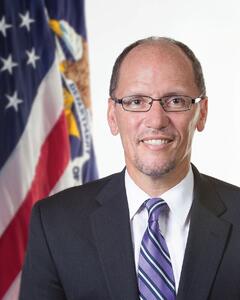
Russell L. Riley
Mr. Secretary.
Tom Perez
How are you all doing?
Barbara A. Perry
Great.
Saladin Ambar
Good to see you.
Riley
Good, how about you?
Perez
Doing well, thank you.
Riley
Thank you for joining us.
Perez
No problem.
Riley
Forgive me for not having my jacket and tie on. It’s hot down here. I’m guessing it is in Washington.
Perez
No problem. Sorry, I just came out of a number of meetings. Otherwise, I’d be a little less formal.
Riley
Well, feel free to loosen the tie and free yourself of the jacket if that works best for you.
Perez
I’ve got another meeting after this, actually, I just realized.
Riley
You can see that we’ve been joined by Professor Din Ambar at Rutgers [University], who has worked with us occasionally. Din has familiarized himself with the briefing materials and the last interview, so we’re all starting pretty much from the same point. We got you back into the Department of Justice last time. We talked a little bit about the people you chose to surround yourself with there, a little bit of the transitional matters. I wanted to pose a question about the condition of the Civil Rights Division when you came in.
You had said that you’d had some, what I think you termed, “Kleenex sessions” last time. But I’m wondering about the personnel issue. You were, as I understand it, down a substantial number of people. How did you go about building the corpus of your operation back up?
Perez
As you probably know, Attorney General [Eric] Holder [Jr.], I think correctly, referred to the Civil Rights Division as the crown jewel of the department. That crown jewel lost a lot of its luster during the [George W.] Bush administration because so many things got politicized, which is one reason why the inspector general recommended my predecessor for criminal prosecution. Because they had really crossed a number of lines that you shouldn’t cross, in particular, in the hiring process.
The challenge that you have coming into a situation like that is a bunch of these folks were hired. What you can’t do is what they did in reverse, OK, you came in, you came in, you came in under the wrong way. [Points in different directions] You’re out of the bar. So it was a delicate situation. In particular, in the voting section, it was particularly delicate because that’s where the politicized hiring had a real beachhead.
I remember one time when I was bringing the AG [attorney general] into the section because the section had been really—the morale issues there and the internal divisions there were very, very palpable. Every time I told the attorney general, he was going, “You’ve got to understand that there are at least two or three people who are recording what you’re saying, and they want to twist something that you say.” The attorney general sometimes liked to make light of things in a wonderful way. But I’m like, “Don’t be glib. You’ve got to bring your A game and understand that anything you say can and will be twisted against you in the court of Pajamas Media,” which was one of those social media sites.
Sure enough, 30 minutes after we had visited, there was something out there. He was on his best behavior, so there was nothing there. I showed it to him the next day because I was like, “Just to give you a sense, this is how long it took for someone who was in the room to write something.” I bring that up simply by way of illustration to give you a sense of what we had to do.
It wasn’t hard to recruit people because the place is just a special place to work. A bunch of people wanted to come back because, you know, the aura of [Barack] Obama, the potential to do so much good. And we were able to do a lot of budget advocacy so that early on, we had the authority to do the largest volume of hiring that we had ever done. At the same time, there were some folks that weren’t performing, and we had to do some things about that, and we had to do it the right way.
It was about a year or two into my tenure, the inspector general announced an investigation into the hiring practices of the Civil Rights Division. I knew that everything we did would be under a microscope. I’ve lived my entire life, from the moment I entered DOJ [Department of Justice], understanding that every meeting I had, I assumed that there was a reporter in the room. It was annoying to have the inspector general investigation because it was a time suck. I was very confident in what we did and how we did it. But it took time. The head of the voting section, we were eventually able to facilitate his exit.
One of the things I’ve always believed, and I’ve had the privilege of leading a number of organizations, is there are folks that you need to facilitate their departure. I’m always a believer in exit with honor as opposed to coming in the first day and Ready, fire, aim. That just has never worked. I’ve watched people do it, and it creates more trouble than it’s worth. So we took a while. There were some folks who were like, “When is this going to come to fruition?” But I’m proud. We had accomplishments, documents that we did, and we got a lot done, but it wasn’t easy.
Again, the voting section was the epicenter of the challenge. We really had to do some heavy lifting there, and we had to be prepared. Because the thing you have to understand about voting is the most important year for voting is always the year that ends in a [number] one. There’s only one year every decade that ends in a one. I got there in late 2009, and we had to be prepared because 2010 is census, 2011 is redistricting, and that’s when—back in the day when we had Section 5 of the Voting Rights Act, we had to be prepared to use that tool.
Just for your situational awareness, Section 5 was really the heart and soul of the Voting Rights Act of 1965. It was a provision that said that certain jurisdictions—and it could be a state, or it could be a subdivision thereof—that have a documented history of discrimination have what’s called a “preclearance requirement.” So any change to voting—and by any, I mean you move a polling place, that’s a change in voting—it had to be precleared. It was an indispensable pillar of our work to hold folks accountable.
I use that example. Change a voting place, how could that possibly implicate the Voting Rights Act? Well, we had a case in Texas where they moved the polling place from a school where it had been for 30 years to a place that was a notorious meeting place for the [Ku Klux] Klan over the years, and everybody knew that. That was a WTF [what the f––k], like what are you doing, sort of moment. It wasn’t subtle. That’s why that requirement was so important.
You can look at law review articles that documented the efficacy of Section 5. And, by the way, Section 5 was reauthorized five or six times by Republican and Democratic administrations, most recently in 2008, led by [F. James] Jim Sensenbrenner, Republican of Wisconsin. So rebuilding that practice was indispensable to rebuilding the division. I guess the punch line is the thing that was so heartening was recruiting people. We brought in so many good people. There were already a lot of really good people there who hadn’t been utilized to their full potential.
The advantage I had is I started there as a summer clerk in the 1980s. I was an entry-level lawyer. I held every position in the division that a law student or lawyer could hold. I was a summer clerk. I was a trial lawyer. I was a first-line supervisor. I came back after my detail with Senator [Ted] Kennedy as the number two person there and then came back to lead the division. So before I walked in, I knew 70 percent of the personnel there in the division. I think that gave me a leg up because they kind of knew me and, I like to think, sort of trusted me.
As I said to you last time, I think, especially after [Operation] Fast and Furious, I said to the attorney general, “You should be dad-gummed if you’re going to allow that to be a legacy.” I think it caused him to think really long and hard about what his legacy was going to be. His number one legacy, I believe, was the civil rights work that we did. I know that sounds a little self-serving, but I think he said it in his own book. We also had some really good partnerships with others in the department that enabled us to do some really good work.
For instance, Arizona passed some terrible laws in 2011 or so, SB 1070 [Arizona Senate Bill 1070]. It enabled local authorities to become immigration cops. There’s a whole body of case law that stands for the proposition that the federal government has plenary authority in immigration matters.
ACLU [American Civil Liberties Union] filed a lawsuit. I had a person on my team that actually had worked at the ACLU a while back and knew those folks. The head of the Civil Division was a guy named Tony West, who is a great guy. You may have spoken to him as part of this. We ended up tag-teaming in that because he understood that we added value. We won that case, and we won a number of copycat cases like that. A woman who served on the trial team actually just got confirmed as a federal judge. She ended up working for Eric Holder after she got out because she was so good. That’s an example of the folks we were able to recruit into the division.
Then the issue of gay marriage—in 1995 or 1996, Congress passed the Defense of Marriage Act—it was ’96. I was working for Senator Kennedy at the time. This vote in the Senate was like 82–18, and Senator Kennedy was one of the 18 who voted against it. That was being challenged. We had a really robust internal discussion in the department about whether to defend it. There were people of goodwill in the solicitor general’s office who shall go unnamed because they’re good people—I just fundamentally disagreed with what their position was. But there’s a proposition that duly enacted laws passed by Congress, we have a duty to defend them in most cases. Our position, myself and Tony West, was in most cases that’s correct, and this is one of those cases where it shouldn’t be. I appreciated the fact that our voices were allowed to be heard in that.
One of the arguments that was made by the folks who wanted us to defend it was there really wasn’t a long history of oppression of LGBTQ [lesbian, gay, bisexual, transgender, queer or questioning] folks in this country as there was, say, vis-à-vis black people or Native American people. We had an LGBTQ working group in the division, and we produced this document that really debunked that. In Massachusetts, if a same-sex couple had sex, it was a death penalty–eligible offense in the 17th century. So, again, the AG gave us a lot of running room. We had a collaborative senior team. The boundaries were not etched in stone so that we could capture those synergies, and that was a big part of what made that job a lot of fun and impactful.
Riley
I have one sort of naïve question about the rudiments of the staffing. I guess I have this sort of conventional impression of most of the bureaucracies being filled with civil servants who come to you through the usual civil service selection process. I guess what I’m trying to get my head around is, you’ve described the people that you inherited in the division as being not completely sympathetic with what you were attempting to do politically and that you had good success in converting the department in the direction that you wanted it to go. Help me explain how that functions in the instant case. In other words, are these people civil servants? How do you go about ascertaining in such positions how they’re going to be operating consistent with your goals for the department?
Perez
It’s a lot of jobs ago, so I don’t remember the numbers precisely. But we probably had 700 employees in the division, and that included probably 300 lawyers? Something like that. In our front office, the people who were noncareer—these are the folks I was able to bring on, our team—were roughly a dozen people. It was a great team, one of my favorite teams I’ve ever had the privilege of assembling. The thing that enabled us to really maximize the “oomph” factor was we controlled the Senate and the House. We got the largest budget increase in our history at the time. So we had the authority early on to hire something like, I want to say, maybe 40 lawyers, which when you look at the denominator, that’s pretty big. Then of the 300, most of them were really dedicated to the mission.
Again, I’ve said to you before—when I was a career person, I watched political appointees come in, Republican and Democrat. What I’m about to say is a nonpartisan observation. I watched Democratic political appointees who understood the critical importance of the career staff and the critical need to engage them. That doesn’t mean you agree with them every time, but you engage them. I saw good ones and bad ones from both parties because I started when Bush 1 [George H. W. Bush] was President. I saw one person, who shall go unnamed, when the Democrats took over in ’93, who thought that anyone who was working in the Civil Rights Division must really not care about civil rights because you worked in the Civil Rights Division under Bush. It’s not only wrong, it’s insulting.
The team that we had, there were a lot of good people. Now there were some who came in under that political hiring process, and their goal was to carry out an agenda that was antithetical to what we were doing. But there are civil service rules, so that made life a little challenging. There was an IG [inspector general] investigation that they were trying to claim that we were dumping people because of their ideological views, and that was debunked. But it did make for some challenge.
I was on eggshells for quite a while in the voting section. Most of those folks finally left because they realized that they couldn’t do any damage. There are ways to limit their ability. I said to all my teams, “Give people honest evaluations.” There’s a lot of “grade inflation” that goes on in government, and a lot of it stems from the fact that people were afraid to hold folks accountable because they thought their bosses wouldn’t have their back.
So, again, we were able to reinvigorate folks who were really good, hold people accountable in an appropriate way who weren’t, and we watched that attrition. Probably the biggest challenge for me was—one of my strongest priorities in every job I’ve had is not only to recruit a top-notch team, but I want to recruit a top-notch team that reflects the diversity of our nation. And if you look at the attrition during Bush, it was dramatic among attorneys of color. We had a number of supervisory openings in the division, and these are openings for career people—like I was a trial lawyer, then I became a deputy in the section.
The challenge I had in hiring section chiefs—these are the folks that are really important cogs. They run the voting section and other places. As a former career person, I wanted to help promote from within so people stay and see that they’re rewarded. But frankly, I had a couple of sections where the people, if I had followed that, I would’ve had an all-white supervisory class. The reality was a number of candidates for a number of these jobs who were the best-qualified candidates happened to be candidates of color who did not work in the division.
So I broke a little china in some of the places because I violated what for most people was sort of a rule: you promote from within. But I don’t apologize for it because we brought in the best people. And in really every case, they were able to earn the trust of the folks in the section because they had been working as attorneys in the outside with these folks. They weren’t a blank slate. That created undeniable tension with some of the longer-tenured people who felt a little disrespected. But leadership is letting down your friends at a pace that they can absorb, [laughter] and I tested that with regularity.
Riley
Other questions on this. Din, please.
Ambar
Secretary Perez, thank you again for joining us.
Perez
Just call me Tom, it’s a lot quicker.
Ambar
Tom, OK, great. I wanted to ask you a question related to DOJ. No good way to put this except that we’re three weeks removed from the third anniversary of January 6 and the attempted insurrection on the [U.S.] Capitol. I guess I wanted to ask, to what extent when you were at DOJ were you aware, prioritized, interested in the rise of white militia groups, so-called white nationalist groups, the gradual movement or infiltration of those groups’ members into law enforcement?
As we know and studies have shown, there have been a number of those folks from January 6 who were involved in law enforcement from those groups. I guess this is a bit of a hindsight question. I hope it doesn’t come off as too much of a Monday morning quarterbacking question. But did you get a sense of the sort of cocktail of ingredients that helped lead to what took place on January 6th?
Perez
I spent the bulk of my career as a career person in the division, so really, a decade prosecuting police cases. I saw the ugly underbelly. Actually, I developed a little bit of a niche. I got a lot of satisfaction from prosecuting cases in rural America. There are so many jurisdictions in this country where the sheriff really runs the county, and there is no internal affairs division.
I saw the seeds of the question that you’re asking because I ended up prosecuting a lot of those cases. I was on the team that was involved in the Rodney King [beaten in 1991 by Los Angeles police] stuff. Gosh, I was two years into my job. I want to be very clear so I don’t overstate it. I was a bit player in that. When I saw George Floyd [murdered in 2020 by a Minneapolis police officer]—it shocks America. It didn’t shock me for a minute. I’d been doing it for 25 years. It’s like, eh, the more we change, the more we stay the same. I don’t mean to be so flippant. I’m just giving you my honest reaction. So I saw those seeds.
Trumpism predated [Donald J.] Trump, and it will postdate Trump. What he gave people was a permission structure to articulate publicly what they had been thinking privately and hadn’t too frequently articulated publicly. When I look at where the world was in 2010 when I was leading the Civil Rights Division and where it is now in terms of social media and the capacity to disseminate at scale, that’s a huge difference, Professor. That has been a weaponizing factor, but this has always been there.
If you look at the history of—we had a cold case unit that looked at legacy civil rights crimes. I had a trip down to Mississippi because we actually had some leads on some of the potential defendants involved in the Mississippi Burning case [1964 murders of three civil rights workers] that were still alive. We were trying to do like the Al Capone–for-tax-fraud play, but we were trying to do something. But if you look at that list of legacy civil rights crimes, the number of people who were in law enforcement should be shocking to people. It’s not shocking to me. The question that you ask is a question that’s been ingrained in law enforcement for generations.
I think one of the most important practice groups in the division is our police practice group. I think I said this last time, but I used to prosecute cases. And then in 1994 in that infamous crime bill [Violent Crime Control and Law Enforcement Act of 1994]—the most important piece of legislation for Tom Perez, personally, in my career—was the pattern-or-practice [of unlawful conduct] authority that we got from the crime bill. If you’re going to change the culture of a police department, you don’t do it one prosecution at a time. In fact, that tends to sow more unrest within the ranks because there’s this overwhelming sense that, Oh, that guy got scapegoated for problems that are endemic to the department. That’s what the pattern-or-practice authority gave us.
If you want to know a difference between the Bush folks and us, they did one case in the eight years: Cincinnati. We did something like 32 cases in four years—pattern-or-practice cases, really looking at systems issues. If you just look at the arc of the pattern-or-practice authority since its inception or since 2000—the first five years they were still figuring it out, so I give them a pass on that. But you can tell who was in power. Nothing done in Trump, nothing done in Bush, a lot done by not just me but my successor, and a lot being done now. Elections have consequences.
Ambar
Thank you for that. I appreciate it, very helpful.
Riley
I was just going to ask, since the question came up, were you at Justice after Waco [Texas siege of the Branch Davidian compound by the Federal Bureau of Investigation (FBI) in 1993]?
Perez
I was a career person. Waco was ’93 or ’94.
Riley
Exactly.
Perez
Ruby Ridge [Idaho white-supremacist stand-off with the FBI in 1994]. There were two things that happened pretty close to each other. There was Ruby Ridge in Idaho and there was Waco. The thing I remember most about that was Janet Reno really taking personal accountability for those cases. She was a neat lady.
Riley
Barbara, you had a follow-up question.
Perry
I did have a follow-up, but now that you mentioned that, just wondered—Tom, I don’t think we asked you last time, the differences in leadership style and approaches and content between Janet Reno and Eric Holder.
Perez
I had and have great respect for them both. They were very different. Janet Reno was much more hands-on, I would say, to a fault at times. She had to be reminded that she’s the attorney general. She’s not the states attorney of the United States. By that I mean someone would call her like, “Hey, there’s this case here.” The next thing you know, you’re a line attorney, and you’ve got to go see the attorney general and give her a briefing on this case. When I was labor secretary and I’d get calls, I wouldn’t call in the line people, Here, you go figure this out, and if I need to do something, let me know.
At the same time, she preserved the independence of the department—at times probably to her personal detriment, as you probably get what I’m saying. I got to know her pretty well because I was the number two in the Civil Rights Division. I was involved in a death penalty–eligible case where it involved these white supremacists who had shot—they tried to start a race war, and they shot at three African American males and killed one of them in 1994. The problem with the case was it didn’t fit the death penalty. There’s a whole [set of] criteria you have to meet to be death penalty eligible, and I didn’t think it did. My trial partner, who was from Lubbock [Texas], was actually prosecuting a parallel case that was a death penalty case involving the rape and murder on Reese Air Force Base of a soldier by another soldier. I bring this up because she was very, very personally involved.
We didn’t think it met any of the factors in our case. What happened in our case, the evidence showed that they basically, they were idiots. They were racists. They got drunk one night and they decided, “We’re going to go kill black people,” and they did. The challenge if you want to get death penalty is that you have to demonstrate substantial planning and premeditation. Getting drunk one night and going and doing stupid things doesn’t fit that. But there was some pressure, that I won’t get into, from others to prosecute our case as a death penalty case.
We told the AG and others that, “If you do this, you have to understand that the judge is going to sever our case”—we had three defendants—“and he’s going to try them separately. Our case is really strong against two but not the third.” They’re all equally culpable, but there was a disparity in evidence. Having three separate trials was going to be a problem. I had some concerns about whether they wanted—I felt like there were a couple of people in the building who wanted to prosecute our case because the other cases had black shooters and white victims. Our case gave them symmetry. Symmetry is not relevant to the determination of whether you seek the death penalty.
The punch line of this is they decided to seek the death penalty, so we filed the notice. We told them, “If you do that, we run the risk of having the judge sever the cases, and that might happen in a few weeks.” The thing I was wrong about was three hours after we filed our notice, the judge severed the cases. We went in the next day and we said, “This is what happened.” We were informed that if that notice was withdrawn, the cases wouldn’t be put back together. Two days later, that notice got withdrawn. What impressed me about the attorney general was she was not outsourcing this. She was personally engaged in this, and I appreciated that about her. Eric was a lot more of a delegator. Got involved in the moments that he had to get involved in, but it was just different styles.
Perry
Well, he also, obviously, is/was very close to the President. Did you see any difference in how he operated or how he was linked to the White House and vice versa because of that close connection with the President?
Perez
He was definitely close with the President. He was very involved in the transition. At the same time, on the issue of defending the Defense of Marriage Act—he didn’t go ask the President, “What do you want me to do?” He didn’t do that in any case because that would be inappropriate.
You tend to want to appoint people to these important positions whose values you have a pretty good sense of. They had a pretty good mind meld on where America should be. I have no doubt that when this announcement was made that we weren’t defending the Defense of Marriage Act—there was no call from the White House saying, “What the heck are you doin’?” [laughter] That was, I think, very consistent with what the President had articulated as his values and, importantly, consistent with where we saw the law, and the Supreme Court ultimately agreed with us. That is a very important element of the attorney general’s success, is having a pretty good window into the moral compass of the President.
Riley
Because you’ve raised the issue and we’ve been going back and forth in time, I wonder if I could ask you to give us sort of a broad portrait of the evolution of gay rights since you’ve been in Washington. If you look, we did a major interview project on the [William J.] Clinton administration. And “Don’t Ask, Don’t Tell,” many people have a hard time comprehending how that was conceived as a success story for gay rights in 1993, 1994. That was a different world then, and you’ve lived in the legal structures dealing with gay rights during this entire window of time. Would you talk a little bit about what you’ve seen—how do you explain this? If you’ve got any insights, help us understand the full gravity of this shift from Bush 41 to Obama.
Perez
That’s a fascinating question. I forgot if it was the Defense of Marriage Act or one of the other cases that the court took up and ruled in our favor, but the President said, “Justice has moved”—I think his term was—“like a lightning bolt in the area of LGBTQ rights.”
When you look at the arc of progress in women’s issues, for black people in America, for Native American people, for religious minorities, relative to the gay rights movement, it’s been a slower process. I don’t mean to imply that on any of these we’ve reached the Promised Land, quite the contrary. We could have a whole conversation about the turning back the clock on LGBTQ rights right now and the whole assault on DEI [diversity, equity, and inclusion]. But it really was remarkable.
In 1995, we were having a very robust debate with the Republicans. This is after they took over. I forgot the one issue we were debating. They wanted something really badly. We were having a debate within the civil rights community about what do we demand. The two choices were a hate crimes bill—I think we had talked about that already. In ’95 or ’96 when I was with Kennedy, I had the privilege of codrafting the first iteration of what became the Byrd-Shepard Act [Matthew Shepard and James Byrd Jr. Hate Crimes Prevention Act]. The debate was, do we push for that, or do we push for the Employment Nondiscrimination Act [ENDA], which barred discrimination in the workplace based on sexual orientation. I was raising my hand saying, “We should do the hate crimes bill.” The reaction to that was, “No, no, no. That’s too easy. That’s going to pass in a year. Let’s go for ENDA.”
In 2009, and it was a month after I got confirmed—it was a wonderful symmetry for me to come back—that’s when the hate crimes bill passed. It took 14 years. It took 16 years for the Civil Rights Act of ’64 to pass. It was first introduced in ’48 by Adam Clayton Powell [Jr.]. I bring this up because it was a really slow slog. We were still debating ENDA. The first bill I testified on when I was labor secretary was the 2013 version of ENDA. I forgot what they called it. We changed the name. All of a sudden, like a lightning bolt in 2013, 2014, and it has even continued. We don’t need ENDA anymore because the Supreme Court—an opinion written by [Neil] Gorsuch, of all people—basically took care of that for us.
The point, number one, is it’s really from a historical perspective, there’s been so much movement. But when you look globally, we were kind of behind the rest of the world on a lot of this, and now we’ve woefully fallen behind the rest of the world on a woman’s right to make choices. We’re one of only a few industrialized nations now that are moving in the wrong direction. So it was remarkable on one level.
But the point that I never lose sight of is for my gay nephew, it certainly wasn’t fast enough. It seemed fast to me. In a historical context, it seems fast. But for folks in the trenches, for many folks, it was too late: I couldn’t get a will because we were a same-sex couple, so I had all these challenges. So while I’m excited at the pace, I’m mindful that the decision didn’t directly affect my personal life, and so it’s easy for me to say that. I think it’s really important for us to never lose sight of that fact. I don’t know if that was totally responsive. I hope it was.
Riley
Absolutely, thank you. Barbara, go ahead, please.
Perry
Din?
Ambar
Well, this is not quite along this line. It’s more about management style, so if you have something directly related to this, Barbara. [indicates no]
I want to come back—you were contrasting Janet Reno and Eric Holder in terms of management styles, and I wanted to ask a question about temperament. Because Barack Obama famously—I think the joke that was told from the view of Michelle Obama, he only eats six almonds at night before bed, or something ridiculous like that. But the point was that there was something temperamentally about President Obama that was interesting and restrained.
I want to ask about the role of temperament in leadership broadly but certainly from what you’ve observed in President Obama and, perhaps, others who you’ve had the pleasure of working with. I want to tie it to this question of scandal—in President Obama’s case, the lack of presidential scandal. Was there a sense of internal pressure that was created to toe the line in ways that were different than what you’ve experienced before? How much of this was temperament? How much of this was just personnel, as I think you’ve alluded to in your last interview, personnel as policy? I would like you to riff, if you don’t mind, on the question of temperament, particularly with respect to your time with President Obama.
Perez
The one thing I did want to bring to your attention is there was one scandal with Obama. You remember that tan suit he wore that summer day. [laughter]
Ambar
That was one of the worst days in America’s life, yes. [laughter]
Perez
I mean, it really is—when I think of scandals of the 20th century and the 21st century, I think of [Joseph] McCarthy, I think of [Richard M.] Nixon, and then I think of the tan suit.
Perry
You mean the one that was very similar to the tan suit Ronald Reagan wore when he interviewed Sandra Day O’Connor?
Perez
Exactly. [laughter] In all seriousness, I love your question because leaders—I’ve prosecuted a lot of cops. I used to do trainings for police departments after a while because I saw the same movie over and over and over again. I used to say the most important two sets of people in a police department are the chief and the first-line supervisor. They set the tone for the department. I used to have these slides. I used to watch some bad television in my youth, and I had a slide of Sergeant Schultz from Hogan’s Heroes. [laughter] You know, “I see nothing. I hear nothing.” That is not a good way to be a first-line supervisor.
I had a case in Arizona involving a border patrol agent, and the supervisor said to the unit—I heard it from umpteen people on the grand jury—“If you people are doing bad things, I don’t want to hear about it.” No, that’s not what you say. The “no drama Obama” thing was real. We had plenty of spirited debates about what to do about issues behind the scenes. But we came to consensus and we reached a decision, and then we were all in the same direction. I loved that. By the way, my position prevailed a lot, and my position didn’t prevail from time to time. That’s beside the point.
You’re part of a team. I’m not a I don’t do windows, I don’t do this. You go out there and you do it. That was the tone that was set from the outset. I think there’s a little bit of hankering for that across America in some corners because there are some who currently equate leadership with bombast. The louder you are and the more crazy you project, “Well, that person has courage of his convictions.”
That’s just not how I am. By the way, it’s a similar—you don’t hear a lot of talk about scandal in the world of [Joseph R.] Joe Biden [Jr.]. This bullshit with Hunter Biden, give me a break. That’s just the tone that’s been set from all the way up, and it pervades the people you hire.
The culture I tried to build in the Civil Rights Division, I knew what I was up against in terms of what preceded me. There were people with PTSD [posttraumatic stress disorder]. Those weren’t my words. Those were the words of some of the people I spoke to early on. So you want people to feel like they’re part of something. If there’s one thing I was proud of above anything at the Labor Department is when I got to the Labor Department, we were second last among large agencies in employee satisfaction. Thank God for DHS [Department of Homeland Security]. When I left, we were in the top quarter because I’d been a career person. I’d been in the shoes of folks who had been toiling in the trenches doing God’s work.
One of the most important things you ask in any organization is, “What do you think?” That question hadn’t been asked at the Labor Department. That question, frankly, hadn’t been asked in the Civil Rights Division for a while, and we were able to include people. We created a number of crosscutting working groups to work on cutting-edge issues. People in every section kind of started feeling like, OK, we got some mojo here and we’re really making a difference. And we hired the right people. We so often, at the moment we’re in right now, conflate amplitude and numerosity. Someone’s loud, so they must command a great majority. That’s not the case, thank God.
But I do think that your question is really important, and I think a key to our success, both in Obama and in this moment, is having leaders starting at the top who have a clear moral compass, give clear direction, are transparent, invite viewpoint diversity behind closed doors, reach decisions, and then go and implement. I can’t think of a situation in the current moment where they’re reporting major disagreements here and there. There’s a pretty similar through line with both Obama and the current President.
Ambar
Thank you for that.
Perry
Did you ever see the President [Obama] depart from his zenlike quality?
Perez
Usually when I had meetings with the President, you cut to the chase because he’s a busy guy. One Monday morning, I had a meeting with him and he had just seen Hamilton that weekend. The first half hour was his saying, “Lin-Manuel Miranda is a genius.” There was a word before “genius.” [laughter] I saw Hamilton three times, and I saw In the Heights four times.
He’s a lot more loose, the President, like when I go see him at his current office, he’s definitely more relaxed. But he’s got a little less on his mind.
Perry
In other words, that was an excitement, that departure. Any time that he would depart either because he—?
Perez
Well, he’s a big sports guy. He was a big sports guy, too, so that—
Perry
NCAA [National Collegiate Athletics Association] bracketology, yes, we know that. But not either because he genuinely was spun up about something, or is it ever helpful for someone who is zenlike on occasion to depart from that to get people’s attention to really make a point?
Perez
One time when that happened, and it wasn’t contrived, was after Sandy Hook [Elementary School shooting]. Another time it happened, and it wasn’t contrived, was down in South Carolina after those brutal hate crimes. You saw the side of him that maybe wasn’t as visible. But just because someone is a little more even-keeled doesn’t mean they don’t have passion. He just, I think, projects it a little differently. That was a big part of who he was. I wouldn’t play poker against him. [laughter]
Perry
Russell once said that to me. How about the 2010 so-called shellacking? You mentioned how helpful it was to have both the Senate and the House on your side coming into the administration in ’09, so the midterms of 2010 and what happened after that.
Perez
At that point, I was leading the Civil Rights Division, so my contact with the President was fairly limited. My more regular contact with the President was when I was at the Labor Department because I really then became part of the economic team, and we did a lot of stuff together. My entreaty to our troops in the Civil Rights Division after the 2010 election was full steam ahead. I mentioned all the resources we got. Thank God we got them when we did because then you usually just sustain your budget. We weren’t going to get a big hiring binge after that, but we had already gotten it. One thing I did, which sometimes people don’t do—they hire methodically and slowly. I knew that when you got the money, seize it. So we hired really quickly, and we just kept doing the same thing.
During this time also, the [Operation] Fast and Furious [gun-walking scandal] stuff was going on. That really distracted the attorney general because he ended up getting—I don’t know—I think he was censured or something like that. I wish it hadn’t happened to him, period, hard stop. But a silver lining of it was what I told you before, which is, for me, I think it really ended up making him focus on his legacy. I never made any request that didn’t get granted after that, or I can’t recall one.
Perry
You spoke so clearly and passionately about the Voting Rights Act and Section 5. Was the division and the voting rights section moving forward in the Shelby County case, the Holder case [Shelby County v. Holder], that comes down from the court in 2013, as I recall?
Perez
Yes, June of 2013. It was the worst day of my eight years in the administration.
Perry
Can you talk about that?
Perez
It was a month before I left. We sort of saw it coming. It’s roughly akin to when you have a relative who has a terminal illness. You know they’re going to die, but the day they die is still a jolt when you get the call. That’s how I felt because I understood the significance. I’ll give you one very concrete example. Arizona in 2011 passed a law to address what they called “ballot harvesting.” That was their pejorative term. It prohibited and criminalized, I think, the practice of taking somebody’s ballot and putting it in the mailbox.
Its specific design—I have a map right over my desk here of Indian country because I do a lot of work in Indian country. I’m looking right now at the Navajo Nation in Arizona. The Navajo Nation is bigger than the state of West Virginia. Some people have to travel 200 miles to find a mailbox. By the way, that’s in a car and most people don’t have a car.
It was abundantly clear the purpose of this law was to suppress the vote in Indian country and in a number of Latino communities. So we asked them for more information. You can either deny it, you can preclear it, or you can ask for more information. So we asked for more information because I was sort of curious, like, I want to hear your excuse. They withdrew the law. In 2013, Shelby County, no more Section 5. Guess what happens in 2014? They pass the law.
That is voter suppression 101. That’s why Shelby County was my worst day. They continue to pick away at the carcass of the Voting Rights Act. In this moment in particular, it is really scary. We always say that the upcoming election is the most important election of our lifetime. Frankly, every time we say that, it happens to be true, in my opinion. So it’s not necessarily hyperbolic.
But it just troubles me to no end that in this upcoming election there are a lot of rules in place, very nonsubtly designed to make it harder for people to vote. Elections are margins plays. This election is going to be decided by about 100,000 votes in five or six states, and they know that. That’s why I spent so much time in the voting context. We just don’t have the tools we need. We’re not going to get a heck of a lot of help from the courts. That’s why the Department of Justice is such an important place.
Ambar
Could you address one of the few recurring criticisms from political scientists, like myself, across the country about President Obama’s tenure? The line goes something like this: Boy, George W. Bush, Ronald Reagan before him, they were great party builders. Now I’m asking you to put on your hat as someone who, obviously, chaired the DNC [Democratic National Committee]. But Barack Obama, for all of his talents, he was not an effective party builder: Boy, if we could’ve built the Democratic Party the way Bush did the Republican Party or Reagan did before, we’d be in a better place now. Could you address Barack Obama as party leader from your perch as DNC chair and from what you saw? What do you make of that criticism?
Perez
In the 2008 campaign, he built a remarkable organizing infrastructure, OFA [Organizing for Action]. It was a bit of a juggernaut. They did make investments in technology that helped the party as well as Obama. His brand was Democratic, but it was a unique brand as well, so I think both of those statements are accurate. I’ll be interested to see his second book because his first book didn’t take us all the way through. I think the mistake that was made—and I don’t begrudge necessarily what he did in 2008, but then he became President. When you’re the President, you’re also the head of the party.
He didn’t pay enough attention to the guts of the infrastructure and building that out. So when we got to 2016, the infrastructure that Secretary [Hillary Rodham] Clinton inherited—and by the way, I was unaware of any of this because I was busy being labor secretary and never thought in a million years—if you told me when I was working earlier on that, “Hey Tom, guess what? In 10 years, you’re going to run the party,” I would ask you what you’re smoking. [laughter] That failure had real consequences, because Secretary Clinton inherited a really weak party infrastructure. We got hacked. I ran the forensics because I had a new job as of February of 2017. That was like stealing candy from a baby, hacking the DNC.
We had to rebuild infrastructure and rebuild trust. We hired some really good people. You’ll notice we haven’t been hacked. That doesn’t mean there haven’t been multiple attempts, but we have a pretty good infrastructure. When he asked me to run, he was acutely aware that the party needed work. He won sort of working not around the party but not in the party, and he won again kind of doing something sort of similar.
The problem with that is it’s not sustainable, and it doesn’t have enough downballot oomph to it. We didn’t do well in 2010, and we didn’t do well in 2014. We’ve kind of kicked butt since 2016, and I’m not suggesting it’s because of me. A lot of it is that people have awakened that our democracy is on fire and it’s a five-alarm blaze. We have a field of good candidates, and we do have a much better infrastructure. But that’s something that I think if he had back, he would probably do differently, or I would hope.
Now moving away from DOJ and DOL [Department of Labor], politics is a game of leapfrog. In 2008, our infrastructure was far better than theirs, and that’s how he won. And then we got a little complacent. They studied what we did, and they leapfrogged us. We got there in 2017. We studied what they did, and we’ve leapfrogged them. The key, and this is what I always say, is we’ve got to leapfrog and sustain. The good news is the party infrastructure is—Joe Biden understands that, and there’s been major investment in the party infrastructure. If you actually look, until now, the DNC has been playing a really big role in running the campaign. That was sort of the case with Obama, but it’s really the case now. And that’s beginning to change because now we’re getting into full campaign mode.
Riley
I want to go back and tie up a couple of loose ends from Justice before we move fully into exploring Labor. Two questions there, Tom. One was about the financial crisis. I’m wondering the extent to which that registers in what you’re doing at Justice, particularly as it relates to some of the parties who were responsible for bringing on the collapse of the economy. Was that something you were paying attention to, and did it have implications for your work when you were at DOJ?
Perez
Yes and yes. One of the first things we did was we put together—our lane in that was not a criminal lane. Our lane was fair lending, and we put together a fair lending working group. My theory of leadership is the bus. You get the right people on the bus, the bus can go anywhere. I hired a guy that I’d worked with before. He’s one of the smartest people in the fair lending space, and he led this group.
We ended up settling, to this day, the two largest fair lending cases in the history of the Fair Housing Act. One involved Countrywide, which was later bought by Bank of America, and the other was Wells Fargo. If you were black or brown, you were just getting screwed. We had all sorts of analysis showing that we had similarly situated people, same FICO scores [credit scores], job strength, et cetera, and the only difference was the color of their skin. They’re being steered into subprime loans, these other loans that had ridiculous fees. We recovered quite a bit of money for them.
Again, I wasn’t involved in this, so I’m not really in a position to offer an assessment. A critique of the Holder Justice Department was nobody went to jail. I can’t really speak to that in the sense that I didn’t have a tool. It wasn’t like I had a tool that I decided not to use. The tools that I knew we should use, we actually beefed up. That was really important work. I personally negotiated the ends of those settlements. When I do trainings on negotiation, I use one of those as an example of how not to negotiate because the general counsel of BofA [Bank of America] came to see me one Sunday afternoon. I remember it well because they weren’t taking us seriously.
That Thursday before, we sent them page 1 of the complaint that we were going to file four days later. It got their attention when it’s United States of America v. Bank of America. We’d been stuck at—I forgot what we were asking for, like $220 million or something like that, and they weren’t budging. He calls me like, “Can I come see you?” I said, “Well, if you’re going to come see me, you probably need to come this weekend because I got a press conference scheduled with Eric Holder on Monday.”
The first thing he says to me when we sit down was, “We never should’ve bought Countrywide,” which, by the way, is a statement of fact. Countrywide was an industry bottom-feeder and they bought them. But what he never should’ve said to me was, “Yes, we put aside $4 billion to settle all these cases that are coming because of Countrywide.” At which point I wrote to the guy who was with me, who had been really neck deep in it, “We’re not moving a damn penny away from what our demand is.” He never should’ve told me that, and we got what we wanted. [laughter] It was a wonderful lesson in how not to negotiate, and we did do a press conference the next day to announce the settlement.
Perry
One more question—at least, Russell, from me—before we leave DOJ. It’s another example of the President, in addition to the Charleston racial murders as well as Sandy Hook—Trayvon Martin [black shooting victim in Florida]. Tom, you talked a lot about policing and racism and, frankly, in my view, fascism in some policing. What about the American public in general and these “stand your ground” and self-defense arguments?
Perez
The Trayvon Martin case, I was there when the incident happened, and I spent a lot of time on the case. The final prosecution decisions took place roughly 10 months after I left, so I wasn’t involved after I went to the Labor Department, but I have an obvious memory of it. If I’d still been there, I would’ve made the same decision they made.
The challenge in that particular case is he [the shooter] wasn’t a cop, so you can’t use the police statutes because you really can’t establish that they’re acting under color of law. It was really hard to establish a hate crime because it was sort of the “stand your ground” thing. Did race likely impact why he did what he did? Yes, I’d say so. Could we prove it? A lot more difficult. I told you about Lubbock. These guys wanted to start a race war. We had all sorts of statements from them. No doubt about what they did and why they did it. Trayvon Martin was just totally tragic. That guy was—I forgot his name.
Perry
George Zimmerman.
Perez
Yes. He was a—the words that come to my mind aren’t worthy of being in a transcript. He was not a good person. I just remember sitting with the AG and saying, “We need to turn over every possible stone. But my gut tells me that just on the federal side, we don’t have the right tool to deal with this.” We don’t have a criminally negligent homicide statute under federal law, something like that. That’s hard to explain.
I remember the President, very eloquent on Trayvon Martin: “Could’ve been my son if I had a son.” Again, like George Floyd shocks the nation. It doesn’t shock Tom Perez because I’d been around the block a little too much on that stuff, and I saw the ugly underbelly of America. Under Trump, this underbelly has a real permittance structure right now.
That’s what is qualitatively scarier about the moment in time that we’re in, is you’re getting—you know, George Bush, for all of his foibles, you remember after 9/11 [September 11 attacks] the first hate crime that occurred was a poor gas station owner in Arizona who was Sikh. He wasn’t Muslim. But he had a turban, so they’re all the same in the eyes of this idiot. George Bush, to his credit—and I’ve said this publicly—was very, very clear in saying, “We are not at war with Islam. This is wrong, and we should come together.”
That’s just not what Mr. Trump is about. And so we’re going to see a lot more of this because there’s just too much—he has granted a permission structure for so many things that were below the surface. That’s why you look at the data right now on antisemitism, Islamophobia, the whole nine yards. It’s not a good moment. At my old job, they’ve got a lot to do, to put it differently.
Riley
Let me ask you one other sort of broad issue area from your time at Justice, and that’s immigration, which was also something you had to spend a lot of time on, I’m thinking. Give us maybe a 5,000-foot overview of if there are any specific illustrations or comments you want to make. I’m just curious about how the issues presented themselves to you and what your reflections are about the state of immigration policy and how it was being dealt with as a legal issue during your time.
Perez
I spend about 40 percent of my time right now on this, so you’re touching a raw nerve. There was a lot of criticism from friends that we didn’t do immigration reform in the first two years. I get it, and these are all my friends. You try to explain, Can we remember where we were? Job 1 when he got into office was to prevent a Great Recession from becoming a Great Depression. It was bad. Our unemployment rate right now is 3.7 percent. I remember doing cartwheels at the Labor Department when we got below 7 percent. There were so many things that needed to be done at that moment.
In 2013, and this is where history has lost this, when he won reelection—and, by the way, in 2010, he tried to pass the DREAM Act [Development, Relief, and Education for Alien Minors Act]. Got through the House, we only had 59 or 58 senators because Kennedy died and we couldn’t get to 60. So he did DACA [Consideration of Deferred Action for Childhood Arrivals] in 2012, which was huge. I remember that day really well. The community understood it was really helpful because the President’s fighting for DREAMers.
You remember Mitt Romney, his immigration policy. His chief whisperer was a guy named Kris Kobach, who’s loony tunes. He was the architect of self-deportation. By the way, that’s not where Mitt Romney’s head and heart is, but he fell victim to election-year politics, and so he went down that radical rabbit hole to his detriment. He’s far nicer than he wanted you to believe.
Fast forward then to 2013, the President understood that he had made that commitment. In the Senate, by a vote of 68 to 32—might be off by one, but I don’t think I’m off by more than one—comprehensive immigration reform passed. By the way, many efforts to do this during Bush and other times. Nine efforts since 2004, all of which had failed. He talked to [Speaker John] Boehner, and Boehner said, “I just want to get this behind me. I know we got our butts kicked in 2012 because of immigration.” He hired a good person to help through it. He knew that the majority of his caucus was against it, but he just wanted to get it done.
He had about 25 people prepared to hold their nose, and that would’ve been enough to get it across the finish line until the following happened in June of 2014. They were going to bring it to a vote in July. A guy named Eric Cantor, majority leader, was up for his primary in Virginia. His pollster told him that he was up 20. He was not in his district on his election day because he didn’t have a real primary opponent, or so he thought. His pollster had a 40-point polling error. He lost by 20. [laughter] They got spooked, the Republicans that were going to help, [by] a far-right guy who was blobbity-blobbing on all the immigration and immigrant hysteria. So it died. That was the closest we got, and we were darn close.
The work that we did at Justice I’m very proud of. I was the guy who led the effort against Joe Arpaio, who was the idiot sheriff in Maricopa County [Arizona]. You could do a whole podcast on, you know, from a moment to a movement. The combination of Joe Arpaio’s assaults, SB 1070, immigrants in Arizona were embarrassed. I went out to Arizona during SB 1070 and met with the chamber of commerce. I asked them, “You could be a clean energy capital of the country given all the solar you have and all the opportunities.” And they said to me, “We can’t recruit foreign businesses in here, because all they do is they look at Joe Arpaio and they say, ‘That’s not the climate we want to invest in.’”
We did a lot in the litigation front. But we didn’t get across the finish line on comprehensive immigration reform, and it wasn’t for lack of trying. To me, the biggest lament is that the [Mitch] McConnell strategy—and it’s proven to have some power to it—was, again, if Obama’s for something, I’m against it. His strategy on immigration was, if we keep getting nothing done, eventually voters, and Latinos in particular, are going to say, “This is a pox on both your houses.” The head of the largest civil rights group that advocates for Latinos here in Washington said publicly at one point, “You’re the deporter in chief, Mr. President.” That was a low moment in our relationship with the Latino community because that was kind of a low blow.
And we’re watching history repeat itself because we are working our tails off to pass a bipartisan border bill to solve the problem. The challenge that immigration brings to us is that we want to solve the problem and they want to weaponize the problem. The last thing I will say about immigration is this: The President in the last 60 years who has done the most via executive action to help immigrants was a guy named Ronald Reagan. The Immigration Reform and Control Act of 1986, the so-called Amnesty Bill, he had two reactions to. Number one, it’s a good bill. Number two, it doesn’t go far enough. The Amnesty Bill doesn’t go far enough, so he took all sorts of additional measures.
I invite you if you have a moment of leisure—I say this seriously—January 19, 1989, Ronald Reagan’s last speech in office. He could talk about anything. The East Room of the White House. What did he talk about? Immigrants. It was a love letter to immigrants. The moment we stop promoting our rich immigrant history is the moment this nation will cease to be what it needs to be. Those weren’t his exact words. Those are a paraphrase of his words. Far more eloquent than I just articulated, and I say that with all seriousness. I read that about twice a month. I’ve given it to the President as we talk about this because I want to remind him that it’s important to remind people.
By the way, the first President that did meaningful immigration reform was [Abraham] Abe Lincoln in the throes of the Know Nothing movement. The party of Lincoln was once the party of civil rights, and it was once the party of immigration rights. In 1996 when we passed immigration reform and we needed help from governors to stave off some really bad amendments, the governor who was most helpful was a guy named George W. Bush. We’ve lost that right now. We’re in a moment of nativism and isolationism and fearmongering and immigrant bashing. It breaks my heart, but it motivates the hell out of me to try to get something done.
Riley
Well, I really appreciate your being so forthcoming on this topic. It’s really important to hear your voice on this.
Perez
Well, you’re watching history repeat itself right now, OK? We have a bill that if rational people were around—by the way, the people who will be most angry if this bill passes are our friends on the Left. The problem is Trump has such a stranglehold on the party. I think there’s a chance we can get it out of the Senate. I will say differently publicly. He’s already basically said, “I want the issue. I don’t want the problem solved.”
Riley
Anything else from my colleagues on Justice? Tom, were you ever tempted to leave Justice before the Labor position came up?
Perez
Oh, no. We were doing too much stuff. I really am proud. We did an accomplishments document in 2013 that I would call to your attention and in so many areas. It sounds a little self-serving, but the thing I was most proud of is just the people I hired. We did some really serious work in the disability rights context. And that’s because the guy that I brought in, he quite literally wrote the book on disability rights. If you go to a law school, you’ll read Sam Bagenstos on disability rights. He knew how to get it done. The same thing in voting, we were able to do so much. The police docket—I told you about the fair lending practice.
There was a law that protects service members called the Servicemembers’ Civil Relief Act. If you’re deployed, you can’t get your home foreclosed on or your car repossessed without a lot of due process. It was passed in the Bush era. Great law, but the Bush folks never enforced it. They got something like—this is not an exaggeration—they recovered something like $300,000 on behalf of victims. These were folks who were getting TBI [traumatic brain injury] while they’re deployed, and they’ve got to worry about their home being lost. That’s not right.
By the end of our tenure, we recovered something like $120 million on behalf of service members. I’m not exaggerating the disparity. They got into six figures in recovery. We got into nine figures. It’s just about paying attention to governance and looking at the statutes you enforce and doing it. That’s what I loved about the Obama team. He had a lot of good people who did a lot of stuff that was really impactful, and that’s what service is about.
Riley
Was it your intention to stay in that position through the second term?
Perez
I was not looking actively. I had been considered for labor secretary in ’08 when they were building out their team. But they went in a different direction, and that was fine. I worked on the Obama campaign. They were really clear to everyone, and I totally got this, We want you to work on this, but no promises to anyone. This is not about quid pro quos. And I couldn’t agree more. At the same time, if you’d asked me, “What would your dream job be in 2009?” it would’ve been to run the Civil Rights Division, so I won the lottery.
I was at [Ronald Reagan Washington] National Airport on my way to Malaysia in January 10th, or so, of 2013, because I was doing some—they were rewriting some of their civil rights laws. They had some sedition laws that were a relic of British colonialism. They invited me to help them and speak at a conference and work with their ministry on it. That was part of our portfolio, helping fledgling democracies, back when Malaysia actually had interest in that.
The phone rang, and it was presidential personnel saying—it was a Saturday night, I remember because I was watching an NFL [National Football League] playoff game—“The boss would like to meet with you Monday about the labor secretary job.” I was like, “I’d love to meet the boss and talk about that, but I’m literally on a plane to Malaysia. I would be doing a disservice if I canceled at the 11th hour.” So I got my assistant, who was phenomenal, and we worked it out so that I met him on what turned out to be the [next] Friday. I compressed my trip to 30 hours there, 30 hours back, and I was on the ground for 36 hours. I got back Thursday night, and then I interviewed with him Friday. It was the Friday before the inauguration.
I don’t think it was an interview. I don’t think they were interviewing multiple candidates, but I never asked because that’s not a question you ask. The thing I remember the most is I just felt like I should give full disclosure. It was like, “If you want to pick me, I want to make sure you know we did a lot of edgy stuff over the last four years and you’re going to need to withdraw some political capital potentially. I totally get it if that’s something you don’t want to do because you have other priorities, and it wouldn’t offend me. I just feel like I have an obligation to let you know that.” I remember his response very well, which was, “We want you to do this precisely because of what you did the last four years because you did great work there, and we want you to do this at the Labor Department. We know you’ve done work at the Labor Department before.” And that was that.
Then I went through the vet [vetting process] and, I guess you could say the rest is history—although I did need 60 votes because I was the second to last person that still had the filibuster, and we had 54 seats in the Senate. I visited Harry Reid early on. Man of few words: “Tom, you’re going to get confirmed. Gonna take longer than you want. Trust me.” The lawyer in me had 15 questions, but the commonsense side of me is like, OK. [laughter] That was the beginning of a wonderful relationship that I developed with Leader Reid, who always had my back and was a wonderful human being, God rest his soul. And he was right.
The last thing he said to me: “This is the last thing you’ve got to do, Tom. You’ve got to go see Senator [John] McCain [III]. He’s going to vote for you on cloture. He’s going to yell at you, telling you that you are way too liberal, but he’s going to do you a favor because he and Senator Kennedy were pretty close. He probably won’t vote for you on final passage, but that doesn’t matter. You’ve just got to get to 60.” I went in there, got yelled at, acted contrite, got his vote. [laughter]
Perry
Unfortunately, we didn’t get to talk to Leader Reid before he passed, for this project. What made him such an effective leader in the Senate?
Perez
He was a fighter. He had a really good sense of, to quote George W. Bush, “strategery.” [laughter] He knew how to count votes. There are a number of people on the Republican side who would say he wasn’t a good leader. But, heck, look at what we got done. We had to get the Affordable Care Act done. And, by the way, we have 21 million people enrolled now, 12 million at the beginning of this administration.
He grew up in very humble roots, and I think he never forgot that. Every time I went in to see him, he would ask me, “How’s my favorite garbage man?” [laughter] Because the thing that jumped off from my bio [biography] was I was a Pell Grant kid and I did anything I could to make money in the summer, and one summer I worked on the back of a trash truck. He was excited by the notion that someone worked on the back of a trash truck who’s now a labor secretary and could hopefully have a little empathy for folks who do hard work. He did a lot of hard work, and I think that was sort of how we bonded.
Riley
When you had your conversation with the President, was there any discussion about what he wanted from you at Labor?
Perez
Yes. The department needed to perform better. I mentioned we were second from the bottom in worker satisfaction. I think part of why I was hired was the Civil Rights Division needed some care and feeding. We made a lot of progress there as well. I think he felt like, This is a bigger turnaround job because it’s 17,000 employees, but you demonstrated that you can lift up an organization. On a certain level, it’s a lot bigger. But the profile of the Civil Rights Division on many levels is just as high as the Labor Department. I think that was part of it.
It did need some work, but I liked that. I’ve been in four or five different jobs over the course of my career that I went into organizations that had a critical mission, a compelling mission, and they weren’t quite firing on all cylinders and they needed some work. I like that puzzle. The goal in life is to leave the place far better off than you found it.
Perry
Can you comment, Tom, on the—granted, you were at different levels between being a Cabinet member at the highest level and the position that you had one step below that in Justice. But can you talk about the difference you perceive between being in an administration in the first term and what it’s like to start out as a Cabinet member at the beginning of a second term?
Perez
I had very little contact with the White House. That was Eric Holder’s job at the Justice Department. By design, there was an independence that we wanted, that Trump has obviously picked away at. So a big difference in the jobs was the level of contact. I ended up becoming part of the President’s economic team at the White House.
You may recall one of the big initiatives was a trade agreement, the Trans-Pacific Partnership, TPP. That was one of the President’s signature initiatives, and we needed to get a lot of work done. There was bipartisan support for it, and there was bipartisan opposition toward it. The bipartisan opposition centered in the labor movement. My job was to be working with the labor movement, with whom I had great relationships. But TPP, that was challenging. I think we’ve been vindicated that we should’ve done it, but that’s neither here nor there.
It was really quite a bit different, the job at the Labor Department, because of the interaction with the White House. It was very fulfilling to actually work your way in and be part of the economic team. We did a lot of neat things that kind of made their way to near the top of his economic agenda. One example I can give you is we did a rule on overtime. If you work extra, you’re supposed to be paid extra—pretty simple concept—but the rules hadn’t been updated in forever.
The President had a process. Every year in the run-up to the State of the Union, he would ask all the agencies to submit a memo, What are some priorities that we should think about? They look at all those, and they make a judgment about what they want to take a look at. And on some of the proposals, they’ll actually do a little bit of focus group work and a little bit of polling just to see where the American people are.
On the overtime, the first thing I had done when I got to the Labor Department is I asked people, “Give me—” because the Labor Department is a federation. We do OSHA [Occupational Safety and Health Administration], we do workforce, we do retirement security, very involved in ACA [Affordable Care Act] because of ERISA [Employee Retirement Income Security Act of 1974]. It’s a multiplicity of responsibilities and opportunities. And so every agency does that. The President’s political director came to me at one point and said, “Tom, of all the things that we studied and tested around the administration, the thing that jumped off the page for people is your overtime proposal.” So, our overtime proposal made it into the State of the Union.
The lesson that I learned early on, which I think they didn’t do as much of, my predecessors there, was if you want to get something done, make it an administration priority as opposed to a Labor Department priority. Because when the boss says you’re going to do the overtime rule, then when you start maneuvering the internal bureaucracy and someone raises this objection or that objection, you can kind of say, “Well, can you do me a favor then? Go to the President and tell him why we can’t do something that he announced we were doing. You do that, and then you let me know how it goes.” [laughter] So we had a number of things we ended up doing.
We did a rule on retirement security. If you have a 401(k)—three of the most important decisions people make in life are medical, legal, and financial. If you go to your lawyer or your doctor, they have a legal and ethical obligation to look at your best interest. But if you go to your financial advisor, some have taken the oath to serve as your fiduciary and some haven’t. If you got cancer, you don’t want your doctor telling you, “Well, this treatment is suitable.” What the hell does that mean? [laughter] What’s going to save my life? We did a rule that said, no, you have to look out for the best interest of your client.
Again, they tried to do that rule in the first term of Obama, but they didn’t involve the White House. The lobbyists were out in force because there’s so much money to be made by misleading workers who are trying to save for retirement. The second time around, we involved the White House. When we announced we were doing the rule, I did it with the President, the announcement at the AARP. Again, that greased the wheels when the boss gets behind it. Those were some of the early lessons I learned. That’s what I try to impart to some of my friends in this job—before I came to this job, quite frankly—because this President has a similar MO [modus operandi].
Ambar
Tom, that’s a fantastic example of a priority making its way through the system and becoming a reality. Is there any sense of how crises maybe thwarted some priorities or a priority that you had once you got into the position as secretary of Labor that just wouldn’t allow it to come to fruition?
Perez
The crisis of the Great Recession in 2009. There were so many critical things that needed to be done and only so much time to do it. That’s why immigration reform had to wait and other things had to wait. They didn’t wait for lack of merit or lack of interest but lack of bandwidth. I remember 2014 was a bad election cycle for us. Part of it was there was a series of externalities that sucked a lot of time out and kind of had people in a feeling of malaise toward us, like Ebola [virus outbreak]. I remember going to daily meetings because, again, we have OSHA, so we’re looking out for hospital safety. There was just a series of things going on domestically and internationally.
Remember the debacle with the ACA rollout. That was a failure of implementation of the highest variety. Turned it around fast, but you only have one chance to make a first impression. The one thing that will happen in every administration is you will make mistakes. There’s not an administration, Republican or Democrat, who hasn’t been it. The key is, what do you learn from those mistakes and how do you move forward? The ACA was a debacle. And thank God the President didn’t just throw it in the trash heap because we’re now 21 million people enrolled, and it’s pretty damn good. But we took in some water from that failure and then Ebola, and the economy was undeniably moving in the right direction, but the pace of progress was not where it needed to be.
Riley
Tom, were Cabinet meetings in any way useful to you or to the White House?
Perez
I think they were useful to the President, first of all, to project leadership. You have the gaggle [informal press briefing] come in and they see what you’re doing. I used to sit next to the vice president. I enjoyed being next to him, and Eric Holder was to the other side of me. I always had some nice sidebars. [laughter] The primary work doesn’t get done at Cabinet meetings. When we were in the throes of Ebola, those were really important because it wasn’t the entire Cabinet. It was the sub-Cabinet of affected agencies. I think that was important as an accountability tool, “You’re doing this. You’re doing this. You’re doing this.” [points in different directions] And it’s important to project to the public that the President is not outsourcing this. This is very real.
The real work is done with other offices in the West Wing. I spent a lot of time in the office that’s across the hall from where I currently am because that was where the National Economic Council head was. The overtime rule, the conflict-of-interest rule that I mentioned a few minutes ago, those are things we worked on collaboratively. Again, the number one lesson I learned that, frankly, I don’t think my predecessor had accomplished sufficiently, was the best way to get big stuff done is to do it together and get the “oomph” factor from working with the administration.
The conflict-of-interest rule failed in the first term of Obama. It failed miserably. When I took over, I met with everyone and I asked them, “What are your priorities?” The office that did that said, “We want to take another stab at it.” I said, “Well, I’m not going to commit to that, but I commit to taking a really close look at why it failed to figure out, is it fixable? Can we do it, and is it worth fighting for?” When I ran the forensics—and I personally did that with a couple folks that I really trusted—it was abundantly clear that they made some 101 kind of errors that if we could correct, we could get it done.
The person who ran the NEC [National Economic Council] turned out to be the perfect person, who is now a close friend and he’s now the President’s chief of staff, Jeff Zients. The beauty of it is Jeff and I come from very different backgrounds. I come from the civil rights community, Jeff comes from the business community. At first, he was like, “I’m not sure where I’m at with this, but I’m very open-minded.” And then once he really dug in, he’s like, “Man, this is righteous. I can’t believe this is happening.” The beauty of building those partnerships was we were in a meeting in the Roosevelt Room with a bunch of Wall Street people who had defeated it before. The purpose of the meeting was for them to hear from Jeff, not necessarily from me, that we’re doing this. You can either help us make it palatable to you or you can sit on the sidelines, but we’re doing this.
And I couldn’t communicate that. I lacked the background to be taken seriously. But when we’re sitting in the room together and the last thing he says in the meeting is, “We’re doing this. You can either be with us or you can fight us. And a number of your colleagues are with us.” The woman who had spent as much time as any on the rule who was on my team passed me a note at that point, and the note said the following about Jeff: “I want to marry him.” [laughter]
Perry
Did she—or was he taken?
Perez
She did not—no, they were both married, and they both continue to be married. But that was the point. It’s a wonderful learning moment and teachable moment for how you get things done. You learn a few lessons when you’ve been in the trenches a few years, and that was a good lesson.
Perry
You mentioned chief of staff. Did you serve with two chiefs of staff, [Jacob] Jack Lew and Denis McDonough?
Perez
Yes. Denis was the longest, and Denis is now, because of that experience—he lives a mile from me. We get together with some regularity. We go to the same church now. I think Denis was one of the unsung heroes of the Obama administration. If you look at length of service of chiefs of staff, he’s either second or third. You’ve got to just spend a week with a chief of staff to appreciate that it’s truly—you know, we talk about 24/7 [round-the-clock] jobs. That is truly a 24/7 job, and your family is really upended.
Denis went to school—there was almost a mutiny among—I wasn’t part of it, but the first-term Cabinet expressed many times to me that they felt very underutilized because it was a very White House–centric operation, or West Wing–centric, if you want to call it. Their point to the folks there was, You brought on some pretty good people. You need to use us better and allow us to do things. And Denis took that to heart.
People ask me about my experience. I never had that experience. I felt so engaged and used. That’s why that job was so fun. All my jobs were fun. I loved the Civil Rights Division, but I never had that interaction with the White House. I thought Denis was the perfect person to do that. He had the President’s respect. He trusted us. He engaged us. I can’t think of enough good things to say about him.
Perry
Were there times you went through him to see the President one on one?
Perez
For me, access was not ever an issue. First of all, I knew how busy the President was. I don’t ever recall a moment in time where I was at loggerheads with a decision and I said, “I need to talk to the President about this,” because we had a really collegial body. If I was talking to Denis, I knew I was talking to the boss, and I knew my position would get articulated to the boss. We sort of clicked real fast because we’re both cold-weather people. We both follow football teams that have lost four Super Bowls each, [laughter] different teams but—
Perry
That does form a bond, doesn’t it?
Perez
The only two teams in the NFL that are 0–4 in the Super Bowl, his and mine. [laughter]
Riley
Well, yours won’t have a problem this year, will they?
Perez
Well, we won’t go to 0–5 because I was at the game last Sunday. I’m actually processing these things a lot faster because I’ve had a lot of experience processing failure. [laughter]
I just thought Denis was exceedingly accessible. Jeff was a great partner. I can’t think of an issue I worked on that we were trying to get done that he wasn’t a partner on, and the type of partner that didn’t take it over but was working collaboratively. Again, that’s, I think, the reason “Team Obama” got a lot of stuff done is it was a no-drama operation, and there was a sense of urgency and a real sense of collegiality.
Ambar
To what extent did your job involve managing expectations or desires of members of Congress from either the Left or the Right within the party? Did you have to assuage some folks about a given policy decision or area that was on the horizon? How much of what you had to do was political in that sense as well as policy oriented?
Perez
Trade is what comes to mind in thinking about the tense moments. There was not only Labor, but a lot of members of Congress. I ended up playing a very forward-facing role because we knew that we had major problems on the Left. If you looked at the Cabinet, I was the best person to try to get out there to assuage the folks on the Left because these were all my good friends, and they still are.
We got through it, but there were some choppy waters during that period. That was the toughest phase moving forward. But, frankly, we just got a lot done at the Labor Department, and so most of my memories, putting aside trade, were working with Elizabeth Warren on—she loved the conflict-of-interest rule. She did this incredible report. When we announced that we were going to do it, it was the President, myself, and Senator Warren at AARP.
I did a ton of stuff with Tom Harkin before he retired. I did a lot of work with folks in the New Dems caucus [New Democrat Coalition], so it wasn’t just going out there with the progressive caucus. That’s what I loved about the Labor Department. Our work really did cut across—like retirement security. When you explain that to a bunch of folks, the most frequent reaction was, “Don’t they already have that obligation?” And when you tell them no—I have a very close friend who runs a trade association. He changed advisors after this because he was so embarrassed that he didn’t know. He did a little digging, and he was getting gouged.
We were able to, at least on the Democratic side, build a fair amount of support. I was not the secretary of labor for Democrats. When I won my DNC race in 2017, the first person who texted me was Susan Collins because I had developed a friendship with her. I had traveled to her state. There were two or three examples of moments where she was about to do something that she would regret, and I had some information that gave me confidence in that. I would call her up and say, “You’re about to do this, and I just want you to know that this one might bite you.” She would invariably call me back and say, “Thank you for helping me avoid that.” I was glad to do that, and it helped her community.
That’s what it was about. We were never told, “You’re not allowed to talk to this one or that one or that one.” You should try to get it done. That’s just a fundamental difference right now, I think, between Obama and Biden and Trump. If we can solve a problem and some of our people don’t like it, we’ll live with that.
Ambar
That’s really insightful, yes.
Perry
Seeing where populism has gone—since we have been talking somewhat about current events, on the other side of where you were, the Tea Party realm—it just seems to me that so many things that you were working on are at the heart of progressive populism. Not just in civil rights but then when you get to the Labor Department, which you’ve already mentioned, and things like minimum wage and same-gender benefits for employees and job training. Did you think of it in those terms and think of it as a core of where the Democratic Party could be coalescing, back to Din’s topic about bolstering the party? Did those things come to mind for you as a whole or as more individual policy areas that were right and the right thing to do?
Perez
I never really thought of my jobs—again, I never envisioned—like if you told me I was going to be the head of the party for four years, I literally would’ve laughed at you. My whole world has been about governing. I firmly believe that the most important dependent clause in our society is that first clause, “We the people, in order to form a more perfect union.” We were imperfect at our inception. The journey has been nonlinear. And our job was to expand opportunity.
When you advocate for paid leave, a big leverage point that every secretary has—and head of the Civil Rights Division is the bully pulpit; I was part of, with Valerie Jarrett, this Lead on Leave campaign—that’s about expanding opportunity for families. We’re the only industrialized nation on the planet that doesn’t have some form of paid leave. So that was about expanding opportunity.
Expanding opportunity for same-sex couples to get what my wife and I can get. If you die, they’re going to inherit it. If you’re sick, they’re there to make decisions for you. That’s why Dobbs [Dobbs v. Jackson Women’s Health Organization] is so incongruous with that dependent clause, because it’s the first time in my life that I can remember the Supreme Court issuing a decision that takes rights away as opposed to expanding. The other decision where they basically, you can’t just—the Civil Rights Act of ’64, the employment part of it, now it covers sexual orientation. That’s an expansion.
That’s how I looked at my job. If we can get more money in people’s pockets through the overtime rule or the fiduciary rule, that’s expanding opportunity. If it helps Democrats, that’s great. But my number one aim was helping as many people as possible. And I’m of the firm belief that the stuff we do—like right now, rural broadband, clean water pipes, bridges—this helps everybody. The most important thing for rural health care in America, in my judgment, is broadband because telemedicine is how you treat, especially, people in mental health crisis. I live in Maryland. Our westernmost county, which abuts Pennsylvania and West Virginia, there’s one psychiatrist in Garrett County. And there’s a huge meth [methamphetamine] problem there. There’s a huge, silent mental health crisis there. The way most people are going to get treatment is through telemedicine.
So when you do that, it’s not about helping—I don’t want broadband in Detroit and in Milwaukee and in the blue parts of Wisconsin but not the red parts. I want it everywhere. That’s what governance is supposed to be about. And that’s what is so incongruous and unconscionable about our immigration debate right now because they know this bill would be a good bill that would help strengthen border security. But the reason they can’t do it is because We can’t give you an issue. We can’t do something that expands things and makes things better. You’ve lost sight of what governance is about when you start doing stuff like that.
As an aside, something just popped up on my thing—jury awarded $83.3 million to E. Jean Carroll—
Ambar
Wow.
Perez
—in that case in New York [E. Jean Carroll v. Donald J. Trump], but I digress. [laughter]
Perry
Well, I do have a question about gender that is, I guess, somewhat related. I’ve been looking at the history of the Labor Department and your predecessor, Arthur Goldberg, and one Esther Peterson and how she worked—
Perez
Wow, Arthur Goldberg. My dad voted for him for governor.
Perry
Is that right? Oh, my gosh.
Perez
He ran against [Nelson] Rockefeller.
Perry
I almost got to interview him for a topic about the Supreme Court and his appointment and then his leaving, and I didn’t quite get there. I kept talking to his secretary, but Mrs. [Dorothy] Goldberg was ill. But in doing this study of then-President [John F.] Kennedy’s Commission on the Status of Women that Esther Peterson had pushed for and got him to set up. Arthur Goldberg was on it, and Eleanor Roosevelt—until she passed away in ’62—was the executive director. But I’m sure you know that President Kennedy signed the first gender equity bill in wages.
My question is, how come there is still a discrepancy in gender for wages after all these years?
Perez
I think April 7th, or something like that, is Gender Equity Day, which is, that’s how much longer you have to work to get what your male counterpart got in the preceding year. We used to do an event every year on that day. We want to make that day December 31st of each year because we’ve gotten there.
I think there’s a host of barriers. Discrimination is one. There are still attitudes about where women should work. You look at the low-wage sectors of this economy, they tend to be heavily female. Service sectors, childcare. We still undervalue childcare in this country. If we paid people according to the importance of their work, those folks should be millionaires. So I think that is part of it.
There’s still a glass ceiling. You look at the C-suites [chief executive leadership] in America, and notwithstanding the fact that this conversation’s been going on forever, it’s still white men overwhelmingly. I’m always flummoxed at these attacks on DEI. Look at the C-suite now. You’ve got 9 out of 10. Is that not enough? That’s the reality. Progress is—we talked about LGBTQ rights and that journey. And relatively speaking, it was a bit of a lightning bolt. This has been a slow boat. That’s the reality of this.
As a father of two daughters and a son, it’s kind of personal. There’s a lot that we have tried to do and will continue to do. But there’s, I think, some real structural discrimination and just the way we value certain occupations that are contributing to this disparity that we tweak at the margins and nothing else.
Perry
I know home health care workers, primarily women, you worked very hard in that area. Certainly for those of us who are baby boomers, believing that we will have a need for more of those workers, thoughts about that?
Perez
That was one of the three or four most impactful things I think I did at the Labor Department. The way in which the rule was interpreted prior to my getting there, home health workers under the Fair Labor Standards Act were treated like babysitters. You weren’t required to provide minimum wage and overtime protections. They’re anything but babysitters. They’re important health care providers. I met a woman in Delaware who quit her job as a home health care worker to go work at McDonald’s because that was a raise. I kid you not. So many people working 60 hours a week and they were making $400. Do the math on that. And they have no life because 60 hours a week, you can barely sleep.
We got sued when we did that because the status quo worked for folks. That’s a big reason why I’m a big believer in unionization. Because you can look at the wage dividend of union workers versus nonunion workers, it’s very, very real. The more we got in the home health care sector—SEIU-1199 [1199SEIU United Healthcare Workers East health care union] is probably the largest employer of home health care workers, and I did an event with them in New York City when we were doing this rule. That entire room, I’d say 90 percent of the workers were immigrants, many from African nations, some from Central and South America, all incredibly hardworking, and all remarkably underpaid, and all incredibly fearful of risking anything by rocking the boat. That’s why I believe in the union movement.
Perry
Were you able to foresee, it seems to me, a resurrection of the union movement right now that we’re experiencing? And as a beneficiary of my father’s union membership, as a member of graphic arts as a photoengraver, I’ve always been pro-union. But were you able to see that starting on your watch?
Perez
It was getting better, but it was only—actually, the data in terms of union penetration, it was marginal. I think any statement of, yes, we made all this incredible progress would be belied. I mean, I settled two strikes when I was at the Labor Department, and those were remarkably interesting moments, just examples of the latitude the boss gave me. The Verizon strike, there were 40,000 people on strike, and it was 40 days long. It was abundantly clear to me that they knew they needed to get back to the table. It was equally clear that neither of them could do that because whoever makes the call is perceived as weak. So I called them.
I’d never met the CEO [chief executive officer] of Verizon in my life. I called the two union leaders. I called the CEO on a Wednesday. I said, “Hey, I’m calling to invite you to my office this Sunday. I want to do it Sunday. I’ll pay for lunch and see if we can get back to the table. If the answer ends up being no, I’ll never tell a soul that we met. If the answer is yes, let’s figure it out.” They all instantaneously said yes because I think I had solved for their problem, which is they knew they needed to get back to the table but they couldn’t call the other person. So we did it, had that meeting Sunday.
I said, “Well, sometimes a change of scenery helps. Why don’t we do it in my office?” Two days later, we started a 17-day, or something like that, being there basically every day. I had told them that in three Fridays from now, my kid graduates high school. I’m going to the graduation. [laughter] I was a kid when my dad died. I’m going to be there for them. We’re going to be done. We finished three hours before my kid’s graduation after a marathon all-night session that Thursday night.
That was great and I’m proud of what we did, but you weren’t seeing that at scale. You’re seeing that at scale now. There were more strikes last year [2023] than any year. Unions have leverage. Workers have leverage. I think there’s just an acute appreciation. If you look at the data, there’s a much more acute appreciation now for the value of the union movement. American attitudes toward the union movement right now are at their highest levels in 60 years. I attribute a lot of that to Joe Biden. He correctly says, “I am the most pro-union President in American history.”
I loved working for Barack Obama. It was a privilege of a lifetime. We were trying to help Volkswagen unionize in Chattanooga, Tennessee. Joe Biden, when he was vice president, he called the CEO of Volkswagen. By the way, they’re the largest auto[mobile] company in the world when you look at all their brands. The only country where they’re not unionized is the United States. We failed because the Republican governor and the two Republican senators in Tennessee threatened to move all the operations out if they unionized. The scare tactics worked.
I bring that up because it’s, I think, responsive to your question. We made some progress during those years, but we’re just in a qualitatively different place right now. To me, as we fight income inequality in this country and fight to build a more durable middle class, that’s a huge part of what we need to do. I attribute a lot of where we’re at, at the moment, to Joe Biden. He’s the first President in American history to walk a picket line, first sitting President to walk a picket line.
Riley
Did you get White House preclearance before you invited both those sides into your office to negotiate?
Perez
I told him I was doing it, but I didn’t ask permission to do it and I kept him apprised. I had settled the—West Coast ports were on strike, and that interaction was like one of my first tests as labor secretary. The question presented was, who were we going to send out to try to resolve it? I was sort of new. Valerie was the one that was like, “We picked this guy. Get him out there.” [laughter] And we were able to resolve that. That sort of helped demonstrate that I could function well in that situation. By the way, the best blue-collar job in America is working at a port. They make a lot of money.
Riley
Gotcha. Were there parallels to this in the first term?
Perez
The ports?
Riley
Well, did your predecessor as labor secretary get involved in any of these kinds of disputes?
Perez
Not to my knowledge. I’d have to think through that. She wasn’t involved in the port. The ports thing was simmering for two, three years, but she was not involved.
Riley
I mean, the predicate for my questions, of course, is that if you put yourself into the middle of one of these negotiations, you become a party and therefore you’re vulnerable to criticism if it doesn’t—
Perez
You’re damn right. [laughter] I’ll just tell you, the West Coast ports, just to give you a little more flavor on that. The hammer that we had would be invoking [the] Taft-Hartley [Act], which would require them to go back to work. That’s not something that was on the table. Basically, I was given instructions: Go settle the dispute. Don’t even threaten Taft-Hartley because we’re not going to do it. Figure it out. I just did sort of a power analysis to figure out where did we have opportunity. The thing that surprised me but the thing I learned the most is, the thing they were most scared of was getting hauled to Washington to meet with the President.
I said the first day, “You guys have done a lot of work. You’ve made a lot of progress. You’re on the 7-yard line. You’re in the red zone. You don’t punt the football when you’re in the red zone. We’re here to do this, and we’re going to get it done this week, or we’re going to go to Washington and do it next week. I’d rather get it done this week so you can save some airfare.” We got it done Friday afternoon. People were paying attention to that one. The Verizon one, somewhat inexplicably, that hadn’t gotten the public’s—it got the attention in New York where they were having a lot of nasty stuff going on, but it wasn’t as—the West Coast ports’ impact on the economy is enormous. All you have to do is go to any of those ports and you see produce rotting, you see container ships that are just sitting there. It’s a big deal.
Riley
I remember during the pandemic when they had to shut down and the economic consequence. But, again, my question was partly—the thought experiment is whether this was possible during a term with a President facing reelection or whether there is a greater degree of latitude for a Democratic President in the second term to free up his labor secretary.
Perez
The UAW [United Auto Workers], the way the President handled that, Biden, was fraught with peril. [UAW president] Shawn Fain was in his grill publicly. He was criticizing us left and right. For the President, his response was, “Bring them in.” There were some people who were understandably saying, “Don’t reward bad behavior. The guy’s been in your grill.” He’s like, “Bring them in.” This is what having a few years of experience can do for you. [laughter]
I invite you, if you have a moment, I’m going to send you that Ronald Reagan piece to look at. But watch Shawn Fain’s speech from earlier this week endorsing the President [Biden]. Boy, it couldn’t have been more fully throated. It was not only a fully throated endorsement, but the contrast that he drew in a way that only he could do was pretty impressive.
You’ve got to do these things. To the extent your question is, did they not do these things the first term because of sort of fear, I don’t think there were those big moments. I don’t have a memory of any big looming strike in that first term that demanded attention. The ports [strike] was, I think, 2014 and Verizon was 2016. The ports were simmering for two or three years, but they weren’t at a boil.
Riley
I understand, and I’m not projecting this as a point of fact. It’s merely, as we often do in these interviews, raising a question about what the circumstances were that led to action. We’re seven minutes shy of our hard stop. There were a couple of questions that I still had. One was, when Eric Holder left Justice in the second term, did anybody call you about that job?
Perez
I don’t think so. I remember reading about my name in the paper once, but no one called me. And by the way, I was very happy at the Labor Department. I wasn’t sitting there like this wondering, Oh, I wish I could go back, because I was sort of hitting stride at the Labor Department.
Riley
There may be other questions about Labor, but I don’t want you to get away without asking a question about the 2016 election. Your name was mentioned as a possible vice presidential nominee. What can you tell us about that?
Perez
I interviewed with Secretary Clinton. I remember getting a call one day from John Podesta saying, “Can you meet me at a park?” We sat at a park bench and he said, “I just want you to know that this is serious. We aren’t asking a lot of people.” The next thing I knew, they were looking at every social media post of my 12- and 14-year-olds and the whole nine yards.
It was an honor to be considered. I love Secretary Clinton. I think I ended up being one of the four or five people who ended up traveling the most. It’s such a tragedy for me personally—the caricature that opponents constructed of her dating back to the mid-1990s was profoundly sad to me—and the ensuing four years, an unmitigated disaster for our country. But it was an interesting 2016. Again, I was honored to be considered. If I had been her, I would’ve chosen Tim Kaine.
Perry
Well, a couple of times you said to us that you didn’t imagine that you would throw your hat into the ring to be head of DNC. What prompted you to do that?
Perez
The boss asked me, [laughter] and I’ve got a little loyalty to the boss. My wife and I had just gone to a holiday party at the White House for Team Biden. We were in the main room when you walk in, and there’s the stairway up to the [White House] Residence. She looked at that, and she said, “Oh, man, I just had flashbacks when we went to the holiday party in ’16 and he was coming down the stairs. He saw you and he pointed at you, and you went upstairs that fateful night.”
I have three kids, and I want the America that they are around in to be a better place. Democracy was at risk, and we had to rebuild. If we were going to win races again, we had to rebuild infrastructure. Your question before, Professor [Ambar], it’s a fair question. It’s a fair critique. And I hope if and when he writes a book, I hope he’s upfront about that failure because that was a failure.
Ambar
I appreciate you answering it honestly and graciously. Thank you.
Perez
“I inherited a mess, so there was nowhere to go but up.” [laughter]
Ambar
Absolutely.
Riley
Rather than extend this, let me put something on the table for your consideration. It would be beneficial for us to spend some time talking with you about the DNC experience, but we can’t do that here. If you’re amenable, I’ll send you an invitation. We can think about a half an hour or an hour max. Because it occurs after Obama’s time, it doesn’t naturally fit there, but we would append this as a part of the interview. It would give us a chance to talk about something that’s really important.
Perez
Yes, I’m happy to do that.
Riley
OK. Well, I appreciate it, Tom. We will receive back our 2 minutes in anticipation of 30 or 60 minutes.
Perez
We can do 60 more. How’s that?
Riley
OK, let’s do 60 more, then, on that subject. You have been very gracious. This has been one of the most fascinating interviews we’ve had the privilege of sitting through. It’s nice to see somebody that’s got that White House logo behind them as they’re talking with us. Best wishes to you for your next meeting and for the weekend, and we’ll say, until we meet again.
Perez
Amen, good to talk to you all.
Ambar
Really an honor, thank you.
Perry
Thank you, Tom.
[END OF INTERVIEW]