Transcript
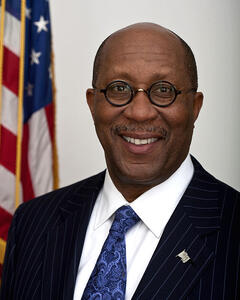
Ronald Kirk
Hey, Russ. I apologize. We had just a little hiccup because of my end.
Russell L. Riley
I’m still not hearing you. Let me make sure—hang on just a second.
Kirk
Russ and I were talking earlier. Can you not hear me?
Riley
Here we go. I can. We’re stumbling out of the blocks this morning. Forgive us all.
Kirk
That’s not on you. I’m working out of our D.C. office. Our laptops don’t automatically change time zones.
Riley
Oh no!
Kirk
Normally, it would. On my iPhone, it did, but on the laptop, it didn’t. Don’t worry. That’s all right.
Riley
I appreciate your patience with us. I’m happy to chat with you for a few minutes.
Barbara A. Perry
Good morning, Ambassador. It’s Barbara Perry.
Kirk
Hi, Barbara. How are you?
Perry
I’m doing just fine. And you?
Kirk
Well, now that I’ve figured out that it was my laptop did not—my laptop stays on Dallas time no matter what. [laughter] But that’s all right.
Perry
You were the early bird.
Riley
Right. We’re deep in the heart of Texas this morning.
Kirk
Well, see, that was my excuse for Barbara now that we’re going to have 15 minutes to do all of our Texas, Dallas, stuff— [laughter]
Perry
We’ll make sure this is all officially on the record, but we’re off to a good start. We’ll wait for our colleagues with the expertise regarding finances and trade and economics before we officially kick off.
Scott C. Miller
Hello, all.
Perry
Hello. Meet Ambassador Kirk.
Miller
Perfect. It’s a pleasure, sir. Thank you for joining us.
Kirk
My pleasure.
Perry
Let’s jump into it. I’ve got our appointed time, so Bob will just jump in when we get a chance. But Russell, anything to add to the conversation about using the materials, written and audiovisual?
Riley
No. It’s just that because this originated as a scholarly project, the written word is more accessible for people who are doing research.
Kirk
I get it. I understand it.
Riley
OK, terrific.
Kirk
And you’re giving me liberal ability to [laughs] edit it. The person most frightened—anytime my wife hears that I’m doing an open three-hour interview, she’s like, “Oh, my God. [laughter] What is this?”
Perry
Well, please assure her all will be well.
Kirk
There is no comforting her when I’ve got an open microphone, [laughter] probably for good reason. All right, I’ll kick it back to you all. How do we want to start?
Riley
Barbara?
Perry
That’s wonderful. That’s great. Well, this is, just for the record, the Ambassador Ron Kirk interview for the President Barack Obama Oral History Project done by the University of Virginia’s Miller Center. We’ve gone through the protocols, so we’d like to start with some biographical information. Tell us about growing up in Austin [Texas] in the 1950s, 1960s, and 1970s—you and I are about the same age, and Russell, too. Tell us what that was like, about your family, what your parents did. Then I sure want to talk about your uncle.
Kirk
Well, you are very kind to have me, except I’m looking [laughs] at you and Russell and thinking the years have been kinder to you all than they have me.
Perry
Oh, I was just thinking the same. Oh, Bob. Ambassador, Bob has joined us, [Robert] Bob Bruner, the former dean of the graduate business school, Darden School of Business, here. Bob, thanks so much for taking time out of your day. Just to repeat, Ambassador, we’ve got about two hours with you today, you said, and then if we needed to add on—
Kirk
Yes. I’m happy to reschedule. As much as I love Austin, and I do—and Barbara, you and I have talked about your at least visits or association with the LBJ [Lyndon Baines Johnson] Library. I will be 70 in June. I frame that because I’m now, ironically, serving one of my lifelong dreams as a trustee for the NAACP [National Association for the Advancement of Colored People] Legal Defense Fund.
I frame that because as a kid, I was acutely aware that so much of what my parents were fighting for—to achieve the right to vote, the ability for us to attend good schools—was because of this crazy, courageous lawyer by the name of Thurgood Marshall and principal jurist. And as wonderful, as progressive of a city as Austin is now, in the 1950s, when I was born, it was still Jim Crow. I remind people, I was born the year that the Brown [v. Board of Education of Topeka, Kansas] case came down and was decided. My parents could not vote without paying a poll tax or a literacy tax.
I was the youngest of four kids. We were blessed. Both my parents had the benefit of a college education from Huston-Tillotson College, which was our HBCU [historically black colleges and universities], but neither of them could attend the University of Texas. We grew up the east side of the city that’s [laughs] now going through a major sort of reimagination. But as I like to tell people, literally from my front yard, I saw two buildings every day. I could see the state capitol directly to the west, and I could see the tower at the University of Texas.
When you are born into a society in which there are constraints on what you’re able to do simply because of the color of your skin or your gender or other factors, I think, at least for me, it has always given me this fanatical commitment to equity and nondiscrimination. I spoke to a group of young people Sunday about how we get politics back and how we do it, and I’m telling them that there are lots of issues I don’t know that I fully understand, whether it’s trans rights or [laughs] whatever the new names, but I do have a firsthand knowledge of the corrosive effect of watching someone denied their dream, like my father was, simply because they were told, “You can’t do this,” because you were black.
That fueled my desire to be a lawyer, but it also gave me a deep sense of respect for political engagement because that was just so important to my parents. My dad integrated the post office after he came back from World War II, which was a big deal then. He was the first black postal clerk. If you didn’t grow up in the South, you didn’t understand how complete segregation was—we had black letter carriers, and I think we had a couple of black and Hispanic police officers, because the white letter carriers and police wouldn’t come into the black neighborhoods. So my father integrated the post office. It was a big deal. He was celebrated for it.
And it would have been a big deal, except my dad was just naturally gifted in math and sciences, and he wanted to be a doctor. He served his country. He came back to Austin with one child. My mother was expecting my second sister. There were four of us—I was the youngest—so a lot of pressure on him to get a job. He did very well on his medical exams, but there was no medical school at that time in the South that would take him, and he simply couldn’t afford to go away to Meharry [Medical College] or New York. So anyway, that’s part of our story.
My mother was the schoolteacher-activist. They were both critically involved in the NAACP and civil rights movement. All of that, I think, gave my siblings and I and people of my generation a sense that we had a political responsibility to be active, to be engaged, to vote, no matter what we wanted to do professionally. That’s why, as we talk about my career, you see I’ve had this ping-pong arc between fulfilling my dream of being a lawyer but also being called upon for service.
Perry
Was it your father’s brother who was also very much of a leader in that civil rights movement in Texas?
Kirk
Well, my father was an only child and never knew his father, and that tormented him. There was one other black family in Austin at the time. William Astor Kirk was both a professor at Huston-Tillotson College but also one of the first black professionals in the federal government. With there being only two Kirk families, we claim one another. He’s my cousin Bill, and I’m still closer to him than I am anyone, so we called him “Uncle Bill,” no matter what. But all of our families were engaged and involved at that time.
But because of my parents’ activism—and it’s interesting, Barbara. We started out talking about my now being a trustee for the LBJ Library. I’m one of the few kids—you may think it was foolish, [laughs] but as a kid, we really thought if Barry Goldwater was elected president that blacks were going to be exported back to Africa. So other than the fact that he was from Texas and our senator, the love, the reverence, the enthusiasm for Lyndon Johnson was palpable.
Our family and so many others knocked on—even as whatever I was, six-, seven-year-old kids—we went around volunteering for J. J. “Jake” Pickle and, all the way, we would help LBJ. [laughter] Then for him to play the important role that he did in making the case for the Civil Rights Act, for the Voting Rights Act, and so many others, gave us all just a great sense of pride and accomplishment and hope.
Perry
Then you go to—first of all, you are, I’m presuming, in segregated schools up until high school, and then I understand you were a student leader in your high school.
Kirk
I was. We all attended segregated—I attended segregated elementary. There’s a 10-year difference between me and my oldest sister, so we were all the first to do something. She was in the first wave to go from our all-black high school, which was Anderson [High School], to Austin High, and then attended the University of Texas. Then subsequently the rest of us—everyone in my family attended Austin High but me.
I started integration in middle school, and it was really fascinating. I find the language now—we say “integration.” The language of desegregation [laughs] was always something. I look back and say, Were we integrated or not? But I attended a junior high at a school situated on the campus of the University of Texas. They called it University Junior High. It was fascinating because it sort of sat right in the middle of Austin, and I don’t know who came up with the idea, but they literally populated the school with, in rough terms, almost a third black kids, a third white kids, and a third Hispanic, and just threw us all in there.
As we used to say, we had a riot of the week for the first two months. It was always over a girl. It was either a black boy talking to a Hispanic girl, or a Hispanic guy trying to talk to a black girl—and then whoever wasn’t involved would go and beat them up. It took us a couple or three months to realize, You know, this is pretty stupid. [laughter] So I started there, and then we were bused to another middle school, Pearce, that became a feeder for Reagan High School, which was the first new high school built during desegregation.
The easiest to way to understand Reagan High School is—I don’t know if you’re sports fans at all, but Denzel Washington made a movie about the integration of a school here in Virginia, Remember the Titans. You could literally just take that movie, whole cloth, pick it up, put it in Austin, Texas, and call it Reagan High School. Because you had the school with about 25 percent inner-city black kids, all these rural white kids, and aside from all of our anxiety about coming together, it was pretty evident, pretty quick, that we made for a hell of a football team. [laughter]
In a state as football crazy as Texas, by the third year we were open, we won our first state championship, and along the way beat the infamous Odessa Permian [High School], made famous for Friday Night Lights, and Midland [High School]. In the first five years the school was open, we won three state championships and two national championships.
Perry
Wow.
Kirk
Just an incredible deal.
Perry
Russell’s too modest always to talk about this, but he was a star football player in high school in Alabama, and his dad was one of the senior administrators at Auburn [University], and Russell played for Auburn. And then he likes to say he decided to step off the team because he had concussions before they were fashionable. [laughs]
Riley
Right. [laughter]
Kirk
Well, Russell, I tell that story—I used “we” very much in the pejorative sense. My daughters still tease me and say, “Dad, that’s not a thing,” because I coined a term. The good thing, I was at Reagan during our football success. The bad thing, I was captain of the choir, and I coined the phrase that I was a “choir jock,” because, you know, a black kid in Texas. [laughter] I was all athletic but thin as a rail then. Everybody’s like, “Surely you played football.” I’m like, “No, that didn’t work for me.” [laughter] But everybody in my family loved music, and my brother and sisters were especially gifted. I sang in the choir all four years, played in the orchestra, was in all-state choir. Our high school choir actually won the Vienna Music Festival. We toured Europe.
But I did get involved in student government. I became student body president. We had one—looking back, it felt more like a skirmish, but it was called a “riot.” It was pretty serious, and somehow, my picture ended up in the paper for trying to get everybody to stop fighting. And the crazy thing, the riot wasn’t so much between the races, but our school really did have a lot of what were then rural “cowboys,” kids from the farms. They were more unnerved by the presence of all the young white kids with long hair who smoked dope. Crazy as it seems, one day, this group of cowboys had declared they were going to cut the hair of all of the hippies. They literally came to school with sheep shears. [laughter] So the black kids, most of us were closer to the potheads and the hippies, so we intervened to defend them. We got through it.
One of the things I was most proud of, by my junior year, they had begun to think about fully closing our last all-black high school, Anderson High. And sadly, most of those kids were my neighbors, and they were split between three schools. Some went to Austin High. Some went to McCallum [High School], which was very much less accommodating and accepting. Reagan, at least, had been somewhat integrated.
My junior year, I had been elected class president for my senior year. But because most of my neighbors went to Anderson, talking with them, and they were, other than really anxious and angry about losing their school—for those that were going to be cheerleaders or student body leaders, they were really anxious about that. So I went to our principal. Reagan had a white principal, but we also had a black and Hispanic vice principal from schools that had been closed. I went to them and suggested, “You know, if we’re going to welcome the kids from Anderson, I think it’s appropriate that whatever they were at Anderson, they should be at Reagan, including student body president, so we’re just going to have co-everything for one year so that those seniors don’t get denied.” That ended up being really, really cool. That was fun. It helped us through that process.
Perry
Right. Then you’re off to Austin College in Sherman [Texas]. Anything that you would like to tell us about that experience, as well as your choice of your major, political science—double major, it looks like, political science–sociology?
Kirk
Yes. I grew up in that world. We didn’t know any better. I’d always wanted to be a lawyer. Thurgood Marshall was my hero. Sadly, there were not that many role models in Austin. We had one lawyer, Virgil Lott. Historically, people forget that 10 years before Brown v. Board of Education, Thurgood Marshall’s—in his mind—seminal first big educational win was a case, Sweatt v. Painter, in which he sued to integrate the University of Texas Law School. Even though the case is styled Sweatt v. Painter, there were two plaintiffs, Heman Sweatt from Dallas and Virgil Lott from Austin.
Heman succumbed to all the pressures of the oppression they got, but Virgil Lott became a lawyer. He was in Austin, but I didn’t know what he did. So like most kids, I said I wanted to go to law school, and everybody’s telling me to study political science. I enjoyed it, but the one thing I tell kids, the beauty of law is you can study anything. If I had it to do over again, I would have studied history or English or philosophy, something that would have made me read and write more.
But I chose Austin College because I didn’t—at that time, there was no real love affair between black Austinites and the University of Texas. I also wanted smaller liberal arts, and I had a classmate at Reagan who had gone to Austin College. The more I asked people about it, the better it seemed. It was a great experience for me. It gave me great training preparation to subsequently go to law school.
Perry
Then you’re off to the University of Texas at Austin Law School. Your thoughts about that experience before you get out into the professional world?
Kirk
By that time—when I was in Austin College, all I got was, How the hell did you leave Austin? We love Austin. We love UT [University of Texas]. [laughs] By the end, Austin was changing. It was growing. I was ready for it. But with my family’s financial background—my mom and dad were public servants and schoolteachers, but to their credit, they put four kids through school. I was the youngest. Looking back now, against our conversation about the mess of filling out FAFSA [Free Application for Federal Student Aid] forms and the cost of college education, it felt like whatever Austin College was, that $5,000 might as well have been $5 million. So for me to be able to go home and go to law school and stay at home was a huge bonus.
If there’s anything that angers me about what’s happening to our country, it is that it seems almost unfathomable that I could work part time at a department store and law firms and leave the University of Texas Law School with no debt. I remember every semester I would get my tuition, and I would go to my father and say, “Dad, here’s my”—whatever it was. Barbara, I’m going to say it was $50 a semester, or it might have been $15 or $25. Whatever it was, my dad would look at it and go, “Oh, come on, you got this.” [laughter] He’d throw it back to me. And I could! I got a great education, had a chance to get to know our most esteemed professor, Charles Alan Wright, who is one of the great constitutional scholars. I played on a legal football team he did.
And I, like most students then—in the 1970s, Austin was not a business community. It was still a town very much dominated by the state capitol and the University of Texas. You didn’t have Dell, you didn’t have any of the tech [technology] companies. So if you were at the LBJ School [Lyndon B. Johnson School of Public Affairs] or the law school or in grad [graduate] school at UT, it was about a 70 percent lock. If you were going to get a job, it was going to be at the capitol.
I worked then for a group, the [Texas] House Research Organization, that was a fairly radical proposition in the 1970s started by a bunch of young legislators that had been elected after the Sharpstown scandal. They came up with this radical idea that it might be good if members actually knew what the hell they were voting on every day. [laughter]
So a bunch of young liberals pooled their resources together and created this group that would read all the bills and have to do a one-page report so that the members could just flip through and say, Here’s what the bill says it does. Here’s what the opponent says is good. Here’s what is bad. We didn’t make a recommendation. But the leadership of the [Texas] House [of Representatives] of the time hated them, tried to bury them, came up with all sorts of rules to put them under, so that just made us more radical and crazy. But it gave me a good window into legislative process.
Now I do have to back up because there’s one important story. It will come through. I know I’m taking a while. You asked about Austin College. I loved it. But my sophomore year, and don’t ask me why—you were asking about integration. I don’t know why, but at some point, I just thought it was a huge deal that I had hit this point in my life where I had now been in an integrated school longer than I ever was in a segregated school.
One of the challenges for me and my siblings, sadly, was, at once, the community was proud that we were having the chance to integrate and do the things they didn’t want, but when we came home, we were also confronted—we were, for the most part, in the neighborhood with a lot of our friends who didn’t go to school. So long and short of it—forgive my language—is I tell people, I was probably called an Uncle Tom more than I was called—as much as I was called the N-word. At some point, I just began to think, This is really effed up. Is it worth it?
Long story short, I decided that I loved Austin College. It was 1,200 students, but by the end of my first year, I was the only black male in my class. We were only about 10 percent, if that, students of color. So I decided that I was going to transfer, and at least looked into transferring to Morehouse [College] or Howard [University] and had gotten the applications, put them in. All of this worked fine but for the fact I hadn’t shared any of this with my parents. So between my first and second semesters, when I was home over the holidays, I declared to my parents that I wasn’t going to go back to Austin College, that I was going to transfer. As I like saying, my mother cried, my father spoke to me quite creatively [laughter] and forcefully and suggested, “You better go find a job.”
I guess as proof that God takes care of children and fools, it just so happened, January of 1975, Texas convened in its first constitutional convention in 100 years to try to rewrite our constitution. When I shared this with my faculty advisor at Austin College, [Kenneth W.] Ken Street, bless his heart, he said, “You’re not going to take a leave. What you’re going to do is a directed study program under my tutelage.” This is obviously before Zoom and computers. But he says, “You’re going to get your hands on every piece of paper you can, and then we’ll do a paper about the rewriting of the Texas constitution.” So I said, “Great.”
I go up to the capitol. At that time, there were four young progressive legislators from Austin who had all been elected after the Sharpstown scandal and redistricting, one of whom was a good friend—all of whom were good friends of my mother, but one of whom included a young lawyer by the name of Sarah Weddington, who had gained fame in arguing Roe v. Wade in her thirties. So I go in Sarah Weddington’s office, and her chief of staff was this fiery, crazy, trash-talking, Waco [Texas] lady who had moved to Austin to raise hell, named [Dorothy] Ann Richards. She knew my family and grabbed me by the hand and said, “You’re [Willie Mae] Ankie Kirk’s boy.” That was my mom.
Literally she said, “Here’s what you’re going to do.” She walked me across the capitol. She says, “You’re going to work for the Speaker, [Marion] Price Daniel Jr. [III], youngest Speaker in the history of the Texas legislature.” She’s telling me all this stuff. I said, “But Miss Richards, how do you know he’ll hire me?” And she says, “Oh, honey, you’re going to be free. He’s not going to pay you.” [laughter] She goes, “Nobody turns down free help.” She said, “But you work hard and look pitiful and hang around, and ultimately, he’ll put you on staff.” And he did.
To this day, I have my business card, which my father made me carry around for three months and show all of his friends, and he would make me read the title. It said, “Legislative assistant to the president of the constitutional convention of the state of Texas.” Everyone would go, Wow. Then he’d say, “Tell them how much you make.” [laughs] I’d say, “Well, nothing.” Anyway, that’s important because that began my relationship, my tutelage, my love affair with Ann Richards.
Riley
If you’ve got a copy of the card, you ought to include it with your transcript. It would be a good visual for people to see.
Kirk
You know, it started me on the deal. But I think I have every business card from every job I’ve ever had.
Perry
Well, include those as part of the record. That would be great. So once you’re out of the University of Texas Law School—and by the way, colleagues, please jump in. I’m just totally fascinated by this part of the ambassador’s career. Russell, Bob, Scott, any questions at this point?
Robert Bruner
I would prefer to defer and pose my questions later. I want to hear the completion.
Perry
All right. Russell?
Riley
No, mine was going to—
Kirk
And you all, please feel free to cut me off, because as you can tell, you’re the only five people interested in what the hell the U.S. trade representative does. [laughter] So when we get an audience—there’s an overexuberance, so I can have trouble finding the breaks.
Riley
No, no, this is terrific. Barbara gave one part of my autobiography. The other part is that my first professional experiences were in the state capital in Alabama. So much of what you say about Austin at the time reminds me—I, being a few years younger—of the environment in the Alabama state capital. State capitals are wonderful learning experiences, and I think many of our students who are drawn to Washington D.C. don’t fully appreciate the kinds of experiences that you can get working around a state capital.
Kirk
I always tell—in any city, wherever it is, whether it’s deep red, deep purple, if you have a city that houses both the state capital, like Austin—or I use Madison [Wisconsin], you know, where you’ve got the university [University of Wisconsin–Madison]—it’s just a different. It’s a wonderful experience to be exposed to intellectual ideas and the practicality of government.
But anyway, Barbara, I think you were asking after that. I finished law school—
Perry
Yes, after you leave law school, you do work for a time for Lloyd [M.] Bentsen [Jr.].
Kirk
I did, yes, but before Lloyd Bentsen, I practiced law. I moved to Dallas to start my legal career. And Sherman’s a great school. Unfortunately, I’ve been trying to get off the board of trustees for the last 30 years, and they won’t let me. [laughter] But for those who don’t know, Sherman’s just about 60 miles due north of Dallas. Our only claim, we’re right next to Denison, the birthplace of Dwight Eisenhower, and our only other claim to fame, one of our most famous graduates, the Munson family.
If any of you are wine lovers—and this is a true story—Ben Munson, the patriarch of the Munson family, regenerated the Bordeaux wine stock after World War II. They had something, the disease that destroyed the Bordeaux wine stock. Munson had been an amateur farmer and “vinophile” and had gone over years before and brought a bunch of that wine stock to Denison. Long story short—if you look it up, you’ll see. It’s one of the few times of French humility. [laughter] They actually have a little plaque and statue of Ben Munson.
But beyond that, there wasn’t jack [anything] to do in Sherman, Texas. It was dry. We didn’t have bars or restaurants. Looking back, just stupid. So every weekend, we were either in cars on our way to Oklahoma, where you could buy three-two [low-alcohol] beer if you were 18—because, you know, our age was the weird period in time where we could be drafted but we could not drink—or we were back in Dallas. So everybody in Sherman spent almost every weekend in Dallas. I decided that that’s where I wanted to start my career, because even though by then I loved Austin, there were just not that many business jobs in Austin. As my father joked with me, “You know, we have the most intelligent cab drivers in the country, but we don’t need another PhD lawyer driving a cab.” [laughter]
I moved to Dallas to work for a friend, David Cain, who was a state representative, part of that House research group. He had worked for a fellow by the name of [James A.] Jim Mattox, who had been elected to Congress. David ran for his House seat, and he had a budding law practice. It gave me a chance to get to Dallas. I did that and then worked—
Riley
What kind of law? What kind of law were you practicing?
Kirk
I was pretty close to—if you’ve ever read John Grisham [Jr.]’s Street Lawyer or seen the movie? I hung at the courthouse. I did no-fault divorces, traffic tickets. I did anything you could do to drum up business. In theory, we were going to be labor lawyers, but all that meant was we represented the CWA [Communication Workers of America], who had been big clients of Jim Mattox, and did a lot of workers’ compensation. Then I spent a year with the bigger plaintiffs, injury lawyer firm, but I was loving being a lawyer, having fun.
Then I get a call from one of my classmates and longest-term friends, Rodney Ellis, who had gone to Washington with Congressman [George T.] Mickey Leland [III], another one of that group elected after Sharpstown and redistricting. He was Mickey’s chief of staff. He said, “Hey, Lloyd Bentsen’s really looking to add some diversity to his staff. Can you help us find somebody?” I spent several months working with him and a fellow friend, John [L.] Hall, who worked for Lloyd Bentsen in Texas. Of course, soon into it, they were like, “The senator didn’t like any of those people. He wants to know if you would do it.”
At first, I declined, because, remember, I’m going to go be this great trial lawyer, follow in the footsteps of Thurgood Marshall. Then I had a conversation, and thankfully, Rodney and John Hall lied and called my mother and said, “Boy, Lloyd Bentsen sure is heartbroken that Ron won’t”—[laughs] I don’t think Lloyd Bentsen knew me from Adam.
But my parents called me, and we got on the phone. My mother—and I’m the youngest child, and my siblings will never read this, so I can say that I’m very much my mother’s favorite, for good reason. [laughter] But we were talking, and she said, “You know, you have spent all your life within a mile of [interstate highway] I-35, where we grew up, at Austin College, back at UT, in Dallas.” And I did. She said, “Maybe it will be good for you just to experience life outside of Texas.” And while that appealed to me, I also intuitively knew that if I started that track, I might never get back to the courtroom. I did it because I just had always grown up in a fairly Democratic, progressive world, so I went to work with Lloyd Bentsen on his legislative staff.
I put two years in, and it was eye opening. I would tell people that I found it fascinating that Texas had two senators and one staff. Now I’m going to sound like the old guy, you know, “Back when we were in,” but, I mean, Bentsen was—one, the interesting thing was having to tell my family, because they were fiercely loyal to Ralph Yarborough, who had been Texas’s liberal senator, who Lloyd Bentsen beat.
As far as they were concerned, Bentsen was just short of the conservative Dixiecrats [States’ Rights Democratic Party], and now I’m working for him. Then Texas had just elected John Tower. When LBJ moved to the presidency—not to bore you, but I think somebody was saying 70 people ran in the race for LBJ’s Senate seat. Texas hadn’t elected a Republican since Reconstruction. But John Tower had the advantage of being just one of two Republicans and thought, What the hell. He put his name in, and the Democrats mistakenly thought, once Tower won—because they split up the vote—Oh, we’ll take him out next time. Well, we saw how that worked.
But Tower and Bentsen respected one another, gave each other their space, and our staffs—I tell people we had two senators and one staff. Interestingly enough, I inherited the defense portfolio. John Tower was chair of the Armed Services Committee, and as you know, Texas has numerous important military installations. That’s important to us. Bentsen was the finance whiz, and every matter that related to defense, Lloyd Bentsen said, “Look, it’s important that you understand, I always make up my mind, but never brief me on a matter without telling me where John Tower stands.”
My first week there, John Tower’s defense staff took me out for dinner and drinks and welcomed me to Washington, and said, “Even though you’re not on our armed services, wherever we go, you’re welcome to go.” We all stayed friends. Whatever that is, 35 years later, when I moved to Washington and was finally confirmed, one of my first dinners was with a handful of former Bentsen and John Tower’s staffers, [William L.] Will Ball [III], and Fred McClure, and a handful of us. We’ve all stayed friends. That took some of that hard, strong, Democratic, no-such-thing-as-a-good-Republican edge off for me, and the reality that you work with whomever can help you move your agenda forward.
I have to back up and say this. Even when my parents got the right to vote, one of my father’s proudest moments—he was always our neighborhood precinct chair. I would go sit with him on elections, and he was so proud to help all these people vote. He didn’t make me, but he always encouraged me to find some Republican to vote for. He says, “Ain’t none of these people perfect, and not all Republicans are bad, [laughs] not all Democrats are good.” I have followed that practice to this day.
Riley
Which two years were you with Bentsen?
Kirk
I was with Bentsen—I want to say, Russell, I moved up ’81, I was there through the ’82 election, so ’81 to ’83. Mike Pate was legislative director. Joe O’Neill was chief of staff. Marina Weiss did tax. John Raffaelli was—we’re all still friends. Ironically, I think Lloyd Bentsen and my mother shared a birthday. Both had passed away. Both were a hundred. But usually, milestones, we gather and have a toast to the senator.
He was brilliant, wonderful, I think a little misunderstood. Following in the footsteps of [Samuel T.] Sam Rayburn and LBJ, everybody expected every Texas leader to be this loud and gregarious leader. Bentsen was intimidating because of his quiet and his resolve. He didn’t scream. Everybody told me, and I’ve never perfected it, but he could swear like a sailor in a whisper. When he was angry at you, he never swore, but he would pull you in real close, and he’d say, “Bob Bruner, wow, the dean, the great economist, smartest man in the world. They told me that you’re the guy I got to listen to, and you fucked up, and now I look like an idiot.” [laughter] And yet the whole time, he’s just whispering in your ear.
But he was brilliant. He had great friendships with Senator [Donald E.] Hines and [unclear]—you know, of both parties. I remarked to him once—and the first time he looked at me like, Maybe you’re not an idiot—I told him, “You’d be better understood if this were the House of Lords rather than the U.S. Senate.” [laughter]
But I had a great time, and I learned a lot. Two different leaders, Ann Richards and Lloyd Bentsen, but it was Lloyd Bentsen that I stole that phrase that I define myself as, a “raging pragmatist,” because that was his approach to service. I think it served me well.
Perry
Speaking of Ann Richards, we do want to get you to your time as secretary of state in her administration. But is there anything in between your time with Bentsen and Ann Richards that we should know about?
Kirk
There were, I guess, almost 10 years.
Perry
Yes.
Kirk
One of the things I always talk to young people about in terms of keeping your friends, your relationships, and I do. As I think back, I said, I’m not sure that I’ve ever applied for a job in my life. Every job I got, I got because of a relationship, from David Cain to Rodney.
While I was working for Bentsen—when we came out of law school, just to put it in context, late 1970s. When we went to law school, we were mocked as the [Regents of the University of California v.] Bakke babies, outwardly. We were the largest class of women, blacks, and Hispanics to attend UT, and it was hand-to-hand intellectual combat. We had a professor, Lino Graglia, who openly questioned the academic—the intelligence of blacks and women, and mocked us, and that. Law firms like Gibson Dunn [Gibson, Dunn & Crutcher LLP], Baker Botts [LLP], were not that welcoming of us, so disproportionately, we went into public service: the U.S. attorney’s office or district attorney’s and city attorney’s office.
So by the time that I was working for Bentsen, several of my classmates were in the Dallas city attorney’s office, one of whom, Vonciel Jones Hill—who’s still a great friend, just a busybody—overheard our city attorney talking to a lawyer and state legislator by the name of Ray Hutchison about her desire to really hyperfuse our government relations program. The city attorney, under Dallas’ charter, had responsibility for that. She says, “Ray, you know people. If you know anybody who’d be great to run intergovernmental affairs, let me know.” And thank God, Vonciel Hill was eavesdropping, marched into her office, and said, “I’ve got the perfect person for you. He’s a young guy. He went to law school. He works for Lloyd Bentsen.”
You got to remember, this is before email, internet, and cell phones, so they started trying to find me. Ironically, I was home in Dallas that weekend—it was a holiday weekend—to hang out. I hadn’t told anybody I was there, but they tracked me down. I was at my old roommate’s. I interviewed in a borrowed suit but got the job on the spot. I spent the next eight years running governmental affairs for the city of Dallas.
After that, by then I had met, married my fabulous wife. We had started a family. I joined the very prestigious law firm Johnson & Gibbs [PC], and I was doing state government affairs and other work. My friend Ann Richards, by that time, had decided to run for governor in 1990. I banded with a bunch of other young progressive blacks who had been around the state, and we supported Ann. But it was a brutal race, if you will recall, because she ran against Mark [W.] White [Jr.], the former Democratic governor, and Jim Mattox, who was our attorney general at that time.
My daughters, who are now in their thirties, watched a PBS [Public Broadcasting Service] series on Ann, and they were showing how brutal that primary was. And they’re like, Wait a minute. Is this the Democratic primary? Because Mark White really, literally, and Jim Mattox hit Ann as being weak on the death penalty, and one of them ran an ad with posterboards of all of the people whose deaths they had presided over as governor or attorney general. It was a bizarre case.
Anyway, Ann prevailed, and as you know, went on. Had a brutal race against Clayton Williams, who, thank God, just kept his finger on the trigger and just kept blowing all his toes off. Fortunately, she won. When she won, she populated her administration with lots of young professionals, men, women, people of color. She initially appointed me to the General Services Commission, and she asked me several times if I wanted to join a higher cabinet deal, but I demurred. I told her, “Governor, I love you. I support you. But I’ve got a young wife, one daughter and one on the way, and I don’t want to work for you.” And by then, we’d become enough friends. Once, she called me back. She’d offered me a job. I’d told her no. She said, “Why don’t you work for me?”
And I told her. I said, “Governor, I love you and I admire you, one, because what you’ve accomplished as a divorced woman, your honesty about being a reformed alcoholic is great.” I said, “But the other way I look at that is, you’re not married, you don’t drink, you don’t have a boyfriend. All you’ve got to do is be governor of Texas 24 hours a day, and you think it’s great to call people at 2:30, 1:00 in the morning.” [laughter] I said, “I don’t want that.”
But thankfully, she kept pressing me. And she’d offered me the job as secretary of the state to fill out the term of a fellow by the name of John Hannah, who had been nominated and finally confirmed to the federal bench by, I think, [William J.] Clinton. I guess Clinton was President then. So I spent a year working with her. It was wonderful, frightening, enlightening. She was everything you’ve heard and more. I’m glad I didn’t, because of the intimacy of our conversations, but there are times I just pinch myself and think how blessed I was that she intervened in my life as a teenager, as a young college student, as a young professional, gave me the chance to listen and learn.
She just had such a passion for the urgency of taking advantage of the opportunities we had, because she told us all the time, “Look, there’s no guarantee we’ll be here tomorrow. All we have is now.” She would convene all of her state appointees once a quarter for a lunch in Austin. One by one, she would go around the room and just randomly say, “Barbara Perry’s running the office on climate control. Barbara, tell them what you do.” It was always random. Part of her deal is, you all need to know one another because, 20 years from now, you’re going to be the ones to lead this state or come back and lead this government. She was just a passionate, wonderful leader, a great friend.
Perry
“Force of nature” is certainly a way to describe her. Just a quick aside. I taught at Sweetbriar College for a number of years. While she was governor, coming up to that race for reelection, she came to our little campus in central Virginia. Our largest auditorium was 600, and she packed the place out. Sweetbriar, then and still, all women. We had a pretty conservative student body, I would say. By the end of her speech to those 600 young women, they were on their feet cheering. I was shocked. I was shocked when she lost.
Kirk
I was not. That’s a whole other deal.
Perry
OK, tell us about that.
Kirk
She was exhausted. One, it felt more like a race she had to run—and I would say, George [W.] Bush ran a brilliant campaign. But she was tired, and the team around her. And it bothers me, as I am very much a pro-business, progressive Democrat. Ann was as good for business as any governor of Texas. Democrats don’t talk about it. We always feel that we always have to just be the champion of the dispossessed, [laughs] but—the campaign ground her down.
I will tell you one story, and then we’ll move on. I nicknamed her “Gladys” because I was with her that year that she was running, and one of her initiatives was this great program called “Texas for a Day.” So once every other month, we would go to very small, remote towns, and she would take her cabinet and spend the day, meet with the chamber [of commerce], do town halls. She did. Even growing up in Texas, I was embarrassed. She would remind us that if you live in the panhandle of Texas, you’re closer to five other state capitals than you are Austin. Her idea is, if you have a problem, you shouldn’t have to travel to Austin.
Anyway, long story short, we would go to these places. She’d typically be welcomed by the mayor or the chamber. She’d visit businesses. Literally, for two hours in the afternoon, she would sit in a high school auditorium and talk to people. Then that night we’d have this open forum, and she would make opening remarks. I’d call it her cabinet, but the heads of agencies there, and people could ask a question. Then we would, in theory, deflect and say, “We have the dean of the business school, he can answer it,” or “Russell can talk.” And my job was to moderate. I would moderate, introduce the governor. Typically, when we would get back on the bus afterwards, no matter what I had done or who I had deflected to, of course, Ann answered every question and did all the talking.
Kirk Watson—who later went on to become the mayor of Austin but was in Ann’s cabinet—and I were considered her boy favorites, and all the women were tired of Ann coddling us. So we’d get on the bus after these sessions, and she would peel the skin off me and just tell me, “You are the worst moderator ever. I’ve only given you one job. I’ve told you that you’re supposed to say, ‘Scott Miller’s here, Barbara.’ And damnit, if you don’t do better the next time, I’m leaving you in so-and-so.” And we’d go through this. We’d now been through this the third time. I would get in there, and somebody would ask the question. I’d say, “OK, we have Barbara Perry.” Ann would interrupt me and do it.
This time, she gives me this speech before we start the program. And I mean, [pointing] she put her finger in your chest: “If you don’t call on more people, if you don’t do this,” she goes, “I’m serious. I’m going to leave your butt here in College Station [Texas].” I didn’t know what to do. I said, “Governor, we understand. You’re Gladys, we’re the Pips. [laughter] Nobody came to see the Pips. They all want to see”—and it just took her back. And she says, “Well, I want to be a Pip.” I said, “Like hell you do. [laughter] You’re the star of the show.”
Perry
Well, she does lose that campaign for reelection to George W. Bush, the future President. Then you go on to be elected the mayor of Dallas.
Kirk
While I was serving as secretary of state, [Harry Stephen] Steve Bartlett, who had been a Dallas city councilman, gone to Congress, beat Kay Bailey Hutchison in a very tough race for Congress, and then comes back in Dallas. But Steve, unexpectedly, was very much the preferred cabinet candidate of the business community. Steve was elected mayor in ’91 when Dallas had just gone through legal challenges to our former government and forced to move to a broader single member, and our politics were really rough. Council was really divided. The city was divided. And Bartlett just had a hell of time of it.
Anyway, he decided not to run for reelection. A number of people encouraged me to run, but I want to be careful because that had always sort of been in the back of my mind. When my wife and I started dating in the middle ’80s, when we got married—my wife attended the Wharton School [of the University of Pennsylvania] on a scholarship. She was an ABC [A Better Chance] kid. She grew up in a divided home in Cleveland [Ohio].
I don’t know if you know about the ABC program. It’s a great program in the Northeast called the “A Better Chance” program, started 40 years or so. But anyway, they identified gifted inner-city kids and paid and sent them to boarding school. Deval Patrick was in the program. Marty Nesbitt was in. [William M.] Bill Lewis [Jr.] is a huge proponent of it. Anyway, she had gone to Miss Hall’s [School] academy or one of those boarding schools, and then Penn [University of Pennsylvania], and very gifted in economics and finance.
Her fear with marrying me was, she said, “Just someday, you’re going to run for politics, and we’re never going to have any money.” [laughter] When we got married in ’87—you know, looking back, it was funny. I said, “Look, I’ve had this weird opportunity that I’ve worked in the state capital, our nation’s capital, and a city, and I loved it.” I tell everybody. I said, “There are only five jobs worth having, in a rough descending order. If you go to Washington, you’re either the President or you’re a member of the United States Senate. You’re a federal district judge because anytime you can get appointed to a job, you keep for life. If you go to Austin, you’re the governor or you want to be the mayor of a big city.” I told her, “There’s only one job I’d want, and that’s to be mayor.”
I say that because I hate for people to say I ran because everybody came and—it was in me. Now, I was thinking about the impact of running with young kids and a young wife. The governor called me up, took me to lunch, or invited me to lunch. I thought it was going to be another cabinet session. Much to my fear, it was just the two of us. She said, “You pick the place,” so I took her to a hamburger dive. She spent 30 minutes telling me that she’d heard from all these people that I might be the one person that could get elected and bring—but that I wouldn’t run. She gave me her theories on, while, yes, she understood that I needed—I had a young family, but that, damnit, those of us that have been privileged to see what we’ve seen at that level had a responsibility to give back.
So I thought about it and talked about it with my wife. I made the race. I think you mentioned that I ran against an open field with nine people, three major candidates. But we built a really fun coalition. And I still love it. In at least most Texas cities, mayors run nonpartisan. That’s a little bit of a fiction because everybody knows I’d worked for Ann Richards and that. But because of that and because of my business background—the law firm I’d been at by then was a big, very prominent firm.
I was able to get Roger Staubach and people like [Fred] Trammell Crow to endorse me. All of the other candidates—there were a couple of black activists who did the whole, He’s not from here. He’s a product of the downtown. I had a brilliant campaign manager. I kept saying, “What am I going to say?” She says, “Nothing. They’ve just done their job for you.” [laughter] The business community embraced me. I had a great coalition from the African American ministerial community. And much to our surprise, we won that race with 62 percent of the vote without a runoff. Then the rest you know.
Perry
The rest we know. Russell?
Riley
No, I was going to ask about, mapping ahead, because ultimately what we’ll be talking about is trade promotion. I know a lot—relatively, much about governors’ experience in doing trade promotion, but I’m wondering if, in your time as mayor, is that something that is at all on your agenda? Or are you mainly just concerned about who picks the garbage up and police forces and things of that nature?
Kirk
Well, the answer to both is yes. One accident of time, the one thing we probably spent the most time on other than Ann’s reelection—’94, Bill Clinton was struggling to pass something called NAFTA [North American Free Trade Agreement] that he’d inherited from George [H. W.] Bush. Governor Richards, most of us, thought this was a gift to Texas, that we would singularly be the biggest beneficiary of it. So we were all engaged in the congressional lobbying to get NAFTA passed.
As fate would have it, by the time I take office in June of ’95, NAFTA had been in effect for about four months. Again, you all know my background. I’m the quintessential political science kid, lawyer. I didn’t study economics. I always find it interesting. Some knucklehead gets elected mayor, and the press—What’s your economic development plan? I just said, “I’m going to make Dallas the capital city of NAFTA.”
I sat down with our chamber of commerce. We then had a modest international program. We’d go to some country two or three times a year halfway around the world because a bunch of businesspeople wanted to go with no relation to us. I said, “Guys, that’s over. Y’all can pick one of those.” I said, “We have to own NAFTA, and we’re going to be in Canada and Mexico at least once a month.” So during my seven years as mayor, I think we went to Canada 17 or 18 times and Mexico, and we did short trips, but we really tried to build those ties.
As you noted, and I would argue, probably not all mayors—and full disclosure, this is where my daughters say I lapse into an acute case of “mayoritis.” But the reality is, we have devolved into a nation of city-states. Congress, some would argue, is almost intractably broken. But whatever you think of our political system, the one good thing: our cities are flourishing and they work. We have eight really big economies in this country called Dallas–Fort Worth International [Airport], Atlanta Hartsfield [Hartsfield–Jackson Atlanta International Airport], Chicago, LA [Los Angeles], New York, Miami. If you’re blessed to be the mayor of one of those cities, one of the great joys is, we do a lot of international promotion. It was, for the most part, seeking international investment.
But you all know the numbers. I was reading in prep for this. I think for the first time in 20 years, Mexico passed China in terms of our top export-import market, as important as the emerging markets are. Rough numbers. The relationship between the U.S., Mexico, and Canada is a $3.5 billion investment every day, and a huge percentage of that flows from Mexico through Texas. Texas is, by a wide margin, the number 1 beneficiary of NAFTA.
Anyway, by the time—to fast forward—I’d finished my term as mayor, I had a much more favorable opinion of trade. And again, this was against the backdrop of [Henry] Ross Perot. While we were fighting for NAFTA, Ross Perot famously made that comment, “That sucking sound you hear are your jobs.” But that was not our experience.
Riley
Could you tell us, on these trade missions, what would you typically do? If you’re making one of these trips to Canada, who’s on your agenda, and what are you doing?
Kirk
Interestingly, let me back up. When I was serving as a city attorney, the mayor then was a lady by the name of Annette Strauss. It’s amazing how much of this—Annette Strauss was the sister-in-law of Bob Strauss. Bob Strauss and I are both graduates of the University of Texas, both lawyers, and 50 years apart, both serve our country as U.S. trade representative. But Annette Strauss, in the—God, whenever it was, I was at the city—had to confront the reality that when we would have a foreign dignitary or ambassador, the city really didn’t have a budget to do that. So she worked with the chamber to come up with an outside funding mechanism to fund Dallas mayors’ hospitality of foreign dignitaries and our trade missions.
So Mayor Strauss started a mayors international weekend. For about 15 years, we invited members of the ambassador corps to come to Dallas, spend the weekend, bring their wives. Mainly, we wanted them to realize we weren’t riding around in cars with horns and that. When they landed, many of them had very primitive ideas of what the Southwest was like, but they’d never been to Dallas. But once they landed at DFW [Dallas–Fort Worth International] Airport, which, coincidentally, turns 50 years old next month, immediately, we would take them to Texas Instruments or EDS [Electronic Data Systems], and our case was made. A lot of it was just making the case that as businesses come here, you don’t have to steer everybody to New York or Boston or LA. The Southwest is a great place.
Out of that, then, we would pick markets that we would go and promote Dallas as a place for investment. It was disproportionately still going to big cities in Europe and China. But the interesting thing, by the time I’m elected mayor, every trip I went on, because of the size of our group—we would have a business-heavy delegation. Every trip I went on, typically I would start with an interview on that country’s biggest news thing. Every interview started with them playing the theme song from Dallas, [laughter] and then showing, tragically, some version of the [Abraham] Zapruder clip of [John F.] Kennedy being assassinated. Then I would come out and say—I said it so many times—I’d go, “Well, obviously, there’s a new sheriff in town.” [laughs]
We would spend 20 minutes with them obsessing over the fact they couldn’t believe that Dallas had a black mayor. And part of my campaign for mayor was to get, stressing, about what Dallas used to be and see us as what we are today, which is a progressive, multiethnic city with incredible resources. But we had to get out and market. That was the framework of that.
Riley
OK, terrific. Thanks.
Miller
Ambassador Kirk, I’d just like to follow up on that. When you’re making this argument for Dallas, is that vision that you just mentioned part of the pitch you’re making to business communities around the world, or are you emphasizing things like the broader business environment, specific tech-sector elements, or is it a mishmash? What’s the actual pitch?
Kirk
I mean, we were selling Dallas to people that didn’t know us. Foreign investment is a huge part of the growth of our country, and we welcome that, whether it’s Samsung or—when some company comes over and builds a factory, creates jobs, that helps grow our local economy. Now, the reality, a lot of them were more attracted to the North Texas region. But still, if we could get them in the region, a disproportionate amount of those jobs, the executives, that money is coming into the city.
That’s why mayors—I would say even now, to fast forward—the formula for passing a trade agreement is, you get a bunch of mayors and governors. Labor fiercely opposes it. You’ve only got about—and it’s shrinking—40 to 50 Democrats who can vote for trade. And pre–[Donald J.] Trump, you get the U.S. Chamber [of Commerce], all the ag [agriculture] groups, and typically 75 to 80 percent of Republicans, and that was your magic way to get a trade group. The mayors were always part of it.
One of my decisions as a mayor that I think most threatened my nomination as U.S. trade rep [representative] was, I was one of five mayors that President Clinton invited to Washington to make the case for admitting China in the World Trade Organization at the time that we did, on the premise that having China a part of the global trade system. As you know, by the time we get to the 2008 Democratic primary, which was a much more fiercely contested race between Senator Obama and Senator [Hillary] Clinton versus Hillary and Bernie [Sanders], one of the deciding factors was labor extracting what they thought was a commitment from both Senators Clinton and Obama that they would rip up NAFTA, and there’d be no more trade. We’ll get to that. But I was more worried about labor finding out that President Obama was going to nominate this pro-trade, NAFTA-loving, China-hugging mayor from Dallas. [laughs]
If you read—and thank you, the briefing book y’all put together was great, and I loved rereading those articles because the business community was, He’s going to be great. He’s going to be that. And labor was like, What the hell is he thinking? [laughter] But it’s the one job that I wanted because I believed in trade, and I didn’t want the Democratic party to turn its back on something that I thought was as integral to our country’s growth as our international relations.
Perry
Bob, questions, comments about NAFTA?
Bruner
Yes. I was wondering, on the heels of your comment there, Ron, imagine a spectrum from pure free trader; in the middle would be somewhere in managed trade; over here, [gestures] I don’t know, would be very strictly controlled trade. I hesitate to identify names or countries associated with any of those. But where on that spectrum would you place yourself?
Kirk
Center right.
Bruner
Meaning—
Kirk
I go back to the raging pragmatist part. Let me say this, and I’ll fast forward because I know at one point we can go back later and talk about the circumstance of my meeting Senator Obama, which I’ll try to do quickly. You know, 2001, another surprise. [William Philip] Phil Gramm shocks everybody and says he isn’t going to run again. Even though I’ve had a very successful tenure as mayor, turned the city around, lots of investment, lots of big projects, I tell people the definition of an optimist is a black Democrat who decides to run against George Bush’s handpicked candidate. [laughter] You know? I guess I’d seen that movie—what’s the famous line? “So you’re saying I’ve got a chance.” [laughter]
But anyway, I won the Democratic nomination, was running around the country raising money. Leaving a moderately successful fundraiser in Chicago, these two tall kids get on the elevator with us, including this one skinny guy, I thought, with just incredibly large ears. [laughs] And they started, “Oh, Mayor, we heard your speech. We’re following you.”
He says, “My buddy is thinking about running for the state senate in Illinois. Do you have any advice for him?” I said, “First of all, I haven’t won anything. Second, I assume if your friend wants to run that he can speak for himself.” I said, “What’s your name?” He said, “My name’s Barack Obama,” to which I started laughing. He tells this story more than I do. He says, “Do you have any advice for me?” And I, in a way that would have made LBJ proud, might have suggested he change his blanking name or he’d have no future in politics. [laughter] But that started that friendship.
So fast forward. He runs. We help him. I bring him to Texas when he’s in the Senate. We have a lot of mutual connections. Robert Gibbs, who became his first communication director, had been my communications person on my Senate campaign. We bonded around his curiosity and his knowledge, which humbled me that when I ran for mayor, my daughters were six and three, and that I was married to this powerhouse Wharton School–educated woman. He’s married. Most of our conversations were around, How the hell did you convince Matrice [Ellis-Kirk] to let you do it, and how do you manage trying to be a good father and husband? That was the basis of our friendship.
He runs for President. I support him. He gets elected. Bob and I get, at some point, the nod that the President wants me to be in the Cabinet. And you all probably know, you’ve heard it from others. With the exception of secretary of state, the attorney general, Treasury—I forget the big—and defense, the rest of us are all just your pictures on the board. The good thing about mayors, as Rahm Emanuel—I said during confirmation, we’re utility infielders. We run airports. We understand housing. We understand commerce. So typically, mayors—there have been several as secretary of transportation, several as HUD [Department of Housing and Urban Development secretary]. We’re usually in the line for [secretary of] commerce.
But when I found out from Rahm—when we had our conversation, he said, “The two jobs we’re struggling with the most”—because as Rahm Emanuel said, “These will be the test of our manhood: what we do with education and what we do with trade.” The inference was that Obama was so beholden to labor, he wouldn’t be willing to reform either. When he mentioned that, I said, “Look. I will serve wherever you want, but if you’re telling me you haven’t decided on someone for USTR [United States Trade Representative], I’m going to stop with the ‘I’ll do anything’ and tell you that’s what I want.”
Bob, to answer your question, you asked where I am on the spectrum. I believed in it, but I was also sobered by the experience of marrying this incredible woman who grew up in a very working-class, blue-collar family in Cleveland, Ohio. Having visited Cleveland and Detroit many times, confronted with the reality that not one but all of my in-laws were either working or retired auto workers or steel workers, and the only thing that they liked less than me showing up in a BMW was hearing me talk about NAFTA. [laughter]
So for someone who was—when you asked that spectrum—decidedly only saw trade from the, Oh, this is great, look at what it’s done for Dallas, that did give me the reality—notwithstanding Ross Perot’s comment, which I thought was unfair—that there is a large part of the world that felt very much aggrieved by trade. They felt aggrieved even though you and I—with you being an economist, you’ve probably studied more and know the numbers better than I—that the overwhelming majority of manufacturing jobs lost in this country have been due to automation and innovation and not trade. But it’s a lot easier, if you have to close a factory because you have invested in it, to just blame NAFTA or Mexico or Canada.
But when you asked where I was, I thought that helped me. When I talked with the President, he said, “You know, Ron, we—it’s not 50 years ago. Tariffs don’t work. But we have to get beyond an either-or argument, and we have to stop labeling labor and people that are anti-trade as just Neanderthals, and we have to do this differently.” So when you ask where I am, I am fiercely committed to the proposition that for a country that is now less than 5 percent of the world’s population, it’s essentially economic suicide for us to say we’re not going to be engaged in the world, but we know enough about trade now to say, we can do it better, and we can make sure that we have a values-based trade agenda.
At least when we came in, it was a legitimate complaint to say, look, we know we’re going to let cars in from Korea and everywhere, but why is it that we can’t get in their markets, and why aren’t we enforcing the rights of workers? So we tried to bring, I would say, balance. I know some of my Republican friends want to call it “leftist,” but I thought, if we couldn’t make trade relevant to the mom and pop sitting at home thinking, Why is it my kid just graduated and they’re home sleeping on my couch? Where are they going to get a job? If we could make the argument that one of the ways we helped them get that job is having a smart trade policy that opened markets and all those things we talked about—that’s where I was.
I will tell you the most interesting thing I did once I got confirmed. You can tell I’m a talker. I’m a walk-around mayor. The first thing I did after the President nominated me and I moved to Washington for confirmation, I literally went to visit Bob Strauss that night, that Monday night, because he’s a hero and a friend. He was in his 90s but still robust. He was in a wheelchair. We had a glass of scotch. He had his 50-year-old girlfriend sitting there. But he asked me only two questions. [laughs] This I may take out.
First, he asked me, “Do you know what the best thing about this job is?” And I said, “No, Mr. Ambassador. You’ll tell me.” He says, “As opposed to mayor, you don’t have all those goddamn employees.” [laughter] Then the only other thing he did, he pointed at this poor lady sitting there and said, “You don’t think she’s too young for me, do you?” [laughter] Obviously not. I went to see him, and we talked about the job.
I got confirmed on a Wednesday. We only had 250 employees worldwide, probably 200 of those in our complex in Washington. I got confirmed on a Wednesday. By Friday afternoon, I had met every employee in the agency. I just took those two days. I told them, “Don’t schedule me. Leave me alone.” I went floor to floor. I didn’t announce it. I knocked on every door. I shook everybody’s hand and made sure they knew my door is welcome. I wanted to know what they did.
Then after we’d been there about three months, I called together all the professional staff, which the best thing about USTR, these are trade warriors, the best that we’ve stolen, frankly, from [Department of] Commerce and Ag [Department of Agriculture], and they’ve been there. They’re brilliant. I brought them in, and I had a presentation by the Third Way about what America thinks about trade. I said, “You guys know more about trade than I ever will. The goal is not to make me a trade expert, but the President put me here because I know how to do deals.”
And I said, “From now on, we can never use the word ‘free trade’ in a speech,” I said, “because when you mention free trade to the American public, you’ve lost them, because their eyes roll over and they believe, somewhat, that we have swapped cheaper T-shirts and laptops for jobs. But,” I said, “if we talk about a balanced trade policy and how if we get a chance to compete, we can win, and the benefits”—it’s like the short story of the Affordable Care Act. You ask people what they think about the Affordable Care Act, the component parts, it gets 90 percent approval. You ask them what they think about Obamacare, and their hair’s on fire.
I was very much trying to thread that needle of getting our staff to be more pragmatic but also getting, for the most part, largely Democrats and labor to calm down and understand that part of that challenge of answering that economic tsunami we inherited had to be engagement with the world. It was probably as tough on the Left as it was on the Right.
Miller
If I could just follow up on that, Ambassador, one of the things I’m very curious about is how the incoming Obama administration, whether that be President Obama or Rahm Emanuel or whoever, framed the trade vision as either congruent or distinct from the Bush and/or Clinton visions of trade. Sometimes, I think, right now, whether this is fair or not—and I would probably say it’s not—but it gets all lumped in together as this neoliberal, [Ronald] Reagan, Bush, Clinton, Bush, Obama, and now with Trump and then [Joseph R.] Biden [Jr.], there’s been a break. I was curious as, internally, how that was framed as being different from the one that came before.
Kirk
This will be one of those things that will not make the transcript, and Barbara, cover your ears. But I tell you, when you’re the trade ambassador in a Democratic administration, you’re the mistress. You’re the sidepiece. I love you, but we can’t be seen in public together. You know? [laughter] I’ll come see you. We’ll have a glass of wine. I’ll send you flowers. But don’t be coming up hugging on me in public in front of my friends. [laughs] So we’re somewhere between.
But on the other hand, I would tell you, fortunately, the most important thing for any trade rep is, people have to believe you have the ear and the respect of the President. While I got knocked because I wasn’t from the trade establishment—and I want to be careful. These were all friends. The nice thing about the office, it’s so small, we’re new enough. The neat thing, we do a dinner now for every incoming trade rep with all the old, Democrat and Republican, so we make our own club. But you’ve got the Carla Hillses, Charlene Barshefskys, Sue Schwabs that come out of that world, and then you have the Rob Portmans, Bob Strausses, Ron Kirks that are dealmakers. I would argue the dealmakers are more important because we don’t get bogged down in those technical details of it.
But the President was, first of all, just intently focused on, How do we keep the economy from falling off a cliff? It wasn’t anything any of us felt. For all of us not named Tim Geithner and [Lawrence H.] Larry Summers, the message was, Thank you for being here. Please keep the house from going on fire. Don’t do anything stupid. But if we don’t save the economy, nothing else matters. Now, the good thing, big picture enough, there was always—even though it was buried—an element that every agency was tasked with doing what we could do to help create jobs. Within that was a nod to trade. It wasn’t front and center. You had the bank bailouts. But the President got it.
Now, there were those in the administration that just didn’t want to talk about it. Then the Republicans—it’s funny. You watch every administration, no matter who’s in. Typically Republicans will go, Oh, you don’t have a trade agenda. You’re not doing—you should be doing this. Well, one, it takes a while, and no president has ever moved trade before they’ve accomplished their other deals.
So I used those first two years to meet my colleagues around the world, begin to lay the groundwork. We inherited the trade agreements with Panama, Colombia, and [South] Korea. What I find interesting—I know it’s not entirely true—as much as Republicans like to say Democrats are anti-trade, all the major trade deals have passed under Democratic administrations. The Republicans launch them, but they launch them in such a way that they are completely hostile to labor.
The one reason I inherited all these stalled trade agreements was because—I think you all have talked to enough people. You know, we have—and it’s a good thing—I forget, 15 or 16 different trade advisory committees, which we should. We have them for labor. We have them for environment. We have them for business, for ag, because they help inform both what we’re trying to achieve, and we have to have information. The labor advisory group did not meet during the eight years of the [George W.] Bush administration. It is cochaired by the U.S. trade rep and the labor secretary—well, the last four years.
The last four years of the Bush administration, Elaine Chao was labor secretary, and she just was not going to meet with labor. So for labor, who is reflexively anti-trade to begin with, having the foil of a labor secretary that—then that just makes it easy for them to go to Democrats and say, Hell, no. No way. You’re not doing this.
So one of the first things I did—within the first month—I called, invited, and met with all of the major labor leaders one-on-one in my office. And it was rough. I mean, Rich Trumka; I think [John J.] Sweeney or [James P.] Hoffa was head of the Teamsters; Leo Gerard from the [United] Steelworkers; [and] the [United] Auto Workers. I met them all. I told them we need you back to the table, that our being absent was not an answer, and that I’d heard from all my labor friends that they were tired of us calling them anti-trade. I challenged them all, as I did the Fair Trade Caucus, to say, if you’re not anti-trade, tell me what a good trade agreement looks like. And I’m going to work my ass to produce that, but if I do, then I’m going to challenge you.
My staff didn’t know what to make of me, and I told them, as you can tell, “No one is less suited to be an ambassador and go to Geneva in a world of plenipotentiaries than a foul-mouthed, big-city mayor. We cuss. You call me the F-word.” Man, when we went to see Rich Trumka, it was the most profane swearing match you’ve ever seen. [laughter] He was mad at the President, “He did that.” Thankfully, my wife, having listened to me—and y’all experienced it—has a saying for me that she will say after a while: “I’ve been listening aggressively. May I speak now?” [laughter] So, after Trumka, I gave it back. I’m sure the Teamsters president would stab me in the heart today. [laughter]
But a consequence of that—I gave everybody my home number. Bless his heart, Leo Gerard of the Steelworkers is the only one who took me up on it. We had dinner, and he forced Richard Trumka to have dinner with me—because I’m a big believer, I learned from mayors, you got to get people at first to strip away their labels. They’ll just label me as “that pro-trade,” “this Republican.” Find out we both like football. Find out we both love presidential libraries. Find out my daughter dances, or I’ve got—you know, there’s things that get us beyond that. But it served us well later when we did finally get through all those trade agreements.
Two of the things I’m most proud of. I think I was the first trade rep in probably 20 years that Leo Gerard invited to Pittsburgh [Pennsylvania] to speak to his executive board, because we filed different lawsuits against China over unfair trade practices, and we won every one of them. Then when we finally passed the agreement with Korea, the kicking point was at 2:30 in the morning. Mike [B. G.] Froman and I had to call the White House and get the President out of bed and said, “We’ve just gotten a commitment from the Auto Workers and the senators from Michigan. If we can get these three things in the Korea agreement for autos, they will not only not oppose it, they will support it and endorse it.”
There’s a great picture—I’ll try to find it—if you Google us, of me and Mike Froman in the White House with President Obama. He’s sitting at his desk in a bomber jacket, and with the time difference, he’s on with President Lee [Myung-bak] of Korea. We extracted those commitments, and when it went to Congress, I think—or at least we say—the U.S.-Korea trade agreement got the largest vote for a trade agreement in history.
Perry
Bob, I know a while back you had a question or a follow-up. We should also add that Bob has literally written the book on financial collapses in this country, and so, Bob, you may have some questions going back to the ambassador’s point about coming in as USTR when the economy is about to go off the cliff.
Kirk
And you all forgive me. It’s my fault, because I’ve been babbling on, but it is 10:00. I could use a one-minute break and get a sip of water. Can we do that?
Perry
Absolutely. Take five.
[BREAK]
Kirk
I’m sorry my stories are so long.
Miller
No. I will be very honest. This is the point of these types of interviews because I think a lot of times when you’re doing shorter types of interviews, you don’t get this kind of thing. They tend to be highly—they’re distilled. They’re very distilled. So that’s the entire purpose of these types of things.
Kirk
Y’all are kind. I want to come back just because I want to talk SEC [Southeastern Conference] football with Bob and presidential politics with Barbara. [laughter]
Perry
SEC football is Russell. I’ll talk all things college basketball.
Kirk
I have been to five Final Fours. I went to one Super Bowl and sold my tickets in baggage claim when I landed, but I’ve been to five—I love college basketball, and I love the fact that Dallas, in our new arena that I built, one of the things I did was I lured the old Big 12 to Texas. But Kansas, they really hated losing Kansas, and I was going to give them our old building to get them to host all their tournaments there. We host a lot of the men’s and women’s. We had the women’s Final Four last year, and I think we’ve got a regional this year.
Perry
Do you remember which of the five Final Fours you’ve been to?
Kirk
Well, the first was when I became chief lobbyist for the city of Dallas in, I want to say—God, this is getting old, I should know—1985 [1985–86 season]. Reunion Arena in Dallas has the distinction of being the last Final Four held in an arena that didn’t have suites and wasn’t a college stadium. It was Duke, Kansas, Louisville, and I still always forget the one. That was the one that “Never Nervous Pervis” Ellison, and I’d say Danny Manning and Kansas won. I was in Indianapolis [Indiana] with Michigan State, Tom Izzo and Mateen Cleaves. I was in San Antonio when [Orlando H.] Tubby Smith and Kentucky—
Perry
Kentucky.
Kirk
But Bob’s back, and the clock’s going. [laughter]
Perry
Yes, we’ll talk about that another time. All right, Bob, we’re back to you.
Bruner
So let me present you with my questions, and you can take them in any order you want. If you need me to repeat them or if you want to move on to other things, that’s entirely your call. All the hoorah about your appointment and the insertion in Obama’s first inaugural address, et cetera, emphasized that the Obama administration would aim to double exports within five years, and that didn’t happen. Obviously, there was a once-in-a-50-, 70-, 80-year financial crisis that the world economy would recover from. That’s a ready explanation. But what else might account for that? That’s question number 1.
Question 2 is, did you have any inkling of the resistance to TPP [Trans-Pacific Partnership] when you were negotiating it? By the time Trump came in and crashed that idea, where was the political wind blowing at the time you were working on it? The related point is the realization that China wasn’t living up to its ideal behavior as a player in the liberal world order. Did you have any clues in your time as USTR about China’s behavior?
Fourth and last, Obama wanted to establish—combine and consolidate the USTR with the Small Business Administration in January 2012. Why? What was going on, and from your perch at USTR, what might have explained that? I’m sorry to load all those things on you all at once, but I know you’ve got a lot you can tell us, and I thought I’d stick my oar in. If you could speak to those, I think it could help illuminate a lot for our purposes.
Kirk
Bob, I think in a polite way, you’re saying that you had to get it all in before I start going off [laughter] into the—you’ve been very patient.
Bruner
All of my colleagues here are asking good questions.
Kirk
No, you’re kind. We are going to run out—will we schedule another round or no?
Riley
Yes.
Perry
Yes, absolutely, Ambassador.
Kirk
Oh, good. Because, Bob, I do want to come back to all of those.
Perry
Yes.
Kirk
It goes back to your broader question I wasn’t ignoring about where I was, where we were in the spectrum. First of all, as you know, you correctly phrased it. The challenge ahead of us economically was frightening, and that took the President’s time in doing. But at least to me, the importance of his challenge to double exports, which economists could look and say it’s impossible, is at least it credentialed exports and trade as part of the overall economic recovery. That was the importance of that to me. Now, I will tell you—over the arc of our time, we did substantially increase exports. People say, Oh, that’s because you came out of the recession. But at least it put in that broader economic recovery the concept of trade.
Now, when you asked where I was, where the President was, I got a pass. I lived in a world in which, when I went to Capitol Hill, Democrats ran from me or loathed me or chased me, and Republicans [laughs] loved me. But Republicans couldn’t say, “Man, Obama’s doing a great job,” on paper, so they’d always give me these backhanded compliments and say, “We know, Mr. Mayor, that you’re a fan of trade and you understand it, but you’re constrained by the President.” I loved sticking it to them and telling them, “You do understand, I only work at the pleasure of the President, and everything that I’ve accomplished is because the President has green-lighted it. You can’t compliment me for what we’re doing to confront China, to try to get these trade agreements, without acknowledging him.”
Within the administration, I won’t say I was fierce, but there was a lot of anxiety. One, mostly driven by the absolute butt-kicking we took in the 2010 midterms. Now we’ve got the run-up to the next election. There’s a lot of finger pointing. They’re mad at Obama. And a lot of the Democrats are like, How dare you even think about trying to pass a trade agreement when we’ve got to go to these same folks and ask to do—so when I talked about being the mistress, [laughs] it was—but I just kept working. I figured my job is to get the deal in somebody else.
In the macro sense, one of the questions y’all had asked is who I worked with the most, and you had Mike Froman. He was sherpa, Larry Summers is number 2, and if it hadn’t been for Mike Froman, Larry and I might have killed ourselves. [laughs] I’m always reminded that I said to Larry once, “You are the smartest man in the world, but you don’t know anything about politics. [laughter] So if you teach me macroeconomics, I’ll teach you trade.” Froman and I joked, the National Economic Council, Larry never convened us because he knew all the answers, and [Eugene B.] Gene Sperling never convened us because he could never get organized.
But Larry was very much of the mind that if we were going to pursue a trade agenda, it ought to be macro, big bang. I glossed over it because we talked about me inheriting the agreements with Korea, Panama, Colombia, and TPP. But we had this Doha development agreement that was pending, and it was not going to pass. We couldn’t say it, but the reality was that. But Larry was a, We should put all our eggs in the Doha basket. I was like, “Larry, we’ll make the effort, but if this is part of the President’s effort to get us going now, I am much more practical. Let’s put skins on the wall. Korea has the potential to add 11,000 jobs.” All three agreements could have given us a couple of bumps in GDP [gross domestic product]. That very much was my approach to it.
Once we passed those three, finally got them done, Mike Froman and I both laughed. We had a meeting. It’s as close as we agreed that we ever got a compliment from Larry Summers, and he congratulated me on passing those and said, “You were not entirely wrong.” [laughter] We took that as a victory. The President putting that challenge out subsequently led to us doing the export promotion programs where USTR worked with Secretary [Gary F.] Locke in commerce, Fred Hochberg, Tom Vilsack, and we went around the country just trying to get more businesses, particularly small businesses, involved in that.
With China—and we’ll talk more, because this deserves more—at the time, we filed more trade disputes against China. We were hell-bent on saying to them and made the case, not just us but through—we had two structured dialogues with China, which I thought was important. One, as you know, was led by the secretaries of state and treasury, the Strategic Economic Dialogue. Then separately, more granularly, was the Joint Commission on Commerce and Trade led by commerce, Gary Locke, and myself. We bolted Tom Vilsack onto that because most of what we were arguing about was agriculture.
The one thing I thought we did well was made sure, whether it was in either form, to confront China with the reality that, one, whatever it was then, you’ve now been in the WTO [World Trade Organization] 20 years. No economy has benefited better, stronger, faster, from a robust export program than China, but with that comes commensurate responsibilities. In fairness, China had moved to open up a lot of their economy. They were obviously a major trading partner. But even under President Hu [Jintao], there were major sticking points around intellectual property, forced disclosure of trade secrets, market access. The one thing I thought we did well is we tried to be as repetitive and disciplined as they were that you’ve got to fix this.
So we sued them on a number of matters, but one of the motivating factors behind the President saying, would we be stronger to confront China if we had an interagency approach, was the reality—because we were hit on—why didn’t we sue China more? So I had to go to Congress and help them understand. I have 250 employees, State has 10,000—I mean between State and Commerce. I have zero Chinese-speaking interpreters in USTR.
When I sue China, which I win, I have to go get resources from Commerce or the State Department to do that. I said, “Just look at it. If you’re China, they know exactly what my resources and what my constraints are,” so they can decide, you know what? We’re going to misbehave 100 times or 200 times, and we’ll accept the 5 times that Ron sues us in the WTO and is successful because that’s 95 that he isn’t able to get to.
I personally had to be neutral around the President’s idea of combining the agencies. The political part of me knew it wouldn’t go anywhere because people forget—and you all probably know—but Congress retained authority over trade constitutionally. USTR reports both to the President but to Congress through the [House] Ways and Means [Committee] and Senate Finance [Committee]. The one thing, if you know about Congress, they do not give up authority. These members wait 40 years to get to be chairman of the subcommittee on peanut allergies, [laughter] and we’re going to have a subcommittee on peanut allergies until that chairman goes away.
But we did look at the reality. Almost every other trade minister that I sat across the table from was the minister of commerce, the minister of economy, and they had much bigger staffs, portfolios, so the idea was how to try to backdoor that and do it. Whether it worked or not, at least it still credentialed us as an important agency, and we were able to get a lot of those things. Then ultimately, he moved on from the agency consolidation to consolidating the enforcement parts. Bob, we were well aware of China’s behavior and not at all bashful about confronting them.
And you mentioned TPP. I don’t think that I have the words, as much as I disagree with them, to help you understand how many Democrats felt that the biggest mistake they’d made was believing Bill Clinton about NAFTA. Our challenge to doing everything was, Clinton told us this, Clinton told—now, they wouldn’t say it loud, but labor, they hammered me. Notwithstanding the success we had passing Korea and Panama and Colombia and the preferences trade adjustment, the broader environment was, OK, enough. When is that SOB [son of a bitch] going back to Dallas? [laughs]
I’d say I had great encouragement from the Hill [Congress]. By then, the Republicans, they were pressing us to go forward, but a lot of anxiety among Democrats. It was just the hope that, Can this be something we don’t have to deal with until after the election?
But notwithstanding it, as part of the President’s broad Asia pivot, I thought it was the right thing to do for all the market reasons, growing economies, and they desperately wanted us a part of it. By then—we talk about the U.S., but those countries bordering China were begging us not to leave them in a position to just be dominated by China in trade, and they wanted that relationship. So getting into it was not as tough because that was something we controlled. I thought it wasn’t perfect, but it was a good agreement.
It was a chance to modernize NAFTA. It was a chance to bring trade up to the reality of where we were from a—you think about NAFTA. It was a good model, but it was a 25-year-old model. We didn’t have the internet. We didn’t have all the things—you know, as an economist, we were taking on the issue of state-owned enterprises, helping Vietnam to integrate. That was in play. It was a very good agreement, an agreement very much at least built around American principles in terms of what fairness looked like.
The fact that Trump—I don’t think Trump cared. I think Trump just wanted the labor vote. Labor knew that Hillary, at heart, was open to trade, and even though she had to publicly come out against it, I think Trump just made a crude calculation that by being anti-TPP, that would neutralize that. I thought it was a horrible decision, and I think we’re paying for it now.
And it breaks my heart that Biden feels a little bit handcuffed. I do think Biden is politically a lot more enamored, beholden—not beholden—a little more of a labor guy than Obama was. If you talk about it, most of the complaints about the Obama administration from the Left, not the Right—I mean, the Right’s not going to give him credit. But I just think we cannot sit on the sidelines while we have this incredible market-opening agreement that we now can’t take advantage of. That’s the shorthand on that.
Now we’ll say something good about Trump. Even though I think he and [Robert E.] Lighthizer’s approach was taking a scalpel, I do think he was not incorrect to say, “Hey, look, George [H. W.] Bush, Bill Clinton, George [W.] Bush, Barack Obama, you’ve tried to coddle China. We’ve tried all that. It hasn’t worked. We need a new approach.” I don’t think any of us foresaw that Xi [Jinping] would be as anti–open markets and insisting on trying to put the band back together again, but we are in a world where we have to take a much more sober, realistic approach to China. If they’re hell-bent on not playing by the rules, we have to be hell-bent on protecting our markets. But I think part of that strategy necessarily means rebuilding that coalition, whether it’s TPP or whatever, around the world.
Miller
Ambassador Kirk, if I could just follow up on that, one of the things regarding TPP. I’m curious about how the administration really thought about that. Was it really just an economic or a trade-related thing, or was it something they truly thought as kind of a—almost a geopolitical, geoeconomic alliance, right? Because you have China thinking about Belt and Road [Initiative], and that’s an economic thing, but that’s also very much a geopolitical thing. We can extract this, if you prefer, from the end transcript, but I’m genuinely curious about how TPP was thought about in that way in the administration.
Kirk
I want to answer quickly because we’re bumping up on the time, and if we come back, we can talk about all this much longer. What I’ve said is—and I hope I don’t come across as an Obama-ite, but step away from all that. You’ve now got a President—granted, it’s been a lot, he’s our first black President. You also had our first President whose mother dragged him all over the world and raised him in Indonesia. He was a kid, as much as anything—we bonded around—
I have this crazy theory I shared with him. I grew up in a two-parent family, but Obama was always hit with the, You’re not Clinton. You’re not that. I shared with him my theory that I think men that are not raised by fathers are always searching for somebody, but they obviously take on the personas of their mothers. If you look at Clinton, it is gregarious, it is outgoing, it is a crazy thirst to be loved. He’s going to know everything about you. Obama’s mom gave him that thirst of knowledge, and Obama’s approach to, You don’t like me? I’m going to outthink you.
Anyway, in your context, you cannot underemphasize the importance of him growing up in Hawaii and the substantial time he spent in Indonesia with a legitimate belief that while we have this incredible, powerful transatlantic relationship, that our not trying to recreate that in the Asia-Pacific was a missed opportunity. I think for him, personally, intellectually, economically, it wasn’t so much a pivot away from the transatlantic as much as to say, Guys, we have this huge other extraordinary economic opportunity, which also happens to mirror a bunch of the fastest-growing economies, which also happens to be—as I liked to say when I was mayor, every once in a while, it’s easier if you push on an open door.
Remember, TPP really was a by-product of the dream of APEC [Asia-Pacific Economic Cooperation] ultimately becoming a free-market zone. They knew it wouldn’t happen, and so Singapore—I think it was Singapore, New Zealand, Australia, Brunei initially pulled it together, thinking, We’re so small, nobody will be afraid of us. The idea was, we’ll just come up with an architecture that everybody can bolt on. But everyone knew, until the United States joined, it wasn’t going to be anything. And for us, because we already had trade agreements with a lot of those smaller economies, it was all about Vietnam, Japan, some of the bigger economies. Once we embraced it, we very quickly began to work in court to open the door to bring in Vietnam and Indonesia. It was also the tool by which we effectively brought NAFTA up to code.
Perry
Well, we will stop there. Ambassador, thank you so much for this introductory two hours, and we will be back with you. We’ll add some more time and complete this amazing conversation. We just can’t thank you enough for your time and your service and your narration. This is what it’s all about.
Kirk
Y’all are so kind. [laughs]
Perry
Thank you, thank you. We’ll see you again soon.
Kirk
All right. Thank you all.
[END OF INTERVIEW]