About the Miller Center's conference on Congress
Improving Congress is part of building a more responsible and effective executive
What kind of Congress do we want and need? What will it take to reform Congress?
Two hundred fifty years ago, “In Congress,” representatives of 13 states declared themselves to be one free and independent people. And while “Prudence, indeed, will dictate that Governments long established should not be changed for light and transient causes,” the first Congress felt that “a long train of abuses and usurpations” were sufficient “to alter their former Systems of Government.”
There is much to celebrate in what our founders created in 1776. That said, the founders felt the need to remodel Congress a decade later, which they did in Article I of the Constitution. And today, 25 decades later, public opinion surveys tell us that support for all branches in our federal government are at historic lows. Congress sits at the bottom of the list.
For 50 years, the Miller Center has examined questions of national importance through the lens of the American presidency, the branch established in Article II. Like it or not, our research finds the executive has become the leading branch in our federal democracy. In recent decades, presidents have become more powerful, more partisan, and less popular. There are many reasons why, but an ineffective and unrepresentative Congress seems to be part of the problem. As former White House Chief of Staff Josh Bolten told us recently, “The system cannot flourish if one of the three branches keeps abdicating its responsibilities.” To advance a more effective and responsible presidency, we need a more effective and representative Congress.
Still, there is little consensus on what “effective and representative” looks like, let alone how to get there. This gathering brings together scholars, practitioners, and journalists to explore these questions and to advance possible solutions.
We will begin by looking back. Examining Congress’s past efforts at reform may illuminate paths forward for the people’s representatives to regain the nation’s trust.
We will look inside Congress, at its capacity to perform its essential constitutional roles. We will review efforts to modernize how Congress budgets and appropriates funds and provides oversight of executive branch officials and actions. Looking beyond Capitol Hill, we will consider whether there are better ways to design how we elect our representatives.
Finally, we will assess how the various proposals intersect and which (if any) we should prioritize to move the needle on congressional reform.
Thank you for joining us at the Miller Center and the University of Virginia in this most Jeffersonian task of helping design a government “most likely to effect [our] Safety and Happiness.”
Congress and the president
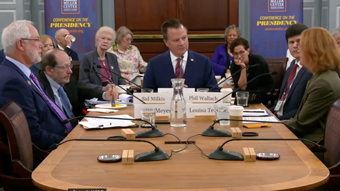
Former White House directors of legislative affairs discuss bipartisan best practices to clarify shared responsibilities between the legislative and executive branches with a panel of Miller Center experts and Mike Emanuel, chief Washington correspondent at Fox News.
Miller Center 50th Anniversary Video Collection
Highlights from our first 50 years
The Miller Center is a nonpartisan institution at the University of Virginia that explores how the American presidency meets national priorities and engages scholars with leading citizens to help solve major problems.