Transcript
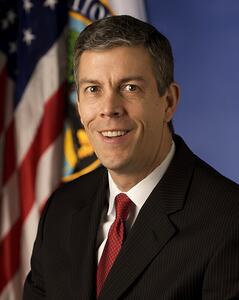
Russell L. Riley
Thanks for being with us. May we call you Arne?
Arne Duncan
Please do. If not, this will be a short interview. [laughter]
Riley
One of the things that we always like to begin with is talking about your formative experiences, your upbringing and so forth. There’s no place people can go to understand the sociology of an administration, who are the kinds of people that are inclined to go work for a particular president, so I wonder if we could start off hearing a little bit about your upbringing in Chicago.
Duncan
Sure. I’m happy to start there. I live two blocks from where I was born, so I’m back in Hyde Park. Dad was professor of the University of Chicago, so we grew up and literally lived on campus. Both my parents were educators. In 1961—I was born in ’64—my mother started an inner-city tutoring program and raised my sister and brother and I as a part of her program, so we were going to an after-school program long before we ever went to a real school. So education is in our family’s blood, in our DNA.
It was a pretty unique upbringing. You don’t realize as a kid because it’s all you know, but seeing the tremendous disparities between the opportunities my friends in my mother’s program had, or didn’t have, relative to what my friends during the school day had has been the driving motivation in my life. My friends at my mother’s program were as smart, as committed, as hardworking, as intelligent as my friends during the school day, just with wildly different opportunities.
People talk about different ZIP codes; it was actually the same ZIP code. It was like 12 blocks away—we used to walk there sometimes—but it was across the invisible 47th Street border between middle-class, integrated Hyde Park and all-black, all-poor North Kenwood/Oakland. I grew up going between these two worlds every day of my life.
I took a year off from college to work with her full-time and wrote my senior thesis about her program, just trying to figure out was this a part of who I was or was this actually who I was. I guess I figured out during that year it was probably who I was, and wanted to follow in her footsteps in whatever way I could. That path was unclear. [laughs] I had no aspirations to be Secretary of Education. I probably didn’t even know it existed. Kids come to me now and say, “I want your old job,” and I didn’t even know I had a job back in those days, so you guys are way ahead of me. I’m happy to follow up any other questions, but that’s the short synopsis of my upbringing.
Barbara A. Perry
Arne, I’m so fascinated by your mother’s choosing this role. What was her background?
Duncan
She was an educator, and she came here. My dad was, at that point, a graduate student at the university, so they moved here, and she was teaching at a community college. The story was she went down to volunteer and, I think, do a little Bible study, something with a set of nine-year-old girls, and found out they couldn’t read. She couldn’t believe it. That changed everything. She went from there. The genesis of her work was finding a couple of little girls who couldn’t read at nine.
Riley
Was she from Chicago?
Duncan
No, she was from Boston and my dad was from Nashville, so neither of them were Chicagoans. They ended up here because he was in grad school in psychology. He never left the university. My mother did that work for like 52 years. Unfortunately, she has Alzheimer’s now, so her health gave out, but that was her life’s work. She was a volunteer; it wasn’t a job. That was her one thing. My dad never left the university, so I got to see the benefits of staying at a certain place and not bouncing job to job.
Riley
And you say your father was a psychologist?
Duncan
A psychology professor at the University of Chicago. Correct. He went to grad school and then stayed, and was lucky enough to get tenure, so we never left.
Kimberly J. Robinson
Do you mind sharing what your parents told you about their hopes and aspirations for your own education?
Duncan
I’m the least educated in the family. They both had master’s degrees; I never had that. So it was that kind of thing growing up. I went to lab schools here, which were affiliated with the University of Chicago. It’s a fantastic K–12 [kindergarten through 12th grade] school, so for me it was never a question of are you going to college. Of course you’re going. It wasn’t even a discussion. It’s a good question.
I don’t remember any discussion of “here are your hopes and dreams.” It was expected that we would do well. It was expected that we would take advantage of the opportunities we had, and I was acutely aware of the opportunity I had relative to my other friends who didn’t have anything close, quite frankly, and we were always trying to do it at night, three to eight o’clock, what the kids weren’t getting during the school day, but just knowing the inequities there, the unfairness there, that was a daily reminder that you don’t take lightly or ever forget.
Perry
How did you decide on Harvard for undergrad?
Duncan
It’s a good question. For all the wrong reasons. I wanted to play Division I basketball. I loved to play. I can’t say I was a great player, but Harvard was one of the schools that showed a little bit of interest in me. I was not some big recruit. In fact, I got cut my freshman year. I didn’t make the team. So my freshman year was really, really tough. I thought about transferring, and was lucky enough that I made the team and ended up starting the sophomore year. But they showed a modicum of interest in me, [laughter] and that was about all I had coming my way.
It’s a very bad reason to pick any school, but I’d gone to an all-star camp going into my senior year of high school with the best players in Illinois, and it was actually really helpful. It’s funny: I didn’t know what I was doing, and the guy who ran the camp said, “You have great grades. You’re not going to be an NBA [National Basketball Association] player, and you need to think about going to a great school.” It seems sort of obvious, but that really was not where my head was. I wanted to go play ball someplace. So that tilted me to thinking of schools like the Ivies.
Riley
How big were you, and what was your strength?
Duncan
I grew a foot in high school. I started high school as 5’3” and left high school at 6’3”, so I was tiny and then grew a couple inches in college. I was always the guard and I handled the ball well and passed, so that stayed with me, but part of my challenge was I was definitely a late bloomer.
Perry
How did you pick sociology for your concentration?
Duncan
I would have done education, I’m sure, but they didn’t have an education major, and I wasn’t a math and science guy. I took some psychology, my dad’s subject, and sociology was the study of people. It felt the most comfortable. I took some anthropology, some psychology, sociology, but it seemed like the best fit. I don’t know if this is good or bad, but maybe not having an education major helped me stretch a little bit, because I’m sure I would have gone down that pathway. But I loved those classes and learned a ton, so for me it was a great fit.
Robinson
What was your central argument from your Harvard thesis?
Duncan
It was called: “The Values, Aspirations, and Opportunities of the Urban Underclass.” I wrote specifically about my mother’s program and about the people I grew up with. William Julius Wilson, who you may or may not know, is a professor at Harvard. At that point he was at University of Chicago. He was very influential for me.
I was just trying to talk about the myths and the realities of folks that happened to be born without a silver spoon in their mouth, born in tougher communities, born without the opportunities I was lucky enough to have and how down deep it’s not a cultural issue it’s an opportunity issue or lack thereof. That was the central point in my thesis.
Robinson
Did you understand the issues as mostly class issues, race issues, or both? When you look back, how did you think about them?
Duncan
Absolutely as both. In some places, unfortunately, they’re absolutely intertwined, so it was interesting to me. I played ball in Australia. I worked with kids who were wards of the state in Australia, and those were all white kids. That was the first time I knew white poverty. I didn’t know white poverty here in Chicago. In D.C., I traveled to Appalachia and things stretched me— the history of segregation here, the history of redlining. It’s just one street, 47th Street. It was too different worlds, and we were one of the only families that crossed into those two worlds every single day. But those two issues were inextricably linked for me growing up, and as I got older they stretched me a little bit. In a place like Chicago, you can’t separate one from the other.
Riley
Arne, one of the things that I don’t remember seeing much about in the briefing book, and that I haven’t heard you talk about yet is politics, and I’m wondering: growing up, Chicago is an interesting cauldron for politics. Was that something that was outside your frame of reference, or is it something that you and your parents were paying attention to?
Duncan
It’s a really interesting question. I’m almost ashamed to admit that I don’t even know if my parents voted. They may have voted, but I remember my mother was extraordinarily skeptical of politicians, and cynical, and we saw the promises, we saw the things that didn’t happen. We were in the neighborhood, on the ground, and saw people giving out food and turkeys on voting day and never appearing otherwise. So politics was seen as almost a dirty thing.
We had no political capital. We were way out—my dad doing his research and his work. He may have voted. I’m 95 percent sure my mother didn’t vote. We tried to raise our kids a little differently, but politics was not something that was respected, frankly. It was seen as a sales pitch. I remember at some point my mother got some award from the mayor. I think she actually went and got it, but she really debated whether she should even show up. It just was not part of how we were raised. I had no interest in politics, [laughs] which is, I guess, a little bit ironic at this point.
Riley
The mayor was [Richard J.] Daley?
Duncan
Yes, it was. I guess Daddy Daley at first, and then I worked for Son Daley, Richard M. Daley. But growing up that was not part of our world at all. That’s probably not a good thing. I’m just being honest about it.
Riley
Sure. But there was not a sense of radicalization, either. Sometimes people in your parents’ position might have inclined towards noncentrist political parties or political interests and so forth, and you don’t recall that being a factor either.
Duncan
No, it was politicians don’t care. They talk. They don’t do the work. Let’s do the work every day and don’t pay any attention and just be in community, do the best we can every day, and leave it at that. But we never felt any help or support and didn’t feel politicians really cared. That’s probably not totally fair at all, but that was the perception, that no one was engaged, no one was doing the hard work and seeing the things that we were seeing every day.
Riley
Sure.
Perry
So in fact, Arne, I calculated: I think you were born three days after Lyndon [Baines] Johnson’s 1964 landslide victory. You would have been too young to hear about the Great Society program, including Head Start, at the beginning of your life, but did your mother ever think in terms of Head Start or the War on Poverty? And did she see any results from the—
Duncan
She didn’t. I was too young. She took me to see [Martin Luther] King speak one time here, so that’s the one memory. There was government funding for programs like hers, but she never took any government funding. She didn’t know. That was outside our purview. She was a genius in many ways, but maybe shortsighted in some other ways.
My whole passion for early childhood education came from her. She always said, “The sooner I can get kids, the better they’re going to do.” We would see a family come in with five kids—12, 10, 6, 4, 2—and you could see how much better the younger kids would do just because they had more time in her program. But we never worked with Head Start or anything like that. She just did her thing. That was, again, probably a little myopic, but we didn’t work directly with Head Start or any of those programs.
Riley
And your basketball experience was also integrated in that way?
Duncan
Yes. My mother was a drill sergeant. We always had to do a ton of hard academic work, but the reward was we could go play in the gym at the end of the day at her center. For years we played what was called—you guys probably don’t know what this is—kick baseball. You roll the ball and you kicked it on the stage, that’s the home run. [laughs] I don’t know why I’m telling you this, but at one point a guy dove into home base and he cut his head on a metal grate, so that was the end of kick baseball. So we started playing basketball. [laughter] Had he not cut his head, I’d still be playing kick baseball.
Riley
Professionally.
Perry
You could’ve gone pro. You could’ve gone pro in that, Arne.
Duncan
Yes, exactly. There was a lucrative career there. [laughter]
Perry
Being from Louisville, Kentucky, I have to ask you: What was your most memorable college game?
Duncan
A few. We played Duke a couple times. That was a lot of fun, playing them. We almost beat them the first time, but we got beat bad after that. I loved playing at Palestra at the University of Pennsylvania. That’s such a historic place. I’d say the Penn games there and the Duke games would be at the top of my list.
Riley
Did you go straight to Australia after you graduated?
Duncan
[laughs] I went to the Boston Celtics and got cut there, then went to the minor league, as it was called at that time. It’s now the G League and it was in the CBA [Continental Basketball Association]. I got cut there, so I had nowhere to go. Everybody else interviewed for jobs their senior year. I didn’t interview for any jobs, which, again, was pretty naive.
I graduated whenever it was, May or June, and went through the fall. It was tryouts. I didn’t make it. It was December and January and I was still working out really hard, but the phone wasn’t ringing. At some point I was going to have to give it up and get a real job. I came home and my dad said, “Do you want to go to Australia?” I said, “What are you talking about?” He said, “Some coach just called from Australia and wants you to go.”
I went two days later. It was totally out of the blue. A player got hurt, so there was an injury, and it just worked. It was a total fluke. There were a lot of people a lot better than me that never got the chance to play professionally, so it was a total gift. But that could easily not have happened.
Riley
Right. And you said that you went to the Celtics and got cut. Did you get drafted?
Duncan
I did not get drafted. I got invited as a rookie free agent.
Riley
I see.
Duncan
Yes.
Riley
So you went to Australia, and you were there for how long?
Duncan
I was there for four seasons, so most of four years.
Riley
How was your basketball experience there?
Duncan
It was an unbelievable experience. For me, my dream all my life was to be a pro, and they give you a house, they give you a car, they give you food, they pay you well. It was an amazing time. I met my wife there, and, like I said, I worked with kids who were wards of the state as well. Your question, Kim, about race—that was the first time I saw poverty and family dysfunction that had nothing to do with race, so that really stretched my thinking a bit. I saw things I’d never seen.
This sounds corny, but it’s true: it’s a very, very good, seductive lifestyle, and had I played another year or two I think I would still be living there. Most Americans go and stay and become citizens, and you can play long careers. I knew all these amazing opportunities I had—educationally, socially, academically—I had because of the opportunities I had growing up in the inner city in Chicago. So I quit playing and I came home.
My best friend is a guy named John Rogers who runs Ariel Capital Management. He was starting to be successful financially, and he knew of my family’s interest and involvement at work, so he asked me to come set up a foundation for him. This is again sort of crazy, because I wanted to come home, but we didn’t have any connections. My mother always volunteered. So had he not been successful, had he chosen to buy a boat or a car or something, rather than set up the foundation, I would still be living in Australia. It gave me a chance to come home and work. Absent that I don’t think I’d be here.
Riley
So you get back. How long did you work with him?
Duncan
He ran the Ariel Foundation. I played ’87 to ’91, got married January of ’92, and came back and started working right then, so I worked for him for six years, ’92 to ’98.
Riley
And were you good by Australian standards?
Duncan
I was a hard worker. I was much less athletic than most of the other Americans, but there it was all about—you’re allowed two Americans per team, so it’s extraordinarily competitive. I remember the guy whose place I took was hurt, and he had a contract. He said, “They’re going to pay me.” He was there one day, and the next day immigration came and got him. He was gone. So that was a lesson for me. I never really had a contract after that. It was just a handshake, because contracts didn’t matter. It was very competitive because you just had the two Americans and you had to win. I knew how to win, and that’s why I was able to keep a job.
Riley
OK, thanks. So you come back to Chicago, and you’re doing the work with the foundation, planting roots in Chicago? You’re planning to stay in Chicago at that point?
Duncan
I started an I Have a Dream program. That was an idea that came from Eugene Lang in New York. I had seen all my life that my mother had done an amazing job of getting kids through high school, but we didn’t know college admissions. We didn’t have financial aid. Some went to college, but there were many who did not have a chance to go to college, and that, for me, was a devastating reality.
We took the entire sixth grade class at Shakespeare Elementary, which is right across the street from where my mother’s program is based in the church. My sister worked with me, and we took that entire sixth grade class and said we would pay for their college education if they made it through high school. That was John’s money that made that opportunity reality. My job and my sister’s for six years was to work with those kids and their families every day. We tutored every day after school, picked them up, worked with brothers and sisters, and worked with parents. I was one of the guys who drove the white van around, picking kids up and bringing them to tutoring. We worked out of the same church basement as my mother’s program, so these things were all very much tied.
Riley
Arne, you’ve mentioned the church a couple of times, and you said that your mother had an epiphany from a Bible study. Was religion an important part of your experience?
Duncan
It wasn’t. I guess she had a little bit of Quaker in her, and she and my dad met at a Quaker work camp in Germany after the war, rebuilding roads. I always say we went to church six days a week but never on Sundays, [laughter] so we got to spend a lot of time in church but never on the right day. So a particular faith has never been significant in our lives.
Riley
Got you. So at what point does Barack Obama become a presence you’re familiar with?
Duncan
I was trying to remember. People always ask the first time. The truth is I can’t remember the first time I met him, so I’ve got to be honest here, but the connection is all basketball. Craig Robinson, Michelle’s [Obama] brother, was a good friend.
Let me back up. John Rogers, who was my best friend and mentor, was the star of the high school basketball team at the lab schools where I went when I was a little kid. He was my Michael Jordan, so I followed him around like a puppy dog, and he couldn’t shake me. I was 10 or 11; I’m 57 now. It’s a 45, 46-year relationship. He’s my best friend today.
He played at Princeton and recruited Craig Robinson to play at Princeton. Craig was a great player. I knew Craig through John, and then we traveled the country, playing in three-on-three tournaments everywhere. We played a bunch of tournaments in Chicago. Craig played two years in Europe and England, came back home, and started working. I first knew of Barack as Craig’s little sister’s boyfriend. That was the introduction to Barack. That’s where it came from.
Robinson
Do you remember when you first met Michelle then?
Duncan
I don’t remember. She would come to some games. His dad had some real health issues, but I wasn’t close with them, and the connection was really through Craig. The interesting story is Barack was a law professor at the university. He played in a lunchtime game there, and my mother played. She played into her sixties. She and Barack played a lot together. [laughter] Barack said, “Your mother used to foul me a lot.” I said, “I know. She used to foul me, too.” [laughter]
I played there occasionally, so I got to know him playing over there some, and then when he became a state senator we started to do some education work together and talking and traveling, so it got more serious at that point. You guys have to check the timeframe when he first became an Illinois legislator. I don’t remember those dates.
Riley
OK. But you said your mother was a regular player in this league?
Duncan
It wasn’t a league. It was a lunchtime game. And yes, she was a competitor, and she recruited all her volunteer tutors from those games, so it was a strong basketball connection of folks from UC [University of Chicago] who would come over and help her in the afternoons.
Riley
And what was her strength on the court, other than fouling?
Duncan
She fouled people pretty well. [laughter]
Riley
Was she a good shot?
Duncan
Yes, she had a two-handed set shot, a Bob Cousy set shot, so a very, very nontraditional game.
Riley
At what point does Barack become a notable presence in your life?
Duncan
I remember him from playing at the gym when he was still a professor, but we started to talk more about education policy, started to visit schools together when he was in the Illinois legislature, and then when he became a U.S. senator. That’s when he and I started to move beyond friendship in hoops to doing some work together.
Riley
Having asked the question about your mother, what about his game? What was his strength? Did he foul a lot?
Duncan
It’s not surprising: He’s a cerebral player, really smart. And the thing I always loved—he was a good player, he wasn’t a great player, but he played to win. I would say he didn’t have any ego. There’d be a game where he might not shoot the ball, or shoot one time, but he played good defense and moved the ball. It was never about getting a workout. It was super competitive, and that was always true. People ask about when he became President things obviously changed, and I said that’s the one place where he could be just Barack. People would say, “You take it easy on him.” It would ruin the game. We never did that. We usually played together, but that was just the one place where he could be a normal human being. I know how much I needed that stress relief, and I can only imagine how much more he needed it than I did.
Robinson
From those early conversations and when you start to work together on education, do you recall his thoughts about the biggest challenges facing education? What were the central issues that you felt you needed to change in our nation?
Duncan
The thing that always struck me with him was how serious he was, how much he really wanted to study and understand this. I remember one school visit where it was a school that I had closed and we had reopened, so it was controversial but doing much better, on the west side of Chicago. I remember I had a couple of places I had to go. We were there for about an hour, and he just kept asking questions. I left him there. I don’t even know how he got where he had to go next, [laughs] but he just kept asking what changed and what happened here.
He was well educated himself. Michelle and her brother Craig have a great family, but neither one of their parents were college educated. A lot of issues are intellectual, but this one was very visceral for him, very real. I think it came more from the heart than from the head.
I’m bouncing forward here, but when he was President we would visit schools together across the country and he would ask kids, “How many of you are on welfare or have been on welfare?” And kids raised their hands. “How many of you didn’t know your father?” And they’d raise their hands. He’d say, “Well, that was me.”
He was extraordinarily real with kids, and he’d say, “My father came into my life for a month when I was ten and disappeared,” and how angry he was. So this was an issue that was very personal for him, and I think whether he was looking at himself, looking at Michelle, he just thought there were lots of kids like them with tremendous potential but not the opportunity, and how do we create those opportunities for more kids.
It didn’t matter if they were white, black, Latino, native. There are a lot of kids that aren’t born with a lot of advantages, but with a great education anything’s possible. He and Michelle exemplified that to the nth degree. But it was very real, very personal for him. How do we create better opportunities, better schools, better teachers, better principals? How do we help more kids be successful and not let their families’ poverty be the defining characteristic of where they end up?
Riley
Arne, we jumped track a little bit in asking you about where the intersection with Barack and Michelle comes in. You’re working at the nonprofit. Tell us the rest of the story from there to your direct engagement in the education community.
Duncan
There was a six-year commitment. It was kids in sixth through twelfth grade. That’s what I did all day every day. Our kids, the group we worked with, had a 91 percent graduation rate from high school. The class that was one year ahead of ours—it was Shakespeare, so they were in seventh grade. We took the sixth graders—they had a 33 percent graduation rate, and part of what I wanted to prove is that the same kids in the same neighborhood have different sets of opportunities. That was really important and powerful.
During that time, the school that we adopted was Shakespeare Elementary School. We took that sixth grade class, so the kids going into seventh grade year. Going into the eighth grade year that school closed. It was such a bad school that Chicago Public Schools closed that school. I remember going down and protesting that closing and we failed. It closed.
We had to move kids to a lot of different schools for eighth grade and then for ninth grade, and there were lots of lessons there. But then in ’97 there was an opportunity for outside groups to open small public schools. There was a request for proposals to Chicago Public Schools. When they closed that school there was no place for kids to go in the neighborhood. It was crazy. It was a terrible school, but there was no plan. So we applied and we were selected to open a small public school.
Honestly, that’s the hardest job I’ve ever had. Starting a school with 40 pre-K and 40 K about killed me. We were doing that and doing the I Have a Dream program at the same time, and we got that school up and running in the building. We took a wing of Shakespeare and started pre-K and K, and we’ve added a grade each year. That school’s 25 years old now. It’s crazy how time goes by.
When our kids graduated in ’98, that was, for me, a fork in the road. We thought about a couple things. We thought about doing another class of I Have a Dream, and that was 40 kids. And then our school was going to be eventually 400 kids. In the Chicago Public Schools there are 400,000. There was something about the math of it—40 in our class, 400 at our school, 400,000—I really thought about scale, and if you want to have impact you have to go inside.
Quite honestly, the public schools had been the enemy all my life. My mother was always trying to do at night what wasn’t happening during the school day. So that was a very different psychological move for me, but I ultimately decided it’s easy to throw stones from the outside, and it’s harder to go inside and try and work with a system.
I think I took a six-month leave from Ariel. I hedged my bets, and John said I could come back. I ended up deciding to go to Chicago Public Schools in ’98. The goal there was to see if the Lifetime of Learning and being a part of my mother’s program, running my own, starting a school—could I try and take what happened at one corner, 46th and Greenwood, and expand that to 400 schools and 400,000 kids.
So I went in and there was lots of culture shock, but I learned a lot and there were some great people there. I worked for the previous CEO [chief executive officer], Paul Vallas, for two and a half years, and then he left to run for governor. Mayor Daley chose me to lead CPS [Chicago Public Schools], which was honestly a crazy choice of his. I don’t know why he did it. I was 36. I was managing nobody. I had no political connections and I didn’t know anybody. But he took a big risk on me, and it changed my life.
Perry
Arne, can I ask you just to back up a little bit, about what your mother saw, as you put it, what she had to try to remedy in the afternoons and evenings, what was not happening in the daytime in school hours? What wasn’t happening? In addition to these children having poverty issues and class issues and race issues, and not having opportunities after school, and then when you go in to be the head of CPS you have to try to deal with what’s happening in the daytime in the schools—what was not happening for those kids in those public schools in Chicago?
Duncan
I’ll try and tell you with a couple of concrete anecdotes. I actually wrote my senior thesis in part about this young guy who was from the neighborhood, a great basketball player—this was the year I took off from school—who asked me to help get him ready for the ACT [American College Test]. I said, “Great. I’m happy to do that.”
We sat down to start to work one day, and he was functionally illiterate. I’m just sitting there. He could barely read. He was a rising senior in high school and on the B honor roll. He’s a kid who’d been passed through the system, stayed out of the gangs, stayed away from drugs, done everything right, was a great basketball player, but at that moment I knew he’s not going to be able to go to college. The system just perpetuated and passed this kid through.
When my sister and I started the I Have a Dream program, we would go into the school to tutor and help out during the day and my sister actually quit going. She couldn’t take it, because nothing was happening academically. Kids would cut and paste, and basically the school was just trying to not have fights and not have chaos. We thought we’d do homework help after school, but there was no homework. We had to create a whole curriculum and try and do things ourselves and create work to do for kids.
Those are just a couple of small but telling anecdotes. And again, that was one we dealt with, one neighborhood high school and one neighborhood elementary school that in that community were terrible. There were other good public schools in other parts of the city, but the entirety of our experience was schools that had no expectations for kids academically. My mother worked people extremely hard in the afternoon with lots of reading, lots of writing, lots of math, old-school stuff, memorization of continents and states and capitals and Greek myth. People would come down and just be blown away by what kids could recite and knew, but she was trying to prove a point to others to really help give kids a sense of confidence in what they could do academically.
Robinson
I’ll ask about your time at CPS, and coming in what your primary goals were and what your biggest challenges were.
Duncan
There were always lots of challenges and a lot to learn, but I tried to focus on a couple things. High school graduation rate was a huge, huge challenge, so we really did a lot to try and improve graduation rates and got those to all-time highs. They’re never high enough, but that was a big focus.
Barbara mentioned early childhood education. That was a big deal to me, so really expanding those opportunities. I didn’t say my mother’s program, she tried to go into that Shakespeare School and work there after school. They wouldn’t let her in. That was in ’61. In 1992, so 30 years later, my sister and I tried to go into the school. They wouldn’t let us in, so we worked in the same church basement as my mother. We had this feeling of two generations being rejected by the school.
I took 150 schools and made them what we called “community schools,” so really inviting the community in. We had a wide variety of after-school dance and drama, music, and programs for parents, GED [General Educational Development], and family literacy nights, and counseling, potlucks, and healthcare centers, trying to get schools that would be centers of the community.
Our neighborhoods aren’t safe, so when kids get swept out into the street at two-thirty, that’s a real problem. It’s not safe, and trying to keep schools open till six, seven, eight o’clock at night. So focusing a lot on high school graduation rates, on teacher quality, trying to significantly upgrade the caliber of teachers coming into CPS, so I spent a lot of time recruiting at different universities, mostly in the Midwest, but a little bit nationally, and saw some real growth there. One of the things I’m most proud of, and people hated: we never had a snow day. I never took a day off. [laughter]
Riley
In Chicago?
Duncan
Yes. I was stubborn there. But schools here are social safety nets. It’s often the only place where kids get meals, and parents are working, so it wasn’t just the academic loss, but it was just what would kids do if the schools weren’t open. So we never had a day off. We never had a strike. For me, just having continuity and stability were really important. And there were lots of details: double the number of kids taking a pass in AP [advanced placement] classes and a big increase in college scholarships.
But there were little things, like our kids were 90 percent minority, 85 percent below the poverty line, but we would have lots of seniors who wouldn’t fill out the FAFSA [Free Application for Federal Student Aid] form. They could have great grades; they could have done everything right. The FAFSA unlocks billions of dollars, and for kids that are poor—without that, you can’t go to college.
We did a lot just to bring discipline and focus to high schools and counselors. Are all kids filling out the FAFSA? Are we applying to college? Just trying to open up the door. It was basic stuff that was crazy, but that was just part of the low expectation thing maybe, or just part of a lack of discipline in a big system. I tried to do a couple of things I thought were super high-leverage to get better results for kids.
Robinson
How did you tackle the issues of violence within the schools when you were Superintendent?
Duncan
The short answer, which I did not love, is we spent more than $100 million a year on security. We had security teams in schools. We had metal detectors in many high schools, which I hated. I always tell the story about one school, North Lawndale Charter High School in North Lawndale, which is one of the neighborhoods I work in now. It was one of the most violent neighborhoods.
That principal came to me. We had an allocation for the school, and we gave them nine security dogs. We had a formula for that. He said, “Could I swap those nine security dogs for nine social workers?” That thought had never occurred to me. Ultimately I said, “You know your school, you know your population much better than me.” He took some risks; I took some risks.
The violence went down precipitously there, and it went down so much that I didn’t even know—we had a team that went out and audited there because they thought they were lying about the numbers, because the numbers didn’t add up. It was a huge lesson for me, and again, that wasn’t my idea of how to approach the issue of violence. Is it with more security or more social workers? That was one that worked well there.
We had lots of tough lessons. The other tough lesson I always talk about is when I first started, we had way too many of our kids being arrested. I went to the police chief and said, “We’ve got good kids. Stop arresting my kids. Let’s figure out how to do something better.” He said, “OK, let me look at the data and we’ll meet in a couple weeks.” He came back in a couple of weeks. Police worked three shifts: they work eight in the morning to four in the afternoon, four to twelve, and then twelve at night till eight in the morning. He came back and showed that the vast majority of arrests were coming during the eight in the morning to four o’clock shift, during the school day.
I discovered that it was our schools. Our schools were calling the police to come arrest kids in our schools. That was actually the biggest driver of arrests. That was a devastating punch in the gut. Remember, you have 180 school days in a year. We had some schools that had 100 arrests every year, so it was almost every other day police were being called. Then we had other schools in the same neighborhood, South Side, West Side, same dynamics, same socioeconomic issues, that had zero arrests. We did a ton around principal training, restorative justice, and how to work with kids who were struggling, and we were able to drive down those levels of arrest significantly.
But Kimberly, to answer your question, it wasn’t just violence from the outside; it was violence perpetuated by our system, and a lot of culture change that we had to go through. We never had a child shot in school, thank goodness, ever. Dealing with the loss of kids in the community was hugely scarring and formative—it’s why I do what I do today—but we never had that in the school, thank goodness.
Perry
Arne, what did the social workers do in the school where the principal traded the nine security officers for nine social workers?
Duncan
They worked with kids who were struggling. I would say when a kid’s acting out, or something’s going on, you can deal with that behavior or you can try and understand the why behind it. It’s easier said than done. Are kids starving? Did they lose a family member? Was their mother beaten up last night in domestic violence? Are they homeless? There’s almost always an explanation for what’s happening, and you can either deal with the kid acting out and just the manifestation of that, or you can get to the root cause. That’s what good teachers, good social workers do, is they get to what’s really happening in a kid’s life, and then when there is conflict, how do you resolve that conflict? How do you empower kids to work that stuff through and have peer juries, and put them in a position where they’re shaping a culture and it’s not all driven by the adults?
Riley
When you’re in this position, what is the presence of the federal government in Washington in your existence? Is it relevant? I’m trying to get a sense about what you’re dealing with here as a point of contrast or comparison to what you’re going to deal with when you become Secretary.
Duncan
Yes, there were three stories that come to mind. First it was Rod [Roderick R.] Paige. I went to some meeting he was in, probably in the White House, with superintendents from around the country, and he said, “Are you the guy that’s closed some schools?” I said, “Yes, that’s me.” He said, “What’s wrong with you? Something’s different here.” He took me under his wing. He was really kind. He said, “You’ve got some courage. You’re doing some things differently there.” So he and I connected. I was a young kid there, so that was helpful.
Then with [Margaret] Spellings, there were two things. I’ll forget the acronym; there are a million acronyms in education. There was some significant incentive money if you could do some things differently around teacher evaluation, and because there’s money from the federal government, I was able to get the union to agree to do some things in terms of better evaluation and master teachers that would have been impossible absent that incentive. So the power of that incentive always stuck with me, and the whole Race to the Top thing came in part from that one experience, to use carrots, not sticks. The chance to bring some resources in encourages folks to behave in ways that they wouldn’t do otherwise.
Then with No Child Left Behind, you may remember there was a big thing around after- school tutoring, and that was clearly something that was near and dear to my heart and in my DNA. But the way it was set up—I don’t know if it was intentional, the federal government screwed it up—it was basically all private providers. They said basically the districts couldn’t provide the tutoring, and you had providers who were—this was not a triumph of the free market. You had groups that just were formed because they’re now chasing this money. They were extraordinarily expensive, and to be clear, the money to pay for them came out of our CPS budget.
I always tried to track data on everything. We probably had 15 different providers tutoring for kids. We were also providing tutoring as CPS, and we were doing it at a third to a fourth of the cost. Of the 18 providers, the data showed that our kids were second in terms of success and kids improving. So I went to her and said, “I need a waiver. I need you to let me tutor everybody. Because we’re spending so much per kid, there are tens of thousands of kids we’re not tutoring, we’re leaving out because we’re wasting money.”
The message, and maybe this was a Republican message, maybe it was intentional, was if the kids are failing, then the district must be failing, so we need some outside help. I get it, but if we’re doing it much more cost effectively, and we’re doing it better—to her credit, she gave me a waiver, and so we were able to—I forget—increase by like 30 or 40,000 the number of kids we were serving, which for us was very, very significant to take that to scale.
The fact was that you had a federal law that, whether it was well intentioned or not, didn’t make sense at the local level, and there was the disconnect between federal policy and what happens at the grassroots. But also having someone willing to listen—she and I did not have a relationship, and frankly had I not had data there’s no way she would have just said, “Arne, I like you. We’re going to do this,” But we showed her the numbers. To her credit, she could have still said no, and she didn’t. Those were the three pieces. I was fighting the federal government; I guess that would be the best way to say it. I appreciated the flexibility, but I never saw the federal government as something that was here to help me or make my job better or easier. It didn’t quite work that way.
Perry
That’s sort of a [Ronald W.] Reagan-esque view of the federal government. [laughs] He used to say, “Those are the frightening words: someone comes to the door and says, ‘I’m with the federal government. I’m here to help you.’”
Duncan
Yes, well, I’ve stolen that line. I’ve used that line. So yes.
Perry
So, team, are we up to the 2008 campaign?
Riley
I think so. Kimberly, do you have anything else on this early era?
Robinson
No.
Riley
Arne, are we missing something important?
Duncan
Well, no. In that transition I’ll just give you one other funny story: that my wife and Barack used to do the groceries together on Sundays, and she watched the transition from him doing the groceries and just being anonymous, to people stopping him, to he had a guy with him, to maybe he would stay in the car and he wouldn’t even do the groceries. He sent this guy in to do the groceries. He said, “Don’t tell Michelle.” He was sitting there and couldn’t get out of the car. [laughter] But that was the transition with him.
I remember going home one night and telling Karen [Duncan], “I think Barack’s going to run for President,” and she said, “president of what?” [laughter] She thought it was the condo association or something. And I said, “No, I think he’s going to run for President of the United States.” She said, “Barack? No, that’s never going to happen,” and the rest is history.
Perry
Were you keeping up with him when he was in the U.S. Senate?
Duncan
Oh, yes. He’d come visit schools. We’d talk. We’d travel. So yes. He was doing lots besides this, but we spent time together on work, on school stuff, when he was in the Illinois Legislature and when he was an Illinois senator.
Riley
You said that you were keeping up with him when he was in the state legislature and when he was a Member of the Senate. The only thing that I know to ask you about is the Convention speech and whether you were witness to that and had any observations about it.
Duncan
Yes. That’s when he blew up. I can’t say I totally saw it coming, but I wasn’t surprised. We’ll back up. He had run for Congress, as you remember, and got crushed by Bobby Rush. I remember Michelle saying, “Let’s get out of politics,”—they didn’t have any money—“go make some money.” Go do whatever.
In the Senate race, I remember it was a crowded field and he was way down, and somehow he won. A Republican, one guy ended up having a domestic violence situation; another guy had a crazy going to a sex club with his wife or something. It was weird. He was the guy that was far, far, far from the favorite, but he just emerged from this. I’d seen the unlikely trajectory and seen what was possible. I’d seen his intelligence, seen his charisma, and seen his eloquence. I want to say I was incredibly pleased but not totally surprised.
Anecdotes make me think. I remember we’d work out sometimes in the weight room at the gym there at the field house, and Barack would be on a machine but he’d be writing. He wouldn’t be working out; he’d be writing. He was writing his book, working on that. He was ambitious. He put things in that book so that other people wouldn’t discover them. [laughter] It was self-discovery, self-disclosure.
There was a path, a trajectory, there was a plan, there was an ambition that I can’t say we talked about a ton, but that was clear and unspoken. I know he struggled—I remember going down when he was in the Illinois Legislature. You have to go down there and talk to them about money and budgets. I remember, and it’s a strange thing to say, but I felt sorry for him. I thought he was so much smarter and so much better than most of the folks who were down there. That’s probably not fair to them, but I thought, What’s he doing here? He’s better than that.
Then the Senate came up. I think he had an impatience with the Senate, quite frankly, and them moving too slowly, so he made this jump that, from a seniority standpoint, made no sense, but from his view of the world and his impatience with change and feeling he had something to offer and wanting to move things, there was a logic there that I understood.
Robinson
Do you remember any first discussions about you possibly serving in an Obama administration?
Duncan
Yes.
Robinson
What is your earliest memory of that?
Duncan
I’ll back up, and tell just one other story. I had a full-time job running CPS and had my hands full, so I did almost no campaigning. I did one trip. I don’t remember what—I just remember it was freezing. It was January or February. I flew with Michelle to Iowa, and it was so cold. I went to some high school and did a rally. She spoke. I remember it was a Wednesday or Thursday night. At that point I can’t say I thought he was going to win. I just didn’t know, and odds were against it.
After the event there were a bunch of kids. This was all white. I don’t remember where it was in Iowa, but there were a lot of kids. It wasn’t the cool kids, it wasn’t the athletes, it wasn’t the whatever; these were the kids that were a little bit alternative. They all hung around to talk to Michelle afterwards. I thought that was something different. This was cutting through race, through class, through everything. These were kids that were looking for something.
That was the first moment that I thought, This thing might be real. I wasn’t on the campaign trail, so there were probably a million moments where there was this stratospheric rise, which I didn’t see—I maybe watched on TV—but for me, seeing how kids who, in my stereotype, were looking from outside in, were a bit alienated, not with a whole lot going for them, were identifying with her. There was something about what was happening that made them stick around on a school night for half an hour or an hour after this thing, and that was the first time for me that I thought, He’s got a shot to win this thing.
Riley
Did you have much interaction with him through the course of the campaign?
Duncan
Yes. To answer your question, Kimberly, from my side it was a little—not tricky—but I knew he was seriously considering me. Post-election he had a transition office downtown, and I did I guess you’d call it an interview—it was more like a conversation—where we just talked about things. I knew I was in the mix, but we were playing ball together.
There was a lot going on. He was going to decide whatever he thought was best for the country. There was nothing he owed me. This is business; this isn’t personal. I’d see him and we wouldn’t even talk about it. I wouldn’t raise it; he wouldn’t raise it. And so you’re watching, and I didn’t say anything to anybody. If people ask if you’re under consideration, you don’t say anything. You’re watching him make other picks, and you don’t know when it’s coming. It’s a little bit of an awkward time.
At one point he called, and Karen answered the phone. She said, “I don’t think you want to talk to me.” He said, “No. Let me talk to your husband.” The call that I remember was a crazy call from a staffer, and he said, “We want to announce the Secretary of Education. Do you have a venue where you could do it?” I said, “Sure, we can find a school.” We have a little conversation, and then I say, “Could you tell me who the Secretary of Education’s going to be?” And there was this dead silence. [laughter] To this day, I’d love to know who it was. He was probably 23. He said, “Oh my God, I’m so sorry. No one’s talked to you.” I said, “No.” He said, “Well, you’re going to be the Secretary of Education.” So that was how I found out.
Robinson
Wow.
Duncan
I was setting up the event for someone else. I would have set up the event and been a good team player, but that was my official notification. So somehow, in the million things that are happening in transition, that one went a little south. But yes, that’s how I found out.
Perry
Before we get you into office, can you tell us your memories of election day and night?
Duncan
We were at Grant Park. I was down there with my wife, and—this is funny—we went into some tent, and we weren’t in the right tent. We didn’t have the right wristbands. We got kicked out of there, so that didn’t work. But I remember my wife saw Brad [William B.] Pitt. She loves Brad Pitt, so that made her day or her night. [laughter]
It was magical, one of those things that’s just indescribable, just to see people, your friends, and see the girls, Sasha [Obama] and Malia [Obama] up there, and Craig. It was one of those moments that are highlights of your life, and knowing how improbable that journey was. At that point I had no sense that I would be part of the administration, and I don’t want to say it didn’t matter, but it didn’t even matter. I was just so happy for him, so proud, so happy for the country. There was no ambition there, no anything. But it was beyond joy. Euphoric would be the way I would describe it, and seeing him walk out was absolutely crazy.
Perry
So now do you have a different view of politics from the one that you grew up with and that your parents had? Did you have both of your parents at that time? Were they alive to see the 2008 outcome?
Duncan
My dad wasn’t. I hate that he missed. It’s funny: I don’t even know if he was Republican or Democrat, but he was a patriotic guy, and for me to go to the White House would have meant the world to him. He died in 2007, so that’s something I desperately regret. That would have been very, very significant for him, and it just didn’t work out, unfortunately.
I guess working for Mayor Daley, and just being part of that Chicago administration was when I had to have a crash course in politics and the work involved, so my worldview was expanding from the time I was a kid. It probably started during that time, in ’92, working for CPS.
Riley
All right. So at some point, notwithstanding the unusual nature of your notice, you were formally notified of your nomination. Walk us through what happens after that during the transition.
Duncan
At some point you’re told you’re going to be nominated, but then it’s still all hush-hush. It’s background checks. I’ll tell you again another anecdote of these two different worlds I live in. That process is going on, and there’s nothing in my background I’m too worried about, but it’s happening.
I’m playing in a summer basketball league here. I never fought, and I’ve been in all kinds of situations, but there was a big game that was very tense, very contested. There was a fight. I ran to grab the guy on the other team to try and stop it, and he didn’t see me. He just turned around and punched me. The gym goes silent and they shut it down, and it is what it is.
So I go home and I get a call that night, late, from a friend, and he said, “What do you want us to do?” I said, “What are you talking about?” He said, “We got him. What do you want us to do?” They were going to kill him. These were guys I knew from the streets who didn’t like that I got hit. People in my life protect me in these neighborhoods. I don’t know how this works, but I thought, Is the Secret Service tapping my phone? I’m having a conversation about do I want this guy killed. Oh my God, this is going to ruin my—So I said, “Let him go. I’m fine.” They ended up beating the guy up pretty bad but they didn’t kill him. It was crazy. So I have this White House world and I’ve got my street life world. I guess my phone wasn’t tapped, and I didn’t have the guy killed. Everyone has a different experience as you go through this.
Riley
Yes, but I think I can say, Arne, having done this for 25 years, I don’t recall a Cabinet nominee having to admit that he didn’t put a contract out on somebody.
Duncan
Yes. That was the first and last time I was in that situation, but I had a lot of people for a lot of years who looked out for me. They took it a little too far there, but it was, in a strange way, a real sign of respect. It was part of my story, right or wrong.
Riley
Tell us about the announcement. Actually, before the announcement, does the President-elect call you to offer you the position?
Duncan
No. How I heard about it was through some anonymous kid. The President may have called at some point. I remember him calling and Karen saying, “You don’t want to talk to me, do you?” and he said, “No, give me Arne,” but I don’t know if I even talked to him formally until the announcement that I was setting up, whether it was for me or somebody else. So I was setting up for myself. [Joseph R.] Biden [Jr.]. Biden came in for that, so that was my first time meeting him.
Riley
Is your wife comfortable with this?
Duncan
Yes. Barack said, “We know you guys have no money, and D.C.’s expensive.” We said, “We already don’t have any money, so it doesn’t really matter.” I remember our kids were four and six. Our daughter was six, and she asked, “Can we bring our cat?” And we said, “Yes, we can bring our cat.” Our son asked, “Do they speak English in D.C.?” We said they spoke English. [laughter] They were young. With my wife, honestly, it was like a one-sentence conversation.
Quite frankly, I didn’t want to leave. When I started at CPS I was the new kid on the block. Seven and a half years later, I was the longest serving big-city superintendent in the country, which is crazy. The turnover is so rapid. I’d done that seven and a half years, and I really wanted to do ten. I really regretted not doing that.
To be clear, had it been anyone but Barack, I wouldn’t have done it. It didn’t matter who, a Democrat or Republican. I didn’t aspire to that job. I loved what I was doing. It had never been an ambition, and that had been more the enemy than the teammate. But it was a chance to—how many times in life does your friend become President? It’s just a crazy, lightning strikes once thing to be a part of his team, to try and be a teammate. I say this jokingly, but it’s real: Had he said, “Come to the White House and help take out the garbage,” I would have said, “I’ll come do that, too.” It was nothing about the job or the title. It was just the sports training: you want to be a great teammate, and I wanted to help out.
I hated to leave. On one hand, it was a really hard decision, but on the other hand, it wasn’t. There was no way I was going to say no. There was no other job I would have left CPS for in the country or in the world, but to leave to go work for him was a no-brainer. There are parts you regret, but I’d do it again in a heartbeat. It was a very, very easy conversation at home. I moved in January. They moved in February. We just pulled the kids out of school. You do what you’ve got to do.
Robinson
Can you share some of your earliest memories of what the President’s goals and aims were for you as Secretary and for education generally?
Duncan
Yes. The huge advantage I had—and, again, it had a lot of luck—was we had so much trust and mutual respect that he gave me a tremendous amount of latitude. I’ll try and answer your question directly, Kimberly, but I saw my job as I wanted to make his job easier. I wanted him thinking about Iraq and Iran, Afghanistan, all these intractable things. I didn’t want him having to worry about this stuff. You want to do some things together? Great, we can do it, and it was important to him, but I wanted to take stress off of him. There were the themes of increasing access, increasing opportunity, on the early childhood side or on the higher ed [education] side, and we can get into any specific strategies. His basic thing was, “I want you to worry about kids and policy. I don’t want you to worry about the politics,” which I absolutely appreciated.
You guys may remember, when Hillary [Rodham Clinton] was crushing him, and he was way behind Hillary in the polls, he went to the NEA [National Education Association], the big union, and actually got booed. He talked about better teachers and merit pay, and did some things that when you’re a struggling politician made no sense, other than he thought it was the right thing to do. So he had some courage. He wasn’t going to do what was just politically expedient or easy.
I knew his heart, and that was why I did it, whatever I could do to increase opportunity, to help more kids. We both had a bias towards helping disadvantaged kids—and again, that’s not just black. That’s white, that’s Native American, that’s Latino. The kids who needed a real chance, where education was their only chance. That was his motivation. That was my life’s work, and so we were synched up pretty good there.
The Recovery Act happened right away. I remember my budget was $70 billion and we got $100 billion in the Recovery Act, so my budget more than doubled overnight. How often does that happen? You had to move quickly, and I remember thinking, Is there a Brinks truck? How does this money move? How do we get it out? [laughter]
The career staff was fantastic, and at that point you had no political appointees. There were only a couple of us. It was just all career staff. How do we get this out the door, and how do we do it with integrity, without scandal? I’m still very proud that there was not one inkling of anything crazy. Things started to happen very fast. You hit the ground running. I guess you always do, but particularly in a time like that.
Perry
How did you go about setting up your structure, your office, and dealing with the vast bureaucracy of the Department of Education?
Duncan
It was interesting. At CPS, I had 25,000 employees; in D.C. I had 5,000, so it was a bureaucracy, but it was a fifth the size, so that didn’t overwhelm me. I had 600 schools in Chicago, but 10 or 11 regional offices, but it wasn’t that big. I think there were a couple of things. The first thing was, before I came there, I really failed to appreciate the talent of the career staff, and so again, early on, it’s just you and a handful of political folks, so I spent a ton of time with the political staff. I’d think that I had some great idea, and they’d say, “Arne, we tried that 20 years ago. It was a disaster and you can’t do it.”
I’d come in every Saturday and just spend time listening and talking and hearing the stories and understanding how folks care passionately about kids and education. I think it was my own, again, not good bias. Coming to CPS there were lots of good folks in the system that I didn’t appreciate coming from the outside. I came in thinking that people don’t care. They don’t really understand this stuff. There’s some truth to that, but there are a lot of fantastic people at CPS. I really picked their brains to learn what’s worked, what hasn’t, where should be my play, where I should spend my time.
You would have to check the dates, but once I’m announced and it’s public, there was a time of transition where you’re getting ready for confirmation, so I’m meeting with folks who were flying in from around the country. The level of talent of people who wanted to come work in the administration was extraordinary. Again, the team’s really important. I’d never built a national team before. That was entirely new. I’d built what I thought was a great team in Chicago, but that was all local.
There was a set of folks that I knew well from Chicago and I knew nationally, who came with me. They made much bigger sacrifices than I did, and that was huge. They were people I trusted who knew my values and my priorities and my strengths and weaknesses, so that was very important.
But there was also a whole set of folks from around the country, some I knew, some I worked with, some I knew by reputation, and some I didn’t know at all. Seeing the kind of folks that wanted to roll up their sleeves and work was unbelievable. You’re figuring out positions, and I don’t want to say it’s complicated, just that you’ve got to do it thoughtfully. I remember being blown away by the caliber and the commitment of folks who wanted to come work, so it was, at the end of the day, a joy to put this team together, and that was, again, a once-in-a-lifetime experience, to be able to do something like that.
I didn’t know D.C. well, so I needed people who knew D.C., different parts of the country, rural America. My inner city street cred [credibility] was pretty good; my rural street cred was nonexistent, so I needed people who understood that world, and people along the east coast, the west coast. We needed tremendous diversity, always trying to have not just educators. I brought in nonprofit folks. I brought people from the faith community. Business leaders worked with me. I tried to have a really diverse set of skills and talents. There were some culture clashes on my teams and folks who were learning to work together, but I always think it makes me, makes the team much better at the end of the day. So that was a joy, and it’s actually moving to talk about just what people were willing to sacrifice to come just try and help out.
Riley
Can you tell us a little bit about your visits to the Hill in preparation for confirmation hearings?
Duncan
Yes. I had spent a little bit of time visiting D.C., lobbying or whatever, talking about education issues, but that was a new world. It was a whirlwind. It was a ton of visits. You’re meeting all the people on your committee, and people shepherded me in and out. They helped you move and helped you get there, because I would have been lost in those buildings. But we had good conversations. I’m pretty transparent. I’m pretty honest. For me, education’s the ultimate bipartisan issue.
I happen to be a Democrat, Barack happened to be a Democrat, but there’s nothing for me Democrat or Republican about higher graduation rates and more kids going to college or reducing dropout rates. I did some things, and continue to do things, that were nontraditional for a Democrat. I closed schools. I embraced charter schools. I had good relationships with the union but challenged the union on some really hard things. There was nothing for me to hide. There was nothing I was trying to sweep under the rug. Here’s who I am, and here’s what I’m thinking about.
As you know, most politicians much prefer to talk than to listen. I’d go in there, and suppose they’re interviewing me. I’d say a couple things and I’d just let them talk. I’d try and soak it up. There was a lot for me to learn.
Riley
Edward Kennedy was the chair of the committee?
Duncan
He was, and then he got sick pretty quickly, as you remember. That was devastating. I don’t remember the timing, but I remember being at a dinner where he had an episode. That was a tough time.
Riley
The Republicans on the committee you said were supportive as well? I remember seeing what Lamar [Andrew] Alexander said.
Duncan
Yes, Lamar was great. I looked in your notes, which helped me, because I didn’t remember. It said they did it by voice vote. So I guess there wasn’t an actual vote, but I don’t think I had any opposition, to be honest. I don’t know if I was unanimous, but that’s my memory. I don’t remember anyone having an issue.
Perry
No curveballs in either of these one-to-one meetings, or from the panel itself, from the committee?
Duncan
I was well prepared. I did my homework. But no, there’s nothing I remember that threw me off. It was tense. It was a big deal. I remember my wife came, my kids came. It was no joke. I’d never done that before. I’d made a statement that was very personal. I’m always best when I’m speaking from the heart, and I had done that. So, no, I don’t remember any questions. There was nothing that threw me or worried me. I thought I was good to go, and I thought I could work with anybody, so no one scared me or worried me.
Riley
Barbara, let me intervene, because we’ve hit an hour and a half mark. We’re going to take a five-minute break here to give everybody a chance to get refreshed, and we’ll come back in five minutes, and then you’re good to go until one o’clock Eastern, as I understand it.
Duncan
Yes.
[BREAK]
Riley
We’re back. One question we always like to ask people is: what was your experience at the inauguration?
Duncan
That’s another one of those memories that’ll stay with you forever. It was freezing. We’re from Chicago. People there had these heated hand warmers and foot warmers. There were people who were a lot more sophisticated than we were, so they shared those. But going out there and just seeing a sea of people, a million people out there in the absolute bitter cold—we were sitting close to Muhammad Ali, who was one of my heroes. I used to watch him work out. He used to work out at 47th Street at a gym there. But yes, it was like, What am I doing here? It was surreal, absolutely amazing.
Riley
Did you go to the balls?
Duncan
We did. Yes, that was a little different, [laughs] but we absolutely went to a ball. I can’t say we danced, but we were there.
Riley
All right. So tell us about your entry into the Department of Education. How did that go?
Duncan
One day you’re not working and the next day you are, but, again, there’d been a lot of meetings, a lot of transition, a lot of talking to folks, so it wasn’t an abrupt thing, and those first couple weeks my family was still in Chicago, so you’re just working nonstop and trying to learn everything you can. Like I said, the arrow hit fast. But it was a heady time. It was nothing that was too scary or too whatever.
It was pretty remarkable to be a part of, so I have nothing but good memories of that time. There’s a lot coming at you and you’re trying to absorb as much as you can, trying to build a team. People get nominated and confirmed on a rolling basis, so you’re building the team slowly. You’re trying to think a couple steps ahead and keep things moving, but it was a wonderful time.
Riley
In building the team, do you have complete freedom in doing that, or are you working with somebody in the White House to facilitate considerations from within the White House about who ought to be working with you?
Duncan
That’s actually an interesting question because I’ve come to understand it’s often not done this way, and frankly, wasn’t done this way in the current administration, from my understanding. But no, I had just tremendous freedom. You submitted names, and they vetted them, and they did whatever process, but I didn’t have anyone assigned to me, and that’s a total gift. That’s not always, or maybe not even often, the case.
I was really able to try and build a team of people I liked and trusted. Some were referrals, so some I did not know until you started to interview and talk, but having total autonomy to build was a gift that I didn’t begin to fully appreciate how special that was at first, because that’s not the norm. It would have been hard for me to do it the other way because this team stuff is so important to me. You just can’t put together a bunch of random folks. That’s never worked in my life. So I was very lucky to have that opportunity and that trust.
Perry
You said how impressed you were with the credentials of people who wanted to come work in Washington, and their desire to contribute to the country by doing so. What were you looking for in them when you would interview people?
Duncan
The President’s putting together his Cabinet. Mine’s obviously a step below that, but it’s the same thing: you’re putting together your Cabinet, your team. The skill sets, for me, are early childhood, K–12, higher ed. Higher ed I was absolutely the weakest at. K–12 I knew, early childhood I knew well, but I had never worked in higher ed. I had some ideas.
I grew up on a college campus. That doesn’t make you an expert by any stretch, so I really wanted strength there. I wanted geographic diversity and to round out my urban experience with folks from other backgrounds. Then I wanted skill sets, not just in education, but folks from the business world. You’re running a business. I thought at CPS I was running a $5 billion business, and you want folks who can help you do that, folks in the nonprofit world and in the religious community. Those are all the characteristics or boxes you’ve got to check in the aggregate, not in any one individual, in the whole.
But at the end of the day what’s always most important to me is I always want people that are going to tell me the truth. In Chicago it’s the Tribune and the Sun-Times; in D.C., it’s the Post and the New York Times. But every decision we make you’ve got to assume is going to end up on the front cover, front page, and I just wanted it to be the best decision possible. It doesn’t have to be perfect, but I don’t want to read later that we didn’t think about this, or we didn’t ask this hard question. What I’d seen, candidly, in other leaders that I knew in the past, is people surrounding themselves with people who just told them what they wanted to hear and not what they needed to hear, and I saw how devastating that was in terms of the decisions they made.
I wanted really smart people, but more importantly, people who would challenge me and challenge each other. Everything else is important, but that, for me, rises to the top. I didn’t want a bunch of yes men and yes women. I also see that the more people perceive you as powerful, the more your titles or whatever are seen as powerful, the less people are willing to challenge you. So I put a premium on that.
Robinson
What were your top policy goals coming in, or what were the President’s policy goals coming in, the top three?
Duncan
The time shapes your goals, and that was a crushing time in the economy. The pandemic’s been another level of terrible, but at that point it had been the toughest in a couple decades. The image I always had in my head was of hundreds of thousands of teachers on the unemployment line, not teaching anymore, can’t pay their rent, can’t pay their mortgage, can’t do whatever. And so very quickly for me—that’s why the Recovery Act was so huge—there was the question of can we keep teachers in the classroom.
I saw this catastrophe for kids, catastrophe for schools, catastrophe for the economy. We saved—I forget the exact number—like 325,000 teachers’ jobs, which was huge. We didn’t save every job, so I’m still haunted by that, but I do think we staved off a catastrophe that would have been unimaginable were we not able to do that. That was something I thought about all my life, but that’s just reality in the moment, and you have to address that as best you can. The vast majority of the Recovery Act was saving jobs, keeping teachers teaching and out of those unemployment lines.
As you know, we carved out a small piece—$4 billion is a lot of money, but $4 out of $100 is small—to do the Race to the Top, and to drive some of the policy changes that were important to me, and to try and drive some change, drive some innovation, drive some excellence at the same time, trying to stave off catastrophe.
Robinson
Can we talk about teachers during your administration? Can you share about your relationship to unions and how you viewed them?
Duncan
In Chicago there’s always some contention, but we got along well. I’ll never forget the poor woman who was the head of the union there, a radical paper or something. One time there was a cartoon of she and I in bed together, and I thought, Oh, God, she’s dead now. That’s the kiss of death. I wish we got along. That was the furthest thing from the truth, but they got rid of her and brought in the next one. So I had had good relationships.
I mentioned we did some creative stuff with the federal government around teacher evaluation. So in D.C. things got tougher. They didn’t start that way. A lot of that, very candidly, I did intentionally. I fundamentally believed that great teaching mattered and we needed to identify great teachers, we needed to talk about great teachers, and we needed to celebrate great teachers. We needed to learn from them. The converse is that poor teaching, particularly for disadvantaged communities, is crushing. To think of teachers as interchangeable widgets, for me, is absolutely a devastating concept.
I also believed that if these kinds of conversations came from the Republican side, then it’s just easy for the Republicans and the unions to clash, and they just yell at each other, and they both make noise for their own political gain. It took someone like a Barack, and it took, frankly, someone like me to be willing to challenge, theoretically, your own, quote-unquote, “side.”
I don’t really have a side in this stuff, but the perception there. If anyone was going to talk about teacher quality, it had to be us. Part of my track record, for better or worse, was I had closed very low-performance schools in the heart of the inner city in Chicago, removed all the staff, and brought in new staff, new teachers, a new principal, and had gotten dramatically better results. That was the one school that Barack came to where he didn’t leave, because he couldn’t believe how much better the kids were performing and he was really trying to absorb that.
For me, it’s never been anti-union. I see the need, I get it, but I want to talk about quality. The example I would always use—and my numbers probably weren’t exact—I always said that California had 300,000 teachers. I’m a little dated now, but I’d always say that the top 10 percent, the top 30,000, aren’t just great teachers for California; those are world-class teachers. They’d be great teachers anywhere. The bottom 10 percent, the bottom 30,000, probably shouldn’t be teaching anywhere, shouldn’t be in the profession. But no one in California can tell you who’s in the top 30,000 and who’s in the bottom 30,000, so I just felt compelled to do this. I’d been deeply influenced by my mother’s lifetime of work, seeing she was an extraordinarily gifted educator and seeing the difference she made in people’s lives.
There’s lots of information, lots of data that shows that if an average kid had two or three bad teachers in a row they’d fall so far behind they could probably never catch up, and two or three good teachers in a row takes you to a different place. I don’t remember the date of this—it wasn’t right when I got there, I don’t think; I think it was afterwards—but [Nadarajan] Raj Chetty, who’s a really fascinating economist—I think he’s at Harvard or Stanford now.
Robinson
At Harvard, yes.
Duncan
He did this really powerful study where he said you look at millions of records in New York, and one good teacher in middle school raised the average lifetime earnings of an individual child by $250,000. One good teacher. So for me, this is not about test scores. It’s about trying to break cycles of poverty and change lives. It’s a long answer to your question.
I wanted to talk about teacher quality. I wanted to talk about how meaningless teacher evaluation was. I wanted to talk about how we’d better support and recognize and reward good teachers. It wasn’t really about firing a whole bunch of folks—that was never my MO [modus operandi]—but it was saying that great teachers matter, and if you want to raise graduation rates and reduce dropout rates, these teachers change lives. If you really want to honor the amazing work that educators do that I’ve seen all my life, we can’t shy from these conversations, even if they’re politically difficult or whatever it might be.
Perry
How do you train good teachers, and even great teachers? Where do they come from?
Duncan
Not from most schools of education, unfortunately. That’s part of the challenge. And, again, that’s a broad statement. There are some good schools of education. I’ll try and answer, but the converse is that people have done polls of young teachers, and two thirds to three quarters say they’re not prepared to teach. I would say if that was true in medicine, if two-thirds or three-quarters of doctors said they were unprepared to practice medicine, we’d have a revolution in our country, but we just don’t value education enough. It’s like any other profession. It’s great mentorship; it’s great practice.
You’ve got to de-privatize public education. You need people to watch you teach. You need feedback. We have video and cameras now. I spent hundreds and hundreds and hundreds of hours watching basketball tapes with my coach stopping them and pointing out my mistake 12 times in a row. “Coach, I got it,” but in exquisite detail. “You did this wrong, you moved wrong here, you should have seen this.”
You film people teaching. You spend time talking to them and give them great mentors. You help them in schools of education, not just learn the history and philosophy and whatever of education, but how to get in a classroom and practice and teach 20, 25, 30 diverse learners who might be very different from you? The whole pipeline, from what we do for 18-year-olds to what we do to 58-year-olds, it’s all pretty broken, quite honestly, in the education space. I was trying to challenge—not always successfully—all of that.
Then the flip side is where you have that great talent, how do you pay them twice as much? How do you have them be master teachers, mentor teachers? How do you help them share their best practices, share their gifts? We don’t help the bad ones improve, or we don’t capitalize on the strengths of the good ones and reward them.
The final thing I’ll say is that almost everywhere all the incentives are for the best talent to go to the easier districts. They pay better. The working conditions are better. So the kids in inner city Chicago, the kids on a Native American reservation, the kids in Appalachia who need the best talent get the worst. It’s a bad analogy: I don’t love it to be compared to war, but obviously when Barack wanted to go get Osama bin Laden, he didn’t send a bunch of rookies. He didn’t send a bunch of folks he didn’t know. He sent the Navy SEALs. He sent the best of the best to do the hardest work. In education I want to send the best of the best to do the hardest work, and we don’t do that.
The theory of decentralized, local control in education is you get lots of local innovation. We had 15,000 school districts, and I traveled everywhere. I said, “Show me one district out of 15,000 that systemically, systematically identifies the best teachers, the best principals, the most successful, and then intentionally places them in their most underserved schools, in their highest-poverty schools.” There wasn’t one district in 15,000 that did that.
Robinson
How did you seek to incentivize change in schools of education during your administration? What successes did you see there and what roadblocks held you back?
Duncan
I did that poorly. I’d give myself a very low grade. We tried to get at that at the end of the administration. It’s hard because you can’t quite do something directly with schools of education because they’re embedded in large universities, so I bully pulpit-ed it. I talked about it. I had tough conversations. I went to schools of education that were doing a great job and talked about what they were doing.
There are groups that do alternative certification. There’s a group here in Chicago that is called AUSL [Academy for Urban School Leadership]. It’s a medical-based model. It’s a residency model, where aspiring teachers spend a year practicing teaching with a mentor teacher, so you’re not given your own classroom day one, and you’re learning by spending time with that. I tried to champion alternative models, but I can’t say we did a great job of fundamentally changing that pipeline of talent into education.
Schools of education are typically cash cows for universities. They’re low-cost, high-revenue drivers of revenue, so they’re lucrative for universities. There’s a total disconnect between what the market needs in terms of what type of teachers and what schools of education are producing. Then in schools of education, the grades are wildly higher than the grades in the architecture school or whatever, so there’s huge grade inflation, which, again, is a dumbing down of what should be an extraordinarily rigorous profession. In other countries it’s much harder to get into, it pays much better, and it’s much better training. So it wasn’t like we had to create something brand new here. There are lots of other countries whose models we could have followed, and we haven’t quite gotten there yet.
Perry
You mentioned low-performing districts, or low-income, and maybe this has changed, either because the policy has changed at the local level or state level, or maybe it’s changed because there was more money coming from the federal government, but I do remember a Supreme Court case going back to the ’70s or the ’80s about whether it was unconstitutional to have the tax base be the foundation of income for a school district, because if you’re in a poor area or a poor district you have a very low tax base. Is that still the issue in this country, in part?
Duncan
It’s a huge issue. When I ran Chicago Public Schools, we were 85 percent poverty, 90 percent minority, and I had less than half the money per pupil of wealthier suburbs—Winnetka, Wilmette—five, six miles north of me. Less than half, and think about the compounding impact of that for 12 years of a kid’s education. So I sued the state. I lost.
For me the hope, the promise of public education is that it’s the great equalizer, that it doesn’t matter, the poverty rate, ZIP code, socioeconomic status, if you work hard you’re going to get a great education and you can move in life. In fact, all over the country, education actually exacerbates the divide between the haves and the have-nots. It makes it worse. So that is an incredible frustration.
Some places have gotten better, and federal money, Title I money, for poor kids are things that happen, but the fundamental structure is broken. I don’t have an easier way to say it. Routinely, across the country, much more often than not, wealthier kids get more spent on them. If you look at access to STEM [science, technology, engineering, and mathematics] classes, access to AP classes, it’s still today wildly unequal, and you wonder why we don’t have kids of color going into the STEM fields with access to AP classes and all that stuff. So there are deep, fundamental inequities, inequalities that are baked into the system that exacerbate the divide between the haves and the have-nots that can be as devastating for our country.
A lot of division we’re seeing in our country now is around lack of education opportunity, and that’s not just a black-white thing. You’ve got a lot of poor whites who are angry at the world who did not get a good education, and that’s created a lot of the political unrest. This is way bigger than education. It’s education in a cycle of poverty. Let’s try to strengthen democracy. I don’t know how we do any of those things if we don’t create much better educational opportunities for kids across the country who don’t live in wealthy communities, and we haven’t had that commitment.
Robinson
Barbara, the case that you’re referencing is San Antonio Independent School District v. Rodriguez. That’s a 1973 case that my first two books are about, and it is the very foundation of what’s broken in education. You talked some, Arne, about quality teachers. Can we back up a little bit with No Child Left Behind versus the ESSA [Every Student Succeeds Act] approach? Under the [George W.] Bush administration, the high-quality teacher requirements really weren’t enforced very much. I’m sure you were made aware of that coming in.
What was your assessment of that federal lever to advance quality teachers? Then can you talk about your shift to performance evaluation for teachers? Because there was some flaw in there or you would not have changed the approach, so I’m interested in your assessment of HQT [highly qualified teachers] as the NCLB [No Child Left Behind] approach, and then what the Obama administration switched to.
Duncan
Yes. You’ll know the numbers better than I, but across the country, maybe with some local variation, 80, 85, 90 percent of teachers are all above average. Everybody’s excellent. It’s like the Lake Wobegon effect. And for me, because I know how life-transforming great teachers are, and I know how life-transforming bad teachers are, this is not something you can just say is OK. Maybe you can have a variation on an assembly line plant someplace, but it’s too important here. All of those definitions are good attempts. It’s hard because it’s so local.
The federal levers are difficult to pull. But I didn’t see any real honest dialogue about great teaching and what that looks like. So what we did—very imperfectly, and we can talk about that—is I tried to talk about how much students learn each year. We have to start to not have that be the factor, but I said that’s got to be a factor in teacher evaluations. For me the goal is never to teach; the goal is to have kids learn. Those are two different things. I can teach all day and not have kids learn.
We’re all shaped by our own personal experiences. You’re supposed to gain a year’s growth for year’s instruction, 1.0 in reading/math for a year’s instruction. In one of the elementary schools I closed in Chicago that had 500 or so kids, the average kid was gaining 0.2 each year. So it would take them five years in that school to learn one year’s worth of math or reading. So you think about how far behind they’re falling each year, and you think about that versus a situation where a kid’s gaining 1.3 years, or 1.5 years, or even two years. It’s just night and day, and it doesn’t have to be that way.
So to try and answer your question, Kimberly, I was trying to have a piece of teacher evaluation be tied to our students’ learning, and that’s complicated. It’s difficult. Does PE [physical education] work? Does dance work? No, but I wanted to entertain that, and I wanted to put that into the ether. It’s done imperfectly everywhere, but I just wanted something in there. I wanted a marker. They’ve been studying this for 50 years. Nothing happened. They’ll study it for another 50 years. There will never be a perfect system, but it’s just a piece of this.
If you had lots of other things than teacher evaluation, with what kids are learning being a piece, but also peer evaluation, that’s actually maybe the strongest thing. I would love the teachers to own their own profession. No good teacher wants to work next door to a bad teacher. If they’re a sixth grade teacher to fifth grade kids, they don’t want to come in so far behind. I would give all this away, get it out of the principal’s hand, give it all to teachers. There are lots of ways to do this, including peer evaluation and leadership in the community. There are lots of ways to come at a teacher evaluation beyond what has happened traditionally, which is around paper credentials and maybe a principal observation once a year, maybe not, but no differentiation in terms of what happens there.
Robinson
A question or concern that often comes up is do you feel that it holds teachers accountable for an opportunity gap that they didn’t create. In other words, they come into that broken system trying to do their best. How would you respond to someone who criticized it in that way?
Duncan
I hear it. I’ll say I hear it. What I will say is seeing a lifetime of work with poor kids in broken homes, in poor neighborhoods, who aren’t fed, I saw every day how much those kids could learn. It’s not easy. It’s difficult. For me, learning to be clear is also what I call value added, so it’s measuring those kids against other kids like them. It’s measuring special ed kids against special ed kids. I want to know you are progressing. The top end of that is I want those gifted kids being challenged, too. I don’t want people just sitting back because that kid is gifted and not having them accelerate. I want them learning more each year.
In a perfect world I would love to end poverty before we do any of this. I don’t know how to do that. I do know that great teachers change lives. I’ll go back to Raj Chetty’s study, that great teachers change lives. That’s what they do. That’s what happens.
There is nothing easy about it. I know how hard it is. I’ve lived it all my life. That’s my mother’s life’s work. I want to pay those teachers more. I want to reward them, I want to do all those things, but I don’t want anyone to tell me that poor kids can’t learn, or black kids can’t learn, or Brown kids can’t learn, or Native kids can’t learn, or special needs kids can’t learn. For me, if poverty is destiny, why the hell are you in the profession? If you think you can’t do it, I think that’s insidious. I don’t have an easier way to say it. It’s an insidious mind frame.
To be clear, teachers can’t do it by themselves. That’s why I want community schools. You’ve got to feed kids two meals, three meals a day. You’ve got to get them eyeglasses. You’ve got to do all those things. But at the end of the day great teachers change lives, and at the end of the day bad teachers also change lives. I will challenge that with every fiber of my body, because I’ve seen all my life what poor kids, what black kids, what kids who come from violent homes, and have had brothers killed, I’ve seen what they can do.
Riley
Arne, I want to get you to expand on this a little bit—Kimberly touched on a piece of it—and that is that there was a major White House-driven education reform before you came into office, through the Bush administration, in No Child Left Behind. It was interesting hearing you say that you had to challenge your party orthodoxy in your own reforms, because the Bush people will tell us that they had to challenge their party orthodoxy in order to get No Child Left Behind adopted. So I’m curious about your general assessment of No Child Left Behind, and how there are important continuities and discontinuities of that reform as you come into office and are tangling with through the Obama administration. Because I’m not an expert, I don’t fully understand these things in the way that Kimberly and others would, so it bears getting you to report on things that you may have already talked about elsewhere.
Duncan
Yes, I do think the intent there was noble. The Bush line, “the soft bigotry of low expectations,” that is beyond real, and for me it’s not even soft bigotry; it’s like hard bigotry, or whatever it might be. And for me, that’s not just around race. I’ve had lots of black middle-class teachers who look down their nose at poor black kids. There are the class divisions there, so this is not about race; this is about looking down at kids that are poor. So that’s real.
I think the intent was noble. The intent was good. What I fundamentally struggled with, and it’s played out in the example I gave on the after-school tutoring. What I think they got dead wrong is they were very, very tight on means and very loose on goals. They were very dictatorial on how you do things. Here’s how you have to tutor. My philosophy in life, my philosophy in Chicago, particularly with education, is you’ve got to be very tight on goals but loose on means, and you have to have a clear goalpost.
You can’t have 50 different states, 50 different standards. You can’t measure stuff. I want high school graduation rates to go up, and I’m going to hold you accountable for that. I want third grade reading scores to go up, and I’m going to hold you accountable for that. But what happens in Wyoming and what happens in New Mexico, what happens in inner-city Detroit, might look very different. It would be the height of arrogance for me in D.C. to sit in my office and say, “Here’s how I want 50 states and 15,000 school districts and 100,000 schools to learn,” or “Here’s how I want you to improve outcomes.”
That’s what I thought they fundamentally got wrong. You had all kinds of states gaming their systems, gaming their accountability. This gets wonky, but it’s important. They were gaming and lowering their standards to meet these goals.
I’ll give you one of my epiphanies shaped by experiences. When I was running Chicago under No Child Left Behind, our kids were getting better and better state test scores, so we were excited. We thought we’re making progress here, making a real difference.
The Consortium on Chicago School Research with the University of Chicago in a third-party, independent group found that Illinois was one of 20 or more states that reduced their standards in response to No Child Left Behind. They dummied down their standards. The Consortium of School Research did a study that was brilliant; I wouldn’t have thought to do it, and we wouldn’t have the capacity to do it—but they looked at how quote-unquote, “meeting standards” correlated to the ACT. If you were meeting the expectations in Illinois, that equated to a 16 on the ACT. If you get a 16 on the ACT, you have like a 10 percent chance of graduating from college. You’re not in the game.
That was another one of these punch-in-the-gut moments where were celebrating and we were part of the problem. So we stopped paying attention to who was, quote-unquote, “meeting expectations.” Our whole goal was then to get kids to exceed expectations, because that correlated to a 20, and at 20, you’re viable. That was a very small percent of our kids. But we lived an example of reacting to a federal law that was trying to do the right thing but gave states the wrong incentives to dummy things down, and then well-intended people think they’re helping kids prepare for something that they’re nowhere near in the game for.
That’s a long answer to your question, but that’s what I thought was fundamentally wrong about No Child Left Behind. It is very loose on goals, very tight on means, and those two things are backwards. Those two things are upside down.
Riley
Does that explain why there were so many waivers? I don’t follow the mechanics; all I know is that looking through the timelines and in the news accounts that there are constant references to waivers.
Duncan
It’s a little more tricky than that. What I wanted to do early is I wanted us to reauthorize and fix No Child Left Behind, and in hindsight, I wasted a year. I spent hundreds of hours talking to folks in Congress and trying to get that to happen, and it didn’t happen. So out of frustration—and I shouldn’t have done it.
People said, “You can’t just bypass Congress, everybody gets mad,” but I had staff who were smart and said, “Well, we can provide some waivers to it.” I really thought No Child Left Behind was hurting kids and hurting education, so we spent a year—Congress didn’t reauthorize, so we’re still operating under this law that I think is detrimental to kids and detrimental to education.
We started to use our own authority, which was controversial, but we had it. No one challenged us in court; no one beat us. We got waivers to states from No Child Left Behind if they did the kinds of things we were talking about: if they raised standards; if they held themselves accountable in a real way. And so we bypassed a broken law, but I thought it was education malpractice not to. So that was controversial politically.
I knew we had a low chance of getting No Child Left Behind fixed. Everyone said, “You have to play that game.” In hindsight, I would have done them a year earlier, and the pushback would have been even greater, but I think we hurt kids for another year when we didn’t have to do that, to play the typical Washington political game, and that was part of the problem. So the thinking behind the waiver process was to work with states that wanted to do the right thing, not play the dummy down game, raise standards, and hold themselves accountable for doing better.
Riley
Thank you.
Perry
What was holding up the redoing, the revising of No Child Left Behind? Because as everybody knows, it was a bipartisan law, and as you said, going into your confirmation, education tends to be one of the few remaining bipartisan elements in Washington and in policy. So what was holding up the revisions?
Duncan
That’s my hope and the ideal. I think it’s harder than that. There are still partisan divisions, and to redo something you need to have bipartisan leadership. Honestly, we struggled a little bit on the Republican side, and we struggled on the Democrat side, but Congress moves at its own pace, as you guys know better than I, and that’s not a kid’s pace. I always say kids have one chance with education. They don’t have decades to get this thing right.
In Congress it just wasn’t a high enough priority. There wasn’t a bipartisan consensus there, and in fact, it wasn’t my intent but people’s anger at my use of waivers actually finally got the reauthorization process going on the Republican side. They hated what I was doing. It wasn’t why I did it—I wasn’t thinking that far ahead—but if I had not done the waivers they never would have reauthorized, and so it was a catalyst. That wasn’t the goal. It wasn’t the intent. It wasn’t perfect. But there just wasn’t the energy, wasn’t the impetus, and there are more political divisions than I would like in education.
My whole philosophy, which I’ve not been able to implement well, is that as a country we should have a series of goals around education. We should have a goal for access to early, high-quality childhood education. We should have a goal for high school graduation rates. We should have a goal for college-going rates. Those are nation-building goals. Those aren’t Republican or Democrat. We should unite behind those goals. And we can have lots of debates about strategy to achieve those goals, and we could have left and right and Republican, Democrat, conservative, liberal—I could care less—and see who does a good job at the local level, district or state, but we don’t ever do that.
We don’t have national goals in education, and what we do is we debate small-ball stuff. We debate charters. We debate teacher evaluation. We debate whatever it might be. I don’t want to say it’s inconsequential, but it’s tiny, and it allows everyone to take their eyes off the ball. What I would love is for governors, senators, congressmen, presidents to say, “I’m running to raise graduation rates from 73 percent to 75 percent, to get access for early childhood education from 50 percent to 60 percent, and to go from 40 percent of adults in my state with a college degree to 50 percent, and hold me accountable for those results.” But you don’t see that courage, frankly, on either side of the aisle. That would be the fundamental breakthrough. I just can’t quite figure out how to get us there.
Robinson
It seemed like you were touching on education federalism, like some of the constraints and guardrails that you had to operate in. Can you talk explicitly about how education federalism really shaped what the administration could do and what it couldn’t do, that you thought needed to be done?
Duncan
I probably pushed those barriers a little further than I should have, but I would do that again. I guess you’re talking mostly K–12.
Robinson
Yes.
Duncan
The federal government is the minority investor. We’re usually about 10 percent of the money. Usually half is state, or 40 percent is state, 50 percent is local, or vice versa, but we’re definitely the minority investor. I absolutely did everything I could to increase our influence, given that we were the minority investor there, and had a couple of things that were important to me: raising standards, talking about teacher quality, talking about turning around low-performing schools. We did a lot in the early childhood space. We definitely stretched or pushed against those boundaries.
Russell, you talked about how Lamar Alexander started out as my best friend and ended up being a little bit more contentious. His line was, “Arne wants to be the national school board.” I really don’t want to be the national school board. I just want some high standards. I want more kids going to college, and we need to try and get there.
It was interesting with him. I remember a conversation at dinner where we were talking about teacher evaluation, and he said, “This is the holy grail of education, but you can’t do it at the federal level.” I said, “If this is the Holy Grail and this is for kids, I’m not some purist. I’m a pretty pragmatic guy. I want to get it done, and no one else has gotten it done. It hasn’t happened anywhere. So if I can do it, I’m going to do it.” But it was clear he got it, and this was the Holy Grail, but he said, “You still can’t do it.” I said, “That’s beyond counterintuitive to me. If I can do something that, right or wrong, I think is in the best interest of kids, I’m going to do everything I can to do it. I’m not going to stay on the sidelines and watch something happen that is mediocre and not beneficial for kids.”
There are legitimate exceptions, and the waiver is a good one: I didn’t want to do waivers. I knew it was hard. But Congress wouldn’t do its job, so I had to do my job. I feel they forced my hand, and that was not my first—we’d spent a year, hundreds and hundreds and hundreds of hours on the Hill, where in hindsight I could have just been in schools. I could have been doing some other things. It’s part of your job, but that’s time I wish I had back. That time flies by. That was not, in hindsight, a good use of my time.
Riley
You had said that your conception of your job was to take care of your area in such a way that the President could devote his time to financial crisis, Afghanistan, Iraq, foreign policy, and so forth. How much presidential attention are you getting during your time there? And when he is devoting his time to education, what is he focused on?
Duncan
I had a relationship with him, and then the VP [Vice President] I didn’t know at all, but ended up traveling a bunch with him. This was something that was really important to both of them. The VP—the President now, but VP at that point—his wife is a lifelong educator. So talking through the policy stuff we did, talking about the [inaudible – 02:52:46 No Child Left Behind?] Act, talking about Race to the Top, everything we did we would check. I wasn’t just doing things unilaterally, whether it was talking directly to him or going through the DPC [Domestic Policy Council].
To be clear, it wasn’t that I didn’t want him spending time on it. I knew for him to visit schools, for him to be out with me, that gave him energy, that gave him fuel. What I wanted to do is not have him having to make really tough calls, and I wanted to take all that stuff off him and have this be a part that was really meaningful to him, it was super important to him, but I wanted to make it as non-stressful as I could. And honestly, I had the confidence that I knew how he thought and he knew how I thought. I didn’t feel the need to run to him on every little thing.
He spent probably more time than he should have on this, which I greatly appreciated. In State of the Union speeches he always talked about education. That was helpful in setting the tone. The VP was fantastic on this stuff.
We haven’t talked about how community colleges were a big deal to me, and that was an important part of what we tried to do. They were unrecognized gems, unpolished gems on the education continuum that were hugely important.
The President and VP were both really helpful, great advocates, and it was fun to do stuff with them, but I wanted him to be able to put brain time into other things.
Perry
Was there a difference, Arne, in being a Cabinet member who had a long history with the President and First Lady, as opposed to others of your colleagues in the Cabinet? And by that I mean, did you feel like you could bypass the Chief of Staff to speak to the President?
Duncan
No, I never did that. What I did have was tremendous trust. It was a huge advantage, a huge benefit. And it was interesting: on a policy issue, working with the DPC, you work things through together, and the new word for me was “optionality.” They’d say, “We want to give the President optionality.” We’d work on three or four policy options, and I’d say, “We can do that, but I don’t want to waste time. I’m going to tell you right now, he’s going to pick B, because that’s what’s best for kids. It might have these downsides.”
After we did that about ten times, they finally started to believe that. [laughter] We still gave him some optionality, but I’d never want to waste two months or three months. You’re fighting the clock every single day that time goes through. So for me, these aren’t paper exercises. We’re trying to move, and move fast, and get as much done. And the critique of me in Chicago and D.C.—and there’s truth to it—was that I went too fast. In both situations I would say of myself I went too slow, and I would go even faster if I could do them again.
You’d have to ask other people, but I don’t think I ever abused that relationship. I always tried to include folks, and that was really important, but I was willing to take more risk because I knew what he thought, and honestly, if he wanted to fire me, he could fire me.
I came out for gay marriage before he did, and I didn’t realize I had, but I thought, If he wants to fire me, he can fire me. [laughs] There were lots of times with Mayor Daley I’d come home and tell my wife, “I’m going to get fired tomorrow,” and she’d say, “OK, we’ll figure it out.”
I went to Australia and never had a contract, so I’m used to working with instability and a day-to-day contract. I never had a contract in my life. So that was the advantage. Bypassing the Chief of Staff wasn’t ever something I wanted to do or needed to do. It was just trying to have a vision and make mistakes, and I made plenty of mistakes, and learn from them, but to push as hard as I could to get as much done as I could.
Why are you there? The only reason you’re there is to make a difference, and otherwise it’s too serious, it’s too important, and I didn’t care about the pomp and circumstance. I didn’t care about all that. You’re just trying to get as much done as you can in a compressed period of time, trying as much as you can to make changes that are lasting. That’s easier said than done, as we’ve seen.
Riley
It’s not uncommon for Cabinet officials to find themselves in tension with their relevant White House staff counterpart. Was there any of that in your instance?
Duncan
Yes. There were times when some of this policy stuff went a little slower than I would have liked, but it was unbelievable. It was such a positive experience. Melody Barnes ran the DPC early. Melody was a joy to work with, and she just totally got it. Her mother was an educator, this was in her heart, and she was willing to do some hard stuff. So I think I got really lucky. I think the stars were aligned, and I give Barack, the President, credit for putting in people who were there for the right reasons.
I did a ton of educational projects. Food for kids is really important. That’s not us; that’s USDA [United States Department of Agriculture]. That’s [Thomas J.] Vilsack. Community college—crazy—that money came from Labor, not from us, so that was Tom Perez. [Kathleen] Sebelius and I bonded over H1N1 [swine flu] and learning how to cough in our elbows—I didn’t know that before—and practicing doing that. But what blew me away was just the lack of ego, and these were people who were all imperfect, all of us with our flaws, but there was no one who was too good or whatever. And you can have that. I’m sure that happens plenty of places. It was the opposite of [Donald J.] Trump. He wanted people working together, but that just happened naturally. I felt really lucky.
Indian education—this makes no sense—but that’s in the Department of Interior. I wanted to take that over. That didn’t work out, but you had to work with [Kenneth L. Salazar] and then Sally Jewell after that. Being joined at the hip with a bunch of those guys on different issues, that was the only way to get stuff done, but honestly, that was fun. That was good to do, and that’s how you get to know people. That’s how you build relationships. So that’s what I remember. I wasn’t going to parties. I was just working. I was home. My chance to build relationships with people was around real work, which is probably where I’m most comfortable anyway.
Riley
One follow-up about this: You I think would have a unique perspective on at least two of the Chiefs of Staff, and I’m wondering if you could reflect back on your perceptions of how well the White House functioned under each of the successive Chiefs of Staff.
Duncan
Well, they’re all different. So it was [William M.] Daley, then Rahm [I. Emanuel], then Denis [R. McDonough]. Is that the right order?
Perry
Rahm was first.
Riley
Rahm was first.
Duncan
Sorry, right. Rahm, then Daley—
Perry
Pete Rouse.
Duncan
Then Denis.
Riley
Pete Rouse was in there for a short time.
Perry
Briefly, yes.
Duncan
Yes.
Perry
Then Daley, then [Jacob J.] Lew, then McDonough.
Duncan
Yes. Rahm, as you know, can be a tough personality. [laughter] I never experienced that side of him. I think the relationship I had with him, he and the President and I—I did hear of very tough calls he had with other Cabinet officials that were not pleasant. I never had one of those. In education, my narrow lane, he saw the world very much like I did, and he was willing to do some hard stuff, so that was good.
Perry
So Pete Rouse, briefly, and then—
Duncan
I love Pete. He wasn’t there long, and I didn’t know him before. He’s a salt of the earth guy, but I didn’t do much with him. Then who was next? Then it was Daley?
Perry
Daley.
Duncan
Yes, Daley was easy for me. I worked for his brother and I knew him well. That was a year, year and a half, something like that? That didn’t work out long term for whatever reasons, but for my side it was great. And Denis was after that. So that was all—
Perry
Jack Lew.
Duncan
Yes, Jack Lew. Sorry, it was more than I realized. That was all fine. I didn’t do a ton with Chiefs. My work with the White House was probably more with the DPC, more directly with the VP and directly with the President, so it wasn’t like I was spending a ton of time with the Chiefs of Staff. I did some, but it wasn’t critical or wasn’t part of my day-to-day working.
Perry
Had you known Valerie Jarrett and worked with her in Chicago?
Duncan
Yes. Again, much more socially, and this goes back to John Rogers. John and Valerie grew up together. They’re great friends. I’ll tell you a crazy story. Her mother, Barbara Bowman, is this early childhood guru, legend, and devoted her life to it. She worked for me in the Chicago Public Schools. She ran my early childhood work and did amazing things. She was a little bit older. When I was going to D.C., she said, “Arne, I’ll go with you.” It hadn’t occurred to me. She’s 90-something now, so she would have been in her upper seventies. So she was traveling back and forth and working three days a week for me in D.C.
I love Valerie, but I really, really love her mother. [laughter] Her mother walks on water. Her mother’s unbelievable. She was my first early childhood guru in D.C., and she was just incredible. She was on planes every week, and she was phenomenal. Valerie’s cool, but her mother’s amazing. [laughter]
Perry
But does she play basketball? [laughter]
Duncan
She does not play basketball, but she’s tough as nails. Her mother will tell you exactly if you do something wrong. Honestly, I worked for Barbara; she didn’t work for me. [laughter] If I was doing something wrong, she did not mince her words. She was no-nonsense, an amazing partner. Valerie was a great friend of John Rogers, and a couple years older than me, but we’re all part of the same family, the same community. She mentored Michelle, and Michelle went into the Daley administration, so there were lots of different ties.
Perry
Kimberly asked you about unions. Can you talk about the other constituencies that you had to deal with? I’m thinking of education reformers, parents, college presidents, states, and governors.
Duncan
It’s a lot. The way I thought about it—I’m a big relationship guy, and it’s really important to me to spend time with folks. I was a district superintendent, so that was my natural cohort. I had a natural bond with other superintendents. We had 15,000 school districts, and I didn’t know how to manage that, but I thought I could manage 50 states. I thought I could manage 50 governors. I thought I could manage 50 school state chief officers, whatever the right title is.
That’s a lot, but I thought I could do that. You mentioned a bunch of positions; there are like 20 others you didn’t mention. The civil rights community was very important to me because for me, that’s the bedrock of this stuff. We can talk about that later if you want. But I really tried to focus on Congress, senators, unions, teachers, and I traveled every week. I was always in schools. I was always meeting with parents. I always wanted to be on the ground—that’s what I’ve always done—and I don’t want to hear things filtered. I need to hear what I need to hear, not what I want to hear. I had a student advisory council I set up. I had teacher advisors. I was trying to always get unfiltered opinions.
It was hard to try to capture education in the country. It’s hard to do that, but I wanted to do that as best I could. I had a bunch of different groups on an ongoing basis advising me. But I really tried to spend concentrated time with governors and with those chief school officers, because I could manage that number of relationships. So much of this policy comes at the state level. If you had federal and state combined—
So that was where I spent time with everybody. People could argue that I spent maybe too much time with everybody. For me, that’s important, but that was at the top of my hierarchy. Those state leaders, as well as the civil rights community, those are the constituents—“constituents” isn’t even the right word—or partners that I thought were most important. So working with governors—Governor [Dewey P.] Bryant in Mississippi, a hardcore Republican, he and I really bonded over early childhood education. We did a bunch of work there together, and that relationship was important to me.
I remember Governor [John R.] Kasich in Ohio called and said, “We applied for Race to the Top. I know you’re not going to give it to us, and I know it’s all political.” I said, “Governor, you don’t know me, I don’t know you, but that’s just not how I think. That’s not how I operate. And you’ll get it or you won’t get it based upon the merits of your application.” It was a tough conversation. Kasich ended up being one of my really close friends. We talked a couple weeks ago. Just seeing that I didn’t really care on the politics, [laughs] and if they were doing good work for kids, I was going to do whatever I could to be supportive, just trying to work with folks across political lines.
Another example is Governor [William E.] Haslam in Tennessee. I begged him to run for President. I thought he would have been amazing. But the idea of free community college, theoretically that’s a Democratic idea. We never got it done. Well, the person who got it done was Governor Haslam. He made community college free in Tennessee as the Republican governor. He took an idea and he actually executed it because he thought it was the right thing, building the assets of his most precious resource, which is just human capital in the state. Those were the kinds of people that were hugely important for me trying to execute our policy. I gave you a couple Republican examples just because they’re a little counterintuitive, but there were lots of folks on the Democratic side as well.
Robinson
Can you talk a bit more about Race to the Top? Because designing it as a competitive program, rather than a more collaborative, traditional program was an interesting choice. What drove that, and what lessons did you learn from structuring it in that particular way? There were winners and there were losers, so it’s interesting to think about that approach.
Duncan
Yes. I mentioned it was informed by the grant we had received in Chicago. It was a teacher incentive something, where we redid teacher evaluation in a pilot set of things with our union here in Chicago. So again, it was seeing the power of incentives to change behavior.
As you know, Kimberly, the vast majority of money from the federal government—it’s significant money—comes out in block grants. It’s a big pie, and everybody gets their tiny slice. It just perpetuates the status quo. It’s not that you don’t need those resources, but I wasn’t at all interested in perpetuating the status quo. I was trying to get better and do whatever I could do to get better.
I guess the theory of it was I’m a big believer in carrots, not sticks. I don’t think you can beat people into it. I do believe in being tight on goals, loose in means. We had leverage because states were broke. It was not a time where people had a lot of money, and $4 billion sounds like a lot, but as a country we spend $650 billion—or we did; it’s probably way more than that—$650 billion each year on K–12, so it was barely half of 1 percent.
The thought was could we put out there a series of things. We talked about raising standards. We talked about teacher evaluation. We talked about turning around underperforming schools. The statistics there won’t be exact, but we had about 2,000 high schools that were producing half of the nation’s graduates, so a tiny percent of schools. There were what I call “dropout factories,” where they were producing exactly what they were designed to produce, which was dropouts, and that, for me, was devastating. So just saying to states, if you’re willing to raise standards, if you’re willing to think differently about teacher evaluation, if you’re willing to turn around underperforming schools, then we’d like to play with you. You don’t have to apply. No harm, no foul.
There were a couple of lessons. One is our greatest hope was that we would get half the nation to apply, and we got almost every state, so it was way more popular than I thought possible. But the biggest lesson was that we saw as much or more change from states that didn’t receive a nickel as states that received hundreds of millions of dollars. That was a fascinating, counterintuitive lesson for me, that the money is important but it’s really about creating the pressure and the impetus for change.
We have lots of folks, Democrat and Republican, who say, “We should have done this years ago. We didn’t have the courage. It was too hard.” But now we can say we have to do it to apply. As the minority investor, the federal government being a minority investor, it made us a major player. Forty-plus states changed laws. There was a book written about it. We made mistakes, and there were things we would do differently, but to drive real change lots of places in a pretty fast way wildly exceeded my expectations. I’ll say that.
People smarter than me helped me design it, so state applications all came to me blind, without the names of the states, and the scoring, the rubrics, were all clear, but I couldn’t see any of it. There were a couple things that broke our way that were just so lucky. In the first round there were two states that were way above everybody else, and then a number of states below that. We hadn’t thought about that. I said, “Well, why don’t you just do those top two states and keep our powder dry? Keep a lot of money, do a second round, and drive even more change.” I just said that because that’s the way the scores broke.
The two states, thank God, were Delaware, which was a Democratic state, and Tennessee, which was Republican. Had it been two Democratic states, everybody would have said the fix was in, so we just got really lucky on that. I’ll thank Governor Haslam forever, but he and Jack Markell were the two governors. They were two education governors, two people I respect immensely. There’s a reason why they had the best applications, but that was a gift. That was huge.
Then, I don’t know who did it—I never would have thought to do this—but we videotaped the interviews with states. There was a big controversy with Chris Christie, who said, “Oh, they fixed the thing. They did whatever. It’s all a political game.” The interview was taped, so we just put the tape out and showed he lied. He fired his state commissioner because he wouldn’t admit he was wrong, so I cost that poor guy his job, but had we not taped the stuff he could have just perpetuated that it’s all politics, because we said, “Here’s the thing. They were wrong. They didn’t get it right. I could care less on the politics.”
That was a brilliant move someone on my staff did to videotape these interviews, which, again, is not how I think. So we dodged some bullets. One was good management; one was good luck. But that helped to create a momentum and create a movement, where this is not political, and it’s not perfect, but I think people saw that we were serious. We weren’t playing games.
Perry
Can you tell us about the First Lady as an asset in this space? I noticed in the timeline she came to speak at DOE [Department of Education] in February, just after the Inauguration, but also that you made joint appearances with her on occasion at schools, and helped with workshops for students to apply for financial aid and that sort of thing.
Duncan
Yes. Again, this is her lived journey, and you go from a fantastic, strong, working-class family with no higher ed experience to her and her brother going to Princeton and going to Harvard Law. She’s one generation. So this is her life. So, like the President, this is absolutely personal, absolutely visceral. She got it. She lived it.
She was always, just like he was, incredibly transparent and honest, and she would talk to kids about the difficulties of going to college, from how do you get your hair done to how you’re perceived, to bedsheets on the bed, real nitty-gritty stuff that was a new world for her. So kids could relate and you could hear a pin drop in those conversations.
There were things we did publicly, and we’d have media, but she was always at her best when there wasn’t any media and there was just an auditorium full of kids just talking real talk about impostor syndrome and what am I doing here. All of that was incredible, just great assets that were helpful for the country.
There was an early visit. For the staff that was a huge deal. That was the kind of stuff I didn’t care as much about, but symbolically that’s really helpful, really important. This is hard work, and whatever teammates can come with you, whatever firepower you can bring to it, you want to do it. So whether it was the President, the First Lady, the Vice President, the Second Lady, those were all, I thought, part of our team. It was great for our team and great for the country to see that.
Perry
One time, with your team, it says in the briefing book, you traveled with Al [Alfred C.] Sharpton and Newt [Newton L.] Gingrich? [laughter]
Riley
I saw that, Barbara.
Duncan
Yes.
Perry
I’m sure you thought as I did, Russell, they were strange bedfellows. Tell us about that.
Duncan
That was a funny story. Newt was doing something with the President, talking to him, and I think the President was probably trying to get him off his back, so he said, “Why don’t you go do something with Arne?” [laughter] I went back to my team and said, “I want to do a tour with Al Sharpton and Newt Gingrich,” and my staff said, “That’s a horrible idea.” I said, “Well, it’s not my idea; it’s the President’s idea.” They said, “OK, we’ll get it done.” But, yes, it was good.
Obviously there’s some symbolism there, but it was important for me, again, to have folks who disagree on lots of things, and may disagree on this stuff, to be out there together and visit some schools and have some conversations to let people know that’s possible. We don’t have to all agree on the same thing, just be grounded in reality. So yes, we visited three cities. I think together, three or five. It wasn’t a yearlong rock band tour, but I would do that again in a heartbeat. I think it was good for everybody.
Newt was fine. We were at one school, maybe in Philly, and people were protesting. Newt was a little off-put. That’s not quite Newt’s thing. For Al Sharpton and me, that’s a little bit more what we’re used to, so we’d go out and say, “What are you talking about?” And they’d say, “We’re protesting.” And we’d say, “What are you protesting?” They weren’t even clear what they were protesting. It was just something. They said, “We want to have a meeting.” And we said, “Let’s meet right now. You’ve got a civil rights leader and you’ve got the Education Secretary. We’ll meet right now. What do you want to talk about?” They didn’t know. It was an interesting thing.
I said, “We’re happy to come back and talk again.” There was anger, there was energy, but it wasn’t clear. It wasn’t directed. We probably caught them off guard. If I have protestors, I always try and talk to them, and people never expected that. That was a black crowd. It was usually a white Republican crowd. If I was driving, I’d stop before the school and get out and talk with folks, and it would really catch people off guard. Not that you’d change all their hearts and minds, but just to see that you’re not scared of it. To my little security team guy I said, “These people aren’t looking to assassinate anybody. They’ve got something they’re upset about, so let’s just talk a little bit.” I was just trying to meet people where they are.
So that’s all that was about. The President gets all the credit, all the blame for that one. I wouldn’t have come up with it, but it kept Newt busy and out of his hair for a while. [laughter] I wanted him thinking about Iraq, not about Newt. Let me think about Newt. So that worked out great.
Riley
I’m not sure which is a bigger mess. [laughter] It looks like we have hit our appointed hour, so I want to thank you so much for being so candid with us and so generous with your time. We’re scheduled to come back tomorrow, same time, same place?
Duncan
Yes.
Riley
This is fascinating. Thank you so much, Arne.
[BREAK]
October 25, 2022
Riley
The first thing we usually do at the beginning of a second day is to ask if anything occurred to you last night as you were about to nod off and you thought, Oh, I wish I had thought to talk about this.
Duncan
No, I’m talked out. I’ve got nothing more to say. [laughter]
Riley
All right. Then our job is to pull it out of you.
Duncan
No. See, you guys are really thorough. I think you covered a lot of ground.
Riley
I think so. Now, I have a couple of questions to begin with, and then we’re going to turn to Kimberly, who’s going to do most of the heavy lifting on policy. Let me ask a couple of questions that are not policy-related questions, more institutional questions. One is about Cabinet meetings. Did you have Cabinet meetings? What were they like? Were they useful or not useful?
Duncan
We did, and it was interesting: people talk about impostor syndrome, and I definitely felt that there. This was a weird thing: I kept waiting for the Secret Service to come in and take me out. “You don’t belong here.” You’re sitting here with Hillary Clinton and Bob Gates, and it’s like, What the heck am I doing in this room? So it was heady, it was interesting, but it took me a few to feel I actually belonged in a room like that, and it does make you think about all the folks who sat in those seats, what they worked on, and what they’ve had to do.
I wasn’t making big decisions in the Cabinet meetings. It was more sharing of information, some updates, just talking through things. I was just trying to build a little bit of camaraderie. Some folks I worked with all the time, and some folks you only saw at Cabinet meetings. So it was a pretty heady experience. Intimidating, maybe would be the way to say it, to start. There were a couple a year. It wasn’t like we were meeting every month or anything like that, but they were definitely part of the experience that you’ll never forget.
Riley
Right. Were they decision-making meetings, or informational meetings?
Duncan
You’re not making decisions with 40 people in the room. It was probably 50 people in the room with staff. So, no, it’s more sharing information, updates, and if there was a burning topic folks would go into that topic a little bit. But it’s much more information sharing, not decisional.
Riley
OK. Any misfits in the Cabinet? I mean, were there people that just, for whatever reason, weren’t on the same wavelength as the rest—
Duncan
You said misfits?
Riley
Yes. I don’t want to say misfits, because that has a different connotation than I mean. It’s more a case of whether there were people who were not as naturally team players as others were.
Duncan
No, that’s not my memory at all. Everybody had different strengths and weaknesses and backgrounds. We talked yesterday a little bit more specifically about the folks I worked directly with, but it was truly the lack of ego. Hillary Clinton I didn’t know, and I never spent any time with her, just to see she was down to earth. Folks like Bob Gates who had worked for four or five presidents—I tried to soak up everything he said.
It was a fascinating time, a chance to learn a little bit and get to know folks. There was no one who stuck out as they didn’t fit or they didn’t belong or they were there for a different agenda, a personal agenda. I think the athletic background of Barack and the sense of being a team, if someone had those tendencies they would have reeled them in. They wouldn’t have fit the culture.
Riley
OK. What about press relations? Did you have carte blanche to deal with the press, or did you have to coordinate what you were doing with the press office in the White House?
Duncan
We did a lot of press, frankly, and if I was traveling with the President or traveling with the VP or traveling with Michelle, the First Lady, you’d involve them. But we mostly did our thing. We had a strong press team, and for better or worse I think we were perceived as an asset and were able to communicate, and we were able to travel across the country and reach different folks. So we had a lot of room to move there.
Riley
OK. And then the final preliminary question is about the instances or episodes where you were most engaged with the President himself. You said yesterday that you felt a part of your job was to take this portfolio and deal with it in such a way that the President could take care of mainly national security issues, by your designation. I’m just wondering if you could talk a little bit about where you were most engaged with the President. Did the White House come to you and say, “We need you on this,” or did you go to the White House and say, “I need the President’s engagement”? Let’s include the First Lady in this as well, since evidently you had a significant working relationship with her.
Duncan
Yes. Just to be clear, on my side it wasn’t just national security. The economy was a disaster. We then had ACA [Affordable Care Act], and that was a tough rollout, so there were a lot of issues. National security came near the top of the list, but wasn’t exclusively there. I just wanted to take the headaches off his plate, basically, and where he wanted to engage, where he wanted to add value, that was fantastic.
So I guess there were a couple different things. When we were doing significant policy moves, we would often, not always, meet with the President on those. Sometimes you didn’t need to. That was DPC’s call, whether he needed to be in the room or not. So there’s that. I had a decent amount of time traveling with him, and when you’re traveling together, that’s a chance to talk through things. We always had mixed work, but there was a lot about family, and checking on the kids, checking on how the families were doing. So it was not always, and sometimes not at all, business. There was some social stuff at the White House and at Camp David, but unless there was something really pressing, we really tried to keep that more social and light.
I guess the different settings would have been: serious policy work in the White House, in the Roosevelt Room, in the Oval Office; travel for school visits, college visits, whatever it might be, and that’s with him and with the VP and a little bit with Jill [Biden]. I traveled once or twice with Michelle. We came back to a funeral here in Chicago for a young girl who was tragically killed, Hadiya Pendleton, and actually pushed real hard to have Michelle come to that. I thought it was really important that she do that. That was one of the few times where I ever asked for someone’s time. I don’t know if that answered your question. Those were the different buckets of how we spent time.
Riley
Right. It may be that as you’re responding to Kimberly’s questions about policy I may jump back in and ask about the President’s specific engagement on these things.
Duncan
Yes.
Riley
That pretty much covers the few things that I had. Barbara, is there any follow-up to that that you want to ask?
Perry
No. Let’s turn things over to Kimberly.
Duncan
One quick story. The one I mentioned yesterday that was on the press side was interesting. On the whole marriage equality issue, I knew where the President’s heart was. I think that was at the time when he was going through his, quote-unquote, “evolving” stage, and I think they were figuring out how to roll this out.
I’d never watched those Sunday shows. The Vice President did one of the Sunday shows and said something about it, and I was doing some press Monday morning, and I didn’t know that. It was actually pretty funny because I had an earpiece. I forget who it was. Maybe it was Barbara Walters. I forget who it was, but my staff was in the room, and they just said, “What do you think about gay marriage?” I said, “I’m for it,” and they said, “Have you ever said that before publicly?” I said, “I have never been asked about it publicly before,” and I walked out of there. My press woman said, “I think that went really well.” I thought, It might be a busy day today. We’ll find out. [laughter]
It was an interesting test for me. It was actually a big deal, because I thought that had my first inclination been to toe the party line, or to not answer the question, I honestly think I would have resigned, because I would have thought D.C. had gotten to me and changed who I was. I just answered honestly, because that’s how I felt. People said, “Oh, you’re going to get fired. The White House is going to be furious.” The truth is I got one call from the White House, and someone said, “I watched it ten times, and you handled it beautifully.”
It did force the President’s hand. They had a whole rollout; he came out much quicker for it. I was glad he came out quicker for it. So I had freedom and maybe overstepped, but I thought I wasn’t there to spin or not do whatever. They asked an honest question, I gave an honest answer, and if that’s not good enough then I shouldn’t be here. So it was an interesting moment that worked out fine.
Riley
Thank you. Kimberly?
Robinson
Yes. I want to ask one last question about Race to the Top, which was such a big signature program. How might you respond to those who said Race to the Top was too prescriptive a blueprint for fixing low-performing schools? What are your thoughts on that?
Duncan
Yes, well, let’s walk through the different elements. I’ll make sure I answer yours specifically. We talked about high standards, and my honest answer is that I think we should have one set of national standards. The idea that there is a different set of standards if you live in Indiana versus Wisconsin, that somehow the body of knowledge you need to know is radically different, that defies logic.
There’s no employer who says, “I want Wisconsin standards and not Indiana’s.” That’s a challenge. So what we said is they had to be high standards, and the definition was simply that they had to be college-ready, meaning that if you took those classes you would not have to take remedial classes in college. We talk a lot about the high cost of tuition for college—we can get into that—but we never talk about how we spend about, my numbers are probably even low now, $8 [billion] to $9 billion each year for college students to take remedial classes, meaning they’re spending college tuition, college grants, and college loans on non-credit-bearing classes. It’s insane. These are high school graduates.
So we set high standards. We couldn’t certify them, so we said they needed to be certified by your institution of higher education. So if it’s Texas, the University of Texas has to say, “If you hit these standards, you’re not taking remedial classes.” We thought that was a clever way to get away from the national whatever to your local thing. And we said “common.” In a perfect world, I would have loved to see one set of standards, but you had consortia of states working together. Basically you couldn’t do it by yourself. We were trying to cut through that. In all of this we were trying to push as hard as we could. I would always like to go further, but you were limited there. So that was one part.
On teacher evaluation, we said we wanted student learning to be a part of student evaluation. We didn’t say what percent; we didn’t say how; we just said this has got to be a piece of how you’re thinking about it.
And then to answer your question directly on turning around schools, this is one of these things in hindsight we actually gave—I forget—either four or five options for folks to do in terms of turning around schools. Many, unfortunately—because I get it—took the path of least resistance, and my recollection is the data showed that where they took the path of least resistance you saw the least change. It’s not a great analogy, but these are schools that are sick. Let’s just call it cancer. Sometimes a little bit of chemo works; sometimes you need a lot of chemo. It’s hard and it’s painful and it’s not good, but you’re trying to really do something different.
I guess a fair critique could be we were too prescriptive. I would argue that we were not prescriptive enough, that we actually gave a little too much, and that was where folks took the least disruptive options. You often saw the least change. That makes intuitive sense. And the challenges we talked about yesterday—I just kept thinking you’ve got 100,000 schools in America; you’ve got 2,000 high schools producing 50 percent of the dropouts. That’s a human catastrophe. We know it’s primarily black and brown kids and rural white kids, and the kids that need the most help. We saw high school graduation rates go to all-time highs. We talked about that. This was a piece of that. Correlation is not causation. The turnaround did not equate directly to it, but I know in my heart it contributed to it.
I don’t think we were too prescriptive. My honest take is we were not prescriptive enough, and what we could have done was say, “Here’s money for turnarounds, but only if you take this radical path.” I think I started with one or two options, and my staff talked me into—I think we ended up with four, but I’m not sure that was the best use of money, of resources, to just tinker around the edges where things were fundamentally pretty broken for kids.
Robinson
The one thing I thought you were going to get to, but I’ll just flag it since you didn’t raise it, was lifting the cap on charter schools. We haven’t talked at all about school choice. President Obama really came out in support of charter schools when Democrats were pretty mixed on it, so I’m interested in why include that as a mechanism, as well as what impact do you think that had.
Duncan
My memory is a little outdated. I think everything else was optional; that was the one thing that was actually prescriptive. For states to apply they needed to lift that cap. It didn’t get much attention. I’m always really pragmatic. I’m not pro-charter or anti-charter; I just want good schools. I went to the National Charter Convention and praised all the successes. I said, “You have bad charters. You need to close them.”
No seven-year-old knows, I want to go to charter school or neighborhood school or magnet school. Do I have great teachers? Do I have a great principal? Am I safe? Am I learning? I just want a lot more schools like that. So where we had high-performing charter schools, which I had here in Chicago—I did a lot in that space—I wanted those to replicate and grow and serve more kids. Where we have low-performing charter schools I wanted those to close and go away. I always thought the charter space, for obvious reasons, moved faster and innovated quicker.
One thing I started to do when I was here in Chicago was, as charters replicated, I started to replicate the high-performing district schools, traditional public schools. We had Disney 1 and Disney 2 and Disney 3, and were trying to learn from the charter model. The President and I had the same pragmatic approach, and the unions struggle with some of that. As you know, some charters are actually unionized schools, so I sort of understand it but I sort of don’t. I just want great schools for kids, and where you had communities that had no good options, I wanted one, two, three, four, five more options to go into those communities, and whether that was charter or traditional or magnet schools, that didn’t really matter there.
So yes, that was again politically unusual for Democrats, but the President had courage, and it wasn’t about the governance structure for him or whatever the adult politics were; it was about are kids learning. You and your husband know so well some great charters are 95 percent poor and 100 percent students of color and have 95 percent high school graduation rates, and 90 percent of those kids go to college. Those are life-changing schools.
I spent a lot of time in schools like that here in Chicago and across the country, and where you have that, how can you look a kid or a family in the eye and say, “We’re going to deprive you of that opportunity?” That didn’t make any sense to me. So we lifted the cap. We put a lot of money into charter school replication where the bar would be pretty high in terms of outcomes.
Robinson
Perfect. Let’s talk about kids that don’t have any options in terms of the D.C. voucher program. Can you talk a little bit about the political battle about that, about either keeping those students who were in the program or expanding the program? I know there was a fight when you were there.
Duncan
Yes, and where I drew a line was public schools versus non-public schools, and the voucher was for non-public. The part where I struggled there is the results were always pretty mediocre. Kids were not doing a lot better in those schools. I don’t remember all the numbers, but I do remember the very high cost per pupil, and the pretty low results in terms of outcomes.
My inclination was not to go that way. Had the data been overwhelming that this was life-transforming, then I would have definitely taken another look at it, but that just wasn’t what the data showed me, so we kept it going. I don’t think we put more money into it. I don’t think we stopped it. That, for me, was such a small piece of the pie. It was politically a big issue, but the actual number of kids served was very small. So that was not one where I honestly spent a lot of time and energy. There were mediocre results, not world-beating results, much less positive results than the high-performing charter schools, so for me it didn’t make a whole lot of sense.
Robinson
OK. Let’s talk about the Equity & Excellence Commission. What led to its creation? What role did you play in shaping its mandate?
Duncan
Do you have the list of folks?
Robinson
I know [Michael M.] Honda was on there and James Ryan—he’s my current president at UVA [University of Virginia]. He was definitely one of the people on there. Michael Rebell was on there. I’m just going from memory, though. I don’t have the whole committee in front of me.
Duncan
Yes, that was big. I’m biased: I loved your college president from Harvard. I knew him less from UVA, but Margot Rogers, who you guys might know, is a good friend who worked with me, and she works with him now. So yes, I think for me the goal was always those two things. I never wanted equity to be around a low bar for folks. It wasn’t equity around some in-the-ground type of thing. You really wanted to have this goal of trying to have super high quality for everybody, and those values not being compatible.
We talked about the low expectations thing. That worried me. For me it was a chance to get some inside folks, some outside folks, to really try and think about how we focus on these two things together, and how do you give kids in communities who have been marginalized a chance to try and have better opportunities? That was the thought there. I think we had civil rights folks on there as well. Catherine Lhamon, who led my OCR [Office for Civil Rights] office, was helpful there. So that was the intent behind it.
Robinson
Did you help create that to prepare for future policy? In other words, here’s a big report that says we need what we’re about to do. Or was it simply wanting some smart people to think about equity and excellence together?
Duncan
Yes, I think it was less a political calculation, but directionally I thought if you had really good people pushing us and helping us think through this as we thought about whatever policies down the road, it would help inform that. But where we were going wasn’t baked. It wasn’t set up for that. It was just a legitimate chance to try. So we did that. We did what we called listening and learning sessions, where every month we’d bring in experts around the country to talk informally with our team.
We had student advisory councils. We had a teacher ambassador program. We put in place a principal ambassador program where folks would come and spend a year with us. I had a college president or two who took time off just to come volunteer for a semester or a year with us. There were so many extraordinarily thoughtful folks in this space, creating as many different formal and informal mechanisms to keep getting feedback from folks, not being insular with your team or just sitting in D.C. So I put that in the bucket of trying to open the thing up, but do it in a system, not as a one-time thing. Whether it’s every month or every quarter, you keep coming back with folks, building relationships, and see what comes from it.
Robinson
Yesterday you talked about working with the civil rights community. You mentioned that in terms of stakeholder groups. Can you expand upon that? What role did the civil rights organizations play in the administration in shaping the education agenda?
Duncan
Well, for me, that voice is so critically important, and goes straight to the Equity & Excellence. They have to be fighting for better learning opportunities, breaking barriers for kids who have been locked out forever, and for me, I always said—it wasn’t my line; I stole it from somebody, but I still believe it—that education was the civil rights issue of our generation.
We had voting rights. I guess we lost the voting rights. We’re starting over a little bit here. But at the time I really believed in my heart that this was the defining factor of young people’s life outcomes. So having the moral authority of the civil rights community, and to be very candid, in your example on the charter schools, you had unions that bought or paid off members of the civil rights community to oppose those kinds of options for kids of color, that for me was really backwards thinking. What I wanted was that voice loud and clear and the moral authority, and I wanted them pushing us. I wanted people knocking down our door, saying, “You’ve got to move faster. You’ve got to do more for kids.” Having Marc Morial and other folks, those voices were really important to me.
Robinson
Can you tell me about some of the civil rights accomplishments that you’re most excited about or that are most memorable that the administration did under your tenure?
Duncan
Yes. I think because I saw these things as so inextricably intertwined, I see all the academic accomplishments of who are you serving. When you’re dramatically expanding access to pre-K, who are you serving? You’re serving kids of color. When you’re getting high school graduations up and challenging some of those dropout factories, you know what kids you’re serving.
We haven’t talked much about higher ed. We got a huge increase in Pell Grants, an additional million students of color going to college because they had access to those Pell Grants. Those are all big wins. Those were not one thing, but all the education outcomes became the lens through which I saw all this work.
Robinson
Yes. So expanding opportunity across the board to protect education as a civil right. I’m really interested in how President Obama’s place in history as the first African American President really shaped his thinking about civil rights and education. I have some thoughts about it, but I’m interested in your thoughts.
Duncan
Keep going.
Robinson
Well, I guess what I’m wondering is, on the one hand, he was very clear to always be everyone’s President. It wasn’t just I’m the first black President; I’m the President of the United States. I think that his own story and background—you talked about his educational background—informed his vision for what he was going to do. I do wonder, though, if he felt constrained to not show particular attention to particular communities because he would be accused of somehow playing favorites because he was the first African American President.
Duncan
That’s a fascinating question, and I actually saw it as a little bit the opposite—that because he was constrained in some ways, and because of how race works in this country, I actually thought I had more space to go places as a white man than he did. I felt I could carry that torch for him a little bit in ways that were not always easy for him.
I felt the opposite of constrained. I felt it was my duty, my obligation. It’s why I was there. It’s why he was there. And if I could do some things and say some things that he couldn’t say or couldn’t do, I was really proud to be able to do that. So it was the opposite of constrained. It liberated me to push boundaries a little bit, and I thought his constraints, as a President, as the first black President, were extraordinarily hard. I didn’t feel any of those constraints.
Robinson
OK. Awesome. One of the things your administration seemed to do in civil rights—this is actually the last question with that, and we then can move to higher ed—is it seemed to issue guidance regularly, as opposed to regulatory change, and what we’re seeing play out now in civil rights, as you’re probably aware, the Trump administration put in many regulations, and those are much harder to undo, whereas with guidance, it’s really a push of a button and the guidance is gone.
I’m interested in your thoughts about were there discussions in your administration about how to advance civil rights, guidance versus regulatory change? Then can you share some of those insights or thoughts about how to really protect education as a civil right? What’s the most effective way to do that?
Duncan
It’s the right question; I just don’t remember that well enough. I’m sure we had those detailed conversations, and whether I was in the room or whether others were in the room, clearly the thought was this was the best way to do it, being less heavy-handed but also being clear, and trying to walk that fine line.
Catherine Lhamon, who you know, I thought was an extraordinary leader of the Office of Civil Rights. She’s back there now. Whatever she said to do, I did. I felt I worked for Catherine. I told her to have courage and push, and just to be clear—I’m always honest—I thought our job was to fight for the underserved, the marginalized, the disenfranchised.
The horrific case I always remember that she dealt with was a case of a girl being gang raped by football players in Alabama, and the school expelling her for lewd behavior. It’s just inconceivable. The Office of Civil Rights was like the court of last resort. Who wants to call the federal government for help? Only people who are incredibly desperate call the federal government for help. Whether it was women, kids with special needs, transgender kids, English language learners, whoever it might be, our job was to fight for the marginalized.
With the Trump administration, I just think that they thought their goal was to fight for the powerful, and to further marginalize the marginalized. It was a mindset, a mentality that’s inconceivable to me, but they were very clear in their desire to better support the powerful, who somehow felt they were under attack, which is always fascinating to me.
So civil rights, women’s rights—the thing I always remember was that one in five women who go to college get raped on college campus. It’s staggering. The number has been consistent for decades. Think about how for 20 percent of women that’s just a normal rite of passage, going to college, that 20 percent of them get raped. How do we have these systems there that don’t address it and don’t deal with it honestly, and don’t protect their rights, and further traumatize them. Honestly, those are some of my most gut-wrenching meetings, meeting with the survivors of abuse and hearing their stories. It’s inconceivable, absolutely inconceivable. I’m not talking about what happened, the incident; I’m talking about what happened after the incident and how these women were treated or mistreated by the universities.
So it’s a long answer, but our goal was to try and fight for the disadvantaged, try and give them a voice, try and protect their rights, and for better or worse we thought guidance was the best way to do that.
Robinson
Who were your biggest allies on the Hill for any civil rights issues that might come up? Were there any particular members of Congress who were supportive?
Duncan
The guidance stuff we could do without needing congressional approval or authority. There are folks that we talked to. My hero was John Lewis, and just to spend time with him was always—I was in awe. I can’t say we went to him directly on any of these specific issues. There were civil rights champions who were my heroes, and I thought walked on water. I wanted to make sure they knew what we were doing, but I don’t remember one person that was our go-to person on civil rights issues.
Robinson
Let’s talk about higher ed and switch gears. You mentioned Pell Grant expansion. Can you tell us about what prompted that and how you got that done?
Duncan
Yes. That was a fascinating one. My math will be a little off—you’ll have to check—but basically we started doing loans directly ourselves and cut out the banks, so we freed up like $40 billion, just a crazy number, without going back to taxpayers for a nickel, and we just put all that into expanded access to Pell. For me it was a total triumph of common sense. We got pushback from Republicans, but also from some Democrats. Banks have lobbyists, and in bigger federal government you can’t do it.
I don’t know if we did it perfectly, but there were no scandals, people got their loans, and you had an additional—I remember it was like 1.1 million students of color going to college on Pell Grants. That’s one of the things I’m actually proudest of doing that has just been done a certain way for a long time, I assume because of lobbyists, I assume because of whatever, but sometimes the government can do things more easily, [laughter] more cheaply, more efficiently, more effectively, and to do that without having to go back and ask for authorization or ask taxpayers for another nickel, I’d do that again in a heartbeat. So that was fun. It was wildly controversial in D.C., but in the real world it was extraordinarily well received.
Perry
Kimberly, can I just jump in? Arne, because it’s still so much in the news, and I think you mentioned a little bit, as well—I know you addressed it while in office—affordability of college. You mentioned community college yesterday, but affordability, and a four-year, or four-year-plus for many, for college, and also the debt load for students.
Duncan
Yes. We didn’t get much done there, and the current administration has done more there. The part that always killed me—I tried here and failed—the total amount of money the federal government gives out in grants and loans each year is a staggering number. It’s $100 billion or $150 billion, a huge number. All of that, every penny, goes to inputs, to enrollment in school. None of it goes to outcomes.
There are three legs to the college affordability issue. One is federal support, which is big. The second is state support for higher ed, and many states over time have cut support for higher ed. I always said if you look at which states are increasing funding for prisons versus which are increasing fundings for education in general, those two graphs would go in opposite directions. The third one is university cost containment, and we know universities’ costs have gone up higher than inflation.
In a perfect world, you would have some part of federal money that would go to states that were also investing, and that would go to universities where it wasn’t just about access but also about completion. For me, the goal is never to go to college; the goal is to complete. And the whole issue around debt, Barbara, is the worst case is debt with no degree. The truth is the vast majority of people with degrees can pay them off. It’s still painful, but when you have those big debts and no degree, that’s when you’re dead in the water.
The last thing I’ll say is that what I would have loved to have done is—my analogy is Olympic diving, where there’s a degree of difficulty measure. Every dive is not equal. The same is true for college. So if you’re taking a first-generation college goer, a student for whom English is a second language, or an immigrant, there are some students that are harder to graduate than others.
If universities are doing a great job of graduating when there are supports—I’ll just make this up, but we should double the amount of Pell Grants for that school, so rather than five grand, make it ten grand, and create incentives for students to go to those schools that actually care about their success. So there’s a real federal potential, a very interesting federal role to play to incentivize universities to focus on completion, not just on access, to force them to think about cost containment and to incentivize states that don’t walk away from funding.
Because no one else can provide that leadership other than the federal government, and because the federal government has it, you’ve got this case of states reducing their funding, graduation rates being what they are, some university costs going up much higher than rate inflation. So you have a pretty broken system, and we would have loved to have done more to incentivize good behavior. It’s a long answer to your question, Barbara, but if those things happened then colleges would become more affordable. Absent those you’re not going to get there.
I would also have loved free community college. We did some stuff there, and a Pell goes a long way, but just making that the norm. For me, this is, again, an important policy point: we have a K–12 education system that’s been compulsory for about 100 years, and I think compulsory high school was a game changer in the United States, was ahead of other countries, and drove a lot of our middle class, but I really think that’s insufficient.
I think we have to move to a pre-K to 14 system. I’d like to make pre-K not necessarily mandatory but available, and university available, and I would love those grades 13 and 14, whether it’s at a four-year or two-year community college or a trade vocational—as a country, we need to move to a pre-K to 14 system. K–12 is important but pretty insufficient these days, so I’d like to extend it at both ends. We made some progress on both ends, but not as much as I would have liked.
Robinson
Can you talk a little bit more about the community college piece? You just said you now support free community college, but I think at the time you came out and said you supported affordable but not free. Can you help us understand what your thinking was at the time?
Duncan
Well, if I said that I was wrong. Did I say that? I don’t even remember. I guess I repressed things I didn’t like.
Robinson
Hindsight’s 20/20.
Duncan
Yes. I actually don’t remember saying that. That’s interesting. And I think, if anything, I thought the Pell largely covered most community colleges, so getting the Pell up was a way to get there. But I visited dozens and dozens of community colleges. Working here in Chicago I really had done K–12, so I’d worked with the community colleges here in Chicago, but again, that wasn’t what I was spending all day thinking about. In community colleges you had 18-year-olds, 38-year-olds, 58-year-olds, people retraining, retooling, people of every race, every background, every nationality who were exemplary of what our country can be and should be, everyone just trying to get better, and everyone trying to do something for their families.
Not all were like this, but where they worked, they were community colleges, but they were also really regional economic engines. They drove economic development. They attracted jobs. Those jobs put their training, put their facilities, put their machines into the community college, created internships, created career pathways, and people would go through that and go right into the world of work. That vision in a tough economic time, with lots of folks being displaced and losing their jobs, the idea of folks going back to retrain, retool, and get skills for the new economy, the best place—I won’t say the only place—but the best place to do that is community colleges.
I thought they were these unpolished gems along the education continuum, and just to see the cross-section, there’s a baby United Nations at some of these schools. They’re just amazing to see. Everybody’s working hard, and you had real public/private partnerships where it was absolutely seamless. It was beautiful.
We put a lot of money in. Again, that largely wasn’t our money; that was Department of Labor money. We were working with Tom Perez and others. They’re looked down upon. I don’t want to say they are stigmatized, but somehow seen as a poor cousin or something to the four-year universities. I’m all for four-year universities, but it’s not even practical, or even possible, for many Americans. So it’s important to shine a spotlight on this to show the successes.
There are community colleges, like regular schools, where graduation rates were very low, where they didn’t have connections to the local business community, so it wasn’t like every community college by any stretch was a panacea. Far from it. Some were pretty mediocre, quite frankly. But the possibilities there were extraordinary, and I thought they were really important.
Jill Biden, at that point the Second Lady, taught at a community college, so this was very close to her. I did a bunch of this stuff with her and with the Vice President. That was more cheerleading, bully pulpit-ing, talking about it, spending time there, and we put billions of dollars in with the Department of Labor to try and strengthen quality, strengthen those partnerships with industry. So yes, that was important to me. I thought that was a big deal.
Robinson
In addition to affordability, what were President Obama’s highest priorities for higher education? What did he want to see done in his administration?
Duncan
The goal was we had to get high school graduation rates up. We know that high school diplomas are insufficient. That’s why the Pell play was so important. I think it was 1.1 million additional kids of color going to college. You had to open those doors. That was the top of the agenda. We challenged the for-profits, because it wasn’t just about going; it was about going to a quality school and not being taken advantage of, not left in a worse position than when you started. So access, completion, excellence, affordability, those would be all the things that would be at the top of his list and my list.
Robinson
Can you talk a little bit about the Parent PLUS Loan changes that happened, and creditworthiness and the aims of changing that, and how either it did or didn’t accomplish what you were hoping it would accomplish?
Duncan
I don’t remember all the details, but that was one we did not handle nearly as well as we should have. I think the thing that we didn’t understand, and I should have just known intuitively—well, it’s a couple things.
Robinson
Maybe start with what happened.
Duncan
I’ll back up from that. I just want to talk about college affordability. The disproportionate amount of debt taken on particularly by black families was something I didn’t fully understand. There’s lots of debt. There are lots of challenges there. But where you have families who don’t have generational wealth, where it’s first generation going— So Parent PLUS—I won’t remember this as well as I should—there were loans that, on the surface, were not good for the customer, they were not good for the consumer, and we were trying to challenge that.
The flip side is you had families that said, “I don’t care what it costs. Our kid’s going to go, and we’re going to figure it out.” Those were often, not always, black families, and disproportionately to HBCUs [historically black colleges and universities] that were really important. Even if, on the surface, it felt like a bad deal, and lots of families were left in a worse position than when they started, which was what we were fighting, that was a pathway. That was a vehicle for some families to get out and to make it. So we struggled there, and didn’t want to have a disproportionate impact. I know we didn’t understand that as well as we should have going in. I think the intent was good, and understanding the real ramifications. We backtracked, we moved a little bit, but we didn’t get that one totally right to begin with. Not close.
Robinson
You expanded access for the Pell Grant for prisoners. Can you talk a little bit about that?
Duncan
Yes. That was another one that was really important. You learn D.C. stuff, [laughs] how to get things done. We talked about waivers for No Child Left Behind. I think we had an executive authority or executive order, but there was a pilot of providing Pell Grants for folks, “second chance Pell,” we called it. We found that without going back to Congress for authorization or reauthorization, because that’s controversial, we could put more money into that.
It was the craziest thing. We know what the recidivism rates are. I’ve spent time in prisons. I’ve spent time at Bard College, which had the best and longest program. You’d go in there and see the rigor, the seriousness.
These folks are not going to come back on the street and harm anybody. They’re in a different place because there are opportunities. So the idea of not thinking about rehabilitation, just locking people up, having them become better criminals, and coming back out, rather than just a little bit of Pell money going in to help out and make it affordable, the ROI [return on investment] on that is crazy, just on a straight finance level, take away the human suffering, take away the potential for future harm to society. You could spend a billion dollars there and that would be the best use of money you could ever spend.
We put significant money in. We expanded the number. I remember we expanded, pretty significantly, the number of colleges that were playing in that space. There was a handful. You’d have to check whether 40 or 50 colleges came in to start to play and provide their programming in the prisons. But yes, that was part of the civil rights agenda, I guess. What’s the theme? It’s trying to create opportunity for the marginalized, for the disenfranchised. Some of that is harder, more controversial. For me, that’s a no-brainer. You can’t do enough of that. So we pushed hard. If I could have done 10x [10 times] or 50x what we did, I would have done that.
Robinson
Where do you see for-profit colleges in the landscape? Can you tell me about the administration’s position on that?
Duncan
Yes. That was a fascinating one. Again, whether I’m right or wrong, my themes are consistent: I just want quality. So I wasn’t for for-profit or anti for-profit; I just want quality. I try and look at data, and I remember there was a set of for-profit colleges where their graduation rates were less than 10 percent. They were graduating 8, 9, and 10 percent of their students. It was inconceivable. And, again, the claim was that these were a triumph of private sector entrepreneurship, but all their funding was coming from us, from the government. [laughter] This was a total government subsidy. This was “welfare queen.” And no one was putting any of their own money into it, because they didn’t have any money.
Let me be clear: I want the good ones to serve more people, because community colleges can’t do it all. Some of it’s shorter term, and sometimes more nimble, where you could go and get some training and end up in a better economic position than when you started. You could go from being a $13 an hour worker to an $18 an hour worker. That’s a great use of your time and energy. But if you take out these loans, take these classes, but don’t graduate, and if you did have a meaningless, worthless degree—there are horror stories of them just signing up people at homeless shelters and at addiction centers, and just marking budgets that were way, way larger than the student support budgets. These are cash cows.
A lot of folks got extraordinarily wealthy, but many of them, honestly, were fraudulent. It was education malpractice. They were stealing taxpayer money. It was taking advantage of the most disenfranchised and putting them in a worse position and casting them off. It was cruel.
I knew the battle. I didn’t want to try and regulate them. I begged them to self-regulate. Kim, you’re a lawyer. The American Bar Association, the American Medical Association, I don’t know if they’re perfect, but I know there’s some sense of self-regulation and being in charge of your own industry. I met with them repeatedly, talked to them on the phone repeatedly, and said, “Can you guys please get your acts together and self-regulate?” They were too fractured. Their leadership wasn’t there. They couldn’t do it. I said, “Well, OK, then you guys forced my hand, and I’ve got to try and push back.”
We got pushback from Democrats. We got pushback from Republicans. I actually remember we got pushback from black Democrats who said this was a racist policy and we were taking away opportunity from black folks and poor folks. That was interesting. I remember an ad in the Washington Post where they were accusing me of being racist, and I thought, OK, I can handle that. Because these schools had so much money, they had bought off lots of folks on both sides of the aisle.
That was a battle. But I was never anti for-profit. I’m not anti for-profit today. I was anti stealing taxpayer money. I was anti shit quality. I was anti taking advantage of people who shouldn’t be taken advantage of. And I wish they had self-regulated. They didn’t have the ability to do that.
Robinson
What was the chief regulation that you adopted, and do you think it accomplished what you wanted?
Duncan
We tried to look at whether folks were able to climb the economic ladder. Were they ending up in a better place financially? The metrics were difficult and complicated, but it was the best we could do. But where folks were taking out $20, $30 grand in loans, and not climbing the economic ladder, by definition you’re in an exponentially worse financial position. That’s where you started. So just trying to look at outcomes, whether it’s high schools or charters or whatever, just looking at outcomes. Show me good outcomes and you’re good to go.
I wish I could do a weighted Pell where you had high-performing for-profits. I would love them to grow and prosper and serve ten times more students. You’d give them 2x Pells, because they help people do better. But where that’s not happening, where the debt and earnings ratios are abysmal—again, we took a pretty low bar.
It was interesting, because it was always after the fact: I had folks come back and say, “You actually did us a real favor. You forced us to close bad-performing programs, and you made us go to higher quality,” but because they’re blinded by an almighty dollar they would never have done that by themselves. So there was some pushback from industry and definitely some pushback from the Hill, but I would do that again. And in hindsight, whatever that ratio was, I would probably up it a little bit more. If anything, I thought we were conservative. It seemed extreme because it had never been done before. But it was a travesty, a total scam.
Robinson
Were there any allies on the Hill? It sounds like they had their hands in the pockets of a lot of people.
Duncan
I don’t remember the breakdown of who was who, but yes, there were allies. But that was much, much tougher. Those were painful meetings. Those were not fun meetings, because they had—I won’t say his name, but one of the big D.C. lobbyists. They had him. How does this guy—? This is when I knew it was big money. This was the heavy hitter fixer for rogue nations, and he was doing the for-profit lobbying. I thought these bedfellows were not the best. But it gave you some sense of the power and the amount of money that was flowing into that system. It wasn’t healthy, wasn’t good.
Robinson
OK. You had a plan for rating colleges and universities and then you pivoted. Can you talk about what the goals were, and then how you shifted?
Duncan
Yes. The details I won’t be as clear on as I should be, but we talked a little bit about it. The U.S. News & World Report rankings were the gospel for universities, and the thing that was always fascinating for me is that you could get the best rank if you could demonstrate how many people you excluded, how many people you didn’t serve. [laughter] So if you were only serving 2 percent of who applied, you’re a genius, you’re at the top of the hill.
For me, it was all backwards. The goal is never how many can you exclude; it’s how many can you include, how many you can serve. Then we talked about what’s the degree of difficulty. I had two parents with graduate degrees. I was going to graduate. I wasn’t a risky college student. Many of our young people today—not young people. You have 28-year-olds, 38-year-old moms, single moms—that’s a very different story. I wanted to rank folks based upon inclusion rather than exclusion. I wanted to rank them based upon not just access but completion and degree of difficulty.
We actually talked to U.S. News & World Report to see if they would—and that was a cash cow. They were doing really well. The magazine actually went away but they kept the report. The report was the real moneymaker for them. There was no more magazine, but they kept the scorecard. You guys work at an exclusive university. I went to an exclusive university. I know the benefits. I’m not anti that. That’s not the vast majority of America. That has a role to play, but who’s serving the majority of America?
The number that always haunted me is still true: less than half the country has a college degree. Most people don’t realize that, but the minority of America has a college degree. But in my time—my numbers are a little bit out of date—the good news is that black and Latino graduation rates have doubled over the past two decades. The bad news is, I think, Hispanic rates went from 8 to 15 and black graduation rates went from 12 to 23 percent.
So the question was do we want to sit here 20 years from now and say we’re heroes because we doubled again, and Hispanic went from 15 to 30, and black went from 23 to 40 or to 45? We have to be trying to do 3x, 4x that. How do we get black and Latino graduation rates from college to 60 percent? You had to think very differently to get those kinds of numbers.
It’s a long answer, but to try and tie it together, you’re not going to do that for the elite universities. They only have X number of seats. You’re not going to get to scale. You are going to get to scale through community colleges. Online has blossomed now. But that’s the only way you get the kind of numbers that our country desperately needs. So trying to open that conversation, talk about where we needed to go, talk about a different way of getting there. What’s value? Do you value how many you don’t serve, or do you value how many who are at risk that you do serve, and serve them well? Those are two very different measures. I was much more interested in the latter than the former.
Robinson
Yes. Can you talk about the DREAM [Development, Relief, and Education for Alien Minors] Act and your work on helping increase access to college for those who would benefit from it?
Duncan
Yes. I always talk about that as one of my three biggest failures, the failure to get that done. I had here in Chicago a number of undocumented students. My wife and I had set up a tiny scholarship fund that we funded ourselves for two students or something. I remember one young man was a DREAMer. He was working 32 hours a week at a gas station, trying to pay for college, and going to school full-time. I’m all for people working hard, but that’s extraordinary, and that wasn’t right. He did amazingly well. He was a top 10 percent graduate, had done everything right, and he could barely make it.
For me, again, it was personal, and the fact as a country we take these kids who, some are valedictorians, they’re student body presidents, they’re star athletes, they contribute to their community, and we slam the door of opportunity shut for them. We’re just cutting off our nose to spite our face. It makes no sense. These are job creators, these are innovators, entrepreneurs. They’re going to create jobs for the country.
To make this investment through high school and then say, “OK. Now you’re marginalized, now you’re locked out,” is insane to me. So the goal for me was to get financial aid available to them. The only way to do that was through comprehensive immigration reform, and it never happened. That’s one of my three greatest regrets. I think we failed to really open that door the way it needs to be opened.
Robinson
OK. Of course I’m going to ask what were the other two. You said three, so— [laughs]
Duncan
I’m happy to talk about them. One I put in both categories, successes and failures. One that was in both was early childhood education. We put $1 billion-plus behind that, so that was huge. That was all HHS [Health and Human Services]. Our department never played. That was another part I should talk about: Kathleen Sebelius was really in the early childhood space. She was a very easy partner and let us drive a lot in terms of quality, so that was huge, but I would love to have done exponentially more.
We did, as you know, a Race to the Top for early childhood. In one round we funded eight states, or maybe 16. One state we didn’t fund because we didn’t have enough money was Mississippi. Governor [Dewey P.] Bryant called me, just devastated, and I was devastated, because we know every state needs early childhood education, and there isn’t a state that needs it worse than Mississippi. He and I could disagree on 95 percent of other issues, but he desperately wanted federal help there. I talked to governors who said this was critical to them, but we couldn’t get a single congressman or senator from Mississippi to back increased funding for early childhood education. This was the disconnect for me between people who actually run things—governors and mayors—and people who vote.
So early childhood is on my list of both successes and failures. We did more than we’d ever done, but the failure was I would have loved to have gone to universally available pre-K, not mandatory but universally available. But that would have taken many additional tens of billions of dollars than we had. So that’s failure and success. The DREAM Act and immigration reform is the other failure.
The last one is the issue of guns. That’s what I’m spending all my time on now. Sandy Hook—and I’m not breaking news here—was the worst. President Obama dealt with the hardest issues on the planet. That was his job. That was his hardest day in office. I saw him cry twice. That was one time I saw him cry. He went down the next day. The VP and I went down a couple days later and met with those families. I went to the funeral of the principal. The fact that we got nothing done in terms of gun legislation subsequent to Sandy Hook is devastating.
It’s not a sidebar, but what I always thought here in Chicago, and maybe it’s not the right thing to say—as long as it was black and brown kids being killed nobody would do anything; it would take white kids being killed for anything to change. I never anticipated Sandy Hook, and you had mostly white babies and five white teachers and a principal killed, and still as a country we did nothing. We had two young kids at the time. I’ve stayed close with some of those families. One of those families actually came to see me a couple months ago here. It’s unbelievable.
For that one, I actually blame us. I remember we did a 90-day task force or something, which is fast by D.C. standards, and I pushed on that, but honestly that was bullshit. We should have just gone for a vote that next day. It still would have failed, but we didn’t learn anything in those 90 days that you didn’t already know. Usually there’s a six-month task force, a year task force. This is sort of how D.C. operates. It wasn’t totally my decision, but if I could do it all over again you would just say, “Just put it up for a vote” the next day, the next week, or whatever, let the cards fall where they may, but don’t lose time. Because unfortunately America’s attention span is so short that folks just move on. Those are my three biggest failures, my biggest regrets.
Robinson
What are your three greatest accomplishments for education during the administration? You had many.
Duncan
Yes, it’s funny: I focus more on my failures than I do on my successes. Take it on different segments. The early childhood piece was huge, getting those numbers up, getting resources there. The high school graduation rates hit all-time highs, and it was important. Every subgroup of kids was going up, so black, Latino, Asian, Native American, English language learners, poor students, special needs students. In every category graduation rates were climbing. None of them were where I wanted them to be, but to see everyone making progress was huge.
We haven’t talked about the Investing in Innovation Fund. We talked about Race to the Top, driving some of those changes. That was fantastic. In higher ed, the community college play was a big deal. The Pell Grant was a big deal. We’ve talked about the second chance Pell and challenging the for-profits. All of those things were things that felt really good.
Robinson
I’m interested in the Investing in Innovation Fund. Tell me about that, what the goals were and what was accomplished.
Duncan
Yes. That’s a really interesting one, because people often say, “What’s the role of the federal government in education?” That’s something we grapple with here every day, and the way it sort of crystallized in my head is it’s equity, which is, again, the civil rights agenda, making sure folks aren’t being screwed by the system. It’s excellence. I put those two things together. It’s a high bar. But the third is innovation, and that’s where I think the federal government is uniquely positioned to drive change.
What kills me in education—I went to all 50 states, visited hundreds and hundreds and hundreds of schools—I would say every problem in education is being solved somewhere. For all the intractable issues, all the challenges, I saw heartbreaking schools—and we can talk about that, too—mediocre schools, but I saw extraordinary examples of success too. What we don’t do in education is we don’t replicate, we don’t scale what works. Maybe the exception there is for-profit colleges, which have mixed results, and charters. Charters are at scale, but the systems, the internal bureaucracies haven’t scaled.
Jim Shelton, who you know, is a good friend, and he really was the visionary here. The concept really is so basic, but it was revolutionary. If you had a little bit of evidence for what you were doing to improve student performance, we gave you a little bit of money, which was like $5 million. If you had medium evidence, we gave you $20 or $25 million. If you had a lot of evidence, we gave you $50 million to scale. It was all about outcomes. It was not what I thought was right, or what President Obama thought about our theories. Just show us what you’re doing to shrink achievement gaps and increase graduation rates, and we’re going to help you grow.
As we talked about yesterday, the vast majority of federal money has always been block grants, so it just goes out on a percent basis to everyone, nothing about quality, and this was only about quality. I won’t remember my numbers exactly, but we were able to fund, at the end of the day, 6 percent of the applicants that we had. We put a lot of money out, a couple hundred million dollars, but the demand was so much higher. In a perfect world this would be a $5 or $10 billion pot every year that across administrations, as long as you weren’t nefarious and you were just funding what works—so there was huge interest.
I went to a consortium of schools in Appalachia—white schools, white poverty—that were doing an amazing job of increasing high school graduation rates. Great. Let’s serve seven high schools instead of three. Let’s just keep growing this thing. It was revolutionary. It was a triumph of common sense. We eventually ran out of money so we couldn’t come back. Every congressman thinks about their little slice of the pie, and it’s hard to get people to see that we have to leapfrog, we have to accelerate innovation, we have to accelerate the pace of change, and the only way to do that is not feeding the beast as it is.
I loved that. There was zero controversy, and I would do it all again. We just couldn’t sustain the funding from the Hill. But the demand out there across the country, from every type of district, every type of community, was unbelievable. I remember thinking it was easier to get into an Ivy League school than it was to get one of our i3 [Investing in Innovation Fund] grants. I still run into people who say, “I got one of those grants. It changed everything about what we did.” It was pretty transformative. It allowed us to scale, allowed us to grow, and that was super impactful. Jim Shelton was really the visionary, the architect there, and did a great job with it.
Robinson
Tell me about your work with rural schools. You just mentioned them in the last answer—because they’re often overlooked in the opportunity gap, and I’m interested in the administration’s efforts to support their learners.
Duncan
Yes. Like I said, my urban street credentials were pretty good; my rural street cred was nonexistent. So I spent a disproportionate amount of my time visiting those schools, because it was just so important for me. I don’t learn by studying reports. I have to see and I have to talk with folks. I can give you a million anecdotes, but I was just really trying to understand—I don’t want to say the unique challenges—but the challenges in those communities, and talk to teachers, talk to parents, talk to principals, talk to kids. It was a huge part.
I’d never been to a Native American reservation. I spent a ton of time—we can talk about that if you want. In higher ed I had a learning curve, but these others were as steep a learning curve and as significant or more significant in terms of my own learning and trying to really get it. So it was super important. Actually, I ended up having a point person who only focused on rural education, not that they’re unique issues. If you want, I can give you some detail and some anecdotes. I don’t know if you want to dig in there or not.
Robinson
I think it’s an often-overlooked issue. I’d love to hear, for example, what was different about the schools in terms of the challenges that you saw, or maybe just a visit that you had that really stands out in your mind.
Duncan
Yes, I’ll give you three or four in no particular order. Way before the pandemic, way before the new technology, I remember seeing a school where the biology class was taught virtually because they just didn’t have a biology teacher, so it was taught by a teacher at another high school. This was 20 or 30 years ahead of its time. Maybe it was ideal, maybe it wasn’t ideal, but they were offering a class that, absent the use of technology, those students simply would not have had access to that. So that was just one example.
I remember a school in Carrollton, Georgia. Carrollton, Georgia was white, rural, and poor. I met with a group of kids who were all going to be the first in their families to graduate from high school, and that was a new one for me. I had lots of times with kids who were first-generation college goers, but they were all going to be the first gen, and just hearing their family struggles, and where they were living, where they were not living, and what was going on with parents. I remember one young boy was saying his mother has had two or three boyfriends and he just keeps getting kicked out of the house, so he’s basically homeless.
I’ll never forget a school—you talk about replication. It was probably illegal and probably broke some child labor laws, but it was a company called Southwire. In a very poor rural district they took the kids who were all going to be kicked out of the district. They were in a high school on the second floor, Southwire had a plant on the first floor, and the kids ran the plant. They were the supervisors. They worked the line. It was staggered and they had split shifts between going to school and running the plant.
Southwire set it up so this was not philanthropic. It was not charitable. This was a business and a profit center. They were making money running this. They set that up very intentionally, because they said that’s the only thing that’s sustainable. Philanthropic money will go away at some point, but if we run a good business we’re going to stay there. So you had these kids that were in a marginalized community, that were disenfranchised, who were now the supervisors, the plant managers, staffing the shifts, putting money in their pocket, which they were paid. They desperately needed the money, because many were living on their own and they were also getting schooled. They were going to a local community college and coming back and working at the plant.
It was just brilliant. I had never seen something like that before in my life. It was not philanthropy. It was a business that the kids were running. It was an example of innovation, taking the most at-risk kids in the most at-risk community and giving them an entirely different structure and set of opportunities. It was saving lives. So that’s one that was impactful.
Columbus, New Mexico was a new one for me. It was right on the border of Mexico. The kids all lived in Mexico and crossed the border every day to come to school in Columbus, because they had been born in the United States, because there was no hospital where they were. I don’t know if they had citizenship. Whatever it’s called, they had the right to come to school here. The parents couldn’t cross the border, so every parent/teacher conference was done via Zoom or whatever it was at that time, where parents would go to a local restaurant there and communicate with teachers.
These were kids that lived with no running water. They had to teach them how to use a toilet and how to hold a pencil, with just the most dedicated principal and teachers. I went with the kids after school to the border, where the bus—it was interesting to see—you can just walk across the border going back Mexico.
To come back this way, there are lines, and the bus has to pick them up at dawn to get searched, but anybody can just walk into Mexico. It was dangerous there. The staff worries about the kids. What’s going to happen as they walk across that? And again, this isn’t any union contract to pick the kids up at dawn and take the kids back to the border and watch them cross over and hopefully find a caregiver on the other side. But those are examples.
The final one was Senator [Joseph] Manchin. His wife was actually the education commissioner of the state in Appalachia, in West Virginia, McDowell County. There was extraordinary poverty and huge opioid use. This was three, four, five generations of coal families, and coal isn’t there anymore. Teachers who were driving 60 miles, because you couldn’t live there, to work every day, and the amount they were spending, not in terms of time but in gas money, and they were not getting paid well.
Seeing how broken things were was, for me really—my personal opinion is that we, as Democrats—it’s easy to say climate change is bad, but you demonize a lot of folks that gave a lot of blood, sweat, and tears to provide for their families. They had real dignity in their work, and you stripped that and didn’t substitute another workplace for them.
Going back to community colleges, you had families where this is all they’d known for generations. That’s gone, and nothing else replaces it, and they’re the bad guys now. That’s where, for me, the elitism sometimes of the Democratic Party, seeing how bad climate change is, but not recognizing the value and the dignity of working a coal mine. I can’t think of much harder work, and to do that for a couple generations, to get food for a family, and then have that go away, and have no one help you transition to do something else, that’s a massive miss that Trump exploited ingeniously—dishonestly, but ingeniously.
We created the space for him to do that because there was so much anger and discontent and resentment and fear, frankly. So those were a few, but clearly these are memories that are still extraordinarily strong—of challenges, of innovation, of creativity, of incredible genius, but also of heartbreak.
Robinson
Thank you for sharing that.
Perry
Kimberly, excuse me, but I just wanted to jump in on Arne’s last point, so well spoken, about Trump exploiting the space that had been ceded to him by the Democratic Party. One of the things on my list, Arne, was about the rise of the Tea Party. I think I had put that in relation to Common Core. I’m not sure I’ve ever really understood what Common Core is. I’m sure Kimberly knows, and Russell, too, but can you talk a little bit about that? Did you see that and feel that?
Duncan
Yes. The Tea Party didn’t understand it either, but we’ll back up. I was told all this was Barack’s fault because he was a black President, that he screwed it all up, and the country couldn’t handle a black President. So yes, they had Tea Party marches in D.C., and I’d go out and watch. I wanted to understand. I wanted to hear it and engage a little bit. I was just a citizen, I wasn’t marching with them, but I wanted to really try and understand it. And again, I’m always honest. For me, this was I don’t want to say a hundred percent but 90 percent a reaction to the first black President, that too much of the country simply could not handle that perceived threat.
There’s no way in my mind—again, you guys are historians; you tell me if I’m wrong—the Tea Party emerges if Barack Obama is Arne Duncan. It just doesn’t. We could have the same policies, the same everything; I just don’t think it happens. So just seeing that—they cloak it in historical—they were walking around in those hats from the Revolutionary War or whatever, but it’s a dress-up charade to cover a fear of losing the world they’ve always known. It’s tragic. I get it.
So what happened was the Affordable Care Act became Obamacare. At first it was an attempt to stigmatize or demonize, and we sort of embraced it. It just became Obamacare. Nobody knows what the Affordable Care Act is. It’s Obamacare. And then more from Obamacare to “ObamaCore,” that’s where that came from. To be clear, the Common Core was an attempt to have a set of standards.
This will get wonky for you. Kim knows this too well, but the federal government is actually prohibited from touching curriculum. I can’t prescribe any curriculum, but you can set standards. I talked earlier about having standards that were college ready. The Common Core standards were a set of things that you needed to know at each grade level. There was nothing set about how you teach them or how you get there. But all this gets lost, so this was an excuse for the Tea Party to say this is federal overreach, this is the black President. And again, all this enforcing—you just continue, the whole critical race theory, all of this now is just the next iteration of that playbook. That was the start of that playbook.
I did not foresee the rise of the Tea Party. I thought I understood very quickly where it came from and why. I can’t say I anticipated it. I think Common Core, from a policy standpoint, was brilliant, but from a marketing standpoint it was a disaster. We should have called it the Highly Uncommon, Very Unique to Every State, Set of Standards. [laughter] If I could do it all over again, I would do that. What most states did is they kept 90 percent of it, they changed 5 percent of it, and they said, “We should call it the Lion Eye standards, the Buckeye standards, the Hoosier standards, and the whatever standards.” We were ahead of our time. Sometimes that’s good, sometimes that’s not good.
In hindsight, it was a horrible name based upon those other things happening. It was the right policy, and it got rebranded. Everybody claimed victory. I claimed victory, too, because the vast majority of states kept the vast majority of standards. They just put another label on it. But we could have saved that trouble. We could have taken away that excuse had we not called it the Common Core standards.
Robinson
Thank you.
Riley
Can I ask a follow-up on that? This is from somebody who’s not an expert in the field. Wasn’t the idea of a Common Core originally a conservative notion?
Duncan
[laughs] It’s funny you say that. Most of the ideas were originally conservative. Well, most of it, actually, was bipartisan. A lot of my playbook that came out of there was that governors group that was [William J.] Clinton, who was there, and Lamar Alexander. It was a set of governors going back to the ’80s or ’90s, whatever that date was, but basically they laid out the playbook. My playbook was basically from their playbook. They had it figured out, and it just never happened. Some of my ideas were original. Most of my ideas are never original; they’re ideas stolen from other folks. [laughter]
So it’s funny, the whole for-profit thing. The original people fighting this were Republicans. It was William Bennett back in the day. You read some of that stuff and it’s crazy how circular this is. We’re talking policy. We’re talking strategy. This isn’t about policy. This is all emotions, and the policy is an excuse to try and drive home an emotional issue, but critical race theory doesn’t exist in schools. It’s a boogeyman that’s been created, and it’s just the latest manifestation.
So yes, having high standards, having a common set of standards, that’s definitely historically out of the Republican playbook, but that also had real bipartisan support. Do you remember, Kimberly, that study? What was that white paper those guys put out? Do you remember?
Robinson
About the Common Core?
Duncan
No, this is going back to the ’80s or ’90s. Clinton was a governor—
Robinson
Oh, yes, it was in Charlottesville.
Perry
It was the [George H. W.] Bush 41 UVA Summit, was it not?
Robinson
Yes. It was here in Charlottesville.
Perry
It was at the university.
Duncan
What year was that?
Robinson
It was 1989.
Duncan
Yes, that’s it. So if you go back and read that, probably 80 percent of what I did I tried to take what they said to do and execute on it. So that was Clinton. That was Lamar Alexander. There were governors on both sides of the aisle that were pretty thoughtful and pretty clear, and they had it figured out.
Robinson
Yes, that’s a great tie-in to Charlottesville. Did you all want to ask any other questions?
Perry
Yes, I’ll jump in, but carry on, Kimberly, for sure. On the politics side, Arne, first of all, anything from the shellacking of the 2010 midterms that you’d want to comment on, and then the 2012 campaign?
Duncan
Yes. I think that’s a typical swing. You guys are historians; you know the swing against the incumbent in those things. I think at that point Obamacare definitely hurt politically. It was part of that swing back. It’s an interesting question. I always wondered whether rather than leading with the Affordable Care Act, if they had led with reauthorizing No Child Left Behind as the first thing coming out of the gate, because we could have done that in a bipartisan way, whether that would have smoothed some of those things out. That was an interesting, in hindsight, political calculation to make. At the end of the day, creating healthcare for tens of millions of folks is more significant than fixing education law, and they pushed hard. They got that done, and they paid a price.
You have to ask Barack. If you ask Barack, I think he would say he would do it again tomorrow and be willing to pay that price to get something done that people had talked about since the ’40s or ’50s and actually have it happen. That’s why you’re there. No one likes a shellacking, to use your word, [laughter] and I don’t want to say it was unavoidable. Maybe in a different strategy—but I’ll just play it out: if we had done No Child Left Behind and waited on the Affordable Care Act and had less of a shellacking, but somehow ACA never gets done, then you’re politically in a better spot but you haven’t changed the world, and you’re there to change the world. So I don’t have any second thoughts there in terms of timing. I don’t think he does. You’d have to ask him that question.
Yes. In 2012 we had a ritual: we’d go play basketball the day of the elections, and that was a way to decompress and just have a little release from the stress. The first time, in ’08, we played here in Chicago. I think we played both times in Chicago because the announcement was here. Yes, it was just in different gyms.
What I’ll never forget is I’m normally really calm and I was all worked up. I thought we were looking OK, but there was no guarantee. I said, “How are you feeling?” He said, “It’s probably 65/35, 70/30. We’ve done everything we can, and I’ve got two beautiful girls and a wonderful wife, and whatever happens I’m going to be good.” I don’t think he was spinning me; I think that’s truly what he was feeling. He was feeling some other things, too, but there was just a perspective there, and had he lost, his perspective may have changed, but there was a calmness, a perspective there that calmed me down.
And then that night—because we were here in Chicago—[Willard Mitt] Romney wouldn’t concede. He couldn’t believe he lost, so it went into late night, and then hearing nothing, nothing, nothing, then boom, you hear, and the whole world changes. Yes, I remember that moment. It was just extraordinary joy.
Perry
Had you decided already that you would stay on in a second term?
Duncan
Yes. We had no plan B. [laughter] We had a mortgage we couldn’t afford. If we had lost, personally it would have been catastrophic. He would have been OK. We would have been a mess, but I guess we would have figured it out. But I hadn’t spent one second thinking about what do we do. I was all in. I was going to keep going.
He could have told me he didn’t want me to keep going. I guess I wasn’t too worried about that. So we were all in, to a fault, and thank God he won for me and my family, [laughter] because we would have been in a world of hurt, boy, if he hadn’t. So that was not good. Better luck than management. That was not real clever. But yes, we were all in, too all in.
Perry
Did you have a sense that you would carry on with what you were doing, or was there a sense, for you and the President and the Cabinet, of let’s make some changes going forward? This is the second term, let’s do something different?
Duncan
Yes, it’s a good question. I guess it’s almost naive to say that I didn’t really operate in the political sphere. Elections, all that stuff clearly impact Congress, and it had impact, but I guess my training—I never thought about it—in Chicago we had elections, but Mayor Daley was always going to win.
Perry
No suspense.
Duncan
No suspense. The question was always whether he was going to fire me, and that was the suspense. So you just worked, and you didn’t pay any attention to the election cycle, and aldermen came and went. I don’t want to say it didn’t matter, but it was not significant.
Rightly or wrongly, in my head we were planning to be there for two terms. I didn’t really have a first term agenda and a second term agenda. That wasn’t the cycle. You’re just building upon your work, you’re figuring things out, you’re doing Race to the Top first round, second round, third round, Invest in Innovation in different rounds.
There’s a sequencing to it, but for me, I don’t ever remember saying, “ this is the first term agenda, this is the second term agenda.” Just, “here’s an education agenda,” and you go as hard as you can every day, knowing tomorrow’s not guaranteed. But it wasn’t like we sat down and had a two-day staff retreat, “What do we do now we have a second term?” We were banking on having a second term, and we kept working. You guys can look at the record: I don’t think there were any big left turns year to year or election cycle to election cycle. That wasn’t how I was wired. It’s not how kids think. Schools don’t work on an election cycle. So that was not irrelevant, but it was relatively unimportant to how I viewed the job and my role.
Perry
This is just a quick question with probably a very quick answer. I see Russell’s baseballs on his shelf behind him, and this is totally inside baseball, and inside UVA perhaps, but I had noted that you came to the ed school in ’09 here in Charlottesville and spoke. I will always remember that the President was looking to come to UVA in August of ’12. You talked about traveling with him to all sorts of schools, including universities. He wanted to speak on “the grounds,” as we call them, the campus. The then-president of UVA—not Jim Ryan—said, “Oh, sorry, but that’s our first day of classes, and the security issues would be such that we would have to cancel classes.”
My question is: did you all talk about that? Were you planning a trip to be at the university as one of your trips together? Because I always saw it as sort of an unofficial kickoff of his 2012 campaign. He did come to Charlottesville—I went to see him—but he was downtown at an amphitheater rather than on the grounds of UVA.
Duncan
I have no memory of that.
Perry
That was what I thought would be the answer, but I had to ask. All right, Kimberly, back to you.
Duncan
Sorry—just to be clear, on all the trips, he had advance staff and I had advance staff. I wouldn’t get trips until everything was baked, so if that was in the planning and it didn’t happen, they would never have brought it to me, so—
Perry
It was before it would have gotten to you.
Duncan
If I were going, it would have gotten to me; if I weren’t going, it wouldn’t have gotten to me.
Perry
[laughs] Got it. Thank you.
Robinson
You were talking about the rural schools and the visits that you had. How did what you learn shape what you did as Secretary?
Duncan
Yes. I won’t say we had a rural strategy, per se, but I almost put it in the same bucket. It’s maybe too big a bucket, the civil rights stuff. Again, maybe these are largely white kids, not exclusively, but for me it’s just kids that are disadvantaged. So all the things we’ve talked about, whether it’s the early childhood piece, whether it’s the Invest in Innovation that we did in Appalachia for those high schools, whether it’s the Pell Grants and trying to put an emphasis on community colleges—all of those things were trying to help kids in communities that needed the most help, whether that was rural or inner city. The challenges had some differences, but the challenges were far from unique. So those were all pieces, in my mind, of trying to better support those communities.
The one thing I remember that we didn’t quite do, but they were working on it, was building a teacher-housing complex, because these teachers were driving an hour each way. That would have been a more specific rural strategy. That didn’t quite happen. We tried to get some private funding for it. That’s the only thing I can think of that was unique. I talked about that Southwire example everywhere I went, because it blew me away. It still blows me away.
I talked about Columbus, New Mexico. What was interesting there, with all this debate around the border and border security, those kids, those families, were embraced by that United States town of Columbus, New Mexico. There was no tension. There was one community, and kids lived on the other side. All this tension and fear, there was zero of that. There was one strong community there. Kids just had a little bit of an unusual bus trip to get to school each day. I’m going on a tangent. I’ll stop there.
Robinson
Yes. Some of the worst schools we have in the nation are the Bureau of Indian Affairs schools, the schools that are serving Native American children, and you referenced that earlier. I’m interested in whether you were able to visit some of the schools, and was that what you expected? What did you learn from that?
Duncan
That was important and painful. I had never spent time on a reservation before, and so just to clarify, first of all, they were BIE, Bureau of Indian Education, schools that crazily are managed by the Department of the Interior. It’s insane, and it serves 10 percent of kids. It’s not insignificant, but it’s the minority of kids. I wanted to bring that district into the Department of Education, and I wanted to run it.
Ken Salazar was there. He was totally supportive, and Sally Jewell. Truthfully, the chiefs, the Native leaders, were suspect of that, and change was hard, so that basically didn’t happen. I had several meetings. There was a congressional committee—I forget which committee would have been named. I would have loved that. There was actually a crazy amount of money that went into that district, so the per-people funding was way higher than what I had here in Chicago, and huge mismanagement, huge issues, and just a heartbreaking situation.
I wanted to take it over. I wanted to be held accountable. I guess, in hindsight, would I have wanted Betsy [Elisabeth Dee] DeVos running that? Probably not. It wasn’t what I was thinking at the time. [laughter] So maybe they were wiser than I was in understanding the sweep of history, but I was disappointed that we weren’t able to take that over and do something really special there. That’s one piece.
Many schools on reservations aren’t BIE schools, so these are related but not identical. Visits to those schools were some of my toughest visits ever. There’s one gym where we did a community meeting, and it’s the only time in my life that I can remember feeling the weight of the depression in the room. I felt physically heavy. I’ve never felt that. I’ve been in all kinds of crazy rooms, but I don’t have another word than “depression.” I just felt this extraordinary physical sensation of heaviness that was disturbing, heartbreaking.
We visited another school where one of the teachers had committed suicide two days before. We often visited schools where kids had committed suicide in the past week or in the past month. The level of desperation and heartbreak I can’t overstate. I remember being in a school where the roof was leaking, and one of the students said, “I know how to fix that. I could fix it. They won’t let me.” It was symbolic of you’ve got a problem and somehow the adults were somehow too paralyzed to do anything, and you’ve got a kid who sees a way to do something. He could go up on a roof and fix a thing, and somehow that doesn’t happen, so the roof just continues to leak. This is very tough.
In Chicago I knew poverty. I knew unemployment. On the reservations you probably know it’s 70, 75 percent unemployment. The one building there is the substance abuse building. There’s a store. I learned that folks who live on the reservation don’t own the land their homes are on, so there’s no ability to build wealth. The whole system is just catastrophic.
I spent a time at a number of those schools. I visited a number of tribal colleges and spoke at a few of those graduations. A thing I’m still haunted by, and I still don’t know the answer, is you always try and inspire, and what I never knew with those tribal graduations, was whether to say stay here and help your people or get out and build a life.
All my instincts are to say stay here and help your people, but there are no jobs here for you to do. So I would say something that felt, for me, very inadequate. I’d ask people, and there was never a clear or easy answer. Yes, people were committed and wanted to understand the community, wanted to help, and some did. Some could come teach or be a counselor, a social worker, but there were no businesses. There was no whatever. There was no entrepreneurship. It was just devastating.
That was tough, and it was really important for me to try and learn and understand. I thought I knew poverty. I thought I knew challenges here in Chicago, and this was a whole different level. I remember going to Hooper’s Bay, an island off Alaska. We did these crazy trips. They had no running water, and a noticeable number of kids were physically deformed from fetal alcohol syndrome. I was trying to absorb that reality. I can’t say I radically changed anything at any of those places. I did try and understand and spent time there, celebrated when I could, and talked about the challenges coming back home.
Riley
Did the President ever make any of these trips, or did you report to him on what you were finding?
Duncan
It’s a good question. I mentioned that he cried twice with me. Once was after he came back from Sandy Hook, and the second was after he went to a Native community. We didn’t go together, and I don’t know if I told him he needed to go. That was not where he spent most of his time. But he came back—and you know how stoic and controlled he is—and he starts telling me about the individual stories that kids were telling him, and tears just started to roll down his cheeks. It’s a different level. Those are the two times that I’ve ever seen him shed tears.
Riley
And are those problems so completely intractable that a President of the United States who is moved by what he sees can’t deal with them? Or were certain efforts made to try to address some of the problems?
Duncan
That’s a great question. You’d have to take a look at what the Department of the Interior did or did not do and how effective or not Ken and Sally were. Just structurally, how you give people rights to the land? How you start to create entrepreneurship in jobs? People have no money. They don’t have liquor on most of these places, but the big liquor stores are right outside. You drive past the liquor store and then you go onto the reservation, so they skirt those things. I can’t sit here today and say here’s where our administration fundamentally broke through there. I hope I’m wrong, but I don’t have a concrete example of what that would be.
Robinson
How did your administration partner with philanthropy? The [Bill and Melinda] Gates Foundation, for example, was understood to be a partner. Were there other big partners? And how were those relationships leveraged?
Duncan
We talked about that when we talked about all the different constituencies, but I did a call every month or two with philanthropic leaders from across the country, not so much trying to sell them—there were certain things where we needed their help and partnership—but just trying to always create a clear vision of what was important to us. When I was in Chicago, that was my first meeting with philanthropy. They did 38 different things, and I said, “I want you to fund these two or three things and that’s it. I want you to stop doing everything else.” No one ever had that conversation before, and they remembered it and respected it. I just tried to have alignment. We couldn’t have a million little pilot things. You wanted to have folks lined up behind it.
I did a call every month or every two months—with 100, 200 philanthropic leaders around the country, to talk about what we were working on, taking questions, working through things, and for me it was no more important or less important than the civil rights community, than the unions, than the parents, than the CCSSO [Council of Chief State School Officers] and NGA [National Governors Association] and governors. It was another—I hate the word “ecosystem,” it’s overused, but it’s a part of the educational ecosystem. I was trying to keep people aligned and focused and get feedback. That was helpful, but not game changing.
We talked about Investing in Innovation, Jim’s thing. We asked for some philanthropic match locally. That was important to get some buy-in. There were a couple of times when we formally played, and we wouldn’t necessarily not take you, but we really wanted to encourage folks to step up at the local level and support things that were working there as well. That may be the one, but often those were local community foundations. Those weren’t necessarily the big dogs.
I remember the Niswonger Foundation that played a lot in the rural space. I don’t even know what the company was, but it was an important partner in some of the things we did.
Robinson
How did some of the not just philanthropy but the business community and others shape ESSA? There’s so much to say about ESSA, but just a question about that.
Duncan
Well, I’ll tell you how they didn’t shape it. I’ll never forget there was a Chamber of Commerce, and Mitch Daniels, who I loved—he was the one guy Barack was scared would run for President. I remember I went and thanked him. I said, “You were the only guy who scared him, so I’m glad you didn’t run.” He laughed.
He was smart as hell. He was really good. We were sitting there at the Chamber of Commerce—I don’t know if he has a business there. I don’t think he was a governor, so this was post his governorship. Maybe he was already at Purdue. He said, “What if we said, as a Chamber, that we won’t open another plant or facility in a state that doesn’t have high standards, Common Core standards?” I said, “That would change everything. That would change the world, that one sentence, that we’re only going to go to states that have high standards.”
It blew my mind. I never would have thought of it. And they hemmed and hawed, and it didn’t happen. They didn’t have the courage to do something like that. I wanted the business community to be our accountability partner. I felt that if weren’t producing the workers they wanted then we were not getting there. I thought they were too nice. They were too soft. It was easy for them. They could go recruit from India and China, wherever, so you had more multinational companies where it was less important to them to have talent coming from us. But I wanted them to really challenge us.
I’ve given you too many anecdotes, but I’ll give you an anecdote from Tennessee. I love Tennessee, and the governor’s great, but it was a bit of a rural community. I went out and met seven superintendents—these were smaller districts—and seven or ten business leaders. These are blue-collar jobs. This is not high-tech stuff. We did a roundtable, and I started to pick up a vibe. I asked the business community, “How many of the graduates from these high schools are ready to enter your places of work?” And they said, “Less than 50 percent.”
Then I said, “How often do you, as school superintendents and business leaders, CEOs, get together?” The room got really quiet, and they said, “When the Secretary of Education comes to town,” so it was the first time they had gotten together. These are all good people. These are good business leaders. These are good superintendents. They all live there, but somehow you don’t have that partnership. We talked about how in community college you’ve got to have that partnership, and how schools are hard to navigate.
So again, Kimberly, that’s a bit of a long answer to your question, but I wanted business talking to superintendents, saying, “These are the skills we need, and this is what we want, and here’s the job shadowing we’re going to do, the mentoring we’re going to do, and the internships we’re going to do.” It’s in everyone’s self-interest, and it absolutely does happen some places, but it doesn’t happen lots of places. The business community was a bit of a sleeping giant, way too passive. I wanted their partnership, but I wanted their truth. I wanted them to challenge us to get better. I didn’t want them just to hire everybody from India or everybody from China. I wanted them to say, “Damn it, I want more kids from Wisconsin.”
All the Tea Party, all that crap—if you had had CEOs in Indiana saying, “We’re going to leave Indiana unless we have high standards,” then the boogeyman’s not the first black President. It’s your local employers where you work and your cousin works and your uncle works, saying, “This is important.” That would have been a game changer. Maybe I’m oversimplifying it, but I hate that that card never really got played.
To try and answer quickly, directly, I don’t remember them being super influential in those conversations. Maybe they felt it was too hard. I know school’s tough, and maybe they felt pushed out. Some were great partners, but I wanted them to be much louder, and frankly much more demanding than they were, of all of us—local, state, and federal.
Riley
Arne, we’re up against our hard stop. You have been very generous. When we were visiting with you yesterday you said you might be willing to give us another little bit of time to finish up.
Duncan
Yes. If that’s helpful I’m happy to do that. If I’ve worn you out, we can call “white flag” and say we’re done. [laughter]
Riley
I have probably half a dozen things flagged here.
Robinson
I’ve covered a lot of what I need, although I did want to flag to Arne that I’m going to be interviewing several Secretaries of Education for my book, so I’ll contact your assistant about that. But yes, I really tried to cover the landscape.
Riley
OK. Do you feel like we’ve gotten where we need to be?
Robinson
I could ask questions all day long, but I feel like I’m trying to cover the highlights, so I want to be respectful of Arne’s time, too.
Duncan
No, let me be clear: if it is helpful, I’d be happy to do one more session—call it two hours, whatever you need. If it’s not helpful then let’s not do it, but what you guys are doing is pretty important, so it’s a good use of my time. So you tell me. What would be good?
Riley
Thank you. I think we could contemplate another hour at a minimum. Maybe we’ll schedule 90 minutes and try to finish in an hour?
Duncan
Done! Just schedule 90. So just reach out to Monica [Guerrero]. We’ll do it, and if we cut it short, we cut it short. But I’m happy to do it. These are things I think about every day, so it’s good for me to reflect on some of this. It’s interesting for me.
Riley
It’s extremely rich material, and you’ve been very generous.
Duncan
In the next couple weeks, let’s just knock it out and get it done.
Riley
That sounds terrific. Thank you so much. We’ll let you go.
[END OF TRANSCRIPT]