Transcript
Barbara A. Perry
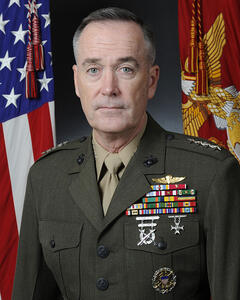
Welcome back and thank you so much for agreeing to a second session with us for the Barack Obama Oral History Project. We’re speaking today with General Joseph Dunford. I’m Barbara Perry. My colleague Russell Riley and my colleague Spencer Bakich, who’s coming to you today from the Virginia Military Institute, are here. So, without further ado, unless you have any questions for us today, General, we will jump right in.
Joseph Dunford
OK, sounds great.
Spencer D. Bakich
Thank you again, General Dunford, for agreeing to sit with us. I was going over our notes from our last session, and we did, I think, a terrific job in making our way through Afghanistan. But that, of course, leaves us with your Chairmanship [of the Joint Chiefs of Staff] to discuss today.
Could you set the scene in terms of the personalities in play, in particular in the context of—I guess the administration was intent on calling it the counter-ISIL [Islamic State in Iraq and the Levant] campaign—the war against ISIS [Islamic State of Iraq and Syria]? In particular, we had a relatively new Secretary of Defense; we had a new Chairman of the Joint Chiefs of Staff—that would be you, of course—and a new commander in the field, and an established general, [Lloyd] Austin at CENTCOM [Central Command].
Could you give us a reflection? As you were coming in, I’m certain you knew all these personalities well, but what was your assessment of the chain of command, the team leading this war effort from the United States and in the field in May of 2015?
Dunford
Well, as you mentioned, none of these folks were strangers to me. General Austin and I had served together on the Joint Staff as colonels. When he was the Vice Chief of Staff of the Army, I was the Assistant Commandant of the Marine Corps, so we sat in Defense management oversight meetings for a couple years in that capacity. Then when I was ISAF [International Security Assistance Force] commander, General Austin was the CENTCOM commander, so when I came back as the Chairman, he was still the CENTCOM commander, no stranger at all.
Secretary [Ashton] Carter and I had known each other for a decade at that point. I first met him when he was AT&L [Acquisition, Technology, and Logistics], Under Secretary of AT&L. Obviously he was the one who nominated me to be the Chairman, and I knew him also from my time, as I mentioned, with what was called the BMAG; that’s the management group. General [John] Nicholson and I served together in the J3 back in 2007 and ’08. I was the Vice J3, and General Nicholson was one of the deputy directors for operations, so I knew him very well in that capacity.
Bakich
As you were entering into your role as Chairman, were you comfortable that the United States had established an effective strategic concept for dealing with ISIS? Did we have in play a set of good enough relationships with the various players who were going to be conducting the main fighting on the ground at that point?
Dunford
First of all, an important variable was the Russian intervention in Syria at that particular time, and it almost happened coincident with when I became the Chairman. They first arrived in September, early October of 2015. They might have had some advance elements there in August. Russia’s presence in Syria was very much a part of the campaign at that point. Conceptually CENTCOM had a good plan to deal with both Iraq and Syria at that particular time, but in terms of how we prioritized and allocated resources, Secretary Carter and I both agreed in October of 2015 that additional resources were going to be required; additional focus was going to be required.
It was really just in 2014 that the map began to turn red in Iraq and in parts of Syria, and by the fall of 2015, it was pretty obvious that Syria required a great deal of attention, as well as Iraq. Conceptually, one of the more important discussions was there had been a thought that we would do Iraq and then sequentially do Syria. It was certainly my judgment in the summer, as I was preparing to come into the job, and it was certainly General Austin’s judgment, the Secretary’s, that we needed to move to a much more simultaneous approach both in Syria and Iraq.
The Iraq piece was relatively straightforward. Difficult times—Certainly the Iraqi forces were having difficulty in Ramadi; they were having difficulty in Fallujah; they were having difficulty in the north—but conceptually we knew how the campaign would unfold. We did need to provide additional support.
We recognized that the issue with Syria was much more challenging because the guidance was to take care of ISIS in Syria; do not address regime forces. We were proscribed from conducting operations against [Bashar al-] Assad’s forces. We were also challenged with Turkey’s presence; we can talk more about that. And we were challenged by the lack of an effective partner on the ground in Syria.
At the time, we were supporting what was known as the Free Syrian Army, so our initial engagements were to provide them with training, equipment, resources, but in any event, very few of the people we trained of the first few hundred actually deployed in the field and were effective. That began our journey, which would eventually be a relationship with the Kurds. Let me stop there.
What I would say to your question—We talked personalities, and we asked if we were satisfied. It wasn’t so much were we satisfied or not; it was that we realized we were at an inflection point, that the momentum of ISIS in Iraq was significant, and additional resources were going to be required. And we knew because of the growing presence of Syria that some simultaneity was going to be required, as well. Refining the concept of operations that was primarily developed at CENTCOM—and they get the credit for doing that—was going to be required.
Bakich
Just to put a finer point on it, you mentioned resources. Can you give us an idea as to what you thought more of was needed? Was it more forward presence of Special Operations Forces?
Dunford
Yes, I think it was all of the above. It was logistical support—I think it would be a mistake to narrowly focus on special operations forces; I would use the word “advisors” more broadly—advisors, aviation capability, intelligence, surveillance, reconnaissance capability, logistics capability, and then engagement at the leadership level, critically, as well.
That’s the operational piece, but then we also knew there was an institutional piece, which was the long-term development of Iraqi forces so they could eventually assume greater responsibility for the security of the country.
Bakich
How effective do you think the influence of President Obama was at the time?
Dunford
Here’s what I would say about judging the administration’s performance: what I would recommend you do is just get a map of 2014, and then get a map of December of 2016. And then, if I were a lawyer, I’d say, “I rest my case.” [laughter]
We don’t need to subjectively assess what happened during that period of time. We can objectively look at the reduction in ISIS control of territory, control of population, the flow of foreign fighters, the flow of resources. The ideology itself was degraded. If you think about transregional violent extremism—the three things that actually evolved to be transregional are the flow of foreign fighters; the flow of money, resources; and then ideology itself.
In all those areas, we made significant progress between 2015 and 2017. By the time the [Donald J.] Trump administration came into office, the momentum was very significant. The progress on the ground was very significant. The relationship with our partners in Iraq and the relationship with our partners in Syria were significant.
There was one decision left hanging when the Trump administration came in, which was the degree to which we would support the Kurdish forces in the northern part of Syria. What happened in the fall of 2016 was President Obama made a decision to do that, but wanted Susan Rice to reach out to the incoming administration. She did reach out to Michael Flynn, who was the incoming National Security Advisor, and the incoming administration asked the Obama administration to hold off on that relationship with the Kurds, so we did. The one decision left hanging was the extent to which we would support the Kurdish forces in northern Syria in 2017 and beyond.
Perry
I remember at the time the so-called red line that President Obama drew about the use of chemical weapons. Did you have to fold that into your thinking, or was that an example of the politics aside?
Dunford
That was actually much earlier. The red line was drawn in the early days of the Assad regime. By the time 2015 came, we were some 18, 20 months from that red line. When I was sitting in the tank in 2012—Secretary [Leon] Panetta was there—there was a discussion about how we were going to handle what was obviously a civil war growing inside Syria, and would we support forces on the ground.
Here we can’t talk too much in detail, but I think you understand that the intelligence operations that existed during those times were separate and distinct from any defense operations at that time. The whole idea of a red line had really become overcome by events by 2015, because we weren’t dealing with the Assad regime and a civil war in Syria; we were dealing with ISIS. When the red line was made, it was the growing civil war inside Syria. It was not as apparent that ISIS in Iraq and ISIS in Syria were going to be the threat that they were to stability of both countries. So timing-wise, it’s a bit different.
Perry
That’s very helpful, thank you.
Bakich
You flagged two countries that were absolutely critical to the United States’ effort and to the effort of the Iraqis: Russia and Turkey. Would you mind detailing your experiences dealing with the Russians, particularly on the ground? Maybe we could start there first.
Dunford
When I came in as the Chairman, we had not spoken to Russia at a senior level since the invasion of Ukraine, since 2014, so we didn’t have any military-to-military relationship ongoing. My predecessor was not speaking to [Valery] Gerasimov, the Chief of Defense at the time. The Secretary was not talking to [Sergei] Shoigu, the Minister of Defense in Russia.
I asked permission, in probably late October, November, from the Secretary and the administration—the President, really—to begin a dialogue with the Russians, with the express purpose of deconflicting our operations inside Syria. At the time, there was language in the National Defense Authorization Act that proscribed any degree of cooperation, so the operative word was “deconfliction.” We clearly were operating in close proximity.
I’ll come back to Turkey in a minute; I’ll talk Russia first.
We were operating in close proximity to Russian forces, so I requested permission to initiate a dialogue with my counterpart in Russia. That eventually resulted in three meetings: one was in Azerbaijan; one was in Helsinki; one was in Antalya, in Turkey. The last one was a trilateral meeting among the Russians, the Turks, and me. Then probably at least bimonthly phone calls with Gerasimov began in December of 2016.
At the first meeting, we established a geographic framework within which we could deconflict operations, and we established direct lines of communication between our operational forces headquartered in Iraq and Russian forces headquartered inside Syria. We also then had a link established directly between me and Gerasimov; either one of us could get each other on the phone at any time. We agreed not to go to the media and talk the details of this arrangement, which proved to be the right approach because we were able to maintain that link effectively over the course of the next couple of years.
While there were several incidents where there was unsafe, unprofessional activity in the air, where we had forces in contact—particularly along the Euphrates River—in all cases we were able to eventually deconflict those operations and mitigate the risk of escalation as a result of these deconfliction lines.
The establishment of it took place in the first meeting in Helsinki. We refined it when we met in Azerbaijan, and we refined it further when we met in Turkey in a trilateral format. That was a big decision by the administration, by the President, to open up that line of communication, given where we had been. It was welcomed by our NATO [North Atlantic Treaty Organization] allies. It’s fair to say that at the political level everybody was uncomfortable with the lack of any kind of effective dialogue, particularly one that could mitigate the risk of miscalculation or mitigate the risk of conflict.
We established that, and that has to be one of the successes of the Obama administration, establishing that framework of deconfliction, because that is what allowed us—Think about this; I would argue it’s about a 9.9 degree of difficulty: we were trying to reduce ISIS presence in Iraq and Syria and allow local forces to defeat them eventually. We were trying to do that without going to war with Assad. We were trying to do that without going to war with the Russians. We were trying to do it without going to war with the Iranians, and we were trying to do it without creating friction in our bilateral relationship with Turkey—really, really hard to do.
Let me stop on Russia, and then I can go into Turkey, which was even more extensive.
Bakich
Sir, before you do that, would you give us a character sketch or your impressions of Valery Gerasimov?
Dunford
Yes, I can, again, having spent many hours with him. This will surprise you, I think: first of all, our meetings were not scripted. We would go in with an agenda, and he didn’t read to me, and I didn’t read to him. We usually had a private meeting upfront, and during the private meeting I would go in with a list of the issues we were going to talk about that day, and I would give him a Reader’s Digest version of the substance of the points I was going to make, so there were no surprises. I used to call it the areas of convergence and the areas of divergence.
I’d line them up, figuratively speaking, on a yellow legal pad, and I’d say, “Here are the areas where I think we have some degree of agreement. Here are the areas where we probably might think about trying to gain some agreement. And here are the areas where we’re never going to agree, so we’ll make our points and move on.”
He was professional. He was thoughtful. In retrospect—hard to believe—he was competent. To be honest with you, I think we established a—certainly not a warm friendship—a professional relationship that allowed us to deal with issues. I’ll give you one example. One night, at about ten o’clock Washington, D.C., time, I got a phone call that forces were moving toward the Euphrates River, and our forces were in contact, meaning they were under fire at that time. Overhead imagery indicated to us that several hundred forces were on the way to the Euphrates River, so they were going to cross what was, in effect, the deconfliction line.
I called Gerasimov at what was probably 3:30 or four o’clock in the morning, Russia time. I got him on the phone within minutes. I told him, “General, there are Russian forces in contact with our forces along the Euphrates River. This is very serious, and we’re about to kill large numbers of Russian forces.”
Gerasimov said, “I don’t have any forces there.” I said, “General, I think you understand”—this is the Wagner Group—“there are Russian forces there. The degree to which they’re under your control—You certainly are in a position to communicate our concerns.” Within an hour, we could see on overhead imagery those forces made a U-turn and started heading back to the west from whence they came. That’s just one of many examples—and there were many others at the operational level—where I think Gerasimov understood the need to manage the risk of escalation. I think he understood the need to do deconfliction so that ISIS could be defeated.
People will criticize the broad political construct of how we dealt with Assad, how we dealt with ISIS, how we dealt with the Iranians, and that’s still open for debate. But given the political objectives that we had, and the political framework within which we were operating, it would be hard to criticize the framework we developed and implemented to actually accomplish the political objectives without the risks that were associated with pursuing those political objectives.
Bakich
Thank you. Now, if we could turn to Turkey.
Dunford
I made 12 trips to Turkey as the Chairman, I think, at last count. Most of them were at the last minute, to go over and try to deal with issues as they were emerging. As you understand, our objectives with the Turks were not aligned.
The United States wanted to conduct operations against ISIS, to include in areas along the border with Turkey. Turkey objected to the forces we were supporting, the Kurds. They equated the Syrian Democratic Forces—which is what we called the collection of Kurdish forces—with the political group that was the YPG [People’s Defense Units]. They equated the YPG with the PKK [Kurdistan Workers’ Party]. The typical line from the Turks was SDF [Syrian Democratic Forces] equals YPG equals PKK. PKK are terrorists seeking to undermine the government in Turkey.
We had a very difficult time working through that. We had a NATO ally, an important bilateral relationship, an important broad relationship within the alliance, and we had operations on their borders, and they disagreed with the methodology we were implementing.
The dialogue from the very beginning with the Turks was, “Look, if you have an alternative to the approach we’re taking, please share it with us.” Over the course of my entire four years as the Chairman, they constantly told either President Obama, or, subsequently, President Trump, that they had an alternative. They never came through with the forces.
They had all kinds of ideas, but they never were able to demonstrate the forces. I’ll give you one example of many. This happened after President Obama, but I think it’s relevant. At one point they said, “OK, we have all these forces assembled. We’re ready to assume responsibility for northern Syria from you.” What they really wanted to do was to create a 40-kilometer-wide buffer along the entirety of the Turkish border, and the word they used was “clear.” You’re wearing your Army uniform today, Spencer, and I think you understand what that word means: they wanted to ethnically cleanse that 40-kilometer buffer of Kurds.
That was clearly not something the United States could support; the only effective partner we had in Syria against ISIS was the Syrian Democratic Forces, which were led by Mazloum [Abdi], who was a Kurd.
So on this one occasion of many when they said they had forces, I said, “OK—” At the time it was General Hulusi Akar, who is currently the Minister of Defense in Turkey, so he’s been at this for a long time. I said, “OK, Hulusi, I’ll be over on Friday, and I’ll stay for a couple of days. I’d like to come down and see the forces train, and I’d like to assess the forces that you’ll use, and begin to talk about how you would assume responsibility for the Syria campaign,” which is what they wanted to do.
I went to an undisclosed training facility along this border with Syria. He drove me around, he showed it to me, and I saw some forces training. I said, “Hulusi, I’d like to go see those forces.” He said, “You can’t see them.” I said, “Why not?” He said, “They don’t like you.” There were 40,000 forces along the ideological spectrum of al-Qaida in northern Syria, and these were the forces they were working with. I said, “Where are the forces that are going to be supporting operations in Syria that we can cooperate with?” “They’re not available right now. We won’t be able to show you those until next week.”
So then I got the station chief, I got our head of special operations, Akar’s guys, and I said, “OK, you guys have until Wednesday to produce these forces.” It never happened. That’s one of many, many trips to Syria.
We could never, through two Chiefs of Defense in Turkey—You know, the political pressure they were under was intense. They were under pressure from the United States not to be there, and to be able to conduct the kind of operations that we have seen them trying to conduct as recently as in the last couple of weeks. This has been now going on for some years. But what we were trying to do was positively manage the relationship with Turkey, understand its importance, and not add friction to what was already inherent friction in the nature of our political objectives inside Syria.
There, again, I think the Obama administration—since that’s what we’re talking about today—did a pretty decent job of managing the bilateral relationship with Turkey, the NATO relationship with Turkey, and continuing to conduct operations against ISIS.
What took place in Manbij, which is in the center of the pocket up in the north, and what took place in Raqqa, and then what took place along the Euphrates River Valley is evidence of our ability to manage the relationship and at the same time conduct operations against ISIS. But it took a hell of a lot of maintenance. As I said, I feel confident in telling you that it was double figures in trips—12 is what I remember off the top of my head—and those visits were all designed to reduce friction and see if we could come up with some way of dealing with a crisis, whatever it happened to be at a given time.
By the way, much of this was that we had Iranian forces, Assad regime forces, Russian forces, Turkish forces. At one time you will recall that the Turks shot down two airplanes from the Russians. What now seems to be an academic discussion was most often crisis management with high stakes, and the potential for some of these tactical actions to have strategic consequences.
Managing that on the ground and then managing the relationship was something taking place at the political level, as well. Ambassador John Bass, who was President Obama’s representative in Turkey, gets huge credit for this in terms of managing the Turkish relationship. He and I were joined at the hip in terms of my engagements in Turkey at that particular time.
In effect, I was the first American to go visit Turkey about 48 hours after the attempted coup in 2016, and I was greeted by large protests with signs with my face on them. You can look it up on Google. I’ll stop there and see if there’s anything else on the Turkish relationship.
Russell L. Riley
I have a question that will steer the discussion in a slightly different direction.
I recall your being so helpful last time in talking with us about some of the people you worked with, and I think we lost Ash Carter in the interval between that session and this one. Could you talk with us about Secretary Carter, your relationship with him, and help us understand both his strengths as you perceived them, and his weaknesses as you perceived them, as Secretary of Defense?
Dunford
In the interest of full disclosure, I’m not an unbiased source here. I had a very close personal and professional relationship with Secretary Carter that continued after I left active duty, when he brought me onboard at the Belfer Center [for Science and International Affairs], and my office was right next to his. Again, it was personal and professional.
I’ll tell you one of his strengths as a leader. He nominated me to be the Chairman. One of the ongoing issues in the Department at the time was the issue of full integration of women. I had been the Commandant of the Marine Corps; we had done a long study that I inherited when I came back from Afghanistan. The study identified issues that needed to be taken care of before full integration. I was the only four-star on active duty who came in and said, “I think we need to continue to have waivers in some areas before we do full implementation of integration.” It’s not because I’m a misogynist, although some people would think so based on what happened at the time.
Secretary Carter, very thoughtful, sat down with me when I was the Commandant of the Marine Corps. I explained to him what we were trying to do. My approach was “Mr. Secretary, here are a number of things that should be done to set the conditions for successful integration. The question is not whether you’re going to head that way from a policy perspective; the question is how do we do this right.” And despite the fact that I was, at least publicly, seen as a bit out of step with the administration’s policy at the time, he still nominated me to be the Chairman. And when he implemented the decision, I didn’t go out with him on the media day saying, “Mr. Secretary, you’re making a policy decision. Go make it, and tomorrow I’ll implement it like it was my idea.” All the staff objected to this, except he understood what I was doing, why I was doing it, and supported it.
I bring that issue up because it’s characteristic of the times when I might have had a slightly different perspective, as you’d expect, looking at the military dimension. He was obviously looking at it from a broader political military perspective. We had so many good conversations about how to work through these difficult issues and how to prepare to provide advice to the President. He was completely transparent with me. I trusted him implicitly. I feel like he would say the same, were he still with us, about me.
My relationship with Secretary Carter was very beneficial, I think, in working through some of these difficult issues. Again, the example of authority to go to Russia, break the ice, so to speak, on the Russia issue, the disagreement we might have had from time to time on policy issues, or approach to dealing with some of the issues we had: those were always things that he welcomed. He welcomed divergent opinions, and he made decisions when it was time to make decisions.
From background and experience, we’ve seldom had a Secretary of Defense who had almost four decades in the defense business. As a young PhD, he wrote the countervailing argument about Star Wars during the [Ronald] Reagan administration, so this is how far back he went. When it came to negotiating with the Russians, in all the arms control discussions of the ’80s and ’90s, he was either at the Assistant Secretary level or a note-taker during many of those times, particularly back during Secretary [William] Perry’s tenure as the Secretary of Defense. In terms of experience, of competence, he was a PhD in physics and also a PhD in medieval history. He had an academic background, a technical background, a leadership background.
You said strengths and weaknesses, and I’m hard pressed, Russell. I’ll probably leave the weaknesses for others to identify because I can’t think of too many. That’s not because he has passed away; it’s because I really do think that in his tenure—He stepped in during a difficult time of leadership transition, and I think, again, from implementing a new strategy that would begin to look more broadly at [unclear] competition, look at the budget in 2016—Again, it’s not my opinion; look at the budget in ’16—It’s the beginning of the shift that we have continued on to this day.
Outreach to Silicon Valley: he established the Defense Innovation Unit to better leverage and establish relationships with technology companies in the United States. He actually brought to life a structure that will allow us to leverage emerging technologies that might have application within a short period of time—Two years was the original window—to dealing with ISIS. Those are some of the things that happened.
When you look at the substance of the main issues that were addressed during his time as the Secretary of Defense, they were very, very good. In terms of supporting the President, there was a healthy relationship among Secretary [John] Kerry, Secretary Carter, and Susan Rice, the big three in the national security space, in the sense that they didn’t necessarily come at things from the same direction very frequently. The President was well served by having broad perspectives and slightly nuanced views on some of these issues. Secretary Carter brought something to the table that was different than what Susan Rice and Secretary Kerry brought, which, again, I would say was a good thing.
Riley
Can you elaborate a little bit more on those? You prefigured my follow-up question, which was about your working relationships, to the extent that it existed—I don’t know enough about your position to know if there’s a great deal of interaction with the Secretary of State and the Security Advisor, but—
Dunford
I had a lot of routine interaction, one, as a member of the National Security Council; I was in meetings and preparing. Secretary Kerry and I got to know each other pretty well when I was in Afghanistan, because he came over to negotiate the Bilateral Security Agreement with President [Hamid] Karzai, so that was several trips in 2014, and the elections of 2014; the transition to Iraqi authority was important. So Secretary Kerry, in addition to being the speaker at my high school graduation—by the way, that’s true. [laughter]
Bakich
Fantastic.
Dunford
He was a 26-year-old former Navy officer, who was an emerging state representative in the State of Massachusetts, so he’s about eight, nine years older than I am. When he was in his late 20s, he spoke at my high school graduation. That’s an aside, but it highlights—
Riley
That’s terrific oral history detail—
Dunford
Yes. We got to know each other much better in Afghanistan. And, in all these issues that we dealt with—These were not military issues. I did not deal with military issues when I was the Chairman; I dealt with broad, strategic issues that had a military dimension.
All the issues I just spoke about—Think about it—they’re largely foreign policy issues. How do we manage the relationship with Russia? How do we manage the relationship with Turkey? How do we deal with Iraq and Syria, and navigate the approach of—? The settlement would be through Vienna, yet we’re conducting military operations and intelligence operations at the ground. That necessarily required routine engagement with the Secretary of State, both in the meetings and in preparation for the meetings and occasional phone calls and those kinds of things. And the National Security Advisor, Susan Rice, and I spoke routinely about these issues, as well.
I had what I believe are very good professional relationships with all three players: the Secretary of State, the National Security Advisor, and the Secretary of Defense. I have respect for all three of them to this day, and I found all three of them to be willing to listen to what were occasionally slightly different perspectives on some of these issues.
When it came to the military dimension of these problems, at the end of the day, sometimes they didn’t necessarily like what I said we could or couldn’t do, but they, in all cases, would come around to say, “OK, if that’s the best we can do, I got it.” As you can imagine, sometimes the Secretary of State and National Security Advisor would want us to deliver more, faster. Sometimes I was in the uncomfortable position of saying, “I don’t think we can necessarily get there.” The professional relationships we had of trust allowed us to sort through those issues.
This is probably an important point: I don’t ever remember going to the President without having aired out all of the issues. In other words, we went to the President sometimes with a State position that was different from a Defense position, but these were all sorted out before we went in to the President, so they’re provided to him in a coherent way. We would say, “OK, Mr. President”—Susan would usually start the meeting—“this is where we are on this issue. This is State’s perspective. This is the Defense perspective. There’s a slight divergence of opinion here. And Secretary Carter and General Dunford will talk to you about it from a Defense perspective; the Secretary will talk to you about it from the State Department,” and so forth.
In terms of the team, all strong personalities, occasionally there was friction when we were dealing with given issues. But everybody at the end of the day was focused on the President. In terms of the climate, everybody knew, OK, this is where the President wants to go, and we all knew our job was to help him get there, even if we had a different view on how.
Perry
Can you describe, then, in those meetings, when you would bring these fleshed-out proposals, sometimes with differences and nuances, how the President would respond to those?
Dunford
Sure, sure. The one thing I’d say about the President—People have asked me, because I did work for two different Presidents, so when I describe President Obama—I think I came up with this description because I was asked to contrast it with others—You’re dealing with a constitutional lawyer who reads everything, who has an inexhaustible ability to absorb detail, and comes into every single meeting with some clear vision of what he wants to get out of that meeting, and with a list of questions that are fairly penetrating.
So I would say this about those meetings: one—I give Susan Rice credit—I don’t think the President was ever surprised in a meeting. She did her homework, and when he walked into the room, she had already told him where all the landmines were, so to speak. He knew where they were. He walked into the meeting, and she couldn’t necessarily eliminate them, but none of them were surprises.
The way a typical meeting would unfold is Susan Rice would give the broad context of the issue, and she would talk about the specific objectives. It was a very disciplined national security process during the Obama administration, very disciplined. I don’t think anyone would tell you otherwise. She would identify the specific issues we were going to discuss, the specific areas of friction, maybe, that had to be addressed before we could conclude on a decision.
I don’t recall the President making too many decisions in public, so the way the dialogue went was he would come in; we’d give the briefs; everyone would have the chance to have their say; the President would ask questions—That would be the next round of dialogue. The President would say, “Thank you very much,” and the meeting would end. Susan Rice would summarize and give everyone their homework for the next turn of the crank, so to speak, and we’d come back and do it again.
The critique of the Obama administration was too many meetings for too long. I might have said that until I was in another administration where maybe we didn’t have enough meetings on some of these issues, and not everybody was in the room. I would ask you not to make that a part of our discussion today.
I have seen a disciplined national security process, which is painful for participants, but I’ve also seen one that is undisciplined, and it’s more painful for participants. [laughter] My broad characterization of the Obama administration, without regard to judgment on the policy objectives and so forth, was it was an extremely disciplined approach, transparent approach, and very clear in most cases where the President wanted to go, even if the path to getting there was challenging. Of course, that’s necessarily the case, right? Because things don’t come into the Sit [Situation] Room unless they’re hard issues. That’s where we were.
Bakich
Barbara and I had the occasion to speak with one of your predecessors, General [Peter] Pace, a while back, and he described, I think beautifully, the challenge of Presidential decision making. On the one hand, it’s difficult to make decisions, and you need a well-structured, well-run national security interagency process to do that.
But General Pace also emphasized the fact that it’s not just the making of the decisions, but ensuring implementation downstream that is a significant challenge. I was wondering if you saw that as an issue in the Obama administration, or was—I don’t want to say automatic, but was there a frictionless or slighter level of friction when it came to implementation?
Dunford
That’s a great question. The framing of the policy and the agreement on the approach are absolutely much easier than implementation. In the structure of the national security decision-making process, the operative word there—decision—is not necessarily the same for implementation. It’s a lot harder to implement, in quotes, whole-of-government solutions than it is to come up with a framework, because there’s not unity of command. There’s not a single person who’s directing and orchestrating the execution of the government. You think about it below the President, right? It becomes very difficult.
Execution in Afghanistan, which was still ongoing at that time, was difficult. Transitioning to the new reality of Russia and China was difficult. The rebalanced Indo-Pacific is probably an example where there were things that maybe we wanted to do but we couldn’t actually get them done during the Obama administration.
Witness the fact that we had, for example, the Trans-Pacific Partnership agreed upon but not implemented—It’s 2022 and it’s not implemented yet—and we still don’t have a multilateral framework within which to pursue our economic interests in the Indo-Pacific. That was something designed during the Obama administration, agreed upon by our Indo-Pacific allies at the behest of the Obama administration, and yet to be implemented in 2022.
I don’t want to be Pollyannaish with my previous characterization of the process, Pollyannaish in terms of execution, because, yes, the map was different in ’14 and ’17. There were certainly bumps and bruises along the way, and disagreements about how to address certain issues in the campaign. But if you think about it now, particularly with the benefit of hindsight, by the time the Obama administration was coming into office—and now I go back even prior to the 2015 period—the idea that China was going to open up politically if we only opened up economically, that assumption was no longer obtaining by 2008 or 2009.
If it wasn’t obvious in 2008 and 2009, it’s very obvious in 2022, looking backward, right? I do have the benefit of hindsight, but by 2015 there was no doubt that we couldn’t deal with Russia with a dialogue as a NATO friend. The whole Russia dialogue with NATO didn’t resolve Ukraine, didn’t resolve Georgia, didn’t resolve Ukraine Donbas break, also Crimea.
Yes, implementation during the Obama administration for the whole wide range of national security policies was difficult, and not always did we find the State Department and the Defense Department in line in terms of the prioritization and allocation of resources that were under the purview of the respective Cabinet secretaries. That’s where, really, you see the difference: what is number one in your inbox? Seldom, if you have a different priority, are you going to have effective alignment and execution. Does that get at the question?
Bakich
Oh, yes, absolutely. Of course, my interest in this would be to push you to Can we solve this problem? But that’s not an oral history question. [laughs]
Dunford
I’ll tell you in 30 seconds: it cannot be solved structurally; it cannot be solved legislatively; it can only be solved with leadership. I’ve seen it work. I won’t digress today, but I’ve seen specific cases where it was very clear which agency had the lead; it was very clear what supporting task the other agency had; it was very clear what the President’s objectives were; and there was a routine drumbeat, so to speak, of meetings to ensure implementation.
When that exists—strong leadership, clear vision, clear policy objectives, and oversight, structural oversight—you can actually do stuff in the U.S. government. The solution is right in front of us, and it’s the same as any business book would identify: how you get a large organization to do things.
The problem is, in the U.S. government—so I don’t make light of it—when you’re dealing with 50 or 60 40-weight issues simultaneously, you’re not going to get 40 or 50 or 60 40-weight issues done well simultaneously. There’s a bandwidth issue. That’s the issue that’s not solvable: we’re a global power, we have global interests, and we have all of the complexity associated with implementing policy objectives globally.
So it’s just going to be damn hard. But when it works at its best, the solution is not very difficult to identify. And if you think there’s going to be a Goldwater-Nichols [(Barry) Goldwater-(William F.) Nichols Department of Defense Reorganization Act of October 4, 1986] for the interagency, you need to talk to me later. [laughter]
Bakich
I would love to. Pivoting very quickly back to the counter-ISIS campaign, but more specifically with respect to Iran, is it inaccurate to say that the United States and the Islamic Republic of Iran had a form of tacit agreement or cooperation—?
Dunford
No, there’s no way. I don’t think that at all. What you can say—I wouldn’t call it cooperation—is there was deterrence against certain behaviors. If you think about Iran, Iran presents challenges in the nuclear space, ballistic missiles, cyber, maritime space, and proxies. Those are the five major exportables of a government that exists solely to export a revolution. That’s their policy objective, so there’s no way to have any kind of cooperation, tacit or otherwise.
During the Obama administration and subsequently, we, broadly speaking, had deterrence against maritime threats, interference with commerce in the Gulf. We had deterrence against direct attacks on U.S. forces, because the Iranians would know if there was an attributable attack against U.S. forces, what the consequences might be. To some extent, because JCPOA [Joint Comprehensive Plan of Action] was in effect from 2015 on, we had some deterrence for the development of the nuclear enterprise, less so with the ballistic missile regime: they were in clear violation of the U.N. [United Nations] sanctions for ballistic missiles during that particular time.
With proxies we did not have deterrence, because by definition they weren’t attributable. This is why I would refute anyone who says it was cooperation. We had over 500 incidents of explosively formed penetrators being used against our forces in Iraq that were directly attributable to the Republican Guard, with numerous incidents of Iranian-backed militias attacking U.S. forces and conducting operations that were inconsistent with our policy objectives at the time.
So we had a troubled relationship, and we also had—keep in mind our partner, Israel, dealing extensively with Iranian operations to include the importation of missiles via Syria into Lebanon during that particular time, and active operations by the Israelis against the Iranians to mitigate that.
We had the Iranians working against us in the southern part, along the border with Jordan, as well as in the northwest part of Syria. We didn’t have them so much interfering in areas like Raqqa or in the Euphrates River Valley, and I think that was based on the limitations of their operational reach, as well as their desire not to come into direct conflict with the United States. But I would reject anyone’s characterization that that was cooperation.
Bakich
Thank you for that. That was great. That was wonderful.
Riley
You had raised Ukraine earlier, and because that has become such a prominent issue currently, do you have any observations about what you and the administration were doing with respect to Ukraine during your time that you can talk about now?
Dunford
It’s a great question. When will this—? How many years from now—?
Riley
As a routine matter of course, we would hold your interview until the completion of the project and the administrative work that would take place after it, which would probably be on the order, I would think, of maybe three years plus or minus. But you also retain the right to place stipulations on any part of this, so if you speak something that you’d rather not have out at that time, you may place whatever constraint you want on that passage.
Dunford
At the risk of oversimplifying—The debate about Ukraine during the Obama administration was to what extent were we going to provide lethal aid. Never has one weapon system, at the tactical level, received so much attention as things like Javelin missiles, a big deal during the Obama administration, as well.
There was a big debate during the Obama administration about the extent to which we would provide support to Ukraine. My judgment—and I had this conversation several times on the margins of NATO meetings with my Ukraine counterpart—is that United States of America came up with a very clear path for Ukraine to follow that was the condition of our support, and Ukraine did not meet those conditions during the Obama administration. As an example, the military being subordinate to civilian leadership and a normalized relationship between Ukrainian uniformed military and their Ministry of Defense in the political leadership above that. Then transparency, accountability of weapons systems—Those kinds of things didn’t exist, so we were less inhibited during the Obama administration—This is the important point—by policy about what we would do with Ukraine. We were more inhibited by Ukraine’s failure—This is why it would be unpopular to say this today. I don’t want to say it today. It’s not the time to say it today.
One of the reasons why the United States, through two administrations—Of course, the tortured relationship with Ukraine had followed President Obama—The real issue with providing support to Ukraine, the reason why it was really less a policy issue than an implementation issue, was if Ukraine had met all those conditions, then we might have been in a position to say, “OK, should we be more aggressive in the support that we’re going to provide?” But the fact is that the Ukraine didn’t meet the conditions that were established in a bilateral framework for defense cooperation. Therefore when President Obama said, “No Javelins,” we could never say, “Mr. President, you should give them Javelins, and I can assure you that that technology won’t be compromised. I can assure you that those weapon systems will be used only for the purposes for which they are intended.” We could never say that or, “and I can assure you that on the path toward normalizing the use of force within a democracy, they’re heading in the right direction. They’re not going to violate human rights,” and so on and so forth.
In all of those areas, the record is not good in Ukraine. This is all, for the most part, predating President [Volodymyr] Zelenskyy. It predates the Russian invasion. History will tell us later whether the basic conditions that existed during the Obama administration will now change in a postwar era. But Ukraine was very, very corrupt prior to the Russian attack, and much of the responsibility for the conditions that existed in Ukraine prior to the war was the result of a series of Ukrainian leaders. That’s my comment.
Riley
Got you. It’s safe with us. We maintain the confidentiality of the interviews personally, and you can hold this as long as you like.
Bakich
General Dunford, can you give us an indication of how high these conversations went? Were you routinely meeting with the President of the United States on this matter, and if so, how frequently?
Dunford
No. There were probably a few National Security Council meetings where it came up—should we? should we not?—but this was not the dominant theme by any stretch of the imagination during my time as the Chairman. We might have had a couple of meetings. Again, the decisions were not that difficult because we weren’t in a position to say strongly what we should or shouldn’t do.
The real point I want to make is we all agreed that providing more lethal assistance to Ukraine would help them. We all agreed with that. We all agreed that that would limit the Russians’ freedom of movement and their ability to continue to conduct operations, largely in the Donbas and Crimea at that point. We also agreed that the Ukraine wasn’t meeting the conditions for us to provide more support, while mitigating the risk to U.S. national interests.
Bakich
Fascinating.
Dunford
That’s the basic structure of the debate.
Bakich
Thank you. My final question is can you paint a picture of how you interacted with the transition team from Obama to President Trump?
Dunford
Yes. Others were working it every day, but I was sitting there as the only person who made the transition from the Obama administration to the Trump administration execution. So when we held the National Security meetings in early January 2017, I was in the room, and when we were holding meetings in February I was in the room, and I was the only one in the room in early January and February, so I think I can say this from an unbiased perspective: I believe that immediately after the election in November, the President gave very clear guidance on the type of transition he wanted to see. I don’t have any personal knowledge of this, but there had been some anecdotes about what had happened back in 2008, in terms of computer stations and electricity and things that created inherent friction in a Presidential transition.
I remember President Obama addressing these things, saying, “I expect that we will do all we can to set the next administration up for success.” No question: I could pick up between the lines that there was going to be a huge disagreement in the policy objectives of the next administration—That was clear from Day One, without judgment. I knew they were there—but in terms of how we would conduct the transition, the guidance was to do so in a professional way.
We had a series of meetings to address how we would deal with these issues. The one on Turkey is a great example, one where we came to a decision, and the President’s guidance was, “OK, I agree, I think we should do this, but let’s make sure that the next administration wants to do it.” Dealing with North Korea is another example where the President really sought to have continuity, in terms of knowledge and preparedness to deal with a crisis, if not in terms of the specific approach to policy or the political objectives that might exist. So in November, December, into January, there was a lot of attention on the transition, and I was completely free at will to engage with the incoming administration. In fact, I did in December. I flew up to New York to Trump Tower to give the President the beginnings of how—
We started with the nuclear enterprise and his responsibilities with U.S. military. We carried over into his role as the Commander in Chief, and how he would interact with the Secretary of Defense and the Chairman and those kinds of things. That would often get into broader issues about where we were with regard to Afghanistan, where we were with regard to the ISIS campaign, and so forth.
Again, I’m not a political guy, but I’d give the Obama administration high marks in terms of attempting to set the conditions for a smooth presidential transition. That starts at the top, where the guidance from the President was unequivocal: you guys need to make sure you set the following team up for success.
By the way, I think the Trump administration folks would say that, too. I think they’d criticize 98 percent of the policy objectives of the Obama administration, but I don’t think any principal who came in in 2020—You can talk to [Rex W.] Tillerson and [James N.] Mattis and even [Michael T.] Flynn, if you could ever talk to him, and others; they would all say that their counterparts reached out to them and did all they could to do an information dump that would be sufficient.
Then, from a mechanical perspective, to make sure that you have continuity in communications, there are little things from workstations and the internet to big things like where were we in the last conversation with the Chinese about North Korea. Both at the tactical level as well as the strategic level they did their best to have an effective transition. That comes from a nonpolitical guy who watched it both in preparation and then in execution.
In the early days of the Trump administration, we didn’t have so many perturbations because there was a pretty clean handoff in terms of Where are we with those broad near-term crises that we’re in the middle of?
Keep in mind, North Korea was probably at the top of the President’s inbox in December of 2016. It had been an unprecedented period with nuclear tests and missile tests. Of the areas that we thought would be likely for conflict, the two most likely would be North Korea and Iran at that time, less so Russia, which was, I think, viewed as a status quo in the Donbas at that time. I don’t think anyone would have foreseen what took place more recently.
Perry
We are at our appointed time, General. Anything that we didn’t ask you about in these two sessions that you would like to have on the record?
Dunford
No, but the thing I would ask is if anything I have said is inconsistent with what you’ve heard from others, without attribution, I’d like to know what it is, and give me an opportunity to say why I said what I said.
In other words, I wouldn’t want comments that I made to be taken as not accurate if others have said that isn’t the way it went down. I tried to do the best I could. I did have some notes, best I could, to refresh my memory of things that were ongoing at the time. But where there are inconsistencies, if you have any right now, I’d welcome a last question about something I’ve said that maybe you heard differently, again, without attribution. If, later on, as you’re putting this thing together, if something I said seems out of context with what else you’ve heard, I would like an opportunity to go back on it and make sure that the record is clear, at least from my perspective.
Perry
Nothing comes to mind for me. If we do see something like that at some point we will get back to you, and you’re so generous to offer that. First of all, just to complete our conversation today, we do pass along our condolences for the loss of your good friend, Secretary Carter. We had an invitation out to him. We know that his death came suddenly, and we didn’t get a chance to speak to him, so your comments about his service are so helpful for the record. You packed more insight and facts and information into two hours than any I can remember, [laughs] so we thank you for that. You’re most efficient.
We know that this is also a part of your long service to our country, to have this for history, and for students, and people in the military, and officials in government, and scholars, and biographers to cover it is priceless. So we thank you for continuing your service to our country.
Thank you so much, and to you and yours a wonderful holiday season coming up, and a happy New Year, and we hope our paths cross in 2023. And thank you to Russell and to Spencer, and particularly Spencer’s expertise in this area. We couldn’t have done it without him.
[END OF TRANSCRIPT]