Transcript
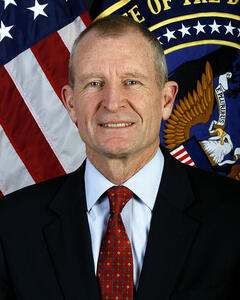
Dennis Blair
Good afternoon, everyone.
Barbara A. Perry
Good afternoon, Admiral Blair. It is great to see you after our conversation recently and introduce to you my two colleagues, [Robert] Bob Strong of W&L, Washington and Lee [University], where he was not only a top political science professor but also provost. We are happy to say he is a fellow with us now at the Miller Center and has just told us that he has taken a house for him and his wife and pets in Charlottesville [Virginia], so we’re glad he’ll be close by to the Miller Center. And my colleague Spencer Bakich from the Virginia Military Institute. We were just talking about his book on the Iraq War. He is also a fellow with us. Both he and Bob, and particularly Bob, have decades of experience in doing presidential oral histories for the Miller Center, so we couldn’t have a better team. We thank you for taking time today.
I just wanted to ask before we begin: I know that you and I went through the protocols, and those are in the briefing book, but any other questions that you have about those protocols before we begin?
Blair
No, no. I think they are fine. Based on our conversation, I think it’s important to know the bureaucratic disputes that I was involved in, which were the subject of most press-writing about my time. They reflected some real decisions I think the country has to make in terms of how it organizes the intelligence agencies. I think I’m going to talk about everything there—the issues and the personalities involved—and I hope that it makes some kind of a contribution to making further progress because it’s really unfinished business. We don’t have as effective an intelligence community as we should, and I think it’s worth continuing to improve it. You’ll hear it all, and I’m happy to do it, but I’m also glad to have a chance to see what it looks like on the page after you write it up and make sure that I’m not offending unintentionally.
Perry
Well, I can’t imagine that you would do such a thing, but that’s what we love to hear. We want to hear the full story as you wish to tell it. It is your story. We also like to go back to the beginnings and talk about your early years and ask you about the long set of generations ahead of you in the Navy. The way I wrote it down in my notes was, “You must have saltwater in your veins,” along with “naval DNA.” Can we begin with that and your family’s history in the military?
Blair
I’m a sixth-generation Navy officer. Spencer, did you know my high school classmate, Blair [P.] Turner, who was at—
Spencer Bakich
Oh, sure. Yes, absolutely. Yes, I arrived at VMI [Virginia Military Institute] in 2016, and so I didn’t know him extensively, but certainly our paths crossed, yes.
Blair
He and I were high school roommates.
But yes, that side of the family was a Virginia family. They were always in the Navy. The father in a Civil War father-son relationship was in the Confederate Navy. He was the one who helped turn the USS Merrimack into the CSS Virginia and sent it out to fight the Monitor. He was a naval engineer for the rest of the war. His son was an officer in the Union Navy and was Admiral [David] Farragut’s chief engineer at the Battle of Mobile Bay. So when Admiral Farragut famously said, “Damn the torpedoes, full speed ahead,” it was poor old Captain [Thom] Williamson who was down in the engine room, a lot closer to the naval mines than was Farragut, who was strapped to the mast, and pouring on the coal in order to get through the minefield into the bay.
That was the first group, and since then, a steady line of Navy officers. My father and both grandfathers went to the [U.S.] Naval Academy. My junior year at high school, I was saying, “I’m not going to go into the family business. I want to go do something else. Why don’t I just go to the University of Virginia?” I went down to Charlottesville to talk to one of the admissions office counselors. It turned out that he was a retired Navy fighter pilot, and after we talked for about an hour, he said, “Dennis, you ought to go to the Naval Academy.” At that point, I gave up and went there myself. That’s how I ended up in the family business, and I’ve never regretted it.
Perry
That’s wonderful. We’re sorry that you’re not a [University of Virginia] Cavalier, but that’s OK. That is OK. We also want to ask—we always do—about not only the professional backgrounds but the political backgrounds. Was there much interest in politics in your family and talk around the dinner table about what was happening in politics as you were growing up?
Blair
None. No. We were the traditional, You don’t talk about politics, sex, or religion in the wardroom. My parents were conservatives—small c. I think they probably voted more Republican than they did Democrat in those years, but it wasn’t a big topic at all.
Perry
Certainly, though, your years at the Naval Academy—and you come out in ’68, do I remember correctly?
Blair
Right.
Perry
You’re coming out at the height of the Vietnam War and in the midst of everything that’s happening in the 1960s with the turmoil at home, assassinations, riots in the streets. What are you making of that at the Naval Academy and then as you go off to—and you go directly, do I remember, on your Rhodes Scholarship to [University of] Oxford?
Blair
Right. In retrospect, we were pretty insulated from the turmoil that was sweeping the country. I think it was brought home to me most strongly in the spring of ’68. My family was living in Alexandria, Virginia, at that time. Driving home to visit the family on one of the breaks, I came over the hill and saw Washington [D.C.] burning. I mean smoke literally coming up with National Guard soldiers on the street. That was the time that I realized that something big was up, something was going on.
But we were quite insulated at the Naval Academy from the tides that swept through most campuses during those days. I know we felt a general feeling of resentment of the antimilitary spirit that was so common in those years. Most people, and especially most young people, didn’t draw a distinction between the Vietnam War itself and those who went to fight it. It’s one of the great developments, I think, in the recent wars, which haven’t been very popular either, that the American people have managed to draw that distinction that if you’re in the armed forces, you follow orders and you go do your duty, whether you think much of a particular war or not.
In those years, I think we had a vaguely anti–most of the rest of the world feeling. When we used to march from the Naval Academy yard out to the football stadium, which was a little bit out of town, we’d march by St. John’s College, and there’d be a little protest—cardboard signs and chants from some of the St. John’s students. I remember one time, one of the St. John’s students got too close to the marching midshipmen. A large hand reached out, grabbed this sort of scrawny, bearded St. John’s student, pulled him into the middle of our company, where he was pummeled and left on the street as we marched on. That was about the extent of our communication with antiwar sentiment.
We just had the attitude that we’d signed up to be in the Navy or the Marine Corps, and we were going to go do our jobs when ordered. In retrospect, we didn’t think too deeply about things at that time.
Perry
Admiral, do you think the active draft at that time was something that was charging up so many of these students who just did not want to be—
Blair
Oh, absolutely. It was personal to them. It interfered with their plans. When you talk to many of them in retrospect, many of my friends who I met subsequently, who were campus leaders and vehemently antiwar—they, in many cases, regret that they didn’t serve, that they chose the path of trying to avoid it rather than going through it and then having that experience. So yes, there was a huge amount of the anti-Vietnam spirit coming from the feeling, “I just don’t want to do it. I don’t want to go there.” I don’t think it was so much fear of being killed as they felt they had higher aspirations and being in the armed forces was interfering with that, was a step down for what they wanted to do.
I’d say the motivation was far more noble for the other protests of the 1960s: civil rights. Certainly, it was for some friends who were Freedom Riders [civil rights activists]—friends later in life. I respect them a tremendous amount, and they did well.
The student preference for drugs, for mostly marijuana in the 1960s, and then for not serving in Vietnam, I think, was in large part based on just ego. We were told by our parents that we could do anything. We were so smart. We thought that they just didn’t get it, they didn’t understand, and we knew better. We knew you shouldn’t have to be told to do anything like serve in the armed forces. You shouldn’t have to be told anything like not smoke marijuana. I think there was just a lot of youthful arrogance there, which was not very good. And yet some of the protests of the 1960s, particularly civil rights, I thought were motivated by a much more laudable idealism. It was a mixture.
Perry
What prompted you to apply for a Rhodes [Scholarship]?
Blair
I don’t really know. At that time, the Rhodes program at the Naval Academy was run by a beloved professor, Jim Cutter, who identified midshipmen whom he thought would benefit from a Rhodes Scholarship and have a chance of winning one. I don’t know if he actually spoke to me one day—I took a class from him—or if it was known that there was this scholarship available. I somehow was aware of it.
Jim Cutter would—it wasn’t any elaborate process such as the universities develop these days of mock interviews and getting other former scholars to read your application and all of that stuff. Jim Cutter would just get us together, about three or four times that I recall, and he said, “Let’s talk about some important issues.” He would test us and have us think about things that did not come up in the normal Naval Academy curriculum. Then I just filled out the application, went through the interview process, and was selected. It was one of the things that seemed like a good idea, and it was. I had a wonderful and not just enjoyable but tremendously important time at Oxford.
Robert Strong
Which college?
Blair
I was at Worcester College.
Perry
I was just going to say you mentioned in our phone call that we had a couple of weeks ago that it was so different in that you were studying history and languages and Russia, whereas you said the academy, obviously, was focused on engineering. Tell us about the impact of the—were you there two years fully?
Blair
It turned out I was there for three years. You could, in those years, apply for a third year, and I was halfway through a second course that I had wanted to take, so it was granted.
There was one other military Rhodes Scholar, [Robert] Bob Earl, who graduated a year before I did. There were two of us who were military Rhodes Scholars. The other 30 were campus leaders, and campus leaders in those years were people who had organized burning down ROTC [Reserve Officers’ Training Corps] buildings, marching, voting for [George] McGovern, all that stuff. We were very much in the minority and were treated with some suspicion and quite a bit of condensation—not condensation. Whatever. They—
Perry
Condescension.
Blair
Condescension. Right, right, and some condensation. [laughter] After about a semester of this, I said, “This is crazy. I’ve got to go back and go into the Navy and find out what it’s really like, and then make a decision if I want to go on in the service or if all of these other people are right that military service is not a good thing to do.” I packed up, and my fiancée and I went back to Washington. I went to the Bureau of Naval Personnel and said, “I want to postpone taking a scholarship on for a couple of years. I’d like to go to Vietnam, and serve, and see what the Navy is like.” [laughs]
I was sent into the office of the Navy captain, the O-6 who was in charge of sending all of the surface officers to their assignments. He said, “Ensign Blair, right now we have enough officers to go to Vietnam. We don’t have enough who can go to Oxford. Go back to Oxford.” [laughter] I mean, marvelous. Wonderful. I had Marine [Corps] friends who made the same decision, and the Marines said, “Got it. You’re on the next plane to Da Nang [Vietnam].” But Captain John Adams, who was, in fact, the father of a classmate from the Naval Academy, said, “No, we’re thinking about the long term here. You can learn things at Oxford that, you’ll be valuable to the Navy, so go back there.” So I did. Anyway, that played out that Vietnam spirit.
At Oxford, there was this unsettling feeling [about military service], but that was quite separate from the academic approach. At the Naval Academy, in engineering school at the undergrad [undergraduate] level, the phrase we used was “plug and chug.” You figured out the formula to solve a particular set of problems, and when you were given a new one, you went through your mental databanks, and you found the right formula. You put the new data you were given into it and out came the answer, so there was not a great deal of critical thinking that was learned there.
I did take other courses in history and literature, but they weren’t taught at a terribly high level. At the academy in those years, you could either do the homework or you could listen in class. You didn’t need to do both. It was more of a—you know, the Navy motto for training, not education, is, “You tell them, they tell you. You practice. You get a grade.” That was carried up into education in many cases at the academy, particularly in the engineering courses.
In Oxford, studying Russian language and literature and history, the tutor would—“Here are 10 books to read. Here’s a subject to write on. Come back and read your essay to me.” Then the essay would be simply ripped apart. “That’s shallow thinking. You missed this point. Go back and read this book.” I just found that a tremendously important skill, which I really hadn’t been taught well at the Naval Academy.
I’d also been taught time management at the Naval Academy. VMI is probably the same, Spencer. You have 30 hours of stuff to do in a 24-hour day, and you learn to manage it all. That was all very valuable.
But to have the Oxford experience of the tutorial system and personal attention from somebody who’s a lot smarter than you are on that subject was a complement. That’s what I’ve relied on—that combination of knowing the physics and engineering of how these big machines [points to background picture of a ship] in back of me work, along with trying to think about the big trends that are going on in the world and how people work. It’s really the twin set of skills that I think has really been valuable to me. I was just lucky to get it at that time.
Bakich
If I could ask a question on the combination between your military education and your civilian education. I’ve heard General [David] Petraeus speak on this on several occasions—that his time at Princeton [University] was quite literally life changing because it helped him think and reason in new ways, and in ways that he wouldn’t have otherwise had the opportunity to had he just received a straightforward military education. My impression is that for the most part, the American military officer corps throughout its history hasn’t blended those two things particularly well. Did you feel when you got back from Oxford that you looked at the world differently than, say, your peers who were young officers at the time, or is that overblown?
Blair
What critical thinking is to me is the intolerance of sloppy thought. You learn how to demolish arguments. But then if you’re a practical person who has to do something, then you have to construct something else. [laughs] Then you see if you can demolish that, and that’s how you work towards ideas that you think will hold up. To me, it was more a process. I never ran into anti-intellectualism in the Navy per se. Sometimes I ran into things because I was an uppity junior officer who thought he knew more than the senior officer, and I had to control that. As you all read with President [Barack] Obama, I didn’t control that very well to the end of my career. But no, I think it was more of a way of thinking that doesn’t affect your core beliefs, which are formed in other ways than what you learn.
Strong
There’s a large number of Naval Academy and West Point [U.S. Military Academy] graduates who went to Oxford. Do they have any association, any regular communication among themselves?
Blair
No, no. Many of us know each other, and we’re in touch just the way you stay in touch with certain people, but there’s nothing—there is a group run by some of the younger graduates, which is a military Rhodes Scholar coalition or something. All they do is get together for a dinner once a year in Washington but no other activities.
Perry
Sir, did you meet anyone—for example, was [William J.] Bill Clinton in your class?
Blair
Yes, he was a classmate.
Perry
Strobe Talbott, Robert Reich? I’m just thinking of people who then went on to civilian careers in government. I told you about having gone to a summer ball at Worcester when I was at Oxford, not on a Rhodes, but I found that I also learned so much from my classmates. And because I wasn’t in Rhodes and had another type of scholarship that wasn’t as group oriented, a lot of them were undergraduates. I had already had a degree, but they were just smart kids. I just loved the way they delved into history, and literature, and language. Were you able to get past some of the condescension from some of these folks and have conversations with them that are memorable or that changed your thinking, or were you able to change any of their thinking?
Blair
Not so much from my Rhodes classmates. Most of my experience at Oxford was in the college, so I had conversations with mostly British, some Commonwealth [of Nations], students. But no, I just can’t say that—as I described, I think what I mostly learned was the skill of deep thinking from my tutors. That was the single biggest thing. Everything else was a level down, secondary, and didn’t make that much of an impression.
Perry
How did you pick your topics to study, your subjects?
Blair
Well, we were in the Cold War at that point, and I figured to learn about the Russians was a good, [laughter] I don’t know, a good professional skill. As I got more into it, it turned out, of course—and I’d taken quite a bit of Russian at the Naval Academy, which was very professional. I learned the naval vocabulary and so on. Of course, Oxford was concerned with having us read [Leo] Tolstoy, and [Fyodor] Dostoevsky, and [Anton] Chekhov, and [Boris] Pasternak, and so on. The Navy thought I was studying Russian so I would be a useful understander of our primary opponent, and at Oxford, I was just learning good things from great Russian literary figures and polishing the language some.
On the history side of it, yes, I did combined study of history and languages. Some of the history was pretty general. It was all European history, but I did take a few military history courses, which were quite valuable. Piers Mackesy at Pembroke [College, Oxford], I took a memorable course from him. My moral tutor at—funny, you were assigned “moral tutors” at that time—was Harry Pitt, who was an eminent historian of the U.S. Civil War. There were some good historians who I took tutorials from.
On the Russian side—there’s such a marked contrast between the Russians who can write these great works of literature and these thugs around [Vladimir] Putin who seem to be in charge these days. It was good to learn something about what Russians can be as opposed to the leaders and policies that they’ve had in most of their history.
Perry
Any lessons either from what you were reading or writing on in your tutorials and discussing with tutors or picking up from osmosis about the rise and the fall of the British Empire and its naval power?
Blair
No, not really so much about that. I took some tutorials about the Royal Navy in its glory days, [Horatio] Nelson and the Napoleonic Wars, but I didn’t really think about how low it had fallen since those days and worry about it. The more I talk to you, the more I realize I missed during those periods. But I’m being honest with you about the things that I remember that I felt were important and that I did spend time on. But no, not much about the British Empire.
What struck me about—you know, this is one thing. I remember, with some of the British friends in the Middle Common Room [student group], we would have what seemed to me to be very intense, open-your-heart conversations. If you have those between two Americans, you feel you form some sort of a personal bond in addition to maybe learning something about a subject. You have those conversations with a Brit [British person] late one night, and you see them the next morning, and they walk right by you and don’t recognize who you are.
This sort of soulless intellectualism was also one of the less attractive British characteristics, which put me off, and I see quite a bit of that. Britain was in a decline in those years, in the 1960s. I just felt basically sorry for it and felt that I was taking advantage of one bright spot in a country that was overall losing its mojo [spirit] and coming down in the world.
I had some South African friends, and what I recall mainly learning was this decision they had to make about whether they went back to their own country—their own apartheid-ridden country—and try to work inside the system to change it, or they all had opportunities, of course, to stay in Britain or go elsewhere. I remember talking with some of my South African friends about, “Well, what are you going to do?” That stuck with me and made me very much a believer that you ought to work in your own country as much as you possibly can to make it better and not give up on it. That was one British Empire country lesson that has stuck with me since those times.
I didn’t know many students from other countries. Oxford was a curiously detached place. If the Naval Academy was a little military cocoon in Annapolis [Maryland], Oxford was really a cocoon. There was a big march in London [United Kingdom] that I went down to see, an anti-Vietnam march, but there wasn’t much reflection of that in Oxford.
I remember there was one protest in Oxford. I think it was an anti-Vietnam protest, sitting down outside the main Oxford offices. I remember going by it just to try to understand such things. [laughs] What struck me was that a student would say, “Oh, I have to leave. I’ve got a tutorial in 15 minutes. Now, who’s going to take my place? Oh, Jeremy, come on over here.” I thought, that’s not serious, that’s performance. The big swirling movements of the 1960s on American campuses, and I guess on French campuses and elsewhere, pretty much bypassed Oxford.
That was fine with me because I knew I was going to go back and get back into serious business after a couple of years. It was really an island of doing the things it had always done rather than some sort of Stanford [University], where my wife went to college. It was just roiling at that time. But not Oxford.
Strong
Bill Clinton says that during that period when he was at Oxford, he paid attention to the news from Northern Ireland and did his first thinking about that kind of political violence and terrorism. Was that a major news topic for conversation at Oxford?
Blair
Which subject was it, Bob, that he said he—
Strong
Oh, Northern Ireland and “the Troubles.”
Blair
Northern Ireland. Yes, yes, right. I had the same experience. Bernadette Devlin—’69 was when the violence broke out again, and that was very much—I can’t remember if the bombings of Harrods [department store] and other places—
Strong
They were later, I think.
Blair
I think they were a little bit later, yes. But no, the whole recrudescence of the Northern Ireland issues did make somewhat of an impression. The impression it made was, these sort of things can happen in well-developed countries [laughs] as well. This is not just a phenomenon of underdevelopment. This has to do with the tribal nature of people, whether they have a lot of money or not much money at all. I wouldn’t be surprised that Bill was struck by that, and of course, he would come later to play a very important role in the final Easter solution [Good Friday Agreement] years later.
Perry
Any thoughts from that period, Admiral, about—you mentioned, of course, the Cold War—NATO [North Atlantic Treaty Organization] and about your future career, and whether that was going to be spent on the Atlantic side or the Pacific side? Anything that you were gleaning at that point that you brought away with you?
Blair
No, no. In view of my later career in the Navy and focus, it’s interesting that I had very little knowledge, understanding, or friends from Asia. It was all on the Atlantic side, on the European side. The history I studied was all European. I’d say one of the most interesting things that I’ve drawn on in recent years is I spent several weeks studying and writing essays on the topic of how World War I started and realized that nobody knows. [laughs] I mean there’s just been volumes of stuff on how this happened, and yet there is not a clear, coherent rationale of—I mean, these blocs had formed for decades. There had been these North African colonial disputes that had been contained. Then all of a sudden, this one assassination down in Sarajevo [then Serbia] set things off.
I think that’s that lesson of, You probably are not going to understand things completely, [laughs] and yet something happens, you’ve got to act. You have to do something. A fellow whom I worked for a couple of times later I think encapsulated that in saying, “When you have 70 percent of the information you need to make a decision, you’d better make it. It’s not going to get that much better after that.” Some of what I learned from history is how even with great documentation, smart people studying it for years, there are going to be some unknowns—it just kind of happened. It just kind of breaks that way, and you’re not going to have a complete understanding of it.
It takes you back to first principles. When you can’t figure out exactly what all of the future is going to be or the implications of what you do, you ought to go back to first principles and just do what you think is right. And you’ll probably feel better about it than if you tried to outguess it, or if you did something that was against your principles or against what you thought was right.
You all are making me think about things I haven’t thought about in quite some time. In general, isn’t it true, in our undergraduate and even our graduate years, it’s more ways of approaching things intellectually and processes that are important, not, “I can give you in detail on this particular event”? To me, that was the—
It’s a little bit different from the engineering side because you use specific knowledge, not just thinking processes, in physics, and in engineering, and thermodynamics, and electrical engineering, and so on. You have to understand how machines work, and you have to have a gut sense of the basic laws of physics and of thermodynamics in order to understand what’s going on. That’s more a combination of facts and processes. I think on the social science side, it’s more a sense of how you think about it, and a certain humility and uncertainty that is what you learn. Bringing those together is, I think, what real knowledge is about.
Perry
Speaking of that, as you talked about learning engineering and these other science fields, and you scooted aside to show us the, as you called it, “the machine behind you,” what is behind you? Tell us what that is.
Blair
Oh, and that’s a good Oxford story too. That is the battle group that I commanded in 1994. The flagship is USS Kitty Hawk [CV-63], three cruisers, a destroyer, and two submarines. That’s the battle group coming out of Pearl Harbor [Hawaii] there. That was given to me by a Rhodes classmate from Bermuda, Peter Perinchief, who was friends with one of the very good maritime artists in the world, who is a friend of his and is in Bermuda.
Peter said to me about five years ago, “I’d like to give you a picture. What would you like the picture to be?” So that’s what I said I’d like it to be because it encapsulates—it’s one of the most exciting jobs I had in the Navy, of being a battle group commander, and it’s set in Pearl Harbor when I was the commander in chief of the Pacific Command. My headquarters building is not shown in there, but it’s just up to one side, and the house that Diane [Blair] and I lived in is slightly out of the picture to the other side. It pulls together a lot of my Navy career, and I thought it made a good screenshot too.
Perry
Great. So this is a painting.
Blair
It’s a painting, yes. The painting is right back in my—well, if I clicked off the background and showed you, it’s off to the side there. I was not allowed to keep much of the swag that one accumulates as a senior officer. We gave all of that away. But Diane let me hang that picture here on the wall of my study because she knows Peter, and she likes it, too, and she liked Hawaii.
Perry
Wonderful. I just have to ask: The “swag”—are you saying that Diane made you give it away, or you’re forced to give it away from military requirements?
Blair
Oh, no. I think the limit is $300. It was in those days. Most of it fit in under that. What I did was, one of the last days before I retired, I laid it all out on the table in our conference room. Then I brought personal staff and said, “OK. The executive assistant”—who is the senior guy on your personal staff—“pick one thing out. If you want any of this, you can have any of it.” Then everybody after that went through. Anything that was left after that, we threw away. But I’m sure you all have seen some of the “I love me” walls of senior military officers with all this crap that’s on there—swords, pieces of tanks, coins. I figured it was time to put that away.
Perry
How nice, though, to share it with your staff.
Blair
[laughs] Yes, right? I don’t know where it all is now.
Perry
I love the story of your background. We’ll get you up to that command eventually. I think we’re probably finished with Oxford, unless my colleagues have any other questions about that? Or sir, if you have anything more to add? We’ll get you back from your Rhodes and on to your next—did you go immediately to the White House Fellowship, or did you have something in between Oxford and the White House Fellows program?
Blair
Oh, no, no. I went back to a ship in Norfolk [Virginia]—the one time I was on a ship in the Atlantic side. We trained up to go through the [Panama] Canal and go over to Vietnam, when Henry Kissinger and Lê Đức Thọ, 1973, negotiated the end of American involvement in the war. So we turned around and we went to northern Europe as part of the Standing Naval Force Atlantic [NATO]. [laughs] Talk about a—“You’re going to Vietnam.” “Nope, you’re going to Sweden.” It was quite a change. Then I was on that ship for about two and a half years.
The Navy was in terrible shape in those days. So was the Army—all of the services after Vietnam ended. A lot of people got out. Funding was terrible. We were just barely holding it all together. The only thing that was good was that promotions were very fast because we didn’t have nearly enough officers who were staying in.
Having been out of the Navy for those three years, which, of course, set me behind professionally, I was able to catch up with my peers very quickly because you needed warm bodies to be in the jobs on ships. I never went—there’s a series of schools you’re supposed to go through as you go to different positions in the Navy, and I just skipped all of those because they needed officers on ships. So I moved quickly up. It turned out—that was the blind luck part of that—that I caught up with my peers within about another four or five years. I had the same experience that they did, and I had had this three years of wonderful training. It wasn’t that my Oxford skills were completely inapplicable as a junior officer, but they were a lot more applicable when I had wider responsibilities than when I was just trying to get the damn forecastle swept or fix a pump.
Perry
Spencer, did I see you have a hand up?
Bakich
Oh, no. I was just wondering, you said that you skipped certain education requirements. Were you at the Naval War College at all?
Blair
Yes. Later, after I was the commander of a destroyer, I was chosen to be part of the [Chief of Naval Operations] Strategic Studies Group, which was a group of seven or eight, what were considered promising Navy and Marine Corps officers who were sent to Newport [Rhode Island], where the [Naval] War College is. But we did a separate project of study, and we were told to come up with a couple of good, big ideas for the Navy, which were then briefed at a pretty high level. That was my equivalent of the War College, and that’s the only time I really went to an extended Navy education after Oxford.
Bakich
I’m sorry. I didn’t mean to jump our timeline here. It was just a question I had.
Blair
Yes, that was years later.
Perry
What were your lessons from the Vietnam War, seeing it come to the end as it did and seeing its impact on the military force?
Blair
I thought it was a very destructive, misguided war. I’ve studied a lot about it since. I think that in the early 1960s, for the United States to try to support regimes in Southeast Asia that were, in fact, under threat by Chinese- and Russian-supported communist insurgent movements was good and necessary. I think that the best authority on that was Lee Kuan Yew, who was right there at the time. He’s told us all later that the United States standing in South Vietnam made a difference because that focused all the Russian and Chinese attention on it, and so in other Southeast Asian countries—Malaya [Malaysia], Thailand, Indonesia—the governments were able to turn back the insurgencies and stabilize. The trouble is we picked the wrong one, with a weak, corrupt South Vietnamese government.
That was OK, but after that, from the mid-1960s on, it’s pretty clear that President [Lyndon B.] Johnson and President [Richard] Nixon were not thinking the war could be won, and yet they weren’t going to be a president who could be accused of losing a war, so they were going to fight some. Sixty-eight thousand Americans died for what we in the armed forces think are the wrong reasons. In particular, in ’69, when Nixon and Kissinger came in, I think they could have gotten the same deal that they later got in ’73 and ended the war at that point. In fact, the American Congress would have provided more support for the South Vietnamese regime in those years—that was all pre-Watergate [political scandal], that was all different—than Nixon and Kissinger promised in ’73. And then [Gerald] Ford was never able to deliver.
I think it was a terrible set of national decisions, and probably as bad as it was internationally, it was worse domestically in terms of the way it ripped the country up. It comes across as just a very bad set of decisions by our national leadership. At the time, I hadn’t thought it through enough to have that opinion. It was a job that had to be done. If you’re in the armed forces, at some level, you say, “OK, I’ve done all this training. It’s game time. Can I play when it’s not a scrimmage, when it’s not practice?” You think, Yes, I ought to go over there and see what I can do. Can I hold up under the pressure under fire? Am I brave? There is that part of your thinking that I think dominates more for junior officers. It’s not until you get a little bit older and wiser and get friends shot up or shot up yourself, in the case of some of my friends, that you begin to really think of it in the wider sense.
Perry
Did you lose a number of your classmates—
Blair
Yes.
Perry
—in the war?
Blair
Right, right. They’re on the wall [Vietnam Veterans Memorial] there in Washington.
Perry
What did you take away, sir, from those first assignments out of Oxford, first thinking you were going to Vietnam and then ending up in Sweden?
Blair
I think the main thing was the—I liked going to sea. [laughs] I enjoyed it when you threw the lines over, and you were off on your own. I admitted this to Diane years later, and she said, “I knew.” That was part of it.
The other part of it was it’s an incredible both physical and intellectual challenge to try to do a leadership job at any level in the armed forces, whether it’s your first one when you’re in charge of 30 sailors or your last one when you’re in charge of 300,000 servicemen and women of all services. I didn’t quite realize how intellectually, physically, and emotionally engaging it is. A career in the Navy is just, if you prove you can do it at one level, they give you more people, more responsibility, and you get to do it again. That’s what really keeps you going, I think. It’s what kept me going, despite how difficult those jobs were because of the lack of money, the lack of sailors. That meant that as a leader, you had to think harder and come up with more ingenious ways to do it. I think that was what grabbed me at an early stage.
Although in my entire career, I’ve never been in direct combat. We try to simulate it as well as we can in our training exercises, and especially on ships. Three-quarters of the challenge is just against Mother Nature and the sea, leaving about one-quarter for doing the actual fighting. That’s all there in the Navy, at least, in peacetime. To be able to match yourself up against that and come out on top—that’s what keeps you coming back.
Bakich
There’s a great deal that’s been written, and I’ve spoken with numerous folks over the years. Institutionally, the United States Army has been characterized as being broken by Vietnam, and it took many, many years of very, very hard effort to bring up morale, bring up standards, bring up training, and all that’s associated with that set of problems. Did you find that to be the case in the Navy as well? Was morale at rock bottom? Did we have rampant drug use? All these types of problems that came to the Army, did you see that in the Navy as well?
Blair
Yes. Yes, very much so. Very much so. I think like the Army, the change in the Navy was by several leaders who said, “We’re going to fix what we can,” one of whom was chief of naval operations, Admiral [Thomas B.] Tom Hayward. He was the one who put mandatory drug testing in for the Navy long before any of the other services ever did it. He just said, “We’re not going to have sailors or officers who are using drugs. If they are, we’re going to kick them out, and we’ll just make do with the ones who don’t use drugs.” That was a—not only did it solve a real problem, but it set an example of, OK, you don’t just give up and say, “Oh, it’s awful. Nothing we can do about it.” You do what you can with the resources you can.
So yes, the Navy was knocked down badly. I think, like the Army, the intellectual foundation for the resurgence that came when the late [Jimmy] Carter years and [Ronald] Reagan years arrived and the money came in. It was used for good purposes because the uniformed leaders had thought about what needed to be fixed and what they would do when the wheel turned. I think it was a very similar phenomenon in all of the services.
The Marine Corps seemed to do a little bit better. They managed to maintain their cohesion and traditions better than the other two services. They’re smaller. They have this amazing heritage that seems to survive an awful lot more than the other services do.
Perry
Bob, did you have a question?
Strong
No.
Perry
OK. Sir, you almost brought tears to my eyes in your reference to not being directly in combat, but early on, military leaders want to know, do they have the bravery and the courage to stand up to fire? Then you also mentioned, at sea, dealing with Mother Nature. Either from a military perspective or a Mother Nature perspective, what was the most frightening time where you felt that your courage was tested?
Blair
I think there are about three times in my Navy career when it was just a case of luck about whether I would survive personally or professionally. One of them was on that first ship I was on. We were in Naples [Italy], and there was a conference in Sicily [Italy] that we were flying down to. As we walked on the brow across the ship to land, to get in the car, to drive to the airport, to get on the plane to go to Sicily, the person who was carrying the keys—he hit his arm on the railing, and the keys dropped into the water there. By the time we could get another set of keys, the plane had to leave, and we missed it. That plane flew into the side of Mount Etna and everybody on there was killed. That was an early lesson in, you know, it could happen anytime.
The second time was later on that same cruise. I was a pretty hotshot ship handler back in the day. We were coming back into Portland Harbour [United Kingdom] late one evening. We had been out all day running really hard. When you come into a port, you always hold a little briefing before you arrive, and you go over, especially a—this was our first time in that port. We should have taken the time to say, “OK, here’s what the tide is doing, here’s what the current is doing. Let’s talk our way through this.” We just didn’t have time to do that. We were going in at night after a hard day, nobody with any sleep, into a strange port.
It turned out there was a very strong current going across the mouth of that harbor. There were two jetties coming out with lighthouses on the end of each one and about a 200-meter break, and we were heading for that break. The current was pushing us sideways. I was the officer of the deck, and I realized that we were going to run into one of those lighthouses. We were being carried sideways, so we couldn’t get out. I accelerated, went up to the maximum speed of the ship, turned. It’s right here.
Every ship has a pivot point. It’s not like a car where if you turn the wheels and go left, the hood of your car goes around to the left. If you turn the rudder to the left, what basically happens is that the stern of the ship goes to the right and the bow to the left. As we were coming in like this, I put the rudder hard to the right, which got our bow around the end of the jetty, then pushed it back to the left immediately, and so we got around it without hitting. When we went by that lighthouse, it was 10 feet away, and we were going 20 miles an hour. [laughs] We made it without hitting it. But again, Mother Nature, the tide coming across, not thinking about it, being tired. That was another time that I wouldn’t be here talking to you if that had happened.
Strong
If you’d hit, your naval career would have been over.
Blair
Oh, yes. I was the officer of the deck. It was my—the captain and I would have been gone. There’s no question about it.
The last one was when I was on this Kitty Hawk battle group. We were going across the northern Pacific. When you’re operating airplanes off your aircraft carrier, if you’re close to land—like 300 miles—and something happens on the carrier that you can’t get the planes back on board, then the planes can go over and land on a field on land. You fix a bit, and they come back. If you’re in what’s called “blue water ops [operations],” there’s nowhere you can go on land.
We were doing blue water operations up in the northern Pacific, and all of a sudden, a fog came in from nowhere. We couldn’t see to land the aircraft. We had about a dozen of them up in the air. The whole battle group just split out, looking for a place where the fog wasn’t so bad. One of the cruisers found one, the [USS] Cowpens, which is the one here on the left. They called in and said, “I think I’ve got a slightly better place.” The Kitty Hawk turned, by this time maximum speed—got down there. The fog was a little bit less.
The captain of the Kitty Hawk, who is the hero of this story, launched one tanker—a plane that has a bunch of extra gas—and gave an extra drink to the eight planes that were in the air so they would last a little bit longer. The carrier got into this slightly better visibility area, and the planes came in one after the other with a bunch of hairy landings. [laughs] They just barely caught a wire and came on board. We got them all back on board. Everybody said, “Whew.” But that was another time. I took the time, while we were getting the planes, to write my resignation. That would have been another one where I would have been gone had it gone another way.
I think those incidents—you kick yourself that you didn’t—in each case, there was something we could have done that would have made a difference. But then you think that cumulatively, you do as much as you can, but you’re not going to be able to do everything. You can’t drive yourself crazy by trying to do everything. I think it gives you a certain amount of fatalism that I think is realistic and is part of life. Those are my—as you could hear in at least two of those cases, nature played a big role, as it always does in naval operations. The other one was just blind luck. Maybe we don’t know all the times we were nearly killed in our lives, but I did know a couple of them [laughs] when I went to sea that I was going to die actually or die professionally. That makes a difference.
Can I pause for just about two minutes?
Perry
Absolutely.
[BREAK]
Perry
You’re back.
Blair
Is this stuff any use in the—I mean, you talk about presidencies.
Perry
Oh, completely. This is what we do, whole life, because we know that people have very interesting lives and careers before they come into the presidencies or the White House.
Blair
I think it forms them. When we come to the part about me in the Obama administration, as I think back about it, I acted the way I did because that’s the way I was raised, and it turned out it just didn’t fit into that administration. [laughs] So it’s probably good to get it right.
Perry
Absolutely. Unless anyone has any questions, or, sir, you have any comments before we get you—speaking of the White House—to your White House Fellowship. Spencer?
Bakich
No, no, please go ahead. The White House Fellowship, I want to hear about that time in the White House.
Perry
Yes. What caused you to apply for a White House Fellowship?
Blair
That was during a period of doubt about the Navy that I think everybody has at some point. Part of it was caused by this—the contrast between the experience at Oxford and the experience as a junior officer on the ship. I’ve told you the good parts of both of them, but there’s a tension there. I think part of it is due to overambition on the part of Rhodes scholars who think that they’re destined for better things automatically. They don’t have to go through and gain any experience along the way. Every class has a couple of people who shoot up to some exalted status. You find out later that things are not—when you’re honest with each other later on, when the competitive juices are not quite as strong, you learn that things weren’t quite as good for that person who you thought was the superstar that you could be too. There’s a little bit of that.
There was also a little bit of that feeling that I told you about when I was applying to the Naval Academy, of when you’ve been just in a single area, you’ll always think, Is the grass greener? Is there something over there on the other side that I would rather be doing? All the things I told you about being positive as a junior officer in the Navy were good, but there were other things that were negative. You felt you were constrained by some things. You weren’t able to exercise all of the skills that you had.
I was thinking, You know, is there something that can give me a little bit of a look around what’s going on outside of the Navy? So I applied for a White House Fellowship. Military officers are the only federal government employees who can apply for the fellowship. If you win as a military officer, you are put into a department of government that has nothing to do with national security, so you can’t come back and have a job that you might have had anyhow in your military career. I worked in the Department of Housing and Urban Development.
I have to tell you that that was a great recruiting tool for the Navy. It was the equivalent of that University of Virginia admissions officer who told me to go back in the Navy because many of the things that I attributed to the Navy being a screwed-up organization are true in many organizations everywhere. Bureaucracy, having to work your way up, having to carry out directives that don’t make any sense—all of that frustrating side that we all, in our first careers, all attribute uniquely to that [laughs] line of work, thinking that other lines of work surely must not be that.
I found out about the frustrations of working both in the civilian bureaucracy of government as well as in the real estate development side, businessmen making billions of dollars in that business and how they operate and so on. It was just a terrific recruiting tour. I went back to the Navy after that year happily, and I never looked back after that point. In my personal story, that was a great—something that put me back on the Navy path in an important way.
Also, friendships from those years really have been important. I worked for Carla Hills. I don’t know if you all recognize that name, but she was an incredibly accomplished—at that time, she was a very young secretary of housing and urban development. She went on to be the U.S. trade representative. When I retired from the Navy in 2002, she was the head of the National Committee on U.S.–China relations. By that time, Asia was my area, and I joined the board, and we worked together. It was just wonderful to be reunited with somebody that I’d worked with so many years ago.
I had a lot more interaction and I learned a lot more among the White House fellows than I did among the Rhodes scholar group 10 years earlier. Some of our very best friends today—in fact, I was exchanging emails this morning before this meeting with some of my White House fellows classmates who have become some of our closest friends since. It was a wonderful year from that point of view.
The other thing in terms of political—there were some interesting political things I learned there too. The first thing is HUD [Department of Housing and Urban Development] and the other domestic agencies, and I think most agencies, are in the business of trying to solve social problems efficiently. They have budgets—in the case of HUD, it was to develop the housing stock, especially for people who can’t afford it. There’s this tension between making sure that none of that government money is wasted, which makes the processes excruciatingly slow and so on.
The other thing I learned is that if you just give something to people, they don’t value it. They haven’t earned it. I wanted to pick an area in which I would really get down to the very tactical level of what HUD did, and so I worked in [Office of Public and] Indian Housing.
Very few people know this, but it’s the Department of Housing and Urban Development that builds housing on reservations for Native Americans. Very dedicated HUD employees at all levels would build these houses. Native Americans would move into them, and within a couple of years, they’d often be trashed. It was just a widespread phenomenon of wonderful dwellings being built, and then Native Americans just wrecking them within a few years. I came to realize because the people that occupy these houses were not involved in earning them or getting them, and their feeling was, Hey, I don’t give things to people just to give them away unless they don’t have any value. These don’t have any value. They’re being given to me, so I’m just not going to take care of it.
That inherent conflict and the government role in doing good things to solve domestic problems is with me to this day. I don’t think we’ve quite figured out how to do it. It made me realize that you want to arrange opportunities, not just redistribute money. It sounds a little harsh, but I’ve never seen any programs that do it. The programs that do provide housing that people value are things like Habitat for Humanity, which has about a less than 1 percent rate of people who get these houses and don’t keep them up, and that’s because they had something to do with it. That was one big lesson out of that.
The other lesson that was interesting was the last year of the Ford administration, and we were there during the campaign against later-President Carter. I thought the Ford administration—you could see the pressure of an election. They wanted to do things that they could tout on the campaign trail. But Carla Hills, in her department—and the tone really came from President Ford—was, We are not going to do bad things just because they’re in a place where electoral votes are located, and so on. It was an example of integrity in government, which actually led to—I mean, that wasn’t the only thing that Ford lost on. There were other things like pardoning Nixon and so on, but it didn’t help not to use the full powers of the government bureaucracy to go into swing states and spend money and promise to spend more. That was good too.
I learned some specific things. I learned to work for a woman for the first time, which was a very valuable lesson for service later in the armed forces. Again, it very much said, Well, for all of its faults, the Navy is a pretty good place. I’d like to go spend the rest of a career in it. That was my White House fellows experience.
Perry
I must jump in, as you can understand, to your comment about first time working for a woman leader. What was that like? What was Carla Hills like? Did you notice any difference between genders and leadership, or was it civilian versus military leadership that was the big difference, or both?
Blair
I think with Carla, it was universal leadership and realizing that if it came with somebody with long hair and makeup, it was still the same principles as somebody with a mustache and a uniform. I was less struck by some sort of special dimensions of leadership by a woman than by the way that she was able to do integrity, follow-up, understanding your people, sensitivity—just the things that are true of all the good leaders that I admire. She had them all and she happened to be a woman, so it made you realize women can do that.
I would say in retrospect, she probably did have a—and I found this true of women leaders more often than men, that a lot of the good ones do have a somewhat softer touch. They don’t strike poses. Some of the bad ones do. I’ve seen some of that, too, women or men. But men, I think, are more prone to try to act an image. The women I’ve worked for are less prone. She was one of that group.
[laughs] You know, what I object to a lot about this sort of DEI [diversity, equity, and inclusion] emphasis now is that it’s driving us to categorize people by ethnic group, gender, these other things, whereas I thought we were going toward the idea that we would have universal principles that we all would follow, and it didn’t matter what sort of DNA characteristics you brought to it. You just did those sorts of things. I think we’re being forced more to think of, Well, is that a woman? Is that an African American? Is that a Latino? Therefore, they emphasize our differences.
Maybe you can’t—you don’t need to be naive about the things that women had to go through, especially in those years, to get to those positions. I think she was the only woman in her Stanford Law School class at that time. Most accomplished women, of my generation at least, when you get to know them and you talk with them, they all went through some terrible sexual harassment things. But they were strong enough to punch through them and then not be spoiled by them. Same thing with African Americans and all. But at the end of it, they thought that, Let’s do this thing, but we can make a structure in which other people don’t have to—I mean, it’s hard enough to get to be a good leader without having this other stuff on top of it. I hope we’re returning to that form of unity rather than this, define ourselves by these superficial characteristics first.
Perry
You know, Justice Sandra Day O’Connor, the first woman on the Supreme Court—first of all, Stanford Law School, one of, I think, two or three women in that class, along with William Rehnquist. They dated, by the way—I always found that fascinating—and then married to other people. But she said in 2003 in the Michigan affirmative action case [Grutter v. Bollinger], on which she voted for affirmative action for the law school there, she said, “You know, in 20, 25 years, we won’t be thinking about—we won’t need affirmative action because we’ll be”—to your point, sir, which is we won’t be looking at these things anymore. Twenty, 25 years, when I was at that oral argument and wrote a book on that subject, seemed a long way away. Now here we are, 21 years down the road, and we’re still talking about it, and the court is still dealing with it.
I want to come back to the presidents you’re seeing at this time in your career, including, as you mentioned, President Ford during your White House Fellowship. John [H.] Dalton, the former secretary of the navy, who serves with me on the White House Historical Association’s board—he’s now an emeritus member of the board, and I’m on the board. I had lunch with him several years ago, and he, of course, went to the Naval Academy. He said, “Barbara, did you know that President [John F.] Kennedy was the first naval veteran to serve as president?”
I said, “No. I hadn’t thought of it that way.”
He said, “Then do you know, he’s followed by four more Navy veteran presidents?”
I said, “No, I hadn’t thought of that either.”
We’ve got Kennedy, we’ve got Johnson, we’ve got Nixon, we’ve got Ford, we’ve got Carter, and of course Carter, a Naval Academy vet [veteran] as well. I just wanted to get your thoughts about that—naval veteran presidents. Were you thinking about that? Were you seeing any difference in their leadership qualities? Particularly, then, for President Carter because of his time in the Naval Academy and then as a naval officer in the Navy?
Blair
That is interesting. Well, of course, you have to look at some of the individual cases. Kennedy was a genuine war hero. Johnson was a fraud. You know? [laughs] He clearly—if you read [Robert] Caro’s book, which I have no reason to doubt, he just pulled all sorts of political strings to get rank, medals, and credit without doing anything. Nixon I don’t think had a very happy time. I doubt if he was formed by his naval career.
I think, with the exception of [Dwight D.] Eisenhower, long-time military service is a disadvantage—especially service at senior levels—is a disadvantage to being a good president or politician of any kind. I’ve thought pretty carefully about it, and I think all of the skills you need as a good military officer, many of the important ones will get you in trouble as a politician, and the political skills will make you useless as a military officer. I think that a little honest military service early in your career is a good thing for a politician to have. I think choosing an accomplished senior military officer to be a politician is probably a mistake.
Arguing against myself, I wish that Colin Powell had been the first African American to run for office. I think he could have won in ’92, had he run on either ticket. He would have been a much better first African American president than President Obama because he was so clearly mature, seasoned, conservative. It would have just set a whole different tone from President Obama.
I think President Carter’s military experience caused him more trouble than made him effective as a president. President Eisenhower was in a league above. Having command at the five-star level, the political experience that he had—it was far beyond what any of us had at a four-star level later. He had learned high-level political skills and was able to apply them.
Perry
Don’t forget, president of Columbia University, [laughs] which those of us in academe know the pettiness of that kind of politics.
Blair
Right, right. Yes, yes. I think he was the exception that proves the rule. Aside from that, they are [laughs] different sets of skills, and you probably—I think that’s how I feel about that.
Perry
That’s really helpful. Spencer?
Bakich
I was wondering if you would extend that caution to Cabinet-level officials? People who—senior officers, highest rank—move from the military to a civilian organization, bureaucracy. Are the political pressures of those positions usually manageable, or are they still very steep headwinds for senior military officers?
Blair
I think the history of military officers in national security Cabinet-level positions is not very good. Not just [Donald J.] Trump and [James N.] Jim Mattis and the others. Mine with Obama in a Cabinet-level position, Colin Powell’s as secretary of state with George W. Bush—they’re almost all negative. I think that’s probably because these are jobs in which retired military officers think they know what should be done, and they bristle against people who tell them to do things that they know are not good and correct. They get placed in this dilemma of, What do I do? I think it’s a record of almost unparalleled failure in national security–related Cabinet positions, at least in recent times. I can’t think of a good one.
I think you need somebody in a Cabinet-level national security position who brings an understanding of military or diplomatic things but is able to bridge that political–military gap more flexibly. When I rate my secretaries of defense on a scale from 0 to 10, [William J.] Bill Perry was the 10, Donald Rumsfeld was the 0. I think Perry was good because he didn’t take any crap from senior military officers based on their supposed expertise, but he could more understand—he was more sensitive to what his president wanted and translated that down.
As military officers, we’re taught to make our best argument to our boss because that’s what we really believe in our recommendations, and then we accept their final decisions and go carry them out. That’s not the way you do it in politics.
In politics, you spend all of your time sensing what your boss wants without having an honest conversation with him. Once you divine what his policy is, then you shift so that you appear to have thought that was always a good idea. It’s just antithetical to what you need in combat leaders, which is, “I think we ought to do this. Here’s my strong reasons I want to do it,” and then the boss listens to that. You know that the boss has a wider set of responsibilities than you do, whether or not you think he’s better at it than you are or not. That’s irrelevant. Once he makes a decision, as long as it’s not illegal, you go do it. When you try that kind of leadership in the political realm, which is Cabinet, sub-Cabinet on up, you don’t succeed. I’m trying to think of examples of—
Strong
Brent Scowcroft might be—
Bakich
I was going to say Brent Scowcroft.
Strong
—an exception.
Blair
He didn’t have line authority. He was just a coordinator.
Bakich
True, true. How would you rank [Lloyd] Austin?
Blair
Five.
Bakich
OK.
Blair
He carried out the orders that he was told to do. I don’t know what his internal recommendations were—I do on the [2020–21 U.S.] Afghanistan withdrawal. That’s the worst thing that this administration has done. I know that Lloyd said strongly, “Don’t pull everybody out quickly like this,” and then he went ahead and saluted, and we saw what happened. On the other policies that I’ve seen, he made his recommendations privately, didn’t go to the press, so in that sense, he was positive.
Bakich
OK. All right. That’s interesting. Thank you.
Perry
We can come back to this. We’re at 2:30, Admiral. This is about halfway through. Would you like another quick break?
Blair
Yes, sure.
[BREAK]
Perry
Well, we are back.
Blair
Barbara, one quick question. I was thinking after we talked, have you all read Alan Brooke’s memoirs, the British—he was the General [George C.] Marshall equivalent and all. He kept a diary during the war [World War II]. Then he came back to it afterwards and made little notes. He didn’t change the diary, but he made little notes about it. He said, “Now that I think about this, here’s my real feeling.” The best-known part of that was his opinion on [Winston] Churchill. [laughs] At the time, Churchill drove him nuts. When he published his diaries after 20 years, he said, “Well, you know, in retrospect, he wasn’t so bad for this, this, and this.”
I’m wondering, is there an option when you all put this transcript—I don’t want to change anything I said today, but is there a chance to put in a footnote that says, “As I think about this, I have another insight on it,” that could be included in the transcript?
Perry
Absolutely, yes. Bob, do you want to speak to that, since you’ve been at this such a long time?
Strong
Well, some people cross things out or quarantine, for time, a portion, although those kinds of complicated decisions get in the way of the utility of the transcript. But yes, people can add, either as if it was in the conversation—and clearly when they have made a mistake and referenced a name and meant another, they just change it—or when they want to put something in brackets and add a further thought or a further observation.
Blair
OK, great. Because you talk off the top of your head in one of these interviews, and your first thoughts aren’t always your best thoughts. As you review it, I think it’s valuable not so much to cross it out and either pretend you never said it or to try to make it pretty. But if you have a different or better idea, if I could just put that in in terms of a parenthetical or an impression, I think that would be valuable.
Perry
As we discussed over the phone about the protocols, these are—even though you’ll get—again, we say very lightly edited because as I mentioned to you, you, like other high-ranking admirals and generals we speak to, you all speak in complete sentences and complete paragraphs, [laughs] so I doubt if there’s going to even be very much light editing that needs to be done because you don’t have nonfluencies. But that’s how it will come to you.
Again, they’re still all your words. You own the words, and you can make any changes you wish, subtractions, additions, and then, as Bob said, quarantine or redactions as we discussed on the phone. The point, again, is to be as candid as you feel comfortable being, knowing if there are things that you want to say that you want to hold, but on other things that you say, in retrospect after several months of thinking about it, or seeing it on paper, yes, you can do anything that you wish.
Blair
Great, great. I think that could be quite valuable.
Strong
Can I add that as a scholar who uses this material, the kind of background information you’re giving us now is actually really very useful. People who are in the administration or in a White House, you know what they did when they were in office and when they said something controversial to Bob Woodward, but you don’t know who they really are or much about their background. That kind of context can be very helpful for someone who is trying to understand a national security team in the Obama years or some other aspect of your career.
Bakich
Says the gentleman who wrote a book called Character and Consequence, so yes. [laughs]
Perry
Right. Just keep doing what you’re doing. It’s just been great, and we’re so grateful.
Strong
Can I ask a related question? Was there someone who wrote an excellent profile of your early career? Did a journalist ever give you the extended interview or the—no? OK.
Blair
You all know more than anybody that has written about me.
Perry
Perfect. I think we have you out of your White House Fellowship and back into the Navy. This is going to be in the late 1970s, right, during the Carter administration?
Blair
Right.
Perry
If there’s anything else you want to say about the Carter administration or those who served in it at [Department of] Defense, particularly, feel free. But tell us what you’re doing as you come back with this experience, now having served in a Cabinet department.
Blair
Well, let’s see. The only brush I had with the Carter administration was—at this time I was executive officer, the number two, on a destroyer. The Navy was coming out of the trough of the early 1970s, but we weren’t all of the way out, so it was really a tough position. I got a call from Victor Utgoff, who had been brought into the Carter National Security Council staff on the military side of it. He asked if I wanted to come back and take a job on the National Security Council staff in the Carter administration. At this time, my ship, USS Berkeley, was in pieces in Bremerton [Washington] naval shipyard. It’s the worst time in an overhaul. I looked around, and I said, Gosh, on the one hand, wouldn’t it be tempting to get away from all of this? And on the other hand, No, I can’t let these people down. The third thing was, I really don’t think much of the Carter policies. He seems pretty wimpy to me. So I said, “No, thanks, Vic. I think I’ll stick with what I have.” That was my one experience.
Two jobs I’ve had in my career that I’ve had for much longer times than is usual: One was executive officer of a destroyer, which I had for almost three years, which is about twice as long as most people have it. It’s the most difficult job on a ship. The captain just turns stuff over to the XO [executive officer] and says, “OK, take care of this.” The other one I had was when I was a director of the Joint Staff. I was the longest-serving director of the Joint Staff after Goldwater–Nichols [Department of Defense Reorganization Act], which put the Joint Staff in the midst of heavy high policy in Washington. I had that job for two and a half years.
Bakich
Which years were those? Sorry for interrupting. Which years were you on the Joint Staff?
Blair
Let’s see. I left in December of ’99, and I arrived in early ’97. It was that period of time. Anyway, those are the jobs that are just grinding—none of the credit, all of the hard work. I found those were two of the most valuable jobs I ever had. I was glad I didn’t pull out of the XO job at that time. I had two commanding officers, one of whom was amazingly good, and the other one of whom was quite bad. I think I probably learned a little more from the bad one than I did from the good one. It was just a very good learning experience.
Perry
What did you learn from the bad one?
Blair
In retrospect, it probably wasn’t his fault. He was a nuclear-trained officer, and because we had a bunch of nuclear surface ships, we had to keep all the nuclear-trained officers we had. There was no attrition. You couldn’t get rid of the weaker ones and keep the stronger ones. Part of the reason I was kept on as executive officer was to make sure he didn’t make any big mistakes when he was the commanding officer.
It was just a case of shoring him up on—he wasn’t a very good ship handler. He didn’t deal with people very well, so I was the buffer between him and the—it was more a lack of skills on his part than it was that he did bad things. [Interviewee’s note: I left the ship in (U.S. Naval Base) Subic Bay, the Philippines, in November 1979, when USS Berkeley was sent to the Persian Gulf in response to the seizure of the U.S. embassy in Iran. The ship performed well commanded by this officer I have called “quite bad.” I believe now that this officer simply lacked experience. Because of his career pattern, he had never been an executive officer. When he had gained command experience, he performed well.] The first skipper was—on an IQ [intelligence quotient] test, the second guy would have been way up here and the good skipper would have been way down here, but that’s when you learn about things that are not measured—but just experience and common sense put together made him a really fine leader. I don’t know what your other military interviewees have told you, but those grinding “no command credit but making the system work” jobs are just really, really important.
One general observation we’ll talk about later is, as I’ve gone through government, my opinion of the importance of policy compared to the importance of competence has just completely shifted. People who are inexperienced spend all the time on policy and think once they get the president to sign off on a decision, that’s great. [laughs] In fact, that really matters a lot less than whether you have competent organizations that carry it out well, and are checked on, and adjust course, and all of that. I think the way you learn about the competence side of it is being in one of the boiler room jobs, actually getting it done, rather than sitting up on top and signing the pieces of paper.
Those jobs have been very important in my development, I think. Just by circumstances, I held them about twice as long in both cases as is the normal assignment. You need that much time for the good decisions you make to be confirmed or for the bad ones to come around and say, Whoa, that was a terrible idea. I’d better change that, and all. You just need time to do that. If you’re in a job for a year plus or minus, it doesn’t give time for effectiveness to come out. Anyway, that was one of those jobs, that executive officer job, before coming back.
When I came back, it turned out that Janet Colson, who was the deputy director of the White House Fellows, was now in the Reagan administration in the [Presidential] Personnel Office in the White House. That was when I went to work, after a few months on the Navy staff, in the White House in the Reagan administration. That was that sequence.
Perry
I’m sure Spencer and Bob probably have questions in this area from more the ground view that you’re talking about, but I’m also thinking from the higher view. As we come out of the Carter administration, we know the concept of Middle East terror as well as the disaster in the Carter years of attempting not only to get the hostages out [of Iran] just generally but also the military act [Operation Eagle Claw] to try to get them out, and how that literally crashed and burned. Then we’re getting you into the Reagan years and what will become the final push of the Cold War. By the time he’s finished and Bush 41 [George H. W. Bush] comes in, the Cold War ends.
Do you want to talk about that period and what you’re seeing in the Navy, as well as—again, I’m sure Spencer, particularly, has questions about working for the Navy staff but also the Joint Staff.
Blair
In the Carter years, before I came on to the Reagan White House, I worked on the Navy staff. Discussing our hostages in Iran, I said to the admiral that I worked for, “We should just declare war on Iran.” That doesn’t mean that we send an army into Iran, but the legal things that you can do when you’re in a state of war with another country are a wide range of economic, diplomatic, and, of course, military, as we know, actions. On the other end, from a state of war, you have a good vehicle for negotiating a peace, which means you can come out of it.
What I learned from a combination of academic study and just watching world events go by was that these fuzzy operations—neither war nor peace, strange congressional involvement, lack of congressional involvement, executive branch wanting to come up with fancy things—had more often than not gotten us into trouble. It seemed to me that this was a clear, Our embassy was overrun. Iranian government said, “That’s fine. We approve of that.” To me, that’s a casus belli, and we could have declared war. Everything from blockading Iran, through confiscating all of its assets, to conducting selected military operations against it, and then we could have had a negotiation. They give the embassy hostages back, and we stop doing what we’re doing.
That idea, which I gave to my boss, who was a two-star admiral, and who said, “Yes, makes sense,” was passed up the line. I learned later that the Joint Chiefs actually came close to recommending it in the interagency process. But, as you know, instead we designed this gimcrack, almost destined to failure, Desert One Operation [Eagle Claw], which had all of the disadvantages of feckless military action, and I thought was unworthy of the United States, which was so much more powerful than Iran. That was my little piece of policy advice at a time when I wasn’t closely involved in the issue.
Perry
Sir, could I ask there, when you presented it to your two-star, that option, did he say, “Let’s talk about downsides,” or did you think, as you were thinking through that analysis, What could be the potential downsides of declaring war and using that as the approach?
Blair
No. He just said, “Interesting idea, Commander Blair. Let me pass that up the line.” That was about it. I never knew the inside details. It was just that another senior Navy officer, whom I met later in my career, told me what had happened with it—that it was actually considered in the tank among the joint chiefs as a recommendation. For whatever reasons that I was never clear on—in retrospect, I think it would have been a better idea. You don’t want to fall under the trap of, What we did turned out to be a disaster, so anything would have been better. That’s not clear thinking. But I think it would have had a lot of advantages.
I think a lot of this messiness of some of the traditional roles of government—Congress declaring war, the role of the president, and all—are caused by a lack of hard thinking. People think that they can cleverly work their way around fundamental issues rather than engaging them.
Perry
Would you add, too, the constitutional structure of the War Powers Act, the statutory provisions of that as the problem?
Blair
No, I think it’s the way they’ve been disregarded. I think it’s the way it’s been at the convenience of presidents to try to control all of the strings, and it’s the fecklessness of Congress in saying that they’re going to wait for the executive branch to act so that they can cheer for it if it went well and pretend that they approved of it all along or criticize it if it goes badly. I just think it’s human political nature triumphing over sticking with the procedures. That’s a secular trend that I think has been bad for this country.
That was that. Then I pretty quickly moved from the Pentagon over to the National Security Council staff. I think I got there in, I don’t know—the administration came in in what? January of ’81, and I think I got there in April or May, something like that. It was just getting started. [laughs] There were some interesting things. I was working in the Europe shop. This was when long-range theater nuclear forces, intermediate Pershing missiles, [Leonid] Brezhnev deploying SS-20s [missiles], Europe wondering if it could trust the United States—a pretty exciting time in European Cold War politics.
A couple of procedure things. I was involved in something—well, this particular issue was when the Reagan administration decided to buy everything [in the defense budget], and we went to Trident II missiles in the submarine forces. It turned out that the Brits had decided to buy the Trident I missiles from us. We abandoned those and went straight to the more powerful, more warhead missiles. The British came in and said, “Oh, by the way, we’d need several of those as well.” I went back to the files to pull out the file on our negotiations with the Brits over the Trident I missiles that had happened last time, opened the file drawer, and there was nothing there. [laughs]
As you all know, all of those records go down to the [Jimmy] Carter Library. We had to put in this request. “Dear President Carter, can we please look at the files of negotiations in your administration to sell umpteen billion dollars’ worth of missiles to the British, and what the terms and conditions were, and how much they had to pay?” We didn’t want to go to the Brits to ask them what we had done on our side of this negotiation. Finally—and some of the caricatures are true—a handwritten note signed by Jimmy Carter came back and said, “Here are the files. You can look at them.” [laughter] I thought, What kind of a government is this?
There were some little process things that were going on as well as the high-level policy. But the high-level policy was pretty exciting as well, because it was a real battle for the hearts and minds of European countries, both at the leadership level and certainly in public opinion. The Russians—we didn’t know then how brittle the Russians were. You had to act as if they could keep going on for a long time. We were pushing back at them with everything we had.
Perry
Why had we missed that? Or is it just the nature of a closed society and a closed government? I do often think of the Soviet specialists, Condoleezza Rice, for example, or in your own case, having studied Russian history. What were we missing about what was happening in the Soviet Union?
Blair
I’ve gone back and read the—[laughs] in fact, when the Soviet Union fell, I just went to my bookcase, and I cleared out a good 30 feet of books that were just not relevant anymore and threw them away. They all had titles like, “Soviet Union: Brittle Superpower,” or “Soviet Union: Strong and Weak.”
It was no secret that the Soviet system and society was this tremendous military juggernaut but had real fissures underneath it. But I don’t think—the Soviets themselves didn’t know it. We sure as hell didn’t know how long they could keep going with the strengths and danger and threat that they had, and hold their grip on power together by a combination of leftover old ideological appeal but pretty strong police state powers, and that we would have to deal with a very formidable opponent. If you have to make an assumption, I think it’s prudent to make the assumption on the side of, We’ve got to stay strong until we have unmistakable evidence that they have cracked, and then we can pull back. I think that’s what happened.
Now, there’s been a lot of talk about, “Oh, the Cold War attitudes lasted too long on the part of”—you name the member of the administration. But I think the overall feeling, that we really have to know that this is happening before we think about them in an entirely different way, is pretty valid. I think we’re in the same position with China right now. Big, great strengths, big weaknesses. We don’t know when the hell the weaknesses will overcome the strengths, so we’d better act as if they’re going to be powerful and threatening for quite some time.
That was the overall situation. Once you do that sort of thinking, then you don’t go constantly back and recheck that equation until something big and significant happens. I was involved in staffing the president and the vice president on Europe, not only the military moves but the diplomatic and the rhetoric. The thing I’m proud of there was that, it had always bugged me that the—when I came back into the White House and read it, the Soviets managed to somehow steal the moral advantage from the United States. I remember Soviet publications that were gaining great currency in Europe called Whence the Threat to Peace. The United States was the threat to peace. We were the ones who were endangering the Europeans. If they would just give up to the Soviet Union, there would be no danger.
Perry
Yes, the Left was buying that. I ran into that among the Left at Oxford in ’79 to ’81.
Blair
Yes, yes.
Perry
The fear of Reagan being elected.
Blair
Yes, yes. I said, This is nuts. I cast around the government for somebody who had thought about this and met a wonderful, now deceased, State Department diplomat named Mark Palmer, who is a legend in the democracy human rights movement. Mark was a midgrade State Department employee. He was one of their wunderkind—wrote speeches for Kissinger and was a key part of the European bureau.
He had a plan for how the United States should be the champion of democracy and liberty, and therefore human rights. He had a good idea that the way to ensure human rights over the long term was to bring democracy to a country. That’s the ultimate guarantor. You can get a Jewish refugee out here, or a political dissident out there, but if you’re going to make a real difference, you have to see that a country becomes democratic.
I joined forces with Mark, who was working within the State Department. Then I found some people within the National Security Council staff who thought the same way. [Walter] Walt Raymond [Jr.], who— [laughs] he was a CIA [Central Intelligence Agency] detailee, so he thought in terms of propaganda. But he went beyond propaganda to think, No, this is real. The United States is the country that does stand for and should stand for freedom and democracy and doing the right thing. We should not allow these totalitarian regimes to twist our ideas and our language and all in order to cast themselves as on a higher moral plane than we are.
We really got this going in the government. President Reagan, as I knew he would, picked this up instinctively. Tremendously underrated president, I think. I worked with his speechwriters to put some of the ideas into his speeches, and many others had picked it up by that time. That was one of the things I was most proud of.
I didn’t invent the ideas. I didn’t advance them much intellectually. But I was in a good position at that time to be able to connect those people who had done a lot of deep thinking about it to some others in the White House with the president, with whom it resonated, and made a difference there. I think that’s the thing I’m most proud of in my service in the National Security Council staff in the Reagan administration.
Bakich
Can I ask a question? Since you were working on Europe and since you’re a Navy man, were you at all involved with, witness, or have any thoughts on the change in naval strategy at the time? The adoption of the “Maritime Strategy” and the focusing on targeting Kola Peninsula [Russia], and all of that? Did that hit your radar, or sonar?
Blair
No, it was interesting because I worked in—the way that National Security Council staff was arranged, there was a military branch and there was a political branch. I was in the political branch in the Europe side. Every so often, I’d be pulled across, just because I was naval officer, into issues.
But the whole John Lehman Maritime Strategy—Tom Hayward, the CNO [chief of naval operations] who did the “Not in My Navy” drug policy, was the one who actually also led the renaissance in more offensive Navy thinking. Then Lehman came in as an incredible force of nature to push the building program. That went on beside me. I knew a little bit about that, and I cheered it on, but I didn’t have a direct role in it.
Bakich
OK.
Blair
I had some not so—[Oliver] Ollie North, a Naval Academy classmate, was in the same administration, and I steered as far clear of him as I could. He was bad news at the Naval Academy and forever after, and certainly bad news within the White House—out of control. There was nothing I could do about it, so I just steered clear of him.
It was kind of a snake pit, the national security staff, in those times. Not very good discipline, everybody thinking that somebody else had the inside track, and so people spending time trying to look at the national security advisor’s schedule and making sure that they weren’t missing a meeting. I was lucky in that I had a pretty clearly defined role. I didn’t have to do quite as much greasy pole climbing as others did. I honestly didn’t want to or didn’t much care about it.
Bakich
Do you attribute that lack of discipline on the NSC [National Security Council] staff to the fact that President Reagan cycled through six national security advisors?
Blair
Completely. Yes, yes. Early in the term, he had this trio of advisors: [Edwin] Meese, [James A.] Baker [III], and [Michael] Deaver. Baker, as we learned later, was the most accomplished. Mike Deaver and Ed Meese were incomplete [laughs] human beings, as we’ve also learned later. But among the three of them, they served the president pretty well because Meese was a check on Republican orthodoxy, Deaver wanted to make it look good, Baker had the political sense. When you fought an issue through those three, it was a pretty good issue.
When we cycled through those early advisors, and when Judge [William P.] Bill Clark came over from the State Department to be the national security advisor, I thought we did very well as an organization. He didn’t know a great deal about national security policy, but he knew enough to ask the right questions, and you couldn’t “flimflam” him, and he did know the president very, very well. I thought it worked pretty well after he came.
President Reagan—I think the mistakes that he made were allowing Meese to go over to the attorney general, Baker to go over to be secretary of the treasury. Deaver, I think, went off into private business. Then they brought in this clown, [Donald] Don Regan, as the chief of staff. He had none of the skills of the others. Meanwhile, we had weak national security advisors, [Robert C.] McFarlane and then [John] Poindexter, who were in way over their heads. Things fell apart.
Blair’s other rule is that there have been no good second terms in presidencies in modern times. I don’t know what you all believe as presidential scholars, but I’ve never known a good one. The Reagan second administration was a disaster, of course, as had been many others. President Reagan, of course, bears responsibility for that, ultimately, but it worked out well in the early term, I think. His vision was clearer and he was sharper mentally, as we now know. I felt that I had had a good couple years there, but it was time to get out. [laughs] That it was time to get back to the Navy, to stop getting very good at political skills.
Ollie North made a different decision. He told everybody else that, Oh, he wanted to get back to the Marine Corps so badly, he was just held here in the White House. Nonsense. I know for a fact that he got the White House to tell the Marine Corps that they needed him and he couldn’t come back. He was all about himself, as those of us who’d known him for a long time always knew. [laughs]
Perry
How does someone like that, particularly with a military background—people who are incompetent, or in it for themselves, or egoists, whatever—get into administrations? Someone like that—you even mentioned that he was bad news at the Naval Academy. Why does a person’s obvious record—I presume he had a record of not being good news at the Naval Academy. How does he end up in the precincts of power in the White House?
Blair
Well, there are quite a few of those, aren’t there, that you can point to. In Ollie’s particular case, he had this flamboyance, this aggressiveness, and when he worked in more junior positions, he had wise bosses who could keep him contained and turn his outside skills to positive purposes and control them. When you get into a place in the White House, there aren’t any controls. What I saw Ollie doing was forming relationships with powerful outside Republican figures, and that gives you high currency within the bureaucracy. Then to these outside Republicans, he offered an inside position that they respect more than they should because they don’t know more about it.
He quite skillfully played off relationships with outside Republicans with relationships with the people he worked with in the administration, in every case overselling the influence and relationships that he actually had in order to advantage himself in the other way. He worked himself quite up that skillfully.
In addition, people of that type—and I’ve got to think. Ollie is still alive. He may read this, but I don’t think I’d say it much different. He believed in what he was doing. He thought that he was fighting communism in Central America and that the rules were slowing him and others down from doing the right thing and doing what the president wanted to have done. He would say, if he were sitting here next to me, that yes, he used these levels of power pretty skillfully in order to put himself into a position where he could do something that he thought was important and in the national interest.
My experience is that you can’t make those decisions on your own. You have got to follow some of the process that allows other viewpoints, allows people more experience to make the decisions. Don’t take shortcuts to the Oval Office to get approval for things that would not stand up to interagency scrutiny. I would say the same thing to Ollie if he were sitting here right next to me.
Perry
Spence, any follow-up there?
Bakich
No. Go ahead.
Perry
You mentioned, Admiral, the second term of Reagan and his decline, which most people do think was somewhat mental and related to his aging, and maybe even to the assassination attempt and his near death back in March of ’81. But was it also his style of leadership, of being quite hierarchical and being above these kinds of things that were happening below? I’m trying to get a sense of, would it have mattered that he was declining somewhat mentally as he got closer to the Alzheimer’s diagnosis, or wouldn’t it have mattered?
Blair
I think there was a certain amount of luck in the first term in that he knew his agenda personally pretty well, and although there was a lot of catfighting at the lower levels, there was no question of the overall direction. People were not going to bring their catfights to him because they seem unworthy of the overall goals that he was setting in terms of reacting to the Soviet challenge by building up strength in all areas and then challenging them. There was a certain level of fighting at the lower levels, but as it worked up, you could see that nobody wanted to bring a fight to him, so they’d better work it out ahead of time.
With Meese, Baker, and Deaver, they somehow worked it out so that it didn’t become least common denominator, but it actually came out as a policy, which they knew the president would approve because it coincided with what he believed. I think he imposed his beliefs on his administration in a way that he did not have to get down the way President George H. W. Bush did, who knew how the boiler room worked, and he could deputize Brent Scowcroft to go in and work that machinery with a knowledge of how it worked. Reagan was definitely above it, but the result that came out was not going to be something different from what everybody knew he believed.
I think his big accomplishments were in his first administration. After that, when things did get more—we didn’t need to do all that crap in Central America. [laughs] By that time, it was pretty clear that the Soviet Union was declining, and the support was going to go down to Cuba, and we just didn’t have to do all of that. By this time, Reagan himself was on to things like trying to reduce nuclear weapons and the opportunities that presented themselves by the end of the Cold War.
Yes, he did say, “Oh, yes, go get them. Go get those Contras [Iran–Contra affair].” It was not something that had the importance of the issues in the early administration that he was working on, and he didn’t have a team underneath him who could really keep control of it. I think it was that kind of a combination that allowed him to be successful early on, and the circumstances were different. His leadership style couldn’t handle it as well when there were less weighty issues involved, and he was not as on top of it as he had been.
Perry
Do you have any insights about George H. W. Bush as vice president at that time?
Blair
I do. I took a trip with him in the winter of—I can’t remember if it was ’81–’82. I think it was ’81–’82. I was the national security representative when he went out, took a trip around Europe to try to drum up support for the American position on these intermediate nuclear forces.
You’d have to check me on this, but I pretty clearly remember that the decision was, We don’t want to send Reagan because we don’t want him to be in front of hostile jeering crowds—this was probably the Deaver influence—but it’s OK to send the vice president, (1) because he’s the vice president, and (2) because he’s a less divisive figure himself. He was thought of as more of a moderate with more experience. So off went George H. W. Bush into a tough mission, but it turned out to be an incredibly successful mission. He handled himself very well. He consulted with the other heads of state. He gave big public speeches at each venue. There were the demonstrating minority, but other people listened respectfully. He did very, very well.
I admired his personal style too. The way Air Force One or Air Force Two works, the cheap seats are in the front. That’s where all of us in staff were. The [vice] president and Barbara Bush and all were in the stern, but they always had to be the first ones off the plane whenever you landed, so they would come by. This was—yes, I know exactly when. It was a February trip because on my birthday, as the Bushes walked by to get off the plane at whatever our stop was, Barbara Bush looked down and said, “Well, happy birthday, Dennis.” Incredible that they—and H. W. himself would write on these postcard-sized—well, it was just two sentences: “Dennis, thanks for your support on this trip.” He must have written hundreds of those. Again, I thought he was just marvelous.
Another time, we were in Italy, and the advance people had gone. Italy at that time had a respectable communist party. We’re talking a long way from [Vladimir] Lenin by this time, but nonetheless, it had the c-word in its title. I can’t remember the Italian—if they’re bicameral or unicameral, but the head of one of the legislative bodies in Rome [Italy] was a grand old woman communist. You had to be very careful to say that there will be no meeting between these two. She somehow convinced the Italian president, again whose name I can’t remember, that no, she wanted to meet with the vice president. And so they arranged it. There you are arriving, and within two hours, you’re supposed to meet with Madam so-and-so, the head of the Italian Communist Party. [laughs]
Bush turned to all of us and said, “What do we do?” There were various ideas and all, then finally he said, “No. Woodrow [Wilson] never shook Hồ Chí Minh’s hand in Versailles [France], and, I am not going to not meet with this woman, that’s wrong. But this has got to be a big meeting.” We all fanned out, staff members. We pulled in everybody off of our delegation. We went into the Italian offices. We got the people who were cleaning the bathrooms to come into the meeting. We made this great big formal meeting in which the [vice] president and madam secretary were largely reduced to pretty banal formal statements, and the photographs didn’t look bad, that two or three of the top communists in Italy were meeting with the vice president. Then he gathered us together and said, “If any of you back-channel me on this, you’re off the plane.”
He knew how this was done. But I also admire him for that first statement—that he was going to meet with the lady because, he’d seen from history, times when you didn’t meet with them have long-term consequences. I was a fan of his then, and I remained so throughout his presidency, which I didn’t know much about. I wasn’t in Washington at that time. But good for him.
Then there were little things. [laughs] In that position, you can do some good things. Our base agreement with Spain was coming up for renewal, and it turned out it came up for renewal in the lame-duck period between a Spanish election, which had elected a very left-wing government, and the previous, more conservative government. Our ambassador determined that the new socialist Spanish prime minister would not overturn a new base agreement. You know, Torrejón [Air Base], Lajes [Air Base, Portugal], [Naval Station] Rota—we had some big, important bases in Spain at that time. He would not overturn it, but he sure as hell wasn’t going to sign it on his watch, so we scrambled around.
In the prenegotiations, the biggest obstacle to getting the treaty done was Richard Perle, the “prince of darkness” of those years. But it also turned out that Richard Perle takes a fairly extensive summer vacation at that time, so it turned out the summer vacation lined up in this interregnum period. We quickly ran through the base agreement at that time, got interagency agreement, signed it, and the new government did not overturn it.
There were a few chances, just being in that high perch, when you could do things for good as well as for ill, to get them going. So yes, there were some interesting things during that time. Again, I felt that my skills were better suited to be in the Navy than to be maneuvering around these White House politics, a judgment that was confirmed when I came back as DNI [director of national intelligence] many years later.
Strong
What was your early judgment, either when you were in the White House or observing afterwards, of [Mikhail] Gorbachev? When did you recognize him as the agent of change that he was going to turn out to be?
Blair
By that time, I had left, so I had to deal with Brezhnev and those couple that came after him before Gorbachev came in.
Strong
[Yuri] Andropov and—
Blair
I was gone by that time. But [laughs] it was pretty clear that I was—because I spoke Russian, I would translate, along with Richard Pipes, a real Russian scholar who was in the next office over. We were the hotline-keepers. Messages would come in on the hotline, and we would translate them and then send them into the Oval Office and around the government and all. It was quite clear that Brezhnev was not running things in that government. We would receive these—President Reagan would send some of these, “Can we talk about some of these important issues as human beings?” He had that instinct. Back would come some bureaucratic answer that had clearly been composed by staff or a committee, and it was coming back. I had insight that Brezhnev was on his last legs, not doing anything useful, but I didn’t know about Gorbachev.
Perry
What happens then as you go back into your naval service, coming out of the White House, and the Cold War ends on George H. W. Bush’s watch?
Blair
Incredible. That was interesting too. I commanded a destroyer stationed in Yokosuka [Japan]. It felt like the depth of the Cold War to us throughout the entire time there. The Russian Pacific Fleet would fly out. We’d intercept them, they’d intercept us. We had a huge three-carrier battle group exercise in the Sea of Japan my last year there, so we’re talking about, what? I guess ’83–’86 is where we are.
At the end of that time, I came home to the United States across the Soviet Union from east to west. In retrospect, it’s incredible I got permission to do that. I told the Russians that I wanted to make the trip and that I had permission from the Americans to do that. Then I told the U.S. Navy that I had permission from the Russians, and I was going to make the trip. Both said yes, and so then it was OK. Our family took a little steamer from Yokohama [Japan] up to Nakhodka [Russia], got on a spur of the Trans-Siberian Railroad, and rode across Russia for five days, and then back.
That was when I actually realized the underpinnings of Russia were just so primitive. The Trans-Siberian would stop at major cities, and as you got off and stretched your legs on the platform and looked around, the asphalt on the road would end in half a kilometer, and after that it was dirt. Just clearly undeveloped areas. Moscow [Russia] looked shabby. Leningrad [now Saint Petersburg, Russia] was bad. That was—I’m trying to think of the guy who was in charge then. He had come from the KGB [Committee for State Security].
Bakich
Andropov.
Blair
Andropov, yes, yes. He had decreed that p’yanstvo, drunkenness, was the scourge of Russia, so he banned all alcohol in Russia. Incredible. Prohibition introduced. Of course, it didn’t work any better in Russian than it did here. But he had spared the Intourist Hotel from the ban on alcohol, so where did all Russian good parties take place after that? They were in the Intourist Hotel. We came in on a couple and so on. That was the first personal feeling I had that all is not well here.
I carried that back—that was when I went to this Strategic Studies Group at the Naval Academy, the equivalent of a War College year. We were working on still Cold War assumptions. I felt the tension at that point, but I went through exactly the logic that I told you earlier. It was either they’re falling apart, in which case all of this action we’re taking will be wasted but not causing disaster, or they can stagger on and get another grip, in which case we’d better be doing all of this stuff. So yes, I had a personal experience of that, just realizing the really shabby underside of Russian society. But when you get into military planning, it’s hard to turn that into, “OK, therefore let’s cut the budget by 25 percent,” or “Let’s stop doing this,” or “Let’s do that.”
From just reading and talking to friends, there was some—I mean, Reagan himself tried to cut deals with Gorbachev on no nuclear weapons, right, up in Reykjavik [Iceland]. I think he was somewhat ahead of the churning bureaucracy, certainly of the Pentagon.
Perry
Were you also factoring in what we were seeing going on behind the Iron Curtain in Eastern Europe with Solidarity [movement] in Poland, for example?
Blair
Yes, yes. You’re right. That’s a good reminder, Barbara, because Lech Wałęsa, Solidarity, all of the support that we gave to them.
Perry
Not to mention the pope—
Blair
The pope, yes.
Perry
—now Saint John Paul II.
Blair
Those were all good things. But were they going to continue to grow? Or would they be—because, you know, the Russians tried very hard to turn it around in Poland. They put [Wojciech] Jaruzelski back in charge, and he held it together for a while. That was a dilemma. That was the dilemma of, Which way is it going to go? And what’s a sensible policy in view of uncertainty? It certainly didn’t seem to most of us that the sensible policy was to assume that the trends of weakening of the Soviet Union would automatically continue if we weakened in response. So yes, that was all there, but somehow you just couldn’t get around that uncertainty.
Perry
I would back up to say not being able to predict exactly when it might happen or even if it would happen, but certainly if it happened, when it would happen, were you—
As a strategic thinker, and being very broad in your background in terms of understanding history, and also knowing what happened in the Iranian Revolution in ’79, did you have a sense of what would happen to the world when the Cold War ended?
Blair
I think we thought, Boy, that would be really good with a lot of opportunities, but I don’t know what they’re going to be exactly. [laughs]
Perry
Did you think it in a good way? Oh, good. Democracy will prevail.
Blair
Yes. Definitely we thought that Eastern Europe would become independent again, and that would be a wonderful thing. We thought that in Asia—in Asia, the Cold War didn’t make quite so much difference after ’75, so I think it was mainly European-centered thinking. The main idea was that the Eastern European countries—because they were mature, because all you really had to do was take off the Soviet yoke and they would do really well, it was almost an overall optimistic feeling. I was involved deeply a little bit later when it all did happen, when I was back on the Joint Staff as director. What do you do when you don’t have a threat? Do you blow up the little threats, which are actually annoyances, if you put them against the scale of the Soviet Union, and you practice with them? Or do you—
Perry
Sir, what would those have been?
Blair
Well, they turned out to be Iraq and North Korea. They were the second-tier, middle-power threats that dominated military planning. To add to that, we tried to add the idea of technological experimentation. Because if you look at military history, it’s partly determined by the geopolitics. You know who your enemy is, and then you make your strategy to deal with that. Or some things are just driven by technology, the most notable of which, which was driven by a war, was the development of nuclear weapons. Nuclear submarines were developed independently. Airplanes came up having nothing to do with geopolitics. We tried to attack the idea of keeping our freshness, keeping our thinking going, with the idea of experimentation of technology because geopolitics were simply—you couldn’t justify a very big force or a very capable force just to handle Iraq and North Korea.
Then, of course, when 9/11 [September 11th, 2001, terrorist attacks] came along, it completely distorted our policy. What turned out to be a relatively minor threat, despite the horrific character of 9/11 itself, turned into a be-all and end-all of our entire national security policy, at great cost, both in terms of things we did and in terms of things that we didn’t do.
So yes, I was in pretty high-level positions from the end of the Cold War on and wrestled with that exact problem of, how do you deal with a world that looks temporarily pretty benign and not much going on, but—from even a superficial reading of history—it ain’t going to stay that way forever? You have a country that has a long and undistinguished history of bringing the boys home, unpacking the gear, going back to other things, and then the world turns ugly, and you have to build back up from a weaker position. So the question of, how do you maintain a decent not only military capability, which is at the heart of it, but an overall engaged, active type of approach that can react to threats when they do come?
The other thing we tried to factor in was opportunity, not just threat. You don’t have to just base your actions on dealing with it, although the American strategic position after the Cold War ended was fundamentally defensive. We liked the world the way it was. If nothing happened, we were in great shape. The only big things that could happen would probably be bad. But within that overall context, we tried to look for—or I tried to, in the various positions I was in—tried to look for ways that we could make things better in maybe a smaller, maybe not the whole policy, but, can we make some progress with that country? Can we continue to grow the number of democratic countries, which makes our lives easier overall? Can we take advantage of some things that are perhaps in the nonmilitary area that would make everyone’s lives better?
That was the challenge between 1990 and 2010, those 20 years, with the 9/11 attack putting a terrible crimp into that. It distracted us and sent us off on some destructive behavior for a while. Now with China coming back, we’re back in the mode of, We’ve got a threat. We’ve got to work on it. We know how to do that as a country. That was the era in which I was in senior leadership positions, which I tried to make sense of and tried to do sensible things during.
Bakich
Admiral, can I ask you, at what point in that 20-year stretch of time did China’s military modernization buildup become a concern for you, or did it at all?
Blair
It became a concern about 2010, I would say. Now, when I was the commander in chief of the Pacific Command, we knew that the Chinese military leaders didn’t like where they were, but at that time, they were the fourth of four modernizations. When I first met with the general who was the Chinese minister of defense on my first trip to China as a four-star in 1999, this guy had fought in the Korean War, so he didn’t like Americans much at all. But you have a certain amount of soldier-to-sailor talk, and he said, “You know, we’re the fourth of four modernizations, so we’re not going to get money here for a while. We’re trying to do the best we can with what we have.”
We knew from intelligence sources that, a little bit like the U.S. Army after Vietnam [War], Chinese military leaders knew that they weren’t going to get a lot of resources, but they needed to think about what sort of People’s Liberation Army they would have when they time came. They did some good heavy intellectual work in that time, but they were coming from such a low base. They were switching from a ground force, army-centered military services to an air-and-navy-centered, which they needed in order to do the unfinished business of Taiwan, and the South China Sea, and the Senkakus [Senkaku Islands].
But their total capability was so low when I was there, and for many years afterward, that we figured it was basically worth this gamble of trying to engage them diplomatically and economically. We had the military side under control. They could have no illusion that they could make advances by military force at that time.
I’d say there was always pretty good awareness that the PLA [People’s Liberation Army] was trying to do this [to build up their forces], but we had a pretty realistic assessment of how much they had actually achieved at that time. It wasn’t until 2010—and so some of my successors began to say that we can’t [assume we have complete military superiority]. When I ran the war plan against China, we could protect Taiwan without scratching the paint. It was no contest. Now it is a contest. Somewhere in there was that transition point.
Bakich
And it is a transition point? I’m sorry, Bob. Just really quick. There isn’t a particular event—
Blair
Right.
Bakich
—like, for example, Russia takes Crimea. It’s more of a gradual transition, accumulation of knowledge and evidence that changes the assessment over time.
Blair
Exactly. Exactly. Yes, yes.
Bakich
Good. Thank you.
Perry
Bob?
Strong
I wanted to ask—at this stage in your career, you’re a major consumer of products from the intelligence community. What was your judgment of the quality of the information and support you were seeing and using?
Blair
I thought it was good enough. On the “big picture” items, like whether China has decided to pursue an aggressive policy, or whether they are going to try to get ahead by insinuation and building up diplomatic and economic contacts and all, the answers were pretty well there among Chinese experts who weren’t in the intelligence community. They didn’t have security clearances, but they had enough access to China at that time that they could just ask their counterparts, “What are you people thinking?” and so on.
When it came to what you cared about in terms of designing your own weapons and so on—you know, How far can this missile go? How fast is it? The so-called MASINT, measuring and signals [measurement and signature] intelligence—you gather information from their own test ranges so that you know what their weapons can do. You do all sorts of things to try to learn about those tactical capabilities. We had incomplete knowledge but some pretty amazing precise tactical knowledge that enabled us to design our own weapons to be able to handle that. I was generally pretty impressed.
Also during that time, it was the NSA [National Security Agency]. This was the early stages of the IT [information technology] revolution, and the NSA was way ahead of that. The information that they could get was really eye-watering, by getting into other countries’ networks and communications systems and all. So I felt pretty well served by the intelligence we had, both at the policy level and at the narrow technical level. I felt that way when I was DNI also.
But there’s also—you have to have a smart consumer of intelligence for it to be most useful. If you ask too much precision of intelligence on things it can’t deliver, you’re doing a disservice. There’s this dirty deal between politicians and intelligence people that goes like this: The politicians say, “Well, we spend all this money on intelligence. We expect to know exactly when something bad is going to happen. Like we want to know that Al-Qaeda has trained five groups of hijackers, and that one is going to go from Boston [Massachusetts] and two are going to go from New York. If you tell us that, intelligence community, we will, of course, take action and stop it.” The intelligence community says, “OK. We’ll do the best we can.”
And then, of course, you can’t do all of that because organizations can hide their plans with very good counterintelligence, so something bad happens. Then the politicians say, “Oh, God, the intelligence community failed again. They didn’t tell us what it was.” The intelligence community will say, “Oh, yes, we failed again. Look at all the things we’re doing. We need another $10 billion in order to do that and one more thing too.” The politicians say, “Well, OK, here’s another $10 billion.” We lop off the careers or maybe the jobs of a couple of senior intelligence officers, and the intelligence community grows, and then you go back to that same old syndrome.
What you do on the military side with intelligence—which is, I think, the only sensible way to do it—is to understand that it’s the commander, the boss, who owns the intelligence. You have to allow a certain margin for the intelligence, not knowing exactly what will happen but knowing in general, knocking off the extremes. Within what’s left, that’s when it’s up to the commander to decide, Well, this might happen. Therefore, I’d better take precautionary measures to do that because I know that intelligence is not going to predict it precisely.
All of the things that we can predict precisely, we stop. [laughs] It’s obvious when you think about it. But we can’t do everything. This syndrome of exactitude in intelligence, we saw it—we’ll get ahead of ourselves for one anecdote.
The Obama administration was on this nuclear negotiation with Iran bent, so they wanted to know exactly how much highly enriched uranium was coming out of these centrifuges. We used to plot these graphs that would show it coming up over time and projecting it in the future. It would be labeled, “one bomb, two bombs, five bombs.” I finally took that graph and said, “We’re going to put a big buffer line to either side of it. They might have three bombs already, and we don’t know.” When we found an entire underground centrifuge facility that doubled the capacity that we’d been using for our estimates before that, you think, You know, that idea of making your national policy based on a point graph is nuts. Intelligence, unless they’re extraordinarily lucky, is not going to know it to that precision.
That interaction of relying on intelligence to tell you absolutely everything and doing your job for you because your job is easy if you have perfect intelligence, right? But it’s not—intelligence can never do that. Your job as a commander, or as a president, or as any other senior leader position, is to take into account the limitations of intelligence and act on it.
I think the way I heard that best expressed was Colin Powell, who remains one of my heroes, when he would tell his intelligence officers, “Tell me what you know. That’s your responsibility. Tell me what you don’t know, that’s also your responsibility. Then give me your best estimate on the rest, and that’s our responsibility.” I hear your estimate. I hear you telling me you may be right, you may be wrong. In that area, my action is my responsibility, not thinking that you can tell me everything that I need to know to do my job.
I don’t know. I’ve been throwing a lot of words out, but do you get that?
Strong
This is great, yes. I was curious about consumption of product you were later going to be in charge of producing and how that may have helped you understand what the intelligence community should be doing.
Blair
Yes, yes. I had a pretty good notion of where it came from based on my year and a half at the CIA and then being a consumer. But it was, I would say, maybe a pretty incomplete understanding of when I found out how collection is really done and the capabilities of the machines that had collected it, the limitations of human intelligence, which—we think we always understand spies. We don’t. I would say I was semi-informed. Probably better than most, but not as good as I could have been.
I wish I’d had some of my operational command jobs after I’d had [laughs] intelligence jobs so I could have been a more demanding and more knowledgeable consumer. It’s that interaction between bosses and intelligence officers that really produces the best stuff. A boss has got to tell his intelligence officer—and this is at all levels—what matters to him. What do I really want to know to make the important decisions that I think are important to me? There’s a formal process for that: RFIs, requests for intelligence, national intelligence priority lists. But those are generally pretty formulaic.
What’s best is taking an intelligence officer into your confidence and saying, “Here’s what I’m thinking. Here’s what I’m worried about. Now go back and find out what the enemy is doing for this particular case, so I can make my decision.” Very few commanders or certainly presidents take the time to do that. Therefore, what you do as an intelligence organization is to take your best guess at what the commander would say if he did sit down and have that conversation. You deliver it, and then you get rock management. You bring in a rock, and the boss says, “I don’t like that rock. Bring me another rock.” “If you would tell me what kind of rock you want in the beginning, I could do a better job of bringing it back to you.”
You generally go through this list of trying to guess what your boss wants, bringing something in, looking at the curl on his lip, going back out, coming back with your best guess for something else. Only the really best and most knowledgeable commanders will really tell you what you want, which makes your intelligence job so much easier. I’ve just seen that repeated time over time at the levels of presidents all the way down to majors in the field.
Bakich
It strikes me that one of the problems in that dynamic is that perhaps the consumers of intelligence don’t know what they want in the first place, and they’re perhaps trying to figure out the right question to ask. It’s an iterative process. “No, that’s not what I wanted. I needed something else.” Do you find that to be the case?
Blair
Yes. But with the time pressures on especially senior leaders, even though they recognize it intellectually, it seems like a waste of time to sit down with your intelligence officer when you’ve got all of these wolves that are so much closer to the sled that are barking at you, so that conversation doesn’t take place as well as it should. I found that the higher you get, the less well that’s done. [laughs]
President Obama, in giving him his President’s Daily Bulletin [Brief], I used to receive these notes from staffers: “Well, the president really didn’t like that PDB yesterday morning.” I would say, “Well, why doesn’t he tell me then? ‘I found this article unpersuasive. I want something on that.’” You know? The intelligence officers are just dying to produce what their bosses want. They just have to tell them. [laughs] Especially an inexperienced administration like the Obama administration just didn’t know enough to do simple things in many cases, and this was one of them.
Perry
Well, that brings us to our time limit. First of all, a great, rich three hours, Admiral. I just can’t tell you how helpful this will be for people coming after us, for some of us who will look back at it, if you decide to clear some passages earlier on, and then for generations to come in all facets of military and government service. We always thank you again for your service in both of those realms.
Blair
It’s fun to think about these things. Have a good weekend all of you.
[END OF INTERVIEW]