Transcript
Barbara A. Perry
Admiral, we can’t thank you enough. We know you’re a busy person, and you just were so kind to respond immediately to my email, and even to say that you were honored, and we are more than honored to have you with us today.
I’m Barbara Perry, and I co-chair the oral history program for the presidency at the Miller Center, and you now know Spencer [Bakich], wearing the tie, and [Robert] Bob Strong. Spencer’s at VMI [Virginia Military Institute]. Bob Strong is at Washington and Lee [University], has been provost there for many years, and goes back almost the entire history of the Miller Center. He has probably done more oral history interviews than Spencer and myself combined, and we’ve been doing this for quite some time, so we’ve got a great team. They both are experts in the areas that you are more than an expert in, so they’ll take a lot of the lead in questioning today
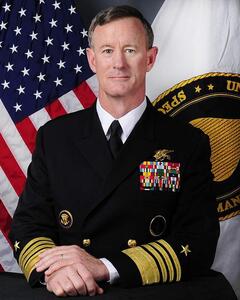
William McRaven
The only caveat I’ve got is I know we had it scheduled to go through two to three hours.
Perry
Yes.
McRaven
I’m probably not going to be able to make the full time.
Perry
OK. Well, again, we are grateful for whatever time you can offer, and we appreciate that. We all were just taken, of course, with your memoir. We’ve read Sea Stories, and I just wanted to let you know—my brother is a bit older than I, he’s a Vietnam vet [veteran], Air Force, and he’s had some health problems, so I sent it off to him a couple weeks ago. He did basic at Lackland [Air Force Base], so I said, “Be sure to pay attention to the beginning.” I said, “I think you’ll know some of those landmarks that the Admiral is talking about.”
McRaven
The funny thing about it is I went back, because I’m here in Austin, and it was 60 years ago, or almost 60 years ago, and I’m thinking, Well, your child’s mind’s eye is different, so we drove back to Lackland. I went down to where this place was. Interestingly enough, it was exactly the same as it was 60 years ago. [laughs]
Perry
Oh my goodness. Well, I don’t think my brother David’s been back probably since basic.
McRaven
The fences were still there. The Gravel Gerties [type of bunker used for nuclear weapons assembly] were still there. Everything was pretty much as I had remembered it.
Perry
Well, I’ll be sure to tell him. Spencer has some basic opening questions for people like me, who are more domestically oriented in what we study on American government. We thought we’d start with those basic questions and then move into the more technical things and the deeper dive. Spencer, it’s all yours for now.
Spencer Bakich
Terrific. Admiral McRaven, thank you very much for agreeing to take time to talk to us. This is a tremendous service. Going back to the very tail end of your career, I believe it was Secretary [Leon] Panetta who was extolling your illustrious service to the United States. He mentioned on a couple of occasions that “I can’t tell you what he’s done because it’s all classified,” which, of course, is true. But it also speaks to a difficulty that I think most Americans will have, and I’m sure a fair number of folks in the United States government have, about precisely what it is you did and the organizations that you did it through.
I was wondering if you could please explain to us what JSOC is, what Joint Special Operations Command is, compared to what United States Special Operations Command is. And if you could just give us a sense of these organizations, where they fit into the Department of Defense, chains of command, and those types of things.
McRaven
Well, as you point out, it’s classified, [laughter] so I’m going to have to be a little bit careful here. When I write my books, I have to send them through a very detailed DoD [Department of Defense] review process. It is a very painful process. I was careful in the books about—maybe I never even said the word, the Joint Special Operations Command. What I can tell you about the Joint Special Operations Command probably isn’t going to satisfy the answer to your question, Spencer, but for whoever may read this, let me give a little bit of differentiation, put it in context.
The special operations community is actually pretty broad. We have a number of different units within the overall special operations community. Nowadays there are about 72,000 men and women within the special operations community, and this includes headquarters, staffs, and then the operational units. And you have operational units like the Army Rangers that are a light infantry. We used them heavily in Iraq and Afghanistan to do basic raids; they’re exceedingly good at that. You’ve got the Army Green Berets. They also do direct action, raid sort of things, but they also spend a preponderance of their time training host nations in their own security, so they do counterinsurgency. They do security assistance, they train the trainer, they’re great in languages and these sorts of things, but, again, in the wars in Iraq and Afghanistan we certainly used them to do raids as well.
Then you’ve got the Navy SEALs [Sea, Air, and Land Teams], and the SEALs have always been a direct-action force. Of course, we come from our roots as Navy Frogmen, so prior to 9/11 [terrorist attacks] we spent a lot of time working with the big Navy, and we did all the maritime special operations that you would understand. There are levels of SEAL teams, just as there are levels of Army special operations, and the level where I commanded, we did a lot of the tracking and capturing and/or eliminating of the high-value individuals. This was part of the job that I had as a three-star [officer]—we used the term “manhunt,” and sometimes that can seem a little derogatory, as it is, but it is, in fact, what you have to do. You’ve got to identify the high-value individual. You’ve got to recon [do reconnaissance]. You’ve got to make sure that it is who you think it is. And then you’ve got to send a team in, or you’ve got to be able to conduct an airstrike to either capture or eliminate the target. So that’s what I did predominantly when I was in my three-star role as the JSOC commander. And it was unique.
In Afghanistan and Iraq, a lot of people were going after high-value individuals or medium-value individuals, but the ones that were most difficult to go after, that required the most amount of intelligence, the most interagency work, were the ones that we were generally given.
Bakich
Excellent. Then JSOC would be a component of a larger organization, SOCOM [U.S. Special Operations Command].
McRaven
Yes. Organizationally, what you have at the top is the U.S. Special Operations Command—that’s down in Tampa, Florida—and then they have a number of components. They have Naval Special Warfare Command—these are the Navy SEALs. They have the Army Special Operations Command, USASOC. They have the now MARSOC, Marine Special Operations Command. They have AFSOC, Air Force Special Operations Command. And then they have JSOC, the Joint Special Operations Command. And JSOC takes people from each of these other commands. We have helicopter pilots from the Army Special Operations Command; we have Air Force pilots from the Air Force Special Operations Command; we have Navy SEALs; and we have Navy boat drivers. All of them come together in the Joint Special Operations Command in order to do this high-value targeting.
Bakich
Terrific. And final question in this vein: the chain of command, then, would run from JSOC or SOCOM directly to the secretary of defense and then through the President, not necessarily through a combat commander in, say, CENTCOM [U.S. Central Command], or—I’m seeing a smile.
McRaven
Yes, it gets complicated. [laughter] Again, I’ll have to be a little careful how I answer this question, but there are several chains of command. For JSOC, administratively, for the most part, all of our chain of command went through U.S. Special Operations Command. And then for certain operational roles, it also went through U.S. Special Operations Command. When we were deployed overseas in support of Iraq and Afghanistan, the Joint Special Operations Command did, in fact, go through the combatant commanders. So in this case—well, actually, we went through a couple of people. We went through the local commanders—so MNFI, the Multi-National Force Iraq; or ISAF, International Security Assistance Force, Afghanistan—and/or then to the combatant commanders that were responsible for those guys, generally CENTCOM, right?
But—and this is where it gets a little complicated—depending upon the mission, if it was outside the major theaters of war, which a lot of our missions were, then I tended to go directly to the secretary of defense, ensuring that the combatant commanders were always kept in the loop, in most cases, and frankly, also the U.S. ambassadors and the State Department, everybody else. If you were going to hit a target in Somalia, for example, that generally required presidential approval. The way I would do it is, from my JSOC command, I would interface with the U.S. ambassador that was responsible for Somalia—and we didn’t have one, actually, in Somalia, so that may not be a good example. Yemen could be a better example—you interface with the U.S. ambassador; you interface with the State Department; you interface with the CIA [Central Intelligence Agency] and the chief of station. You have to get approval of the secretary of defense and the chairman [of the Joint Chiefs of Staff], but at the end of the day, you get the President’s approval.
For me, on some of these missions that were outside the major theater of war, it was directly to the secretary of defense and the chairman, and the combatant commanders were aware of it. If they didn’t support it, it didn’t happen, but generally they were supportive. But it was always the President of the United States that would have to make the decision for us to go after a target outside the major theaters of war.
Robert Strong
I have a related question. Typically, how would a President be informed of the activities? Not the high-profile ones, where there would have been lots of conversation, consultation, but your routine activities. Was that in the—?
McRaven
No.
Strong
He was not?
McRaven
No, absolutely not. When you’re fighting a war, the President can’t make every decision, so this is where you have the chain of command. All the operations we did—and there were times we were doing 20 missions a night in Iraq, going after targets, right? And we weren’t alone. This was not unique to my command. Everybody out there was going after bad guys, right? So you have a chain of command, and for me, it was in Iraq, it was MNFI, Multi-National Force Iraq. When I first got there it was George Casey [Jr.], and then it was [David] Dave Petraeus, then it was [Raymond T.] Ray Odierno, and then it was Lloyd [J.] Austin [III]. I spent a lot of time in Iraq. [laughter]
Again, I didn’t have to get every mission approved by them either. There was a routine. As a flag officer, I’m making decisions to go after targets wherever I had responsibility within Iraq. Same thing within Afghanistan. I didn’t talk to Dave Petraeus and ISAF-er [International Security Assistance Force] [Stanley A.] Stan McChrystal every time I went after a target because we were doing 10 targets a night. You have an expectation, they have an expectation, that you know what you’re doing, and they give you the latitude to do the job. If it’s outside Iraq or Afghanistan, then almost always—maybe always—I had to get the President’s approval.
Bakich
Excellent. Well, thank you for that primer. That was enlightening for me, certainly. You obviously, as you just described, spent a significant amount of time interfacing with the White House and talking to President [Barack] Obama and his chief advisors, but, of course, this wasn’t the first time that you had White House experience. I was hoping you could take a few minutes and describe your role as the director of strategy and military affairs at the White House National Security Council staff under President George W. Bush. Immediately after your accident, you roll into that White House job. What was the White House like at that time? How did you find President Bush as you are helping to develop a global strategy for combating terrorism?
McRaven
Yes, so, to your point, Spencer—I can’t remember—I think it was July of 2001 I had my accident, and then, obviously, in September of 2001 you have 9/11 [September 11 terrorist attacks]. I got a call soon thereafter. General Wayne [A.] Downing, who was a retired four-star, had been asked by President Bush to come up and establish the Office of Combating Terrorism, OCT. Downing was under the impression that he was essentially going to be running the war on terrorism. As it turned out, guys like Secretary [Donald ] Rumsfeld and others [laughs] had a different opinion about that, and they eventually won out. Nonetheless, General Downing was going to be President Bush’s advisor on the war on terrorism.
I had worked for General Downing, not directly but indirectly, several times. He heard about my accident and he wanted me to come up, and so I came up. I got there in October of 2001 to the White House. I’m a Navy captain. I’m a post–major command captain, which means I’m pretty senior. I’m probably 46 years old, I guess, but I had no experience. I’d had experience in Washington [D.C.] because I’d been in the Pentagon earlier, but I had no experience at the White House. So you get in there at a time—I mean, it’s a month after 9/11. You know that it is a historic time. You feel it. It’s tangible, the sense of urgency, the sense of anxiety, the sense of the unknown. Is today going to be another attack? We’re getting indications and warnings. And, candidly, it was an exciting place to be at that point in time.
So there weren’t a lot of military, uniformed military, on the National Security Council staff. I think there were three of us: I was in the Office of Combating Terrorism; there was a Marine in the defense issues—I forget what it was called, Office of Defense or something—a Marine colonel; and then there was a part-time guy down in Western Hemisphere who I rarely interacted with. My job when I got onboard was to start building the national strategy for combating terrorism. It was bureaucratic work, but in the course of this we were looking at the threats every day.
We would go down in the Situation Room. We would have briefings from CIA and FBI [Federal Bureau of Investigations] and the Coast Guard and all of that. At the same time that all this is going on, you get the 9/11 Commission going on. You’re looking at developing the director of national intelligence, the secretary of homeland security. All this is coming about as we are trying to also build and form this plan for combating terrorism, at the same time that we’re fighting in Afghanistan. Then, in March of 2002, we make the decision to go into Iraq.
All of that is happening while I’m in there, so it’s a very exciting time. Long hours. I would get in probably about seven o’clock in the morning and come home at nine o’clock at night, and that was generally six days a week, and I was almost always in the office on Sunday for a couple hours. But the one thing that I learned, which was really essential to me, and I don’t think I make this point well enough in the book Sea Stories, or others. Having spent two years in the White House, I understood how the process unfolded. I knew how to get the President of the United States to make decisions. I also knew what the President didn’t know from a military standpoint.
When I became the deputy JSOC commander when I left the White House—and, well, first it was Dell [L.] Dailey and then Stan McChrystal came in. As we got to certain points in time, I was able to advise General McChrystal, “Sir, let me tell you how we can get the President of the United States to make this decision.” As a three-star command, you just didn’t go to the President of the United States; that’s just not the way it generally worked.
But I also understood that the President needed our good military advice, our best military advice on certain things. I understood that the President probably would have liked to have a more direct relationship. And so, as the deputy, we didn’t do it a lot under Stan McChrystal. But when I came in as the commander, we broadened our scope, if you will, on chasing bad guys, and I knew how to engage with the White House. So my two years on the National Security Council staff was invaluable to me as both the deputy and then later the commander of JSOC.
Perry
And sir—if I may, Spencer—how did that process work? In other words, what did you see in the White House, and how to get to the President? Did you have to go through chief of staff, for example, to get into the Oval [Office]? Take us through that, if you can.
McRaven
Yes, so within the national security process you have the interagency process, and every time there is an issue—let’s say it’s a long-term issue: How do we deal with AIDS in Africa? There’s an interagency process that brings in the State Department, that brings in USAID [U.S. Agency for International Development], that brings in whoever, and they have meetings. You go from a policy planning group to a deputies committee, to a principals committee, to the National Security Council, right? There is this kind of approach you take, and every time you begin to frame the issue, it gets tighter and tighter and tighter and tighter. And then the issue is presented to the President of the United States. “Well, Mr. President, we’ve looked at AIDS in Africa, and here are the three things you think you ought to do, and here are some of the issues.”
Now let’s say it’s a faster thing: you’ve got a threat against a U.S. target someplace. Sometimes the policy planning committees don’t even meet. You go to a deputies committee, and then a principals committee, and then a National Security Council, and that can move pretty quickly if it’s a rapidly unfolding issue. If it is a real crisis, sometimes just the principals committee or the National Security Council meets. But I realize that using the video teleconference to bring in the interagency—to inform them collectively at one point in time on a particular target that I was looking at—allowed me not to have to go through a long, involved process.
So when I became the commander, if I thought there was a high-value individual in Yemen, in Somalia, in someplace, I would generally go to the chairman of the Joint Chiefs of Staff’s staff, the director of operations there, and I would say, “I want to put together an interagency video teleconference.” Normally somebody at the lower level in the White House might be involved in the first one, right? And so I would get on the video teleconference—and, again, it would be CIA and State Department, and sometimes FBI, and National Geospatial[-Intelligence Agency], everybody I needed on there, the U.S. Embassy in Yemen sort of thing. I’d get them all on, and I would make my pitch: “OK, here’s the bad guy. Here’s the intelligence we have on him. Here’s the strike we want to do. Here’s what we think’s going to happen.” And then you’d get people going, yes, no, yes, no, yes, no, “I don’t think I like this. It’s going to cause this.”
That’s fine, but I didn’t work for the State Department, and this was the thing that I think frustrated a lot of the interagency, and I can understand why. A lot of times I would say, “Thank you very much, but I’m going to push this up to the secretary of defense.” And they would say, “But we don’t agree with this.” I’d say, “I understand that, but I’m still going to push it up to the secretary of defense.” And sometimes I could go directly to the chairman or the secretary, but a lot of times I wanted to make sure, because you could win the fight but lose the battle, or lose the war, so you’ve got to make sure you keep people as collegial as possible.
Then I would elevate it to the chairman or the secretary of defense, and I would say, “I would like to take this to the President. I need a presidential approval on this.” And then what would happen is the next step might be the chairman of the Joint Chiefs. Then it would be the U.S. ambassador, the deputy director of CIA, almost a D.C.-level, deputies committee–level Zoom or video teleconference. But, once again, I didn’t work for the CIA, and I didn’t work for the State Department. So I would brief them on this, and then the chairman would say, “Well, I’m going to take this to the secretary, and he’s going to take it to the President.” A lot of times the other agencies were going, “Well, we don’t support that.” That’s fine. We’ll let the President make this decision.
The next video teleconference was generally the President or the National Security Council, and they had the opportunity to say yes. Then the secretary of state, the secretary of defense, the director of homeland security, whatever, they would be on, and I’d be briefing it again. Now the fact of the matter is, if it was something that I had time—a lot of times I’m looking at a bad guy, I’ve got days or weeks to work this, and we have an indication or warning that bad guy is going to be moving from point A to point B in a couple of weeks—then I got to the point that it was a very simple, what I called the “if-and-then approach.”
I would have a five-slide deck for the President of the United States, and that five-slide deck generally said, “Mr. President, here’s the bad guy we’re going after.” Here’s all of the intelligence, right? Here’s the way we intend to do this: it’s going to be a raid, or it’s going to be an air strike. And then I had the if and then: “If it is the bad guy we think it is, and the collateral damage is acceptable”—either zero or one, depending upon who it was—“then you’re going to authorize me to take that strike, or do that raid, when the criteria are met.”
The reason this was important for me—and it took a while for the White House to get comfortable with this, but they did, because at some point in time they trusted my judgment. They understood that, look, I’m not going to take a strike unless all the criteria are met: We’re pretty much 100 percent sure it’s the bad guy. I couldn’t always do that, and I would tell them that. Part of the if is if we’re 80 percent sure and there’s no collateral damage, then you’re going to get—so if the President said, “OK, Bill, I support that strike,” it might not happen tomorrow, it might not happen in two days, might not happen in a week. It might not even happen in a month. Now sometimes, if it went too long, I had to come back and reset the deck, so to speak.
The point was that at some point in time I have it all set up so that when all these things got aligned, then I could take the strike without having to go back to the White House and say, “OK, I got all this. Can I go now?” Because sometimes the intelligence was so fleeting that I didn’t have time to get back.
When we did this so frequently, on one occasion I called General Petraeus on a particular target, and I said, “Sir, I’ve got a two-minute time frame. I need to get the President’s approval on this in the next two minutes.” And General Petraeus called the White House, got the President on the line, said, “Bill says here’s what the target is,” da-da-da-da, and the President said, “OK, I got it, I trust him, and away you go.” That was unusual. Normally we had more time to broker the agreement, but there were occasions when all of a sudden something popped up. I hadn’t had a chance to explain to people, and we just needed to take the strike, but generally I did all the coordination so that nobody was left out of the loop.
Bakich
No, it sounds like you taught the White House interagency mission command.
McRaven
Well, it was mission command—you’re right, Spencer—but framed so that it wasn’t mission command that, Get the bad guy. It was, Get the bad guy as long as it fits in this box. I was very comfortable with that. People always said, “Wow, you’ve got the White House micromanaging you.” On the contrary, I’m micromanaging myself so that I don’t do the wrong thing and that I never, ever, ever, ever mislead the President on the risk or the pros and cons of the strike we’re going to take. As a commander, [laughs] you only get one chance to mislead the President of the United States and then you’re no longer trusted and valued, and I wasn’t going to let that happen.
Strong
I have a related question. Is there a skillset for video conference meeting that’s different than in-person meeting?
McRaven
Absolutely. It’s a great question, Bob. So the answer is yes. If you think back on [Richard] Nixon and [John F.] Kennedy—I mean, seriously—you think back, Kennedy had a charisma, a personality on a video teleconference that Nixon did not have, so you understand the framing. For example, when I was briefing the White House or anybody else, what you’re seeing now is what they saw. What they didn’t see was that behind me I had three or four of my staff members—they would bring me papers or something—but I didn’t want that. I didn’t want it to look like I wasn’t fully aware of everything that was happening, right? So there was a presentation aspect of this.
Now, again, I didn’t mislead them. They knew there were other people on the video, or on the Zoom, but what they didn’t know was, in a lot of cases, exactly who those people were, what they were doing. And you also don’t want to be like this, [moves camera further away] because then you just lose the personal connection. So, yes, I went to a lot of trouble to make sure I was framed properly, the background looked right, the lighting was right. Then people aren’t saying to themselves, I can’t quite see the guy, what’s going on, that table’s—they don’t worry about that anymore. All they worry about is the message that you’re conveying.
Perry
Were there any people in positions—the personalities, et cetera—that, through this process, you found most helpful and effective for you in getting to the result you wanted? And, likewise, you’ve already mentioned the State Department a couple of times as perhaps not always following what you wanted to do. So others who were allies and were most effective in helping you, or not, as the case may be?
McRaven
Yes, the chairman, Admiral [Michael G.] Mike Mullen, was probably my biggest advocate. Now he wasn’t always easy on me, but he was always in my corner. There were a lot of times when the State Department or the CIA or others would say, “Well, we don’t want to take this to the President.” Mullen would say, [laughs] in his own sort of style, “Well, thank you very much, but I think the secretary wants to take this to the President, and we’re going to take it to the President.” And sometimes they would say, “Well, you can’t take that to the President. We have a Department of Defense chain of command, and we’re going to use it.” After a while they stopped trying to fight Admiral Mullen on it. So I would say Admiral Mullen was my best. Inside the White House, John [O.] Brennan and Denis [R.] McDonough. So John Brennan, I forget what his title was at the time. He was—
Perry
Counterterrorism and homeland security.
McRaven
Yes, he was a counterterrorism guy.
Perry
Yes, in the White House.
McRaven
I don’t know what his exact title was. John Brennan was exceedingly helpful, and he really was my go-to guy. Denis McDonough started off as the deputy chief of staff and then became the chief of staff, and he was very, very helpful. I will tell you, Secretary [Robert] Gates was always very helpful, but mainly I worked through the chairman, who talked to the secretary. But then Secretary Gates would always be there for any of the discussions.
Strong
So there’s a chain for getting to the right level to get a decision to approve an operation. Is there also a set of routine meetings after operation to keep people informed about how it went and what is going on?
McRaven
Yes. Again, good question, Bob. Certainly within my staff, we did extensive postoperation briefs. Generally, for the interagency, again, because these were happening—“routinely” may not be the right word, but they were routine enough that we’d send out a message afterwards saying, “OK, this was the target, this was the bad guy, here’s what the strike did, here’s what the collateral damage was, and here’s what we expect.” It was generally a fairly short message, but, frankly, we tended to move on to who the next target was.
Now if there was some blowback from it, which a lot of times there was—if we hit a target in Yemen, the Houthis got upset, or Yemen and al-Qaeda got upset, or the Yemenis got upset—the State Department would generally send out a cable saying, “OK, the president of Yemen is really upset because five civilians were inadvertently killed in the strike, and he’s having to deal with it.” OK, but the president of Yemen always understood when we were doing these strikes. We kept Yemen, or wherever we would do them—the U.S. ambassador always made sure the president of the country was aware of these.
Bakich
So, mindful of your time, I’d like, if we could, to spend a little bit of time in Iraq, in Balad, where you are the deputy commander of JSOC, working closely with General McChrystal. What transpires in the course of those years is a significant military innovation, right? And that is the fusion of special operations with intelligence with the regular industrial Army, such as it is, and a whole host of other folks downrange, or in theater.
General McChrystal wrote in his memoir that you were instrumental in the development of those concepts, but the literature out there doesn’t necessarily speak to exactly what role you played, or your relationship with General McChrystal. I was hoping that perhaps you could give us an insight into how this significant development in the way the United States uses military force came about.
McRaven
Yes, it came about probably more organically than it would appear. The moment that I remember, Stan McChrystal and I were in Qatar. We had a small command center that we had set up there in Doha, at Al Udeid [Air Force Base]. We’re in there one day, and it is relatively early in his command tour.
Again, I go back to my time in the White House and understanding the interagency process. At some point in time what I told him was, “Hey, look, what we need is a Joint Interagency Task Force, a JIATF.” And he said, “OK, explain this to me.” I said, “Well, think of it as a mini-interagency group, so we’ll have somebody from the CIA, somebody from the FBI, somebody from the National Geospatial[-Intelligence] Agency. We’ll pull all these people together. They will also be liaisons out to their parent organizations, but this JIATF will allow us to bring in all the intelligence, all the information we need.” And also, as part of the JIATF, we had conventional liaisons in there.
Again, instead of us just being JSOC, Army, Navy, Air Force, Marines, looking at the bad guys, what we said was, yes, we’re going to have all of the colors of the rainbow on the special operations side, but now we’re going to include the interagency, now we’re going to include our conventional partners, and later on we’re going to include our allies. So at some point in time, the JIATF—and it took years to develop this—got to the point where it was large, but it was very inclusive. It gave us different perspectives on things, and we were always in a position where we could reach out to all the agencies so that nobody was ever in the dark; everybody understood what we were doing. And we also got to the point where we could move an issue very, very quickly.
Back to the video teleconferences, whenever I was getting ready to brief the President, I knew what everybody’s decision was going to be. I was never going to put myself in a position when the President went around the virtual room and said, “Well, Mr. and Mrs. Ambassador from Yemen, what’s your position?” I knew what their position was, or I wasn’t going to have that video. [laughs] And the ambassador always had the trump card. So part of this JIATF was we always had somebody from the State Department that would reach out to the U.S. Ambassador’s office in Yemen, or wherever it happened to be, and they would say, “OK, what is the ambassador’s position?” And if the ambassador’s position was no, well, then I was going to call the ambassador. So the JIATF really was the interagency brought into a combat element.
And then, back to your point, Spencer, we also brought in the conventional forces over time so that they understood where we were operating, why we were operating, what we were doing. I tried to give these people—particularly in Afghanistan, the battlespace owners, the conventional forces—I wanted them to have a vote. They needed to have a vote in how we were operating in their area because they knew their area, candidly, better than we did. And there were a lot of times I said, “Well, look, there’s a bad guy here outside Kandahar,” and you’d go down to the battlespace owner. He’d go, “Yeah, yeah, yeah, yeah, but if you kill that guy right now I’m going to have a lot of difficult days ahead. Please don’t kill him right now.” OK. That’s good. I need to know that.
This meeting in Doha—and I’m guessing it was sometime in the summer of 2004—but it took us a while, because I remember after that one, we didn’t have very good video teleconference capabilities, and it was frustrating. It’s hard to believe now, as we all live in the world of Zoom. But I would say every time we’d pull together a video teleconference, half of them would crash because we didn’t have the bandwidth, we didn’t have the connections. At one point in time Stan got so frustrated, I said, “Sir, I got this. I’m going to fix this problem.” I had an Air Force colonel that was our guy in charge of communications. I said, “I don’t care what it costs. I want this fixed. I want it fixed now. If it costs us $100 million, let’s do it.” And so with a blank checkbook, we went out and built a network that allowed us, more so than anybody else in the federal government, now to reach out to nodes worldwide. It took us several months to get all this up and running again, but rarely after that did we have a Zoom crash on us. And Stan, and then later, me—we commanded that away. At one point in time, I was having six video teleconferences a day to command troops all around the world.
But it all started in Qatar, with this concept of a JIATF. Stan had to go to the CIA and say, “Hey, I need some of your folks,” and CIA was like, “Eh, I don’t know.” And to the FBI, “Look, I need some of your folks.” “Eh, I don’t know.” But then he did his arm twisting, and eventually, of course, they started showing up. And then they realized that the JIATF was where they wanted to be, so then what happened was everybody wanted to be in the JIATF, right? And so the JIATF really was an organization—it reported to the J3. So if you understand our—and I know you do—but from the standpoint of a military organization, you’ve got the commander and the deputy commander. Then you’ve got J1 is admin [administration], J2 is intel [intelligence], J3 is ops [operations], J4 is logistics, J5 is plans, J6 is comms [communications], J7, 8, 9, that sort of thing. So the JIATF was really the ministaff that would report to the J3 that then would report to the commander.
Bakich
Fantastic.
Perry
Just a technical question: all of those video conferences, were they all recorded at the time?
McRaven
No.
Perry
None of them? None recorded?
McRaven
No.
Perry
And memcons [memorandums of conversations], would there be any records of them?
McRaven
No. We were doing so many of them, it just—we didn’t record them, probably for a lot of good reasons, [laughs] but we didn’t have the time to do a memo on everyone. What you would find if you went back in the records, at some point in time somebody would probably reference it: “Remember, the commander said on this date that we were going to do this.” But no, not what you would think of in terms of a detailed—like you have in the White House, where all the statements of records and that sort of thing are.
Strong
I had a broader question. You’re good at that kind of coordination if you know how the White House works. You’re good at that coordination if you have decent technology, right?
McRaven
Right.
Strong
What are the human qualities that make people good at that kind of relationship?
McRaven
Yes, I think it’s the same human qualities that make people good at any other kind of relationship. If you’re a jerk in person, you’re probably going to be a jerk on the video teleconference, and then people aren’t going to want to deal with you. I saw that a lot. We had some folks that didn’t want to be on the video teleconference. I would call these VTCs, as we referred to them. I called them all the time, and unfortunately we worked on what was referred to as Zulu time [military time zone], Greenwich mean time. So recognizing that I’ve got forces all around the world, when we would send out an email, it would be, “OK, we’re doing this at 16:00 Z.” It wasn’t, “Well, we’re going to do it at 16:00 East Coast, and this is what it’s going to be on Central time.” Everybody understood. They had a clock in every office that said Zulu time. Now if you’re in Kathmandu [Nepal], 16:00 Zulu for you could be three o’clock in the morning, or it could be one o’clock in the afternoon. But that was important for us.
So back to your question, Bob. Every once in a while when I’d call a video teleconference—and for some of these ambassadors or chiefs of station it’d be like three o’clock in the morning—they’d get on, and they’d be snappy, and they’d be hacked off that they had to be there, and Who cares about this? sort of thing. And this translates, as it does in any human relationship, you’re like, Eh, this guy’s a jerk. [laughs] I’m sure he said the same thing about me. But once again, there is a way to convey your appreciation, your sincerity, your confidence, your command personality. You’ve got to be able to convey that across a virtual network. If you can’t, if you look like you don’t know what’s happening, if you look like you’re drifting off, then that affects people on the video teleconference.
Strong
I was interested, in part, because people who study the National Security Council staff say that that deputies level is very important—
McRaven
Right.
Strong
—and that it worked better under Bob Gates and the George H. W. Bush team than it did under almost anybody else that they can name or think of. And I’m curious: he couldn’t have been a jerk. [laughs] He must have been able to do that work unusually well. What is it that makes that possible?
McRaven
Well, I’ll give you another couple of examples. When we finally got the video teleconferences working well, Stan McChrystal—let’s just say he’s not always the friendliest person on camera. He is the general, he’s in charge, and everybody better be paying attention, right? Well, as we would go around the virtual room, the first couple of times we did it, Stan would go out there, “So, Yemen, what do you got for me today?” “Hey, sir, nothing to report today.” Well, one person did that one time, and Stan said, “Let me get this straight: you’re in Yemen, where we got al-Qaeda in Yemen, we got the Houthi, and you’ve got nothing to report? So why are you there?” And then he would rip them apart. [laughter] And guess what—after that, everybody had something to report, right?
There were a couple of times—and it wasn’t just the military guys. I remember one video teleconference in particular, sometime early on—and I guess it still happens today but not as much—the camera would focus on who’s talking. But if you had a hot mic, even though you might have had 40 or 50 stations onboard, it would all of a sudden zoom over and you’d catch people in a room in CIA or State Department. I remember at one point in time, one of our analysts is briefing, and for whatever reason somebody—I think it was in either State or CIA—the camera slewed to them, and they clearly weren’t paying attention. They’re yapping, and they’re talking back and forth, they’re eating, they’re not looking at the analyst at all. And Stan just ripped them apart: “Do you know how much trouble these analysts go through? Do you know—?” And they were like, Whoa! They didn’t know they were on camera.
What you found after that was every time people walked into a room, if there was a camera, you better be ready to, one, answer; you better be paying attention. So Stan set the tenor for video teleconferences. When I came, my personality’s not at all like Stan’s, but we had already established the rules, and the rules were that you’re going to have something to say and you’re going to pay attention. Now every once in a while that didn’t happen. My approach was a little different. I would send somebody an email, point to point, and say, “Hey, I need you to be paying attention. You’re representing your agency, and this analyst is working hard. I saw you on the video and you were eating a hamburger and not paying attention. Can’t have that.” And they were generally pretty receptive to that. But it was because Stan had, once again, set the tempo for how this was going to go.
Bakich
And, of course, the effect of all of these procedures and the structures that you’re setting up allows your teams, both in Iraq and Afghanistan but also worldwide, to operate raids at an astonishing level of—yes, an op tempo that’s incredible. The turnaround time on process intelligence is phenomenal. I’m curious: at what point—and it certainly, I’m sure, happened under McChrystal’s command—did you personally feel, We’ve got this, we’ve got a system that is phenomenal and combat effective?
McRaven
Well, we always had a system that was combat effective, but, of course, the enemy becomes more complex. When we started this thing, back to the JIATF, we were initially focused only on Afghanistan, and then it was Afghanistan and Iraq, and then we took on a worldwide approach to this. Much of the credit for this, of course, goes to Stan and his ability to build out the JIATF, his personal relationships. I think Stan probably went to the White House maybe once or twice in his five years as a JSOC commander because we were fighting down, if you will, in Iraq and Afghanistan. Stan was doing major operations in Iraq, then major operations in Afghanistan. So the way we worked it is if Stan was in Iraq, I was in Afghanistan; if Stan was in Afghanistan, I was in Iraq. We had another officer, Dave Scott, who would spell me. There were three of us, and we would just rotate between one theater or the next. I could literally be in Iraq one day and then hop on a C-130 [military transport aircraft], go down to Al Udeid [Air Base, Qatar], fly to Afghanistan, and then I would take over Afghanistan. Because we had this virtual setup, I could hit the ground in Afghanistan and be running again.
In terms of the combat effectiveness—back to your very initial question, Spencer—on bringing together not just the JIATF, but it was everything. The battle rhythm was our schedule, but in that battle rhythm, you didn’t violate it. It is what allowed our process to work—it was the convergence of the intelligence and the operations. And when I say the intelligence, also the work that was done in our detention facilities that generated some of that intelligence. It was the interagency process. All of this was lined up, but it took several years.
Now when I came in as the JSOC commander—I was the deputy for three years, then I went to SOCEUR [Special Operations Command Europe] in Germany for two years, but I still stayed in touch with what was going on at JSOC. I actually went out to Afghanistan once or twice when I was the SOCEUR commander and spent time with the JSOC folks, not knowing I was going to be the JSOC commander. I was able to stay in touch during those two years’ time as well. When I came back in as a JSOC commander in 2008—we had still done, and Stan had done, a number of things outside Iraq and Afghanistan, so I don’t want to leave you with that impression—but we began to really grow the scope of what we were doing, and that really just continued to refine the process.
When I came in 2008 we had a hell of a great process. And, again, I give Stan McChrystal all the credit for pulling that together. It continued to evolve in the three years I was there. By the time we got to the [Osama] bin Laden raid—and it was very fortuitous in this regard—we were hitting on all cylinders across the globe. There wasn’t any area where I thought, We need to work on that. We had this process down pretty much pat by the time 2010 rolls in and I get notified about bin Laden.
Strong
Was there ever a study done about what difference you were making? You were clearly a larger operation. You were successful at going after more targets. Did anybody stop and ask what difference that was making?
McRaven
Yes, we were always looking at the data. In a couple of years we hit 2,000 targets and pulled 2,000 guys off the battlefield, that sort of thing, but we weren’t naive enough to think that that was making a difference. We had a responsibility for taking these guys out, capturing them or killing them. And, of course, every time you took out a senior leader, there was always somebody that would come up, but they wouldn’t be as experienced. We found it generally took about 18 months for whoever was the replacement to get into the point where they were just as effective. But what you were trying to determine was, OK, that’s great, we’re killing people faster and faster and faster and faster and faster—so what? Are things better in Iraq? Are things better in Afghanistan?
What we were trying to do—Afghanistan may be the best example—once again, we’re working with the Green Berets that weren’t part of JSOC. We’re working with the battlespace owners. If you think about counterinsurgency, you have an area—let’s say you have a village here in the middle, and the Taliban are constantly coming in, they’re threatening the elders, they’re killing people, and now you’ve got to create a security zone around it, right? And you want to take—and it’s an old way, they refer to it as the “ink spots.” It’s how you fight an insurgency: you start with one village, you got another village over here, you got another village over here, now you’ve got to connect the ink spots. Well, you do this by killing the bad guys that are creating the problem, and then it allows the ink spot to grow, the good piece to grow. You do that at this village and this village, and before long you’ve connected them. Then you connect the villages to the districts, the districts to the province, the province to the central government. That’s the theory.
So if we were out killing bad guys in a particular part of Iraq or Afghanistan but we’re still not enabling the good guys to be the good guys—you’re not enabling more power to come into the homes in Baghdad, more food to get to the locals, more markets to be safe—then you’re just killing people. You had to look at it holistically, and we did. Actually, Dave Petraeus was probably the best at that. Stan was great in Afghanistan as well. All the commanders—and, again, I worked for a lot of commanders in Afghanistan, starting with Dan [K.] McNeill, then [David D.] Dave McKiernan, then Stan, and then Dave Petraeus—all of them looked at it from a strategic standpoint.
Iraq might be easier to understand. Every week I would go down and meet with whoever the MNFI commander was, and we were always looking at things like how much electricity were the folks in Baghdad getting. That was always a key indicator because if we could give them electricity, they could get back to a more normal life, which was important for us. But al-Qaeda was always blowing down the power lines, right? They were always blowing down the cell-phone towers. So a lot of times they [the commander] would be like, “Find out who this guy is that’s in charge of blowing down the cellphone towers so that we can make sure they get cell service.” Well, that became our job. So we would track down the cell-phone bad guy, get him off the battlefield, take down the power bad guy, and then you could see the effect it was having.
I was always careful about saying, That’s great, we killed another hundred bad guys. So what? What is the “so what” of this? We thought—and I think this was a strength of JSOC, and it’s a strength of all commands that do this well—look at this strategically. Tactical changes make a difference, but you really want to see whether or not those tactical changes are making a strategic impact on the fight. And so we were evaluating this all the time, Bob.
Strong
OK.
Bakich
You’ve offered a nice segue into 2009. You are JSOC commander. In September of 2009, President Obama begins the Afghan surge debate. What’s the nature of the strategy that we’re going to adopt, the force proposals, increases that the President is going to consider? If I can boil down an extremely complex debate to a couple of points, General McChrystal would like a 40,000-troop increase to do fully resourced counterinsurgency. Others weren’t so keen on that. Vice President [Joseph R.] Biden [Jr.] wanted something on the order of 20,000 with a counterterrorism focus. First question: Were you at all involved in that debate? And secondly, did you have any opinions on how that was unfolding?
McRaven
So, no, I was not involved in the debate, and, no, I really didn’t have any opinions on it. That sounds [laughs] maybe a little myopic, but the fact of the matter is I had a job to do, and my job was to do whatever Stan McChrystal or Dave Petraeus told me to do, whatever the President told me to do. I knew what my job was in Iraq and Afghanistan: it was to chase down and get high-value targets. And so if you were going to bring in 40,000 guys, great; 20,000 guys, great. Personally, it’s not that I didn’t care, but it wasn’t going to affect how I did my mission.
Bakich
Sure, sure.
Perry
I was just going to ask, sir—I mentioned my brother is a Vietnam veteran. You had your job to do, but at any point did you think about what’s happening among the American people, in the 2004 presidential race, 2006, the midterms, and there are people getting ready for the 2008? Did you ever worry that these endless wars could turn into “Vietnams” and the impact that would have on the military and, in the end, on your job and your duty?
McRaven
This probably sounds fairly shallow, but no, I didn’t. I didn’t worry about the midterms. What I did worry about was my forces. My guys have been fighting since 2001, and so by 2009 these guys had been in combat for eight straight years, and I was absolutely worried about that. I actually became more worried about it when I was a SOCOM commander, but even as the JSOC commander and the JSOC deputy. As the deputy it wasn’t so bad because the first couple years guys are fired up, but now I come back in 2008 to take JSOC and I could see the strain on the force. So I was pretty adamant about how we were going to now start deploying our guys. I gave them a little bit more time off back home. I wanted to make sure that they got the care that they needed when guys were wounded or when they were stressed out. I did care about that. In terms of what the American people were thinking and was this going to be the Vietnam War, no, I was a little too shallow, I guess, to worry about that.
Strong
Or busy. [laughter]
Bakich
Yes, I was going to say busy. I would like us to begin to transition, if we could, to the bin Laden raid, but before we do that I want to give Bob the opportunity—he’s got several questions about your impressions of President Obama as commander in chief. Bob, if you’ve got a line that you’d like to run with, please do so.
Strong
Sure. I’m assuming that that’s the period of time you have the most direct contact with a President.
McRaven
It is.
Strong
And particularly President Obama. There’s a lot of things I want to explore in that. Let me just start with this observation: 10 years after the bin Laden raid, you were on a stage with Obama. Thinking back on those events, I think you said then that Obama behaved as if he had actual military experience, or his leadership style resembled what you had become accustomed to in your military career. I’m curious what told you that he had that kind of style and where it might have come from.
McRaven
[laughs] Well, I’m not sure I can tell you where it came from, but I can tell you he had the level of confidence. Once again, when you’re a great leader, you walk into a room, you kind of command the room. Doesn’t mean you have to be loud and boisterous—that was not his style—but he had a level of confidence about him. And I can’t remember, candidly, when I first met him. I just don’t remember, so I wouldn’t be able to give you a good chronology of when I first met him—it just kind of happened. But I do remember one of my very first meetings with him on the bin Laden raid. When he came in, he’d just sit down in the Situation Room, and I’m sitting at the President’s desk. Obviously, he’s tall. He’s got a commanding appearance about him. Back to your earlier question, Bob, about presence, he’s got a deep voice. All of these things lend to a sense of confidence in the individual. He never seemed to be flustered when people had differences of opinion. He welcomed those differences of opinion, which is what I think good military leaders do. Hey, I got a plan. What do you think? And it’s OK to tell the emperor he doesn’t have any clothes if you think that’s the case. President Obama welcomed that sort of—
He just had a sense about him that you see, as I used to see, in great military leaders: confident, with a bit of a swagger, but not cocky; good personality. A lot of people have this “no drama Obama” thing going, but I found he always had a great sense of humor, and he was very personable when he was around you one on one. And frankly, and maybe it was just my sense, but I’m a big basketball guy, and I knew Obama was a big basketball guy, and so he’s a sports guy. Back to your point about what leads to this, and this may be a terribly either chauvinistic or myopic approach to this—you think about people that are sports people, if they have been in positions where they’re the quarterback or the point guard, or they’re in a position where they’re leading a sports team. That gives you a level of confidence.
I would offer, when I look back on my life from the time I was small, growing up, but when I finally hit my growth spurt, I was always the quarterback. I was always the guy leading the basketball team. I was always the guy that people looked to on a sports field, and that gave me the confidence then to lead SEALs at a platoon level, et cetera. And I think that has a lot to do with President Obama’s upbringing. When you’re a sports guy, and you played sports, and you’re good at it, it gives you a level of confidence, and that conveyed itself in the Situation Room.
Perry
Could I combine, then, sir, your concern about the troops—soldiers, sailors, airmen, Marines, et cetera—with Bob’s question and what you just answered? And that is, President Obama at Bagram [Airfield, Afghanistan] in 2010—I’ll jump a little bit ahead, and then we’ll come back to the bin Laden raid—but going to Fort Campbell [Kentucky] and meeting with those people, what did you see? Because sometimes we would read or even hear people say, maybe just because they had political differences with Obama, but, Oh, he never served, and he doesn’t understand, and he’s an empty suit. What did you see with him at the grassroots, with those people who were carrying out his orders and your orders?
McRaven
Yes, Barbara, your point is well taken, which is these people don’t know the presidents, and so there’s always a political difference. If they’re a young conservative soldier, then they think [William J.] Bill Clinton and Obama and anybody else in that position is really just a suit, really doesn’t understand because they didn’t serve, et cetera. But what I saw, frankly, wherever I went with him—Fort Campbell was before this, but at Fort Campbell I actually had them edit the film that we did because I got very emotional. Frankly, I was speechless for a couple of minutes because I was reflecting back.
When we got to Fort Campbell—one, right after the bin Laden raid. And I can’t remember who it was, it was either the vice president or the chief of staff came to me in the Situation Room—I was hanging around, I forget exactly what—and he says, “Well, the President wants to go down to Norfolk, Virginia, to see the SEALs and thank them.” I said, “Sir, let me offer something different. I would rather have him go to Fort Campbell and talk to the great soldiers that are the helicopter pilots that flew the SEALs in, because they’re not going to get the kind of pat on the back that the SEALs will. And oh, by the way, at Fort Campbell is 101st [Airborne Division]. These guys have been sacrificing for a long time.” So they agreed with my recommendation to go to Fort Campbell.
But when we got to Fort Campbell, I had all the team that had been involved in the bin Laden raid. We were in a separate area. The President was just great with these guys, but that was a small setting. Then we drive over to the 101st, and I had coordinated this with—the 101st commander was actually gone, but the deputy was there, [Jeffrey N.] Jeff Colt. He had set up in a big hangar, and there were probably 600 soldiers in this hangar. The intent was the President was going to get up, shake hands with a couple of the senior leaders, the sergeant major, and the commander, and he was going to say some words, and then he was going to depart.
So he gets up, and they’ve got a stage set up, and all the soldiers are there. Actually the vice president spoke first and then the President gets up and, off the cuff because he is a good public speaker—he’s good extemporaneously—really thanks the 101st for the work they did. And then he steps offstage, and I can’t remember exactly how the stage was set up, but there’s a bit of a rope line and he starts shaking hands with one of the soldiers down there. And then all of a sudden the soldiers start lining up to shake hands with the President. I’m thinking to myself, You’ve got to be kidding me. There’s 600 soldiers here.
So the President starts shaking hands, and he’s talking to every one of them, and, of course, he’s got that great smile and that sense of confidence. As this is going on—I think it was [William] Bill Daley who was chief of staff—I come over to the chief and I said, “Hey, sir, the President will be here for hours. We need to—” And he goes, “I don’t think you’re going to talk him out of it.”
So as I’m watching this, the word gets out on the base at Fort Campbell that the President is shaking hands, and then all of a sudden people begin to line up. They come from everywhere else on the fort, and they line up outside the hangar. Well, we’re about half an hour into this, and we’re already half an hour behind schedule, so I pull up next to the President, and I said to him, “Mr. President, you’re going to be here for another hour or so. If you want to step aside, it’ll be OK.” And he looks at me and he goes, “Bill, I want to thank ’em.” Yes. He said, “This is part of my job. It’s part of my opportunity to thank these soldiers. I don’t care if we’re here for another two hours,” [laughs] and I think we were there for another two hours. He shook hands with every single soldier.
You would see this with President [George W.] Bush as well. Of course, there was always this feeling that Bush had this connection with the soldiers, more so than Obama did, and that may have been true from the standpoint of just the nature of politics—young soldiers are generally more conservative, they’re from the South. But I will tell you, once you got in front of the President [Obama], and you had a chance to shake hands, and you had a chance to see him, the soldiers were mesmerized by him. I don’t know how long we were there, but he shook every single hand in that hangar and seemed to be happy doing it the whole time. Again, we were so far off schedule, but he didn’t care. To me, that was a great indication of (1) the soldiers’ appreciation and (2) his appreciation for them.
Perry
Thank you.
Bakich
That’s fantastic. Bob, do you have anything more you’d like—
Strong
I have a lot more questions. [laughs] Here’s a general one. The story of the deliberations connected to the bin Laden raid has been told—a lot of memoirs, a lot of journalists have worked on it. In your judgment, what’s the percentage of that story that’s now known to the public and what’s not yet told, either because it’s classified or because there are too many personal perspectives? How much do we not know about that?
McRaven
Yes, I think you know most of it by now. There’s very little that has been left out. I know [Christopher] Chris Wallace had great access, and, of course, to your point, Bob, you’ve gotten perspectives from other people that were in there, from Bob Gates and Leon Panetta, et cetera. There are one or two things that remain highly classified but really have no bearing on any of the decision aspects of this. I think it’s pretty much all out there.
Strong
And is the story fair to the participants, or are any of them misunderstood by the public?
McRaven
Misunderstood by the public? The accounts I’ve read—and, frankly, I haven’t read all the accounts, because I was there. I didn’t really [laughs] feel like I had to read everybody’s accounts. The ones I have read, yes, I think they fairly characterized what happened in the Situation Room, they fairly characterized the President’s decisions, and they fairly characterized the personalities. I didn’t see anything where I went, Ooh, I didn’t think that was right. I think they were pretty spot on.
Bakich
One of the things that struck me—and perhaps after our conversation so far, I shouldn’t be struck anymore—was the willingness on the part of CIA, both Panetta and [Michael] Morell, to suggest that the raid was not in the wheelhouse of CIA Special Activity Division. I found that to be an amazingly disciplined recommendation, a void of “turf,” a void of all of the types of things that you would expect a large bureaucratic entity to do. I am assuming at this point that part of the reason is because of the trust that had developed between the agency and you folks, but perhaps there’s more to it than that. I was wondering if you could comment on that.
McRaven
Yes, and again, I give Leon Panetta tremendous credit for everything that happened in the bin Laden raid. The President obviously had to make all the tough decisions, but had it not been for Leon Panetta, I’m not sure which direction this would have taken. And to your point, Spencer, this could have been the greatest operation in the history of the CIA. They had all the intelligence. They did have guys that were prepared to go in and do a snatch-and-grab. But in one of the books I wrote, it may have been the last one here, I talk about the first time I went in to meet with Director Panetta. I can’t really remember what year it was, but I go in and I’m the JSOC commander. He’s got all of his senior officers in his office there. And so I come up to him, and the first thing he says is, “Oh, call me Leon.” I said, “Well, that’s not going to happen. [laughter] You’re the director of CIA. I’m just a three-star.” And he kind of laughs, and we laughed about it. There are about 10 or 12 of his senior officers in the room, and he starts to introduce me to each one of these officers. Of course, “How are you? How are you? How are you?” And finally, as we go around this, one of them gets up enough courage and says, “Director Panetta, we all know Bill. [laughs] We’ve all been working with—” “I was with him in Yemen.” “I was with him in Afghanistan.” “I was with him in Iraq.” I knew all these guys exceedingly well. I didn’t get along with all of them exceedingly well—there were a couple of them that I had a lot of personal conflicts with—but they were all very professional. And, actually, it was the guy that I probably have the most personal clashes with that ended up being my strongest advocate when it came time for the raid.
But to your point, this was about, look, we had built up a relationship since 2001, or 2003 in my case. Now this is probably 2009 when I have a chance to meet Leon for the first time, but they knew we were good. We had built the trust with the CIA, so that’s part one. Part two was Leon Panetta just has this gregarious personality that makes you want to like him, and he doesn’t really seem to have an ego when it comes to getting the job done.
Of course, they did have a plan for their guys to go do this. I think I wrote this maybe in Sea Stories. There was a young former Army captain who was the guy in charge of their portion of the raid, and I had been working with him, and I had one guy. I wasn’t allowed to have any more, so it was me and one other guy, and I had put him at CIA. I said, “Here’s the deal. I do not, do not, want this to be looking like, Hey, we’re the pros from Dover. We’re coming in here to do the job. This is too important.” I said, “If the CIA can do this job better than we can, then I want the CIA to do this job. So don’t you ever, ever make any implication that their plan is not as good. We want to help them in every way we can.”
And so as this young Army captain, former Army captain, began to develop his plan. We were trying to help them through this, but at some point in time, to your point, I think the senior leaders at CIA realized that their force was just not going to be able to pull this off. Panetta calls me into the office one day and says, “Look, I really think we need you guys to do this.” And I said, “Sir, look, we’re here to help, but I don’t want to be seen as the guy that came in and took—” He says, “No, no. I’m the guy making this decision, and we want you to come in and do this.” I said, “OK.”
But here was the thing: I went and talked to this young Army captain—and I told Panetta this later—this was going to be the mission of his lifetime. This would be something he would be able to tell his kids and grandkids about, and all of a sudden we just pulled the rug out from under him and took over the mission. Instead of whining and complaining or just feeling like he’d been screwed over, he said, “Sir, I got it. What can we do to help?” It was remarkable. It was just a level of professionalism and maturity that I’m not sure I would have had, had I been in his shoes. When all of a sudden you’re about to go play the Super Bowl of commando operations and now you’re told, Hey, you’re sitting on the bench, he was just terrific. So I made sure, after all this was said and done, that Leon Panetta took the opportunity to recognize him.
But that’s a long way of telling the story that the CIA throughout all this was incredibly professional, and they did put aside whatever organizational concerns they might’ve had to do what was right for the country, and I put that squarely on Leon Panetta.
Bakich
Go ahead, Barbara.
Perry
On the same topic, leading up to the bin Laden raid, Bob had a great question on historical parallel. Do you want to go ahead and offer that, Bob?
Strong
Well, I was just curious. It’s different than many foreign policy decisions in that you have a block of time when Congress isn’t interfering, there’s no public knowledge, you can actually change your mind about something along the way. Is this like the Cuban Missile Crisis? Is it like the unusual form of decision-making where time, camaraderie, the importance of what you’re doing, makes it distinctive from the usual chaos of foreign policy?
McRaven
Yes, I think the difference is this was a military-slash-intelligence operation. As the commander in chief, he does not have an obligation to notify Congress. Congress has given him the authority to conduct operations to protect the American people. So I think the short answer to your question is no. I don’t think this was unique because it was within the authority of the President of the United States, and therefore all the Congress and the press and whatever else might have interfered with his decision process, it didn’t come into play. We were all wanting to do what was right for the country, we knew who the guy in charge was, and we were confident in the guy in charge.
We went through a process to get to the point where the raid was what we all agreed upon—or we didn’t all agree upon it, but it was agreed upon—and everybody wanted this to turn out well. There was no petty squabbling, nobody saying, Well, I didn’t get my option approved so I’m not happy. I didn’t see any of that. Now, there may have been some of that behind the scenes, but, remember, [laughs] I’m the junior guy in the Situation Room. But I never sensed that, and everybody was, needless to say, exceedingly happy when the raid went well.
Strong
But hardly any of the decisions you worked on went to that level and spent as much time at that level. Is that fair?
McRaven
No, it’s not fair.
Strong
It’s not, OK.
McRaven
Well, I’ll qualify that a little bit. At no time did I ever have that many engagements with the President, with the rehearsals and all—so I guess that is fair, Bob, in terms of the length of time. In terms of the process, where, OK, I got a bad guy here, and we went through the process and it didn’t happen the next day—it sometimes didn’t happen for months. I would engage with the White House periodically, and then finally, again, the if-and-then thing would come into play and we’d go. But what we didn’t do was, I didn’t have to do a full dress rehearsal for the President and the national security team. I didn’t have to constantly be over at CIA. So to answer your question, yes, this was unique in that regard, but I didn’t feel like it was dramatically more unique than the other things I had done. I was perfectly comfortable in the setting, I guess is what I’m saying.
Bakich
If I could, really quickly, you spoke at length about then-Director Panetta. I’d like to ask you for your thoughts about Secretary Gates. I originally had planned to ask you a question about when did you feel that JSOC, and special operations more broadly, had evolved fully from Desert One [failed Operation Eagle Claw to rescue American hostages in Iran in 1980]? I haven’t asked that question because it sounds irrelevant. However, Secretary Gates is in a prime position to see the evolution of special operations. He knows precisely how effective you folks are.
McRaven
Right.
Bakich
And yet when it comes to his advice to the President, Desert One is looming extremely large in his mind. Now you’re not Bob Gates, so I’m not asking you to tell me what he was thinking, but do you have any insight, any perspectives on that?
McRaven
Yes, absolutely, and I do know what he was thinking. [laughter]
Bakich
Oh, great, OK.
McRaven
He talked about it. This is where I said Secretary Gates was always supportive of me and the missions that we conducted. Once again, the stars aligned so nicely for the bin Laden raid in terms of the fact that this was not the first time I’d worked with the President. It was not the first time I’d worked with the White House, not the first time I’d worked with Hillary [Rodham] Clinton or Bob Gates. We all knew each other; we didn’t just come together all of a sudden. JSOC was probably at its peak at that point in time. It really was. I had done thousands of missions. I’d been the deputy commander. There wasn’t anything about this mission that was beyond the scope of what I was capable of understanding and doing. My force—this was not a tactically challenging mission, necessarily, so everything was aligned.
But at one point in time—and, again, Gates has been pretty open about this, and I’ve told the other side of the story—every time the President would go around the room and say, “OK, who’s in favor of the raid?” Gates would say, “I’m not in favor of it.” He said, “I lived through Desert One. I was in the White House during Desert One, and I remember the planning that went into that, and it failed, and we had to live with that.” So the idea that a helicopter would come in and crash and all, it bothered him.
So after one of the times, and I can’t remember which meeting it was, we come out of the Situation Room. I pulled the secretary aside, and I said, “Mr. Secretary, I work for you. [laughter] You don’t want me to present the raid, I’ll back out of it.” And he said to me—and I think this is the great courage and the great leadership of Bob Gates—“No, Bill. The President needs all the options on the table. I don’t agree with this option, but I’m not going to stand in the way of you presenting it. I want you to present it as best you can. I want you to give him the best option you can, even if I disagree with it.” And that, again, says a lot about Bob Gates and his approach to decision-making and leadership. It gave me a feeling like, OK, the boss has said I can go forward.
One of the things I’d qualify—I was telling someone this the other day—I never advocated for the raid. I didn’t want to be a cheerleader for the raid. In every meeting with the President, I was going to give him the facts, and just the facts. I wanted him to know all the risks. I wasn’t going to shade any of the risks. [laughs] If anything, I overemphasized the risk because I wanted him to understand, yes, we could have a helicopter shot down. Yes, we could have guys killed on target if there are booby traps. Now I had a plan for dealing with all that, but I wanted to make sure the President understood all the intricacies of this and all the risks.
I made a point of not cheerleading and not advocating for it. Mr. President, you’re asking questions, how are we going to do this? I’m going to tell you exactly how we can do it. I’m going to tell you exactly what the risks are, but I’m not going to sit here and say, Oh, Mr. President, we can really do this, we’re the guys to go. One, I knew that would color a little bit of my professionalism, I think, and my impartiality, and I didn’t want to do that. But also I just wanted to make sure the President understood everything. So when Bob Gates said, “Hey, I want you to continue to present this,” then I felt very comfortable engaging.
[BREAK]
Strong
Let me ask a question not really about the raid but about the story surrounding it that is well told. It’s a story of professionalism. It’s a story of competence. It’s a description of the American government that lots of Americans don’t believe is typical or don’t believe is the government we have. In your experience, was this an extraordinary example of things working well, or are we hopelessly ignorant of how well our government actually works?
McRaven
Yes, I think our government works a heck of a lot better than people think it does. What was extraordinary about this was our ability to keep a secret, for one thing. It was the overall professionalism. I had been in the Situation Room a number of times when I was in the Bush administration, and then obviously with President Obama. Frankly, in a number of Situation Room meetings I’d been in, let’s just say the decorum was not what the American people would hope for or expect. That was not the case with the bin Laden raid, and that was not the case in, generally, most of the meetings I was in during the Obama administration.
Again, I give the President great credit for this because it was just the way he ran these meetings. But even though there were these differences of opinion amongst the principals, there was no backstabbing. There was no pettiness. It was really professionals at work. And you think about who they were, though: Bob Gates, who had been around for a long time; Hillary Clinton, who’d been the former First Lady; oh, by the way—I’m just blanking—[James] Jim Clapper [Jr.], who had been in intelligence for 52 years; Leon Panetta, who’d been four or five times within the—none of these people were rookies at this. And so this understanding of the process, this understanding—the biggest rookie was the President, [laughter]. And yet this is why it is so remarkable to me, the level of confidence and leadership that he had. But his principals around the room were all exceedingly experienced, in all modesty, to include myself as the commander. I had pretty much done everything at special operations by that time. But if I look back on all the missions before that, yes, they were all pretty much similar. There was a sense of professionalism. We did this a lot.
I tell the story—and my timing here is probably a little off—but at one point in time I’m in Iraq, I am briefing President George W. Bush on a target that we’re going to do in Syria. I’m on the video teleconference and it’s President Bush and his whole team, and we’re going through this. Then a couple weeks later I turn on the video teleconference, and it’s President Obama, and it’s a whole new team except for Bob Gates. And I’m like, Oh, yeah, yeah, yeah. The election happened and we got a whole new team in here. OK, well, here we go. And initially, as experienced as they were, a lot of them hadn’t worked with JSOC before—with the exception of Bob Gates—so they’re like, OK, who’s this McRaven guy? Kind of seen him before maybe, I don’t know.
Actually, in one of the first meetings I had with the Situation Room folks, Gates introduced me, and they all nodded and they were all very supportive early on, but we grew together as a team. This would have been 2009, I guess, but I did a whole lot of missions between 2009 and 2011, right? So they got much better as a team, as all organizations do. They got much more comfortable with each other. They got much more comfortable with me.
So I would say, I don’t think the American people understood or appreciated how good the government can be when it’s working well for the nation’s interests, and this was certainly one of the cases.
Strong
And should we think of Obama as a risk-taker?
McRaven
Absolutely.
Strong
A lot of the way he’s portrayed is the opposite—too cautious, too careful—but the story here is very different.
McRaven
Yes, very different. I never found him to be too cautious or too careful. He was thoughtful. He weighed the risks, but he was not risk-averse. And while I can’t go into a lot of detail, suffice to say a lot of the missions I presented to him were pretty high risk, and I told him that, Look, I’m going to do everything to mitigate those risks, to take care of civilians, et cetera, I can’t think of a single mission that he ever turned down that I brought to him, and they were not all easy operations.
Bakich
Before we turn to your command of SOCOM, there’s one question that I did have from Sea Stories, and it’s a sentence about General Petraeus. We know that the circle for the bin Laden raid, who was read in, was very tight. However, you mentioned in your memoir that perhaps among the reasons why Petraeus wasn’t read in was that there were folks in Washington who did not get along with or did not like him, et cetera. It’s a very brief mention, and I was wondering, given Petraeus’s role in the wars that we’ve been fighting, if you could expand on that and perhaps maybe talk about how that impacted American national security policy broadly.
McRaven
Yes, I don’t know. You’d have to find me the quote in Sea Stories where I talk about Petraeus or that concerns about him. What did I say?
Bakich
Sure: “Petraeus had always been incredibly supportive of special operations, and I liked him a lot. Unfortunately, there were many in Washington who did not feel the same, and consequently Petraeus had been left out of the planning for the raid.”
McRaven
OK. I think that’s a fair characterization. Candidly, being recorded here, I’m not going to go any further into the discussion on that. You guys all know there were some concerns about Dave Petraeus, but Dave Petraeus, I will tell you, was always supportive of me, and I worked for him more than any other Army officer ever did. But in this particular case, neither he, nor [James N.] Jim Mattis, who was the CENTCOM commander, was fully read into the mission. And I don’t know that anybody in Washington had concerns about Jim Mattis, maybe they did, but I was surprised.
So at one point in time, before we’re getting ready to do this, let’s say I talked to someone, and I said, “Sir, I work for Dave Petraeus and Jim Mattis. I don’t want to do this unless they are read in on it.” And they said, “OK, OK, OK, we’ll call him up and we’ll read him in on it.” I said, “I appreciate that because I’ve got to continue to live with these guys after this mission’s over, and I don’t want them to think that I worked around them.” Well, let’s just say that that person didn’t truly give them [laughs] a full scope of what we were going to do.
When I finally go down to brief Dave Petraeus, I fly down to Kabul, I have been told that he’s been briefed, but I want to make sure he understands exactly what we’re doing. So I fly down to Kabul from Bagram, and I’ve got a little briefing packet for him. I walk into his office, and I said, “Sir, I understand you’ve been briefed on this mission we’re getting ready to do.” And he says, “Yeah, yeah, something about a mission in Pakistan?” When he said that, I’m like, You’ve got to be kidding me. So I sit down, and I put the briefing package in front of him.
As I’m going through this, he said some choice words, [laughs] like, “You have got to be kidding me.” And I said, “No, sir.” He said, “When are you doing this?” I said, “Sir, we’re doing this tomorrow,” and he actually starts laughing. I’m going through slide by slide, and the interesting thing about it—I’d gotten to know Dave well enough—he wasn’t angry. There wasn’t this, They left me out of this. There wasn’t any of that. He was—I don’t know. Anyway, when I got through briefing it, he had another meeting he had to run to. He says, “Well, Bill, good luck.” [laughter] And I said, “OK, sir.”
Well, then I get back to Kabul and I call General Mattis, and this one did not go as well. I said, “Sir, I understand that you’ve been briefed on this target that we’re going to hit tomorrow.” And he goes, “Yes, something about some CV-22s [Osprey aircraft] that are going back into Pakistan?” I’m like, Ah, here we go again. I said, “Well, no, sir, not exactly.” I said, “We’ve got a mission to go get bin Laden in Pakistan.” And I start to go through this, and he goes, “OK, thanks.” I’m thinking, Oh, that didn’t go so well, [laughs] and that was the end of that conversation because clearly he felt that they had not kept him fully informed on this.
I want to be careful about casting any aspersions on whether or not either Dave Petraeus or Jim Mattis was left out of this for whatever reasons, but they were absolutely not fully briefed on it. And the funny thing about Dave Petraeus is I had a liaison officer, a full colonel, who was there in his command center. Dave assumed that he’d been briefed in, but I hadn’t briefed him in because we were keeping a close hold.
So as the mission is unfolding—it’s pretty funny—Dave goes to this guy and says, “Well, where are we? Where are we on the mission?” The guy goes, “Sir, I don’t know what you’re talking about.” He goes, “The bin Laden mission!” And the colonel goes, “I’m sorry, sir, I don’t know what you’re talking about.” And Dave, of course, thinks that the guy’s—and he goes, “The mission! Get McRaven on the line. We need to find out where we are here!” So all of a sudden we’re getting this chat from the colonel going, “Are you guys doing something tonight?”
At that point in time we’d already launched and everything, but this was how tightly we kept—I didn’t tell any of my staff. None of my staff, other than the people that were in the close, close circle, knew what was going on because you just couldn’t afford to have somebody leak it.
Bakich
Thank you very much for that. That was fascinating. OK, so I think now would be an appropriate time for us to transition to your assuming command of SOCOM, August of 2011, correct? [McRaven affirms silently] OK. There are a number of issues, obviously, that are going to hit your radar and that are going to demand attention. My first question is, how did your responsibilities fundamentally change when you went from JSOC to SOCOM?
McRaven
Yes, well, I was no longer an operational commander, so that’s where it fundamentally changes. Now you’re, for lack of a better term, an administrative commander. Your job is to man, train, and equip. But I wasn’t in the Joint Operations Center running missions, so essentially everything changes. My job is to make sure that those components that I talked about—WARCOM [U.S. Naval Special Warfare Command], USASOC, MARSOC, JSOC, and AFSOC—all have the resources they need. I’m a resource provider, some small, operational role, but I wasn’t commanding troops in battle every day.
Bakich
When you say command, train, and equip, that almost sounds like the job of an Army chief of staff or a CNO [casualty notification officer]. Am I mistaken in equating your role in that?
McRaven
No, SOCOM is very unique. It has both a service responsibility—as you say, like an Army service—so I have resources. No other combatant commander—CENTCOM, EUCOM [U.S European Command]—none of them have a budget, so as SOCOM, I had what was referred to as Major Force Program 11, MFP11, money that I can spend on my troops, and so I have a whole—it was, I don’t know, $10 billion a year at the time or something like that. I have both a service chief responsibility and then a combatant commander responsibility, and SOCOM’s the only combatant command—because I was a combatant commander—that has that unique trait.
Bakich
Interesting. I guess by the time you take command of SOCOM, dated from the 1990s, special operators have grown in number from about 35,000 to about 60,000. Would you say that’s accurate?
McRaven
From when, Spencer?
Bakich
The 1990s, late ’90s.
McRaven
Oh, yes, from the ’90s—I think I had 69,000 or 70,000 men and women under my command in 2011. I don’t know what it was in the 1990s, but that sounds about right.
Bakich
Sure. And given the Obama administration’s emphasis on special operations, I imagine that there is an effort to scale up the training capacities for special operators, institutionalizing at a much larger scale. First, is that true? And, secondly, did you run into any particular challenges, given the difficulties in training and equipping this particular force?
McRaven
Not really. Again, Admiral Eric Olson was the SOCOM commander before me, also a Navy SEAL. He was the first SEAL three-star and the first SEAL four-star, and Eric had been there, as well as the deputy, so he’d been the deputy for four years and then the SOCOM commander for four years. You never have enough money—of course, you want everything—but we had sufficient money. The programs were in place. I didn’t have to do a whole lot of manipulating of the programs in order to get us the resources we needed. This is 2011. We’ve come out of Iraq, but we’re still in the fight in Afghanistan. We’re still fighting bad guys around the world. So resources, again, you had to fight for them in the Pentagon, as you do all the time, but it wasn’t that hard.
One of the things that I did, however, very early on in my tour, because I felt I could do a better job of it, is you have the combatant commanders, and then each combatant commander has a theater special operation [command]; we refer to them as the TSOCs. So if you’re the EUCOM commander, you have SOCEUR; if you’re the CENTCOM commander, you have SOCCENT [Special Operations Command Central], et cetera; PACOM [U.S. Indo-Pacific Command] commander, SOCPAC [Special Operations Command Pacific], right? Well, those theater SOCs, they report to the combatant commander. They had no relationship with me as the SOCOM commander, which made absolutely no sense at all. Now the reality of the matter is, you know, we helped them out where we could—we were the ones that provided the people to fill it—but there was no hard command relationship. So very early on, coming off of the bin Laden raid, now Leon Panetta is the secretary of defense, [Martin] Marty Dempsey has come in, I think, to be the chairman. Again, I’ve got a lot of cachet when I came in as the SOCOM commander, and I knew what I wanted to do. I wanted to get all the theater special operations commands aligned under SOCOM, under what we referred to as “combatant command.”
So what I said to the combatant commanders was, “You will still retain OPCON [operational control] of these, but I will have combatant command,” meaning my job really was to man, train, and equip. What I promised them was “I’m never going to get in your business”—that’s your business—but I’m going to make sure you have the right people, the right equipment, and I’m going to advocate for these guys, and they will be part of my budget. And one of the combatant commanders had some problems with it, but once I got over that, they all agreed and we made the change. Now all the TSOCs were under the combatant command of SOCOM.
That really allowed us to synchronize special operations command globally in a way that had never been done before, and, again, it’s just the timing was right on it. But in terms of the training, I didn’t make any real, fundamental changes to that. The one thing I did make a fundamental change to, in addition to the TSOCs, was the deployment schedule. Back to the discussion about—and Barbara, I think you raised it—the troops and how I viewed things, I was always concerned about the stress on the force. Admiral Olson before me, when I was getting ready to take the job, had done a report. It was about yea thick [indicates 3 inches]. Spent about 18 months, and he had a team that went around and talked to all the soldiers and all the commands, and he called it, “The Pressure on the Force and Families.” He said, “Bill, the first thing you do when you take command is to read this report.” He said, “I’m serious. On day 1, you need to read this report.”
So on day 1, I sat down and read through this report, and it was clear that the force was really, really stressed. We took “The Pressure on the Force,” and we turned it into “The Preservation of the Force and Families,” and I began to put money against it. At every command, we built this consolidated JIATF, if you will, of doctors, psychologists, social workers, sports therapists, everybody, so that we could find a way to take care of the mental, the physical, and the spiritual nature of each individual and so that we could reduce the pressure on the force. If I had one legacy as a result of my time at SOCOM, that and the TSOCs were probably the two things, but I didn’t really have to worry much about either resources or the training.
Perry
Spencer, can I just ask sort of a soft-power question, but directly related? Admiral, to your last point about the soldiers, the families? Did you work at all with the First Lady, Michelle Obama? I know you sat in the seat with her for the State of the Union in 2012, with her and the Second Lady, Jill Biden, who also had an interest in military families and helping them.
McRaven
So the answer is yes. They came to Fort Bragg [now Fort Liberty, North Carolina] a couple times. My wife, Georgeann, met with them. The First Lady had a Navy SEAL, actually, on her staff helping with the—I forget what the program was called—Joining Forces, I think. So, yes, we leveraged that. It wasn’t directly tied to the POTFF [Preservation of the Force and Families], as we referred to it, but she was a great advocate for military families, and we leveraged that where we could.
Perry
Spencer, back to you.
Bakich
Did you feel you were pushing against a culture in the United States Armed Forces broadly, or in the Special Operations community narrowly, against mental health issues, reporting them?
McRaven
Yes, where we had problems wasn’t with the Army, Navy, Air Force. Where I had problems was with the individual soldier, and the soldiers didn’t want to come forward and talk about their problems. I was fortunate. My command sergeant major, my senior enlisted guy, was a guy named Chris Faris, and his wife was Lisa. Chris had had issues for a long time, and I was well aware of these issues, and he went to therapy. When I became the SOCOM commander and we had this report, I asked Chris and his wife Lisa—they volunteered, but we had this conversation. They went around to every single command. They spent about 18 months having these town hall meetings. Chris would say, “Look, the commander has had me as his sergeant major for six years now, and he’s known about all my problems, and guess what: I’ve been able to work through my problems and still be very effective. You can too.” And then Chris and Lisa would talk frankly about their marital problems, and their family problems, and how they had to deal with that. He was my best advocate for dealing with mental health problems.
As an admiral, you can’t say, “Well, I’m an admiral, and I’ve been married for 40 years, and my wife and I get along great.” Troops don’t want to hear that. They need to hear that there are real people out there, having real problems, and they’re able to overcome these problems, and Sergeant Major Faris was able to do that beautifully.
Bakich
Terrific. So we want to be very respectful of your time. We understand that you’ve got a commitment coming up. I would like to ask you, if you could, please rank-order or give me a basket of the principal issues, in addition to special operations readiness and the preservation of the force. What are the things that are hitting your radar most consistently, most urgently, as you are in this position?
McRaven
Well, again, while I was not an operational commander, it was the operations that are hitting you every day. We’re still at this point in time fighting heavily in Afghanistan, although there is the desire to draw down now in 2011, 2012, 2013. Before I even take command, we have the shoot-down of [helicopter call sign] Extortion 17, which happens on August 6 [2011]. I take command on August 8th. I go up with the President and all the service secretaries, I think, on August 11th, when the remains come back.
So much of my responsibility—again, the man, train, and equip—is one piece of this. But it’s also making sure as I’m watching the fight unfold in Afghanistan and, frankly, globally, am I making sure that the TSOCs, that the guys that are in the field, have the equipment they need to do the job? Do they have the money? Do they have the resources? Is the JIATF still working well? Am I still talking to CIA? All these sorts of things were really day-to-day.
And, again, the resourcing. When you’re fighting the budget, it’s a yearlong process. It’s actually a two-year-long process. You have to testify. You’ve got to do this. You’ve got to look at the President’s budget. You’ve got to go up and talk to the people in the Pentagon and all that stuff. And so that becomes my new routine, rather than going out on missions every night or watching missions every night.
Bakich
Right. As the President’s self-imposed deadline for surge troops in Afghanistan starts to decline, there is increased talk and emphasis placed on special operations forces somewhat backfilling those losses. Given the way you’ve talked about classic counterinsurgency, and the ink spot metaphor, how concerned are you about America’s ability to achieve something approximating victory in Afghanistan as you roll into 2011, 2012?
McRaven
One of the things that we undertook at SOCOM was we built a war-game room, and in the war-game room initially I had a model of Afghanistan and Iraq built. This war-game room, the floor was 32 feet by 24 feet or something like that, so we’re talking a very large space with arena seating. I would bring in all the combatant commanders—I was a convening authority—so I’d bring down the chairmen, all the combatant commanders, and we would talk about the war in Afghanistan.
Army guys love to look at maps, right? Well, this was a three-dimensional map, and you could all get around it. It began to give you the impression of, wow, we think we have a lot of forces in Afghanistan, but when you see the size of Afghanistan, and you see a little flag pin here, and a flag pin there, and a flag, you go, whew, we really don’t have that many forces. We would run these scenarios: OK, now this is with X amount of forces, now we’re down to this. Of course, as we continued to run these war games, and you get down to 10,000, or 8,000, you have the realization that the Afghan National Security Forces are really going to have to step up and take charge, but even they didn’t have the force strength to be able to do that.
I was never of the belief that we, special operations, could do this by ourselves. This requires troops on the ground. You can do some limited strikes, but what enabled us was we had sources out in the field. The CIA had sources. We had sources. You pull on those sources for intel. You fly Predators [remotely piloted aircraft] overhead. You confirm whether or not that source is right. You track the bad guy. You’ve got a bunch of people that you can call on, rangers or regular infantry guys. You can go out and do this. The battlespace owner, who had to be there, has a sense for what’s going on on the ground. It was going to be very, very challenging for us to be able to continue to keep Afghanistan safe with a very small footprint.
So, yes, I was concerned. Yes, we spent a lot of time looking at that. But at one point in time, President Obama was looking at drawing down to zero. He elected not to do that, and I think he kept 8,000 folks in Afghanistan, but it was clearly not going in the direction that we had hoped.
Bakich
Right. I’ve been told that when you’re at about 10,000, the mission becomes much more of a force protection mission than anything else. Do you concur with that?
McRaven
I do. Yes. When you think about it, people always talk about it as—and, again, we don’t need to get into the fall of Afghanistan—but people keep saying, “Well, why didn’t you hold onto Bagram?” Well, those people have never been to Bagram. I mean, Bagram’s the size of Dallas Fort Worth [International] Airport in terms of the space, so how many people does it take to protect Bagram? If you’re going to have planes in and out of there, you’re going to have thousands of troops just to protect Bagram. So, yes, I don’t know whether it’s 10,000, Spencer, but there’s a certain number at which you’re really just protecting yourself.
Bakich
OK. There were questions about the viability of the Afghan Local Police, and press reports indicated that you were an advocate of giving them more responsibility, greater training, despite perhaps patchy human rights records. I was wondering if you could comment on that.
McRaven
Yes, I really didn’t have a lot to do with the Afghan National Police. I’m not sure where those press reportings came from. Did I think the Afghan National Police, or the Afghan Local Police—
Bakich
Local.
McRaven
—Local Police, yes. I thought it was a good program. Again, I didn’t run that program. Well, I would qualify it: as the SOCOM commander, yes, the Green Berets and others were running those programs. Having a local constabulary, just like community policing, is never a bad idea. You’re taking the young men from that village, and you’re asking them to take care of their own village, and we did train them. Was there corruption? Of course there was. It’s Afghanistan. You try to limit the corruption as much as you can, but you don’t have the military force to be able to protect every little village.
Back to the counterinsurgency strategy, this is a strategy that has paid dividends in various other counterinsurgencies. You need a local, “the kids from the neighborhood” force; then you need an Afghan national security force that is over them, Afghan National Police; followed by the Afghan National Army. So it was this layered approach. None of us were naive enough to think that these were going to be like New York City policemen, but you work with what you’ve got.
Bakich
Right. I believe it was General Casey in his oral history, which has subsequently been released [in the George W. Bush Presidential Oral History], expressing similar frustrations that the United States military—actually, the whole of government—has real problems in figuring out how to help others train police forces, which is a critical mission in counterinsurgency.
McRaven
Yes, absolutely, and I don’t know that we—I guess I differ from General Casey a little. It’s not that we don’t know how to train them. We know the basics of policing, and you bring in military police, and frankly we had a lot of civilian cops that were brought on, reserve cops, that would come in and help train. But it is always the culture, and it is whether or not that culture is going to accept the training you’re providing them.
You take a bunch of 18-, 19-, 20-year-old Afghan kids who have never been policemen. Now you’re going to give them a uniform, you’re going to tell them what they need to do, but if it’s not part of their culture, it’s just hard to instill in them the right protocols that they need. And then when someone threatens them or their family, well, they don’t care about being a policeman anymore, you know? But, again, it was a challenge in Iraq. It was a challenge in Afghanistan. It’s always going to be a challenge, I think, wherever we go.
Bakich
Did you have any direct role in helping the White House put together the so-called playbook on presidential authorization of direct action, essentially creating procedures, protocols for subsequent administrations to use the instruments that you had so fully developed?
McRaven
Are you talking about the drone strikes?
Bakich
No. Actually, I have it down here as the playbook on presidential authorization on direct action and use of special operations forces. Perhaps it was a White House initiative that they did themselves.
McRaven
Yes, there were a couple of things that were going on. One of them had to do with drone strikes, and in that regard I did have some input on the periphery. That was mainly handled out of USDI [Under Secretary of Defense for Intelligence and Security], and then the Pentagon, and then through the CIA. It came back to this idea of near certainty, making sure that before you were going to strike—back to my if-and-then. One of the things we had impressed upon the President was if we know this is the guy and at some point in time the word came out, “Well, how do you know?” My job was to present the case that we had near certainty. We couldn’t give you 100 percent, but I could give you near certainty, and if I couldn’t get to near certainty, then we weren’t going to take a strike.
But in terms of the use of special operations, I don’t remember off the top of my head, Spencer, whether or not I had a role in that. It doesn’t ring a bell with me, to be honest with you. I mean, I get it—when I was running special operations, we had pretty good latitude to do what needed to get done.
Bakich
Right.
Perry
Could we discuss Syria and [Vladimir] Putin’s annexation of Crimea that are ongoing and still have repercussions today?
McRaven
Yes, in terms of my role, I was out of the military by then, so 2014 is when that happened. I wasn’t completely out of the military, but I didn’t really have a role in any military aspect of that, supporting the Ukrainians. But what’s your question, Barbara?
Perry
Could I just bear down on Syria, and the red line, and [Bashar al-Assad] Assad’s use of chemical weapons? Just reading last night Susan Rice’s memoir about the conversations that were going on in the White House, and relating it back to your comments about Obama not being risk-averse, but knowing that by the time that we as a country are looking at what we might be able to do about Syria, we’ve got Afghanistan and Iraq as our experiences.
McRaven
I was still in the military when the whole “red line conversation” came about. In fact, I was deeply involved in the prep—not deeply involved, I’d qualify that. I was involved and aware of the preparations that we had, that we subsequently decided not to take as a result of the chemical attacks. So this is one area where I guess you could—again, every President is going to get criticized at some point in time, and I don’t know whether he actually said “the red line”—I’d have to go back and look at the tapes sort of thing. But clearly we had told the Syrians, we had told Assad, “If you use chemical weapons then we’re going to come after you,” and we didn’t. At least, we didn’t at this point in time when I was still there.
But it’s interesting, the President’s second term was different than his first term. You get new Cabinet members in, and I think some of the criticism that he’s taken was generated probably more from the second term than it was from the first term. I was kind of out of the loop by the end of 2014, so I wasn’t as active in his second term, but obviously you had Benghazi, you had a lot of these sort of things that occurred during that time frame.
But with Syria, the one thing that was obvious to me early on was that Assad was going nowhere. The reason that I knew Assad was going nowhere is because Assad had watched what happened to [Hosni] Mubarak, he watched what happened to [Muammar] Gaddafi, and he said, “No, I’m going to fight to the bitter end.”
I had a running engagement with my J2 at SOCOM because very early on when I took over in 2011 is when all this is happening in Syria, my J2 came to me and he said, “Sir, Assad will be lucky if he makes it the next six weeks.” And I said, “Do you want to make a little wager on that?” “Absolutely, sir.” [laughter] So we had this very public and very humorous sort of thing. Six weeks go by, and I come into my command center. I said, “So, what’s the status on Assad? Can somebody give me an update?” [laughter] And then, of course, I would pull this guy’s string about every year. I’d come back and say, “So where are we with Assad now?” And Assad has not only survived but now he’s thriving again. They’re bringing him back into the Arab community, et cetera. Assad was as brutal as any dictator we’ve seen, and, unfortunately for him, he survived it.
Bakich
Yes.
Perry
I have just a quick leadership question. I’m taken with, sometime back in our conversation today, your description of leaders of height and deep voices, which sometimes women can’t achieve, either in terms of the height or the deep voice. I had the honor of meeting Michelle Howard recently in Washington, the first four-star woman Navy admiral, and she is certainly not tall of stature, and I didn’t gauge her voice. Your thoughts about leadership as it has tended to be, obviously, in this country and still has been in the presidency: male, not only male-dominated, but with—and I must say, I think the same. Growing up Catholic, only knowing male clerics, I have that model.
So through your long experience, and seeing someone like Hillary Clinton, who not only was First Lady but had been a senator, what are your thoughts about leadership from different genders?
McRaven
Yes, I’m glad you raised that because I want to clarify the probable misperception. I worked for [Condoleezza] Condi Rice, and I never woke up every day thinking, “I’m working for a black woman.” All I said was, “I’m working for Condi Rice,” and she was one of the best leaders I ever served with. I didn’t judge her based on her height or her voice. What I did judge her on was her level of confidence, her level of professionalism, and so the same thing with Michelle Howard, Ann Dunwoody. I can go on and on and on about the women that I have worked with or served with that were phenomenal leaders. My only point about Obama was, from a male standpoint, it doesn’t hurt you to be tall with a deep voice. The fact of the matter is, statistically speaking, most presidents have been over 6 feet, right?
Perry
Yes.
McRaven
Right, why is that the case? Because the American public, right or wrong, tends to think that male figures that are large and imposing are going to be better leaders than those that are small and not imposing. Absolutely not the case, trust me. I look at Eric Olson, who is the first Navy three-star and four-star SEAL. I don’t know how tall Eric is, but I’m guessing maybe 5’7”. And maybe, [laughs] don’t quote me on that, but he’s not tall. He’s nowhere close to as tall as I am, and yet he’s one of the finest leaders I ever served with. Eric does have a distinct voice, but he is also confident. So, no, when it comes to gender or orientation, none of that matters in terms of leadership.
What matters is that you are confident, that you are professional, that you are respectful. You have to earn the respect of the people around you. I would say it is just the nature of the things—sometimes it is easier for those men that have come in, that are big and imposing, that have played sports, that have a sense of confidence about them, it may be an easier initial path. Not always. I’ve worked around a lot of men that were buffoons; that were big, tall buffoons; and that happened to be football players or basketball players; and they were still buffoons, and you knew they were a buffoon in the first five minutes.
So, yes, I’m glad, Barbara, you asked that so I can clarify. It’s just that with Obama, he had this sense of confidence. And, to me, the projection—I think I was dovetailing a little bit off Bob’s earlier point about projecting—he projected.
Perry
And I’ll just add that a friend of mine took me to Norfolk when President Obama was there and walked into the room first for a grip-and-grin [an event where people smile and shake hands for photographs]. My friend is about the height of the President, about 6’2”. 6’3”, and blotted out the President, and then stepped aside for me to shake hands. I’ve met some presidents, and I’m pretty personable, but I got the sense of the little boy in the movie The Christmas Story, when he finally gets to Santa Claus to ask for his Red Rider BB gun and the only thing he knows to say is “football.” So I take your point. The President hadn’t even spoken to me yet, but he just had an imposing authority. There was an imposing authority about him and yet approachable at the same time.
Strong
And to your credit, you do praise the men you went through your SEAL training with, who were not of his stature.
McRaven
Yes, right. [laughter]
Perry
There we go. I think we’re coming to our end point, sir. Any last thoughts, Spencer or Bob, or Admiral, that you want to close with?
McRaven
I want to make sure I understand: this is for the presidential library?
Perry
Right now, this is for the Miller Center at the University of Virginia’s long-time program on presidential oral history that goes back to the [Gerald] Ford [Jr.] administration. We have, in some instances—for example, the two Bushes and President Clinton—worked in partnership with their libraries. When we get to the end of a project, which we will certainly inform you about, we will have a rollout of some sort.
McRaven
And this is about President Obama, though, right?
Perry
President Obama. It is for the Obama presidential oral history, exactly. Ours right now is just for the Miller Center at the University of Virginia.
McRaven
Thanks, Barbara, and I’m a huge fan of UVA so I’m more than happy to do this for the Miller Center. I thank you for the work you’re doing. I know I’ve helped with a couple of oral histories in the past for some old sailors, and I’m sure all of you enjoy the work. It’s got to be fascinating as you talk to people and you get the inside stories. I’m envious of the opportunity, not necessarily with me but with everybody else you might have an opportunity to talk with.
Perry
Well, we’re happy to say that is the case, that there’s no place we’d rather be than having these conversations. I also want to thank Spencer and Bob, who, again, have been with us a long time and have such expertise in this area.
And last point is a good friend of mine, [William] Bill Suter, who was the clerk of the Supreme Court, a two-star in the Army, was head of the JAG [Judge Advocate General’s] Corps for a while—I always tell him when we’re coming up to interviews with military leaders. He said, “Oh, tell Admiral McRaven he gave the best commencement address I’ve ever seen.” [laughs] He wanted me to let you know that.
McRaven
Well, I appreciate it. I’m always flattered when people think those remarks were worth having around, so thanks. But Spencer, Bob, Barbara, thanks for your time very much today. I enjoyed it. And let me know if I can help in any other way.
Perry
Oh, we will.
Bakich
Thank you.
Perry
We hope you can come to the Miller Center one of these days.
McRaven
I would look forward to it.
[END OF INTERVIEW]