Transcript
Barbara A. Perry
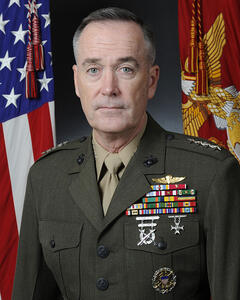
This is the General Joseph Dunford oral history interview for the Barack Obama Oral History Project at the University of Virginia’s Miller Center.
Joseph Dunford
One thing upfront—I’ll try to be as honest and provide as useful input as I can. I’m reluctant, just based on the questions, now or ever to criticize political figures. That’s a reflection of my previous responsibility. I want to try to balance history as best I can with a professional ethos that I think is probably, arguably, now more important than ever. So the one thing I haven’t done is criticize political figures publicly, and I’m unlikely to do that.
I still believe I can maybe contribute from a historical perspective to some of the questions, but on questions like, “Do you think President [Barack] Obama was effective as a President, or had a foreign policy that was successful?” I’m unlikely to provide you anything that’s very useful in that regard.
Perry
Understood. We’ve always had such good relations with your colleagues over the years, from other Chairs of the Joint Chiefs to Vice Chairs to combatant commanders. We always enjoy working with you all because you’re so professional and so honest in the areas where you feel you can be forthright. We appreciate that and that you are so disciplined about getting transcripts and deeds back to us. We’re appreciative of that and your service to our country.
I’m going to turn our questions over—at least at the beginning to kick us off—to my colleague, Professor Spencer Bakich, who is now a full professor at the Virginia Military Institute. He specializes in the areas we’re going to chat with you about today.
Spencer D. Bakich
General Dunford, it’s a pleasure and an honor to speak with you today. I was thinking, perhaps, given our time frame, that we could focus on maybe two general baskets of questions: your time as commander of ISAF [International Security Assistance Force], and then moving over as Chairman of the Joint Chiefs, particularly with respect to Syria and the counter-ISIS [Islamic State of Iraq and Syria] campaign, if that’s OK with you.
Dunford
Yes, that’s perfect.
Bakich
Starting off then, with Afghanistan, you were tapped to be ISAF commander in October of 2012. You took command in February of 2013. I was wondering if you could give us, to the best of your recollection, your assessment at the time of the strategic effects of President Obama’s surge in Afghanistan as it was beginning to wind down, and decisions about troops coming out. How did you assess the overall state of the battlefield, both militarily and politically?
Dunford
Sure. I have some notes on this that I can provide if they’re helpful, but probably some context. By the time I was going in, the President had already made a decision to draw down the forces significantly, so the surge had probably provided a temporary opportunity to grow Afghan security forces. But when I went in, we certainly didn’t believe that the Afghan forces were capable of being independent.
From a political perspective, we were still dealing with some instability. Certainly the economy hadn’t grown much, so the situation hadn’t fundamentally changed since before the surge. What the surge did, I think, was allow U.S. forces and NATO [North Atlantic Treaty Organization] forces to reduce the level of violence to the point where Afghan security forces could make some degree of progress.
I’ll let you keep asking questions, but I think my focus in February of 2013 was first Milestone 2013, which was the transfer of responsibility to the Afghan security forces in June. We had elections coming up during that period. Then much of the focus was really beyond 2013, into 2014. The day I arrived, we were working backward from December of 2014, when the NATO mission would fundamentally change, so that was much of the discussion that we were having. Everything that we were doing in 2013 was nested in where the President wanted to be by 2014, and we had to really put it in terms of how we would set the conditions for that to occur.
There was a military transfer of authority in June, followed by political transition, followed by the NATO mission changing. At the risk of oversimplifying, those were really the three major events going to go on between 2000 and 2014, which were driving the dialogue inside the National Security Council, certainly driving my focus with the ISAF staff. I’ll try to make my answers as brief as I can, and then if you want me to keep going, I’ll pile on.
Bakich
Oh, no, no, that’s actually very helpful. It strikes me—and please correct me if I’m wrong—that that type of end-state strategy, to borrow a phrase from a different conflict, working backward from a particular time, seems to be a different kind of modus operandi for strategic thinking in Afghanistan. Could you comment on that?
Dunford
Well, to be honest with you, when I was in Quantico, Virginia, in 1977, we were taught to work backward from actions to the objectives, [laughter] so this was a tactical principle I carried over to the strategic level. Begin with the end in mind, right?
I can’t comment on specifically how people might have thought about it before me, but I can guarantee you that the day I arrived—and all of my notes and all the conversations we had with the President would indicate this—it was all focused on where we wanted to be at the end of my tenure. The President’s guidance in that regard—his intent may be better said; we would iterate guidance over time—his intent was very clear to me from Day One.
Bakich
You’ve done a wonderful job of succinctly describing how you understood your mission, and that seems very clear. I wonder if you could, perhaps, circle back and pick a few of the most pressing challenges to completing that mission as effectively as you possibly could. Which do you think were the biggest obstacles?
Dunford
I’ll take them sequentially. Enabling the Afghan forces to assume responsibility for security inside Afghanistan required us to have a detailed understanding of what support they would still continue to require, even as they assumed responsibility in June of 2013.
One of the biggest challenges I had, believe it or not, was assessments, truly having a granular understanding of where they were, so we could prioritize and allocate resources to the Afghan forces to first set the conditions in those months that we had available for the transfer of authority, but then to understand what would be the framework within which we would provide support from June of ’13 beyond that.
What I am speaking about right now specifically is the degree of aviation support, the degree of logistics support, the degree of advise-and-assist missions, the degree of intelligence that would be required, but then also how would we, as U.S. and NATO forces, conduct operations in a way that recognized the sovereignty of Afghanistan in 2013.
This was a political challenge as well as a military challenge: describing the relationship between the government of Afghanistan—It was under their authority that we would have to conduct operations subsequent to June of 2013—and how we would operate in a support role. We have a term in the military, “supported supporting.” If you think about that, you have an organization that is being supported, and you’re the supporting force. We were now going to change that relationship from NATO and U.S. forces in the lead as the supported force, to Afghan forces in the lead as the supported force, with NATO and U.S. forces supporting.
Describing the details of that relationship, agreeing on the details of that relationship, conducting the rehearsals that were going to take place before June of 2013 to make all that come about was our focus. Of course, at the same time we were trying to train, organize, and equip the Afghan forces to be able to assume responsibility.
The basic theory of the case was that we had—We can check the number—about 120,000, plus or minus, NATO forces in Afghanistan in February of 2013. The authorized number of Afghan forces was about 352,000, but we didn’t have anywhere near that at the time, and certainly not anywhere near that well trained, well equipped. The theory of the case was that we could meet the President’s intent to reduce the U.S. and NATO footprint by growing the capability of the Afghan forces, so trying to understand how we could draw down U.S. forces at an aggressive, yet effective, pace and increase Afghan forces was problem one.
Problem two was a significant logistics problem, in that we were closing bases and closing infrastructure all over Afghanistan at that time. That logistical challenge in and of itself would have been, in most cases, our priority, but this was now my third priority because I had to deal with the political space within which we were conducting operations and prepare the Afghans for transition to assume responsibility.
But at the same time, we were confronted with a very significant physics problem in terms of collapsing infrastructure. Just as you do when you’re camping, we were trying to get it to the point where we were taking only memories and leaving footprints in those areas we were drawing down. There was a significant amount of sensitive equipment, a significant amount of hazardous materials, a significant number of people in support—including Afghans in support—and all of that had to be done in a very deliberate way. The enemy recognized that our drawdown was creating vulnerabilities at various times, and this required us to be very careful about how we prioritized and allocated forces across the country, in how we prepared for the unexpected, if you will.
Bakich
How at the time did you folks understand the enemy?
Dunford
We understood the enemy as a pretty virulent insurgency. The Taliban obviously were assuming responsibility for—You know, the facts are what they are: in increased areas, in the rural areas in particular, Taliban influence and physical presence were expanding. Taliban clearly—We knew this from intelligence—understood the vulnerabilities that would be inherent in what we were trying to do. They also understood—and I think this is an important aspect—what we assessed to be the center of gravity or the source of strength inside Afghanistan, and we always characterized it as the spirit and will of the Afghan forces themselves, and then, more broadly, the confidence of the Afghan people.
The Taliban understood that, and many of their operations were designed to erode the spirit and the will of the Afghan forces and undermine the confidence of the Afghan people. That would obviously have an adverse effect on the political environment within Afghanistan, and go after the GIRoA [Government of the Islamic Republican of Afghanistan] government specifically, but then also the idea being to make the Afghan forces less effective.
I’m sure that you’ve seen the fear, murder, and intimidation campaign they implemented. They would find soldiers from various areas outside where they may have been operating. Say they knew one from Kunar Province who was operating in Helmand Province; they would go and visit the family in Kunar Province and threaten the family there, which would cause the soldier to maybe go home and try to take care of his family. Or, in cases where they might have gone back on leave, they would threaten them so they wouldn’t go back.
It was a very concerted effort to assume more responsibility for terrain, greater influence in the rural areas, undermine the Afghan forces, and undermine the confidence of the Afghan people. That’s kind of how our understanding of the adversary was. Of course, they had sanctuary. We all know that. They were able to operate freely across the Pakistan border.
I’ll describe the Taliban threat: the primary focus for us, of course, was counterterrorism. In the northeast part of the country we were dealing with al-Qaida and al-Qaida-affiliated personnel who were planning to conduct operations against the West, and our operations focused on disrupting their ability to plan and conduct those operations.
Bakich
How cooperative a partner was the Afghan national government, both under [Hamid] Karzai and then under [Mohammad Ashraf] Ghani, as this mission was being implemented?
Dunford
On balance—This may surprise you to hear this, and other people have a different view—I needed the operational freedom of movement to conduct operations and do what needed to be done. If I step back and ask, “Did I have it or did I not have it?” the answer is yes. [laughter] Was it difficult to negotiate, difficult to navigate, difficult to manage the expectations of President Karzai and some of the specific incidents that caused friction in the relationship? All that is true, but at the end of the day, we had the ability to do what needed to be done.
Our relationship with the Afghan forces during that period was very good because they were dependent on us, so the nature of the relationship was overall pretty healthy. Keep in mind that during this time, President Ghani was actually my counterpart, and the counterpart of my deputy, as we did the transition tasks. Everything from turning over detention facilities, to turning over the bases and the infrastructure, to turning over equipment to the Afghans was all being done within this framework for transition, of which President Ghani was the lead.
So we spent an awful lot of time with President Ghani during that time, which carried over into a [relationship] that had been built up for a great deal of time, including during General [John] Allen’s time, with President Ghani.
I would describe both President Karzai and President Ghani as having strong views as sovereigns. They were both presidents of their country, and it was difficult space to navigate with both of them. President Karzai was publicly more volatile and perception was more difficult. On a personal level, we generally got through the issues, and we developed what I would describe as an effective enough relationship, and I think he felt the same way.
President Ghani was, perhaps on the surface, easier to deal with, but actually had less influence and less political clout across the country, so was not able sometimes to deliver in a way that was helpful to the mission. Of course, the one thing you’ll know is in July-August 2014 and the months before that, the whole issue of the Bilateral Security Agreement colored the political relationship. That was probably the low point in terms of our relationship with President Karzai, and I actually was there at the Loya Jirga the day that he recommended it not be signed.
Bakich
That’s the question that I was going to turn to next. Can you shed some light on how you navigated those political challenges? As I was getting ready for our conversation, in much of what I read, they were almost—well, “coercive” is too strong a word—but difficult, tough negotiations, from your perspective.
Dunford
In the months leading up to the summer of 2014, we had what I call hours of my life I’ll never get back. We were in meeting after meeting with the Afghan representatives, developing agreements on everything from equipment to freedom of movement to air space to you name it, contractors, and the legal status of contractors. There were countless issues.
This Bilateral Security Agreement of a couple of pages reflects volumes of background information and agreements and understandings about how to actually effect a relationship once the Bilateral Security Agreement was in place. Those were difficult negotiations.
I was blessed with a great counterpart: Ambassador [James] Jim Cunningham was with me in those meetings. I would say that there was no daylight between the U.S. Embassy and U.S. Forces Afghanistan. It was in my U.S. Forces hat, not my ISAF hat, that we worked this issue. We had a very good relationship with the Embassy, and where we had a divergence of opinion, we were always able to fix it in private and go public with a unified voice on all these issues. He was very supportive on all of the issues, particularly those where the military might have had the greatest equity, so that was all fine.
So, very difficult negotiations: our Afghan counterparts weren’t giving much. But it wasn’t contentious. It became contentious only as it was elevated politically to President Karzai and his government, and then, as you know, there was a series of visits by then Secretary of State [John Forbes] Kerry to try to close the deal over the summer of 2014.
At that point, it really became difficult. It was difficult working through the issues, a lot of negotiations, but not contentious. It moved to difficult and contentious in that summer of 2014. Oh, by the way, we were in the middle of preparing for an election at the same time. As you know, both the Bilateral Security Agreement and the results of the election all came to a head in August and September of 2014, and both were unresolved when I left.
Bakich
Do you attribute President Karzai’s contentious attitude to his political problems, or was it a matter of principle for him? Do you know?
Dunford
Yes, my assessment is that by that time in the war, he had a deep-seated mistrust of the United States, of U.S. commitment. On the issues of civilian casualties, I don’t think that was a political issue at all. I think he genuinely was concerned about the Afghan people, and he was genuinely concerned about how we used force, when we used force, and the results of our use of force.
So I don’t question his motives at that particular time. The nature of the relationship as a whole was a bit threadbare by 2014. You have to think about what I call the Y2K effect: [laughter] U.S. commitment was literally questioned every year, and the Afghan people spent a lot of time wondering, OK, to what extent is the United States going to support us at the end of whatever date certain was the one that was currently on the table?
The series of hard dates that identified the end or the qualification of U.S. commitment was really wearing on the Afghans by this particular time. Again, if you go back to the confidence of the Afghan people being a source of strength, their confidence was waning at that point.
Russell L. Riley
I don’t want to lose too much the train of thought here, but I have a different realm of questioning. You indicated early on that you were carrying out the President’s intentions, and I’m wondering if you could tell us how you were receiving the President’s intentions when you were in country. What were the lines of communication from point A to point B?
Dunford
As a commander forward, in terms of engagement with my senior leadership, it was probably about as good as it could be. I spoke to the Secretary of Defense at least every week—at least every week—at length, and it would typically involve a full campaign brief.
The Chairman and the Secretary would be on the other end. Usually the CENTCOM [United States Central Command] commander and the European commander, wearing his NATO hat, were on the line, and we had an in-depth conversation, and typically the Secretary and the President had routinely spoken to President Karzai. Then—I don’t know the exact number, but certainly on a fairly routine basis—we had a video teleconference with the President. I would provide a campaign update to the President, and he would provide his guidance.
We had routine visits from the administration. Susan Rice came over at one critical time. Secretary Kerry came over routinely. Secretary [Leon] Panetta, when he was the Secretary of Defense, came over routinely. Secretary [Chuck] Hagel came over routinely. The commander of CENTCOM came over routinely. The commander of U.S. Forces NATO, the NATO Secretary General, congressional delegations—I don’t think it’s an overstatement to say that we had probably two, three, four high-level visits per week in Afghanistan among the various countries that were represented as well as our own government, so at no time was I confused about where we were as a country at this point in my tenure in Afghanistan. I understood exactly what the President was looking for. I understood exactly what the Secretary was looking for. The question was could we actually execute along the time line that the President outlined: this is how many forces you are going to have at this particular time, what combat authorities do you need at this particular time, what’s our relationship with NATO?
The what and the why were very clear; the how was where we spent much of our time in negotiations, if that—at the risk of oversimplifying it—answers your question.
Riley
That’s a lot of channels of communication. Were the messages consistent throughout, or do you recall circumstances—
Dunford
This is a very interesting question. This is a quick anecdote, but it does answer your question. When I was going to Afghanistan, one of the best pieces of advice that I had came from [Michael] Mike Scaparrotti, who’s a retired four-star. He had been the three-star commander, later became Supreme Allied Commander NATO, and was there at the same time I was.
He was the director of the Joint Staff, and I said, “So, Scap, I’m going through all of these speeches that the President’s given, documents that have been written, things the Secretary of State has said, things the Secretary of Defense has said.” He showed me a matrix where he took all the documents and all of the key points that were made in these documents, or public presentations, and he said, “This is how we kept track of it.”
So I did something very similar: I created kind of a matrix, and every time there was a public event, every time there was a document written, we would cross-reference them. Then where there were differences in the documents—and there were differences in documents—I had plenty of opportunity to say, “Mr. Secretary, my understanding of this issue, from looking at the various documents, is this. Is that your understanding?”
One of the key things that was important to me from the beginning was assumptions, so I took every opportunity when I did have the Secretary of Defense visit, in particular, or engagement with the President or the National Security Advisor, to refresh the assumptions I was making at that particular time, actually put them on their agenda for the visit. I’d say, “Hey, I’d like you to talk to me about these assumptions and make sure that we actually have a common understanding right now.”
There was one particular occasion which, for this session, may be a useful one. I remember going back to Washington, D.C., to meet with the President to talk about the 2014 mission. I went back on a couple of occasions, and we were in the Oval Office, and I was briefing him. I’m a fair reader of body language, and it was pretty clear to me that the more I was talking, the more irritated the President was with what I was saying. [laughter]
Part of the giveaway was he kept pulling a three-by-five card out of his interior pocket, which I assumed was his schedule, and he was wondering how much longer he was going to have to endure Joe Dunford speaking to him. So I stopped and said, “Mr. President”—and he’ll remember this conversation—“I can tell that I’m irritating you.” He started with, “You know how many generals have sat here and told me, ‘One more year’?” I said, “Mr. President, I’m not doing that. I’m trying to listen to your objectives, your political objectives, and I’m trying to offer you what I believe to be the military dimension of achieving those objectives.” I said, “Mr. President, have your objectives changed?” The ice immediately was broken, and he sat back and said, “You know, that’s a fair question. My objectives haven’t changed. My confidence in our ability to achieve those objectives has changed.” I said, “Well, Mr. President, that’s very helpful to me. We can have a different conversation now about where we’re headed.”
I guess the real moral of that story is that because I was afforded routine and I think fairly productive conversations, clearly there were divergences in the guidance; clearly there were issues where maybe I was heading right and I was a step behind where the administration was at a given time. But not too much time ever went by where I didn’t have a chance to relevel—reset, if you will—and say, “OK, I got it; we’ll refine the plan to meet the intent.”
This was one of those cases where I did have some legitimate criticisms about what we might have been doing at that particular time, but in terms of communications and an opportunity to ensure that I understood clearly the political guidance, I have nothing but pretty fond memories of that particular part of the campaign. There are other things that were a little more problematic, but we’ll get to those.
Bakich
Following up on this thread, the negotiations or the discussions that you had with the President and Secretary of Defense about how many troops in residual after the ultimate drawdown—That seems to have been a moving target over time. Could you talk about the nature of those discussions?
Dunford
I would probably characterize it a bit differently than a moving target. That’s fair, but I would characterize it as various options or excursions that we needed to offer to the President so we could begin to understand how risk was associated with various levels of resourcing, risk not just in terms of the military campaign, but clearly in terms of keeping the coalition and the allies together, keeping the confidence and the cooperation of the Afghan forces, how it might affect Pakistan hedging, and so forth.
We tried to identify all of the interdependent variables in the campaign and associate levels of risk at various levels of resourcing against these interdependent variables. It was a very painstaking dialogue, and it was iterative.
Those video teleconferences that I summarize as remembering fondly, I’m not sure had you talked to me immediately after two or three of those meetings, I would have had such fond memories. I remember them fondly in the aggregate because they got us where we needed to be, but we would work on these issues, and we’d brief them, and we’d think we had a pretty good plan, and there’d be four or five questions, and another turn of the crank, and another turn of the crank, and another turn of the crank. We spent a lot of time planning, replanning, reexamining these various levels.
It culminated in a final conversation that took place late in my tenure, when I went in to the President and said, “Mr. President, I’m at the point now where I would recommend we either maintain 10,000 U.S. forces and an associated number of NATO forces, or I think it’s time to think about withdrawing all of our forces.” He said, “You don’t mean that.” I said, “I do, Mr. President. We’ve taken a hard look at it. Let me walk you through it.”
I described in that meeting our environment as an ecosystem. I said, “Look, for us to justify the risk to young men and women in uniform for deploy, we have to be able to have a clear articulation of what it is we can accomplish right now. If we don’t have 10,000 forces there, we don’t have the requisite intelligence in place, force protection in place, operational reach for our aviation, logistics support, and so forth. When I correlate the threat with levels of resourcing below 10,000, I can’t come up with a probability of accomplishing something that justifies our presence sufficient to make that recommendation.”
In any event, the President approved 9,800 forces to be in place in December of 2014, and it was very much informed by the months of dialogue that we had where the outcome was a common understanding of the relationship between probability of achieving specific political objectives and levels of resourcing. By the time we got to the end of it, all that work allowed us to have a conversation where the President had confidence that what I was saying at that particular time was based on a military judgment that he could accept.
We had to go through a long journey of probably 14 or 15 months before we really got to that point, because clearly what the President wanted—and, by the way, what I wanted—was no U.S. forces in harm’s way, and mitigated risk against the terrorists who attacked on 9/11 and whom we still assessed to be a threat, one that would reconstitute were we not to stay engaged.
I didn’t go into this saying, “How do we stay in Afghanistan?” I went into this saying, “What is it that we have to do to mitigate the threat, and how can we do that in a way consistent with the President’s guidance?”—which was minimize the treasure and, more importantly, the commitment of young men and women and the risk to them, minimize that and still accomplish the objective.
There was this constant—I won’t call it negotiation, because I was not negotiating at that point as an equal—but constant dialogue taking place between the political leaders and the military leaders to come up with an acceptable military dimension of the problem in the context of the political objectives that needed to be achieved.
As you all know—You’re presidential historians—only refugees from accountability ever have clear answers on these problems. [laughter] These are tough, tough issues to work through, and even with the benefit of hindsight I can’t tell you that I have some flash today that was much different than what we were grinding through at the time.
This was all taking place, by the way, with a thinking enemy that was adapting over time, in a situation politically, economically, and from a security perspective that was changing all the time. “Dynamic” is probably an overused word, but it’s the word I’d use to describe the environment. We were not making decisions in a static environment. We were not having dialogue in the summer of ’13 necessarily based on assumption conditions that we could foresee into 2014. It was a constant process of refinement.
Bakich
Those 9,800 troops, I’m assuming that they would have a counterterrorism plus train, advise, and assist role, is that correct?
Dunford
Yes. The key thing—By the time I got to Afghanistan, there was no doubt in my mind that our purpose was counterterrorism. It always was after 9/11, but perhaps we went on some excursions where we expanded our ambition from time to time. But by the time I was there, there was no question about an expansion of ambition.
We didn’t initiate one major project in the time I was in Afghanistan. None of the major construction projects or anything were initiated after 2013, and we went through every single one that was ongoing with a fine-tooth comb—This is one of the other things we were doing at that time—to say which ones had a probability of actually being successful and which ones should we just cut our losses and move on. This was another major focus that we had during that period of time. What point do you really want me to get at here?
Bakich
I was thinking post-2014, into ’15 and ’16.
Dunford
OK. What we really were doing was conducting counterterrorism. Our view was we needed two things to be effective to conduct counterterrorism: protect the United States and our allies and friends around the world. We needed what we called the platform, a place from which to conduct counterterrorism operations. That’s Afghanistan. We needed a political framework within which we could conduct operations.
The other was if we were going to be effective in conducting counterterrorism with a minimal number of U.S. forces and NATO forces, we needed a partner to help us conduct counterterrorism operations. There was a quid pro quo here: What was in it for the Afghan government? What was in it for the Afghan forces? What was in it for us? I would view the support that we were providing to Afghan forces and the Afghan government, certainly post-2012, as what was necessary for us to establish a relationship where we could pursue our mutual objectives.
Think about our objectives as a Venn diagram. We have in the middle our common cause against al-Qaida and associated movements, and then when you go outside where our common interests lie, it’s establishing governance in rural areas; it’s establishing effective governance from GIRoA in Kabul, all those things that I didn’t think were necessarily important or critical to counterterrorism. That would have been another way to accomplish it, but in order for us to have the kind of relationship necessary to sustain our counterterrorism efforts, we continued to do that.
It’s really important, I think, to make that distinction, because some people might look at individual acts we were performing during that period and say, “Oh, we’re still doing nation building.” No, we would define those acts based on the outcome we were seeking, not based on what they looked like. And the outcome we were seeking was an effective relationship in order to conduct counterterrorism operations, not in order to build a country as a democracy, economically sustaining and self-sustaining security forces. I’ll stop there, but I think that’s an important characterization of where we were at that time.
Bakich
I absolutely agree. That’s a distinction with a big difference. Before we pivot to ISIS, do either of my friends have anything they want to ask General Dunford at this point?
Perry
In terms of our time situation, we certainly want to get to your appointment to be Chair of the Joint Chiefs. Would you say that in the interesting conversation you described having with President Obama, he felt comfortable with you? There were others, obviously, who could’ve been chosen to be Chairman of the Joint Chiefs, but he chose you in 2015. Can you talk to us a little bit about that?
Dunford
Sure. I had had three four-star jobs under President Obama before I was the Chairman. In the first one, as the Assistant Commandant of the Marine Corps, he was probably not particularly familiar with what I was doing on a day-to-day basis. I didn’t have a direct relationship with him. I attended meetings where he was there, occasionally represented the Service Chief, and so forth. When I became the Commandant of the Marine Corps, we had, at a minimum, every six weeks or seven weeks some engagements and conversations about the budget, and then we’d bring in all the combatant commanders and talk about operations. And so we had a year there.
If you combine that with my time in Afghanistan, which was the most contact I had with President Obama, when he made the decision to nominate me as the Chairman, he was nominating somebody he knew. I can say that. He’ll be better at judging what he thought, but I can say that I was a known commodity to the President when Secretary [Ashton] Carter went over and said, “I think this is who should be nominated,” and the President agreed.
There were certainly other people, some of whom were my friends, who were eminently qualified to do the job, and prepared to do the job. I was only in my job as the Commandant of the Marine Corps for about nine months when I was nominated, so it was a very short period of time as a Service Chief. And by the way, I did not know that I was nominated for the job before I met with the President in the Oval Office.
What’s interesting is that Secretary Carter did not want to affect the President’s decision space, so he didn’t tell me that he was nominating me for that job. There were a lot of rumors at the time, including from my wife, who picked it up. I said, “This is ridiculous. [laughter] I’ve only been in my job nine months. This process is well in train. No one’s told me anything. Don’t worry about it. We’re going to be fine. I’m not going to take the job.” To say that she was not excited about it would be an understatement at this point.
I was in North Carolina visiting Marines one day and—God bless my Marines—the White House called and said, “President Obama would like to see General Dunford on Thursday,” and the initial response from my guys was, “Well, he’s going to be in North Carolina till Saturday so he’s not available.” [laughter] I then got a phone call from, as I recall, the chief of staff in the Secretary of Defense’s Office saying, “What the hell are you guys doing down there? The President wants to see you on Thursday.” I said, “OK, I’ll see you on Thursday.”
I went over there, and the President—This is related to some of the questions you had—talked to me about his thoughts on senior military leadership, and about his previous experience with Chairmen, and about what he was looking for in a Chairman of the Joint Chiefs of Staff. And he’ll remember; I leaned over and said, “Mr. President, I’m not campaigning for a new assignment here.” He said, “No, I understand that.” We continued to have a conversation about a variety of the challenges we were facing, and as I walked out, he said, “I think we’re going to be seeing a lot more of each other, Joe.”
I went home that night, and that was the first time my wife knew that this was actually serious. That was Thursday; the White House released it on Tuesday—They made an announcement at the Rose Garden, so we didn’t have a whole lot of time to adjust.
Perry
We know families serve along with the military leader. What were your wife’s concerns about this position?
Dunford
One, we were just settling into what was a big responsibility, which was the United States Marine Corps: over 200,000 Marines, sailors, and then families, another 150,000 or so. It was a big responsibility, and I had promised my wife many years before this that we would retire when the children were in middle school. By this point, they were in college. I had had 38 years of active duty before this conversation took place.
So it was a big commitment, and she knew that, and it was a commitment that she wasn’t familiar with, unlike people like me. Whether I did well in a job or not well in a job, you can’t go back and look at my career and say that someone didn’t try to prepare me for that responsibility. Spouses don’t have anything close to that kind of preparation, and yet she’ll walk into a theater not knowing that there are going to be 2,000 people there, and everyone will say, “Ladies and gentlemen, this is Mrs. Dunford,” and expect her to wax eloquent about this or that issue and take questions for a couple of hours.
It’s a big deal for a family. Also, we had had almost five years of separation as a general officer, so we had a relationship we had to work on. Those of you who are married know that when you’re physically gone for five years, and you’re emotionally gone for much of the time in between, you get to the point where it’s OK, Joe, where is this going? To make a long story short, my wife for the first time in our married life said, “I’m not doing it,” and we had a very quiet weekend after that first meeting with President Obama.
We went into the Roosevelt Room. A couple of people congratulated her. My wife’s not a crier. I mean, by this point she had moved 25 times, raised three kids. She’s a tough woman. The President came in, gave her a big hug. My wife completely melted down, [laughter] cried, and had to leave the room. The President said to me—because everyone thinks all you want to do in life is get promoted, and that’s not actually how it works—The President turned to me and said, “Is she going to be all right?” And I said, “Oh, yes, she’ll be fine,” and then we went out to the Rose Garden, and the rest is history. She turned around and did what had to be done for the final four years of our time.
But the President knew what was going on, and we had a couple of conversations about his own personal experience with Mrs. [Michelle] Obama, and we had a couple of private conversations where he kind of understood. He understood that he was going to the well deep with his family, and I was going to the well deep with my family, and we could understand that. We both also understood that we had responsibilities, and we were blessed that after all the friction was put aside, both of our families were willing to continue to make that sacrifice until our time was up.
We even talked about that before I was nominated as the Chairman. We had a couple of conversations about family, even in some of the previous interviews or some of the times I came back from ISAF. He was very open, on a personal level, about the challenges of public service and balancing that with personal commitments, and I think that helped us to have a relationship on a human level, which is a good foundation for a professional relationship.
Riley
General, he never served in the military. How did you find his professional sensibilities about the issues you were bringing to him?
Dunford
I’ll just say this: I’m not sure if any of you are constitutional lawyers, or you’ve been around one, but President Obama read everything we gave him. He asked many, many questions before he ever came into the Situation Room. I never saw him unprepared, and I never saw him attend a meeting where he didn’t have a pretty clear understanding of what the outcome of that particular meeting was going to be. I’m sure you have heard this from many other people. [laughter]
I don’t recall thinking about his lack of military experience once during my tenure. I don’t recall one time saying, “Ah, you just don’t understand.” Keep in mind, now, I became the Chairman in almost year seven of his Presidency, so he was a very experienced President at that point. He had dealt with the issues of Iraq and Afghanistan ad nauseam by then, so his grasp of the issues, his understanding of the nuance of the issues, allowed for what I would describe as a very mature dialogue. I never found him wanting for understanding on these issues.
Perry
I have a note here to myself that he visited Bagram in May of ’14.
Dunford
Yes.
Perry
Can you describe his relationship with the boots on the ground?
Dunford
Yes. Number one, if you’ve ever been around him, like anybody who, I suppose, gets to that level, or most people who get to that level, in person he’s incredibly charismatic in a public setting. So when he came to Bagram—I recall this day very clearly—we met him. We went up to a conference room. There are a lot of pictures of that. We had all the commanders, and we talked about the campaign.
We had thousands of soldiers, sailors, and Marines, men and women, in a big airplane hangar in Bagram, and the band was playing, people were in there for a while, talking. There was a degree of excitement. I mean, the President of the United States was coming to visit them, and they were in Afghanistan. They had been telling their parents all day, “Here I am. I’m at Bagram, and the President’s coming.” I wish that we were all so innocent now, but at that point there was great excitement for the President to be there.
He got up and spoke, and he was very well received. And, to be honest, we got a little bit of a bounce out of his visit, because what did his visit mean? How do you show what’s important? You show what’s important by your physical presence. The fact that he flew all the way around the world to come to Afghanistan reinforced what I was saying to our people every day: “What we’re doing is really important. The President’s paying attention to this. This is a big deal.” He came, and it just reinforced that message.
Our men and women in uniform, as you know, don’t get too wrapped around the axel—at that point, anyway—with politics and those kinds of things. He was their President. They had a mission. All that was necessary for them to get after the mission the next day was knowing that the President actually cared and wanted to get it done, so I found that visit to be incredibly helpful.
When you’re a commander in a situation like that, you view visits by the Secretary of Defense and President—There are a lot of jokes made, “I’m from Washington; I’m here to help”—but, to be honest with you, I viewed them as strategic opportunities to take advantage of, to reinforce the message that what they were doing mattered.
Frankly, in many cases, that’s all our people needed to know. They needed to know that what they were doing was important, and then they’d get after it the next day, and that’s kind of where we were. I hope I don’t sound like a cheerleader—I’m not intending to be—but on that particular issue, I’m describing to you actually how I feel.
Bakich
Did you get a sense that the President’s focus on Afghanistan in particular waxed and waned over time, or was he dialed in constantly?
Dunford
It waxed and waned. My only frustration as a commander in Afghanistan—The communications were good; the guidance was clear; he allowed me to balance the ends, ways, and means of a strategy so that I could manage what I used to call risk to the mission and risk to the force.
I used to say the President owns risk to the mission. Whether we accomplish the mission, when he makes decisions about resourcing, that’s his risk, but what I have to pay attention to is risk to the force, and make sure that the resources we have are sufficient to protect the force. But, as importantly, I have to be able to articulate the relationship between probability of outcome, as I spoke of earlier.
I was frustrated about that because there are so many—again, frustrated, but I’ll leave it to others to be critical—I never felt like we owned, as a country, the mission in Afghanistan at the strategic level. There was a huge void in communicating to the American people what we were doing, why we were doing it, and so very often it was left to me—even if you go back and look at my congressional testimony during the time I was ISAF—to articulate what we were doing, why we were doing it, and make the case that we needed to continue to do it to protect the American people.
I felt like at times, maybe, that was not at the top of the inbox of our political leaders. Again, you’re doing the history, so you understand that what I was dealing with was in the much broader context of what the President was dealing with at a given time, so clearly every day I woke up I was focused on this. This is what I was doing. He was not focused on this every day, and yet it wasn’t that he was negligent and didn’t recognize we had men and women in harm’s way; it’s just that he was navigating other issues, and sometimes it was probably to his advantage or not his advantage to emphasize the Afghan mission at a particular time.
I don’t know whether it was unpopular with the American people at that time. I’m not compelled by that argument. Some people make that argument. I would describe it more as ambivalence than unpopularity. But no, that would be my only comment about whether the President was engaged with it all the time. The communications sometimes were lacking, both from the State Department, the Defense Department, and the White House, again, for understandable reasons, but it was still an issue for me, even if I understood it.
Bakich
I appreciate your comments about the President being exceptionally well-prepared for every meeting, every briefing. Secretary Carter said that he did not feel that the White House micromanaged him. Did you have the same sense, or did you feel the 8,000-mile screwdriver?
Dunford
A lot of people talk about that. Here’s what I would have said then, and what I’ll say now. What I would have said then was, “There are too many meetings. [laughter] There are too many meetings. I don’t have enough time to do my job. I have all these meetings.”
I think people confuse the process with micromanagement. For example, you ask if I had a good relationship with Susan Rice. I actually had a good personal and professional relationship with Susan Rice. She asked me questions forever. She asked me more questions than I could answer in a lifetime, and followed up on it. In her book, she describes a conversation with an unnamed general about two years after she left office where I said, “You know what, Susan? I miss that micromanaging—” fill in the blank. [laughter] It’s in her book. I’m the one who said that.
I didn’t really honestly feel like it was an 8,000-mile screwdriver. I do understand, in retrospect, it was an important issue, but I can’t have it both ways, right? I can’t say the White House wasn’t engaged, and then say we’re having too many meetings, in this case, on Afghanistan. What I would say is that the Obama administration had an incredibly disciplined national security decision-making process that reflected a Chief Executive who was incredibly disciplined.
When people talk about the national security decision-making process, and whether we needed Goldwater-Nichols [(Barry) Goldwater-(William F.) Nichols Department of Defense Reorganization Act of October 4, 1986] for national—I say, “You guys are missing the point. The process reflects the decision maker and how the decision maker makes decisions, and what information, intelligence, and so forth that individual needs to make decisions.”
To the extent that the National Security Council staff and the National Security Advisor were accused of micromanaging, I know personally, both then and now, that that was simply to execute what was necessary to support the President. The President said, “This is what I need,” and they were delivering it. Was it painful? Yes. Was it time consuming? Yes. Was it always fun? No. [laughter] But I think we need to separate micromanagement from a disciplined process that involved, perhaps, more meetings than the average administration.
Perry
This has certainly been one of the most productive hours we’ve spent, and we should just say to you our time is your time, so if you don’t mind, we will circle back to you, because we know that there is more for you to contribute to history. We thank you so much, but we don’t want to intrude on you.
Dunford
No, no, for productive questions I’m happy to try to reschedule another interview.
Riley
Please convey to your wife our thanks to her.
Dunford
Thanks so much for saying that. People say, “What are you doing in this chapter of your life?” I’m doing a few things, but at the top of the list is a valiant attempt to try to be a good husband, a good father, good friend, good son, good brother, and all those things that I was so bad at that they didn’t have any expectations. [laughter] I’m trying to do better these days. But I will say that to her. Thank you so much.
[END OF TRANSCRIPT]