Transcript
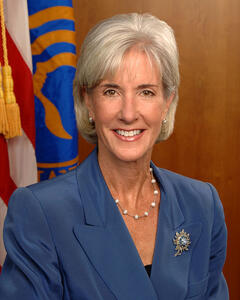
Russell L. Riley
This is the Kathleen Sebelius interview as a part of the [Barack] Obama Oral History Project. Thank you. We’re in Lawrence, Kansas. Normally we like to start with some autobiography, and we hope you’ll indulge that. We know we have a lot of material to cover, and there are some very hot issues that we want to delve into, but it’s helpful first to know a little bit about the past of the people who populate an administration. You have a unique past in politics, so I wonder if you’d tell us a little bit about your upbringing, and how you came by your politics.
Kathleen Sebelius
Sure. I was born and raised in Cincinnati, Ohio. My father ran for city council when I was five. He had been a teacher. His father hoped he would take over the family funeral home business, which was not greatly appealing to my dad. He ran for city council and was elected, much to his surprise and everybody else’s surprise, because there wasn’t really a Democratic Party in Cincinnati at that point. He was in politics then for the next 25 years, ran ten races in 11 years.
Growing up in that family, with a brother a year older than I am, a brother a year younger, and a younger sister, we all assumed that’s what everybody did, that they went door to door in the fall, they put up yard signs, they had political debates, they had people who were furious at them and ripped up brochures. That was my life as a little girl; I just began to learn a lot about politics and organization.
My dad was a very progressive Democrat in a conservative city, beloved by labor and the African American community. He became a spokesperson for a lot of progressive causes in a city that wasn’t very progressive, involved in civil rights and human rights, and ended up antiwar early on in the Vietnam War. I think having two sons who were about to be draft age helped compel him. He became, as an Irish Catholic male, more of a feminist I think because of his two daughters. But he took on a lot of causes that were interesting.
So he was in city council, Congress, ultimately ran for Governor and was elected the year I got out of college. I had grown up in politics, watched politics, seen politics, been very interested, worked on his campaigns, but actually never saw myself as a candidate. I just saw politics as one of my hobbies and interests.
I met my husband, [Keith] Gary Sebelius, in Washington, D.C. He had gone to Kansas State University and Georgetown Law School. I’d gone to Trinity College and stayed in D.C. and worked in criminal justice areas.
Riley
Why Trinity College?
Sebelius
I wanted to be in D.C. Georgetown did not accept women at the time I went to college—It was an all-male college—unless I wanted to be a nurse, and I didn’t really want to be a nurse. I’d gone always to an all-girl school and that appealed to me. I had an opportunity to play sports when people couldn’t play sports. I liked that environment. I always had boys around me, but I was also interested in good education. I’d looked at the Seven Sisters schools—Trinity, and there was a Catholic college at the time, Manhattanville; they were the equivalent of the Seven Sisters. They were the Catholic version. My father’s twin sister had gone to Trinity, so they knew something about it. I applied and got in, and that seemed OK, so I went to D.C.
But I met Gary in Washington and found out at some point along the way—I didn’t know it at the time—that his father was in Congress and was a Republican Congressman. That was not part of his bio that I was aware of when we first met through friends. My father at the time was Governor, so we were an unlikely duo, although Gary’s politics, it became clear, were very different than his father’s from the outset. We agreed on most issues.
We ended up after a year and a half getting married, and I moved to Kansas, where I had spent two days. I think I’d visited twice. He had moved back to Kansas. He grew up in the northwestern part of the state in a little tiny town, and knew that he did not want to return to western Kansas, but he wanted to see if he really liked the practice of law and thought it would be easier in a smaller firm in Kansas than in a big firm in D.C. or New York, where a lot of his friends were going. He wanted to have contact with clients and figure it out, so he accepted a job in a law firm in Topeka.
My dad ran for reelection, unsuccessfully, for Governor in 1974, and we got married on New Year’s Eve in 1974, one of the last parties in the Ohio mansion, kind of a burn-it-down party. The attitude was pretty laissez-faire. My father would travel around the party with his own bottle of champagne and fill people’s glasses and then pour some over his shoulder and say, “Let them clean it up.” [laughter] It was an interesting way to leave the mansion, but a great celebration. And I moved to Topeka.
I worked in criminal justice, because that’s what I had done; got a master’s degree at KU [University of Kansas]; and did a variety of things.
Riley
When you say worked in criminal justice, what kinds of jobs were you doing there?
Sebelius
In D.C. I worked for two organizations. One was a very small ex-con organization, my first job out of college, that was aimed at getting people jobs as they came out of prison. We worked in a very burned-out section of Washington. I was the 22-year-old white chick, and all the people in the organization were African American and male. It was a very dicey part of town, but it was a terrific learning experience, and something that I will never forget. Some lawyers who I had met helped to sponsor this initial organization, and thought it would be a great job for me. They had offices on K Street. They didn’t even visit the office, but they thought it would be terrific. It turned out to be a great job.
They also had contracts with the federal government—It was the time of prison riots in states around the country, there was a lot of violence—and they were running some projects on nonviolent mediation techniques, training and teaching guards and prison officials how to engage without getting out guns. That was the D.C. criminal justice project, and we had grants from the Justice Department to travel around and go into prisons that had recently come off lockdown, had had a very troubled situation, and do interviews of guards and inmates. Again, it was very interesting. My mother would say periodically, “Why don’t you think about being an airline attendant?” [laughter] She could not for the life of her figure out what in the world I was doing, and was terrified. It was a little terrifying, but it was also a really amazing experience.
I went into Soledad [State Prison, California], a week after it had been locked down for 18 months, and spent four days interviewing people who came to talk to me and were shackled to the chair by their hands and feet with a guard standing outside the door with a drawn gun. That’s as close as he wanted to get, and I thought, Well, OK, here we go.
When I came to Kansas, I applied for a couple of jobs and ended up at the department of corrections as an assistant to the secretary. What I quickly found out—I was the first woman that they ever hired who was not a secretary who was in that office. It was a very hostile work environment. The secretary of corrections, the cabinet-level guy, was a big champion and fan of mine, but the boys around him were not thrilled at all to have some young woman there.
But I did that, and I then got hired to be the director of the trial lawyers association, plaintiff bar association. My husband actually was a trial lawyer and I knew a lot of the people, so after a couple of years in the corrections department, I switched over to that. At all points along the way I had gotten involved in politics, and actually been invited into politics because I had taken my husband’s name when we got married. The Democrats here in the state thought it was really delicious to have somebody named Sebelius who was a Democrat, because my father-in-law was very well known and liked and represented what they call the Big First District, which at that point was almost the western half of Kansas. It’s now the western two-thirds of Kansas because of the population shift, but a very sizable area.
People were like, “Oh, be on this committee, and come in. Would you cochair this campaign?” I don’t think they were looking for somebody who really had opinions or thoughts. They just wanted a name. But I learned that the Kansas political group of Democrats is actually a very small group. We didn’t have a lot of Democrats in the state, and we didn’t have a lot of people in office. It was a great way to come in at the higher—unlike Ohio, where there were levels and levels. It was an era—We got married in ’74, so this was the late ’70s—where women were really thought—You just be quiet and sit over to the side and don’t—
Michael Nelson
The women’s auxiliary.
Sebelius
Yes, you bet, but I could be on the committee because of my last name. I was often the only woman in the room, but they had hoped that I would just come in and be quiet. [laughter] Fast-forward.
Nelson
Could I just ask you about this, the trial lawyers association and your husband? Later, of course, when you’re Secretary and Republicans are talking about health care reform, they want to see trial lawyers, they want to see tort reform, and I just wondered the extent to which the experience you had here shaped your view of that issue later on, if I’m not jumping around too much.
Sebelius
No, it certainly helped. I’ve said often that I think I had a great affinity for the way plaintiffs’ lawyers operate. It to me was as close to politics as you get, because these guys—First of all, they take a case on a bet, if you will—We don’t get paid if you don’t get paid; we’re taking the case believing we can win—which is how somebody enters a political race. They, in my view, are often with the little guy against the big. They’re the outsiders running against the corporations or the hospital or the wealthy doctor or the insurance company or whatever, and making a consumer case. And it has a finite period of time, like an election. You can sometimes get continuances at trial, but basically you put the evidence out, you put the arguments out, and then you win or lose. To me it has lots of parallels. They’re willing to take risks, and you have to do that to be in politics. There’s a rhythm about what they do and why they do it and how they do it that I found very compelling and interesting.
In the case of tort reform, I had done a lot of work here in Kansas. We had had debates about should there be caps on judgments, and should you limit contingency fees. All the things that came up in Washington, I had been through 30 years earlier. The evidence was pretty compelling that some of the limitations on trial lawyers’ practices first did not have a great impact on malpractice insurance. It might dent it a little bit one way or the other, but malpractice insurance was like 0.08 percent of any medical cost, so you could get rid of the whole thing and still not make a big difference. That was one thing.
The other thing was that there was no question they brought some ills to the table that absent them suing and bringing things forward would stay covered forever. It was harder to talk about that in the malpractice area, but kids were wearing pajamas that lit on fire, and that was stopped by suits. Ford made a financial decision to put the motor of a car in one place instead of another place, even though they knew in a crash you’d be much more likely to blow up, because it cost $8 a car to move the—Things like that were just horrifying. You think, Well, that’s an interesting—so it certainly informed my viewpoint and decisions.
I inherited a Congress when I got here that also was very resistant to federal—We had a different set of arguments here. Most of the, I would say, pro-lawyer Members of the House and the Senate—some were Republican and some were Democrat—
Nelson
In the Kansas—
Sebelius
No. I’m talking about when I got to Congress—believed that those issues really should be settled at the state level. They did not want laws that preempted state law. The people who put forward tort reform were often rebuffed not necessarily because of the arguments about tort reform itself but by the arguments about should we have a federal law that preempts all the state court and all the law and all the precedent. That often was, at the end of the day, what prevailed. It became a different debate.
Two kids: a two-year-old and a five-year-old. We lived in the capital city. My husband was very busy; I was very busy. I was now the head of the National Association of Trial Lawyer Executives. I was flying around a lot, working a lot. The wheels were coming off the wagon at home: two kids, two jobs. It was difficult. Our local state legislator was a Democratic woman who I knew well. She lived around the corner from me. I had been involved in her campaigns. She made the decision not to run, and she said, “Well, why don’t you run?”
I thought, Hmm, that’s an interesting—because I had not, again, really thought about myself as a candidate. The Kansas legislature is a part-time legislature. I lived ten minutes from the capitol and it was very intense. I had lobbied as the trial lawyer director. I was in the capitol a lot; I was friends with the Governor I knew. But I thought this job would be a much more family-friendly job than the job I had, so indeed I ran, and won, in 1986.
It was a big financial hit, but was a much better lifestyle change. I was off in the summertime. I could pick interim committees, stay busy, and I could leave the legislature and be at the kids’ school in ten minutes and be the room mom and be there for Halloween. It was a balance that was really nice.
I did that for eight years, and then the craziest race I ever ran was for insurance commissioner, because a Democrat had never held that office in the history of the state. There was an incumbent in the office, and beyond that, just the political issues. Nobody really knew what the insurance commissioner did. [laughter] I certainly didn’t. I figured it had something to do with insurance, but what the hell it had to do with insurance I didn’t know. Nobody knew anybody who worked in the—nobody in my world, because there were no Democrats who worked in the office, and the two previous commissioners, the guy who was in and the guy who preceded him, had been there for a total of 50 years. There was no short-term memory. It’s like this statewide office that I kept thinking had to have something to do with health insurance, and I’d served on the health committees and done a variety of things, but I didn’t really know what.
My friends thought I had lost my mind. I thought I had lost my mind. But I was really ready to do something else, and I thought, Why not? I’m taking way too much time because we’ve got to get to all this stuff. Anyway, I decided to take—
Riley
It’s fascinating. Thank you.
Sebelius
I had very few credentials except that I’d served on the house insurance committee. I could say that. I decided I would take the test to be an insurance agent, that if I could say to people that I had the credentials—not that I’d been, but credentials; I qualified to be an insurance agent—that would be another deal. I read the book, it’s not rocket science.
Get in to take the test, and I realize it’s a computerized test and at the bottom of the test it says, “The results of this test will be sent to you and to the Kansas Insurance Department.” I thought, Holy shit! It’s supposed to be very private, but I knew in a heartbeat I’m going to run against the guy who’s sitting in the Kansas Insurance Department, right? [laughter] And if I fail this test, this might be the shortest campaign on the face of the earth.
I decided it would be a sign from God. If I failed the test, then I should get out of the way. I did not fail the test. It turned out that my lack of knowledge became a real—I first of all pledged that I wouldn’t take any money from anybody regulated by the office, so I ran as a consumer and as an outside voice. My trial lawyer background was very helpful because they hated the insurance department. So I had this funding base all over the state. They were willing to write checks. Nobody else really was willing to write checks, because nobody had any idea what the job did. If you eliminate all the insurance agents and all the companies, that was always the base of support for the Republicans.
It was an easy pledge for me to make, because I was running against the incumbent and they were never going to give me any money anyway. But it was a way to say to the Kansas people, “This guy is bought and paid for.” Nobody knew that that was even legal. We drove that home.
I won, much to my shock and everybody else’s. It was 1994. I was the only statewide Democrat to beat an incumbent in a statewide office in 1994, which was a terrible year for Democrats and a terrible year in Kansas. We lost the Governor’s office and we lost our two congressional seats, and I won.
Two terms as insurance commissioner. Ran for an open seat as Governor. Again it looked like a long shot, because there were lots of Republicans vying. But they dropped out along the way.
Riley
What year was that again?
Sebelius
I served as insurance commissioner, elected in ’94, reelected in ’98. In 2002, I ran for Governor, a sitting statewide officeholder. My opponent ended up being a guy I knew very well who had been in the legislature with me and was the treasurer of the state. We had two sitting statewide officeholders. I beat him, and then got reelected, and had met Obama in ’04, as he was running for the Senate through friends in Chicago. We became friends.
We established very quickly that we had a Kansas connection. His mom and his grandparents were from Kansas. We had a little joke at the time. I was Governor at the time; he was running for the Senate. I said to him, “If you get elected to the Senate, I don’t like our Senators. You can be my Senator.” He said, “Well, I really don’t like our Governor very much, so you can be my Governor.” [laughter] So we had a coadoption very early on. Then he ran and won.
Riley
Did you know much about his family in Kansas?
Sebelius
He told me about them. Did he know more, are you saying?
Riley
I had remembered in reading the briefing book that at a campaign appearance was the first time he’d ever been to—
Sebelius
By the time he was growing up, his grandparents lived in Hawaii. He knew them. He didn’t know a lot about Kansas itself, but he definitely knew they came from Kansas and he knew that Andover was his grandfather’s town. We talked about that. Leavenworth was an important area. His mom was born and raised here. But he did not spend a lot of time in Kansas, because they had already relocated to Hawaii.
But I think he felt that there were a lot of—and he still talks about the Midwestern values that he was raised with and he took some delight that [Natasha A.] Sasha [Obama] went to the University of Michigan and she’s going to get that Midwestern—He still talks about those values and that philosophy and vision of the world that he found very comfortable and feels is his center of the world. I think that a lot comes from his grandparents.
Riley
I had wondered, and I’ll plug this idea to you. I have often wondered whether, had his mother lived longer, if that might not have been something important for his public face.
Nelson
If she was alive when he was in politics?
Riley
If she had been alive. Because people knew this Barack Hussein Obama whose father was an African—
Sebelius
A Kenyan.
Riley
—but they didn’t know his mother, other than as a story. And if she had been physically present, a white face—?
Sebelius
I think that may have made a difference. Janet Napolitano and I and Claire McCaskill were the three—My sons were very enthusiastic about Obama, and I had told him in ’06, “If you run, I’m with you.”
Riley
If you run for President?
Sebelius
Yes.
Nelson
You told him that in ’06.
Sebelius
Probably late ’06 or early—when he was beginning—
Nelson
He declared in—
Sebelius
No, before he declared.
Nelson
—February of ’07, so it would have been ’06.
Sebelius
Yes, so it had to be ’06, and he was making calls to lots of people, “What do you think I should do?” I said to him at the time, “You’ve got two choices. You run now, and you believe you are a different kind of candidate and you put together a different coalition and you just go for it, or you get in line. But you don’t get to pick how long that line is and you don’t get to pick when your number comes up. You get in line, and you’re one of those Senators standing in line waiting. You can’t say, ‘I’m not running now and I’ll run in four years.’ That’s up to the line to decide. You’re then in the line. Those are your two choices.”
He said, “If I go, will you come with me?” I was a sitting Governor and I was chair of the Democratic Governors Association in 2007. I said, “Yes, I will. I’m with you.” But my problem was that I committed when I became DGA [Democratic Governors Association] chair that I would not endorse during that year. I said to him, “I’m with you.”
My sons did not know about this conversation and they are just wild about Barack Obama, and kept saying, “You got to get out there, you got to endorse, you got to do something.” There was a real generational problem in the primary, where if you were a woman under the age of 50 you could pick and choose. If you were over 50, they were ferociously committed to Hillary Clinton. “This is our time, this is our candidate.” She was clearly the presumptive nominee. It was a done deal, the table was set.
Janet, Claire, and I—Janet was a very good friend. Claire I’d known for years. Claire is sitting in the Senate with Hillary. Janet and I are Governors. Janet is about to become chairman of the National Governors Association, so we were going to rule the world, because there were 30 Democratic Governors. But we all talked about the fact that we were all likely to be with Obama, not with Hillary.
Riley
This was as early as—
Sebelius
Fast-forward. Mid-2007 we began to have these conversations. He’s out there and Hillary is out there.
Riley
Your exposure to him was sufficient at that time. You’ve mentioned one or two conversations.
Sebelius
Yes. He’d done very little. He tried to keep his head down when he went to the Senate, even though by the time he gave his convention speech and everything else, people were like, “Oh my God.” He had done a fundraiser for my reelection, which was very unusual, in ’06. He said, “I’m not doing any fundraisers, but yes, we’ll do this one.”
Riley
Did he come here?
Sebelius
He did it in D.C. That was very helpful. We talked. He was a very interesting guy. He had, I wouldn’t say, the [William J.] Bill Clinton Rolodex, where he called you constantly, but he’d touch base on a regular basis, and just was in touch, and continued to do that, and followed advice. He had a pretty small cadre, and he was really swimming upstream, because the institutional Democratic Party was so focused on Hillary. He was looked at as this pain in the ass and how dare you think about this. Too young and too—He kept in touch with people who knew him.
Nelson
What made him so impressive to you on his own terms, but also in comparison to Hillary Clinton?
Sebelius
I was a big fan of Bill Clinton’s. I met him when he was first running for President. He was a good friend of our Governor at the time, John Carlin. They were two young, exciting Governors, one from Kansas and one from Arkansas. I heard Bill Clinton speak. Bill Clinton came here for one of our Democratic events, I guess it was ’88. I’m so bad on dates. It was before he was really out there running for President. What’s the first year he ran?
Nelson
Ninety-two.
Riley
He thought about it in ’88, but there was the Gary Hart thing.
Sebelius
OK, so it would have been ’88, ’89. We had our yearly event. He came here and he was dazzling and used a language that I’d never heard a politician use, and I just found him very compelling. Bill Clinton, once you meet him, you’re in his orbit, and he doesn’t let people escape very easily. He does a great job of keeping in touch. The DLC [Democratic Leadership Council] when I began running statewide was a very helpful messaging organization. The language that they developed and used was very helpful in Kansas. The east coast and west coast Democrats were not particularly helpful. But he came out of this center. There was a lot of that that was very appealing.
I had an affinity to him and a relationship with him. I never really had that kind of knowledge or relationship with Hillary. That just wasn’t part of the deal. She also didn’t do anything as she began to think about running for President to reach out to anybody in my circle. There were five Democratic women Governors at the time. One would think that’s a pretty easy call list. None of us got calls. I got a call ten days before I endorsed Obama, and it was very clear I was going to endorse Obama. That’s the first call. I was chairman of the Democratic Governors Association. Never. Because the table was set, she had all the people she needed.
My good friend Jim Doyle in Wisconsin—Wisconsin is always a swing state, always a—he never heard. It was just amazing to me.
Nelson
And Bill wasn’t calling you?
Sebelius
I did three events with Bill Clinton during the year before, I guess in ’06 and early ’07. I had him come to Kansas for our Washington Days thing. Raised a lot of money. He did a lecture at K State. We were in the car for an hour. He talked to me about the campaign. I dreaded the whole time. I did a climate event with him in New York and I can’t even remember the third thing. He never asked me.
Nelson
He never did the ask.
Sebelius
No. And I prepared for it each time, thinking, What am I going to say? How am I going to deal with this? How am I going to tell him no? Never happened. It was amazing. Each time I would get out of the car and say, “Oh thank God.” [laughter]
Nelson
You said that Obama impressed you because he had a lot of the same qualities you saw in Bill Clinton. Could you talk about that?
Sebelius
Not the same qualities, let me clarify. What I saw is an ability to speak in a manner that excited people, to talk about ideas in a very different way. It was very different than Clinton’s style, but for the time and the purpose—and I just began to watch this guy. I think part of that skill was on display at the convention, when he delivered that speech and people heard that. By contrast, Bill Clinton gave the worst possible convention speech in 1988 that anybody had ever heard. I had said to my brothers and sister and my dad, “There’s this young Governor from Arkansas. I saw him at this Kansas—” because our event is earlier in the spring, so fast-forward. I said, “You’ve got to keep an eye on him, because he’s really something.”
Each of them, because they’re such kind people, called me on the heels of the speech, saying, “Yes, he’s really something. [laughter] He is really spectacular. You have such good instincts.” It was like, Oh dear God. Can he just stop talking, please?
But there was something about Obama that was electrifying and exciting. And I began to hear people talk about him, and particularly younger people. I’d watch my kids and I’d listen to people in the office. People were like, “Holy smokes, who is he?”
Riley
I got you off track because you were talking about your kids. This, I think, brings us back full circle.
Sebelius
OK. They were very eager that I get out there. My younger son, who is an interesting young man, said to me, “Mom, he needs old white women—” [laughter] It was absolutely right, absolutely right. He said, “—so you have to get out there.”
We had a coordinated effort. I can’t remember who was first. But Claire, and then four weeks later Janet, and then four weeks later I endorsed. It was this boom-boom-boom to say there are old white women, there are people who are longtime EMILY [Early Money Is Like Yeast]’s List. We had people from EMILY’s List call us all, saying, “I want my money back.” Ellen Malcolm almost had a stroke when the buzz began. We all had very uncomfortable conversations with Hillary.
Hillary actually called me. She had called Janet, and Janet made it very clear that she was going to endorse. She had stopped speaking to Claire, who she worked with every day, a while ago. She finally calls me, and it’s about a week before I’m going to go. “Oh, how are you? We’d love to get you involved in the campaign.” I just finally said to her, “Senator, if you win the primary, I’ll do anything I possibly can. But I plan to endorse Senator Obama.” Whereupon she was very unhappy and said to me, “I’m going to win. You know I’m going to win. This is a huge mistake. You’re turning your back on all kinds of supporters. This doesn’t make any sense.” Then she hung up. The next time I saw her was at my first Cabinet meeting. It was like, Hi. [laughter]
Janet and I were at the Cabinet table. I was the last Cabinet person. President Obama said, “Welcome to Kathleen. We’re in the midst of the H1N1 outbreak and I’m going to turn the meeting over to my two good friends Janet Napolitano and Kathleen Sebelius.” [laughter] I thought, OK, here we go. Yes. That brought me to the Obama administration.
Nelson
I’ve got to ask you another thing. When you talk about Obama and Midwestern values, it sounds like you and he know what you mean by that term. I’m just interested in what “Midwestern values” encompasses.
Sebelius
I think it’s a moral code, to start with, just a sense of right and wrong that you’ve grown up with, that you come from a place—I think this is true of his background and raising; He may be moving into a whole different world at this point, but—where there isn’t a lot of wealth and swirl around you and glittery things. It’s people who work hard and take care of each other. There’s a community spirit and sense. Family is very important, but also hard work and playing by the rules. That’s the ethic that everybody adopts. If somebody’s in trouble, you’ve got to help that person. There’s not, again, a huge economic disparity. People live fairly modestly, here in Kansas at least. I think this was the case in his Hawaii upbringing.
If you have a lot of money in Kansas, you don’t live a lifestyle terribly different, at least for most people. There are a few very ostentatious people, but most people don’t live a lifestyle that’s terribly different than if you don’t have a lot of money. You find out almost accidentally that somebody’s worth millions and somebody else is worth thousands, and they live side by side, and they’ve known each other all their lives.
There’s an ethos about the Midwest. Nicer. People literally, I think, are “Midwest nice.” They say hello in the morning and they ask you if you’re all right, and they really want to know if you’re all right. If you’re not, they might even do something about it, which I think is just different than some other parts of the country.
Janet and I ended up being a great travel team. We did a lot of campaigning together once he had the nomination. I would start the riff. First of all, he wanted women out there, but I would start by saying—This is how we got on this topic—“People say they don’t know who Barack Obama is. Well, I know who Barack Obama is, because he was raised by Kansas women, and I know Kansas women.” I would talk about that a bit, about what the ethos is, that those are his values, that’s how he was raised, that’s what he believes in. I would talk about his mother and his grandmother a little bit.
Then Janet would say, “And I know John McCain.” Because she came out of Arizona.
Nelson
Tag team.
Sebelius
Yes, that was our campaign riff.
Riley
What contributions were you making to the campaign, both in terms of providing guidance and then going out and campaigning?
Sebelius
He would touch base on a pretty regular basis about all kinds of things. Not surprisingly, I was pretty adamant that he stay in touch with Governors. I thought that was a really important thing, and that these were the people on the ground who could make a difference in the general election. At that point, in ’08 we had 30 Democratic Governors, who knew how to win in that state. I said, “They are your best allies. They are your on-the-ground people who know how to unlock those levers.” The bulk of them had been elected or reelected in ’06, so it was a fresh election. That’s a whole cadre that Hillary just missed. She knew and relied on the congressional folks, but paid no attention.
We did a lot of things, like the second he was the nominee urged him to pull together all of the Democratic Governors, including people like Ed Rendell and Ted Strickland from Ohio and people who had been on Hillary’s team, but bring them in early. Make them part of your team. Be nice to them. Show them what the plans are. And then make them your guy on the ground. He did a lot of that. He, for instance, called at the time that John Edwards was dropping out. There was this pilgrimage, there was a window between the Edwards end of the campaign and the scandal coming out that was about two months. You didn’t know the scandal was coming. At this point Edwards was sitting there. He had support. He had backing. There was a little pilgrimage: Hillary had gone to see him and Barack was going to see him.
The question was, “Well, what do I do? How do I talk to him? What do I say?” because I knew John Edwards I think as well as he did. I just would talk to him a little bit about—He said, “I’m pretty convinced Hillary is offering him jobs. My instinct is that’s a really bad idea. I don’t want to try to promise jobs to people while I’m running.”
Nelson
The word was he wanted to be Attorney General.
Sebelius
I understand. That was out and about. But I’m saying Barack said, “I don’t think this is the right thing to do,” and I reinforced. I said, “That’s a really dangerous path to go down. Begin hanging the drapes before you get the—Your instincts are right. You can say, ‘I’d like your help. I’d like your involvement,’ but I would never—” But I said, “Don’t forget Elizabeth [Edwards]. I would talk to Elizabeth. If Michelle [Obama] is not going with you, have Michelle call Elizabeth, because Elizabeth is going to be very influential about what he does, and I think she’s often overlooked, but she is key to a decision along the way.” Things like that that he would just touch base and be involved.
My son John [Sebelius] would say to me, “Mom, when he calls, it’s like you’re talking to your boyfriend.” [laughter] I’d say, “Well, you know.” He’d say, “You get so excited when he calls.”
He would call on the phone and say, “Kathleen, this is Barack. Obama.” I would say to him, “I don’t know any other Barack. What are you doing?” [laughter] I would just laugh. He never. “Kathleen, it’s Barack. Obama.” “OK, got it.” Oh, that Barack. He’s got that voice anyway. There is no other voice like that on the phone. “Barack. Obama.” Got it. Check.
Riley
All right. You gave a speech at the convention. Mike, do you have any questions about the nomination?
Nelson
No. At what point do you realize you’re being talked about for Vice President? What did that involve?
Sebelius
That was pretty surreal. He called me, and he probably said, “This is Barack. Obama.” I was in a meeting of the Bilderberg Conference, which is this very interesting group of leaders. I had been invited to go two years earlier to Turkey with Rick Perry as a Democratic Governor and a Republican Governor, which was—[laughter]—and this meeting happened to be outside of—We were in Virginia somewhere at some retreat. It was in the United States. My phone rang and his name popped up, and it was him, and so I left the room and answered the phone.
He said, “I need to ask you a question. Are you willing to be vetted for Vice President?” I said, “I think it’s a terrible idea. The last thing you want is a black guy and a white woman. You’re a step too far for lots of people. The two of us would be really a step too far for lots of people. You need somebody with this kind of experience and that kind. I have no foreign policy experience.” I went on and on. He said, “That isn’t my question. My question is are you willing to be vetted for Vice President. I’d like to put you on the list. You cannot tell anybody this; you can’t discuss it with anybody except your family, because they’ll be in it too.”
I said, “I will do anything I can to help you win. Again, I strongly recommend that you look in very different directions. But I will go through this process if that’s what you think is the best thing. What do I do? What do you want me to do?”
He said, “Jim Johnson is downstairs,” from where I was standing. “And he would like to talk to you.” I said, “Downstairs where?” He said, “Where you are,” and he told me exactly where I was. “He is two floors below and sitting in the room.” I thought, Holy shit! This is really creepy.
Nelson
He was there for that purpose?
Sebelius
Yes.
Nelson
He wasn’t just there?
Sebelius
No. I said, “Oh. OK.” But first of all, I felt like, They’re everywhere; they know where I am. Jim had been peripherally part of this group and part of the Bilderberg thing. But the fact that he was head at that point of the search committee—Indeed, I went downstairs and I spent some time just with forms. He just said, “This is going to happen and this is going to happen. This person.” You were assigned a team. It was one of the most thorough, in a very broad sense, looks at our lives, our finances, our kids.
People found everything. My son who was at RISD [Rhode Island School of Design] and off the beaten track a bit had done some things on his website at one point that he thought were sort of funny and taken them down. He was still in college. I remember an FBI [Federal Bureau of Investigation] agent saying to him, “Nothing ever disappears. We know where everything is. We know. You just need to know that.”
We were pretty uncomplicated, because we didn’t have really any money. But it’s a grueling process and one that Obama took very seriously. It has always given me some insight into watching this team of idiots come in and knowing how little of that ever went on, no questions asked, no nothing. They seem terribly surprised by everything that came up. I could tell you, Obama knew everything about everybody. People were disqualified way early for what would have been regarded as just incidental. He just felt it was very important that he have people. I did go through that process.
Nelson
Did he give you a sense of how many?
Sebelius
No. From that point on, I read the paper.
Nelson
But you’re taking this on faith that he wouldn’t be doing this to you unless he were willing to consider seriously the possibility.
Sebelius
Yes. This is all him. I didn’t ask. You never volunteer to be vetted like this. It’s an entirely secret process. But definitely I was assigned a person who was the lead on the team. There was a whole slew of not only FBI but financial, all kinds of—people unpacked everything. Yes, I knew that there was a process. I had no idea how many people were simultaneously going through that process.
Nelson
Did you ever get him to answer your question about what advantages do you think I would bring and what do you think of the objections I’m raising? Did he ever give you a sense of here’s what—
Sebelius
No. We did not ever have that back-and-forth. He just said, “I really want to do this.” At the end of the process, when he called and said—What I knew is, again, more from press reports and speculation than anything else—it was narrowing and narrowing. It was, I think, down to four. He called when I was in Michigan—We have a house in northern Michigan; it had to be shortly before the convention, maybe three or four weeks—and said, “I need you to know I’m going in a different direction.”
At that point, he said to me, “You should understand this has less to do with your faults than my faults. I need somebody,” and repeated back to me in some ways what I had told him at the outset.
Nelson
Foreign policy experience.
Sebelius
I said, “That’s a great idea. I’m all for that.” He said, “I’m missing these pieces and I think it’s really important that I have these pieces.” I said, “That’s great and I’m all in. Let’s go.” Actually I thought it was a splendid idea.
Nelson
Did it bother you that he had all this information about you now?
Sebelius
No. I just trusted him. It may have been silly or stupid. He said in that conversation, “Believe me, if and when I win, I want you part of this.” He just said, “This is not the end of this conversation. I need you.”
Nelson
You were in your second term.
Sebelius
I was.
Nelson
Which is a two-term limit?
Sebelius
Correct. It was like a continuation. A lot of the campaigning that I’m talking about then occurred once he had that nomination. That’s when the Janet-and-Kathleen show went on the road to lots of places.
Riley
Any particularly memorable experiences on the road with Janet?
Sebelius
None that leap out as dramatic. We had a lot of fun. We were sent to a lot of women’s groups. We were sent to fundraisers. We were sent all over to swing states, to wherever.
Riley
By that time you said the nomination had been secured, so you’re not running into Hillary people out.
Sebelius
Right.
Riley
OK. You get to the convention.
Sebelius
No. We then get to the election. We’re postconvention.
Riley
Post convention. But you gave an address to the convention.
Sebelius
I did.
Nelson
And were cochair. I don’t know if that involved a lot of work.
Sebelius
No, that was very symbolic. You got nice tickets and a suite in the Denver stadium. It was exciting; it was exhilarating. Seeing that coliseum just filled, the field filled, with people. There was a real high in ’08. You could watch this momentum build and this young, exciting guy just begin to electrify. It seemed to be a real fulfillment of what we thought the promise was going to be, and sure enough, it was coming to fruition.
Riley
Do you remember writing your speech and the back-and-forth on it?
Sebelius
No.
Riley
I had looked at it. You said when you were doing the tag team with Napolitano, she was going after McCain. I was struck in your remarks that you were going after McCain.
Sebelius
Yes, I frankly don’t remember. Typically yes, we would have written the speech and probably shared it with them and gotten some input. But this was not like these are your lines and these are your lines and we want you to deliver this. It was much more you have this slot. I think the overall team of communicators was more interested in there not being a lot of duplication. If I happened to come up with very similar ideas to somebody else, they would have probably screened that. They wanted to help a bit with delivery and whatever else, but no, it was definitely my—
Nelson
How did Sarah Palin’s nomination affect your campaigning?
Sebelius
It did and it didn’t. I don’t know if it was the Morning Joe show or where it was. It was in Denver, the morning after Obama had secured the nomination. I was doing a morning show before I flew back to Kansas. We’re in Denver.
I’m on the set after I’ve done my interview, and whoever the host was—and I think it might have been Mika [Brzezinski] but I can’t remember—she’s on an earpiece. She said to me, “Do you know some Governor named Palin? Does that ring a bell?” I said, “Alaska?” She had been elected just two years earlier, so she had not been part of our—There are 36 Governors elected on one cycle, and then the rest are scattered in the other three years.
Mika said, “They’re saying she might be the Vice Presidential—” I said, “No, it can’t possibly be true.” They were like, “Yes, I think it is true.” [laughter] I thought, Holy smokes. She was really almost invisible at national Governors meetings. There are people who come in with a big splash. I’m not sure I could have picked her out of a roomful of two people.
I know that initially there was a real shock wave through the Obama—because he’s sitting there with two guys, and I think they think, Oh dear God, we’ve gone in the wrong direction, which I think pretty clearly got dispelled. She delivered a hell of a convention speech, that was clearly her high moment, which was two weeks later. Then it began to quickly unravel.
But I think it made the women who were his front line even more important. They wanted us out there. They wanted us to do interviews. They wanted us to do pushback, the Governors. I do think it impacted in that way. We went where they told us to go, let me just say. We’d get a call. I made it really clear that I was open to doing anything, just let me know. Janet was pretty much the same, because she was also a second-term Governor. It wasn’t that we were neglecting our duties, but we had the state in hand, so it’s like I’m open.
They had plenty of money, and would send in a little jet to pick you up and take you someplace. We’d meet up and go around. We went to Pennsylvania; we went to Wisconsin. Looking back, they were going to key states. They were coming into key areas. We’d do a lot of press coming and going. I think having us was also a way to counter Sarah Palin. Here are two competent women Governors, and here is somebody else. [laughter]
Riley
I stepped on your line. Was there any engagement with the debates that year?
Sebelius
No.
Riley
No, OK. You’re doing your events. Mike, am I missing something?
Nelson
The election. Is there anything that we’re not asking you about that you’d like to say?
Sebelius
No, I did a couple of things with Obama, but it’s almost like we were trusted surrogates. We could go other places. Not that Janet and I were always together, but we spent a lot of time together. But every once in a while, we would say, “Could we come to some of the cool parties?” [laughter] I remember Penny Pritzker, meeting her along the way, because she was the finance chair at the time. She was having this big gathering of women in Chicago, and I was sitting in some boondock in Indiana not very far away. I said, “Wait a minute. Rather than me going and sitting in a motel for this morning event with women wherever the hell you have me, how about if I go to Penny’s house the night before and come to a cool party, and meet all these women, and then I’ll go do Indiana?” They were like, “Oh, that’ll work.” [laughter] We did have some things like that, Oh, wait a minute.
But I’d grown up as a political kid. My dad often sent us to places that he didn’t want to go. [laughter] I knew this drill. You go to the polka fest in Toledo. Dear God. That was a bit of what it felt like, but it was good. But I did travel some with him and we got to know a bunch of the people on the trail. There was some discussion about how we talk about this and how we talk about that, so I was happy to be part of that.
Nelson
Any contact with [Joseph R.] Biden [Jr.]?
Sebelius
I don’t think on the campaign trail I really ever ran into Joe. I kind of knew him because I’d done enough—I’d been testifying on various things on the Hill for the DGA or for health issues or insurance issues for a while. I certainly knew him and had become acquainted, but no, we never did anything together.
Riley
To your mind did they make any big mistakes?
Sebelius
In the campaign?
Riley
During the course of the campaign. Do you recall ever being exasperated particularly? I know that there’s a day-to-day exasperation that we all deal with. But were there moments where you thought, Boy, this really has the potential to—
Sebelius
The Reverend [Jeremiah A.] Wright [Jr.] period was terrifying. It was a very difficult period for the campaign. It was very difficult for the President. I think it was difficult for everybody. But playing those sermons—I remember hearing some of those sermons, thinking, Oh dear God, and his pastor, and his faithful advisor. To their credit, and certainly the President’s instincts: I have to deal with this personally. I have to address this. This is an opportunity.
I’d watch that kind of thing happen periodically. That’s the one that comes to mind quickly, but I’m sure there were other things like that that you thought, This could be lethal, and watched him then meet the challenge and move on. What happened during the campaign actually assured me that he really was ready to be President, because things would come lobbing over the transom and they would figure out a way to deal with it, cope with it, and continue to move forward. But Reverend Wright froze everybody for a while.
Riley
Do you remember at what point you thought, He’s going to do it? You’re a politician.
Sebelius
In early October the polling seemed to be on a trajectory. Money was pouring in. Crowd size was growing and growing. One of the final events that he did on the trail—Michelle had come to Kansas a couple of times, to the Kansas City area. I’d done some things with her. I knew that area well just because I knew who was a Democrat and who was not. Looking at the people who were in the room, I thought, Oh, this is interesting. Because there were clearly people there in a much broader array and coalition to greet her, women who I knew were not Democrats at all.
Then he did a Kansas City event toward the end of the campaign, I think it was the final week, that was just seas of people. There was this sense of momentum that was unlike anything I had ever seen in this part of the country. I knew Kansas was not likely to vote for him, but the enthusiasm was incredible. The people who were talking about him. This is a pretty good barometer, just in terms of being a very red state in many ways, but when you can feel that on the ground, and see that on the ground, it’s pretty exciting.
Nelson
At this point you’ve been a state legislator. You’ve run a state executive department. You’ve been Governor of a state. You’ve been told by Obama, “I want you to be part of my team if I’m elected.” What did you think, in terms of things you might hope to be considered for? Or did you even put yourself forward for anything in particular? Did they ask you, “What would you like to do?”?
Sebelius
They did ask me what I would like to do. I said the only two things that really interested me were—and this conversation, I may have had it with Valerie [Jarrett] before the election. They were beginning very quietly, maybe two weeks out or something. I said, “Really, the things that have an interest to me are health or energy, because that seems to be about the future; everything else is a bit about the past.”
I did not want to be the Labor Secretary or the Education—She said to me at the time, and it was true, that Tom Daschle is likely to be—and that was clear for those of us on the campaign. He was in early. Most of the staff Obama had in his Senate office was Daschle staff. Pete Rouse and others were the key team around him. Tom had been a good friend and advisor to Barack from the moment he stepped into the Senate, and that’s what Daschle really wanted to do.
Valerie said, “It’s likely that Tom Daschle will be the Health Secretary.” She said, “Barack feels it’s very important to have somebody who is well aware of nuclear energy since that portfolio is under the Energy Department.” I was thinking of it more as alternative energy and the new wave. She said, “Think about other things.” The domestic agencies are all wide open.
Nelson
Were you thinking running an agency or department or thinking staff as a possibility as well?
Sebelius
That came up later, when one of the many Chiefs of Staff left. That possibility came up. This was really a conversation about the Cabinet. I didn’t really see myself going in as a staff person in the White House, and I don’t think they initially thought about that either.
Then he got elected, and within that first week he again pulled Governors together, which I thought was a very smart thing to do. I remember there was a little hotbox moment where he pulls me aside and he’s like, “I need you to think about this. I need you to come to Washington. We need to talk about what you want to do.” I said, “Yes, OK, I’ll do that.”
Then they revetted me, [laughter] which I thought, Really? You had a proctologist living in my house. But God knows something could have happened in the last eight months that nobody knew about.
Nelson
Also you said during the VP [Vice President] vetting process FBI agents were involved. It struck me as odd. Is it possible that FBI agents were involved only at this later vetting? Just thinking it’s not a government function for a candidate.
Sebelius
Yes. I guess that may be right. Maybe that’s when the FBI—I can tell you there was somebody involved who was digging who had access to—
Nelson
That I believe.
Sebelius
But I’m not at all sure that he didn’t have some access to law enforcement folks who could look.
Riley
I think they did, Mike.
Sebelius
Yes. They could scrub documents. They could find things that I can guarantee you those of us in the civilian world could not. I do think there was a level. He had Secret Service protection at the time. But for this forensic vetting exam, I think they have access to law enforcement.
Nelson
But you had to go through it again, anyway.
Sebelius
Yes. Because God knows what have I been doing? [laughter] And my children and my husband? That process back-and-forth went on for a while. We went on a vacation over Thanksgiving with our kids. I had a long and difficult conversation with Rahm Emanuel, who was basically insisting that I pick a slot.
I knew by that point what they were doing, because I’d done a similar thing as Governor, where you have a Cabinet, you have slots, and you have to fill the Cabinet, and you’re moving pieces around a checkerboard. We need an African American woman. We need a handicapped short person. We need somebody from this place, somebody from that place. They’re trying to move the chessboard around.
Nelson
Casting a movie.
Sebelius
But simultaneously. Somebody says yes, and that changes. Then I have too many white guys and I need this and I need that. Rahm is like screaming at me and saying, as Rahm always does, “You know you’re going to come in. Don’t do this. Pick an agency. Just pick a goddamn agency. You may not like it at first.” He told me this long story about Erskine Bowles, who came into the Clinton administration, started someplace, and ended up someplace else. I’m like, “In all due deference, I don’t care what Erskine Bowles did. This is very interesting.”
But what became pretty clear to me, just in my own gut, was I was willing to leave the Governor’s office for things that I really cared about; I was not willing to leave to just be a Cabinet member. I finally reached that conclusion in my own heart. My older son was also somebody who said, “Mom, don’t do this. If this doesn’t make sense at the time, just don’t do it now. You don’t have to do it.” I thought, Yes, that’s right. I don’t.
Right after Thanksgiving, or early December, I had a conversation with the President. I said, “Just take my name out of consideration.” I said, “Look, here’s the deal. You need troops on the ground. I love you. I will support you in any way. You need people to begin to implement the policies. I will be a sitting Governor. And when my term is up in 2010, it’s likely you’ll have people who will begin to leave. You’ll have a second term; I don’t have any doubt. That might be an attractive time for me to come to D.C. But right now, take my name out.” He kept saying, “Oh no, you should come.” That’s how we left it.
Riley
Two questions. You said Valerie called you before. Had you had—
Sebelius
Valerie is the one who introduced me to Obama in ’04. I had good friends in Chicago who knew Valerie and knew her in her relationship at city government. Jim Houlihan, who was at that point the comptroller of Chicago and was actually a longtime friend of mine, introduced me to Valerie. I knew Valerie before I knew Obama. I think she was the one who then orchestrated a meeting with Obama. I would see her periodically on the campaign trail.
Riley
So it didn’t strike you as at all unusual that she would be having this conversation with you?
Sebelius
No. They were close enough. I don’t remember the exact date. It wasn’t, again, promising a job. It was if he—Are you thinking about this? He’d like you to think about it, and what might you be thinking about.
It was a face-to-face. I don’t even know where we were. We were having coffee someplace that we both happened to be. We might have both been at a campaign event. But no, that was a continuation. That was a four-year relationship.
Riley
That’s helpful to know. Then the other question was about Rahm. Had you known Rahm before he called you up?
Sebelius
Not really. I knew of Rahm. I knew that he was a sitting Member of Congress. I may have testified in some committee that he was around. But at that point he was moving into the role. He had been named the Chief of Staff or was coming in as Chief of Staff. Rahm just operates a different way than anybody. It was a good acquaintance with the Rahm I was going to deal with then for the next two years. [laughter]
[BREAK]
Nelson
I wanted to ask you one more thing about being Governor at this time. That is the financial crisis. Did it enter your accounting?
Sebelius
Yes, it did. That was one of the factors I should have mentioned. The economy was beginning to go south, although we were more protected in Kansas. The financial crisis hit the Midwest later and we recovered later, but we also had a more diversified economy than some of my buddies. Janet was in a boom state, where there was lots of building, and the crash hit her much harder. We had agriculture and we had exports and we had some other things that kept going. But yes, it was also a very difficult time for lots of states.
Nelson
I guess, since what you said was that you were thinking, By the end of my term there’ll be openings in the administration just in the natural course of things, the events that led to your being offered the job came as a surprise. Right? In other words, Daschle—
Sebelius
They did.
Nelson
Could you talk about how you were observing that and how it turned—
Sebelius
Let me just say I hadn’t really, I think honestly, spent a lot of time thinking about—I mean, as a little girl I didn’t grow up thinking, Oh, I want to be in the Cabinet of the United States. I didn’t really know even what that meant. When it was talked about or offered, I still had this vague—Running a big department? I didn’t know a lot about all of that.
So in taking it off the table, I was in some ways really sad not to be part of this team, whatever that meant, not to go to Washington with my friend. But I didn’t have a very clear idea of what I was missing or what difference it would make.
I got a call then in February, I guess, from Bob Dole, who said, “Tom Daschle has just withdrawn his nomination.” Dole was in a law practice with Tom Daschle at the time. “I know you said you would not consider being in the Cabinet. I think you would be terrific. I think it would be great for the State of Kansas. If this job were to be offered to you, would you take this job? Because I want to help you if that’s of interest to you. But I don’t want to do anything if you tell me that you would not.” Then he gave me this big pitch about why I should do it and why I should think about it.
I said, “Yes, if that’s the job that’s on the table, I would think about it.” “That’s all I need to know.” [laughter]
Riley
Did it strike you as unusual he’d be making this call?
Sebelius
A little bit, particularly because in ’08 one of the things I did on the campaign trail is spend time in North Carolina and campaign not only for Barack Obama but against Elizabeth Dole. One of my lines that I used over and over again was that the last time we had a Democratic President, one Dole left the Senate, and the next time we should have a Democratic President, a second Dole should leave the Senate. Yay! Kay Hagan was running and I knew Kay Hagan. I kept thinking, Oh, dear God.
There also is a long history with Keith Sebelius and Bob Dole. They were county attorneys in western Kansas and had run against each other in the First District primary. Dole beat Keith by 400 votes. There was a lot of belief in the Sebelius family that Dole cheated along the way and made allegations about Keith that weren’t true. There was a lot of animosity that my mother-in-law, at least, had for Bob Dole.
Now fast-forward. When Dole went to the Senate, Keith went to the House. They became friends and colleagues. But when Keith, died my mother-in-law said, in this little, tiny town, “Anyone who wants can come to the house, but not Bob Dole.” [laughter] So I thought it was a little unusual.
Riley
I’m glad I asked the question. Look at all that history.
Sebelius
It was a little unusual.
Riley
Did it cross your mind you might be letting yourself get set up here with Dole?
Sebelius
No. I had then run into him a lot. He never campaigned against me. We had had a relationship, I would say, certainly lots of conversations. He’d been involved in lots of projects that were really important to Kansas, and I had him involved. He was chair of a committee when we did a big project to get a government contract for a major Ag [agriculture] defense facility. Bob Dole chaired that committee at my request. That’s old family history. But it was complicated and interesting. No, this did not. He was a very Kansas guy. “What’s good for Kansas, I’m all in, and you would be good. This would be a huge honor for the state. It would be good for the state to do this.”
He knew a lot more about the Department of Health and Human Services than I did. [laughter] What I knew is that HHS [Health and Human Services] runs more money to states than any other agency. I think they run more money to states than all the other agencies combined, when you take Medicaid and child grants and foster care and mental health and aging. Dole knew that well. I never thought it was that. I was surprised that he was the first, and I didn’t even know—The press wasn’t even out yet about Daschle. This call came as a surprise. I just said, “Well, yes, I told Valerie that six months earlier. If that’s the deal then yes.”
Riley
What happens next?
Sebelius
They always have this Governors meeting at the White House. The winter Governors Association meeting is in Washington; the summer is wherever the sitting Governor that chairs the NGA [National Governors Association] lives. The call came first. There’s some back-and-forth. I get calls from other people.
When I go to Washington for the Governors meeting—By this point a bunch of my friends—Tom Vilsack is in the Cabinet. Janet is in the Cabinet. The boys asked if I would come to a meeting—Again top secret; I can’t tell anybody—but they want me to come over to the White House and have a conversation with some folks about this process and the possibility of being nominated.
Riley
I’m sorry. You said, “the boys”?
Sebelius
Yes. It was all the boys.
Riley
Meaning?
Sebelius
It was Rahm and David Axelrod and probably [Robert] Gibbs was in the meeting. It was not the President, let me say that. There’s a step in between. Conversations go back and forth, and I get a call from Obama, who says to me, “I’m not offering you this job. What I want to know is, if I offer you this job, will you take it.” I think he was a little annoyed still at me that I didn’t. I said, “Yes, I would take it.” “All right, well, then we’re going to start a process.” That was the official deal of I don’t have the job, and they begin to float names.
I get called over to the White House under the cloak of night and I cannot remember everybody in the room but it was all guys. It was a tableful of boys who were giving what about this and what about this and what about your record on this. I think they were doing the political vet, if you will, and what’s going to happen at a committee hearing. I remember the most contentious part of the discussion was around choice issues and around the abortion issue.
One of them, and I don’t know if it was David Axelrod or Rahm or who, said, “We’ve had all these Cabinet confirmations. Just floating your name has brought up the issue of abortion. It’s a contentious issue; it’s going to be contentious in the Congress. Why is it that we should think about you? I know you’ve had problems with the bishops and you’ve had fights on this issue.”
I was calm. I just said, “Look. Here’s your choice. Is the President likely to appoint a pro-choice Secretary of Health and Human Services? Yes or no? Because if it’s yes, this is the department. Nobody’s going to ask the potential Secretary of Defense about abortion. They don’t care in the Department of Labor. This is the department. This is the Health and Human Services Department. So yes or no? That’s step one. If it’s yes, this issue will come up. That will be a conversation. Step two is when it comes up, you want somebody who’s dealt with the issue. I’m in a very red state. I have been elected now four times statewide. I am clearly pro-choice. I am a Catholic. I have publicly fought with the bishops. That doesn’t seem to have dented my popularity with the public. That should be good news for you, not bad news. The last thing you want is somebody who has never dealt with this issue, who has no record on this issue, who has no fights on this issue, who doesn’t know how to talk about the issue, so just calm down, or appoint an anti-choice Secretary and make all of your constituents very, very unhappy. But that’s where you are. This will come up.”
We had a long conversation there. We talked back and forth. Then I get a call saying, “OK, we’re going forward.”
Nelson
A call from not Obama?
Sebelius
I don’t even know. It probably was Obama. By this point there are so many people in my face and in my life.
Nelson
Might have been a different Barack. [laughter]
Sebelius
He could have made the call or somebody else could have made the call, saying, “On this date come to Washington. We’d like to make the announcement on this time.” All of this at this point they want to keep very close hold, and they want nobody to know. They did a pretty good job of it.
The other thing I knew is that they were going to put two people—Daschle had prenegotiated: “I want a seat in the White House and I want the department.” They were going to split; they were going to have somebody in the White House to work on health reform and somebody else. But I did not know who. I knew that there would be another person, but I did not know who, until I got there that morning and they told me it was Nancy-Ann DeParle. I was thrilled because I knew Nancy-Ann. I met her when Donna Shalala had appointed her head of what turned out to be CMS [Centers for Medicare and Medicaid Services]. At that point it was called something else.
I didn’t know her well, but I thought, Oh, this is great. I know her well enough that I can work with her. This’ll be terrific. Again, I did not know enough. What I found out later is people in Washington are so concerned about their title and who’s in the room and who’s out of the room. There was a lot of anticipation that this would be a big deal, that somehow this was being divided. I thought, Divided? If I’m going to be Secretary of this gigantic department, the last thing I need is another job. I don’t even know what you’re talking about. It was really not an issue to me. There were, I think, people eagerly anticipating catfights. Oh, the girls will be fighting. It’s like, Get over it.
Nelson
Daschle clearly thought that performing both these two roles was going to be important. In hindsight, do you think it would have been better if you had?
Sebelius
No. Because health reform turned out to be a big part of what I was doing, but not the only part by any means. Having somebody who 24-7 that’s the only thing that they did, who spent tons of time on the Hill with all the “take this phrase out, put this phrase in,” that was not my job. We had very good communication. We had a lot of back-and-forth. We divided duties very well.
Nancy-Ann was on our payroll at HHS. The Office of Health Reform from the White House was on the agency payroll. Those positions didn’t exist. There was a really seamless—But the notion that I was going to be—Daschle had Hill experience that I did not have; let’s just start there. He had a lot of individual knowledge of people. He did not want to give that up. I was delighted to have somebody else do that. The Hill process was very complicated, given where we started this conversation. Somebody to do that full-time was perfect. Again, Daschle had skills that I didn’t have and experience that I didn’t have. Not that Nancy-Ann did, but we needed somebody there all the time.
Nelson
Was the H1N1 thing already happening when you started the job?
Sebelius
I think it was helpful, because when I was nominated there was an announcement by a lot of the anti-choice groups that they were going to fight this to the death. I still don’t quite understand why—It’s part of the congressional history—but as Secretary of HHS, you have the great pleasure of having hearings, and have to be approved by two committees, not just one. Most Cabinet members go through one committee. The HHS jurisdiction is split, so you have to go through both Finance and the HELP [Health, Education, Labor, and Pensions] Committee, two sets of hearings, and two sets of approvals.
The way I got accelerated a little bit—The process started, the vote was on the twenty-eighth of April, and that was a relatively rapid timetable from the beginning of March until the end of April, just in terms of the whole from start to finish. But H1N1 was already here; it was in North America, and there was an absence at Health and Human Services.
Janet actually was in charge. But it was clear that Homeland Security should be a partner but not the lead, and that was helpful to me, just getting through in a more rapid fashion.
Every step along this way should have been an indication of what I was coming into. We had a great plan in Kansas, which was that I would get confirmed, I would resign, we’d have a ceremony swearing in the Lieutenant Governor, and then my husband and I would come to Washington and I would start this job and it all would be lovely.
I’m sitting in my office the morning of the twenty-eighth of April. I know that the vote is scheduled for that day. You don’t have any idea if it’s even going to happen, because they begin to debate. I get a call at about ten o’clock in the morning Kansas time, eleven o’clock D.C. time, from somebody at the White House saying, “The President has a plane in the air. It will land at Forbes Air Force Base at one o’clock. He wants you on that plane coming back to Washington.”
I said to whoever this was, some 12-year-old, I’m sure, from the White House, [laughter], OK, well, that isn’t quite what we had planned. Here’s the plan. We’re going to do this and then we’re going to do this and then we’re going to do this. Whoever’s on the other end of the phone said, “There’s a plane in the air. It will land at one o’clock. The President wants you on that plane.” I said, “But I don’t have a job. I won’t be confirmed at that point. I’m not going to resign as Governor until I have a job. This could go very badly; I may not have a job.” Then the line got repeated again and I thought, Oh, fuck.
I’m about to have a boss again. I hadn’t had a boss since 1986. So I literally wrote a card that said, “In the event that I am confirmed by the United States Senate, I hereby resign as Governor of Kansas.” I signed it and dated it. I had two people notarize it. It sat on my desk, and I went, and I called my husband—He was a judge by this point and he’s on the bench—and I said, “I got to go to D.C.” He said, “Oh. What are you doing?” I said, “I don’t know. [laughter] I really don’t know, but I might get sworn in. I don’t know exactly what’s going to happen.” He said, “Well, when will you be back?” I said, “I don’t know.”
He said, “Well, I can’t go this afternoon.” I said, “I get that. I’ve just got to tell you I have to go.” So I packed a little suitcase, and I went. I got on the plane as ordered. There are military guys on the plane. There’s a security guy on the plane. About halfway across the country I get a call from somebody who says, “Congratulations, Madam Secretary.” I said to this military, “Where are we going?” Literally, I had absolutely no idea. They said, “Ma’am, we’re landing in Andrews Air Force Base.” I said, “Well, that’s cool. Then where am I going?” [laughter] “I don’t know, ma’am.”
During the whole confirmation process, I’m a sitting Governor and I’m flying back and forth to get briefed on this department, and I’m beginning to understand what the breadth of this department is, 11 operating agencies, things that I had never heard of in my life. I’m about to go through two sets of Senate hearings where they can ask anything under the sun. I had books like this on each of the agencies, what the NIH [National Institutes of Health], what the CDC [Centers for Disease Control and Prevention] was about, how about the FDA [Food and Drug Administration], what about this and that and the other thing.
There’s a whole team of people, many of whom came out of Daschle land, who were ready to work for Tom Daschle, who loved Tom Daschle, a lot of people who had been on his staff, who had signed up to be part of the transition, waiting to come into the department for Tom Daschle, who all made it very clear to me when I first appeared that we will help you get confirmed, but we have no intention of coming into the department, because our loyalty was there, and really who felt heartbroken, who felt like [Maxwell] Max Baucus and others had really left Daschle out to dry. They were unhappy with it, but they were committed. I thought, Well, I don’t know much. These are the folks who know everything, and they’re all telling me that they will never work with me. It’s like, Well, OK, let’s just see how this goes.
One of the women who was at the front of that line is at the base of the plane when I come off the plane. Let me just say, along the way, not only did they teach me very well and get me ready for these hearings but they all came to work at the department, which I felt very good about. She became my chief of staff. She’s standing there, and I said to her, “Laura [Petrou], what am I doing? Where are we going?” She said, “You’re going to the White House and the President is going to swear you in.” Then she started to laugh and she said, “Well, he’s really not going to swear you in, because he found out he doesn’t have the authority to swear you in, so he’s going to hold the Bible and the clerk of the Office of President—There is some title of somebody—who is invisible except for I guess swearing-ins. There is somebody in his office who has the constitutional authority to swear people in.”
Riley
How does that fit under the unitary theory of Executive power? Anyway, go ahead.
Sebelius
The secretary of the President, whatever it is, but he did not have that authority, so indeed, we pulled together this deal. I go right into the Oval Office. Because we had been friends, we had this little conversation in advance. He said, “We’re going to do this press stuff. Then I have to go back to a reception, because there’s a reception for new Cabinet members, that’s what we’re hosting tonight, a reception for new Cabinet members, and you’re going to go to the Situation Room.”
I said, “Well, here’s the deal. I know how to do a reception for Cabinet members, and a lot of my friends are there. Why don’t I do the reception and you can go to the Situation Room?” [laughter] He said, “It doesn’t work that way anymore.” It’s like, OK.
I got sworn in. There was all this press, and he says, “We’re glad to finally have a Secretary of Health and Human Services, and she right now is going to get right to work on H1N1 and she’s going to join a group in the Situation Room and have a briefing from the Canadian Health Minister and the Mexican Health Minister on what’s happening. Her colleague Janet Napolitano is there.” So indeed, I get sworn in, and somebody has to lead me to the Situation Room, because I have no idea where it is.
I go in this room, and we’re there for two and a half hours. I’m thinking, Oh dear Lord. The first call I get is from the head of the WHO [World Health Organization]. There are all these people. Then at about eleven o’clock they all get up and leave, and I’m thinking, OK. [laughter] Luckily, I’d lived in D.C. before, and I’d found a house on the Hill. These guys were fabulous, who became my very good friends. I said, “I can’t rent the house because I don’t have a job, but if I get the job, I want this house.” They said, “We’ll take it off the market. You give us a month’s rent, and we will take it off the market and hold it for you, because we’d like you to be here if it works out well. And here’s the key.” It was fully furnished, ready to go. They were incredible.
My best friend from college lives on the Hill, and I called her. It was about eleven, eleven-thirty, and I said, “Are you awake?” She said, “Well, kind of. Michael [Ellis-Tolaydo] and I are here and we’re in our pajamas.” I said, “Well, I just became a Cabinet Secretary, and I’d sort of like to go, ‘Woo-hoo,’ with somebody. Might be you. Could I come over?” [laughter] So I did. That’s the way I started, and it got crazier from there. But it was a good way to figure out this is a whole new world.
Nelson
Is the reason that it was like you needed to get on this plane at one o’clock because the Canadian Health Minister—in other words was this meeting set up for you to walk into on the assumption that you would be confirmed?
Sebelius
I think they were actually having conversations every other day at this point. The H1N1 started in Mexico. At the point that I came in, according to your documents, which were very helpful, there were 100 cases in the United States, so it had already spread across the border. There had been one death, but that was a child who had come from Mexico, died in the United States, but was a Mexican child. So there were confirmed deaths throughout Mexico.
But it was clear it was going to come quickly through the Americas, and there was a lot of cooperation at that point between Mexico, Canada, and the U.S., and I think they were talking regularly. The United States was beginning to prepare for a bigger outbreak. We knew it was here. We knew, given the border between Mexico and the U.S., the notion that you could quarantine or stop this was nonsense. That, I think, was not set up for me particularly, but I think Obama felt that there was a real urgency. If I’d been confirmed, there couldn’t be any big lag between. He was like, “No, you’ve got to be here like yesterday. The work is underway, so we’re going to put you onto a rapidly moving machine, and you’d just better be ready.”
Nelson
I have one backfill question. When Obama calls you and sounds a little bit irritated, did he have you in mind for a particular Cabinet office?
Sebelius
No. It’s like, Anything. Take anything. We want you here. That was what Rahm was—They may have, but it was like—
Nelson
But you didn’t know that.
Sebelius
You want Labor? You want Education? It was like you can have any domestic agency you want, except these two.
Riley
I guess the question is whether now we ought to just dive down into the H1N1 thing or do you have organizational things to deal with. In other words, is it the case that you still have a department to fill out?
Sebelius
Yes. One of the rules is you don’t confirm anybody until the Secretary is confirmed. All of the key political positions are vacant. There are people teed up. Part of what I did during this time I’m getting briefed was also do some interviewing. It was a very curious parallel process, where we needed the head of CDC, we needed the head of FDA. I’m doing interviews.
Bill Corr, who was on Daschle’s staff, had been on Donna Shalala’s staff. He was the chief of staff for Donna Shalala, knew the department well, was a lawyer, had done a ton of work on antitobacco stuff, but very, very knowledgeable about the department. He had been tapped by Daschle to be the Assistant Secretary, the Deputy Secretary. I made it very clear the moment I met him, “Please,” because he had the Hill knowledge, the department knowledge. It was like, I need a lifeline; you need to tell me right now that you will. He said yes, so he was heading the transition team.
The protocol was in the past that people who were going to work at the department weren’t even to come into the department until—They actually had offices down below and had meetings with one another. There’s a big transition process, whatever. Bill had, in most key positions, teed up two or three candidates, had some thoughts about them, but then we did interviews, some in person and some by phone and video, of a whole bunch of key positions. Part of the goal was as soon as I got sworn in to begin to tee these people up and get them. They all had to get nominated by the White House and go through—We started with the Senate-confirmed. You could move people in who weren’t confirmed positions, but you couldn’t—and in many cases you didn’t want to hire all the people underneath because you knew that the incoming head of the FDA would want—The other thing I learned very quickly, which I think is a terrible misconception in the outside world, is that the Department of Health and Human Services is one of the largest domestic agencies. I think it’s now close to 90,000 employees. A total of 190 political appointees are on top of that agency. Of that 190, which was the number at the time—That may have gone down or up since then—half are really entry-level, and half are experienced politicos. So you have about 90 folks in 11 operating agencies and the Secretary’s office who are really committed to the mission of the new President. Everybody else is a career civil servant, so this notion somehow that you can just walk in and everything is transformed overnight is nuts.
Getting those people in place as quickly as possible is really urgent. Again, looking at this current situation, where a lot of those people are missing, that’s good news as an American citizen, because there’s nobody mucking with the really career knowledgeable civil servants. They’re doing their job; they’re doing their mission. But boy, you don’t have any impact. So yes, there was that.
There’s H1N1. Health reform discussions were already underway. Again, catching a moving train, Nancy-Ann had begun to assemble stakeholder groups and others. I began to participate in those right away. Then trying to just get the scaffolding for these departments filled out and make sure that there was some mission. Part of the goal was to get me also out and about fairly quickly to each of the agencies, which are spread across the D.C. landscape and in Atlanta, so people would have some face time with the new Secretary. There was a lot.
Bill was like the COO [chief operating officer]. He was the let’s-make-the-trains-run-on-time kind of person, and did that role. I needed to be the public face, out and about, and with Congress, internally. But he was very, very skilled at designing what that portfolio looked like, and helping to get the key people in the door.
Nelson
I know this is on a scale that’s bigger than Kansas, but you’ve been a chief executive. You know how to interview people. You know how to delegate. The skills you developed as Governor and even as insurance commissioner, how much of that was transferable? Just the basic skills, as opposed to the local knowledge.
Sebelius
I think being a Governor is great training to be a Cabinet officer, because the rhythm is very much the same. You know the Cabinet because you’ve had a cabinet. You know how to deal as a chief executive with a legislative branch. That’s very similar: finding really good, talented people; giving them a mission; and then letting them do their job. I had agencies under our department that looked very much like my cabinet offices did when I was Governor. That whole process—interviewing, hiring, trusting your gut, and then letting them do their job—was really familiar to me. People on the Cabinet who had not had that experience had a lot more struggles, who had come out of the legislative branch or come out of Congress. They weren’t used to that at all, and they didn’t know. That was pretty familiar to me.
The breadth of these agencies was staggering, just because any one of them could have been a more than full-time job, heading an agency, and somehow calibrating how you didn’t get sucked into the cool stuff that was going on at NIH and forget all these, that became complicated. Then having a boss again for me personally was challenging, because I was used to being a CEO [chief executive officer], and just saying, “OK, we’re going to do this.” Somebody in my little group would say, “We can talk to the White House about doing that.” It’s like, Oh yes, there’s that guy down the street.
Sometimes there were issues that there were battles about. A lot of the food issues, for instance, were the Department of Ag on one side and—I was the public health person and Vilsack was the Ag promotion person—we saw the lens very differently. Those disputes would be brought to Obama and he would resolve them. We’re going in this direction or that direction. I knew that drill, but I always got to be the decider in the past. But I knew a lot of that was helpful.
What I had done as insurance commissioner turned out to be incredibly helpful, because one thing that the federal government had never done is regulate private insurance. They ran big public programs. They ran Medicare and Medicaid. I had regulated the private insurance market. I knew the health insurance market; I’d done that for eight years. I knew how to set rates. Insurance is regulated at the state level; it’s not a federal job. So it turned out I had not only a whole group of people I turned to and hired and brought into the department who had that state-based expertise, who were known as the national consumer champions, who I had met and gotten to know, doing that for eight years but I also knew more about the regs [regulations] and what needed to happen and what the framework could be than most of the people who were advising me, just because I had done that job.
As I say, it was the strangest political race I ever ran, but turned out to be a body of expertise that I would have never thought would have been as valuable as it was.
Riley
When you said, “I had a boss, the White House,” that’s perfectly precise, because it indicates that your boss wasn’t Barack Obama. The question is how often did you find yourself, particularly in the early stages, being the object of tussles within the White House over what it was that you were doing? In other words, were you getting these calls from Rahm periodically? Or was there somebody else in the White House? Was the President routinely getting involved in your business? How did that work?
Sebelius
It worked on all fronts. All of the above was going on, because of health reform. I have no idea what it would have been like if this had been a typical year in a typical agency, how much of what I was dealing with would have happened. But all I know is my own experience.
I was in charge of the President’s number-one agenda item. I was going to be the implementer and the person to carry that out. We had a ton of interaction with the President, with the Vice President, tons of meetings, three Cabinet agencies. There were all these meetings where because of the way that the bill was going to have to be written and constructed, Treasury and Labor Departments and HHS were at the table. That’s a very unusual structure in and of itself, because there’s the uninsured market and Labor is in charge of all of the self-insured folks and Treasury was going to have to be involved in all the tax incentive pieces. Those meetings were going on, on a regular basis, with staff and key Cabinet Secretaries and the President and the Vice President.
There were lots of in-between conversations with the Office of Health Reform, Jeanne Lambrew and Nancy-Ann DeParle, and lots of Hill input. So that was a full-time deal that frankly a lot of my Cabinet colleagues were unhappy with the amount of face time or the amount of attention that Health got, because they felt that their issues were being neglected. I remember lots of conversations facetiously where I would say, “You can have my Tuesday, Thursday, and Saturday. You can have 14 calls a day. I don’t care. I’m happy to give this to you,” because there was no shortage of interaction with every level of the White House all the time.
Obama was incredibly personally involved. There was no decision along the way that he wasn’t at the table and knew. All this nonsense that occurred later, where people said, “Oh, he just didn’t know what was in the bill,” was just total bullshit. He was very hands-on, because he cared a lot about this, and he wanted this to work. There were times where we had Larry Summers and Peter Orszag and [Timothy F.] Geithner. Geithner is still dealing with the financial crisis, but also Geithner is there. It wasn’t his top priority. They were very laissez-faire about how the marketplace should be and why would we ever write rules and this’ll be fine, this is a private industry thing, if you’re going to have private health insurance, they should write the rules. I’m ferociously on the other side, pro-consumer, because I’d dealt with the insurance industry a long time in health care, in saying, “There isn’t any market. The way you make money in health insurance is don’t insure anybody who gets sick, and that’s what we like to do. We’ve got to break that apart. You’ve got to have a regulatory—”
The Labor Department, Hilda Solis was helpful in that. This is just a bit of an aside, but by background, she came out of Congress. She’s a lovely person. She was really struggling as a Cabinet Secretary. I watched her try. But it became really important that she come to those meetings, and often I would call her and say, “You’ve got to be at this meeting because we’re going to have a vote on X, Y, or Z, and I need you. You and I are going to be there and I’ll be happy to give you the talking points, but you’ve got to be at the table.”
There was a lot of interaction. Bob Gates did a very early retreat meeting for all the Cabinet Secretaries as we came in. At that point I think this was his sixth administration. He had a great line about this. He said two things: “First of all, somebody in your agency is breaking the law right now as we sit in this room.” [laughter] Because he’d been the head of the CIA [Central Intelligence Agency]. We thought, Well, what do you know that we don’t know? He said, “Just take my word for it, something’s happening. You’ve got a couple of ways of dealing with it. You can cover it up. You can try and hide it. You can try and downsize the problem. But it will come back. It will be bigger than ever. The best thing you can do is deal with it and make decisions, be very transparent, be very public, and move on. But that’s happening. If you think it’s not going to happen, get over it, because it’s going to happen, and you’re going to have a series of internal screwups that you just have to get ready for.”
“The more important advice,” he said, “is you’re going to get a call all the time or what’s going to happen,” and this happened to me more, “one of your staff is going to rush into the office and say, ‘We just got a call from the White House to do these four things, and we’ve got to do it,’ and their hair is going to be on fire. Here’s how you respond to that. You say, ‘Was it the President on the phone?’ ‘No.’ ‘Was it the Vice President on the phone?’ ‘No.’ ‘Then hang up the phone.’” [laughter]
It was the best advice, because often the White House did not call me. This is a very long way back to your question. They would call someone below me, someone on the staff, who would do just that. I’d say, “Why are we doing this?” “Because the White House—” “Well, who in the White House?” I don’t know if you’ve ever watched Veep.
Riley
Oh yes.
Sebelius
OK. Jonah is everywhere. “I’ve got the West Wing credentials. Going to do this. Get out of my way.” There are a thousand Jonahs who end up in the West Wing, and because they are the White House, and it happened constantly.
We finally got into a rhythm that, particularly if it was something that I just thought was wrong or stupid, I’d say, “No, we’re not doing that. Here’s what we’re going to do. If the President wants me to do something else, I see him like three times a week. He’ll tell me.”
Or I would say to one of these guys, “Stop calling my staff. If the President wants to deal with me on this, he will deal with me on this. Just get out of the way. Stop. These people are working as hard as they possibly can. Just stop it.” But it happens constantly.
But Gates, I loved that. That Gates answer was always ringing in my head: Vice President. President. Hang up the phone.
Nelson
When you’re meeting with Orszag, Summers, Geithner, is there a) a sort of finance arrogance, and b) a male arrogance that’s coloring those interactions?
Sebelius
Absolutely. [laughter] All of the above. Tim [Geithner] I would say does not have the latter. He was actually a very smart guy, he was in these meetings because he had to be in the meetings, but his head is elsewhere, and I wouldn’t say he was arrogant. This was not his thing. He was always lovely to deal with and a super smart guy, and we wanted him to go save the financial world. I always felt it was unfortunate. He would come when the President or Vice President came.
Peter Orszag was one of the most arrogant and patronizing individuals I’ve ever dealt with in my entire life. And Larry Summers was shortly behind him. Larry would always start a conversation by saying, “I don’t know anything about health care.” I would want to at that point say to him, “Then shut the fuck up.” [laughter] But he never would. And then he’d go on for 15 minutes to expound about markets and laissez-faire markets. I was like—So yes, there was definitely a male arrogance, and there was definitely a finance arrogance, and a just market arrogance. We know, and aren’t you sweet, and aren’t you nice? But consumers, pffft. Need to make the markets flow, and we think insurance are part of the markets, so this has got to go by the rules.
The good news was that the President routinely—When presented with we can go this way or this way, his instincts always were with the consumers, always. He understood enough about the dysfunction of this market that he was very—and Nancy-Ann and I were on the same page always. She was desperate for me to get there, because she’d gone through two months of these meetings where she was a lone voice and she didn’t have a Cabinet position. They would just mow her down; they wouldn’t even pay attention to her. To get me there and to get Hilda there, it’s like there are some of us in the room who disagree.
The President was very receptive to that, and he would make the decision. There may have been some minor things, but his instincts were no, we’ve got to go in this direction, which was helpful.
Riley
Is it useful for us to bore down on the H1N1 piece of this, apart from other things, or is that too artificial?
Sebelius
It operated a bit in its own world, because it was a crisis, because I think there was a very growing concern that this could topple the Presidency. The worst thing for this brand-new President, new Cabinet, was to have thousands of Americans dying and children dying. The scary thing about H1N1 that has some parallels with coronavirus is it’s a novel virus, no vaccine, but the profile of people who were getting seriously ill and dying was also very different than the flu. Younger people, children.
When children began to die, that was terrifying. There was a lot of real, by the time I got there, not just concern but fear. What should we do? How do we get prepared? How do we talk to the American public? Parents are saying, “What am I going to do if my kids—?” There isn’t anything more threatening than children. It’s like the poliovirus, when kids are dying because they’re going in the swimming pool. It was a panic across the country.
[BREAK]
Sebelius
It was pretty terrifying. We were dealing with a lot of public fear, a lot of congressional fear, and a lot of tumult within the White House. We should do this. We should do that. The President, to his credit, at every step along the way said, “We’re going to listen to the science. We’re going to be guided by the CDC and the NIH. We need those people front and center. We need them out there. We need to tell people every day what we know and what we don’t know.” He reiterated that.
There was a meeting I remember in the late spring. I came in at the end of April. This is probably mid-May. I’d been there all of two weeks. Rahm had called the meeting and he had Arne Duncan, Secretary of Education. Janet and I were in the room, some of the NIH people. He had decided that what needed to happen is all the schools needed to close, that that’s the only way to keep the country safe, that we had to shut down all the schools.
I remember looking down the table. Arne Duncan turned a shade of green that I thought, He’s either going to pass out or throw up. I’m not sure which. He was just like, “I—you—we can’t.” Janet and I were like, “It’s going to be OK, just calm down a little bit.” He said, “You have to rewrite the CDC guidance. That’s what we need to say,” because at that point CDC had said, “Close a school when enough of the personnel in that school get sick enough that you can’t hold classes. But other than that do not close schools.”
They had outlined a series of reasons. First of all, it sets kids free. They are then more likely to be in health danger, all kinds of danger, than they would if they’re in school. A lot of kids rely on schools for food, breakfast and lunch. And it shuts down the workforce, because parents don’t have any place to go if their kids are home and they can’t go to work, so it has this series—Do not. And there is no scientific evidence that preemptively shutting a school does anything.
Rahm just insists, “We’re going to go downstairs.” He’s talking to [Richard] Rich Besser at the time. “You’re going to rewrite the guidance.” And I just said, “We’re not. We’re not. If you want to move this meeting into the President’s office, let’s go. But the President has said we’re going to be guided by the science. Dr. Besser is here. Dr. Besser, tell Rahm what the science is.” He would repeat it, and I said, “That’s where we are. That’s what the guidance says. That’s what we’re going to say.” “Yes, but people are—” like, We’re not doing that.
What Rahm knew at the time is that if the President was faced with that decision, he would have said—and Obama did a lot of things that were very—He brought together the whole team who had been part of the Gerald Ford event and met all the people. People were like, “I’m the one they fired because I made this call.” They gave some really good advice that you plan for a national vaccination campaign, you do this, you do that, but you have to have off-ramps. We didn’t have off-ramps. They said, “You need to not bring this virus into the White House. Mr. President, you need to be involved. You need to be the Chief of Staff. But somebody else has to be the face of the flu.” I’m sitting next to Obama. Obama puts his arm around me and says— [laughter]
Riley
Points at you.
Sebelius
I’ve been called a lot of things. Now I’m the face of the flu. Great. It was that kind of advice. You need to do this, you need to do that. That was really helpful from people who had been through it before.
Nelson
I love that you’re getting all this advice from former Republican administration officials. Bob Gates, the Ford—
Sebelius
Right. But he was like, “You know this.” That to me, again, was he was very open to what should we do. We’ve got to learn lessons. Because in the Ford days, they did this massive vaccination campaign. It was during the Jimmy Carter-Ford debate. Then more people got Guillain-Barre than got the disease. It turned out to be a total disaster. So Obama wanted to know, “What did you do that was right? What would you have done differently?” They said, “We had no off-ramp. Once we said go, we just had to go. You have to have a series of gates. You have to say, ‘All right, if the disease hasn’t spread, we’re not going to vaccinate.’” But what we saw is escalation of the disease.
Riley
That’s one of the fascinating aspects of this. There was relevant precedent. You had earlier cases. They didn’t look exactly like what you were experiencing, but you get the people in the White House to learn from the experience of those early—
Sebelius
Yes. There had been pandemics, and there had been the SARS [severe acute respiratory syndrome] outbreak that, again, was contained, but that was very lethal. But what we quickly also were able to determine was we didn’t have a vaccine but we got really, really lucky in how rapidly a target was chosen, and the first target chosen was right on point. That almost never happens.
Nelson
What was the target?
Riley
You mean the vaccine?
Sebelius
The vaccine target. They usually test three or four. They have something that looks promising, and then they test it a couple of times, and often you go through six iterations of that. The first one they tested was like, Bingo! And it was very effective to the target population, which almost never happens. A whole series of vaccine things—It was, I think, six months between the time that it was first identified and there was a vaccine. That’s almost an unheard-of—
Riley
Was it entirely luck? Or is it partly a function of people doing their jobs in the right way?
Sebelius
It’s people doing their jobs, but some of that is luck. They are testing a multitude of things. It could be effective and lethal. You don’t know the science until you know the science. You don’t know what the ingredients are, so some of that is really luck. You listen to Tony Fauci talk about this, and he just says, “You’ve got to be prepared for this. You’ve got to test it in animals. You’ve got to test it in people.”
The vaccine turned out to be lucky. But we also realized that in the United States there were huge missing pieces. There’s no distribution system for a national vaccination campaign. There’s a child vaccination campaign, and there’s a distribution system to get vaccines to pediatricians. This was how do you immunize the whole country, where do you go, who contains it, how do you get that delivered. We had to invent that whole thing. You need local partners. We had local and state officials ready to step up, open gymnasiums and schools and fire departments. That did not exist.
Riley
So you’re inventing all of this?
Sebelius
Yes. The people—I’m not inventing it, luckily, but yes. There were people who were working: the logistics of once we have a vaccine how the hell are we going to get it to people, who does that, who is able to vaccinate. We need some immunity. All of those pieces of the puzzle. There’s an incredible operation within HHS, the emergency preparedness folks and the logistics folks and the vaccine people who are looking.
We also did not have nearly enough manufacturing capacity in the United States. That was quickly identified, that we were relying on contracts that were in place, most of which were in Europe. The European countries in these early discussions made it very clear that their first priority was to their own nation. We couldn’t solve that overnight. We could get big places in line with each of those. But what we knew is that was a piece that had to be solved. The good news is we now have three times the manufacturing capacity in the United States that we had then. That was put in place afterward. But there were big pieces of this puzzle.
The other piece that again was already begun when I came in, and became a critical part of this, is a real all-of-government approach. The Labor Department had to be involved because of dealing with employers, and what is the policy about—I listen to the folks today talk about this, and it’s very similar: If you get sick, you should stay home. There are millions and millions of workers in the United States who have no paid sick leave; staying home means their family doesn’t eat. They don’t have any health insurance. While it’s interesting to say that, that has huge ramifications.
We did a lot of employer work to say, “You really need to think about putting in, even if it’s temporary, paid sick leave. Do you want your whole factory exposed to this, or do you want something that balances that?” We couldn’t force them to do it, but Labor had a whole—Arne was dealing with, in Education, what is the policy for schools, how much guidance should they be given, what happens to those kids, what can we do at the federal government to help support, if there’s a school that closed down can we run the food programs into community.
Janet in Homeland Security is looking at this whole apparatus. What do we do if we have to quarantine somebody? All of those preparedness issues. Again I was struck by the two people who have been added to the task force at the federal level now are the economic advisor, Larry Kudlow, and the Treasury Secretary, and I’m thinking, I know they want a spin for the stock market, but that isn’t where—. Preparing America is about really all of those, how you work with state and local governments.
We don’t have the hospital surge capacity. We knew that. We again worked a lot, drove money to hospitals, but had them put plans in place. What happens if you have to have temporary surges? What happens if you have 1,000 people hit a hospital system simultaneously? We know we don’t have enough ventilators. That became a huge issue. We don’t have enough ventilators now, unfortunately. There’s some stockpile. These are $25,000–$30,000 pieces of equipment that take two or three health care staff. It’s not like you just go buy a bunch of stuff and put it in a warehouse.
We had big fights with the hospital workers, because the first line of protection has got to be the health care providers. You’ve got to keep them healthy and safe. They knew that there weren’t enough protective masks. We’re not talking about surgical masks that do almost nothing. They really have to have ventilated masks that keep them safe. But having enough of that.
Having some discussion about do you have a mandatory policy for vaccination, once we have a vaccination. There were lots of health officials who felt we should have it mandatory, that nurses and anybody who’s in a hospital had to have a vaccination. That gets a big pushback. So there were all sorts of issues that were pretty thorny and dealt with people throughout the administration.
Then there’s a whole communication piece, of saying to people, “Here’s what we know and here’s what we don’t know. We can’t tell you exactly when there’ll be a vaccine. But we’re making progress,” or we’re not making progress. We had one real glitch along the way, which was I had a press conference at one point using numbers, once we knew we had a good candidate for the vaccine that was going through testing. The manufacturers gave us numbers of how fast they thought it could come out, and those numbers turned out to be unfortunately way too optimistic, so when it began to be produced, it was at a much lower level, and there was this huge demand at that point because people were terrified. There was a monthlong period where lots of accusations and, “You lied to us,” and it’s like, Well, we told you what we thought was the case. It was too optimistic.
Then we had to figure out if you have a limited number of vaccine, where do you send it, who gets it? We did an allocation based on population, and there were people who said, “Oh no, that’s not fair. You need this. You need that.” But all of those decisions are not easy, and particularly they’re not easy when there’s a lot of fear and pressure.
But the only way to assure people, I found out, is just to be very honest about what you know, and say at every point along the way, “The scientists.” We had Anthony Fauci, who is still the head of infectious diseases and vaccinations at NIH. He was in charge of therapeutics and finding the vaccine, and he would do that reporting. And Anne Schuchat, who is now front and center at the CDC, who had headed that department. Rich Besser, who was the head of CDC at the time, the acting head, came out of the infectious disease—Anne was actually promoted when Rich became the head, so Rich was the CDC spokesman. But those were the two who bore the brunt of this, and then Janet and I were the backup: here’s what we’re doing.
What we also had to convince people, and I think this is going to be a challenge right now—So I came in at the end of April, and the disease was breaking out. But in the summertime, there’s a lag, because virus doesn’t travel as fast in the hot months. But then it came back with a bang. The prediction is that will be the cycle that we’ll be looking at. Unfortunately we have a President who is saying it’ll be over by April. That could not be more wrong. It may just be an outbreak. We may see a leveling off, or even a dip in cases in the summer, but what all the scientists say is we will see a real—And you can only hope that there’ll be a vaccine by the time the fall season comes around. But we had to, again, give people the sense that it isn’t over, that we will see a rise in cases, and that’s exactly what happened here.
Nelson
Something you haven’t mentioned, and I hope it’s because it didn’t happen. Clearly the health care reform issue is going to become intensely partisan. Was there a partisan dimension to this in terms of problems with Republicans in Congress?
Sebelius
No, there really weren’t, I think, at that point. What had happened after 9/11 was a big bolus of money set aside for preparedness and a lot of funding. That was still pretty much in place during the Obama years. In part it’s not a good look. That was allowed to be depleted. It’s really hard to convince people to put billions of dollars aside for something that might or might never happen, and it’s easier just to say, “Well, if it happens, we’ll react.” But I think there was enough fear and panic about this, and enough sense that this is a real emergency and this is a new President; we want to give him a chance.
There was some partisan snarkiness about why didn’t you do this, but I think there was generally a sense of we want to give you the money to respond; we want to be informed on a regular basis. Members of Congress were getting pummeled by their constituents: We need a vaccine. We need our kids protected. We need this, we need that. They’re not about to get into a fight, but on health care, we’re ramping up.
Riley
I wondered whether the mentality wasn’t primed to accept this because of what had just happened in the financial markets. In other words, people are sitting there thinking that the economy is going to go poof, and it is stabilized by this point, but then all of a sudden, you’re getting a second wave of things.
Sebelius
I think that helped. It was very international from the outset. We were also at the epicenter. If you think about the way people are dealing with China today, saying, “We need to isolate you,” we were China. It was Mexico, U.S., and Canada, the bulk of the cases for a while. It spread pretty rapidly. But they were here, and we were actually in a situation of in some ways trying to not be cut off and isolated, not to be the scapegoat. We were not only, if you will, speaking to the American audience, but speaking to the world audience. We wanted to be very aggressive, very transparent. But it could have really been incredibly hard.
Mexico did an incredibly courageous thing, where they immediately owned up to what was going on. They were very transparent about it. They took a big economic hit. They closed national venues. Their tourism industry dropped overnight. They said, “We need to do this. We need to self-contain, try and limit the disease spread within Mexico.” We don’t know exactly what happened in China. I’m not very trusting of what they’re saying and what they’re not saying about how many cases. But Mexico operated in a pretty transparent fashion.
Nelson
Let me ask you one more question from your Kansas years, I guess, before we break. That is, your relations as Governor with the Republicans in the legislature here. Was it in any way preparation for what would turn out to be the atmosphere between the Obama administration and Congress in Washington?
Sebelius
Yes and no. I always had a Republican legislature. We had to accomplish things or I would have never been reelected. But the Kansas Republicans were really split into two Republican parties: a more moderate party that still existed in the legislature that was more susceptible to making deals with the Democrats, and then this growing conservative party.
By the time I got to D.C., that phenomenon began to present at the national level. But what had happened already by 2009 is that a lot of the moderate Republicans were being defeated in primaries. The House was turning. The Republican Party was moving.
I knew that phenomenon; I’d lived with that. It actually kind of started here in Kansas. We saw it as early as 1994. There were two open Senate seats, and Sam Brownback, who was a first-term Congressman who had run as a pro-choice Republican, saw an opportunity to turn far right, and begin to develop this whole movement. There were people in the legislature at the time who then followed him. And there was a moderate Republican Governor in place, but the Republican Party began to split here in Kansas.
I would say the dynamics were different, and there was such animosity—personal, racial animosity—to Barack Obama that some of those conversations—There were people who would say to me, “I think you’re fine. I’d like to get to know you better, but we’re not going to work with Obama at all.” And I do think [Addison Mitchell] Mitch McConnell [Jr.]’s statement early in the Obama term, that Mitch McConnell saw his most important job that this President not get a second term, was really a mentality that was throughout Congress.
There were some issues like this H1N1 where it was more seen as a national security issue. But any domestic issue, they were not about to let this President have any successes. That was the goal.
Nelson
Did you figure that out before the President did?
Sebelius
I think the President was optimistic that he had been elected with such a mandate and such a broad coalition of people that the resistance to him would understandably lessen when people began to hear from their constituents that they wanted—I think that was proven pretty early on to be just wrong. The health care debate and ultimate vote was the best example of that, where as he used to say, “I’ll cut the grass of Republican Members; I’ll go pick up the dry cleaning. I don’t know what else we could do. We put every amendment in. We’ve done this, we’ve done that.” It became clear that that was not going to budge.
Brad Kemp
Can I ask a question?
Riley
Yes, sure. On this? Or about when we’re going to be done?
Kemp
No, on this. I don’t care when you’re done. I’ve always thought—Tell me if you think that there’s any truth to this at all—that a lot of the racial animosity toward Barack Obama, people knew was not socially acceptable. They couldn’t say, “I don’t like him because he’s black.” But I think they learned in part—because people like Mitch McConnell, I think, taught them over time—that they could use disliking Obamacare as a proxy for that. They didn’t know what was in Obamacare. When they didn’t know what was in it—They liked it, but they still didn’t like Obamacare. And so today we’re still living with these echoes of that racial animosity from all those years ago, and trying to solve a seemingly unrelated problem, but it just pervades the whole. Am I wrong to think that way?
Sebelius
I don’t think you’re wrong. I think it was not at all accidental that the Affordable Care Act was renamed Obamacare. That was a very strategic Republican choice: We want to tie it to this guy, make it clear it’s this guy. I don’t know how we will ever determine how much of the animosity toward him was because he was black. Some of that clearly was the case. He violated everything that a number of people felt was right about this country, that we have leaders who look like this. There was a definite piece that he has disrupted that.
For those of us who felt, This is a brand-new chapter in America and we’ve turned the page and here’s this new President, there were people who felt just as strongly, It is a brand-new day in America, we have turned the page, here’s this new President, and we hate this, and we need to go back. But yes, the choice of naming, making sure people knew this was Obama’s health bill, yes, absolutely. It was very personal, very visceral.
In all due deference to this guy who I admire and care a lot about, once he tried—and he tried and tried—to break some of this, he became very frustrated. He never liked the United States Senate. I think one of the reasons he ran as quickly as he did is he wanted to get out of the Senate. [laughter]
Riley
It worked.
Sebelius
Those of us who knew him well would say, “Just make sure you really want to be President.” It’s like, Oh dear God! There was a piece of that. Then he let that inner self out more once it became clear there was no way to curry votes or favor, that people were locked in. That probably wasn’t terribly helpful going forward. The fact that he referred to people often, his former colleagues, as whiners and bedwetters was well known. And he didn’t like to hang out with people, he didn’t want to hang out with people. That did not help him in the long run change that dynamic.
But having the battle—and it was really a 15-month battle to get it passed. But what then didn’t happen was any coming together. It wasn’t the battle to get it passed that was so searing. I think it was the lawsuit filed the day he signs the bill, and then what began to transpire, which was actually a much more open warfare. When we lost the House, it became even more visceral and more open. He was ready for the initial battle, and the fact that we didn’t get Republican votes, he was like, We’ve still got to go. Because we’ve waited. But boy.
Nelson
Your dad voted for Medicare in Congress.
Sebelius
Medicare, Medicaid, Voting Rights Act.
Nelson
It wasn’t “Johnsoncare.” And after it passed, that was it. The fight was over.
Sebelius
Well, sort of. Medicare was, because benefits became available right away. The one that parallels this the closest was Social Security. There was a five-year period—I think it was five years, four or five—between the time that [Harry S.] Truman actually signed the Social Security Act and people began to get benefits, because there had to be some money built up. You were paying payroll tax, but there were no benefits. There were two attempts to repeal. I think one got all the way to his desk. There were lots of fights in Congress that actually had some parallels. What we had is this four-year gap between the time the President signed the bill in March of 2010 and January of 2014 when the full benefits would roll out. We knew that that would be complicated. I didn’t know what we were going into, and the President certainly didn’t.
You can’t be a Kansas Democrat unless you’re an optimist. I kept thinking there’d be benchmarks. This will change when the Supreme Court ruling comes down, it’ll be different. OK, it’ll change when Obama gets reelected, it’ll be different. And never. Never, never ever.
Nelson
Thank you so much.
Riley
We need to turn you loose. Fascinating. Extremely productive.
Nelson
This is a great interview. We’ve done a lot of these, this is a great interview. Keep doing what you’re doing. Don’t change a thing.
Riley
Don’t make her self-conscious.
Nelson
Just keep doing what you’re doing. Don’t think, Did that go well? It went well. It went extraordinarily well.
Riley
It went terrific, it’s been a great morning, and we still have a lot of work cut out for us this afternoon.
[BREAK]
Afternoon Session
Riley
Anything occur to you while you were away that you thought, Oh gosh, I should have told them this, or I wish we’d talked about that, before we get too far away from it?
Sebelius
I don’t think so. I think we’re just getting involved. Nothing, no.
Riley
It’s extremely interesting to us and very illuminating. We got started on the health care piece, and I think at this point it makes sense to go ahead and do the deep dive on that, because that may take us some time. It was a big part of your portfolio.
Sebelius
It was.
Riley
When you mention the designation of Obamacare, did you recognize that when it was happening? Was there a conscious recognition, Oh, this is now becoming—
Sebelius
Yes.
Riley
Were there efforts made to combat it? Or is it just something that is insidious because you can’t arrest it?
Sebelius
This all occurred after the law had passed. It now is the law of the land, the President has signed the law. We’re somewhere in the implementation phase.
Riley
I just couldn’t remember when the designation—
Sebelius
Yes, it wasn’t really a conversation. Can we go back? Because I can get to that. To me it’s easier if we do this a bit chronologically.
Riley
That’s perfect for us. We’ll interrupt if it’s OK with you.
Sebelius
Perfect, yes. I would just say Obama, when he declared for President, put health care as one of his top priorities. That was clearly a debate during the campaign, during the primary, that Hillary claimed the high ground on that. He was scrambling to figure out where he was different, where he was the same.
Fast-forward into the White House, where he clearly had this crashing economy, not only in the U.S. but globally. All kinds of people felt that that had to be his number-one, -two, -three priority, that that should be 24-7 focus. He felt that while they were right, he had a unique opportunity with this momentum and this vote and a Democratic House and Senate. This was a moment to actually deliver on health care. That debate permeated the next 15 months between how much political capital should you spend, how much of your time and energy, what about your bully pulpit, this should be about jobs and the economy, and jobs and the economy, and jobs and the economy. He would say, “Yes, and health care.”
He was insistent from the first day until the bill signing that we were going to go as big as we possibly could. We might not get everything. Rahm is very transactional. He wanted to get things done and move things along, and he was the most insistent voice: Let’s do something. Let’s call it a win and move on. Obama would constantly come back to how big can we go, where can we go, because he really did feel not only had he committed to doing that but it was something that he really believed in.
Riley
If I’m hearing correctly then, you’re communicating a bit of a tension between what Rahm would have accepted and what the President felt was possible.
Sebelius
Oh yes. The President did not know everything that was possible. But he did not want to insure three children and an old person and say, “We’ve made progress.” Rahm was like, “We’re wasting too much time on health care. We’re spending too much time on health care. People want you to be talking about other things.”
That sentiment was not unique to Rahm, I should make that very clear. There was a sentiment within other members of the Cabinet, You’re not paying enough attention to this; you don’t care about rural issues. Everybody wanted a piece of time and a piece of the puzzle. The economic team was saying, “Yes, we’re rebounding, but very slowly.” It wasn’t just Rahm, but Rahm knew he could get something modest through relatively quickly and get it off the table.
Nelson
Is there a bit of a hangover from the failed Clinton—
Sebelius
Yes, that’s what I wanted to—Everything works in government in some ways in pendulum swings. First of all a lot of key people were part of the Clinton administration who were now back in the Obama administration. This isn’t just memories; people were there real-time.
What the White House determined was two things: One was you could not do this in secret, which is what the Clintons did. Hillary had 1,000 people working in secret task forces and meetings, but total lack of transparency, and then it was sprung out. Congress didn’t own it, so they felt every reason to reject it. They just said, “This isn’t mine.” I remember our Congressman in Kansas, a Democrat, and Clinton came in on Air Force One and did this big hoopla in Topeka with a roundtable trying to get Jim Slattery’s vote. He was a no vote and he stayed a no vote and he made it very clear that he was happy to talk about health reform, but they hadn’t really had an opportunity to talk about health reform. This bill was presented to them.
Riley
You said, “Clinton came in.” Bill Clinton, President?
Sebelius
Bill Clinton, the President, yes. It was just an indication of they were going everywhere trying to get this thing passed. I think Obama wisely looked at that experience and said, “We’ve got to do something very different,” and began with the notion that we’ll have a framework of principles: It’s got to insure more people. It’s got to be fully paid for. It’s got to be this; it’s got to be that. But then we’ll let the House and Senate really develop this process, and we will be very actively engaged with them, but it’s got to be something coming from the Democratic Congress, and that’s the only chance we have of getting something passed.
Riley
Had that conclusion been reached by the time you arrived?
Sebelius
Yes, I think so. I did not disagree with that at all. It just was the common—To prevent this from happening, we’ve got to go here. That was a critical decision.
Another critical decision was we need to have the health care providers with us; we need the insurance companies with us; and we need the drug companies with us. Because there were searing memories of “Harry and Louise” ads, and that every part of the health care delivery system had opposed the Clinton bill. That decision had also been made before I arrived on the scene. While I agreed with the first premise, that Congress had to own this, I had real disagreements with the second premise, particularly with the insurance industry and the drug industry, because my own practical experience was there are always going to be friends and enemies, and I think there is no downside running against the insurance industry. It’s what I had done my whole career. It’s what I knew sold to the public. Everybody might like their insurance. They might like their insurance agent. Nobody likes their insurance company. There is nobody who wakes up in the morning thinking, Oh my God, I’ve got—They like the doctor; they like the nurse. I agreed with we’ve got to get the health care providers. But boy.
But those deals in some ways had been cut by the time I got there. Nancy-Ann, who had been part of the earlier—A lot of the people were like, “We’ve got to get these folks on our side.” They began—The drug companies were a big piece of that: We’ll take a voluntary haircut, and you don’t mess with us. Those two industries, if you will, were sort of at the table. What we learned along the way, of course, is that both of them ended up playing both sides. They were funding like crazy the opposition, and pretending. They did exactly what I thought they would do. We ended up in a real bind, at the end of the day, when the President very much wanted to do some drug regulations, some ceilings, some price negotiation. The Democrats at the time were saying, “Bridge too far, we cannot vote for that.” This was a Democratic House and a Democratic Senate, and that’s how much the sentiment has changed.
There were some framework deals. It was like we’ve got to get everybody in early on. What the White House was doing was not having them buy into specific language, that came later, but it was these concepts: We’re going to insure more people. There’s going to be financial aid, insurance industry, to get you more clients. We will not take over federal regulation. The regulation will continue to be at the state basis—those kinds of framework deals—but at the end of the day, we want you to be for insuring more Americans. This will be private market; it won’t be public takeover.
Some of those deals were preset. But I had a unique—Part of the reason that my profile was attractive for this job was that background with regulation and insurance. I’d not only been a politician and I’d run a big agency but I had that piece of the puzzle. Nobody else had that piece of the puzzle.
Congress owning the bill was in many ways a very good decision, as theory. It was really chaotic in practice, because we ended up with five bills. The three House committees of jurisdiction each drafted their own bill, had hearings, had amendments. And the two Senate committees of jurisdiction drafted their own bills. So we had five bills, and each of the chairmen felt that their bill was the very best. The House and Senate bills were very different, so just resolving that became a really complicated mess. The House approach was much more progressive than the Senate approach, starting with how much money they wanted to spend and how much they wanted to lean on the public side. Medicaid expansion was one of their key issues that was reluctantly included in the Senate side, which was much more concerned about financing. The philosophy showed up.
Lots and lots of hearings, lots and lots of efforts. The House really came up with the framework pretty early on. They could have voted all the way through. In fact they wanted to finish their business and move on to climate. They had the framework for a pretty substantial climate bill that would have had a market tax on carbon, as well as renewable-energy portfolios, lots of incentives, whatever else.
Nelson
Did one of these House bills emerge? Did one of those three emerge? Was there some composite version that the leadership—
Sebelius
There was a composite. The House jurisdictions, Henry Waxman has the whole Medicaid piece. That did not conflict terribly. There were more conflicts between the Senate committees. One was the HELP Committee that [Edward M.] Teddy Kennedy had chaired and ultimately had to give it up to Chris Dodd. The other was the Finance Committee, which had a very different approach, and a very different group of Senators.
Max Baucus of the Finance Committee—and I don’t think this is out of school—basically said to the President—By this point Jim Messina, who had been Max Baucus’s key aide, is in the White House, and Jim Messina reinforced this. Baucus’s commitment was, “I need some time. I want to work with six of our Members, three Republicans and three Democrats, and I will emerge with a bipartisan coalition that can be the coalition that will get this bill passed.” That was a very significant mistake as far as I’m concerned, because what happened is everybody hit pause and gave Max that couple of months. There was this momentum and everybody’s charging and there are lots of hearings and there are lots of debates and things are heating up, but rather than just push it to the goal line and move, it hits pause.
Nelson
Is that because Obama was so open that there could be something that could be called bipartisan?
Sebelius
Correct. He felt, and it wasn’t an incorrect feeling, that it would be a much stronger piece of legislation if we got Republican votes. Meanwhile the committees were eagerly adding, more in the Senate than in the House, Republican amendments to bills, listening. The whole mandate was basically a right-wing notion of everybody had to have individual responsibility for health care. This wasn’t a liberal policy. Things like that were being done in the framework to try and attract Republicans.
The price of the bill started close to $1 trillion and kept coming down, again with Republicans. Unfortunately President Obama listened to the Republican talking points, which were about fiscal responsibility—this had to be paid for—and then he adopted that as a mantra, which turned out to be totally crazy, because of course the Republicans had passed Medicare Part D in the [George W.] Bush administration, which wasn’t paid for at all, and then have proceeded to put in place a tax cut, which isn’t paid for at all. They have interesting talking points for Democrats that Democrats actually, really—The fact that we are fiscally responsible and these other folks are not is—But the bill’s price tag kept coming down. They were really trying to be responsive.
Meanwhile, the pause button. Max goes behind curtains and behind closed doors. I think while the seeds of it were there, the Tea Party and opposition really begins to crank up.
Riley
Baucus’s pause is sometime summer of—
Sebelius
I would say everybody’s pause. But Baucus is the one who supposedly—Yes. Summer of ’09. We begin having these town halls, and we begin going around the country. I had two very memorable town halls. There were many, but the two I really remember—One was in Louisiana. It was supposed to be a rural tour that Tom Vilsack finally was getting on the agenda. Vilsack felt it was very important for Cabinet members to go out into rural areas. The whole idea was tell the public what we were doing for rural communities. This was General [Eric K.] Shinseki from the VA [Veterans Affairs]. I was supposed to do a little gig on rural health. Tom was there to talk about agriculture. Hilda may have been there. There was somebody else with us. I can’t remember. And then depending on the location, you’d switch. Shinseki was there because there was a big VA hospital that was going to go in in Louisiana.
We get into this room. We’re in a National Guard armory or someplace like that. This room is full of people, and all these signs about our constitutional rights and get off, get out of here. I’m thinking, OK. Mary Landrieu was with us, a sitting Senator at the time. This discussion begins, and people are shouting about government takeover of our health care and get out. There’s a woman who literally stands up at one point and says to me, “You keep your hands off my Medicare.” [laughter] I kept thinking, Ma’am, I don’t know how to even respond to that.
Nelson
Where do you begin?
Sebelius
But it was clear this was an organized—Nobody had seen this before. We went through our little presentations. Then Q & A [questions and answers] were all for me. Question after question—"What are you going to do about this?” “I’m going to lose my doctor”—as calmly as possible. It finally ends, and we go back into our little hold room. I’ll never forget, General Shinseki looks at me and says, “You’re very interesting to travel with. [laughter] Are all of your engagements like this?” He’s a general; he talks about the VA. I don’t think he’d ever been in a meeting like this in his life. I said, “Well, they’re not all like this, but yes, welcome to my—I’m a Democrat from Kansas. I’m used to people yelling at me. It’s nothing, this is fine.”
Mary Landrieu was a little put back. It was clearly different than she’d ever seen. There was something happening. About a month later I was with Arlen Specter, who had become a Democrat by that point, is running again. We’re in Constitution Hall in Philadelphia. [laughs] I’m laughing because this was such an incredible scene. They’ve set up a little platform, and it’s Specter and I again. At that point we were talking about health care, but the crowd is full of these very angry, shouting—We’re in Philadelphia, which is a pretty blue city, but this was not a Philadelphia crowd, this wasn’t a neighborhood crowd. This was definitely a Tea Party crowd.
Specter, I think he’d been the elected DA [district attorney]. He’d been around Philadelphia/Pennsylvania politics for a long time. He actually comes out of Kansas; he’s a Kansas boy, born I think in Russell, Kansas, with Bob Dole.
As we’re beginning to be introduced, we’re both standing at the edge of the stage. We’re going to go back and sit down and make these presentations. He says to me, “So do we have an exit strategy here?” [laughter] Literally. I said, “Yes, you see those two guys over there? They’re my guys, and they’re going to get us out of here. They have a back door.” He said, “Oh, good. Well, then we’re fine.” It was that kind of—We hadn’t even begun to speak and he was a little concerned. He had one aide there, but no security.
They began to then beef up security. These folks were angry, and often misguided about what it was that was being talked about, but being driven—A lot of daily negative misinformation was being pumped out of Fox News [Channel], and a lot of these folks were taking it. Sarah Palin made the accusation somewhere along this way about death panels and that took hold, and I was, of course, going to pick and choose who lived and died. There is a piece in here [gestures] about the death panel that is not accurate.
Riley
In the briefing book?
Sebelius
The issue about death panels was—There was a regulation that CMS did issue. It wasn’t even going to be part of the Affordable Care Act, but there had been longtime requests from health care providers that doctors be paid for a consultation with their patient about end-of-life options. This came out of the geriatricians, but also primary care. You could get paid for a checkup, but there wasn’t any code for that, so CMS thought through Medicare that that was a very appropriate deal and developed a code for that conversation. That was the trigger for death panels.
The reg had been put out. Ultimately there was such a furor about death panels, it was withdrawn. The reg was just put in place two years ago. It was introduced in 2009 and it took seven, eight years for what was a perfectly logical patient-driven request so a doctor could actually put that down in a code, saying, “I did this kind of checkup and I checked blood pressure and I actually had this conversation.”
Nelson
Especially with hospice growing more as an option.
Sebelius
Yes. Anyway, that’s where the death panel—
Riley
I will inject my own personal aspect on this. I’m from Alabama. My father is fairly conservative and I even heard from him. He was on a hospital board down there about these death panels. I thought, Dad, this is—I never talk politics with my dad.
Sebelius
It was Sarah Palin in an interview who said, “And the bill contains—” things like that. Somebody would say it who had some kind of credibility in the right-wing community, and it became the fact, particularly anything that related directly to the law and the words that were being debated in Congress. All we could say is “That won’t happen.” But you had no tangible this is, this isn’t. That continued. At the end of the day we ended up with zero Republican votes, but losing some of the momentum.
We got back. Congress reconvenes at Labor Day, and we are at that point still nowhere in the Senate with the Republican vote, and even Olympia [J. Snowe], who had voted for the measure as it came out of Finance Committee—As a committee member she voted to move it forward—ended up on the floor voting no. I spent a lot of time with her. The President spent—She was our most likely one Republican.
We all saw this problem happening. The House finally moves and passes its bill, and there were all kinds of issues about abortion. People by that point wanted something. Every Member of Congress has issues with HHS: “I’ve got a hospital in my district that needs this.” “We’re being penalized the way Medicare allocates rates if we’re an efficient state.” “You give Florida, which spends a gazillion dollars, tons more money, than you give Minnesota.” There’s that caucus of “We don’t want to be penalized by the way this is.” There was so much in this bill in addition to the health care piece. There were all kinds of issues that people had pent-up demand for. A decade of Democratic health. Big prevention funds from [Thomas R.] Harkin. Teddy Kennedy’s CLASS [Community Living Assistance Services and Supports] Act. There’s all this stuff swirling around that arguably had nothing to do with the central focus.
I’m a huge fan of Nancy Pelosi’s. There is no more masterful politician I’ve ever seen in my lifetime. And I say politician in the most revered manner. I am a big fan of politics and of government. She is the single master of this process. I have never seen anybody who knew her members of her caucus better, who knew exactly what they wanted and needed, who was leading this very cacophonous orchestra and a big motley crew that ranged from super liberal people to very conservative folks, and knew how to count, and knew how to do this.
We had a lot of communication with her staff. I was often the closer. At that point, what I became is the person not on the front lines, very intentionally. They did not want me in rooms until we got pretty close to something, and then I would come in and deliver or make a commitment. It was all ethical and within the bounds, but yes, HHS will commit to take a look at this.
Some of the requests were a little goofy. I can’t even remember what some of them were. But the things that people wanted is just a sense of fairness. There is no nuance within the federal government; it’s either this or that. What we were trying to do was calibrate that and say, “Well, we could have a group take a look at this and they’ll feed back—You have my commitment. I’m going to be here. You have my commitment this will happen.”
The House goes through its process. By this point, the Republicans in the Senate are so ticked off. They know this is coming. They know this is happening. I’ve always regarded it as part of Senator McConnell’s ultimate disdain for this President and this process that in spite of the fact that there were 60 Democratic Senators and he knew that there was no way he could stop it, he could throw up enough procedural roadblocks that the final Senate vote was Christmas Eve. He just kept people—It wasn’t that it was going to make a difference. He just wanted to make them pay. People missed flights and missed trips. It was like, OK, you want this to happen, great.
Somewhere in those last few days Teddy died, or died right after. He died right in that period of time. An appointment was made quickly, but Massachusetts had put in place this process where there was going to be an election in January, and we knew that. Suddenly, what had been solidly 60 votes—The other thing that happened along the way happened in the fall, which actually came as a big surprise to everybody, including the President of the United States and everybody who had their pulse on this, was watching Joe Lieberman go on I think it was Meet the Press—It could have been another Sunday talk show—and announce that he would never support a public option. That was the first notice that any of us got that that had to come out of the bill, at least on the Senate side.
Nelson
It was in the House bill.
Sebelius
Oh yes. And it was in the Senate bill. That had been some feature. Lieberman making the statement on public television without really informing anybody sent a little shock wave. It’s like well, Who knew that? Because that was always seen as one of the rate controls.
Nelson
When you’ve got 60 for as long as you had 60, even then any one in that 60 could say, “Here’s the price of my support, you can’t have that.”
Sebelius
You bet. Well, and did. There was [Earl Benjamin] Ben Nelson with the “Nebraska kickback,” whatever the hell that was. [laughter] Luckily, I did not cut that deal. That had to come out. But you finally got the Senate to pass a bill, the House to pass a bill, and they were really quite far apart. Let’s just start there. We still have 60 seats in the Senate. Probably the most interesting room I was in the entire time I was in the Cabinet was the negotiation between the House and the Senate. There was literally a quasi–conference committee that was all the Democratic leaders, key leaders from the House and the Speaker, all the key leaders from the Senate and Harry Reid, and the President.
Nelson
Oh. It was a “conference committee” meeting at the White House, quote/unquote.
Sebelius
“Conference committee” because there were no Republicans.
Riley
You’re making air quotes, just for the transcriber.
Sebelius
There were no minority—It had the rhythm of a conference committee, but we were doing it with the entire Democratic presence, because at that point we weren’t really interested in negotiating with minority Members who were never going to vote for the bill anyway and didn’t vote for the House or the Senate version.
Riley
So this is held in the White House?
Sebelius
This is held in the White House.
Riley
Do you remember where? You have to do the East Room for something like this?
Sebelius
I know we were in the Cabinet Room, so we’re not in the Roosevelt Room. I can see the room but I can’t tell you. It’s off the corridor. The President was there every minute. We all go home for Christmas.
Riley
You come to Kansas for Christmas?
Sebelius
Yes. But the House and Senate goes back. But before they are formally back in session, the leadership is back to do this. We had a couple of days in late December, and then three or four more, and it was morning and evening, very few people in the room, almost no staff people. I think there was one other person from the White House, Phil Schiliro, who was head of the legislative team. I was in the room.
It was fascinating first because it was so clear that the House Members and the Senate Members rarely had that kind of exchange. I knew that from my legislative days. They’re bodies unto themselves. We might as well be in China. We don’t really care; we operate very differently. Having them literally sit across the table, the President there numbers of times during the course of this process—We went through the bills a section at a time: “This is what the House bill said.” There’d be arguments and debates back and forth.
The President—He wasn’t saying, “This has to be in and this can’t be in,” or “I like this version.” He was insistent that they make deals with each other, that they come to a resolution when there were huge points of departure. There were times when the entire Senate delegation would stand up and march out of the room. There were times when the House—He’d go out and say, “You must be kidding. Come back in the room.” He wanted none of this. “No, you’re not going to stop.” The House would make a great declaration that we’ve had it with this process, and he’s like, “Really? Sit down.” He played this very key role. Again the allegation that nobody knew what was in the bill and that he didn’t know what was in the bill, is like, “Really? Really?”
That got finished, and there was a deal. There was a collaborative effort that included key features that the House really felt strongly about. The Medicaid expansion, the way it was written in the House, and this and that. The issue of drugs came up several times. The President brought it to the table: “We need this.” Both sides made it very clear that if they tried to put that back in, because we were still at the stage you could have put other things in the bill, because you’ve got the majority sitting there.
Nelson
Is this “drug thing” meaning closing the doughnut hole?
Sebelius
No, no, that was in the bill. He actually wanted Medicare negotiation, some kind of pricing control about drugs. He felt that that was really a missing piece. Pretty universally the House and Senate Members said, “We can’t get that through our caucuses.” There were Members in the room who said, “I won’t vote for it if that occurs.”
Those kinds of discussions, what was critical, resolved along the way, reached a deal. Then the Massachusetts election happened. Before that bill could go to the floor, there’s an election and we lost the sixtieth vote.
Riley
And nobody’s expecting that.
Sebelius
No.
Nelson
That was a consequence of McConnell’s prolonging things. Do you think it was a strategy on his part, or was he just doing it to be in the way?
Sebelius
I don’t think he could have anticipated when Teddy Kennedy would die. No, I think that the prolonged vote was really just punishment. They could have passed it the first week in December and there were all kinds of procedural things. Everybody took their full time to debate. There’s that rule. The vote was inevitable, and the outcome was inevitable. It just was about running the clock. It was punishment. You want this? All right. Miss Christmas.
When that happened, suddenly all bets are off. Unfortunately or fortunately, or something, all of the key House Members now know in graphic detail how much is in the Senate bill that they really hate, because they’ve just spent eight days going through the Senate bill a line at a time. I can guarantee you they would have never done that otherwise. Somebody would have done that. But here they all are and they’re saying, “Oh, this is a terrible bill.”
So we’re faced with a situation where the only way to get—Because we can’t get a bill on the floor of the Senate; that’s gone. The 60 votes are gone. We’ve watched Mitch McConnell play this to the very end, knowing that now he is never going to allow that to happen. The single way to get anything done, and anything big done, is take the Senate bill through the House. That’s it; that’s the only door left. Every other door is shut.
I watched, again, Nancy Pelosi start from the premise that this cannot happen. That was her public—Watching her deal with impeachment had such similarity to me. We are not going to move to impeachment. We cannot do this. We must not do this. What she tried to do and did very successfully in 2010 was buy time for her caucus to grapple with this new reality, to get to know what was missing, what was there, hear from constituents, allow the grassroots momentum to build among providers, and have This is our one opportunity; we can’t let it by.
They didn’t care or know a lot about the nuances of what was in and what was out the way the Members did, but the thought that they were going to let health care die because they didn’t like the Senate bill was like, “Really?” and allowed that to build long enough. Between January and early March, there was a series of activities. The President is doing bipartisan things trying to bring the Republicans to the table. The grass roots are really getting organized. The right wing is getting more ferocious, thinking maybe they have a chance to really kill this thing. And Pelosi finally says, “I think we’re close.” She’s counting votes at every point along the way. She finally gets to the point.
We went into the floor of the House not really knowing that we had the 218. It was close enough that she thought at the end of the day—But it was the only way to get it done, and sure enough got it passed.
Nelson
How would you characterize the Democrats whose votes were either opposed or in doubt? Were they conservatives who were unhappy for that reason? Liberals who were unhappy because the bill wasn’t as strong as originally passed?
Sebelius
There were definitely some liberals unhappy, who really did not like various features of the Senate bill and thought that it was wrongheaded in many ways. But they were not as concerning as the Blue Dogs. We then had the Catholic bishops weigh in in a very unhelpful way, suggesting somehow that this was opening the gates of government paying for abortion and running that whole number. One of the great answers to that scare tactic and pressure was the nuns mobilizing, which I just loved. Simone Campbell, who runs the social justice entity of NETWORK (NETWORK Lobby for Catholic Social Justice), and Carol Keehan, who was the head of the Catholic Health Association, were very instrumental in organizing leaders of convents throughout the country to push back against the bishops’ suggestion that all Catholic legislators and all legislators should vote against this bill, and made a case for the social justice issue of providing care for the needy, and how while it’s not the perfect bill, this is the bill. And thousands of nuns stood up. You had these fearless women who said, “This is just wrongheaded.”
I particularly enjoyed it because that had been what happened to me in Kansas, that as the bishop got more aggressively opposed to me and called me out and told me I couldn’t receive Communion and I was the worst sinner on the face of the earth, the nuns stood up and said, “Don’t pay any attention to him; we never do. Do what you’re doing, it’s fine.” [laughter] Watching that happen on a national basis, I was like, “Yes, ma’am.”
Nelson
Did you have a hand in that?
Sebelius
I worked with them a bit, yes. But they saw it as a very critical mission, and actually they’re at it again. The Catholic bishop here in Kansas—We still have not expanded Medicaid. The Governor has it on the agenda and there’s a blockade, because the conservatives want a constitutional amendment about abortion. And the Catholic archbishop has declared, just in the last month, that nobody should vote for the Medicaid expansion until they resolve this. They’re totally unconnected. But they’ve again linked them. We just had 76 nuns throughout Kansas stand up and say, “It’s immoral not to pass health care for people and you need to stand up,” and I think, OK, the fight goes on.
But anyway that occurred. There was a group—[Bartholomew] Bart Stupak, who was one of the holdouts to the end, I think ultimately did a very courageous thing. He was in a very quasi-conservative district anyway. The Catholic majority in his district and others made it very clear that if he dare vote for this he’s probably going to lose his seat. At the end of the day he said, “OK. Come and get me.” And they did.
But what was really encouraging to see were people who were in very difficult districts who just stepped up and said, “This is why I got elected. This is what I’m here to do. I’m going to vote for this. I may lose my seat, I may not lose my seat, but that can’t be the reason I get under my desk and hide.”
Pelosi again was very good, knew who the President should talk to, knew who I should talk to. I think at two o’clock in the morning before the vote I was with a group of the more efficient states who wanted commitments that HHS would look into Medicare rates. Their issues were very legitimate. They had a point. I was doing things like that. We were working up to the—Nancy was sitting in her office calling individual Members. She knew where we were and got it done, which was just unbelievable to see.
So we ended up with a bill, and two days later the President signed it into law. That day the second phase of the battle began: I think 13 attorneys general, headed by Florida, challenged the constitutionality, and 13 others ultimately joined that suit or filed various suits, and it got conglomerated, including here in Kansas.
First of all, the people who were much more steeped in congressional history than I was say they have never seen anything like that, that usually yes, there’s a fight to the death, and then once it’s done, it’s done, and then everybody figures out how to make it work. The shot across the bow was “Never. This war has just begun.” Again, it came from the state level. I don’t know that everyone in the administration knew that it also meant Congress was digging in. This was not over by any means.
Nelson
It seems like there’s a missing piece of the enactment story, which is when Scott [P.] Brown wins the election and there are now 59 votes. Somehow the budget reconciliation process gets involved and then a side piece.
Sebelius
Well, no. You have the legislation that has been agreed upon, but it’s new legislation, because it has features of the House and Senate. That can either go to the floor of the Senate and be voted on—But there is no mechanism to get it to the floor of the Senate without 60 votes, so that’s off the table.
We can get it to the floor of the House. They could have passed that. The way reconciliation works is that any issue which is designed to lower the budget, to have a positive budget impact, can be outside the rules, can be considered. The Senate has already passed the Affordable Care Act. It has all kinds of features that actually do lower the deficit: taking money out of Medicare spending. We’ve done various things. The CBO [Congressional Budget Office] has projected that this will save money over time. There are all sorts of things.
The goal was to avoid the Senate having to have any more votes or a new bill. They’ve passed this bill. As all of the experts looked at the options, this became the only option. Take the reconciliation bill. The Affordable Care Act passed by the Senate now becomes the reconciliation bill. Some of the titles had to come out of it because they had nothing to do with budget deficit. Most had some budget impact and they could stay in. You could take that bill and, under the rules of reconciliation, take it back through the House. The House could actually adopt that bill. That was determined by the scholars who know the byzantine rules of the House and Senate much better than I do.
If the Senate had still had a vehicle on the floor, we could have done a lot of different things. But we couldn’t get any new vehicle to the floor of the Senate. We only had the bill that they had passed.
Nelson
So the election of Scott Brown changed the way it happened, but didn’t change what happened?
Sebelius
Oh, I would say it definitely changed what happened. If you had 60 votes you would have taken the so-called conference committee bill. The agreed-upon House and Senate bill. You would have taken it back to both Chambers and passed it. If you had 60 votes sitting, because the agreement had been struck by the leadership of the Senate majority. And while the Senate still had a majority, because of the way the damn rules are written, a simple majority couldn’t get a bill to the floor. You could pass a bill with a simple majority; you just couldn’t get it to the floor. If Martha Coakley had been elected, we’d be talking about a very different piece of legislation.
Nelson
What happened to the parts of the bill that were agreed on by the leaders of both Chambers that didn’t fit into the—They were gone? Can you give some examples of things that were lost?
Sebelius
I can’t.
Nelson
Apparently nothing that was memorable.
Sebelius
No. There were lots of pieces of legislation that mattered a lot to people that went by the board. The Senate bill had a much lower price tag than the House bill. That became an issue, because people have talked about things like how did you set the subsidy level where it was. It was all about money. We had a number that we had to hit, which was the Senate number, not the House number. The agreed-upon number was somewhere in between. But we had to come back down. Things like that that had a material difference, but it wasn’t lines 14, 15, and 16. I cannot remember any major substantive thing that was gone, but it was a different framework.
Teddy Kennedy felt very strongly about CLASS, which was frankly a pretty crazy thing to add to the bill. CLASS was an entitlement program for the disability community that set up a pension opportunity for people who really hadn’t worked for much of their life, if you will. After three years of paying in at relatively low levels, you could draw benefits. It was very much supported by the disability community. The Senate, at the end of the day—And this probably was kind of a saving grace; the House didn’t like it much, but it was the way the Senate bill was drafted—the House bill didn’t have this in it at all. The Senate bill said, “We’re going to put this in place.” At the end of the day the more conservative Senators said, “But it has to be looked at by an actuary and certified that it will never draw on government subsidies. It has to be solvent on into the life of the bill.”
I remember saying to people the day that they added that, “Well, it’s an entitlement. Of course it’s going to draw on government subsidies. You’re never going to build up enough in these pension funds when somebody’s working three days a week at a sheltered workshop and a tenth of their salary is coming out to pay a living.” Things like that, that I had to then go back to Congress and say, “We’re not going to start the CLASS program because it’s not going to be solvent.” People are like, “Well, you lied to us. It’s in the bill.” It’s like, “No. [laughter] I didn’t lie to you. And we’re doing exactly what you said we should do.” Things like that as implementation went along were just totally nuts. The bill is signed in March. The President’s budget was already out for the year.
Riley
Wasn’t there a nice little reception?
Sebelius
Oh, there was. There was a joyful reception on the east balcony looking out at various things. Joe Biden said a very interesting thing at the reception to me. He said, “This is the single most important thing this President is going to do as far as the international community is concerned.” I said, “Really? Is that because we’re finally joining the world in expanding health care? Or what are you talking about?” He said, “No. Every President in the last 50 years has promised that they were going to do something on health care. None have been able to deliver it. And the fact that 15 months into his term this young President is able to deliver on what he says he’s going to do will send a very important message to our allies and to our enemies: believe what this guy says,” which I thought was really interesting. It would have never occurred to me. But Biden felt it very strongly.
We knew it was historic, because everybody had been promising this. That was March. And in May one of the things the HHS Secretary does is lead the U.S. delegation to the World Health Assembly. It’s a once-a-year gathering of all the world health leaders. It’s set up like the UN [United Nations]. It’s under a big umbrella at the UN. It’s every country and they’re all seated by delegation.
I was greeted like the conquering hero. This was to the rest of the world such an amazing advancement. They could not believe it. I got a standing ovation by just saying, “We passed.” “Yes.” There were Ministers the year prior when I’d been there who knew that this debate was underway—Ministers from very poor developing countries who would say, “We’ll help you. We can help you. Because we have health care for all of our people. [laughter] So if you want some help we’ll be glad to help.” “So sorry, yes, we don’t.”
People were just mystified. You go anyplace in the world and they’re like, “Tell me why this debate is underway in the United States.” Nobody understands what it is that we’re even talking about. You realize how out of step—It’s like, How can this be a big political problem? This is a way of life.
Riley
The attitude at the reception and immediately thereafter is unalloyed joy? Or is there anxiety that there’s a lot of hard work now to be done to get this?
Sebelius
For a night, there was pure joy. [laughter] The next morning it was like, Holy shit! Because even without all the battles, while it seemed like a very long time, there was a lot to be done. We had a very difficult structure with three Cabinet agencies supposed to write rules and regs. The rule-and-reg process is never easy. We had this massive piece of legislation, which had still lots of other things than just the insurance part of health reform. It had lots of pieces, but then a three-legged stool to get that through.
HHS was the lead in all of this, and we had an additional problem that a guy named Bill [William B.] Schultz, who had been in the Clinton administration—He’d been at the FDA as a lawyer; he’d done a variety of things, and it was universally agreed that he was absolutely the only person who should be the HHS legal counsel—was disqualified for two years because of a rule that the Obama team had put in place to make us super pure with political appointees. It was if you have lobbied in the past two years you could not come into the administration. Bill Schultz had one lobbying client in the time between the Clinton administration and the Obama administration, and it was Tobacco-Free Kids. That crossed the line, and David Axelrod and others were so skittish about making any waivers that we had a vacant position in the general counsel, which was a hugely important position. We had to actually play a little cat-and-mouse game with the White House, who kept suggesting people, “Well, how about this person? How about Bill? How about Russell? They could do it.” We’d go through this elaborate process of saying, “Well, for all kinds of reasons.” Finally, Mark [B. Childress].
Mark came off Teddy Kennedy’s staff. He wanted to come into HHS. He was in HHS for a while, he was one of those strategy politics—He was a lawyer, but that was not his real skill; his skills were elsewhere. When Kennedy got really sick, he asked him to come back and help navigate this through the committees, which he did. We finally said to Mark, “You are the only person that the White House will see as legitimate, and will just stop bugging us about filling this position. You have to come and be acting general counsel until the clock ticks on Bill Schultz.” Because now we’re in April of 2010 and it’s been a year, so we’re looking at the ticktock.
Mark says, “General counsel? I can’t.” “You don’t have to be the general counsel; you just have to sit in the chair. You will be in on all the meetings. We need you to be the strategy guy.” So he did. That worked well, except there were meetings where we would sit in a room like this, and various people would be proposing, “We should do this, we should do that, we should get around the reg this way.” Mark was always the one with the most creative ideas, and I would look at him and say, “Isn’t that against the law?” He would say, “Well—” I said, “You’re my general counsel. [laughter] I don’t want you to be creative. You need a bright line.” He would say, “Oh yes, I’m general counsel. Oh, OK.” It’s like, “Get out of here, you’re the general counsel.” “OK, OK, we can do it this other way.”
Nelson
In hindsight, as messy and elaborate as the process was, do you think it was the right decision at the outset to let Congress own this bill, write this bill, even maybe put up with however long it took for it to become clear that the Baucus process was not going to work? Or anything strategically that didn’t work out better than the alternative would have been?
Sebelius
I think absolutely it was the right decision to have them on the bill. I don’t see another way to go. Part of it is just this incredible pent-up energy to do something. Most of the people in leadership had been through the Clinton debacle, and they’d been waiting to do something on health care for a very long time. And there was no way in the world that a brand-new President and a brand-new White House could have jammed something through. I think that was absolutely right.
The Baucus decision was probably one of the biggest strategic maneuvers, to just not put a clock on it, or not say, “We’ll give you two weeks and then we’ve got to move.” To calibrate urgency with effort on that part, and to realize at the end of the day the six people who were designated—and Olympia, a little out of school, said later they didn’t even talk to her. She was there for window dressing. She was the most gettable Republican and she was not really even a part. So who knows what the process was? But it took way too long and delivered way too little. Being a lot tougher about that and just saying, “You’ve got two weeks and let’s see.”
Nelson
How would you assess the performance of the Legislative Affairs Office through the whole process?
Sebelius
My sense is it was good. Phil Schiliro had long and intimate ties with lots of people in the Legislature, I think. Nancy-Ann had some issues. Jeanne Lambrew. But there was a lot of real collaborative work, real intimate back-and-forth. The Senate got a little trickier, just because the changeover from Teddy Kennedy to Chris Dodd was tough. There were Kennedy people and there were Dodd people. That was not a clean process.
Again the Finance Chair—I think Baucus was always very difficult. There was no love lost between Max Baucus and Tom Daschle. They had fought with each other. Even though Tom Daschle wasn’t the commander at the time at HHS, there was still this residual We’re going to do it my way; you don’t understand. The Finance Committee is way too dominated by small-state people. You get the House, where California and New York prevail, and there’s just a very different mentality. But as far as the White House went, all of us were engaged and involved. They really had their finger on the pulse in terms of how much they were there, how much they were gone. A lot of the people who were in our office came off staff of key Members of the House and Senate. There was no lack. They had a lot of congressional experience in HHS; they had a lot of really strong congressional ties. The Daschle people knew very well what was happening, so I think it was a good process.
The President was at that point really open and willing to do anything. People would say, “You need to talk to these people; you need to have these people over.” He was all in. The goal was to get something across the finish line and be as big as possible.
Nelson
How about the public campaigns and the political side?
Sebelius
There’s a real difference between what happened in the first 15 months to get the bill through and then what happened after that. The effort in the first 15 months to get the bill to the President’s desk was a well-oiled, well calibrated—The campaign high was still very much there. The OFA [Organizing for America] folks were still organized. They had groups and lots of grass roots. We did a good job getting the health care providers, who had been very engaged and involved.
Health care providers came to the table in a big way once the nomination was Obama’s. They were critical in helping to get him elected. And they stayed at the table. Once again, I compare nurses and doctors to bishops and nuns. I’d much rather have the nurses, because they do stuff, and they are politically savvy, and they were all in, and they were all over the country, and they were totally fabulous. The advocacy group—that effort.
And there was a real mission, and the President used his microphone a lot during the process. We’d say, “You should do a town hall. You should have moms.” That really drove his schedule in many ways in those opening months.
The deal that was struck once the bill became law was HHS and the departments would be in charge of implementation, regulation, getting the pieces of the puzzle in place, and the White House would be in charge of communication. That did not go well, in my humble opinion. Communication attention was quickly turned to lots of other topics. I understand that. I think there was a huge pent-up demand. People said, “Wait a minute. Talk about jobs. Talk about roads.” But when that communication arm then focuses elsewhere, the opposition never stopped, and in fact became more heated as we went forward.
Nobody’s ever dealt with anything like Fox News before, which was really an adjunct of the Republican Party, and actually an adjunct of the Tea Party—but a 24-7 message machine of lots of misinformation, but drilling it out on a regular—We had nothing to combat that. What then began to happen is House and Senate Members got increasingly skittish, because the early town halls that I was seeing, they were beginning to face in their home districts. The mobilization of the opposition—Then they had a target number two. Target number two was never let this bill go into effect. You can’t stop it from passing, but declare it illegitimate, challenge it, fight it, defund it, fight about it, and block it at the end of the day, knowing—and they are absolutely correct in this knowledge—if it ever goes into effect, if people actually have real benefits, we’ll never get rid of it.
They immediately on the signing of the bill have a second target, which is January of 2014. That’s D-Day. They had their eye on the prize at every point along the way, and had a huge multi-hundred-million-dollar message machine. At least in my five and a half years and watching since, the single most coordinated message of the Republican Party from the time Barack Obama was elected until today is we’re going to get rid of health care. They may not agree on a whole lot of other things, but they agree on that. And that became the standard. Any Republican, moderate, liberal—We can do it better. We’re going to get rid of it. We’re going to repeal it.
In the meantime, our side of the House had limited effectiveness with communications. House Members were the first to call the alarm, and got more and more frantic as the elections approached, just saying, “There’s all this misinformation out there. You can’t say, ‘Well, your Aunt Betty has insurance now, or you now have Medicaid coverage,’” because none of that was in place. It was all a “he said, she said.” You’re going to lose your doctor; you’re going to lose your firstborn child; you’re going to go bankrupt; all the employer coverage is going to stop. Every time there was a new day there was a new assault that could not be countered.
It’s making House and Senate Members very nervous, and unfortunately, they retreated to—and I said this to a number of them, so this isn’t a private conversation—their way of dealing with it, which was to kind of get under their desks. We’ll talk about anything else, we’re just not going to talk about that. We’re not going to talk about why we thought this was important. There was not a robust pushback by Members. It’s like well, if we talk about Ag [agriculture], or we talk about something else, this is going to go away. That was a really wrongheaded strategy.
A lot of them were in districts where they’d never confronted people standing up and yelling at them. They were appalled and kind of intimidated and apologetic and “Well, we’re going to fix this.” It also, I think, had an impact on the White House, making people less—I think this was probably the second wave of optimism that didn’t turn out to be true: if we negotiate on this, then the din will die down; if we roll off for a year the employer mandate; if we soften this piece of the reg. None of that mattered at the end of the day. The din didn’t stop at all. It was just relentless.
And the Republicans, particularly once the 2010—In 2010 you have not only losing the House majority but a whole bunch of Republican Governors giving fuel. I think you had seven new Republican Governors. The attorneys general, who already were out there, then have more fuel. And because of the way the bill was written—and I take responsibility for some of this, but I still think this was the right thing to do. Insurance is regulated at the state level; the bill was written assuming that states would want to own their own exchanges. States’ rights, right? The conservative mantra. The notion that the federal government was going to take over we were trying to resist even in the early days. It’s like, No, this is your choice. We’re the fallback, but you step up.
Again, not anticipating that the politics would continue to play long beyond the law. No Governor whose attorney general was suing, stating it was unconstitutional, was going to embrace beginning. They took money, but at the end of the day they were not going to put state resources and put any energy—We began to have this disparity among the states. Some were in a thousand percent: all the way from Day One, they wanted to be the early adopters; they were willing to go. Others were Over my dead body. Florida passed two pieces of legislation that were quite remarkable. One was saying—this was the later one—that no person involved in trying to enroll people in Obamacare could use any state property to do that, so no state health department; you couldn’t be in a park. Nobody had ever seen—You could probably have challenged it, but it was like, “What?” Just the level of hostility.
The other one was saying that the insurance commissioner—Florida, again, had an elected insurance commissioner—could not regulate rates in the Florida marketplace that were related to Obamacare because the law was illegal and they weren’t going to have anything to do with it. That was the most outrageous example of hostility. And Florida had the second highest uninsured population in the country. Just saying. So there were battles at the federal level; there were battles at the state level. There were things that we could not have anticipated that just continued.
Meanwhile, the Republicans who take over Congress not only begin to vote on a regular basis in the House to repeal it—I think they passed that 30 times or 35 times—but systematically refused to fund it. When the law was passed in March, the President’s budget was already out for that fiscal year—It sounds like a lot of money, but in federal government it’s chump change—There was $1 billion in the bill, anticipating that then there would be an appropriation, either in the budget or the next year, once the framework is set. That was the only money ever—The CBO estimate was it was about a $10 billion implementation effort across government, and they refused to ever appropriate another dime, and in fact tried to tie the hands of HHS to shift money, which had always been part of—You had a level of dollars, I think up to 20 percent of funds, that you could move from an agency. They passed restrictions on what could be shifted—on where it could go, on who could—as an attempt to really try and kill implementation along the way, make sure that there were not enough funds available.
They went after contracts for various people. We probably had at any point 40 to 50 oversight requests of all kinds over every department and division. It was a systematic war, with our department in the front end.
In the meantime, people are trying to do this extraordinary job. What we also wanted to do—and we were pretty successful—was to roll out some early benefits. There were some of the benefits that were going to go into place early anyway: kids on their parents’ plans, limit insurance companies from not selling to kids with preexisting conditions. But what we tried to do is accelerate those deadlines, get people to voluntarily agree, and try to have benefits that meant something to people come out early, to counter a little bit of what was going.
Some of that was effective. But we found out a couple years later if you said, “Do you like the notion that young adults can be on their parents’ plans?” “Oh, absolutely.” “Do you know that’s part of the Affordable Care Act?” “No.” The mindset was just to totally disconnect. “Do you like the fact that insurance companies can’t pay?” “Oh, yes.” “Do you know that that’s part of this?” “No.” So there was a very good communication job done by the other team, to paint this as just day and night, black, evil, and terrifying. Terrified seniors, terrified parents. We did not do a good job combating that, I don’t think.
Riley
You said on a couple of occasions that HHS was designated the lead. Was this the President’s decision? How was that communicated?
Sebelius
“You take the lead.” [laughs] Because the structure was so unusual. Usually when a bill gets written, it’s very clear who the agency is who’s going to implement it. This wasn’t a big contest. There weren’t people fighting to get in front of this line. This was not like oh, we’ve got to arm wrestle. There were pieces that clearly were uniquely—The Labor Department had the big self-insured market because that wasn’t under HHS, and they were exempt from all kinds of issues. And we didn’t fight with Treasury about who got to write the regs on how the tax exemptions were going to—So there were pieces. But the structure was put in place right away that just said HHS: we figure out which regs, we put the timetable together, we figure out who’s at the table. As I say, this wasn’t a battle saying, “I want it. Please give it to me.”
Riley
I thought that was probably the answer. But given what happens afterward, I just wanted to make sure that I fully understood where the action was officially supposed to be located. You told us that.
Sebelius
Yes. But a structure that worked all the way through. At times when they would be working on the pieces of the puzzle dealing with the tax incentives or paying cost shares or whatever, anything that Treasury—They would have the original drafting responsibility and circulate the draft, and the final—but the bulk of the regulations really were about health or human services or pieces of that puzzle, so it was logical.
Riley
But as you’ve already said, there was no designation of funding to actually do this. You’ve got to find out a way to take the lead on this.
Sebelius
The $1 billion funding came to us, and we made some allocations to other agencies along the way. As we found or scored more money, we shifted agency money in some places to other departments to help support this effort. The two things that people, again who know this process a whole lot better than I do, say is there was never a willingness to do even a technical fix. You can imagine the messy process that I’ve described, where you have a House and Senate bill, and then you have this reconciliation process, where some pieces are in and out. Some of the language just doesn’t make sense. There are pieces that were not carefully redrafted and crafted. Never would they take a technical fix bill through. And folks say they’ve never seen a piece of legislation where that occurred, where people didn’t say at the end of the day, “Of course we want to fix this.”
We’d come into sections in the implementation—and I wish I could tell you precisely what they were—where the language didn’t mesh at all. You’d have paragraph one that might have been taken from someplace and paragraph two, and it was like, Well, which one of these? There was an absolute refusal to do that, and there was absolute refusal to do the funding that should have been applied. At least the congressional historians say they just have not ever seen that.
It was an example—Again, when some of us say this was very personal, there is no historic precedent for this kind of implementation war that went on.
Nelson
Within HHS, was it the Centers for Medicare and Medicaid Services that was charged with—
Sebelius
It was an all-hands-on-deck. We had a small Office of Health Reform. That office came back out of the White House and all came into HHS. Jeanne—
Nelson
What had been Nancy-Ann DeParle’s White House operation?
Sebelius
Correct. Nancy-Ann stayed on and became an advisor to the President, took on some different titles, and was definitely involved. Implementation was part of her deal. But the Office of Health Reform itself, which had two or three people in it, came back to HHS. Mike Hash and Jeanne Lambrew and others came. I say “back”; they had always been on the payroll. They just physically relocated.
They led the team, but—and Bill Corr is largely responsible for the structure—we literally had designees from every agency across the department who sat at the table on a regular basis with a major dashboard of what’s happening, because we had incredible expertise across the department: people who knew a lot about rural health; people who knew about consumers. We built a whole office that didn’t exist that was the Office of Insurance Regulation and Consumer—it got renamed three or four times. But it became the private insurance exchange office. That was built from whole cloth. Initially it sat by itself and reported directly to me, and within a year we decided to, if you will, bury it in CMS. It became the Center for Insurance—so there was the center for Medicare, the center for Medicaid, and then the center for private insurance, because we knew that the only agency that had funding, which we could potentially make more available to some of this effort, was in Medicare. And to put this office under that umbrella also protected it, so there wasn’t a separate line item. Congress couldn’t get at it as directly.
But everybody was at the table. We had people from the mental health community at the table. Because there were so many pieces of the puzzle as you develop what the benefit package needed to look like, how the exchanges would work in a rural state versus—All of those items were broadly discussed with the department. And then there was a team of policy and legislative folks who would put together the real regs and be at the table and pitch it in Congress.
I don’t know what the numbers are—I’ll do the wrong numbers—but at the end of the day there are 1,000 “The Secretary shall.” The bill is full of “The Secretary shall.” This is the technical fix. By the time the President signed the bill, we had already missed deadlines, because the bill was written in 2009, at the end of the year, and there were some immediate deadlines in early 2010. Well, the bill didn’t get passed and signed until March of 2010, and literally there were 20 deadlines that were already—Oh, we’re a little behind the eight ball here. So once we’ve finished drinking on the balcony, [laughter] it’s like, By the way . . .
And Congress was furious about the interim final rule process, that we weren’t going to put every reg out for comment for 60 days. We don’t have time.
Riley
But they wouldn’t go back and fix those deadlines?
Sebelius
No.
Riley
Because you couldn’t open it back up.
Sebelius
And they could not, luckily, prevent us from using the interim final rule process.
Riley
I see people grabbing snacks. Maybe we ought to take a three-minute break. You’ve done such a terrific job with the chronology on getting us enacted, maybe the thing to do is just give you free rein to give us your narrative of the travails of implementation. You want to take a break?
[BREAK]
Riley
All right. Let me ask a question in a provocative way to launch us into the next piece. And by the way, this is good. Thank you.
Sebelius
You’re welcome.
Riley
Barack Obama, before becoming President, I guess the biggest thing he’d ever run would have been a Senate office.
Sebelius
Right.
Riley
Is that a factor in either his attention to or his execution of the emergence of what happens with the Affordable Care Act?
Sebelius
I think that his lack of actually running and managing something, combined with the fact that he didn’t have anybody in the White House who had ever managed something, was a problem, because there was nobody who had done the governing piece and the whole execution piece for any sustained period of time. The legislative branch and executive branch are very different, and he really didn’t have anybody on his staff, his Chief of Staff, anybody, who had that kind of management experience. And I think that became problematic. The flip side is he had a very experienced in lots of ways Cabinet. But inside the White House and around him, that did not exist.
There always is a tension—I understand always, because this was my one and only experience with federal government—between the White House and agencies, in that the sense at the White House is you’re in our way, just go do your thing, but we’re responsible, we represent the President. And I think the Affordable Care Act was clearly a complicated piece of legislation that involved massive changes and new programs. It also had big involvement from industry. It had a big impact on state and local government, so there were lots of moving pieces of this puzzle, and probably would have been complicated for anybody even in the best circumstances.
But it’s hard to evaluate what the best circumstances could have looked like since we were in really unprecedented territory. The legal congressional war and the state war—We were fighting on all fronts—was pretty relentless. We’ve talked a little bit about 2010 was a watershed, just because then we’re in an even more precarious position with the Senate, who can block terrible things from happening, but we’ve got this constant at least Chamber with BB guns who are just shooting, spraying on a regular basis. And while they can’t actually do things to take down the structure of the law, it’s like a thousand cuts. We’re going to stop this, we’re going to stop this. We’re going to demand. And that was really the goal, to make this as difficult as possible, to throw up as many logjams as possible.
A lot of us, including the President, felt 2012 would—Well, hanging over all of this is the possibility this whole thing could be struck down by the Supreme Court, so we’ve got that little—Everybody’s got their eye on the Court. We got the Florida judge and then the court of appeals who rule, both against us. And a real uncertainty about what actually will happen when this gets to the Supremes, because some of these issues are pretty novel. Is the individual mandate a tax or a requirement to buy a private product? One could say there are pretty legitimate arguments on both sides, and it’s a little tough to put your finger on the dial of where this is going to come out. And lots of issues along the way.
So while we’re doing all of these other pieces, there begins to be a team that has to work on all of the possible outcomes for the Supreme Court and what our reaction would be, what would we do. This is like playing five-dimensional chess. We’re already in a situation where a lot of the framework of these new marketplaces is supposed to be state-based, but right now we don’t have a ton of states. Our hope is that once the Supreme Court, best-case scenario, says this is constitutional, some of those states will say, “Well, hell, we want to run our own exchange. We want this state control,” even the more conservative ones who have been suing us.
So we begin to also write regs and deadlines that try to get out beyond some of those decisions. We know that the Supreme Court finally when they take up the case won’t make a decision until 2012. We figure it will be one of the last cases, as they always hold the big cases to the end. So then we have to move the reg date out.
One of the things that I had to do about a year and a half out—In the law it says that the Secretary will designate the open enrollment period. We knew benefits started January 1. That’s in the law. The open enrollment period was not in the law.
Nelson
January 1 of?
Sebelius
Twenty fourteen, where the Medicaid expansion starts and the opportunity to buy insurance in these private markets starts. That’s a fixed date. The discretionary date is how long do you give people before January 1 and how long afterward for the first market enrollment and Medicaid enrollment to hit. Medicaid is going to be year-round so that’s not as important. It’s market enrollment.
So we decided—in an abundance of I wouldn’t say caution, but it’s a brand-new product, nobody knows anything about it, we’re never going to have enough money to promote it, we want to give all the time and energy we can—we’re going to have a six-month open enrollment. Three months before January first and three months afterward. Insurance companies think that’s a terrible idea, because they need to know for Year Two who their population is. They need to base rates on who actually signed up, who did this. And they’d rather have six days than six months.
But that decision was made. So October 1, 2013, becomes a key date. Not that that’s when people are going to get benefits, but that’s when they can start lining up, so that becomes our mark in the sand. Now we’re in a situation where we know that the Supreme Court won’t make a decision until June of 2012, a little over a year away from what we know is the sign-up date, so we’re now in this really interesting time frame. But we made decisions based on maximum flexibility, hoping people will participate, engaging folks who have sued us. But then we also have to game out the scenario of what if we lose, what if we partially lose, what if they strike down, what does that look like, what does this look like.
All the while we’re writing regs and doing all these things, there’s also this sidebar of what if this? Well, we could put this piece in. And then we just decide—Yes, there has to be a group to think about it, but we can’t spend. We don’t know. We don’t know what we don’t know. So we continue to march forward, but a lot of deadlines keep moving and rolling, based on hoping the states will actually step up. We didn’t want to create a whole federal infrastructure. We didn’t want to try to run all these, so deadlines for them to opt in or opt out kept being moved.
In the meantime we had no mandate in the bill, appropriately I think, that insurance companies had to participate, so I spent a lot of time on the phone with insurance company leaders in states across the country, and with national leaders, saying, “We need you in. We’re not telling you what you have to sell. You have to sell this package of benefits. We didn’t take over price regulation. You create it. But you’ve got to come in.” What I knew was competition was by far the best rate regulator. If you had monopoly markets, we were screwed from the beginning, because they were likely to be very highly priced.
But nobody knew, anticipating the first open enrollment, who would sign up. What we knew and the insurance companies knew was likely was people who were desperate for coverage. People who were sick, people who were locked or blocked or priced out of the market would be noses pressed against the glass. They’d be in the door. It didn’t matter, because they finally had a chance. But our success or failure would depend on how many other people you could encourage.
Year One the penalties, and even Year Two, for the individual mandate, were minuscule I think.
Nelson
Ninety-five dollars.
Sebelius
Yes, 95 bucks Year One. And then it went to a fraction, a percentage. So that was never going to be. It was really outreach and communication and this and that, those efforts.
When states were engaged and involved and said, “We want this to work. We’re in, we’re pushing”—and California is probably the best example that was all in from Day One: robust participation, massive marketing campaigns, huge enrollment success—to the other end of the spectrum, to Florida, who says, “You may not come on our property; you may not talk about this; we’re not going to talk about it; we’re going to ignore it.” When asked, the attorney general often said, “The law is unconstitutional.” Basic information about how we sign up, unconstitutional. [laughs] So we had this spectrum.
Texas pretended they didn’t know this was going on, although we had Texas mayors. We quickly found out that mayors even in very conservative states were going to be big allies, because they had a lot to gain or lose, and they were often Democrats.
Riley
Can I ask a question about what you’re finding with the insurance companies? Because you’ve had some prior experience with them. Are you getting the sense that their judgments about reluctance to participate are entirely profit-driven as a private business? Or are they also spooked by the politics of this? And are they reacting in the way that politicians were, which is I don’t want to have anything to do with this, because I’m trying to sell in conservative markets in Texas or Florida or wherever?
Sebelius
Until the Supreme Court ruling came down, they were very cautious, because they did not want to get way out on a limb only to have the law be struck down. And then they’d be in the middle of the politics.
Also in some states they were dealing with very hostile local politics where people were saying, “If you sell this stuff, you’re going to be punished here.” But once the Supreme Court ruling came down, which was June of 2012, the next big hurdle was the election. We’ve got June and then we’ve got November. McCain is out there promising that he will—
Nelson
[Willard Mitt] Romney.
Sebelius
Romney. I’m sorry—promising he will repeal the Affordable Care Act. It will be gone Day One. Donald Trump’s lines echoed Mitt Romney, in spite of the fact that, of course, Mitt Romney had passed the platform bill. So then there’s another pause. Every time we thought we came to a threshold where we had clear sailing—Once we got through 2012, and there’s no question this was a big debate in 2012 which way we would go—one could argue the American public sided for health reform moving forward by reelecting this President. He made it very clear that that was his goal, that was his mission.
By the time you get to that point, you’re now really less than 12 months away from open enrollment. We are past really the opportunity—Even if you thought, Oh, it’s a really good idea for me to run my own marketplace, you’re too far behind the eight ball. You’ve got to have bids in the next four months.
Nelson
You mean for a state to decide? Too late for a state to opt in?
Sebelius
You bet. The timing was really screwed. If the Court decision and the election had been a year earlier, we may have had a different kind of engagement, where states would finally have said, “OK, well, we’re in. This is ridiculous.”
What we did have in the meantime—and then quickly had was a bunch of Republican Governors looking at the Medicaid expansion option and saying, “I’m in. There’s no way in the world—” Medicaid is the single largest transfer of dollars from the federal government to the states, even before this. Every state’s budget has a huge Medicaid category, and to have the opportunity to have childless adults be enrolled on the federal dime for four years was an economic offer that was hugely attractive to most states. The ones who turned it down, like the State of Kansas still, it was purely politics. All the economic studies, all the information—You had this situation in some cases where the attorney general is fighting the constitutionality, the Governor is signing up for Medicaid expansion, they can’t figure out if they’re going to run their own exchange. It was not a clear shot. But the Governors, many of them, did come forward and engage in the Medicaid piece of the puzzle.
But by the time you got through the 2012 election and it was clear that the law was going to go, you couldn’t change your mind on some of the other pieces, as much leniency as we wanted to give states. You couldn’t go back.
Nelson
Surely at that point, after the election, insurance companies realized, This is going to happen.
Sebelius
Yes.
Nelson
I’m guessing their main concern is how are we going to get a pool that’s broad enough so that we’re not getting all the sickest people.
Sebelius
Yes, absolutely: how do you not have an adversely selected risk pool? How do you balance it? And there was no way, initially. The law knew that. The law was written to say, For the first three years of operation there will be risk corridors. We will look at the end of the day to the North Carolina risk pool. Five companies participated, and company A has four times as many people with preexisting conditions as company B. There’s an extra pot of money to help balance that a little bit, to give company A—We don’t want you to drop out. You may need to raise your rates, because if you try to be Southwest and drive the other airlines out of the airport, you’d better have the cash to stay there for a while at that rate, or you’re quickly—Well, in insurance, the worst thing you can do is set your rates in such a way that you get all the people who are price sensitive, which is all the sickest people. You’re losing 100 bucks a person, and you’ve got five times as many people.
Because everybody had to sell the same package of benefits. That was the essential benefit decision. Everybody had to eliminate any kind of medical screening, so price became one of the ways that people differentiated themselves. And if you really screwed up and had this very low cost, your company could be out of business, so the risk corridors were set up to help balance that. That was another piece. In ’15, it was a Marco Rubio brilliant—They stopped paying the risk corridors, so there’s a suit. The guy who is in this law office, I think he went to Charlotte, or South Carolina. There’s a major piece of litigation where the insurance companies who did participate are owed hundreds of millions of dollars based on the law and based on their participation that they were supposed to be repaid along the way. Congress defunded that and the litigation says, “You weren’t able to repeal the law. This is what the law says. You don’t have a right.” And I think they’re going to win that suit.
We had some mitigation for adverse risk pools. The theory was that after three years you will have a trend line. You will know who’s signing up. And you’re on your own, but for those first three years. And that is a very typical way for a new product to come into an insurance market. You have a buffer, if you will, for adverse selection, and particularly in a situation where you just don’t know; there’s no precedent for who’s going to sign up.
But yes, insurance companies came in, and again very robust participation in states that really wanted this to work, because you had the insurance commissioner, you had the Governor, you had advocates, you had other people. Limited participation—we got insurers everyplace, even though there was no mandate that they had to come. Some were pretty good. Limited in some states.
Maine had a real problem with a very limited number of providers, and we actually got some providers to come out of Massachusetts and provide. We were doing this kind of door-to-door, Would you come in? But there were multiple participants in every state in the country by the time we got to open enrollment.
What we also did was say things like, “Here are the essential benefits, but you can offer them in a plan that looks like your most popular small group plan.” We tried to mirror as much as possible the market in that state.
We also made, I think, a critical decision about mandates. A lot of the advocacy groups really wanted mandates, like you must provide autism screening and services, which had been added to insurance policies at some state through a state legislative process. California has, as you might, imagine a whole host of mandates. You have to have naturopathic medicine. You have to have any willing provider. You have to offer a chance to look at the stars. [laughter] I don’t know what the hell they have.
A lot of people felt for once and for all the federal government should take all the mandates and make them part of the federal package. Our response was “No. These policies need to mirror what’s available in the state, so for the first two years we’re going to pick up the mandates for the state at the state level. We’re not going to make Arkansas carry the California mandates. But we’re not going to eliminate the California mandates for a California insurance policy. That’s what has been fought about in that legislature.”
The advocacy groups did not like that much, because then they were still left with a state-by-state—like the Autism Speaks group and others. But it was again a way to try to say to people, “We’re not trying to—You’ve had these fights in North Carolina. This is where your legislature stands on what a health insurance policy looks like. Now can you eliminate mental health care? No. Can you eliminate hospital care? You can’t sell this crap and pretend it’s health insurance, but we’re not going to force you to do things that don’t look like North Carolina.”
Some of those decisions were an attempt to make it as state-friendly as possible, to make it seamless. And to also make sure that if somebody came into the market on an individual policy and then went to a group policy they wouldn’t lose benefits or gain, that it looked like the policies that were being offered by the small groups in that market.
Nelson
Hovering over this whole thing is the famous Obama promise, “If you like the health insurance you’ve got, you’ll get to keep it.” How did you deal with that?
Sebelius
That was a very unfortunate line in a speech that I think probably came from Axelrod, but I’m not exactly sure who wrote it.
Nelson
Politically, wasn’t it a very functional line? Because most people say they’re happy with their health insurance.
Sebelius
It was. And the problem was that what he was trying to counter was the notion that everybody in the country was going to have a change in insurance. You have 180 million people with employer-based coverage, and most of them, they may think it’s too expensive, but they’re fine with it. People like their Medicare coverage. People even like their Medicaid coverage. This was always about a very small slice of the marketplace, eight to nine million people, sometimes as high as ten. And those people churn because it’s when they’re not employed by somebody who has health insurance.
I think the point was in a broad-based way—because the attacks were that everybody is going to lose coverage, the government is taking over health care, you are going to be harmed, you’re going to be hurt. His pushback was that’s just not true. If you like your plan, you’re going to keep your plan. This is not an issue.
Many of the people in the individual market hated their plan, or were medically underwritten. Your heart attack wasn’t covered. You didn’t have cancer services. Or you were locked out. Or you were priced way high. There was a group of individuals—and if I had been shopping for individual coverage I would have been one of them—at age 60 before I’m eligible for Medicare I took no prescription medication, the last time I was in the hospital was when I had my second C-section. I’m in good physical shape. I don’t need a lot of medical care. I get a yearly checkup. I would have in the individual market had really sweet rates. That’s how they roll. They would have liked me. That’s fine. You can be enrolled.
My husband, on the other hand, has bad health conditions. He’s a diabetic, he’s overweight, he takes 7,000 medications. He would have loved to be in a pool. If he had been paying individual rates and I’d been paying individual rates, our rates would have been 3,000 percent apart.
When the health law hits, I hate Obamacare, because suddenly my rates go up, because I’m suddenly insuring him. His rates have come way down. And even in the individual market, the vast majority of people’s rates came down. But our income would have put us outside of any subsidy level, and I would suddenly be faced with one choice only of paying this new astronomical cost. We figured at the end of the day it was probably one and a half to two million people who were in that exact situation. I think every one of them contacted their Member of Congress. [laughter]
So you have 180 million people that have good care. But because those people—So that became a lie: If you like your plan—But that’s really what the math boiled down to. It’s that slice of that slice of the market. But unfortunately, saying it the way he did—he didn’t say “most people.”
Nelson
Or “any acceptable plan” or “any decent plan.”
Sebelius
You bet. “If you like your plan, you can keep it.” And that became a very problematic statement. Those of us who were on the policy side of the house would have never let him say that if we had been asked, just because I would have taken him through this.
The other thing they loved to say—We finally got them to stop saying it—is, “Love to talk about rates coming down.” For the vast majority of people, that was true; for this particular slice, that was not going to be true. And we said, “You can’t.” And for young and healthy people that was not going to be true. If you’re a 22-year-old male and have insurance, again you were somebody. And in the private market, people changed rates every year. They changed doctors every year. They churned you.
This is a great insurance trick. They kicked a bunch of people out and just never sold them policies again. That was legal. But for a lot of people, they didn’t kick you out; they locked you in. They created their own risk pool. We have individual policies sold to these 10 people. Five of these 10 have really lousy medical histories and backgrounds, because we can individually medically underwrite everybody. We’re going to keep them in their own pool. You guys, we’re going to give you the choice of five different plans. You can continue to shop and you can get better rates. You will have rates that go up 20 percent a year. And we hope you drop out along the way. But if you don’t drop out, we’re going to take a pound of flesh.
But there is no way to blanket describe—You tell me who you are and what your health condition is, and I can tell you if you are happy or sad. Again the vast majority of people were happy, but there were enough—And if you’re writing the press, you want to say, “Everybody’s rate is going to go down.” And I would say things like, “They’re not.” “We can’t say that.” “We’re not going to talk about that.” And that became a problem.
Riley
Can I ask you about 2012? Did you feel like you got payback from some of the early benefits that you had attempted to institute before that? I guess the children.
Sebelius
In some ways. I think it definitely helped the President as he talked about the bill. He could go, and we had a lot of active moms at that point of children with preexisting health conditions who became very actively involved.
By that point a lot of the health care providers understood that both with Medicaid expansion and with these subsidized private market plans they were going to get bills paid that they hadn’t gotten paid. They were moving from this population of charity care into—Even if they didn’t like Medicaid rates, 78 cents on the dollar is much better than zero cents on the dollar, so there was a growing understanding that this was going to be a financial benefit; it was going to be a health benefit.
Parents—if they were open to it, who had insured their kids—were thrilled with that. That was a very cheap way to get a young adult. And you could insure your kid and your stepdaughter and their kids all on an employer plan and it made such a little difference in the employer market. The employers didn’t care.
It still wasn’t fully engaged, and there were still lots of people. We were running a high-risk pool for people who really were desperate for coverage, who had been really locked out. There were people in the individual market who could not buy insurance at any price. They just wouldn’t, so we had a pool for those people. There were definitely some benefits that were very tangible, and pockets of people who could talk about it and were running ads and doing various things.
One of the most controversial—nothing lacked controversy—along the way was this big issue of contraception. Again, choice came back in its roaring fashion. Part of the Affordable Care Act said that HHS was to design a package of preventive benefits for women and implement those along with the essential benefits in the health bill. A lot of the Congressional Women’s Caucus thought that was important. And most employer health plans had real absence of issues involving women. And women have always been an afterthought in medicine: they’re not part of clinical trials, they’re not part of a lot of health benefits, so the congressional women had written this statute. We saw that mandate, and decided that we should not make those decisions within HHS. It shouldn’t be some bureaucrat making decisions. We went to the Institute of Medicine and said, “Put together a panel. Look at what’s available in the market in terms of insurance policies. And you come back to us with recommendations of what the benefits are.”
The importance of a preventive medicine benefit was the Affordable Care Act said if this qualifies for preventive medicine, you have the benefit without co-pays or deductibles—so children’s vaccines, cancer screening, well checkups every year, doing body mass index—things that if you did them, like flu shots, keep you healthier. We don’t want a deductible to be a barrier. We don’t want a co-pay to be a barrier. We want that to be part of the deal. So putting in preventive services for women—What might women need uniquely? What’s different?
There were ten different benefits, but one of them was contraception. And they took a look at a lot of insurance plans. I had done this. When I was insurance commissioner, we did a look. Eighty-five percent of the plans that were offered had Viagra as part of their prescription packages. This is in Kansas in late ’90s. Eighty-five percent had Viagra, 20 percent had contraception as part of a prescription drug package, which meant that women were paying entirely out of pocket.
Contraception is the single most used drug of women 15 to 60. IOM [Institute of Medicine] has ten things, and one of them is contraception. And they just say this should be part of a—
Nelson
IOM?
Sebelius
Institute of Medicine. We said to them, this independent body full of doctors and nurses and health advisors, “What’s missing? You tell us.” They came back with ten things. Domestic violence screening, a whole series of issues involving maternity, so lactation rooms and help with breast pumps, and things that were uniquely situated for women but also lent to people’s health, and contraception was one of them.
We adopted the whole IOM recommendation as our regulation—these are the benefits that need to be included in private health plans—and then looked around the country, because there were bunches of states that had regulations that if you had a prescription drug plan as part of your insurance plan you must include contraception. That had been a state-based effort, and probably 14, 15 states had that in place.
we looked at what kind of religious exemption they gave. Did it apply to everybody? There was a religious exemption that had been included in four different state laws that had also been tested in court as appropriate. Some people had tried to enlarge it and the court said, “Come back.” And we thought, OK, we’re going to write the reg and take that language. It was pretty limited. If you’re a religious entity—and they defined what that was—and if you met these three criteria, then you were exempted from this mandate.
All the mandate said is if you have a prescription drug package, you have to offer contraception. Fast-forward. Catholic hospital, all their employees, that has to be part of their prescription drug package. That became the firestorm of the Western world, that somehow we were violating everyone’s religious freedom and we were doing this and we were doing that. And that became a real internal battle in the White House and external battle in the world at large. And the bishops and the nuns.
The President found himself in an uncomfortable situation. This was one that he would have just as soon avoided, but understood pretty quickly that you could not avoid this, that this was hugely important to a lot of women across America and a lot of his constituents. But he had a White House. He had Joe Biden, Catholic; at that point Bill Daley, Catholic, is his Chief of Staff. He had key leaders around him saying, “Oh, this controversy will just go away if you just exempt the Catholics.”
I was on the other side of this debate, saying, “That’s millions of women, millions of students, dependents, others, who you’re saying their employer gets to choose what access they have to health services? What if this was a Christian Scientist employer who says, ‘I’m not going to put hospitals in a package because I don’t believe in hospitals’? That’s really what we’re saying, that the employer gets to pick and choose for this individual.”
We went through 14 different iterations, and at the end of the day the President agreed that the exemption should be written narrowly and that the benefit made sense, that women were indeed being discriminated against by having to pay out of pocket. Also we had some very compelling evidence about the fact that the most effective and longest active contraceptive devices were very expensive. So if you have an IUD [intrauterine device], which if you’re dealing with a 17-year-old who knows she doesn’t want to get pregnant for a period of time, that’s a much better contraceptive strategy than having a daily pill—If you miss a pill or two, you’ve screwed up—but those are expensive and you have to go to a doctor’s office and you have to have the insert. So having this available with no cost opened the door to a much more effective strategy about how you avoid unwanted pregnancies, and particularly how you deal with a lot of people who are in a marginal population and don’t have the economic wherewithal. They may be able to buy a pill prescription, but they don’t have access to anything else.
That turned out to be quite a battle, but Obama begrudgingly came down on the side that yes, we had to move forward, that exempting all these people and all these dependents and thousands of women and thousands of hospitals—I did find it somewhat ironic, because that was, I guess, a 2011 debate. And at the 2012 convention there were all kinds of speeches about being on the side of women, and this was one, because this mandate applied to not just people in the new marketplaces but across the board. We estimated that there were about 50 million women who then had access to contraception as a no-cost benefit that had not had that before. It was a huge issue across this country, but is still being litigated today by all sorts of people, and was a flash point—one more.
I think it was the right thing to do. It has had a hugely beneficial impact in lowering teen pregnancy rates to the lowest level ever, and lowered abortion rates, which to me has always been ironic, that the very people who really want to fight about abortion also want to fight about contraception. You want to lower abortion? We can tell you how to do that, let’s just help people not get pregnant in the first place. [laughter] How about that?
Nelson
Another flash point I guess on the left, so to speak, was the so-called Cadillac plans that so many unions had negotiated for their members.
Sebelius
Yes.
Riley
You’re getting an exasperated look on your face.
Sebelius
It’s such an esoteric debate. It was just, I think, the stupidest thing on the face of the earth. Peter Orszag and the budget boys wanted to, their favorite expression, “bend the cost curve.” We had to do something that bent the cost curve. I’m exasperated only because—I mean, that’s a good idea, but the framework was if they had an actuarial calculation that drew a line in the sand, but it drew a line in the sand five years out—I think it was five years–six years out, something like that. The theory was if you had a health benefit package that was worth more than X amount of dollars five years from now—So they took the most expensive package, put it on the highest inflationary trajectory, and if you hit that ceiling in the future, then you would pay a tax on the differential between the highest value of your plan and where you should be. Because there was an actuarial projection of what a more modest inflationary rate would look like over a more modest package.
The thought was if you put that in the law and you put that as a target into the future—now nobody’s going to pay it—that that will help people modify the health benefits and keep an eye on that target, because they won’t ever want to pay the tax. That’s one of the ways to bring down some of the costs of these excessively expensive plans.
People went crazy. I’m not sure that many union members had any idea of the calculation I’ve just given you. The thought was they’re attacking our health plans, they’re going to take away your health care. Did the idea and the theory make some sense? Probably. Were the numbers exactly right? Probably not. But it was like the independent payment board, which became this incredible—IPAB [Independent Payment Advisory Board] was debated.
There was a section of the bill that said Medicare inflation can be one and a half times CPI [Consumer Price Index] inflation. But if it gets more than that, then Congress should put in place some cuts that bring it back to one and a half times so we don’t have this wildly—because the fear was Medicare is runaway spending. Other than executing old people, we have to do something about it.
The section went on to say, “If Congress fails to do their duty and put this in place, then the Secretary of Health shall impose cuts and a benefit package, and must propose them to Congress,” who has had the first cut at this and said, “No, we’re not touching this.” Must propose them to Congress. And if they don’t like what the Secretary proposes, they must substitute their own. It didn’t even say at the end of the day the Secretary does it unilaterally. Secretary again goes back to Congress, and you can say, “No, I don’t like these five, I’ll put these five in.”
The projection was that the first time that that might hit if inflation went the way it was going was 10 years out. [laughs] I’m laughing about this because this became this—the IPAB board, some were appointed by the Senate, some were appointed by the House, some were appointed by the President. No one was ever even nominated. There was never a nominee made. There was never a board put in place. There was never a structure. And we had a debate every year about oh my God, IPAB.
IPAB doesn’t exist. This is it. There is no IPAB. We have to repeal IPAB. No, we need to save—Oh, dear God. Just shut up. The Cadillac tax was sort of like that. There is no Cadillac. Congress has really patted themselves on the back. They repealed the Cadillac tax. Cadillac tax really doesn’t exist. It might have hit somewhere in the future over some limited number of plans and brought in $14.55, but it was hardly—Lots of debates about things like that that just became a living entity.
The CLASS Act. Long after I went to Congress and said, “I am reporting back to you as directed by the statute. I’m telling you that we will not enact the CLASS Act because we cannot certify actuarially that it will not draw on government resources. It will not happen.” Every budget hearing after that: Well, what about the CLASS Act? What are we doing about the CLASS Act? How much is being drawn? “It doesn’t exist. [laughter] As you recall, I came here and I told you we weren’t starting it. That’s what you directed me.” Didn’t matter. There’s a lot of Groundhog Day in this whole—[laughter]
Nelson
The short time you had between once the election settled that Obama was still going to be President and October first. Is that the period in which you were trying to find so-called navigators, people to help others sign up?
Sebelius
Yes.
Nelson
How was that unfolding?
Sebelius
There were pots of money that we had identified by then. We had a whole implementation plan, call centers set up with translators in multiple languages. We began to put people on the ground in states around the country, particularly in areas where we knew there were lots of uninsured people and vulnerable populations. Again, lots of language competency. We dealt a lot with community groups. That effort was expanding, and at the same time there was a lot of work underway for the website, which was under the jurisdiction of CMS. They were the lead operator. But we had many people who were reporting on that on a regular basis and what was happening and how that was coming together.
As we approached open enrollment, the pieces of the puzzle that clearly went well were a lot of the on-the-ground operations, and a lot of the media efforts. The President was really engaged and involved and got a lot of high-profile—We knew that younger, healthier populations was a super important target because they were going to help stabilize health pools, and they also had a very high uninsured level. We knew that the Hispanic community was a big target because there was a lot of cultural mistrust of anything that dealt with the government. If I have to give you information about who I am and what my Social Security number is and what my employment status is, I’m not going to do that. Lots of community efforts. There was still a lot of mistrust in the African American community about government running various plans.
We knew a bit about where populations were likely to be seriously underinsured. We tried to get many knowledgeable community partners, so we didn’t send HHS people into areas; we would deal with the biggest Latino advocacy group, and give them a contract to put navigators in place, or with community health centers, or in the population. And these call center operations were amazing, where people literally could connect with a translator. I think we ultimately had 15 languages. If you called and needed help and clearly were not an English speaker, we could push a couple of other buttons and get you someone who spoke Taiwanese and then have an interpretation of how you walk through and get that done in a very efficient fashion.
The piece of the puzzle at the end of the day that was seriously flawed, at least for a substantial period of time, was the website. And that has been described in graphic detail. The irony is that, as we approached this October deadline, Congress became more and more frantic. The Republicans in Congress became more and more frantic to stop this bill, knowing that this was going to hit, up to and including an August-through-October back-and-forth about budget and government shutdown, resulting in a government shutdown on October 1, the day the bill—and [Rafael] Ted Cruz’s 26-hour filibuster on the floor of the Senate, and on and on. Back-and-forth about who’s going to do what, trade-offs. We won’t sign this; we won’t fund any of the government. And they literally shut the government down for 16 days, which I see as one of the most interesting parts of this battle that never stopped.
Ironically, what they didn’t know was that the website didn’t work. I thought later it was somewhat amusing that they really could have avoided that because we had a couple of months where people couldn’t really enroll. They could hand-enroll. But you couldn’t really get in. Instead, we lost billions of dollars and the government shut down only to find out that oh, well, it wasn’t working in the first place.
Nelson
You think the Republicans were afraid it would work?
Sebelius
Oh, absolutely. They wanted to do anything. The whole deal was part of the last package that was sent to the Senate by the House—delay ACA [Affordable Care Act] implementation for a year and we’ll fund the full budget. The Senate rejected that, and that’s what finally precipitated. That’s how desperate people were to not let folks begin to enroll. They had fought every battle that they could think of up until that moment, and that was the final straw: We will not let any of government operate as long as you’re going to run this law. And Obama just kept saying, “We’re moving. It’s going.”
So we then have this huge self-inflicted wound with a website that just is seriously flawed. And all the promises: It’s going to be so easy; it’ll be like Expedia. All you do is go on.
Nelson
Amazon.
Sebelius
I think the most terrifying period of my life was the period until—Initially, we thought it was just traffic. There was an enormous volume of traffic. But it became clear when there was some real probing that even if you could get people over the initial hurdle, they ran into problems along the way.
Nelson
Got kicked off the site.
Sebelius
All kinds of things happened. It depended on how far you went. It was like the Rube Goldberg thing, where the parts and pieces worked well end to end by themselves, but when you plugged it all together—And one of the things that we’d been told—McKinsey had come in. They’d done a big analysis about six months out, and said to us at that point, “There’s a real problem that you haven’t had enough time to finish all the pieces and then do end-to-end testing with the volume you expect.” And it’s like, Well, we’re government; there’s no way we can do beta testing. You can’t say to a state, “How about if you test enrollment? You can enroll your folks—we’re not going to enroll anybody else—but you get to try this.” There wasn’t any framework for that. There wasn’t any ability to do that.
They correctly identified that as part of the problem. But then they identified several areas that they thought could be very problematic, which ended up working very well. The hub, which is the most complicated part of the technology, never had a problem at all. Some other pieces had huge—
Nelson
The hub is when you put your—
Sebelius
When you first came into the site, you put your name in, you put your Social Security number in, you put your employment in, you put data in. And at that point you ping multiple agencies. Department of Homeland Security certifies that you are a citizen. The Social Security office verifies that you are that person. The employment, your tax records are pinged up. And it was set up in a way that that information was not housed and stored. It stayed with the primary agencies. The firewall stayed. But it was able to be pinged, come back in, and let you proceed. You are who you say you are, you are eligible, this is your employment, this is your financing. Because—All of those pieces then determined what it was that you were eligible for in terms of subsidy, or whether you were eligible at all. If you were a noncitizen, you were booted off at that point. If you were Medicaid-eligible, you were directed to the Medicaid program in your state.
So it had on-ramps and off-ramps. And the beauty of it was that no data—People kept suggesting that well, if the website didn’t work, all this data is available for hackers and you released—And we said, “We don’t have any data. We’re not keeping any data. We have a secret passage into these various agencies. But there’s no data in the hub at all; we’re not collecting anybody’s personal health information. We’re not storing it. We’re not keeping it, so it cannot be liable for hacking or breaches. We don’t have it, we don’t need it, we don’t want it.”
Once we got through the first couple of days, it became clear that there were huge problems. And there was a great call to action. The guy who had started in our department had now become the President’s head of information technology, Todd Park, who still is a very good friend, who came out of Silicon Valley, who had lots of connections with private techies, who put out this all-hands-on-deck moment. A team of about 20 folks showed up to wrap themselves around the contractors and the software engineers to fix this thing.
People said, “Well, why didn’t you have them in in the first place?” A lot of it is government contracting rules. The contracting rules basically were that you already had to be a government contractor in order to bid. And that always puts you two decades behind in technology. You’re never going to have the newest.
We had about a 10-day period. Maybe it was five days, it just seemed like 10 days. Seemed like 10 years. We’re now in like the fifth or sixth of October, and there had to be an analysis of whether or not the site was able to be fixed: go-no-go, or do we throw it all out and start all over again. That was a—
Nelson
Terrifying.
Sebelius
Totally terrifying period. The notion that I would go back to the President and say, “Oh, by the way, it’s got to be burned.” The report we got back was, “Lots of issues. It can be fixed. And by December first, we can have it in functional shape.” That was in some ways a very long period of time, but the great news about December first was it was a month before any benefits hit. We were three months out.
Nelson
From January first.
Sebelius
You bet. And nobody’s going to get benefits till January first. It doesn’t matter if you can sign up on October first or October fifteenth. Your benefits start on this date.
While it was a horrible eight-week period of time and very agonizing and difficult, and no question the President got smacked around, and no question I took my share of hits and had lovely congressional testimony, to actually get it up and running a month before benefits meant that people could get in the door who were desperate for insurance. We weren’t dropping people from coverage. We weren’t denying people coverage. So we went through that first step.
Then, as we got closer to the first of December, it’s like well, we don’t have two bites at this apple. We’ve either got to have a way to actually get people to sign up or we are totally screwed. We kept getting assured that it wasn’t going to be a thing of pure beauty, but it would be very functional and we could indeed have a huge volume and have hits.
And that’s exactly what turned out. I think we had over 1.5 million people by the end of December, but then the volume built and built. And we extended open enrollment for an additional month I guess at the end, since they’d lost two months at the beginning. We put it on the end. I think the final count April 1, instead of the earlier date, was that we had 8 million people who signed up, which actually beat the earlier projection.
It was the first time for me that I had ever been in a situation where there was a huge failure in something that I had tried. I’d never lost an election. I’d not had a major scandal. This was playing out across the nation on television every day and every night. We had an ironic situation where people who absolutely did not want this law ever to work, did not want the law ever to become effective, just beat me over the head about why wasn’t it working, which I found to be particularly interesting.
Nelson
Ironic. [laughter]
Sebelius
And the President was understandably hugely troubled, and people around him. Most interesting to me in all of that was—Probably two or three times my phone would ring late at night, and Barack Obama would call to just say, “How are you? Are you OK?” I saw him regularly. I was reporting to him regularly. But this was just like a we’ll get through this, it’s going to be OK. He was calling to assure me. And I was like, “Oh my God.” That is the kind of man he is; he just had great concern that it’s going to be all right, we’ll make this work. And we did.
Nelson
In some of the writing, naturally there’s a search for bad guys. What I see most often is CMS and the contractor CGI [Client Global Insights] Federal. Were they at fault for not getting the website in operational form by October first?
Sebelius
Yes. There’s a lot of fault and blame. I think there was an issue certainly at CMS, where probably Marilyn [B. Tavenner] at a very much earlier time should have had somebody be the integrator on this 24-7. Having said that, they ran the most popular website in government of all times—Medicare.gov—most heavily used. We anticipated—given the slice, Medicare, 60 million beneficiaries, every year enrollment, every year open enrollment, lots of changing plans, lots of benefits—that was in the CMS wheelhouse. They ran call centers, they ran outreach programs, they did mailings to 60 million people. This was always going to be a marketplace much smaller, much more limited, so the website was built with the theory that if you built it for three times the volume of Medicare, we were wildly oversubscribed.
The first week we had I think 25 times the Medicare beneficiaries try. Now, some of that was just voyeurs and people who just were screwing around, wanting to see the site. So some of the assumptions made just were blown out of the water right away.
There definitely was some fault with CMS. There definitely was some failure of people to report bad news up. There was an urgency. And I am certainly in part to blame for this. The President is partly to blame for this. The Congress is certainly to blame for this. We knew that once we were on this path after the election, as the drumbeat to kill the law—We didn’t have an option to say, “We’re going to delay it six months.” Any blink of an eye, any hesitation, might have killed the whole bill forever.
People said, “Well, why didn’t you just not start it?” It’s like, I don’t think you understand how ferocious—If we had ever done that, I’m not sure we ever would have started, because by that point the Senate and the House are Republican.
Nelson
The Senate goes Republican in November of 2014.
Sebelius
Oh, that’s right. They just seemed Republican. [laughter] The way they operated, we still couldn’t get laws and bills and appropriations. That may have been why it seemed so—yes. There may have been a few more Democrats, but it wasn’t helpful.
There were some options that weren’t on the table. CGI just lied. There’s a congressional testimony that is a month out where the five major contractors are all brought to Congress, and under oath, “Are you ready to go? Do you absolutely certify?” And each of them says, “Yes, absolutely.” There was nothing but very happy talk out of CGI. And they just totally dropped the ball in so many ways and so many parts of the puzzle were their problem that I do think they bear a lot of blame.
In part, personally, the problem was this was also one of the first times there was a huge problem to deal with and I couldn’t fix it. I don’t write code. I couldn’t go and say to the people, “Just get out of the way. I’ll come and do this; I’m happy to take it.” You could not at that point fire CGI because they had written so much of the stuff. To move them out, you really would have started all over again, so we were stuck in a situation where they have really screwed up, and they have not delivered accurate information. It becomes clear that they’re not even sure how to fix all these. But you can’t just wipe their seats clean. You have to keep them in place. That’s why we brought people in and wrapped around them, because they had to be part of the solution.
Nelson
Could you have brought the surge, so to speak, the team of Silicon Valley folks who came in to do the fix—?
Sebelius
Earlier?
Nelson
Would it have been worth bringing them in earlier just to do a “we want a second set of eyes on this to make sure our contract folks”—
Sebelius
Looking back, of course. Hindsight is brilliant. But we thought we had done that. Todd and others really wanted the McKinsey people to come in, and that’s what their job was. Take a look at this end to end. As I say, they said, “In theory you should have allotted the time,” which we never had in the whole four years, “to build this in a way that you could have tested it. And you should do beta testing.” That was interesting but not very helpful. But then they identified puzzle pieces that we tested and tried and brought people in to test and try. And they really worked.
Nelson
The pieces worked.
Sebelius
Yes.
Nelson
It was putting the pieces together that didn’t work.
Sebelius
Like the hub, as I say. They identified the hub as being very vulnerable and really problematic. “We’re not sure this is going to work.” So a lot of time and effort was spent making sure, and it worked beautifully. There was never an issue with the hub.
We did that, in a way, and tested according to their identification of possible vulnerabilities; we followed that. And I’m sure better tech, better contracting, an integrator from the outset—There are lots of ways I think the system could have been improved. I just was extraordinarily thankful that it was eight weeks and not eight years. It seemed like eight years, but it was really an eight-week period. The residual effect lasted for a long time. The website debacle. But lots of people at the end of the first enrollment period were insured.
Again the Medicaid piece worked extremely well, the diversion of people. And one of the things that had been done was to require states, as part of this new effort, to very much simplify their application, get rid of all face-to-face meets. The definition of what is income that counts against your eligibility was unified and simplified. Medicaid became a much more seamless and easier process. We also set up a system—It was in place in a couple of states, but not nearly enough—where if you were enrolling in Medicaid there was also an automatic enrollment in the other programs that you might qualify for. Some states did that voluntarily on their own. But if you were eligible for Medicaid, you’re probably eligible for food stamps or free and reduced lunch programs or this or that. Nobody ever put those pieces together. For the lowest-income people that was fabulous, except for the states—now we’re at ’14—which still have not expanded. There are a number of people too poor for any kind of subsidy, for any kind of help. And those are the most heartbreaking and tragic conversations in the world. Yes, I know you need health insurance. Yes, but you’re below 100 percent of poverty and you don’t qualify.
Kansas, if you are a childless adult, it doesn’t matter what your income level is, you are not eligible for Medicaid at any income level. Some states have 10 percent, some states have 15 percent. But there’s a gap between 100, when you get a subsidy in the private market, and whatever the state chooses, which is really terrifying.
Riley
Was there ever a formal after-action study made about the website debacle to examine what had happened and lessons learned or consequences?
Sebelius
I think there have been multiple looks. I left in June of 2014, right at the end of that first open enrollment. We launched some programs. We first of all launched a major inspector general’s look at contractors and what had been charged and what had been overcharged. I know that proceeded on for a while and then ended with some litigation and legal action to recover some costs and actually get some services for free. So there was a money side of it.
I know that Optum, which was the private company brought in to help do the integrator role during the open enrollment, also delivered a lot of recommendations about ongoing work and opportunities. There was a separate look at what the contracting—Part of the issues were how we got here in the first place, how these contracts were let, who was eligible, who wasn’t eligible. There was a whole series of recommendations about how government contracts, particularly in the tech area, should definitely be changed and updated.
What I can’t tell you is where those all stand right now. They took slices of the puzzle. There were lots of allegations about website security and breaches and whatever else, and that was a thorough investigation both in Congress and within the department to find out that the site was totally secure; there really hasn’t been a breach. Part of the allegation was based on data that we didn’t even have, that the data was unsecured. Well, great, it’s unsecured, but we don’t have the data, so I don’t know where the hell it’s unsecured.
Nelson
As far as I know, since December 1, 2013, there have been no issues with the website with enrollment, have there? In other words, since it got fixed.
Sebelius
Ironically, there were some this year.
Nelson
Really?
Sebelius
Yes. That’s what the newspapers reported. Again, I’m not privy to those, but they said that part of the allegation was since the site has not been—I know during the Obama administration there was a continuous improvement effort. If you think about the way Amazon started, it was clunky at first and then it got better and smoother. Definitely by the time we left at the end of ’16, “we” being the administration, I think the process was much more user-friendly. It had features that it didn’t have—But yes, it never shut down. It never slowed down. People just kept coming through.
What I’ve understood is a lot of that continuous improvement effort was not part of the priority of the current administration, to the point that there were some serious glitches. I know it shut down several times. They greatly limited open enrollment. Six months was long. We went down to four and then to three. I think they had a six-week open enrollment period this year that went over both Thanksgiving and Christmas. The site did not operate for two of the six weeks is what was reported, so there were some serious issues that just took it offline. I think that’s the first time since December of ’13.
Riley
If it’s not too painful, can you reflect back for us the public damage control efforts that you were engaged in at the time of the website? I know you were called up on the Hill. You went on Jon Stewart’s show. You’re rolling your eyes at that.
Sebelius
Yes, that was not a great experience. I think that Jon Stewart was supposed to be a way to get some buy-in from friends, and I had done some stuff with Jon promoting open enrollment. That turned out to be a pretty disastrous interview because he was determined, I think, to be objectively—Our media folks and others felt it would be a friendly audience. It turned out to be a pretty hostile interview. And he kept pulling up the website. It was not a fun way to spend 15 minutes or 20 minutes or whatever it was.
In fact what was interesting to me is when I saw him a year or so later at some effort—He had pushed the first responders bill and had done a great job. I had worked on that a lot, and we were at a ceremony together when some reauthorization was done. He actually apologized, which I don’t think he does very often. He said, “I was really a horse’s ass and I’m really sorry.” [laughter] I said, “You’ve got to do your job.” He said, “No, no, no, I’m really sorry.”
Riley
It was painful to read about.
Sebelius
Oh, it was painful.
Nelson
Yes, it was painful to read about.
Sebelius
It was awful, it was awful. But what I knew is whoever was the individuals responsible, I had the big title, I had the big name. I had to take responsibility for it.
The hearings on the Hill were also just difficult. It wasn’t so much that I minded going and saying, “I’m responsible. We’re committed to making this work. I apologize. Hold me accountable.” But then this insistence—I guess from Members that I knew really did not want the law to work—that I had intentionally lied to them, that I had misled them, that I had misled the public. That part of it was not accurate and also not comfortable. And there’s nothing you can do but let them scream and yell at you.
I think Democrats were terrified. They had staked their reputations on this thing working. They had constituents who were very unhappy, who wanted insurance and couldn’t get in. They saw this as stepping on their own reelection messages. They were hoping by this point to have a very robust enrollment as we rolled into the 2014 elections.
That wasn’t going to happen. Between allies and enemies, there was nobody happy. There were people across government—One of the things that happened in the administration was the President had made it very clear that this was his number-one priority. During the late summer and fall of 2013 he wanted all hands on deck around enrollment efforts and promotion efforts, and really asked people to think about what assets they had.
Shaun Donovan came up with strategies to promote enrollment in public housing operations. And there were signages on public transportation that Ray LaHood helped to navigate and negotiate. This is like, We’ve got to make this work; we’re all in. Lots was done at school sites and in communities and rural health centers. It was an enterprise-wide operation, so I really felt not just that we had let the President down, but we let everybody down. And this huge consumer public who were desperate for benefits. Here was their opportunity finally to get health insurance, and if we had screwed that up and had a blockade in place that we had created, I could not imagine a worse scenario. It was one of the worst eight weeks of my life.
My dad had died in August of that year, and then I went into this period, so it was tough. My saving grace personally was our son and daughter-in-law and my year-and-a-half-old grandson had come to Washington and [Edward] Ned [K. Sebelius] was working at the State Department. So in the few minutes that I had any off time, I would have George [Sebelius] come over, just focus on him, because there’s something about a year-and-a-half-old. He didn’t care: website schmebsite. [laughter] He wanted pancakes. We were going to go outside. We wanted to put the animals under the umbrellas. This I could deal with, so that became a solace.
Riley
Did you consider leaving? Resigning?
Sebelius
No, not at that point. I had had conversations with the President. Most of my friends left at the end of the first term. That is a logical turnover. I had said to him along the way I was in through the end of open enrollment; I was not going to walk out the door as this thing was building to a crescendo. But I knew I was also not the Donna Shalala; I was not going to do the full eight years.
I didn’t know exactly what that looked like, but walking out in the middle of this? I had to fix it. Along the way, we agreed that at the end of open enrollment—and that was about the timetable that I had proposed initially. There were certainly lots of people calling for my head along the way, but that framework was pretty much what we had talked about, that I’d go through that. Little did I know that there would have been this interesting chapter that I would have loved to hand it off to somebody else. But it was mine.
Riley
You were there.
Sebelius
I was there.
Nelson
By the time you handed it off, a lot of people were enrolled.
Sebelius
Yes. We had, as I say, 8 million by the time open enrollment closed, so that was good, that was a good number. There were certainly Congress and the Washington press corps that never let the website—oh, the website debacle. It lives on to this day. I think there are people who still think the website doesn’t work.
Nelson
Reputation so outlives reality.
Sebelius
What we found out, which was really interesting, a lot of—Particularly people who had never had insurance before, and a lot of the people who enrolled, had no idea that there was any website issue at all, because they didn’t know anything about anything. It really took somebody walking them through the process or enrolling in a community health center. All of this website issues, they’re like, “What website?” Literally it was like, Well, that’s an interesting piece of the puzzle. The people we were really most interested in serving were not dismayed at all. Some were, who had tried a couple of times, and then we just kept saying, “Just come back, it’s going to be fine.” And it was.
Riley
You mentioned in passing at one point that Bill Daley had come in as the Chief of Staff. You survived a lot of alterations in White House staffing. My question is whether those materially affected your work or your relations with the White House. Did you notice changes when the domestic policy advisor changed or the Chief of Staff changed?
Sebelius
Some. Not huge. I was very close to Melody [C. Barnes], and when she left that was a blow. But the way that health reform had been designed, she really didn’t have that in her purview. She had all the other pieces of our puzzle, but she didn’t have that. In some ways, I think that was a problem in the way that was structured.
My thought about Energy and Health, which I had identified early on as Cabinet—He actually had Energy and Health carved out of domestic policy. He had his own Office of Energy and he had his own Office of Health. It made the domestic policy a little choppier because there was no one umbrella, which was interesting, and I think it didn’t hurt my job. I think it was more difficult for her job, because there was no domestic coordinator and international coordinator. It was like you get all the domestic things except the two big things, and they’re going off and doing their own offices and their own funding.
I had a lot less contact with Bill Daley, but it turns out that so did everybody. Bill Daley was not a very engaged Chief of Staff. Rahm was happy to be in your face every second of every day, and Daley, he did not know Cabinet agencies well. He didn’t know the Hill very well. I don’t know what he did. Was the interaction different? Yes. It wasn’t negative, it just wasn’t very much there on a regular basis.
When Axelrod left, he was a close friend. Some of it was more about friendships, and it didn’t change the job that much. There was still a lot of interaction with the White House. I’m always amused at the, as I like to refer to them, pod boys. Pod Save America. Because I remember very well [Jonathan] Fav [E. Favreau] and [Jonathan I.] Lovett and [Howard Daniel] Dan Pfeiffer all being in the White House. Often, you’d just say to them, “Oh, just get out of my way.” [laughter] They were kind of the kids. They weren’t Jonah in Veep, but there were some elements of that. It’s like, Oh please, dear God.
Riley
Let me ask you about this, because this has been something that I’ve been thinking about as we’re talking. You hinted at this once before, about being a woman in a powerful position in an administration. I guess what I’d like to get you to do is reflect a little bit about gender issues and how they presented themselves if at all. Is it all sub-rosa?
Sebelius
No. It isn’t sub-rosa. The President is a boy’s boy, even though he is surrounded by women. And he may be more of a boy’s boy because of that. I mean that his greatest relaxation—he likes to hang out with the jocks. He likes to play golf to get away, but mostly with men. All of that makes sense. He used to say to people, “I am married to this very talented bright strong woman. I have these two wonderful daughters. I was raised by a mother and a grandmother. And I live with my mother-in-law. What is it about my life that you think is not sensitive to women? I’m anchored to women.” [laughter] And he had a very nearly equal gender Cabinet, which was unusual. He didn’t have any problem with strong women and with input and trying to divert. I think Melody and I still are the, I like to say, “two girls who made it through the gauntlet” and played golf with him. Most of those were men. We were on the short list.
I became his favorite date one night when we were at some banquet and the way they would put the President and the Cabinet is you sat at the front of a room side by side and staring out at the room, the most awkward seating possible, so you were on display. It’s like being in a cage at the zoo. All the other people are up, wandering around having drinks. But it happened to be during an NCAA [National Collegiate Athletic Association] tournament, and what they would do with Obama, “they” being his staff, was take away his phone, because he was such a basketball fan that he would be trying to watch the games. You couldn’t sit at one of those head tables and put your head down, because people would know something was going on.
I had my phone, and I actually had the ESPN [Entertainment and Sports Programming Network] app. At one point he looked over and he said, “You got the games?” “Yes.” “You got the scores?” “Yes.” I said, “I will every five minutes or so hand you my phone and you can look at them. But if you duck your head for more than a couple of minutes, you know some organizational police is going to come up here and take my phone. And that will not work for me.” “Really? This is the best deal.” I’d hand it to him and he’d be able to check. Things like that he really liked; he thought that was OK.
But there were clearly people around the Cabinet who just—It’s the girls. Valerie was a very important ally. She was a huge friend, had a special pipeline to the President. She also really wanted to make sure that women’s voices weren’t ignored or drowned out. She was very conscious of who was at the table, who got into the rooms. He didn’t have a lot to do—He’d go into a room and the people seated were in the room. She paid a lot of attention to who was on the roster.
Actually Janet and I, when we had been Governors, put together kind of a girls Governor group, because we just thought all the guys had this network of people, and we thought, Well, we’ll have an opportunity to get together. We’d have drinks at every meeting. There were definitely times where the men got a little agitated. “Can we come?” “No.” “Can we just sit with you?” “No.” “What are you talking?” “Well, we’re talking about you.” It’s like, No, get out of our face; go do something else. [laughter]
When we got to Washington, we put together that group. All of the women Cabinet officers were invited, and the senior White House women. Our deal was once every six or eight weeks we will have dinner. We’ll find a private room in a restaurant, we’ll send around a notice. Totally off the record, totally behind the scenes. It became a very important network. When the contraception issue came up and that was being debated, we had one of our dinners, and I just shared that with people. “This is one of the things I’m dealing with.” They were all like, “Well, we need to get involved in that.” And they began lobbing information over the transom, just having their point of view heard.
That, or supporting when people went after Susan Rice and she got hung out to dry on Benghazi. This gathering of people became a support network and information network. People came and shared what they were doing, because a lot of us on the domestic side really didn’t have any clear visibility into the international side, and vice versa. But it was really a support network. I think the guys had that just informally, and we created that.
Most of my colleagues and peers were fabulous. No issues, no problems. But there were clearly people who just hadn’t worked a lot with women and didn’t like that very much. It’s always an issue. Most people who would get into that situation have dealt with it over and over again. It’s not that you just live with it; you find various ways to just push back against it, or find a different way to support.
When I say Obama was a “boy’s boy,” I mean it more that the kinds of things he thought about and—I think because he had such a woman-centered personal life and background—he sought. He never had a brother. He didn’t really know a father. So that was something he was always kind of looking for.
His instincts and his attitudes were always I think very open and progressive. There was no pushback. You just had to get in his face. Hey. I’m here. Oh, OK. [laughter] That kind of thing.
Riley
I’m married. My wife and I have these conversations. She’s a professional. A lot of the concerns she brings to me are about visibility. She speaks up in a meeting and says something, everybody ignores it until a man sitting next to her says the same thing five minutes later, when it carries some gravitas then.
Sebelius
That was never him. Never.
Riley
Never the President.
Sebelius
No. People around him, you bet. Oh, you bet. Sometimes patronizing: “Well, maybe you just don’t understand this very well.” We can deal with that.
Riley
How do you deal with that?
Sebelius
Just ignore them. Seriously. My background and my experience have been very much in a male-dominated world and in a male-dominated setting. It wasn’t at all unusual to be the only woman in the room. I just learned a whole long time ago all kinds of ways to say, “No, I’m here,” and not wait to be invited.
Frankly, my earliest days of being in an all-girl school—What I learned from Day One was girls did everything. They were the presidents of the class, they were the jocks, they were the ballerinas, they’re the dumbest and the smartest. I always lived in a world where you didn’t get to be the treasurer and the boy got to be the president. I played sports all the way through high school and college, pre Title IX. Most people my age, sports stopped in the sixth grade.
My experience, not just professional experience but from the beginning, was I’m here, and if you don’t like it, then maybe you should leave, because I’m not going anywhere.
Riley
Let me pose this question to you. Did you see any generational differences with your younger colleagues, whose professional experiences were different? Were they in any way more confrontational on gender issues because that was maybe a more commonplace approach to dealing with them?
Sebelius
I don’t think so. I have no idea. That could have happened at the individual department level and at the individual Cabinet level. What my experience was, was in Cabinet meetings, which are run by the President. Rahm was probably difficult to deal with for everybody. Male and female, there wasn’t really a distinction. Everybody was like, “Well, he screams at me.” “Well, he screams at me too.” Screams at everybody. That’s the way Rahm rolls.
Bill Daley, I had some limited back-and-forth with him, probably was more patronizing and gender-biased than anyone that I dealt with in that hierarchy. He wasn’t very involved in my activities, and he wasn’t there very long. It just didn’t have a great impact. But he was the most out of step. He was out of step; it wasn’t that that was the culture and he was the messenger. He was out of step.
Penny Pritzker, she didn’t come into the Cabinet until the second term. She wasn’t part of our first-term group. I remember asking her early on what she found most surprising about government, because she’d always been in the private sector. She said, “Clearly there are lots of rules and regs and some of that stuff I still don’t really understand. But the single most surprising thing is how many women there are, and how many women in power there are. I was a CEO, but I’ve never been in situations like government rooms, and powerful government rooms, where there are so many women who are the responsible parties, who are doing the activities. If you had told me this was part of government, I would have not believed that. But this is a very different work environment, a very different peer environment, than I’ve ever experienced in my life.”
I thought, Well now, that’s really interesting. Because most of my work has been on the public sector side, not on the private. But she was stunned by how little gender imbalance there was. She said, “There are not only women in the room but they are at all levels of power from high to low. I find that in the department. I’ve never been in an atmosphere where that’s been the case.”
Riley
Out of curiosity. Joe Biden.
Nelson
I was going to ask that myself.
Riley
Oh, sorry.
Nelson
No, go ahead.
Riley
His name comes up partly because this evidently has been an issue in the Presidential campaign.
Sebelius
Biden is complicated. If there is a generational issue, it’s Joe Biden. I feel more like I’m with my father’s colleagues when I’m with Joe than with other colleagues, where he’s an enormously kind, courteous, gracious person. He is an incredible gentleman, but you feel like it’s a bit outdated and outmoded.
His greetings tend to be a little awkward. I feel like his whole demeanor is almost from a different generation. Most of that is very good, some of it is pretty strange. [laughs] He does have characteristics that aren’t the most modern male characteristics and male-to-female. He’s very deferential, which in some ways is nice and sometimes is a little creepy.
But I never was in a situation where I thought anything was inappropriate. He didn’t make me uncomfortable. He’s like men I’ve known all my life and admire. But is he hip? I can easily see how a younger woman who doesn’t know him well might find some of it creepy or obsequious. But I don’t see that as part of a flaw. Really, it’s like he’s out of another generation; he got put here. I don’t know how else to say it.
Nelson
Apart from the gender aspect of your relationship with him, over the six years almost that you were in HHS did you interact with him much? Did he have much of a role in the issues you were dealing with?
Sebelius
He did, and I did. One of the bills, I think it was the first bill that the President signed, before I was even there, was the Recovery Act. Biden was put in charge of the whole implementation process, and HHS ended up with the largest amount of money that we were putting out into the public domain, a lot of it to cities and states, to level out. Lots of special grants. We did extra Medicaid funding so people wouldn’t lose their health insurance. We picked people up as they lost health insurance.
That began our very intimate—There were regular meetings that he was running in that regard. He was very intimately involved in the whole health care debate. Most of the meetings that the President attended, he was definitely there. He had pretty strong views, and I think generally was really on the consumer side of issues, and agreed with the President on a lot of that.
He wasn’t as intimately involved—I think he was in the room some of the time but not all the time—in the negotiation process. He did spend a lot of time on the Hill, getting votes for the bill along the way, and particularly on the Senate side he was the go-to guy. We did some things together. We did some town halls together on the whole health reform with seniors. So he was part of the outreach and part of the messaging.
When Sandy Hook happened and he was charged with leading the effort to put together a package of gun reform legislation, gun control legislation, that was an issue where he was far more aggressive than the President. The President was instinctively for gun control, I would say loath to be too aggressive. He was more cautious in what should be put forward. Biden had the experience of the Violence Against Women Act and he’d done the assault weapon ban.
He was very committed that we needed a very strong package and a very strong message. Eric Holder and I became the two Cabinet point people who worked with him on this. We did probably 15 outreach meetings to various groups—everybody from video game producers and movie producers—to talk about violence, mental health professionals. We had college people in on violence on campuses and guns. We just had this array, all of which he chaired and led. A very strong package of legislation that unfortunately went nowhere—including background checks. There were issues about mental health services.
So yes, I had a lot of interaction with him. When I say a gracious, wonderful man, he was a guy who you knew if you needed something, I could pick up the phone and call him and say, “I really need this,” and he’d do it. He was that kind of guy.
We had a funny experience at one point where I left a meeting at the White House. He was coming out of the West Wing at the same time, and his motorcade was already lined up in the driveway. He hadn’t been in the meeting I was in; it was two different meetings. I said, “Well, you’d better hurry up and go home, because I’m coming to your house.” He was having some book party at the residence. He said, “Oh, come on, come get in the car, come with me.” I said, “No, no, I’m going to pick up my son,” who had been in town on another meeting. “I’ve got a car here, we’ll pick him up. I’ll see you.” “Oh, no, we’ll go pick him up. This’ll be fun.” [laughter]
And you can see his driver’s like, Oh dear God. This must have happened all the time. I tried to get out. He was like, “No, no, no, no. This’ll be fun. Come on, come on. Where is he?” So I say to my guys, “OK, you’ve got to get in this motorcade because we’re going with the Vice President.” There are two front cars, there are motorcycles, there are three—and there are people behind and there are lights and sirens. We’re leaving the White House. John is staying in a hotel that’s over near the GW [George Washington University] campus because he’s come in to do some art judging and that’s where they put him up.
I called him. I said to the driver, “Here’s the address. Where do you want him to go?” He said, “Come to the corner of L and 13th, and have him stand on the corner.” So the driver, first of all, made a couple of wrong turns. We did a U-turn in the middle of this. [laughter] I’m like, Holy smokes. He said, “I don’t see him.” I said, “We’re blocks away. Of course you don’t see him. I can guarantee you he will be where he says he’s going to be. He’s at the corner of L and 13th Street,” or whatever it was.
I called John and said, “Are you there?” He said, “Yes.” I said, “Can you see us?” He said, “I can’t see you, but I can hear you.” [laughter] Because he could hear the roar. I said, “We’re with the Vice President. It’s a little noisy.” I said to them, “OK, see that kid? He’s tall. On the block. That’s my son. There he is.” They pull up, screech to a stop, and John said, “I had the good sense to decide they need to open the door and invite me, as opposed to me trying—” Because by this point there are all these kids out on the sidewalk.
I said, “That was a really good instinct.” So the door opens and they say to him, “Come here.” As he steps off the sidewalk, this kid says to him, “Who are you?” He gets in the car, and Joe is sitting here and I’m sitting here. Joe pulls down the jump seat and says to John, “Sit right here, I want to talk to you. How are you? John, anybody you want to call?” John is like, “Well, yes, we could call my girlfriend.” “Oh, that’d be cool. What’s her number? Hi, this is Joe Biden.” By the time we get to the house, John is like, “I don’t care what happens tonight, that was the coolest ride I’ve ever had in my entire life.” I think it happened to him every day, because you could tell by the drivers. It’s like, Oh dear God, what do you mean we’re going to go pick somebody up? Ah, come on.
He always had a great Saint Patrick’s breakfast at his house with the bishops and the archbishop. He did a whole lot of things. He just was a lovely guy to deal with. I did a lot with him, and I cared a lot about him. He was a great partner to the President. It became clear as they worked together that they not only respected each other but they really liked each other. They really had this great bond and relationship. It was good to see and good to watch.
Nelson
Can you explain that? What do you think was the basis of the personal bond?
Sebelius
I think they both admired qualities that the other one had. Obama is known for being reserved and more cerebral, and people think he’s standoffish. I don’t think it’s that, but he is not going to be terribly gregarious. He has an interesting personality trait for someone in that position. A lot of people I have seen in positions like that gravitate to folks who want to be around them, are the adoring throng. If anything, Obama has a magnetic—
Nelson
Repulsion.
Sebelius
—repulsion for that. The more somebody puts up their hand or says, “Pick me, pick me,” he’s like, I can’t see you. It’s very curious. It makes people who really want that attention even more frantic. Biden is just the opposite. Not that he wants adoring yes-men, but you could push him out of an airplane, and if there are three people on the side of the street, he will know their names; he’ll know their children’s names. He does it very naturally. He just has a much more naturally gregarious—That piece of the puzzle, they tended to be very good for each other.
There’s enough of an age difference; they were never real competitors. They admired traits in the other one. Vice President Biden was able to do a lot of things with colleagues in the Senate and with procedures that Obama knew he couldn’t do, and didn’t want to do, and was always incredibly grateful that somebody was eager to do that.
I think their wives, Jill [T. Biden] and Michelle, did a lot of work together. They did a lot of veterans work. There was a real natural affinity. The Bidens’ grandchildren were similar ages to the Obama children, so there was this discussion about what kids are doing. Two of them may have even been in school together, so there were a lot of points of connection.
Often if you have two powerful people there is friction, because they’re jockeying for position, and that was never a sense. It’s like this is your wheelhouse—you do that really well, and you have pieces of that puzzle that I don’t have—and this is my wheelhouse. I didn’t ever see a lot of tension and one-upsmanship, but much more real collaborative—And they had fun together.
[BREAK]
Nelson
Something I’m really interested in—
Riley
Mike, I’m going to preempt you. I’ve got one before you. A palace is built on this one. And that is—
Sebelius
Won’t know until he asks it. Then it’ll be too late.
Nelson
This better be good, huh?
Riley
While we were on Biden, it occurred to me that we haven’t asked you about Hillary Clinton in the administration. Did she have any engagement whatsoever on health care, given her previous experience? The last we heard her mentioned in our discussions was a very unhappy phone call, so I’m curious about whether that breach was ever repaired, to borrow a Clintonism.
Sebelius
No, my contact with Hillary was really limited to Cabinet meetings. There were numerous attempts at outreach about getting together and love to pick your brain, and you’ve been through this before. And always a welcome, that would be great, and then never an appointment scheduled. We couldn’t get an appointment.
Riley
Outreach from you to her, OK, yes.
Sebelius
She was invited to participate in the women’s group; never came, never had a drink with us, never came to a dinner. While we did a lot of international health work and I did a lot of international traveling and often stayed at embassies—
Riley
Oh, yes?
Sebelius
HHS has employees in 50 countries.
Riley
In how many?
Sebelius
Fifty. All over the world. CDC has presence, NIH runs research. There’s an FDA component in lots of countries. Embassies often had a health attaché; they were very key often in getting not only information but getting work done with the local leadership. There were lots of people in the security apparatus and in the State Department apparatus who felt that while countries often did not like our trade policies, they may not want the military involvement, they were not wild about various things, they loved the health assets. And we were often the soft diplomacy that could get into areas more easily with personnel. We could be seen as good partners when we were helping people deal with outbreaks or overcome various health challenges. But I did not ever deal directly with her on any policy issues. No.
Riley
Did you get the sense that that same level of detachment reached across the administration?
Sebelius
I know she was engaged and involved, and a lot of her work clearly was in the international side. She was engaged and involved in a lot of those security discussions that I wasn’t involved in, although we had a bunch of health security issues that came up. But I can’t really speak to that. My involvement with her, or interface with her, was very limited.
Riley
Just one more question, Mike. That’s about Cabinet meetings. We always like to ask. Is that your question?
Nelson
Yes.
Riley
Sorry, Mike.
Nelson
What am I here for? I’m actually the ventriloquist.
Riley
I told Mike that we’ve done this so often that it’s like playing doubles with a very familiar partner.
Nelson
Yes, go ahead, Russell.
Riley
Cabinet meetings.
Nelson
Were they genuine exchanges of ideas or was it individual reports? Is that what you were going to ask, Russell?
Riley
Yes.
Sebelius
Some of each. There were clearly meetings that were scripted for a press event, or to get a message out: We’re working really hard on this or that. But there was a lot of exchange often. And much of the reporting that went on was also very valuable across-government reporting.
Somebody would talk a lot about what was going on internationally, and for those of us who were mostly on the domestic side, that was the only time that we got that kind of insight: here’s what happens, here’s what we’re dealing with. And similarly, we would do the same thing about domestic issues. And that would change depending on what was hot and what was not. It wasn’t like everybody go around the room and give your 10 cents. It didn’t have that rote feeling about it. It was really what is the topic du jour, what are the hot spots.
A lot of what Obama did was do some pretty enterprise approaches. The Gulf oil spill—there were really disparate Cabinet agencies involved in that effort to both deal with the challenge and figure out what the hell was going on. A whole group of people was doing the engineering piece of it: what was leaking, how was it leaking, how do you stop it. Some of us were dealing with the aftermath and what kind of services had to be provided.
Often a Cabinet meeting would be exchanging that information and bringing everybody else up to speed and getting ideas about maybe what was missing. There was a pretty good exchange.
Again, I remember Bob Gates. His last Cabinet meeting, which was right after the [Osama] bin Laden attack had been successful, the President wanted him to go through his view of what that raid had been like, and he walked us all through step by step and what were the decisions. That was really fascinating. But then he went on to say, “Mr. President, I did not want to be in this Cabinet. You know I did not want to be in this Cabinet. I didn’t want to continue on in my job, and you persuaded me to do that. I was ready to go. And I am so glad I did that, because I have never worked with this kind of Cabinet, where people are competent and congenial and absolutely dedicated to a mission that you describe. I’ve been with Cabinets where people are at each other’s throats at the meeting or when they walk out the door are stabbing each other in the back in the press or are often very competitive. I have never seen this before, and that’s about you, Sir.”
It was a really interesting analysis because, again, I’d never been in a Cabinet. I had no idea if this was typical or not typical. But hearing him lay that out, I thought, Wow, that’s pretty interesting. But he found it to be very unusual, the way we operated and collaborated. There were not only a lot of friendships, but people who really genuinely cared about how the other one was doing and wanted to help, and well, maybe I have some thoughts about that.
There’s always a limited presser at the top, and that was always very scripted, and we knew that. But then there was really a pretty good exchange of ideas and thoughts and insights into things that I would have never known were happening absent being in that room and dealing with that. I found them to be often enough that you felt connected to the folks. They weren’t arbitrarily put on the schedule for show. They really had some purpose or mission or something about them, and I found them to be very beneficial. I’d run cabinet meetings, and knew something about ones that went well and didn’t go well, so I thought they were pretty good.
Nelson
Here’s a question even Russell would never anticipate. It’s a policy question, and tell me if this doesn’t resonate at all with you. But I’m thinking that with the ACA, the interaction between HHS and the private health sector, the insurance companies and so on, being much greater than it had been, meanwhile there’s this tendency within Medicare to have more and more moving into Medicare Advantage. Is that just a parallel process? In some ways are the two processes related? Do you see this as a good development?
Sebelius
They’re not related and there’s not really a super parallel. But they definitely have some intersection, because some of the companies selling Medicare Advantage also are the marketplace leaders. But Medicare Advantage really was an early ’90s [George H. W.] Bush era—It had been around for a while, but not with any great interest, first Bush. I guess it started earlier than that. The private sector basically said, “We can compete with the public sector for these beneficiaries. We can offer the same package of benefits, and we can do it at 90 percent of the cost.” That was the promise. We’ll compete. It’s actually where the public option idea came from, in reverse.
Congress said, “Oh, it’s a great idea,” and created this framework. By the time the Obama administration came into office, Medicare Advantage, which was about half of what it is now, which is interesting in terms of enrollee numbers, was operating at 115 percent of fee-for-service, with absolutely no identifiable health value connected with those extra dollars. And those extra dollars were being paid by everybody. At that point it was less than a third, I think it was about 20 percent, of beneficiaries were choosing Medicare Advantage. Everybody else was in fee-for-service. But the costs are spread across the whole pool. So not only do I not have Medicare Advantage, but I’m paying this extra money.
The whole Affordable Care Act reduction in Medicare costs was all about that. It was bringing Medicare Advantage from their 115 percent down to parity with fee-for-service. At the time it was $500 billion that we were taking out over the course of 10 years, and the accusation was that we were killing Medicare Advantage; we were going to destroy people’s choice. But fee-for-service in the Affordable Care Act structure set a ceiling of what Medicare Advantage plans could pay and how much they could increase. And the ceiling was whatever fee-for-service was.
And actually the inflation began to drop, so it came down even faster. Lots of ads were run about they’re stealing money from Medicare, they’re taking it. That’s that debate, that delta. And today Medicare Advantage plans, they’re now at like 105; they’re still a little bit above, but they’ve really come way down in price, and it’s twice as big as it was when we came in. It hardly killed Medicare Advantage; there’s still a lot of room to take them down further.
I always found ironic the description now of Medicare for all. Bernie [Sanders] uses that term a lot. Medicare for all is just what I’ve described. It is a public-private competition, set of benefits, government control, government price ceiling, government negotiation, and you can choose your benefits either through a private plan or public plan. It’s what the Affordable Care Act would have been with mostly private and then a public option. Again, package of benefits, regulatory control. It is Medicare for all.
So it’s not that one followed the other; they’re tied together. But the concept of having competition from the public sector and the private sector under a government umbrella regulation with government setting prices and benefits certainly is part of the structure of Medicare, and works very well. And the theory was it could be part of the structure of this new marketplace for individual beneficiaries and work very well. There’s similarity in the structure and some of the companies are the same. United is the biggest MA [Medicare Advantage] plan, and United participates in some of the marketplaces.
There are, again, states that really want this to work. They haven’t done so much with Medicare because states don’t really control Medicare. But they’ve said, for instance, to companies, to get more companies in the marketplaces, “If you want to bid—” Because the other thing is, every state in the country, I think with the exception of two, has private companies administer their Medicaid program. Most states don’t run health workers anymore. The contracts to administer, enroll, provide beneficiaries for Medicaid are all in the private sector. What a lot of states have said is, “If you want to bid on those contracts, you have to sell product in the marketplace.” And it’s a very effective strategy to get competition, because that’s a big chunk.
You have a company like United, which went from exclusively private sector and now by far their biggest cash cows are Medicare Advantage and in some cases Medicaid.
Nelson
Fascinating.
Sebelius
They’re all into the public sector. Blues have very much diversified. But Medicaid plans are run by the private sector all over the country.
Riley
I wanted to ask you about a continuation of a program you inherited. When we interviewed the Bush 43 people, one of the things that they’re most proud of is PEPFAR [President’s Emergency Plan for AIDS (acquired immunodeficiency syndrome) Relief] and malaria. Are the accounts that we’re getting praising that, in your experience, valid? Were these valuable programs that you continued? Or was there tweaking or major reforms in them when you came in?
Sebelius
There’s no question PEPFAR saved a generation of Africans. Let’s just start there. There is absolutely no question about that. What was missing and Obama put in place was an actual national AIDS strategy. What was really interesting—The Bush administration was a lot of focus on other countries, almost none on the United States, so we did a companion plan, made a strategic action plan for HIV [human immunodeficiency virus]/AIDS in the U.S. and a way to distribute funds. But PEPFAR was not only an enormous success but still is an enormous success. And there should be a great deal of pride related to that.
The global health efforts are, depending on how much money, time, and attention is put toward them, successful or not successful. PEPFAR has been very successful. And in fact Debbie Birx, who was just named by Trump—not really named by, pretends she doesn’t exist—but in the Trump press conference he talked about, “And somebody’s coming over from the State Department.” And yesterday they named who this was, who’s now reporting to Mike Pence, God help her. But she’s totally fabulous. And she has been the AIDS Ambassador. She worked at CDC as the head of the AIDS Program. I know her very well. She was in part responsible for the PEPFAR program continuing.
It has made just a huge difference. They have found a way to stop maternal-to-child transmission. They have had enormous success in testing and prophylactics. They’ve been widely responsible for distributing information and condoms and all kinds of strategies. So yes, I think they should be very proud of that. It is a structure that makes a lot of sense.
But in terms of just a health issue, AIDS and HIV were always carved out in the United States, because it was a death sentence. For a while it was ignored, and then when it was finally looked at, with the Ryan White CARE [Comprehensive AIDS Resources Emergency] Act and others, enormous attention was paid to all of the wraparound services that you needed. There’s a real dilemma pushing forward, where it’s now a chronic disease. You don’t die from even AIDS any longer if you get the right medication. And there is beginning to be a big discussion among progressives and others. Should we continue this really separate group of super services, if you will, for people who are HIV-positive that don’t exist for any other? There are a whole lot of chronic diseases that are debilitating, where people need transportation and they need help getting to the doctor, they need multiple issues, they may have housing issues. And why is it now that this population that has an effective treatment gets carved out? We’re about to have the next-generation discussion in this country. But it’s a huge success.
A couple of things that I just want to put on the table in terms of big policy things that really happened in this administration. One, again, was part of the Recovery Act. But it may be one of the single most transformational policies in all of health care, which is the HITECH [Health Information Technology for Economic and Clinical Health] Act. It was part of the Recovery Act, which was a framework to begin to convert medical information from paper files to digital information, and set up not only a series of protocols and policies, but a financial incentive system followed by a financial penalty system for doctors and hospitals to make that conversion.
We literally went from in 2008 or ’09 about 20 percent of doctor practices and really 30 to 40 percent of hospitals having any kind of comprehensive electronic health information to now we’re basically at 100 percent. Nobody has ever done that anyplace in the world, to take an entire country and convert. There are still lots of issues about interoperability and “my system won’t talk to your system.” But everything from paying for quality care to exchanging scientific information and test data on a regular basis to giving consumers access to their own information. That was an essential platform, and that will transform—It’s been slower than people would like, but it will transform, finally—health care, because it opened health care to technology advances, where it was impervious as long as you were exchanging information on paper files and people owned those paper files and you couldn’t get at them. Now you have a platform. So that was a big deal.
The tobacco legislation that finally passed and went into law again in 2009—There were people in our department who’d been working on that issue for 40 years, and never thought they’d see FDA be given the regulatory authority over nicotine. Again, it’s a push-pull situation. You see it now with vaping, where FDA is too slow and they’re not moving in. But there was such a huge move forward that they won’t ever go back in the ability to drive the smoking age of kids, and begin to look at smokeless—Workplaces, bars, restaurants, parks were not smoke-free in 2008. That did not exist, that sense that you really should be able. Public housing, you didn’t have a smoke-free option. And people now take that for granted, that of course there are no-smoking—That’s all very recent and very relevant, and the fact that kids can’t buy tobacco products. That’s a big piece, and I think will be a big lifesaver.
And then food safety initiatives. There was the first real update in food safety in, I don’t know, 45 years or something, with all kinds of regulatory efforts behind it of what kind of pesticides farmers could put on their land to how you had to advertise things. Again that was a big system change that will have lots of domino effects.
Any one of those three would have been a major administration accomplishment, and they’re almost little footnotes. It’s like, Oh, well, yes, that happened, whatever, what else were you doing? But those three will have some real impact long into the future.
And Michelle Obama changed the conversation about obesity. Even when it first started, the accusations that this was kind of nanny state, and how dare we suggest to talk to parents about what they fed their children, or change school menus. All of that, it’s 10 years ago, but in that decade those things have become much more commonplace, that people recognize particularly childhood obesity as the crisis it is, and at least have conversations about it, much more interested in school menus. Some of those have a real health piece—the Let’s Move! stuff that Michelle did—They have a much more lasting effect than Lady Bird Johnson planting bushes and trees and shrubs. She chose some pretty thorny issues, and she I think did them very well, and was criticized at every point along the way. But she was pretty resilient, and I think they’ll have a real lasting impact.
Nelson
What do you think about Obama’s post-Presidential activities? Have you been in touch with their center and so on?
Sebelius
I have. And I’m in touch with him still on a periodic basis. The foundation work—I’ve talked to a number of people who have been at some of these international gatherings for the young leaders, which is incredibly fabulous work and can pay real dividends. The notion that we would have a network of dazzling leaders worldwide who are connected to one another, connected to their countries, have a training protocol, is really exciting. And the people who have been to those gatherings—which I have not—are really interested in it.
I know a bit about the work that’s still being done in the Chicago area with Our Brother’s Keeper, which has taken on a legacy of its own. Some of the other things that they’re building frameworks for I’m not so familiar with. I think he’s trying to find the right balance of how active politically to be and not to be. Reluctant to be the point-counterpoint at every step along the way, which I think is really appropriate. On the other hand, his engagement in 2018 made a big difference. He intends very much to be out in 2020—exactly when is still a point of debate. He doesn’t want to precede a candidate out there, but I think he will be engaged and involved.
It’s problematic. He’s still the single most popular Democrat that we have, and everybody wants him. That’s a difficult place to be. We may be in a post-Obama Presidency but they’re not in a post-Obama Democratic Party yet. It’s like, No, come back. He’s trying to do that a bit, and trying to finish his book, the never-ending project.
He’s so young, and he’s got so many opportunities. I think Michelle has proven herself to be now a singular superstar. She can do whatever it is she wants to do. They’re a pretty powerful duo. I’m just interested and curious about what they do next. They’ve got another probably 40 years of doing stuff. That’s a long legacy and some real opportunities, and it’s exciting.
Riley
You have been very patient with us.
Sebelius
Oh, not patient at all.
Riley
We’re giving you 15 minutes of your time back. We yield it back to you. We could go on forever, but you’ve been very generous. It’s fascinating, a really interesting portrait of your time, and we’re grateful for it. We feel like we have some of the greatest jobs in the world, having the opportunity to come and listen to you.
Sebelius
I feel so sorry for you guys. I can be so boring.
Riley
Are you kidding? This is what we live for.
Sebelius
She’s still talking, make her stop.
Riley
So we’re grateful. Thank you.
Sebelius
Well, absolutely.
[END OF INTERVIEW]