Transcript
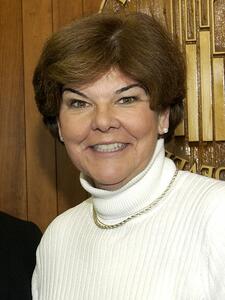
Ann Compton
I’m looking forward to this, and I thank you very much for even inviting me to do it.
Barbara A. Perry
Well, first of all, Bill [William J. Antholis] and I had been talking about this for ages. When we were standing in the parking lot of the Miller Center after you and Bill were on stage for the 9/11 film for the [Virginia] Film Festival, Bill and I said, “We’ll be seeing you, Ann. We want to do your oral history.” With that we said, “We’re doing this now.” You were the first person in our batch of spring-term invitations to say, “Yes, I can do it.”
Compton
Oh, good.
Perry
All right, so here we are. Tell us about Ann Compton, because you and I talked about your background, in part because it’s similar to our communications head, Howard Witt, and our mutual friend, Suzanne Whitmore. You come from the North Shore of Chicago area? Were you born there?
Compton
Yes. Mom and Dad, lifelong Chicagoans, were married there, on the South Side, about a block from where Barack Obama’s house is. I grew up in a house on the next block from where Barack Obama’s house is on Greenwood, so we’re longtime Chicago families. When I was about five they decided to move us from the South Side, which was wonderful, and their whole life, up to the northern suburbs.
I grew up in Glencoe, Illinois, which is home to all of the John Hughes movies like Ferris Bueller and Home Alone. I skated on that rink. The beach scene is where I grew up learning how to swim. My whole life that I remember was in Glencoe, Illinois, and huge New Trier High School, where I got to know the families of future White House Chief of Staff Don Rumsfeld, and Sharon Percy Rockefeller was a senior when I was a freshman, so there are wonderful ties to the North Shore of Chicago. My picture on the New Trier Hall of Fame is right below Rahm Emanuel’s, so this was an upbringing that just kept on giving.
I went to a huge public high school. There were more than 1,200 in our graduating class, so I wanted to go to a women’s college. It was the era when Harvard, Yale, the Ivies did not accept any women undergraduates, so I applied to Wellesley early decision and cried when I was deferred. But a college counselor and then a friend of my mother’s said, “Well, why don’t you look at Hollins?” which I had never heard of. I went to the school library and read the catalog of this women’s college in the South cover to cover. It wasn’t a brochure; it had the class listings and everything—and I fell in love with it. Dad flew me down there in February of my, gosh, what would have been senior year, and I loved everything about it.
I had four glorious years at Hollins College in Virginia, which instituted in my junior year a mandatory January term. We had first semester and exams before Christmas. We had the entire month of January, where we were forced to do an independent study, an internship, a research paper, something academic in which you could just focus on one thing, and I took an internship at the local big station in town, the CBS [Columbia Broadcasting System] station, WDBJ Television.
Perry
What prompted you to do that? What were you majoring in? And if I could back up, what did your parents do?
Compton
Well, I was majoring in drama, which has no relation to anything else in our family. I loved the theater. I loved literature. I loved staging. It was something that interested me in high school. I did summer musicals and high school musicals and high school plays. That was something that was just an enjoyment for me. It was nothing that I ever considered as being a professional track.
Perry
What about politics when you were growing up? Did your family talk about politics?
Compton
My parents were conservative Republicans. My mom was an election judge, so I know all about these election judges. Every Election Day she would go in at dawn to the local village hall, the police precinct, and set up—She’d be the Republican judge, and a friend of hers was the Democratic judge. She’d be there late into the night until they finished everything.
While my mom and dad were interested in civic affairs, it was nothing that touched me at all. In fact, I got through high school American history figuring, I’m never going to remember all this, so I memorized the names of the Presidents: [George] Washington, [John] Adams, [Thomas] Jefferson, [James] Madison, [James] Monroe, [John Quincy] Adams, [Andrew] Jackson, [Martin] Van Buren, [William Henry] Harrison, [John] Tyler, [James K.] Polk, [Zachary] Taylor, [Millard] Fillmore, [Franklin] Pierce, [James] Buchanan, [Abraham] Lincoln, [Andrew] Johnson, [Ulysses S.] Grant, [Rutherford B.] Hayes, [James A.] Garfield, [Chester A.] Arthur, [Stephen] Grover Cleveland. That’s what I took out of American history when I was in high school. [laughs]
My dad was in advertising. He was a Chicago ad man. I call him “Don Draper” without the sex, liquor, and cigarettes. My mom was the beautiful blonde bride. I was the eldest of four children. Mom became a real estate agent once we kids were all in school. We had a wonderful, wonderful family upbringing. I’m the eldest of four kids. There are no journalists in either of my families, in any of my in-laws’ families, and no journalists among my four children.
Perry
So what prompted you, then, to go to this affiliate in Roanoke for your J-Term project?
Compton
It interested me in that my dad, being an ad man who sold airtime to client advertisers—He came home from work one day and said he just sold Sea Hunt to Hamm’s Beer, and he was so thrilled. This is way before—Neither of you are old enough to remember Sea Hunt or—
Perry
Lloyd Bridges, right? Sea Hunt?
Compton
OK.
Perry
I got it. Just for the record, it was a nationally produced television show with the father of Beau and Jeff Bridges, the actors.
Compton
He was an underwater diver, and it was an adventure show. Think of Hawaii Five-O, but on water. I was aware of his broadcast interests. My major professor, the head of the drama department, had a good relationship with the station, and one or two other girls during summertime had gotten internships there, but I got the first academic internship. I just wanted to go and learn all about everything that the TV station did.
It was a fascinating moment in Virginia politics, when a Governor’s race was coming up. It was the end of the old [Harry F.] Byrd machine, where the Democratic Party leadership was older white men who closed school systems rather than open them to blacks. A Republican from Roanoke was running for Governor named Linwood Holton. I kept going down to the newsroom at the end of the hall, and they had three anchors—for morning, six o’clock, and eleven o’clock—no reporters; they all had to go out and do reporting as well. There were a couple of great cameramen, a news director. I was just fascinated with everything they did, and that’s where that little drop of ink got into my veins.
That was my junior year. Then I went back to my drama major and got some wonderful courses in literature and directing. I didn’t do a lot of acting, but I designed sets. I could take apart the lighting and put it back up again.
Perry
This is why your home background is so beautiful. [laughs] You staged your living room.
Compton
Thank you. February 12th of my senior year at Hollins all my friends were either getting married—a lot of them got married—or they were going to graduate school or going to New York to work for Sotheby’s. That was kind of the—
Perry
That was 1969.
Compton
Yes, 1969. Where we are in the world—We’ve been through the ’68 election; we’ve been through the assassinations of 1968; we had American center-city protests against the Vietnam war. It was an incredibly roiling time. Richard Nixon was elected in ’68. I’m trying to think. The Vietnam war, and of course the Civil Rights and the Voting Rights Acts were now law and were being implemented, so it was a fascinating but a very politically explosive time. February 12th of my senior year there was one phone booth on the girls’ dormitory hall where I lived, and someone yelled, “Hey, Ann, you’ve got a phone call.” It was the general manager of WDBJ Television, John Harkrader, a gracious Southern gentleman, asking if I would accept a job on graduation, $100 a week, as a young reporter for WDBJ.
I realized they had never, ever had a woman on the air. I said, this may be a tumultuous time in the country, but it’s also a very important time for women, and women’s education and a woman’s entrance into a marketplace. Literally four years later I’m covering the Holton administration in Richmond in the State Capitol, and my phone on my little, tiny desk in the press room rang, and it was ABC News in New York saying, “We’ve been given your name by some TV [television] stations in another state, and we’d like to offer you a job as a correspondent at ABC News.” They were desperate for women. My timing of being interested in news at a volatile time, and being a woman—often the first woman hired for a category—made all the difference.
Perry
It’s so inspirational. Stefanie, anything at this point that you want to follow up with?
Stefanie Georgakis Abbott
Ann, I’m curious, reflecting back on a women’s college education, especially at this important moment in the country’s history, were you happy you went that route? What were your takeaways? How did you feel about having gone through a four-year women’s college?
Compton
I had two reactions at the time. One is, again, I came from a huge public high school that was considered top of the world in a silk-stocking area, a famous American, very successful high school, but huge, and obviously co-ed, where the president of each class was a boy and the vice president was always a girl. I got to Hollins and it was an even playing field. In class you were not sitting with some loudmouth boy over here, or some competitive bully over here.
They were all women, and they were all smarter than I was, so I found four years of a women’s education not unusual or not odd. Some women wondered whether it would feel kind of artificial because it wasn’t the real world; I found it life affirming because it was the first even playing field that I had come across. I look back now at all the friends I have.
I did not get into Wellesley with Hillary Rodham [Clinton] that year, or my good friend Betsy Griffith, the historian here who’s coming out with a new book on women since they got the vote, but some of my best friends are women who also came through the educational years, and then into professional years, at a time when the doors were finally really, really opening to women.
Abbott
Amazing.
Perry
We’ll come back to you, Stefanie. Our first meeting, Ann, you may recall, was in 2000, when I was at Sweetbriar College, again, one of the women’s colleges in Virginia. The reason I reached out to you, in addition to knowing you have covered the White House for many, many years, and we wanted you to come to Sweetbriar to talk about your experiences, but I knew you’d gone to Hollins, and I thought, Ann Compton will have an affinity for a woman’s college in Virginia.
Compton
I have given commencement addresses at almost every women’s college in Virginia, not at Sweetbriar, but at all the rest of them, I’ve done it. At Mary Baldwin, I took my ten-week-old daughter with me, my only daughter, in her bonnet and little dress. I wanted them to see—not only the young women, but I also wanted the faculty and the parents to see—that this is what women can do. They can not only have a cool job covering the White House but—at that point—they could also have three small babies.
Abbott
Well, if I may, Barbara, just ask one follow-up question on that. Ann, you left a four-year women’s college, you had this women’s educational experience, and then you went into a male-dominated field to work for a station that had never had a woman on air. What was that transition like?
Compton
I was so focused on learning how to be a reporter because there were no communications, no journalism classes at Hollins or any of the women’s schools; there was no training. Eric Sevareid used to say that the print journalists who went into television learned at the expense of the audience, and I thought, well, that’s me, too. I’m going to learn how to do this at the expense of—WDBJ covers parts of West Virginia, North Carolina, but it doesn’t even reach to Big Stone Gap.
The hindrance that I found was my age and my lack of experience. I had to work twice as hard, not only on the local scene to get to know the local politicians and how local government works in Roanoke County versus the City of Roanoke and the City of Salem, but also to see how state politics works.
The station, and John Harkrader, who called and offered me that job, deserve great credit, because it was years later that I saw a letter a friend of mine had written to him, saying, “Don’t you listen to any of those audience people who call in or write to you and say, ‘Get that girl off the air. She doesn’t know what she’s doing. She’s too young.’” He protected me, and he kept me on there, and then was very proud when I left four years later to go off straight into the network—a different network even.
The biggest hindrance for me was not that I was a woman. The biggest hindrance was that I had so little experience, so little historical knowledge about journalism, state politics, the kind of responsibilities of putting the First Amendment into operation, that I did feel handicapped. I will tell you that by the time I got to the White House at the age of 27, I had to work even harder because the people around me were so experienced.
Tom Brokaw was in this booth. Dan Rather, Bob Schieffer, Bob Pierpoint, Phil Jones were in this booth at CBS, Herb Kaplow of NBC [National Broadcasting Corporation], and the print reporters, Peter Lisagor of the Chicago paper, and Jim Deakin of the St. Louis-Post Dispatch, the New York Times, the Washington Post correspondents could not have been more supportive, more helpful, pointing me in the right directions on things, explaining things that I didn’t understand. The support I got from the senior men in the White House press corps and in the State Capitol press corps in Richmond was extraordinary, and when I got to Washington I had somebody like Helen Thomas, who said, “How can I help?”
Perry
Oh, I loved her. Well, before we get you to the White House and to Washington, tell us about New York and that experience going into ABC in the Big Apple.
Compton
ABC was desperate for women. They had hired two women correspondents, both named Ann. Ann Medina was Canadian, and she worked out of New York for 13 weeks and was gone. Ann Kaestner, I don’t know where she was stationed, but she covered Wounded Knee and left the network after that. They hired me, and they took me to New York for a year. I was there for 15 months, and it was really a great way to begin to look at the world in national and international terms, because all I’d covered was Virginia. It was just before the Six-Day War in the Middle East. They had me four or five days a week anchoring network radio newscasts, which means you take the whole world, you write very economically, and you have three minutes of what’s important at the top of the hour or the bottom of the hour, whatever. ABC had lots of newscasts. It was probably the best training ground I could have asked for.
There was one other woman on the air. She worked a different hourly schedule than I did, but she’d been around for years, and she was also very, very supportive. All the desk editors were men. There was one other woman reporter. All the bosses were men.
The time in New York was a period of growing up, not only professionally, because I’ve now looked at the world, and the global impact of things, and had to learn very fast on that, but I also had to learn how to live in the big city, all by myself in an apartment at 3 East 82nd Street, right across Fifth Avenue from the Metropolitan Museum. I used to keep my windows open so I could hear the fountains at night. Joe Namath lived right across the street, and I could look into his apartment.
Perry
[laughs] “Broadway Joe” of the [National Football League] Jets.
Compton
Yes, Broadway Joe. One year for a 26-year-old living in New York was absolutely fascinating. I’m anchoring the radio newscast, then they’d send me out to do man-on-the-street interviews outside Lincoln Center. Our studios overlooked Lincoln Center. Richard Nixon resigns, and then ABC’s junior male reporter at the White House got very huffy with management and said, “Well, if you’re not going to let me anchor the news on the weekends, or the network news on the weekends, I quit.” They said, “Goodbye.” [laughs] They called me in and said, “We’re going to send you to cover the White House.” I’d been at the network 15 months. I went home in tears. I loved New York. I loved everything about it.
I’d done a fellowship in Washington during my first year at WDBJ. They let me go do a four-month fellowship at the Washington Journalism Center, and I loved that, too, so I packed up and moved to Washington. To get to your point, Stefanie, that’s where it was probably the best advantage I had to be a woman in a man’s world, because there were no other television networks that assigned a woman to the White House, and I got a lot of attention.
Perry
Tell us about that. What kind of attention, and what did that mean for you and what you were reporting and your career?
Compton
Gerald Ford took over as President of the United States, and with him Chief of Staff Don Rumsfeld, whose family I had known back in Glencoe. His dad, George, was a real estate agent. My mother was a realtor. I remember going into the office. I figured, The Chief of Staff, I already know him, but I’ll go talk to the White House Deputy Chief of Staff so I can have somebody I can call. He’ll have more time to talk to me on the phone. Naïve me. I made an appointment, went in, walked to his office, said, “Hi, I’m Ann Compton. I’m new to the ABC News team. I’ll be calling you, and I just wanted you to put a face with the name,” and Dick Cheney said, “OK.” He still tells that story. Every time we’re together he tells that story.
I was able to go around. I could meet every senior person on the White House staff. I could sit in the front row. There were no rows in the Briefing Room; it was set up like a men’s club: tufted sofas, Currier and Ives prints on the wall, captain’s tables and chairs. It was basically a waiting room for the daily briefing, which was never on camera, so I had a chance.
By the time I could pack up and get down there, Gerald Ford had just pardoned Richard Nixon, and the CIA [Central Intelligence Agency]—You guys are too young to remember the big crisis at the CIA. A CIA agent was killed in Greece because somebody had let his identity out. It was a big time of turmoil. I was in on the beginning of the Ford administration, and Ford was very generous, very open to the press. He knew everybody. He got to know me right away. The fact that I was young hurt me, because I had no institutional memory. Funny: I left the job with more institutional memory than anybody, but I didn’t have it then.
I was young, I was inexperienced, but I was there every day, all the time. I was 27 years old, single, devoted to my job, hands-on in a way that not all correspondents who have families and other commitments could be. Being a woman made me highly visible. Maybe it made sources—Even the President’s doctor was willing to talk to me. Maybe I didn’t seem as threatening as somebody who was a hard-bitten political journalist.
Moving into a brand-new administration, with obviously many holdover appointees—but the Ford administration cleared out the Watergate remnants and moved forward—and to be part of that at that moment of time gave me an entrée, which allowed me to go in and do my job, to learn my job, and make an impression on people. Of course many of those were people I covered again, like Dick Cheney and Andy Card and any number of others.
Perry
Don Rumsfeld. [laughter]
Compton
I covered him for decades.
Perry
On the gender note, it makes me realize that it was about that time, not long after Ford became President, that Mrs. [Elizabeth Anne, “Betty”] Ford, the First Lady, was diagnosed with breast cancer. Did you cover that story?
Compton
Oh, indeed. I covered Betty Ford a lot.
Perry
Tell us about that.
Compton
There is an interesting anecdote that I will throw in at this point. Both Betty Ford and Gerald Ford were very open to the media. They weren’t afraid of the media. They’d been in Washington their whole married life. When she was diagnosed with breast cancer, she was already outspoken and campaigning in favor of the ERA [Equal Rights Amendment]. Her husband was lukewarm on it, but she was out there. I traveled with her around the country doing things. But because she wanted to be outspoken, and she had a very, very aggressive press secretary, Sheila [Rabb] Weidenfeld, who wanted Mrs. Ford to get out there and wanted her to have contact with us. Betty Ford I wouldn’t say was ever a source, but she was a source of events and a source of news that was open to being covered by us, and I was the junior member of the ABC team, so I got to do the junior-most stories.
They were in office for two and a half years, and it became obvious to any of us who saw her with any regularity, and probably to the public, as well, that there were times she wasn’t totally plugged in, that her speech wasn’t fluent, a little spacey. During the campaign when he was running for election in 1976, I was on the flight with her. She and I were flying into Williamsburg [Virginia] to join President Ford for the last Presidential debate.
I had an interview with her, with my camera crew on the book, an exclusive interview, and I came up into her cabin. We sat there, and after I asked about the politics and everything, I said, “You know, Mrs. Ford, sometimes your speech sounds a little slurred or not as distinct. Is there a reason for that, do you think?” And she smiled. She put her hand down on mine. Betty Ford said, “Oh, I’m just not the public speaker that you are, Ann.”
The camera cut off, and the camera crew left, and she reached out for my hand again, and she said, “Someday you and I will sit down with a cup of coffee and I’ll tell you all about this.” At that point she and her staff knew something had to be done. It was years later when she finally got the help she needed with a family intervention. She got the help and then, of course, went on to crusade for healing. But there was an intimacy about that. I don’t know that a male colleague could have gotten quite that same interview.
Perry
That’s fascinating. Stefanie, any follow-up to that? We don’t usually skip ahead—We usually go chronologically, but because this is going to be part of the Obama project, we wanted to jump ahead to that, and then once we’re finished with your experience in the Obama administration, we’ll circle back and again cover themes and any other Presidential stories, First Lady stories, et cetera, that you want to share with us.
Shall we start at the beginning with Obama in 2008 coming toward the end of the Bush 43 administration in 2008? It would end in 2009. The economy is collapsing, the financial markets are collapsing and seizing up, but you have this young man from Chicago, this young Senator, Barack Hussein Obama, who is connected, along with his wife, to the area of Chicago where your parents lived, and where you were born and lived for the first five years of your life. But he’s also running for the nomination against the person who’s clearly out front, one thinks, at the beginning, a Wellesley graduate, as you would say, from that class, Hillary Rodham Clinton, the former First Lady, and at that point a Senator. What were your thoughts about this most unusual Democratic race for the nomination, and did you cover it?
Compton
To set a bit of a broader stage here, George W. Bush had not only been President for eight years, but the wars in Iraq and the kind of forgotten war in Afghanistan were gnawing at his administration. The economy began to slide off of a cliff. I’m sitting there in the White House Press Room. I was president of the White House Correspondents’ Association, and had helped create this new professional Briefing Room.
Those of us sitting in the seats of the White House Press Briefing Room didn’t even really appreciate the extent to which the economy was being crippled. We focused first on housing, and the administration didn’t seem to have a very good grip on why the housing markets were so bad and all the speculative mortgage lending. One of my colleagues asked President Bush once, “Well, gasoline costs are going to be up to four dollars a gallon,” and Bush answered at the podium, “Oh, I didn’t know that.” All of us covering the White House, and maybe those inside the White House, didn’t realize the extent to which the economy was really skidding right off the edge of a cliff.
During the year 2008, I spent the primary season covering Hillary Clinton. I asked President Bush in private, “So who’s the Democratic nominee?” He said, “Hillary,” and he was saying that all the way up through March into April. At the end of March I remember asking him the same thing upstairs in the Residence. He said, “No, it’s Hillary.”
I spent a lot of time out of the White House during that time. I had known Hillary Clinton and covered her, obviously, for the last—well, gosh, it would be her eight years plus the Bush eight years, so I’ve known her since Chelsea [Clinton] was 12. I had traveled the world with Hillary Clinton, and she knew me well, and yes, I assumed that she would be the Democratic nominee. But there was—
Perry
Can I pause there? Because I noticed in the briefing book that you were on a panel, at Brookings in 2001, as Bill Clinton was leaving office. It was a retrospective on his Presidency and predicting how history would view him. You all were talking about 2018—“Well, what will people think of him?” I couldn’t help but notice that in 2001 you mentioned the Clinton Presidency, and you were referring to Bill Clinton but also the Hillary Clinton Presidency. You were already thinking in 2001, apparently, that she would run for the Presidency and win at some point.
Compton
What that reflects is this: as reporters, we talked a lot about dynasties in the late years of the Bush administration, as Hillary Clinton was clearly gearing up to run for President. Should there be a Bush dynasty, father and son, brother [John Ellis] Jeb [Bush] out there somewhere, who eventually ran for President? Could Bill Clinton then bequeath the torch to his wife? That would have been historic.
There was a lot of feeling about dynasties and whether that’s even appropriate for a republic and a democracy like the United States of America. When we talked about Hillary, it was in terms of should there be a dynasty, and maybe if Jeb gets elected sometime in the future, Chelsea will run after that. It almost became a running joke. But it was no joke to know that Hillary Clinton was ambitious, and President Clinton had told us many times, “After my eight years it’s Hillary’s turn. Whatever she wants to do, I’m on board. It’s her choice after that.” While I don’t know that I ever thought she would be President, it was clear that—because at this point she was in the United States Senate.
Going into the election year of 2008, Barack Obama was out there showing some interest, “showing some ankle,” but the whole dynasty question—Would the Bush dynasty give way to a Clinton Presidency to a Bush and then maybe to another Clinton?—colored our reporting and our perspective on the race, and that’s why Barack Obama began to come out of the woodwork as somebody—Well, maybe Hillary Clinton doesn’t have a lock on this?—and he went about it aggressively.
Barack Obama, in his primary runs, went around picking off local, statewide, and national Democrats, plucking them off of the Clinton tree and plugging them into his own administration. Part of that had to do with Hillary Clinton’s lack of popularity among some within his own party, but also a strategy by Barack Obama that you don’t just get elected by winning caucus voters and primary voters; you have to have the political establishment to build your case around. And the final pluck for Barack Obama I believe was in January when President [John F.] Kennedy’s daughter announced that she would support Barack Obama, and they had the big event where Caroline Kennedy sat there, and Barack Obama sat there, and she said, “I’m supporting Barack Obama.” That’s when we felt the Earth move.
Perry
Did you cover that, Ann? That was at American University, and it wasn’t just Caroline, remember? It was her uncle Teddy, Senator Edward Kennedy. She had already written an op-ed saying that for her whole life people would come up to her and say, “Oh, your father inspired me so much,” and she said in the op-ed, “I always hoped I would find a candidate I could feel that way about,” and she said, “I have found him, and it’s Barack Obama.” Then Teddy joined, as well. That was true in January of ’08: they supported Obama, and there he came into the auditorium to great applause. But the Kennedy Camelot magic—You talk about dynasties—now enveloped him.
Compton
Yes. Without a royal family in America, dynasties had always been kind of out there, but had never really been considered a solid part of American democratic, with a small D, tradition. When that happened, I was watching the Obama emergence from the cocoon of the Hillary Clinton campaign, which became over the next couple of months one of the saddest places in America. Every inner city we went to, she had to rely on unions turning out crowds for her, everybody in a union jacket. She had to go into deep downtown Detroit, downtown Pittsburgh to get crowds and to make her case. And the Hillary Clinton campaign was where I was through Barack Obama’s growth, so I watched Barack Obama grow as a force to be reckoned with that would sink the campaign that I was on.
It was amazing to watch, because, again, to me, the shift of Democratic Party regulars, the establishment Democratic Party, began slowly migrating out of Hillary’s camp and into Barack Obama’s camp, and it made the Hillary Clinton campaign kind of a sad place. She even went after the primaries all the way to the Democratic National Committee. We were over at the Omni Shoreham Hotel at the daylong Democratic National Committee meeting, and went behind closed doors. They decided that no, Hillary can’t have those contested delegates in Florida, and Barack Obama would be the nominee.
That was the ultimate—We stood out in the lobby of that hotel and waited for the Democratic National Committee to open the doors and decide whether Hillary Clinton would get the Florida delegates that she begged for and she had been told she couldn’t have. When the doors opened and they said no, she cannot have the Florida delegates, the entire axis of the political Democratic world shifted to Barack Obama.
Perry
Stefanie, as co-director of the Hillary project, is our resident expert on Secretary Clinton. I want to turn to Stefanie. Anything that you want to probe about 2008?
Abbott
Maybe you don’t want to jump ahead this way, Barbara, but since we’re on the topic of Hillary Clinton, I’m curious then what you thought about President-elect Obama’s choice of Hillary Clinton for Secretary of State. Having watched Obama’s campaign from covering Hillary Clinton’s campaign, reflect on that for a moment, if you will.
Compton
Those were the months in which Doris Kearns Goodwin got more airtime than any other historian in history talking about a “team of rivals,” since there wasn’t much coverage back in the 1860s. [laughter] This was the whole idea that someone like Abraham Lincoln could pull to him people who had not been his supporters. He was not rewarding those who helped him get there; he was pulling together people that he felt he could work with moving forward in a time arguably much worse than 2008 was for the nation, whether it’s financial cliffs or civil wars.
I don’t remember how President-elect Obama explained it at the time. Let me see if I can phrase this correctly. The idea that in such a divisive time within the Democratic Party, and between the two parties, that Barack Obama decided to take somebody who had been his arch enemy, his absolute antithesis, and say, “But to move forward I want your help and expertise”—and it wasn’t even in a field that was her specialty, like health care or education; this was foreign policy! She’d been a Senator for four years.
Perry
By that time it would have been about six years? Was she elected in ’02 from New York?
Compton
She was elected in 2000, wasn’t she? She was elected the year that her husband—
Perry
While she was still First Lady. Is that right?
Compton
I’m pretty sure that’s right. But—
Perry
So she had had about a half dozen plus years in the Senate, right?
Compton
Which was a little bit more than Barack Obama had had. [laughter]
Perry
And her travels as First Lady, and her work in the field—
Compton
Which is counted, and Stefanie, when you get to it, I was on all of her foreign trips, and they were absolutely the best trips I ever did. But to go back to your point, Barack Obama’s brain trust was behind him—the David Axelrods, the David Plouffes, the people he really counted on. There were so many really good people around him, staunch establishment Democratic powers, not necessarily household names, but people that he really trusted. They must have encouraged this.
I think it was one of those strokes that set Barack Obama apart from the rest of the Democratic field and the rest of Democratic history, by saying, “I’m going to bring the party together. I want to move this way forward.” That was obviously one of the defining decisions that he made in those months, in those weeks, actually, when he was able to put together Team Obama.
Perry
Let’s back up just a little bit to Hillary’s concession speech in 2008, where she refers to the cracks in the ceiling. We focused a lot on gender, for obvious reasons, with you. What did you make of that? What was your reaction to that?
Compton
Personally, I feel sorry for anyone I have covered that they get up to the very finish line and they don’t cross first. She talked about how she had put 18 million cracks in the glass ceiling. She got absolutely as many votes as Barack Obama did during the primaries—They both got about 18 million votes—but he got the delegates. I saw a woman who was struggling with not being Pat Schroeder—when she bowed out of the Democratic race years earlier and just couldn’t hold it any longer and burst into tears. Hillary is not a crier in public.
By the way, in the years that I have covered not only American Presidents but foreign leaders, why do we all call the women leaders by their first name and the male leaders by their surname? You remember Maggie Thatcher, and [Corizon] Cory Aquino, and Indira Gandhi, and Golda Meir. We tend to us their first names—and Benazir Bhutto—not just because their surname was also a leader—Benazir Bhutto’s father, [Zulfikar] Ali Bhutto—but to me it’s always been kind of a diminutive to call the women leaders by their first name.
But Hillary Clinton must have been devastated, and knew in her speech, when she was finally yielding to Barack Obama, that she didn’t want to lose an inch of space. She didn’t want to lose an inch of how far she had come, and have it not count, so she made the point about how far she had come, 18 million cracks in the glass ceiling. She staked that claim at the cost of maybe not being quite as gracious as she could have been to Barack Obama.
Perry
How about on the Republican side for 2008? John McCain? Had you had any relations with him in terms of covering him as a Senator? We certainly want to talk about his coming in September of 2008 to the White House, when he called for a meeting to talk about the collapsing economy and said he was going to put his campaign on hold and duck out of the next Presidential debate because he needed to focus on what was happening in the economy. We also want to talk about Sarah Palin as his running mate, so the floor is open for you to comment on all of that.
Compton
One of the reasons the White House press corps and the national press corps so love John McCain is he was a maverick, and he would take positions that would drive others in the party nuts, but he would do it in a way that always sounded pretty righteous. What was important in 2008—I covered him a little bit in New Hampshire, when I was up doing Hillary coverage, and I would stop in at the firehouse where John McCain was talking to the fire crews. I never traveled with him during 2008.
John McCain would take positions that really resonated with a lot of people, Republican and Democrat, and it made him very popular among the White House press corps, the campaign press corps, because he was also so accessible. You could ride with him on the “straight talk express.” You could get up to him anytime and ask him absolutely anything. He was a seasoned Washington politician and he always had a glib answer. A lot of reporters loved covering McCain because he was always a good story.
I remember riding on the Obama press bus in whatever city we were in before the Republican Convention—by then we had cell phones—when our cell phones and pagers crackled, saying, “John McCain has chosen Alaska Governor Sarah Palin as his running mate.” On my phone I looked her up on Wikipedia or her state bio or something, and I looked at the names of the children: Piper [Palin], Bristol [Palin], Trig [Palin], and Track [Palin]. We had not focused on her much before. That was the beginning of the end of the McCain candidacy, because she could come up with great lines about “What’s the difference between a hockey mom and a pig? Lipstick,” but she was a liability from Day One.
On the Obama campaign, I think they also saw her as a liability from Day One. Can you imagine anything that’s more the mirror opposite of Sarah Palin than [Joseph R.] Joe Biden [Jr.]?
Perry
How about that meeting? As I understand it, when we talk to the Bush 43 people, they all say the President did not want to have that meeting at the White House, that McCain was indicating he was going to come and hold forth about what he would do, but the President felt like he had to do it, so he did. You tell the story. How did you cover that?
Compton
Well, at that point I was with Obama. What month was that?
Perry
That was September of ’08.
Compton
Yes. I was still on the road full time with Obama, but the Obama people were obviously looking at and tracking this. If George Bush were a Republican President who believed Republican Presidents should follow him in office, I could imagine embracing the idea: “Let’s get John in here. Let’s give him a platform. Let Americans look at him not as a Senator, but as somebody who’s bringing national economic rescue policy to the American people who are really hurting.” But they were reluctant to do that.
For McCain’s political purposes, dealing with Barack Obama—McCain was a senior Republican in a position to really get out there and do something and say something and lead on the economy. Barack Obama was a four-year veteran of the Senate, which isn’t very long. He didn’t have a big track record and didn’t have any personal leadership position. Barack Obama didn’t have any personal leadership record at that point. It was how good a game he talked; it was not what he had done. To even offer to give up a debate so that you could work on something that every American family at their kitchen table worried about was a pretty good move, and I think the Obama campaign realized it.
Perry
Stefanie?
Abbott
I’m OK for now.
Perry
OK, good. Just hold up your hand if you want to jump in.
Ann, you are a veteran of Presidential debates, and I have to say I had so much fun going through the briefing book, reading the transcripts of the debates you were involved in. I remembered that you had been on the panels on these debates, but it was just fun to remember the issues in 1988 and 1992 and to think of the personages you were questioning. We can talk about it now, if you wish, but also, since we’re in ’08, did you cover the debates in ’08? If so, let us know your thoughts about McCain and Obama debating, or Biden and Palin debating. Then I do have one specific question about debates, and that is: Your questions are so good. How did you develop your questions?
Compton
Well, let’s start with this: I’m going to give you some debate stories in the background, but I definitely want to get to the 2008 debates. The two times that I was invited to be on debate panels were ages and ages ago. In fact, Margaret Warner and I had lunch yesterday together.
Perry
How is she doing?
Compton
She’s healing from a bad fall, and she’s doing really well, but it’s been a year plus. She had to move out of her house and into an apartment. She hurt her back very seriously.
Perry
Oh, I’m so sorry. Give her our best.
Compton
But she’s great fun. So, Presidential debates had been taken over by the bipartisan Presidential Debate Commission run by Republicans and Democrats, party insiders, very establishment. You might be interested to know that the first one I was invited to be on was the last debate of 1988. Margaret and I were talking about it yesterday.
We got the call 36 hours before the debate, asking if we would participate—literally 36 hours before! I was on Lloyd Bentsen’s campaign plane in Allentown, Pennsylvania, and we were taxiing for takeoff to go back to Washington. The pilot got a message from the tower that Ann Compton had a phone call waiting for her in the terminal. The plane turned around, and Bentsen and Joe O’Neill, the campaign chairman, and Mike McCurry, the press secretary, came running back to me and said, “Go, go, go, let us know what it is.” They knew exactly what it was. I didn’t. They did.
I’m given a phone number with an LA [Los Angeles] area code. It rings. Ed Fouhy, my former ABC News bureau chief, who is now executive producer of the debates, picks up. “Ann, this is Ed Fouhy. I’m calling on behalf of the Presidential Debate Commission. We would like to offer you a place as a panelist on tomorrow night’s debate.” I said, “Well, Ed, I’m going to have to check with my boss.” He says, “Yes, call him. Call me right back.” So I call, and in New York all the ABC management is sitting in a conference room at a telephone waiting for me to call. [laughter] I didn’t know.
They put me through and said, “Do they want you to be the moderator or a questioner?” I said, “A questioner.” They said, “Good, good, good. Yes, you can do it.” So I called Ed back, got back on the plane. Bentsen is thrilled and Mike McCurry’s ecstatic. By the way, he’s now, I think, the ranking guy on that debate commission.
We flew home to Washington. Roone Arledge, my boss, called and said, “I’ll give you anything you need.” I said, “A good makeup person.” [laughter] I went home, four little kids asleep upstairs—I got home late at night—and I told my husband about it. I’m lying in bed all night writing down questions. No research, no time to really think things out. It’s the last debate of the campaign.
When I got to Los Angeles the next day, I said to Margaret and to Andrea Mitchell, the other questioner, and to Bernie Shaw, who was the moderator who got to ask the first question but otherwise was timekeeper, I said, “Peter Jennings called me and he said, ‘Ann, 90 minutes is a long time. We all walked in there for the Vice Presidential debate with the same six questions. Make sure you have enough questions.’”
So I said to Andrea and Margaret, “Let’s meet in my room in the morning. I’ll order coffee.” They hid us in a little hotel somewhere in Los Angeles so we’d have total privacy. We ordered coffee and sweet rolls, and we went to yellow pads to make sure we had the Supreme Court, the nuclear triad, all these other things. I had my little list of questions. It was a time when a lot of sports heroes were getting in trouble with drugs and losing their places on teams, and I wanted to ask the candidates, “Who in American society can young people look to as heroes these days?” And of course, famously, George [H. W.] Bush’s answer was Tony Fauci. [laughter]
Perry
Yes, I underlined that in the briefing book.
Compton
Anyway, so Bernie said, “We’re professionals; we don’t write each other’s questions,” so he didn’t want to show up, but he came to my room, shut all the curtains, and said, “You never know; the Bush people might be out there trying to find out what we’re saying,” and he finally told us that his first question going to [Michael S.] Dukakis would be: “If [Katharine] Kitty Dukakis were raped and murdered, would you oppose the death penalty?” Andrea said, “That gave me chills,” and Margaret said, “How about just taking Kitty’s name out of it?” He would not be moved. That’s the drama that we went into in that debate.
We tried three times the next day, the day of the debate, to talk Bernie out of it. We couldn’t do it. When he asked the question, in the darkness behind us in the hall, where the all-partisan crowd had been sworn to be quiet, out came the words, “If Kitty Dukakis were raped and murdered—” There was this gasp—loud, breathy [imitates gasp]—from behind us, and we knew that the debate was over at that moment, that there was just no saving it.
The second debate I did was in ’92. I was surprised to be invited, because I’d just been on the most recent one. It had three candidates: Bill Clinton, [Henry] Ross Perot, and the President of the United States, George Herbert Walker Bush. I remember Roger Ailes standing right off the side there—He was managing things for Bush, the President. Perot was in the middle and Clinton was on this side. Hillary and Chelsea came in and sat right behind me, down in the audience, and they had a little step stool for Chelsea because she had twisted her ankle in a ballet class. She had a little stool to put her bandaged foot up.
That debate, because it was three ways, was a challenge. I was back with Jim Lehrer, who was the moderator, John Mashek, and [Sander] Sandy Vanocur. I don’t even remember much about the content of that, except that Perot came up to me at the end and said, “They told me that the first question you were going to ask me was what are the last three books you’ve read,” [laughter] which had not been one of my questions. I said, “Well, what are they?”
Perry
You don’t remember what he said? Well, let me ask you this, Ann, because I can’t resist, having read the transcript—and I wouldn’t be the first person to notice this. There’s a lot of populism in Ross Perot, and there’s a lot of populism in his answers. Many people say that was really the forerunner of [Donald] Trumpian populism because Ross Perot talks a lot about “The people will send me to Washington. The people in Washington typically don’t know what they’re doing, but I’ll be the representative of the people.” Of course he was all about balancing the budget, so he talked a fair amount about that. What impact did he make on you during his campaigning—he’s in, then he’s out, then he’s back in—but also at the debate itself?
Compton
Just one little anecdote. It probably won’t be of much help to you. When the Democratic Convention was underway, I was with President of the United States George Herbert Walker Bush, who went to the Grand Tetons and stayed at [James A., III] Jim Baker’s ranch down in Pinewood [Wyoming], just south of Jackson. Jim had a little farm there, a little ranch. And it was Jim Baker; his wife, Susan [Baker]; and the President of the United States, hanging out during the Democratic Convention.
I did a live shot on Good Morning America that morning, so I was still in the empty press room that morning when the announcement came that Ross Perot was dropping out. The White House grabs me and a camera crew and puts us in a car, and we drive an hour down to Pinewood, Wyoming. Out at a wide place in the road the President of the United States came out to react to it, and he was thrilled that Ross Perot was out of it. It lasted a couple of months. I do remember that moment and what it meant to the Bush campaign: a sense of relief. Also, the Bush campaign—by the time we got to the homestretch, we could tell how the traction was gone.
This, again, won’t help you, but I’m going to get this on the record anyway. On election eve in Houston I’m standing at the foot of the big platform where George and Barbara Bush are standing, and all the country music stars in Houston. This was the big, last rally. It’s almost midnight. I’m right at Barbara Bush’s shoe level and I’m looking up, and somebody’s singing “God Bless the USA” or something. She turned around and she looked at George, and I saw her lips move: “It’s over. It’s over.” She knew it. That was just a poignant, poignant moment. Do you want to move on back to Obama’s—?
Perry
Absolutely, to the debates with McCain.
Compton
The format and the—Tonight I’ll go back and look at the transcript, because I didn’t get to that in my review of the material. Barack Obama is usually so quick with a thought or a good line, as is John McCain, that I was surprised that President Obama didn’t seem as sharp or as well prepared as maybe he should have been for the first debate. Maybe he was overconfident. I couldn’t tell, but he was not on his strongest stride.
He came back in the second debate. I thought the Biden-Palin debate was fascinating, because, again, how can you imagine two people really more different? The bad thing about Vice Presidential debates: nobody votes for Vice President. Maybe their mother-in-law. For me, in 1988, if Michael Dukakis could lose with Lloyd Bentsen as running mate, and George Bush could win with [James Danforth] Dan Quayle as his running mate, it proves every political rule of thumb that Vice Presidents don’t matter.
Perry
To be sure, that’s the political science view of it, although you did touch on some of the issues related to Sarah Palin that—let’s put it this way—did not help John McCain. Once she did the Katie Couric interview, that did not help John McCain.
Compton
She dressed beautifully, and then there was even a flap over did they pay her back for the clothes, or did she take the clothes as a clothes deduction or something. She looked terrific, but—
Perry
She did. She had great wardrobe, and they did work really hard on that, but she got into the same issue that Jackie Kennedy [Onassis] had faced and Nancy [Davis] Reagan faced about wearing couture, and who’s paying for it. Yes, that becomes an issue. We’re getting close to our halfway mark, and oftentimes at this point we take about a five-minute break. How about we do that and we’ll come back in about five minutes?
[BREAK]
Compton
Should I be looking at anything else here on debates?
Perry
You mentioned transcripts. I don’t think Brian included transcripts from any debates, unless you were on the panel, so don’t worry about that. We’ve covered that.
Is it OK to move on at this point? You’re good to go? OK.
Compton
I just want to make sure I’m responsive to what it is you’re asking.
Perry
Oh, absolutely. We are up to the actual election of Barack Obama. Thoughts about Election Night on such a historic night?
Compton
We’re going to start before the election.
Perry
Oh, excellent.
Compton
Barack Obama was, of course, raised by a grandmother who adored him, and she died a couple of days—what, 48 hours? 72 hours?—before the election. He was so confident of how well he was doing that he was able to take just a small jet, and I think there were one or two pool reporters with him, but not the rest of us. They flew all the way to Hawaii—which is, as you know, a horrendous—to see her very briefly, and then flew all the way back. We got word as we were arriving at the last rally for Barack Obama. It was in northern Virginia, way out in the suburbs of Virginia. Barack Obama had just gotten word that afternoon that she had died. But he had been to see her, and he was glad that he had been able to do that.
Earlier on that Monday he had his last big daytime rally. It was in Jacksonville, Florida, where McCain had also had a rally. I had asked for and was granted the only one-on-one interview with candidate Barack Obama in the last 24 hours of the campaign. I was taken into a sports dressing room. I sat there among the empty lockers waiting with my camera crew for half an hour or so. Finally, Obama shows up, sat down across from me, elbows on his knees. He’d already done the big event, and he was just killing some time before we flew up to northern Virginia for the last event. I remember thinking of all the questions I’d ask him, knowing that I would have this on the air while the polls were still open, but before we knew anything.
Every answer he gave me was, “As President, I will,” or, “This really worked; that didn’t.” It was remarkable. He, unquestionably to me, thought he had it won, and that gave him a kind of swagger that was pretty understandable if you really thought this was a no-brainer, he’s going to win this. I did ask him—and I was careful of my wording—“Are you sure you would want to put your family, your daughters through this?” And he explained how, no, they’ve already arranged for Michelle [Obama]’s mother to move into the White House with him. She’ll be there to help take care of the girls. I thought, Man, he’s been planning this for a while. It was kind of fun in the hours before the polls were closing to have a guy who sat there absolutely convinced he had it in the bag.
Perry
Had you seen that before, Ann, in candidates you had covered? Somebody like, I would say, [Ronald W.] Reagan in ’80, who won by a landslide, and was reelected by a landslide in ’84?
Compton
Yes. That kind of swagger, when it’s an empty seat, there is no incumbent, and there are two challengers, neither of whom has ever won a nationwide election before, that’s the time that I found it surprising that candidate Obama was quite so confident.
Perry
So, Election Day, Election Night?
Compton
Well, in this case it meant going home to Chicago, and it is November. I grew up in Chicago. I lived right on the lakefront, howling winds, snows as early as October. It was so hot that day.
Now it’s Election Day. Huge tents set up in Millennium Park. The whole area was roped off to the public. It was just the media, campaign people, the people who would be coming in for the Election Night party, a huge stage, and an orchestra. It was a huge extravaganza, the biggest I’d ever seen. And it was so hot that we had to send people out for fans at each of our workstations because we were sweating so. We all had big, heavy coats and sweaters and everything. We were dying of the heat.
But it was clear as the heavy voting went out where the voting was. It was clear where the early exit polling—that we did not report, didn’t even reference on the air—and in the early evening reporting that he was going to be able to pull this off. And then you look for that Election Night appearance. What will this tell us about the Presidency to come? And it was fancy. It was big. It was boisterous. She wore a designer dress. The girls were dressed perfectly. He looked strong. He came down a very, very long runway to come give his acceptance speech.
It was a big Hollywood production, but it also, of course, was against the backdrop of a country where the economy was now really, really scary. In my mind I contrast that big production and the celebration and the fireworks from Election Night to what Barack Obama did just a few blocks away first thing the next morning: in the offices on Michigan Avenue of a company that had given him some office space to work out of. He got his first briefing from officials in Washington, the morning after the election. They came in and told Barack Obama what they had already told President Bush: this might not be a recession; this might be a depression.
Talk about throwing cold water on a big victory. Barack Obama got his first real taste of leadership the very next morning. He would now have to deal with a crisis of unimaginable proportion, far worse than he even imagined during the campaign, and that would define what he could not do of all those campaign promises he had made, at least the first year.
Perry
Right. Now, Ann, you had said—Oh, sorry, Stefanie?
Abbott
Very quickly—Ann, can we go back to Election Night for one moment? Can you reflect on was there a palpable feeling of this historic moment, the election of the first African American President, and what that felt like in that room?
Compton
It wasn’t a room; it was outdoors, in Millennium Park, overlooking Lake Michigan. Because his whole candidacy had been “maybe the first ever black President;” because his mother was white, his father was black, and long gone; because he had moved through society as a black man, but with a very distinguished, Ivy League education, Harvard Law, a very privileged kind of life, I don’t know that the impact of “This is the first black President” had much resonance out in that huge open-air park that night. It would later, when he would go to the South Side and meet with families where there’d been shootings the night before.
There were obviously times as President where there were so many racial incidents that hit very hard—Ferguson, Missouri, and others. His Presidency would be pockmarked by more racial shootings and incidents, and a “beer summit” having to do with a white officer arresting a black Harvard professor on his own front steps. There would be many occasions, but that night I didn’t get the impression that this was an overarching wow. This was a young, promising future leader who now is being handed the keys to the kingdom. Does that help?
Perry
Yes, I’m glad that you asked. And Ann, just to relate to that, I’m glad Stefanie raised race, because we’ve talked about gender but not a lot about race. When you were going from Chicago to Roanoke, for example, it’s not as though Chicago had no racial issues. In fact, there is the whole South Side, the famous Leroy Brown song about the South Side of Chicago. Also, when you were covering Linwood Holton, as an example, the first Republican to be elected Governor, and, bless his heart and soul, he’s just passed away in his nineties.
Compton
I gave one of the eulogies.
Perry
He was such a lovely man, and we are so grateful that he helped to found the Miller Center and remained such an important—
Compton
I got in a plug for the Miller Center in the eulogy.
Perry
Oh, excellent. And you are part of the Holton Society, as I recall, at the Miller Center?
Compton
So I am told, yes.
Perry
Yes, congratulations. But he, of course, had an important role to play in the early ’70s in Richmond, sending his children, for example, to schools that had been integrated, where others might have sent them off to all-white private schools. You go from Chicago to Roanoke, which is in the heart of the old Confederacy, and you’re covering politics at an inflection point on race in Virginia, in covering Richmond and Linwood Holton.
First of all, was there anything stirring in your mind in those times that you were covering Virginia politics? And then was anything stirred again on Election Night 2008?
Compton
The short answer is that the years between Linwood Holton’s election and covering him taking Tayloe [Holton] into school, a black high school, on August 30th, 1970, and making a point of saying in his inaugural address, “I want Virginia to be a model of race relations,” from 1970 to the year 2008 is a long time, and for me personally there was not a string or a connection between the two.
One of the best moments for me, for my own growing up was the first time I went back and looked at that little townhouse where my mom and dad raised me and my brother for the first five years of my life. The first time I went back—I had gone to Chicago to interview Jesse Jackson for a World News spot about Carter’s urban budget, and I said, “Jesse, I grew up on East 50th Street.” He said, “That’s eight blocks from here. Same street.” Jesse Jackson drove me to my house, where I grew up, eight blocks from his office. Of course the area was totally black. Now I go back and there are Black Lives Matter signs everywhere, but it’s the most mixed neighborhood I have ever seen. When Obama took the girls trick-or-treating the Friday before the election, black and white families walked together everywhere. For me, we were decades past the sensitivity that I had so noticed and admired with my Virginia years.
Perry
I’m so glad that Stefanie raised the race issue about that time, because now we know about the Jesse Jackson anecdote. That’s superb. How about transition, then? Did you cover that transition from George W. Bush to Barack Obama, at such a crisis moment?
Compton
I have a couple of little stories. I think what I will add to you for this, since the policy side of it I know you will be able to talk to Obama intimates, and people like Denis McDonough and David Axelrod and Robert Gibbs—There are a couple of little parts of that transition that I think are important. I covered them, but they are important to me. The first one: George Bush wasn’t defeated. His party was defeated, but even if it had been just him running and he lost, he would have been as gracious as he was to Barack Obama.
When Barack and Michelle Obama brought their two little girls—They’re little girls at this point—to see the White House, what they didn’t tell the Obamas was that they brought their own two daughters, who had been college students during those years and didn’t live there full time, up from Texas and New York, or wherever Barbara [P. Welch Bush] was, and had them waiting. They showed the little girls around the White House, “Here’s where your rooms are. Here’s the banister where we can actually slide down.”
That kind of personal level, President to President, family to family, welcoming to the new President, was one of the quintessential memories I’m going to have of how Washington used to be able to get past the deepest political divides. The two men didn’t agree a whole lot on policy, but the humanity of knowing that the American people have chosen this man, and he is bringing his family, and what can we do to make them feel at home, it’s a little bit like the letter that Bill Clinton opened from George Herbert Walker Bush: “You’re my President, too, and we all want you to succeed.” That’s part of the transition, when the Obamas were welcomed in.
One sour note on that: the Obama girls were going to start school in January at Sidwell [Friends School], in the second semester, after Christmas, which meant the whole family had to come to Washington before the January 20th inauguration. The folks who ran Blair House, the guesthouse across the street where the President-elect and his wife stay for a night or two before the inauguration, would not make Blair House available to the Obamas until right up until almost Inauguration Day.
The excuse was there were planned social events, and the property was being used for something, so the Obamas had to stay at the Mayflower Hotel. I think if George Bush had known that, he probably would have tried to reverse that. That was an unfortunate. Not letting the President-elect, with his own safety and family involved, stay within the secure boundaries of the White House grounds I think was wrong.
Perry
Who’s in charge of Blair House, Ann? Who would have made that decision? Do you know?
Compton
Well, Blair House is kind of its own entity. It has a lot of State Department influence, because it’s where foreign heads of state, usually not just dignitaries but foreign heads of state, stay. It has its own board and everything, but it’s very closely tied between the White House and the State Department, and I don’t know who made that decision. I know who was head of the board at that point, and it doesn’t sound typical of her, either. [Selwa Showker] “Lucky” Roosevelt used to be the White House Chief of Protocol under Reagan. It just was a bad note.
Let me give you one other good note about the transition. This had nothing to do with policy, but it had everything to do with that transition between George W. Bush and Bill Clinton, the decision that took till December 12th to get through the Supreme Court, the bad feelings there were. Al Gore was gracious in his concession, but his young staff, who had been hanging in there, so hoping that they would be moving up into the West Wing, did some damage in the West Wing, but also in the Old Executive Office Building.
Do you have telephones on your desk at the office with several lines on it? Those are all connected with big, thick cables, and each line and each instrument is carefully programmed so that it can reach the other, and, of course, secure communications, and computers everywhere. When the Bush people arrived on January 20, 2001, some of the computers had been damaged, and the key W had been taken off—George W. Bush—and in some places stuck onto the ceiling of a doorway. The big phones with all the computer stuff, the lines had been sliced, and then all the phone instruments dumped in one office. Now, who does that hurt? Does it hurt George W. Bush? No. Does it show well on Al Gore? No. It means a bunch of technicians on inauguration week are going to have to weed through all this and rewire everything.
George W. Bush was going to make damn sure when he left the White House—Can I say, “damn sure?” [laughter]—that the incoming Democratic administration would get every conceivable benefit: early national security clearances for those who were coming in to set up the Situation Room and the national security apparatus; clearance for some in the agencies so they could get to work on Day One. And one of the senior press aides—not a press secretary, press aide—came to me and to Mike Allen, who at that point was with the Washington Post, I think. He said, “I need both of you to come with me. This is off the record. You are not to tell anyone about this unless there’s an incident.”
We were escorted across to the Old Executive Office Building. Mike and I stood in the hallway, and the aide said, “Pick any office on any floor. We’ll go visit several of them. We want you to see how we are leaving the Executive Offices.” And we said, “OK, this hall, third door. Up next floor, one right around the corner.”
We went to six or eight offices, conference rooms: spit and polish, desks in order, shades drawn, phones ready, not a speck of dust anywhere. Everything was in perfect, move-in condition. And the young aide said, “If anyone finds a problem, we want someone to be able to vouch that we did our very best to make sure that the incoming administration would have perfect conditions starting on Day One.” That’s the extent that all levels of the Bush administration went to to make sure that all levels of the Obama administration would be able to get right to work.
Perry
As you can imagine in doing the oral history for Bush 43, we certainly have so much information in our oral histories about that, but we didn’t have this story that you just told. We do have people we asked about the stories you also relayed about the Clinton people leaving. I wanted to ask you, Ann: just like you had a tour where you could randomly open an office—because obviously the Bush 43 people wanted you to know if there was something amiss, and they didn’t take you to a Potemkin village but they just said, “Open any door in any office,” and you saw nothing—This is really a journalistic question about sources; how did you get the information about what happened at the end of the Clinton administration toward the incoming W. Bush administration?
Compton
From aides who had arrived expecting to walk into an office set up and they found that. And there’s another little wrinkle of that. I did this because I was trying to show that the Obama people at all levels were getting that kind of consideration. President George Bush told me something else on the first Air Force One ride he took as President. He came back and sought me out in the back of the plane. He said, “I just want to go on the record. There was a story that as they left Washington in January 2001, when the Clintons were flown away from Washington to go up to New York, a very short flight, that some of their guests took silverware and took glasses and broke some of the glasses and kind of raided the pantry. None of that happened. What did happen is the Air Force One crew—wonderful, military, enlisted people—had done a beautiful farewell cake for the Clintons. They had it set out, and they had champagne flutes and champagne to give them for this very short flight. Sharon Farmer, Clinton’s photographer, was getting ready to take a picture of the Clinton’s receiving the cake. The plane hit an air pocket, and she jostled, and knocked over the champagne flutes, which shattered into the cake.”
President Bush came back—brand-new President, first flight: “I want you to know that they didn’t break anything. It was an unfortunate accident. They were trying to be so nice to the Clintons out there.” He personally wanted people to know that some of the stories of theft or vandalism were not true, and he personally came back to tell me that. But again, that’s not going to help you with Obama.
Perry
No, but that’s very helpful on that transition, certainly.
Compton
He himself came back and said, “I want you to know.”
Perry
Right. We’ve talked about the team of rivals anecdote of asking then Senator Clinton to become Secretary of State Hillary Clinton. What were your thoughts about those early days of the Obama administration? What were you covering? And something else that I wanted to follow up on: You had said that as the financial collapse began, you and the rest of the press corps were in a bit of a bubble of the White House, getting out into the campaign realm, and then following Obama to the White House, and knowing, as you said, that the very next day after his victory speech in Chicago he gets that briefing for the new President-elect from Washington about the fact that this may become not a great recession, but the next Great Depression.
We know Bush himself had been told that eventually by his advisors, and that he responded, “Look, I’m a capitalist. I’m a market man. I’m not the person who wants to have the government intervene, but,” he said, “if we’re about to face a Great Depression, I don’t want to be Herbert Hoover; I want to be FDR [Franklin Delano Roosevelt].” [laughter] That was also part, I think, of trying to have common ground in that transition period. What do you see of Obama and his people as they’re addressing that, for the first time in the transition and once they get into office, and how are you finding that you have to report that to the American people, because to this day I don’t understand credit default swaps?
Compton
This is a great question, and one that I was hoping you would ask, because it is a fascinating time as President Obama is taking over and moving to Washington. Remember, it’s a couple of months before he gets to Washington and gets his hands on the levers, but he already knows that the TARP, Troubled Assets—
Perry
Troubled Assets Relief Program.
Compton
—that the Bush people put into place to protect companies—some companies, not all of them—and to protect jobs, that was already in place. Bush was uncomfortable with it, but it was there, and the Obama people said, “Yes, we’re going to make this work.” But what Obama also wanted to do was a huge infusion of public works, a stimulus. Now, we all knew at the time “stimulus” is a four-letter word, and nobody really wanted to be accused of pumping untold—what was it, $787 billion? Trillion? Zillion?
Anyway, President Obama takes office, and who does he put in charge of the stimulus program? Joe Biden. Who does he put in charge of Iraq, the bad war that should never have been started? Joe Biden. The President would take care of Afghanistan, the war. It was worth bringing to a dignified end. Who did the President put in charge of gun control after Sandy Hook, or after school shootings? Joe Biden. President Obama decided the minute he got into Washington that if he had a Vice President who had years in the Senate, who had experience, Joe could do all the dirty work and the President would take the highest road that he could in the issues that he wanted to be seen as forward on. And it was classic. It was obvious and it was classic, and Joe was happy to do whatever he could.
Perry
As a White House correspondent, do you start covering Biden and what he’s doing in those three important areas you just mentioned?
Compton
The primary responsibility for any of us sitting there in that White House Briefing Room is what is the President doing, the President’s schedule, the President’s news conferences, but very often the Vice President’s office would allow a small pool to come in and take a picture of him meeting with the gun manufacturers or the urban leaders, to go out to a construction site where they were building roads. I would volunteer for those all the time. I loved the chance to see the Vice President holding up part of what in calmer times might have been something the President would have done. But yes, very much we were allowed access to cover Joe Biden, as well as the President’s daily schedule.
Perry
Tell us your thoughts about Vice President Biden. Had you known a lot about him when he was Senator? Had you ever covered him on that score? Obviously you knew of him and knew who he was, but had you covered him that closely? What were your initial thoughts about his persona, about him being Vice President?
Compton
I covered him in that he and I both came to Washington about the same time. Wasn’t he elected in ’74?
Perry
Yes.
Compton
I arrived on December 2nd, 1974, to cover the White House. Where I saw the most of Joe Biden is during the second Reagan term. My colleague at ABC News Charlie Gibson was covering the House, and [Alexander Britton] Brit Hume was covering the Senate. During the second Reagan term Roone Arledge called me and said, “I am reassigning you. I want you to be my chief House correspondent, because we’re taking Charlie Gibson and sending him to New York, and he’s going to be the anchor of Good Morning America.” That was fabulous for Charlie, a terrific boost, but I was devastated. I just said, “Well, Roone, so long as I’m on your A team, send me wherever you will,” but I was crushed, because I did love covering the White House and one person and having one focus every day.
But then I went up to the Hill. I’d covered the first Reagan term, and I’d also had three babies. I found out that the Hill comes to work on Tuesday mornings. They go home on Thursday nights. [laughter]
Perry
Much more family-friendly, right?
Compton
And three weeks for the Fourth of July. It was so easy I had another baby. [laughter]
Perry
By the way, Ann, let’s pause just a moment there. Tell us about Bill [Hughes], your Bill. We haven’t added him into the mix. Then we want to come back to covering the House of Representatives.
Compton
I was a young White House correspondent, and loved the White House, 31 years old, loving my job, working nonstop. I finished my stand-up close on the north lawn of the White House on a Saturday afternoon and raced over to the market in Georgetown near where I lived, but the meat market was already closed, so I came out of the market, got in my car, and this fellow ran up to my car.
He said, “Do you know Marley Lott? She’s madder than hell at you.” She was a classmate, the valedictorian of our Hollins College class—I hadn’t seen her in nine years—Harvard Law, attorney at Baker & Botts. I could have gotten out of there, but he was so cute, [laughter] so I put the car back in park and stood up. We chatted for 15 minutes. He was a doctor. He was a professor of medicine, University of Texas, Medical Branch, and he was on a one-year sabbatical at the NIH [National Institutes of Health] doing research. He asked me out for dinner the following Tuesday. I went home and called my best friend, and I said, “I just met the man I want to marry.”
That was April 22nd. Bill Hughes three weeks later goes back to Texas. His sabbatical’s over. I invite him back on June 11th. Vice President [Walter F.] Mondale invited me to a big, fancy party at the Vice President’s residence, and Bill flew in for it. At the door Mondale says, “Who is it?” I said, “Mr. Vice President, this is it. I want to marry this guy. Can you help?” [laughter] Years later, Mondale, on his way to Japan as Ambassador, said, “How did I do?” I said, “You used super glue. We’re still married. We have a mortgage and four kids.” I married outside the faith: I married a doctor who went back to Texas, resigned his tenure, moved to Washington, showed up on my doorstep, and we moved into this house 41 years ago. We’ve been married 43 years. We have four children, and—
Perry
The rest is history, as we say in this business.
Compton
The rest is history.
Perry
That is a great story, Ann. All right, back to the House of Representatives.
Compton
Back to the House. Well, I’m at the House of Representatives, but the second Reagan term it was all about the Iran-Contra scandal and the hearings up there. So I was, in a lot of ways, still covering the White House through the lens of the Hill. It’s interesting: the Reagan White House counsel, Fred Fielding, used to call me every afternoon on the Hill at four o’clock: “What do you need? What do you got? What do you hear?” Still working the White House sources, even if I was up on Capitol Hill.
I was on the Hill, but I covered things like the Clarence Thomas hearings, and the Iran-Contra hearings, and the tax reform, 1986, where these disparate—Bob Packwood and Dan Rostenkowski—they actually got a huge tax bill. Oh, I covered Bill Richardson and Leon Panetta, head of the House Budget Committee. So much of what I covered at the White House before and after those four years on the Hill—Pat Leahy—all tied into the White House coverage.
The second Reagan term was a good time to be on the Hill, getting to know that dynamic, and getting to know Joe Biden. I didn’t cover him every day, but I knew him. He knew who I was, so when he became Vice President, I got invited over to the mansion and parties, and covered him a lot. When he ran for President, I had retired, but when I retired from the Obama administration Biden invited me and Bill to come over to the Vice President’s office for a farewell photo. Forty-five minutes later, he’s still talk, talk, talking. The National Security Council is still waiting for him, and he’s still talking about it. It has been fun to know him back in the old days, and now to at least watch him as President of the United States, his long suits and his short suits.
Perry
Well, we’ll no doubt circle back to that, maybe even tomorrow in our session. This will probably show my ignorance of Washington journalism, but I hadn’t thought about—When you mentioned Fred Fielding—I always think of journalists calling their sources, so that you would call Fred Fielding, or he might call you to say, “Here’s something that you might want to know.” But I was fascinated when you said he was saying to you, “What do you know?”
Compton
“What do you got?”
Perry
“What do you got?” How often does that happen?
Compton
Very often with sources that you deal with, to sweeten their appetite to tell you things, you show them a little bit of what you’ve got. You don’t betray other sources, but you say, “You know, I’m really convinced when I have people tell me that your new budget is not going to come even close to the figures you’re saying publicly,” and that gives them a chance to push back. Trading information is not uncommon at all. What you don’t do is say, “Pat Leahy just told me that you are totally gutting the voting legislation.” You don’t go quite that far, but trading information, or trading on information, is, I would say, commonplace.
Perry
Before we leave, you’d mentioned Iran-Contra, and I also want to back up to the Clarence Thomas hearings, as well, but we’ll do this chronologically. Iran-Contra certainly casts a shadow over the end of the Reagan administration, and since you and your colleagues were so perceptive about Betty Ford and her sometimes spaciness or slurred words when you were covering President Reagan, especially in the last couple of years of his Presidency, did you see anything that maybe alerted you to what was to come? That is, his ultimate Alzheimer’s diagnosis?
Compton
I remember discussing this with some of my colleagues, like Lesley Stahl, and we both felt that there were really moments where you thought, Man, he’s out to lunch, because Reagan was always a storyteller. He would tell stories that weren’t really pertinent to the moment but they were funny Hollywood stories, and people enjoyed it. When I left to go to the Hill for the second Reagan term, it was just before Christmas, and the President invited me to bring my husband and the three children I had at that point—including little baby Annie [Hughes], who was about eight months old—into the Oval Office for a photo op.
We come in, and the President comes halfway across the room to greet us, and Billy [Compton Hughes]—who’s now worked at the White House and at Justice—is three. He’s hiding behind my skirt and won’t come out. The President takes a little bag of Jelly Bellies, jingles it in front of him, and his hand comes out. The two-year-old was more than happy to come out and see him, but the baby wouldn’t look at Reagan. He held her. She wouldn’t look at him. She looked over there. And Reagan explained to my husband—I didn’t have a camera crew in there, but the Navy film crew that always films the President was there—and he said, “Yeah, the babies always look at the cameras and the strobe lights and everything. They never look at me.”
That’s the kind of folksy Reaganism stuff. I never saw anything even—although I wasn’t with him during the election year for ’88. I was out on the campaign. The last six, eight months, maybe even ten months of ’88 I was not at the White House every day. But reporters actually talked about it after he was out of office, and after the long ride into the sunset, whether we saw actual moments where he wasn’t there, and in discussing it contemporaneously then, most of us decided we did not see anything that signaled that.
Perry
OK. Clarence Thomas. We can’t let that go without backing up to the Clarence Thomas hearings. We’re going to be interviewing Janet Napolitano this coming month, and something I did not know about her until going through the briefing book—She has a memoir now—She was a young attorney at a law firm out in Arizona, and it was a law firm that the judge she had clerked for in California, a circuit court judge, had started or been a part of, so it was kind of an easy shift over to this law firm. It happened to have a lawyer who was also an expert on Supreme Court appointments named John Frank. She, as a young lawyer, was asked by him to help in the preparation of testimony for Anita Hill. We will no doubt be talking to Janet Napolitano about this, but what were your thoughts in covering that hearing?
Compton
I’ll tell you the story about that morning. Because I so often did Good Morning America, early mornings were not strange for me, but I got a really early-morning call that morning to just come in even earlier, that a woman was going to speak up and accuse him of improper remarks—I forget exactly what her initial statement was going to be—and that she was going to be allowed to testify. Biden was going to let her testify, even though most of the hearing was over, so I come into the White House press room. The podium’s up over here, the seats are over here, and waiting for me by the podium are two White House aides, one of whom was Judy Smith—Olivia Pope from Scandal, the character for the TV show Scandal—Is that the—?
Perry
Yes.
Compton
Yes. Judy Smith was hired by [Max] Marlin Fitzwater and the administration to be this high-powered—I think she was Marlin’s deputy. She’s African American, very, very stylish, and she was waiting for me. She said, “We have all these women who have worked with Thomas at the EEOC [Equal Employment Opportunity Commission],” because he was head of the EEOC, and I forget where else.
Perry
DOJ [Department of Justice]? He was at DOJ, I think, and I think she worked with him there.
Compton
Several of them were women I knew. Janet Brown has been the longtime executive director and runs the Commission on Presidential Debates. Etta Fielek was Bob Packwood’s former press secretary. All of these women said, “We know him well. We loved working for him.” And there it was, 6:15 in the morning.
The White House was already armed with names and people we could call to refute the idea that Anita Hill not only was mistreated but also then stayed and worked for him. That was almost a pre-pushback, and I was surprised that they seemed to be aware of what was coming and very eager to push back on it as fast as they could.
Perry
Ann, this may be the time just to put out the question, since we talked about your early career as often being the only woman in a very male-dominated profession. Did you encounter sexual harassment along the way?
Compton
I was not the most beautiful, glamorous White House correspondent in Washington, and I am sure there are women who had far more incidents than I did. I always had one little trick: No. Just say no. Turn around and walk away. I have one story I will not tell you on this. It has nothing to do with Washington. Al Capp [Alfred Caplin] once made a play for me in Virginia. You’re too young to know him. He was a cartoonist, and he was a big conservative pundit back in the ’60s? ’70s? Anyway. But I have had lots of occasions where somebody I knew and respected and covered made kind of a pass, and I would just say, “No,” turn around, and walk away, so I don’t have any horror stories.
Perry
That’s good to know. [laughs] And that is always the answer.
Compton
No!
Perry
Yes. We’ll bring you back to the White House now for Obama and the hundred-day mark, and first-year mark. Certainly we get lots of questions at the Miller Center from media about the hundred-day mark. We know it goes back to FDR and his saying, in July of 1933—He had only been in office since March, because that was the last time that Presidents were inaugurated in March—He brought up the hundred-day mark and how much they had done, and they had. He had passed all this New Deal legislation to try to ameliorate the effects of the Great Depression. Was that ever very meaningful to you, along with this first-year anniversary that we’re just noting even today, as we speak, for Joe Biden?
Compton
Is a hundred days a valid mark of anything? No and yes. No, there’s no magic to 100 days. It depends entirely on what the President’s agenda is, and what the real world presents him. But yes, because you have to be able to show progress. You have to pick some point in time to say, “We’ve gotten a start on this. We can’t do everything by Executive order. We certainly need Congress. We need the states. But we have to make sure that we are being held to account by the American people for doing something.”
No, a hundred days isn’t perfect, but yes, finding a point where you can say, “We have now had three months with our hands on the wheel to do what we can administratively, to set in motion, to send up nominations, to send up legislation. We are doing our job.” So, yes, a hundred days, or a hundred and four, or six months, or Fourth of July, yes, the American people have a right to measure whether a President is meeting his or her promises and delivering to the American people.
Perry
That makes perfect sense, to be sure. We haven’t talked a lot about Presidents and how they dealt with the press. Again, I’m sure we’ll circle back to many more stories about all of the seven Presidents you covered, but let’s just zero in on Obama.
Compton
Absolutely.
Perry
What were your thoughts about the press secretary and the head of communications? Presumably, as a White House correspondent you deal mostly with the press secretary, but do you also deal with the head of communications?
Compton
The communications operation for Barack Obama was bigger, more robust, more organized than any of his predecessors’, the six predecessors that I covered. They came in with a mission, a team that knew and liked each other, it appeared, with a strategy of how to get messages out. I will leave technically how it got done aside for a moment—
Perry
OK, I’ll make note of that.
Compton
—with the personalities and the strategy. The Obama team, when they set out, on health care or, obviously, the economy, civil rights kind of issues, they would pick when on the calendar they wanted to go in on this. Other Presidents had point of light week or education week or No Child Left Behind month, but they had a strategy of when they wanted to illuminate things and put it together, and Presidential events to sync up with that. But they also did something invisible to the American people, and that was they provided us with briefings, material, and access to aides, where we could flesh out the rest of the story, not in the White House Briefing Room, where it would all be on camera.
We would often go into the Roosevelt Room, or up to— I’m trying to think whose office it was at the time. Anyway, we’d go to an aide’s office. We would go into the National Security Advisor’s Office, maybe just three or four of us, on a Friday afternoon, and we could ask him or her anything we wanted to about what’s going on. Why are you doing this? What are you going to deal with? What’s on the horizon that we don’t see? We had probably better access to senior officials who would explain to us the deep background behind things going on.
It was also true on the road, on foreign trips. Foreign policy was not Barack Obama’s long suit in the Senate. He didn’t really have a lot of long suits. But Denis McDonough, who was his Deputy National Security Advisor, would stand in hotel hallways and explain to us in excruciating detail why this coming bilateral was important, or what happened at yesterday’s bilateral, so there was a tremendous flood of information. For a reporter, it was gold. It was not only a lot of information, but it was strategically well laid out, and I think that helped us understand Barack Obama earlier than we might have otherwise, because he was a new product. He’d been in Washington four years. He was not well known to a lot of us, unless we knew him on the campaign. I give them high marks for knowing how to strategically get their point of view over.
[Howard] Dan Pfeiffer was probably one of the most important sources. David Plouffe, whose actual title now evades me; he was kind of this ethereal figure, and of course he was a Chicago guy. He was not anybody any of us had known. David Axelrod was incredibly important. Press secretary Robert Gibbs was accessible, but Gibbs was also the public face. There were so many people who really did talk to the White House press, and when I say, “the White House press.” I mean the people who are there every day, people who are assigned to the White House. I didn’t go anywhere else in Washington. I went to the White House every single day.
Perry
How many journalists are assigned to the White House, at least during the Obama years?
Compton
It gets fuzzy, because there are some people, for instance from the Huffington Post—I’m using that as an example—or from Salon, who are the White House correspondents. They come maybe once or twice a week. When you go to the networks, I was there every single day. Usually there are at least two or three people from each network there every single day, and something that we had started way back with maybe Clinton, maybe George Herbert Walker Bush: we had an off-air reporter.
Each of the networks hired somebody who was a producer. You never saw her or him on camera, but they did the same thing we did. They went to all the briefings, they asked questions, they wrote up memos for everybody so everybody at ABC News would know what’s going on. They were really key members of the team, so every single day ABC News had at least three people in the booth. We never, ever, ever left the booth unmanned, when there was no lid on, during a workday, ever. Things happened, and you had to have somebody there. For wire services, networks, you have to be there to get on the air.
Perry
Yes. Now, you mentioned Robert Gibbs as press secretary. To the layperson or someone like myself who studies the Presidency but not specifically all the ins and outs of media coverage on the technical side—You said that you didn’t have much connection with Gibbs other than the public face. He would do the briefings, and those are typically every day, or were they?
Compton
It’s a little more than that. It was the longtime, longtime tradition when I arrived at the White House that the daily briefing was never broadcast. The idea was the President speaks for the administration. It was not until Clinton’s second term that White House briefings were on camera every single day. And of course that coincided with Monica [Lewinsky], which was interesting. Gibbs briefed every day on camera, but there also was a long tradition for people who were there every single day, who only went to the White House, and we were there early for Good Morning America and The Today Show or whatever, through the wire services.
We would go into the press secretary’s office and sit down at about 9:15. The White House pattern is—and this is true of every administration I covered; the time may vary by 30 minutes—White House senior staff gets to the White House at about 7:00 a.m., sometimes earlier. There is a diary of news headlines from overnight that usually is available to them in hard copy. They go into the White House senior staff meeting at around 7:00, maybe 7:15. It might have slipped to 7:30, but the National Security Advisor, press secretary, domestic policy, legal counsel, economic council—all of the big guys—sit down with the White House Chief of Staff: here’s the game plan for today; here’s what you need to know happened overnight. It’s strategy for the day.
Then they have secondary meetings that are area specific—the Deputy National Security Advisor, deputy speechwriter, and so forth—that happen elsewhere. There’s a conference room down in the White House Mess that they used to use for operational stuff. But then the press secretary would leave that morning meeting, the senior staff meeting, knowing what they wanted to emphasize, what the message was, what the overnight reaction was to things, and the White House regulars could sit there in the press secretary’s office just nose to nose with him or her. It’s all on the record, but it wasn’t recorded; there’s no transcript of it. It was the real, important groundwork for the day, especially if things were happening overseas.
That had been the longtime typical pattern, and then somewhere around noon would be the White House on-camera official briefing. Most reporters, including from the Washington Post, New York Times, would come in for that, because they don’t have private workspace in the Briefing Room. They don’t have a place where they can sit on the phone and talk privately to anybody. We do, but the print people don’t.
Abbott
Ann, I’m curious if the same strategic, coordinated, organized messaging machine of the Obama Presidency was characteristic of the Obama campaign as well? In other words, did their communication shop operate that way during the campaign?
Compton
Not exactly, because campaigns are not static. We’re not in one place. We are constantly on the move, and when we’re on the move from one place to another place, we’re either on a string of four press buses, not one, or we’re on one campaign plane, but that’s when the staff needs to meet with the candidate. Sometimes we fill up two different hotels, not one, so there is no ground zero for us during the campaign.
The worst thing about the Obama campaign was that there’d be two big speeches a day, maybe three. You’d do one big morning event, then the next city, then something in the middle of the afternoon, get it done with before the evening news, and maybe one evening thing. While the candidate is speaking, while he’s on the podium, while he’s talking and you’re listening to what he’s saying, or you have your off-air reporter listening to the President, David Axelrod would wander around to the press tent and be available. We could talk to him about anything.
We did that personal staff connection, but then you couldn’t hear the candidate, which meant you had to double-team this, and since the campaign speeches were very often the same thing place after place, we left the junior off-air reporter, “You go cover the candidate; we’re going after Axelrod or Plouffe.” Plouffe would talk endlessly on the sidelines of things. God help the correspondent who’s on a campaign all by him or herself!
Perry
I have a question about that concept of administrations and transparency. There’s an article included in the briefing book that really takes the Obama administration to task, and not only declares that they were not transparent—and I do remember at the time the issues about photographs, that they often didn’t give journalist photographers access but they had Pete Souza, and they would say, “Well, here’s the photograph of this meeting or this event.” That’s one part of the transparency issue. The other is that in this article, this one journalist says the attempt to find leakers and shut down leaks was akin to or worse than the Nixon administration, infamous for the “plumbers.” [laughs]
Compton
Let’s do the shutdown of leaks really quickly, because every administration is worried about leaks. Barbara Bush used to say, “You all are making this stuff up!” [laughter] And I’d have to say, “Mrs. Bush, open the Oval Office door and look down that hallway. All those senior staff people that are working for your husband, they all leak.” Leaks are a problem for everybody, and I never had any problem. If they want to know where it comes from, they can probably guess pretty well. I think that’s the least of our problems.
Transparency: I was highly critical of the Obama administration while I was covering them, careful to be—I’m a journalist; I’m not a member of the administration. I don’t tell them what to do. Technically President Obama was able to put out his own version of what was going on every day, with photographs. Any President could put out a press release—We got those all the time—or put out an announcement on something, or a description of a President’s phone call, and press isn’t going to be in on every foreign leader phone call, every Oval Office meeting.
I think the Obama administration talked a great game on transparency, but the wrong transparency. They said, “Oh, we’re going to tell you everybody who comes in and out of the White House gates. You can have all of our visitor logs. We’re going to show you everything we published on this.” Well, that transparency is OK, but that isn’t what we’re really talking about.
What we’re talking about is the President had a meeting with [James] Jamie Dimon—and I’m not going to get all the rest of their names right. Goldman Sachs and all the big banks had them all coming in to meet with the President. That wasn’t on the daily schedule. Any photo op of all these titans of Wall Street coming in to see the President in a financial crisis wasn’t allowed, but the President’s own film crew, videotape crew—He was the first President to have his own videographer—not a Navy film crew, for the record. He had his own videographer who would come in and get not only pictures of it but you’d hear what he said to Jamie Dimon, or what Jamie Dimon said to President Obama.
They would put it out on WhiteHouse.gov every Friday morning at around ten o’clock. It was called West Wing Week, and it was highly produced. There was a format and a theme song. It was voiced over by then Deputy Press Secretary Josh Earnest, and it would tell you all the wonderful things that the President of the United States had done this week that we hadn’t been allowed to see and weren’t told were going to happen.
Of course when he’s playing basketball with a WNBA [Women’s National Basketball Association] group, it only shows him making three baskets. The girls who were there shooting baskets with him said, “Yeah, those are the only three he made. He shot a million baskets that didn’t go through.” It was their own happy news version of the news, and way too often they would try to issue an official photo of the President doing something in a meeting that should have been open to a professional, ethical, responsible White House press pool on behalf of all the reporters covering the White House.
Perry
That’s excellent, Ann. That really explains the situation. How do you get around that? Just using your example of the titans of Wall Street, how do you get that story about what really happened to the American people?
Compton
Luckily, people like titans of Wall Street show up. They’re visible, and they’re well-known faces, and sometimes they even come out onto the driveway, where we had to keep cameras out there, hot, focused on the West Wing door, all day long, to see who comes and who goes. We never really did that for most of the Presidents I had before. We always had cameras there in case something happened, but we didn’t have cameras focused on the West Wing door, watching that poor Marine shiver in the cold, or sneeze, or whatever.
We also had a way to get our cameras to look down on West Executive Avenue, where you could see a very short area between cars that would pull up and drop off VIPs [very important persons] to walk past the big stone column to get into the west basement door. We’ve used those little quick shots—They last less than a second—to keep track of who’s coming and who’s going, a congressional leader storming out of a meeting and going home early. We had to become kind of spies outside.
Also, you have to lean on the staff, saying, “You’ve got to tell us this stuff,” and you can then raise it, of course, in the daily briefing, saying, “This is not appropriate.” And the White House Correspondents’ Association, we had to get very, very vocal with the White House leadership, saying, “You cannot deny us this kind of coverage. This is standard operating procedure from Presidents before you. You have got to respect our professional place in this ecosystem.”
Perry
Did that have any impact?
Compton
Sometimes. Look, if there’s something they want to keep quiet, they can keep it quiet. I’ll give you an example. President Obama at his inauguration was famously sworn in by the Chief Justice of the United States, [laughter] who stumbled on the oath itself. Now, in the old days, everybody would laugh and say, “Yeah, right,” but in an era when somebody might say, “No, you know, he’s not really President; not only was he not born in the United States he was born in Kenya but he wasn’t sworn in.” However the Chief Justice came back that night, did it again, and four reporters were invited to witness the second ceremony, along with a photographer. The Reuters reporter represented us all, writing afterward: “Then Gibbs ushered reporters into the Map Room, where Obama was waiting, smiling, along with the Chief Justice. The President visited with journalists and then stood next to Roberts and took the oath again.”
Can I give you an Elena Kagan story? I know we’re not at Elena Kagan yet.
Perry
Oh, but that’s one of our questions: How did you cover Supreme Court nominations, both Elena Kagan and Sonia Sotomayor, now that I know you covered the Anita Hill hearings? My question was whether anything was different about covering the Supreme Court, but go ahead with Elena Kagan.
Compton
Well, the one Elena Kagan story that I wanted to tell you, because it might fit into the Obama scenario—He makes the nomination. I actually saw her at lunch maybe a week before that, and I teased her. We did not know each other well, but I was speaking to a big Women’s Bar Association thing. She came at the last minute, and I teased her. I said, “Well, Madam Justice.” She said, “Oh, no, no.”
Perry
Because she would have been Solicitor General at that point, I think, for Obama? Before she went on the Court. I think that’s right.
Compton
It may be. I just remember her name was out there, and all the women at the bar association were so excited she came, because everybody said, “We’re going to get another woman!” Anyway, so they make the announcement. The President does a big event, and Elena Kagan’s standing there, and the President’s personal videographer films it, but then goes into a room nearby, and the President has to sign the actual parchment that is “I nominate.” He has to sign it to be sent to the Senate to begin the confirmation process. The videographer’s there, and Obama’s huddled down over this. He’s got the pen, and Kagan is kind of standing, leaning over his shoulder. He says, “I’ve got to make sure I spell your name right,” and she said, “That would be embarrassing!” [laughter] It was a cute moment. They put that up on the internet on Friday morning as part of his week!
That’s where he took advantage of being the first President in history, the seventh I covered, but the first one I covered who could take something that he wanted to show directly to the American people, with no editorial control through the responsible, ethical media, and put it out there for all the American people to see. I think he overstepped over and over again putting his own material out there, something that could just as easily have been a coverable event, brought to the American people by the media they so trust. [laughter]
Perry
That is a great example. I was just listening recently to an interview of George W. Bush, and to that point about Elena Kagan and President Obama, Bush said nothing humanizes a President more than self-deprecation, or showing yourself making a mistake, or about to make a mistake, and not being afraid to do that, so it is interesting to me that Obama and his people would want to show that, where he reveals a weakness—“I want to make sure I’m spelling your name correctly”—a good, light moment with a future Supreme Court justice. No doubt they were all thinking about that when they decided to put that in “The Week With Obama.” Stefanie, anything you want to back up to ask any follow-ups? And if not—
Compton
I’m going to throw in one more thing—
Perry
Please do.
Compton
—which I think is important, in terms of Obama. Every President grants a limited number of one-on-one interviews, and of course they can choose whether to do 60 Minutes, whether to do NPR [National Public Radio]. Everybody has requests in. President Obama did some individual interviews that I thought made sense. There was one with John Harwood when he was with CNBC [Consumer News and Business Channel], and it was something economic. The reason I remember the interview is because they’re sitting there in the blue room or wherever it is, getting ready to go, and Obama goes, “Got the sucker!” He killed a fly that had been flying around the room before they started the interview, and he gloated over killing a fly. PETA [People for the Ethical Treatment of Animals] put out a statement saying, “Killing is just not the answer.” [laughter]
Perry
I would say it’s a Mr. Miyagi moment from The Karate Kid, but in any event—
Compton
Every President goes through a time when they choose to do more one-on-one interviews, because they are controllable. You can control and have much more ownership of one person back and forth than you can yesterday’s press conference [with President Joe Biden], which I missed because I had a doctor’s appointment. But two hours? And I don’t know how many questions all told. I give Biden great credit for sticking it out. Go ahead and take it, stand there until the last reporter’s out the door. But President Obama? Go back and look and see what kinds of interviews he did. Very often they’ll choose somebody like Jeffrey Goldberg; he’s editor of The Atlantic now, the foreign policy specialist. For a really good event on the Middle East, you go to Jeffrey, this foreign policy expert, and he does the best interview, the most substantive. You can make the most of it. You can get your points across. I think the Obama people found that those one-on-one interviews became very, very helpful. Every President gets to a point, I think, where they begin to pick and choose just how much exposure they get.
Thank you for the book including my radio interview with Dick Cheney, which was one of my favorite all-time interviews. I thought my questions were good. I thought his answers were substantive, and yes, I was really, really pleased with that interview. And it was offered to me. It was an exit interview at the end of 2007.
Perry
Right. Well, we’ll certainly come back to that. Stefanie, did you have your hand up a moment ago?
Abbott
I know we’ll come back to the changing digital landscape of media more broadly, but we spoke about Obama’s team and accessibility versus transparency. Was Obama himself as a President accessible to the media? How would you compare him to predecessors?
Compton
He certainly wasn’t afraid of us. He did not hide. Let me think. Two points I’ll make: compared to George W. Bush, who would occasionally in the Roosevelt Room invite in maybe ten correspondents to sit around the Roosevelt Room table, and just any questions you want back and forth. There were no cameras in there. As I remember, they might have been recorded. But to give reporters who were there every day a good half an hour, 40 minutes with the President, that’s very positive. And Obama did some of those.
Obama did something else. I had lunch sitting right next to him, a press lunch. [Jennifer] Jen Psaki I think set it up. It was in the family dining room. It was beautiful. There might have been 10 or 12 of us reporters, and several senior officials. I think it was all on the record. I don’t really remember. But to sit there for a whole, long, served lunch, and to be able to talk to the President about anything, those are really, really valuable, especially for people who are there every single day and need to have a real sense of how he’s thinking, what’s he thinking, how does he look, how does he sound, that kind of thing.
They also had one night—It was a cold, miserable night outside—where they invited us and our spouses to cocktails with the President, and we walked into the great hall, with a huge buffet set up. There must not have been more than 30 of us and our spouses, fires going in the fireplaces in the Red Room and in the Green Room, and we wandered around with cocktails. You could go out to any room and Obama just came around and kibitzed and talked to people for it must have been two hours. Those kind of events—They’re not really social, but they’re on a very personal level—are so important, because it helps the reporters who have to cover you every single day get a much better sense of where the President’s head is.
Let’s face it: a lot of pundits who pontificate about the President all the time never see him in person. They read our stuff. They hear our stuff. They say, “Oh, the President was absolutely wrong to do such-and-such.” They weren’t there. They were going on our information. So to take good care of the press that’s there every single day, your first line of defense, I would give Obama fairly good marks for being accessible and taking our questions. He was not afraid of us in any sense.
Perry
Ann, to that point, what sense are you getting from him? You’ve seen him as a candidate, candidate Obama. As you say, he had not a lot of experience in Washington, hardly any experience except for his amazing 2004 speech at the 2004 [Democratic National] Convention that brought him to the national consciousness, and his memoir, as well. But what are you seeing in him as a new President, his persona, his way of thinking, his way of learning, his way of dealing with the press?
Compton
On the campaign, Barack Obama seemed so bold, so certain of himself, so convinced intellectually in what he thought of government, of what he thought of democracy, of what he thought of the role of good government. When we actually saw him in action, making decisions on what do we do about Syria, he seemed far less certain of what to do: the “red line” in Syria: “You use gas again and we are coming for you.” They used gas again. The red line’s in the sand. People are saying, “OK, you said—” “I’m going to do it, but first I’m going to ask Congress to vote on it.” Boom! He can’t bring himself to do quite as much as he thought he wanted to. The bold candidate, when he became the President of the United States with the weight of the world on his shoulders, had a dimension in him that he wasn’t quite as cocksure about things as he was before he actually took the reins of power.
Perry
As my predecessor, Jim Young, who really started the Oral History Program at the Miller Center, used to say, “This isn’t my oral history,” then he’d say something, so I’m going to say this isn’t my oral history, but it reminds me, as a Kennedy scholar, that when he was interviewed two years in by some of your predecessors—I think one of them was Sandy Vanocur, in fact—they said, “What is your sense of the Presidency now two years in?” And he said, “I’m really struck by how much more difficult the problems faced by the President are, and how much less power the President has to address them, than I might have thought before I came in.” And he certainly had a lot more experience in Washington than Obama, and a lot more experience with Presidents and international leaders than Obama had, so maybe that’s pretty typical. Was it President Bill Clinton we once told us, “When I got here I found that all the easy decisions had already been made.”?
We’re coming toward the end of today, but there are a couple more things about Obama, and we still have some more on our list of questions. One thing I wanted to ask you about, Ann: when you had those briefings from the White House from the various advisors, you said they would give you briefing materials. We’re starting to talk about the changes that are happening in media—We haven’t yet focused specifically on social media, but that is really the change that happens during Obama, the use of social media. At this time you’re both writing pieces for online, correct? And you are broadcasting, always. Other than the obvious difference between writing and broadcasting, is there a difference in the message you’re getting out?
Compton
Yes, and I must tell you I was very privileged as a White House correspondent. You’re really busy. You’re not only covering the events, but you’re getting them on the air immediately on radio. You’re getting stuff immediately posted on the internet. Television takes a few more hours, and had obviously scheduled windows, although now it’s live streaming all the time.
When the ABC push started with George W. Bush, the ABC mentality changed so that we don’t care whether it goes on radio. We want it on the internet; we want it there fast. And because that all could be done remotely, I would very often pick up—We had a hotline at ABC. I’m told other networks don’t have it, but I don’t know. It was called the 320 line back in the dark ages when we had a switchboard. Extension 320, if you dialed it, rang on every newsroom desk, rang in the management offices. It rang at the White House. And if you had breaking news—I remember once Dick Cheney’s office was on fire, and I left the White House briefing, went out, saw the smoke, and I called extension 320. I just kept dictating where the fire was, no trucks yet, people streaming out of the building, so that everybody could hear things at once.
When I would call in something from the White House, or a bulletin from the briefing, there were young internet kids back at the bureau who would hear that, and they would type it up, and they’d put my byline on it, and hopefully their own byline as the actual scribe, as well, and we’d get it on there. I did not have to stop and hit a keyboard and fix everything and make sure it looked OK and get it in; I could just dictate or explain, and they’d send it to me to double-check. They of course had all the protocols of how you turned it into the correct format and everything to get it actually uploaded.
As we transitioned into the digital age on getting print stuff up on the ABCNews.com website—which is one of the worst out there; it’s still bad—I did not have to slow down and do that. I could make a phone call, get something on the radio, and then go back out and ask more questions. The emphasis was away from worrying about whether you get it on television or whether you get it on the radio or whether you even call the office.
The emphasis to be the first to have it on social media was then taken over completely by the kids back in the office and my partner at the White House, Jake Tapper, who could tweet, write a book, interview people, and talk to his daughter all at the same time. [laughter] I have never met such a master of multitasking. He would tweet things at the same time he was doing two other things. I never could keep up with him.
Perry
Wow.
Compton
He was born the year I graduated from college. There’s a generation—
Perry
We are always astounded by your ability to multitask, as we saw many times in your service on the Board, not to mention when we would see you on TV, and on 9/11, especially. One final question for today, and that is the moniker of “No Drama Obama,” the cool-as-a-cucumber Obama. Did you see that in your interactions with him? One question. Second question: if that was the case, did the No Drama moniker fit, do you think, the administration?
Compton
It was such a great rhyme, No Drama Obama. He was a cool cat. He was somebody who thought very highly of his own skills, thought a lot about culture. He was very, very attuned to culture and TV and music—his playlists. He kept up with sports. He exercised a lot and would watch SportsCenter, I think, all the time. This came right on the heels of a President who never watched anything on television, who was in bed at nine o’clock every single night, got up early in the morning, did work out.
The No Drama Obama was such a cute catchphrase. I guess we all used it, but I don’t think it ever can really apply to a President who takes office and sees his whole campaign political agenda fade into the background while he has to take care of purchasing one of the big U.S. carmakers, pumping money into every street and road and highway in the country, dealing with foreign adversaries and a foreign community that thinks he walks on water and gives him the Nobel Peace Prize within hours of taking office, or at least votes on it. It was a clever phrase, but I don’t know that it really was a practical description of the Obama administration.
Perry
Well, we have come to the appointed hour and minute to end today.
[BREAK]
January 21, 2022
Perry
Well, Ann, as we said yesterday, we always ask on Day Two, in looking back over our discussion yesterday, is there anything that we didn’t cover? We have obviously a whole other three hours. If you want to go to 4:00 with us, we’ve blocked that out. But was there anything that we didn’t cover yesterday in terms of adding on to something, or a different wrinkle, that you wanted to talk about? Also, when you jumped off, Stefanie and I talked a little bit and passed on to Sheila some of the things that we ended with yesterday, and some of the things that we’ll finish out, we believe, with Obama today.
I said to Sheila that you also were so skillful in talking about Obama, but then often you would reach back to compare and contrast with other Presidencies, or tell us about how you started with the story of the iPhone or the change in technology. We got a little bit into that. Any other themes that we haven’t covered naturally in our conversation, we will go to those, some of which are in the topics. But did anything overnight occur to you that you want to talk about?
Compton
At three o’clock this morning I thought out a good, and I hope concise, but colorful, sweep of technology, from Ford through Trump.
Perry
Great.
Compton
I do it with a very brief connective to how they behaved as Presidents. I kind of refined what we played around with yesterday, but I felt that I had gone very long, so that’s one thing. We can do it later. It’s freestanding from anything else, but it is that sweep, how I think that technology has defined the behavior of at least the Presidents I’ve covered.
Perry
That sounds perfect. While that’s fresh in your mind from 3:00 this morning, [laughs] why don’t we do that? Then if you will add on to that one of the questions I was just developing that I was going to perhaps end with but we can start with, as you do that arc to start with today. As you’re thinking about that, which of these strategies in using the changing technology that Presidents were applying did you think was most beneficial for you and the media, and for the press as a whole, and which was most effective for the President?
Compton
Well, that is part of it, because some of the really old ways, where you went up and you talked to people, were by far better for the reporters.
Perry
Right. Well, we’ll give you the floor, Ann.
Compton
OK. I didn’t cover Watergate, but when I arrived at the White House, it became clear to me over the arc of the 40 years that I covered Washington Presidential politics that the times, the second half of the 20th century and the first decades of the 21st century, really have shaped the Presidents in how they deal not only with the press but how they deal with the American public. In the second half of the 20th century, American politicians had this wonderful way to come right into Americans’ living rooms and their kitchen tables by way of radio and television; it was a very personal connection that Presidents were finally able to make with a broad expanse of viewers.
When I arrived in 1974, covering the White House we obviously had television and radio and newspapers, but the way we reported was still very much in person. In the West Wing of the White House, the press had this press area that Richard Nixon had set up. We had access to walk up to some of the offices and could easily make appointments and go see senior staff and White House officials. And 99 percent of the reporting that I did on the Gerald Ford era, and certainly into Jimmy Carter, was absolutely firsthand, looking at sources and visiting with them. I could call them on the phone, but there was something very personal about how reporters could deal with senior staff and with the President himself.
Gerald Ford—we would run into him outside the limousine, or coming out of a doorway, or as he got off the airplane, and he’d always stop and talk. Connecting in person was absolutely characteristic and very helpful for a brand-new reporter in 1974, when I arrived, and through the Ford and Carter administrations, and somewhat into Reagan’s.
When we got to the Reagan administration, he, of course, was shot and gravely wounded 62 days after he took office, so there was a period where we didn’t see the President much, but my goodness, we still had full access to the brain trust in the West Wing, and they knew that they had to speak up on the President’s behalf, so reporters found it very easy in the Reagan years to get the full idea of what President Reagan wanted to do, because these were the triumvirate that were key advisors, and the people that he had dispatched. He would give orders, “This is the way I want the ship of state to sail. You make it happen.” All of those eras were very helpful for a reporter, especially a young reporter who didn’t know everybody and was competing with reporters who had been around a long, long time.
In 1984 Ronald Reagan was elected in a landslide that also brought the Senate into Republican hands for the first time in a generation. He won 49 states for reelection. Can you imagine a politician in the 21st century who could come even close to 49 states? The only one Reagan had lost, of course, was his opponent Vice President Walter Mondale’s home state. At Reagan’s birthday, shortly after his second inauguration, we said, “Well, Mr. President, what would you like for your birthday?” He said, “Well, Minnesota would be nice.”
Perry
[laughter] Great Reagan impersonation, Ann.
Compton
What else happened in that Reagan landslide era? CNN [Cable News Network] hit the air in 1980. USA Today was put together and built from scratch. The introduction of news that could be consumed during the day at the office, at home, wherever, began to change television. USA Today cut into the heft of the major daily newspapers, which came out every morning or every afternoon, and the landscape began to change.
When you get to the end of the 20th century and the 2000 election—the narrowest election that I have ever covered, that I think I will ever see: Vice President Al Gore won by an eyelash with 500,000 popular votes, but of course he didn’t win the electoral college, and by the time in December that the Supreme Court stopped the recount and the questionable ballots in Florida, George Bush became President.
What else happened by then? In 1980 we had CNN, USA Today. In 2000 we had MSNBC [Microsoft/National Broadcasting Company], CNBC, and Fox News channel. Cable news had come of age and really was beginning to overshadow network television as the go-to place for instantaneous political news all day long, especially during campaigns. That meant that the campaigns did bigger events later in the day. They weren’t catering to network television as much. And because it was so easy for a cable network to put on live events all day, reporters who traveled with campaigns, reporters who reported every day from the White House, found that their news was kind of old when you got to six o’clock at night, or certainly by the time the paper hit your doorstep the next morning.
In the 21st century so much became digital that the first email use by the White House was in the George W. Bush administration, where a young aide in the press office could email things out; the previous administrations would literally hand out pieces of paper with the daily schedule or announcements or transcripts on it. Because we now had this way of communicating, the administrations and Presidents and senior staff found it was really, really easy to answer reporters’ questions fast, which counted for broadcasting, on email, or on our little pagers that we carried. We had pagers during Clinton, but they weren’t as effective, obviously, as email became.
When you got to the 21st century, email supplanted so much of the personal connection that reporters had with their sources. It speeded up the availability of quick confirmation of stories, but it took away that human element, and the depth and the perception that reporters really needed to flesh out Why is the President doing this? or what the President wanted to get across, or the staff wanted to get across some subtleties in why a foreign policy was being shaped. That first couple of years of the 21st century dramatically changed not only the way White Houses dealt with information but it also certainly made George Bush the first internet President who could have relied on it.
But what did George Bush do? He had seen Watergate. He had seen congressional investigations on Iran-Contra. George Bush as President never once sent an email, refused to use even private email to text his daughters, who had gone off to college that year. He said, “I’m not going to do it, because someday some committee’s going to say, or court’s going to say, ‘We want to see your personal email just to make sure you didn’t do any government business on it,’” so he never sent a single email while he was in office.
When we got to Barack Obama, everything changed again. He was given a Blackberry because they could put an encryption service on it that would protect his traffic, or was supposed to protect his traffic, and he used it to text his buddies in Hawaii. But that, and then eventually the iPhone, when it came in—So much of what we did at the White House was now on the personal devices. We had what I called the “Blackberry prayer position.” [laughter]
Dana Perino, the last White House Press Secretary under George Bush was very short, and when we were in the Oval Office filming, or taping then, a meeting that the press was having, she’d go stand behind the President’s Resolute Desk, and the chair completely blocked her. I would sneak around, and she was in the Blackberry prayer position, with the thumbs working hard, so there, too, even in a room where you wanted to be listening, people were tied to these devices.
That impersonal shorthand use in social media and in communications then has added to the coverage of Presidents, and in some way the information that Presidents want to get out. It’s shorter and it’s quicker. It’s shorter, shallower, and, in a lot of ways, more shrill. The coverage is more shrill, the commentary more shrill, and the reactions are more shrill than the coverage, which was, I think, much more substantive back in the good old days of the 20th century. That went way too long. I apologize, but that’s the idea.
Perry
You can never go too long in an oral history and commenting. And second, that will be used for years in political science classes, and journalism classes, and social media classes. You’ve just given a beautiful summary of that arc as you witnessed it happening.
Compton
It was shorter at three o’clock in the morning. [laughter]
Perry
No. You cannot go too long in answering in oral histories. As I said to Stefanie yesterday, the one thing in addition to talking about being in person, where you said you could bump into Gerald Ford, that’s the one thing that we miss about being in person for these oral histories. Also, as Russell always would point out, you can see your colleagues and see a turn of the face or a raise of the eyebrow, knowing they want to ask a question. So Sheila, I said to Stefanie yesterday just go like this [gestures] so that I can see in the little thumbnail sketch that you want to jump in. But before that, Ann, maybe just delve a little bit more into that personal side.
The way you summarized the outcome of these changes I think is absolutely on point about the shrillness. Do you also think the loss of that personal connection to the President himself, and that humanity that you talked about, makes an already adversarial press—? That is its role. Let’s just say that, and Justice [Hugo] Black said that in his Supreme Court ruling, that the founders created the First Amendment, freedom of the press, to make sure that the press would be adversarial, that they would be getting, as best they could, the truth out from the government to the governed. Thus the name media: between the government and the governed.
Do you think that that loss of the human touch or of the running into Gerald Ford in the hallway or coming out of his limousine has also led to the shrillness?
Compton: I think it has, and I will give you one Barack Obama anecdote that really crystalized it for me. We were heading into his last two years in office, and his new White House Chief of Staff, Denis McDonough, invited a handful of us—maybe eight or nine of us, maybe ten—to the little patio—It was warm weather—outside the Chief of Staff’s office, which of course is just down the hall from the Oval Office and the patios out there. They can’t actually see each other, but out back there’s a wisteria arbor. Denis had a cooler full of beers and invited us out. He was going to give us the lay of the land as he saw it as the new White House Chief of Staff for what the trajectory would be for Barack Obama’s final two years in office. And we said, “Well, where’s the President?” He said, “Well, I was just with him in the Oval Office. I told him I was going to come see you all.”
At that moment the screen door from Denis’s office out to the patio opened, and it was a very angry Barack Obama. “I heard you all were here! I heard Denis is going to talk to you!” He came out and unloaded on us for a good four or five minutes—None of us had notebooks; none of us had tape recorders—about how we called everything a scandal. He said, “Benghazi wasn’t a scandal. It was a tragedy. We lost four Americans. We lost the Ambassador. It was not a scandal; it was a tragedy, and we have taken care of that. The IRS [Internal Revenue Service] slow-walking tax exemptions for conservative Tea Party groups, that’s not a scandal. That was a bureaucracy, and we have tried to turn that—” He said, “You turn everything into scandal.” I had never seen Barack Obama as heated and as focused.
Perry
Uh-oh. Ann, we’ve got a [screen] freeze situation.
[BREAK]
Perry
When we last left you, Ann, you had just said that Barack Obama appeared, talking about the IRS and Benghazi not as scandals but as glitches that they were addressing, or in the case of Benghazi, a tragedy. First of all, anything more to report on what Obama said? Did he then engage with you? Could you respond? And also, how did you report that? Could you report it?
Compton
We listened in stunned silence, because the President had never taken us to task like this before. It was an off-the-record session, and those are very valuable to reporters, or can be, but no one argued with him. Nobody said, “You know, Mr. President, that’s a lot of bullshit.” [laughter] Nobody took him on. But he said his piece and stayed for another couple of minutes, and then he left.
I did check with a couple of my colleagues the next day, because when we finished there I wrote my notes down. I quoted it once in a piece for Politico magazine. My lead sentence was “With a string of expletives—” or, “In an outburst, using a string of expletives—Barack Obama complained of coverage that was all scandal,” and went on to some other things. I never quoted directly from him, but I did reference it publicly. But other reporters recalled what I did. I don’t think anyone ever wrote about it, that I saw, but I certainly did.
To get to your point, do Presidents get frustrated with coverage? Yes, of course they do. It’s rare that I’ve had this kind of an outburst. What did that do? It made all of us appropriately cognizant of being careful of how we framed things, and how we reported the richer context of what he was doing, whether it’s Benghazi or tax reform or health care or anything else. It certainly gave me a wake-up call. There was a second part of the question you asked about—Did it have impact? What was the other—?
Perry
Well, on that note, it sounds like two other things, too. One was what was Denis McDonough’s reaction?
Compton
I didn’t even look at him. [laughter] How could you take your eyes off the President?
Perry
Once the President exited, did Denis McDonough—
Compton
Oh, we stayed for another half an hour, talking with Denis about what the President hoped to accomplish in his last two years, which was the whole point of getting together that day. Remember, it was summertime, almost two full years left to go, and it was kind of feeling like a reset. The congressional midterms were over. We’re on into the last lap. But Denis didn’t apologize for it or didn’t say anything. We were all pretty—It was the wire services and network correspondents. I don’t even remember whether there were newspaper reporters there.
Perry
One thing that changed, maybe subtly in a nuanced way—The President’s comments caused you to pause and think about how you were writing and what you were saying or what you were reporting. Is it too much of an exaggeration to say that it put a chilling effect, as the courts say, on the way he spoke and how he spoke?
Compton
It would not be the kind of chilling effect like, I’m not going to do anything on that story again, or I’m not going to say anything about Benghazi again, or I’m not even going to call So-and-So to follow up on something. I would describe it more for me as a wake-up call to the fact that the President had what he thought was a legitimate gripe that the tone of the coverage of him was off base, and I guess I couldn’t really disagree with that. Our reporting was thorough, and I thought it was responsible. It was fact-based, but I think it gave me a sense of not a chilling effect but the realization, as I always tell young journalism classes, words matter. Words count. They are important. Use them carefully.
Perry
Yes, Sheila?
Sheila M. Blackford
Ann, going back to the discussion of the arc, I was wondering if 9/11 and security had any effect on the arc in terms of how you all accessed the White House information, or whether that kind of put a damper, made the personal disconnect a larger hole than it had been before.
Compton
It did not change that. What it did change is that the press, the broader Washington press corps, gave the administration a little more of a pass, a little more leeway on the [USA] PATRIOT Act[Uniting and Strengthening America by Providing Appropriate Tools Required to Intercept and Obstruct Terrorism Act]. What kind of surveillance would be appropriate? How far does a government go to protect Americans against an honest-to-God threat that took 3,000 lives in one hour?
I’ll give you one example, and this is a Bush example, but many months after 9/11 the Washington Post did a front-page story about shadow government, detailing how officials—not just from the White House or the Congress but senior people from the IRS, people from Agriculture and Interior—would be sent for a couple of weeks at a time to safe locations, secret, secure locations, where they set up kind of a shadow government. They had computers, they had food, and they had water.
If anything dramatic happened in Washington, someday they were going to have to collect taxes again; someday they’re going to have to manage America’s wildlife and Interior Department; you’re going to have a Transportation Department. They put that on the front page of the Washington Post, and instead of coming out and criticizing the Washington Post for harming national security, [Lawrence] Ari Fleischer came out and complimented the Washington Post for not only a responsible story but for being willing to edit their story at the White House’s request. Before it was published, the Post brought it to them and said, “This is what we’re going with.” They took out specific locations for where these installations were. They took out some specifics about the number of people, the scope—and he thanked the Washington Post for keeping in mind American security.
I think it went both ways: 9/11 changed how much leeway we cut an administration to get sensitive things done to protect the American homeland—I’ve always hated that phrase—the American people; but it also made, I think, the political battle even more acute when, after Edward Snowden and the leaks of material, the Bradley Manning [currently known as Chelsea Manning] security leaks, how strongly the administration was criticized for some of its surveillance. It had that impact. But in terms of how we operated, I did not get that feeling.
[BREAK]
Perry
To follow up on the gaps that can develop—and in the arc the gaps that were developing—between your sources in the White House or between you and Presidents over those years, yesterday I think you referred to a reconfiguration of the actual White House room where the briefings happen. You said something about the redecoration, that that space was completely redone, and that you had to move across the street to Lafayette Square at one point. Am I remembering that correctly? If so, when did that happen?
Compton
It happened twice, and the politics of it—Richard Nixon was tired of the press hanging out in the West Wing lobby talking to everybody who came in to see the President, so he took the old swimming pool that was Franklin Roosevelt’s in the colonnade between the White House itself and Teddy Roosevelt’s West Wing and floored it over and made the press room there, which we’re grateful for. It’s a fabulous location. No press corps anywhere in the world—I could get up from my front-row seat in the Briefing Room and 27 paces later I am at the door to the Oval Office suite. We had that, but it was because there were no daily briefings on camera.
It was decorated as a men’s club. Ronald Reagan came in and wanted something more formal because he wanted to be able to come speak, not just in the East Room or other places, so they tore all that out, and they put in theater seating, just like a movie theater, and we worked over in the Old Executive Office Building, in kind of a tunnel, way up in the top floors of the Old EOB [Executive Office Building]. That took months, but that was early in the Reagan administration.
Now we had a Briefing Room with actual seats, 36 seats. By the time we got to the George Bush era, they had to redo a lot of infrastructure in the West Wing. You remember there was a big dig out on the lawn? I’m sure they were putting in a lot more than air conditioning equipment. [laughter] I can guarantee it was a lot more than that, but that lasted a year, year and a half. But they took the press area because it had old air conditioning, old windows, and not enough electrical power, and in the swimming pool, which was empty except for a couple of computer servers. These were big things that were used for telecommunications, in the swimming pool.
They moved us over across the street to now a White House conference center that didn’t exist during the Reagan administration, in the new Old EOB, and they gutted everything down to the original brick walls of the colonnade area, and put in wiring and air conditioning. All of the computer equipment that would run everything now was all placed in the swimming pool, all this wasted space, all of it and all the wiring coming up, so you can still open the door and go down the stairs into the deep end. We’ve all written our names in magic marker on the green swimming pool tile. The Historical Association would not let them dig out the pool. [laughter]
Perry
That was not only for FDR but for John Kennedy.
Compton
You still see the lighting fixtures, and we’ve all written names on the wall, but it’s now a good storage area for the technical stuff, and we now have much better lighting, air conditioning, and safety stuff. The only thing that the Secret Service refused to let us put in was an internal Wi-Fi system—We’re all using Wi-Fi for everything—because they felt that any Wi-Fi system would compromise the White House electronics, and it could not be trusted to not jeopardize security within the West Wing, so we were not allowed to put in Wi-Fi—
Perry
So you just used cellular, and you just had to use your—
Compton
We had cellular, sure, but for my laptop—The last couple of years I was there I took this laptop into the White House briefing with me, and I did all my notes on this. I didn’t use a pen for the last two, three years I was there, because I could have everything organized. I could save it to my laptop, but I couldn’t save it to my desktop because there was no Wi-Fi.
Perry
Well, Stefanie, back to you.
Abbott
Ann, you spoke about the changing nature of technology and how the President was able to communicate directly to the American people, and how that changed the press’ relationship with the President. I’m wondering if social media and a platform for not just the President to communicate with the people directly but essentially for everybody to be their own pundit, how did that change your job reporting on politics and the White House?
Compton
The struggle for me was how to make sure that it did not change my job. My job was fact based: The President is going to China. This is who he’s going to meet. This is what he tells us he told President Xi [Jinping]. This is what the President just signed into law. This is what he says he will veto. I wanted nothing but fact-based information, and, of course, social media becomes opinion very, very fast. I rarely tweeted out about something happening. I would occasionally tweet out things like, “What you don’t know about what you just saw in the Rose Garden is that the President already had planned to go to Spain,” or to the moon, or whatever. I would use it occasionally to elaborate on a story, or to promote an interview we had, or to promote something on ABC.
But some reporters—Mark Knoller of CBS, who was their radio reporter and who had a fabulous archive just in his head, would tweet everything the President did. He became a newsfeed for all of us on his own. But those of us who are fact based felt like we were kind of on a different digital universe than the people who used it to criticize, to castigate, to ridicule, to mock. And of course that got even worse after I left the White House and the next administration came in.
Perry
On social media—I didn’t know the answer to this, and you may or may not, but I thought I would throw this out. I just the other day had a question from someone; I couldn’t tell if it was a reporter writing for The Atlantic or a researcher helping a reporter write an article for The Atlantic. There were three questions, and one of the questions from this woman was, “Does the Miller Center take opportunities to have an official viewpoint on something that’s happening?” Second, “If so, did it have a viewpoint that it wanted to express as the Miller Center about Presidential tweets particularly?” They were doing a story on President Trump’s tweets. He’d been thrown off Twitter, but the tweets he had sent out, at least while he was President, where did they go? They seem to be inaccessible, I think she was saying, so I said, “Contact one of our Miller Center experts, Danielle Citron, who is a Fellow and is an expert at the Law School on social media.
My question is this: do you think Presidents own their—? They can’t own their documents because of the Presidential Records Act, right? They can’t take their documents with them, or they’re not supposed to. But I said I don’t know whether the social media platforms—Sheila, maybe as a librarian you know this, or Stefanie: When you put something out on Twitter or social media, do you own it? Does the platform own it? And if it’s the President doing it, is it considered an official Presidential document covered under the Records Act and must go to the Archives, or is it still owned by the social media platform?
Compton
I’ll throw in one more complication on this: “POTUS44” [44th President of the United States] was the official Twitter site of President Barack Obama. “POTUS45”—I don’t know to what extent Trump ever used that. What he used was “RealDonaldTrump,” his personal Twitter. Sheila would know much better than I, but the way we at ABC viewed his tweets was once he publishes them, they are, in effect, in the public domain. He doesn’t own them anymore. He certainly can’t control them. He doesn’t want to control them.
Look at anybody who’s ever tweeted something and then has tried to take the tweet down. There are people all over the place who have screen grabs of it. Nothing is secret once you hit “Send.” So I don’t know. Is there an answer—Does the National Archives archive every tweet of the RealDonaldTrump Twitter account? Which, I guess is gone.
Perry
Oh, that was the other question, Ann. This reporter or researcher for a reporter wanted to know if the Miller Center had captured all of Donald Trump’s tweets, and I said—
Compton
I should hope not. [laughter]
Perry
Yes. I said, “I don’t think so.” And, two, we don’t, as an organization, make official pronouncements on media questions. I said our scholars do make their own expert judgments.
Compton
The Miller Center supports the concept of the First Amendment, but we don’t go out as advocates. We can share information to help an educated public and an educated academy, an educated government to stand up for it, but your answer is perfect. And wasn’t there a time, Sheila, when the Library of Congress was trying to capture and archive every tweet? This was early in the Twitterverse.
Blackford
That’s right, but I think they had to give up. The sheer quantity of how much it was—But I do think, Ann, you’re right that there’s a difference between—and I think this, Barbara, would fit with the Presidential Records Act—what Donald Trump did from his RealDonaldTrump account versus the POTUS [President of the United States] account, which I think would occasionally retweet his tweets. But I don’t know if the National Archives captured just the POTUS, or whether they also captured the RealDonaldTrump.
Compton
I don’t know either. It’s an interesting point to look at.
Blackford
Yes. And Barbara, it’s funny. Now that you say that, I think that Miles Efron, one of our computer gurus, did a test run where he scraped Twitter for Donald Trump’s tweets; we did it as sort of a technological “Can we do this? Is this something we want to do?” but then we didn’t end up making them publicly available.
Perry
Was he going for both @RealDonaldTrump as well as @POTUS?
Blackford
I think so.
Compton
Don’t worry, guys: Moscow’s got all of them. [laughter]
Perry
That is so true. Anything else anyone wants to jump in on this amazing arc that Ann has developed for us for the technological changes in media production? How that had an impact on her reporting and others’ reporting on the President and how various Presidents dealt with that? We can always circle back on specific Presidents, but shall we circle back to Obama specifically?
When we ended yesterday you were making a broad statement about Obama and policy, and we said let’s delve into some of those. You mentioned two: one was Benghazi, and one was the IRS and the Tea Party, either glitch or scandal, however one wants to view that. We talked a little bit about the ACA [Affordable Care Act], so-called “Obamacare,” so we want to add that to the mix, and the rise of the Tea Party coming out of the Great Recession, but also its, I think, incredible rise as a response in opposition to ACA and the “birther” movement that Obama was having to deal with. Let’s just throw those out domestically and then we’ll maybe add foreign policy or any other issues—
Compton
Foreign policy, and I have a Nobel Presidential trip point.
Perry
Oh, the Nobel Prize. You mentioned that a little bit. Absolutely.
Compton
First of all, President Obama, when he became President, didn’t have a big foreign policy portfolio with him. He did bring in people he thought would be really exceptional. He picked a Secretary of State who also didn’t have a big portfolio, but I think he also made good use of career professionals in building up his administration. The President’s problem with things like Benghazi and Libya and Syria and, to some extent, Europe, and certainly the Middle East, is that he didn’t seem to have this guiding principle the way Reagan did, the way perhaps Richard Nixon did, seeing China out there, seeing Russia here.
President Obama kind of grabbed onto the tail end of the Bill Clinton pivot to Asia. Bill Clinton is the one who created the APEC, Asia-Pacific Economic Cooperation, to counterbalance the United States’s involvement in the G5 [Group of 5 economic summit], and then 7, then the 8, then 7, which was so Eurocentric, and because it was a big economy. Bill Clinton knew that to keep China—not contained, but to balance it—you needed to build up the other smaller democracies there.
President Obama, I always got the impression, was kind of—I’ve never thought about the word I would use for him. Was he kind of freelancing all the time? Did he have this world vision of what he wanted? I didn’t get the sense he did, with the possible exception of the Muslim world, because there were critics who thought that he was Muslim, that he did believe that Muslims were not given, necessarily, equal treatment in many things, globally as well as perhaps in the United States, so when we get to things like Benghazi—The other element in Benghazi was to what extent is the American government willing to pull the trigger on military action? Like Bill Clinton, who kind of reluctantly went into Kosovo and Somalia, I think the Obama administration picked up on the tail end of not George Bush but of Bill Clinton, to pursue the foreign challenges that presented themselves to him. To me, the most serious course was Syria, which became what is it now, a ten-year civil war.
Perry
We have two experts with us today on the State Department in the Obama years and Secretary Clinton. You mentioned the China pivot, so if Sheila and/or Stefanie have anything that they want to ask at this point, or drill down on, before we might move on to the domestic issues and policies—
Compton
I’d appreciate questions steering me in the right direction.
Blackford
I’d be curious to know what you thought of the Afghanistan surge after Obama spent much of 2009 deciding what to do, studying, lots of discussions and meetings and so much thought and care and consideration, and then he decides in, I believe, December 2010, to announce that he’s going to send more troops. I’m very interested in what you thought about that, but also the whole process, and was the press frustrated?
Compton
I’m glad you raised it because it allows us to touch on the military, which is something that is in your questions and we hadn’t really touched on it yet. Barack Obama, George W. Bush, and Bill Clinton were all Presidents who had never served in uniform in active-duty military. For the old Bob Dole, George Herbert Walker Bush generation, the torch had passed, so I think when President Obama dealt with the military he always showed them respect.
He had two wars. He did not want to be a wartime President, but he knew he was. There was one war he thought deserved to be brought to a dignified conclusion, and one war that should never have happened and should be wound down and the nation-building stop.
We didn’t see a lot of his interaction with his military, either the Joint Chiefs or with military commands, except when he traveled, and, again, he always showed them respect, but the emphasis that Barack Obama put on the military was always “What can we do for the families?” He and Michelle would go to military bases and talk. “We’re going to improve your housing. We’re going to make sure your schools on the bases are good. We’re going to make sure you’ll get trained for a job, because we’re going to shrink the size of the military. You need good training. You’ve got great skills here to get good jobs.” And of course they leaned on private industry to hire veterans. That was his whole track.
Then you get down to what he as Commander in Chief had to do. You had Afghanistan, which needed his immediate attention. It’s almost as if he didn’t really see ISIS [the Islamic State] coming. Maybe nobody other than the real experts saw the rise of this Islamist terror faction. Syria, you can argue, was misjudged. The President said, “If you use gas on your civilians again, that’s a red line, and the U.S. will not let you do it.” He got right up to the red line and they did it again. And he said, “Yes, I’m going to do something, but first I’m going to ask Congress to vote on it.” So you didn’t get the feeling that this guy was strong and comfortable in the role of Commander in Chief.
We had a couple of incidents. We went to South America, and we landed in Brazil. Why does he go to Brazil? It’s a huge economy, and the environment. And President [Lula] da Silva, who later—Did he end up in jail? I know he ended up on trial. He was a big populist. We land in Rio de Janeiro, and within hours President Obama has to order jet fighters to attack Libya. We did it from a Brazilian government office building with none of the communications we needed. We carried it live. I was on the phone with the pool reporter who was in the room, waiting a full hour for the President to come in and make his statement about this. It just was not a smooth, easy time for him, both in the events that were presented to him, and maybe in the strategic thinking going on at the State Department and the National Security Council. Everything was difficult for him. What were the other things you mentioned, Barbara, along with Benghazi?
Perry
Before we move away from his Commander in Chief role, Ann, let me pause at two events, one almost in retrospect seemingly more minor, and that is the Somali pirates, but that was one of the first instances of Barack Obama acting as Commander in Chief, and that was highly successful and became a Tom Hanks hit movie, Captain Phillips; the other, with much more weight then and now and in history, of course, was the killing of Osama bin Laden.
Compton
Let me hold off, and then I’ll get to you, Stefanie. In terms of the Somali pirates, where was Stephen Decatur when we needed him? [laughter] My favorite book by the White House Historical Association, and my favorite place in Washington, or second favorite place, is Decatur House. Stephen Decatur went out there and blew up the ship that he saw being built in Philadelphia when he was a little boy. He saved the day and came home to great triumphs. The pirates are troubling, and were nuisances, not big enough—It seems like such small potatoes when you look at some of the other big things going on in the globe.
The other, in terms of Osama bin Laden, is really important. The capture and killing of Osama bin Laden was a ten-year operation, and I remember being told after the night when they had launched the attack. It was the second night. They didn’t do it the first night. I think they did it the second night. You’ve seen the picture of Hillary Clinton and all the men crowded into the Situation Room. Obama was sitting way off to the side, and I’m told was just sitting there for hours waiting for the helicopters to get there, waiting for the actual action. He got up and went out into another room and played cards with somebody for a while. I think he found it really hard to be the line commander, the guy in charge at that moment. Everything being done to get Osama bin Laden had been the product of a huge, ten-year search, and he was there for the last act.
I also think it was very classy that the first thing President Obama did after they got word back, that yes, we are sure this is him, he went to the phone and had a phone call put through to George Walker Bush, who was out to dinner with Laura [Welch Bush] somewhere in Highland Park with friends. The agent came over and said, “Mr. President, you have a secure call coming in at home,” and he left everybody at the table. He went home and picked up the phone, and Obama said, “We got him.” He knew where the root of that, the weight of all of that, lay, and he called George Bush first before they did anything else.
What if it had happened the night before and we were all sitting in our [White House Correspondents’ Dinner] ballgowns in the Washington Hilton and had to get up and race—? I would have been reporting for the next three days in a designer gown with little fancy evening sandals on. It would not have been a good sight.
Some of our ABC News guests at the dinner that night were the cast of Modern Family, the big ABC show, and they were sitting with the brand-new White House Chief of Staff, Bill Daley. It was his first week on the job, and during the dinner he passed the word they were not going to be able to give the cast the promised tour of the White House on Sunday. He said, “Something’s come up; we just can’t do it tomorrow.” The cast was really bummed, but the reason they couldn’t is because the operation was underway and they didn’t want anybody anywhere near there.
So going back to the serious part of it, President Obama gets the credit for having gotten it done, but I’ve always looked at the Osama bin Laden finale as part of the George Bush ten-year CIA, U.S. military, Navy SEALs [Sea, Air, Land] effort to bring that chapter to a fitting close.
Perry
I’m sure, Ann, there are follow-ups on the specific foreign policy and defense issues, but as long as we’re at the White House Correspondents’ Dinner, which did play a role on that weekend, April 30–May 1, 2011, because we read about Obama having to go to that dinner and knowing he—
Compton
He dropped an Osama bin Laden joke from his material.
Perry
Yes, and knowing what was happening in the background. But it’s that one, is it not, the 2011—I put this in the questions—where Donald Trump is there? I think it’s 2011. He’s there in the audience, and if it’s not, it’s another occasion of the White House Correspondents’ Dinner, but it’s famous—or infamous, depending on one’s viewpoint—that President Obama poked fun at—
Compton
He ridiculed him over and over again. There’s one camera shot of the C-SPAN [Cable-Satellite Public Affairs Network] cameras that cuts across through the audience from the side, and you see the side of Trump’s face. Of course, his hair shines; they’re close enough the stage lights are shining on his hair. I think it’s a Wall Street Journal table where he’s sitting, because I forget who was sitting next to him, but I’m pretty sure it was somebody from the Journal. He didn’t look pleased, and he looked down.
Donald Trump would have been crushed if he had never been mentioned at all. This is a man who gave as good as he got, and he constantly berated people and ridiculed them and bullied them, so I think Donald Trump would have left the dinner if it had been just one quick, little aside—“Hey, Don, glad to see you tonight; don’t count on being here next year,” or whatever. I think Trump would have been crushed if he had not been mentioned at all.
Perry
In retrospect, though, given the birther movement, which was propounded, in part, by Donald Trump, was it a mistake for Obama to do that?
Compton
I’d have to go back. Look, I remember the morning that they produced in the White House Briefing Room the paperwork. They had sent an aide—the White House staff secretary, I think—all the way to Honolulu to pick up the document and fly back with it. That was before [April 27, 2011] this particular dinner where the President ridiculed him.
Obama was always so offended that people would make a big deal out of where he was born. He didn’t have an easy childhood. He had a wacko of a mother. He had wonderful grandparents who saved his life, really shaped him and made him into a responsible young man; and he had a father who walked out on him, came back once and gave him a basketball, and never saw him again, so he was really offended every time with the idea that his birth was something else. That’s really personal. To me, an outburst by President Obama wasn’t very Presidential, but if you were going to do it anywhere, a good place to do it is over the wine and the candles of the White House Correspondents’ Dinner, which is supposed to be a funny dinner.
Perry
Others? Yes, Stefanie.
Abbott
If we could go back for a moment to the global stage, I think it was mentioned in the questions, certainly in the timeline, the Arab Spring. Ann, do you have anything to say about covering the Arab Spring? You mentioned you had a Nobel Peace Prize trip story, so I would love to hear that. And tacked on to that, I’m just curious about your reflections or sense of how President Obama was viewed on the world stage by global leaders, both good and bad. He had strong relationships with some leaders in Europe. He had very difficult relationships with others, like Benjamin Netanyahu, and obviously Vladimir Putin. Your reflections on those points would be great.
Compton
Well, let me go ahead and give you my big, broad view. In dealing with Obama’s foreign policy, I’d like to frame my initial answer to you in terms of 2009, when Gibbs got the call and woke the President. They both thought they were being punked that he had won the Nobel Peace Prize in October of 2009. They literally thought, This is a joke. How did it even get to the President?
In 2009 Obama didn’t have a large foreign policy portfolio, but he did have kind of a worldview, and fashioned himself—We talked about this a little bit yesterday—kind of a cool dude who got the modern vibes on things, and that he looked at the world in a fresher, more contemporary way than maybe the old World War II veterans or the more establishment players.
In his first year in office he went to 19 different countries in the months between March and December, and that not only included—I can’t even read my writing. Oh, first stop: Queen Elizabeth [II] in Buckingham Palace. He met Putin. He met the Pope [Francis]. He went to a NATO [North Atlantic Treaty Organization] meeting, so he met all of his European colleagues. He went to China. He went to Africa—to Ghana, not to Kenya.
One of the most vivid stories I remember was he went to Cairo, where he gave his first big Arab Spring speech. I was in the travel pool and I was sitting in the orchestra pit of this big theater. I was live tweeting that as it went. I think before he did Afghanistan he went to Baghdad, where American forces were. That was all in the first few months of 2009, and everywhere we went he was greeted as a rock star by many of the international leaders at NATO, places like that, but also in public gatherings, in crowds in the street, particularly in places like—We stood at the Brandenburg Gate in Berlin. He was considered a fresh, new, important, contemporary, 21st-century leader.
While he may have felt, in October when he got the call, that it was a spoof, he did get that Nobel Prize as being something aspirational. On the day that he got the call, as I remember, he made a statement and he said, “I accept this on behalf of the American people, and the force for good that the American people can be for peace around the world.” It was a fairly humble speech, because he had a lot to be humble about, but I think it was just the right tone for that.
I thought it was interesting that he had such an aggressive foreign travel schedule, including that he was sworn in January 20th. He went in March. He went on another trip in April and another trip in May. And where did he not go until his second term? Israel. In the second term he went to Israel for the first time and met with Netanyahu. I think we went to the West Bank on that trip as well. It was interesting how he approached foreign policy. He obviously physically wanted to be very present in the global picture, but I think he probably had doubts about whether he’d ever live up to that Nobel Prize. He gave all the money away to little charities, $100,000 here, $100,000 there. Were there other things in your question?
Abbott
No, that was perfect. Thank you.
Perry
I’m going to move to a related topic, based on the Cairo speech as an example. Obama was viewed, I think, by both proponents and opponents alike as an effective speaker, and certainly as an effective orator. We mentioned yesterday it goes without saying that he starts that process of being thought to be a good, and maybe even great orator—who wrote, as I understand it, a lot of his speeches, or had a good speechwriting camp or team, but he would write a lot of his speeches himself—He starts in 2004 and hits the national, international stage at the Democratic Convention by giving the keynote—
Compton
That’s where I first interviewed him.
Perry
Really?
Compton
When he came up to do his rehearsal, I was the podium correspondent for ABC News.
Perry
Tell us about that.
Compton
OK. Barack Obama was a—Nobody could—
Perry
An Illinois legislator. [laughs]
Compton
They couldn’t pronounce his name. They couldn’t understand his name. Central Illinois? Really? So I’m waiting on the runway, where he comes out on the day before the afternoon of his address, and he goes down and checks the microphone. They show him where the teleprompters are and everything. He goes out, and Michelle stands back with me and watches. I’d have voted for her for President that night. [laughter] I had a wonderful chat with her. She was very engaging, very warm.
I didn’t know much about the Obamas at all, but I think with that speech he realized that that is one of those rare star-crossed moments when he would have the kind of attention that would have a quantitative and qualitative difference in his political track going forward, unlike the night I bought Bill Clinton a beer after his long address for the Dukakis—
Perry
In 1988?
Compton
Yes. I was a podium correspondent, and after that speech where he got applause for “In conclusion,” [laughter] I’m walking back to my hotel—as one of the TV correspondents, I stayed close by—and he’s walking right in front of me with his Georgia state trooper. He looked like he didn’t have a friend in the world. I came up behind him and I said, “Governor, can I buy you a beer?” We stood in the bar at the Marriott hotel, and he said, “The Dukakis team—Everything in that speech, they asked for all that. They wanted me to talk about all of that. They saw the speech. They knew.” He felt his political life was over, this backwater Governor from a two-bit state. He really looked like he didn’t have a friend in the world.
Perry
So, Ann, we now will say that you saved Bill Clinton, and you saved his career, but in addition to your taking him for a beer, remember that week he went on Johnny Carson and poked fun at himself? And of course Johnny Carson poked fun at him for what had just happened. I often think that saved his career, as well, but I didn’t know about how you saved him. [laughs]
Compton
I didn’t save him. I just smoothed over the moment. Going back to Barack Obama, I met him in 2004.
Perry
And what did you think of him?
Compton
Well, I was impressed. I wasn’t deeply, deeply impressed until I heard the speech; again, it had that freshness, kind of a new generation. Remember, I had covered Bob Dole, Howard Baker, Jack Kemp, the Democrats from Mondale and [Hubert H.] Humphrey and everybody else going back a million years. There was something so new, so fresh, so contemporary about Barack Obama that I think people felt—What did they call it, looking for the next new shiny object? That’s a little oversimplifying it, but there was something about him that was very, very appealing.
We were talking about him writing speeches. I don’t know how many he wrote himself. He certainly could do off-the-cuff quick responses when he had to stand up and say two or three things. He always had a good command of thinking on his feet. His secret weapon was Cody Keenan. Cody Keenan was his chief speechwriter. He was a young Turk and gifted writer. They always found the right words to resonate at the moment the President was speaking, and in many ways, his gift as a communicator impressed me more than Ronald Reagan’s very old-school gift of communication. I never found Reagan to be that Great Communicator in all capital letters; he certainly was a charming one. But I do think that Barack Obama had a bit of the magic pixie dust on him when it came to public speaking.
Perry
How about covering State of the Union addresses?
Compton
Of course the best State of the Union is the second Bill Clinton one, but let me think. Gosh, I hadn’t looked back on the Obama ones.
Perry
I’m thinking not just of a State of the Union, and if you don’t have anything to offer about Obama, that’s fine on that, but feel free across the Presidents. I am thinking of Obama in front of Congress, the speech that he was giving on health care, and the infamous “You lie.”
Compton
Right. President Obama, I think, did realize that since his prize, what became Obamacare—The holy grail for Barack Obama running for President was Obamacare, getting a health care package and getting it passed. His Democratic predecessor had failed, famously, and he was so sure that they had better ideas and better people working on it. He also knew that by having houses of Congress on your side, you have a very small window, because that first congressional election after a President is elected is very often just a disaster. He called it a shellacking. George Bush said of his that he got a thumping. [laughter]
In the world of realpolitik Obama knew that he had to get that done, but the economy falling off a cliff delayed him for a year, so they worked very hard. They ended up passing Obamacare with all Democratic votes. I believe I’m correct. I do not believe there were any Republican votes on final passage. I’ll get back to his dealing with Congress, but the night it passed, he invited all these kids who had worked so hard on it. All of his staff came up on the [Harry S.] Truman Balcony outside the Residence at the White House. There were cigars and there was liquor, and they were out there celebrating all night long this great victory.
The President—I’m trying to think how I would describe him in his very public approach to Congress. He spoke bluntly and forcefully when he wanted to get his point through. He would argue. He knew the details of his plan, and he could argue any of them to the ground on it. “No, that’s not a death panel; this is a way to really guarantee better quality,” or, “No, if you like your doctor, you can keep your doctor,” which of course turned out not to be the case. But he knew the material well, and he personally invested himself in his public appeals to Congress.
I was never in on any of the private meetings that he may have had with people on working out the details, but it clearly was the one thing closest to his heart, and to make his point with Congress he was never above using props, like the little child who stood with him at the signing, who got one of the pens and had a terrible medical history and big challenge, and how this would change the family’s life. I think the President gave every ounce of effort he could to that issue.
Perry
I was going to ask, Ann: on his attempt to be bipartisan in getting it passed—as you say, ultimately it was not—were you there for the meeting that he went to, the Republican congressional retreat? I think it was in Baltimore. He also brought to Blair House a bipartisan group from the Hill to try to make another plea to get at least some votes on—
Compton
Yes. Well, I covered the Blair House thing fairly intensely. It’s where he finally started talking to John Boehner. You’ll find this interesting. John Boehner was probably not the strongest House Speaker the Republicans ever had with Congress, but he was a wheeler-dealer. He was somebody who played the inside game.
We kept saying to the White House, “Why doesn’t the President meet with the Republican opposition? Your predecessors had congressional leaders from both parties every Tuesday morning at ten o’clock! Every Tuesday morning they came by. They kept that communication open.” Obama didn’t do it and didn’t do it. Finally in the second year he started meeting with Boehner, and Boehner was game.
John Boehner, Republican Speaker of the House, hired a press secretary named Brendan Buck whose sole purpose on the Boehner staff was to deal with the White House press corps. He came and took me to Caribou Coffee on the corner. We talked by phone a couple times a week. We would email each other during a White House briefing, when I’d say, “Well, wait, the White House says this,” and Brendan was on his computer, answering all of us in the White House Press Briefing Room, “No, Boehner never said that,” or, “No, Boehner won’t go with that.” President Obama had somebody in Congress that was willing to deal.
Of course they got that big economic summit over at Blair House, and at the very end Obama comes in and [Charles E.] Schumer or whoever it was said, “Can you just take $500 million more?” I forget even what it was for. The Republicans threw up their hands and said, “No, you blew it. We had a deal right here, and you want to go mess it up with one more thing for your Democrats,” and they walked away.
I guess I paid more attention to that than I did to his more public—I covered his speeches and stuff, but what sticks in my memory is how Obama finally got around to dealing directly with the Republican leadership that counted, and finally sat down at these endless meetings at Blair House. At the end it fell apart.
Blackford
Perhaps I should know this from the historical record, but I just don’t. Why didn’t he deal with Boehner? Why didn’t he reach out to the Republicans? Was there something in him that thought, I don’t—
Compton
For the first almost two years. Good question. I could guess maybe it was a bit of audacity that he thought he could do it, that he as President had enough power that they would eventually have to see it his way. I don’t know that. I never talked to them about that. They were always just relentless in those meetings that we’d have with senior staff in the Roosevelt Room.
Usually on Fridays David Plouffe and Dan Pfeiffer, sometimes Gibbs, Jen Psaki, would sit and brief us over and over again on all the things that they were doing and all the strategy. They were on background—We couldn’t quote the aides—but I think they probably thought that they had enough muscle, they had the electoral mandate, elections have consequences, he’s President, and he’ll get his way. That’s my guess.
Perry
We’ll just say, for people who’ll be reading these interviews and the other Obama interviews, and also our Bush 43 interviews, we always make a point to interview the Director of Legislative Affairs. Sometimes they’re called the Congressional Liaison. Sometimes they bring their whole staff and we interview the Director and all of the staff members.
Compton
It’s important to have the staff, because there are so many individual stories, which is why they have a staff. The position of Congressional Liaison weakened significantly. Ford and Reagan had very, very strong ones. Carter had Frank—
Perry
Frank Moore? Was that his name?
Compton
Moore, and his wife Nancy [Moore]. Frank Moore, who turned out to be just awful. He’s a wonderful guy. I like the guy so much, but he was terrible. But I think over the years the Congressional Liaison staff did more and more constituent services, and listening to Members of Congress and seeing what they wanted, and the real policy muscle remained with the White House Chief of Staff and a couple of the Cabinet Secretaries. On the big, powerful things, the real congressional power was with more the principals rather than the Congressional Liaisons. That was my impression certainly with Bush 43 and Obama.
Perry
That is so helpful, again, to get your broad path across those offices. Also, I can’t help but comment from this week, President Biden’s two-hour news conference in which—I think, given your explanation and description of Obama’s relations with Congress, and because Joe Biden had spent over 30 years on the Hill, he said in this press conference maybe he made a mistake in his first year, of viewing himself as the Senator President, or the President Senator, thinking he would be able to move Congress by all of the experience that he had and by constantly meeting with Members of Congress. We’ll leave it to the historians to make that judgment.
Compton
A footnote that goes 30 seconds back to the Congressional Liaison role: it occurs to me where it changed was the Clinton administration, because Bill Clinton decided to create a National Economic Council. He had a National Security Council. He said, “I want the economy to have equal billing.” That operation kind of left the Council of Economic Advisers as bean counters—They didn’t count—so the White House senior staff now had a National Security Advisor, a National Economic Advisor—and that’s where so much of the work Brian Deese and the senior people on the Domestic Policy Council and on the National Economic Council, [Lawrence] Larry Summers, people like that—That’s where the clout was in terms of things like Obamacare, taxes, things like that. They did the heaviest lifting on those big issues.
Perry
That’s fascinating, obviously, for Obama.
Compton
That carried through to Obama.
Perry
To Obama, and as we’ve been talking about, the economy collapsing, the financial structure collapsing, and their having to go in for the stimulus, also called the recovery package, would make sense. We should note, for those reading this, that we always interview those people as well. We interview the heads of those groups within the White House.
Before we move on, are there any other questions for Ann in this realm? If not, I have a question. You mentioned Elena Kagan yesterday, a very cute story about her leaning over the shoulder of President Obama as he signed on the official parchment her nomination to the U.S. Supreme Court, so people will see that in the interview. But as someone who’s also covered the Supreme Court, in addition to Presidents, and I wrote my dissertation on Supreme Court nominations, I just have to ask—Let me just put it this way. How did you cover openings on the Court? And how did you cover nominations and appointments to the highest court in the land?
Compton
Talk about a holy grail. Any President who gets one, much less three, nominations to the Supreme Court in the framework of a single term has hit the jackpot. There is always a long list in a drawer somewhere in the Oval Office of who would we really want to think about, and every once in a while I think they take that list out and say, “Yes, we’ll listen to the American Bar Association. Yes, we’ll listen to our friends. We’ll listen to the Senators who say, ‘Yes, we really want So-and-So.’” But I think that list is one of the most interesting, and I think it’s always kind of in the back of a President’s mind: What would I do? How could I really shape this? I think Republican and Democratic Presidents have wanted to put the first woman in, or the second woman in, or the first black since Thurgood Marshall. Remember, a lot of those came from Republicans, not from Democrats. I would think every President looks at that opportunity as just this historical moment.
It’s interesting the way the White House now handles how the President goes about choosing. We know that his couple of favorite candidates are snuck into the White House through the First Lady’s door, East Wing stuff. The meeting is very often somewhere in the house where nobody will ever see the person, nobody will ever get any whiff they had been in there. They’d like to shroud it in a considerable amount of secrecy until they’re pretty sure that’s what they want to do. They’ve done enough background vetting to make them happy.
The White House inner circle has done the vetting. Then I think a President weighs in his mind: How will this play? What will it mean if I choose Sonia Sotomayor? What will the public reaction be? I think Bill Clinton thought that about Ruth Bader Ginsburg. I know people like Trump thought about it with Brett Kavanaugh. I didn’t know [Neil M.] Gorsuch well. I know Brett pretty well. It’s such a big personal stake, isn’t it, for a President to make that kind of choice. And because Obama had been a constitutional law professor, as we know, in his Chicago years, briefly, I know how seriously he took it.
Why did he go with Sotomayor when he did? I’m not sure. We have Supreme Court reporters who do so much of the heavy lifting on this for ABC. I think the Kagan one was an easier call for us to see it happening. We didn’t know Sotomayor very well, but Elena Kagan had been around, and we knew her, and I’d seen her a couple of weeks earlier at a bar association lunch. But it’s one of those moments for any President where he is writing history, and it’s very high stakes.
Perry
Ann, did you ever try to talk to—? The White House counsel often plays a role in developing that short list. In the case of Trump, he pretty much was open about the Federalist Society and the Heritage Foundation giving him a list. That was partly the reason he was elected, that people felt comfortable with the people he was going to put on, in the [Antonin G.] Scalia mold. But did you ever, in anticipation for an opening, look for that as a preparation?
Compton
Well, not from the White House counsel’s office. Over the years I’ve known a lot of the people in the office—Fred Fielding I mentioned the other day—but the lower level—Charlie Gibson’s daughter, Jessica [Gibson], was a White House counsel at the end of Clinton, one of the junior counsels in there. A couple of kids my son went to law school at [University of] Virginia with were on the staff. But I have never found White House counsel’s office in something like that to be any help at all. They, too, realize that this is the President’s deal, and while they will do some of the screening—I know who sat with Gorsuch and kind of guided him in and out; a young kid who brought Gorsuch in and out was one of my son’s roommates in Charlottesville—but I’ve never found the counsel’s office to be much help to me.
Perry
No, not very forthcoming, as you say they shouldn’t be. You knew these people were being sneaked into the White House, and you would be there in your office knowing it was happening, but they did it so well you could never find them. [laughs]
Compton
Yes. It might have been Bush 43 who was considering a woman circuit court judge in the South.
Perry
Edith Clement?
Compton
Yes. And we did have one of our legal off-air reporters, Ariane de Vogue, who’s now on CNN. She kept in touch with people in the courthouse. “Is she in today? Is she on the road?”
Perry
Oh. [laughs] Good questions. I have also a couple things related to race that we talked about yesterday, and you mentioned briefly. That is, the police killings of young black men. For example, Michael Brown in Missouri. You also mentioned the arrest of Skip Gates, Henry Louis Gates Jr. He is the professor at Harvard and now does the wonderful genealogy show—
Compton
Aren’t those wonderful?
Perry
—Finding Your Roots—Everyone loves that—on PBS [Public Broadcasting System], but he was arrested on the porch of his own home in Cambridge, Massachusetts, near Harvard, because he had locked himself out and was trying to figure out a way to get in.
Compton
By a white cop.
Perry
Exactly. So President Obama brought to the White House, for the famous beer summit—The cop and Skip Gates and Biden were there, and Obama. But clearly, it seems to me, watching it—and you were probably in the Briefing Room when Obama came out—
Compton
I was in the Rose Garden.
Perry
Oh, OK. I have a memory of Obama saying, “Sometimes police do stupid things,” at a briefing.
Compton
Yes, in a news conference.
Perry
He got a lot of blowback for saying that from police supporters. But anyway, tell us what you remember about that whole incident.
Compton
OK. I’m going to talk about the beer summit, and then I’m going to talk about two questions at Presidential news conferences with Obama. And this is all Obama, finally! [laughter]
Perry
No, we love where you’re going.
Compton
Starting with the beer summit. Obviously, we heard about the incident. The fact that Barack Obama was the first African American sitting behind the Oval Office Resolute Desk, and because he had gone to Harvard Law, and he knew Skip Gates, we had asked about it, and he had said the line about, “Sometimes they do stupid things.”
President Obama knew that this was an early moment when perhaps he could—perhaps he should—get involved, and he came up with what was kind of a low-key, rather unusual situation. He knew Skip Gates and could get him to come; and he could invite the police officer [Sergeant James Crowley] and have him come. And there was the idea—Can’t we just sit down and talk about this?—no matter what the legal status was at that point.
They set it up on a Friday and the cop got there. They came in separately. A few of us were allowed to stand right in front of the Cabinet Room, at one end of the yard, and way over at the other end of the yard they brought out a round table and garden chairs and stuff, and that was the first time I’d seen Joe Biden drink a near beer, because he didn’t drink beer. That’s the first time I knew that he was a teetotaler. Skip Gates wanted some Jamaican beer or some Caribbean beer that he was fond of. They ordered what they wanted and they were served by white-gloved White House waiters.
We could hear none of the conversation. We could observe the body language. Joe Biden was basically silent during this. This was not his party. But we could see people talking back and forth. I don’t remember either Mr. Gates or the police officer coming out to talk to us afterward. I’m pretty sure they left by other means. But it was the image of a President saying, yes, lousy things happen and shouldn’t have happened, and what can we do in a case like this, instead of rail about it? Can’t we just sit down and talk about it? I thought that was a very Obama kind of approach to take, but of course he couldn’t do that with so many of the other incidents that happened around the country.
I want to tell you about two questions at Presidential news conferences. The President had one news conference one month after he took office, and then he had a second one two months after he took office. At the second one he called on me when I didn’t expect it, because he’d already called on so many network people and everything, and had not called on the New York Times, who was sitting right in front of me. But he calls, “Ann.” And he said, “You look surprised.”
I said, “Well, I am surprised. Mr. President. I want to ask you about race. You were elected as the first black President. Has there been any time in the last two months where you have made a decision, thinking consciously, This is what I should do because of my race, or made a decision because of the racial dimensions of it?” I don’t really remember the language he used. Basically, it was “No.” Of course it was still when the economy was everything, and he said, “I know that when we fix the economy rising water will lift all boats.” I got an earful back in the press Briefing Room from black reporters, who, first of all, said, “Why do you get to ask that question?”
A woman of color and conservative columnist, Michelle Malkin, wrote a column saying, “That was a stupid question, ‘Has he ever made a decision based on race?’” ABC immediately had her on the radio being interviewed. I called my boss and I said, “Thanks loads. She just called me stupid.” He said, “She did?” [laughs] I felt that my black colleagues in the press corps were kind of pissed that I got the question, but I was almost at the end of the news conference. I don’t make any apologies for that, but it was still a very sensitive kind of issue.
Fast-forward to 2014, August, and it’s the last news conference before he goes off on vacation. I think it’s the one where he wore a tan suit. Remember that? Best line out of that whole news conference—He didn’t say it; it was said to him. My dad used to wear a suit like that. I thought he looked divine. They called it “the audacity of taupe.” [laughter] It’s after Ferguson, Missouri, and it’s way after Trayvon Martin.
Over and over again there are incidents that remind the President of the United States that he’s black, and there are blacks out there who are getting shot for putting their hands up. He goes through all these questions. He announced at the news conference that he was sending his Attorney General to Ferguson. I’m pretty sure it was Ferguson. He announced it there: “I’m sending Eric Holder,”—his black Attorney General—“to Ferguson.” To represent him. Then the President said, “I’d like to call on Ann Compton, because she’s retiring. She’s leaving.” Nobody in the room knew that. I had sworn Jen Psaki to secrecy, and Mike Allen had let the news out. Nobody in the press room knew. Everybody said, “Oh, you’re retiring.” He said, “Ann, it’s been a pleasure to get to know you, and you get the last question.”
My question was going to be, “Why aren’t you going to Ferguson, Missouri?” I blunted the beginning of my question by saying, “Mr. President, you’ve worked so hard on working with black kids in the South Side of Chicago, and the Big Brothers that you’ve brought to the White House and tried to train them to do things.” I said, “Why aren’t you the one who should be going to these communities?”
I don’t remember what he said, but I did get two opportunities to remind people that there is something special when you elect the first black, or eventually the first woman. I was interested in how they use that status in making the decisions on what they do every day; or when they are hit with a national tragedy, how does their status as the first, or one of the first, resonate in their mind. So I did ask two questions on that.
[BREAK]
Perry
We did Supreme Court justices, the beer summit. You made a reference to this yesterday, Ann, but I was going to ask you about President Obama as Comforter in Chief.
Compton
Oh, OK. That was the extension from the shootings and everything. Yes, I’d love to do that.
Perry
Yes, please do. Please feel free. I also think particularly about the Newtown shooting, the 26 people, including those 20 darling children. It just hurts my heart to this day, and I’ll never forget Obama speaking in the Briefing Room about that, but it’s your story. Please tell.
Compton
There were so many incidents of gun violence during the eight years of Barack Obama’s Presidency. The worst day of his entire Presidency was the day that we got word that there was a shooting in [Newtown] Connecticut in Sandy Hook Elementary School. As we were sitting at the White House, doing whatever we were doing that day, our colleagues from New York, who had raced down to Connecticut, called in and said, “They aren’t telling us much, but we hear a lot of the victims are kids.” Of course we had no idea the targeted victims were kids and a couple of young adults. We had gotten wind of it, and the White House had certainly been alerted. But that day the feeling among the President’s staff that we saw was How can this keep happening? Why are these guns out there? How could it possibly be that somebody with all the other school resource officers and the other precautions—How could this be happening?
Of course you find out, as in many other shootings, someone who was very, very unstable not only has access to guns—The kid went shooting with his mother. It was something the family did. The father and the mother were divorced. The father lived elsewhere, with a couple of other kids. And the young kid, a school kid, took the gun, killed his mother in her bed, and then went over to the school and managed to target little second graders. My oldest grandchild is a second grader. It’s beyond anything—
The President knew, of course, that he would have to go up to Newtown. We went on a cold and very rainy Sunday night, when they had finally had the chance to bring the families and the school community together. It was the whole school community. It was obviously not at the elementary school; it was at another school there. We landed at Newark and drove in this motorcade in the pouring rain. I was a pool correspondent traveling with the President. When we got to the school where this was being held, the President went into private rooms where he would meet with the families. It must have been just ghastly hard.
The travel pool was taken into one of these old school auditoriums, with the old wooden chairs with a seat that went down. Big camera platforms had been put in for all the cameras that were there. I set up my recorder and my laptop and everything on the back of the camera platform. I could still see the President a little bit, but it gave me workspace and electricity.
I sat next to two fathers who had their kids, who were older than the Newtown victims, but they were all Newtown parents and families. It struck me watching them that the fathers never took their hands off their kids. Their kids were playing there, they were getting up on dad’s lap and down, but the parent just didn’t let the child out of his reach the whole time we sat there, for about an hour before the President spoke.
The President felt that if this event does not bring about serious changes in assault weapons, gun registration, et cetera, nothing will. And of course, he was right—nothing did. He did make Joe Biden the front person on the issue of gun control, and I covered any number of meetings where Vice President Biden was meeting with chiefs of police, or community activists, or neighborhood associations. I covered probably a dozen of them around Washington, sometimes in the White House. They couldn’t understand why they still couldn’t budge Congress. Toward the end of his administration, the President said that unquestionably the worst day of his entire Presidency was the day of the shooting at Sandy Hook.
Perry
Indeed. Stefanie, I remember at the end of yesterday we had talked about a topic that you wanted to broach with Ann on a public policy matter, about marriage equality, I think.
Abbott
Yes. Ann, we’re curious to hear your thoughts and reflections on Obama’s evolution on his support of same-sex marriage, and how you covered that and saw it play out over time. Specifically you mentioned that he put Joe Biden in charge of the gun control issue, but we’ll all remember that actually Joe Biden preempted President Obama in his public support for same-sex marriage. Could you reflect on that for a moment?
Compton
I sure can, because here was this cool, modern, hip, culturally attuned guy, and certainly open to people on his staff that were gay. There were politicians who were gay. There were people who spoke out strongly in favor of same-sex marriage. Dick Cheney’s daughter eventually got married and had a baby during Cheney’s time in office. President Obama just couldn’t seem to bring himself to say yes, not just civil unions but marriage ought to be legal for two people of the same sex. All I could think of is a lot of older black Americans, churchgoers, very traditional families, also did not believe that same-sex marriage was something that they felt they could embrace.
So how did the President finally cross the Rubicon? We have never seen a social issue change and gain in popularity faster than we saw same-sex marriage. Look at the lightning speed in which American public opinion said, no, no, no, well, yes, yes, yes, absolutely. Off the charts. It went so fast.
How did bold, outspoken, swaggering Barack Obama decide to do it? During his reelection year he agreed to sit down with ABC’s Robin Roberts, the prominent, long-admired African American television host who was not married. They liked sports, and they seemed to have a lot in common. He agreed to sit down with her during his reelection campaign to say that yes, he now believed that same-sex marriage should be embraced. My reaction was I was a little surprised: What took you so long? But he did it, and then stood by it. And the world was full of people, Republicans and Democrats alike, conservatives and liberals, who were on board before Barack Obama was, and I don’t know. Has he ever been asked, “What took you so long?” because if he has, I haven’t heard his answer.
Perry
Well, we will hope to interview him someday, and we’ll say, “Ann Compton has one more question for you, sir. You thought she was retired. We always knew that that wasn’t true; she’s certainly not retired.”
You just mentioned 2012. Let’s talk about the 2012 election. Going into it, what were your thoughts? Even before you knew the Republican nominee, did you have a sense—although we read about Obama’s first year not being viewed as being very successful, that people were writing in journalism at the time—that if his first term continued the way the first year had gone, he wouldn’t be reelected? What were you seeing up close and personal leading up to 2012?
Compton
I walked into the year 2012 believing that he could not be beaten. I just thought there was a political chemistry in the country that felt the economy was somewhat more stable now, he had gotten Obamacare, he was trying to bring down the military commitments, ISIS had not yet risen, as I recall, as the crisis that it became, and I just got the sense that there was no huge national shift saying, “Enough of this; let’s go back to the Republicans.” George W. Bush, the former President, was still considered by many people, even some Republicans, as that didn’t work; he was not a successful President. I assumed all year that Barack Obama would be reelected, and I assumed that Joe Biden would be his running mate.
Then you start looking at the Republican ranks, and the Republican Party used to have so many potential experienced leaders, you thought, Bob Dole and Jack Kemp and Howard Baker and all these people who had made such positive contributions in Washington. The Republican bench looked thinner, and I didn’t get the sense that there was this groundswell of Maybe we can really hit one out of the park; let’s tap up our great strength. [Willard] Mitt Romney was an interesting choice. I had met him. I hadn’t really covered him, obviously, as Governor. I ran into him occasionally, knew who he was, he knew who I was, but I had never covered him as a candidate.
There was a weakness in the Republican Party, or almost an exhaustion factor in the Republican Party, that just didn’t have the—What’s the right word?—the energy to come up with, “Let’s really mount the perfect response and take back the White House.” He chose Paul Ryan as his running mate. I’d always had a good impression of Paul Ryan, until the day we knew he was likely to be the one chosen.
We had a young reporter who worked “off air”—John Parkinson was in a car following him around from the airport to Ryan’s house in Wisconsin. John pulls up out front, and he sees Paul Ryan go to his front door and fiddle, and then go around back. He waved, said something about it, and went around back. Or maybe he went in his front door and snuck out the back and got in another car, and Paul Ryan skedaddled to the airport, trying to lose the reporters who were chasing him. I thought, Well, there’s deceit. [laughter] There’s somebody who’s kind of embarrassed to be seen, and slinky and snide. You know, Kennedys didn’t used to sneak around like that.
Mitt Romney had a less-than-impressive at bat, in part because of things like the “47 percent” and the bartender who videotaped his comments at a closed fundraiser. Again, I just didn’t feel that the Republicans had the cohesion and the energy to mount the kind of aggressive campaign that they would have needed to take back the Presidency, so I always assumed that Obama would be reelected for a second term.
Perry
What was your reaction to Obama’s—I think it was the first debate, where he had a very poor performance?
Compton
Expectations in debates are everything, and Mr. Smooth, Mr. No Drama Obama, was always kind of expected to sail through this. He’s glib. He’ll have some good one-liners. And he kind of didn’t. Now, everybody has off nights. When you’re on television as a reporter 10 times a month, or 20 times a day, when you’re a President giving speeches, when you’re a corporate executive, you have your days it just doesn’t quite pull together. It never happens, I’m sure, for professors [laughter] and expert researchers, but most of us mortals have days where we just don’t have it together.
I thought at the time maybe that was kind of a head fake. Maybe he didn’t want to overdo it and was saving his gunpowder for the last debate, which is maybe a little more important. Plus he knew that he had the Biden debate coming up between the two Presidential ones. I guess that’s another question you can ask Barack Obama: Did you purposely lowball it in the first debate?
Perry
How did you report it?
Compton
My reporting, Barbara, was always about what did he say. It was less analytical. It was much more about he made these points; he did not make these points. I usually kept my reporting to what happened, rather than judgment calls on did he do what he needed to do. I leave that to the pundits.
Perry
Right. I think what you’re saying about the Republican Party is quite accurate. After they lost the race to Obama on his reelection, and through Mitt Romney, they had the famous autopsy that the party leaders put together.
Compton
Isn’t that the strangest thing? A political party doing a postmortem on itself?
Perry
[laughs] And what they decided was if they didn’t expand the tent and reach out to women and minorities and immigrants that they would continue to lose the Presidency to the likes of the new generation that you have described so well, represented by Barack Obama. Either because you were covering it at the time, or you’ve mentioned yesterday that your parents had been longtime Republicans, did you follow that? And what did you make of it?
Compton
My mom was a longtime Republican election day judge. My dad—age 100 in 2016—up until 2016, said, “But Annie, I’ve never voted for a Democrat,” [laughter] and was really concerned about it, but he also had his principles. I don’t know. I’m trying to think back to that time, things that stood out to me. Of course the Tea Party had been out there, but we didn’t see it coalescing, and the nature of the Republican Party turning as dramatically as it did a couple of years later, so I don’t know. I’m embarrassed to say maybe I just kind of went through the motions in 2012. Maybe I wasn’t really at my sharpest.
Perry
Oh. [laughter] That we cannot believe. Sheila?
Blackford
As you’re watching your long career—but then also the 2012, and looking to 2016—specifically on the Democratic side, you sometimes had Vice Presidents who were going to be the kind of young up-and-comers who were going to come after them. Then both with George Bush and with Barack Obama you don’t have that in the most obvious way, because their Vice Presidents are actually much older than they are, right?
Sometimes people have criticized Obama for not paying enough attention to the politics and building the Democratic ranks. I’m just curious about your reaction to that. Do you think that’s true, or fair, or not? Maybe the same could be said about George W. Bush; I’m not sure, so I’d be curious about your thoughts.
Compton
Yes. Both parties went through a period after the years that I started. The first convention I covered was 1976. There were always so many prominent figures in both political parties that the parties seemed to have a strong bench of people who were well equipped and tried and tested in the public arena who might be able to step up and offer themselves to run for President or Vice President.
Both parties had thinner ranks. Remember, too, that by 2012 we were very much in an internet/social media landscape. The places where we got our news, people now went to their own comfort zone to find out—where they want to just get their daily news, much less exchange social media views, and that weakened both political parties, which depended on strong, loyal, core supporters, who weren’t dragged off in one direction or another, but who really did believe in party.
The parties were weaker, and the Presidents who get a second term sometimes don’t do enough to build up the strength for the next generation who would take after them. I buy into that theory, that neither party really had groomed the up-and-coming generation. Paul Ryan, who had a distinguished background and had been Speaker of the House—Even more important, he had been Chair of the Budget Committee. He disappeared off the face of the Earth. Quit, left, gone. Maybe it’s just that all of politics were of ill repute, or people just didn’t want to put up with that anymore. It’s an interesting question.
Perry
Yes. This will take us to 2016, when we know you weren’t at the White House, but before we get to Secretary Clinton versus Donald Trump in 2016, Stefanie and I were talking yesterday about something that we keep reading about in reference to preparing for the Hillary Clinton project, and conducting that project: we keep reading about tensions between the Obama team and the Hillary team. We talked yesterday in depth and really productively about the “team of rivals” approach, of Obama reaching out and inviting Hillary to be the Secretary of State, but in covering the White House, or on these foreign trips, or things that you were hearing about the State Department, were you ever familiar with any kind of tension between those two camps?
Compton
I would phrase it a different way, with a very simple answer: both Barack Obama and Hillary Clinton had around them very loyal, long-term aides-de-camp, supporters, advisors, who were personally loyal to her and to him, as opposed to the broader Democratic Party or the institution of the Democratic National Committee.
While I didn’t get deep into any of the frictions that may naturally occur within any administration, she left and another Secretary of State came in. I used to call it back in the Clinton days, they each had their own orbit, and the little satellites and galaxies that orbited around them. And those really didn’t mix. There was not a lot of bleed-over between the team Hillary and the team Barack. By the very nature of the way they dealt with that really, really loyal inner circle, that core protected them. There wasn’t much gravity between them.
Abbott
Do you think those frictions in their orbits made the team of rivals approach more difficult to accomplish? Did it get in the way of the work to be done?
Compton
I honestly don’t know. My focus was always so much more on all of the catastrophes befalling administrations, overseas and at home, that I spent less time on the palace intrigue. I covered Hillary Clinton through all of the primaries in 2008, and then jumped over to Obama and covered him all the way through all of the general election, so I knew both camps, but I knew them separately. There was one particular aide for Hillary Clinton who came over and worked for Obama for quite a while, but that was really the exception to the rule. I paid a little less attention to the palace intrigue and more about what in the world they were going to do with what’s going on publicly.
Perry
One of the areas that’s a focal point for the Hillary project, the Secretary Clinton and the State Department project that Stefanie and Sheila are really working on closely, is the topic of what they call Women, Peace, and Security, and how that was such an emphasis for Secretary Clinton, and those in the orbit around her, as well as attempting to refashion the State Department to be interested in that. You weren’t covering the State Department or Hillary in that way, so I wouldn’t ask about that, but on these foreign trips with the President did you see instances of that kind of interest on his part, or from the White House’s perspective, as he went around the world to meet with leaders and members of the public on occasion?
Compton
I don’t remember instances, or even a sense that I was paying much attention, but you piqued my interest in one thing. If I look back to the George W. Bush years, I saw such coordination, cooperation, and camaraderie between the President of the United States and Secretary of State Colin Powell and National Security Advisor Condoleezza Rice, and I saw such seamless, longtime relationships that just seemed to work so well. They seemed very comfortable with each other and they’d known each other a long time, that maybe by comparison—I saw that in the Bush years. I don’t remember ever seeing anything like that in the Obama/Biden years.
Perry
That’s fascinating. Sheila?
Blackford
That is very interesting. My initial question was that from Ford forward, what we’re seeing is the decline of the parties and the rise of the individuals, so that Ford, Carter might not have had that. I’m sure they had their inner circle, and I know that Carter was criticized for the way he managed because of how he wanted everything to go through him, but I’m curious about your thoughts on that. Did Obama and Clinton have a unique, really loyal inner circle, or is that a broader trend?
Compton
You’ve really nailed something very important. They were little galaxies of their own. They were both superstars on the global stage. They were both big figures. And both political parties, the Republicans and the Democrats, were also withering, to some extent, not very strong political benches. You put those two factors together just as you described. That makes good sense to me.
Perry
Yes, I think that’s exactly right, Sheila. You’ve hit the nail on the head there. Political science would say certainly that the parties have declined, and maybe in some ways starting even as far back as Kennedy, because of television, the personality-oriented campaigns with the charismatic leader, and in his case the “Irish Mafia” around him.
Ann, back to the women’s issues. I saw in the briefing book that you had traveled with Laura Bush to Afghanistan. Is that correct? And then do I remember that you were traveling sometimes with Hillary Clinton when she was First Lady? Let me just throw that out for whatever you want to say about your memories and your experiences, but if they also happen to relate to the issue of women—Particularly, did you go with First Lady Hillary Clinton to the Beijing Summit on Women?
Compton
I’m going to tell you really quickly about Laura Bush. Afghanistan was a war zone. George Bush had gone at Thanksgiving to see the troops in Iraq, but there was no way he could go into Afghanistan and see Hamid Karzai or anybody else in the capital.
I’m driving home from the White House one day, and it’s a little after six o’clock. It was still daylight. My phone rang, and I pulled to the side and picked it up. It’s Scott McClellan, the White House press secretary. “Ann, this is off the record. Tomorrow morning at nine o’clock First Lady Laura Bush is flying to Afghanistan, and you are on the plane. You cannot tell anyone.” I said, “Scott, I am absolutely going to tell the ABC News bureau chief so I can have a camera crew, so I can have radios that will work, so that I can—” I went home, called my bureau chief, and she set up all the details.
The next morning, my instructions were to go to the White House and come in as usual. I used to be on the air a lot between 7:00 and 9:00. At nine o’clock, instead of going up to Scott McClelland’s office for the little morning informal gaggle, where we gather in his office, I hung back. I waited until everybody else went up there. I grabbed my little kit bag and my computer and headed out the door, down the driveway to West Executive Drive, where they put me into a car and drove me out to Andrews Air Force Base. ABC News sent me a terrific camera crew. We could not take a picture of her going up the steps to get onto—We’ll call it Air Force Two; it was actually, Air Force Executive One-Foxtrot—for “family.” [laughter] She was going to be the first American official to fly into Bagram in a marked U.S. Air Force Presidential jet. My cameraman said, “OK, I’m going to get on the plane and get her coming up the stairs so you can’t see what the plane looks like.”
We flew for—God, we refueled. All the staff that Laura Bush was given on the plane, the top West Wing staff—Deputy Chief of Staff Joe Hagin, Steve Atkiss, the Secret Service agents—I had all of my regular operational people with the West Wing sitting there on the plane with me who did anything for me. I couldn’t make phone calls, but they’d make phone calls for me. They would send emails for me. They would get couriers to the refueling stop airport and everything.
We land at Bagram, and we helicopter into Kabul. These are big military things. We’re sitting in the canvas slings, and the back of the helicopter stays open, and there’s a gunner sitting there with a mounted machine gun, looking out as we take off. We flinch when an explosion goes off right underneath us, sparks everywhere. But we notice the military crew didn’t bat an eye. They unload canisters of chaff to pull away any heat-seeking missiles that might be—We jumped out of our skin, but the crew just sat there and didn’t move the gun.
We spent all day on the ground. We moved around to lots of things, and I was the pool reporter. I got an interview with her on the plane going in, and again then coming back. We went back to Bagram, got back on the plane, and flew all day, all night to get back. We were gone maybe 40 hours, with no break, in a little coach seat.
Perry
With whom did Laura Bush meet in Kabul?
Compton
She met with President Karzai. Oh, yes, and some of their Foreign Ministry people. An American Ambassador was there. We went to a little bakery on a little street. We went to a school, because her big thing was women and school. Then we went through it looked like it might have been a wing of a hotel where they had craftspeople with rugs, and she would go through and compliment them on their beautiful handiwork. Some of it was public, but the trip wasn’t announced until she was wheels up and we were on our way. That was a neat trip.
The best trip, hands down, that I’ve ever been on with anyone was with Hillary Clinton on her first foreign trip as First Lady. It was in ’95. It was so beautifully crafted and so thoughtful about the way she put together the issues of this. It was a year before the UN Women’s Conference in Beijing, and the U.S. obviously was going to be committed to go to that in Beijing. We went to five countries in South Asia. All five of them were where women were culturally, religiously, by law second-class citizens, and all five of them had at that moment, or had had, women Prime Ministers: Benazir Bhutto in Lahore for the first stop; then in New Delhi, where Indira Gandhi was no longer there, but we met with the Prime Minister, and we went to Mother Teresa’s orphanage and held babies. The next day in Bangladesh we met the woman Prime Minister, and with us was Muhammad Yunus, who created the Grameen Bank, a wonderful guy. I kept in touch with him for years.
We were way out in the countryside where women from other villages had been told to come, and we asked, through a USAID [U.S. Agency for International Development] person who spoke the language, “Why are you here? Who did you come to see?” “We came to see the queen of the world.” They’d been told Hillary Clinton was the queen of the world. She sat on a little bench, and the women said, “Do you have cows on your lawn?” “Well, no, we don’t have cows, but—” They said, “Do you have sons?” “Well, no, I have no sons, but this is my daughter, Chelsea [Clinton].” We went during spring vacation so Chelsea could go for two weeks. She said, “This is my daughter. This is our only child, and we are so proud of her. Next year she’s going to university.”
These women had been told if they took any money from the Grameen Bank—five dollars, ten dollars, to keep their little home businesses going—The husbands were out drinking and not being great—if they took any money from this ingenious system that would give them a little money to build up their individual businesses, that sea monsters would eat their children. Well, where we were there were no sea monsters—We were about 200 miles inland—but they believed it.
So we did that, and then we went to Nepal. It had a woman Prime Minister, and then we went to Sri Lanka, where it had a woman Prime Minister. They have homegrown sapphires and rubies in Sri Lanka, and I bought that [gestures to a sapphire ring worn daily since] in Sri Lanka.
Hillary Clinton went to five places where women were second-class citizens. She visited women who’d been kicked out of their homes by their husbands, and were now damaged goods, so their families wouldn’t take them back. I saw that kind of thing. One year later I go with her to Beijing, and she says, “Women’s rights are human rights, and human rights are women’s rights,” and it had a perfect symmetry. It was the most rewarding trip I’d ever been on, because the content, the thought, the purpose were clear, and there were wonderfully colorful events. Every speech that Hillary Clinton gave was rich in substance, was forward-looking, and was inspirational. So yes, that was the single, in 40 years, best trip, hands down.
When we got to Beijing there were protests, and we had to go out in the countryside to meet with the NGOs [nongovernmental organizations] and Donna Shalala and Hillary and Andrea Mitchell and I, in pouring rain. Winston Lord, the Ambassador to China, was with us. The crowd saw him and knew who he was, and they tried to get him. I remember Secret Service agent Frank Larkin dragging us through a fence to get us into where her motorcade was, to get us away from the crowds outside. We were drenched to the skin. [laughter] It was wonderful.
Perry
Oh my gosh, what a great presentation that was, and so helpful. Any follow-ups on that? I want to ask about another event. This will take us farther back into your career. You mentioned it, but didn’t mention the actual day and what it was like: the assassination attempt on President Reagan in March 1981.
Compton
I’m going to disappoint you.
Perry
You can never disappoint us.
Compton
It was my first day of maternity leave. [laughter] Can you believe my timing? First day of maternity leave. Through his inauguration, they got me a chair. I was on Capitol Hill in the morning and then at the White House in the afternoon. I’m out to here, eight months pregnant. Because I was having two babies within a year of each other, the doctor said, “You have to take off a little early,” so I was literally home for the first time, upstairs here in bed, and the phone rang. It was my husband saying, “Turn on the TV.”
I couldn’t be of much help. I couldn’t reach anybody by phone who would know anything more than what the people at the hospital would know. I did watch with despair when the young reporter who was sent over—actually, not a young reporter; he’d been there longer than I had—to take my place for that week. He listened to something in the press office and came in and on the phone told Frank Reynolds that Jim Brady was dead, and Frank was not pleased when he found out that was not the case. He was glad that Jim Brady was not dead, but he was not pleased that he got the wrong information. I was not there that day.
When I did come back to the White House, I can tell you this: the security that came down around the President of the United States, the physical security, also turned into kind of a political security, as well. While he was recuperating we could not see much of the President, obviously, but Jim Baker, [Edwin] Ed Meese, and Mike Deaver, who was in the motorcade, were all go-to people. They were still good sources, but there was a sense of almost political security coming down around the President, as well.
Having covered Ford with two assassination attempts with live guns in California within 17 days, when I’d first arrived at the White House, I took it very seriously, and I will always consider the threats to the President to be— I don’t ever, ever want again to cover an assassination attempt on the President. It is an offense to the entire country. It’s frightening. It’s heartbreaking. And I hope that is something I don’t ever, ever have to cover again.
Perry
Let us all hope that that never happens again. Another elongated event—and, again, you made a reference to it today—the close Bush v. Gore race, and you mentioned the outcome of it. How did you cover that? Obviously, again, there were Supreme Court reporters covering what was happening in the legal world, but how were you at the White House covering—? You couldn’t start a transition report because we weren’t sure who’d be President.
We’re getting close to our endpoint today; we have about 15 more minutes. We also want to make sure that you get to tell us about what you said yesterday was your proudest interview, with Dick Cheney, at the end of the Bush/Cheney years. Let’s start with Bush v. Gore. How did you cover that? It was so complicated and complex legally.
Compton
It was, and what was amazing on Election Night—I’ll start quickly with Election Night—That was the only campaign where ABC News had me bounce from one campaign to the other, and I didn’t like doing that. I liked being on one campaign and being the expert, knowing everything about that campaign. When I jumped back and forth I didn’t feel like I was in the real “in crowd” on either of the campaigns. As it turned out, ABC News assigned me to be with Gore on Election Night, as it turned out, and in Nashville, where, of course, I had three sons go to Vanderbilt, so I knew the territory well, and Austin, Texas, was somebody else, where it snowed that night. There was terrible weather in Austin, Texas, which is usually so warm.
But I’m sitting—I have a little makeshift booth. I’ve got my computer. My technician had even brought plastic to put over. I had everything I needed. I had been reporting since 10:30 that morning that there were voting irregularities reported to us in a Gore briefing at 10:30 that morning. They didn’t know quite what it was, but there were some ballot problems in south Florida, so we knew there was something. But we saw the Gore motorcade pull up.
I didn’t know that Gore had put in a call to Bush at that point. We knew the numbers were so, so close, but it looked like Bush was going to pull it off. There was a podium set up for Gore on the steps of this big pantheon. He was Vice President, so he had White House support, and the young aides came out to put the seal on the podium and to set up teleprompters, and the skies opened. It was pouring rain.
The next thing I see is Terry McAuliffe. He wasn’t chairman of the Democratic Party then, or maybe he was, but a big, big Democratic powerhouse. Terry comes out of the building, no raincoat, soaking wet. He comes over and says, “He’s not going to concede. There are still votes out there. It’s not over with. Al Gore is not going to concede.” I’m on the air and, as it turned out, Gore never came out at all. Bill Daley, his campaign chairman, came out, if I remember correctly. But anyway, we stayed there for three days. Gore stayed in Nashville, and then finally went back to Washington. I spent the next several weeks in the ABC News bureau. We had as many people as possible in the bureau sharing information, and I sat in front of a microphone 12, 14 hours a day, reporting every hour.
The legal teams were dispatched to Tallahassee, led by everybody’s secret weapon, Jim Baker. Jim Baker was the key. He was the key who got Ford elected—didn’t get him reelected but got him the nomination away from Reagan. But Jim Baker set up a whole thing again. We had some sources down there we could talk to, and we had people on the ground who could talk to people there, but you really had to wait to see what the Court was going to do, when eventually it got to the Supreme Court, and then, of course, on December 12th the Court made its ruling. And then the race to get everything ready for the inauguration.
But the sense I had watching it: democracy has its rules, and everything in a democracy is kind of thought out, so that when you run into a catastrophe there is a legal way that you’re supposed to get through it. Whether you like the outcome or not, I think we saw that democracy held itself together and got us through to the finish line and got us a new President inaugurated. Whether you liked the outcome or not, democracy worked.
Perry
Dick Cheney. It sounds like it was an exit interview, in a way. It was in ’07, was it?
Compton
Yes, it was late in ’07. I was so pleased to see it in here, because I hadn’t looked at this for a million years. One of the first people I met when I went into the White House was this young Deputy White House Chief of Staff named Dick Cheney. He was ten years older than I was, so he knew only ten years more about the White House than I did, [laughter] and I knew nothing. But I’ve known him over the years. When he was a Congressman he called me and asked me to give the high school commencement address for his daughter, Liz Cheney, which I did.
I covered him. He became Defense Secretary. He was head of Halliburton. I called him when we heard that he might be the Vice Presidential nominee for Bush. It was midnight his time. I was in Okinawa with Bill and Hillary Clinton at an ASEAN [Association of Southeast Asian Nations] meeting, or it may have been APEC. It was noon there, and I called him at home. I still had his home phone number in McLean. He said, “Oh, Lynne [Cheney], it’s Ann Compton calling at midnight.” [laughter] I said, “Are you going to be the Vice Presidential running mate?” “Why, Ann, I don’t have anything to give you on that.” I said, “Well, you’re head of the search committee. Dick, are you going to be the Republican nominee for—?” “Gosh, I just don’t have anything for you on that. How’s Okinawa? I love Okinawa.” He was clearly telling me, “You’re on to something, kid.” Anyway, I’ve known him for so many years.
The Bush administration toward the end was very good about getting White House regulars in for one-on-one interviews. I got one with George Bush in the Oval Office, sitting in the yellow chair by the fireplace on the day of his last State of the Union Address, and I was offered this interview with Dick Cheney. I forget what had just happened, but reading the transcript, Dick Cheney was somebody you didn’t have to do a whole big run-up for on your questions. The first question to him was, “Did Iran blink?” There had been an incident with some British sailors or something. All I had to say was, “Did Iran blink?” Good, solid answer: “Well, it would seem so.” I asked him about his daughter, Mary, who was about to have a baby. It was the first baby with a Cheney surname—and Mary and her at that point spouse, Heather Poe, and how his thinking had changed on same-sex marriage. At this case, he said he thinks it really should be up to the states, but that he fully supports both of his daughters. There was a candor to him that I found very admirable.
I know everybody thought he was Darth Vader, that he was the evil genius behind the Bush administration, but I will tell you this: there are a lot of evening events in Washington where people come and make humorous remarks, like the White House Correspondents’ Dinner. The Radio & Television Correspondents’ [Association] Dinner. I had been the president of that 20 years earlier. I stopped by the night Vice President Dick Cheney was going to speak. This was 2008, so they were lame ducks. This was their last year in office. He gets to the podium. He leans down. He comes up. He’s wearing his fishing hat. His Secret Service codename was “Angler,” because he was an avid trout fisherman. He said, yes, he and Lynne are already starting to pack up. He says, “Already starting to pack up the Vice President’s Residence—” He says, “You know, it takes a long time to disassemble that dungeon in the basement.” [laughter] He had a sense of humor. He also had a terrible history of heart attacks, and at that point didn’t know whether he’d ever get another heart. He had gotten very thin and very weak. He got a heart and almost instantly was back to wonderful health.
Because he was somebody I had known for so very long I was grateful for the interview, and thank you for including it in this, because I want to show it to my kids.
Perry
Oh, wonderful! Well, Bryan Craig gets all the credit for that.
On a serious note, at the end of the Bush/Cheney administration, there are discussions in the literature, so I presume that we can take the following as fact, but you’ll tell me if otherwise. First of all, that Bush 43 himself, as he gained more experience, particularly in foreign policy and defense policy in that first term, felt more comfortable making these decisions, not that I ever thought that Dick Cheney was making all the decisions behind the scenes.
We know toward the end of the eight years that they began to diverge, and particularly diverged on [I. Lewis] “Scooter” Libby, because Dick Cheney, the Vice President, had asked President Bush on his way out if he would, if not pardon him, commute his sentence. He said, “Mr. President, if you don’t do this, we’re leaving a good man on the battlefield,” was how he explained it to the President. Either in your interviews with these two men or in what you were observing in the White House, certainly you were aware of the controversies around Scooter Libby, but were you aware of that tension that was developing toward the end?
Compton
The tension was bigger than that, and the two men, Dick Cheney and George Bush, left the administration, left the White House, not very good friends, and not close—somewhat respectful of each other, but the divide had happened and they were no longer a team. I saw that particularly well when invited to George and Barbara Bush’s little nest at their Presidential Library, when I’d been invited to come in and do an event for them.
I had to sit with the President, who was wonderful, but my husband, Bill, sat on the couch with Barbara Bush, who did nothing but trash Dick Cheney the whole time they sat there, about how terrible he was. So Dick Cheney, his personality, his record, his points of view on things, and George Bush separated, and they have never come back together.
Perry
Well, we are almost at the appointed minute and hour to end. I hate to draw it to a close, but I will give my two colleagues—Any last words or thoughts or reflections or questions for Ann?
Abbott
I just want to say thank you, Ann. This has been so much fun and so enlightening.
Compton
Well, thank you, Stef. And thank you for all you have done for me and all the programs you’ve put together. You’ve done such a great job of shaping and guiding those who were invited to come in and participate.
Abbott
Thank you.
Blackford
Well, yes, Ann, same for me. The only question I have, which may be more appropriate next time I see you in person—at, perhaps, a Miller Center gathering—is how did you raise a family with your career? [laughter]
Perry
That was my last question, too. How did you do it, Ann?
Blackford
How did you do it?
Compton
There are three secrets. One, you marry a saint who never traveled. When you’re a doctor, all your patients are here, so Bill Hughes never traveled, and I traveled nonstop. Number two, we were blessed to find a wonderful housekeeper, a woman of great generosity, who had already raised her own family, was widowed and lived in Washington. She kept all the home fires going. I had four easy, normal, healthy children, no challenges. I had four children in five years. We were all in high chairs and playpens, all taking naps. Later, all riding the chairlift together when we’d ski, all in high school or college together. And today all four of them and their four spouses, and the eight, soon to be nine, grandchildren are so close, and keep in constant contact with each other, that I was lucky enough to have a good, happy, healthy, normal family, and no crises. So— [knocks on wood]
Perry
This couldn’t happen to a nicer person. The harder you work, the luckier you get, they say, so that was not all luck, I’m sure, but sometimes it doesn’t happen that way. We’re so pleased for you and Bill and the whole clan, but we’re mostly pleased for the Miller Center, and I have to name Suzanne Whitmore for drawing you to our Board. This just is the capstone, I think, of your two terms on the Board. You did enough just doing that, and we’re so pleased that you are a Linwood Holton Fellow now, and a member of that society, because we know that you will stick close to us.
When we’re all traveling again, we hope to get together with you in D.C., and certainly have you back to Charlottesville. But I think of President Kennedy saying about the famous dinner in ’62 of all the Nobel Prize winners, and he said it was the greatest accumulation of intellectual talent and firepower at the White House since Thomas Jefferson dined alone. I would say of the hundreds of interviews we have, that this is the greatest compilation of Presidential history and information we have, except for Ann Compton’s single interview, which pulled together 40 years of the Presidency and seven Presidents, so thank you for that. This will be of such value to biographers, to journalists, to political scientists, historians, teachers, and students who come to the Miller Center for this information. It’s just invaluable. Thank you for giving your time to us. We can’t wait to see you in person soon.
Compton
I’ve loved every minute of it. Thank you all.
[END OF TRANSCRIPT]