Transcript
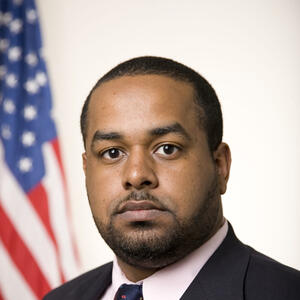
Barbara A. Perry
I’m Barbara Perry, and my colleague Russell Riley and I co-chair the Presidential Oral History Program at the Miller Center, where we are often joined by Katie Dunn Tenpas. She is a Fellow at the Miller Center, and, like Russell, knows everything there is to know about presidents and the White House, so I’m always pleased when they’re joining us. Thank you for taking time out of your busy schedule to be with us today.
Joshua DuBois
It’s a pleasure to be with you all. Thanks so much for having me.
Perry
For the record, this is the Joshua DuBois interview for the President Barack Obama Oral History Project at UVA’s Miller Center.
We thought we would start, as we always do, with our interviewee’s biography. You have a very interesting background that we all learned about not only through the briefing book but through your spiritual memoir. It looks like you had an unusual—and I would even say unique—path to the White House. Before we get there, tell us about your childhood, your upbringing, and how that got you on your path to the White House.
DuBois
The relatively short version: I say I’m from Nashville, Tennessee—most of my extended family is there—but I was born in Bar Harbor, Maine. My biological father, whom I didn’t grow up with for much of my life, was working in Maine, and my mother, obviously, was there at the time, as well. I was there for just six months, but I’m one of the few black Mainers in the world, [laughs] and we enjoyed that period of time. We moved to Cambridge, Massachusetts. My parents were divorced there, then moved to Connecticut, and then finally my mother found her way back home to Nashville, which is where I grew up, largely.
The first couple of years back in Nashville, my mother met my stepfather, who became an itinerant minister in the AME Church, African Methodist Episcopal Church. The nature of that church is that they move pastors around a lot, and so we moved to Virginia, Ohio, and a few other smaller appointments. I was with him and with them on that journey to different congregations in my childhood. Our last stop was in a little town called Xenia, Ohio, which is where I went to high school, and then from there to Boston University, where I studied political science. I also became active in social activism in Boston.
It was in my time in college that a man named Amadou Diallo was killed by police. He was an African immigrant who didn’t speak English well. He pulled out his wallet when he thought he was being asked for his ID and was shot 41 times. That was a social awakening for me. I’d never really cared that much about the world around me before that, but there was something about Amadou’s experience, his life and death, that shook me, the injustice that he faced.
I wasn’t involved in student government that much or NAACP [National Association for the Advancement of Colored People], and so I didn’t really have a formal outlet, but I wrote his name on a piece of poster board and stood out in the middle of Marsh Plaza at BU [Boston University], just so that people would mark his name in the world, that there would be a legacy for him that I could have some part in.
That was my first foray into engaging big issues in society, and that led to some work with the student government following that protest, and more activism on campus that also increased my interest in public policy as a potential means to address the injustices in the world.
I wrapped up at BU and went to Princeton—at that time the Woodrow Wilson School, although it has a new name now—for graduate school, on a full ride. I have always been the type of person to not just want to go to class but also do a lot of other things in addition to my classroom study. I worked as an immigration caseworker for a congressman from New Jersey, Rush Holt, one of the only members of Congress who’s also a rocket scientist, so that was his claim to fame. I did immigration casework for him, helping people navigate their visas and other things, after class and whenever else I could.
That was my first formal foray into politics in a legislative capacity. I was trying to figure out what I was going to do after Princeton and took another internship on Capitol Hill for [Charles] Charlie Rangel, at that time a congressman from New York. In the course of that internship, which was in 2004, the Democratic National Convention was going on. After work one day, I stopped at a bar to watch the convention in Boston and enjoy a hamburger, and I remember very clearly seeing then–State Senator [Barack] Obama for the first time at that convention.
A lot that he was saying in that historic speech resonated with me from a policy perspective and from a communal perspective. Then he talked about the awesome God that we serve in the blue states, and as a believer—as someone whose faith was and is important to me, who grew up in a religious household, went to Christian camps, Fellowship of Christian Athletes growing up, and so forth—I was not used to progressives talking like that [laughs] and being able to adeptly navigate the language of faith communities
I thought that this was a guy I needed to get to know, so I bought his book and went back to finish my second year in grad school and started pursuing potential employment with, at that time, State Senator Obama. He eventually, of course, would become United States Senator Obama. I wrote his campaign a few times and initially didn’t get any response at all. Then one day, an envelope showed up, and I was so excited that there was a possibility of moving forward. It was a form letter of rejection for employment [laughter] on his Senate campaign. I have it to this day.
I decided that this was where I wanted to be. He was elected in November of 2004, and then in the late winter, early spring of 2005, I started a series of journeys from New Jersey to D.C. to show up at his transition office and try to get an interview. That didn’t work the first couple of times I did it.
The second time, actually, I thought I had a major breakthrough. I guess they were tired of me just showing up at the office, so they said they would allow me to meet with someone who was pretty senior. I had a wonderful conversation with this young man and thought there were some possibilities. Then I Googled him on my drive back to New Jersey and found out he was the IT [information technology] guy. [laughter] They just had me sit down with whoever would take the meeting.
Before coming back down a third time, I sent a last-ditch email to Christopher Lu, who would become the legislative director in Senator Obama’s office. I said, “Listen, man, I’ve done two round trips. I’m happy to do more, but if you want me to stop bothering you, perhaps I could have at least an informational interview.”
To my great gratitude to this day, Chris responded and set up an interview. I spoke with him and a few others in the office, drove down, had an interview in person with Michael Strautmanis and [Peter] Pete Rouse, and was hired as a legislative correspondent in Senator Obama’s office, writing letters to the constituents of Illinois. But I actually ended up, because of my policy background at Princeton, leading immigration, labor, and trade work as well, so I was able to get some substantive policy work early on.
That’s the relatively short version of my early pathway to Senator Obama’s office. There are lots there in terms of how I got into the faith space with him and onto the campaign in the White House, but I’ll pause there and see if you have any questions about that.
Perry
Could we back up a little bit to Nashville and your move up to Xenia? What were your childhood experiences? I understand your grandmother was in the civil rights movement and participated in sit-ins? Then, as you got older, as a young black man, what were your own personal experiences involving race, either in the South, if you were there still, or visiting, or going into the Midwest, into the heart of central Ohio?
DuBois
I’d say they were complex. It was a very racially aware household, where the heaviness and complexity of our racial past was always in discussion around me. My grandmother was active in the civil rights movement, participated in Nashville sit-ins. My uncle—Rip is what he was called, he passed away two years ago—was a Freedom Rider, and so that history was around me.
The African Methodist Episcopal Church, where my stepfather was a pastor—he was functionally more my father because I wasn’t as connected to my biological father—is the most socially active African American denomination. They’re educators and elected officials and nonprofit leaders and so forth. It’s a denomination that arose out of protest: Richard Allen was pulled off his knees in an Episcopal church in Philadelphia in the late eighteenth century and decided that, rather than having to sit in the balcony, he would go and start his own church. That’s the history of the AME Church.
The reality of our country’s complex history on race was always around me. My college essay was focused on my experiences as a young black man in the South and Midwest. But I would say it was more of an abstraction in terms of any potentially negative experiences with me personally at that time, although that would come later, in the Northeast, in Boston, where I confronted more acute racism. Most of my world was black: it was so highly segregated in Nashville and in Ohio that my social networks, the communities I was around, were fairly homogeneous.
I learned about the civil rights movement. I learned the stories. I soaked in the set of experiences that my grandparents had. My great-grandmother Ola Mae Webb, who just passed away two years ago at 96, was a maid in households across Nashville, so I grew up hearing from her about her own experiences in the Jim Crow South. These were things I was experiencing through them but not as much firsthand. So, yes, it’s a bit of the context around me and race as a child.
Perry
What prompted your choice of BU, given, as you say, that Boston certainly had a very fraught racial history? Dr. [Martin Luther] King got his PhD there. Did the fact that there was a memorial to him enter the picture for you? How did you come to pick BU?
DuBois
I wish it was more complex than the fact that, one, they gave me a scholarship, and, two, as a 16-year-old at the time, I wanted to be at least five states away from my parents. [laughter] It was the combination of financial aid and the desire. Although I initially did not have a full scholarship to BU, I was able to get one after my freshman year.
I did get a completely full ride, plus a very generous stipend, to the University of Dayton, but my parents were up the road in Xenia, and I wanted to spread my wings and be in a different space. There was not a ton more than assessing the financial aid packages of the institutions to which I was admitted and realizing that I wanted to try something new and different.
Russell L. Riley
A lot of young people do more to rebel than just leave their parents four or five states away, and I’m wondering if, in your case, there were ever temptations either to political radicalism or a loss of faith in the sense, I’m going to distance myself from my parents by leaving the church and doing something else?
DuBois
Absolutely. I think that was a driving force for my early rebellion in that space, but largely from a faith perspective, from a religious standpoint. As a PK—”preacher’s kid,” they call us—you get to see the underbelly of religious bureaucracy [laughter]. The AME Church is a very political church. Because it’s based on bishops who make appointments and financial assessments and so forth, it’s probably the most political entity among black denominations, and I was very disenchanted with all that.
I felt no real sense of a personal faith or intimacy with God in my own space at that stage in my life, and so I did lots of things to rebel against that. I tried to come right up to that line, and maybe cross it just a little bit, in terms of all the things that pastors’ kids should not do in high school.
Then when I went to BU, I completely walked away from my faith. I didn’t attend church. I probably would have called myself an agnostic at that point, probably not an atheist, but certainly someone who had big questions about the existence of God and so forth. That lasted for a couple years.
It was in that same moment of protest where my political awakening and awakening to the world around me came, this Amadou Diallo moment. A gentleman named Eugene Schneeberg, a dear friend to this day, stopped by my little one-man protest and had a conversation with me and invited me to his church. In not so many words, I basically let him know I appreciated his support for the protest, but I had done this church thing. I didn’t need to do it again; I had been there before. But he stayed on me until I visited his congregation, which wasn’t much of a congregation at all. It was a tiny little gathering of about 15 people in a middle school auditorium in Cambridge.
But his pastor—who later became my pastor, Warren Collins, who also passed away earlier this year—was a dear friend and mentor. All of the bureaucracy of the church that I had grown up with was completely stripped away, and in his message, and in the context of a service that I was in in Cambridge, it was just a conversation about God, a conversation about faith, about values, and the first principles of our faith.
Believe it or not, although I had been in church pretty much every Sunday growing up from the time my mom married my stepfather and following, I’d never experienced that before, a raw, unvarnished approach to religion, and that was transformative for me. That’s the way I found myself back to faith, cultivating my personal relationship with God and with my faith.
So, yes, you’re right. I think it’s an important question, and I certainly did react to my upbringing by stepping away for a moment and then coming back.
Perry
It sounds like at that point you had a community that you belonged to. What was your relationship like with your fellow students? Had you attracted a lot of attention with your protest? How were you treated during and after that?
DuBois
I think the friends who knew me up until that point were just completely stunned. [laughs] They said, “Wait a minute, you’re the guy we were partying with two months ago? Where did this come from? Who are you?”
So it definitely forced me into a spotlight that I had not planned and wasn’t seeking. I can’t say that this was some strategic move to build a platform on campus, but I think it was welcome. It started a path to my engaging more on issues on campus. I got closer to professors who took their work seriously, people like Glenn Loury, the theorist on race and economics, and Walter Clemens and others. I think my peers started seeing me more as a leader and would seek me out in that way. So, it shifted my college experience from a largely academic and social one to one that was more purposeful for the remainder of my time there.
Riley
In terms of your inner circle of friends, was it integrated? Did you have white friends and black friends at BU, or was BU a fairly segregated place for a black student?
DuBois
It was very integrated in ways that were new for me, not necessarily because of the homogeneity of my upbringing from a racial standpoint but regionally. In Xenia, there were black folks, white folks, and immigrants from Mexico, and it wasn’t even a broad spectrum in the Latin American community, the AAPI [Asian American and Pacific Islander] community. It was just relatively specific backgrounds of people I went to high school with. Certainly in Nashville, it was just black and white.
In Boston, most of my black friends were Haitian or from the Caribbean, folks from Cape Verde. I had a white roommate for the first time, who’s still a friend to this day. One of my dearest friends is a white woman named Jessica Hearst from Rhode Island. We met and clicked, and she and my wife are best friends now. That was a relationship that started in Boston. It was a beautifully diverse mix of people and social network there that wasn’t the case when I was in the South and Midwest.
Katie Dunn Tenpas
I find it fascinating how one particular incident can change the trajectory of a college student. In your case, it was the awareness of what happened to Amadou Diallo. Your history seems to have these events that turn your trajectory into something.
You mentioned that in 2004 you were in a bar and saw the speech. What was it about then State Senator Obama that appealed to you to the point where you continued to try to get jobs in his office and things like that? Could talk a little bit more specifically about that?
DuBois
Yes, a few things. One, just the electricity of a black man on a stage like that was a pretty amazing thing. Then I had a subsequent experience: following that speech, he visited the Hill for some Congressional Black Caucus [CBC] thing.
He hadn’t been elected to the Senate yet, so he was not technically a member of the Congressional Black Caucus, but I remember it was while I was in Rangel’s office. I remember him walking with an entourage through the basement of what was probably the Cannon [House Office] Building—I’m not exactly sure what building it was—and there was an energy and electricity around him and this moment. There was a sense that he was on the rise but in a way that felt different. These were probably subconscious motivations. I certainly didn’t have this level of clarity at the time, but it felt different from the kind of civil rights–oriented platforms I had seen African American leaders have in the past.
He stood alone. Yes, clearly a black man and with a set of experiences that connected him to a racial past, but there was something that was broad and appealing across categories. You could see this in the people who were getting excited about him. It just felt different. I would have been just as excited if I had been around for the early phases of Jesse Jackson’s campaign, but that was a different thing.
There was an electricity and energy there, and there had to be because when I was wrapping up my time at Woodrow Wilson, having gone to undergrad, grad school, coming from a background where we did not have a lot of money at all, the offer in Senator Obama’s office was $24,000 a year [laughs]. I had a competing offer to be on an executive pathway at a major nonprofit in New York. I think I started at $95,000 and would move up from there.
I told my parents, and they said, “What are you doing considering this Barack Obama thing? [laughter] What are you talking about? Who is he? What’s an Obama?” So there had to have been this energy, this sense that there was something more there, because the finances didn’t make sense at all at that time.
Perry
Did you go so far in your mind to imagine him running for president? And if you did, when did you think he could be president?
DuBois
I did not. There was a moment—skipping ahead years to the middle of the Jeremiah Wright controversy—that it clicked for me that this man should be president. Believe it or not, in the middle of a campaign. I thought that it was a possibility. I thought that a black man as a U.S. Senator was amazing, and that’s as far as I got in that moment.
I helped him on a major speech on faith in May of 2006, and following that speech, I had an inkling that we should send copies to faith leaders around the country in case he did something else. I wouldn’t put a fine point on what that “else” was, and I wouldn’t even say it out loud to anyone, because I also knew that there would be some exposure for him if it looked like he was doing any sort of national outreach.
I mailed copies of this “call to renewal” speech to T. D. [Thomas] Jakes and Rick Warren and the Catholic bishops and invited them in for conversations around faith and politics and the President’s views on the importance of engaging the faith community, church/state issues, and so forth. We had a series of meetings from May through November, building relationships, building that groundwork. I knew in the back of my mind at that point that there was a possibility that there would be something more.
Then when the chatter really ramped up in late October, November of 2006, and there began to be some reporting that Senator [Hillary] Clinton was putting a team together—this was before we announced—I wrote a memo, which I still have, and I’m very proud of to this day, because I look back and I think, This wasn’t bad for a 23-year-old.
It laid out how, if he did have a presidential campaign, he should engage the faith community, basically saying, “I know I’m very young, but if you do this, not only here’s how I think you should approach it—from pastors in Iowa to black churches in South Carolina—and I’d like to lead it for you.”
And to his great credit, Pete Rouse, who’s always been someone who empowers young people and young leaders—if you can do the work, he doesn’t care how old you are—set up a meeting with me and Senator Obama, and probably Michael Strautmanis, I don’t remember if he was there. I walked through that memo a few weeks before he announced. That’s when the inkling became more real, and we started preparing in earnest.
Tenpas
Is there any chance that the [National] Archives has that memo?
DuBois
Probably not. I’m more than happy to share it.
Tenpas
I’d love to see it, yes.
DuBois
I have it. I keep a Joshua’s Journal account on Gmail. I try to forward myself interesting things that I should remember along the way.
Tenpas
Yes. That’s historic.
Riley
Joshua, think about appending these to the transcript, in addition to sending one to Katie, because anything that might be of historical importance that didn’t go in the Presidential Library, people could easily access as an appendix to your interview. This would certainly be a valuable place—Take this as an opportunity to provide access to people, because they will find it really interesting.
DuBois
Yes, I would be happy to do that.
Perry
When you were at Princeton studying public policy, public administration, was it ever crossing your mind—because I think I remember you were doing some preaching even when you were an undergrad at the time?
DuBois
Undergrad, not in grad school. I was associate pastor at that church. I started as just showing up and reinvigorating my faith, and then became an active member, and then was actually ordained through this little denomination and this tiny little congregation and became an associate pastor at that church, Calvary Praise and Worship Center. When I moved to Princeton, although I continued attending different churches in the area, I didn’t have any formal role there. I was just attending services.
Perry
Obviously, that more informal approach was suiting you as an undergraduate. Is it correct, then, to say that you weren’t thinking formally about going to divinity school and getting a divinity degree and becoming an official part of a congregation, as your dad had been?
DuBois
That’s right, yes. I never felt the call to formal—I would say the role I had at Calvary was relatively formal in that I led Bible studies and Sunday schools. Eugene, the man who reintroduced me to my faith, and I actually led a Bible study at a halfway house for young people, and so there was a level of formality of practice there, but that was as far as I wanted to go. I never thought I was going to be a pastor and work in pastoral ministry, and I did not have any desire to go to seminary.
Perry
Then at Princeton, and then when you did a summer in Washington working on immigration issues, did you see yourself as becoming a public policy expert in maybe social policy areas? If so, did that include faith issues? Were you thinking in those terms, or more broadly about being someone who was a public policy specialist and analyst?
DuBois
I was keeping the two fairly distinct at that time. I was deepening my personal faith and my journey of awareness and intimacy with my own faith, and at the same time I was learning a lot about public policy.
Rangel was on the Ways and Means Committee, and so I really dove deep into trade and tax policy, and more, everything from trade on the African continent to—just trying to be as in the weeds as possible on the legislative debates of the day, and how I could add value there. But I did not contemplate bringing the two together until it was time to help Senator Obama write his speech on faith and work on the chapter of his book on faith later on.
Riley
What were you focusing on at Princeton?
DuBois
Track 3, which is domestic policy broadly: micro- and macroeconomics, poverty and inequality, just a broad—in some cases, deep—look at the domestic policy challenges we face as a country and what solutions might be.
We did a lab in partnership with the City of Philadelphia where we wrote a universal health care plan specifically for the city. We shared it with the mayor’s office and got feedback, and then passed it off to their local health department. We’d go to Philly twice a month to serve as graduate student advisors for the city. It was just a broad immersion in domestic policy and the various challenges we face as a country, with a particular focus on health care—which I didn’t really come back to, except in my later work in the White House related to the Affordable Care Act. That was the thrust.
Perry
Do I see that for a moment you started into Georgetown Law School?
DuBois
I did. This was the risk mitigation, never-wanting-to-be-broke-again side of me, [laughs] which was, If this political thing doesn’t work out, I feel like I need a degree that I can fall back on and actually make some money.
So I took the LSAT, did well, and got into night school at Georgetown. I was working on the Hill during the day and going to class at night. I would have continued and finished had it not been for the 2008 campaign intervening and the need to move to Chicago for that campaign.
I’ve never come back to it. I’m sure I still have some credits at Georgetown if I ever want to circle back there. I also met some dear friends, including one of the groomsmen in my wedding, a dear friend to this day, in law school and had some great experiences. But I had some bills to pay for Georgetown as well, [laughs] having not completed that degree.
Perry
Any thoughts at that point about someday running yourself for public office?
DuBois
There’s a long process of me being disabused of that notion and then a reawakening. In undergrad, my email address was pres2028@bu.edu, [laughter] as in President 2028. So I was very interested in running for office, having become socially aware. I changed, and I always thought I would explore elected office. So the answer is yes.
But the closer I got to the electoral process—particularly the persistent need to raise money and the way that money in politics dominates so much of the conversation—for that and many other reasons, I decided that would not be the vision for my life. But at one point, yes.
Perry
As you got into the Senate office, when did you read Obama’s first memoir?
DuBois
That was during his 2004 campaign.
Perry
Can you tell us more about that? What were your thoughts about it, particularly his relationship, or lack thereof, with his father?
DuBois
It certainly resonated with me. It was different from my own journey, but the fact that they had such a distant—although at times intimate and important—relationship developed a sense of connection there.
Honestly, I fancied myself a decent writer even then and really enjoyed the process of crafting compelling narratives. I think what I took away most is, This guy’s a really good writer, and he has a really sharp mind. It was less about any deep sense of connection, or a sense that we shared the same personal journey, but more the fact that I would love for this country to have a U.S. Senator who is writing something that I genuinely want to read and I genuinely find a compelling story, in a biography that resonates.
I think that was the largest takeaway: just being impressed with his ability to capture his life in the way that he did.
Perry
Any other questions for Joshua about biographical steps to the Senate office of Barack Obama?
Riley
We’re political science nerds here, in addition to people interested in the story of this president. I’m curious about what you were finding when you took this job that you had been after for such a long period of time. Can you tell us about the structure of the Senate office? You’ve mentioned Pete Rouse and the other personalities there. Paint a picture for us, for people who are on the outside.
We’re going to see as we move into the White House that these structures become very important, and we’re really curious to know if there are antecedents to organizations and personalities that get picked up from people working in that Senate office. That’s a very broad-range question.
DuBois
It’s so funny, you can trace so many people who would continue to be really relevant and important in the course of the presidency and beyond back to those moments. Pete was one of them. So the answer to the first question on structure: the 101st Senator was largely what he was known as. He had a particularly strong relationship with Senator [Thomas] Daschle from South Dakota, who at the time was, I believe, the Senate Majority Leader—Minority Leader?—and so that was hugely helpful for Senator Obama. Chris Lu, legislative director, kept the trains running. Michael Strautmanis, senior counselor, was someone who had gone back for years with the Obamas and had a connection to Chicago.
Then back in the State Office was Ken Bennett, who was the state director, and then Anita Decker, now Decker Breckenridge, was the downstate director, because Chicago and the rest of the state are very different, as you know. So Anita handled downstate and is now the President’s chief of staff.
Then there was a layer of legislative assistants, LAs, which was interesting. I was still rather young but had finished up graduate school and felt a sense that I could handle a legislative portfolio. But then I got in there, and I learned that LA role—particularly on the Senate side, as opposed to the House—is reserved for people who are more senior and who have just been around a bit longer.
My boss was a guy named Danny Sepulveda, who had a pretty broad portfolio. And the other guy I connected a lot with was Ian Solomon, who works at the University of Virginia now [laughs] and is an old friend. I saw him a few weeks ago at Monticello, believe it or not. And so, yes, it was the structure of LAs underneath that, and there were others, Ruchi Bhowmik, who went on to the administration—I think almost all of them went to the administration—Dora Hughes, who did our health care policy; Mark Lippert, who went into the National Security Council [NSC]. These were the LAs in the Senate Office.
Then, below that were LCs [legislative correspondents]. These were budding policy folks who thought that they should be LAs, like me, [laughs] but were not. We got a chance to staff the LAs and sometimes fill in and take over some pieces of legislation, but we also had to spend about 60 percent of our time responding to constituent mail because Pete Rouse was very serious about mail.
Some offices can devolve that down one level lower to a staff assistant, but Pete wanted to make sure that there was a substantive response to every single letter that came in. So he had us research the issues, develop a letter template, and then send it to him for review. Now, once that template was finalized, you could send it to a lot of different people, but it was just a very serious and rigorous approach to, believe it or not, just mail, the handling of constituent mail on issues. So that was that level.
Then below that were staff assistants, people in charge of the administrative functioning of the office. Then there were some offices on the side, like communications: Robert Gibbs, communications director. [Thomas] Tommy Vietor, who would go on to the NSC, was doing great things as a press secretary, reporting to Robert. Jon Favreau was a speechwriter.
Then there was the scheduling operation: Ashley Tate-Gilmore and Alyssa Mastromonaco, who went on to the White House, two of them working in concert. Ashley still does the President and Mrs. Obama’s travel and logistics for a big chunk of their work. She’s a dear friend, almost like a sister, to this day. Am I missing anything else? Michael Robertson, who was a dear friend of many folks in the office, passed away from cancer a few years ago. I think that’s it.
So that’s broadly the structure. There was chief of staff, legislative director, LAs, LCs, staff assistant, and then on the side, scheduling advance and communications.
Riley
Is it possible for you to comment on the extent to which what you were doing in the Senate Office was state-oriented, and the extent to which this was a man who had a larger-than-life persona who was going places? What was the internal tension, if there was, between tending to business at home and developing a larger portfolio?
DuBois
We cared a lot about ethanol subsidies in Iowa, and I always was trying to figure out why. [laughter] So that’s one thing. But no, I would say Senator Obama was very aware, and Pete was keenly aware, that if he was too national-focused, that would be a vulnerability for whatever he did next, whether it was run for reelection or do something different.
So it was all about the people of Illinois. That was the driving theme for our time in the Senate. Now, really smart folks like Gibbs and Pete and others were monitoring other parts of the Senate to make sure that we were in the right place. I actually, interestingly enough—which I only recently remembered—staffed Senator Obama, who was on Foreign Relations at the time, in the response to Hurricane Katrina. He visited New Orleans. That was one of the moments where he was showing up nationally in a really important situation.
So there were times like that, particularly in his role on the Foreign Relations Committee, because that was, by definition, not Illinois focused. But most of the thrust was delivering for Illinois, for the people of Illinois, for the constituents of Illinois. I think there was a sense that if he did not do that—one, it’s just the right thing to do; but two, based on where he was going, the thing that would probably sink him quickest was a sense that he was a high-flying character who didn’t have substance. So the goal was to have a substantive approach to delivering for his constituents.
Riley
The other question I want to ask about this is your sense about how the politics of race was playing out within the office, but particularly with Senator Obama himself. Did this concern about Illinois make him somewhat less concerned about the politics of black America in a pure form? I don’t even know how to phrase this.
DuBois
I would say there were several forces. Some were just the force of personality of people like Robert Gibbs, who—and this is, I think, a big reason why we won in 2008—knew that a moderate posture that would appeal to people across the board, and not just the African American community, would be important. A sense that he was just not an ideologue—reasonable, that he just wanted to do the best thing for the country, as opposed to a more ardent activist approach that had traditionally been taken by, for example, other members of the Congressional Black Caucus. There’s value there. There’s value in the prophetic voice in a Congress, and speaking truth when no one else will, the Barbara Lee voting against the authorization to go to war in Iraq, and so forth. That’s one approach, and that had been traditionally the approach that the few elected black Senators and more House Members had taken.
They were explicitly deciding to not take that approach, and there was, I think, a little bit of an undercurrent of tension with the Congressional Black Caucus as a result. That’s another way that race came in, nothing explicit, but they thought he was too big for his britches and that he didn’t want to be known as the black Senator.
Now, he never said that, and I actually think that that is too flippant a way of characterizing their views because he always knew he was a black United States Senator. I think he did not want to be defined solely by a civil rights agenda but wanted to be seen as someone who was interested in and engaged in the range of challenges the country was facing, not just the black community.
I think that drove some tension with other African Americans elected to Congress. There was a sense that, Wait, you think you’re different from us? You think you’re better than us? [laughs] We felt that at the staff level, even engaging with other CBC offices.
So yes, that was one of the undercurrents. At the same time, this is a man who’s very comfortable in his own skin, and he knows he’s a black man named Barack Obama. This is not someone who’s looking past that. And so, from the policy and substantive stuff to just socially, he was not at all trying to be anything other than a black man in America. But they did have a broader purview.
There were times, I think, in his fatherhood speech—which is not remembered as much but was really important—at a church in Chicago, which I also had a part of, where basically it was one of these Sister Souljah moments: “Men need to step up and be fathers,” and, “Any man can have a child; it takes a real man to raise one.”
There were moments of almost constructive antagonism to the black community, too, that I think were, one, what he really believed but, two, also, quite frankly, designed to position him in more of a moderate space.
Riley
And your own position on the staff, were there tensions ever between black and white staff members on issues?
DuBois
Please come back to that question in the White House because there was an important story to tell related to some black and white tensions early on there, but in the Senate staff, no. One, lots of young people worked on his Senate campaign who got to know each other really, really well and were really close across racial lines, and because we were probably all 25 and under, except for the few old heads—Now, I’m older than they were at the time. [laughter]
Chris Lu probably was in his midthirties, and Ian was probably in his midthirties as well. It was just a bunch of young, excited people who went out for drinks together after work. There was a lot of camaraderie. They were just folks walking through life together. I can’t remember any explicit racial tension in the Senate office, which is funny because I handled the Jeremiah Wright stuff in an intimate way and was a part of a lot of other pieces, and so lots of racial tension in other moments in this journey but not in the Senate office that I’m aware of.
Riley
I appreciate your indulging the question. It’s a complicated thing to ask about and to get into, and you’re good to let me dig a little bit.
DuBois
There were massive amounts in the campaign—and in important ways that I think have relevance for his legacy moving forward and in the White House and beyond—that I’m happy to speak to as we go along. Maybe I’m just looking back with rose-colored glasses, but it was just a pure moment, [laughs] I think, in this whole journey.
Tenpas
At what point, while you were working in the Senate office, did it become clear that the eyes were on 2008, and you were starting to hire maybe outside consultants to think about fundraising and primaries and things like that?
DuBois
I don’t remember the exact point. I do remember a question in December of 2006, maybe January of 2007, where they asked me about whether we would hire this firm that was led by a pastor in South Carolina who had a political consulting firm on the side and what I thought about that. I thought, Oh, man, this is getting real, preannouncement. Then there was that memo, which I drafted. It’s so funny. I can probably find it, but I think it was dated December, too. I’m looking at my notebook. [laughs]
Tenpas
As soon as he was sworn in as the U.S. Senator from Illinois, was everybody thinking ahead at that point, Boy, we have some momentum, there’s some energy here, there are intangibles that make this seem like we’re going places?
DuBois
Not everyone. I think Pete and Robert were. I think a lot of us were too young to have the luxury of thinking much beyond what was in front of us at the moment. I think we all pivoted there in the middle of 2006 and then later, early 2007, even before the announcement—I’m looking at some of this stuff now. There was an early madrasa controversy before we even announced, that maybe he had been educated at a madrasa in Indonesia. I had to weigh in there from a faith perspective. So it heated up in a very fast way from late 2006 through the first two months of 2007.
Perry
CNN did that series of the last two election cycles where they picked four, five, or six historical races to the White House. They began the one they did about Senator Obama running with him meeting with Harry Reid, and maybe [Charles] Chuck Schumer, some other leader in the Democratic Party, encouraging him to run.
Then there are the stories that he consulted with Edward Kennedy, who said, “Yes, go for the brass ring now. I know you’re new at this, and I know it’s early, and some people will criticize you, and some people in this body will criticize you for having these ambitions, but sometimes you stay just long enough to get a lot of baggage and then it’s harder to run.”
Were you all hearing stories of that as well?
DuBois
A little bit. I can’t remember explicitly, but there were people who had a deep affinity for the Clintons—who, by the way, I love now, and I’m close to many from that world. It’s funny how things change, but there were Clinton folks on the Hill, in the Senate Office. There were a few [Joseph R.] Biden [Jr.] people, but mostly in the Biden world.
Then there were people who just were not Clinton people. It’s not that they were Obama people; it’s just they had not—and I would put Harry Reid in that category, and Daschle. They had to deal with them, but they were very much open to an alternative and would quietly encourage alternatives.
We saw that, we felt that. It was almost like a mentor-mentee thing between Harry Reid and the Senator, between Daschle and others. It was probably Daschle at the time more than Schumer. They would never say it explicitly because everyone needed to protect their own interests, [laughs] because who knew what was going to happen in the future? But there was kind of a twinkle in their eye when they saw Senator Obama and a level of implicit encouragement there.
We felt that, but I can’t point to a—It was never so fine a point where it was, “Did you hear what Senator Reid said to Senator Obama?” It wasn’t that. It was just this sense that he had some powerful people who were rooting for him in a kind of unique way.
Perry
Did you have a sense of why—it could have been very positive, as you say—that they would just get a twinkle and a glow when they would talk about Senator Obama, but did you get a sense from people who were not looking like they were going to support Senator Clinton? Was it something related to her positions, policy-wise? Was it the [William] Clinton administration and her husband?
DuBois
I couldn’t say there. No, I didn’t have a window into that.
Riley
What were you finding out about the man who was the senator you were working for?
DuBois
Well, one, there were so many moments where I couldn’t believe that a United States Senator would ask my opinion on that. He’d stop by my desk. I was out in an open bullpen/hallway on the way out to outside of our office, and he’d stop by and chat from time to time. That really ramped up.
He was writing Audacity and got to the chapter on faith, and basically asked—I forget if he asked me directly or if Pete asked me. Someone asked, “Does anyone have a connection to the faith community and want to help with this?” I raised my hand and talked about my background a little bit. He said, “All right, come on, let’s do this thing together then.”
He would send me drafts of the chapter, and then we translated that chapter into a speech. They asked me where I thought he should deliver it. I teed up the Reverend Jim Wallis’s “Call to Renewal” conference, Sojourner’s conference, and they accepted that, and I staffed him there. Then I helped him further refine the chapter until he submitted it to his publisher. I was so honored to get a little mention in the back of his book at the time, which was kind of cool.
That was just one thing. I was, I think, 23 [laughs]. Oh, and I do remember it was the first time he called me on my cellphone. He was giving a speech to a refugee protest or gathering on the National Mall, and he called me on a weekend. It was blocked, and I missed it, so he left a message. I was appalled that I missed his call, and I called back. He asked for a passage of scripture to begin his speech, and I was able to quickly give him one. I believe it was Proverbs, “Rescue those who are being led away to slaughter,” something along those lines.
So, yes, it was just this openness to finding the best ideas, no matter where they came from. I did not have any sense of position or authority in that office, but—
That was one thing. He was very funny. I was very rumpled [laughs] in my appearance, and he’s very buttoned-up, so he would frequently comment on an unbuttoned collar or a wrinkled shirt or something of that nature, just a funny guy.
Then when my biological father passed away, he heard about that, and we spent two hours on that alone. As I mentioned, I didn’t grow up with my father, but I did have a relationship where I visited him in the summer, a complicated relationship. But he found out that he passed away and invited me into his Senate office and had a really loving, mentoring conversation connected to wanting to know more about my dad and sharing his own story. That was just an intimate moment there, which totally did not have—
There are some United States Senators who carry themselves with such a weight—and this is not necessarily a bad thing—it’s such an elevated position that they would never interface with someone who’s a legislative correspondent making starting $26,000 a year, [laughs] and that was not his approach. So, yes, I found out that he was personable, that he was open to input. He was very, very funny, had a lot of integrity.
But he was also politically adept. It was he who asked whether we should hire this pastor in South Carolina and potentially pay him ten grand a month consulting fee. I’d never heard that level of granularity come out of his mouth. We’d talk about issues and faith and so forth, but then it was, “So do you think we should hire him?” So he had a political consultant lens, too. That’s the sort of thing you don’t tell the Washington Post, but I could tell you all. [laughs] He was a political strategist as well. He knew what was going on, whether it was a decision like that or ethanol subsidies. There was a level of sharp-mindedness there.
I remember when I staffed him in New Orleans after Katrina, and we visited with the mayor of New Orleans at the time—[Raymond] Ray Nagin. He ended up going to jail. It was just me and him and the mayor, and he left there and basically reflected, “This guy is not going to end up somewhere great.”
The reason was Mayor Nagin had this moment with the United States Senator on the Foreign Relations Committee and other committees that had—He was well positioned to be helpful, and the only thing he asked for was photos for some donors. It was just a surreal experience, after this massive disaster, and there was no substantive engagement on the issues in this meeting. I say that because one of the things I learned there was he’s an accurate evaluator of talent and of politics. It was a prescient moment where he basically declared that this guy was not on the right path in terms of his political trajectory. Those are a few things that come to mind.
Riley
One follow-up on this. This is a man who, I think by his own account, certainly didn’t have the experience that you had of being raised in the church and steeped in scripture and so forth throughout the entirety of his life. Could you comment at all on whether he was still in his learning curve as you were working with him? Were you finding him curious about spiritual things that came second nature to you, because this was something that you had bred in the bone as you were growing up?
DuBois
Yes, and I would say that that was reflected less in conversation and more in edits to drafts in the sense that, for his book and the speech and all the things that would flow from that, there’d be a phrase that would not necessarily be the way that folks in the black church would say it, and I would suggest something else.
Or even as he talked about when he walked down the aisle at Trinity United Church of Christ—this actually was the operative point—the way he described it was an intellectual decision to join this church. I pushed him and asked him to think about it because if that’s accurate, then that’s exactly how we should describe it. But was this more an acceptance of a new trajectory of faith? Was this an adoption of a set of beliefs? And if so, then it’s described as something different when people often talk about that. If your goal is to both accurately describe your own journey but also resonate with people of faith, then there’s a different language that would be used there. He chose the latter.
I’ve often looked back at that and wondered, Should I have just let him be exactly who he was [laughs] in a moment like that? And this is why, parenthetically, I’m only able to say this, because this is for history and not for contemporary consumption. The initial framing was, “I made an intellectual decision to join this congregation,” and the framing that resulted—which ended up being very helpful, because we used the quote in so many spaces on 2008 and beyond—was, “I accepted Christ as my savior.” There’s just a distinction there. I let him make the choice which path, but I did present the second option, and he said, “OK, well, that feels more like what I want to say.”
So, yes, that would be an example of the kind of subtle interventions that, again, you don’t want to be overly prescriptive, but I was looking out and realizing that we were going to try to appeal to progressive and moderate Evangelicals and Catholics and folks in the black church and so forth, and we wanted the possibility of doing that in a way that was resonant.
It’s a small thing that no one other than me would care a ton about, but I’ve often questioned that. Was that him, though? Was that him, or was that me? [laughs]
Riley
Well, but he was coming to you, right, as a—He has a message he wants to communicate, and he understands himself evidently well enough to know that the words he chooses may not communicate exactly what he wants the audience to hear.
You have a natural ear for that particular audience, and you will know what they’re responsive to, so the fact that he asked you to do this, I think, is important—
DuBois
That’s a great point.
Riley
—evidence about your relationship. It’s not as though it’s not an accurate representation, because you know the reality on the ground that he’s trying to communicate to the audience, right? It’s not as if he’s representing something false; it’s just how he chooses to characterize it.
DuBois
And that ultimately is his choice. That’s a great point, that he put me on that spot in order to achieve that ultimate aim of communicating in a way that engages this audience. The goal was not, “Help me distill exactly my most authentic feelings.” It was, “Help me craft something that is engaging, that is achieving the goals I want to achieve.” So I think that’s right.
But it’s funny, I did that so frequently—campaign, White House, and so forth—and I often would hold in tension the need to engage but also the fact that these are still deeply personal things about a person, and I don’t want to be too far afield from who one actually is.
Perry
So we are approaching the campaign, but I don’t want to leave the Senate Office and your work there before you have other things to say or my colleagues have other questions.
DuBois
I’m trying to think if there are any—The Katrina moment was a really salient—I remember walking around New Orleans with him. I also remember a 30-minute break where we were about to go into St. Peter Claver Catholic Church and he was about to give a speech, and no one could find him because at that time he snuck away for a smoke break, [laughs] which was a challenge at that moment. He’s since walked away from that, but that was one thing that we were dealing with at the time. I’m trying to see if there’s anything else.
This was in the Senate Office, but World Magazine—which is positioned as something of a thoughtful Evangelical but still very conservative magazine—ran a story in early 2007, basically, “Here are the people who may run, and here are the people who might do faith for them if they run.” And so in a really small part of this office and world that not too many people were focused on, other than Pete and me, that was a transition point for me: OK, now, this is declared in print that we’re going to start moving in this trajectory. That was a little bit of a pivot.
Perry
Well, because you weren’t just talking one-to-one with the Senator about speeches and his faith and how he should express it; you’re also doing faith-based outreach. You’ve given some examples of that, but you were the go-to person—am I understanding correctly?—as an LA, and writing letters to constituents. But also, were you beginning to see the links between what would become known as faith-based initiatives and policy? Were you working on that explicitly?
DuBois
Yes, but that May 2006 speech—which, by the way, was elevated. E. J. [Eugene Joseph] Dionne did a column about it in the Post, and he called it the most important speech on faith and politics since John F. Kennedy talked about his relationship with the Pope.
That was just this massive endorsement and encouragement to everyone in the office that there’s something here; we should move forward with this engagement. It was that moment, and then mailing the speech to people around the country, and then I put together an outreach plan where we invited all the denominations that had D.C. offices—the Orthodox Jewish Union, the Religious Action Center, Rabbi David Saperstein, and the Islamic Society of North America, all the mainline Protestant offices, and what’s called the “God Box,” which is on Capitol Hill. I invited them in to meet with me and Michael Strautmanis and share the speech and talk about their priorities and begin building relationships.
The speech launched the intentional outreach strategy. That did not become overly political until we started moving into the campaign. But the answer is yes; not prior to that speech, so not in 2005, but 2006 onward, after the speech, I was the faith guy in the office.
Tenpas
Do you ever recall any incidences where the Obama Senate Office was critical of the White House Office of Faith-Based and Community Initiatives? I know that the big criticism at the time was that there was a fear that these faith-based groups who were given federal grants would also proselytize, and so instead of just providing food or providing education to groups that needed it, they would also be possibly converting them.
I’m just wondering, after you became that faith-based person, did you keep a closer eye on what the White House was doing because there could have been opportunities where Obama could have come out and drawn attention to a wider approach to faith-based organizations, and also being critical of the [George W.] Bush administration?
DuBois
Yes, it was a huge opening for us, and one that became a big theme in that “Call to Renewal” speech: the importance of the separation of church and state and the Establishment Clause, not just for government but as a way to protect the thriving of religious communities, and how the relationship between government and faith-based organizations—while government can and should support those organizations—shouldn’t just be a crass relationship based in just funding but what can we do together to address human needs, starting from that basis rather than just a fiscal lens through which you saw those relationships.
We then took that message on the road as we did faith forums on the campaign, because the challenge with the Bush Faith-Based Office—which I think did a lot well, by the way, and I ended up becoming very good friends with John DiIulio, the first director, and lots of other folks connected to that office. I think they got a bad rap in a lot of ways, but from a political standpoint, we were able to highlight some challenges with that office because there was a perception that there was a lot of money floating out there to faith-based groups, but no one knew anyone who got it. There was this sense of, here are the faith-based offices giving out grants, but we’re not getting any.
That created an opening for us to say, “We have a different vision for the partnership between government and faith-based organizations: one, we still believe faith-based organizations should receive funding, but the relationship should not be rooted in finances alone. It should be, how can faith-based organizations and the government partner to meet human needs, to address the challenges that communities are facing, and so forth?”
That became a core message for us: the contrast between what we wanted to do and what the Bush Faith-Based Office was doing.
Tenpas
Yes. I remember at the time it was a dominant criticism that there was no transparency about where the grants were going, and to whom, and how much. Thank you, that was interesting.
Riley
Did the Muslim question show up at all in these early phases, a man named Barack Obama? Or was this something that only began to percolate as a presidential bid started appearing evident?
DuBois
Only as we started moving toward a campaign. I remember very well that Devorah Adler, who was the—I’m pulling up the madrasa emails [laughs] from January 2007, from Devorah, from her Hotmail account: “So we’re almost official.” That’s the campaign, January 9, 2007. “I want you to meet Shauna Daly. She’s going to be the deputy research director. I’m the research director.”
Then they asked me to organize a letter in response to some reporting from some far-right outlet that said that he was educated in a madrasa and was secretly a Muslim rather than a Christian. But that was the first time. In fact, because the speech was about his Christian faith, that was what we were communicating, and no one had ever said anything differently. That was the first time that we had to confront that issue.
Perry
You became a national director of religious affairs—is that correct?—for the campaign itself? When did that happen in the life of the campaign?
DuBois
Early on. I was one of the first hires. I was dispatched very quickly to South Carolina. One of the first events he did after the announcement was a prayer breakfast with pastors in Columbia, South Carolina, and so I was off to the races in the first wave of campaign hires.
Perry
So off you go to South Carolina?
DuBois
Yes, I was based in Chicago—I had to find an apartment there pretty quickly—and then started moving around the country to early states, with a particular focus on South Carolina, given the importance of the black church there. We did a bunch of other stuff with other religious communities there as well. The early phases were just planning, thinking about how we were going to approach this work, and what it meant to—
This was the first—John Kerry had a religious affairs advisor whom I would go on to hire in the White House, Mara Vanderslice Kelly, but that was at the very end of the campaign. It was focused largely on engaging the Catholic community. This was a much different thing: there was going to be a department. I should say, I don’t think that anyone, other than probably Senator Obama, envisioned this being that big a deal on our campaign, either, but I had to make it a department.
I found eight religious affairs interns [laughs] and created my own kind of shadow staff. We ended up doing our own, we called it in the campaign world, “chum.” It’s just bumper stickers and buttons and so forth. They call it “chum” because you throw it out there, and people eat it up like it’s chum in the water. We created our own faith chum and faith email community. It was just building that infrastructure. I eventually twisted some arms until I got a deputy, Paul Monteiro, and he helped me build this out. Yes, we were just creating a department from scratch.
The thing that was pretty consistent was Senator Obama saw and knew the need, and on the relatively limited occasions, just given what he was doing, [laughs] that he could lean in, his choice was always, “Yes, we need to do more here.”
There were a lot of other folks who weren’t actively antagonistic, they were friends and good people, but they were like, “This is not what you do in Democratic politics. You don’t have a faith department; we have no idea what to do with this.”
It was constantly fighting for space, making the case for why this work mattered.
Perry
What were you seeing in Chicago? Am I correct to think that you were in a headquarters, based in an office?
DuBois
In the headquarters office, yes.
Perry
Who was in charge, and who was different from Washington?
DuBois
Well, it was the introduction of David Plouffe and [David] Axelrod and their firm, AKPD, and so getting to know them. Plouffe was always—I didn’t spend a ton of time with him, but—the ally and someone that this work resonated with.
Then there was my first interface with Valerie Jarrett, who’s a friend and mentor to this day. I worked with her. There was also a real desire for me to wade into the religious politics of Chicago, particularly the black church there, which is fraught, to say the least. Oftentimes, my conversation with Valerie was around doing a pastor’s roundtable with South Side pastors and then with West Side pastors, because the two certainly can’t sit at the same table together. I was just engaging the religious community in Chicago.
Perry
Mrs. [Michelle] Obama? We haven’t talked about her yet. Any interaction with her at this point?
DuBois
One of my first big trips on the campaign with a principal was to a funeral that I recommended one of them go to—and, to my great surprise, they said yes—for a guy named Bishop Gilbert Earl Patterson, the head of the largest black denomination of the Church of God in Christ. It’s also a more conservative denomination. It’s not the social justice AMEs; it’s center-right, if not right. But it’s the biggest one. There are more black folks that are COGICs—Church of God in Christ—than any other denomination. They’re not very politically engaged, but they’re very important in black religious life.
G. E. Patterson died. He was pastor of their headquarters church in Memphis, Tennessee, and I encouraged us to have a presence there at the funeral, and Ms. Obama said yes. So I staffed her as we traveled to Memphis for G. E. Patterson’s funeral. That was one engagement.
I forget exactly the moments of connection with this piece of it, but Ashley Tate-Gilmore, who was the deputy scheduler in the Senate office and was a dear, dear friend, like a little sister to me. Her mother, Desiree Tate, is friends with Michelle, so I lived for a time in their basement—way too inside baseball here [laughter]. So as a result of the friendship between my friend’s mother and Michelle Obama, I had more of a connection than other campaign staff, because they were hanging out with each other, and she would get to know me, or Desiree would say something to Michelle Obama about me. They got to know me a little bit through Desiree.
Perry
So you traveled with Mrs. Obama to the funeral and staffed her and attended the funeral with her, did you?
DuBois
I did.
Perry
What are you seeing from her and her relationships with people out and about?
DuBois
Very just down-to-earth, funny. Bit of an aside: Barack was so healthy. He had the same grilled chicken every day, but he would allow himself every now and then to eat some Hawaiian macadamia nuts. He would always comment on how fatty they were, which to me was like, if you consider that unhealthy, then [laughter] I have a cheeseburger to show you.
I say that because when we went to Memphis, the moment we landed there, Michelle was like, “Show me the ribs. Where are we going to get some?” [laughter] So we had to find the closest really good soul food, and we all got some plates, Melissa Winter, who was staffing her, as well, her chief of staff, and Michelle and I, which is funny because she went on to do “Let’s Move!” [laughter] So that stood out to me, as well.
Perry
That was her last bad meal.
DuBois
I doubt that seriously. [laughter] I think she can still appreciate some good ribs.
Perry
It’s time for our break. We’ll be back in five or so.
[BREAK]
Perry
Anything we should know about how things were running, what you were doing, before we get to Jeremiah Wright and that controversy? We don’t want to miss anything.
DuBois
Yes, a couple of anecdotal pieces. The South Carolina primary is a moment in this campaign that does not get anywhere near its due. There’s a broader subtle challenge there where the history of the campaign is largely written by the best storytellers, [laughs] in a good way—I use the word “storytelling”—and the folks who have a history of storytelling and are able to capture it, but that misses some big parts.
South Carolina was a really big part because won in Iowa but lost in New Hampshire and tied in Nevada, so it was this moment of overwhelming victory in South Carolina. That was a black state where black folks stood up and voted for him in massive numbers when a lot of folks thought that the Clintons were going to be entrenched because of Bill Clinton’s relationship with the African American community. Anyway, something that I frequently think about is how South Carolina, the African American leadership in that campaign office and elsewhere, doesn’t get its due.
We did this thing called “40 Days of Faith and Family” heading into that primary. We invited people of faith to come out and talk about their values, and then we shared Senator Obama’s values and thought about the overlap in the two, which was just brand new. Faith-based outreach, if it was done at all in the past, was a candidate coming to a black church on Sunday morning saying, functionally, “Vote for me.”
But Senator Obama was nice enough, and I asked him to record an intro video that we played on a DVD before all of these events, where he talked about his own faith journey and why he thought it was so important to engage people of faith substantively, and the project of American renewal. Then we had a conversation, and when we did these in South Carolina, there were white United Methodists who had literally never been in the room with a black Baptist before, particularly not related to faith, and they were in the same space, talking about their common values.
When we did it in New Hampshire, it was the Orthodox Jewish community and a gay Episcopalian pastor [laughs] in the same space, talking about their faith and values and why Obama might be the candidate for them. We did close with an ask: “Hey, if those values align for you, if you see something in him that resonates, of course we want your support.” But it was a fresh and new approach to engaging communities that worked really well and that we were really proud of, because you would look at these rooms, and it would be America. It would be exactly what one would hope to see in our country.
We called them “faith forums” in all of the early states, and the branded campaign in South Carolina was “40 Days of Faith and Family” because we were in the South, so faith and family matters. That was a really beautiful thing.
Senator Obama’s chastisement that I never forgot, and would frequently leverage moving forward—There was a really big and important convention, the AME Church General Conference. It was every four years, lots of black folks coming together in one space, thousands, tens of thousands. I submitted the request for him to speak at this thing as one of maybe three or four faith events he would do over the course of the campaign. He didn’t do a ton of them, but I said, “This is a big one. He should do it.” It got to the powers that be, and there was a no. Word got back to him, probably from faith leaders that he was close to, that he wasn’t going to this thing, and he confronted me and said, “Why am I not going to this?” I said, “I submitted it. I’m not going to go around the process.” He said, “If there’s ever anything that’s that important, and you know it’s important, you need to come to me.” Screw the process, basically, you need to come to me—excuse my language.
That was important for me personally, because in my world there were lots of things that people did not want to do, [laughs] whether it was going to Saddleback [Church] for Rick Warren’s forum, and so forth. And navigating a lot of the stuff we navigated with Reverend Wright, he encouraged me, “You’ve got to have a direct conversation with me about some of these things.” That would get me in trouble all the time, particularly with Jim Messina.
Sometimes he would have to tell people to back off, because he was the one who asked for this type of intervention, or asked me to take this approach. That was another meaningful piece for me that probably was important moving forward.
It also just had the sense that—I hopefully never let them see it—I’m in there with the big dogs and I’m 24 years old, [laughs] trying to hold my own and fight for my stuff. I’m glad I had that then, because the White House was an even more acute version of that, but it helped me build a level of resilience and confidence at that time.
Perry
When you were meeting in these diverse religious groups, diversity in backgrounds and race, sexual preference, did people come forward honestly if they had issues about Senator Obama? Would they express them?
DuBois
Yes, and we would ask, “Hey, have you heard anything about him that you want to ask about?” They’d say, “I heard he was a Muslim,” or, “I heard this.” I would say, “I appreciate that. One, we deeply value the Muslim American community in this country and folks from the Islamic faith around the world. He just doesn’t happen to be a Muslim, and here’s his background, and here’s where he came from.”
We loved it if there was someone who spoke up. But frequently it was about, “I’m going broke paying my hospital bills, and I feel like this goes against everything I know about my faith and my values, the fact that my family’s going through this right now. So I appreciate that Senator Obama’s speaking up for universal health care, and I feel like that’s an outgrowth of his faith, and so I’m going to vote for him as a result of that, because his values are expressed in helping other people.”
It wasn’t as much on the hot-button political issues related to faith but more on what people were going through and how the challenges they were facing connected to our faith.
Perry
Before we leave South Carolina and that crucial primary, two things come to mind. One is Bill Clinton’s entering into the mix. I think it was there that he talked about the “fairy tale” that is Barack Obama—
DuBois
Oh, we loved that. [laughs] We loved that.
Perry
Tell us how much you loved it.
DuBois
It was a massive blow when John Lewis endorsed Senator Clinton; that was hard for us to come back from. That was, I think, the previous summer, the summer of 2006. People don’t remember that he endorsed her first and then took back that endorsement. [laughs] That was huge. It felt like we were going to lose this thing because, if you can’t get John Lewis—
Oh, there was another big incident in South Carolina. We had to introduce people to this man in a personal way. He did trips there. We’d talk about his family, his kids, the girls, and give people a sense that this was possible. It wasn’t just Bill Clinton who was saying it was a fairy tale; you had a whisper campaign of both supporters and a lot of paid people, too, not just campaign staff but some of their consultants who were on payroll saying, “This is never going to happen. Do not waste your vote. This black man is never going to win.”
It was that same firm, remember, that he asked me whether we should hire, and I said no. They ended up getting hired by the Clintons, $10K a month. He was the pastor of the largest church in Columbia, and he was out there telling everyone who would listen, “There’s no way this guy is going to win.” So we had to push that back. We could have hired them! We could have had them on, [laughter] but because we didn’t, he was even more motivated to be critical. Valerie often tells me that I need to let stuff like this go, [laughter] but I still remember it to this day.
Another major moment there—which Valerie telling me to let things go makes me remember—Barack gave a speech at Ebenezer in Atlanta on MLK Day 2007, before the South Carolina primaries, another speech about race and faith. It was beautiful, and I had the honor of staffing him there, as well. That same day, in order to step on the news from that speech, Calvin Butts, a pastor in New York, did a press conference endorsing Hillary Clinton [laughs] to somehow balance the news coming out of Atlanta. I don’t hold a grudge against Calvin. I’m not a vengeful person, but these things are all coming back. [laughter] Valerie says, “You need to let that go.” So anyway, I just remember that as well.
Speaking of that, back to the beginning of the campaign, this was a hugely, hugely important moment because it had relevance years down the line. At the very beginning of the campaign, Bill Burton and Strautmanis and I staffed Senator Obama on a visit to Selma [Alabama] to walk across the Edmund Pettus Bridge. This was the first time he did that. He did it on many other occasions—I was with him at the last one he did, even after I’d left the White House—but this was the first time.
There were lots of cool things about that moment. There’s a story of Michael Strautmanis and me standing between Senator Obama and a contingent of new Black Panthers, the Black Panther Party, who had their fists raised. Time magazine was there taking pictures, and we needed to block them out of the shot [laughter] because the Clintons would have taken that and run with it. That’s just what they did. So you have me and Straut trying to block the Black Panthers out of this shot.
But from a substantive perspective, I worked with Adam Frankel, the deputy speechwriter, on a speech—that Barack actually rewrote and did his own thing on—that made this beautiful connection between his father’s journey to the U.S. and the U.S. civil rights movement. It was a stirring set of linkages that no one would have identified that brought him into the civil rights conversation in such a powerful way.
I encourage you to check it out. No one thinks about it, and one reason why people don’t pull out the speech, and why we were discouraged from using it moving forward, was that he had a couple of narrative flairs about his own history that probably weren’t exactly accurate. It wasn’t intentional. It was just, you know, how people—I’m sure even in the course of recounting my own childhood—and if you did the same, you’d miss some stuff, or there are things that become a part of your story that, Well, did it really happen that way? He had some of those in this speech, and so we weren’t able to use it as much later as we desired, but it was beautiful, and it was powerful.
Two people were there who were really important. I was in charge of gathering some of the living legends of the civil rights movement to meet with him in the clutch before the speech, and we did that. I thought I had gotten everyone, but Barack went up to the pulpit to begin giving the speech, and he looked out into the congregation and pointed to a somewhat feeble-looking and small gentleman in the middle of the crowd.
He said, “Wait a minute, that’s C. T. [Cordy Tindell] Vivian, that’s the man Martin Luther King said was the greatest preacher to ever live.” He encouraged him to stand up, and it was absolutely beautiful. It was just this moment, and it showed everyone that he was not new to this. He had studied and immersed himself, and it was beautiful.
Another person who was there—He was the first person, before John Lewis, to talk about “good crazy” and “bad crazy.” John Lewis had getting into “good trouble.” Joe Lowery had the frame of “good crazy,” and he characterized Barack running for president as the good kind of crazy. Joseph Lowery was the cofounder of the SCLC [Southern Christian Leadership Conference] with Dr. King and a major activist, probably my most important mentor. He passed away a couple of years ago. Lots of people passed away a couple of years ago. I can’t believe how many times I’ve said that.
I’m on the board of his institute now, but this was his first time meeting Barack, and he ended up being our most important surrogate. He pulled me to the side after this and said, “Boy”—he always called me “boy”—”I want to help you out wherever I can, because I believe in this good crazy.” That started the journey with him as our most important—other than Michelle—surrogate in the black community, going to South Carolina and Iowa and encouraging black folks to support this man. It was a huge event in Selma where these civil rights connections were made.
Perry
Wasn’t it in South Carolina that Mrs. Obama gave the speech to black folks who wanted to vote for Obama but were afraid for his safety if he rose too far? She told the story about covering the furniture in plastic. Am I remembering that correctly?
DuBois
I remember the speech. It probably was South Carolina. I wasn’t super involved in that one, but I do remember the moment. I don’t think I have a ton of insight there.
Perry
“Fired up, ready to go.” Did that start in South Carolina?
DuBois
That was Edith Childs, Greenwood City Council, that’s who she was. She was at a gospel event we did initially, and I was there. “Fired up! Fired up! Ready to go!” was a chant she had used in other spaces before but applied it in our—She just yelled it out at one of our rallies, and that became our thing.
Perry
Is that a bit like a black church call and response, first, “Fired up!” And response, “Ready to go!”?
DuBois
Yes, the general notion of call and response is certainly a black church thing. That particular chant was this NAACP leader’s thing. That’s what she did at rallies; it wasn’t something that was widely accepted. It was this amazing woman who decided this was going to be her branded thing. Not branded—I’m such a marketer now. [laughter]
Perry
She could have. She could have copyrighted it, trademarked it, branded it.
Riley
I’m just wondering if there were any other benchmark events that happened before the convention.
DuBois
I’m sure there were. South Carolina was a big one.
Perry
I thought of the debate, and it’s a question about Barack Obama’s personality. The famous—or infamous, depending on what side one was on—remark in one of the debates to then-Senator Clinton about her personality, was she likable—
DuBois
“Likable enough,” yes.
Perry
—and, yes, turning to her and saying, “You’re likable enough, Hillary.” Sometimes people talked about Obama as being cool, in a good way, but also a bit aloof. What did you make of that?
DuBois
It reminds me of one of the stories as well. He’s a policy wonk who learned to get people fired up and ready to go, but that’s not who he is. He’s not a preacher. He’s not a civil rights activist. He’s just not. He’s someone who has a ton of mental capacity to unpack tough challenges and land on solutions. He’s very friendly, and he has an insane recall. He remembers everyone. He has a memory like an elephant, but he’s not a backslapping, friendly person.
There are so many occasions where people, myself included, will say some general thing that people just say, and he hones in on it and says, “Did you actually mean that?” There are no loose words with him. But to be a person who immediately comes off as warm, you have to have a few loose words. There’s a level of informality that doesn’t come naturally to him.
I think people who were seriously seeking to assess a person’s character and personality were great with him. But for folks who just wanted someone to slap them on the back and kiss the babies, he could do that, but it’s just not his thing. But that meant that when he did engage, it was so much more authentic.
Skipping years later, I staffed him in those classrooms in Newtown [Connecticut] where he met with those families, and it’s not fake. He’s present. He’s looking in your eyes. He’s hearing what you’re saying. So, yes, I definitely saw that a little bit.
He doesn’t love being around a ton of people all the time, and so we had to push him to go to stuff sometimes. [laughs] I definitely saw that, but there was no meanness there. It was just, he was an intellectual. That’s who he is.
Perry
I did think of a turning point on an endorsement in—was it March of ‘08? Ted Kennedy and Caroline Kennedy’s endorsement.
DuBois
That was huge, yes.
Perry
Particularly because of the linkage to 1960, and John Kennedy’s—interestingly enough to me—promoting separation of church and state, so he could get the vote of people who weren’t Catholic. And in the case of Obama, trying to walk that fine line, both in campaigning and, as Katie pointed out, when he got to the faith-based initiative issues. Any comments about that endorsement, which was pretty crucial?
DuBois
Yes, it was huge. It didn’t intersect with my work in the faith-based space. Interestingly, John Kerry’s kind of did. I remember when he endorsed and flew into South Carolina. I think I’m recalling that correctly. For some reason, black folks loved him, [laughs] and so that was helpful for us in the moment.
Random aside, but a now forgotten controversy on the campaign that I was in the middle of—There was a gospel artist named Donnie McClurkin, one of the most prominent people in gospel music. We were doing a gospel concert tour in South Carolina, and we’d gotten these artists to perform on our behalf. We had booked Donnie for that tour. Donnie was apparently a former member of the gay community, and this was when he declared this onstage. He said, “God delivered me from homosexuality,” or something like that. It launched a massive controversy: progressives wanted Barack to distance himself from Donnie McClurkin. But remember, this was 2007. This was before his support for marriage equality, and it was in the middle of a contest for black votes in South Carolina.
I think Barack’s shift on marriage equality, which I’m grateful for, moved a lot of African Americans, but that wasn’t the case back then. It was a completely different world. So do you distance yourself from Donnie McClurkin, or do you not do that and lean into the black vote? He called me on my cellphone and asked me what he should do in that instance, and I think we put out a statement creating some distance: “We don’t agree with what he said.”
It was also the case—[laughs] this is fascinating campaign politics—it was actually a member of our own campaign team who tipped off the press to Donnie’s statement. Apparently, he previously had said some things that the vetting didn’t catch, and this person—in the sense that they were working for the greater good—said that we could no longer align ourselves with people who were antigay, and they were going to make an example of this moment.
I won’t say anything more than that, but it was fascinating in that it went to one particular blogger, and we found out who sent this to this particular blogger. I don’t think they would have done anything that would have sabotaged any broader purpose on the campaign, but a tiny little part of the campaign was sabotaged. That prepares you for the complicated politics of the campaign and the White House, in the sense that they were saying, “We’re going to make an example of this moment so we don’t align ourselves too far to the right in this faith community moving forward.” It was a fascinating experience for me, to say the least.
Perry
That same issue was also controversial with Rick Warren, as I recall.
DuBois
Similar thing, although a little-known fact there is that Rick Warren wasn’t controversial when Barack went to Saddleback and did a “debate” with John McCain there. The controversial piece was inviting him to the inauguration. But we had already seen the early stages of controversy on the Saddleback thing.
I was surprised that we did the inauguration. It was Axelrod who said that it should be Rick Warren. We needed to send a signal at the beginning of this thing to conservatives that this was going to be a different kind of administration, so we should go back to Rick Warren. There were people who were like, “Absolutely not, we shouldn’t do that.” I was actually skeptical of it in the moment, but it was Ax who wanted to send the signal that we were casting a wide net in this new Obama administration.
Perry
Russell, did you have a question about the convention?
Riley
I just wondered if you had a piece of the action at the convention. Was the faith-based element a part of the focus at any point?
DuBois
In a small but very specific way—I’m smiling because it brings back very fond memories—we did a few faith forums there from a DNC [Democratic National Committee] perspective. I was able to contribute some scripture to the speech. I want to make sure I have this exactly right: “And let us, in the words of scripture, hold firmly without wavering to the hope that we confess.” He asked for a little passage, and I was able to give him that, and that’s the way he concluded his speech right before he said, “Thank you, and God bless America.” That was my one little nexus to that speech.
Tenpas
Was there any specific outreach you had to do at the convention with regard to religious leaders or other faith-based groups?
DuBois
Yes. We hosted several panels and forums with the faith leaders who were attending the convention. Nothing particularly notable there, just a set of conversations with the faith leaders, encouraging them to help mobilize their constituencies throughout the rest of the campaign.
Perry
What changes, if anything, in the general election campaign against John McCain, in your area?
DuBois
We had a big meeting with conservative Evangelicals we flew into Chicago, and we also went back to that quote from his speech and book, the one that was kind of two paths to take. We used that and some other pieces to do a piece in Christianity Today about his personal faith. We leveraged that piece in Christianity Today and sent it around to a bunch of key Evangelical leaders, flew them into Chicago.
Believe it or not, it included Rick and T. D. Jakes and others, but it was also Franklin Graham. It was the whole spectrum of conservative leaders, and in the best possible way, it put them on their heels. It was, “You may not support us, but we are not running from you, and if even 10 percent of this room want to support us, we welcome that. We saw a bit of an uptick in Evangelical support in 2008, and part of it was we just showed up. There wasn’t a massive wave. But John McCain was also not someone who engaged this community a ton, and so the fact that we were showing up, I think, was meaningful.
That was also a lesson for me in communications. I was so wet behind the ears, and we successfully locked in the luminaries of the Evangelical world for this gathering in Chicago. I was focused on the gathering itself and the substantive conversation. I thought it was fine to tell these people that this was going to be closed press, and this was just about the meeting itself and what happened there. When that got back to Robert Gibbs, they said, “So we can’t do press on this? What are you talking about?” [laughs]
Apparently it was a major faux pas to have set this up around the substance of the relationship and conversation, as opposed to making this more of a media moment. There were some internal pieces to navigate around that.
Perry
The economy was collapsing as you were running. The financial system was about to seize up—was this close to seizing up, which could have triggered a worldwide depression. Did that have an impact on what you were doing in terms of social gospel? How would you help people navigate?
The reason I’m thinking of it in that way is what ended up becoming the Tea Party response eventually to the ACA [Affordable Care Act], but it was the Tea Party response to bailing out Wall Street and, in their minds, not “Main Street.”
DuBois
Yes. Indirectly, we were meeting with a lot of folks who were struggling, period. They had a sense that the system as it was built was not working for them, and they wanted to try something completely new and different. Thankfully, we had somebody very new and different to offer them.
It was at that level that a lot of folks we were engaged with in a lot of communities, yes, 401(k)s were declining, and housing values were rapidly deteriorating as well, but a lot of these folks weren’t even invested in the market or didn’t even own a home. They had been struggling for a long time, and so it didn’t change it dramatically for many of the working-class communities we were organizing in. But it further strengthened the message that we needed a shift in this country. We needed something that was not a continuation of what we had had in the past.
Riley
As you were going into the general election, a great deal of what you had been doing throughout the campaign, as you say, was engagement, having a conversation with people to let them know that, on the question of fundamental values, you were sound and that they would be a recognized part of your community as you were governing.
Were you moving beyond that to lay out plans of action once you got in the White House? What were you telling them that you intended to do if you were elected that was intended to appeal to them? Were there important controversies we should know about where they were pushing you to go further on something or they were disagreeing with you about how you proposed to do this?
DuBois
Good question. In July of 2008, Senator Obama went to Zanesville (Ohio) and delivered a speech that Danielle Gray, a couple of other folks—Martha Minow from Harvard—and I weighed in on, on the future of the Faith-Based Office and his approach to the intersection of religion and politics. It built on his 2006 speech. This was more of a prescriptive, “Here’s how we’re going to do this thing. We’re going to fully and robustly engage the faith community, but it’s not going to be rooted in finances alone. We’re going to continue the faith-based initiative itself. A lot of Democrats want us to shut it down, but we’re not going to do that. We’re going to actually expand it, invest more in it, but take a fresh approach.”
At that time, he said that—which, believe it or not, I knew was a level of controversy. I didn’t know how acute it was until I was in the White House and had to navigate even more. He would not provide funds to religious organizations that favored their coreligionists in their hiring practices. This was the big controversy among more progressive religious and church-state groups. Religious hiring was a huge thing, and they wanted to shut down the funding of faith-based organizations that favored their own coreligionists—they would say discriminate in hiring, whatever, same thing.
At the time, he expressed some openness to making a shift from the Bush administration there that became more complex, and when he got in the White House, there was less of a desire to have that more significant shift. But it was a controversy in the religion news writers’ space, not a broad national controversy. The big takeaway was that he had a faith-based plan, which most Democrats had not before, and so it was an asset for us for the rest of the campaign.
Tenpas
What was behind the name change, or when did you decide to change it to, instead of Community Initiatives, Neighborhood Partnerships?
DuBois
I proposed it heading into the speech and then reaffirmed it in the transition period. One, it was just, we needed a new name that was adjacent and resonated with the space more broadly but was not the same. And, two, the fact that he wanted to be local and focus down at the neighborhood level, supporting faith-based organizations that were meeting human needs, with the lens of those needs first, not funding. So, nothing particular about community initiatives that signaled funding, but just a fresh approach that was more local and focused and based in neighborhoods.
The major shift, though, was from a lens that was almost all about financial partnerships, shifting to what we called “civic partnerships.” That didn’t mean that finance wasn’t going to be a part of it, but how could we come together with the faith community to address a specific problem? So, for example, we didn’t say to all the grant makers at the U.S. Department of Agriculture [USDA], “Use this amount of funding on faith-based groups.”
Instead, what we said was, “What are the big challenges communities are facing?” One huge one was that a lot of kids were going hungry in the summertime because they received free lunch during the school year, but there was no one to give them lunch in the summertime.
Who has the ability to solve this problem? Faith-based organizations certainly do. They’re providing meals and so forth. Let’s mobilize a national campaign to help end childhood hunger in the summertime in partnership with faith-based groups. Funds are a part of that. There are some churches that don’t need our money; they just want to be convened, and they want best practices to address this issue. How do I start a feeding program?
It’s a subtle shift, but an important one, from, It’s just about leveling the financial playing field to Let’s put the issues first and focus on what we call civic partnerships. So whether at USDA or the Corporation for National Service, where we mobilized, through the AmeriCorps program, folks from different religious backgrounds on community service projects; the Department of Education, where we had faith-based organizations partner with their local public schools to support those schools—just a shift in focus from, “Let’s work on issues, not just on dollars.” We previewed that in the Zanesville speech.
Tenpas
Did you think that by doing so you would eliminate the lightning rod that funding caused during the Bush administration?
DuBois
Yes. One big motivating factor was that the focus on funding didn’t help them much. Maybe it helped them with a few strategic pastors who got a grant, but even among conservatives, if you weren’t funded, it felt like there was just some opaque system that you didn’t know how to navigate. So that message was actually very counterproductive.
Now, I should say the message was very different from the reality. The reality was what John DiIulio and a lot of other folks were doing, which was, in large measure, actually rooting out real discrimination that was happening in federal agencies. A lot of federal agencies incorrectly thought that they couldn’t fund faith-based groups before the Bush administration.
So some of this was very much needed, but the message that got out there—which was probably furthered and accelerated by political types in the Bush world who wanted to send the message that it was all about money—was taken way too far. It branded this initiative as something that ended up being counterproductive for them.
Tenpas
One other feature of the office during the Obama administration was the emphasis on fatherhood. That seemed to be under the umbrella of your office. Am I right?
DuBois
That’s exactly right. It started actually in 2006, in the Senate Office. I had a little, tiny fatherhood portfolio long before I had the three kids I have now, and we worked with Senator Evans Bayh on a fatherhood bill then. That was my first foray in that speech. I helped him write his speeches on fatherhood on Father’s Day on the campaign, and then we started the fatherhood initiative—basically, lots of different things, from major gatherings at the White House with dads and their kids; funding through the Department of Health and Human Services for fatherhood groups that were helping dads get back on track; public service campaigns with the Ad Council, and more—sending a message: One of the most important contributions the President could make to society is to send a message to dads that they should be there for their families. So, yes, that was definitely part of our work.
Riley
Do you want to comment at all on getting the party unified and reintegrated after the convention? Particularly in your communities, were there people like John Lewis who were relieved to be able to now come and support Barack Obama? Or were there raw feelings that you had to deal with?
DuBois
In our space, the Clinton religious network—some of whom are very good friends to this day, so I want to be mindful of them—was an older, more established civil rights network. They were going to be where they were going to be, and that was that, but they stopped having to work to grow that network. They had the same group of folks there in 1996, and they actually didn’t intentionally build relationships from probably 2005 on, particularly in black church spaces.
Then Evangelicals, unfortunately—which I think is horrible, and we saw this in subsequent elections—had such a negative view of Senator Clinton that that was never a real challenge, competing for those votes. Then the kind of mainline Protestants, progressive, antiwar, they were trending toward us anyway, so there wasn’t a lot of reclaiming that had to be done in my particular space. Now, in other spaces, yes. Certainly, elected officials who had endorsed the Clintons, I’m sure there was a lot that had to happen there. But in my world, it wasn’t a huge challenge.
Perry
Would you prefer—because we’re getting close to your hard stop—to go ahead and close out today, and then when we start up again, we’ll start with finishing up the campaign, Jeremiah Wright, getting us to election night? Anything before we sign off today that you wanted to add?
DuBois
I would be delighted, even in relatively short order while it’s still fresh, and so if there’s an hour that works for you all next week or the following, I would be happy to do it, just to continue the conversation.
To preview a bit, I think some of the big anchors to dive into are—just in case it helps as a roadmap for future conversations—the Jeremiah Wright controversy and the existential crisis that that created for me personally, [laughter] just having to navigate it. And the transition period where, actually, for a moment, I thought we might not have a Faith-Based Office, even after the commitment he made.
Then the startup phases of the Faith Office itself and our convening of the first-ever external Advisory Council of Faith Leaders. Being brought into the race conversation throughout, related to police violence and more. Massive debate with the Catholic Church on religious liberty and contraception, connected to the Affordable Care Act, and how that all played out.
My unexpected role of being there in moments of national tragedy—from Newtown to the West Virginia miners, to traveling with the First Lady after a group of Sikhs were murdered at a temple, at a gurdwara—that component of the role. First Lady Obama’s surprise request for me to start doing Sunday school for the girls in their residence, [laughs] that practice.
Then there’s the transition out, the lightbulb moment of thinking about the world after the White House and what that meant. And then the interesting ways that race showed up in the campaign and White House in ways that—I mentioned that the Senate Office didn’t have as many complexities, but there were certainly those in the White House. I would be happy to speak to that as well. Those are some potential themes.
Perry
That’s super. Thank you for the roadmap.
Tenpas
This has been fascinating. Thank you so much.
DuBois
Looking forward to speaking again. Thank you all very much.
Riley
It’s been a pleasure.
[END OF TRANSCRIPT]