Transcript
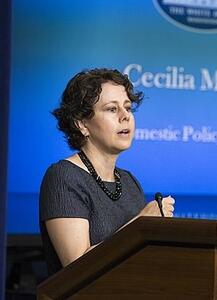
Russell L. Riley
Barbara, are there any other preliminaries we need to do before I can officially get us started?
Barbara A. Perry
Oh, just the routine.
Riley
That’s fine. Thanks so much. Do you have any questions for us about process or procedure?
Cecilia Muñoz
I don’t think so. You sent me a whole briefing book. Everything has been very clear so far, so I appreciate how thorough you’ve been. It was amazing to see all the materials that you pulled together. My goodness!
Riley
Well, we have a very good research team. It’s very experienced. They do a wonderful job and they make us look good. So we always like to hear this, because then we can go back to them and let them know that their work is being appreciated, not just internally but outside, and it sets the perfect tone for us to get started.
We’ll frequently refer to your book. One of the passages that I particularly liked was where you said you can tell when somebody really enjoys their work because there’s a certain spark of life in them. I think that was roughly the phrasing. I hope it’s reflected in what you see of us today, and what you’ve seen of us already, that we have some of the world’s great jobs, and we are that way because we have an open avenue to people like you to talk about things that are just absolutely fascinating. So thank you for your willingness to help.
My guess is we’ll probably start the transcription even before this, but I will officially introduce this as the Cecilia Muñoz oral history as part of the Miller Center’s [Barack] Obama presidential history project. Thank you so much for doing this.
In instances where people have written things that the users of the transcripts should be aware of, we like to make note of that, and your book, More Than Ready, is something that anybody who comes to this transcript ought to see, and they otherwise might not. It’s filed, I guess, under business and self-help—I’m looking at the back—so it’s not a conventional memoir in any sense. People might not otherwise think to go back and look at this, but it’s absolutely essential, I think, for understanding who you are, as well as something about your experience in Washington.
My son is finishing at UVA [University of Virginia] this spring. I really want him to read this book. I don’t know, because it’ll be coming from his dad, whether he will do it. [laughter] It’s aimed at women of color on the rise; my son is not a woman of color, on the rise or otherwise, but there’s so much rich wisdom in this book that I hope he’ll read it when I give it to him. Plus, it’s a fantastic read.
We read Presidential memoirs all the time—This is part of our life—and it has what I think is one of the great lines in here that I have to come back to, on page 64, when you’re dealing with David Axelrod, about the first State of the Union message. You’re having a bit of a conflict with him over the language on immigration, and you said, “In that moment, David Axelrod needs one thing from me. He needs me to go away.”
Perry
Go away. [laughter]
Riley
I thought for you to be self-aware enough and self-effacing enough to record that, that’s just a gold nugget.
Muñoz
Thank you. That’s very kind.
Riley
I think the book ought to be required reading for anybody in the transition who’s going to have a life in the White House. Thank you so much for writing it.
Muñoz
Thank you. That’s incredibly kind. I appreciate it greatly. That’s extremely high praise.
Riley
Go ahead, Kevin.
Kevin K. Gaines
Yes. I had the exact same thought, that I would recommend this book to our son, who’s just out of college and a little upended by the pandemic, and trying to figure out next steps. So thank you.
Muñoz
Thank you. That’s high praise indeed. I appreciate that more than I can say. It’s exactly why I wrote it, to be of use to people who will confront some of the same things that so many of us do but that we don’t talk about.
Riley
Terrific. Thanks for that. We always like to begin with some biography, and we’ve got bits and pieces of that in the briefing book and in your book, but in talking about your upbringing you don’t talk a lot about politics, and I’m wondering: were your parents political people? And if so, what can you tell us about your political upbringing? Then, attendant to that, we’re educators, and at a university. You attended two universities, but you don’t say a great deal about your experiences in college and graduate school, particularly influences on you, both personal and intellectual influences. We’d love to hear you talk a little bit about that as well.
So let me get you started there, and if you don’t mind, the one thing that Zoom is not very good for is interrupting. We may wave at you occasionally if we want to interject with a question, but otherwise the floor is yours.
Muñoz
Thank you. Wow. As you know, I’m a Midwestern Latina, which is a thing that much of the country doesn’t know is a thing, but it’s a thing. My parents were immigrants from Bolivia. You ask if I grew up in a political family, and the answer is absolutely, yes. Not in the sense that my parents ran for anything, which they never would have dreamed of doing in a million years, but my father especially followed politics very closely.
My first political memory is of his hatred of Richard Nixon. We watched the Watergate hearings when I was growing up, and we talked about them. I’m the youngest of four children. We had dinner together every day. Dad walked in the door at 5:30, and at 5:35 dinner was on the table. We sat in our places and we had a conversation, and that conversation was frequently about science and frequently about politics, which my dad followed closely. He was an avid reader of the Detroit Free Press and of Newsweek magazine. By the time we were done with dinner it would be 6:30 and Walter Cronkite would be on, which we also watched as a family.
My dad was the guy who, in going to his job at Ford Motor Company, where he worked for nearly 40 years, would take little file cards, postcard-sized cards, that were addressed to his Congress Member and stamped, and he would hand them out. If there was an issue that he was riled up about, and there frequently was, he would get his colleagues to write letters to Congressman [Carl] Pursell, who was our Congressman when I was young. His wife was my fourth grade teacher. My dad was a frequent writer of letters to the editor to the Detroit Free Press.
I didn’t think of it as politics at the time as much as it was being aware of what was going on around us. It was very much part of my education. And because I’m the youngest sibling, I had the advantage of also hearing what my mom and my siblings were interested in. My sister, who’s 11 years older, went to the University of Michigan, was an ardent feminist, as was my mother, as, ultimately, were all of us. I was born in 1962, and I was growing up particularly in the ’70s, so those conversations had a lot to do with women’s roles. My brothers were also pretty actively engaged. I grew up in a suburb of Detroit called Livonia, which is a pretty Republican place, and my parents were staunch Democrats. We had the only [George] McGovern sign for miles around, I remember quite vividly, and my brothers worked for that campaign.
I guess that makes us a political family, in a lightweight way, and I say that in comparison to many of the people that I worked with when I worked in government, who have themselves run for office, or are the children of people who ran for office, or who grew up knowing that they were going to do this. I did not in a million years dream that I would grow up and work at the White House. Not in a million years.
Perry
Cecilia, do you remember some of the issues that your dad was taking the postcards in to his colleagues to write to the Congressmen about, or some of the letters that he was writing to the newspaper? Do you remember some of the issues that he was really fired up about that you would talk about at the dinner table?
Muñoz
I remember a lot about Watergate, and what I would think of now as rule-of-law kinds of issues. He was absolutely incensed at the corruption. I remember that. I know that my parents were interested in civil rights because that was filtered down to me in a way that was sort of seamless, it was just part of who we are, which I now wonder about, because we are light-skinned Hispanics. My dad had blue eyes. We lived in a very white suburb.
I think my parents, if you were to ask them what their race is, would have described themselves as white. My dad did not speak English with an accent. My mother did. They were almost evicted from their first apartment in Detroit because the landlady caught them speaking “Mexican,” as she called it. But I didn’t know that story until I started working in the civil rights movement myself. They never told us.
We were living 20 minutes from Detroit. The uprising happened in 1968. My parents were very much affected by it, maybe because they were immigrants. I don’t quite know why, because they were people of privilege in Bolivia. Not all of their family started out progressive or ended up progressive, so it wasn’t necessarily a natural thing that they would identify, frankly, with the black community in Detroit and teach us to identify with that justice movement, but they did. To this day I’m not quite sure I know why, but I’m very grateful for it. I know civil rights was part of what my dad wrote those postcards about. Frankly, it was a pretty gutsy thing to take those issues into the glass plant in Dearborn, Michigan, where he worked, because Detroit’s even still a crazily segregated place.
I grew up around racism that I was aware of. I grew up around kids who had never been to Detroit and would not dream of going, because it would mean being in the same vicinity with black people. I was shocked by that as a kid because it was not my parents’ attitude, and we were in Detroit all the time. That was a more subtle part of my upbringing, but a real part of my upbringing.
Gaines
Cecilia, you just mentioned that your family visited Detroit, and I guess that was unusual for your neighborhood. What were some of the things that you did when you visited Detroit? They have so many wonderful cultural institutions.
Muñoz
Yes. The symphony, the opera, the Art Institute, the Freedom Festival, since Canada’s right on the other side of the Detroit River. On the first weekend in July there would be this amazing festival between the two countries to celebrate both places, with fireworks and parades and picnics and all of those things. The Thanksgiving Day parade in the city, and then just meals. We were foodies. My mother was an amazing cook. We were great lovers of food, and Detroit is a good place for eating.
I’m the first generation of my family to be born in the United States, but I’m the third generation of my family to graduate from the University of Michigan. My grandfather went as a foreign student to the Engineering School for his graduate degree in the ’20s, and he loved it so much that he sent his sons, one of whom was my dad.
My dad was at Michigan during the war in the ’40s, and he had a wonderful experience. He went back to Bolivia after four years and started building a railroad with my grandfather. They were both engineers. He met and married my mother, and then confessed that he hadn’t graduated. He needed one more credit. So right after the wedding they came to Ann Arbor with the intention of spending a year, and their first visit back was 18 years later. They ended up staying. My dad found work in the auto industry, and that was kind of that.
So Detroit is central to how we understand ourselves as Americans. My sister still lives in Dearborn. My father passed away a couple of years ago in the house I grew up in. They were the first and only owners of that house until he died, and I have a bazillion cousins in Michigan, some of whom work in the auto industry. Obviously Detroit is a major industry town. We lived in a suburb of Detroit, but Detroit was the central place. Many people saw the suburbs as a way to be away from the city. We saw it as a way to be close to the city.
Riley
You said you were the youngest child. Can I ask about your brothers—particularly about the Vietnam War? Were they susceptible to the draft? Was that an issue within your household?
Muñoz
They were too young. My sister’s 11 years older than I am. She was born in 1951. My brothers are five and six years older than I am, so they were too young to be drafted, but it was my sister’s cohort that was. I have a cousin who served in Vietnam, and another who is older, who served in the Army, but not in Vietnam. It was before Vietnam. So yes, that was of course one of the issues that my dad was writing to his Congress Member about, and that was very much part of the conversation. I remember seeing the posters in the windows of the families who had sons serving, and it was an issue for my sister’s high school friends, but I was pretty little.
Riley
OK. So that would not have been one of the issues for your father to have been particularly engaged in?
Muñoz
I think he was engaged. He opposed the war, and I’m sure he wrote letters to his Congress Member and to the Free Press about it, but I don’t remember dinner table conversations fearful about my brothers being drafted, because they were young.
Riley
OK. Thanks.
Perry
I’m fascinated about how your parents—perhaps the word is “protected” you from that story of having been thrown out of an apartment for speaking “Mexican.” I hadn’t realized that your grandfather had studied at the University of Michigan, and then when your father came that he didn’t intend to stay, and that he went back, but then when he married your mother and they came back for him to finish up his degree and get his one credit, they stayed. So was the concept of immigration a topic of conversation? You also had so many family members who were now coming and settling, and aunts and uncles and cousins. Was that one of the issues to be discussed in a political realm?
Muñoz
It’s so interesting. No, we didn’t think of it as a political issue. Obviously immigration was central, because my parents are immigrants, we grew up speaking Spanish, and because we had so much family around us. But the major immigration reform of that era passed in 1965, so I would have been too young. My parents were already here, and they came before the 1952 reforms, which would have kept them out, actually. Before 1952, if you were from the Western Hemisphere you could just come. So they had no difficulty, other than what I described. And then my aunt and uncle—
I should back up. Bolivia, when my parents came in 1950, was going through turmoil. The turmoil erupted especially in 1952, and there was a major set of reforms. My mother used to tell stories about going to the town plaza in La Paz after a period of unrest, looking for her cousin because they couldn’t find him, and she had to look among the bodies. Bolivia was a rough place when they came.
They did not intend to stay. They were only going to stay for a year, but what happened was they kept writing back to the family and saying, “Is it time to go back?” The family kept writing back and saying, “Things are very unsettled here. Wait.” Year after year went by, and then there was a job at Ford, and then there were kids, and there was a house, and, as I say, they didn’t go back, even to visit, until 1968.
My mother’s sister was married to my father’s cousin, so they were also Muñozes. They came to the Detroit area. They started in, I think, Decatur, Illinois, then went to Memphis, and then he found work in Detroit. When they first came, they came with five children, and no one would rent them a house. They had to live in two different apartments, he with the older kids and she with the younger ones.
After I joined the civil rights movement, he told me the story of the time when my very Catholic family would go to mass every Sunday. I don’t know if this was in Illinois or in Memphis, but the priest came to visit them and said to them, “You know, you’re a people of quality. You should not allow your children to play with the Mexican children, and you shouldn’t be sitting in the back of the church with them,” and my uncle threw him out of the house.
It’s interesting to me, one, that I didn’t know about nobody renting them a house, about that story, or about my parents almost being evicted, until I started talking about my work when I was at the National Council of La Raza. My parents and my aunt and uncle did not understand it as racism. They understood it as prejudice. They understood it as ignorance. But this is actually pretty common among immigrant communities. I’ve actually studied this. There’s this sense of your whole focus is on striving, and there are so many obstacles that you just think of them as obstacles, but it’s the next generation, frequently, or the one after that, that understands what it is they’re looking at.
I can remember as a college student I was given an award for Outstanding Hispanic College Student for the State of Michigan, and my parents proudly went with me to Holland, Michigan, to receive the award. I was a college student who had done some work understanding my own identity, and I made comments about people who were white and people who were people of color. After the speech my mom said to me, “I don’t think I understand, because I thought we were white.” And of course if you’re Latino—many of us are—it’s an ethnicity, not a race. But for people who divide the world between white and nonwhite, I know which side of the line we end up on, and that was news to my parents.
Riley
Was there a conscious effort to affiliate with a Spanish-speaking community in Michigan?
Muñoz
Yes, because it felt like home. So, yes, fortunately we had a big enough family that we were constantly around community. Most of the Latinos I knew growing up I was related to, but there were a lot of us. Thanksgiving at my parents’ home was 40 people, which was the best. But in those years, if you heard anybody speaking Spanish besides family, it was a very big deal. For us, it was the language of secrets. You could go to the store and say, “Look at those interesting shoes that woman has on.” You could say that in Spanish and be very confident that she couldn’t understand you. You can’t do that anymore. [laughter]
Yes, so my parents made friends. At one point there was a group called the Latinos de Livonia—Livonia is the suburb I grew up in—where they managed to find other people like them. At one point, as a teenager, my cousin and I were made to carry the banner for the Latinos de Livonia in the Memorial Day or Fourth of July parade, and we were just teenager enough to be completely mortified by that. So yes, they did make an effort to get to know other Latinos, and among the people who became the closest friends were the ones that they found. There weren’t very many of us then. There is actually a mostly Mexican American neighborhood in Detroit on the west side called Mexicantown, but we weren’t as aware of it when I was growing up.
Riley
And how about your own experience coming up through the school system? Did you feel different?
Muñoz
Yes, I think not in a racial way, but in a cultural way, maybe. Because we’re light-skinned, it was much easier than it could have been. There were no black kids in my school growing up, all the way through, kindergarten through grade 12. Not one. I did feel different—
Perry
All public school?
Muñoz
All public, yes.
Perry
And just to interject: how come your parents didn’t send you to Catholic school?
Muñoz
They sent my siblings. I think because I’m the fourth one. [laughs] My siblings went to Catholic school until we moved to the house that I grew up in, which we moved into when I was three, and then they switched to the public schools.
The Livonia public schools were good quality schools, and they were believers in a public school education. In fact, I can remember—I say this with some hesitation, because it was my mother saying to me, “Please don’t tell” my cousin, who had kids my age, “that we’re voting against—” There was a ballot initiative to provide funding for parochial schools that my parents voted against. My cousin sent her kids to Catholic schools, and my parents did not want her to know that they had taken that position. My siblings went to Catholic schools until we switched, which was in about 1965.
Perry
I didn’t mean to interrupt, but you were telling us about how you felt in public school.
Muñoz
I can remember getting to kindergarten and realizing that I had to switch to English and not Spanish. We spoke Spanish at home. Because I had older siblings, they had already made the switch, so they communicated with my parents in English, but I can remember feeling very vividly, Nobody else does this thing? I better not do it. I remember that feeling in kindergarten.
Then there was the cultural stuff. Our names are complicated. My name is Maria Cecilia. My sister’s name is Maria Cristina. My cousins are Maria Carmen—Everybody’s first name is actually Maria, but because we all have the same first name, we all use the second one. My last name on my birth certificate is Muñoz Perou, which is actually my father’s last name.
In Latin America, you have two parts. One comes from your dad, and one comes from your mom. Muñoz came from my dad’s dad. Perou came from his mom. When they came to the U.S., the people who filled out the forms filled out the forms for both of my parents in my dad’s name, and they didn’t bother to correct them. They didn’t plan to stay. They thought it was kind of cute that everybody wanted to use what was at the end, so we were the Perous, which is not our family name, but everybody I grew up with knows our family as the Perous because in America you use what’s at the end, even though in Latin America you would not. In Latin America our name would not be Muñoz Perou; our name would be Muñoz Sierra, because Sierra was my mother’s name.
And of course in those days there were no hyphenated names or two-part names of any kind, so on the first day of school every year the teacher would get to the M’s, and they would get to me, and what appeared on her little spreadsheet was M-U-N-O-Z-P-E-R-O-U. So I knew that she had gotten to my name when we got to the pause like you get after whoever’s name starts with M-C, and then you get to me, and the teacher—You could see her eyes get really big. No one could pronounce Muñoz, so I would just say, “Just forget the first part. Just use Perou.”
There was the notion of having the unpronounceable, complicated name; the bringing funny food in in our lunches kind of thing; the fact that we spoke this other language, which seemed mysterious and exotic. But then, if people knew where we were from, I would get a lot of, “Where is that, and how come you’re not black, because isn’t that in Africa?” Or Bolivia had a lot of unrest we would get teased about, coming from a banana republic, or coming from a place that has, they used to say, 52 revolutions per minute.
So I felt different, but in a proud way. I have a wonderful, close family, a wonderful, close extended family. Our whole social network, every birthday, every Mother’s Day, every Christmas, the people we got together with were my cousins. My only sleepovers ever were with my cousins my own age. I would never have dreamed of doing a sleepover with someone who wasn’t family. This is a common thing among my Latino friends. My Mexican American friends say the same thing: they had to talk their parents into agreeing to sleepovers, because why would you sleep at someone else’s house? [laughter] It didn’t make sense to our parents. So, yes, I felt different, but in a privileged and proud way. I understood us as being special, and to the extent that there was teasing, it wasn’t particularly hurtful.
Riley
Is it the case that you were always going to go to the University of Michigan?
Muñoz
Yes. My sister and I went. My brothers didn’t. My brothers went to private colleges. But we were a serious Michigan family, watched the football games religiously, the only sport that we watched. My brothers watched baseball because the [Detroit] Tigers won the World Series in 1968. My eldest brothers remain baseball fans, but, yes, we watched Michigan football.
What was clear—and this is important—is that all four of us were going to college, and that was because we lived in the United States, because had we stayed in Bolivia, there’s no way the daughters would have gone to college. It was clear that we were all going to go, and my parents left it up to us. But yes, I only applied to one school.
Gaines
At Michigan did you overlap with any of the student activism around African American Studies or Latinx Studies?
Muñoz
No. I wish I had, because I had a double major in English and Latin American Studies. I had to invent Latin American Studies, and there was no activism at all. There were no other Latinos at all, really. I was at Michigan from ’80 to ’84. The [Allen] Bakke decision, the affirmative action decision [Regents of the University of California v. Bakke], was just before then, so the university was kind of struggling with how are we going to comply and do this. At the time I think the black community of Michigan was only 3 percent of the student body, which is bonkers. So there was a definite conversation about how to do a better job as a university of recruiting students and helping them be successful, especially from the black community. There wasn’t even a conversation about the Latino community.
I did some work later on, because of the affirmative action suits that Michigan was involved in, and learned—I wish I knew what the source of this data was, because I’m not sure I could re-create it, so I hope that it’s accurate, and I’m not positive that it is—that the year I graduated, the incoming class of freshmen, which is something like 4,000 students, had 20 Hispanic students in it. I don’t think I knew a single other Latino student the whole four years.
I can’t name a single professor—well, no. I had one Argentinian professor who was a thesis advisor. I had to cobble together a Latin American Studies major, as it was really an independent studies major that they had to approve, so I took the one Latin America–focused archaeology course, and the Latin America–focused history course, and some literature courses, and turned that into a Latin American studies major, and wrote a thesis comparing William Faulkner and Gabriel García Márquez’s work. The well-known Faulkner expert’s comment was, “Why would you even do that?” [laughter]
So, no, there was no activism yet, and now the university has a Latino Studies program, and African American Studies, but that wasn’t much of a conversation at the time.
Gaines
Yes.
Riley
What did you think you were going to do with that education?
Muñoz
No idea. [laughter] I was a literature person, so I knew I wanted to be an English major. But I sat in a freshman seminar, and in English read One Hundred Years of Solitude by García Márquez, and it was so much like my mother’s stories that I realized that this was a thing I was part of, that I was part of a bigger thing, that it wasn’t just my crazy family, but that this great novelist had written something that sounds a lot like what my mother had told me about growing up in Trinidad, Bolivia. I kind of fell in love, so I did both. Then I got myself to Berkeley on a scholarship as a Latin American studies master’s candidate and focused there on literature as well.
But of course I got to Berkeley and the place was awash in Latinos, which blew my mind. As I say in the book, that was when I understood that this thing that was pretty isolated for me—my little family, and our little enclave in Michigan—was actually part of a broader community that I felt a real affinity with from the moment I began to understand what it was.
Riley
Well, I think you were quoting Valerie Jarrett in the book, that you can’t be what you can’t see, which, by the way, I used with my daughter this morning, because she’s playing softball and there was a story in the New York Times about a pitcher that had pitched not only a perfect game in softball but had struck out all 21 batters. My daughter had not seen a story in the New York Times featuring a softball player before, so it was an important revelation to her that she could see something, and maybe that’s something she could be. So in your case, you’re going to Berkeley, and you’re seeing things that you’ve never seen before. Is that creating a sense of expanded horizons for you?
Muñoz
Yes, in two ways. One was just the academic experience, but also, because I had a scholarship, I didn’t have to work. I didn’t have to wash dishes the way I did as an undergrad. So I volunteered at a legal services clinic called the Office of Hispanic Affairs near the Fruitvale BART [Bay Area Rapid Transit] station in Oakland, which was providing legal services to immigrants.
I went through this training session. This was a tiny office. It had a lawyer and an assistant to a lawyer, who was an activist. His name was Martin Cano. He was recently back in the community after having served some time. He was Mexican American—Chicano, he would call himself—and he was the person who trained me. He had quite a big influence on my life.
He said to me—I will never forget this, because I was wrestling with “I’m this Boliviana; I’m not a Chicana. The people around me are Mexican American; I relate to them, but it’s also not my history.” So I was wondering, Where do I fit in? I’m not brown. Where do I fit? And he said, “You’re a Chicana.” He basically said, “I have the ability to declare on your behalf that you are one.” [laughter] That meant a lot to me and helped me understand that all of our experiences—It all counts, right?
That volunteer experience was an enormous part of my graduate school experience, and helped me get connected to this community. I didn’t understand at the time, but I was launching a career. I thought I was volunteering to do something useful, and to learn some things, but I’ve been doing immigration ever since. I am one of many people in that field who would say they never really chose immigration; immigration kind of chose them. That’s true for me.
Perry
Did you ever think about law school, especially at that point when you’re helping people navigate the legal system?
Muñoz
It’s funny that I never did. My brother and I were roommates. He was at Berkeley’s law school when I was there as a master’s student, and we shared an apartment, so I watched him in law school, and it never occurred to me. Interestingly, as I was diving in, and being told I can call myself a Chicana, my brother, Eddie, with his light skin and blue eyes, tried to join the La Raza Lawyers Association at Berkeley’s law school and they told him he didn’t belong. Because he wasn’t Mexican or Puerto Rican, in their view he didn’t count. I didn’t know that until he read the book, actually. He never told me that.
Gaines
So these years in Berkeley would have been the mid- to late-’80s?
Muñoz
’84, ’85.
Gaines
OK. Do you have any recollections of, let’s say, the Jesse Jackson campaign and the Rainbow Coalition where you were? I’m just wondering the extent to which your narrative dovetails with those kinds of political events.
Muñoz
Yes, although I remember the Jackson campaign and the Rainbow Coalition from the years just after that. I graduated from Berkeley in ’86 and moved to Chicago right as he was starting his campaign. He ran in the ’88 election, and I voted for him in the primary, actually. I was less aware of it at Berkeley, but very aware of it in Chicago.
What I did become aware of at Berkeley was IRCA, the Immigration Reform and Control Act of 1986, which was being debated in those years, between ’84 and ’86. I was on the ACLU’s [American Civil Liberties Union] mailing list, so I got the action alerts about IRCA. And because I was helping immigrants, my job, the volunteer work that I did, was about helping do deportation defense for people in deportation proceedings, and helping people adjust their status to permanent residents who had come in the Mariel boatlift from Cuba.
There was a lot of conversation about this law that Congress was debating. It was maybe going to allow for legalization of undocumented people, and there was a fight to make sure that it did. There was a lot of anxiety because it was also going to make it for the first time illegal to hire undocumented people.
I was watching all of that, was part of the conversation about it, with the clients where I was volunteering. I was also getting these action alerts, and doing the phone trees, and calling Congress and all of those things. Then I graduate and I move back to the Midwest, and I start looking for a job and end up at Catholic Charities in September of 1986, and IRCA passes in November. It’s signed into law November 6th of 1986.
There’s a legalization process in the law that they scheduled, and Congress, in its infinite wisdom, picked May 5th, thinking, Cinco de Mayo, let’s start it then. So there was not a lot of time between the law passing and May 5th to stand up a legalization program, and I was asking questions about it because I was getting these action alerts. I ended up running the legalization program for Catholic Charities, which was a completely nuts thing to be doing at the age of 24, but I did.
Perry
I’m struck by, in your memoir, the connection of the Holy Cross priest you knew at Berkeley who connects you with Catholic Charities in Chicago. “Father Jack,” right, is Monsignor [John Joseph] Egan. I’m Catholic, by the way, too, so I’m thinking—Pope John Paul II is already ensconced in the Vatican, and the Church is turning more conservative, but it sounds like you linked up with the social gospel wing of the Catholic Church, which is a good thing.
Muñoz
The lefties, that’s right.
Perry
Tell us about that.
Muñoz
I was raised Catholic in this suburban, white Catholic church, and in graduate school met Father Tim Scully. We used to call him “El Curita Loco,” the Crazy Curate [laughter]—with his Chicago-tinged Chilean accent. Now he’s a major figure at Notre Dame. He was just very nice, and introduced me to Father Egan. I had no idea what an august figure he was. He very kindly took me under his wing and helped me find my first job in Chicago. And I came to know who he was because he spent a lot of time with me.
I was fortunate to hang out with the sort of liberation theology crowd, the priests that I worked with, in the first part of my job—Before I got the legalization job, I was organizing in Catholic parishes in Pilsen and Little Village, which are neighborhoods on the near South Side of Chicago that are very, very immigrant. The priests there were Irish guys who had studied Spanish in Panama, so they could do a Spanish language mass and lead a congregation in Spanish. But they were big liberation theologians at the time.
Gosh, which reminds me: the other big issue we talked about all the time, that my dad wrote about all the time—I can’t believe I didn’t mention it—was Central America, the U.S. role in the [Ronald] Reagan administration in Central America. And—
Gaines
I would have asked. [laughter]
Muñoz
Yes. That came up a lot around my dinner table. I ended up gravitating toward those priests. I was working with those priests in their parishes. I was being mentored by Jack Egan, and I got to work with some really seriously badass nuns: Sister Bernadine Karge, who remains a friend, who’s from the Dominican community in Sinsinawa, Wisconsin. She was the lawyer for the legalization program, and she remains a close friend to this day.
I really struggled with the priests. I just have to tell you that my two Irish guys in the parishes where I was working who really preached a social gospel, they had big fights with the Archdiocese, who they felt for whatever reason was not taking their communities seriously enough. They chose to fight their fights over the program I was leading, and they didn’t treat me particularly well as a part of that. I learned how hard it is to be a woman trying to run something in the Catholic Church in the Archdiocese of Chicago. I was also 24, and I was not a nun.
Catholic Charities ran the legalization program as a deliberate decision by Cardinal Joseph Bernardin, who I think was a very good man. He recognized that at the time half of the Catholics in Chicago were Latino. Half. There was one Latino priest. His name was Juan Huitrado. He was imported from Mexico at Our Lady of Vilna Church, the name of which just cracks me up. I just somehow love that. And then a bunch of Irish guys who spoke Spanish.
Cardinal Bernardin was bound and determined for the church to send a message to the flock that it was going to run the legalization program to help them. I was the person in charge of that program. The program became the source of a tug-of-war between the priests, who wanted more out of the Archdiocese, and the Archdiocese, who really wanted this program to be successful and were suspicious of this kid who was running it, who was also a feminist and a bunch of other inconvenient things.
It was a very intense experience for me. At one point a guy named Father Frank Kane, who was kind of the number two guy for the Cardinal, said to me two things. One: “You may come to this meeting about your program, but you may not speak, and you should just know my hierarchy for how I give credibility to what people say. It starts with priests in the hierarchy, and then it’s priests, and then it’s deacons, and then it’s men, [laughs] and then it’s women religious, and then it’s women.” He told me this so that it would be clear to me exactly where I stood. And so I learned, I think, a little bit more about how the church runs than I wish I knew, honestly.
I worked my heart out in that program, and learned a ton, and we helped legalize 5,000 people. We were the largest program in the city. We built a coalition with other programs that were also serving people out of the Lutheran Church, and out of the evangelical churches, and out of the nonreligious social service agency. That coalition still exists. It’s the Illinois Coalition for Immigrant and Refugee Rights. I grew tremendously during that experience, but I still carry some pain from it in what I learned about this kind of monarchy from the Middle Ages that is my church.
Gaines
Could you say a little more about the issue of Central America and how it might have related to your work with Catholic Charities?
Muñoz
Yes. The country’s engagement in Central America, which really started in the ’70s, when I was in high school, was a major source of conversation in my household, and a major source of outrage, that the U.S. would play out the Cold War in a way that seemed unnecessary and greatly hurtful, and ultimately we were sponsoring violence that was visited on lots of people. So that was a great subject of conversation and outrage in my household, and actually had some influence on my wanting to stick to Latin American studies, and wondering whether I could make a contribution to the world through my combination of my identity and my interest in these issues.
It’s maybe the first issue that made me something of an activist. It’s also the subject of a story that I think also has a lot to do with my activism, which is that my high school boyfriend at the time, believe it or not, is the person who said to me, “If we were to ever get in a war in that part of the world, I could see putting your family in an internment camp, like we did with Japanese Americans.” He remained my boyfriend after that, I say with some shame.
That was the beginning of my education around how no matter how American we understand ourselves to be, there are people who will not see us in the same way, who just will not. I was really, deeply shocked by that, and I wrote about it later in an essay for “This, I Believe” as the propellant that took me to the civil rights movement. That was my moment of, Oh! For some people my whole family’s always going to be an“other.” There are people who believe it’s OK to treat people under a different set of standards. I don’t believe that’s OK, and maybe that’s what I want my life to be about.
So that connects to Central America. That was a big part of the propellant for me. But I ended up identifying more strongly, or finding my path more, with Latinos in the United States than with foreign policy, and I think that happened when I was doing that volunteer work in California.
Riley
While you’re in Chicago, you’d mentioned that you had become a little bit involved, I think, in the Rainbow Coalition politics. Is there a more conventional partisan dimension to your work at the time, or are you pretty much wholly immersed in the immigration work?
Muñoz
I was pretty immersed. We had one year to find as many undocumented people who qualified as we could and get them legalized, so that was really where I was focused seven days a week. But I do remember following the primary closely, and I have a vivid memory of my feeling of pride that I had voted for Jesse Jackson, that it felt like a milestone moment that I’d had the opportunity to vote for someone black.
Perry
You also say in your book that that experience in working in Chicago for Catholic Charities, and in that part of the program, helped you to know what you didn’t want to do, which I do think is one of the most important lessons any of us can pass on to those coming behind us, that it’s OK to check something off the list and say, “I saw that,” or “I tried that. I definitely know I don’t want to do that.”
Muñoz
Yes.
Perry
And that gets you to Washington, right?
Muñoz
That’s right. I tell this story to young audiences a lot, because I think it’s important for them to know that you can think you’re headed for one thing and discover that you’re not good at it, which is what I learned. That experience with Catholic Charities and running legalization was intense. There were things about the work that I loved, but I realized that I was losing sleep over the families that we had to say no to, because they didn’t qualify under the law. At one point I was interviewed by the Tribune. They did a feature of 88 People to Watch in 1988, and I was one of them. I told that reporter that my job felt a lot like watching people get pushed off a cliff, knowing that you could only save some of them. Those are not the words of someone who is in love with their job. [laughter]
I had thought that the job for me was direct service. I ended up doing direct service, and I learned that if you do direct service you have to be willing to let go of the times when you don’t have the tools to do everything you want to do. But at the same time, I also learned that our clients—There were huge advocacy needs, and I had all this information in front of me about how legalization was and wasn’t working, what the government was and wasn’t doing right, because that’s what we were seeing every day in the lives of our clients. I discovered that I was really good at putting that information together and presenting it to policy makers. I found my voice, really, as an advocate in doing that job.
I can remember Sister Bernadine saying to me, “Look, our job is actually to get these people through the process, get their applications reviewed, and get them in. Why are you spending all this time with this coalition?” And I would say, “Because we can actually get more people through if we win some of these policy debates, so this is related to the lives of the people that we’re trying to help.” So I got that. I understood the need to build coalitions instinctively, and understood the possibilities of being able to expand the policy influence for people, and discovered that I was really not just good at it but animated by it. That got me up in the morning.
Legalization was a time-limited process. There were two stages, actually. The first stage ended in May of 1988, and then there was a second stage of legalization, which the whole infrastructure had to keep going for. I, at that point, realized that the way that structure was going to get set up I was going to end up tussling with another leader in Catholic Charities who I didn’t have a lot of respect for, and because that person was a man, I was not being set up to succeed. I realized that as important as that work was, that it wasn’t my work to do.
At that point I had gotten to know a couple of leaders in organizations in Washington, because the Illinois Coalition was connected to other coalitions by a group called the National Immigration Forum, which convened a table that included Washington groups like the ACLU and the National Council of La Raza. I’d gotten to know them a little bit.
I called the leader of the Immigration Forum and I called Charles Kamasaki at NCLR [National Council of La Raza] to say, “All right, this legalization stage has ended. I’m looking for my next thing. What do you think?” They both offered me jobs, and I took the one at NCLR. I went on an epic biking trip across the Canadian Rockies that summer, and then in September of 1988 moved to Washington and started at NCLR, like everybody who comes to D.C., thinking I’d be there for two years, [laughter] and here I am.
Riley
All right. Tell us about the work there then. How do you find Washington? Is it what you expected it to be? You’re coming in ’88, so there’s still a Republican administration running things. Does that matter much to you in what you’re doing or not?
Muñoz
I was really there at the very tail end of the Reagan administration. It had been President Reagan who had signed IRCA. It had also been President Reagan who had done the budget cuts which almost killed NCLR, so I started at a point at which—When he was elected in 1980, NCLR had been built with War on Poverty money. It had mostly government grants, and had built a network of affiliates all around the country, which were providing services through government grants. The Reagan administration cut a lot of those grants in midstream. I think NCLR lost more than half of its budget. A bunch of its affiliates closed their doors.
Raul Yzaguirre, who was the president of NCLR at the time, weathered that storm, diversified the funding base, and started to build back. I get there in 1988, when some of the building back had begun to happen, and he’s hiring for the first time a cadre of middle managers. He hired three middle managers for his policy team. I was one of them. I was the senior immigration policy analyst. There was a civil rights analyst who started a month after me, and just a month before me a senior poverty policy analyst had started. All women.
So I came in with a bunch of newcomers who were my peers and who were all brilliant. One of them is my best friend now. We worked under Raul, who is a great man of extraordinary integrity, and Charles Kamasaki, who led the policy division, who is just a mensch. He’s just a brilliant, lovely human. He’s also written the definitive book on IRCA, by the way, which I highly recommend.
We were getting trained in the ways of Washington. Lisa Navarrete, the civil rights policy analyst, had been working on the Hill for a member of the Congressional Hispanic Caucus, so she knew the Hill, as did Charles. I knew immigration really well, and I knew it from a community perspective. Between the two of them, they taught me what I needed to know about how to tangle with the guys. All of the people doing immigration advocacy at the time on the Hill were men—and me. So Charles, who had been one of those guys who passed IRCA, just disappeared on them and threw me into his role. Some of them took it better than others. It was really trial by fire. He just kind of dropped me in, gave me some coaching, and left me to figure it out.
At the time there was an immediate, huge thing. We were still finishing up implementation issues around IRCA, in the second stage of IRCA, and protecting the family members of the people who we’d gotten legalized through IRCA. IRCA treated you as an individual, so if you legalize but your wife didn’t legalize, she was subject to deportation. We were working on that and working on the next major legislation, which was reforming the legal immigration system.
I was part of this little team that prevented a really terrible thing from happening, which was the bill that Ted Kennedy and Alan Simpson had negotiated on, where Kennedy, frankly, had gotten taken for a complete ride by Simpson. That bill, through a really complicated mechanism, would have decimated the family immigration system. Right when I got to Washington, my first assignment was to generate the letter from the Congressional Hispanic Caucus to keep that bill from the floor in the House, because it had already passed the Senate, which we did. We kept it from moving. Then, when the next Congress convened, my job was to either keep that bill from happening or to improve it, and that’s what I spent my first two years, really, at NCLR working on.
I had to testify before Kennedy and Simpson on their own bill and tell them how bad it was. It was my first ever testimony. [laughs] We beat them on the floor on a bunch of amendments and vastly improved the bill, and it went from being a pretty negative bill for immigrants to being quite a positive one by the time it passed into law, and, sadly, to this day, that remains my greatest legislative achievement, because legal immigration increased. This is a bill that passed in 1990, and has a lot to do with who we are as a country now, actually.
Yes, it was a total trial by fire, stepping into Charles’s role, who is a brilliant guy, and beloved by his colleagues. He let me make my own way, and NCLR was a place that if you knew when to check in with the boss, he would let you speak on behalf of the organization.
I developed huge expertise on passing legislation, on influencing regulations, on speaking in the media, in English and in Spanish, all because Raul was willing to trust his team to get it right. It was an amazing experience, just amazing. I was there for 20 years. I started as the senior immigration policy analyst and I ended up ultimately in Charles’s job. I ended up running the policy shop there. And during that period I met my husband, we got married, we had a couple of daughters, and bought this house, which we have this month been in for 30 years.
Riley
I hope that means a paid-off mortgage after 30.
Muñoz
It does. [laughter] That’s such a good thing.
Riley
Congratulations. I’m sort of surveying, and as always in chairing a session, am mindful of time. Is there anything through the [William J.] Clinton years in particular? You’re somebody who ultimately works for a Democrat, and you’ve had Democratic components in your roots. What’s the relationship during the Clinton years between the organization and the administration?
Muñoz
Actually, pretty tense. With the Reagan administration, he was the guy who signed IRCA; he was also the guy responsible for the budget cuts that almost put us under. The George H. W. Bush administration actually helps us pass the good immigration bill, so we had actually quite a strong partnership with them. He also does an Executive order that Raul pushed for very hard to create a commission on Hispanic educational excellence. Raul’s major, major concern, and rightly so, was that we had something like a 40 percent dropout rate at the time.
The school systems were failing our kids in a really serious way, and we didn’t have great data sources. It’s hard to imagine now, but at the time this was a very big deal: the first census that actually counted our community with any accuracy was in 1980. So we were operating off of the first datasets that allowed us to even tell our own story and understand our own educational and economic status. We knew from experience what the issues were, but we couldn’t quantify it really in any kind of meaningful way until the 1980 census.
So Raul knows there are huge educational disparities, and we’re beginning to be able to document them. He really wants government to pay attention to them, so we did a letter-writing campaign to the Bush administration to urge him to do this Executive order. I can remember sitting in the conference room with the glue sticks, folding, closing the envelopes. And President Bush does it. He signs this Executive order, which then gets continued in the Clinton administration, and Clinton appoints a task force, which Raul chairs, to implement this Executive order on Hispanic educational excellence.
But then Clinton assigns someone, I think from his Education Department. I don’t know who the actual individuals were. I had a colleague who was working on this full time, and I was mostly watching it. But they view their role as cheerleading for the Clinton administration’s accomplishments, when Raul understood the role of this commission to be lifting up what the disparities were and making recommendations for what the government could do about it. He feels like he’s getting sandbagged, and that the Clinton administration is using his commission to whitewash their own record, and he resigns, publicly. There’s an article in the New York Times. He resigns in protest.
He had been invited to a state dinner around then, and they waited until Audrey, his wife, was on her way into D.C. with the dress in the car to change to go to the dinner before they disinvited him. So that’s what our relationship with the Clinton administration was. [laughter]
To their credit, there were a lot of ways in which we made progress during the Clinton years. There was also something called the Hispanic Education Action Plan, which we developed in Clinton’s second term and we made great progress on. Part of the reason we made good progress on it—we called it HEAP [Hispanic Education Action Plan]—was Janet Murguía, who was in the White House Legislative Affairs Office.
She was one of the highest-ranking Latinos in the White House. There were three: Maria Echaveste, who was Deputy Chief of Staff; Mickey Ibarra, who was the Director of Intergovernmental Affairs; and Janet, who was a high-ranking person in the Leg [legislative] Affairs operation. Janet, uniquely, was in touch with us, and carried our water, totally appropriately. She could see that we were trying to move the needle for our folks, and she was an advocate on the inside. So we did make some progress, and we had good relationships with people like Janet and Mickey and Maria.
But the welfare reform passed during those years was designed and passed on the backs of legal immigrants. Forty percent of the cost savings in that bill was a direct budget cut in federal services to immigrants who were perfectly legal in the United States, and it was retroactive. The reason that it happened, and the first people to serve up legal immigrants as a source of funding for that bill, was the Clinton administration, for which I will never forgive them.
Then that ball was picked up by Newt Gingrich and he ran with it, and they passed a bill that was not only not great for welfare recipients at the time, because it imposed work requirements but didn’t help people in a meaningful way, but also 40 percent of it was a budget cut in services to immigrants. By retroactive, I mean that if you were a Holocaust survivor and were now in a nursing home on a respirator, and you had never become a U.S. citizen—so you were a legal permanent resident, and you were receiving supplemental security income and Medicaid—you were going to be cut off of those things and left with nothing. That’s what that bill did. And I, to this day, have not forgiven Bill Clinton for signing it.
We managed to get into his signing statement. He said, “Part of it is bad.” He ran for reelection on having ended welfare as we know it. That’s why he signed the bill. But we at least got him to say, “I will work to undo this terrible thing that we did to legal immigrants.” I spent two years of my life on that. In the Balanced Budget Act of 1997 we managed to reinstate about $15 billion worth of benefits to legal immigrants. We got rid of the retroactivity part. But the affirmative part, that if you’re a legal immigrant you’re not eligible for anything for five years, and if you’re hit by a truck, too bad, has never been fixed.
And then, right after that, he signed a really terrible immigration bill that has a number of the ugliest provisions that we’re still living with today. He signed them into law.
Riley
Which one was that?
Muñoz
That’s IIRAIRA [Illegal Immigration Reform and Immigration Responsibility Act]. It was signed in 1997.
Riley
’97. OK.
Muñoz
Well, it could have been ’96. It was signed in ’96, actually.
Riley
Yes, there was a lot of activity in ’96 with the Republicans in Congress, but that—
Muñoz
Yes. Welfare reform and immigration reform happened in close succession. He signed both of them. Now, the Clinton administration did not serve up immigrants on the immigration bill the way that they did on the welfare bill, but they were not our friends.
Riley
Well, it’s interesting, thinking back. In President Clinton’s own experience, he didn’t have a good experience with immigration as Governor of Arkansas with, I guess, Cubans then, and then Cubans again in ’92, ’93 were problematic for him.
Muñoz
Exactly.Yes. So the lesson he learned was that this issue is trouble. He had people like Rahm Emanuel working for him as a senior advisor, and Rahm, who I know well, viewed immigrants as a political loser for them, especially in those years. Rahm prevented Clinton from ever speaking at a naturalization ceremony, for example. He never did, not once. Naturalization ceremonies are like the most motherhood-and-apple-pie thing you can do, and Clinton didn’t go near one. So I had a lot of animosity [laughs] toward the Clinton administration.
I had an opportunity to work there. I was offered jobs there in the administration a couple of times when my kids were little, but once he signed welfare reform, I was never going to work for him.
Perry
I think Russell is absolutely right in nailing, in part, personally and politically for Bill Clinton why he would have developed these views about immigrants, but did you also worry about where the 1990s, starting in the 1980s, where the Democratic Party was going? Certainly away from the George McGovern era, and the Democratic Leadership Council, which was to find a third way and find a midpoint between conservatism and liberalism. Did you worry about where the party itself was going?
Muñoz
Yes. The party was never in a great place on immigrants or Latinos to begin with, and immigration is this weird—at the time, at least. It’s changed in recent years, painfully, but at the time was in a weird place where the left and the right connected. Democrats would be a little nervous about the impacts of immigrants on workers, and some Republicans, the Wall Street Journal editorial board among them—The Wall Street Journal used to advocate for open borders. They were very pro-immigrant, and, for that matter, the lower wage, the better.
The coalition willing to support a generous immigration law was a little weird. We would lose Democrats on the far left, but we would pick up Republicans on the far right. And Democrats, in general—Understand that the Latino community was smaller then, considerably, so our electoral clout was limited to a handful of states. We were not particularly well understood by the Democratic Party. Really, I would say, until Barack Obama. The only Democrat at the Presidential level who understood us in any way at all was Lyndon Johnson, because of his history. But Bill Clinton, who had a feel for the black community, did not have a feel for the Latino community. He just didn’t know us. And his sense of immigrants was to position himself with some distance. That’s kind of where the Democrats were.
So yes. It’s not like I was worried that they were moving in a bad direction, but that I never experienced them as being necessarily our friends. You had to always overcome the immigrants-taking-jobs-from-Americans question in dealing with Democrats.
Riley
How did Henry Cisneros fit into this matrix?
Muñoz
He led a walkout at the DNC [Democratic National Convention]. This is why you should read Charles’s book, which I suspect you will love. He led a walkout at the ’84 Democratic Convention over IRCA, actually, over employer sanctions. So he, as a young and up-and-coming leader, understood the potency of this issue, and tried to teach his fellow Democrats where they needed to get it right. So, yes, he was tremendously important, actually, at that point. He was mayor of San Antonio when he led that walkout.
Riley
Right. But did he stay that way? Maybe I need to read the book and it’ll answer all of these questions, but once he went into the administration, is he sort of captured by the White House, or is there a limit to what he can accomplish from the perch he has within the administration?
Muñoz
It’s more that there’s a limit. He and Federico Peña, who was the other Latino in the Cabinet, were very much trying to do what they could from the inside, so they were very much internal advocates, but in Clinton’s first term he had nobody in his inner circle. He had two guys in his Cabinet, but neither of them had responsibilities to drive immigration. Federico’s leading transportation, and Henry’s leading HUD [Housing and Urban Development]. There are no Latinos at the White House in the first term. Zero. Eventually he promotes Maria Echaveste, who had been at the Wage and Hour Division in Bob Reich’s Department of Labor. She becomes first the Director of Public Liaison, and then she becomes Deputy Chief of Staff.
So Maria gets there, Janet gets there in the Leg Affairs operation in the second term, and Mickey gets there. That’s the first time he’s got somebody really whispering in his ear in a day-to-day kind of a way from the community perspective. I think Henry and Federico were doing what they could. They’ve both always seen immigration as part of their responsibility, but the Cabinet, for all of its importance, is not the White House inner circle.
Riley
Right. Was there a sense that Al Gore was any better? Did he have anybody around him who was paying attention?
Muñoz
No, and I’m trying to think if there were any Latinos even on his staff. He’s also from the South, right? So he didn’t have a lot of experience with us. Then he has the Buddhist temple thing. Do you remember that?
Riley
Of course.
Muñoz
That’s about foreign-born people contributing to elections, so he’s careful. In fact, remember my little coalition that’s lobbying the immigration reform of 1990? One of them was Melinda Yee [Franklin] from the Organization of Chinese Americans. She was setting up some of those constituencies that were donating that turned out to be a problem. So he learned some caution.
Riley
I see. All right, so let me ask you this, thinking about trying to bring us to our main event: is there some optimism associated with George W. Bush on this question?
Muñoz
Yes. Absolutely.
Riley
And why is that?
Muñoz
Well, as Texas Governor he objected to English-only in his state. He was kind of a pro-immigrant Governor. He understood the politics of this in Texas. So he was the un–Pete Wilson.
The other thing that happens in the ’90s is you have Pete Wilson in California pushing Prop [Proposition] 187, which he did when his poll numbers were, like, in the twenties—He gloms onto this ballot initiative, which is being pushed by an anti-immigrant organization—which, by the way, has ties to white supremacy. He gloms onto that, soars in the polls, and rides that to reelection. George Bush is doing the opposite in Texas and saying, no, that kind of approach, those kinds of initiatives, are not welcome here, because look at who our population is. So he is a much more sympathetic figure because he seems to get us in a way that even lots of Democrats don’t.
Then he gets elected President, and he forms a strong bond with Vicente Fox in Mexico. They’re hosting a summit, and they’re talking about doing an immigration bill that legalizes people. The first people to put legalization on the table and in the headlines were not people in the movement. It was George Bush. At that point I was in meetings with colleagues from around the country who were saying, “The undocumented population has been growing all this time since we passed the Act of 1990. We’ve had all of these fights in the mid-’90s over the immigration bill and over Prop 187. In the meantime, the undocumented population continues to grow.”
There are things about the ’96 law that perversely actually make it harder for undocumented people to become legal residents in the U.S., so as a result the undocumented population grows faster. Some of the advocates from around the country are saying, “We’ve got to start working on legalization again.” This happens around 2000, right? And we are just starting to think, Oh, this is a heavy lift. How are we going to put this on the table in a meaningful way? The person who does it for us is George W. Bush.
Riley
I think that meeting happened on—was it September 10th?
Muñoz
You’re right. It’s in 2001. There’s a headline in July, where the L word, “legalization,”gets uttered, attributed to the Bush administration, and we were at NCLR’s conference. It was in Milwaukee that year. We were all ecstatic. Then, on September 10th, Raul and John Sweeney, who recently passed away and was the head of the AFL-CIO [American Federation of Labor and Congress of Industrial Organizations], and Tom Donohue, who only just stepped down as the head of the U.S. Chamber, the three of them are on a panel, testifying before Congress in support of legalization.
That was not on the 10th, because that’s a Monday. There wouldn’t have been a Congressional hearing on a Monday. September 7th or 8th is that hearing. On September 10th I’m doing, with coalition partners, a visit to the White House with—I’m blanking on the name of the woman who was at the Domestic Policy Council who was responsible for immigration. We were talking to her about immigration reform on the 10th. Then on the 11th, I am in Tom Daschle’s office with Esther Olavarria, who’s Kennedy’s person; the late Cassandra [Quin] Butts, who is Dick Gephardt’s person; and Angie [Angela Maria] Kelley, who’s still one of my dearest friends, who’s now working in the administration, when the TV’s on and we see the planes hitting. We were in Daschle’s office to plot strategy on the same immigration bill, essentially the same one we’re still trying to pass now.
Riley
And then the world changes.
Muñoz
Yes.
Riley
We’re at a point where I probably owe you a break, if you want to take five minutes.
We’re at about the halfway point for the day.
[BREAK]
Riley
I just checked the calendar, and the Mexican President was in Washington for a state visit on September 5th and 6th, so I was off by about five days, but I had remembered that there was some movement. I know your first association with Barack Obama comes during the Bush administration. Is there anything before we get to that stage on the immigration issue that we ought to know about with respect to Bush’s White House?
Muñoz
Yes, just that Karl Rove was one of the people who felt that it was wise to advance an immigration reform, and ultimately he makes the decision after September 11th that they have to wait until they get on the other side of responding to that crisis, which turns out to be a really fateful decision, because we had the votes to get it done in Congress. but without the White House’s support, we couldn’t do it. Then a terrible bill passes the House under [Frank] James Sensenbrenner in December of 2005. We passed a really good immigration bill through the Senate in 2006, but we decided it didn’t make sense to conference those two bills because you’d end up somewhere in the middle.
On the assumption that we had the President’s support, we deferred to the next Congress. The same bill effectively comes up in the Senate in 2007, and the bottom falls out. There was a daily barrage. Lou Dobbs was on CNN [Cable News Network] every day, trashing immigration. We didn’t understand the extent to which the bottom was falling out, and the same bill fails miserably on the floor. At that point the Bush administration is trying frantically to resurrect it. They’re working it very hard, but by that point he had no political capital left, even with his own party. So here we are.
Riley
Can you tell us about your opening associations with Senator Obama during this time, how this presents itself to you, and what are you thinking about this person that you’re first interacting with?
Muñoz
Yes. My very first encounter with the Senator was shortly after he gets to the Senate. He’s making the rounds, kind of getting to know everybody. NCLR gets invited to a dinner at Bistro Bis in the George Hotel with other civil rights and progressive leaders. Janet Murguía, who by this point is the president of NCLR, can’t go, so she sends me. It’s in this basement conference room. He’s sitting at the middle of a long table.
I know I’m the only Latina. There must have been other women in the room. I can’t remember who they might have been. I don’t think I was the only woman in the room. But there’s Bob Borosage and a lot of white progressive leaders. I think Wade Henderson is there from the Leadership Conference. There are some African American leaders, but it’s the sort of progressive folks who are mostly men.
Riley
How big?
Muñoz
Maybe 15. The people go around the table, they’re sort of getting to know him, and he’s in listening mode. He’s just trying to get to know everybody. But everybody’s talking about saving Social Security, because that was what was happening at the time. This was during the Bush administration’s effort to privatize Social Security. There’s a conversation about unemployment insurance and extending unemployment insurance because of the recession. And there’s a conversation about saving the filibuster, because of anxiety about who he might appoint to the Supreme Court.
Those are the topics of the moment, and as they go around the room, this is what folks are talking about. I’m sitting there thinking, All right. Am I just going to go with the flow here, or am I going to actually say something that will be useful to him with respect to my stuff?
So when it’s my turn, I say, “This is all important, so let me just foot stomp that what everyone has said is important, but I guess I also have to say that if you’re interested in a conversation with the Latino community, you can’t talk about extending unemployment insurance, because 40 percent of us don’t qualify for it in the first place because of how we’re situated in the workforce. And while I would be the last person to say that the filibuster isn’t important right now, that’s not where you should start a conversation with my community.”
By this point I’m used to being the skunk in the room that says stuff like that, that where everybody’s heading may be fine, but my job isn’t to be with the progressive or Democratic mainstream; my job is to elevate the concerns of the Latino community. At this point I’m not just the immigration person at NCLR. I’m running a whole public policy division, and I’m responsible for education policy, and poverty, and health care, and a whole range of other things. So I say that.
I can feel the room—Everybody going, OK, that’s a little awkward, she’s a little off message, but now we’re going to nod politely and we’re going to continue the conversation. I’m used to this. I’m also an introvert, and dinners like this are excruciating, [laughter] so I’m thinking, When is this going to be over? Let me go home to my children now. Maybe I can make bedtime.
The dinner breaks up. I get up. I’m not interested in the schmoozing at the end. I don’t want to go shake his hand. I’m slinking out of the room. And there in front of me is Michael Strautmanis, who is now a dear friend, who is the staffer who accompanied the Senator to the dinner. You can’t tell this from Zoom, but I’m 5'2'', and Straut’s at least a foot taller than I am. He’s a big guy, and he kind of leans down. He’s between me and the door, which is where I most want to be. He leans down and says—He has this very gentle voice—“The Senator was really interested in what you had to say, and he wants to hear more.” I thought, Well, that’s never happened before. So I give him my card. I get the heck home. And they follow up, which was amazing. That was my first inclination of, oh, this isn’t actually somebody who thought that I made an awkward contribution at this meal. [laughs] He actually heard me. So that’s unusual.
In 2005–06 he starts inviting me to brief him on the immigration bill, the one that was coming to the floor in 2006. I remember the first of those briefings was in his conference room in his Senate office, which is in the [Philip A.] Hart Building. He invited me and Doris Meissner from the Migration Policy Institute and maybe one other person to brief him. We’re animatedly talking him through the issues, and he’s asking great questions, which indicate to me clearly this is a guy who understands this issue as a civil rights issue, which is unusual, but his questions are all about, “But tell me how I explain this to people in southern Illinois.” He’s really worried about white working people, genuinely. Those are good questions, and we have answers to those questions, but it’s a really good thing that he’s asking them.
I think that’s unusual, too. I get called in to several of these where he’s asking excellent questions. Every once in a while my phone will ring, and it will be him with a question, and that’s also very unusual behavior for a Senator. And the fact that I can tell that he understands what this issue means to me, and to us, is really important, because that doesn’t really happen with a lot of Members of Congress. Ted Kennedy had that, but not everybody does.
A lot of Democrats would be like, “Please don’t talk to me about immigration,” [laughter] and he wasn’t one of those. But he would say, “Look, here’s why it’s hard. Tell me how I manage this part of it,” but from the point of view, “It’s because I want to be where you are.” I appreciated that. So I am recognizing this is an unusual Senator, and I like him. So I guess I drank the Kool-Aid then.
Perry
Excuse me. Had you thought about him during or after his speech in 2004 at the Democratic Convention? Had that made an impact on you?
Muñoz
It did, the same way it had an impact on everybody. I thought it was an amazing speech, super cool that he was going to be the next Senator from Illinois. And you could tell when he got to Washington that he was a superstar. It was impressive that he was not trying to leverage his star power; he was trying to do the work. He was staying low key. I respected that. I thought, Good for you, because you could be very prima donna about this right now, and you’re not. I like a good policy nerd. I have respect for somebody who cares about policy, and that’s more rare, actually, in Washington than you would think.
Riley
Kevin, did you have something you wanted to—
Gaines
Oh, no, I was just reflecting, maybe a little loudly, on Cecilia’s last point. Russell, you go ahead.
Riley
My question was about your Chicago roots. That may be too strong a word, but you had connections in Chicago. Did you check him out with people? No. OK.
Muñoz
It’s so interesting, because we were both organizing in neighborhoods that were about 60 blocks from each other, at the same time, and the organizing that he was part of was supported by the Catholic Church. I totally should have gotten to know him, but I didn’t. Our paths never actually crossed, because I was really only organizing from September through about February, and then by February I was all legalization all the time.
Riley
But within the community of people that you got to know in Chicago, you weren’t touching base with them to see whether they were giving you a reading on this person?
Muñoz
No.
Riley
All right. Kevin, I’m sorry. I don’t know whether you had something from there.
Gaines
Well, I don’t know if this is the time. It just seems that, from what we’ve talked about before, the Democratic Party’s really aloof on the issue of immigration. You mentioned earlier that Karl Rove, before 9/11, was thinking about bringing up immigration reform legislation. So if the Democrats were aloof, how would you characterize the Republicans administration’s openness to the issue?
Muñoz
It’s a great question. I believed then, and continue to believe, that Latinos are swing voters, and there’s more evidence now to support this. We’ve ended up in the Democratic bucket overwhelmingly for a long time, mostly because the Republicans have been so terrible on immigration, so insulting, but that’s sort of an artificial phenomenon. And even still, there’s a big conversation now about how Donald Trump’s support among Latino males actually grew for his reelection, which is mind-boggling but worth understanding.
So yes, what I learned at NCLR, and this was very important to Raul, was that we not be beholden to either party, not just because we were officially a nonpartisan organization but because it was not in our community’s interest to be understood to be in any party’s pocket, and that the two parties should be competing for our votes. I remember there was a time when I did a round of visits—We hired a conservative consultant, a guy who had run for Congress by the name of Jeff Bell, a big sweetie, very Catholic, conservative, who really believed that the party should be competing for our votes. I disagreed with him on 80 percent of what he worked on, but he was a pro-immigrant guy.
He took me around to meet the head of CPAC [Conservative Political Action Committee], people at the National Review, Grover Norquist at Americans For Tax Reform. I made the rounds to just describe what my organization did and what our views were on immigration. All of those meetings were very interesting, and in all of those meetings, except for the one with Jane O’Beirne from the National Review, who just really wanted nothing to do with me, there was a bit of a—I heard it as, “Oh, she can speak in complete sentences, and her English is pretty good, and they’re not crazy, fire-breathing dragon people on immigration. There’s actually a theory of a case to this.” I don’t know what they were expecting, but I did not give them what they were expecting.
The idea was to try to build relationships, because it felt useful to advance the community’s interests to be supporting the line of thinking among some Republicans—This is kind of the Reagan and Bush thinking, which is when you think about Latinos, you think we are very either Catholic or Evangelical, a really strong work ethic. Latino males have the highest labor force participation in the country, and conservative social values, yes, that go along with all of that.
Ronald Reagan used to say, “These are perfect future Republicans. I don’t know why these people are voting for the Democrats.” And that’s not wrong.
But the other thing that’s also true is we believe in feeding hungry people, that the government has a role to play in making sure that people aren’t poor. We suffer discrimination and believe in civil rights. So there’s this weird conversation that’s still happening, which you can boil down—It’s too simplistic, but you can sort of boil it down to this: do you understand Latinos by lumping them with African Americans, and therefore overwhelmingly Democratic and overwhelmingly supportive of civil rights?
Some of those Republicans would frame it as having kind of a “grievance” approach to law and policy, which I think is an insulting way to put it, but that’s how they put it. Are we white ethnics, are we really Italians, who suffered some discrimination when we got here but are really white and are going to turn white over time? And of course the answer to that is no and no, right?
We are not African Americans. That history is very different and particular. We’re also not Irish or Italian or other white ethnics. We are something other than both of those things, and someday we will get defined in our own terms and not in terms of some other community. But at the time, the idea was that Democrats and Republicans should be competing for our votes, and that ultimately we were going to be more effective at making sure policy delivered a good education and access to health care and other things if that competition was happening.
Gaines
And in that competition, it seemed like the Republicans were a little bit ahead in seeing the Latino vote as a potential national voting bloc.
Muñoz
George Bush won election and reelection with a big chunk of our votes, 40 and 44 percent, I think. Right? And that was the model. In fact, we believed, until Donald Trump, that a Republican could not win the Presidency without at least 40 percent of the Latino vote. The reason that Donald Trump broke that logic is because he expanded white turnout.
Gaines
Right.
Riley
I want to pose a specific question to you about the 2006 reforms. I went back and looked at one of the cleared interviews that we did with Josh Bolten, who was the White House Chief of Staff, because we talked with him about this issue. Basically his description echoed what you just said, which is that they were very close to succeeding on reform. There was a critical moment in 2006 where they decided to pause the bill and pull it. There was a recess afterward, and people went home. The Lou Dobbses of the world just churned everything up, and the dynamic changed almost overnight.
Muñoz
Yes.
Riley
But one of the remarks that was made in the interview was about Senator Obama. At the time, he was, I think, a member of the Gang of 14 who had pledged their support for a commonly defined bill. But the critique in the interview was that although the members of that gang had pledged that they would fight off amendments, both the conservatives’ and the liberals’, because there were people offering poison pill amendments to kill the entire package.
At least the argument in the interview was that Senator Obama defied that understanding and brought a couple of amendments to the table that were considered to be acts of bad faith by that White House. And you could understand, we’re doing this interview when Senator Obama is now President Obama, so there may have been some bad blood that developed. Do you have any specific recollections about this particular issue? And were you involved with Senator Obama in these efforts to try to redefine that bill at a time when the Gang of 14 felt like they had an agreed-upon package?
Muñoz
Yes. I don’t remember it in huge detail, but I do remember, because it came up again when we were trying to pass immigration reform in the Obama administration, and some of the Republicans, and some Democrats, actually, accused him of not truly being serious, and this was one of the examples that they gave.
My sense was that there was a group of Senators kind of on the inside working with Kennedy and John McCain. There were folks on the outside, and he was one of the ones on the outside. So there was a little bit of folks trying to make their mark, as well as Democrats trying to find this space of protecting American workers. It was in that space that he offered his amendment, so we didn’t understand it as an act of bad faith or hostile.
I don’t think it ultimately went through. But I think it’s been overstated in terms of what the intention was. He was not trying to kill the bill, which is a thing that folks have accused him of. He was trying to make a mark and a statement with respect to workers in southern Illinois, which we had known had been his interest since the very beginning. But he wasn’t one of the drivers in the immigration debate. He was in the chair when this 2007 bill went down, which I hadn’t remembered. There’s a documentary that focuses on that moment. When you’re a junior Senator, you take turns being the person to sit in the chair, and it happened that he was in the chair when that bill went down.
Riley
I didn’t remember that. Now we’re getting to his being a candidate. Do you have a personal preference going into 2008 or—
Muñoz
Big time. [laughs] As you remember, I’m not a fan of the Clinton administration. I feel sort of personally betrayed by welfare reform.
Riley
All right. That extends to Hillary [Rodham Clinton]?
Muñoz
It does. And I am utterly shocked when Raul Yzaguirre goes in hook, line, and sinker for Hillary, because he had also had his struggles with the Clinton administration. He signed up for Hillary early, as does most of my community, which shocks me because I think of the Clinton administration as having kind of abandoned and betrayed us. Again, we had made progress, so that’s not completely fair, but I remain really pissed off about welfare reform and immigration reform. And Raul, strangely, is not.
By this time he’s retired from NCLR. He has Parkinson’s disease. I run into him at the Des Moines airport, because he’s been traveling around, stumping for Hillary. He looked so exhausted. I said to him, “Raul, this has got to be hard on you physically.” And he said to me, “Well, it was harder picking cotton. It’s not as bad as picking cotton,” which is something he grew up doing, which is a totally Raul thing to say: Yes, it’s bad, but I’ve been through worse.
So yes, I was a little bit shocked that so many leaders in my community were in the tent for Hillary, and I understand that to be out of both respect for her, herself, and also she was a known quantity. Obama was not a known quantity to them. He was too new in the Senate. They didn’t feel like they knew him and didn’t feel like he knew them.
I think there was some black/brown stuff happening in my community, as well, for sure. But I felt like I knew Barack Obama, and I was on board at the beginning. But understand that “on board” meant I told Strautmanis, “Let me help. Let me do what I can.” There were regular conference calls with some D.C. people that I was on. But I say that with real humility, because I know people who gave up their jobs and lived in their cars in Iowa, and I didn’t do that. I stayed at my job. I had kids at home. So I volunteered, and helped some on Latino policy, and Latino outreach, and immigration policy, and the other policy issues I have expertise on.
They called me in a couple of times to brief him. There’s this thing in Iowa during the caucuses called the Black-Brown Debate, which is sort of hilarious because the audience is neither black nor brown; the audience is all white people from Iowa. But at the time it was hosted by a pair of state legislators, one of whom was African American, one of whom was Latino. I was in Des Moines and briefed him to prepare for the Black-Brown Debate, which is the first time I meet Valerie Jarrett, the first time I meet David Axelrod.
I had to say another hard thing there, which is another one of my signs that this is the guy. This was over the driver’s license issue. New York’s Immigrants’ Rights Coalition had been pushing a policy to give driver’s license access to undocumented immigrants. It wasn’t a great time to raise that, because what we feared would happen happened, which is that it caused a ferocious backlash. Because of the backlash, Hillary Clinton reversed herself and came out against providing driver’s licenses. That was the politic position, right? You had to be a little crazy to be for providing driver’s licenses to undocumented immigrants. The political winds were blowing in such a direction that this just didn’t feel like good politics to anybody.
So in preparing for the Black-Brown Debate, there’s Axelrod, who I’m just meeting, and Valerie sitting there, and other people who I don’t know, and I say to him, “Look, you may get asked this question. Hillary reversed herself, and you have previously taken a position in support of providing driver’s licenses, and here’s why you should stay put. Denying people driver’s licenses just means that they’re driving without licenses, and you’re not making anybody safer. A driver’s license isn’t providing any kind of legitimacy to an undocumented immigrant; they’re still undocumented. I understand that the politics of this are tricky, but understand people will notice if you reverse yourself. People are not giving her points for reversing herself, and it’s not actually substantively the right position.”
Axelrod is looking at me like—He’s giving me the look—and the Senator turns to him and says, “Ax, I know what you want me to say, and I realize this isn’t like a—” I forget exactly how he put it, but it was along the lines of, “This may not be what people want to hear, but that’s probably why I need to say it.” And I thought, That’s why this is my guy. [laughter] I’m sure Axelrod filed that under, “Oh my God, this woman.”
Riley
You do a great David Axelrod, by the way. [laughter]
Muñoz
He remains a dear friend.
Riley
All right. Follow-ups?
Perry
Could you say a little bit more about the black/brown lines? In your career up to that point had you worked with black people? Where is your movement, and where is the black movement? Where are black people?
Muñoz
Oh, there’s a lot there. Yes. It’s a thing. It remains the black/brown thing, but it has changed a ton in the time I’ve been doing this work, and for the better, I’d say.
When I get to Washington, NCLR is a prominent member of the Leadership Conference on Civil Rights, which is the historic and strong civil rights coalition. Joe Rauh, who helped form the Leadership Conference and helped pass the Civil Rights Act, is still around. I got to know him.
We’re at the table with the African American leadership and civil rights community, but they, obviously, understandably, dominate the Leadership Conference. It came into being to pass the Voting Rights Act and the Civil Rights Act, so we’re kind of newcomers. Everybody’s being polite. But then we’re also pushing this immigration thing, which is actually complicated for the AFL [American Federation of Labor] and the labor unions, who are, among other things, not just sitting at the table but are helping fund the Leadership Conference. And it’s a little tricky for the NAACP [National Association for the Advancement of Colored People].
Just before I get to Washington, when IRCA is going through, the AFL takes a position in support of employer sanctions, the thing that makes it illegal to hire undocumented immigrants. NCLR, the whole Latino community, vehemently oppose employer sanctions, because we believe what’s going to happen is that if it’s illegal to hire somebody who’s undocumented, employers will resist hiring anybody with a name like mine, right? This is a law that will actually engender discrimination, which is different in the civil rights context, because civil rights laws have been about redressing discrimination when it happens.
This is a law that’s going to create some discrimination. The AFL says, “We are for it,” and so does the NAACP, so there’s real tension. The Leadership Conference only takes positions when there’s a consensus, so they can’t oppose employer sanctions on civil rights grounds, because of the AFL and the NAACP. So there is real tension, despite the fact that we’re working together on other civil rights issues.
When it comes to reauthorizing the Voting Rights Act, for us, a big piece of that is bilingual ballot provisions. The way the Leadership Conference worked at the time is they’re going to work on the main issues of the Voting Rights Act, and if you want to do the bilingual ballot provisions, Latinos, you go ahead, and good luck to you. So we kind of did it on our own. That’s how it used to be. It’s changed a lot. So there’s tension.
Raul, who I deeply love and respect, really feels that he wants the same kind of primacy on our stuff that he feels the black groups get on their issues. And the younger generation of folks, of which I’m part, are in this argument with him about, for all of their primacy, the black community is not in a good place. You’re seeing them as the powerhouse here. We see them as a beleaguered community that has so much further to go, and we should be trying to link arms. So the people my age are making that argument, and Raul’s coming from a place of they have power and we don’t, and we want some.
There is a moment in which, later—This is all kind of set up before I get to Washington. IRCA happens. There is a provision built into IRCA that there are going to be three GAO [Government Accountability Office] reports, and if the GAO finds that there has been a widespread pattern of employment discrimination caused solely by employer sanctions, that it will trigger a provision that allows Congress to go on a fast track to reconsider the law. It started out as a hard rule that if they make the finding, employer sanctions goes away. That gets watered down in the bill to if they make the finding, there’s a fast track for Congress.
The third GAO report comes out, and they make the finding. They investigate and find that employer sanctions have caused employment discrimination. And of course Congress does nothing. We go back to the Leadership Conference and say, “Now can we take a position in opposition to employer sanctions. Here are the words on paper after an investigation.” The NAACP says, “We are prepared to be neutral on this vote," and the AFL says no. Raul is about to be given an award at the Leadership Conference’s dinner, and he authorizes us to picket the dinner, which we do.
It’s ugly. A bunch of us are standing outside the Leadership Conference dinner with our signs that say things like, “AFL-CIO supports employment discrimination.” The head of the Leadership Conference, Ralph Neas, is freaking out. Raul goes in and accepts his award, and gives a pretty scathing speech.
I experienced the tension in a profound way. The next thing that happens—This is in the late ’80s, early ’90s. By 2000, we’ve been around a few more blocks in this coalition, and the next thing that happens is that Dr. Benjamin Hooks, who is the leader of the NAACP, has a relationship with Raul. They sit next to each other at the Leadership Conference meetings. They know each other, and Raul is pressing him, and Ben Hooks takes the employer sanctions to the floor of his convention. The NAACP is a convention; it’s not a conference. They actually vote on stuff, and you have to win the votes. It can be really dicey.
He gets up on the floor of his own convention and says, “Look, I know this is uncomfortable, but I have to say that we have been where these people are, and I want you to vote to reverse our position on employer sanctions,” and they do. It’s a big deal. And then, SEIU [Service Employees International Union] and UNITE HERE, both unions that are actually organizing immigrants, do the same thing at the AFL-CIO, and the AFL also reverses its position. It took until 2000 for the AFL to get there.
But that’s one thing that reduces the tension, at least, between the institutions and the leaders. Then the next thing that, frankly, reduces the tension and changes everything is that there’s this moment, which must be in about 2004, when a bunch of the leaders of the civil rights organizations all retire at the same time: Ben Hooks, Ralph Neas, and Raul. There were a bunch of them that within a year of each other everybody hit the same point in their lives.
The head of the Urban League, whose name I’m forgetting, retires and you get Marc Morial. There’s been a series of leaders at the NAACP since then, and you get Janet Murguía at NCLR. They’re all from the generation that has come up in the ’60s and ’70s, and they instinctively know that they’re not supposed to be competing with each other. They instinctively build relationships with each other, link arms, and basically say, “We’re all in this together.” And, God bless him, Hilary Shelton, who is the lobbyist for the NAACP, leads the coalition on the language provisions under the Voting Rights Act. He doesn’t just say, “Go do it.” He says, “I will do this with you, and I will make the argument,” and it’s so much more powerful when he’s making it.
So we arrive at that point. Institutionally, I think things have changed a lot. I think in the community things have changed a lot. I don’t think we are where we need to be, but I’ll tell you what: there were a lot of Latinos out in the street last summer along with African Americans, and I consider that a sign of progress.
Perry
Thank you.
Gaines
Yes. I thought your point about the generational change was really profound, and you have a younger generation of leadership, say, in the NAACP and the civil rights movement that is maybe a little less invested in that notion of a hierarchy.
Muñoz
Yes. I think that’s exactly right. Some of that is a generational evolution, but I also think—Gosh, our kids’ generation has a deeper understanding—They call it “intersectionality.” It’s a term that we didn’t use at the same stage, but they understand it in an even deeper way than we did, which gives me some hope.
Gaines
Yes.
Riley
Let me bring us back to 2000 and ask a question, because Kevin introduced the dynamic between the Democrats and the Republicans. John McCain, at least for a time, was considered sound on immigration, right? Am I misstating that?
Muñoz
He was a leader.
Riley
What happens in 2000?
Muñoz
He runs for President [laughter] and he tries to get the Republican nomination. So John McCain, briefly, is a Senator from Arizona. He wins regularly with a huge number of Latino votes. He’s another one like George Bush. He understands the community, opposes English-only, does not go for the reflexive ugly stuff. He stays away from that stuff. And it’s a border state.
For years in the 2000s he walks around with, in his pocket, an article from the Wall Street Journal, which describes very graphically what it’s like for the people who die in the desert at the border. He reaches a point where he’s invited to speak on immigration all the time, and he always starts his speeches by reading from that article, and it is graphic. It describes how death happens to these people, and he does that for effect, to make the case about why he is standing up for immigration reform. So that’s who McCain is, right? Somebody who knows the community and regularly earns our votes in his state, and is willing to stand up for something that he believes is right. He forms a partnership with Ted Kennedy, who’s our great champion.
So he was sort of a friend on this issue from the time he gets to the Senate. Then he runs for President, and he becomes unrecognizable, and that’s because he has to win primaries. Bob Dole did same thing. Bob Dole had been a perfectly amiable guy. He wasn’t a leader the way McCain was on these issues, but he took the right positions. He reverses himself when he’s running for President. He’s Mr. English-only. It’s like, Who is this guy? And he’s rewarded by getting less than 30 percent of the Latino vote. At some level we’re getting used to this. This is what happens in Republican primaries, but it’s really gross that it’s McCain, because he becomes unrecognizable.
Then he wins the primary and the nomination in 2008, and tries to pivot back, but by that point he’s running against Barack Obama. There’s no way he can be better on the issues than Obama is, and he’s unable to recover. So he reverses himself in 2000, doesn’t win the nomination, is the guy who—it’s his and Kennedy’s bill, in 2006 and 2007, and then he reverses himself again. We never got him back, really, fully. Well, that’s not fair. We did get him back in 2013.
Riley
Yes. Sarah Palin?
Muñoz
[laughs] Gosh, I don’t even know what to say about her. What terrible judgment on his part, which he acknowledged, ultimately, later on. And she is, arguably, the beginning of the ugly, although there is a case to be made that Newt Gingrich is the beginning of the ugly. But she certainly took the ugly to a new place. But here’s the thing that I struggle with. When I talk about how we didn’t understand how much the bottom was falling out between 2006 and 2007—You made reference to Josh Bolten.
When they pulled the bill and there was a recess, and that gave people the ability to organize—I think all of us, everybody, a hundred percent, missed this current that almost swept us away in these last four years, but it didn’t just emerge in these last four years. It was there the whole time. It’s not like we didn’t know it was there when I came on the scene in Washington, right? We just barely eked out a win on IRCA, but it was a win. There had been some civil rights wins. There was a win on housing discrimination. We were still getting legislative wins in what felt like the civil rights space, and immigration is squarely in the civil rights space. We thought we were at a level that we weren’t going to go back from, and we weren’t.
The anti-immigrant groups, the same groups I’ve been pushing against my whole career, they all have ties to white supremacy, all of them, documented ties. I’ve spent 30 years trying to explain to reporters that it’s not legitimate to quote an organization with those kinds of ties as if they were a legitimate think tank with an unbiased data-based perspective, but those reporters only saw that argument when we got to the Trump administration, not before. So we have actually been pushing against that current for a long time, but we did not appreciate its depth, and now we do.
Riley
Right. So in 2008 and ’09, during the transition period, you’re being recruited. Is there anything that you want to add to the accounts that you’ve published about your selection to come into the administration?
Muñoz
No. Well, I guess there’s one element that I haven’t said publicly, which is maybe OK to say now. I did not consider going in. I didn’t try to position myself. I supported the campaign, but only really from the outside, as a volunteer. My first call was from John Podesta, who asked me to consider going in for an interview. And I said, “Oh, John, my mother has just passed. I’ve got these teenage girls.” And he said, “Look, go in.” He gave me excellent advice. He said, “You can do this. You can work at the White House with teenagers at home. I did it as Chief of Staff. But you have to understand that you get one thing besides working all the time, and if family is your thing you can do it, but then you have to accept that you kind of jettison everything else,” which was excellent advice. It was true.
I went in and interviewed with Rahm and Jim Messina. I was very honest with them. I was really trying to gather information about immigration. I figured, This is awesome: I don’t actually want this job, so it’s a low-pressure interview, and I get to find out what Rahm Emanuel is thinking about passing immigration reform. [laughter] Messina called me the next day and said, “We have really bad news for you. We really want you to take this job.” I said no, even after that, until I got the call that I’ve described in the book, which was just completely, crazily over the top. I now understand President Obama revels in being that over the top to persuade people. I’ve seen him be just completely outrageous in twisting people’s arms, either to get them to come or to get them to stay.
So all of that happens. He calls me on my cell phone. I still think it’s completely bonkers that that happened. And I say “yes.” Then they want me to fly to Chicago. They basically said, after I’ve said yes, “Can you come for a conversation in Chicago?” And I say, “Of course.” The night before I’m going to leave, Strautmanis calls me. He’s kind of hemming and hawing, and he says, “You’re going to meet Valerie tomorrow. I need you to know that Rahm didn’t tell her that he’d hired you to work on her staff. [laughter] She thinks she’s interviewing you for this job, so you just need to know that.”
I’m thinking, Well, this is awkward. Thank you very much. What?! Rahm bypassed Valerie for a position on her team, and now I have to go sell it? But I was also thinking, I said no to this, and now I’ve said yes. My life will be fine if I don’t do this, so I’m not going to walk into this feeling like I have to sell myself for this job. I’m just going to go find out the lay of the land, and whatever is going to happen is going to happen.
I get to the airport, and Podesta’s on my flight. He waits for me after we land in Chicago, and we take the L [elevated railway] into the city. He’s chatting with me, and sort of letting me know the lay of the land, which is very lovely, putting me completely at ease. I go into the Chicago transition office, and I’m sitting, and I wait, and I’m thinking that I don’t really know very much about this Valerie Jarrett woman. I met her once at that Black-Brown Debate, but we didn’t even really talk. I’m thinking that when you read about her in the press, she sounds formidable. Rahm has put me in this terrible position. She’s going to hold it against me, and she has every right to hold it against me. This is going to be dreadful.
Perry
And why did you think she would hate you?
Muñoz
In part because Rahm had hired me, and she had reason to be suspicious of Rahm. She doesn’t know me from Adam, so I’m going to come across as somebody who was angling for a job with Rahm Emanuel, and now she has to be my boss. So there was a part of me that kind of gave up a little bit. I just sort of thought, I’m not going to have a strategy here. I’m just going to be who I am, because the worst thing that can happen is that I don’t get this job that I didn’t want. Let’s just see what happens. So I was actually pretty relaxed. I figured, If she hates me, she hates me. I have a job that I love. I’ll be fine.
She walks in, and I remember exactly what she was wearing, a black suit with white pinstripes. She sits down, and she’s very direct. She says to me, “You didn’t want this job. Why is that?” I said, “Valerie, I’ll be honest with you. My mother died a few months ago, and I have teenage daughters. I’ve been completely focused on being the best mother that I can be.” She leans forward and says, “You’re going to make me cry,” and from that moment on, we were friends. [laughter] It was really lovely.
We had this great conversation. I remember she said, “Look, we’re going to work really, really hard, but I promise you you won’t miss anything important.” Then the President-elect walks in, and he’s very persuasive. They announced me the next day. I was announced in November.
Perry
What were you thinking about the job itself? We know that you didn’t want it, and for the reasons you just suggested, but Intergovernmental Affairs? What were you thinking about your background that would mesh with that job?
Muñoz
Honestly—
Gaines
I’m sorry I have to go. This is so riveting. I hate to leave, and I hate to interrupt and disturb the flow, but I’ll see you all tomorrow.
Muñoz
Thank you so much. See you tomorrow.
I wasn’t qualified for the IGA [Intergovernmental Affairs] job, honestly, in the sense that I had not worked with state and local governments much at NCLR. So I really got that he wanted me to be in the White House, and that this was a place that they thought I might fit, but it wasn’t the best fit for my skill set, honestly, and I knew that. He made it clear that I was also there for immigration, and that’s another reason that I felt it was OK to say yes. He basically said, “Look, we’re going to get immigration reform done, and I want you to help lead the charge.” I kind of understood that the way the slots worked, that this was the place that they thought I would be a reasonable fit. So I had to learn the job, basically.
I met with Mickey Ibarra, who had held the job in the Clinton administration. Of course we were in this epic economic downturn, and I understood immediately that working with states and localities and ultimately tribes, which I didn’t know was part of the job, but which I embraced, that this, with respect to the economic recovery, was really going to be paramount. I threw myself into that aspect of it because that was right in front of us right away.
Perry
You’re so open in your book about the feeling that can always come over you about checking an affirmative action box, an ethnic box, and especially since this isn’t the job that you’re absolutely, naturally trained for and experienced to do. Does that enter into your mind, or are they so open and welcoming and so obviously admiring of your skills and your background that you actually don’t worry about that with the people who are hiring you?
Muñoz
Oh, no, it was very much on my mind. I understood. I was one of the first personnel announcements that they made. That was intentional. They were sending a signal to the community, and I understood that. And the reason that I was not troubled by it, or felt like I was being tokenized, was because this was the Obama administration, and I felt confident that he would not ask me to come, or push as hard as he did, if he didn’t know exactly what he was getting, and if he didn’t feel that that’s what he wanted. I don’t think that I would have put myself in that position in a different administration. In fact, I’m sure that I would not. But I believed, and I think I was right, that Barack Obama would not tokenize the highest-ranking Latina in his White House. I knew Strautmanis well, and I developed an immediate respect for Valerie, and I knew that she wouldn’t allow that to happen either.
Riley
Was Melody [C. Barnes] already slotted for the Domestic job?
Muñoz
Yes, that was clear. She had had a policy role on the campaign, so it was pretty clear she was heading for the DPC [Domestic Policy Council].
Riley
OK. And is that the slot that you felt like you might have been best styled for, or was there some other position that—?
Muñoz
Well, I wasn’t thinking about a position at the White House at all, is the thing. And at that point, I obviously was managing a whole public policy shop, and Mel was one of my colleagues. But DPC is a huge job. I’d never been in government before. I barely dared to think that I was appropriate for DPC when I did go for the job three years later.
Normally, honestly what happens is a Democratic administration puts its people of color in the outreach jobs: IGA [Intergovernmental Affairs], the Office of Public Engagement. That’s kind of the typical pattern. This was not a typical administration, which is why Melody, who is amazing in every way, winds up at DPC, which is as it should be. I assume, having been on the other side of personnel decisions like this, there’s a whole matrix you have to consider. You’re looking at people’s skills. You’re also looking at representation. You’re looking at your gender balance, and other things. So I assume that that’s how I landed at IGA, and I think having me be part of Valerie’s operation was probably useful for a number of reasons, and that turned out to be a good call.
Riley
Let me pose one other question that comes to mind. You had consulted with Podesta, and seemed to have a very good relationship with him. He’s also somebody that’s very connected to the Clinton network. How did that work?
Muñoz
I don’t know, except that John is just a really lovely human being. I had met with him a few times in the Clinton administration, and then at CAP [Center for American Progress], but I was not, as you could tell, a Clinton person. I was not in the Clinton orbit. [laughter] But John is not a holder of grudges or a carrier of that kind of water. He’s really interested in advancing good policy. So I had always had a good relationship with him, and he’s been insanely generous to me, frankly. And he didn’t have to wait for me when we got off the plane to get on the L together. He just did it because he’s a lovely guy.
Riley
Yes. Terrific. What can you tell us about the transition period? What are you doing to get yourself ready to take a job that you didn’t want and didn’t think you were going to get?
Muñoz
The minute I said yes, I fly home from that November meeting with Valerie and the President-elect. They make the announcement the next day, and my life is immediately catapulted upside down. I had to tell the people at NCLR, who were completely gobsmacked, because they knew I wasn’t angling for a job. Then I effectively had to step away from NCLR right away and join the transition right away. The minute you’re announced for the job, it’s as if you are in it.
They made space for me in the transition building. I had to start working with Valerie to pick staff. So I’m letting go of NCLR and taking on all of this stuff at the same time. And then the President-elect and Vice President-elect are meeting—this is already in the works—they met in December with all of the Governors at Constitution Hall in Philadelphia. It was this amazing thing. So that was already in the works, already being planned when I was named. I had to dive into that and help develop this meeting, which was going to be tremendously important.
Remember that everyone is in a panic over the economic downturn. The President-elect in December has the meeting with his economic advisors that they refer to as the “Holy Shit Meeting.” I’m sure you’ve heard about that. So we’re in that space. The Governors are freaking out because of the economic downturn. So there’s this historic meeting set up at Independence Hall. It’s the historic building where the Declaration [of Independence] gets signed.
That’s my first real experience in the bubble. So I helped organize this meeting, prepare the materials for them, for the President- and Vice President-elect. And then I get myself to Philadelphia, and all I have is Strautmanis saying, “You need to be here on this day. Here’s my phone number.”
So I get there, and I’m texting him, “OK, I’m here. How do I get in the building?”—because the whole Secret Service thing is happening—and he says, “I’ll send Nick out to get you.” And out comes Nick Rathod, who I ended up hiring on the IGA staff, who had been a campaign volunteer, who was working on the transition. He escorts me in and then I’m in the bubble. We’re organizing this meeting, and I meet Evan [Maureen] Ryan, who becomes the Vice President’s Intergovernmental Affairs Director. She is now the Cabinet Affairs Director in the [Joseph R.] Biden [Jr.] White House, and is married to our Secretary of State.
I’m beginning to get to know the team, but it’s completely bewildering. I end up, at one point in the meeting, standing next to Sarah Palin, who I discovered, despite her very high heels, is shorter than I am. You have to wake up pretty early in the morning to be shorter than I am. She’s a tiny person. The whole thing is very exciting, a little bewildering. I’m trying to figure out what’s my role here. But obviously the events of the day are enormous.
We’re starting to set up briefings for Governors. I’m starting to take in input from Governors, and mayors, and then the U.S. Conference of Mayors actually meets. There was a group of mayors that we brought to meet with the President-elect in Chicago. I remember that meeting, because there was a snowstorm coming and we had to get everybody home before they were all stuck in Chicago. But this is the point at which they’re all dying to get input. They want to tell the administration what to do. The President-elect is trying to reassure them and to build the ties that they were going to need in order to ultimately pass the Recovery Act and implement it. I realize that I’m the conduit between all of these folks.
So I’m getting caught up on the policy. I’m getting to know Jason Furman, who is developing the Recovery Act with Madhuri Kommareddi in the transition operation. They’re meeting with everybody, developing the provisions of what’s going to be in the law. I’m getting input from mayors and Governors.
I’m paying particular attention to the territories, because I know instinctively that nobody ever pays attention to the territories, and I discover that Puerto Rico is having a worse time of the economic downturn than any of the states, by a lot. I’m scouting and making sure that Jason and Madhuri are scouting for any time that you say “state” in the statute, will you please say, “state and territory,” and when you’re looking at FMAP [Federal Medical Assistance Percentage] and making sure that you’re getting the FMAP allocation right for the states, when you’re increasing it, will you please make sure you’ve got your eye on Puerto Rico and the territories? Which I think wouldn’t have happened but for that intervention.
So that’s kind of what’s happening during the transition, and I’m figuring out with Valerie how much staff are we going to have. Strautmanis becomes her chief of staff. We figure out how many staff slots we have. We figure out how we want to use them. And I begin to hire people.
I hire David Agnew, who had volunteered for the campaign in South Carolina and was Mayor Joe Riley’s chief of staff. Shaun McGrath, who had been the mayor of Boulder, Colorado, so I have a mayors guy and a Governors guy. And then I interview this woman named Jodi Archambault Gillette, who is a member of the Standing Rock community and who had been a campaign volunteer. In the middle of my interview with her, I realized that I am late for a briefing that I forgot. It’s an ethics briefing that if we don’t go to it, we can’t go into the White House on our first day.
So I say to Jodi in the middle of this conversation, “Oh my God, I’m so sorry. I have to leave right now.” She has to go catch a plane. So we finish the interview by phone from the airport, and I’m mortified. This is a terrible way to treat this woman. I hired her, and that was one of the best decisions I ever made. She, I think, is the first Native American person to serve in the Intergovernmental Affairs operation, which is responsible for the nation-to-nation relationship with the tribes.
All of that happens during the transition: staffing up, influencing the Recovery Act, building my relationships with the mayors and Governors, and starting to build my relationships with the other White House leads.
Riley
Right. How big a headache is the clearance paperwork for you?
Muñoz
I’ve been in the nonprofit sector my entire career, so my finances are not complicated. [laughs] What is complicated is that I am from an immigrant family, and I married an immigrant, and you have to list every foreign national that you are in regular contact with, which is completely bonkers. I saw the question and I thought, This can’t be right. Oh my God, everybody in Bolivia? Everybody in India? Everybody in the U.K.? Are you kidding me? What do we mean by “regular contact”? And every trip you’ve ever been on, and we visit family every year in various parts of the world. So that part was hard.
My husband, fortunately, has a really, really good memory for dates and trips, because I do not. But yes, we had to call his college buddies in London, who we see every time we visit family, to say, “I need your passport number so I can put it on my clearance form.” It’s just awful. That part was time consuming and a little bit bonkers, but the financial part was not hard, because there isn’t a lot to show for it.
Riley
Let me ask one explicit question about something that’s at least beneath the surface throughout this time, and you’ve already addressed it—the financial crisis. To what extent is that dominating?
Muñoz
Oh my gosh. It’s impossible to overstate how much it was dominating, because it’s a free fall that’s happening in real time. We’re in the middle of it, and we don’t know where the bottom is. With every passing day, the scale of it gets more apparent, and the economists that are running around the transition building are getting wider-and-wider-eyed.
The beginning and ending of every sentence in every meeting is that we’re about to be responsible for the United States government in a moment of free fall. We don’t know where the bottom is. This is possibly the Great Depression again. Now go figure out what to do. It was utterly terrifying, and it’s not reassuring to realize how utterly terrified Larry Summers and Jason Furman are, and the economists who are supposed to know the answers are like, Whoa! That was a big number that just went by.
So that’s what it feels like. And it’s clear that nothing else can happen, none of the President’s ambitions can be realized, unless we right the ship. What was not clear was where the bottom was, or that the Republicans were going to be such an obstacle to addressing the crisis.
Riley
Did you experience cooperation from the outgoing administration?
Muñoz
Yes. In fact, the Bush administration made it a point of pride that they were going to handle the transition well, and they did. It didn’t affect me that much. There was an Intergovernmental Affairs Director, but they had structured their White House differently, so it wasn’t a very senior position. She very graciously met with me and showed me the ropes, but you could see that she wasn’t a member of the senior staff, so there wasn’t that much that she had for me that was very helpful, but she was super gracious.
Riley
OK. Now, let me ask you this question: there’s a cottage industry of our colleagues who produce briefing materials and are experts on Presidential transitions. Did you avail yourselves of any of those materials, or did you find any of that helpful, or are you drinking from a fire hose and therefore finding it impossible to consult the professional guidance of the experts?
Muñoz
I’m smiling as you say that because I just spent seven months of my life on the Biden-[Kamala] Harris transition. I took leave from my job and threw myself into it. I ran domestic and economic policy for the transition. So that’s why I’m smiling, because I feel like I’ve just gotten a PhD [doctor of philosophy degree] in Presidential transitions.
But the honest answer to your question at the time was that I was completely drinking from a fire hose, was completely unaware. You have to understand: I never worked in government before. I had never thought about working in government before. I didn’t know how to do it, so it didn’t occur to me that those resources might exist and that I might go find them, honestly. I remember everyone was reading Jonathan Alter’s book about the FDR [Franklin Delano Roosevelt] transition and his early Presidency. But no, the Partnership for Public Service I didn’t know yet, and I wish I had, because I think that would have been terribly useful. I know them well now.
Riley
[laughs] How did you learn your job, then?
Muñoz
I learned it totally by doing. Totally, frankly, by instinct. I got some pointers from Mickey Ibarra, who had held the job before me in the Clinton years, but it was a very different job then, because the thing that President Obama did away with was this notion that we were going to—I mean, he came to sort of reshape Washington. Funding decisions were not made on the basis of politics at all, and we had very, very high rules and ethics standards.
A big chunk, as I understand it, of the IGA job was for the Democratic Governor of wherever to call the IGA Director to say, “I need this bridge.” And the IGA Director’s job is to make sure they are watching the President’s politics, and making sure that they intersect with the agencies to get our allies what they need. That element of the job was completely absent. I was forbidden from doing that. So I was in the position of having Governor [Edward G.] Rendell call me and say, “Look, I need this bridge,” and I would have to say, “That’s very interesting, Governor. Here’s the number of the Secretary of Transportation. Go make your case, but the White House isn’t going to help you.” As you might imagine, that’s awkward, to be the person to convey that.
Perry
What was the response on the other end of the line?
Muñoz
Oh, he would call Rahm right away. “What the hell? I need this bridge!” [laughter] So I learned a lot by instinct, but a number of things became clear right away. We passed the Recovery Act in the first three weeks, and the Governors and mayors had a lot to say about what they wanted out of that. That was very consuming very early on.
The next thing that was really consuming, which is one of the stories I tell in my book, is the disaster process, which I didn’t know a damn thing about. There was an ice storm in Tennessee within the first ten days. I learned how the disaster process worked. Then we had a pandemic. H1N1 [swine flu] happens, and I realize that part of my role is to make sure that tribes, Governors, mayors are getting what they need, getting the information they need, in order to keep people safe. At the same time, I’m the senior-most Latina in the White House, and that’s very clearly part of my remit, as is immigration. So honestly I was spending a huge chunk of my time being the IGA Director, and a serious chunk of my time also watching Latino substance and politics and immigration.
Riley
Well, that’s going to leave us a big space to fill when we come back. We’re about to our appointed hour now. Let me close by asking, did you go to the inaugural balls?
Muñoz
I did. I went to, I think, one or two. I’m an introvert, so inaugural balls are not my thing. I felt like I had to go show the flag because I was an appointee, especially for the Latino ball. It’s really important, so I went to show the flag. My best friend, who was with me at NCLR, finds it hilarious, because the minute you get named to a position like that and you go to a Latino event, you’re like a magnet. Everybody wants a picture, or they want something, or they want a job, so you stand in one spot, and that’s what you do. And for me, I’m a person who finds that exhausting. Then you’re doing it in heels and a gown, which is even more exhausting.
Riley
I don’t have any experience personally, but I’ve heard that that’s true. I’m assuming you were at the inauguration itself.
Muñoz
Well, no. I had tickets. I had 11 houseguests. Everybody I knew from around the country really wanted to be here. My husband was in India, and there were 11 people staying at our house. We were among the people who bailed, because people with tickets had a hard time getting to where they were going to get, so we ended up at NCLR, watching on television, much more warm than everybody else. So no, I didn’t. I started work the next day.
Riley
You’d been around Washington long enough to have done one of those before, maybe?
Muñoz
Yes, but that’s sort of not my thing. I prefer to be home and watch it so that I can see and hear, and you experience so much of it in the ether around town, but to go in the crowds and stand for six hours in the cold is not my bag.
Riley
I think that’s a good place for us to stop. We’re delighted that you are willing, notwithstanding your introversion, to allow us to visit with you and probe with all these questions. I agree with Kevin. It’s been riveting. We’re fascinated, and appreciate very much all of the time. With your permission, we’ll sign you back up tomorrow and go through the rest of this if we can.
Muñoz
I appreciate it very much. Thank you.
Riley
It’s been a lot of fun, Cecilia. Thank you.
Muñoz
See you tomorrow.
[BREAK]
April 16, 2021
Riley
Thanks for returning. Anybody have any questions before we get started? No? All right. You guys know the drill. This is day two of the Cecilia Muñoz oral history. The first thing I always do after we’ve had a one-day break is to ask if anything occurred to you last night, or did you think, Oh my gosh, I wish I had thought to deal with this regarding some of the questions we talked about yesterday?
Muñoz
I don’t think so.
Riley
You’re too busy. You left and dealt with scores of other things. All right. Most of the big piece of the agenda today I’m sure is going to be on immigration, but you tantalizingly touched on a couple of things that you found on your plate in the first role, fairly soon after you arrived at the White House. I thought those would merit further attention and discussion, and that was the emergency management portfolio, because those are things that can bring Presidents down.
Muñoz
You bet.
Riley
We’ve seen Presidents who’ve mishandled that. We’ve seen Presidents handle it well but maybe not get the credit for it. I’d be really eager to hear you flesh out a little bit what you were learning, if there were lessons learned, about those experiences. Then you touched on the H1N1 issue, which we hardly can skip over, given the set of circumstances that require us to do this remotely rather than in person. Just so you know a little bit of the background, I was actually with our colleague, Mike Nelson, in Lawrence, Kansas, interviewing Kathleen Sebelius on the 29th of February last year as everything was breaking loose, and I have to tell you that it was that experience—I could see the lines on her face as she was discussing her perceptions of what was breaking. It was that experience that led me to conclude that we were in for something terrifying.
Muñoz
Yes.
Riley
Let me throw all that out and just let you run with it then.
Muñoz
I’m happy to do that, and can I just say out loud: I hope in addition to talking about immigration, which I am, of course, happy to do, and I can do all day long, I would love to talk about some of the other elements of the work that took place while I was at DPC, particularly the place-based policymaking, which was a big innovation of the Obama years, and that in particular, but some other pieces of labor-focused and social policy as well.
Riley
Absolutely. It’s your interview, so we want to take this in the directions that you feel are going to be most productive, so by all means. If you don’t mind, start with this, and then we’ll take it from there.
Muñoz
I think of the disaster portfolio—and it really is a portfolio, a major body of work—in two pieces. We had two kinds of experiences with it. One is the [Robert T.] Stafford Act, which is the thing that you hear about the most. I guess you don’t hear about the Stafford Act itself the most, but that’s the law under which Governors and now tribal leaders, which is an innovation of the Obama years, request disaster declarations, and then the administration decides whether or not to grant them, and ultimately releases funds, both to prepare for, importantly, an impending disaster, as well as to respond after it happens.
I think, frankly, in large part because of the [George W.] Bush administration’s mishandling of Hurricane Katrina, and the aftereffects, this is a point of sensitivity for every administration that followed. The media likes to look at everything and ask, “Is this President So-and-So’s Katrina?” The most important thing, really, is to make sure that the infrastructure, the FEMA [Federal Emergency Management Agency] infrastructure in particular, is run thoughtfully and well, and President Obama selected Craig Fugate to lead that effort.
President Obama himself used to say, “This is the work that Craig was born to do.” He is a consummate professional. This is the stuff he is passionate about. And he understands both the necessity of developing resilience and preparation and the partnership between the federal government and state and local and tribal governments in being constantly prepared, because the amount of stuff that happens across the country in any given year is crazy. But then, also, he understands the mechanics of delivering services quickly and respectfully and effectively after something has happened.
Craig is somebody who, I think, did it with an eye toward equity, which I think is important, because there are communities that get left behind, communities that have difficulty accessing the infrastructure, and that’s unacceptable. The federal government’s job is to make sure that the people who need help get the help that they need, period.
One of the innovations that I’m quite proud of that happened during the Obama years was something that Jodi Archambault, who I mentioned yesterday, worked on, and that is to give tribal communities the ability, actually, to petition for themselves. That need became apparent after one of the many incidences of flooding that we experienced, especially in the Upper Midwest, which happens every spring when the snow starts to melt. It affected a tribal community that existed in multiple states, which meant that tribal leaders had to work with more than one Governor to request the disaster relief, and then had to fight to make sure that the relief that went to the state made its way to the tribe, and that didn’t always work terribly well.
We worked with Craig, and I can’t remember now whether we had to do this by statute or whether it was by regulation, but I suspect it was by regulation, to allow tribal communities to petition for themselves, which meant that the whole tribe, which existed in multiple states, could name its needs and work directly with the federal government in partnership. It’s kind of shocking that it was necessary to change policy to make that happen, but it was.
The notion of the professionalism of the staff or the nonpoliticization, if you will, of the process is essential to make sure that we do this well. Then the whole Stafford Act infrastructure is one, and then, as Director of Intergovernmental Affairs I got to know well what the Governors needed in advance of something, what they needed afterward, what city leaders, what tribal leaders needed for this to function well.
But then the second kind of disaster does not fall under the Stafford Act, and the oil spill was the big example. Much of 2010 was occupied with the oil spill. The first briefing that I was in was actually on Earth Day, which is April 22nd. We were in the Oval Office watching the reception happening in the Rose Garden for Earth Day, that the President was going to go out and speak at later, and Carol Browner was briefing us on this really quite terrifying thing that was happening in the Gulf of Mexico. That was at the beginning, when we thought that we had the technology to actually bend the pipes to stop the flow of oil, and obviously we all know that that didn’t work.
This is an example of—There was existing infrastructure. There is a whole set of things that falls into place when you have a disaster of this magnitude and a whole sort of chain of command that develops that was under Secretary [Janet] Napolitano, with the whole incident-response kind of infrastructure. But Valerie felt very strongly that we needed a separate channel to the Governors in the Gulf States to make sure that we stayed on top of this and to make sure that we had independent ability to verify that the system was working as it should.
I think Janet Napolitano was not excited about this. I heard about that more than once, but it was not intended to interfere with the incident command in any way. It was intended to just make sure that we were on top of things, through both substantive management and, frankly, some political management of the situation.
There were five Gulf States. All of them had Republican Governors. We hosted a morning phone call with all five of them, every day, seven days a week, for three months, during the duration of the oil spill. Most of the time Valerie was on those calls. I helped facilitate, but she led. I had my team taking thorough notes of everything that happened in the conversation. And the Governors would say, “I’m having trouble getting this particular infrastructure built to protect my seacoast,” or, “We heard this was going to happen, but it hasn’t happened yet, and we have questions about it.”
Every day it was a different set of requests. We wrote them all down, and we started the next day’s call with, “OK, yesterday you asked for this and this and this and this. Here’s where we are on every specific item.” If there was something that we couldn’t resolve, that went on the call for the next day. This was an effort to be really thorough and help make sure that the Governors had an additional conduit for their requests and concerns so that we understood them and the President understood them.
It was a very interesting experience, because you would think that a crisis of this magnitude is also political fodder for a bunch of Republican Governors. One of them was Haley Barbour, who was a very canny political operator. He’d been head of the RNC [Republican National Committee], Governor of Mississippi. So I expected some tension with Governor Barbour. We had zero tension with Governor Barbour, and with Governor [Robert] Riley, for that matter, also a serious political player. They were really just focused on governing. They were straightforward in what they needed, they asked for what they wanted, they said “Thank you” when they got it, and there was no politicking that went on at all. Governor [Rick] Perry almost never made the calls; neither did Governor [Charles] Crist of Florida.
Governor [Piyush] Bobby Jindal of Louisiana made requests. There was the kind of famous set of incidents. He wanted sand berms to protect his coast. The scientists were telling us the berms weren’t going to accomplish what he wanted them to, that they would ultimately disappear, and that it was a giant waste of money. He was insisting that he wanted them, and ultimately since BP [British Petroleum] was paying, he got his berms, and the scientists have turned out to be right.
The way Governor Jindal behaved compared to the way Governor Barbour behaved was really interesting. In our offices we had television screens, and there was one White House channel that allowed you to see all four cable networks in four boxes on your screen. We would finish these calls, and like clockwork Governor Jindal’s face would pop up on one of those screens—He’d be doing an interview—then he would show up on the next screen and he was doing an interview with another cable network.
He would make the rounds, and he was politicking with what was going on. The whole world knew that he was asking for berms, and that he didn’t get them as quickly as he wanted. What it looked like to me was advocating for his state, but also playing some politics, getting some attention. At some level, he’s a politician; that’s what they do. I don’t fault him for that, necessarily. I think he may have felt that that was among the tools that he needed to get the job done. But I found it interesting that that’s not what we got from Governor Riley or Governor Barbour, and it’s what we got from Governor Jindal. It does tell you something about them.
Ultimately the oil spill was a really difficult, really challenging moment. At other times, when we were “in the barrel,” as President Obama used to say when everybody was kind of taking shots at us, he would frequently come into the senior staff room to say, “Look, I know you’re all feeling bad because everybody’s taking shots at us, and it feels like we’re in the barrel. All of this Washington chatter is not an actual problem. You know what’s an actual problem? Remember when there was a hole in the ocean? That’s an actual problem. Being in the barrel for political reasons, having our poll ratings not be what we want, is not an actual problem, and please remember the difference.”
I’m proud of our response, because it was effective, and because for us it was not political. Our job was to get the Governors what they needed, and to protect the land and the water as much as we could. It was horrible and hard, but I think we did an effective job. That required the very deft work that DHS [Department of Homeland Security] and all of the other agencies were engaged in together. But also the White House played a very hands-on role, and I think it made a difference.
Riley
If you were looking at this from, say, a foreign country, and you didn’t know anything about American history, based on your description it’s not clear why there ought to be a political dimension to disaster relief, right? You yourself indicated that you relied on the professionals, and that your top professional was somebody who was born for this kind of work. Presumably, he had a lot of experience in it. So could you tease out a little bit more about why it is that we’re in a situation where the political dimensions are so important?
Muñoz
Yes. The contrast that everybody draws, and I think it’s the right contrast, is that part of the reason the Bush administration failed miserably to protect people and respond effectively after Hurricane Katrina is because he had a political appointee in charge of FEMA who was not a pro. It was political patronage in a job where you need someone who knows what they’re doing.
It’s most obviously true in a role like FEMA, and to draw from a crisis that we’re going through right at this moment, it’s equally important for the much less visible Director of the Office of Refugee Resettlement at HHS [Health and Human Services], for example, which is responsible for maintaining enough shelter space for unaccompanied migrant children. You don’t want a political hack in that job. You should not be using operational jobs like that, that people’s lives depend on, to reward the people who worked in your campaign.
It’s almost hard to remember now because of what we have gone through since the Obama administration, but changing how Washington worked was something that President Obama believed in deeply and ran on. And what he meant was we’re not going to have political hacks in positions like the Director of FEMA, but also we’re not going to make grant decisions on the basis of whether or not you are our friends. So the grant programs run by every department—by HUD, by the Department of Education—had clear criteria. Those criteria were public.
When we made the huge grants out of the Race to the Top program, it was transparent and visible what we were grading the applicants on, and how it turned out. The idea was, and this really changed the role of the Director of Intergovernmental Affairs considerably, we were not going to be making political decisions and handing out money. We were going to actually hand out money where the data demonstrated the need was, period.
As you might imagine, if your friends are counting on you to do it the old way, it can get a little tense. But the President’s strong view was that those kinds of decisions should not be political decisions, and that if Governor [William E.] Haslam of Tennessee has the best program, then he should get the waiver, or get the grant, or whatever it is. We took great pride in operating that way.
Riley
I was going to pose one follow-up, and that was about the sort of equity issues involved in disaster relief, particularly in the instance of the Gulf oil spill. Was that something that you had to make a conscious effort to deal with? Because you’ve got Republican Governors there. Presumably there might be some skepticism historically about whether they were looking after underserved communities. Do you recall any instances where that was an issue in this case?
Muñoz
Yes, absolutely. So to give you an example, I feel like if I’ve learned anything over the course of my career, it’s that the equity stuff doesn’t happen by itself. You have to be very deliberate, right? And that’s something that was well understood across the administration, starting with the President, and it was clear from him that his expectation was that we would be deliberate in trying to figure out who was likely to get left behind, and be explicit about making sure that they didn’t.
In the case of the oil spill, for example, we pushed to make sure that informational materials and materials that allowed people to ask for relief and funds, both coming from the government as well as coming from BP, which provided a lot of the relief, would be made available in Vietnamese, because of the Vietnamese fishermen community that was very much affected by this. If we hadn’t lifted that up, I don’t think that that would have happened.
Our Office of Public Engagement was really an incredibly useful and effective tool for doing this, in that their job was to make sure that they were in touch with communities, and that they were acting as the eyes and ears of the administration to make sure that we understood who was likely to be affected, and whose voices were getting heard and whose voices were not getting heard.
Frequently, it won’t surprise you to know, that takes on a racial and ethnic character, but not always. There were other communities of fishermen, for example, that were affected by this, that we made sure that the President met with. There were some industries affected more widely than others. And in the case of a storm, a hurricane, a tornado, if it devastates small businesses, again, you have to make sure that the relief is available, not just to certain ones.
We’re learning this, again, from the implementation of the CARES [Coronavirus Aid, Relief, and Economic Security] Act, that the relief has to be available, the application has to be accessible to small business owners, as well as the larger businesses, and that the tiny mom-and-pop businesses are just less likely to have the capacity to access small business relief than the better established groups who have been around the block before and who have done it before. You have to go out of your way to make sure that you are reaching the folks who need you the most and who might have the least capacity to access the government. We tried to hire people, especially at the agencies, and make sure that they had robust outreach teams and that they had staff who could filter that information into the process.
Riley
Beyond this, was the environmental justice portfolio at all a piece of yours, or was that somebody else’s?
Muñoz
It bumped into my energy team’s work a fair amount, but the Council on Environmental Quality effectively operates as the policy council on environmental justice issues, so those things mostly didn’t run through DPC.
Riley
OK. Do you have any specific recollections of, apart from the oil spill, other specific cases of disaster relief that either were memorable for successes or that created nightmares for you in ensuing years?
Muñoz
Did I tell my Governor [Andrew G.] Beshear story yesterday?
Riley
I don’t think so.
Perry
No.
Gaines
No.
Muñoz
I told it at an event that I just did this week, which is why I couldn’t remember if it was this. In some ways this is an example of what it’s like to start in these jobs in the White House. It must have been January 30th, because I’d been there all of ten days. There was an ice storm, and Governor Beshear of Kentucky called. My phone rings. My assistant says it’s Governor Beshear, so I take the call. At this point I’ve been there ten days. We’re all still figuring out where everybody’s office is.
Riley
Where was yours?
Muñoz
On the second floor, in what had previously been the DPC office. It’s the second floor in the corner.
Riley
West Wing?
Muñoz
Yes, West Wing. The DPC office, at least in the Obama years, was in the opposite corner. So I was on the second floor of the West Wing all eight years. Governor Beshear, who I love, who’s a charming man—I won’t attempt his beautiful accent—says, “As you know, there’s been an ice storm. I want you to know it’s hit my state very hard. I’ve got nursing homes that don’t have power, and I need generators. I’m about to do a press conference, and I’m going to tell them that I’ve talked to the White House, because I’m talking to you. So thank you,” and hangs up the phone.
I think, Now what do I do? The first thing I think of is I do not want to be the person who dropped the ball on the thing that becomes Obama’s Katrina. These people are in nursing homes and they need their generators. I think I have to figure out now how that’s going to happen. And there is no training, certainly not for the appointees at that level.
I sat down with Chelsea [Kammerer], who was my assistant, who had worked on the campaign, and who knew everybody, because there were lots of folks who had worked in various roles in the campaign who had found their way into various spots across the government. She said, “Give me an hour.” She got on the phone and an hour later an official from the Homeland Security Council, which was part of the National Security Council, is in my office with a binder, walking me through the Stafford Act process and what needs to happen.
This is why the NSC [National Security Council], very importantly, has career people working on it, and detailees from across the agencies. The NSC does not turn over all the way the way the rest of the White House does. The DPC does. The NSC does not. This is effectively a career person from an agency who’d been detailed to the NSC who was ready for this moment, and walked me through it.
It took us about ten hours that day, but by about 10:00 p.m. Governor Beshear had his generators. But that feeling of I’m the only person who even knows this is a thing, and I have to get to a solution, and I have no idea what the path is between here and there but I guess we’re going to find that path now is a little bit how a White House job works, especially at the beginning. But it speaks to the importance of having a permanent infrastructure that is not political, of folks who just know how to do this, and can do it the day after the inauguration, if necessary, while everybody’s still finding the bathrooms.
Riley
Are you otherwise at the mercy of people in the departments to do these things, and then you’re trying to figure out what’s the right lever?
Muñoz
Yes.
Riley
Your thing? Yes.
Muñoz
All the time. Constantly.
Riley
I’ve been reading a biography of Margaret Thatcher, and it’s fascinating how in the U.K. there is this sort of permanent infrastructure basically across the entirety of the government available for an incoming Prime Minister to rely on, but what you’ve indicated is they’ve got a good structure for that in the national security arena, but it sort of fades away after that.
Muñoz
Well, we have it in the agencies, too. It’s the civil service. This is why the civil service is so vital and why it is really important that there not be political interference with the civil service. As a political appointee, there were limitations on what I could ask the civil servants to do, and that’s as it should be. Again, we’ve seen over the last four years what happens when you try to politicize the civil service. It’s not good for the country.
So, yes, there is a permanent infrastructure, and what we’ve experienced over the last four years, and the stories that I’ve just told, tell you exactly why you need skilled people who know what their job is, who know what the law says, who know how to implement, and can do it on January 19th, when you’re in one administration, just as well as you do it on January 20th, when you’re in another. For something like the disaster process I think that is obvious, but it’s equally true for the other big functions of government. So yes, as an appointee, you’re constantly learning about something going on at the bowels of an agency that you didn’t know about but it’s somebody’s job. Hopefully they’re doing it well.
Perry
So, Cecilia, you’re giving a perfect example of what Melody Barnes tells us about walking into the DPC office on Day One. The way she puts it is the phone is ringing as you’re walking into the office. But it also makes me think about what certainly Russell and probably Kevin and I will be asked about up to April 30th of this year, the President’s first 100 days. You’re giving us examples of the things that are coming in over the transom in those first 100 days. Then you’d already started to mention the Recovery Act, for example, and I’m sure we’ll get to that as well.
I just wonder, as we go along—first of all, you can speak to the 100 days concept. Is that something that you think that journalists and media and historians and political scientists should just throw out the window? Or is it something that on the inside you’re having to pay attention to, generally, because we’re new? You’re just saying on issues related to disasters we want to do a good job, we don’t want to have a Katrina, but also that this President is not thinking in terms of opinion polls and that kind of thing. Even if you’re not thinking of 100 days, I’m just wondering if you can make that an overlay as we’re going on today, talking about those first three months of the administration.
Muñoz
It’s a little bit of a self-perpetuating thing. The media’s going to make it a measure, so you know you have to live with that measure, whether you want to or not. Invariably, when you’re a candidate you promise things in the first hundred days, so then you’re going to get measured against that. I worked for the [Joseph] Biden-[Kamala] Harris transition, so I’m deeply familiar with how many commitments he made for the first hundred days, because part of our job was to catalog them and put them on a course to fulfill them. So it is an invention. There’s no substantive reason. The first hundred days falls—as you said, on April 20th, or around.
Perry
April 20th this year.
Muñoz
There’s no magic to a hundred days, but there’s big symbolic importance. So a wise Chief of Staff and a wise President will have clarity of what they want to achieve within the first hundred days, and what they want to be measured on. And because it’s fresh in my mind, the Biden example is he went before the inauguration and said two things, and I was part of the planning meetings that chose those two things. We’re going to do a rescue plan, and we’re going to do a recovery, a jobs plan, and those are going to be the things that dominate. That’s going to be the purpose of my first hundred days. It helps to name it and say, “This is what I expect to be measured against,” and you’d better achieve it.
Perry
Thank you.
Riley
I know there’s no such thing as a typical day, but could you give us a picture of what a representative day would look like if you were looking back, for somebody who doesn’t have an idea about what your life is like?
Muñoz
Yes. I’ll do it from the DPC years, because it was a little bit more consistent. The first meeting of the day is at 7:30, so I was in a morning workout at the gym in the EOB [Executive Office Building]. I get there by 6:15, be ready for the senior staff meeting at 7:30, which takes place in the Chief of Staff’s office. That meeting is followed by the 8:30 senior staff meeting, which happens in the Roosevelt Room. That’s a group of 30 to 40 of the senior staff, all of which is just to organize the day. What’s the incoming? What is it that we want our message to be? What’s happening that might throw us off course?
Rahm [Emanuel] used to conduct the 7:30 and the 8:30 meeting at the beginning, and those were fairly terrifying meetings. If you didn’t speak, you got yelled at. You would go around the table, and everybody had to report. If you didn’t have anything significant you’d get reamed out a little bit.
Riley
Can you do a Rahm impression for us?
Muñoz
Only by doing this, [gestures, laughter].
Gaines
Oh, God.
Muñoz
Yes, and if I were to do a verbal impression, it would be more vulgar than should be recorded. He is famously very foulmouthed, and also a dedicated and good public servant. So I would go from the 8:30 meeting upstairs, and then meet with my front office in the DPC office. That was a chief of staff, a substantive deputy, a scheduler, and then a second administrative person who helped coordinate all of the administrative functions across DPC. To organize our day, I could then recount the information that they needed from the first couple of meetings, and then gather information from across the DPC team, which mostly worked in the EEOB [Eisenhower Executive Office Building].
Those meetings take you until 10:00 or 10:30, and all you’ve done is meet internally to organize your day. Then it’s off to the races. A given day would include some number of policy meetings, meetings where we’re trying to figure out what the changes to the overtime rules should be or whatever the public health authorities, the folks at the FDA [Food and Drug Administration] wanted to put forward, or the new nutrition guidelines, or some number of policy issues from across the whole range of the domestic infrastructure.
Those would be the parts of my day that were planned, and then also presentations to groups that had been convened in the auditorium space in the Eisenhower Executive Office Building. I’m providing the welcome to the group of advocates who’s in for X, Y, or Z, or I’m meeting with a group of the folks who care about the rule changes in the Head Start program, or whatever it is. There were a number of external-facing meetings, but almost invariably folks coming to us; I barely left the building. There were a number of internal meetings that were to try to move things forward and then some amount of unplanned incoming.
My poor scheduler—The schedulers of the senior team in the West Wing are lovely, invariably quite young, supersmart people. Often that’s a job that you could’ve worked on the campaign and then you land a job like that. Their jobs were a total nightmare, because I could look at 7:15 at my schedule—I would have a binder every day. The first page of the binder was the schedule, and then there were tabs for the materials I needed for each of the things going on that day.
At 7:15 my schedule would look one way. I’d come back from the two meetings and it would have changed already. Or there’s something happening and the Chief of Staff calls a meeting, or there’s a POTUS [President of the United States] meeting unexpectedly, where we need to huddle with the President on something. You don’t get to say, “Oh, sorry, I’m not actually free at two o’clock,” if you’re needed in the Oval Office. So then the scheduler’s job is to work with all the other schedulers and move the stuff that had been planned to some other time so that you can do the unexpected thing that you’re called in to do. That happened every day, all the time.
I learned I could not accept requests to travel to give speeches, or even to give speeches in D.C. I did those very rarely, because there were too many times when I had to call at the last minute and say, “I know I made this commitment six months ago, but I’m needed in the Oval Office at two o’clock and I can’t tell them that I won’t be there.” So I stopped saying yes to things, because it’s so unpredictable.
I learned not to count how many meetings I had in a day, because there were days I had 16. There was one day I had 22, and it just makes you tired to think about it, so I stopped thinking about it. But in the nonprofit world, where I had been working for 20 years, when you schedule a meeting, the assumption is it’s at least an hour, and sometimes more. In the White House the assumption is it’s a half an hour, and there is no beating around the bush. You walk in, and it’s, “What’s the thing that we’re here to do?” because you know everybody’s got to be somewhere else in 30 minutes.
When you leave government and go back to the rest of the world, which is still having hour-long meetings, and is kind of chitchatting, you’re thinking, When are we getting to the stuff? We can’t chitchat. There’s no time. It’s exhilarating, because there’s so much information coming at you, and the problems are challenging, but they’re also really interesting, and you’re working with brilliant, committed people all day long.
You really have to perform at your absolute peak all the time, which is challenging, but it’s also really exhilarating. You’re giving it your best every minute, because you know you have to and because the stuff is really important. I can remember reviewing memos that would be going to the President and thinking that there cannot be a typo. This is the epitome of you don’t get to make a mistake. This is a memorandum going from me to the President of the United States. It has to be perfect, and in a way that simplifies things. It’s quite a rush to be living on that kind of adrenaline all the time.
But there is also a physical therapist in the West Wing, and his office was in the EEOB. I have difficulties with my knees, which is how I discovered the physical therapist. He’s part of the White House Medical Unit, which is a military operation that provides health care to the President and to his senior team. Everybody was going to this physical therapist because we were all breaking down from the stress. People had shoulder problems and hand problems and knee problems and back problems, and God knows what all else. I used to feel bad that I had to see him. His name is Drew Contreras, a really, really lovely human being. I’ve had two knee replacements as a result of Drew’s advice, so I’m walking because of him.
I used to feel bad because he’s an Army—I guess he was a major when I first met him, and then he got promoted. He’s been doing physical therapy to people who were losing limbs in our wars, and here I am, this 5'2'' person who can’t manage the stress of sitting in meetings all day long. I was embarrassed. And he would say, “No, you don’t understand. The mental work that you’re doing all the time is physically very demanding. It’s not just that your head’s going forward and now your shoulders are sore. It’s also that you have adrenaline running through your body constantly and it never stops. That takes a toll, and your body finds a way to tell you.” And he said, “Those injuries are not lesser injuries. They’re real.” And that’s why he was there.
He would watch the State of the Union address, where the President’s whole Cabinet and the whole senior staff are on the floor of the House, when you can see us all on TV, and he would say, “Oh, yes, those are all my clients.” [laughter] All of us found our way to his door.
Perry
Cecilia, can you give us some examples in this representative day? You said at any moment you could be called into the Oval for a quick meeting with the President. Could you give us some examples of those topics? What would rise to the level that the President would say, “Get this group into the Oval; we need to discuss this”? And then, while you’re doing that, can you talk about the President’s style, how he liked to learn things? How did he learn things?
Muñoz
I think there were three kinds of ways that I would interact with the President. One would be the planned POTUS meeting. You have a decision on a policy matter, and he can make decisions either on paper, where you send a decision memo, and where you have to explain what the issue is, who’s got what perspective—because invariably, if the decision can be made at the Cabinet level or at the staff level, it doesn’t need to go to him. He only gets the ones where people can’t agree or where the problem is just crazily hard, or it’s going to be really visible and he needs to know and to be the one to decide. Your job as a DPC Director is to figure out what can go to him on a memo or what needs a POTUS meeting.
A decision memo couldn’t really be longer than five pages, because he would take home a binder every night that had a bunch of those. So a big, big part of the job is taking a big, hairy issue and condensing it down to, “This is what you need to know in order to make a decision, and here’s where your Secretary of Labor is, and here’s where your Secretary of Commerce is,” when they disagree, and make sure that they’re getting a fair hearing in the memo. Then there are three boxes: approve, disapprove, and let’s discuss. That’s an interaction that happens on paper.
If it’s a meeting, he gets a background memo for the meeting, but you’re effectively convening the people who are going to make the argument. So as you might imagine, there’s all kinds of drama over who’s on the manifest for those meetings. You don’t want it to be too big, and you want to make sure that he can opine and ask questions in front of people who aren’t going to leak, right? Your job is to protect his ability to not know things, to be wrong, to ask hard questions that might indicate a direction of what he’s trying to do, so the meetings have to be small enough to be safe for him, but have enough of the experts so that he gets the information that he needs.
All of those decisions, if it’s a DPC issue, are decisions that I have to make with the Chief of Staff. If it’s a small meeting, it can happen in the Oval. If it’s a bigger meeting, it can happen in the Roosevelt Room. There were no decision meetings that were bigger than would fit in the Roosevelt Room, at least not in my experience.
If it’s in the Roosevelt Room, I have to sit across from him. There’s one chair that’s taller than the others; that’s his chair. The person running the meeting sits across from that chair, and he’s not conducting the meeting. It’s my job to conduct the meeting so that he can listen, and absorb, and ask his questions, or say what he needs to say. So that means—To pick an issue like the overtime rule, which is a thing that we did, it’s not rocket science to think that the Department of Labor and the Department of Commerce might not agree with each other.
It was my job to get the right people in the room, to make sure we’d had the preparatory meetings so that everybody understood the parameters of what we were trying to decide, to make sure a fair memo went in to him that was not trying to lead toward a particular conclusion. My job is to be an honest broker. Then I have an hour, and I have to use that hour so that he has all the information that he needs to make a decision at the end of it, which means I can’t let anybody filibuster.
I used to plan those meetings to the minute. I would have a little roadmap for myself of here’s what the setup is going to be, and here’s who’s going to do it, and here’s how much time they have. Then I’m going to give Tom Perez this amount of time, and then I’m going to give Penny Pritzker this amount of time. I would go through it at the beginning, and I would tell them—I was a little notorious for this—“I’ll cut you off after ten minutes,” because I’ve got to get him out of there in an hour, and you don’t want to be the reason that he’s late for the next five things in his day.
The President, first of all, read the memos 100 percent of the time. He was never not fully informed, and I think he has a photographic memory, because he could conjure up details from those memos that were pretty in the weeds. He would approach the meeting having already read the thing. We would sit at the meeting. He would largely listen. Very often he would have a cup of tea brought to him. Then he knew what questions he needed to ask.
He would wait for people to do their things, to see if it got answered in the course of the conversation, but then generally he knew exactly what he wanted to know to be able to make a decision. Sometimes he could make a decision in the room, and frequently he would say, “OK. I have what I need. I need a day, and I’ll come back,” and he would. He would sometimes give himself time to digest the information before reaching a decision.
He was really, really good at reading the room, including the junior staffers sitting in the back, who he knew were the supersubstantive people who had just briefed the Secretary of whatever. Frequently he would call on them, and those meetings would have the Cabinet officials but also the directors of the various White House offices, so the communications director would be there and the directors of the other—I rarely did a meeting where the NEC [National Economic Council] director wasn’t sitting in the room too.
He would notice who wasn’t speaking, particularly if it was someone who he was pretty sure had a perspective but hadn’t gotten a word in, and he would call on them. You didn’t get to be a wallflower in those meetings. He would call on you, and you had to know what you thought. But he’s very disciplined, and generally those meetings went on time. If they went over, they went over for a reason, because it was some thorny thing that we were working through. If you’re running a meeting, you don’t want to end up in the situation where the President’s assistant has walked in to say, “The Prime Minister of Such-and-Such is waiting for you in the Oval.” You don’t want to do that to his day.
So that’s the planned POTUS meeting. Then there’s the unplanned POTUS meeting. The oil spill is an example of that. That one wasn’t planned two weeks in advance. There’s a situation, and Carol Browner flags, for the Chief of Staff, that we have a situation and we need to brief the President, and he’d say, “OK, two o’clock, and here’s the window we have. You’ve got 45 minutes at two o’clock. Here’s who needs to be there.” If you’re on that list, as I was that day, your scheduler gets the call sheet. “We need her in the Oval at 2:00 to discuss this thing.” He’ll print out a new, “Here’s what your schedule is now,” and hopefully you have time to prepare for whatever it is that’s coming. Frequently you don’t.
That’s the other thing that actually is, I think, an essential qualification for a White House staff person, because there are times you will be called in on something that’s happening in the moment, and you haven’t had a chance to do your homework. He might ask you a question, and if you don’t know the answer you have to say that. You cannot bluff when it’s the President of the United States and it’s a major topic. You can say, “I don’t have the answer to that, but I’ll get you one.” Not only is there no shame in saying, “Sir, I don’t know,” but it’s shameful to make up an answer if, in fact, you don’t know. So that’s a second kind of POTUS meeting.
And then the third kind is when he just calls you down because something has come up. I’ll give you my most memorable example of that. This is in the middle of the summer of 2014, which was the crisis of unaccompanied migrant kids, and we were also under pressure from the immigration groups for him to take executive action to protect people from deportation, so there was a lot going on. We had had a meeting with those groups—that was a pretty tough meeting—and we were also in the middle of a daily crisis. We had a lot of kids piled up at the border, and that was a hard summer.
My assistant came into my office and said, “The President wants to see you. Could you go down now?” Of course you drop what you’re doing and you go down. You think, I wonder what’s going on. What if it’s not good? And in this case—The door to the Oval Office was open, I walked in, and he said, “I just wanted to make sure you were OK,” and he gave me a big hug. I have a photo of that hug, because Pete Souza, the Presidential photographer, is there all the time.
I remember that because it was amazing, and also because I feel a little bad that it was not the only time he was worried about me, and that he expressed that he was worried about me. He has a lot to worry about. You don’t want to be on his list of things he’s concerned about. I think of that as extremely generous on his part, and it’s the kind of human that he is, but also it’s a little mortifying because your job is to be there to do your job, and I must not have much of a poker face. When I’m struggling, I think it’s visible. But I was able to tell him that day, “I examine my conscience every day, and I think we’re doing the right thing.” I was glad to be able to tell him that.
Perry
He famously was known by the moniker, “No Drama Obama,” and I think part of that comes from the summit that John McCain had called on the economic collapse during the campaign. The leaders on the Hill on the Democratic side called on their own candidate to speak. That got out into the press, that he was not dramatic but was clearly informed and knew what he was talking about in the White House before he was President. So does that fit? Particularly in these times of terrible stress, whether it’s the oil spill or the children at the border, or it’s the collapse of the economy, is that how you saw him, and is that how he was in meetings? Did he ever depart from that?
Muñoz
Yes. He’s very analytical. He’s really, really smart. Really, frighteningly smart. He’s very analytical and he’s very calm, but that’s not to say that I didn’t ever see him get angry. He did get angry, but the most memorable times I saw him get angry were when someone criticized his staff in front of him. He did not abide that. It happened to me once in front of the entire Congressional Hispanic Caucus, and he snapped at that Senator in quite a memorable way.
I remember it happening to Nancy-Ann DeParle during the health care debate. I was in the Oval Office with them, and a Member of Congress said something a little disparaging about her—She was sitting right there—and he went off on that Member. So I’ve seen him get quite sharp, particularly if he thought someone was being mistreated.
He was not a person who’d yell at his staff, which is not to say that he couldn’t get sharp in a tough situation. As you might imagine, there are times when people on his team disagree with each other, which is important, actually, and important to be able to do in front of him, but he had limits. You didn’t get to relitigate issues. If he had the information that he needed, then it was kind of important to stop. It sounds like it’s a normal thing and an expectation of the job, but I actually think it’s extraordinary that he was prepared all the time.
This is a guy who’s really good at winging it. He’s really smart. He was not flying by the seat of his pants, ever, at least in my experience. He had read the briefing books. He understood the issues. He had an analysis. He knew he wanted his analysis challenged, and he expected that out of his team. But he was calm, really, most of the time, overwhelmingly, and just super, super analytical and smart.
He is a man who understands his own capacity, and his capacity is tremendous. But he also has—and this won’t surprise you—extraordinary empathy. To have that analytical mind also in the heart of somebody who is also scanning the room for who’s being shy here, who has a perspective that I haven’t heard that I need to hear, who’s having a bad day, is remarkable. He was all of those things at the same time.
Gaines
Cecilia, you mentioned during the decision meeting that you were running the meeting, and you said that Tom Perez had a few minutes to present, and then Secretary Pritzker had a couple. Was that a hypothetical, or was there a particular issue?
Muñoz
The overtime rule.
Gaines
OK.
Muñoz
We worked really hard on that. It was a very hard issue. It’s an example that I like to give because I feel like I’m not revealing some deep, dark secret, because one would expect that the Secretary of Commerce and the Secretary of Labor would have different views on that. And it’s a technical issue. The question of where to set the wage at which you’re eligible for overtime is a highly technical question, and to make a good decision you need to understand how it feels from the business community’s perspective and how it feels from a worker’s perspective. Ultimately the decision that got made had to do really with workplace flexibility. That, ultimately, was the argument that carried the day with the President in the end.
The President liked to say, and it was really true, that he only got the hard and scary stuff. Right? Then the issues that could be decided down the food chain didn’t need to make their way to him. The only ones that made it to him were the problems where there was no good answer, or where there was a disagreement, or that were just really hard. That’s what his whole day was like.
Perry
I thought of one very specific question that related to putting the meetings together when you made a comment about you didn’t want any leakers there. Of course that always becomes an issue if there is a lot of leaking going on in an administration, or if there’s not, and people on the outside are commenting on that. How do you know inside when you’re putting a meeting together who is a potential leaker and who is not?
Muñoz
It’s hard. You hope that the senior team most around the President is not going be, but it’s not always true. So you realize—and this was really an uncomfortable realization—that some people are going to hang on to information because they’re going to write books later, so if you express a view, or muse about something that you’re struggling with and trying to figure out in a meeting, it’s not necessarily that it’s going to be in the New York Times the next day, but it could end up in somebody’s book a couple of years from now.
Unfortunately. it’s not unheard of for Washington operatives—famously, Rahm did this—to take things to the papers in an effort to try to curtail the space for him to move in one direction, or to open the space to move in the direction that you want him to move into.
Rahm very famously went to—Was it Dana Milbank?—somebody at the Post to try to advance the argument that he was making internally, which was that he should abandon the Affordable Care Act and do something smaller scale to get it done and move on. Rahm used to reinforce the notion in that 8:30 meeting that it is fundamentally disloyal to do that. You do not carry out an argument in the papers. You do not send up trial balloons so that someone will shoot them down so that you don’t have that issue to contend with. That is diminishing the space that the President has to make his decisions, and that is not for you to do. The President gets to decide. But he did it all the time. [laughs]
Riley
Based on my reading of your book, you yourself, I think, indicated that you had a very good capacity for reading a room. Do you know what the sources of the President’s self-confidence and his resolve were? You spent a lot of time in his company. Where does he come by this?
Muñoz
That’s a really good question. It’s interesting, because at some level anybody who runs for President of the United States has to have some ego, and President Obama’s no exception. His ego was really about he had a good sense of his own capacity, he had confidence in it, and therefore did not need adulation. He’s not an insecure guy. He knows what he can do. But it’s pretty straightforward. I suspect if he were in this conversation he would say that his empathy came from his mom, who appears to have been a woman with a lot of awareness and compassion and concern for the people around her. But it’s a formidable combination. I think it’s a rare one.
Riley
Yes. From your perspective, did he have any blind spots, or were there certain biases either that you witnessed or that as a staffer you’re trying to compensate for in presenting him materials and helping him make decisions?
Muñoz
Mostly no. Again, this is the joy of working with somebody with that kind of analytical mind, and frankly whose judgment I just completely trusted. This is part of the reason I ultimately said yes, and why I would not have said yes, and I did not say yes, to the offer I had in the [William J.] Clinton administration. Which is not to say I didn’t think President Clinton was supersmart, because he very clearly is. I felt so aligned in terms of values with President Obama that I believed he would not ask me to compromise my integrity, that he wasn’t going to ask me to do stuff I didn’t believe was right, and I was right about that. So it’s on some level it’s the whole package of values and smarts and empathy.
My observation about him is that the thing that he got better at, that he wasn’t as good at at the beginning, was really about management of his own team. If he were here he would say that at the beginning he thought he could recruit a bunch of superstars—I’m not including myself in that number necessarily, but he recruited some of the best and the brightest from across the country—and that he would be able to keep them in line and make them work like a team.
Of course when he was in the room he could, but he wasn’t always in the room. So there were tensions on the team, especially in the first couple of years. And there were gender dynamics on the team in the first couple of years, which are also famous. They’ve been remarked upon a fair amount.
Over the years he got better as a manager; he got better at picking good managers among his Chiefs of Staff, and he got better at fielding a team. And we just got better as a team, particularly under Denis McDonough, who was his Chief of Staff for four years. We were a much better functioning team under Denis than at any other point, and by the end the President understood that the recruiting-superstars model was the wrong model, that actually what you need is a well-functioning team, which can be people that nobody’s ever heard of, and that part doesn’t matter if folks are watching out for each other and rowing in the same direction.
Riley
Yes. That’s a really interesting response. Thank you. I wonder if you could continue elaborating on this. There were four Chiefs, is that correct? Or five Chiefs?
Muñoz
Five. After Rahm’s departure, Pete Rouse was briefly Chief of Staff. He was replaced by Bill Daley, and Jack [Jacob J.] Lew, and then Denis.
Riley
Could you start at the beginning and give us your evaluation of the strengths and weaknesses? You talk about Daley in the book, so I think you sort of prefigured what we’ll hear there, but it would be helpful to elaborate. You’re very well positioned to help us understand staff and how well it performed, and it fits so nicely into what you just said about the President. You could really help us understand this dimension.
Muñoz
He chose Rahm for a bunch of reasons. Rahm is brilliant. Rahm is a master tactician and strategist, and somebody who really believes in the power of government and public service, and he knew the Hill. He’s also famously abrasive and foulmouthed, and really did lead through fear, to a certain degree. There was a lot of cursing out the team that happened. I also think it’s entirely likely that we never would have gotten the Affordable Care Act without him, so at some level he possessed the skills.
Nancy-Ann said to me once—In that horrible period after Senator [Edward M.] Kennedy had died and then Scott Brown wins the election and we have lost our 60th vote, and the whole world believes the Affordable Care Act is dead, Nancy-Ann said to me, “For all of the things that we’re going through, I will say that what gets me up in the morning is that I don’t believe that Rahm will allow this to die.”
Riley
Interesting.
Muñoz
Yes. So the upside of Rahm is brilliance and his legislative skill and his tactical nature. The downside of Rahm is that he is his own political director, which made life very hard for Patrick Gaspard. He’s his own communications director, which made life hard for his press secretary, and his first comms [communications] director, who left. And the gender dynamics are not ideal under Rahm. I don’t think he was particularly aware of that or conscious of it, but it’s just true. And it’s hard to form a team. There were definitely people hunkering down, prepared to throw each other under the bus in the Rahm era.
So Rahm steps back to run for mayor of Chicago, and the President puts Pete in, Pete Rouse, who is beloved, and a mensch, and a wonderful guy, and who had run his Senate office—he was known as the 101st Senator; he knew what he was doing. But Pete is so self-effacing that he was uncomfortable having somebody prepare his book for him, even. This is just an example.
Pete is a believer in nobody is above anybody else. You do all of the things. There’s no job too small for anybody. But when you’re the Chief of Staff of the White House, you have to be willing to lean into letting other people prepare you, and he just couldn’t get comfortable with that. I think the President, who loves Pete—We all love Pete—felt like we had to reach a different level, and was persuaded that Bill Daley was the guy to help us do that, Bill Daley, who was the Secretary of Commerce, and also who knew his way around government.
Riley
Right. Forgive me for interrupting, but am I correct in recalling that Pete was designated acting Chief of Staff from the outset? So that suggests that this was viewed as a kind of interim stage until you could figure out the next—
Muñoz
I think that’s right, although I think there was some possibility that he might have been made the permanent Chief of Staff.
Riley
Thank you. That’s helpful.
Muñoz
Bill had a lot of government experience. Obviously, he’d been the Commerce Secretary. He’s very hierarchical, so for the first time in that 8:30 meeting there were placards on the seats to tell everybody where they should sit, which is not the way we had operated. That’s just an example of his approach.
He made a great impression by meeting with all the teams, including the smaller teams. He met with the whole IGA [Intergovernmental Affairs] staff and the whole Office of Public Engagement staff to try to get to know everybody, which I think folks really appreciated. But in the end he was very, very hierarchical, which I think was out of keeping with the culture that had already been established, and the President himself, who is just a less formal guy. If you look at the picture of the [Osama] bin Laden raid, where they’re all sitting in the Sit [Situation] Room watching, the President’s in a bomber jacket, Denis is in shirtsleeves, everybody’s in shirtsleeves, except there’s a uniformed officer and Bill Daley’s in a suit and tie. And that was a weekend, but that’s just the kind of guy he was.
I recount my particular Bill story. I really have two Bill stories. The one I recount in my book is of him disclosing to a couple of journalists effectively that he believed I was an affirmative action hire for DPC. I put that in my book not as an effort to dime Bill out, because he had dimed himself out by making that public, but because this kind of thing happens to women of color in these kinds of roles a lot, and I think it’s instructive.
My other story is that there was a moment at which we were making an immigration decision related to family immigration, which policy I knew well. I was still the IGA [Intergovernmental Affairs] Director—Melody was the DPC Director—and I was effectively doing this. Melody’s immigration team, which was her DPC team, effectively reported to me, because Melody was generous and easy to work with in that way.
Bill set up the manifest for the meeting on an issue that I was managing, and I was not on it. His view was this should be reported up through DPC, Melody’s in the meeting, and the issue’s represented. But Melody hadn’t been working on the issue; I was working on the issue. I went to his team to say this is a problem and I could not get into this meeting. I realized that if I can’t actually be there to advise the President on this issue, then I have no place in this White House.
So I went to Valerie. I did not say out loud to anybody if I can’t get into a meeting on my topic I think I have to resign, but I did reach Valerie, who was at dinner, to say, “I’m still not in the meeting.” She had to call him, and ultimately he relented. But I’m pretty confident that if he hadn’t relented, I think I would have had to leave, because it was sending a signal.
Riley
In the book you don’t name the people that he had indicated ought to have that domestic job.
Muñoz
I know who they are, because they’re in either Jonathan Alter’s book or Mark Halperin’s book. The two that I was most focused on were Walter Isaacson and Cass Sunstein, who I love. Both of them are friends. Both of them are brilliant. The story I tell in the book is that I walked into Politics and Prose Bookstore one day, and their books were right next to each other. It was like a sign from the universe that I was completely out of my mind to think that I could get this job over these brilliant men. But again, I love them both. I also knew that neither of them was right for the job. But that didn’t necessarily mean anything, really. That was my view; it didn’t have to be the President’s view.
But I went back, because you guys sent me that binder and timeline, and realized that—I forget if it’s the Politico article or the New York Times article that ran when I was named DPC Director—one of them asked whether or not I had gotten the job because I was a Latina. They mentioned the White House didn’t say whether or not this was why she’s there. And I thought, How insulting is that? But it’s a thing that happens.
Riley
Yes. Forgive me; I interrupted your flow. So we’ve gotten you to Bill Daley, and through Bill Daley, so we can take a breath of relief. [laughter]
Muñoz
And then Jack. Jack was appointed at the same time that I became DPC Director, so we started at the same time. He had been the OMB [Office of Management and Budget] Director. Jack is a policy wonk like me, so he’s awesome to work with. And he is a mensch, and just a decent, brilliant guy, who I think understands public service as the high calling that it is, and I think does not say no when his President asks him to serve, even at considerable personal sacrifice. His wife was still in New York. I think it was really hard on him personally, but he was unfailingly lovely. I only heard Jack swear once, and later that day he was up in my office apologizing, which, considering that we had all lived through Rahm, was super charming [laughter].
He’s a man of great integrity and a total policy nerd, so man did I have to prepare for those morning meetings, because you could go down a policy rabbit hole in the morning meeting, easily, and you’d better be ready with answers, because Jack had really, really excellent, detailed, probing questions. He really wanted to, and enjoyed, having his head around all of the policy dimensions. He’s a brilliant guy, so he could get way into the weeds, and he did.
When Jack became Secretary of the Treasury, he was followed by Denis McDonough, who had also obviously been at the White House all eight years. I hadn’t worked with Denis very much because he was at the NSC, so our roles didn’t overlap very much. But Denis is one of the great leaders of all time that I’ve ever worked with. I’m a big fan.
Riley
Terrific. Let me ask you one further question. If you could reflect back on your experiences, do you recall any real misfits in the staffing apparatus? Were there people that for whatever reason didn’t—
Muñoz
Yes.
Riley
And can you talk about those?
Muñoz
There were some false starts that are sort of publicly known. The first communications director, Ellen Moran, who is lovely and wonderful, didn’t last very long. She wasn’t very comfortable. Jackie Norris was replaced pretty early on as the First Lady’s chief of staff. I think when you’re starting a White House team, you have all of these campaign people that you’ve become close to that you need to reward, and being good in a campaign context isn’t the same thing as governing. It’s not always the same. Some people shine in that role and some don’t.
Famously, Desirée Rogers left her role as social secretary. So, yes, there were some initial rough starts, and Greg Craig as the first White House counsel—He and Rahm didn’t see eye to eye on a lot of things. Greg is also a lovely, lovely, brilliant, good human. I’ll say this, too. I watched Cassandra Butts struggle working under Greg, because the counsel’s office was struggling with the Chief of Staff. Cassandra was a personal friend of the President, a brilliant lawyer, and a friend of mine, and just great in every way. She was ultimately happier after she left the White House and went to the Millennium Challenge Corporation.
I learned that none of it is about your awesomeness, because every single one of the people that I named is amazing. Some of it is about the fit with other people. Some of it is about stuff that happens that has nothing, actually, to do with you, or that you can’t really control, but which ultimately matters to the team’s ability to function successfully. I remember thinking, Wow, this is a place where you can be out on your ear at any given moment. You can make a bad mistake.
Van [Anthony K.] Jones was famously brought onto the CEQ [Council on Environmental Quality] staff. Some comment he had made blew up in the media, and he ended up having to leave, and he became the famous guy he is now. But that was very painful at the time. Again, obviously, his departure had nothing to do with his awesomeness.
It’s a place where I’ve learned I had to accept I could be fired at any point, or resign because I’ve become a distraction, and that’s just the way it is. You have to learn to accept that. You have to give it your all today, and then it may not be enough, or it may not be the right thing, and that doesn’t mean you’re not a good person. I lay that out too, in the book, about how it mattered, I think. It helped to picture what it would be like if the worst happens, if I really screw up today.
The day I got yelled at by Rahm in front of the whole senior staff—Let’s assume that that was a firing offense. What would happen? I would pack up my office. I would walk out of the building. It would feel terrible. It might be on the news for a few days, and that would feel terrible. Some people might cringe when they talked to me. That would feel terrible. I would go home to my family, who would still be my family, and eventually I would find something else to do. I might always be the person who got fired from the White House over that thing, but I could still probably go on and live a happy life. Once you get there, then it’s less scary, because you realize that’s just the tightrope that you’re walking on, and it happens to really, really good people all the time.
Perry
That’s very therapeutic. You don’t have to speak about your private appointments, but did you find people in the White House, Valerie or others, you could speak to about that? Because having read a lot of these books, like Keep Calm and Don’t Worry, that’s one of the exercises that they take you through. If you’re worried about X, do this chart of what if X happens and then follow it all the way to the end. Just like you found the physical therapist to be very helpful with all the stress and the adrenaline flow, did you find people in the White House or outside—including your family, obviously—who were helpful in that?
Muñoz
I talk in the book about being kind of relentless in seeking feedback, and finding folks who are safe to ask those questions of, and that was really one of my strategies. Valerie was definitely one of those people. You don’t get feedback as a matter of course. There’s no formal evaluation process the way there is if you work in a normal workplace. You have to decipher whatever the signals are that you’re getting. If you are not doing well, no one will tell you. You just kind of stop getting invited to meetings, which is a terrible feeling, and which means you’re always wondering, Why am I not in that meeting? Is this because I’m falling apart, or is there some other reason?
I identified folks that I knew I could ask. I could ask Pete Rouse, although occasionally he would tell other people that I’d asked, which I wish he wouldn’t. He did that once, intending to be very sweet. I told him about the Bill Daley thing, and he was so outraged that he told several other people, who then marched into my office and said, “That’s terrible,” and I said, “Oh, Pete wasn’t supposed to tell you that.” But Valerie was another such person that I could walk into her office and close the door and say, “Wow, that meeting didn’t go well. Tell me what you saw. What should I change? Did I not explain this thing well? Is there a different way to explain it?”
One of the pieces of advice I give is to be kind of relentless in asking for feedback, but choose your people carefully. I wouldn’t have asked Rahm for that kind of feedback, because you have to be sure you’re asking that of people who won’t hold it against you or see it as a sign of weakness.
Riley
I wonder if we could ask you to talk a little bit—and this probably will work as a segue into the immigration question—about your relationship with the communities that you’d been working with for 20 years. I get the sense that there are difficulties there, and I wonder if you could talk about the evolution of that relationship and how you managed the pressures that came with the job, if it’s not too painful to talk about.
Muñoz
No, it’s not at all. I knew when I accepted the job that part of the reason he asked me was because he wanted me to take responsibility for immigration, and I knew that if I took that responsibility that I would end up sort of owning immigration enforcement as an issue, and that there were people that I worked with who would never forgive me for whatever decisions we had to make, because perfection was just not on offer. I wasn’t going to be able to achieve perfection, but I believed we would be able to make progress, which we did, and that was enough. I recognized I was trading off the ability to make progress for some of my relationships, and that’s what happened.
By and large, the relationships with the people who actually really know me and have worked with me, they’re fine. I can’t think of one that was really damaged irreparably, including Janet Murguía, who very famously called the President the “deporter in chief” in remarks to Politico, and it is my best friend in the world who prepared her for those remarks. Janet and I are fine. Lisa Navarrete, who still works with Janet, and I are fine, although that’s still a little painful, because President Obama will never forgive her. So that’s probably the hardest one, and the one that gets remarked on the most publicly. But at the end of the day, Janet and I are family. She flew across the country to come to my mother’s funeral. I flew across the country to go to her wedding.
The world does not remember, but I do, that the point she was trying to make was she was actually responding to a question about John Boehner accusing President Obama of being lax on immigration enforcement, and she was responding by saying, “He’s not lax on immigration enforcement. We call him the ‘deporter in chief.’” But it was Politico, and that was an irresistible sound bite, and it became what it became. It will probably be in the President’s obituary, and that fact is the biggest source of pain to me, because I don’t think it’s fair. But it’s too irresistible a sound bite, especially given that it came from Janet.
By and large, the narrative on immigration enforcement, which is sticking to the President, which I find very upsetting because I don’t think it’s fair, is based on the fact of the numbers of people who were deported during the Obama years. It’s a high number. It peaked in one year, which I think was 2012, at about 400,000 a year, and it was over three million over the course of his administration.
That was a source of real aggravation in the community that I come from, and the community of advocates that I come from. What we were trying to do was, for the first time ever, actually have a strategy around immigration enforcement.
In other words, before the Obama administration, if you were at DHS, or the INS [Immigration and Naturalization Service] before it, there were 10 million, 11 million undocumented people. Your job, and the way you approached it, was to try to find as many of them as you could, period. Any police force worth its salt has a strategy and approach, right? Because there’s more crime than you have resources to fight, so you don’t spend it all on the jaywalkers, hopefully. You spend more of it on violent crime, and that’s as it should be. I’m not sure there’s anybody who would disagree with that as an approach. You have to have priorities, and some things are high priorities and some things are low priorities.
This was not true of immigration enforcement until the Obama administration, and we developed over time an approach. It took us, frankly, way too long, and this was the source of a lot of arm wrestling that I did with Janet Napolitano and John Morton, who was her ICE [Immigration and Customs Enforcement] Director. They were on board with the notion that there had to be priorities, but they were also terrified that they would let somebody go who would then turn out to be an ax murderer, and that there would be hell to pay. So the first iterations of this enforcement strategy were tentative, and they had some pretty big loopholes in them, which I knew.
I did not press them to be more aggressive, because I felt that if I were the Latina at the White House who works for the black guy, who is telling this law enforcement agency how to do its job in a way that they are resisting, that I might win in terms of getting the right words down on paper, but I would not win in terms of getting the agency to actually deliver on those words. So they were tentative, and I was pushing, but I was pushing carefully, and as a result, it took a long time.
The barometer of whether or not we were succeeding in concentrating the enforcement resources on the people where we should, people who were convicted of serious crimes as opposed to somebody’s abuelita, the barometer for that was whether or not DHS was picking up DREAMers [Development, Relief, and Education for Alien Minors]—people who had been brought as children and then grew up in the United States without immigration papers, but really knew no other country but this one.
Janet’s DHS and John Morton’s ICE kept picking up DREAMers. Janet is a politician. She’s politically savvy enough to know—and is a believer, obviously, in the DREAM [Development, Relief, and Education for Alien Minors] Act, and in the fact that these folks are not the ones we should be spending our enforcement resources on. Every time that would happen, the advocacy community would make it known, and Janet and John would clamp down a little more and revise the enforcement strategy.
There were several iterations of enforcement policy memos. There was a point at which we actually reviewed the entire deportation caseload to knock out people who were low priorities for enforcement. That’s a big deal. But DHS didn’t want to offer them the ability to stay permanently with work authorization, so it was not as impactful as it could have been. The advocacy community resented that we weren’t being as generous as we could be.
But ultimately the point of this exercise was not to engage in a conversation about whether to enforce the law, because that’s the wrong conversation. The government should not be asking the question about whether to enforce the law. Our job is to enforce the law.
The conversation was about how to enforce the law, and we changed how that law is enforced, in a way that, again, was too slow, but that ultimately produced a dramatic shift in how DHS used its enforcement resources, so that by the time you get to the 2014 enforcement priorities, they are executing warrants to remove people who have been convicted of serious crimes. When they knock on the door and there are other undocumented people in the household, they leave them alone, which was an unthinkable thing before, and that’s the thing that we achieved.
Of course the other thing we achieved, which was part of that process, was DACA [Deferred Action for Childhood Arrivals]. People think of DACA as a benefits program. It’s not a benefits program. It’s a use of enforcement authority. So we do all these iterations of enforcement policy memos. DREAMers still keep getting picked up. In the White House, we are thinking through if we were to do an executive action to carve out this population, what would it look like? But we’re doing it ourselves with the White House counsel. We’re talking behind the scenes to DHS, but we are deliberately not proposing it as a policy, because for the same reason, we are concerned that if it comes from the White House, DHS will never do it effectively.
We actually at one point—I guess it’s OK to say this now; it will eventually be visible in the archives—sent a memo to the President saying, “We are not recommending this at this time because we don’t think DHS is in a position to implement it. Everything we know about DHS suggests that they’re not ready, so we would put forward a policy that would fail.”
Two weeks later, Janet’s in the White House counsel’s office proposing DACA, which was the same thing that we had proposed. I think she had realized that it was politically untenable to remain where we were, so she brought the proposal forward. And the fact that it was DHS proposing it is what got everybody to yes. At that point we wrote to him a memo and said, “That thing we just said to you two weeks ago? Here’s what changed. Janet is proposing it now, which means that DHS is behind it, which means that we think we can be successful.” That’s when we did it, in 2012, and that’s why we did it.
But the trail of breadcrumbs that leads to DACA, frankly, is that trail of not-good-enough enforcement priorities, and that’s the thing that just took me five minutes to explain it to you. It doesn’t lend itself to a press article. It’s an inconvenient advocacy argument to make for my friends in the advocacy community. The convenient one to make is that he deported three million people; he’s the “deporter in chief.” But in fact, the biggest advancements in enforcement policy, certainly to date, and the high-water mark of doing this in the most humane possible way, is in the Obama administration.
If you look at the composition of what’s contained in those removal numbers, there’s an analysis by the Migration Policy Institute. They did a deep dive and reached the same conclusion: those three million people are overwhelmingly in one of two categories. One is the recent arrivals, under the theory that it’s much more humane to remove people who have just come than it is to remove people who have been in the interior for 20 years and have built their lives. Overwhelmingly, those are the largest numbers. The MPI [Migration Policy Institute] analysis has it at about 85 percent. Of the remaining 15 percent, the overwhelming majority, over 95 percent, are people convicted of serious crimes. That’s who’s reflected in the numbers; I think those are the right enforcement priorities.
But that is a fight. The whole conversation about who you remove and who should be the priority for removal is the product of the fact that we have 10 million, 11 million people about whom to have this conversation. If we passed immigration reform, the overwhelming majority of them would be legal residents of the U.S. and we wouldn’t need this conversation. So that’s an enormous source of frustration.
As you can see, I still have questions about whether or not I should have or would have been effective if I had pushed harder, sooner. I don’t think we’ll ever know the answer to that. I don’t have questions about whether this was the right strategy. My conscience is actually pretty clear, and there are people in the immigration advocacy community who are outraged by my saying that. But it’s true.
Gaines
You talked a little bit about those tensions with the advocacy community, and yesterday you made an observation about the media and how the media’s coverage of immigration was, in your view, lacking, that they were giving legitimacy to right-wing anti-immigration groups that, as you said, had clear ties to white supremacy.
Going beyond your tensions with DHS and the activist community, if you could talk about the media environment for this issue. It seems like all of this is unfolding in the midst of some regional flash points of immigration. The policies in Arizona, and the policy in Alabama gives more momentum, and perhaps the activist community would be mobilizing against those kinds of policies, but then you get caught up in the middle of that. If you could talk about that broader environment—
Muñoz
It’s a great question. And actually what it points to is that at the beginning, when we got there, in 2009–10—Folks who are in the immigration debate now don’t really remember this, or don’t realize that we were still coming out of the era when the pressure on the border was very high from single adults from Mexico. The numbers were falling by that point, but falling from really quite a high point in the Bush administration, so the pressure on the border was high, and border-state Democrats were all over us to stop it. Congresswoman Gabby [Gabrielle] Giffords, famous now, sadly, for other reasons, who was Congresswoman from Arizona, used to call Rahm to say, “You’ve got to fix this. This is unacceptable. I’m going to lose my reelection in 2010. Will you please send the National Guard or something?”
There was a lot of pressure, and it was coming from Democrats. Right now we think of Democrats as being the good guys on immigration and Republicans as being the Neanderthals, and that’s a more recent phenomenon. So whenever President Obama would say out loud, “And I intend to pass an immigration reform,” David Axelrod’s phones would light up, and it would be Democrats saying, “Please make him stop saying that. Do not make us talk about legalizing people right now, in the middle of an economic crisis, when there’s a lot of pressure on the border. That is crazy talk. Please make him stop.”
At that point I know that this is a President who wants to do immigration reform. It’s the reason I’m there. And Axelrod is hearing from other Democrats, “Please make it stop. Don’t talk about this.” David’s a pro-immigrant guy, but the politics of this are not great for Democrats. They’re really not great during an economic downturn, and all of our efforts to try to create the bipartisan group to resurrect the conversation that had produced the bill in 2006, they all failed. John McCain is not there. Lindsey Graham is not there. Chuck Schumer is not there.
In Arizona they’re getting ready this terrible ballot initiative, which passes, and then the Justice Department has to make a decision about whether to sue, whether to file a preemption lawsuit. Tom Perez is the head of the Civil Rights Division, and he’s leading that conversation, and Eric Holder is obviously very civil rights–minded at the Department of Justice. They are raring to file this lawsuit, and David Axelrod is kind of hoping that they won’t, I think, because the politics are a little scary for Democrats.
Ultimately, we filed the lawsuit, which was not an easy decision from a political standpoint, but it was the right decision legally. Part of the reason it wasn’t an easy decision is because some of the Justice Department lawyers were pretty sure we were going to lose, so we would have staked a claim that was politically costly, and then lost, which is total lose/lose. So for that reason, that was a very hairy decision. We won that lawsuit and kind of saved the day in Arizona, for which President Obama, rightly, gets a lot of credit. But that’s what those tensions felt like, and nobody remembers that these things were hard for Democrats at the time because the politics have shifted, although I think in the moment in which we’re having this conversation the politics haven’t shifted as much as all that anymore.
In the early years, particularly because of the economic downturn, but also because if this is what’s happening to the numbers of people attempting to enter illegally, which is sort of what happened over many years, we’re still at a very high place in the first term. And the reason we can deport so many people is because one of our priorities is new entrants, and there are still a ton of single adults coming from Mexico who can be easily returned, unlike what’s happening as we have this conversation, which is that the pressure at the border is from families from Central America who cannot be easily returned, because they’re not from Mexico, and because they’re asking for asylum.
So the dynamics, in terms of the composition of who’s coming, as well as the politics, are completely different in 2009–10, and they begin to shift over time. The composition also begins to shift over time, so that by 2012 you can do something like DACA and the world does not implode. We were terrified that it would. We weren’t sure that Democrats were going to support us when we did DACA. That was also a very hard decision. What the advocacy community has absorbed is that they set Barack Obama on fire as many times as they possibly could until he finally did what they wanted him to do. That’s their analysis. They did set him on fire plenty of times.
That’s not how DACA happened. DACA happened because of that chain of events, those iterations on enforcement policy. We were able to build a policy case for it, and a legal case for it. But actually the decision whether or not to do it was a very fraught decision because it was still legally questionable. We weren’t sure we weren’t going to get sued and lose. Ultimately, that’s what happened to DACA’s successor policy, and DACA to this day remains in jeopardy, legally. But because it was an executive action, we weren’t sure that the Democrats in Congress were going to stand with him, and we couldn’t ask them, because if we’d asked them, somebody would have leaked it. So we didn’t know. It felt like an enormous risk at the time, and of course we now know it went down way better than anybody expected.
Riley
Can I get you to put a pin in this right now? Because I owe you a break. We’ve got a little over an hour, so why don’t we take our five minutes and come back and we’ll pick up the story from there.
[BREAK]
Riley
All right. Did you want to just continue your narrative?
Muñoz
I think I’ve said what I need to say about that. If there’s something you want to pick up on, I’m happy to start where you—
Riley
Most of what you had discussed was about the enforcement aspect of things, and I’m curious, although obviously this bleeds over into the legislative arena, do you want to talk about the up-and-down prospects for getting any kind of reform? Is there a story worth telling there, or are the outlines of that story pretty well known?
Muñoz
There is a misconception about the story that I would love to correct, that I try to correct every chance I get.
Riley
Perfect.
Muñoz
It’s a Republican talking point that is also occasionally used by the immigration advocacy world, which is that Barack Obama had the Congress, he had 60 in the Senate for his first two years, and he must not have cared about immigration or he would have gotten it done then. That’s the narrative. This one drives me completely bonkers, because obviously he did have 60 Democrats, but that’s not the same thing as having 60 votes for immigration. We were not, as I pointed out already, living in a time where the Democrats were really comfortable or excited about moving immigration reform forward in the first term.
We did try to get the DREAM Act through, and that was really, frankly, Harry Reid’s initiative. He was running for reelection. He remembered that the times when he had close races, it had been the Latino vote that put him over the top, so in the course of campaigning he said, “I’m going to bring the DREAM Act up for a vote,” and the entire advocacy world was like, “What?!?” [laughs] That had not been the plan.
The immigration community was kind of focused on the notion that the DREAM Act had to be part of a larger package, but once he said the words, he’d made the commitment of what was going to happen, so we all got on board, from within the government as well as outside of the government, and gave it absolutely everything we had. The vote on the DREAM Act happened in the lame-duck session of 2010, passed the House for the first time ever, and then in the Senate vote, we lost by five votes.
The White House team mobilized every resource we could think of to maximize those votes, from the President making calls to the Senate, to we had the members of the Cabinet out doing events about why the DREAM Act was important. Obviously, for Arne Duncan, the Education Secretary, it was easy, but we had an Assistant Secretary of Defense making the argument from a Defense perspective. I think we got Ray LaHood to do a transportation-focused event. We had everybody. It started to be a joke in the press that another day, another Cabinet member’s going to come talk about why the DREAM Act is important to what they do.
There were 11 Republicans in the Senate at the time who had previously voted for the DREAM Act. Orrin Hatch was an original sponsor of the DREAM Act. It was his bill. We didn’t need all of them. We got three, and we lost by five votes. Now, there were five Democrats who voted against it, and so, again, the narrative is, well, if he had delivered all the Democrats it would have passed, but the only time in 30 years that I have seen all of the Democrats support an immigration bill was in 2013. Before that, since at least the 1965 Act, there are always Democrats that you lose. In my view, it’s clear that if we had gotten the Republicans who were for it before, the DREAM Act would be law now.
It’s not a question of Barack Obama didn’t make it a priority. Even on, frankly, the most compelling, the easiest, thing to get the votes for, we did not have the votes for. We also didn’t have partners in the Congress at the time. He convened bipartisan bicameral meetings, and John McCain famously sat next to him at one of those meetings. We convened a couple of those. He met with the various caucuses that were focused on immigration. He gave a speech at American University in 2010. He gave one in El Paso later on. President Obama really wanted to get this done, but the politics of our own party were not cooperative in the first term.
When he gets reelected—[laughs] I guess I’ll tell another Rahm story, because this is a good one. President Obama wins reelection. He absolutely clobbers the other side with respect to the Latino vote. The Republicans do an autopsy that says, “We have to get this issue behind us because it’s clobbering us demographically,” so the whole world understands that the Republicans have to get on board now.
And the President is inaugurated. I did go to his second inaugural, which was amazing and wonderful. There’s a party at the White House that night, and I’m there in my gown. It’s all these people that I know, and it’s wonderful. I run into Rahm, the former Chief of Staff, and I say, “Look, I think we’re going to be able to make some progress now.” And he looks at me and he says, “A blind person could pass immigration reform now.” So the gist of what everybody thought was that this is going to be like falling off of a log now. This is going to be easy. David Plouffe thought we would get it done by St. Patrick’s Day. I was not quite so sanguine, but we had already had a bill drafted.
The Gang of Eight forms in the Senate, and the President makes it clear to everybody, “We’ve got a bill,” but he’s perfectly happy to let the Senate do its work. And he says to us, “I care absolutely zero about getting credit. I want this to get done, so if, in your judgment, giving pieces of the bill to the Gang of Eight so that they can call it their bill is the way to get this done, I am on board. Your marching order is to get to the outcome, not to get me credit.” We took him at his word, and we fed sections of the bill through the Democrats in the Gang of Eight until most of our bill was their bill, and then they negotiated various other pieces but came up with a solid piece of legislation that we could support.
Then—and I’m actually very proud of this—we fielded a team from within the administration to make sure that we were speaking with one voice through the Senate, the whole deliberation on the bill. The Vice President has an office in the Senate, because the Vice President serves as the President of the Senate, so there’s a physical office in the [Everett] Dirksen Building, and we sent our team there.
The idea was if there were going to be amendments, as of course there were going to be, there were lots of different agencies in the federal government that would have equities: DOJ [Department of Justice] would have equities; DHS would have equities; HHS and DOL [Department of Labor] would have equities on some of them, so to be able to give speedy administration feedback to our allies in the Senate, we placed everybody in the Vice President’s office.
We just took it over for the duration of the Senate debate. Ed Pagano was the lead from the Legislative Affairs team in the White House, and Felicia Escobar was the DPC lead for immigration. Ed is, I think, 6'6'' tall. He’s super-duper tall. Felicia is shorter than I am. She’s maybe five feet tall on a good day. A bunch of our team were Latina women, and they’re all my size, so it was Ed and all of these women—It was an amazing team—in the Vice President’s office, fielding all of the incoming and making sure that we were able to respond quickly. It was super effective.
One of the results of that was a very strong bill that was voted out with 68 votes. The vote was considered so important that the Vice President was in the chair, and the vote on final passage of the bill was in person. It wasn’t one of these roll call votes where you come in and out as you’re available. They were all sitting at their desks, with the Vice President presiding, and they stood up and said aye or nay one at a time. It was very moving. Prior to that, before the Vice President got there, as they were still debating, Senator Elizabeth Warren was in the chair, because she was a junior Senator at the time, and we were up watching in the gallery.
The bill passes with a strong margin in June 2013, and John Boehner calls the President and says, “I’m going to do this.” Then he hires Becky Tallent, who had been McCain’s point person on immigration, who I know well, and we think this is a great sign. She knows how to do this, and we’ve worked with her a ton. She moves into Boehner’s office and starts by developing a set of principles to take to the Republican retreat in January, which happens as they organize the new Congress. It’s just a set of principles, two or three pages, and it causes an explosion in the Republican caucus. It does not go over well, and this is kind of the milquetoast stuff before you get to the details. That was our first sign of uh-oh. Then Eric Cantor loses his primary, and whether or not it’s actually true, it’s understood to be because of immigration.
Throughout all of this, the President has an open line with the Speaker, and the Speaker continues to tell him, “I’m going to find a way to get this done. We’re getting this done. Let me manage my guys, but we’re going to get there, because this is important,” and the President believes him. I don’t think he was lying, but—
We continue on this course while the advocacy community is getting more and more nervous. This is 2014. Then the border erupts, and we have this unprecedented surge in the numbers of unaccompanied kids, which is a challenge in and of itself, but which further contributes to the immigration issue—toxic, messy, who wants to go there. The advocacy community does not see—and this is happening again, right now—that there is a relationship between what’s happening at the border and what is legislatively possible, but we see it in abundance and we are trying to fix it, both because it’s the right thing to do and because we also need to do it to get an immigration bill through.
At the same time the advocacy community is saying to him that they’re kind of sick of Congress. They say, “You should just fix it. Just stop deporting people. Just do an executive action.” So that pressure is mounting on him. All of the advocacy energy from the advocacy community is not focused on the House of Representatives at this point. It’s all focused on President Obama, which is very frustrating, and he is very frustrated.
We have an ugly meeting, the same meeting that happened that he later called me downstairs and gave me the hug for. There were a couple of ugly meetings, and in this one, they were pushing him to do executive actions. They were also freaked out about unaccompanied kids.
One of the advocates says to him—I think she meant it well, but she said, “I don’t know how you sleep at night.” He got sharp with her, and he said, “You know what? I don’t sleep well at night, and not only am I worried about these kids, but I have to worry about kids in Somalia, and I have to worry about kids in all of these other places. And here’s the really inconvenient thing: we live in a nation with borders, and my job includes the sovereignty of that nation, and the sovereignty of those borders. I understand that you believe it’s unfair, that the circumstances facing a child born in El Salvador today are not the same as the circumstances of a child in the United States. You’re not wrong. It is unfair. But I can’t fix that, and I have to do what is mine to do in a sovereign nation. I cannot say to the American people that everybody who’s coming gets to stay. Our law doesn’t allow for that, and it’s also not the right policy.”
So they’re both pressuring him on that, as well as urging him to do an executive action, and he says to them—I may be conflating two meetings here—“I am asking you to give it more time and to stay focused on the House of Representatives, because we still have a chance to get a bill through. I promise you that whatever I can do through executive action, it pales in comparison to what Congress has the ability to do. You’ve taken your foot off the gas too soon.”
The meeting ends, and they’re all sitting there. John Podesta and I are there in the room, and John stands up and shoots me a look, and he says, “They need some time to talk before they go out,” because when you leave the building you walk by Pebble Beach, which is where all the cameras and the reporters are. So I stood up and said, “Why don’t you all come up to my office?” because these are all people I know really well. I brought them up to my office and I said, “I work here. You don’t want me in this conversation. I will just say to you that the President of the United States, who is your ally on this issue, has asked you to give him more time.”
I pointed to Eliseo Medina, who is a legendary labor leader from the SEIU, and said, “Eliseo, will you take it from here?” And I left them in my office. Eliseo convinced everybody to walk out and say, “This is our President. He’s doing the right thing, and we’re going to pressure the House of Representatives to take action on this bill.” They gave us more time, but it was quite dicey.
We know how the story ends: By September the Speaker calls the President—and actually they called me down; I was in the Oval Office with him when he took this call—to say, “I can’t do it. It’s not going to happen.” At that point he instructed us, and he went out into the Rose Garden to announce that he’d instructed us, to develop as wide a range of executive actions as possible. Of course we’d been thinking about it for a while, and we did, and that’s how you get the announcement in November of 2014, which is DAPA [Deferred Action for Parents of Americans and Lawful Permanent Residents], the bigger version of DACA that would have protected another five million people.
The enforcement priorities were just hugely important. Jeh [Charles] Johnson really did a masterful job. He engaged his guys, the folks at CBP [Customs and Border Protection] and at ICE, to develop them, and he got them to implement them. Then there were several other pieces: the Task Force on New Americans and some revisions to administrative work that we could do to streamline the visa process. He gave a prime time address, which the networks did not carry, to make that announcement.
The rest of the story, obviously, is that we got sued on DAPA, and we lost, which was terrible. And here we are.
Riley
I want to ask a kind of naïve question, and that’s about the theory of the Grand Bargain. The approach has been that you’ve got to take all of these things in one omnibus bill to make it work. In your mind, was that ultimately the only avenue to make this happen, or might there have been other approaches that would have allowed you to get some progress made on certain issues without embracing everything related to immigration?
Muñoz
If that were true, then we should have been able to get the DREAM Act passed, because the DREAM Act was the most palatable piece of the whole thing, and we still couldn’t get that through in 2010. But the reason for having it be comprehensive was both substantive and political, in the sense that the politics are if the growers are getting what they need with respect to farmworkers, and the tech sector is getting what they need with respect to workers, then you get everybody pushing, rowing in the same direction, rather than competing with each other for committee time and floor time.
We had long believed that the way to get to 60-plus votes—which turned out to be true, because we got 68—was for all of the various constituencies to have their piece in. But the substantive reason for it to be comprehensive immigration reform is that you can’t actually fix the border thing without fixing the legal immigration system, right? This is abundantly true in the crisis that’s happening even as we have this conversation.
And this really kills me: If we had passed this bill in 2006 or ’07, when we first tried, or 2013, the Central American parents—They were mostly women—who are living in the United States now and who have been living here for years, who have sent money to smugglers to bring their children north, and that’s like half of the unaccompanied minors situation that we’re facing right now, those women would be legal residents.
They’d be using the legal immigration system to reunite with their kids, and no one would even notice, because they wouldn’t be showing up at the border, and they would not be in the hands of smugglers. They would be getting off of airplanes with visas, and that would be that. The crisis that we’re facing now is a result of our failure to get Congress to do what they’re supposed to do.
Riley
Another follow-up: were you, in advance of 2014, either in your office or with the National Security Council, sufficiently mindful of the turmoil in Central America so that you were dealing with issues there proactively that might have short-circuited the pressures that are created later? This is a completely naïve question, not a pointed question, because I don’t have enough information to—
Muñoz
It’s a very good question, and the answer is no. This is actually one of my big regrets. I don’t regret that we didn’t see the surge of unaccompanied kids coming, because that was unprecedented. It really would have meant predicting the future in a way that is not available to humans. But we were so focused on the operational challenges of getting those kids out of Border Patrol custody and into HHS shelters and reunited with their families that we were just buried in the operational crisis.
The initial feedback that we got from border officials was that 40, 50 percent of these kids were economic migrants, that they were not fleeing violence, and 80 percent of them had parents in the U.S. The news that we got through the Intelligence community was that the reason we saw a surge was because the smugglers had developed a new strategy, which was to tell people that the piece of paper that you get, that your kid gets, when they get to the border is a permiso, an ability to stay, and it’s not. It’s a notice to appear at your removal hearing.
The smugglers were marketing the notion that the door was open in the United States. We understood that to be what caused the surge, and we, I think, underestimated the extent to which people were fleeing something, so we didn’t appreciate it for the refugee crisis that it is soon enough. We ultimately did recognize that, and took appropriate steps, but by that time it was pretty late and those steps were much more easily dismantled by the next administration.
Riley
Do you remember who the Ambassadors were in Guatemala and El Salvador and—?
Muñoz
Our Ambassador to El Salvador is a woman named Mari Carmen Aponte, who is a friend of mine, and who is a rock star. I don’t know who the Ambassadors were to Honduras and Guatemala, but I didn’t do the international pieces of the work, which were done by the State Department and the NSC.
Riley
Right. But I guess that raises a question itself about the extent to which your domestic portfolio, obviously having been affected by what’s happening there—Is there a structural problem, or—?
Muñoz
No. It’s a good question. I guess it’s fair to say, should our diplomats have spotted what was happening? It’s complicated, right? Because we’re facing Central American migrants now, again, and that, at some level, has been true the whole time since. It’s a combination of impact of violence and, frankly, climate change—what happened to the coffee crop in Guatemala and the fact that Honduras just had two huge hurricanes hit the same spot within two weeks. It’s a lot of things going on.
The infrastructure that we built, from the moment we knew that there was a crisis, included NSC, DPC, State Department, DHS, HHS, DOJ, at first convened actually by the Chief of Staff’s office, because it was a crisis, and that was the best way to mobilize quickly. Then it was effectively coconvened by me and the NSC, a woman named Amy Pope, who’s great, who was Lisa Monaco’s deputy, the Homeland Security Advisor. Amy really sat in the chair and she led the meetings, so it was quite a strong collaborative effort.
Vice President Biden played a huge role in that we requested $2 billion from Congress. He used his personal connections in Congress to finally get them to appropriate what they ultimately appropriated, which is $750 million, and then he led the conversation with the Northern Triangle countries himself, quite effectively. It was kind of a whole-of-government effort. It was just really hard.
Perry
Could I bring us back to our domestic politics that we’ve traced through our conversation today with you? And that is recognizing that sometimes there were Democrats who were standing in the way. You mentioned Gabby Giffords, for example.
I’m just thinking about the arc that we saw at the time, but I know I didn’t put all of the arc together, and I wondered if you did, as well. I’m thinking of the so-called shellacking, the victories of the Republicans in the 2010 midterms; the formation of the Tea Party Caucus in Congress, particularly in the House, and the blowback against some of the bailouts that they thought were wrong, the Wall Street bailouts; the blowback against the ACA [Affordable Care Act].
There seems to be hope that the Republican Party, through the autopsy that you mentioned after the 2012 defeat, that they’re going to be turning to a bigger tent, but then you mentioned Eric Cantor’s loss to a Tea Partier in Virginia in the primary. I’m not saying were you psychic about the rise of Donald Trump, but we also know in this whole time the birther movement, in part led by him, is underway. As you put all these things together at the time, were you fearful that things were just going to get worse in terms of how the Republican Party was dealing with the immigration issues?
Muñoz
That’s a great question. No. I certainly didn’t predict we would end up where we ended up. I did not dream that we would end up with a Donald Trump Presidency, or that a white supremacist would essentially be my successor in the White House. Stephen Miller sat in the same office that I sat in. This is a longer trend, of the bottom falling out, over a much longer period than we really understood.
The thing that haunts me is that in some ways the immigration movement should have been, or could have been, the canary in the coal mine. We knew what we were seeing in the sense that the white supremacy, which ultimately took hold; the media’s unwillingness to recognize it for what it was, which was a big problem during the Trump campaign; and the Members of Congress willing to bend to sentiments that they knew were unsavory.
I remember having a conversation with Jeff Flake’s office—Flake who famously left the Senate because he could not abide Trumpism. I was still at NCLR at the time. We wanted to give the Senator an award, and his staff said, “No, he can’t possibly accept that award.” And I said, “What are you talking about?”—because NCLR is a very reputable, pretty mainstream civil rights organization—and they said, “Well, it can only hurt him.”
I remember NCLR had just gotten an award. We had been named in a book as a supereffective organization for work that we did on housing and education and other things. I said, “Even with that?” She kind of chuckled. “Oh, yeah. Don’t ask us to show up with you on something.” And that was before I got to the White House. So we saw the signs of it; we just thought they were crazy extremes and we did not realize how much they had the capacity to drive the country.
Riley
It’s still the case, right? That if you don’t have the surge at the border in 2014—?
Muñoz
Maybe you have a bill. Maybe. I don’t know. We’ll never know.
Riley
How would you handicap it?
Muñoz
The surge on the border sure didn’t help, but I actually think the [John Dennis] Hastert Rule problem was bigger. Boehner’s dilemma is he wants to get it done. I take him at his word that he understood this was an important thing to do. Paul Ryan, for heaven’s sakes, had been a staffer for Sam Brownback in the House, and a pro-immigrant Congress Member. He is a pro-immigrant guy. He called me at one point to beg me to ask the President not to do the executive actions, but at that point I was like, “Can you commit to me, Congressman, that the House is going to pass a bill?”
Boehner’s problem was that the 218 votes that existed in the House to pass an immigration reform were the Democrats and a minority of the Republicans, and he would lose his chair as Speaker, because the people who were against it in his caucus had intensity on their side, and it was clear they would have been prepared to throw him out as Speaker if he had done it. And frankly, there was a part of me that was hoping he would be the guy to save his party from itself. At some point it was really clear he was going to have to call a vote that would cost him the Speakership, and ultimately he did, and that vote was to keep the government running. He could have done that, frankly, to pass an immigration reform and save the party from itself a little bit, and I will forever be sad that he didn’t.
Riley
Interesting. Any follow-ups on this?
Cecilia, there were other things that you said that you’d like to talk about, particularly with the DPC, and we’ve got about 40 minutes to go, so maybe the best way to get started on this is at what point were you approached about making the move into that position?
Muñoz
Melody announced her departure from DPC in December of 2011; she’d been at the job since the beginning. And I thought that job would be a better fit for me than the Intergovernmental Affairs job. By that time I’d been in the government three years. I knew how it worked, and it was just clear to me that it was a better fit, so I thought, Maybe I’ll throw my hat in the ring. I went to Valerie, who was my boss, and said, “Hey, I’m considering throwing my hat in the ring for Melody’s job.” She smiled at me and said, “I already did,” [laughter] which was really high praise.
There was an interview process. I was interviewed by Valerie, Pete, Alyssa Mastromonaco, and one other person I can’t remember. I interviewed with the President for the job, where I figured I’d just be honest. I was on his team. A lot of people put themselves in the position where if you put yourself forward for a promotion and you don’t get it that means you have to leave, and I wasn’t sure I was approaching it that way. I just knew this was a better fit for me and I felt that I could offer something that the President needed, and we were turning a corner in that we were going to have new leadership in the Chief of Staff’s office. It’s going to be a second term.
We’d learned a bunch of things in the first term that I was ready to deploy. But I knew who some of the other candidates were, and I knew they were brilliant, and I thought, This is a hard decision. The President is very close to Cass Sunstein, and I know he’s an admirer of Walter Isaacson, so I had the confidence to believe that I was well-qualified for the job, but I was still shocked when he called me to offer it to me, and grateful. Then once that happened, it was, again, off to the races. There was no transition period.
One of the things that I’m proudest of that I’d love to talk about, which started under Melody and which we were able to keep going and grow, is the place-based policy making that the administration did, which I think is actually quite important. It started under Melody’s leadership, along with Shaun Donovan, who was at HUD at the time, and Peter [Richard] Orszag at OMB. Melody and Peter did an initial memo to the agencies, basically saying, “We’re going to try to work in this kind of interdisciplinary, crosscutting way.”
Her staff member, Derek Douglas, developed something called the Strong Cities, Strong Communities program, He was at DPC, but our IGA team helped. The idea was that if you’re the mayor of wherever, instead of you being the one who has to navigate the whole federal bureaucracy and figure out how 18 different agencies work, and access whatever funding HUD had available for you to achieve its objectives, and whatever funding that HHS has available for you to achieve its objectives—instead of you being the guy to navigate all of that, what if we flipped the equation? What if the federal government, instead of being the holder of the resources trying to get you to do what we want, said, “We’ll actually help you navigate. We think you might know how to best move your community forward.”
With Strong Cities, Strong Communities, which is a tiny program, we got the agencies to cough up staff members and we placed them in cities that we thought were ready to hit a tipping point and just needed a little boost. We were careful to pick cities that we thought could reach a tipping point with some help and that had leadership on either side of the aisle. Fresno was one of the communities we picked, which had a Republican mayor, for example.
Those were the seeds of what we developed in the second term—the Promise Zones proposal. I guess the other seeds were there was a Promise Neighborhoods proposal, which was, I think, part of the Recovery Act, which were competitive resources focused on education. There was a Choice Neighborhoods proposal, which had resources that HUD administered that were place-based, the idea being the federal government provides resources to people through things like the SNAP [Supplemental Nutrition Assistance Program] program, or the TANF [Temporary Assistance for Needy Families] program. It provides resources to systems, like the educational system and the health system, and the idea was that we would begin to provide resources to places. Again, this was something that Melody started. We really started under her leadership.
This was based on the theory of Geoffrey Canada, who had started the Harlem Children’s Zone, that you couldn’t just focus on third graders in Harlem. There was a time when that was sort of the trendy thing to do, that third grade was a pivotal point. You can’t just focus on the preschoolers in Harlem, because the preschoolers in Harlem have parents, and they have to walk to school, and they live in homes, and there are other things affecting their lives. So you actually have to focus on Harlem, and you have to create a whole zone in which everybody is focused on the well-being of those kids. So that’s the theory. The notion is you invest in the place, not just in people and not just in systems.
We thought about how we would do that as a federal government, building on what we’d learned from Strong Cities, Strong Communities, and in 2013 the President had asked me to lead a conversation about if you were to make one big investment in opportunity, and equity of opportunity in particular, what should that be? We ran a whole process and concluded that that was early childhood education, which is the proposal that he made in the next State of the Union. Actually I think that must have been in 2012, and he made that proposal in the 2013 State of the Union.
At the same time, we were developing a whole set of these economic opportunity–focused proposals, one of which was the Promise Zones proposal, which was also in that State of the Union address. We knew we weren’t going to have money, new money. We weren’t going to get Congress to pass a whole new thing, so we figured out a way to a strategy to allocate points for the proposals for federal grants for some number of places that could be designated as Promise Zones.
If you got designated as a Promise Zone, we couldn’t give you a grant, but we could say anybody with that designation gets extra points on their grant proposals for the following, and we had a whole huge list of federal grants where they would get some additional boost. So we gave them access to resources that way. We gave them federal staff, as we had in Strong Cities, Strong Communities, so that there would be somebody from the Department of Justice, or HHS, or DOL, whoever it was, on the staff of the entity that had become the Promise Zone. In some cases it was a city, and in some cases it was a neighborhood organization. We made sure tribal leaders and rural communities were part of this as well.
The way the proposal worked was if you are the local leader, of the neighborhood association or the mayor of San Antonio, we think you know how to get your community to the next level, so you tell us what that is, and you tell us who your team is, you tell us who your partners are, you tell us what your metrics are going to be, and how you’re going to measure them. We will ultimately choose 20—we ended up with 21 by the end of the administration—places to be designated.
We’ll designate you as a Promise Zone. You will get access to federal resources. You’ll get access to federal staff. I remember the mayor of Detroit, which is my hometown, saying, “Could you just give us money? This is nice, but really? [laughter] What we just need is the resources.” Later what he said to me was, “Actually, the federal support is the best thing you guys ever did to help me navigate all of the things.” Detroit wasn’t designated as a Promise Zone, but they got federal staff because of the bankruptcy.
We learned from his experience that actually having a staff person embedded on your team helped him navigate when the city was ready to purchase new streetlights. The person who was on his team happened to be from the Department of Energy, and saw that they were going to do the old kind of streetlights, and figured out you could do LED [light-emitting diode] lights that would save the city a million bucks a year. She helped them navigate that whole process. Those kinds of things started happening, and the mayor got to see the value of it.
We ultimately designated 20 Promise Zones, but in the process a lot more communities did that planning that we asked them to do. They figured out what is the next level that we want to get to, how will we know when we get there, who is our team, who are our partners, what are our metrics, and many of them were able to go ahead and deploy on those plans, whether or not they got the federal designation. That was the idea, that we would be creating interdisciplinary approaches locally to move forward, but that we would also be working in an interdisciplinary way across the federal government.
The thing that we hadn’t realized would happen but that did happen was that the federal employees who were part of this effort loved working this way. They loved the notion that we would be communicating to a locality, “We’re not actually telling you what to do; we are trying to be on your team so that you tell us how you want us to deploy on your behalf to reach specific goals.” We built into it extensive training so that by the end of the administration we had trained something like 700-plus civil servants on how to work in this collaborative way.
We’re not traveling at this moment because of the pandemic, but in the course of my travels over the last several years since I left government, I’ve ended up in various cities that have Promise Zones, or that are near Promise Zones. I give a speech on whatever, and somebody at the back comes up to me at the end and says, “I’m the federal designate for Camden, and I’m still here, and it’s still happening. It’s awesome for the following reasons, and here are all the great things that we’ve gotten done.”
It’s a small program, but what it represents with respect to a different and, frankly, more humble approach by the federal government is tremendously important, and I think of it as one of the important legacies of the Obama administration: that we communicated to local communities and tribal communities that the federal government’s job is not to tell you what to do. Our job is to listen to what you know you need to do, and then to help you do it. And then we trained a lot of federal officials in operating that way.
Perry
Were you able to look at some of the metrics of these places that were designated, at least by the time you were leaving, to say, yes, not only are people coming up to you now to say this is working but you were also seeing the benefits through the metrics that those localities had chosen to measure themselves by?
Muñoz
Yes. Now, some of this progress is slower than we were able to measure in the time that we were there, especially for the Promise Zones that got named later, but San Antonio was in the first class of Promise Zones that we named, for example, and I visited there. This was when Julián Castro was still mayor, and this was one of the reasons that he became a candidate for HUD Secretary.
His Promise Zone team was focused on the east side of San Antonio, which has a kind of equally distributed African American and Latino population. The people who organized around the east side Promise Zone were from the housing community and the education community and the job-training community, lots of different folks who don’t necessarily talk to each other. Their theory of the case was that they could organize around the principle of the lives of the children on the east side.
They walked me through, when I was down there, kind of a map of the life of one child, from birth up until going to college, and all of the ways in which they were designing interventions toward the success of that child, so that when the child enrolled in preschool the job-training people were there to talk to the parents about whether or not they had needs. Some of those parents ended up in job-training programs.
They were also doing assessments of housing and the safety of the route to school. So instead of the housing people just having blinders on, focusing on housing, they were thinking about what tools do they have that are affecting the lives of children on the east side, which is a different question, and how can they be collaborating with the public safety people and the job-training people. The high school attendance rate shot up in the high school on the east side, as did the graduation rate, as a result of their work. They had some early metrics that were incredibly promising, just by organizing themselves around the principle that now our job is not just about housing; our job is about children on the east side.
Gaines
Would you elaborate on that, even beyond the Promise Zones program? It seems like there were all sorts of positive indicators in terms of educational achievement and measures, falling rates of high school dropouts, et cetera. Could you talk about the administration’s impact more broadly on that sense of just improving social indicators for young people in cities?
Muñoz
Yes. I think education is a really good example. It’s an area where we focused that was a priority for the President, where we had two outstanding Cabinet secretaries in Arne Duncan and John [B.] King, where one of the great innovations—This was actually Melody’s team’s doing—the Race to the Top program, passed in the Recovery Act. It basically said to the states, “Here’s a great big pot of money. To compete for these funds, you have to meet some specific requirements. One of those requirements is that you have to develop college- and career-ready standards for your students. We won’t tell you what those standards should be, but your higher ed [education] system into which you’re going to be feeding your students has to sign off on them.” I thought that was supersmart. “If you develop and implement those standards, you can compete.” And 47 states did.
If anybody had told us at the beginning of the administration—We had set a goal of half the states are going to up their standards—that would have been insanely ambitious. We got to almost all 50 through the Race to the Top approach. So that all by itself has been really quite transformative.
The other big innovation that happened in the Recovery Act is the eliminating of the middlemen from the college loan process so that the government took over more of the process and reduced costs, because there had been middlemen in the equation. Some of those costs were plowed into the Pell Grant system and that made more Pell Grants available and expanded college access that way. Then we tried some innovations, including a FAFSA [Free Application for Federal Student Aid] innovation for the financial aid form, which you have to fill out by using the previous year’s tax information.
We did two innovative things, the first under Melody and the second under my tenure as DPC Director. Under Melody, it took them two years to convince the IRS [Internal Revenue Service] to allow people to access their own tax information online so that you could effectively press a button on the FAFSA and it would populate with your previous year’s tax information, which made the form so much easier. You people who are in higher ed, you who have a college student at home? That’s a big deal.
The next innovation we did was over the time period. The way the FAFSA used to work was you’d apply for financial aid in January or February but you didn’t really do your taxes until March or April. You had to do your taxes early, because that would be the information you’d have to put on the FAFSA. We changed it so that you could just use the previous year’s information on the FAFSA. The use of FAFSA went up, which means you just left less dollars on the table that students can be accessing.
So those are the structural innovations that we made. Then our sort of superstar power was the First Lady and her Better Make Room campaign. I’ve seen some numbers, and they’re really amazing, in which you can see getting into college for underrepresented communities is starting to go up when we make changes to the FAFSA. We’re doing all this outreach, and we’re engaging with school districts, and then the First Lady starts Better Make Room, and it goes way up.
Her star power and her focus on college signing day, which is something she still does, where you have whole communities doing parades with the students as they sign their acceptance letters to their chosen universities—creating momentum around the notion that this is something everybody should do, that it’s possible and accessible. All of that increases college access to underrepresented communities, and the impact of that on the Latino community, which I’m really familiar with, is huge. Huge.
Now we still have work to do on college completion, and we did a bunch of other things like the College Scorecard. President Obama was very focused on the notion that people should have at least as much information when you’re making the college decision about the value you’re getting as you get when you’re buying a refrigerator. So we tried a number of innovative approaches, and they worked. We made huge gains in college access in those years. We made huge gains in reducing the dropout rate in those years, huge gains in standards across the states.
There were some really interesting innovations that were sort of in the wonkier family of, for example, connecting K-12 systems with university systems and creating feedback loops, because they operate as separate systems in most of the country. The K-12 folks are guessing as to what actually is going to make their students successful when they get to college, and the college systems are frustrated over the students who are not ready, but they weren’t talking to each other.
We would bring them in and create feedback loops so that you had the university systems helping design the curriculum, and giving feedback to the K-12 systems about what assumptions they were making were paying off and what assumptions were not paying off. And vice versa—the K-12 systems were providing information and feeding information that the university systems needed to know to make sure students were successful. All of those kinds of innovations make a difference, but it really requires a big focus on this as a priority, which was true for the President from the start.
Riley
Are there other particular issues in your time in the Domestic Policy Office that we ought to talk about?
Muñoz
Have you talked to anybody about the U.S. Digital Service?
Riley
No.
Muñoz
OK, this is a big deal. You need to talk to more people.
Riley
We do need to do that, I grant you. We’re working on it.
Muñoz
I can give you names. So this is a huge government innovation, and it may turn out to be among the most impactful things the Obama administration did, right up there with the Affordable Care Act itself.
You remember HealthCare.gov failing miserably for its first three weeks? I still get a stomachache when I think about it. Then you remember that we fixed it, and 20 million people got health care. I always remember to add that part. [laughter] What happened in between is we brought in a team, led by Jeff Zients, to diagnose what was going on, and we learned that it wasn’t an engineering problem that we had; it was a management problem. That stuff that the Silicon Valley does every day before breakfast, government sucks at doing, right? You and I at this moment could get online right now and buy shoes while we’re talking on our phones—
Riley
In fact, I did that. [laughter]
Muñoz
—but governments are terrible at this. HealthCare.gov was a case in point. So we brought in a guy named Mikey Dickerson, who you should totally talk to, who had been at Google. He had volunteered for the campaign and we persuaded him to come back. He kind of lived in his car while he was developing the dashboards, and they did an amazing thing in fixing HealthCare.gov. But Mikey, the way he puts it is, he went back to Google and he tried to care about his job, and he couldn’t do it. He said, “We’re essentially using some of the best minds in America to figure out the next way we’re going to circulate pictures of our cats.” The insight that Denis and the President drew from this whole experience is that we need a way to leverage this kind of talent.
The CIO [chief information officer] at HHS at the time is a guy named Todd Park. Todd is the guy who thought that HealthCare.gov was going to work, and was absolutely devastated when it didn’t. Todd had the presence of mind enough to be honest about what the problem was, and to set about fixing it. And the fix was not just to the website.
They attempted to fix the way government does this kind of work, and they developed something called the U.S. Digital Service, and then a second thing called 18F. 18F is named for the address of the building where it is. It’s a government building. 18F is effectively a career consulting service for the federal government on digital issues, and the U.S. Digital Service is actually housed at OMB. It still exists. It existed throughout the Trump administration, and it is going strong now. Because I was at DPC, I got to place USDS [United States Digital Service] teams where we needed them in the federal government. I’m going to tell you a couple quick stories.
What Todd did was go up and down the Silicon Valley and make a pitch for people to try to get people to volunteer to do two-year tours of service, Peace Corps style. His pitch was like this: I want you to take a leave from your job, move to Washington, where you will earn a tiny fraction of what you’re making now, and sit in a windowless office at a place like the Veterans Administration, where no one understands what you do, but if you’re successful, you get to transform the way veterans get benefits from the federal government. The people who thought that that was a cool idea are the people who came. There were hundreds of them, and you should interview some of them.
Riley
This is a great story.
Muñoz
And I’ll tell you the refugee story, because it’s my favorite one. Around the same time, we create the Digital Service, so now we have these folks working on HealthCare.gov, and we’re trying to identify where should we deploy them in the agencies where we have tough things that we’re trying to do. And that’s about the time when the President says, “We’re on track to resettle—” I think it was—“75,000 Syrian refugees this year. I want you to make it 85, and there isn’t going to be any more money, because that would take Congress, and Congress is a disaster. So 10,000 more. Go figure it out.”
In that situation, you go into the Sit Room and you bring in the agencies with equities on the refugee process, which is DOJ, HHS, DHS, and the State Department. These are the refugee people. This is what they do for a living. They resettle refugees, and they are proud of this work, and they believe in this work, and they look at you like, What do you mean, 10,000 more this year, with no money? Even if we had money, we’d have to hire people. We’d have to train people. The system is at capacity. You can’t even do it in a year with money, let alone without money.
Avril Haines, who’s now the Director of National Intelligence, actually ran this process. Avril would patiently hear them out and say, “OK, just humor us. Will you sit down with these digital people, please?” And refugee people are thinking, What the hell do these engineers from the Silicon Valley know about our refugee processing? Nothing. So they kind of roll their eyes, and they sit in the meeting. And the digital people, for their part—Todd recruited for people with high EQ [emotional quotient], but the digital people are like, We’re problem solvers. We’re from the Silicon Valley. We know everything. And they don’t.
But there’s a problem in the middle of the table, and fundamentally all these people are problem solvers, and you have the benefit of saying, “The President of the United States wants an answer to this question, and he’s asked us to do this thing, so we’re going to do this thing.”
So they did a deep dive together. They call it a sprint. This is the work that I do now. This is why I’m so animated about it. I got so excited about it that I decided to do it for a living when I left government. They do a sprint to sort of take apart the pieces of how the refugee processing system works, and the way it works is that, say, Russell, you are a potential refugee, and you’re at a refugee camp in Jordan, and I work at USCIS [United States Citizenship and Immigration Services]. I’m a circuit rider. My job is to determine whether or not you’re qualified.
I fly to Jordan, and I interview you to see if you qualify. I determine that you qualify, so I stamp that page of your application, but your medical exam is not yet in, neither is your FBI [Federal Bureau of Investigation] check, so I can’t stamp those pages of the application. My next circuit is with Pakistan, so I go to Pakistan, and you wait in Jordan until I can come back. If your paperwork is in, I will review it, and I’ll stamp those pages of your application. You can get on a plane to the United States.
The digital team figured out how to do a digital stamp, so that when I’m in Pakistan and your FBI check comes in, I get pinged, I can review it, I can stamp it digitally, and you can get on the plane. That’s ten thousand additional refugees without spending another nickel in the course of a year. And the best part is not even that. It’s that the agency people, the State Department people, the USCIS people, are like, “Oh! This is a skill set that we didn’t know existed.” And the State Department was like, “Can we have a digital team on everything?”
In some ways that’s what we were trying to achieve, the light bulb moment when a federal agency realizes that by using these modern approaches you can revolutionize how government operates. That’s an innovation that was created in the Obama administration as a result of the HealthCare.gov debacle that has a potential to change everything.
Gaines
Cecilia, why don’t we know that? I could say, well, I’m an old-fashioned, analog kind of guy, why is that really, really just fascinating news that makes me want to inspire a research project on it?
Muñoz
I think you should. When I left government, I went to an organization, a think tank called New America, to promote this field of public interest technology. Part of the reason you haven’t heard about it is, one, it took me a ten-minute story to explain it, so it’s complicated and a little wonky. It’s a brand-new field, and there are people like me whose whole job is to try to figure out how to lift it up and explain it and understand it.
My colleagues Tara McGuinness, who was part of the whole health care experience in the White House, and Hana Schank just published a book on Tuesday called Power to the Public, which is about this, so we’re trying to get it out there. And for that matter, Jeff Zients and his HealthCare.gov team was on the cover of Time magazine. But that story was the smaller story about how they fixed the website. The bigger story is about the creation of the [U.S.] Digital Service.
There is a world of public interest technologists who are to technology what public interest lawyers are to law, except that it’s brand-new, and many of them don’t even know to call themselves that yet. They think of themselves as government innovators. It’s so new that the people who are practitioners of it are still figuring out how to talk about it. So we haven’t done a good job of telling the story yet.
But as you can see, it’s a big deal, and we’re in a moment right this minute where the Congress has just passed a couple billion dollars’ worth of stuff that’s supposed to get to people’s pockets, and the government sucks at getting those dollars into people’s pockets. One of the critical pieces as to whether or not the Biden administration is going to be successful really depends on whether the U.S. Digital Service in particular can help the Department of Treasury get the child tax credit out the door. There are some very, very good people working on that problem. A bunch of them are Obama alums, and you should talk to some of them.
Riley
When they’re less busy. [laughter] Well, we are approaching our appointed hour. And, by the way, thanks for making sure that that particular story is in the record, because we haven’t picked it up anyplace else. You talk about it a little bit in your book, but it merits a fuller exploration here, and that’s exactly why we do these interviews.
Muñoz
I’m happy to introduce you to folks who could elaborate on that story.
Riley
Well, I’ve got Mikey Dickerson, and Todd’s last name was—?
Muñoz
Park. If you meet him, he is the most enthusiastic person you will ever meet. I will just tell you right now. He’s amazing. [laughter] But yes. There are several people from that family of folks who I’m happy to introduce you to who are really proud of this work. There’s also a guy named DJ [Dhanurjay] Patil, who is the first Chief Data Officer [Scientist] for the United States. And there are whole ways that we use data in innovative ways, including something called the Police Data Initiative. I guess I didn’t talk about the policing task force, which is another thing that was led out of the DPC, which I’m also really quite proud of.
Between the President’s Task Force on 21st Century Policing and the Police Data Initiative, where we worked with more than a hundred local police forces to use data in innovative ways to improve policing, there’s a whole story there that is about building a consensus between activists and police officials on a set of actionable recommendations. These are still in use and still kind of the gold standard, even as the conversation begins to shift toward different approaches to community safety. Then there is the Data Initiative, which is, again, an innovative way to change things using what the data tells you. It’s another aspect of public interest technology that is really, really important to government.
Riley
Yes. Well, I think the thing that’s particularly compelling about the Digital Service is the making of lemonade out of lemons from the experience that everybody does remember as being so unfortunate, and that’s why I think it’s especially terrific that we’ve got it now recorded here, and it’s something that we’ll be mindful of now in our subsequent interviews to dig into and ask people about as we move along. Let me look to my colleagues: Barbara, Kevin, anything here in the three or four minutes we have?
Perry
Oh, I just had one. This actually came to us, Cecilia, from Melody, who said, “Be sure to ask Cecilia about her role in contributing to President Obama’s response to things like the Mother Emanuel shooting in Charleston.” So I’d made a note to myself about that, and didn’t want to let us finish up without giving you an opportunity to mention that, or other things related to those kinds of issues.
Muñoz
The person you should talk to about the response really is Heather Foster. She actually contributed a chapter to West Wingers, which you may have looked at, about this. Heather Foster was the Office of Public Engagement liaison to the black community, and describes what that was like for her, but also how the administration responded. It was much more a question of engagement than it was policy. In other words, there wasn’t a policy response to the crime as much as there was an effort to lift up people’s understanding of what it meant, right? Heather was the kind of hands and feet of that effort, and heart. But that was really driven by the President, as I’m sure you could tell by his remarks. That was a pretty unforgettable moment.
And that was a hell of a week. Because that was the period in which there was a Supreme Court decision on the ACA, which saved it, which we weren’t sure we were going to win, followed by the decision on gay marriage, all of which happened—The crime happened that week, those murders happened that week, and the memorial service was that week. That’s a combination of big things and a lot of policy as well as an enormous emotional moment that underscored what we were still dealing with, with respect to race, with respect to access to guns.
I guess a thing I’ll say about that, which I hope you’ve explored with some of my colleagues, because it feels so different now. I just worked on Joe Biden’s executive action, the whole-of-government approach to racial equity, which I’m very proud of. It was developed in the transition. Read the language of that thing and the language of the executive action related to housing, which he signed a few days later. It says things that we could not have said out loud in the Obama administration, none of us—that there are systems in government that are themselves racist—which is true, but there’s no way we could have said those things. No way.
It’s really interesting. I’m not sure that we would have seen an executive action where a President Biden would sign those things had it not been for what happened in the interim. There is a lot to be pulled from that about how we understand ourselves, what we’re prepared to say, what truths we are prepared and not prepared to acknowledge, and why.
It’s not like we weren’t aware at the time that there was stuff he could not say or do because he’s black. The “beer summit” is a really interesting example. It’s not like we weren’t aware, and it’s not like he didn’t comment about it, because he did. But things have shifted so much. Our common understanding has shifted so much, because we stared at the abyss for so long.
Gaines
You’ve given us so much food for thought throughout. The time is getting really, really short. I can’t get out of my head something you said earlier today, that this epithet, “deporter in chief,” will likely be in the President’s obituary. For a historian who wants to provide a balanced account—and you did speak to this earlier in terms of maybe drawing a distinction between the Bush administration’s enforcement policies and Obama administrations—what would you say to that? How would you provide the counterargument to that?
Muñoz
The Obama administration, actually, the picture of President Obama as somebody who decided to deport a lot of people to attract Republicans to immigration reform, which is what people think was going on, is an inaccurate picture, and obscures the innovations that the Obama administration was making in how immigration reform was conducted. That’s the actual story that I hope gets told, because it’s been obscured by the sexiness of the “deporter in chief” remark.
Riley
We’ve hit our appointed hour. You’ve been very generous with your time. We have learned so much, and are deeply grateful for what you’ve done. Barbara and I are going to make sure that our colleague Christina is aware of your book, and we hope that when the immunizations catch up enough with everybody that maybe we can lure you down here and give you a public forum to talk a bit about that work. But you’ve done us an enormous favor by spending this time with us, and we’re just extremely grateful for it. So thank you.
Muñoz
Thank you for doing this good work. It was lovely to get to know you all a little.
Gaines
Thank you.
Riley
Well, we never exhaust every possible avenue of discussion, but we’ve captured a really interesting portrait, and one that will be enormously helpful for people in the future, so we appreciate your service, and your time with us.
[End of Interview]