Transcript
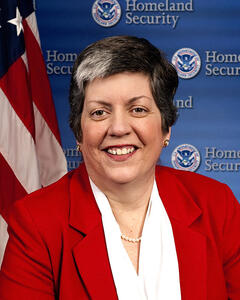
Barbara A. Perry
Thank you for taking time to do this today, and some of tomorrow. This is the Janet Napolitano interview for the Barack Obama presidential oral history at the Miller Center. I’m Barbara Perry, head of presidential studies at the Miller Center, along with co-chairing with our colleague Russell Riley—who’s on leave at the moment—the Oral History Program. Mike Nelson is our colleague at Rhodes College, where he’s the Fulmer Professor of Political Science, and he’s a fellow at the Miller Center. Nancy Kassop is a professor of political science at SUNY [State University of New York]-New Paltz, and has, along with Mike, engaged in many of these oral history interviews, so you’re in good hands, Janet.
Janet Napolitano
That’s all very clear. What is the ultimate purpose and audience for the oral history?
Perry
We have done this at the Miller Center since the [Gerald] Ford administration. The Miller Center began a group oral history project with a very young [Richard] Dick Cheney. Brent Scowcroft was in on that project, as well. It continued at the end of the [James] Carter administration, with the President and a number of his senior officials. We put these on our website, and teachers, students, professors, biographers, journalists, political scientists, historians, practitioners, and lawyers all make use of these—a very broad audience.
Napolitano
Oh, very good.
Perry
Usually we start with the biography of our respondents because we know all of those people and all of those audiences—particularly students—love to know about how the people we interview got to where they got. How were they so successful in their career paths?
With those respondents who have written books and memoirs about their time in office and about their lives, we like to dig and say: “What got left on the cutting-room floor? You were very concise, and yet complete, in telling us about your life and career, but we know there must be things that didn’t quite make it into the book that you would like to be there for history.”
So with that, what are your earliest memories, especially of public life?
Napolitano
I really got interested in government, per se, with Watergate, watching the Watergate hearings. Those were very transformational for me. That was in the day when there were three TV [television] networks and PBS [Public Broadcasting System]. My family had a black-and-white television. You had to change the channel by hand; there was no remote control. I was captivated by the procedure, the proceedings, the eloquence of some of the members of the committees—and of course I was disturbed by what was being uncovered.
I was always a good kid. I was always involved in student government, and the student paper, and Girls State, and activities like that, all the way through high school. When I went to college, I was in the honors program at Santa Clara. Santa Clara is Jesuit, and the honors program is really Jesuitical, meaning a heavy dose of history, philosophy, religious studies, foreign language, hard science, mathematics, which left room for only a few electives. The electives were the major I chose, which was poli sci [political science]. In retrospect, I should’ve just been a history major, but poli sci sounded pretty good, so that’s what I did.
Perry
Were you also imbued with the social gospel of the more liberal Jesuits?
Napolitano
Yes. The importance of social justice, the commitment to equity, and social fairness really came through, particularly in the philosophy and religious studies courses.
Perry
I know you went to public school, but were you raised Catholic?
Napolitano
No, I was raised Methodist. My dad was Catholic. My mother was Methodist. Dad would stay home on Sunday morning, and Mom would take us to Sunday school and church.
Nancy Kassop
You talked about your exposure to social justice and that type of information when you were at college. Was that the first time you were exposed to that, or was that something you recognized growing up, before college?
Napolitano
Growing up, my dad was a medical school professor and then dean. My mom was a homemaker, but she was heavily involved in the community. She was deeply involved in the Museum of Albuquerque, for example. There was a sense around the dining room table that we were put on this Earth to do something positive for our fellow man, and that making money was not the only measure of success, so I think those principles were instilled—if not directly, at least by osmosis—from a very early age.
Kassop
Was politics discussed at the dining room table?
Napolitano
Oh, yes. University politics were discussed, [laughter] and high school student government politics were discussed, and state and national politics were discussed. I have a brother who’s a year older than I am, and I have a sister who’s seven years younger. My brother and I disagreed about almost everything, and we would get into very active debates at the dining room table. My parents would let us go at it, and then at a certain point, my dad would lower his glasses and say, “I think it’s time for you to be excused.” [laughter]
Kassop
What about Watergate? Was Watergate discussed at the table?
Napolitano
Yes. My parents were not fans of Richard Nixon, so really in the sense of the need for him to go.
Perry
Who were the personages you think made the biggest impact on you?
Napolitano
Oh, I remember the House Committee: Barbara Jordan, and Elizabeth Holtzman, and Walter Flowers from Alabama. I particularly remember Barbara Jordan. She had that deep, stentorian voice, talking about the Constitution—just wonderfully impressive. And Peter Rodino, of course, the Chair. I remember Howard Baker and Sam Ervin. Now I’m flipped over to the Senate side, obviously. Those are a few of the names that still crop up.
Perry
Did this make you start to think about the law? In addition to politics?
Napolitano
I think so. I did not come from a law family. My dad, obviously, was a PhD [doctor of philosophy] in anatomy. My mom majored in zoology in college. My brother is an engineer. He went to MIT [Massachusetts Institute of Technology] and then got his PhD at Stanford. I kind of fell off the turnip truck. I always did well in math, but I had to work at it, and I didn’t have to work quite as hard in the liberal arts subjects, English and history and so forth. Just as things happened, the law became a viable option for me.
Perry
You came along just as the [Harry S.] Truman Scholarship was established, and that requires a commitment to public service. You already knew then, halfway through college, that you wanted to devote your life to public service, I presume.
Napolitano
Right. Yes, I was in the 1977 class of Truman Scholars, the first class. At that time, they selected one scholar per state. It was a competition, so you had to get nominated from your college, and they administered a proctored exam that you had to take.
They narrowed it down to regional finalists, and I was applying from New Mexico, one of the nice things about being from a smaller state. I remember having to go to Dallas for my interview, and was selected. Then they flew us all to Independence, Missouri, to receive our scholarships, and they had a very nice ceremony. Margaret Truman Daniel was there.
The Truman Scholarship was great for me because it covered almost the entire cost of my junior and senior year of college, and together with what I made in the summers, it really went a long way to covering my first two years of law school, so it was a great benefit.
Perry
What did you say at the interview and in your application you wanted to do in public service?
Napolitano
I have no idea. [laughter] That was so long ago. I’m sure it was quite moving, but I really don’t recall. That’s interesting. But I do remember the faculty member at Santa Clara who ran all their fellowships—the Fulbright competition and the Rhodes and all the rest—was Father Martin. He was so pleased when he got word that I had won. He was as happy or happier than I was. [laughter]
Michael Nelson
It’s interesting that your response to Watergate was to be attracted to political life more than repelled by it, which for many people was the case. It sounds like you found inspiration in at least the way in which that crisis was resolved. Is that a fair assessment?
Napolitano
Yes, it is, and I can’t help but compare what’s happened in recent years to what happened then. It just seemed that the Members of Congress, in particular, who were involved were very impressive. Of course, this was before social media and tweeting and all the rest. There was a level of seriousness of purpose that came across to me, even watching on a black-and-white TV.
Nelson
This was also a time when feminism was reaching some high points. The Equal Rights Amendment got through Congress about this time. Did that influence you at all, in terms of thinking about what you wanted to do, what you wanted to be in life?
Napolitano
No, but I do remember I took a course on women in American politics at Santa Clara. It was a brand-new course, taught by a new professor, Janet Flammang. Here’s how the circle closes: Janet Flammang and I now share season tickets to the San Francisco Opera, which is quite a bit of fun.
I do remember at a very early age—high school, early in college, whatever—believing very firmly in a woman’s right to choose, that that was something that government should not take away, or intervene in. Of course, that led me to the Democratic Party.
Perry
Any conflicts at Santa Clara over that and your view?
Napolitano
Well, obviously, there were conflicts with the dogma of the church, but it was never anything that got in my way at Santa Clara.
Perry
The Vietnam war was drawing to a close about that time. Thoughts about that at that time for you?
Napolitano
I wrote my paper for the senior seminar on international relations on the bombing of Cambodia, and obviously I knew that we needed to get out of Vietnam. How we would exit Vietnam was an open question, but we needed to go.
Perry
Any thoughts about books you read at that time? You probably didn’t have a lot of time for outside reading, but books that made a real impact on you, particularly in that very heavy liberal arts, classical approach that the Jesuits took?
Napolitano
Oh, Plato and Aristotle, obviously. Shakespeare’s tragedies, obviously—the tragedies, not the comedies. [laughter] I’m trying to recall what we read in Women in American Politics: Betty Friedan, some Simone de Beauvoir—Was it Sheila Firestone? Something like that. I’ll need to go back and double check. I should call Janet and say, “What did you make us read? [laughter] I need the syllabus back.”
I spent the spring of my junior year at the London School of Economics, on a study abroad program, and that was a terrific experience. It was 30-some-odd American college students. We all lived on the same floor of a German YMCA [Young Men’s Christian Association] in London near the Lancaster Gate Tube stop, near Hyde Park. I took advantage of that time to travel extensively, and lots of theater, lots of music. It was a wonderful time.
Perry
What did you study there?
Napolitano
My tutorial was on Eastern Europe, and I wrote a paper for that class on what would happen to Yugoslavia after [Josip Broz] Tito. I actually predicted that without Tito, Yugoslavia—which was kind of a false country, in a way; it was Slavic republics thrown together—would dissolve into separate countries, which, in fact, has happened.
I took a class on international business management. I took a class on Western political philosophy, and I took a class on Western government poli sci–type stuff, Western European poli sci. So it was a very poli sci/econ type semester, but what I remember more than the classes was everything we got to do while we were in London.
Kassop
We were trying to tease out what it was that made you interested in going to law school. Obviously growing up and coming of age at the time of Watergate and Vietnam; and watching, as you said, the hearings; and being impressed by all the Members of Congress who, for the most part, were lawyers; and also being motivated by watching what was happening with women’s rights, and the bombing of Cambodia, the topic of your senior thesis—There’s so much law involved there.
Then, following on that: by the time you got to law school, it was still fairly early for women there. What was your experience, being one of probably not too many women in law school at that time?
Napolitano
I took a gap year and didn’t go right to law school; then, obviously I went to UVA [University of Virginia]. Our class was about a third women; it was right at the time when women were really beginning to enter the profession.
The judge I ended up clerking for in Phoenix, which is how I got to Phoenix, went to the University of Chicago for law school, and there were three women in her class. But by the early ’80s, it was opening up.
Perry
You took a gap year, and you worked in Washington between undergrad and law school?
Napolitano
Yes. I didn’t know what I wanted to do after college. I was thinking of law school. I took the LSAT [Law School Admissions Test] while I was a senior. I took the GRE [Graduate Records Examination] in case I wanted to get a master’s [degree] in public policy. The master’s in public administration was the more popular degree then.
My dad was good friends with Senator [Pietro] Domenici of New Mexico, Republican. I’d known the Senator for many years through that relationship, and he offered me an internship with the Republican staff of the Senate Budget Committee, so I moved back to Washington, rented a room in a house at 3rd and F Northwest. It was an old tenement-style house with a group of guys, one of whom I’d known in college. We heated it with a wood stove. [laughter] The house is now long gone; I think it’s become a parking lot.
I would walk up to the Senate side of the Hill, and the staff was housed in an old hotel called the Carroll Arms, right across the street from the Hart [Senate Office] Building, and it now, too, is gone. Our offices were in old hotel rooms, so I shared an office with a woman, and we had our own bathroom, because it was a hotel room, [laughter] so it was nice. Then, a month or two into the internship, one of the staffers left to go on maternity leave, and they gave me her position, so I became a junior staff analyst for the Senate Republicans on the Budget Committee.
This was at a time when the budget process was seriously done, and it was seriously bipartisan. It was back in the day when they really marked up the budget, and the approps [appropriations] committees were expected to adhere to the numbers contained in the budget resolution. It was back in the day when the reconciliation process really worked.
I had an amazing experience, because the staff was divided into pods, and I was in the economics pod. I was assigned to work on tax legislation. Now, realize, I’m a poli sci major from Santa Clara, but what the heck? Two major bills were going through right around the same time. One was the so-called windfall profit tax on oil, and the other was the Chrysler bailout bill. They were both put on the floor of the Senate in December of ’79, and I was assigned to monitor the bills and the amendments as they came through. Then when Republican members of the committee would come through the doors to the floor of the Senate—because I was sitting on a couch in a corner—I’d run up and say, “This is a yea or a nay,” or what have you.
At that time there were leather couches in the corners of the Senate floor for staff. I think those are gone now. I’d park myself there for days on end. I’d go home. I’d shower. I’d change clothes. I’d come back. They were all trying to get out for the Christmas recess, and the leadership was just holding the Senators on the floor until they got through those bills, so I really saw the Senate process up close. It was a unique experience.
Nelson
Now, when you were advising Senators, “This is a yea vote; this is a nay vote,” is it Republican Senators whom you’re relating to?
Napolitano
Oh, yes. Yes.
Nelson
Having charted a course for public service, that could have gone in the direction of staff, agency, public policy, could have gone a direction of party politics, elective politics. I wonder where you saw yourself when you thought about a future in public life. On the appointed side, the policy side, the elective side, the campaign and politics side? Had you come to a fork yet in the road?
Napolitano
I had no idea. I was a 21-year-old kid, and I knew that I wanted to work in government somehow, but what form or fashion that would take took a little bit of time to evolve.
Perry
Did it ever cross your mind while you were sitting there on those couches? What did you learn about the legislative process by witnessing it up close and personal? Did it even flit through your mind that you might aspire to being a Member of Congress someday?
Napolitano
Yes, it did. I can remember so well that the Senators seemed to get along. It was very much a men’s club; that was obvious. They’d come back after dinner, and they’d had a few drinks or what have you, and they’d wander on to the floor, and then they dealt with what they had to deal with. Dale Bumpers of Arkansas sat toward the back, and he was friendly with everybody, it seemed.
Watching the Senate today, as I perceived it when I was in the Cabinet, and certainly now in the [Donald J.] Trump and post-Trump years, it was truly a very different place. Even though I was a kid—I really was—a lot of the staff were very young. [laughs] That’s still the case. But I learned the rules of cloture very well, and how it worked, and how many votes you needed, et cetera. I learned the rules of the Senate. What else was I going to do? I was parked there, right?
It was interesting, because the Chair of the committee when I started was [Edmund] Ed Muskie, and the ranking Member was Henry Bellmon, who was from Oklahoma. He was a very large fellow with a very deep voice, and he was as nice and courteous as you could imagine, and he worked well with Muskie.
Then when Muskie became Secretary of State, Muskie’s place was taken by [Frederick] Fritz Hollings of South Carolina, and Bellmon and Hollings worked together, which was kind of interesting. Fritz Hollings had that big gentlemanly South Carolina accent, and Bellmon had this deep voice, Oklahoma accent. [laughs] It was two different voices. But they really, in a way, looked down on Senators who were viewed as too extreme and too partisan. Orrin Hatch was a relatively new member of the committee, Republican of Utah, and he was viewed as the extreme in the Senate at the time. Now he’s really almost in the middle. [laughter]
Nelson
Since this is the Obama project, any memories of the future Vice President, [Joseph R.] Joe Biden [Jr.] when he was in the Senate?
Napolitano
No, not at that time. My memories of Joe Biden start later.
Perry
Any sign of sexual harassment when you were there?
Napolitano
Not to me, no. I was never subjected—I was always treated, I thought, with way more courtesy and credibility than I deserved. [laughter] But it is what it is.
Anyway, while I was in the Senate, on the Senate staff, I looked around, and so many of the Members and so many of the staff were lawyers that I thought, Well, maybe that’s just what I ought to do. I applied to several law schools. I applied mostly to what would be known as national public law schools, public law schools with national reach, national reputations: Virginia, Boalt—it was then Boalt—at Berkeley, Texas. I did apply to Duke.
I rented a car to drive down to Charlottesville, and then on to Durham to interview. It was a beautiful day in Charlottesville. It had snowed the day or two before, and the snow was still on the ground. And as you know—You’re there—once I saw it, I was like, “I’m going here. [laughter] If I get in.” So I got in, and obviously I went.
Perry
Tell us about that experience, and I especially want to know from whom did you have constitutional law?
Napolitano
I took Con Law from Stephen Saltzburg, but the classes I really enjoyed, I must say, were the civil procedure type classes, civ pro, and federal courts, and crim pro [criminal procedure]. I also enjoyed the more business-oriented classes: contracts, tax, commercial transactions, those kinds of classes. I had a wonderful time at UVA [University of Virginia] and had a very good group of friends. We’re still friends. We regularly Zoom with each other. My moot court partner I managed to persuade to leave a judgeship in California to come work for me at the Department of Homeland Security. We’re spread all over the country, but we’re still very close.
Perry
Do you ever come back for reunion?
Napolitano
Yes, I have. The last one I came back for was probably my 20th reunion, and I was a Governor, so that was kind of cool. Then I did get the Jefferson Award, which is a very lovely honor, and that brought me back to campus when I was Secretary.
Perry
Anything else on law school we should know about?
Napolitano
No. I enjoyed law school. I even enjoyed my first year, which most people don’t, so it all went well.
Perry
Then you decided on a clerkship. You definitely wanted to apply for a clerkship, and specifically circuit court?
Napolitano
Yes. I had been very active in the moot court competition at UVA. In that connection I had to write a lot of briefs and things of that sort, and I wanted to get back West, so I applied to judges on the tenth circuit and the ninth circuit. I had no strategy about which judges I applied for. I really was looking at cities, so I applied to judges in Denver, Phoenix, San Francisco, and Seattle.
The way they did judicial clerkship selection at that time was you’d send the judge your letter with your résumé, and then in the summer between your second and third year, you’d interview with the judge. Then, if you were offered a clerkship, you did it the year after you graduated from law school. I had an interview with a very elderly man who was a tenth circuit judge in Denver. My interview was the Friday before Memorial Day weekend, and it was at 1:30, right after lunch. He was a little late coming in, and he started asking me about my writing sample, and I started explaining the point I was making. All of a sudden, I looked at him, and he’d fallen asleep. [laughter] He was asleep in the interview, and I was like, What do I do? Do I leave? Do I kind of poke him? Do I just keep talking? What does one do? I just kept talking, but louder, and after a few minutes, he woke up.
Anyway, long story short, a few weeks later I was in San Francisco, working for a law firm in San Francisco that summer. Mary Schroeder was there on calendar, hearing cases. I interviewed with her, and I interviewed with another Phoenix judge who was also in San Francisco on calendar, Tom Tang. A few weeks after that, Mary Schroeder called and offered me the job and changed my life.
Nelson
Were circuit court clerkships at that time regarded as a step toward a Supreme Court clerkship? Did you think of it that way?
Napolitano
They could be, definitely. If you want to go to the Supreme Court, you need to do at least one circuit court clerkship, but not necessarily. I didn’t look at it that way. I wasn’t thinking of the Supreme Court. I was looking at the circuit court clerkship as a way to spend a year until I figured out where I wanted to take the bar and practice.
Perry
That time was right in the thick of the [Ronald] Reagan administration, the mid-’80s. The ninth circuit often was said to be the most overturned of the circuits at the Supreme Court level. What were you seeing in terms of the judicial politics of the ninth circuit and how it fit into the judicial firmament?
Napolitano
The ninth circuit was viewed as very liberal, and I would say in some things it has been, but that’s an overgeneralization. It’s overturned the most in the Supreme Court because it produces the most cases in the country. It’s by far the largest circuit. About 20 to 25 percent of all appeals come out of the ninth circuit.
Because of where it is, it has the border, it has California, it has states as diverse as California and Idaho; it’s a very large and diverse circuit. When you clerk for a judge on the ninth circuit, the judges have chambers in their various cities. The court sits in three-judge panels, and you travel around the circuit during your clerkship year with your judge, so that you’re with her on calendar. At least, that’s the way Mary Schroeder managed it, and that was great. We were on calendar in Pasadena and San Francisco and Seattle and Portland. Every other year she goes to Hawaii; I missed that year. [laughter]
It was really a terrific experience. The court is headquartered in San Francisco, so you tend to come to San Francisco several times a year, but you do travel around the circuit.
Nelson
Judge Schroeder was a Carter appointee. Did it make any difference that you had this Republican brand from your Senate internship?
Napolitano
No, and by then I’d become a Democrat anyway, so it didn’t really matter.
Nelson
How did that happen?
Napolitano
The issue for me really was a woman’s right to choose. I believe very strongly that that’s an essential part of gender, and of your gender, and that led me to the Democratic Party.
Perry
What did you learn from Judge Schroeder, and at this point did you contemplate someday being on the bench yourself?
Napolitano
I learned a lot from Judge Schroeder. She was very big that you need to get your work done on time. You should be concise. You should write well. I learned a very good life lesson from her, which is you should plan your leisure. In other words, don’t just leave gobs of open time, but make sure that you’re getting tickets for a concert, you have arrangements to go see an art show, you have planned a weekend trip to the Grand Canyon or what have you. And you should have some balance there, some work/life balance.
She had a metaphor for her chambers, which is that she used it as a boat. We were all in the boat. We were all supposed to be rowing in the same direction. As the year went on, the boat filled with cases that had to be decided, and by the end of the clerkship year, the boat should be empty.
During my clerkship year, I decided I was going to stay in Phoenix and take the Arizona bar, and I took the bar while I was still clerking. My clerkship finished at the end of August, and the bar was at the end of July, and because we were emptying the boat, there was a lot of work to do, so I’d work like a fiend and then go over to Arizona State [University] and take the bar review course, and then [laughs] what have you. I took a week off to take the bar.
Perry
Did you write opinion drafts for the judge?
Napolitano
We wrote what are called “bench memos” that were given to the judge before oral argument. She liked to do her initial draft, and she used a dictating machine. We were often with her while she was dictating the initial draft, to fill in things or answer questions. Her secretary would type up the dictation, and then it would come to the clerk, and we’d begin the process of going back and forth.
Perry
Then you were off to her firm.
Napolitano
Right. I had decided to stay in Phoenix. During my clerkship year, I’d made some friends in Phoenix. I had an apartment. The town was booming. The big firms were all desperate for lawyers. It was halfway between Albuquerque and San Francisco. I wasn’t really paying attention to party politics then, so it didn’t really hit me that I was practicing in what was then a very Republican state.
Mary Schroeder’s mentor was a lawyer named John Frank. He was a senior partner at Lewis and Roca, and he took an interest in me. Once he picked me up at the courthouse and took me for a picnic lunch at a park to recruit me—not a fancy lunch in a restaurant or anything. It was sandwiches in the Encanto Park. When I joined Lewis and Roca, John always got a first-year associate as his associate, and before me it had always been somebody known as “John’s boy.” [laughter] Well, that didn’t quite work. I went to work for John and ended up working for him and with him the rest of my time at the firm.
Perry
This brings us to Anita Hill, doesn’t it, your time at the firm?
Napolitano
Yes. I became a partner in 1989, and Anita Hill happened in ’91, so I was a young partner. John was very good friends with Judith Resnik. Judith was in Anita’s circle, in a way, became part of Anita’s circle when the allegations first went public. When the Senate decided to have a hearing, she recognized that nobody around Anita had ever actually handled a contested hearing, but she knew John had. He’d been involved in [Clement] Haynsworth; he’d been involved in [Robert] Bork, so she called him and asked if he would come help her prepare for the hearing. He came around the corner and asked me if I would like to go help, too. I said, “Absolutely, I’m in!” We flew to D.C. on the red eye, got there, went to a law firm that John had arranged to provide us with office space, and everything was very ticklish. This was very controversial, and it became controversial at the firm when we got back, too. I’ll tell you about that story.
We met our client the next day. The [Senate Judiciary] committee was trying to figure out what to do. There was no process or procedure. We’d think we had an agreement with the committee, and then [Clarence] Thomas and his team, who were sherpa-ing him, would get that changed. It was crazy. I was assigned the role of prepping three witnesses who were people Anita had told at the time of Clarence Thomas’s behavior, to undercut the argument that she had just suddenly made this up to torpedo his nomination.
This was all being done at rocket speed. We got to D.C. early Tuesday morning on the red eye, as I mentioned, and I think the hearing began Thursday or Friday. I may have the actual days mixed up—We’d have to go back and check—but we only had something like 48 hours to get the whole thing prepared, and to prepare her and her statement, and then to try to work out the process, the procedure that the committee would follow, and then to do the hearing itself. It was crazed.
Other women had come forth, and we needed to talk with them, get them prepared, and make sure that the Senate committee members—most importantly, Biden and his staff—knew that there were other women. But it got ugly, fast. It was ugly from the get-go.
Perry
Your thoughts about the committee itself? We did have then Senator Biden chairing that committee. People would ask about Anita Hill—people who certainly were taken by what you were preparing—that she had told people at the time what was happening to her. But people would say, “Then why did she go to another job with him still as her boss?”
Did you ever get a sense of that? Again, come back to your thoughts about the committee, what you were seeing in the changes in the Senate from when you had been there on the budget committee.
Napolitano
We now know way more about sexual harassment in the workplace than we did at the time. The Hill-Thomas hearing—If there is one good thing that came out of it, it is that it raised in the public consciousness that sexual harassment of women in the workplace had been going on for a long time. It had just been under the table, and now for the first time it was really out in the open. We now know that women who have been harassed, for a variety of reasons, don’t cut off contact with the harasser, particularly if it’s someone who has power over them. But at that time it seemed counterintuitive, and to many it still does seem somewhat counterintuitive. But it happens frequently.
Biden really didn’t know what to do with this, I think. He was hampered, in part, because the person he would have relied on most to help was [Edward] Ted Kennedy, but he had his own problems in this area. I think Kennedy was sitting as far back as he could get away with. I think Biden was shocked by the way the Republicans approached Anita. I don’t think he had any idea of how they would attack her. Then he didn’t shut it off. He didn’t say, “You know what? This line of questions is inappropriate. Stop it.”
One of the things I really remember was—First of all, the agreement was that Anita would testify first. We were already over at the Senate, in the waiting area, for her to testify, when all of a sudden we were told, “No, Thomas is going to go first,” so that was interesting. But when she finally got the chance to testify, she was a very poised, articulate person, and she dealt with all the questions about the Coke can and the pubic hair and all the rest with class. She was a very good witness, and when she finished, you could tell in the hearing room that she had earned a lot of credibility. That’s how it came across on the six o’clock news.
The Thomas people—I think Boyden Gray was the lead on his team—knew that they needed to grab momentum back, so they persuaded Biden to reconvene the committee that evening. I was in the committee room; our team had left to go to dinner. All of a sudden, I see the committee doors open and the members start coming back in—What’s going on? Then I see Thomas and his team strolling down the aisle, getting ready to sit at the witness table: Oh my—They’re going to start this hearing again! This was before anybody had an iPhone, so I had no way to get in touch with my colleagues who were at dinner.
That, of course, is the time when Thomas made his statement about this being a high-tech lynching of an uppity black man. When he said that, the men on the committee—and they were all men—First of all, some of them, like Kennedy, had their own problems in this area, but they were also very sensitive to the issue of race, Thomas’s race. It didn’t seem to matter that Anita was also African American. They were very sensitive about Thomas’s race, and when he said that, you could almost end the hearing then. You just could see that they had made up their minds.
It was interesting: they let the hearing go on for another day or two, and then Biden shut it down before hearing from the other women, for which he got criticism, but he just wanted to end this thing. Senator [Dennis] DeConcini of Arizona was on the committee, and he crossed over and voted for Thomas. That became an issue later on in how I became the U.S. attorney for Arizona, and we can get to that story.
It certainly changed Professor Hill’s life. I don’t think she saw herself as a women’s studies professor at Brandeis. It changed public life, in the sense of the issue of sexual harassment in the workplace, and laying the predicate, really, for the #MeToo movement, and so forth. And it certainly changed my life.
Perry
Thank you for that. At this point, you were closing in on a decade at the law firm, and you had made partner. Other than the judicial politics around Anita Hill, are state politics, party politics coming to mind? That’ll get us up to your U.S. attorney appointment. Anything else from the law firm years we should be adding to the record?
Napolitano
No. I had a very good experience at Lewis and Roca. I had really good cases. I worked with very good lawyers. I worked hard. People always say to me, “Janet, you work so hard,” and I’m like, “You’ve never been an associate at a law firm.” [laughter]
I learned how to practice law, which is not something you necessarily learn in law school. On the side, I was doing state party work, and, again, John Frank helped me. He was counsel to the state Democratic Party, so I became vice counsel to the state Democratic Party. I ran the Presidential delegate selection process in 1988, and that got me all over the state, training Democrats on how to become a delegate, and how the election is run, and so forth. It was really complicated.
I did workshops all over Arizona, so I was meeting active Democrats, party activists who wanted to go to the [Democratic National] Convention. I went to the Convention in ’88 in Atlanta where Ann Richards gave that great keynote speech: “Poor George, he was born with a silver foot in his mouth!” [laughter] That was great.
Then I became friends with and helped a man named Stan Furman run for the state Senate, and that taught me a little bit about on-the-ground campaigning in Arizona. I did a little of everything. I hung door knockers, set up chairs at his little wine-and-cheese events, printed the name tags. I was just a very good worker bee and then handled his filings and things that he needed to do from a legal perspective. He lost the first time he ran; then he won the second time, so I learned a little bit about persistence, too.
Nelson
At some point you connected with the [William J.] Clinton for President campaign. At what stage, and in what ways? What attracted you to support his candidacy?
Napolitano
I supported Clinton once he became the nominee. In ’92, I was the state chair for Bob Kerrey, and we had all the delegates from Arizona lined up. He would have won the Arizona caucus, because we did delegates by caucus, and we had it “saucered and blowed.” Kerrey dropped out of the race two days before the Arizona caucus. Our caucuses were on Saturday, and I think he dropped out on Thursday. That left me without a candidate, so I went to Clinton, but I wasn’t really all that active in the Clinton campaign.
Perry
Had you been there for his infamous lengthy speech in ’88 in Atlanta? Were you there in the audience or on the floor?
Napolitano
Oh my gosh, yes, and I was one of the ones who said, “That guy’s not going anywhere!” [laughter] It was awful! I was sitting in the Arizona delegation. We were seated behind the Wisconsin delegation, and they were all wearing their cheese heads, and here’s Bill Clinton going on and on. Oh my heavens, yes!
Perry
Again, this is for candid history: were you one of the ones who cheered when he said, “in conclusion” or “finally”?
Napolitano
Oh, yes. I was like, “Yeah!” [laughter] That was a pretty funny moment.
Perry
It was. Then he saved his career on [The Tonight Show Starring] Johnny Carson that week.
Napolitano
I guess he did. He did something. He had that ability. Anyway, he was elected in ’92, and, as I mentioned earlier, Dennis DeConcini had crossed over to vote for Thomas. I had gotten quite a bit of press in Arizona about representing Anita, and I had become an active Democrat in the party. I think he was afraid that I was going to primary him in his reelect in ’94. It was scheduled for ’94. I wouldn’t have primaried Dennis, a member of my own party and overall a very good Senator. I later appointed him to the Arizona Board of Regents, but that’s a long way down the road.
He sent over his consigliere, a guy named Ron Ober, to talk with John Frank to see if I would be interested if Dennis put my name in as U.S. attorney. At that time, U.S. attorneys and district judges were basically the patronage of the senior Senator of the President’s party, if there were one, and Dennis, obviously Democrat, senior Senator, et cetera.
John raised it with me, and I didn’t really even know what a U.S. attorney did. But with John’s advice, I talked to a fellow named Mike Hawkins, who had been a U.S. attorney in the past, and did some reading, did some research, and thought, Yes, I could do that.
This is really funny. Dennis wanted to make the offer personally, and he had me meet him at the airport in Phoenix, literally behind a potted palm at his departure gate. He asked whether I would be interested if he put my name in as the U.S. attorney, and I said I would be honored. He didn’t say anything specific about me not running against him, except I think he did throw in a line about, “I know you’ll support me in the future, should I run again.” I didn’t say anything, but it was, you know—
In December of ’92, Dennis had a press conference and announced that he was going to put my name in to be the nominee. It was interesting: I still had to get approved by the White House and the President. Even though it was the Senator’s patronage, it wasn’t the Senator’s nomination. So all that spring, I was still at the law firm waiting for the White House to move. It took forever, and I was so impatient! I couldn’t take on new clients. That was a terrible period in my life.
In the spring of ’93, my mother died very suddenly. My name had been put in in December by DeConcini, my mother died in April, and I was still not in until July 3, when the White House agreed that I could go in as the acting U.S. attorney while my nomination was pending in the Senate. At that point, you could go in as an acting while your nomination was being considered in the Senate. That ability has since been removed.
I was in as the acting, running an office—one of the larger U.S. attorneys’ offices in the country, 120-some-odd mostly federal criminal prosecutors—having never myself handled a criminal case. But I appointed a really good chief deputy, and it was a very good office, very professional, helpful. I had a vertical learning curve.
My nomination had to go before the Senate Judiciary Committee, and they, of course, remembered me from representing Anita Hill, and some of them developed a theory that I had improperly coached one of the witnesses during the prehearing prep, so they were putting me through all kinds of “Did I suborn perjury?” baloney. Finally Dennis managed to get me out of the committee, and they demanded a cloture vote on the floor. I’m a U.S. attorney nominee! [laughter] It requires 60 votes. It was the Wednesday before Thanksgiving, and Dennis DeConcini and [Pietro] Pete Domenici were both in the well of the Senate, rustling up votes. I passed with a nice margin and became confirmed. There hasn’t been a cloture vote on a U.S. attorney since 1993, until this year, when the U.S. attorney nominee for Massachusetts became controversial for one reason or another, and she had to go through cloture.
I was in office. I was working. I was doing the job. This was all going on in D.C., and I was prosecuting cases and having a great time.
Kassop
Can I go back to 1990? You were involved in Arizona politics at the time, but that was the [Lincoln] savings and loan scandal, and DeConcini and [John] McCain were wrapped up in that.
Napolitano
The Keating Five, yes.
Kassop
Exactly. Did you have any role in that at all?
Napolitano
No, no. My firm, Lewis and Roca, stayed out of the litigation, which was a good thing, because the law firms that got involved all got in trouble. But yes, I had zero connection with that.
Perry
While U.S. attorney, you had a part in the Oklahoma City bombing prosecution against Timothy McVeigh. That happened in ’95. When we asked about your classes at UVA Law, you said the ones you enjoyed—in addition to some of the business courses—were civil procedure, criminal procedure, federal courts. Now you were getting to use those. You were getting to use all of that knowledge, but now you were doing the practicing that you didn’t get to do in law school.
Tell us about that particularly, because it’s domestic terrorism, which is where all of this is leading when we get you into the Cabinet as Secretary of Homeland Security. I know that Merrick Garland was assigned to that case from DOJ [Department of Justice]. Did you work with him?
Napolitano
Yes. A few days after the Oklahoma City bombing, I was home. It was early in the morning, and the phone rang. I answered it, and it was Jamie Gorelick, who was the DAG, the Deputy Attorney General. She said, “Janet, we caught the guy. His name is Tim McVeigh. He planned all of this in Kingman, Arizona, and you need to have a command center in Kingman up by close of business.”
OK! So I called Weldon Kennedy, who was the special agent in charge of the Arizona branch of the FBI [Federal Bureau of Investigation]. He had just gotten that call from the FBI Director, who was Louis Freeh, I believe, at the time. We went to work. We took over the National Guard Armory Building in Kingman, which is right near the freeway. I don’t know whether you’ve ever been in Kingman, Arizona, but there’s not much there, really. But by the end of the week, it was the site of the tenth largest FBI office in the world. That was a noticeable presence.
My role was working not on the McVeigh part of the matter, but his buddy, Michael Fortier. He was the individual with whom McVeigh had stayed in Kingman and to whom he had disclosed his plans to do the bombing. We learned during the investigation of—We called it “Oak Bomb”—that McVeigh had actually looked at two other courthouses to bomb, in addition to the building in Oklahoma City, one of which was the courthouse in Phoenix, where my office was. He chose the courthouse in Oklahoma City because it had a childcare center in it, and ours did not. Evil, just evil.
We worked with the FBI on Fortier. He ultimately pled out and flipped. He still got 20 years. I was not directly involved in the pretrial or trial of McVeigh himself, but in the course of our work, yes, came into—I knew Merrick from my previous work with the DOJ, as U.S. attorney, and I had chaired the Attorney General’s Advisory Committee, which is like the executive committee of U.S. attorneys. That took me to D.C. once a month, and I became familiar with all the leadership in the department: Janet Reno, Jamie Gorelick, Merrick Garland, Seth Waxman, the whole gang. I got to know Merrick and Beth Wilkinson, as well.
That was a tense time because Oak Bomb was in April of ’95. In October of ’95, an Amtrak train was intentionally derailed in a very isolated section of western Arizona. There were dozens of injuries and several fatalities. Of course, the thinking was that that was another act of domestic terrorism, but we never found any evidence that allowed us to prosecute anyone for that crime.
Nelson
At this stage of your career, and continuing, when you’re beginning to have dealings with some of the agencies that will later be under your purview when you become a DHS [Department of Homeland Security] Secretary, are you getting a feel for how those agencies and the issues they deal with operate at the grassroots?
Napolitano
Oh, for sure, particularly on immigration. All the federal immigration criminal cases came through the U.S. attorney’s office, as well as all the big drug cases coming over the border. We had lots of that kind of work, so I became very familiar with law enforcement along the border, immigration issues along the border, transnational criminal organizations working the border, and so forth. Obviously, when I became Secretary of DHS, the border was a big part of my portfolio, so, yes. I became familiar with and worked closely with the FBI and the DEA [Drug Enforcement Administration] and the other federal law enforcement agencies that are not under DHS but with whom DHS commonly partners.
Nelson
Certainly now you were getting the deep understanding you developed of the border as the membrane, so to speak, rather than a firm line of demarcation between the United States and Mexico.
Napolitano
Right. The border is a complicated place. It’s complicated from a law enforcement perspective; it’s complicated from a political perspective. I went through the briefing book you all provided me, and I’d forgotten some of this stuff—obviously, it was a long time ago—and still, there’s a lot in there about the border, because it gets so much political attention. But yes, being the U.S. attorney, I became intimately familiar with the border.
Perry
Anything else from your time as U.S. attorney before we get you into the attorney general’s position in Arizona?
Napolitano
No, except to put another point down on the fact that even though I was U.S. attorney in Arizona, I was on the AGAC, the Attorney General’s Advisory Committee, from the get-go. I overlapped with Michael Chertoff in that role, which is where I got to know Michael, who was my predecessor at DHS. He was a holdover for a year into the Clinton administration. Then, at Janet Reno’s request, I chaired that for two years, so I got to know the whole community of U.S. attorneys very well, and the federal law enforcement community pretty well.
Perry
This will dovetail nicely. We did an interview with Secretary Chertoff for the [George W.] Bush project, so this is one of those instances where people can follow how these positions change, and how they grow.
Napolitano
Oh, and I also overlapped with Eric Holder. He was the U.S. attorney for D.C., and he became a member of the AGAC.
Perry
We certainly hope to interview him for this Obama Project. We are at the halfway mark for this afternoon. Shall we take about a five-minute break and then come back and finish up?
[BREAK]
Perry
We are to your attorney generalship. In 1998, you became attorney general of Arizona, but you had to run for that office.
Napolitano
Yes, I did. [laughter] In 1997, I was going to be turning 40, and I had been U.S. attorney for four and a half years. I had an itch I needed to scratch, and the itch was to run for office.
When [Morris] Mo Udall died in 1990 or so, I lived in that district, and I thought about running, but that would have meant running against [Edward] Ed Pastor, who was a very prominent Hispanic county supervisor and had that seat in mind. I’m glad I didn’t take on that race. I wasn’t ready, and it would have created a lifelong problem for me if I had. Part of choosing to run is not only the office, but the timing and where it fits in your own personal life, how you evaluate the risks, the upside, the downside, et cetera.
I was turning 40, and I thought I didn’t want to be 80 years old and in my rocking chair on my front porch doing woulda, coulda, shoulda. The attorney generalship was going to be an open seat. Grant Woods was term limited. There were some complicated Arizona politics at the time. A woman named Jane Hull had been Secretary of State and had been elevated to Governor when Fife Symington was indicted for federal fraud. She was running for reelection, and there was a little bit of a push to get me to run against her. But I thought, No, I’m going to run for attorney general. I have a good case to make, having been the U.S. attorney, and I can run for Governor later if the chance arises.
So I resigned as U.S. attorney to run for AG [attorney general] in the fall of ’97, which gave me about a year to campaign for office. Here’s the thing: there was really no statewide Democratic Party machinery by then. DeConcini was out of office. We hadn’t had a statewide Governor, AG, whatever, for two decades or more.
My first office was in a really bad part of town. We rented a room. We had a card table, a couple of chairs, two phone lines. I had one staffer to help, and we began the business of calling people and raising money. We would do call time for five or six hours a day. Then in the evenings we’d try to do little wine-and-cheese things or backyard get-togethers. I’d go anywhere there was a group of more than six people, [laughter] and we began to build a campaign. I traveled around the state, which I truly enjoyed. I did all the parades.
The parade I enjoyed most was the Navajo Tribal Fair Parade. It’s the biggest parade in Arizona. Every Navajo goes back to the reservation for the Tribal Fair every year. The interstate highway goes right through the reservation. The parade starts on the New Mexico side, and then it crosses the border and ends up on the Arizona side. You have New Mexico politicians, Arizona politicians. You have marching bands and floats and lots of horses. It’s a sight to behold.
You’re expected to throw out candy to the children along the way, and not just little bits of candy. My first year, we took 600 pounds of candy, and those were done a quarter of the way through the parade. We got booed the rest of the way of the parade because we had no more candy. By the time I was going up there as Governor, we’d take 1,600 pounds, 1,800 pounds of candy and throw it out, except for the one year when I was Governor.
I was the education Governor, and I was like, “Diabetes is a problem on the reservation. Why are we throwing out candy? Let’s give out pencils.” My staff looked at me like, This is not good. [laughter] Anyway, we took pencils, and we almost blinded an old woman. We were throwing out these pencils, and the kids were looking at us like, “I don’t want a pencil. Where’s my candy?” That was an experiment that failed.
I started learning about those events when I started campaigning for attorney general. It was a tough race. Because I was the U.S. attorney, I thought I was pretty well known, had done some big cases, et cetera. There was an initial poll that showed that 8 percent of Arizonans knew who I was; it determined that the only people who knew who I was were either other lawyers or defendants, and the defendants couldn’t vote, right? [laughter] We had a lot of work to do, and slowly but surely we raised money. Every time we raised another $100,000, John Frank would have a little loving cup given to our office that we would put on a shelf to give us a little more incentive. Raising money is not the most fun part of politics.
I was fortunate in that the Republicans had a very hotly contested primary. One candidate was a guy named Tom McGovern, who was Grant Woods’s designated successor, and then a state senator named John Kaites. They really went at it, and McGovern won; he was the guy I ran against in the general. Arizona has a late primary; the primary’s in early September, and the morning after the primary, I had my first ad up. It was a radio ad, and it started with the sound of a bulldozer. A guy says, “Hey, Mac, what are you doin’?” He says, “I’m gettin’ rid of all the mud from the attorney general Republican primary!” “Why you doin’ that?” “’Cause I’m gettin’ ready to vote for Janet Napolitano!” [laughter]
Perry
Who developed that ad for you?
Napolitano
I had a guy named Saul Shorr who did my media, and he was great. I don’t know how we got linked up with him, but he ended up doing my media for all of my races. He’s based outside of Philadelphia. People still remember the bulldozer ad, because it was funny, and sometimes humor goes a long way.
I started off the general probably eight to ten points behind. I remember two weeks before the election driving back to Phoenix from Prescott, Arizona, and my campaign manager called and said, “There’s a new poll out, and you’re up by eight points.” I said, “We’re gonna win this thing.” Between that poll and the election, we saw the race tighten and tighten. Arizona then was very Republican, and Independents tended to settle Republican. The other Democratic candidates for statewide office—Governor, secretary of state, whatever—were not even close. I was the only Democrat who was still alive and kicking.
We got to Election Night, and I was ahead by about a point, but there were still mail ballots to be counted. We knew where those mail ballots were coming from, and a lot of them were coming from the reservation, so I went to bed—The media figured out that I was going to be the winner, so that’s how they were talking about it—but McGovern didn’t concede until the next day.
I became the attorney general-elect and took over that office. The attorney general’s office in Arizona is, in point of fact, the largest law firm in Arizona. It has the largest number of lawyers, something like 600. It’s a big office. It handles all the civil matters for the state; it handles all the criminal appeals for the state; and it handles all the post-trial death penalty work for the state. Shortly after I took office, the state supreme court issued a ruling that opened the floodgates for executions—They’d all been held up on a legal question—so we had over a dozen executions in my first two years as attorney general. That was the least pleasant part of the job, I must say.
Nelson
It doesn’t surprise us that you would have to deal with that issue as attorney general, but I wonder: in Arizona at this time—You’ve mentioned the reservations—Indian casinos were a presence. Did that ever become an issue there in a way that it might not have in many other parts of the country, because of the tribes?
Napolitano
It was more an issue when I was Governor, when we were finishing negotiating the gaming compacts, but not so much when I was either U.S. attorney or AG.
Kassop
What was the relationship then between the attorney general’s office and the tribal courts and tribal justice?
Napolitano
In Indian country, the way it works is that all felonies committed on Indian country are handled by the U.S. attorney’s office, federally. Misdemeanors between a tribal member and a non-tribal member also are federal. Misdemeanors between tribal members may be handled in tribal court.
When I was U.S. attorney, we had a fairly large violent crime unit, which is unusual for a U.S. attorney’s office, because we were basically the DA [district attorney] for the 21 Indian reservations in Arizona. It’s kind of similar to the U.S. attorney in the District of Columbia: they do all the local crimes, and they do the federal crimes. But the state attorney general’s office really doesn’t have all that much to do with Indian country.
Perry
You must have been thinking, as you were attorney general, that you were going to run for Governor at some point. How were you walking these lines, whether it was on the death penalty or immigration or drugs, knowing that you wanted to run for higher office in the future?
Napolitano
I became attorney general in ’98, and I knew the Governorship was going to be an open seat in 2002 because of term limits. The law is the law, and you enforce the law as it’s given. But as a state attorney general, which laws you choose to focus on makes a lot of difference.
For example, we did a lot of consumer fraud cases that had targeted senior citizens. When I came into office, there was a tremendous backlog of Child Protective Services cases. Kids would be in that backlog for 18, 20 months, which, when you’re a four-year-old, is almost half your life, and while you’re in that backlog, you’re being moved around from foster care placement to foster care placement. It’s really a terrible thing, so I moved resources into that area of the office and said we were going to get rid of the backlog and stay current on all cases, which we did.
We did another thing, which, in retrospect, was, I will say—I’ll be modest—brilliant. [laughter] We prepared a set of documents, anything you needed to prepare for end of life: health care power of attorney, mental health care power of attorney, a so-called living will or living trust, all of those things that complied with Arizona law. Then we got the state’s largest newspaper, the Arizona Republic, to co-sponsor it with us, so on a Sunday there was a whole insert in the paper: “Attorney General Janet Napolitano and the Arizona Republic have all of this for you.”
I would go around to senior centers and do a little seminar and gave everybody a free packet if they wanted one. Those were the kinds of things you could do as an AG that were very helpful to people, but were also, if I might say so, good politically as well. That was really how I managed the attorney general’s office. Yes, we carried out the death penalty; yes, we didn’t shy away from controversial matters. But we focused on things that people really wanted the AG’s office to do.
Nelson
Did you have any contacts with another former state attorney general before he became Governor, Bill Clinton?
Napolitano
No, no contact there, but I became very good friends with other AGs in the country. There’s a National Association of AGs, NAAG—bad acronym [laughter]—National Association of AGs. Many AGs ultimately become Governors or Senators or what have you, and it was a wonderful community to be part of.
We were coming right out of the tobacco litigation. The multistate settlement had been negotiated by Grant and others before us, but our crew was responsible for all the follow-up and the implementation of it. The tobacco litigation was really the first time in United States history where state AGs realized their collective power: if they united efforts, they could bring a case against Facebook; they could bring a case against big pharma. They could do all of that. That all started with the tobacco case. It’s an underappreciated development in American law and American politics, I think.
Kassop
Not so much anymore, because—certainly during the Trump administration—it was state AGs who would band together to bring cases against Trump policies, and now essentially the same thing is happening with the Republican AGs who are banding together and challenging federal policies—
Napolitano
But here’s the difference: the tobacco case and the cases we were doing were bipartisan, and NAAG was bipartisan. It was really only after 2000 when RAGA was formed, the Republican Attorneys General Association, and then after RAGA was formed, of course you had to have a DAGA [Democratic Attorneys General Association]. Now, of course, they litigate DAGA, RAGA, what have you.
Our view—and I think it is ultimately the better view—is that AGs should be as nonpartisan as possible, but that kind of fell by the wayside. During the Obama administration, I think it was the Republican AG of Texas who described his job as, “I get up in the morning, I go to the office, I sue President Obama, and then I go home.”
Kassop
I use that in my classes. It was such an incredible quote. But you’re absolutely right that unfortunately it’s no longer a bipartisan group, and that was much better.
Napolitano
Yes, yes. It used to be that AGs did not raise money for races against other AGs. In other words, a Republican AG would not raise money against me if I had run again for AG, but now that’s no longer the case. That part has changed, but in those days, it was very bipartisan.
I remember very well after my first year I went with a small group of AGs to Israel, and in our group were Mark Pryor, who then became a Senator from Arkansas; [Christine] Chris Gregoire, who became the Governor of Washington State; me. Those are the couple that I remember right now off the top of my head who I stayed in touch with but went on to other office.
Perry
What did you do in Israel?
Napolitano
We had a wonderful tour organized by the America-Israel Friendship League. They do a very good job of bringing to Israel individuals who are in different levels of political office in the United States. It’s a way to increase sustainable support within the American political establishment. Also, as with a group of state AGs, you have in there some people who may become Senators or Governors or Members of Congress, and who can be helpful to the nation of Israel.
We started off in Tel Aviv. We went via the Sea of Galilee up north, went up on the Golan Heights, came down, spent a few days in Jerusalem, went down to the Dead Sea, came back. It was my first trip to Israel, and it was very impactful.
Perry
Anything else from your time as attorney general before we get you to the Governor’s race?
Napolitano
Well, on a personal matter, midway through my term, I had breast cancer. It was diagnosed in 2000, and it required me to have a mastectomy. Having that kind of surgery when you’re in public political office is difficult in any event, but trying to have at least a little privacy was difficult. We had some serious discussions about do we do a press announcement? Do we just let the press find out? How do we manage this?
What we decided to do was not say anything until after the surgery was over, and then to do a press statement. I had some difficulties, and it turned out to be about an eight-hour surgery. Then I had to be in the hospital for four days, five days, so it was complicated. A further complication was that I had the surgery in mid-July, and I was scheduled to speak at the Democratic Convention in early August, in L.A. [Los Angeles].
The challenge was whether I could do that. I could barely stand up. [laughs] It was tough. But I was determined: I’m going to do this. It was my first time speaking at a national convention. I didn’t have a great time slot—It was an afternoon time slot—but a time slot at a national convention is something you have to work to get. I managed to do that, but it was a tough time.
Perry
In addition to thinking about how to present it to the press and the public, did you think in terms of making this a pivot point on advocacy, much as we think of [Elizabeth] Betty Ford in the ’70s—just saying the word “breast cancer.” People didn’t even talk about it in public.
Napolitano
I said something to the effect of, “I’ve had great health care, and I only wish that every woman had access to the kind of health care I got,” but I stayed away from making it a bigger deal than it was. I didn’t want to be known as Janet Napolitano, the breast cancer survivor. If it came up, it came up, but other than that, I figured it was my business and that was it.
Perry
Right, so it’s both personal and something you don’t want to be associated with if you’re going to be running again.
Napolitano
That’s right. It’s a fact, it happens, but it’s not necessarily a helpful fact.
Perry
So how did the speech go in L.A. at the convention?
Napolitano
Oh, it was great. I’m not Barack Obama—We’ll get to that [laughter]—but it went well. All the Arizonans were there, and they were all yelling and screaming, so that turned out fine.
Perry
But 2000 was difficult for the party, because of Bill Clinton and what had happened as he was coming to the end of his two terms, obviously, with impeachment, and then the running of [Albert, Jr.] Al Gore against George W. Bush. How did you deal with all of those issues?
Napolitano
We focused on all the good things Bill Clinton had done, and we focused a lot on Al Gore, and how qualified he was, and what a great leader he would be, et cetera. It was a huge difficulty for Gore: how to handle Bill Clinton, and what role Clinton would play in his campaign.
There’s something to be said for the notion that had Clinton not had his affair with [Monica] Lewinsky, and others, Gore may well have carried the day in 2000. You can always go back and say, “What if?” You never know. It was a difficult year, and it was difficult for Gore.
Nelson
Because we’ve had over the course of these many oral histories a lot of references to political conventions, did you get to write your own speech, or did you get talking points from the Gore campaign? Just how did that work?
Napolitano
We were given a topic, and then we did the first cut. We were given the time: here’s your three minutes; don’t go over. We did the first cut, and then we went back and forth with the speechwriters for the national candidate, and at the end we had a product.
Perry
Of the 50 attorneys general in the country at the time, why were you chosen?
Napolitano
Arizona was considered a battleground. My team had a very targeted strategy to get my name in there, and I think it was a combination of those things.
Nelson
Were you in any of the speculation for Vice President?
Napolitano
Not for Gore, no.
Nelson
Coming attraction there of a later election?
Napolitano
Yes, there was very light speculation of putting me on the ticket with John Kerry, and obviously that didn’t happen, but by then I had risen enough. It’s a stairstep, right? I was still marching up the stairs.
Kassop
It wasn’t a consideration under Obama, for you as a potential VP [Vice President]?
Napolitano
No. The Governor who was considered was Kathleen Sebelius from Kansas, but to my knowledge, no. You know when you’re under consideration, so to my knowledge, no.
Perry
You had a very close election for Governor in 2002. What did you see happening in the Arizona Democratic Party? You’ve given us a very stark impression of it when you ran for AG, and you had also had the decade before that when you were working with the delegates to the [Democratic] National Convention. And at least in going around the state, there were people who were interested in the Democratic Party, but you said there was really no machinery available to you in running for AG. Had anything changed in those four years, then, between running for AG and then running for Governor?
Napolitano
Yes. When I was AG, my team had really begun the process of building a state party political operation. Once the decision was made that I was going to run for Governor, we knew we were going to need it, because the Republicans were not going to give up that Governorship without a fight, and they already had their designated candidate, a guy named [Matthew] Matt Salmon. Salmon had been a Republican Congressman from the East Valley, eastern part of Maricopa County. He’d been a Congressman for, I think, three terms, and had left Congress to go work for Qwest, the phone company, to prepare for his gubernatorial campaign.
It was a fight. I had a primary. In the end it wasn’t a serious primary, but a former state minority leader of the senate, Alfredo Gutierrez, a prominent Hispanic, got in, and another guy named Mike Newcomb, and another guy whose last name was [Mark] Osterloh. I remember Alfredo.
It was just as well I had a primary because it forces your team to really get in shape and get your act together. Then we went right from the primary into the general against Salmon. We’d actually been running against Salmon in the months before the primary. It was clear I was going to be the nominee and Salmon was going to be their nominee. The campaign had some really weird moments. I’ll tell you one, which didn’t make it into the briefing book, but it’s pretty funny. We had a campaign worker who dressed up like a cat—helmet, body suit, everything—and he would be Fat Cats for Salmon. [laughter] He’d hand out Salmon dollars, and it would have, “In Qwest We Trust,” and that kind of stuff.
Then Salmon accused me of avoiding debates. He had a campaign worker who dressed like a duck and traveled around to my events—Napolitano ducking the debates, et cetera—so we got to the end of the campaign, and we’d both been at it for a year. We were giving our last press conferences. It was the Friday before the general election. I could give his talking points; he could give mine. He was on one side of the lawn in front of the State Capitol; I was on the other side of the lawn. We all had our teams there, and the press was there. Somehow the duck and the cat got into a fight, and the duck stole the cat’s tail, pulled the cat’s tail off, and the cat hit the duck with his sign. Anyway, the next day there was nothing about what either Matt or I had said, but there was a squib in the press about the fight between the cat and the duck. [laughter]
Perry
That’s great. What made the difference for you in this very thin margin of victory?
Napolitano
You know, to win statewide in Arizona, we needed healthy Democratic turnout, we needed to win 60 percent or so of the Independents, and we needed a small slice of moderate Republicans. That was the coalition; that was the math.
We had to do really well in Pima County, which is Tucson, and Coconino County, which is Flagstaff, really drive the turnout up there. Maricopa County is the behemoth county; over half the voters in the state are in Maricopa. At that time it was pretty Republican, so the math was that if we were to lose Maricopa—which we likely were—we needed to keep the margin very small. Then we needed to split the rest of the rural counties, the remaining 12 counties of Arizona.
That’s basically how it worked out. We knew Election Night that we had won. We had really good campaign volunteers who knew the numbers and knew the votes that had been counted and the votes that were yet to be counted, and where those votes were coming from. I was ahead late Election Night by enough so that when they began opening mail ballots the next day, it would be highly unlikely that Salmon could catch up. He would catch up some, but not enough.
We got to Wednesday, and they opened the first swath of ballots, and sure enough, he picked up some, but not at a rate enough to catch up. I had made reservations months before to go to a spa in California for a long weekend after the election with some friends, and Salmon hadn’t conceded yet. I’m like, “You know what? I can’t do anything. Let’s go to the spa.” [laughter] So we went to California, and we were getting our treatments and everything. I just checked in as Janet Napolitano, not attorney general or anything like that. He didn’t concede on Wednesday. He didn’t concede on Thursday. He didn’t concede on Friday. Even by then it was really clear that he’d lost.
Saturday morning, the phone rang in my room, and it was the concierge for the spa. He said, “Governor, this is your wake-up call.” [laughter] It turned out the concierge for the spa’s brother was the head of the Arizona Rock Products Association and was on Salmon’s steering committee. The concierge had told his brother that they had this group of people in from Arizona and figured out who it was. The brother had let his brother, the concierge, know, and that’s how I found out that I’d actually been elected and that Salmon was getting ready to concede. Then we packed up really fast and got back to Phoenix. [laughter]
Perry
I’m so glad you followed your mentor’s advice to plan your leisure, off to the spa. You mentioned in your book the success of women in politics in Arizona. Given that you took the course on Women in American Politics as an undergrad, and Sandra Day O’Connor was the first woman majority leader of a U.S. state senate, what is it about Arizona and its openness to women in power?
Napolitano
That’s a really good question. In point of fact, I was the third woman Governor. I was the first woman Governor elected from scratch. The other two were secretaries of state. Rose Mofford was the secretary of state, and the Governor was a guy named Evan Mecham, who was a nutcase. He got impeached, and she became Governor for just the end of his term. Then, as I mentioned, Jane Hull was secretary of state, and the Governor then, Fife Symington, got indicted on federal fraud charges, and he resigned, so she finished out that term and then ran in her own right for reelection.
People speculate that there’s something about being in the West: you have pioneer women, strong women. They had to travel with the covered wagons across the country and then cook the dinner, and take care of the kids, and all the rest. I don’t know about that. Maybe there’s something to the fact that Arizona is a state where you don’t have to live there for generations in order to advance. In that way, perhaps, it’s a little more open to women candidates. You don’t have to be George Alexander XV to run for office. I don’t know. It’s a really good question.
Perry
We’ll ponder that. Adding to what you’re saying, I think of somebody like Sandra Day O’Connor. Obviously, she was from the Southwest, but she and her husband went off to Germany, and she’d gone to Stanford to law school and undergrad. But then they decided that’s where they wanted to make their family. They’d come to Arizona.
[William] Rehnquist was from Wisconsin originally, then went to Stanford and decided he wanted to settle—and you yourself: you’d been in Charlottesville and in D.C., and loved Washington and the government. But it seems that people maybe are more open-minded about where they’re settling. Maybe that’s part of it. It’s fascinating.
Napolitano
Yes, although O’Connor is a real Arizonan in the sense that they had their ranch down in the southern part of the state. So, yes.
Perry
She always said being elected to the Cowgirl Hall of Fame was her favorite award. [laughter] Did you get to have much interaction with her over the years?
Napolitano
Here’s a funny story. There’s a group of ten women who call ourselves the SEW group: Senior Executive Women. Back when I was Governor, it was the woman who was publisher of the Arizona Republic, and the woman who was secretary of state, and there were a couple who were bank presidents, and one ran a major foundation. We would meet monthly for dinner. It was only ten women because the room we met in could only handle ten. When I left to move back to D.C. to become Secretary, O’Connor had recently relocated to Arizona, and she took my place.
Perry
[laughter] O’Connor filled the Napolitano seat in the SEW.
Napolitano
In the SEW, exactly.
Perry
Your time as Governor—Any high points that, again, may expand on what’s in your book that we should be parked on for a little bit before we move on to Obama himself?
Napolitano
I loved being Governor. It was a wonderful time in my life, a wonderful time in Arizona. We got some things done that were really good. We got free all-day kindergarten for every child in Arizona. That went along with—It was kind of gimmicky, but it sent a good message—We would pick a book, a free book, that we gave to every first grader in Arizona. They’d get a book, and we’d have a print run of it so that the front page had a picture of me and a little note, “Welcome to first grade; I hope you love reading as much as I do. We want you to have this book for yourself to read and enjoy.”
We really focused on education. We were able to raise teacher pay. We focused on our public universities. When I became Governor of Arizona, Michael Crow became president of Arizona State, and he is a true empire builder. We had all that underway. It was a really good time, because you could see us making progress. It was tough: Republican houses, both houses of the legislature. I did 160-some odd vetoes—never overridden, but we had some real struggles. I talk about this in the book: at the beginning of my second year as Governor, we had a prison hostage crisis that was quite something. It went on for two weeks. We ended up getting everybody out alive, but it was very tough.
Nelson
How about September 11? How did that affect you as a Governor?
Napolitano
On 9/11, I was the state AG.
Nelson
Well, as attorney general? [laughs]
Napolitano
I was getting ready for work, and I had the radio on, and they said a plane had hit the World Trade Center, and that perhaps it was an air traffic control problem in the New York area. Then shortly after that, the second plane hit, so I went out to turn on the television and saw the smoke coming out of the World Trade Center. I immediately began thinking, This could be an attack.
The phone rang, and it was Governor Hull. She said, “Janet, is this what I think it is?” I said, “Governor, I’m not sure we know enough what to think, but we should begin thinking through the questions that you and I are likely to be asked, and what steps you should take.”
One of her questions was whether she should activate the national guard to provide flight security around the nuclear power plant that’s outside of Phoenix. Did she have the authority to do that? There was no playbook; nobody had exercised any of this. I said yes. Then there were questions like, “Should she close the schools? Should she close the airport, close the border, cancel the baseball game scheduled for that night?” These kinds of questions all have answers, but not answers that anybody had researched. We were really flying by the seat of our pants. And on some of those things, she didn’t have the authority. The border is a federal matter. Airports are primarily federal. Air traffic is federal.
But Washington, D.C., was not answering the phone—They were out of the picture—so the states were really operating on their own for the first days after 9/11. We just had to work hand in hand and then try to reassure people: “If we have any information that you need to know, we’ll tell you, but right now we don’t have any.” That’s the way we handled that.
Perry
While you were attorney general, and then Governor, in the wake of Bush v. Gore in terms of the closeness of the vote in Florida—ultimately settled by the U.S. Supreme Court—and given where Arizona is now, while we’re speaking in the winter of 2022, any voting issues during your time in those two offices in Arizona?
Napolitano
No.
Perry
Nothing relating to process?
Napolitano
No, everything was all fine. The one thing I would say is Arizona always had a significant mail vote and is used to handling a significant mail vote. So the so-called “fraudit” audit this year was ridiculous on any number of levels, but one basic level was that Arizona’s been running elections the same way for decades.
Perry
That’s important to know. As you say, Maricopa County, with all of those voters, was ground zero for the Republicans this time around in 2020, with the mail-in vote. You’re saying they’ve been doing this for decades.
Napolitano
Right.
Kassop
Was the reason they had a history of mail votes related at all to the tribal vote?
Napolitano
Yes, and I think they had a couple of county recorders and secretaries of state who were pretty forward thinking in terms of election management. People in Arizona are into convenience, and mail voting is a convenience. You don’t have to stand—It can be really hot, particularly on primary day. It can be really hot. You don’t want to be outside standing in line. [laughter]
Perry
Lots of retirees, I presume, people who are not 12-month residents?
Napolitano
Yes, but they have to be resident enough to be able to register to vote in Arizona.
Perry
One other personage before we leave the governorship: Senator McCain. You mention him a little bit in the book, but he’s such a compelling figure in American politics. Your relations with him?
Napolitano
They were very professional. We weren’t close. We didn’t hang around the same people and all of that. But when you’re a Governor, you need help from your congressional delegation, and he was always as helpful as he could be. His staff were always very helpful. When Obama indicated that I was going to be his nominee for DHS, he was on the phone very quickly. He was relieved I wasn’t going to run against him, actually. [laughter] He was overall very supportive. And Cindy [McCain], his wife, is delightful, and she and I got to know each other a little bit.
Nelson
Would you have run against him?
Napolitano
You know, it’s certainly something I thought about. I really didn’t want to be in the Senate. Over time I’d gotten into more of an executive mindset, and I just didn’t know if that’s what I wanted to do. If you’re going to run for office, you’d better really want the office, because it takes a lot to run, and it takes a lot to do it once you win.
Nelson
You’d already sat on that couch, anyway.
Napolitano
Right, I’d already been there. I already knew the cloture rules.
Kassop
When you were Governor, were you active with the National Governors Association? Who within that group were you close with?
Napolitano
I was very active; in fact, I chaired it. I succeeded Mike Huckabee. Mark Warner was the NGA [National Governors Association] Chair, then Huckabee, then me, because it rotates, D [Democrat] and R [Republican].
I worked a lot with Sebelius. We were very good friends and have remained good friends. Mark Warner, same. Jennifer Granholm and I still remain very good friends. [Christine] Chris Gregoire, still very good friends. The whole group of people I served as Governor with, I haven’t stayed in touch with a lot of them, but I think I could pick up the phone and call any one of them and still connect.
Perry
This is the most important question of the day: those women you mentioned, you had a blazer club, a women’s suit coat club. Where do you get those?
Napolitano
Nina McLemore. [laughter] She has a website. Nina McLemore makes the best clothes for women in political life: great colors, great materials. They’re expensive but not outrageously so. Who wears Nina McLemore? I wear Nina McLemore. Kathleen wears Nina McLemore. Chris wears Nina. Jennifer. Elizabeth Warren wears Nina McLemore. Amy Klobuchar does. Jeanne Shaheen does. Hillary [Rodham Clinton] wears her.
There’s a look. She uses a lot of bright colors, some interesting cuts, and you can put on one of those jackets and wear it all day and then wear it into the evening. It’s great. They’re highly packable. They hold up, and they have pockets where you need pockets.
Kassop
Does [Nancy] Pelosi wear them?
Napolitano
Pelosi wears Armani. [laughter] She’s at a different level.
Perry
You mentioned the successes of your Governorship. Were those part and parcel of your much larger margin of victory in your reelection?
Napolitano
Yes. For whatever reason, I hit the strike zone when I was Governor. I was a very popular Governor—I will say that—so when I ran for reelection, the Republicans didn’t bother to put up their most serious candidate. They put up a guy named Len Munsil, who was a far-far-right candidate, and it wasn’t a close election. I carried every county and every legislative district in the state, which had never been done before and hasn’t been done since.
Perry
That’s amazing. Your first recognition of Barack Obama?
Napolitano
In 2004, we were getting ready for the National Convention in Boston, and we kept hearing the name of this state senator from Illinois who was the next hot thing. We were like, “Ah, state senator from Illinois, pshaw.” Then Kerry named him as the keynote speaker, and we thought, Who is this guy?
Then I got a speaking slot, and by now I had moved up. I was no longer in the afternoon; I was actually during prime time: I got the slot right in front of Barack Obama—To this day, I’m so grateful I didn’t get the spot after him. [laughter] It would have been terrible. I met him just in passing in the green room before going on to speak. Then I went out and gave my very nice speech. I think mine was on health care. It went well, and I went backstage and met some of my team, and we went back to where the Arizonans were sitting.
By then he had started to speak, and you know it. It was an amazing performance, and it just blew the roof off the place. I think it was the start of his Presidential campaign. He was new. He was fresh. He has that great speaking voice and speaking presence, and he had good material. He had great material for that speech. That was my first meeting with Barack Obama.
Perry
When you met him in the green room, was it merely just a handshake and hello? There wasn’t any exchange of small talk, but even just his presence, did you have a sense even before you heard him speak?
Napolitano
No, it was very, “Nice to meet you, good luck tonight,” that kind of thing, nothing to write home about. But the speech he gave was something to write home about.
Nelson
Could you talk about what it meant to be considered for Vice President that year? Interestingly, because Kerry apparently was also considering another Arizonan, John McCain. Did you go through the process of being vetted and so on?
Napolitano
No, I did not. My name was thrown around as someone who would be a good match for Kerry, but I wasn’t vetted, and obviously he selected somebody else, so I never got that far in the process.
Nelson
What about the McCain talk that year? Were you involved in that in any way or consulted in any way?
Napolitano
No, but I always thought, There’s just no way. [laughter] That’s not going to happen. It was kind of funny, fun, interesting. I knew McCain wanted to run himself someday, and he was not going to run if he had been on Kerry’s ticket.
Nelson
When you said that Obama’s 2004 speech was the start of his Presidential campaign, do you mean it had that effect, or do you think that he was thinking, This is the start of my eventual Presidential campaign?
Napolitano
No, I think it had that effect. He was in a Senate race at the time. I don’t think he, at that time, thought that speech was the beginning of his own Presidential campaign, but it certainly had that impact.
Perry
What were your thoughts about the Kerry campaign in ’04? Did you campaign for him? Did you think Bush was vulnerable enough that he might not get that second term?
Napolitano
Yes. I thought there was no way Arizona was going to go for Kerry, for different reasons. He really came off as an East Coast elite. Do you remember that picture of him windsurfing that ran in the paper, wearing those weird shorts? I respect John Kerry very much, but there was no way I could really sell him to the Arizona voters I knew, but I helped. We put on events, supported him, but I didn’t do any national campaigning for him the way I did for Barack.
Perry
Anything else we should know before 2008 is upon us and you were deciding for whom to cast your lot?
Napolitano
That process really began in 2007. Obama started reaching out when I was Governor. One time I especially remember was in the winter of ’07. The Governors were all meeting in D.C. for the winter meeting of the NGA, and Obama called my staff and asked if he could get together with me. We arranged to have breakfast, and we had a room in the lower level of—What’s the hotel where we all stay; it’s catty-cornered from the White House? Not the Willard, but—
Nelson
Hay-Adams? Jefferson?
Napolitano
One of those hotels. It’s for sure not the Willard. But anyway, it was supposed to be a 30-minute breakfast, and we ended up talking for well over an hour, an hour and a half. It was a great conversation where we shared many of the same ideas. We knew many of the same people by then, et cetera. He didn’t say at that time that he was going to announce to run for President or that he would want my endorsement, but I’m sure that, in his mind, that was the beginning of the wooing process, and that process went through ’07.
I was Chair of the NGA, which is a bipartisan organization, so I said, “Senator, I think while I chair this organization, I’m not in a position to get into the Presidential process.” That was frustrating to him because he wanted people lined up early. Of course, he was running against Hillary.
Interestingly enough, during the same time that he was wooing me, I was also trying to reach out to Hillary, because I wanted to play a role in this national campaign. I wanted to be a player. I wanted to get around the country and campaign for a nominee, and I thought in all likelihood it was going to be Hillary. But I could never get a call or a meeting with her. It was very frustrating.
The rumor was that with the Clintons you were either in the in group, or you were never going to be in the in group, so the combination of that—Plus I genuinely liked Obama. You want to be wanted, [laughter] and that combination led me to the decision, and I told Obama right after the New Year in ’08 that I would be ready to endorse him.
His campaign had a strategy for how they wanted to roll out certain endorsements. They had three statewide elected women: me, [Claire] McCaskill, and Sebelius. They decided that I would go first, right after the New Hampshire primary. Then McCaskill would go, and then Sebelius would go. You should talk with both of them to see if they remember the same thing. [laughter] This was supposed to be all hush-hush, but Presidential campaigns are like sieves.
The morning after the Iowa Caucus—This was where Obama cleaned Hillary’s clock—my secretary came into the office and said, “I have Senator Clinton on the phone for you.” I said, “Really?” “Yes, she would like to speak with you.” I said, “Well, put her on, and call Dennis.” Dennis Burke was my chief of staff. I said, “We’ll put her on the speakerphone.” Before I said anything, she was basically yelling, “You can’t do this.” I said, “Do what?” “You can’t endorse that man. He doesn’t have any experience. He’s not ready to be President.”
I said, “Senator, I’ve been trying for a year to catch a meeting with you to talk about your campaign. I never could talk with you, and I’ve been talking a lot with Senator Obama, and I made my decision.” She said, “He can’t win.” I said, “Well, I disagree, but if you’re our nominee, I will campaign very hard for you.” That, of course, didn’t satisfy her, so she said, “OK, bye,” and hung up the phone. I was thinking to myself, Boy, if she wins this nomination, I’m going to be in Siberia at the convention at Denver. [laughter] I’m going to have so much free time I should bring my boots and go horseback riding or something.
I was supposed to endorse Obama right after New Hampshire and then meet him up in Nevada to campaign. I woke up early the morning after New Hampshire to hear that he had lost the New Hampshire Primary, and I thought, Oh, man, this is not going to be good. His staff—It was either [David] Axelrod or [David] Plouffe—called my chief of staff, and of course they wanted to know whether I was still in. I said, “You know what? I made my agreement. I am in,” so we kept to the program. I endorsed him, flew up to Las Vegas. We did a great event at a high school in Las Vegas, and of course you know what happened with the election itself. That was a very interesting time.
Perry
Just to be clear: when Senator Clinton was calling you, and her voice was raised, was it in anger or disappointment or vehemence, enthusiasm, or all of that?
Napolitano
Oh, first of all, she had just experienced a humiliating loss in the caucuses, because remember, when this thing started, she had it locked, right? I would say it was anger more than anything. I do remember this other thing: when I told her that I’d been trying for a year to get a meeting with her—or even a call—and never could get through, she said, “Oh, that was my staff.” That just convinced me that I was right in endorsing Obama.
Perry
I think you said in your book she used some colorful language, as well? Am I remembering that correctly?
Napolitano
No, she didn’t use swear words or anything, but she was clearly agitated. I don’t know when she knew about me whether she also knew about Claire and Kathleen. That might be something to ask them.
Perry
We’ve come to the end of our time today. We can’t thank you enough. If it still works for you, we’ll continue tomorrow.
Napolitano
You’ve been very patient, listening to all my stories.
Perry
They have been wonderful. And as we always say, if you think of anything overnight that you want to go back and add, or things that we need to take up tomorrow, please let us know.
Napolitano
Talk to you tomorrow. Bye-bye now.
[BREAK]
February 8, 2022
Perry
This is Day Two of our Secretary Janet Napolitano interview for the Obama Presidential Oral History Project. We had gotten you up to the 2008 campaign and your choice of working with then Senator Obama. We want to talk a little bit about the campaign itself and your role in that, and the platform for the Democratic Party and the Convention that year.
Napolitano
I was active in the ’08 campaign. They had me on the speaking tour, and very frequently they paired me with Governor Sebelius of Kansas. We would start our presentations, and she would say, “You all know Barack Obama was raised by his Kansas mother. I’m the Governor of Kansas, and I know all about Kansas mothers and Kansas values.” Then I would say, “And I know John McCain.” [laughter] I would do a little riff about all the individuals from Arizona who’ve run for President who have lost—Barry Goldwater; [Morris] Mo Udall, Bruce Babbitt—and I would say, “And we need to continue that great tradition.”
It was great fun, because by the time we were through the primaries and after the Convention, there was great momentum behind Obama’s candidacy. I think he led the whole way, and you could just feel it, right? We could feel it in the audiences and the energy and so forth. It was a lot of fun.
Kassop
How did they determine which states you went to?
Napolitano
That’s a good question. Kathleen and I spent a lot of time in the Midwest. We spent time in Pennsylvania and Ohio. They sent me to Florida once. It was interesting. They definitely had a strategy, but how they determined it, I really don’t know.
Perry
There was a little bit of a charge of energy when McCain picked [Sarah] Palin for the Vice Presidential slot. What were your thoughts about that? Did you know her through Governor connections?
Napolitano
Oh, I knew her fairly well, but I had no idea that she was as conservative as she turned out to be. She knew a lot about oil but not a lot about anything else, in terms of government. She gave a really good speech at their [Republican National] Convention, and they did get a bit of an uptick on her. But what I remember is a few weeks after the Republican Convention, I had been sent to Pittsburgh and did several events there. I got back to my hotel room late and turned on Saturday Night Live. Barack had been scheduled to be the guest host that Saturday, but there was a big hurricane going on, and he thought it inappropriate for him to be doing a comedy show when people were evacuating their towns and so forth.
I turned it on, and there was Sarah Palin. I thought, Well, that’s kind of good, some counterprogramming, kind of makes sense. Then I looked at it, and I said, “That’s Tina Fey. That’s not Sarah! That’s Tina Fey.” And I said to myself, “We’re going to win.” [laughter]
Perry
Because she “could see Russia” from her house.
Napolitano
She could. Then it turned out she was really horribly underprepared to be Vice President. It was really, I must say, a cynical move by McCain. You know, McCain was older. He had some health issues. There was some possibility she could really become the President. To pick somebody with very little vetting—Really, he just picked her because she was a woman—was a very cynical move, in my view. I rarely say that about something McCain did, but that was a mistake, and he paid dearly for it.
Perry
The economy was collapsing around us at that point, and McCain was doing some interesting strategy by calling for that White House meeting and saying he was going to skip one of the September debates. You were a Governor, and you were seeing the economy collapsing. Your thoughts about that? What were you thinking in the campaign?
Napolitano
It was a very difficult time. Arizona was, to some degree, a real estate–based economy, so we were really seeing it. McCain knew a lot about military policy; he knew a fair amount about foreign policy; but he really knew nothing about economic policy, and it showed. I think he actually suspended his campaign and then called for a meeting at the White House. I think the people at the White House were like, “What is this about?” I think Obama was similarly confused. It turned out just to be a bust, from the McCain perspective. I don’t think he ever recovered from it, frankly.
Perry
What about leading up to the election, Election Day itself? Were conversations beginning to happen with you?
Napolitano
Yes. Did you want to talk about the platform at all?
Perry
Yes, please.
Napolitano
The Obama team asked me to chair the Obama platform. There was the Obama platform that would feed into the Democratic platform at the Convention, and he asked me to chair the platform on his behalf. Really, there was a whole public-input process, but we got through the platform very smoothly with very few issues.
We took charge—“We” meaning the folks who worked for me—of writing the domestic policy part of the platform. Susan Rice played a major part in drafting the foreign policy parts of the platform. As I said, it went very smoothly, and there were no debates. There was no controversy. That’s what you want out of a platform. You want it so that it just goes through like a knife through butter: no ripples, no controversy, et cetera, and we succeeded in that effort.
Perry
You weren’t seeing, were you, what we see now in the Democratic Party: the progressive wing and the more moderate wing? Were you seeing anything like that, either at that time or beginning to develop?
Napolitano
Not really. There were certainly people on the platform committee who were from the more liberal side of the party and some from the more moderate side, but there wasn’t the kind of division or lines that you see today, so it was a very consensual effort. Obama was “No Drama Obama,” and he was like that through the whole campaign. The last thing he or his team wanted was a platform fight, and we were able to avoid that.
Kassop
Two questions about the platform. How were the other people selected? Was it state by state? You said that the Obama platform got folded into the larger Democratic National Convention platform, so if you could speak about those two areas, that would be good.
Napolitano
The platform committees for the Democratic Party are selected through the Democratic National Committee, and they have a process that they use for that. For the Obama platform drafting, I think the people selected were picked by the leadership of the campaign, people like maybe Plouffe, maybe Axelrod, people at that level, so yes, they were coordinating very closely with the Democratic National Committee.
Nelson
Just to be clear, the Obama platform was not a public document, is that right? It was used by the Convention—
Napolitano
The Obama platform was used by the national platform committee as their platform. There were sessions in all of the states, and then we had two major drafting sessions. One was in Pittsburgh, and I forget where the other one was.
Perry
This sounds like a sense of unity, and yet just up to June of 2008, there had been conflict between Obama and Hillary Clinton, and the rules committees of the DNC [Democratic National Committee], and how the delegates would be counted, and that sort of thing. Once it was Obama, and when it came to policy, did that conflict just filter away?
Napolitano
I wouldn’t say that. There were definitely Hillary people and Obama people, and it was a hard-fought primary, and—particularly for the Hillary people—there was a lot of disappointment, because she really had been viewed as the nominee-to-be at the beginning of the process. But I think that—and now I’m speculating, but what I’m speculating is that—the leadership of the Hillary team communicated to everybody, “Cool it. We’re going to go along to get along, and we’re not going to have a fight about things that are, in the end, immaterial.”
Nelson
As someone who studied women in American politics, and was a woman in American politics, did you have a perspective on Hillary Clinton’s strategy for getting the nomination that might be of some larger significance for how women could succeed at that level?
Napolitano
Not at that time. I’ve obviously thought about it since, and thought about it also in terms of the 2016 race. Hillary is a complicated candidate. She’s complicated because of her history with her husband. She’s complicated because of the baggage she carries along with that. She’s a wonderfully qualified and talented person, but there’s just something there that causes people not to like her, and I can’t be more precise than that. It’s inchoate, but it exists.
When I announced that I was going to support Obama, I had a security detail, Department of Public Safety officers who drove me around and everything, and they never talked politics with me. I didn’t know whether they were Republican or Democratic, didn’t care. They were great guys, very helpful. But when I announced that I was going to support Obama over Hillary, they were driving me someplace, and one of them turned around. I sat in the backseat. He turned around and said, “Governor, can we make a political comment?” I said, “If you’d like to.” He said, “We’re so glad that you’re supporting Obama. We just couldn’t go along with Hillary.” I didn’t ask why or what have you, but I heard that then from other people as well. It was like there was just something there that they just couldn’t accept.
Perry
Interesting. So now you were seeing this momentum, feeling very positive about the oncoming Election Day, and it looked like it was going to be successful. You must have been thinking about what your role would be.
Were you having conversations with anyone, or was that—not measuring the drapes to the Oval Office—forbidden? In your mind were you thinking about what you might want to do in an oncoming Obama administration?
Napolitano
Yes, I was beginning to think about it, but I was also being very careful not to measure the drapes. You have to win the thing. I think Obama and his team were beginning to think about where they’d like to plug people in, but they weren’t reaching out. They also were not getting ahead of themselves.
Perry
At that point, if you could have waved a magic wand and said, “This is exactly where I want to go,” what would that have been?
Napolitano
The two roles where I thought I would be able to contribute would be AG or Homeland Security. What I worried about was that they would want to plug me into Interior, where they typically find a Western-state person and plug them in. Don’t get me wrong: I like being outdoors, I like all that stuff, but it’s not really a keen passion of mine. So yes, I was beginning to think of either of the two roles I stated.
Nelson
Why DHS?
Napolitano
I thought DHS was fascinating. It was a new department. It covered some subject matter areas that I thought I had some unique experience in: the border, immigration, natural disasters, FEMA [Federal Emergency Management Agency]. Governors work a lot with FEMA. And I thought, from a management perspective, it would be a big challenge—and interesting.
Then AG, because why not? [laughs] I had been a state AG, a U.S. attorney. That’s a key role in an administration.
Perry
Memories of Election Night? Where were you? What were your thoughts of that historic occasion?
Napolitano
I was in Arizona. I didn’t go to Chicago. The Democratic Party had a big shindig downtown at what was then a Hilton. It was just coming in so well. Everybody just was having a great time. It’s fun to win. [laughter]
Perry
Emotions? Did you have emotions related to this historic election of the first black President?
Napolitano
Oh, I remember watching the Obama family come out into Grant Park in Chicago, and it was just such a beautiful, memorable moment. I thought at the time, Maybe the U.S. has actually turned a corner. I’m not sure that’s been sustained, but there was that moment there where it just seemed like we were moving to a different place.
Nelson
Turned the corner in what sense?
Napolitano
In terms of race relations, racial history. If somebody like Barack Hussein Obama could get elected President, we really were an open, inclusive society, with opportunity for all—all of those kinds of platitudes we hear all the time. It just seemed like they were coming true.
Nelson
Could you walk us through the next few weeks that led up to your being selected as Obama’s appointee to head DHS?
Napolitano
I had a few conversations with Rahm Emanuel. He and I were good friends. This is interesting: not the Sunday after the election, but I think it was the following Sunday—I used to play tennis on Sunday mornings, and I had an answering machine on the counter in my kitchen. You remember answering machines? [laughter] I came home from playing tennis, and the red light was flashing. I had a little tablet where I’d write down a message and then delete and move on to the next one. So I hit the red light, and there was this voice saying, “Hi, Janet, it’s Barack; give me a call,” and the number. I wrote it down, and then I hit delete.
Then I said, “I just deleted the President-elect of the United States! [laughter] Oh my gosh!” So I called him, and he asked me if I would join his Cabinet as the Secretary of Homeland Security. I said, “Mr. President”—I was already calling him Mr. President—“I’m very honored. I’d like a day or two to think about it.” He basically said, “Well, make it quick.” [laughter]
I then called my political team in Arizona. The issue was not the job. I thought I’d like the job, and I was term limited. I was going to face two more years of dealing with a Republican legislature, both houses, and, frankly, I was looking forward to a new challenge. But if I left, the Governorship would be assumed by the secretary of state, who was Republican, who would serve out the remainder of my term. It was a woman named Jan Brewer. However, the then attorney general of Arizona was a Democrat named Terry Goddard, and we had some polling that showed that in a Goddard versus Brewer contest, he was ahead by double digits. We thought that after two years of Jan Brewer, the voters of Arizona were going to want a change.
Then you have to think of the personal: you have to move; you have to find a place to live in Washington. The federal government doesn’t pay moving expenses, so you have to deal with that. I still had a mortgage in Arizona; I had a condo in Arizona. There’s no gubernatorial mansion or residence in Arizona, so I had the only gubernatorial condominium in the United States. [laughter]
There were all those kinds of logistical things. I also had a lot of people who worked for me who, when I left, would lose their jobs. I wanted to make sure that they would have an opportunity also to come to Washington if they so desired, so I talked to Rahm about that. I said, “I have a lot of Arizonans who will want to come back to Washington. Can you assure me that we’ll be able to find spots for them?” He said, “If you come, we’ll take them.” Then I called President-elect Obama and agreed to come back as his Secretary.
Nelson
It’s always an issue for new Cabinet members: do you get to appoint your own Deputy, your own assistant department heads? Or does the administration, the White House, pick those people? Did you get any assurances on that? How did it work?
Napolitano
Yes. That’s part of the deal you need to cut, because if you don’t cut that deal, the White House is going to give you people. I had assurances that the Arizonans who wanted to come back could come back. I had the assurance that I could appoint my own chief of staff. I had assurance that I would have final say on the Deputy Secretary of the department, and that I would also have say on the big operational agency heads within the Department: FEMA, TSA [Transportation Security Administration], CBP [Customs and Border Protection], et cetera.
In the end, some two dozen Arizonans came back, and they were not all at DHS. One or two went to Interior. My head of the Department of Transportation became head of the Federal Highway Administration. They went to different places. Most of them came to DHS, but there were some in other departments as well. But others of my colleagues had not cut that kind of a deal, so they got what they got.
Kassop
Can I ask you about the transition? I gather you had conversations with [Michael] Chertoff, but I work on White House staff transitions, which I gather are quite different than departments, as everybody is now finding out if they had not already known that all the documents, records leave the White House with an administration.
Napolitano
Hopefully not torn into quarters, right? [laughter]
Kassop
Correct, and they hopefully go to NARA [National Archives and Records Administration]. But with the departments and agencies, you had a paper trail that was left behind for you, is that correct, of their records previously?
Napolitano
Yes, and as I mentioned yesterday, I’d known Chertoff since we overlapped as U.S. attorneys, and I’d also dealt with him some when he was Secretary and I was Governor on some Arizona-related issues. I liked him very much. I still like him. We’re good friends.
When I went back to D.C. during the interim period—Obama did his press conference naming me; we were all brought back to Chicago. He named three or four of us at the same time on the first of December. That period between the first of December and January 20—the interim period—is when I went back to D.C. a couple of times and met with Chertoff at the headquarters of DHS, which were at that time up on Nebraska Avenue.
It was called the NAC, the Nebraska Avenue Complex. It was really a pit. It was an old Navy depot that they had made into the headquarters of DHS, pending the construction of a real headquarters. Tom Ridge, the first Secretary, has some very funny stories about going to the NAC on his first day and having to send people out to Staples to buy chairs. [laughter] It was really not what one would think of for the third-largest department of the federal government, but it is what it is.
I met with Chertoff up at the NAC, and he had had his team prepare very extensive briefing materials. I was still Governor of Arizona; I couldn’t just move to D.C., and yet I had to get prepared. So Chertoff had briefing materials sent to me, and they were extensive. I remember looking out my office window in Phoenix, and there was a guy with a dolly loaded with three-inch binders. They were the DHS briefing materials.
He sent DHS staff to Phoenix to brief me, which was really extraordinary, and very helpful. DHS is a sprawling, extraordinarily complicated department, and it has many mission sets, so getting a head start was very useful. I’ll always be grateful to Mike for doing that.
Kassop
Did you work on the general transition, or was it just your own transition into the Department of Homeland Security?
Napolitano
No, I worked on the general transition, too. I was on the Transition Planning Advisory Committee. There were a dozen or so of us. In early December, we all went back to Chicago to meet. I think we were actually in the headquarters office of the campaign, which had been turned into a Chicago transition office.
Obama came in, and then the economists came in, and they started giving us the real numbers, what was really going on with the economy. You could literally [laughs] see people around the room just tearing up their papers. They knew this was going to be an all-hands-on-deck, save-the-economy effort, at least for the first year or two. And, of course, it was. The economy was very fragile, and we were in a deep recession.
Ultimately they got a stimulus package through. It would have been better if it had been larger, it turns out, but Rahm, among others, was convinced that it couldn’t be larger than a billion dollars. Now, of course, we think in terms of trillions, but they got that package through. They had to save the automobile industry. That package went through, but it was tough.
And remember, on the day of or after the Inauguration, [Addison Mitchell] Mitch McConnell, the majority leader in the Senate, when asked what his top priority was, said it was “to make Obama a one-term President.” I’m thinking to myself, The nation’s on the verge of a depression, and that’s your number-one issue? That gave me a little clue about what we were going to be dealing with in Washington.
Anyway, I was on the general transition team, and we ultimately had transition offices in Washington, pursuant to statute. Once there’s a winner who’s ascertained by the GSA [General Services Administration]—How this ever got set up, I do not know. There was an office there. At the same time I was Governor, I was doing my own transition for DHS and working on the general transition. It was a busy time.
Perry
You had this link, obviously, to the outgoing Secretary of DHS, but we finished several years ago the [George W.] Bush 43 oral history, and they were all declaiming and proclaiming and quite proud of the outgoing President’s guidance of, “We sprint to the finish line, we help in any way we can, especially because the economy is collapsing.” Did you find that that was the case in transitioning generally from one administration to the other?
Napolitano
Yes, absolutely. It was, in a way, a model transition. The Bush team had been given direction from their leader that they were to not only have materials pre-prepared, but to cooperate in any way possible. And, of course, Obama’s team was “No Drama Obama,” so it was very smooth, in contrast to when [Donald J.] Trump got elected, when the Obama team was really prepared, and the Trump folks were not interested in the transition at all.
Kassop
With the exception of [Christopher James] Chris Christie, initially—
Napolitano
Exactly.
Kassop
—and then, because he was too interested, he got sacked. [laughs]
Napolitano
Yes. Yes.
Kassop
I gather [Joshua] Josh Bolten was instrumental in overseeing the Bush transition to Obama?
Napolitano
Yes, he was very much so, but it was really throughout the Bush administration. There was no resistance to transition, even though it was from one party to another party.
Kassop
Sometimes that’s easier than the intraparty transitions. So I’ve heard.
Napolitano
I can see how that would happen, but no, it was very good. It’s important that it was, because the country was really in crisis.
Kassop
But wasn’t Obama called into the White House by Bush so that he was well informed about the legislation they were trying to pass through Congress to address the economy? Bush basically said, “You need to know about this.” Is that correct?
Napolitano
I don’t know about that. That may very well have happened—It wouldn’t surprise me—but I wasn’t party to it.
Kassop
But as far as the Transition Advisory Board, what were your functions there?
Napolitano
Our functions were to help with filling out the sub-Cabinet, to help with logistics, to help with identifying immediate first-hundred-day needs, so there could be a first-hundred-day plan. It was those kinds of activities.
Kassop
Were you going through job applications?
Napolitano
Where I was concerned, it was more like the White House would send over a bunch of names and say, “What do you think of these people?” Sometimes they’d say, “What do you think about this person for this job?” Or sometimes it was just, “What do you think about this person?”
Kassop
Were these for a variety of departments and agencies?
Napolitano
Correct, yes, yes. Not just DHS, for sure.
Perry
Were you getting any guidance from the President-elect or Rahm or anyone else in the administration about goals for DHS?
Napolitano
No. They were so busy with the economy, and I think I had enough credibility with them that they relied on me to handle the initial actions of DHS, and what we were going to do, and so forth. I had very few conversations with the President during this period. He was swamped. He was trying to take over not just a department, but the whole shebang. It was crisis management from the beginning, so it was tough.
Nelson
You were so close to Governor Sebelius during the campaign. Did that carry over during the transition and into the administration?
Napolitano
Yes. Now, Kathleen was interested in becoming Secretary of HHS [Health and Human Services], but the initial nominee for that role was Tom Daschle. It wasn’t until a month or two after Obama was sworn in and Daschle had some sort of tax issue. He hadn’t reported some transportation service he received or something. I forget the details of it, but he had to withdraw his nomination, and then they turned to Kathleen.
When you interview her, you should ask about that, because by the time she got named, we were already experiencing the H1N1 flu epidemic. The way it’s supposed to work is when you have an epidemic or a pandemic, the Secretary of DHS manages the whole-of-government coordination, and the Secretary of HHS manages all of the health care–related activities: the development of vaccine, the development of health protocols, et cetera. But when you have a pandemic, many other departments are involved—the Department of Education, the Department of Commerce, the Department of Defense—so the DHS Secretary has that overall coordinating role. By the time Kathleen got there, we were already dealing with H1N1.
Perry
Mike has already interviewed Kathleen Sebelius, and, by coincidence, it was the last interview we were able to do in person before the pandemic.
Napolitano
Did you talk with her about that time?
Nelson
We did. This was literally the week before New York shut down, and nobody was wearing masks. We interviewed her in Lawrence, Kansas, nobody in the airports, nobody around. She gave me enough of a scare that we pulled the plug on a trip to New York the following week to interview somebody else. She had a sense of what was coming.
Napolitano
Yes, I did, too. Yes. [laughter] You don’t have to go through these things more than once to get a sense of what it means.
Kassop
Did you have policy ideas in place that you knew you wanted to change from what Chertoff had done? Or did you know which of his policies you wanted to continue?
Napolitano
I had a couple of things. One is I knew the President wanted—and I thought the country sorely needed—comprehensive immigration reform. I wanted to work on that, and while that was pending, really look at the enforcement priorities on immigration within the department.
I also appreciated that FEMA was still suffering from a post-Katrina funk, and New Orleans and that area were still suffering from Katrina-related damage. I knew we needed, first, to find a really good FEMA Director, which we did. Then, I learned immediately the role of DHS in international matters. Also, I got a much better idea of the actual threat environment facing the United States. The Secretary of DHS is one of the recipients of the President’s Daily Brief [PDB], and the security side of the Cabinet had some briefings during the transition, but immediately upon taking office, we began receiving the PDB, and that was an eye-opening experience.
This is kind of interesting: the plan was that, on the day of the inauguration, once the President was sworn in, the paperwork for formal nominations would be transmitted to the Senate. Then, after the inauguration, there’s a luncheon in the Capitol for the incoming Cabinet, for the incoming President, Vice President, and leadership of both houses, et cetera. The plan was that after the luncheon, they would take the incoming Cabinet down to a parade viewing stand, and the Senate would convene and begin to process nominations, focusing on the security side of the Cabinet first. We were watching the parade, and every now and then a Marine would come down and tap you on the shoulder and say, “You’ve been confirmed.”
Chertoff and I had made the arrangement that even if I were confirmed on Inauguration Day, I would not actually take the oath and be sworn in until the day after, because there was a threat stream against the inauguration, and we were both worried about a change in command right in the middle of an active threat stream, so we made that arrangement between the two of us. It turned out they were able to track down the source of the threat stream, and obviously nothing happened, but it very well could have. Just another example of transition, right?
Kassop
I think there had been a meeting where Obama had been notified about the threat for 24 hours before Inauguration Day, and Hillary apparently said, “What are we supposed to do, just whisk the President off the stage? That’s not a good look for the country.” He would stay there through the swearing in and then leave. Yes, it was really scary to think that that could have occurred.
Napolitano
Yes, but Inauguration Day itself was just grand. It was freezing. There were so many people.
Kassop
One-point-nine million.
Napolitano
Yes. We were all on the platform, and from the platform we could look down toward the Washington Monument. It was just wall-to-wall people, amazing.
Kassop
You’re absolutely right: it was an incredibly freezing cold day. What I remember is that because it was wall to wall, we were packed in like sardines, so we couldn’t even walk around.
I would like to go back to your confirmation hearing, since we haven’t covered that. I’d be curious to know how that went.
Napolitano
It was really interesting: it wasn’t a formal confirmation hearing, because I wasn’t formally the nominee. They called it something like an information briefing or something. They had some label for it so that it could happen in January, so that the committee would be prepared to move the nomination on Inauguration Day and then to the floor. [Joseph] Lieberman was Chair of the committee; [Susan] Collins was ranking. It was kind of a nothingburger. They didn’t poke or prod much. They asked me a little bit about immigration but didn’t focus on it. It was about as noncontroversial as one of those things can be, and particularly so since when I came up for U.S. attorney they made me go through cloture. [laughs]
Kassop
There had been the immigration battle in Congress in 2007, so even with that as the background, they really didn’t focus that much on it?
Napolitano
They got my commitment to enforce the law. We explored a little bit what immigration reform could look like, but it wasn’t contentious. It’s interesting. Maybe they took this from watching the way Bush managed the transition, which was that they were not going to raise a ruckus, at least with some of us in the Cabinet.
Perry
Are you able to say now, after the fact, what happened to that threat stream on Inauguration Day?
Napolitano
[pause] I’m not confident with giving detail. All I can safely say is that the source of the threat was identified and mitigated.
Perry
Good. That’s the most important thing.
Napolitano
Yes.
Nelson
I would love to hear you reflect on the H1N1 challenge as you were experiencing it as it unfolded at the time. Was there a genuine concern and maybe planning for what if this thing goes everywhere?
Napolitano
Right. The first reported case of H1N1 in the United States was either in March or early April of ’09, early in the administration. It involved the death of a young boy from California. Then there were a couple of school-aged children in New York who got it and died, so the word got to me, and us at DHS, that we may be dealing with a new kind of flu, and that it was very unclear at the outset what the mortality rate was. Of course, when you hear “a new type of flu” you immediately go to 1918 and what a widespread disaster that was. So there was lots of initial scramble.
Sebelius wasn’t yet there, so there was an acting Secretary of HHS—I don’t know whether the Deputy Secretary was in. There was an acting Head of CDC [Centers for Disease Control], Richard Besser. There were lots of questions about what the President should do, what his actual authorities were, what the actual authorities of the various Cabinet departments were. There were factual questions about the source of the disease and the spread of the disease. The immediate focus was on contact tracing to identify where disease popped up—contact tracing and isolation. We got that running.
There was a fair amount of spread of the disease in South America and Mexico, so we were in touch with leadership in those countries. There were questions raised to me about shutting the borders and closing the ports, and I made the decision that that was not called for, and that the costs of doing that outweighed any possible benefit. It’s a disease; it doesn’t abide by borders.
There was a Cabinet meeting, full Cabinet, and then Rahm asked me—and by then Sebelius was in office—and Arne Duncan and Eric Holder, and maybe one or two other people, but those are the ones I remember, to come into his office. One of his first questions was whether we should close the nation’s schools. I said, “The effects of that will be profound.” Arne turned pale [laughter], and then Eric pointed out that the President doesn’t have the authority to close the nation’s schools. He can suggest it, he can do that, but he can’t actually do it. Of course, we made the decision not to do that.
Arne, Kathleen, and I did a lot of press about the things you can do to protect yourself from the flu: sneeze into your elbow; wash your hands very thoroughly; sing “Happy Birthday” while you wash your hands to make sure you’ve done it long enough. We didn’t get into masking or social distancing. In point of fact, we were lucky, because H1N1 turned out not to be as serious as first feared. Because we’d done contact tracing, and because it was a form of flu, and the pharma [pharmaceutical] companies were able to go into the flu vaccine recipe they were using and tweak it to be effective against H1N1, we were able by the fall of ’09 to begin vaccinating school-age kids. We focused there, because unlike COVID or traditional flu, with H1N1, the most susceptible population was young children, so it was important to get them vaccinated first.
Perry
What was the policy to push vaccination of young children? Was there any conversation about the 1970 swine flu and some of the issues that came up about that vaccine and deleterious side effects?
Napolitano
Yes. Of course everybody knew about swine flu and how it had resulted in Epstein-Barr for some of the recipients. Those science determinations were left to HHS and the FDA [Food and Drug Administration] and CDC. But this was not a totally new flu vaccine; it was an adjusted flu vaccine, to be simplistic, so the fear of side effects was not high. The notion was “Let’s get the vaccine out there.” Unlike COVID, I don’t remember there being a big anti-vax movement with H1N1. It was just a very matter-of-fact thing: “Here, get your shot.”
Perry
Since we’re on the subject of pandemics—and we have mentioned COVID and talked about February/March of 2020, and when Mike mentioned that Kathleen Sebelius was right on point about where this was going in February 2020, you said, “Yes, I knew this was going to be a problem”—what were you thinking in February 2020?
Napolitano
Oh, I thought, You know what? This is going to be a big one. I thought a strange pneumonia appearing in China, highly transmissible, just had all the hallmarks of pandemic to it, and it turned out we were right.
Kassop
Did you contact Kathleen to have conversations with her? Did you try to pick her brain as to what was happening?
Napolitano
No, but Kathleen and I talk every now and then—pretty regularly, actually—and I remember having a conversation with her, saying, “Aren’t you glad we dealt with H1N1 and not this thing?” [laughter]
Kassop
It’s interesting that you say the first response of the Obama administration to H1N1 was contact tracing, which did not happen in 2020.
Napolitano
Yes, testing and contact tracing was a real failure of the former administration, and I don’t know why that is, because the advice we were given when H1N1 popped up was we had to do testing and contact tracing, and isolate those who have it or have been exposed.
There was a real screwup in the testing we had for COVID; we didn’t have a good test. Then the FDA wouldn’t approve any other tests that were out there and available, and then once there was an FDA-approved test, you had to send your samples back to the FDA, so it took forever to get the results, so the utility of the test was not good. It was just a screwup.
Perry
Before we delve into your other first challenges at DHS, since we’re talking about the Cabinet, can you tell us about the Cabinet as a unit, its meetings, the President’s dealing with the Cabinet? And as long as we’re talking about the President, were you dealing with him? He had not been an executive before, so what were you seeing in terms of his being the chief executive of the United States and the leader of the free world at this point in the early months of the administration?
Napolitano
The full Cabinet met maybe every six weeks, every other month, and those tended to be, if I might say, a bit ceremonial. We would all get in the Cabinet room. We would all be in our chairs. The President would come in. The Vice President would come in. They’d open up the room for press, so they’d get a photo. Obama would make a few remarks, and they’d close the door.
Then there would be a few Cabinet members who had been alerted before the meeting that the President was going to call on them to give a report of some sort. He would call on Tim Geithner, or he’d call on Bob Gates, or he’d call on Hillary Clinton, or so forth. There was never any real discussion about initiatives the President wanted to start, or legislation he wanted to get on the floor, anything like that. Those kinds of meetings and decisions were held in a different setting, and a smaller setting.
But I will say this about the Cabinet I was a part of: it was a tremendously impressive group of people. You had former Governors, former Senators. You had a former Nobel Prize winner. It was just a great group, a very experienced and talented group. And we all got along. That was the good part. I have a picture of that Cabinet in my office, and I was proud to be a part of it.
Perry
Were you surprised by the “team of rivals” pick of Hillary Clinton?
Napolitano
Yes, I was, and I’ll share with you that, at the staff level, there were rumblings about the fact that she had all of her old folks over at State, and that was Hillaryland, et cetera. But DHS a little bit was Janetland, so I couldn’t complain. [laughter] It turned out to be a good pick. I think the President and Hillary got along well. I think they respected each other.
Now, the President as an executive: you’re right, he did not have any executive experience, but as in so many things, he was a bit of a natural. He’s so smart, a quick study, and he has the ability to delegate, which is key to managing a large organization. He also had the ability not to get swept up in the small stuff, but to keep his eye on the larger picture.
His executive abilities evolved over time, as they would. Early in the administration, where I was concerned, he left a lot of the interaction between me and the White House to Rahm, his Chief of Staff, who also had no executive experience, and to John Brennan, his Deputy National Security Advisor or Homeland Security Advisor. Those were the two in the White House I had the most frequent communications with.
Kassop
What are some of your Rahm stories? You said you’re good friends with him, but he has a legendary reputation. I’m just curious how you found working with him on a professional level.
Napolitano
Oh, yes. [laughs] He’s great. He uses strong language. He wants action fast and doesn’t really like a lot of debate. Maybe that’s why he and I got along so well. I’m trying to remember a specific Rahm story.
Kassop
Was there pushback from other Cabinet members against him? Were there conflicts that you were aware of?
Napolitano
Not that I was aware of. There very well may have been, but not where I was concerned. Brennan I did not know beforehand. He was an old Washington CIA [Central Intelligence Agency] hand, and he became a great partner and a great friend. We actually set up a time about once a month, every six weeks or so, when just the two of us would meet for breakfast at a little diner in Adams Morgan. It was a little Greek diner, and we’d be the only people in the place, and we could have a frank one-on-one conversation, no staff, no other officials there. I could bring him up to date on what we were dealing with at DHS, and he could share with me some of the things he was most concerned about. That was very useful.
Perry
To the extent, again, you can, barring national security issues, what were those topics that you wanted to bring up to each other one to one?
Napolitano
Just plain administrative issues we were having: the fact that we really didn’t have adequate space; that we really did need help with our budget. I’d talk with him about some differences of opinion we were having between DHS folks who did immigration enforcement and some of the policy folks in the White House who were not really of an enforcement mindset.
Early in the administration, we still had a fair number of threat streams targeting the aviation environment. We were seeing increased cyber threats and cyberattacks, and those increased substantially over my tenure in office, and have increased even more since. We’d talk about that, and we’d talk about people we were dealing with, different leaders in the Middle East he was meeting with, that I was meeting with, dealing with the EU [European Union] and all of their unique qualities. Things of that nature.
Perry
Tell us about that part of your portfolio, meeting with foreign leaders. We talked yesterday about the exchange trip that you did, for example, to Israel, and I think you said that was your first trip to Israel. I’m presuming you did not have a lot of experience working with foreign leaders. What was that like?
Napolitano
Fascinating; it was maybe one of the parts of the job I enjoyed the most. I went to some 39, 40 countries while I was Secretary. I would typically meet with my counterparts, so in the U.K. it would be the Home Secretary; in most countries it was the Minister of Domestic Affairs, some title like that, Minister of Security.
The meetings were interesting. The kinds of meetings I had typically dealt with things like information sharing, airport travel protocols, shipping and cargo and cargo inspection issues, as well as things like what everybody was seeing from different extremist groups. In the meetings, the topic would always vary. I was usually there to finish negotiating a memorandum of understanding or some other kind of agreement that we would then sign. Usually the signing was in some kind of formal ceremony. Many times there was a dinner, a nice kind of affair, that a host country would host for us. It was really interesting to be in that environment.
Kassop
Were many of the foreign ministers that you met with women?
Napolitano
Yes. None in the Middle East, obviously, but the Home Secretary of the U.K. was Theresa May, and there were several leaders in the Scandinavian countries who were women. In the EU, there were a fair number of women Ministers. In New Zealand, the leader was a woman. So, yes, more than I would have thought, but the Middle East, Africa, South Asia: men.
Perry
Across the world, across the globe, other countries’ views of the United States at that time? Because of the Iraq War and negative views about that, and about President Bush 43, the sense was that views of the United States in many of these places had grown negative, that the alliances that had been unified right after 9/11 and up through when the Iraq War had gone bad. Were you picking up on that at all, or were you picking up a more positive view because of the election of Barack Obama?
Napolitano
[pause] I went to Iraq, and I don’t think there was a unified view of the United States. Early in the administration there was a view of giving the President the benefit of the doubt and waiting to see. These leaders were curious about him. They knew nothing about him. He’d been in the Senate for two years. He gave a great speech in Boston. He didn’t have a track record, really, that they could rely on, so it was wait and see, and I think that’s primarily what they did. They did not ascribe to Obama the mistakes that Bush made.
Perry
To follow up on Nancy’s question about meeting with women in these foreign countries, we’re aware of Hillary Clinton’s State Department push for what became known as Women, Peace, and Security—in other words, to raise women up around the world was in the best interest of the United States because, the argument is, it brings peace eventually. Were you aware of that within the Cabinet, as part of what Hillary was attempting to do through Melanne Verveer as Ambassador for this women’s initiative? Also, were you aware as you traveled around these countries of any of those initiatives, or did any of the women in those countries talk to you about it?
Napolitano
Not in that way, but I do remember when I was in Afghanistan in January of 2011, the Ambassador, Karl Eikenberry, assembled a number of Afghan women leaders to meet with me, and that was super interesting. Then we also went to some small businesses that had been started by women in Kabul, also super interesting. I’ve really been wondering since August how many of them are still there and how many got out. It’s a terrible environment for women now.
Perry
I think we should ask—even though this is the Obama oral history—what were your observations this past August of 2021 of the United States leaving Afghanistan and how it turned out?
Napolitano
Well, I was very aware that Vice President Biden was opposed to our presence in Afghanistan, and was opposed to the surge that the Department of Defense was advocating early, early in the administration.
Here’s an observation I would make: the Pentagon is a force. They’re led by careerists. They have lots of money, lots of resources. They come to every meeting with a PowerPoint. They’re super organized, super prepared, very impressive. And, of course, he had Bob Gates as his Secretary of Defense, a holdover, and meanwhile, the rest of the Cabinet was scrambling. People were still finding places to live. They were trying to figure out where the bathroom was in their office. They didn’t have a sub-Cabinet yet. They may not even have had a chief of staff yet, so early in an administration the DoD [Department of Defense] just runs circles around everybody. I think President Obama gave them—If I might be a little critical—too much deference early on. It took him a while to learn to be a little less deferential to—not the capacity and capabilities of the military—but the judgment.
Perry
Very interesting point.
Napolitano
But Biden had been around the circle a bit, [laughs] and he already had a feeling that he wasn’t buying what they were selling.
Perry
Were you observing that, or just hearing about—? You could read the newspaper to know what he was thinking, but were you seeing this in meetings you were having with others about where the Vice President was on this matter?
Napolitano
I was hearing from others. I wasn’t physically part of the Afghan meetings—Those were DoD and the White House—but I had my sources. [laughter]
Perry
We are at our halfway point for this afternoon, so how about if we take five or so minutes for a little break?
[BREAK]
Perry
Congress. According to your book, you had 55 hearings [laughs] before Congress, and you made a reference to Mitch McConnell and his approach to the administration. Let’s talk about that: the oversight piece; what you were running into there in terms of backlash and lack of bipartisanship.
Napolitano
When Congress passed the Homeland Security Act—It’s a sprawling department, with agencies that came from many legacy departments—Justice, Transportation, Commerce, and so forth—and then some new agencies that were created almost out of whole cloth.
One of the recommendations of the 9/11 Commission when it issued its report and recommendations was that Congress revisit its oversight organization where DHS was concerned, because there are 100-some-odd committees and subcommittees that have some jurisdiction over the Department. That’s the one recommendation of the 9/11 Commission that there’s been absolutely no progress on.
I remember talking with Nancy Pelosi about it, [laughs] and she basically said, “Good luck with that.” Committees and subcommittees don’t give up jurisdiction well. The problem with that is you lose any kind of overall strategic oversight of the department, and the number of resources it takes from the department to respond to all the congressional inquiries, all the hearings—I had 55 myself, but there were many others throughout the department who would be summoned to testify.
To prepare a Secretary to testify is a big deal: you have to prepare a prehearing statement; you have to do a moot court or two, with possible questions so you’re ready to go. It’s a lot. If you were going to redesign the world where DHS is concerned, you’d start with almost redesigning the congressional oversight function.
Nelson
Before we leave 2009, could you talk some about the—I guess entirely unexpected—Christmas Bomber, the fellow on the airplane? The Underwear Bomber, I guess, is the other way you hear him referred to. How did you handle that in the midst of a holiday?
Napolitano
Yes, Umar Farouk Abdulmutallab, the Underwear Bomber. Christmas of ’09, we had been really pounding it for two years, election year and then the year following the election. I came out to California to have the holidays with my brother, his family, and my dad. My brother and I were taking our after-Christmas-brunch walk, and the military aide, actually, who traveled with me came and found me. He said, “The White House needs you right now on a secure call.” I run back. The Suburban that they used to transport me had a secure phone in it. Got on the call and found out that this fellow, Abdulmutallab, had tried to set off explosives that were hidden in his underwear on a flight that was en route from Amsterdam to Detroit. The explosives hadn’t worked very well, and the passengers were able to subdue him, and he was now in custody.
They were now doing the reverse engineering as to where this fellow came from and how he was able to get on a U.S.-bound aircraft. We immediately took some operational actions. We immediately reran the manifests for the passenger lists of all the flights inbound to the United States that were in the air. We put a ground stop on some flights from some airports until we could put in some more security procedures.
Nelson
You didn’t know if this was an isolated individual or another 9/11?
Napolitano
We didn’t know yet, right. Meanwhile the intelligence community was scrambling, because really the question was “Is this one guy or part of a group? Are we going to have other planes?”
The processes we use gave us a good assurance that he was acting alone at that time, but we didn’t know whether there were others who were getting ready to get on a plane, so we immediately put enhanced security procedures in all of the last points of embarkation for U.S. airports. From Europe it’s Schiphol, it’s de Gaulle, it’s Frankfurt, it’s Heathrow. There are seven or eight major airports that 90 percent of the inbound passengers come from. For example, [laughs] the CBP folks had to reach out to their counterparts in Germany and say that everybody going through Frankfurt embarking for the U.S. who had any prior travel history in all these many countries should be pulled over into secondary.
This was all being done on Christmas Day, so everybody was theoretically on holiday. I was in California. My press guy was in Oregon. My chief of staff was in Phoenix. Everybody had taken a few days off. The President was in Hawaii.
We got control of the situation, and the intel, as they reverse-engineered Abdulmutallab, showed there were some misread flags there, primarily from a lack of info transfer from the State Department to DHS. Nonetheless, the more we learned, the more we were confident that he was a solo actor. He had worked with a bomb maker in Yemen, [Anwar Nasser] al-Awlaki. He was radicalized by al-Awlaki. He worked with a guy we knew as “the Bombmaker” in Yemen, who had put the package together.
The White House called, and they wanted me to go on the Sunday shows and give people assurance that it was safe to travel. It was the holiday travel season, and they were worried about people not being willing to get on a plane. I was comfortable giving that message, because I was comfortable that we had overall control of the situation. I was in California in the East Bay, and to do a live Sunday show, you have to get up at three in the morning to get over to San Francisco where the studio is so that by four o’clock Pacific time, you can start doing live shots for the Sunday shows. They had me booked for, I think, four in a row. I did three, and those interviews went fine.
Then I did Candy Crowley, and she asked me a question, and I responded infelicitously that the system worked. What I was thinking was the postincident system: once we learned of this guy, we were immediately able to take all these steps to reassure the traveling public. But that statement got blown up, so to speak, and by the time I got back to D.C.—because then I went in my plane to fly back—it was a full-blown D.C. media thing, and some of the Republicans in the Congress were calling me basically an idiot. One or two called for my resignation, and yada, yada, yada. I had to do some serious repair work for that and explain myself.
In retrospect, it would have been better to have had the President make a statement. Why? Because where aviation security is concerned, people’s fear antennae just go way up, and this was really the first direct evidence that terrorists still existed that the public had seen during Obama’s Presidency. Nonetheless, I got the call, and didn’t do as well as one would have hoped. Mistake made, and when you make that kind of mistake, you have to own it, and then you have to dig yourself out of the hole.
Kassop
Did that change your protocols going forward as far as Homeland Security, as far as people getting on airplanes? Did you put in new procedures after that?
Napolitano
Yes. One of the things we discovered was that when there were red flags raised about U.S.-bound passengers—because we had what’s called “derog,” which means derogatory information—the passengers weren’t checked until they were actually entering the United States. They weren’t checked until they were on the U.S. side of the flight, which doesn’t help you very much if somebody’s trying to blow up a plane, so we had to flip that around, and ensure that where we had derog, people were put into so-called “secondary” before they would be able to board a plane bound for the United States. That’s moving personnel. That’s dealing with foreign countries, because they had jurisdiction over their airports. We’re there because of their courtesy—They don’t have to allow us in their airports—so that took quite a bit of doing.
Working with ICAO, the International Civil Aviation Organization, part of the UN [United Nations], one of the things we did was a set of meetings with air carriers and transportation Ministers around the world to rewrite the ICAO International Aviation security protocols. We had a regional meeting in Tokyo. We had one in Lagos. We had one in Mexico City. I think the European one, if I recall, was in Spain. By October, which is like lightning speed where the UN is concerned, we were able to get those revised protocols in place through ICAO. We not only reformed the U.S. protocol but also the international protocol.
Kassop
I’d like to go back to Obama’s first day in office, when he issued Executive orders, and the one to close Guantanamo. From my understanding, it never was successfully done by the end of his administration for a couple of reasons: number one, obviously Congress was very obstructive and difficult to deal with. But also—and you might be able to speak to this—Rahm essentially put it on hold, and the motto was AHC, “after health care”: nothing gets done until after we get health care done first, so Guantanamo took a backseat.
Napolitano
So did immigration reform. “After health care” was definitely the motto. First, save the economy—We had to do that first—but then it was health care, and that was clearly conveyed to us. It took longer than they wished for health care, because [Maxwell] Max Baucus kept thinking they were going to get [Charles] Chuck Grassley to agree to a bipartisan bill. It wasn’t until Obama finally had Grassley in his office, after months of messing around, and finally said to Grassley, “If we agree to everything on your list—everything on your list!—will you vote for the bill?” Grassley finally had to look at him and say, “I guess not.” What the heck? Thank goodness for Nancy Pelosi. She really gets the credit for getting that bill through.
Perry
What was that like, then, when you were head of a department that had a lot of policy priorities—including terrorism, including obviously things related to immigration, et cetera—but you knew that your priorities just weren’t the priorities at that point of the White House?
Napolitano
Well, we all understood the reasoning behind the priority of the White House, and we were part of the team. I was a former Governor. I knew the importance of health care reform. I’d seen it on the ground, so I didn’t disagree with that priority at all. And it wasn’t like we did nothing. There was still a lot of work going on; it’s just that really the message was, “Don’t expect a lot of the President’s time or effort on your matters until health care gets done.” That’s how I interpreted it, and I couldn’t disagree with it. Every leader has to set the table, have their priorities, and it was Rahm’s job to communicate the President’s priorities clearly, and he did.
Kassop
What was your role regarding Guantanamo?
Napolitano
Not much, because fortunately Eric Holder got it. [laughter] What an awful situation, first of all, to have a Gitmo. We had some role, and that role was in helping place inmates who were being relocated to other countries, and to assist with making those arrangements where we could provide assistance.
The real, I think, fatal flaw in Gitmo is the notion that we cannot bring inmates to the United States and try them in our federal courts. We’ve tried terrorists very successfully in our federal courts. We tried the 1993 World Trade Center bombers. We tried Timothy McVeigh. We know how to do it. We know how to secure the courthouses. We have a maximum security facility in Colorado that they can’t get out of.
We know how to do this, but the way it got handled was when it leaked that DOJ was going to bring Khalid Sheikh Mohammed to Manhattan to try for 9/11, they really hadn’t done adequate prep work with the City of New York in terms of talking with them about what it would mean: having to block off streets around the courthouse and all those sorts of things. They hadn’t really prepared the city politically for bringing KSM over. The Governor went nuts, the mayor went nuts, and they weren’t able to do it. Congress went nuts, so you end up with these military tribunals, which have been really ineffective.
Nelson
What was DHS’s role, your role, in handling the consequences of the Deepwater Horizon spill?
Napolitano
Yes, we had a major role. First of all, the Coast Guard is part of DHS, so the minute the rig blew and there were people to be rescued, that’s the Coast Guard, so we were on point for that. Then, when the wells started to leak, the President designated it as a spill of national significance, and once it’s designated a spill of national significance, then the Secretary of DHS is responsible for coordinating the federal response.
One of the things I did was to set up—at the outset it was twice daily, then it became daily—conference calls, principals only. Not staff, not seconds, principals: me, [Kenneth] Ken Salazar, Lisa Jackson, [Steven] Steve Chu. We would have Thad Allen on, who was the incident commander—He was the commandant of the Coast Guard—and Carol Browner from the White House. We would go through our list—what we had done, what we knew, what was next—and there were some immense challenges.
For example, we were dealing with some interesting politics in that area of the world. [William H.] Billy Nungesser was the head of Plaquemines Parish, very critical of the initial federal response. We had to get people down there, and then we had to get ships over there to help with getting the oil cleaned up, and to protect the shore. Then we had to lay miles and miles of boom, and in that connection we had to mitigate the fight between Mississippi and Louisiana about who got boom first, and who got this many miles and that many miles.
Then we were dealing with BP [British Petroleum]. Under the law they were responsible for closing the well, but they had no response plan to speak of, and they didn’t know how to close the well, and they didn’t have the mechanism underneath the surface of the water to know how much oil was actually coming out of the well. It was a very difficult problem, because if you simply capped the well, you could force all that oil under the ocean floor, and it would spread out and come out in a million different places as opposed to one location.
Steve Chu, our Nobel Prize winner, ultimately went to the BP headquarters in Houston to help them work out what could be done to shut the well. At one point, we had at least 30,000 people working the spill. We had people doing community relations all along the Gulf. We had people doing cleanup. We had people on vessels and ships. We had to bring ships up through the Panama Canal to get there. It was quite the logistical feat. By the end, it was by far the largest oil response that’s ever happened. While this was all going on, Anderson Cooper was on CNN [Cable News Network], and they had a show of the well putting oil into the Gulf on 24/7. The media coverage was not great.
It was very complicated. But I’ll tell you, at the end, I would venture to say that the condition of the shore in Louisiana and Mississippi and all the areas that were affected by—I call it BP; you called it Deepwater Horizon. I just call it BP, because it was their fault—ended up cleaner than it was before the spill. It wasn’t exactly a sterile environment before the spill—They had all these little wells and things like that—but it was pretty darn clean by the time we were done.
Perry
The media have popped up, as they do in your book, first of all, because of the Underwear Bomber story, and then the oily duck chapter, I’ll call it, with Anderson Cooper pointing to the poor oil-sodden duck. How would you suggest a new Cabinet member coming from a Governorship and not having had to deal so much with a crisis situation deal with national media? Also, were you seeing changes in media coverage of the Presidency and of politics and of crises in your time in the Obama administration?
Napolitano
I don’t know if I saw changes. I grew a deeper appreciation for how media cover these things than I did from a state perspective. I grew a deeper appreciation for politics if I can say that. For example, during BP, I remember one time when Ken Salazar, the Secretary of Interior, and I went to meet with Bobby Jindal, the Governor of Louisiana. We had a very good meeting, and he was quite complimentary. We all agreed on next steps, et cetera.
Then we went out to do a little press conference. Ken and I were standing behind him, and the sun was shining, it was blazing hot, and he proceeded to just blast us to the media. I’m like, “Who is this guy? [laughter] What the heck?” That kind of game playing.
In contrast, during Hurricane Sandy—which also was on my watch—I dealt a lot with [Christopher] Chris Christie, and he was a very honest broker and a good partner. He did not play games like that. I saw those differences that I wouldn’t necessarily see from my perch in Phoenix.
Perry
You’ve mentioned the label famously given to the President, “No Drama Obama,” but you also had to work with him in these taut, fraught times, tension-filled times. You do mention a little bit in your book about the underwear bombing incident, and that he was, of course, frustrated by that. How did he deal? He can’t have just been completely calm all the time. How did you see him deal with his anger and frustration when these crises occurred, or things couldn’t happen as quickly as he would have liked?
Napolitano
He could be very direct. After the Underwear Bomber, we had a meeting in the Situation Room with all of the terrorism players, and he basically said, “You all, this is just unacceptable, and it can’t happen again.” Message received. When he did an initial flyover on BP with Thad Allen—who, as I mentioned, was the incident commander—it was reported to me—I wasn’t with them—that the President turned to Thad and said, “You need to get more people here, fast,” so he could send a very direct message, but I never saw him yell, never heard him use inappropriate language. He’s a man who’s very much in control of himself. He’s a very self-disciplined person in that way.
Perry
In preparing for a previous interview, I remember reading a piece by Peter Baker of the New York Times, and in this time period—’09, ’10, leading up to the midterms—he was saying it took longer to get ACA [Affordable Care Act]—At that point when he was writing it hadn’t passed yet. Then you had the BP oil spill, and unemployment was still high, and he was saying it was unclear whether Obama could be reelected in 2012. We do know what happened in the 2010 midterms. Were you keeping an eye on this, as well? You’ve mentioned the local politics or the state politics, but in terms of national politics were you concerned about where the administration was heading?
Napolitano
I never had a concern about reelection. I just, for whatever reason, had faith that Obama and the Obama coalition would prevail, without even knowing who the Republicans would nominate. Yes, I could appreciate that we were likely to lose seats in the Congress. History would tell us that we were likely to lose seats. History wouldn’t tell us that we would take what Obama called a “shellacking,” but you could kind of feel that coming.
Nelson
Did that affect your relationships with especially the House, where now the committee chairs were Republicans?
Napolitano
Yes. The chair after Bennie Thompson was Peter King of New York, and after my “The system worked” comment at Christmas of ’09, he had really gone after me on TV, so when Congress returned from the Christmas recess, I made an appointment. I went to see him and said, “Congressman, I made a mistake. I misspoke. I gave three interviews, then I gave a fourth interview, and this is what I was intending, this is what I meant, and I just said it poorly. Of course you don’t say that the system worked when a man with explosives in his underwear is able to get on a plane.”
He said, “Look, we’ve all made mistakes.” He basically said, kind of patronizing, “I know you’ve learned your lesson.” [laughter] Anyway, we worked fairly well together when he became Chair of the House Homeland Security Committee, and very well together in Hurricane Sandy, which touched on his district. I grew to like him.
Nelson
I don’t know if this is the best way to approach the issue, but something that runs throughout the whole course of your time is the issue of what to do about immigration, and about immigrants who are here, and about border security, and whether and if it’s possible to involve Congress, and then realizing that that might not work. I don’t know if you want to take this as a whole immigration chapter, so to speak, and talk your way through it, or if there’s a different way you’d like to approach it, but it’s a running theme throughout your tenure.
Napolitano
Right, and particularly the border is a big part of the DHS portfolio. It was interesting, going back through the briefing book. First of all, it brought back lots of memories, but secondly, there’s a lot in there that’s immigration, enforcement, and border related. It’s important first to recognize that DHS is not the Department of the Southwest border, despite the way it looked particularly during the Trump administration.
Here’s the thing: The United States needs strong border security. We’re entitled to it—Every sovereign nation in the world is entitled to protect its borders—and it’s better to know who’s in the country and who is not in the country. How you do border security is the question.
The border between the U.S. and Mexico is 1,950 miles. It’s rugged terrain. Some of it is desert. It’s mountain. It’s wetlands. Some of it crosses sovereign Indian lands. It crosses private property. You have communities where you have family members who live on both sides of the border. The border with Canada is almost 3,000 miles, and it’s truly isolated. But the focus is on Mexico, because that’s where the bulk of the illegal migration comes through.
My basic approach is that if you wait till people get to the actual, physical border to deter them, to prevent them from coming, you’ve almost waited too long. The real focus of border control needs to be miles from the border, further south, focusing on the countries of origin and so forth. But once they get to the physical border, then you need to use your best mix of technology and manpower to maximize your opportunity to pick people up before they get into the interior of the United States.
Once people are in the interior of the United States, you have to use your best judgment as to who you’re going to enforce the immigration laws against. You have to recognize that all of the 11 million people in the country illegally are not the same. Some have been here for years, have businesses, have families, are, for all intents and purposes, law-abiding citizens, except for the fact that they’re undocumented. Others are parts of violent gangs and parts of drug organizations or have committed other serious felonies, so you need to be able in your interior immigration efforts to make some judgments and operationalize that.
Now, ICE, Immigration and Customs Enforcement, does the interior immigration enforcement. CBP does the border, and they operate the land ports, as well. Border Patrol covers the border between the land ports, and Customs operates the land ports, and these are huge land ports. These are some of the largest land ports in the world. I think the land port at San Ysidro in Southern California, between San Diego and Tijuana, is the largest land port in the world. Billions of dollars of commerce go through those ports, and the commerce needs to be able to move, so it’s a complex operational environment.
On the interior enforcement, it’s only part of ICE that does interior enforcement; it’s the part called ERO, Enforcement and Removal Operations. These are officers who basically view themselves as immigration cops, and they’re not into prioritizing who is to be removed. If you’re in the country illegally and they find you, they’ll pick you up, so part of our challenge at DHS was to change the culture at ICE: to say, you know what? Every law enforcement organization sets priorities, and you’re a law enforcement organization. We need to set priorities, and then you need to follow those priorities.
So we set priorities. The top priority would be those in the country illegally who committed other serious felonies, those in the country whom we picked up right at the border. They weren’t longtime residents; we just got them. Also, those who were known gang members. By the time we were done at the end of the first term, about 90 percent of the removals we were doing fell within those priorities. But nothing is 100 percent in the immigration world, and on the outside you have groups on both sides: you have advocacy groups who, frankly, I don’t think ever want you to remove anybody, and then you have other groups who basically are like, unless you remove everybody, you’re for open borders and you’re worthless, and ne’er the twain shall meet.
That’s the problem with doing immigration enforcement. The Secretary has to be able to thread that needle as best he or she can so that you do have an effective enforcement mechanism and an effective border security strategy, but also one that takes into account the different types of illegal migration that we see.
I remember one time I was testifying—I think it was before the Senate Judiciary Committee—and I had a Republican Senator—It may have been [Rafael Edward] Ted Cruz—yelling at me for not enforcing the law. Some members of the immigration advocacy community in the audience were waving signs saying how awful we were for removing people. I was right in the middle, and I was like, “Well, that’s the role of being the Secretary of Homeland Security.” It’s a terribly difficult issue that evokes a lot of passion on both sides.
Nelson
It does seem like over the course of the administration there was maybe a sense that legislation just wasn’t going to happen, asking you, in effect, to say, “Well, what can we do through Executive action?” Is that a fair summary?
Napolitano
Right. The President was reluctant to move by Executive action early, in part because he had real questions about the extent of his authority, and he didn’t want to let Congress off the hook. He wanted them to do their job and legislate.
Where we finally reached our limit was with the failure of the DREAM [Development, Relief, and Education for Alien Minors] Act to pass in late 2011. It failed to get cloture in the Senate—There were five Democrats among those who voted against cloture—so I called my team together back at DHS and said, “I want a plan on how we deal with these DREAMers.” They came back a day or two later with a plan, and the plan focused on the DREAMer population already in removal proceedings. That was a dozen. There were hardly any actually in the removal system. I was like, “No. I want to see a plan that will enable us to defer or prevent deportation for the whole group. How do we do that consistent with the law?”
They came back later with the formation of DACA [Deferred Action for Childhood Arrivals]. We worked on DACA at DHS. Our general counsel finally satisfied himself that it was lawful. We thought through all of the kinds of administrative logistics that we would have to do. Then we sent it over to the White House, and the White House had a number of questions. Kathy Ruemmler, the White House counsel—very good lawyer, careful lawyer—wanted to satisfy herself, wanted an opinion from the Office of Legal Counsel at DOJ, so we obtained that. We finally took it to the President. He had questions, and we were able to satisfy those, so in June of 2012, he did a Rose Garden announcement of DACA, which got overall very favorable response and fairly limited pushback.
He announced it in June, and we were to be up and running in 60 days, a brand-new program. We had to have the forms. We had to have the process. We had to train people on how to adjudicate the applications. We had to set up an appeals process. We had to figure out the fee, because we had no appropriation for it, so it had to pay for itself. We didn’t know when we started it whether we’d get 5,000, 15,000, 50,000. In the end, at its height, there were like 850,000 in DACA, and it was a success.
Then, of course, Trump tried to repeal it. By then I was the president of the University of California, so we sued him. I think I’m the only Cabinet Secretary to have sued her successor. [laughter] That case went all the way to the Supreme Court, and we won there, five-four, with a very limited [John] Roberts ruling. Since then there have been other issues about DACA, but, as I understand, it’s still alive, still ticking, but it’s still an area that needs reform.
Nelson
From what you’re telling us, the initiative for DACA came from you, is that right?
Napolitano
Yes.
Kassop
But then your next effort on DAPA [Deferred Action for Parents], with the parents of undocumenteds, was less successful?
Napolitano
That was after I had left. When we established DACA, we had not gone that far, because I thought we were going to get sued, and it’s a lot easier to defend a program that covers a million or less very sympathetic young people than six million adults. That’s what the expansion of the parents—The expansion covered parents and other relatives. In this area you have to be very careful and strategic, and, frankly, I thought that was overreach.
Kassop
It seems as if the difficulties over getting immigration reform were—On the one hand, Congress wanted to be satisfied that you had a high degree of law enforcement at the border, that would be traded off for how you would deal more sympathetically with those undocumenteds here already, who were law abiding. It seems as if those two were in contest with each other. Would that be fair to say?
Napolitano
That’s how we were managing it. The politics of immigration: it’s so easy to make immigrants the scapegoat for any possible problem. It’s always a soft underbelly, particularly for a Democratic administration. One of the frustrations I had was Congress kept saying, “We won’t do immigration reform until the border is 100 percent secure,” and I kept saying, “Look, you can’t seal the United States like it’s a Tupperware container.” They kept moving the goalpost on us as to how much border security was enough. It was a delay tactic. They didn’t want to deal with it, and they still haven’t dealt with it.
Perry
Do you ever foresee a change in the political environment that will allow commonsense reform in this area?
Napolitano
Not with the current generation of leaders. The next generation may be more understanding, but not with the current people we have. Sorry to say, but they’re just not capable of dealing with it. I can bet it really doesn’t matter what [Alejandro] Ali Mayorkas does; they’re still going to attack Biden on migration, so he ought to just focus on doing the best he can and having a policy and a strategy that matches his and Biden’s values, and just hold to that.
Perry
Do you have anything to follow up on immigration?
Kassop
What Janet just said about the next group of leaders also could reflect the fact that the younger generation is much more amenable to the idea of acculturation. In other words, when the younger generation becomes leaders, their perspective on immigration will be much more progressive than the current generation’s. I don’t know if that makes sense.
Napolitano
It totally makes sense. That’s what I was getting at: on some of these issues—LGBTQ rights is another area—they’ve grown up in a different environment; they’ve seen different types of TV shows and other things that sensitized them to some of these issues; plus the demographics of the United States are changing. So yes, one can only hope.
Nelson
Knowing our time is limited and you have other things to do besides talk to us, I wonder: other things that occurred during your tenure there, if there are any in particular? You have Hurricane Sandy. You have Sandy Hook, the Boston Marathon, even the Secret Service [laughs] scandal.
Napolitano
Cartagena, yes. What a mess. I’ll let you interview Mark Sullivan, who was the Director of the Secret Service. [laughter]
Why don’t we talk about Hurricane Sandy and the Boston Marathon? Hurricane Sandy in the fall of 2012 was the largest landfall hurricane and the largest hurricane to confront the United States since Katrina. It was a massive storm. The storm area itself covered the landmass of Western Europe, and we could see it coming.
The reason I want to talk about it is I mentioned that when I took over DHS, I knew that FEMA was still in bad shape. Then I also mentioned that one of the things we did was to go looking for a great FEMA Director, and we found one from Florida, a guy named Craig Fugate. If anybody knew hurricanes, it was Craig Fugate, who’d been head of their Division of Emergency Response. Craig was an interesting guy. He was not a small-talk kind of guy. He could talk about three topics: he could talk about the Civil War; he could talk about disaster response; and he could talk about Florida Gator football. [laughter] If you went beyond that, he was lost, but he really knew disaster response. He instituted a set of changes in FEMA so that by the time we got toward the end of the first term, fall of 2012, FEMA was a very different type of operation. We had been through a number of natural disasters during that first term—some horrible hurricanes, a tornado that took out the city of Joplin, Missouri. We had some bad stuff.
When Hurricane Sandy started forming—One of the advantages of a hurricane over a tornado is with a hurricane you have several days’ warning; tornadoes just happen. Craig let me know; he said, “This is going to be a big one.” We authorized prepositioning a lot of equipment. We authorized a predisaster declaration, so even before the hurricane hit, the disaster declaration was done. That facilitates the movement of money, primarily.
Then the storm came, and it came right up into New York Harbor. It took out all the power in Lower Manhattan. It took out power up and down New Jersey, New York, took out a lot of the power poles themselves, so those had to be restored. Then, once the storm had passed, there was lots of post-storm flooding. There was flooding in the Battery Tunnel, for example. Those had to be restored.
People were homeless. People were stranded in their high-rises, so on the New Jersey side, you had all these older people who lived in these high-rise apartment buildings, and there was no power, so the elevators didn’t work. We had to figure out a way to get them food and medication and so forth.
Fortunately, we had a number of things: we had people already positioned to go in and do response. We had already arranged for the Department of Defense to let us use some of their big C-130 cargo aircraft to pick up utility crews from elsewhere in the country and bring them back to the East Coast to help with getting those poles back up and power going. But it still took a few days. It was important to get the power going, because without power, gas stations don’t work, and people can’t get gas for their cars, so there were all these domino effects that happened.
We worked very closely with the Governors. I mentioned Governor Christie already, but Governor [Andrew] Cuomo, Mayor [Michael] Bloomberg, the mayors of all the smaller cities on the New Jersey side. We had to go all the way up the coast into New England.
But the reason I wanted to mention Sandy is that while Katrina was really used against Bush politically, Sandy was never really used against Obama. I view that as a mark of success because it was in September, right before the 2012 reelect.
Then in 2013 was the Boston Marathon bombing. It was a terrible event. One of the aspects of it that actually was helpful is that just a few weeks before the Boston Marathon, DHS had funded an exercise in the Boston area for a mass casualty event, so they had already been through practicing what would happen. It was just a generic mass casualty event—It wasn’t Boston Marathon—but it’s the same health centers; it’s the same ambulance companies; it’s the same et cetera, so they were able to move injured people to hospitals very quickly, and in Boston, of course, there are a lot of hospitals, so they were able to spread people out.
Tamerlan Tsarnaev, the older of the two brothers, was an interesting case. He had had some previous travel to Chechnya, so there was some speculation that he had been radicalized there. But there was really no actual evidence that he had been, and no evidence that would have justified putting him under perpetual surveillance or anything like that. It wasn’t a very sophisticated bomb. Basically, they used explosives in a pressure cooker. Both Tamerlan, who ultimately was killed, and then the younger brother [Dzhokhar Tsarnaev], who’s now in prison, were hapless individuals. The younger brother was kind of a college student, but not a serious one. Tamerlan sometimes worked, sometimes didn’t. They were just hapless and just thought, Well, let’s set off a bomb at the Boston Marathon; that’ll be good to do. Idiots.
The President was very interested in Tamerlan’s travel history and immigration history, as to whether there were any red flags that we should have picked up. We went back and reverse-engineered his travel and immigration history, and there had been a red flag that had been shared with the FBI. The FBI had done a knock-and-talk at Tamerlan’s home. They didn’t see anything really that unusual, and so forth. They talked with his wife. I think they talked with his mother. There was no further follow-up.
The FBI did get criticized by the Boston Police for not telling them at the time that they had done a knock-and-talk at Tamerlan’s home, but that happens all the time. In the end, it was two hapless brothers who were able to get the recipe for making a bomb off the internet, made a bomb, and set it off at the Boston Marathon. Then the post-explosive identification of them and capture of them was a drama all its own.
Perry
Yes, because it completely shut down Boston, didn’t it?
Napolitano
Yes, or Watertown, I think. They killed an MIT police officer, then they carjacked a vehicle, and the younger brother somehow ran over Tamerlan and killed his older brother. Then the younger brother was shot and ended up in a boat in somebody’s backyard. There’s now been a TV movie made about it. It was really quite a drama.
Kassop
The younger brother, Dzhokhar, is now challenging his capital punishment, his death penalty, at the Supreme Court.
Napolitano
Right, right. Whether he ultimately gets the death penalty or life without parole, he’s never going to see the light of day.
Perry
In our final minutes, cybersecurity. We must raise that, of course, particularly as it now relates to voting. Your thoughts about that?
Napolitano
When I started as Secretary, I spent maybe 10 percent of my time on cyber-related matters. By the time I left four and a half years later, it was 40 percent of my time. It was a rapidly growing area of concern, and from a management perspective, one of our issues was just developing the personnel and the capability and capacity to deal with it. Where the federal government is concerned, most of the capabilities and capacities are held in the Department of Defense and the NSA [National Security Agency]. DHS was kind of late to the party, so we were competing for personnel, not only with the private sector, but with the Pentagon, the NSA, and so forth.
We were able to start the national cyber incident command, the NCCIC [National Cybersecurity and Communications Integration Center]. That now has been morphed into something called CISA [Cybersecurity and Infrastructure Security Agency]. That’s where during the last election [Christopher] Chris Krebs was, and where the election security stuff was headquartered.
Perry
When you took the position, did you have a sense of how long you would want to stay in the administration? You said you didn’t doubt a reelection in 2012.
Napolitano
After the President was reelected, he asked me to stay for the second term. Frankly, personally, I was physically exhausted. You hear “24/7 jobs”—DHS is really 24/7. I thought another year I could do, and then to give the President the opportunity to nominate a successor, get that successor confirmed, and to enable my successor to have enough time to do something, you either leave after one year or you should stay the rest of the term and make it work, so I told the President that I would in all likelihood leave within a year so he could begin thinking about a successor.
I was thinking about what I’d like to do next. I’d always enjoyed working on higher ed when I was Governor. You can see the impact so much more clearly and immediately than in K-12. I’d grown up in a higher ed family. I wanted to move back West, so I thought, Well, running a small college back West would be a fun job. [laughter] Literally two weeks later I got a call from a headhunter for UC [University of California], saying they were looking for a new president; they were willing to entertain nontraditional candidates; and would I like to be considered. I thought about it and said yes. They arranged for me to meet with the woman who was chair of the Board of Regents’ selection committee. She and I were both going to be in New York City at the same time, so we met for a cup of coffee at the Plaza Hotel, and I took that job.
But here’s the last story. Only my chief of staff knew I was in consideration and thinking about this job. We told nobody else in Washington, nothing in writing, no emails, nothing. The Board of Regents also kept everything very confidential. When I finally got the offer, we let the Chief of Staff, Denis McDonough, know. I had told Sherry Lansing, who was chair of the search committee, that before I could accept I needed to tell my boss, the President. So we called Denis, let him know what was up—again, everything by phone, no documents, no emails. Denis arranged for me to meet with the President a day later, at the end of the day, in the Oval.
So I went in the Oval, and I was in there, sitting there. I was by myself. There was no other staff, nobody else. Obama came walking in and said, “So, Janet, you’re really going to leave us?” I said, “Yes, Mr. President, I think I am.” He said, “To become president of the University of California?” I said, “That’s the offer on the table.” And he said, “The whole thing?” [laughter] I said, “Yes, Mr. President, the whole thing.” Then he looked at me and said, “Shit, Janet, I’d take that job.” [laughter] Which, when I was thinking about it afterward, I thought was a very gracious way for him to let me go. It showed that he appreciated the mission of my new job and that he could appreciate why I would want to take it.
Perry
That is great, and what a positive way to draw us to a close. I do have one last question, and it relates to the end portion of your book, about “black swan events.” I have to ask: do you think that the insurrection of January 6, 2021, was a black swan event?
Napolitano
I hope it was a black swan event, an unusual event that happens once and doesn’t happen again. But what I think we have to plan for is that it could be a harbinger of other similar type events. I hope it’s a one-off, but I don’t think we can assume it’s a one-off. If you listen to the words of last weekend’s Republican National Committee, it was part of, what? “Legitimate political discourse” or something?
Perry
Yes, protected speech, apparently.
Napolitano
Yes. That’s what gives me pause.
Perry
We will pause now, and thank you not only for your service to our country, but obviously to your state, and to our own higher education profession. But we also see this as a continuation of your public service by relating to us these amazing memories for all of history, and the many audiences we talked to you about at the beginning yesterday. Thank you so much. Thank you, Mike and Nancy. And Janet, we hope we’ll see you in Charlottesville soon.
[END OF INTERVIEW]