Transcript
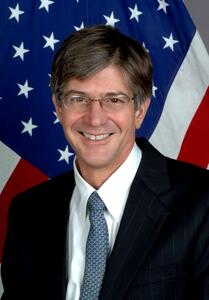
Russell L. Riley
This is the James Steinberg interview as part of the Obama Presidential History Project. We’re delighted to have you with us. We’ve just talked before the transcription began about the ground rules, so those have been stipulated and agreed to, and so we’ll begin.
James Steinberg
OK.
Riley
Because you’ve already done a [William J.] Clinton interview, we have up to about [year] 2000 of what we would normally want to cover in the first part of an interview, so what is of interest to us to begin with now is what you were up to during the interregnum, during the George W. Bush years. Maybe the simplest way to start is to ask you to tell us what you were doing after you left government service.
Steinberg
OK. I left not at the very end of the Clinton administration, but pretty close to the end, then I spent just under a year in New York, working as an advisor to the [John and Mary] Markle Foundation. I was a good friend and colleague with Zoë Baird, who was the president of the Markle Foundation. She invited me up, and I thought it would be nice to get a good break away from Washington for a bit. But then an opportunity came up to be a vice president for foreign policy studies at Brookings [Institution] in the summer of 2001, which, for a variety of reasons, I thought was a good idea, so we moved back to D.C. about two weeks before 9/11 [September 11, 2001, terrorist attacks]. It turned out that we got out of New York in a timely way.
The opportunity to be at Brookings was a good one for me, with lots of friends and colleagues there, and although I wasn’t hired by [Nelson Strobridge] Strobe Talbott, Strobe subsequently became president, and since we had worked very closely together in the Clinton administration, it was a very familiar setting. I spent four years in that position.
Then, surprisingly to me, a number of my colleagues and friends who were on the faculty of the LBJ [Lyndon Baines Johnson] School at the University of Texas approached me about becoming dean of the LBJ School, which is not something I had really thought about. I certainly had never thought about living in Texas, but they were very persuasive and, after I had an opportunity to visit and meet with both the faculty of LBJ School and the leadership review, I was persuaded it was actually a great idea and a great opportunity. So in summer 2005, after we had just finished adopting our second child, we moved to Austin. I was there as dean of the LBJ School up until the time that we’re going to be discussing today.
Riley
OK. Did you have any particular initiatives at Brookings that we ought to pay attention to in terms of area focus or subject matter focus?
Steinberg
Yes. There were a number of different things. One of the things that had become a very important part of my work, as you know, in the Clinton administration, involved East Asia and China. We did quite a lot of work both strengthening the existing Center for Northeast Asia Studies and Brookings, and then beginning the work that ultimately led to the creation of the [John L.] Thornton Center on U.S.-China relations at Brookings. We also began to do more work on transnational issues, which is something that Bill and I had begun to do early in the Clinton administration and became an important part of the work that we did together in the Clinton administration. Then we began to think about broadening the ambit of the work at Brookings. We created the Haim Saban Center for Middle Eastern Studies while I was at Brookings, so that was a major new initiative on Middle Eastern studies at Brookings as well.
Barbara A. Perry
And so, Jim, in 2005, the Phoenix initiative, or Phoenix Project, is released, and you were obviously working on that, leading up to it. I guess that was thinking down the road for the end of the Bush administration and where you wanted to see strategic leadership going with the next administration. Can you talk a little bit about that?
Steinberg
Right. For a variety of reasons, and fairly uncharacteristically, I wasn’t very involved in the [John F.] Kerry campaign in 2004, but there were a number of us who had served in the Clinton administration who were concerned, because of what happened in the Kerry campaign, that Democrats didn’t have any strong, articulated set of policies that would allow them to be successful in the foreign policy/national security debate, that it had become too much of a truism that the Democrats seemed to want to talk about domestic policy and the Republicans wanted to talk about foreign policy and national security policy.
Many of us believed that it would be hard for Democrats to be successful, and especially as we saw all the problems that John Kerry had, notwithstanding his own very strong record on foreign policy, and also the need for some fresh thinking about what a foreign policy for the 21st century should be like.
As a result of a lot of informal conversations and the fact that all of us were working in the same physical vicinities during that period, and during the Kerry campaign in the immediate aftermath, we decided to launch a project of close professional colleagues to think about whether we could articulate a platform for the next Democratic Presidential candidate. Whoever he or she might be, they would have to draw on thinking about how to be effective in policy and in articulating something that would be politically successful in the context of—since Bush would have finished his second term—whoever the subsequent Republican candidate would be.
As you know from the group, it’s a group that was very close, both personally and in views about a forward-looking foreign policy, so it was a natural fit and one we felt could contribute to both good policy and strengthen the Democratic candidate for the better in foreign policy. It could also help the many good ideas that Democratic candidates have on domestic policy have a chance to be successful.
Perry
Did you have a thought at that time of the candidate you’d like to see lead the Democratic—
Steinberg
No, we were quite neutral on the issue, and the whole premise was that this should be something that any Democrat, or any plausible Democratic candidate, could embrace. It was really in the immediate aftermath of 2004, so I don’t recall even any discussion about specific candidates. The idea was precisely to have something that was not based on any particular candidate’s perspective, but our perspective about what a good foreign policy would be, both substantively and how to articulate it.
Riley
Jim, let me ask you a question as a sort of predicate for what will take place later. Could you give us a kind of 10,000-foot assessment of where you thought the Bush administration had taken wrong turns in foreign policy? In other words, if part of what you’re doing after President [Barack] Obama comes in is making substantive changes in foreign policy, what were the main contours of the critique of Bush that we ought to be mindful of in advance of that experience?
Steinberg
Right. Well, I have a lot of personal respect for the people who served in the Bush administration—many of them, not all. We’d been back and forth against each other in the ’92 election and the 2000 election and the like, but our view was that the Bush administration was dominated by old thinking that still saw things in a very state-centric way, that saw it in traditional foreign policy terms, and this was something that the first President [George H. W.] Bush had as the hallmark of his foreign policy, and then was carried over into the second Bush’s Presidency. Nothing illustrated this more than their failure to understand the threat represented by al-Qaeda and their tremendous focus on Iraq and state threats to the United States.
It wasn’t just terrorism, although that was the most important. The fact that we had a lot of materials that you shared with me emphasized the fact that in my exit transition conversations with Steve Hadley, who I have great respect for, we made clear how important we thought the al-Qaeda threat was, and then the Bush administration came in and started focusing on Iraq, rather than al-Qaeda.
But it was broader than that. It was the withdrawal from the Kyoto Treaty. It was this failure to really think about these transnational and emerging 21st-century issues as being at least as important as state-to-state relations. And that was a hallmark of the kind of training and background that many of the people—[Condoleezza] Condi Rice, Steve Hadley, and others—brought to the Bush Presidency. They did not have the same view of the importance of the things that we thought were emerging issues in the 21st century, not that states weren’t important. I emphasized, and we emphasized that in the Phoenix Project, that there was more to it, and that a successful foreign policy needed to take those things into account.
Many of the most serious failures of the Bush administration, from our point of view, came from a backward-thinking, traditional statecraft view about U.S. foreign policy that didn’t correspond to the emerging developments of the 21st century. Also the unilateralism.
There was a tremendous amount of focus on freedom of action and autonomy by the Bush administration. This was more [Donald H.] Rumsfeld and [Richard B.] Cheney than Condi and Steve, but the dismissing of the traditional allies that Rumsfeld did in the run-up to the war in Iraq—the “coalitions of the willing” idea rather than recognizing the value of long-term alliances—and the value of international institutions—All of this was because of this view that the United States shouldn’t tie its hands, should have freedom of action. This was an administration which, after all, had John Bolton in it, and ultimately at the UN [United Nations].
It was those two things—the combination of the interdependence issues and the transnational issues, and this go-it-alone version of American foreign policy—that favored autonomy over strength in numbers. Those were the two principal lines of critique that we felt about the Bush administration.
Riley
Had you been an early skeptic of the Iraq intervention?
Steinberg
No, I was not an early skeptic in the run-up to the intervention, though I was critical of what ultimately was done. But I was sympathetic to the need to address Saddam’s failure to comply with UN WMD inspection. My view was I’d spent a great deal of time in the Clinton administration dealing with Iraq, and among the most important things I was involved in were the events in ’98 and ’99 involving the inspections and the thwarting of the [Richard W.] Butler inspections of the places that he wanted to inspect on behalf of the UN, and Saddam [Hussein]’s continued resistance and unwillingness to do this, which led up to the so-called “Desert Fox” military strikes.
My view was we had UN Security Council resolutions that demanded access, which were being ignored and thwarted by Saddam, so if we believed in the UN, and we believed in the value of Chapter 7 action by the Security Council, we needed to back it up by forceful action.
To the extent that the Bush administration, which it claimed in the fall of 2000—particularly Secretary [Colin L.] Powell—was trying to strengthen the UN, and going to the UN to enforce the UN mandate, I was quite favorable. And the only way to enforce the UN mandate was to make clear that there would be costs to Saddam for the failure to comply with his obligations under the relevant Security Council resolutions. So I was for increasing the pressure, I was for Powell’s trip to the UN, and I was for what the administration said it was trying to do, which was to mobilize the UN in support of pressure on Saddam, and was very forceful with that. That was true up through January of 2003.
But then, just as the Bush administration began to get some traction in the UN, through the French and others, the administration pulled a 180 [-degree turn] and basically said, “We’re going to go by ourselves,” even though the UN process was continuing. That was inconsistent with the whole reason I supported this, which was to strengthen the UN, and it raised questions about whether the administration was ever serious about the UN, whether it ever really wanted to give the UN process a chance to succeed, or whether it was just a pretext to go forward with the unilateral action.
It became increasingly clear that the administration was preoccupied with the increasing advent of summer and the hot weather and not wanting to conduct military operations in the summer, and seeing the UN activities as potentially delaying their optimal military timetable. That was the point at which I parted ways, but in the early going, many of us were willing to be supportive of the Bush administration being tougher on Iraq, but because of Iraq’s defiance of not the U.S. but the UN.
Riley
Let me ask one follow-up and then turn it over to my colleagues: were former associates in the U.K. in touch with you during this interval about the dilemmas they were confronting on Iraq?
Steinberg
Not much.
Riley
Well, President Clinton had been close to Blair, and then Blair finds himself in a very different situation vis-á-vis George W. Bush. One of the things I’m curious about is whether there were enduring communications between people in Blair’s orbit and people in Clinton’s orbit about how to deal with the new world after 9/11, particularly running up to Iraq.
Steinberg
It’s an interesting question. I was, and remain, close to a number of people who worked for Blair, including Blair himself. But it was awkward, because we frankly felt that in Blair’s desire to sustain a relationship with the United States, and Blair’s belief that by staying close to Bush he could have some influence with Bush, we felt that Blair was empowering Bush. Rather than having influence, he was just emboldening Bush, and not acting as a cautionary brake on some of the unilateral instincts of the Bush administration, and that by having such strong support from Blair, it was just emboldening. So it was a little awkward for us.
Blair had clearly made his decision to take that tack, rather than being cautionary and critical, even in private, of Bush. He seemed to want to try to gain Bush’s confidence by being enthusiastically on his side with visits to Camp David and the like. So it was awkward to talk much, given the tactic that Blair had chosen to pursue what he believed, I’m sure in good faith, was the best way to influence U.S. policy.
Perry
I was going to follow up, Jim, on the Iraq side. You’ve been very clear about the process that you hoped the U.S. would follow. I’m wondering about the policy itself of removing Saddam and regime change, your thoughts about that, and disrupting maybe a balance of power in that part of the Middle East vis-á-vis Iran.
Steinberg
Well, the regime change issue is very complicated. This is more a Clinton administration issue. Throughout the last several years of the Clinton administration, we were faced with a Congress that was increasingly passing more and more explicit resolutions, trying to get the administration to buy a policy of regime change, which we were reluctant to do. We were trying to manage the increasing pressures from Congress that were trying to constrain our actions in Iraq. We certainly believed that the ideal was to deal with the WMD [weapons of mass destruction] problem, and that the focus should be on that, rather than regime change, for all the many other reasons why a change in regime would be good, because we didn’t feel we had the tools to do this.
There are some aspects of this which I can’t discuss, because they were certainly highly classified at the time and I don’t know whether they remain classified today, in terms of how we approached that issue of regime change, but I’ll simply say that we certainly felt a change of regime would be in the interest of not just the Iraqi people but of the region. But as to how that should be best accomplished, we were not at any point in favor of an overt military intervention.
Riley
Bill, you’re being awfully quiet.
William J. Antholis
You guys are asking all the right questions. But you’re getting close to a period that I’ve got a few questions for, so—
Riley
All right. I’m just extending the invitation to jump in.
Steinberg
Let me just finish this. I do think during this period there was a lot of interaction. I was pretty close friends with Paul Wolfowitz and saw Paul a lot during this time. I had very little contact with other people in the Bush administration, but I did see Paul fairly regularly. It was clear that different people in the Bush administration had different objectives vis-á-vis Iraq. Paul was very focused, as he had been, on the democracy and human rights part, and though I disagreed with the intervention, Paul’s sincerity on the issue was quite clear. He had a lot of ties to the Iraqi opposition, and he brought many of them to meetings and dinners in Washington. I attended some of those. So although I didn’t agree with the idea that we should use military intervention, I think it was sincere.
But it was also clear that you had a situation where different people in the Bush administration had different objectives, all of which converged on removing Saddam, but for many different reasons. The Rumsfeld objectives were very different, I think, from Condi’s, and very different, certainly, from Paul’s.
Riley
Can I further the question by asking: You developed a focus on Asia—maybe it was there all along, but certainly in the Obama administration—and the question then is about your sense about Bush in Asia. Was it not fully attended to? Was it Japan-centric when it needed to be something else? What was your assessment of that?
Steinberg
A couple of things. The first year of the Bush administration was extremely poorly conceptualized vis-á-vis Asia. You had a meeting either in February or March between President Bush and Kim Dae-jung, the President of South Korea, with whom we had worked very closely and who was one of the great figures of our time, a hero who risked his life for democracy in Korea, and through this really remarkable series of developments over a 20-year period had become elected as President of South Korea.
You had a situation where one of our most important allies is headed by this quite extraordinary figure with whom we had worked very, very closely during the Clinton administration. We had a shared interest in Korean democracy, a shared interest in the denuclearization issue, and had worked very closely with him. We had a very strong conviction that while the United States may have different views about how to approach North Korea, the South Koreans were on the front line, and we ought to take their approach seriously.
When KDJ [Kim Dae-jung] came in with the Sunshine Policy, we wanted to work closely with him to make sure that he could pursue what he believed was in South Korea’s interest, in a way that was consistent with our interest in dealing with the military and nuclear threats posed by North Korea.
We expected in our transition conversations with those people in the Bush administration a certain degree of continuity there, and certainly I think Secretary Powell intended a degree of continuity there. But after meeting with Secretary Powell and being reassured that things were going to continue roughly as they had in the Clinton administration, Kim Dae-jung went into the White House and President Bush basically told him, “We’re not on the same program as you are. We’re not supportive of the Sunshine Policy.” And you have this famous quote from Powell, asking what had happened, and he said he’d gotten too far out over his skis.
That was reflective of the fact that the Bush administration had come in. They had a very clear, hardline view about state threats, and they were going to take on Iraq and Iran and North Korea. They pulled the rug out under Kim Dae-jung in a very public and humiliating way, which reflected, in my view, a deep misunderstanding of both the alliance relationship and how to manage the situation in North Korea.
Then, within the same time frame—I think it was in April—you have Bush making a very forward-leaning statement about defending Taiwan, notwithstanding the abrogation of the U.S.-Taiwan security treaty in 1978 and the premise of the One-China policy. He had talked a little bit about the campaign, and it’s never been clear to me how scripted that statement was—I believe it was in early April of 2001—but it clearly represented a significant departure from the very careful balance that we had developed in dealing with China.
So right off you had two very significant developments, which betrayed, in my view, kind of a reckless disregard for two of the most important issues of stability in the region. And then there were corrections. So you have the EP-3 incident and Secretary Powell getting more control over the policy as it became clear that there were real dangers there. I began to see the more experienced hands on East Asia beginning to have some influence on the policy.
Nonetheless, after 9/11 and the invasion of Iraq, the administration was completely preoccupied with the Middle East, Afghanistan, and Iraq, and was paying very little attention to East Asia, particularly Southeast Asia. All the engagement was focused on getting partners in the so-called “War on Terror.” Every time Secretary Rice or others would talk to people from Southeast Asia, they’d want to talk about terrorism, and Islamic terrorism, and how we can work together on terrorism, whether it was in Indonesia or Thailand, rather than the issues that were paramount to them.
Similarly, because of scheduling and all the demands, failure to attend at the Secretary of State level important meetings of ASEAN [Association of Southeast Asian Nations], and the ASEAN Regional Forum and the like, all reflected the fact that there was a lot on the administration’s plate. They were prioritizing the two wars in the Middle East and finding it difficult to give East Asia the attention that it needed and deserved. So there were my early concerns about the policy, and then later, as the policy became more stabilized, it still wasn’t getting a lot of attention. That became something that many of us wanted to make a big issue, both in the campaign and as a priority as we began to think about the next Democratic President.
Perry
Also, during this period—you mentioned, of course, Afghanistan—but your comments or thoughts on what’s happening there in the midst of the Bush administration, and as you get closer to 2008?
Steinberg
I hope I’ve already been smart enough to not try to do everything, and to recognize that some people know more about some things than others. I have very little background or experience with Afghanistan, so wasn’t deeply involved and wasn’t really second-guessing a lot of the policy there. I just did not have a lot of experience.
What I did know, or what I did have some experience in, is in relations with India and Pakistan, so my focus during the Bush administration was more on how to think about the Afghan conflict in the context of sustaining relationships with India and Pakistan. I’d done a lot of work on that in the Clinton administration, at the State Department and then later at the White House, both in terms of beginning to reorient the relationship with India, leading up to President Clinton’s visit to India, and also trying to think about how to develop a relationship with Pakistan in the context of dealing with the aftermath of the nuclear tests in ’98 and the like.
On Afghanistan, per se, I don’t think I had strong views or convictions. I didn’t know a lot of the actors. Obviously I had a familiarity with the history—everybody knows about The Great Game and all that—but it was not my greatest area of expertise.
Perry
On Pakistan, however, did you think that [Osama] bin Laden was being hidden there?
Steinberg
No. Obviously you have no access to intelligence once you’ve left, and it’s a perfectly good thing because if you have it, it constrains what you can write and say. I had a pretty good sense where bin Laden was during the Clinton administration, but afterward I wouldn’t have had the slightest idea or any reason to know.
Riley
Let me ask you a question about your time at Texas. Do you have any reflections on any correlations you saw between those kinds of institutions and the caliber of people that are produced by them to contribute to public policy making in the way that you’ve done in your career?
Steinberg
I think about this a lot, and I’ve spent the last 16 years, with the exception of the two and a half years I was in the Obama administration, on precisely this question, having been dean of two of these schools: how to make sure that the people that we’re preparing for these kinds of careers have the kinds of skills, knowledge, and experience that will make them effective in this. I’ve done a lot of thinking about what makes for a good foreign policy advisor in government, what that kind of person needs to know, and what they can benefit from as they’re getting ready to go into these things.
One of the things that I did when I went to the LBJ School was create a new degree program called global policy studies, and the whole motivation for that was precisely the same kinds of things we talked about in the Phoenix Project, which is that we needed new ways of thinking about international relations that involve different disciplines, different ways of thinking about the world. You used to call these degrees “international relations,” right? Whereas the idea behind both the title and the curriculum that we developed for the master’s [degree] of global policy studies was to recognize the much greater connection between domestic and international and these new kinds of issues.
It was really my chance to put into action, from a pedagogic point of view, some of the ideas about the kind of preparation you wanted people to have before they went into government. I spent a lot of time at both of the schools thinking about that, and I have been running a big project with the Carnegie Corporation for the last six years, not just training professional master’s degree students but now PhD students, who are contributing both in their research and then sometimes in their careers doing this. It’s really critical to take the experience that you develop in government, both for one’s own research but also in terms of how one thinks about teaching and curriculum for future leaders.
Riley
Thank you. Approaching 2008, there is a presumptive Democratic nominee with whom—
Antholis
Actually, this is where I’d love to jump in. Jim, I’d love for you to talk a little bit about the 2008 Democratic primary, because you end up working pretty closely with both of these people, or at least the two final candidates. Just tell us about that experience. You stayed on the sidelines in the primary between Obama and [Hillary Rodham] Clinton. And if I remember correctly, you hosted a debate, because I remember watching at home—
Steinberg
Yes, one of the great, great moments of my life.
Antholis
I remember watching at home with Kristen [Suokko], and Kristen saying, “There’s Jim!”
Steinberg
Let me talk a little bit about all that. I went to Texas, and one of the best pieces of advice that I got before going to Texas was from a former dean at the [Harvard] Kennedy School, Al Carnesale, who’s a very good friend of mine and ultimately went out to UCLA [University of California, Los Angeles]. He told me, “When you go to place a like the LBJ School, embrace the distance. Don’t try to fly back to Washington and stay in the mix. You can’t do it. Washington is a very close community where propinquity matters to everything, and if you’re going to be out of Washington, get out of Washington. Think about other issues. Think about different perspectives.”
So from the time I left I really disconnected myself from Washington and a lot of the Washington activities. I didn’t fly back much except for very limited LBJ School–related activities. I didn’t try to stay engaged in think tanks, or go to conferences, or all the things that go on every day in Washington. I thought Al’s advice was excellent, and I really wanted to focus on my deanship out there, so I was really not thinking about Washington during this period of time. That was the first thing.
The second thing was I was dean of a public university, and there are very strict legal constraints on what you can do. I was a public employee. I was on a state payroll. The rules were very clear. You can advise political candidates as long as you are available to advise all candidates who wish your advice, of whatever party or inclination. You have to be open to that, which means that even though I’d worked in Democratic administrations, if John McCain or anybody else had called me up and asked me to advise them, I had to be prepared to do that.
I viewed my position as one in which I really needed to respect that. Literally, there were legal constraints on what I could do. In some ways it gave me the luxury of not having to make a choice, because I felt that the nature of the constraints were such that I had to be available to advise any candidate, and if I were to endorse a candidate publicly, it would make it impossible for me to meet my responsibilities to be available to any candidate.
I didn’t have a choice, but I wasn’t unhappy that I didn’t have a choice about endorsing one or the other of the candidates. Plus, it did allow me to be the moderator of this debate. We were very fortunate because CNN [Cable Network News] had the right to host one of the debates, and [Wyatt] Tom Johnson, the president of CNN, was on the advisory board at the LBJ School. Tom Johnson, of course, had worked for Lyndon Johnson and was very close to Lyndon Johnson. As soon as it became clear that CNN was going to have the debate, I called Tom and said, “We’ve got to have this at UT [University of Texas],” and Tom made it happen. CNN, after all, was his network. [laughs] They picked UT, and I was the natural person to be the host. It really was one of the great privileges of my life. I didn’t moderate the debate—There was a CNN moderator—but I was able to introduce it and welcome them on behalf of the University of Texas.
Riley
Were you called and asked for guidance by any of the campaigns?
Steinberg
Yes. The vast, vast majority of the people who had worked in the Clinton administration and the foreign policy establishment were supporting the former First Lady, then Senator Clinton. The last thing they needed was advice from me. They had more advisors than they knew what to do with. These were all my friends, but nobody from the Clinton administration was calling me up and asking for advice.
By contrast, there were a relatively small number of people who were advising Senator Obama, and almost all the people who were advising Senator Obama were people who were well known to me, and they did ask for advice. I was close to many of them. I had worked closely with Tony Lake during the Clinton administration. I had known Susan Rice from back to the [Michael S.] Dukakis campaign. She worked for me when I was a foreign policy advisor to Mike Dukakis in 1988. Greg Craig and I worked together for Senator [Edward M.] Kennedy, and I had known both Mark Lippert and, to a lesser extent, Denis McDonough from [Thomas A.] Daschle, and had worked very closely with them as well. These were people who were known to me, and they did call.
I would have been happy to help the Clinton people, but on East Asia, Kurt Campbell was advising the Clinton campaign, and I’m sure they felt if they had Kurt, they had good advice on those things, and so many other people. I don’t feel it was invidious, but I wasn’t hearing from the Clinton people. The Obama people did reach out to me.
Antholis
Since you mentioned Kurt, one quick follow-up there: at what point in the middle of all this did you start working on the book about transitions with Kurt?
Steinberg
Good question, Bill. Kurt and I obviously had spent a lot of time thinking about this, and as you know from the book and my own history, I’ve been involved in a lot of transitions. I worked in the first year of the [Jimmy] Carter administration. I wasn’t involved in the transition directly, but I was at the Center for Law and Social Policy as an extern in ’76 and knew a lot of the people who were working on the Carter campaign, so I had an indirect involvement during that transition period, then was brought into the Carter administration in the first weeks. I went to work for Henry Aaron, who was at Brookings, who came in as the Secretary for Planning and Evaluation at then HEW [Health, Education, and Welfare]. But Ben Heineman, who had been at the Center for Law & Social Policy, was [Joseph A.] Califano’s chief of staff.
I had quite a lot of insight into the Carter transition in, and then a great deal of insight in the Carter transition out, since I was in the Carter administration until the last minute of the Carter administration. I was still working on completing the hostage deal as [Ronald W.] Reagan was being sworn in, and so was deeply involved in the transition activities from the Justice Department, especially vis-á-vis Iran, on the transition out from Carter to Reagan.
Having been involved early on in the Clinton campaign, I was deeply involved in the transition in from Bush 41 to Clinton, and then in the transition out from Clinton to Bush. I’ve thought about this a lot, and knew what we’d done well and done badly in each of those, and I knew that we had had two very unsuccessful Democratic transitions in—Carter in ’76–’77, Clinton in ’92–’93. For all the other reasons, despite all the other things that we had done, we were hopeful that we would have yet another chance to do this. It seemed like a good opportunity to really reflect on both my own experiences and the historical experiences.
So Kurt and I—I don’t remember exactly when, but it would have been, I’m guessing, the fall of 2007—decided we should do this, and that we needed to get it done by the time of the convention, because part of what we wanted to write about was not just the postelection transition but even the campaigns. We’d set a goal for ourselves to finish the book by the summer of 2008, and we were, I remember, sort of finishing it up in July of 2008. It was very explicitly designed to be a handbook of our best thoughts, from our own experiences from history, for whoever was the Democratic nominee.
Riley
On that, it’s rather striking: I don’t know whether you want to comment on this or not, but I’ve taken a close look at the people that President [Joseph R.] Biden [Jr.] has surrounded himself with, and you see people like Steve Ricchetti and Bruce Reed, and you compare that with President Carter. There is now a Democratic corpus of experienced Presidential people that didn’t exist in that earlier epoch. Is that something—
Steinberg
Oh, they existed, but you’ve got to remember that Carter disdained them, famously dismissed [Thomas P.] Tip O’Neill, and didn’t have to work with him, and deliberately chose the Georgia outsiders. So it wasn’t that they didn’t exist in 1977. After all, Warren Christopher, the Deputy Secretary of State, who later became my boss, the Secretary of State, in the Clinton administration, had been at the Justice Department in the Johnson administration.
There were all these quite capable people from the Johnson administration and the [John F.] Kennedy administration who were still alive and kicking and who were available to Carter in 1976–77, as well as people on the Hill who had experience. So it wasn’t that there wasn’t a cadre of people with experience; it was that Carter wanted to be the outsider. He ran that kind of campaign, and then brought with him a group of people who had essentially no experience—[William] Hamilton Jordan, [Joseph L.] Jody Powell, all these people, [Thomas B.] Bert Lance. It was a deliberate decision not to involve the establishment, and it was very costly to Carter.
Riley
All right. I accept the corrective. Thank you. At what point do you start thinking about going back in?
Steinberg
You don’t think about going back in. I learned this lesson way back, too—the famous “measuring the drapes” problem, right? I worked for—You remember “President” Mike Dukakis, the guy who was 17 points ahead in the summer of 1988? I learned my lesson, that there’s no point in starting to think about this until the votes have been counted, and as you learned in 2000, sometimes even after the votes have been counted. You take one step at a time.
I became increasingly involved in the Obama campaign because they were increasingly reaching out to me, and once he was the nominee, they asked me to play a more active role. But at that point the focus was on getting Senator Obama elected, and, as I say, having worked for the huge frontrunner in 1988, I watched all these people starting to think about what jobs they were going to get in the “Dukakis administration” starting to position themselves. Seeing how it turned out, that this was silly, I took that to heart from that 1988 experience, and it didn’t become an issue in my mind until after that.
Riley
Let me ask you, then, if you would, to assess the Obama campaign on general foreign policy issues, if you could both during the primary season and during the general election. What are you finding out about this person? What are you finding out about the networks of people around him? What were they particularly good at? What were they not particularly good at?
Steinberg
President Obama, then Senator Obama, was an extraordinary figure. He was a brilliant man, with an incredibly sophisticated understanding of the world and of human beings and human nature, and a great appreciation of American history and the strengths and weaknesses with American history. He clearly wanted to run as an agent of change across the board. It, after all, was the slogan of the campaign, but it reflected his own view about that. But he also was not as experienced in foreign policy as others—He was more experienced than Mike Dukakis—who have run for President.
One of the things that I found rewarding in my own interactions with him was that, on the one hand, he believed in change. He believed that the world was changing and that we had to adapt to that world of change, but he was also respectful of kind of the cautions and advice and experience of people who had experience that he hadn’t had. All of the interactions during the campaign was that balance between his challenging and questioning and wanting to be novel and different and break from the past, but also to be mindful of the pitfalls and not just cavalierly dismissing experience in the way that Carter did.
He was not Carter. He was more of an outsider than many, but he wasn’t Carter, completely brushing off the outside experience. There was that dynamic where he had around him people who were quite experienced, but who were also interested in change, and of course that corresponded a lot to some of the ideas that we had in the Phoenix Project, and it’s not surprising that Susan and maybe the people who were involved in that were involved with Obama.
It was this dynamic between his questioning and wanting to think about the ways of approaching foreign policy, but also his respect for why we got to where we were and the like. In all my conversations with him, which intensified during the very intense time we spent together during that foreign trip, I think it was that. He wasn’t accepting just continuity because that’s what we had done in the past, but he was willing to listen to the arguments for that. He and I had quite a number of very intense conversations about Iran and Iran policy, which reflected that dynamic.
Riley
This was during the campaign you had those—
Steinberg
During the campaign. As you know, he took this famous trip during the campaign to the Middle East, and to Europe. I was with him, but not for the entire trip. I did not go to Iraq with him, but I met them after the Iraq portion. That was really my first extended, intensive engagement with then Senator, candidate Obama.
Perry
That trip included the trip to Germany, Jim?
Steinberg
Correct.
Perry
Right. I remember that so well, the thousands of people who turned out to see him. It seemed quite exciting to me, but I remember opponents saying, “Oh, he’s a celebrity and that’s all he is.” But what were you feeling—
Steinberg
Well, I had lived in Europe, and had spent a lot of time working on European issues for the early part of my career, so I felt like I knew Europe pretty well, and I was confident that Europe was desperate for an American President who cared about Europe, instead of this Rumsfeldian “old Europe” and “coalitions of the willing” and the like. I don’t believe that Europeans felt that the Bush administration valued alliances enough, and there were aspects on the value side that Europeans felt closer to in Obama’s approach: multilateralism, human rights, and things like that. So we were quite confident that he would be well received.
It was less clear how the meetings with the leaders would go, but we were absolutely confident that the reception was going to be wild, that the European public was looking for something different, and Obama was what they were looking for. That was, in some ways, the easiest part of the trip. The Middle East trip and, procedurally, the part in Israel, was way more complicated and tricky compared with the Germany part. It was still a little unclear how he’d be received by the Chancellor, because it’s awkward to have a sitting head of government, meet with a candidate, because they still have to work with the current leader, but all those meetings went fine. But with the public reception, we all knew that the enthusiasm would be there, and it was very exciting.
Riley
Do you have any stories from the trip?
Steinberg
For me it was the opportunity to have these deep conversations with the candidate about the roots of our policy toward Israel, the roots of our policy toward the Palestinian conflict, the roots of our policy toward Iran. Dennis Ross was also on that trip. Dennis and I were very close. We had worked very closely together in the Clinton administration, especially in the first term—both terms, but especially in the first term—when I was at the State Department and Secretary Christopher was so involved in the direct negotiations between Israel and the Palestinians but also with each of them with the Syrians and the like.
Dennis and I traveled together with Secretary Christopher constantly, so Dennis and I had become very close, and then we had the opportunity to work together. He and I spent a lot of time talking to the candidate during this trip about these things. They were lively discussions, and Obama challenged a lot of us. How willing should we be to negotiate with the Iranians? What should the terms of that be? How involved should we be in the peace process between Israel and the Palestinians? How should we approach that?
There were lots of conversations where Obama would come out of the fitness facility in the hotel that we were staying at in Israel, still with the towel draped around his neck, talking about how do you deal with Iran, how do you deal with these threats, how much can you achieve by negotiation, who should you negotiate with. It was a uniquely intense opportunity, with the informality when you’re still on a campaign to have the kinds of conversations that you later would recapitulate when you’re in office, but it isn’t the “Mr. President” with all the pomp and circumstance. [laughter] It’s the guy with the towel wrapped around his neck having just come off the treadmill.
I do think he pushed back a lot. We didn’t see eye to eye on everything. But as I say, there was that nice balance between his challenging and saying, “Just because we did it this way before doesn’t mean we have to keep doing it,” but also willingness to listen to the arguments about why we had done things the way we had in the past.
Antholis
Jim, at this point, hearing about him being engaged in debates about strategy and tactics, you’re in the middle of a political campaign, and while Europe is certainly looking for somebody to embrace multilateralism, and many Americans probably were, as well, I’m sure there were a lot of Americans that supported Obama that at that point, because of the failed Iraq experience, wanted to simply withdraw. Was he reflecting on, or were you discussing at this point, popular support about international engagement at all? Was he expressing concerns, biases, foci on that issue?
Steinberg
No, that’s just not his style. We all know his autobiography. He’s a man of the world. He’d lived in the world. He believed the United States was deeply implicated in the world, had a lot to give and a lot of responsibility, and a lot to gain from engagement. So he was a disengager from Iraq, because he thought Iraq was a mistake and a catastrophe and counterproductive, but he was never a disengager at all in any other respect. I don’t think that ever came up, and I don’t think he ever felt that that was a major theme, or that that was a tendency that he had to worry about. It was more that he went to great lengths to disentangle his desire to disengage from Iraq with any perception that he wanted to disentangle from the world.
Antholis
Was he perceiving anything in the public in that direction that you all as a group needed to be wary of? I’m looking back, but then thinking forward, to what happens following his administration, where clearly a big part of what supported President [Donald J.] Trump was simply running away from the world, or walling off from the world. Was he worried about that as a theme in American politics to be wary against?
Steinberg
It’s not my sense, to be honest. I think he believed that there was support for engagement, but just a different kind of engagement than in the Bush administration: less emphasis on the military, more emphasis on cooperative and multilateral engagement. I can’t remember any conversations suggesting that we needed to deal with kind of an isolationist, a [George S.] McGovern-like “Come home America” sentiment.
Antholis
That’s what I was trying to get at, and that’s interesting.
Steinberg
It didn’t feel to me, and he certainly didn’t express any sense that this was 1972, which clearly was that, and that’s where a lot of the Democratic Party was. But I don’t have a sense that that was the concern there. It was just a different way of engaging, sort of like, “You’ve got to get back in. We got out of Kyoto. We’ve got to get back into the climate agreements.” They’d been basically disengaging from the UN; we had to get more engaged. I don’t think there was any point at which there was a sense that you needed to address that so much as—
Perry
That summer of the campaign, Senator Obama speaks to AIPAC [American Israel Public Affairs Committee], the Jewish American interest group, and as I understand it, you helped with that speech? Am I correct?
Steinberg
Yes.
Perry
In going through that speech, it was remarkable to me how many times there would be a sentence or two and it would say “applause,” and then the next sentence or two would say “applause.” I was struck as well by the Senator wanting to draw together the history of Jewish Americans and African Americans in the civil rights movement. So clearly it’s a pro-Israel speech. It seems to me that he is reaching out, obviously, to this group, and this interest group as an important bloc of voters, but any thoughts behind the scenes about the Palestinian side, the human rights question that we’re seeing this very week going on about Israel and the Palestinians?
Steinberg
It was maybe in the Nicholas Lemann piece you shared with me, something about how autobiography is kind of the way in which Obama comes into his ideas about the world and things like that. I thought it was a wonderful way of capturing it, because that is absolutely true. He’s a very self-reflective individual who draws on his own experience.
Going back and rereading the speech, it was an even better speech than I remember. It was a really wonderful speech, and I take credit for a little bit of it, but not the best parts. The best parts of the speech draw on his personal experience of being an African American and having lived outside the country. But the story in which he talks about his grandfather and being at the concentration camps is just a powerful, powerful story. He always believed that a way to connect with people is to show that you had it inside you. I’m Jewish, and that’s how Jewish people think about it, that you have it inside you. It’s not an intellectual thing; it’s something that you feel inside you, and the validity, the credibility, of that as a way of connecting is much more powerful than just mouthing the policy laws, right?
There are a lot of important policy lines in the speech, and I’ll come back to that in a second. The thing that was most important was why—I had to deal with this in ’88. There were deep questions about Dukakis’s commitment to Israel, notwithstanding the fact that his wife was Jewish, because he was seen as potentially not strong enough in his support of Israel, or too sympathetic to the Palestinians way back then. I was very close to a lot of people in the Jewish community. I’d worked with them from my years working for Senator Kennedy, knew a lot of people in the major Jewish organizations, the ADL [Anti-Defamation League] and AIPAC and the Conference of Presidents of Major Jewish Organizations, and it was clear that when Mike was running, and especially before the New York primary, you had to deal with some of those issues.
I worked with him on a speech Dukakis gave at the Conference of Presidents of Major Jewish Organizations, which didn’t go great. And it was in part because, notwithstanding the fact that he was married to [Katharine] Kitty [Dukakis], he never was able to persuade his audience that he deeply felt the things that they felt. That influenced me in a lot of thinking about how President Obama, candidate Obama, Senator Obama had to approach this and make it personal, because he wasn’t going to get much credit. He had to say the policy lines, but he wasn’t going to get credit for saying the policy lines, because everybody could say, “That’s just what Denis told him to say,” or, “That’s what Jim Steinberg told him to say.” He had to be believable. He had to be credible, so the goal here was to make that connection.
There were two things that had to happen: he had to connect it to his own experience and he had to be sincere. He had to be clear that he wasn’t saying one thing to a Jewish audience and another thing to another audience. He had to be willing to say to the AIPAC group things that they weren’t going to like as well as the things that they were going to like. He would get more points for being honest about that. So, for example, in the long discussion he has about Iran in the speech, he doesn’t say all the things. He doesn’t back off from his belief that we should negotiate with Iran. And we all felt that he felt that he would have no credibility if he either downplayed that or didn’t take that head-on.
But I really want to emphasize—Everybody focuses on the Germany part, but that was an easy part. The Israel part was really important, and he was going to the Western Wall. He was going to the families of the people who had been attacked by the rockets from Gaza, right? He didn’t make a big public showing of it, but he went there and talked with the families; it was important to his connecting to the human side of this conflict with the Palestinians and understanding how Israelis and how Jews talked about these things, and even his meetings with [Benjamin] Netanyahu.
That’s all of a piece, which was he needed to understand and be familiar with what the AIPAC crowd cared about, and the magical words and all those things, and perhaps the most important magical word, and the thing that was most debated internally about the speech, was the question of an undivided Jerusalem. There were divisions within the campaign about whether the President should endorse an agreement with an undivided Jerusalem.
Both Denis and I believed very strongly that there were a lot of things that you could disagree on with people who supported Israel, but this was fundamental, and if you didn’t believe that and you couldn’t say that, it was going to have consequences. But it was also clear that he wasn’t going to say it if he didn’t believe it, so we had intensive discussions. We had a lot of discussions while we were in Israel about this, and we had intensive discussions going into the speech within the staff and with him about that line. Ultimately it was his decision as to whether he felt comfortable with it, but certainly Denis and I—I can’t remember where others specifically were on this—felt very strongly that this was going to be one of the things that would be most looked for in the speech, and he did say it.
When you talk about the applause lines, the applause lines sometimes come from saying the things that are important for your audience to hear. That was certainly one of the things that the audience wanted to hear, and wasn’t sure whether they would hear.
Perry
In helping him to write the speech, did he specifically add those personal touches?
Steinberg
Yes, or I assume did. That, I’m sure, came with him in conversations with Ben Rhodes, who’d been deeply involved in all of this too, and Denis and others. But yes, that certainly came from him. That’s how he approached everything. I certainly saw this during the Presidency, as well. He writes his own stuff. Ben’s a good speechwriter, we all contribute stuff, but he writes his own. He’s an incredibly eloquent person. He’s a great writer, and you can’t read his books without seeing what an eloquent writer he is. It was true in the Berlin Wall speech; he wrote much of that himself. I was never a speechwriter for him. Our role was to give ideas and thoughts and content, not to actually shape the presentation.
Riley
Jim, you’ve described somebody who is, in your area, very astute and talented. Were you picking up any blind spots or any weaknesses in his game? Were there areas of substance or areas about his own capacities that he had to accommodate for in the foreign policy business?
Steinberg
The only thing was his limited personal relationships with foreign leaders. He’d been on the Foreign Relations Committee, but he’d only been on for a short period of time, and he didn’t know a lot of these people personally. You could overstate the personal things, and we often do overstate the personal relationships; sometimes we think we’re getting more out of it than in reality.
I’m not a pure IR [international relations] realist. I’ve written about agency—I think agency matters—but there are some people who think you can just be chums with people, like President Trump, who seems to think if you just engage people directly you’re going to solve the problem. But I do think that the fact that he didn’t have as much experience directly engaging with foreign leaders was something that wasn’t necessarily a liability but just was something that he didn’t have. He just didn’t have that kind of experience. He had the cerebral experience of thinking about the issues, but not of the way in which you engage leaders and make this happen. And he was very different from [William J.] Clinton.
Clinton didn’t have a huge amount of that either, frankly, but Clinton was such an extrovert and such an engaging person that you just never worried about him. You knew with Clinton he’d get in a room with Helmut Kohl and [François] Mitterrand and these guys and no problem, right? This is what Clinton was brilliant at. Because Obama was more of an introvert, that’s just not how he did this. He thinks about things, but he doesn’t—That was the one thing that was different and had to be developed, which is how do you do that if you get into a room with a foreign leader, especially where you have a difference of opinion, like Netanyahu or others? It’s easy with folks that you are on the same wavelength with, but a lot of it is very different, and it came naturally to Clinton. It did not come naturally to Obama.
Antholis
A bracketed aside, Jim, is that Russell and Barbara have spent 20 hours with President Clinton and we haven’t spent any time with President Obama yet. I’ve been lucky to be with him for 15 or 16 of those hours, so they get what you’re saying, at least with respect to Clinton. But my question is: in this period, there are so many issues where you are so centrally involved, but on an issue that commands a lot of your time and attention, and where comparatively you’re bringing a huge amount of expertise—China—prior to being elected President, where are you finding him on the China question? Particularly because the pivot becomes such a central feature of the first term. What is his thinking at that point and what are you perceiving?
Steinberg
I don’t think it’s a great preoccupation of his at the time. I always felt one of the great successes of the 2008 campaign was how small a role China played, because my own experience on this is that whenever China becomes involved in a Presidential campaign things go badly. [laughter] I was deeply involved, and painfully involved, in ’92–’93 with Clinton and the Butchers of Beijing. I’ve written extensively about this, and it was relevant to our book about transitions: just try not to talk about China in a campaign because no good can come of it. You’re obliged to take a very tough line, and it makes it very complicated when you come to office.
But because of what was going on in the world, China was not a big factor in the 2008 campaign, and to the extent it was, China was actually behaving fairly responsibly on the global financial crisis. So you had China, which could have done some things that would have made the recovery more difficult, or been potentially advantageous to China at our expense, didn’t happen. There wasn’t much going on that was controversial or a crisis in the nature of U.S.-China relations, so it wasn’t necessary to talk much about this.
To the extent that we did, Obama, because of his focus on transnational issues and issues on climate and things like that, understood the importance of trying to work with China, and was hopeful that one could develop a constructive, positive, engaged relationship with China. He wasn’t naïve about it, but he was hopeful that we could find a positive way forward at that point, and that was consistent with the way his advisors were involved.
It’s interesting. You recall that of the early group of people who were supporting Obama, one was Jeff Bader. He was in the very, very, early group. Jeff and I think very similarly on these issues. We’ve been very close for a long time. We worked together in the Clinton administration. We’ve worked together at Brookings. By the time I got involved, Obama had had a heavy dose of Jeff, so he’d been exposed to one of the most sophisticated thinkers about China and East Asia, and absorbed a lot from that. I don’t know how much he knew before he engaged with Jeff, but it was clear to me that he had a pretty good understanding of it. But it just wasn’t a major issue.
Those of us who were concerned about this, going back to your earlier question about our critique of the Bush administration, were less focused on what was going on in the campaign and more on what did we need to do during the run-up, assuming he got elected, and the transition, to be ready to put into play some of these ideas. A lot of this was done without a huge amount of engagement with the candidate during the preelection, and especially the postelection transition period, when Kurt and Jeff and I and a number of others put together the plan.
It was a very well developed plan. We had a very, very strong conviction about this, and we were ready on Day One with a comprehensive approach to the region. We felt optimistic that the two most important principals, the President-elect and the Secretary of State–designate, were going to be supportive of this overall approach. But the details were things that were really being worked at the transition staff level.
Riley
The conventional wisdom is that because of the President’s own personal experience he came into the office with an appreciation for Asia that was unusual. Is that a valid assessment, or is it overstated?
Steinberg
I begin by saying that it’s more that his experience, both of his family and his time in Indonesia, was an understanding of others and other cultures and perspectives, not specifically East Asian. So it was more of this broader piece of having lived with others with different understandings, different religions, and different histories. To some extent the Indonesia experience is sui generis; it’s not like when he’s living there he’s doing Indonesian foreign policy, right? [laughter] But it does give him a sense of a very rich and unique culture, and, to a limited extent, also an appreciation of Southeast Asia as this important part of the world that’s very different from China, Japan, and Korea. It is very, very different.
You can overstate it—we certainly played it up—but I think what he learned about it was some specific things about Indonesia and some broader things about being able to understand others, in ways that I don’t think any other President has ever had. Clinton had traveled abroad a certain amount, but nobody had the kind of gut-level instinct about what it’s like to live among people who just have different assumptions and different ways of looking at the world than we Americans do. So it had as much impact on his understanding of the Middle East, for having lived in Indonesia, as it did his understanding of East Asia.
Riley
What about race? You’re working with a man who is the first African American nominee. You spoke earlier of the fact that he didn’t have the same personal characteristics President Clinton did in terms of gregariousness in meeting foreign leaders. Did you think much about race when you were dealing with him? Is that something that you can help us understand as he’s developing an approach to the rest of the world?
Steinberg
I can’t say I thought about it much in dealing with him. The two things I thought about were 1) two audiences for this historic moment, which is 1) young people in America. I was dean of a school of public affairs, and I will tell you I love Secretary Clinton. I have nothing but the best to say for her, and we’ll talk about it. I’m a huge fan. But the level of enthusiasm of my students for candidate Senator Obama was off the charts, and part of it was because he was young, part of it because he was African American, and part because he was change. But the message of his candidacy domestically was something that I felt in my role as dean.
Then the message to the world—I’ve taught a lot about American history and history of American foreign policy, and there has always been this shadow over America’s soft power. We talk about ourselves as a land of equality, but the race thing was in the background. I’ve taught this before, this famous memo that [Richard M.] Nixon wrote to [Dwight D.] Eisenhower after his first trip to Africa, talking about how we wanted to get African support in the Cold War, and how what was happening in Little Rock and places like that back home were just undercutting our ability to tell the story. It was ringing false in so many parts of the world.
So the message to the world that America could really live up to its rhetoric and its values about race and opportunity and equality is really powerful. When I talk about the Berlin speech, the Brandenburg Gate, that’s about that too. People wanted to believe in America. People do want to believe in America, but sometimes we don’t give them the reasons to do that. We have to walk the walk as well as talk the talk.
Obama was both: he talked the talk, but his candidacy was walking the walk. It was about America. I will say this in all candor—until election night I never believed it. I grew up in one of the most racially combative environments in America in the 1960s, in Boston. I worked for the first African American city councilor in Boston. I worked for Kevin White when he ran against Louise Day Hicks for mayor, in reelection. I didn’t work for him in ’67, but I worked for him in his reelection in ’71, and I’d seen it. I’d seen the ugliness of race in this country, even in my hometown. All through the campaign there was this fear in me that we just couldn’t do it, as a country we couldn’t elect a black man President.
To this day I choke up thinking about the fact that we did do it, for all the problems we had. It’s a testament to him, to Barack Obama, but it made one feel good. In personal conversations it wasn’t an issue; it was more just my awareness of how important this election was, disproportionately important because of his race.
Riley
Well, I’m from Alabama. I met with some people out at the Punahou School when we were first devising the oral history project, and I remember telling them that this was an impossibility. I knew it was impossible. So certainly what you just said resonates with me very much.
Perry
I was going to ask you, Jim—We know now the blowback from that election and what it led to. Did you at the time fear that?
Steinberg
I guess I just believed that people would come together around this. I remember being in the crowd for the inauguration, there with my kids and friends and just feeling that maybe this was the moment that we could overcome it. It’s probably the only time in all of this—I’m not a particularly sunny, optimistic-type person. [laughter]
Riley
You’re getting a good laugh out of that.
Steinberg
But for those few moments, I have to say I kind of did believe that people—Part of it was I thought the inauguration was so powerful, and I guess I wanted to believe. So at least initially I was just hopeful that this was a chance to come together, and he would be a uniter, not a divider, in all of that. Obviously it didn’t turn out that way. I should have known better. I’m going to try through all of this to be as little partisan as I can—and I don’t think this is about race, by the way.
I had been through the Clinton administration, where I believe the Republican Party spent eight years doing everything it could to cause President Clinton to fail. I should have known that the same thing would happen to Obama, less because of race; just because the Republican Party seems determined to feel like its only business in life is to cause Democratic Presidents to fail so that they can recapture the Presidency. I regret that. It’s one of the worst things about our system, and I am deeply critical of the opposition party, our opposition party, for what is just unwillingness to put country ahead of party.
Riley
Normally at this point, Jim, we give folks a break.
Steinberg
No, I’m fine.
Riley
OK. We’ll go ahead and work for the next hour.
Antholis
I’ll only do that if I feel like I’ve heard Jim answer a question before, and so far I haven’t. [laughter] This is really great for me.
Riley
Terrific.
Steinberg
How am I doing, Bill?
Antholis
In reading this briefing book, I feel I’m doing an oral history of my brother, where he had a secret life that I didn’t know about. The truth is that I was watching all of this from the outside. In fact, maybe that’s a way of posing the question: I remember seeing you when you came during the transition, before positions had been named. You came to D.C. and we got together for dinner. I was watching a lot of this on the outside, and would occasionally touch base with you, but what’s really great about this process is digging deep into some issues that either we didn’t talk about or I was scared to ask. [laughter] So now we get to ask.
Steinberg
There you go.
Riley
I wanted to ask about Tony Lake. This is somebody who was deeply involved in the Clinton administration. How is that Tony Lake ends up in the opposition camp in the primary season?
Steinberg
Well, Tony was never close to Clinton. It’s just a fact. Tony Lake was National Security Advisor because [Samuel R.] Sandy Berger made him National Security Advisor, and Sandy Berger was as close to Clinton as anybody.
Antholis
I only learned that reading Sandy’s interview. [laughs] Sandy didn’t claim it, but in his oral history with the Miller Center, which I read right when he was about to pass, he was self-effacing, but one could tell that that’s how it happened.
Steinberg
Oh, it totally happened. I adore Sandy, too, and bless his soul, may he rest in peace. And the privilege of working for Sandy—This was an extraordinary, different kind of a place. But Sandy cared so much about Bill Clinton and the success of Bill Clinton’s Presidency that he knew and believed that it would look better if a foreign policy wonk was National Security Advisor rather than a trade lawyer, even though Sandy would have made a better National Security Advisor. That wasn’t because he was smarter than Tony or knew more than Tony, but he was closer to Clinton. It’s not a critique of Tony, but Tony didn’t have a relationship with Clinton. Tony had a relationship with Sandy. Tony had been head of Policy Planning; Sandy had been his Deputy. So they were really close, and they’d stayed close.
But Tony had no relationship with Clinton. Sandy had gone to Texas with Clinton in the McGovern campaign and had known Clinton from before anything, so Sandy, who had worked for Tony, brought Tony in. Obviously I wasn’t part of the conversation, but I’m confident that the conversation was Clinton was: “Sandy, want to be my National Security Advisor?” And Sandy says, “You should make Tony the National Security Advisor because it will look better for you, given your lack of foreign policy experience, to have somebody who looks like a foreign policy person, a career Foreign Service person, who has written about foreign policy, all that stuff. I’ll be the Deputy and I’ll be here.”
Tony never got close to Clinton during the time he was National Security Advisor. Clinton respected him, but they were not close. So there was no particular Clinton loyalty, I don’t think, on Tony’s part, and I don’t know how it came about that he got connected with Obama. I don’t know who brought him in, whether it was Susan or—I don’t know how that happened, but it wasn’t surprising that, unlike, say, [Richard C.] Holbrooke or somebody else, there was no personal connection to the Clintons or to Senator Clinton that would lead Tony not to be open to the idea of being with Obama.
Riley
OK. Following that logic, who was the person who most had Obama’s ear on foreign policy?
Steinberg
Denis McDonough.
Riley
OK. All right, so we get him elected. Are there any questions, colleagues, about the election or the campaign that I’ve missed?
Antholis
I guess one question, Jim. I may have known the timing of this in the past, and I didn’t see it in any of the materials. At what point were you asked to head up the foreign policy transition? Was that well before Election Day? Around Election Day? I know there was a lot of preelection transition planning, but when do you start getting drawn into transition planning?
Steinberg
It began a couple of weeks before the election, because you have to do the thinking about what are you going to do first. When are you going to get the PDB [President’s Daily Brief]? When are you going to get the briefer? So there’s a period you start to think about it. You begin to start doing this stuff after the nomination. You’re beginning to think about what will the transition look like and who will be involved, and things like that, but it’s a very preliminary and cautious kind of thing because of the hubris problem, and looking like you’re—
But as you get closer, you realize that you have to at least think about what do you do until you can put a formal transition in place. So a lot of it was just really focused on what are the first couple days. What about the briefing? What phone calls do you make or take? Things like that have to be decided before the election, because you don’t have the chance once the votes are in. I’ve been involved in a lot of that. I did fly to Chicago right after the election, and that was kind of planned, that people would get together pretty quickly after that. But in terms of the formal role, that wasn’t until after the election. There was this core group of us, and what happens is that by September, other than debate prep, there’s not a lot of policy stuff going on, so the people who have been doing policy start to focus on transition-related activities.
Riley
How much of the financial crisis is overwhelming the normal conduct of business in the foreign policy arena during both the campaign and the transition?
Steinberg
It’s hard for me to say during the campaign. During the transition it was huge. Thankfully, other than this gigantic financial crisis, we did not have any major national security crises going on, so you could feel it, especially in the Chicago stage before we transitioned to Washington, where we didn’t have as much to work on. The foreign policy group was more separate from everybody else. But when we had this facility in Chicago, everybody was together, and the overwhelming concern was what to do about this.
I’ve always been a big fan of the one-President-at-a-time thing, and sort of counseled against President-elects doing much, but in this case, there just wasn’t the luxury of doing that. This was like 1932–33, where [Franklin Delano] Roosevelt just couldn’t not engage on the economic issues. Obama couldn’t not do that. So, unlike the foreign policy issues, where we could talk to him and start to plan what he would do when he was President, he didn’t need to speak to the foreign policy issues from Election Day until Inauguration Day, but he had to on the economic issues.
The economic issue was deeply there. It was the overwhelming focus of what they were doing, other than the personnel side of picking people for the Cabinet and the like. It was the center of gravity, really, where the energy was, and I saw it very vividly during the Chicago phase of the transition, less so when we moved to the GSA [General Services Administration] space in Washington.
Riley
Were you taking a lot of incoming from overseas during the transition about American culpability for the problems?
Steinberg
I wasn’t. I didn’t get any sense of that. I don’t know if the economic team was, but I didn’t have any sense of that.
Riley
OK.
Antholis
And, Jim, at what point is now Secretary Clinton’s name being floated as Secretary of State? Were you connected to those conversations? Just reflect on that.
Steinberg
I was not deeply involved. The personnel side was kept separate from the policy side. I was not deeply involved in this. I learned about it, or that she was seriously under consideration, just shortly before—
[BREAK]
Riley
All right. We were getting you to tell us the story about Secretary Clinton’s designation, what you know about how it came about.
Steinberg
I wasn’t involved, and I don’t know who was on the list and who was not on the list. The personnel process was completely separate from what we were doing, and I heard about it—I can’t remember exactly—before it was announced but not long before it was announced. I remember thinking, What a great idea. Here’s a person who is talented. We were talking about giving a new face to the world, and here you’re going to have a team that reflects that. I thought it was brilliant. I was surprised in the sense that I didn’t have any reason to know that she was under consideration or that she would consider doing it, but when I heard that that was where he was going, I just thought it was terrific, a great stroke.
Antholis
Tell us a little story of how it emerges for you to become her Deputy. There was lots of speculation at the time, including what I refer to as the “Steinberg kids,” all the kids that had worked for you at one place or another. Some of those kids don’t have hair anymore; some didn’t have hair then. [laughter] But at the time there was lots of speculation, and then you get the phone call from him about becoming Deputy Secretary. How are you thinking about all of that?
Steinberg
There were a couple of things. As I said, it sounds self-serving, but during the campaign itself I didn’t give a lot of thought to it, in part because, I told you before, I certainly wasn’t confident we were going to win. I’d been through this before, so I didn’t give it much thought.
Obviously, once he won, given the role that I had played in the campaign and the transition, the possibility of some significant role was a possibility. But it’s also the case that I’m living in Texas, I like my job, and I have two young children, and they like their life, so there are arguments against doing it at all and a real awareness from eight years in the Clinton administration about what it means. I got married during the Clinton administration. Even just for two people, it’s costly in terms of the amount of time you can spend together and the implications of that, and then you add young children onto the top of that.
Public service is a great thing, and I’m a great believer in it, but it meant leaving a job I liked for an incredibly demanding thing, which would make it very, very hard to give the same kind of attention to your kids that you would if you were dean of a school of public affairs. So I went back. I was in Texas after the election, and it’s possible I’ll be offered a job, and I have to think about what it means for the family and for me personally, as well as the excitement and potential of being in the government. You’ve read all the stuff. Clearly one of the possibilities was National Security Advisor, but it became pretty clear early on that it wasn’t going to be that. That was another reason for thinking about just staying in Texas, so that’s where I was.
To be honest, if I’d been offered National Security Advisor, I don’t think it would have been a hard debate. We would have just said this is something we have to do. I obviously wasn’t going to be a Cabinet member. The family was of mixed feelings about it. Then there’s this famous story, which is I’m at a birthday party for one of my kids’ friends, where they open up the gym and they have the kids running around and jumping and doing gymnastics stuff.
I got a call on my cellphone, and it’s President-elect Obama. He said, “I’d like you to serve as Deputy Secretary of State.” “Excuse me, Mr. President, it’s kind of noisy in here. I’ve got to go outside the facility and take the call.” [laughter] I didn’t mean to sound coy, but I said, “I’m honored and flattered, but I’ve got to talk to the family.” The first conversation was with the family, and the second was with the Secretary of State–designate. We needed to make sure that this was something she wanted, and that we were both comfortable with our conceptions of the role and how we would work together and all of that stuff. I had to work through all those things before I got to, “Yes, we’re going to do this.”
Riley
What did the family say, and what did the Secretary say?
Steinberg
The kids were very young and very unenthusiastic, but one of the parts of the conversation, I guess I should add, is there was also conversation about my wife joining the administration too, and that became a big part of it. That facilitated the decision to do it. To be honest, I can’t recall whether the specific job had actually been offered by the time I decided to do it, but there was a serious conversation about the fact that it would be important to me in order to do this to know that Shere [Sherburne Abbott] would have the position, and then once John Holdren became Science Advisor it became quite easy, because she knew John well, I knew John well, and so that worked out. So for Shere and I, the opportunity for her to go back, as well as me, made it a lot easier.
With Secretary Clinton, it was just a long conversation about what kind of role do you envision. Is it going to be a division of labor? What are we going to do, and how are we going to do it? We just worked through a lot of the questions about the role. We could go through each of the specific pieces, but I was very satisfied that she and I had a similar conception about the role.
There were a lot of pieces to this. You have the issue, which was important to me, and the other thing that helped seal the deal for me was the conversation I had with the President about being on the principals committee. If I wasn’t going to be a principal in the normal sense of a Cabinet member, I wanted to have a sense that my voice was going to be heard. There were some precedents for having people who were not Cabinet members on the principals committee, and the President agreed to that, so that certainly facilitated my sense that this would be worth becoming engaged. The fact that the Secretary supported that was important to me, too, that she didn’t feel threatened by it or that it was going to be a problem to have both the Secretary and the Deputy Secretary on the principals committee.
I will say that part of it was when I was Deputy National Security Advisor I was on the principals committee, and there was a long tradition of that. I was going to be Deputy again, and just didn’t want to be taking a step backward. The fact that I could say I’m coming back as Deputy and I’m on the principals committee—so at least at the same level of engagement that I had in the Clinton administration—made it easier for me. I was a Deputy in title but on the principals committee for Clinton, and a Deputy in title but on the principals committee for Obama.
But for all the things that we talked about in terms of how she and I would engage and the nature of the relationship, it was very easy. We knew each other pretty well beforehand, and I went up and spent time with her. The Clintons had an apartment in New York City, and I spent a whole afternoon with her talking through these things. There were no problem areas, so that also made it a lot easier to say yes.
Antholis
Were there clear places where, whether or not she wanted you to take the lead, she was really looking for you as the point, that there was Asia/China—
Steinberg
No. Definitely not. Part of it was, for better or for worse—It’s one of the great debates between the Secretary and the President, but mostly it was the Secretary’s idea, of having very senior people as Special Envoy types made clear that in terms of the big areas that she was going to rely on George Mitchell for the Middle East, Holbrooke for Afghanistan/Pakistan, so it was not going to be a division of labor in terms of areas.
To the extent that there was a division of labor, she was going to be much more the public face of American diplomacy, and I was going to be the interagency guy, which suited me fine. It wasn’t even a close call on the public face in terms of who you want to have out there, both in terms of her ability to communicate, her knowledge, her relationship with all these people, and the like. This is the person you wanted to be seen as America’s diplomat, both at home and abroad.
I had unprecedentedly good preparation for the interagency process, having spent four years as chairman of the deputies committee, and I was happy with that. I’m a policy guy. I like doing the diplomacy, and I ended up doing a fair amount of diplomacy, but my comparative strength was policy development and the interagency process. That’s why being on the principals committee helped, because I could do that, including when she was absent. The biggest division of labor was sort of an inside/outside thing, not that she wasn’t also doing the inside stuff, with Cabinet-level work and with the President, but it was more that she was clearly going to be the public face of American diplomacy, and I was going to focus on both the internal processes within the State Department and the engagement with the interagency process as well.
Perry
Before we get away from this specific slice, the President’s memoir of this time, Secretary Clinton’s memoir, and all the literature, they all talk about how her requirement for accepting the position of Secretary of State from the President-elect was for Hillary to say, “I want to be able to choose my staff and maybe go farther out in the concentric circles from typically what a Secretary of State would do,” in terms of picking the people she wanted around her. Did you have the sense that it was the President’s idea to choose you and she was fine with that, and that’s why you had this great meeting of the minds, or that together they chose you? Did you have a sense of that?
Steinberg
I don’t know for sure. I would guess that whether it was the President or Denis who suggested it to her, I was pretty close, and I was very, very involved in the transition, so probably they had some sense that they should try to find a place for me, but I don’t know whether it was Denis who suggested or the President suggested to her, and how that came up. Again, it’s speculation on my part. I don’t know.
It was constantly a question. Afterward, was I the President’s person in the State Department? The White House guy in the State Department? It was pretty clear, however the process came about, that it was not my role to be the White House person in the State Department. I was her person, and I saw myself as her person, and felt very comfortable with that, and was honored and pleased to do that, and she was my boss. He was the President, but she was my boss. I worked directly for her and indirectly for the President. I always felt my first responsibility, bureaucratically, was to her.
Perry
And then she brought in [Jacob] Jack Lew for management. How did you view that?
Steinberg
It reflected how well we got along, and what I thought was her respect for me, when she said, “I’m thinking about doing this. Would you be comfortable with it?” I really appreciated that, because if I hadn’t been, it would have been a problem. I wouldn’t have felt good about her deciding to do it without asking me. Happily, for both of us, she was enthusiastic and so was I.
I was totally in favor of this. I believed in the idea of having a Deputy for management, but I didn’t want to do management. I had seen this before, because I’d spent four years in the State Department in the Clinton administration. One Deputy can’t do both well. At the beginning of the Clinton administration, Cliff Wharton was the Deputy Secretary. Cliff was a good manager, and he knew very little about foreign policy. Then after Cliff left, Strobe became Deputy. Strobe was really good at foreign policy, and I hope Bill won’t be offended if I say management was not Strobe’s thing.
Antholis
Not offended in the least.
Steinberg
Bill was basically the guy who kept Strobe’s management stuff on track at Brookings. I’d seen the fact that you could do one or the other; you couldn’t do both. Nobody’s especially good at both, to be honest. So I thought it was a good idea, and if it meant I didn’t have to do it, all the better, because it meant I could focus on what I was good at, because my comparative strength is not management and budget, it’s policy. I like Jack. I’d known Jack from when he worked for the Speaker. So this was easy, in the sense it worked out perfectly. She asked me, which I really appreciated. I assume she would have taken into account my view if I had been negative, maybe not. But I was totally enthusiastic, and so it’s unproblematic, both the idea of having two deputies and having Jack as my counterpart. We got along great.
There were a couple of times where there was a bit of overlap in terms of our responsibilities on economic policy, but nothing significant, nothing serious, and at no time did I ever feel like it was a problematic relationship.
Riley
What’s the condition of the State Department when you arrive?
Steinberg
It was pretty good, actually. To be honest, Condi coming over helped a lot. People liked Powell, but they felt he had no influence. And then having Condi as Secretary of State, somebody who they knew had the President’s ear, and a feeling that in the second term the policy moved much more to a State Department–like policy, rather than a Rumsfeld-like policy, I think people felt pretty good, in that sense. I think that both Powell and Condi had advocated for the Department, advocated for resources for the Department, advocated for staffing the Department, so I don’t think we faced a major problem in the way that we do right now, with the catastrophe of the last four years in the State Department, where morale and personnel is just at rock bottom.
We had the best of all worlds. Things were pretty good, but they were also thrilled that Hillary was the Secretary of State. So it wasn’t a situation where things were good and people were worried that it wouldn’t be as good; it was pretty good and they were confident that it could only get better. That was good. This is a little self-serving, but I think they thought it was good that I was there, because I had spent almost four years at the State Department, so I knew the Department well. I knew a lot of the people extremely well, including many of the senior career people, and the career Ambassadors and the like. They felt like they had a person who would give stature to the Department through Hillary and a person who knew and respected the Department through me. I thought people felt really good about that.
When we named Bill [Burns] as “P”[Under Secretary of State for Political Affairs], that was the trifecta, right? Because here you had a career Ambassador who was extremely well regarded by the career people as the number three in the State Department. It was good.
Antholis
For the record, that’s not me; that’s Bill Burns.
Steinberg
Yes, Bill Burns. [laughter]
Antholis
Jim, what I remember from this period in early-morning runs and late-night beers, to the extent that I could steal you from Shere and the kids, was you were spending a huge amount of time at the White House in deputies committee meetings. If you look back on it, what do you remember being the time division of topics you were addressing? I remember you saying, “I’m spending 12 hours a day at the White House.” It may not have been that much, but when you look back on it, how was that divided up, topic-wise?
Steinberg
For the most part—and this is generally true; it was certainly true in, at least, my years in the Obama administration—there wasn’t a division of labor between the deputies and the principals. The deputies basically teed up the decisions for the principals. We had to do everything, which is why we spent a huge amount of time on Iraq and Afghanistan and all that. Part of the reason why we were there all the time is because all the process went from the Assistant Secretary level to the deputies level to the principals level. Everything had to go through that process, and it was everything from arms control to Afghanistan to Iraq to North Korea, to everything being done there. Because of the way things were run at the White House, it was a very White House–oriented process, so everybody was over there all the time in the process that was being run largely by Tom Donilon and Denis.
Antholis
And Afghanistan and Iraq were at the top of the list. North Korea, Asia still behind? Because at this point people start talking about—
Steinberg
We didn’t spend a lot of time on Asia because it wasn’t that complicated. We’d made a lot of decisions about where we were going to go, but there weren’t tough issues. We decided to join the Treaty of Amity and Cooperation so we could become a member of the East Asia Summit. There was nothing to debate; everybody was in favor. The only issues that really were contentious on Asia were trade issues. That was the only time that there was back-and-forth, on trade-related issues.
For most of the things we were doing, we didn’t have to make tough decisions. It was an engagement process. It was inviting Tarō Asō to be the first foreign head of government to come to the White House, or inviting Lee Myung-bak to be the first state visit. Those weren’t hard issues. We were doing a lot in Asia, but it wasn’t contentious or where people had different views about what to do.
Antholis
You have your Asia plan, and it’s marching forward—
Steinberg
It’s marching forward and everybody’s on board, and they’re not tough questions. It’s an engagement process through that first year, so we really don’t get into a lot of tough issues that require a lot of interagency back-and-forth. To the extent there was anything going on, it was Kurt trying to figure out how to deal with Okinawa, and we weren’t dealing with that at the deputies or principals level.
Antholis
Right. I reflected in advance to Barbara and Russell that while the briefing books were terrific, I was struck by this contrast between what I was hearing from you about how much time you were spending over there, in my mind presuming that it was Iraq and Afghanistan, or a lot of it was, and how little in your public presence there is on Iraq and Afghanistan, even though I’m sure you’re wrestling with it. So reflect on that a little bit. As you think about those issues, where are you leaning into particular issues that you think need to be gotten right, and what is the engagement of Secretary Clinton and President Obama at that point?
Steinberg
One of the things deputies do is all the things that the Secretary doesn’t have time to do. I spent my time on the Balkans, Azerbaijan, Armenia, Nagorno-Karabakh, Africa, things like that, Latin America, Colombia. There’s only so much the Secretary could do, so as a diplomat my role was to do the things that the Secretary just was not able to do. There’s an implication that they’re secondary, and unfortunately, that implication is true. It’s just that they aren’t worth taking the Secretary off Iraq and Afghanistan to do those things.
Iraq was a huge time commitment for me. I didn’t do that much on Afghanistan. Holbrooke was there, and he had a whole process. I like and admire Dick, and I was not going to get in the middle of that. I was busy too. I can’t do everything. So I had very little involvement on Afghanistan. I had a huge involvement on Iraq, and I ran this process in the State Department where we had a weekly, and sometimes biweekly, meeting of everybody in the State Department involved in Iraq with the Embassy in Iraq, on secure video conferencing, trying to keep the Iraq policy going forward. That involved dealing with [Nouri al-] Maliki and dealing with the political and resource issues.
I spent a great deal of time, both within the State Department and in the White House, on Iraq, but I wasn’t speaking publicly about it. That just wasn’t my job. We had Doug Lute in the White House, who was handling that, and a variety of other people who spoke to those things.
So other than in Michael Gordon’s book, which you didn’t include in the materials, the arguments about Maliki I was deeply involved in, and that was the only time I surfaced on the policy side. I had met with Maliki, and with then Vice President Biden, and I was quite convinced that Maliki was not the answer to our problems. I was deeply involved in the effort to persuade that we needed to move on and find somebody else to run the country, not that we depose anybody but to not be seen visibly as backing Maliki as our choice for the head of Iraq.
I did spend a lot of time on it. I just didn’t speak publicly about it, as opposed to the Balkans, where nobody else was going to do the Balkans except Carl Bildt and me. I spent a lot of time in the Balkans or I would go to things like the Summit of Democracies or the AU [African Union] summits, or things like that. That’s what deputies do, because the U.S. needs to be represented and the Secretary just can’t do all of those things. A lot of my public visibility was on those issues, and then on North Korea, because I did a lot of East Asian diplomacy. I spent a lot of time in Korea and China throughout the time that I was there, so I knew this. I knew the people well, so I had more visibility on the North Korea issue, and generally on Northeast Asia issues.
Perry
So we’re still in our conversation, chronologically speaking, in the transition, and you’ve just written your book on transition just prior to that. Then you’re in a transition. What grade would you give the administration based on—
Steinberg
An A/A-.
Perry
[laughs] Explain.
Steinberg
I thought we were well prepared. There was a good early focus on decisions about personnel, which are the most important, because if you don’t decide on the personnel early, all the policy work is irrelevant, because you have to do it all over again once the principals are named, because they have to have ownership. It’s not just the President. It’s the Secretary of State; it’s the Secretary of Defense; it’s the head of the intelligence community; it’s all of that. Making those decisions early with Secretary Clinton, with Secretary [Robert M.] Gates, with [James L.] Jim Jones [Jr.] as the National Security Advisor—getting that early allows you to have the team take ownership of the issues. That’s number one. So that was one of our biggest recommendations in the book.
The second was take time to digest the legacy before you decide things. Again, the transition did a great job of that, especially on Iraq. The President said a lot about Iraq in the campaign, but he recognized that we needed to really dig into this hard before he actually set a deadline and decided what to do, and he did that. He took the time and he didn’t get out too early on these things, and he did send Biden to Iraq to talk to people. So we slowed down the timetable. We took a look and worked the problems in a thoughtful way, and engaged heavily with the outgoing administration.
You have Martha Kumar’s book on that, which describes that very intensive process that took place, which is unprecedented, and really was part of what we had recommended, which was to take the time. The outgoing people owe the incoming people and the incoming people owe it to themselves to take the time to really understand. Hadley had prepared it well, and Tom and everybody over at the White House transition team spent the time to make that happen.
Most of the things that we recommended in the book, we did. The only reason it’s not a pure A is that there are certain things that you just sort of feel obliged to do on Day One, which you then regret having done on Day One, and the most obvious one of those was closing Guantanamo. I was in favor of it—It was a blot on America—but we had no plan, we hadn’t brought Congress in, and it was a debacle. It went against everything that we recommended in the book. Don’t do these things on Day One, build the consensus, get people on board, and figure out how you’re going to do it. It just felt a lot like Clinton and gays in the military, and had the same kind of result. It was the only thing I really feel we messed up in the transition, because it cost us in the sense that we were never able to get Guantanamo closed.
I can’t prove the inverse, which is that if we’d done it right we would have gotten Guantanamo closed, but I can say with confidence that because of getting out there so early before having a plan that people could agree to, we almost doomed the project from the beginning. Again, it’s self-serving, but it’s the only thing I can think of that if I had it to do over again I would have done that differently in the transition than what we did.
Riley
Jim, you have any good inaugural stories?
Steinberg
Obviously I was aware of the inaugural threat. So one of the big things, which everybody now knows about, is this threat of a terrorist attack, which had everybody scared to death. We were all scared. It was like, Oh my God, is this under control? How serious is this? So there’s all this excitement, and yet there’s all this gigantic anxiety about the event itself.
But the other part was, as I said, just being in the crowd and taking my young girls down to be there in this crowd, among the hundreds of thousands of people, just making our way in. We didn’t have super-good tickets—We got in one of the front parts of the Mall—but we were out with the crowds. We weren’t in some VIP [very important person] thing. Just being there with your children and the future—I have two Chinese adopted girls, and for them this was very special, so that really was the thing. And then it’s go to work, right? It’s just like, OK. [laughter] Right. Now it’s go to work.
Riley
Where was your office located? We usually ask this of people who are in the White House, but describe the physical setting of your office.
Steinberg
Oh, so the seventh floor of the State Department is fantastic. The Deputy Secretary’s office is the mirror image of the Secretary of State’s office. It is very ornate. It is very beautiful. You are looking out over the Lincoln Memorial and the Mall. You have this gigantic formal reception room with a fireplace that could hold a reception for 300 people. You have this private inner sanctum where you have all your meetings. You have to have curtains because you have secure conference calls and things like that. But it’s magnificent, and you have your own private elevator that comes up from the garage into the Deputy Secretary’s suite. It’s very special.
I was in the White House as Deputy National Security Advisor—You’re basically in a closet. [laughter] The Deputy National Security Advisor’s office is like the smallest office in the country. You can barely get three people in it. Obviously, propinquity is everything—You’re also down the hall from the Oval Office—but by contrast, the Deputy Secretary’s job is a very ceremonial job, and it reflects the difference.
But it is literally the mirror image. So if you’re looking from the Mall, the Secretary’s office looking toward the HST [Harry S. Truman] Building, hers is on the right-hand side; the Deputy’s on the left-hand side, across from the Potomac, and they are physically the same. There’s a suite of staff offices in between, and then there’s a private corridor. The whole seventh floor is a SCIF [secure compartmentalized information facility]. The entire section there is a secure SCI facility, and all of your staff and everybody’s there, and you can walk in between the two from my office to hers. You have to pass through the staff offices, but you’re in this kind of closed community. It’s just the two of you, basically, and your staffs. But it’s very elegant, very lovely, and you feel the dignity of the office by having that there.
Riley
The girls were impressed with Dad’s new digs?
Steinberg
Yes, they liked it. They thought it was pretty cool. [laughter]
Riley
All right. Were there any surprises when you came, things that you didn’t expect, either organizationally or any changes at State, or in terms of policy or relationships that took you by surprise?
Steinberg
Surely there’s something, but I’m not feeling that, in part because it felt very familiar. Policy Planning is also on the seventh floor. It’s not in the SCIF, but it’s on the seventh floor. And between my relationship with Strobe, the Deputy Secretary at the time, and my relationship with Warren Christopher, and Tom Donilon was Chief of Staff then, I spent all my time as head of Policy Planning in that space, so it was like coming home.
I knew a lot of the people. Some of my staff was new, but I knew a lot of them. I had brought with me two people: [Bathsheba] Sheba Crocker, who had worked with me—She was my assistant when I was Deputy National Security Advisor, and I brought her in to be my chief of staff; and Laura Updegrove, who had worked on the transition, and had been the staff director of the foreign policy transition, who came and was my operational director; Brendan Lavy, who had been my chief of staff at the LBJ School. I was with a very well known group of people. I knew Hillary well. So there was a sense of being able to move quickly.
The Under Secretary for Management was Patrick [F. Kennedy]. We’d worked with him closely. I’d known my predecessors well. I knew [John] Negroponte and [Richard L.] Armitage. I’d spent time early on talking to them, getting their perspectives on these things. There weren’t things that we didn’t know about, right? Big secrets, or—Afghanistan was there. Iraq was there. We’d spent a lot of time on it, and on the transition, so I felt we were very ready to govern. We had the team in place. I was confirmed very early, which made things very easy. I was very fortunate in that respect, to have my confirmation come so early, and I was really very grateful to the Foreign Relations Committee for taking that.
She was confirmed early. I was confirmed early. We were in place. I didn’t feel like there were big surprises. Things obviously began to start happening, like with the North Korea nuclear test a few months later, things like that. We were experienced, and we had thought a lot about it. We knew each other well. There weren’t a lot of new faces, so people didn’t have to get to know each other, which also helped a lot.
Perry
Jim, we’re doing another project that’s focusing on the Women, Peace, and Security portion of Secretary Clinton’s agenda. Did you have a role in that, or did you see it firsthand? And how it was circulating with the Global Women’s Initiative Office and the appointment of Melanne Verveer to be the Ambassador in that realm?
Steinberg
Only to a limited degree. I knew Melanne from the White House, so we had a relationship there. I knew a little bit about the Northern Ireland piece, because I’d been very involved in the Northern Ireland negotiations, which to some extent was kind of a precursor for thinking about the role of women in peace and security and the role that the women’s groups had played in facilitating the Good Friday Agreement, but beyond that, not in an extensive way.
Inevitably there’s a fair amount of division of labor and trying to leave space and lanes for everybody to do their thing. I kept abreast of it, but I wasn’t deeply, deeply involved. Again, a little bit in Northern Ireland, a little bit because of the role that some of the women’s groups were playing in the Balkans, but just to a very limited extent.
Perry
Then that wasn’t something that the Secretary was pushing to add to your agenda?
Steinberg
No. Definitely not. It was relevant in the Balkans. They were one of the groups we were trying to mobilize the parties to get civil society to be more influential in trying to break some of the logjams there, but I wouldn’t say it was a significant piece of what I was doing.
Perry
Another element of this project is looking at smart power and its approach to foreign policy, and you write about that, or the group wrote about it, in the Phoenix Project. For those of us who don’t do foreign policy, is that something that gets layered over everything, or do you approach everything—
Steinberg
There’s a certain amount of—What are the big themes of the administration that you’re focusing on? That was certainly one of them. A great preoccupation of the Secretary’s—and her partnership with Secretary Gates—was how do you integrate them more. But it really came together around the QDDR [Quadrennial Diplomacy and Development Review]. None of that’s in your materials, and nominally Jack had responsibility for that, but I actually was pretty involved. Jack and Anne-Marie [Slaughter] had kind of the leads on the QDDR, but because it affected everything that we did, I was fairly involved in it, though less than the two of them.
But that’s where the smart power came to bear, thinking about where does diplomacy fit in, what are the different functions of the State Department, how do you organize the State Department. I had a lot of interest in that because of having been involved, working in the State Department, thinking about how the State Department functions. It was a part of what I did, and I certainly participated fairly actively, although not in a leadership role in the QDDR process.
Perry
Thank you for adding that, because that’s something we are focusing on, to be sure, in this other project. In fact, we were supposed to interview Anne-Marie Slaughter last week, but had to postpone that, so we’re anxious to speak to her about it. Anything to add from your perspective on that, and how it was received in the building?
Steinberg
It was well received, although, like everything that has to do with resources and organization, people had different ideas. There was the question of how much do you reorganize, how much do you change, and how much are the gains from reorganization counterbalanced by the disruption of trying to reorganize. There was a lot of back-and-forth around that. I’d been involved in the Clinton administration in the debates around AID [Agency for International Development] and how to reorganize there and the like. There was sort of a sense that reorganization is necessary, but the problem is that you spent so much time on it that it’s hard to get done, and by the time you get it done, you’re done being in office.
So there’s this tendency, because of your high discount rate, to not want to put a lot of effort into this, because you won’t even reap the benefits—The benefits will come way down the road—but also recognition that the world had just changed, and the State Department had not evolved enough in any respect—as an organization, in its personnel, in the way it operates, in the way it interfaces with other agencies—so it had to be done. It was really important. This was a case where the disruption was worth it. But it’s hard. There are a lot of different equities and a lot of legitimate concerns about these things to get the kind of change, and it’s constantly a negotiation between what would be the ideal if you could start from scratch compared with what you need to do when you’re having to move from what you already have to something else.
Antholis
Jim, as we’ve got about 10 minutes, maybe a way of putting a cap to this early first phase is this: Were there personnel issues and decisions in that first year to getting people confirmed, putting people in place in the broader Clinton State Department, or even more broadly in the administration, that you really cared about? Staffing up the Assistant Secretaries, Special Envoys, and the like? Just talk a little bit about your role in assembling the full Clinton team.
Steinberg
I cared about all of that. Because of my role in coordinating the internal process, I cared a lot about the Assistant Secretaries and I believed that we needed to empower the Assistant Secretaries. That was really a critical thing, and I was fully involved in the process. It was one of the things I’d talked to Secretary-designate Clinton about. I wanted to be involved in that. But it was also clear, by the way, that the person who had the point on that was Cheryl [Mills], and that was what Hillary expected Cheryl to do. I had input to Cheryl, but often Cheryl had the lead on personnel decisions. That was understood, and I respected it.
Antholis
Any particular people that—you’ve mentioned Kurt before—Europe? Other positions that get named in that first year that you recall were particularly important players that get put into place or that didn’t work out?
Steinberg
Well, Kurt was the most important, for a variety of reasons, both personal and professional. I felt like the team that ought to be doing East Asia, if I was going to be part of it, was Jeff and Kurt and me, so it was important that that became the team, with Jeff as the senior director and me and Kurt. That was clearly my priority.
Phil Gordon was a priority, somebody who I knew and liked. I pushed very hard for getting Dennis Ross in. There was a lot of resistance to that, I have to say. Although Dennis had been involved and was an advisor to the campaign, there were some people who, because of his past involvement, wanted fresh thinking and a different approach on Israeli/Palestinian issues and other things. I had enormous respect for Dennis, and was pleased that we were able to get him in, and was saddened when the White House finally realized that we were right and they brought Dennis over to the White House. I was very involved in the selection of the Special Envoys, and I cared a lot about that, too, so with George Mitchell, Holbrooke, obviously, but that wasn’t very controversial, and with [Stephen W.] Bosworth for North Korea, who I knew and respected.
I cared a lot about all those things because I knew how important they were and how important it was for people to work together. Getting Anne-Marie in Policy Planning—all of those things were things that I cared a lot about, because I knew they mattered a lot.
As I mentioned, in the book we focus on the team. The team is the most important thing, and a team working together effectively. I’d seen the dysfunctionality in the team in the first year of Clinton. I’d seen the tremendous dysfunctionality of the team under Bush in the first term. So that just reinforced the strong conviction that we expressed in the transition book about the centrality of having an effective team. It doesn’t have to be people who all have the same ideas, but it has to be a team that’s worked together collegially, can get things done together, aren’t constantly fighting or being passive-aggressive or whatever. We were able to not replicate those problems that the two previous administrations had had at the outset.
Riley
And those often overlap with NSC [National Security Council], so the team at NSC you’re comfortable with?
Steinberg
Yes. I understood why the President went with General Jones as the National Security Advisor. It wasn’t costly in a big way, but I’m not sure that was the ideal. Ultimately we got to where it should have just been from the beginning, which is somebody in whom the President had confidence.
Riley
Anything else on this? How about Defense? Were you comfortable with folks at the Defense Department who you’re obviously going to have a lot of—?
Steinberg
Yes. I didn’t know Gates that well, but I thought it was a brilliant choice to keep him on, and I was thrilled with my opposite number, because Bill Lynn had succeeded me in Senator Kennedy’s office. He was [Edward M.] Kennedy’s military legislative assistant after me. Bill and I were very close friends, and I was just delighted that they picked Bill as Deputy. That made it terrific. Then having Michèle Flournoy as the Under Secretary was somebody else I’d worked with very closely. My relationship there couldn’t have been better. On policy you end up working more with the Under Secretary for policy rather than the Deputy, but the combination of the two for me was perfect. I could not have hoped for better counterparts in the Defense Department than having Bill as Deputy and Michèle as Under Secretary.
Riley
Terrific.
Antholis
And at the Agency, Jim? The choices at CIA [Central Intelligence Agency]? For the record, you’d had a background in intelligence, as well, starting at INR [Intelligence and Research] back in the Clinton years. Did you think the Obama team came in and had an understanding of the Agency’s role and that they picked well there?
Steinberg
I was for John [O. Brennan]. I had a lot of time for John and was a strong supporter, both personal and professional, and he deserved to be Director. I understood there were a lot of issues because of his previous involvement, and questions among some important constituencies for the President that didn’t make him Director, but then he ended up playing a big enough role that it worked out. But I would like to have seen John as the DCI [Director of Central Intelligence].
Riley
You had mentioned earlier that, particularly with Asia, trade was important. Is the USTR [U.S. Trade Representative], relevant to the team discussion?
Steinberg
I had a long-standing relationship with Mike [Froman]. This was somebody I felt good about, and enthusiastic about. Just as you’re seeing now with the Biden team, there was almost nobody in the senior levels who I didn’t know and hadn’t worked closely with. So you had Larry, and you had Tim [Geithner] at Treasury, and the NEC [National Economic Council], and these were close friends and professional colleagues. Mike was at USTR, and Ernie Moniz at Energy was another close friend and somebody I admired and liked well, and Eric Holder.
I thought the President did well in who he picked, and it was very fortunate and felicitous for me because when you have these prior relationships it just makes it a lot easier. You don’t have to necessarily agree, but it certainly oils the wheels of the process to be able to call each other up and have candid conversations, to not let the bureaucracy get in the way. It was a very congenial group.
Riley
Terrific. We’ve done terrific work, and we’ve gotten to a really good breaking point, because basically we’ve got the administration built and ready to go, and now we just have to find out from you what happens over the ensuing years. But all of the preliminaries we’ve covered in great detail. It’s fascinating. You have been extremely accommodating.
This is one of our easier interviews, in the sense that you get what we’re doing, and therefore you’re being extremely responsive, and we’re grateful for it. We’re grateful as well that you’re willing to subject yourself to a little more of this at a mutually convenient time to be determined, and we hope it will be a point at which we can lure you down to Charlottesville and do this where we can see you in person.
Steinberg
Great. Well, as somebody who teaches the history of American foreign policy, this is really important. Bill knows that it’s a reality, but one of my great regrets is that we have destroyed any possibility of having a lot of contemporary documentation of the foreign policy.
I’m as guilty of that as anybody. I took no notes and made no records. There’s nothing. You will not find my footprints, as we’ll talk about later. The story of the Clinton emails tells you something, and that is, of the tens of thousands of emails I’m only in four, and one of them was to wish Secretary Clinton a happy birthday. [laughter] From my own experience in the Clinton administration, everything you wrote down got subpoenaed and ended up in places you didn’t want it to. As a historian now who teaches this, I regret that we don’t have contemporaneous, candid documentation of the meetings and stuff like that, because nobody’s willing to write it down anymore. All we have are the oral histories, which are not as good as the contemporary documentation because we all can tell the story that we want to tell, but it’s better than no documentation at all. So I thank you for your work on this project.
Antholis
Jim, we’ve just made an explainer video of oral history to continue to build financial support to finish the Obama project and to start a Trump project, and we may be interviewing you in high-def camera to weave you in as a validator for the effort.
Steinberg
Happy to do it, because my students—I teach, of course, about critical decisions in American foreign policy, the historical and contemporary, and I make them use primary documentation in studying these things. This is pretty close and really important.
Riley
Well, thank you, Jim. We appreciate your time and your candor and your willingness to subject yourself to more. We’ll have our schedulers in touch with you to see when we can set this up again maybe to finish next time.
Steinberg
Sounds good. Thank you all.
[END OF INTERVIEW]