Transcript
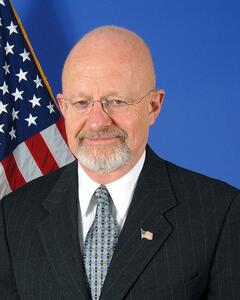
Russell L. Riley
Thank you for your time. I need to begin by issuing an apology: the briefing book [background materials] you got was delayed coming out of our research shop. We usually like to get that to you, not because we expect that you’ll sit down and read all of it, but at least you’ll be familiar with what we’ve had a chance to look at before the session.
James Clapper
Actually, I did look through it last night, stayed up pretty late, and it brought back memories, some OK, some not so OK. [laughter]
Riley
We would like to proceed as we normally would: going back into the early parts of your career. We don’t want to focus too much on biography because so much of it’s here [gestures at book]. The Miller Center’s principal focus is on the American Presidency. One way to start is to think about your encounters with Presidents, your relationship with Presidents over time.
You mention in your memoir, for example, that you met John Kennedy briefly. Why don’t we start there, and let you tell us what’s going on personally and professionally with the Presidents starting with Kennedy and tracking through until you have a more prominent role with an administration?
Clapper
I happened to be at Air Force ROTC [Reserve Officers’ Training Corps] summer camp at Otis Air Force Base in Massachusetts, which is now a National Guard base. It was the closest Air Force base to Hyannis Port. The President was flying in to go to Hyannis Port, so the Air Force had us all out to man the rope line at Otis. I just happened to wind up, by complete happenstance, in the front row of the rope line. We were all decked out in our uniforms, and he went down the line and was shaking hands with each cadet in the front row and asking what they intended to be in the Air Force.
Of course, virtually all of them said, “I’m going to be a pilot,” or a fighter pilot. He got to me and asked the same question: “What do you plan to fly?” I said, “I don’t. I plan to be an intelligence officer.” He did a double take and said, “Well, we certainly need intelligence officers,” and kept on going. It was an indelible experience for me. I’m sure he forgot about it five minutes later, but it was actually a big thrill, with Camelot and all that. The Kennedys were very popular contemporaneously, at the time.
To be quite honest, while I served in a lot of administrations, I was down in the trenches and really didn’t have any interaction with Presidents until much later. [George H. W.] Bush I briefed when I was the chief of intelligence at Strategic Air Command. I met President [William J.], Clinton, and had a couple of meetings in the White House when I was the Under Secretary for Intelligence in the Pentagon with President [George W.] Bush, but I really didn’t have the intense interaction I obviously did with President [Barack] Obama.
Barbara A. Perry
In terms of your parents, you mentioned all the way through the book, but especially toward the end, about your dad’s never putting a political slant whatsoever on his intelligence gathering and thinking about his job. You also tell that wonderful story about your mother in Japan bringing the black dentist to the lunch. Other than those two stories, did your parents talk about politics at the dinner table? Did they have political views? Democratic? Republican? How did they think about Kennedy?
That’s such an important time in your life. You’re so open-minded—That’s a theme throughout your memoir—about gays in the military, and obviously on race. I was taken with the topic of your master’s thesis, which was not strictly military, but was race and military, so I wonder about your parents and your family upbringing, and the impact that might have had.
Clapper
That’s a great question, and, to be quite honest, I don’t remember overhearing political discussions between my mother and father. In those days, it was much, much harder for service members to vote if you were overseas. They didn’t have absentee balloting like we do now, so when we were in Ethiopia—Eritrea was part of Ethiopia in 1946—voting in the U.S. election never came up because there really wasn’t any way to do it. That’s all changed now, obviously.
As essentially military vagabonds, you’re constantly on the move. You don’t really establish roots anywhere, so they were apolitical, I think. Attitudinally, philosophically, my mother would have been labeled a feminist, a term that didn’t exist then. She was much more assertive about those kinds of things than my dad was.
I should mention that my mother was the daughter of an Episcopal priest. Some of what would be construed as her liberal tendencies, particularly about domestic issues, may have stemmed from that. Her father, my grandfather, was known in the Episcopal Church. He took a church in Philadelphia that was formerly all white. The North Philadelphia neighborhood had changed and become black, and the church was about to go under, so he took it. He got a call to take this church. It was a huge, cathedral-type, beautiful church—hundreds and hundreds of seats in it—and they filled it with about 30 to 40 people typically on Sundays. He opened it up, and it thrived because of that. I don’t remember sermonettes at the dinner table or anything about it; I just knew that was going on. I guess it rubbed off on me.
That anecdote about my mother in Japan with a black dentist, as I pointed out in the book: my mother talked a lot, and a lot of it I forgot. But what struck me—what made that an indelible memory—was the fact that she never said a word about what she did. She and my dad may have talked about it, but not within my earshot. When we got home after that brunch, she didn’t say a word. I guess that’s why I remembered it. [laughter]
Perry
It was an object lesson, to be sure.
Clapper
It definitely was. I didn’t know it, I didn’t realize it at the time, but it stuck with me.
Perry
Coming back to the Kennedy era—just as you’re coming into the military and meeting President Kennedy at Otis Air Force Base, there’s proselytizing going on in the military for people like the John Birchers, like General Edwin Walker, to the point where he’s shuffled out by the Kennedy administration.
The movie Seven Days in May is about that: a liberal President, and there are conservatives in the Pentagon who are going to stage a coup against the President. Coming into the military at that time, were you aware of that going on?
Clapper
Not really. I was way too far down the food chain: a second lieutenant and a junior apprentice officer, really. My whole perspective was a very small reality bubble. [laughs] I don’t remember even reading about it very much. It just wasn’t something that made much of an impression on me or any of my contemporaries. Our head wasn’t there.
Nelson
I’m just a little younger than you, so I know that for you, as for me, there are powerful living memories of two great intelligence surprises: one was Sputnik, and one was the Cuban Missile Crisis. As you were a young ROTC cadet at that time, did that have any effect on your interest in getting into intelligence, or did it make any sort of lasting impression at all?
Clapper
Not really. I think the die was already cast for me. By 1962, I was clearly set on the course to follow in my dad’s footsteps. I finished up at Maryland. I graduated and was commissioned in ’63. One thing about the Cuban Missile Crisis was that which was revealed publicly: there was some shocking imagery from overhead or U2s and that sort of thing. [laughs]
This sounds a little strange, but I wasn’t going to go into that line of work. I specifically was focused on being a signals intelligence officer like my dad. In those days, although there was a huge SIGINT [signals intelligence] effort mounted during the Cuban Missile Crisis—I found out later—there was no publicity about it at the time. The only things I actually knew about were the pictures, the imagery, and that wasn’t where I was going. I never thought about that before, but it seems kind of strange. It’s all intelligence, and certainly my intelligence perspectives broadened later on.
Nelson
Thank you.
Clapper
Sputnik was a huge shock, and a lot of that had to do with the fact that the U.S. didn’t have much capability to monitor anything in space because there wasn’t anything there. I really don’t know the history of the extent to which we had some forewarning—I’m sure we did—that the Russians were pursuing this, but the fact that they had a successful launch, and the thing beeped from space, I do remember that being a big shock.
Nelson
By the way, why the Air Force? Why not the Army?
Clapper
My freshman year in college I was at the University of Maryland in Munich. In those days, they had a full-time day program for dependents for the first two years of college. This is an artifact of Little America; we had a quarter of a million troops just in Germany alone, so there was a sufficient college-aged population that would support two years of college, and that’s where I went my first year. I definitely wanted to do ROTC, so the manual that was in our counselor’s office there at McGraw Kaserne in Munich said that Maryland did both Army and Air Force ROTC.
It turns out that was a little out of date. I got back to Maryland, and they said that they had stopped Army ROTC some years before; they only had Air Force. Well, I’m here; I guess I’ll do this. [laughter] So I did, and they were quite accommodating, because I took four years of ROTC in two and a half years.
Even at the end, I considered applying to the Army to get commissioned in the Army anyway, and my dad, an Army officer, said, “Don’t kick a gift horse in the mouth.” I had a regular commission in the Air Force as a distinguished graduate. I had exactly the assignment I wanted, which was to go to Goodfellow Air Force Base, the Air Force college of SIGINT knowledge, so to speak. He said, “You should go ahead and go in the Air Force.” That turned out to be a good piece of advice.
Nelson
Once you became an officer, did you notice any difference between officers who came up through ROTC and those who came through the Academy?
Clapper
No, not really. Academy graduates were given a lot of advantages. Their commissioning date was deliberately pegged to precede ROTC and OTS [Officer Training School] graduates. They were always the more or less teachers’ pets, you know? Base commanders loved to get Academy graduates—They were almost like mascots—but it didn’t make a lot of difference after that. There were some really sharp Academy graduates and some not so sharp, and the same is true of ROTC. It’s a cross-section.
Riley
You write about your experience in Vietnam. There were a lot of political implications to what was happening in Vietnam. Were those on your radar, or as a young professional, were you just focused on getting the job done and not paying attention to them?
Clapper
That’s a good question. First, I volunteered to go. That was the “right” professional thing to do, so I had positive expectations of the experience, which turned out not to be the case. And the more time I spent there, the more disillusioned I was. The irony is that—just quite by coincidence, happenstance—my dad was also there. He was the deputy chief for the National Security Agency in Vietnam, so our tours, quite by accident, overlapped seven months. I was a first lieutenant, he was a colonel, so I bunked in with him, and my standard of living dropped precipitously the moment he left. [laughter]
As time went on, I became really disillusioned with the war, what it was doing to our military, the problems in the ranks with drugs, and all that sort of thing. The other experience, which I recount in the book—I was trying to be somewhat tactful—was I was plucked out of the sea of lieutenants to brief General [William] Westmoreland every Saturday. I had never even seen a four-star general, let alone talked to one.
My job was to brief him on signals intelligence reflections of airstrikes over North Vietnam, if we intercepted conversations where the North Vietnamese were talking about airstrikes, and particularly if it had some results. A sergeant who worked for me made up an acetate map, and we’d put little bubbles with arrows pointing to where the intercept came from. I’d go down with my briefing board every Saturday.
I remember the Friday night before the first Saturday I did this briefing. I was really intimidated, and I didn’t sleep a wink that night. I was scared to death of a four-star general, let alone General Westmoreland, the commander in chief for all of Military Assistance Command Vietnam, as it was called.
But after about three or four Saturdays, I came to the conclusion that General Westmoreland wasn’t very smart, and he had no real clue about what he was doing. He had no vision other than what turned him on: body counts and how many bridges were blown up or oil tanker trucks were exploded. That was the depth of his thinking about the war.
Plus, it was a tough time personally. My wife was pregnant with our daughter, and we didn’t know it when I left, so that was very difficult. I went back to San Antonio, where I’d come from, and essentially was given the same kind of job. My plan was to finish my master’s degree at St. Mary’s—I was going at night—and get out of the Air Force and go to work as a civilian at NSA [National Security Agency]. I came very close to getting out of the Air Force.
Well, again, for some reason, I was plucked out of a sea of lieutenants, and I was mentored—a term that wasn’t used then—by a couple of general officers in succession. That made a huge difference for me, for my career in the Air Force and afterward, so as a consequence, whenever I was in a position that could influence such things, I really pushed mentoring people. It can make a huge difference in one’s life.
Riley
Was there any generational difference between your perspective on Vietnam and your father’s? Did you have conversations with him about this to know whether he shared your disillusionment?
Clapper
No, he didn’t. Some of it had to do with how he valued the work he was doing, and he didn’t see it quite the way I did, no. We didn’t talk about it, argue about it, or anything. His generation, his fellow colonels, didn’t see it. It was clearly a generational thing.
Perry
Looking back, General, what are the lessons you took from that experience? You’re back in the States as [Lyndon B.] Johnson comes in and is escalating the war, and then public opinion turns desperately against the war by ’68. What were the lessons you were taking in as a young officer that you now look back on and say, “That helped me understand and to think the way I think about Afghanistan and Iraq”?
Clapper
That’s a great question. I had occasion to reflect on that very experience as a lieutenant in Vietnam when I was DNI [Director of National Intelligence] for President Obama. I remember the endless meetings we had in the White House Sit [Situation] Room about Afghanistan. Of course, President Obama wanted to get out of Afghanistan, too. He wasn’t unique, nor were the Presidents who’ve served since him.
We’d sit through these meetings, which would start with a VTC [video teleconference] connection with whoever the four-star commander was in Afghanistan. Of course, the appeal was, “More time, more troops, we can win this thing.” That was the general theme. It didn’t matter who the four-star was; it was always pretty much the same theme.
At one of these, I didn’t say anything during the meeting itself because President Obama wanted me to stay out of the policy business. I was the intel guy. I did the throat-clearing briefings at the start of meetings. That was my job. But it happened that we had a meeting on a Wednesday, and the next day it was my turn in the barrel in the Oval. I did those twice a week for six and a half years, Tuesdays and Thursdays. I had an alter ego who did it the other days. At the end of our session, I said, “Mr. President, as you know, I try to stay out of the policy business, but I have to tell you that what I heard yesterday from the Pentagon and from the four-star in Afghanistan,” whoever it was, “was hauntingly reminiscent of what I remember hearing from the generals in Vietnam: just a few more troops, few more months, and we can win this thing.”
He looked up at me and said—there’s a profanity here I’ll delete—“Why the F didn’t you say something yesterday?” Then he caught himself and said, “No, that’s the right thing to do. I’m glad you didn’t bring it up. I am glad you brought it up now.” I said, “I’m just hearing the same kind of rhetoric and the same kind of themes as I recall the generals in ‘my’ war”—air quotes—“in Southeast Asia.”
So to the point of the question, did that have an effect on me? It sure did. Lifelong.
Riley
Moving ahead in the time frame, part of the reaction to Vietnam in the 1970s was a reaction also against the intelligence community, right? You had Frank Church committees and those kinds of things.
Clapper
Right. Yes, I lived through all that.
Riley
I’m interested in your observations about that. How did you feel that? What lessons were you taking from that experience? Were you supportive of that, or was it overboard? Too much?
Clapper
Again, I was a captain at this point. I went back and did a second tour in ’70–’71. I was based in Thailand and was commander of a 100-man signals intelligence detachment that flew on the back end of EC-47s doing SIGINT reconnaissance over Laos and Cambodia. That, in contrast to the first tour, was really phenomenal. It was hard, but it was a great tour and professionally very rewarding.
One of the generals I mentioned earlier who was mentoring me planted me in the heady reaches of the front office of the National Security Agency, so, as a young officer with eight years of service, I was working directly for two successive Directors of NSA. I had a front-row seat for what transpired after—in fact, after I left NSA—which resulted in the Church-[Otis G.] Pike hearings.
My take on it at the time was that NSA was doing what it thought was right. It’s hard to go back and recapture how things looked contemporaneously, and the genuine fear of a—I hate to use the word—insurrection in this country. There was rioting in the streets: Washington, D.C., was burning up, L.A. [Los Angeles] was burning up. There was a lot of angst about it in the government. At the time, it seemed to me to be a legitimate use of the foreign intelligence apparatus to have a better understanding of what was occurring in the United States.
Now, having said that, I didn’t know the details of some of the abuses that were part of that—the FBI [Federal Bureau of Investigation] monitoring Martin Luther King [Jr.], and things like that. I didn’t know about that. The [Frank] Church-[Otis] Pike hearings were somewhat cathartic—a cleansing, if you will, for the community. Of course, that’s what gave rise to the two oversight committees that were stood up in the late ’70s, and that we still have today, which sometimes are functional.
Perry
Since you mentioned the Intelligence Committees—obviously a theme throughout your memoir—we want to hear about the so-called people’s branch, the first branch, the Congress. Thoughts about that oversight function? We know there were issues, but how do you look back at that? Necessary? Necessary evil? Better in the late ’70s than now with all the polarization—
Clapper
Actually, it was better. When the committees first started, the general attitude of the members was This is a sacred national public trust, and it’s not necessarily connected to my home state, my home district, or my party. There were exceptions, of course, but the general attitude of the members was that.
Well, the two committees are not invulnerable to partisanship, and over the years they’ve gotten gradually more partisan. The history has been cyclical, where if a chairman and ranking member of the committees made a pact at the outset of their time to treat it that way—This is nonpartisan, and it’s important to nation security, et cetera; we’re going to do the right thing—that carries with it great credibility within the intelligence community.
The most recent or modern-day example of that was the tenure of Mike Rogers, a Republican from Michigan, and [Charles] Dutch Ruppersberger, a Democrat from Maryland. That’s exactly what they did. They made a pact that they were going to run it on a bipartisan basis, and they did. Of course, the committee now is very partisan and very dysfunctional.
The Senate had managed, particularly during the Richard Burr/Mark Warner era, to stay bipartisan. That makes a huge difference in the oversight function. If you’re consumed with partisan issues on the committee and that’s all you deal with, then the original purpose of the committees, which is oversight, gets neglected. I do think it’s appropriate, consistent with our system of government—three coequal branches, with friction between and among them all, which is a good thing—that there be an overseer for the intelligence community, ensuring that what it does is legal, moral, and ethical. Unfortunately, as we alluded to, history is replete with examples of abuse by the intelligence community—maybe well-intended, but abuse, nonetheless.
Nelson
Do you find that in times when there’s bipartisanship on the Intelligence Committee you can trust secrets to that committee and its staff more reliably than when there’s partisanship?
Clapper
Well, you have a general feeling of trust—whether it has to do with the protection of classified information or not—just the general feeling. Of course, what you’re always concerned about in a highly charged partisan environment is if you share certain classified information, one party or the other will use it to its advantage or leak it, if somehow that’s one-upmanship on the other party. Yes, then you do get a feeling of mistrust, just because of the partisanship.
Riley
With President [Jimmy] Carter, there was some critique of the intelligence community after the Iranian Revolution: that that had been missed. Is that anything that you would have had any relationship with?
Clapper
No. The only involvement at that point was the aftermath of the attempted raid to rescue the hostages, which was something of a fiasco. Intelligence really wasn’t invited to play in that, which was a critique and one of the reasons it failed. But, again, considering my position in the food chain—I was, at that point, a lieutenant colonel/colonel—I was not really involved in the politics of things.
In fact, I had little of what I would call “political” engagement at all the whole time I was in the Air Force. You’re kind of sheltered from it, and deliberately so. When I really got into a highly charged political environment, it was as DNI. Even as the Under Secretary in the Pentagon, it just didn’t affect what I did.
Nelson
I had a question regarding the First Gulf War, when you were working in Air Force intelligence. On the eve of the First Gulf War, the widespread public understanding was that Saddam [Hussein] had a very powerful army, that at best the United States would suffer 10,000 or more casualties. Was your intelligence reading on the eve of that war consistent with that?
Clapper
This gets to a good point, which occasioned some discussion I had with President Obama about ISIS [Islamic State of Iraq and Syria] later on, much later on. One of the things that’s always difficult for the intelligence community is gauging the will to fight ahead of time. We didn’t do a very good job of that in Vietnam. We profoundly underestimated the Vietcong and the North Vietnamese and their will to fight, and we profoundly overestimated the ability of the Army of the Republic of Vietnam or the South Vietnamese Armed Forces in general.
Gauging something as subjective as will to fight is hard, and we proved that again in the First Gulf War. The intelligence community, as it is wont to do, worst-cases everything, and has a tendency to hyperexaggerate a threat. Some of that may just be conditioning: you’re safer magnifying a threat than underplaying it. Maybe that’s subconscious.
That certainly happened to us with the invasion into Kuwait, where thousands of Iraqi soldiers would wave white flags at the sight of an unmanned aerial vehicle. That actually happened. We profoundly overestimated their will to fight, even the Republican Guard, their elite forces.
Nelson
Thirty years on, has the community found better ways to assess the will to fight?
Clapper
To be honest, I don’t think so. The Holy Grail for intelligence people is plans and intentions, and that almost gets into the mind-reading area, and that’s pretty hard. That’s a cross the intelligence community has to bear: people sometimes forget the difference between mysteries and secrets. Secrets are knowable, empirical facts; mysteries, not so much. Too often the intelligence community—I may sound defensive here—is held to the same exacting standards for divining both mysteries and secrets.
Perry
I was taken with one of your comments in the memoir. You said you thought that President Obama understood intelligence gathering even better than Bush 41, despite his having been the head of the CIA [Central Intelligence Agency] for a while.
Clapper
Yes, President Bush was only there about 13 months. The basis for that statement derives from a negative development, and that was the [Edward] Snowden revelations. Most Presidents don’t get into the innards—how the sausage is made—in intelligence, how it operates as a system, and the components of that system. They don’t really delve into collection techniques. They’re interested—for understandable reasons, time being one of them—in the output: what is the substantive assessment here, the result of all that collection? This huge apparatus that runs 7 [days] by 24 [hours], 365 [days a year], to generate that information is not really their focus, unless it has to be.
The Snowden revelations, when that all came out, caused President Obama to delve deeply into how the intelligence apparatus works. Most Presidents don’t do that because they don’t have time, don’t have to. Well, he did, so that’s the basis for that statement. I would say that over the six and a half years I worked with him, he learned a lot about how the intelligence apparatus works, as opposed to just concerning himself with the output.
Nelson
It’s surprising, I guess, that other Presidents wouldn’t sometimes ask you, “How do you know that?” or “What makes you think that?”
Clapper
President Obama was always poking at that: “What assumptions are you making here?”
Periodically we’d have what we called expert briefs, where we’d get a couple of analysts in the Oval and brief him on a given subject. If he was going to have a foreign visitor, or he was going to take a trip, we’d have a little more depth, more drill down. He would engage with these people and poke at assertions they were making. He was very good about that.
The other thing President Obama was quite good at—well, two things: he insisted on truth to power. He said, “I want whatever the intelligence community says. I want it unvarnished.” Some folks around him weren’t quite so happy about that, but that was a good standard.
The other thing is he welcomed dissent. In fact, on more than one occasion I remember him remarking, “If the intelligence community, as big as it is, as many organizations as are in it, always is in unanimity about a given issue, I’d be very suspicious.” He welcomed dissent, wanted to know about it. Of course, he expected there’d be some rationale for the dissent, and there always would be.
Perry
Coming after the one term of Bush 41 and getting into the Clinton years and the first bombing of the World Trade Center in the early ’90s—should we talk a little bit about what you were thinking as you were rising through the ranks in intelligence, and what was happening in the Middle East—that terrorism was coming to this country, and then homegrown with the 1995 Oklahoma City bombing?
Clapper
At the time I thought, with both Oklahoma City as a domestic example and the World Trade Center, those were taken—and certainly I guess I took them—as one-offs, didn’t necessarily see that as a harbinger of things to come at the time. Maybe we should have, but we didn’t.
We were very consumed, at the time, with the fall of the [Berlin] Wall, the end of the Soviet Union. We were very busy reaping the “peace dividend,” in quotes. We were under a lot of pressure from the Congress to cut the intelligence community—“We don’t need all this intelligence anymore because the Soviet Union is gone”—so I, as Director of DIA [Defense Intelligence Agency], was consumed with how to reduce without doing a lot of harm to our most valuable asset, our people. There was a lot of focus on that, and we were slow to make the adjustment to the changing world, and the end of the bipolar competition.
In later years, particularly when I was DNI, I almost found myself longing for the halcyon days of the Cold War [laughter]: a very simple threat, simple to understand, very predictable, very stereotypical. That threat subsumed all others. That was very much the culture and the mindset of the intelligence community for 30 or 40 years.
We were slow culturally to change our perspective when our primary adversary—the enemy we grew to know and love, the Soviet Union—went away.
Perry
Talking about Congress and the Intelligence Committees becoming so partisan, I think back to the ’90s and the views of many on the conservative side that Bill Clinton was an illegitimate President. We start to hear that—certainly in my lifetime—for the first time. You have a whole group of Americans saying a President is illegitimate, and you see that polarization. We know about the impeachment. I always wondered: was that one of the reasons, perhaps, that caused us to take our eye off what was happening in the Middle East, the growth of al-Qaeda, for example?
Clapper
I don’t think so. I don’t really think that all the falderal about the Clintons, plural—Whitewater or Monica Lewinsky—didn’t really play—We had our job to do. The intelligence community was going to march on, doing its thing. I don’t think it was swayed that much by it.
Nelson
Would you talk about your experience with DIA: how that position came about; how the larger intelligence community looked from that vantage point; anything else that would be interesting?
Clapper
It was a big shock when I got nominated to take the job. That was a big surprise to me. If I was going to head an agency, NSA would have been more natural. That was my background. My father was a SIGINT-er. My wife was an employee of NSA. Her father was a longtime SIGINT-er. I did two tours there in earlier incarnations, so DIA was a surprise to me.
I was the senior military intelligence official in the Pentagon, uniformed, very much consumed with the aftermath of the fall of the Wall. We spent a lot of time tracking locations of nuclear weapons. We were very concerned about that. That was a big deal. The other preoccupation was a resource one: reducing. Those are two memories. I’m not sure I’m answering your question.
Nelson
I was interested in how you got the job and how the larger intelligence community looked from the vantage point of that particular position.
Clapper
It was then, and still is, regarded as a prestigious position for a career intelligence officer. The reason I was surprised is the Air Force Chief of Staff, somewhat by accident, was Tony McPeak. He was part of the generation of senior generals in the Air Force who were captains and majors during Vietnam who were very disenchanted with intelligence.
I remember distinctly that when I heard that McPeak had become Chief of Staff of the Air Force, I went home that night and remarked to my wife, “Well, two stars is not bad. Now, here I am, nonrated intel guy, and I got to be a two-star general, so by any measure we’ve had a successful run in the Air Force,” figuring I was done.
But actually, I struck up rapport and a good relationship with Tony McPeak, and one day I got a call from him out of the blue saying, “I’m going to nominate you to be Director of DIA.” I almost fell out of my chair. I wasn’t expecting that at all.
It’s a big job overseeing thousands of people all over the world, running the attaché system, among other things. It has a very variegated mission, a significant scientific and technical intelligence effort to oversee. It was a huge challenge, a huge job, and it was a great run. I was honored to serve in that position.
Riley
It’s striking that, by your own account, you’re not having much interaction with the White House at this stage.
Clapper
No. In fact, DIA Directors traditionally don’t. That prevailed during my time as Under Secretary and DNI. President Obama wouldn’t have known Mike Flynn if he’d fallen over him. There just wasn’t any need for a DIA Director to be in the White House. I don’t think it ever happened during my time. There’s a reason why the first letter of the Defense Intelligence Agency’s name is D, as in Defense.
Riley
So the reporting line would be up through the Secretary [of Defense], then?
Clapper
Exactly. Well, now it’s through the Under Secretary for Intelligence and Security, but ultimately you work for the Secretary of Defense. In fact, of all four of the agencies in DOD [Department of Defense], the Secretary of Defense has, quote, “authority, direction, and control,” which are pretty expansive words. In practice, though, the DNI has big sway over those agencies, particularly the ones whose first letter is N.
Nelson
How did you, as head of DIA, interact with the other members of the intelligence community?
Clapper
Much in the matter in which it is today. For one, you have what was then called the National Foreign Intelligence Board—They took the F out, since it’s now foreign and domestic—so you had quite a bit of interaction with your colleagues. My principal interaction was with the service intel chiefs: the chiefs of Air Force, Navy, and Army intelligence. I had a lot of interaction with them, and quite a bit with the Director of NSA, and with NSA institutionally—the other components, not so much.
NGA [National Geospatial-Intelligence Agency] and NIMA [National Imagery and Mapping Agency] didn’t exist then, when I was Director of DIA. The NRO [National Reconnaissance Office] did, but there was substantial interaction with the NRO, as well. That was true then; it’s true today.
Nelson
Was there any sort of tension—or at least difference in points of view—between DIA and the civilian intelligence agencies?
Clapper
There was always friction and competition between DIA and CIA, and I think appropriately so. One man’s duplication is another man’s competitive analysis. And when you have a mortal threat to the United States—I’m referring now to the Soviet nuclear arsenal—I don’t think it’s good to put all your analytic eggs in one basket, so to speak. It was good to have competing points of view, particularly about a mortal threat to the United States. So, yes, there was friction and substantive differences, analytic differences, between the military intelligence community and the larger intelligence community, led most prominently by CIA.
Nelson
How would these differences get either worked out or presented to the President?
Clapper
The way it would work, typically, is these arguments would come to a head in the course of preparation of the National Intelligence Estimate, which is the apex, the top-of-the-food-chain intelligence product that is sent to the President and senior policy makers.
In the course of that, you’d duke it out analytically and cast your evidence against your opponent’s. You’d either come to a consensus, or you’d have a dissenting view, which is fine. The point was there was a forum and a process for at least addressing the differences, even if you couldn’t resolve them all.
Nelson
There were some situations during those early Clinton years where the President would want to know what was going on—Somalia, Haiti, North Korea: “Tell me what’s going on there.” I’m wondering how what you were doing and what your counterparts were doing would end up answering that question.
Clapper
One thing you have to understand is intelligence isn’t like Sherwin Williams paint: it doesn’t cover the Earth equally. [laughter] Some places are well covered; other places aren’t. And invariably, the crises come up in places that aren’t well covered, Somalia being a case in point. I hardly knew where Somalia was. It was a backwater. I wasn’t paying attention to it.
We had exactly the same situation in Afghanistan in 2001. Afghanistan was hardly in the top ten of our priority list. It got that way very quickly. The illusion that the intelligence community has equal visibility, has the God’s-eye, God’s-ear view of the entire Earth is just not the case.
Riley
Could you give us an overall assessment? You’ve mentioned the fact that you were going through the contractions after the end of the Cold War. What’s your global assessment about how good a job we did, or how good a job the overall intelligence community did, in shifting its focus from that single locus of threat—which is an oversimplification—that single locus of threat to a very different kind of world where particularly Middle Eastern conflicts came to dominate later?
Clapper
We didn’t do it very well. It’s not that easy. The Cold War’s over, we won, so to somebody who has worked the Soviet army for 20 years: “OK, starting tomorrow you’re in charge of the Brazilian Navy.”
People think that analysts are very fungible and flexible and agile, and they are. But when you have a lot of subject-matter experts—the analytic cadre of the intelligence community is composed of a lot of subject-matter experts—simply mandating that we’re going to have a thousand fewer people focused on Russia, and we’re going to spread them around, doesn’t necessarily carry with it the expertise, the insight, perspective, the judgment, the intuition that you develop over a period of years when you follow one problem.
We had the problem of shifting priorities while we were reducing. We were struggling with incentives to get people to leave early to try to avoid just summarily firing people. We didn’t want to do that. As a consequence, it was not managed very elegantly, and we forsook—if that’s the right word—we compromised a lot of capabilities we had. Our scientific and intelligence capabilities, which were highly developed, highly sophisticated when pitted against the Soviet Union, really atrophied in the late ’90s in the absence of a scientific and technical intelligence problem to confront.
So, no, we didn’t do a great job. I’m not sure it was possible to do a great job. At the end of the day, after we’ve reduced 20 percent, everybody’s where they should be, and everybody has the requisite background, training, and experience. The real world doesn’t work that way.
Riley
Looking at your timeline, you retired in 1995 and went into the private sector for about five years, and then came back into the government in 2001. How much different did things look after that five years out? Was there an awful lot of continuity in the way things looked when you came back in, or did you come in and think Boy, things have really changed since I was here five years ago?
Clapper
That’s a good question. Actually, while I was in the private sector I was still very engaged with the intelligence community. I still had a clearance. I was a senior intel and counterintelligence investigator for the Khobar Towers bombing. I served on the NSA Advisory Board for four years. I was on a commission headed by former [Virginia] Governor Jim Gilmore on weapons of mass destruction. I was on Defense Science Board task forces. I was very involved and engaged, so when I came back to the government full time, it wasn’t such a dramatic contrast, because what was happening was quite visible. Oh, and I had taught at what was then called the Joint Military Intelligence College. I was fairly current, so I was part of whatever change occurred between when I retired in ’95 and when I came back to a full-time position in 2001. I didn’t notice a stark contrast because of that.
Riley
There was a flaw in the premise, and it’s helpful to have that clarified. I was about to ask if terrorism was any more on your agenda, but because you had been dealing with Khobar afterward, did you find—I’m thinking about the portrait that the 9/11 Commission painted afterward, about how there was a lot of evidence about what we could have known, but there was a lack of imagination. Is that consistent with your sense of what was going on just before 9/11?
Clapper
I knew about the general warnings, and there was a PDB [Presidential Daily Briefing] article for President Bush in August of ’01 about al-Qaeda, that it posed a threat to the United States, it was bent on attacking the United States. There was certainly an awareness on the part of the intelligence community, and, of course, the intelligence community is faulted because they don’t pick up on tactical things that occur.
I will tell you that the American people have a hard time dealing with things that never happen to them, and I’ve often fantasized about George Tenet, who was then the Director of Central Intelligence, Director of CIA: suppose in the summer of ’01 he had gone public and said, “You know, we’re aware of al-Qaeda. They are bent on attacking the United States.”
Now, let’s just say for the sake of discussion he had gone so far as to say, “We suspect that they’re going to commandeer airplanes and crash them into buildings,” without specificity—and then added to his speech, “So, starting immediately, you have to go to the airport two hours early, take your shoes off, and subject yourself to searches.”
How do you think that would have been responded to by the American people? They would have laughed him offstage.
So when the 9/11 Commission said the IC [intelligence community] failure was because of a lack of imagination, I would disagree; there is no lack of imagination in the intelligence community. We can cook up all kinds of scary scenarios. That’s easy. The problem is getting anybody to believe any of them and then do something about them. I get a little sensitive about this intelligence failure thing. If you tee up intelligence and nobody does anything about it, is that an intelligence failure? That’s something of a rhetorical question.
Perry
Your example of going to the airport two hours in advance, taking out all of your materials, taking your shoes off, men taking their belts off, et cetera, et cetera, is the conflict between national security and individual rights. You make that very clear in the book, and there’s no answer to that, really, is there? It’s trying to find a balance.
Clapper
Before the pandemic, I was doing a lot of visits to colleges and universities, and oftentimes Snowden would come up and whether Snowden’s a hero for all of his shocking revelations.
I asked the students, “Tell me, if you drive, do you stop at red lights or stop signs?” “Yes, I generally do.” “If you’re at the bar off campus and you’re carded, do you produce identification to prove your age?” “Oh, yeah, I do that.” “Do you go to the airport two hours early so you can go through security?” “Oh, yeah, I do that.” “Well, those are all compromises people make for the common good. You do certain things; you give up certain things—your civil liberties and privacy—in order to generate safety and security for the collective.”
That’s not unlike the telephone metadata program that was so hyperbolically reported on. It’s the same thing. The intelligence community goes to great lengths to avoid infringing on people’s civil liberties and privacy, to include their telephone communications, whether wireless or landline.
Again, this gets back to my wishing for the halcyon days of the Cold War, where you had two mutually exclusively telecommunications systems: one dominated by the Soviet Union, one dominated in the West by the United States. You rarely, if ever, saw any reference to a U.S. person on the telecommunications system dominated by the Soviet Union.
Well, along comes the internet. Now, we’re all mixed up together. You have hundreds of millions of people every day conducting billions of innocent transactions, but all mixed up among them are nefarious people conducting nefarious transactions, and those nefarious people can be nation-states or their representatives or criminals or hacktivists or whatever.
The intelligence community is confronted with the challenge of picking out those needles in not just one haystack, but hundreds and hundreds of haystacks. And oh, by the way, to stretch the metaphor, you also have to predict when a strand of hay might morph into a needle, if you get my drift.
It’s very difficult, and to me it comes down to the impossible, elegant, exquisite slicing and dicing of communications to avoid any infringement on a U.S. person, where you’re interested in an email from/to, which has 50 CC [carbon copy] addressees, all of whom are innocent, have nothing to do with the transaction that’s afoot. But somehow the intelligence community is supposed to magically and exquisitely slice those off so that you don’t have any infringement, which is impossible.
It all boils down, in my mind, to how much an individual citizen is willing to sacrifice in the way of their civil liberties and privacy in order to promote the common good.
Perry
I’m thinking about the Cold War and some of the steps the United States took during that time. I’m thinking of Iran, for example: taking out [Mohammad] Mosaddegh and reinstalling the Shah. That was, in part, for Cold War reasons, as I understand the history. Or thinking too, of the Soviet invasion of Afghanistan and our supporting the opponents of that to fight off the Soviets, and then they come back to bite us.
Any thoughts that you might have about that in general? Maybe that’s too policy oriented. But also, then, when you were in the mix helping decision makers, did it ever strike you that you would have to say, “But what is this going to mean down the road?”
Clapper
Yes, absolutely. First of all, the things you’re alluding to—and this is a very important distinction to make in the intelligence world—a covert action, which the examples you cite are, is a separate and distinct program. Covert action is not an intelligence activity, per se. It’s conducted by an intelligence agency, but it’s a separate endeavor. It’s paid for with intelligence funds, but these are a President’s programs, and that’s one case where the CIA yet today still reports directly to the President for the conduct of any covert action.
That’s a unique circumstance. Too often the intelligence community gets painted with the same brush when there are distinctions about the way a covert action is managed, authorized, executed, and overseen by the Congress. That’s one important distinction I make.
Absolutely, certainly my experience was, if you’re going to consider a covert action, the first thing to do is consider the implications. What are the consequence, both intended and unintended? That’s hard to predict, but you have to go through that ritual, that discipline, of analyzing whether this covert action actually complements or supports or buttresses our foreign policy objectives.
That’s why I think it’s unique to have Bill Burns, the first-ever career Foreign Service officer as Director of CIA. Bill and I talked about this, about the unique perspective he will have in evaluating the effectiveness of covert action. After all, covert actions are supposed to be conducted with a view toward reinforcing, buttressing, amplifying, complementing our foreign policy objectives by covert means. He’ll probably be in a better position to assess that himself.
Nelson
You’ve mentioned the ’90s as a decade in which there was a loss of clarity on the international stage, a decade in which the intelligence agencies were getting fewer resources, smaller budgets, more difficulty bringing in people. But it was also a decade when the technology of personal computing and the internet, all these things were exploding. I have two questions.
Was the intelligence community able to keep up, given the shrinking resources? And more generally, how did the coming of these new technologies affect the work of the intelligence community?
Clapper
That’s a great question. When I was on the NSA Advisory Board, the House Permanent Select Committee on Intelligence gave a homework assignment directly to the NSA Advisory Board, which was to assess NSA’s adaptation to the internet. NSA for decades during the heyday of the Cold War had thrived on good old high-frequency manual Morse [Code]. That was the backbone of the Soviet-dominated military communications system. The Chinese used it, the North Vietnamese, North Koreans, all the East Europeans. That was the mainstay. There were other forms of communication, but the mainstay was good old high-frequency dit-dah-dit-dah. That’s how people communicated.
Now, all of a sudden we have the internet. I was asked to lead this study that the HPSCI [House Permanent Select Committee on Intelligence], specifically charged in language, wanted the NSA Advisory Board to do. The general bottom line of this study—this is ’98, ’99, somewhere in there—was that NSA was very slow to adapt, and that they were being overwhelmed by the variety, volume, velocity of communication on the internet—I remember the three Vs. Eventually, of course, the NSA came around and, some would suggest, overachieved. [laughter] But, yes, we were probably, in retrospect, a bit slow to adapt to the changes wrought by the advent of the internet.
Nelson
Was this a matter of having the technology or a matter of agency culture?
Clapper
It was probably more of the latter. People have a tendency to cling to what they know, what they understand, and have a reticence about taking on things they don’t know. That’s just human nature, so when you magnify that by a collective, the whole agency—Certainly, there were farsighted people who understood and were trying to push for change, and, to its credit, NSA changed.
Nelson
Did it take 9/11 to jump-start that change?
Clapper
No, it was pretty well underway by 9/11. I don’t think 9/11 particularly was much of an accelerant for technological change. That was underway anyway. And, in some sense, the terrorists don’t pose that much of a technological challenge—other challenges, but not that so much.
Riley
Did 9/11 have a profound impact on your own portfolio?
Clapper
Well, what it did is the old saw about “never waste a crisis.” I was brought on as the Director of what was then called NIMA, the National Imagery and Mapping Agency, which had been legislatively stood up in 1996. The idea was to meld or marry imagery, imagery analysis, and imagery intelligence with mapping, charting, and geodesy. The rationale for that was that the data for those two separate endeavors came from the same source: overhead imagery. The thought was—It was principally John Deutch—Why don’t we put all this together and form an agency?
One of the critiques of the U.S. intelligence system after Desert Storm was that we didn’t have the institutional commitment to imagery intelligence that we had to signals intelligence. One of the reasons for that was you didn’t have a center-of-mass agency that institutionally represented the discipline of what later became geospatial intelligence.
When I came along, I was the third Director of NIMA, and my charge was to bring that vision to life. There was a commission that reported out in December of 2000, I think, that laid out a very clear, concise, readable, understandable-to-laymen road map for doing that. It made sense to me, even though ironically when I was Director of DIA, I was adamantly opposed to the formation of any kind of imagery agency, because I didn’t want to lose my 500 imagery analysts. [laughter] Where you stand depends on where you sit.
So then along came 9/11, and our laser focus was on Afghanistan. I used that example as a way of forging change in NIMA, which later changed to the National Geospatial-Intelligence Agency. A lot of that was based on things we did to meld those previously disparate disciplines into one. While NGA, NIMA wasn’t really a player in 9/11, it certainly used the occasion of it, because we badly needed foundation data, mapping data, all that kind of thing, to understand the terrain in Afghanistan. There was a lot of pressure on us to produce all that quickly at levels of detail that were quite specific. In that sense, 9/11 did have a big impact on me and my portfolio for the almost five years I was Director of NGA.
Nelson
How did that appointment come about? Were you expecting to go back into government?
Clapper
No. I have no idea to this day. I got a call somewhere in July, August of ’01 from [Donald] Rumsfeld’s executive headhunter, asking me if I would be interested in coming back to government to run NIMA, and I said sure. I had never gotten the “psychic income” that I got from government service when I was in industry, so I jumped at it. My wife wasn’t too happy about it, because it represented a pay cut. [laughter] We were doing two cruises every year and life was good. But I really don’t know why, after six years, they approached me. To this day I don’t know why.
Riley
General, one of the most interesting parts of the book is your discussion of the intel leading up to Iraq, and the issue of weapons of mass destruction in Iraq. Would you talk us through that experience? What were the pressures at play at that point that caused such a significant failure?
Clapper
I was Director of what was still NIMA in those days, so as an intelligence agency head, I sat as a member of what was then called NFIB, the National Foreign Intelligence Board, which is the final approving authority for NIEs [National Intelligence Estimates], so my fingerprints are on the weapons of mass destruction in Iraq NIE that was published in October of 2002. It’s another very indelible memory. I can’t say, really, looking back, that politics had a lot to do with it. This had more to do with bad tradecraft and the fact that, in those days, analysts were not allowed to gauge sources of HUMINT [human intelligence]. They were kept separate—two different cloisters.
I’ll never forget that I first found out about this at a closed hearing that the Senate Armed Services Committee had with George Tenet. He had three or four of the agency Directors with him. I always likened myself in that setting to one of Gladys Knight’s Pips. I’m sitting in the back doing doo-wops for George. [laughter]
This whole thing is playing out to me where some of George’s analysts would come in, and, of course, that’s when I first learned about “Curveball” [Rāfid Aḥmad Alwān]. Now, by the way, this after the NIE was approved in October of 2002. I’m learning this myself. Then I learned about what was wrong with Curveball, who was a German asset that the U.S. never had direct access to. He was an alcoholic and had all kinds of problems with the truth, et cetera, et cetera. Much of the NIE hinged on a reporting stream from him. I couldn’t believe it. I was really shocked.
To George’s credit, he started making repairs to this system. And to this day—and I certainly insisted on it in the six and a half years that I ran NIBs [National Intelligence Boards]—we had a fixed agenda: the very first thing we’d do was that any agency who contributed or had a footnote—even one footnote—in an NIE would have to certify the veracity of the collection sources that were used to derive any inputs into an NIE, and to inform if an asset who was reporting later turned out to be bad. Each agency Director, or his or her representative, would sign a memo, formally documenting the veracity of the sources used for an NIE.
Another thing we didn’t do very well with that NIE—It was kind of the standard practice—is if there were dissents, you’d have to read carefully the footnotes, so we changed the process whereby a dissent is prominently displayed in the text of an NIE, so people would know that. And there were dissenters—the Department of Energy and Department of State were vociferous dissenters to that NIE—but the majority—the rest of us—we went along with it, me included.
Thinking back on it, I had no insight, really, into the veracity of, say, NSA sources, SIGINT sources, or CIA human sources. That’s a fundamental flaw. Those kinds of tradecraft flaws had much more to do with that NIE than did the fact that you had an administration that was, shall I say, a willing recipient of some bad information.
Riley
One of the questions we will wrestle with about this is the extent to which the politics had at least an implicit effect on the tradecraft. Is it your sense that those two things were separate and unrelated?
Clapper
What was going on was there were competitive sources of “intelligence”—“intelligence” intentionally in quotes. Certain policy figures, principally in the DOD, had an agenda, and they were pushing it. They had another stream of intelligence, quite apart from what the intelligence community itself was producing. There was no one single silver-bullet flaw here. It was a systemic failure.
Of course, I had to endure the Weapons of Mass Destruction Commission that was co-chaired by Judge [Laurence H.] Silberman and [Senator] Chuck Robb. I got to live through that. As I recall, there were some 72 recommendations that the WMD [weapons of mass destruction] Commission made, and that also served as another input into what became the Intelligence Reform and Terrorism Prevention Act [of 2004].
Riley
Your answers, though, are extremely helpful, because those of us who are on the outside of the process are still engaged in trying to understand and communicate to students and to other scholars what actually happened at this stage to create a failure of understanding about what was going on in Iraq. We don’t have a partisan disposition in this, so it’s vital for us, when we have somebody who was close in, to be able to hear from you what your perceptions are about where things took a wrong turn.
Clapper
Well, like so many things like this, I have my own recollections and reflections. If you talk to others, they’ll have a little different take on it than I do. I was struck by Jim Comey’s book and John Brennan’s book and my book, each of which described what occurred in Trump Tower when we all briefed then President-elect [Donald] Trump on January 6, 2017. It was all very similar, but each of us had different takeaways from that experience. It just struck me.
That’s, I suppose, the value of interviewing people who lived through the same event and then have them each describe that event. It’ll invariably be different.
[BREAK]
Riley
Is there anything we should know about the Bush White House from your time at NGA? Do you have any observations about its functioning?
Clapper
No, not really, because, again, I was too far down the food chain as an agency Director. The only agency Directors who really had interaction with the White House are CIA, NSA, and ODNI [Office of the Director of National Intelligence], and even then NSA is occasional. DNI and CIA are the primary intelligence organizations that are visible in the White House.
Nelson
This is just a matter of curiosity: did Saddam Hussein ever have WMDs, and, if so, when and how did they disappear?
Clapper
No, he didn’t. He didn’t have nuclear weapons of mass destruction; he certainly had chemicals. As far as I know, I don’t even think there was research being done on bioweapons. Just to continue the discussion there, at NGA, we came up with—I remember the number—something like 956 suspect sites in Iraq that, from overhead imagery, could potentially have been associated with WMD. But when they had the on-the-ground inspectors, they went down the list and never found anything at any one of them.
But, in fairness to the imaging analysts, you’re dealing with incomplete information, which is why it’s always better to have multiple sources of intelligence for a given issue and not rely on just one, where in many cases you are drawing inferences from incomplete information.
Perry
Did you have a sense of what was happening in the Middle East in the balance of power between Iraq and Iran?
Clapper
To be truthful, no. Certainly during Desert Storm I never thought about it. I’ll be candid with you: I didn’t understand, as I should have, probably, the religious schism, Sunni versus Shia. I didn’t really appreciate back then the implications of that, and as a senior intelligence officer, I should have.
There’s a point here that I might mention: when I did the Khobar Towers investigation, the Khobar Towers bombing occurred on June 25 of ’96. Wayne Downing, a friend of mine, had just retired as commander of Special Operations Command, and he asked me to come on as an advisor and basically do the intel and counterintelligence investigation piece.
I had just retired the previous September ’95 as Director of DIA, so I got to critique myself. One of the findings from that was that DIA had a grand total of four people who were focused on terrorism full time. That’s, I think, a barometer on our failure to recognize and to devote the resources to a really significant problem. I certainly got religion about terrorism with the Khobar experience in 1996.
Riley
You left the government again in the middle of the Bush administration.
Clapper
Actually, I was terminated early by Mr. Rumsfeld.
Nelson
Tell us about that.
Clapper
When I came on in 2001, the “contract,” in quotes, was for five years. The rationale was they thought that’s what it would take to bring about this cultural transformation in NIMA to NGA. Then, out of the blue, in the fall of ’05, I got a one-liner memo signed by Mr. Rumsfeld saying, “Your term of office ends on June 13 of 2006.” I was supposed to have gone until September 13 of 2006, so it was a 90-day difference there.
I tried to find out what was up with this. The media speculated that it was because Mike Hayden and I—Mike was then Director of NSA—had done a lot of things together with the two agencies to bring them closer together, because there are remarkable similarities and parallels between SIGINT and GEOINT [Geospatial Intelligence]. We had spoken at Wye Plantation to a crop of newly minted SESs [senior executive services employees], and at the time—This was before IRTPA [Intelligence Reform and Terrorism Prevention Act] was enacted; this is being studied by the Congress; this is all in the aftermath of 9/11—we thought maybe it was time to consider taking the agencies whose first letter is N, as in National, out of DOD.
These séances with newly minted SESs were supposed to be for nonattribution, but apparently somebody went back to their hooch right after our dinner discussion and sent an email back to the Pentagon. About two days later, Mike and I were summoned to a lunch with Mr. Rumsfeld, which was not very pleasant. In fact, he got up and stormed out of the room before dessert was served, and it was actually a pretty good dessert. [laughter] So the media speculation was that I was canned early because of that.
I never did get any authoritative explanation, but I later learned—from somebody who was in a position to observe—that during [Hurricanes] Rita/Katrina I had deployed about 75 employees and two of our tactical support vehicles—NIMA on Humvees—portable capabilities that just happened to be back in the States for maintenance—down to the Louisiana/Mississippi area to support Thad [William] Allen, who was then the commandant of the Coast Guard.
Of course, in the Sit Room they were having nightly meetings, I heard later, on the government reaction to Rita/Katrina, and the two organizations that were getting pretty high marks were the Coast Guard and NIMA. Mr. Rumsfeld found out about all these NIMA people who were deployed, and these two capabilities, and he got upset because I hadn’t done a “Mother, may I?” with the Pentagon and gotten an operations order approved.
What they didn’t realize is that NIMA, the predecessor organizations—DMA, particularly—had a long-standing agreement with FEMA [Federal Emergency Management Agency]: “they called and we hauled.” Apparently, Mr. Rumsfeld took umbrage at that, and so I was gone, which was fine with me. It was OK. I thought I had done something with the agency; I had done what I was asked to do, and it was extra time anyway. I had already been an agency Director once before that, so it didn’t bother me.
It was just a few months later that, lo and behold, Bob Gates was appointed Secretary of Defense. Bob and I were friends. He was a mentor of mine when he was the DCI [Director of Central Intelligence] in the early ’90s and I was Director of DIA. He asked me if I would consider coming back to the government, and I said, “Sure, but I need a favor. Would you call my wife?” [laughter] He did. He recounted that in his book, which is kind of embarrassing. The deal was I was only going to finish the Bush administration, the Bush term, 19 months, so I said, “OK, I’ll do it for that.”
Well, he got held over. That had never happened before, where a Republican of Defense was retained by a Democratic President. That had never happened. Bob, in turn, asked me to stay on, so the 19 months turned into three and a half years as Under Secretary for Intelligence. The irony that some people pointed out as poetic justice was my replacing the guy who helped fire me, Steve Cambone. [laughter]
Nelson
There’s an interview you did with Loch Johnson that we included in the briefing book. You’re telling him about this meeting with Rumsfeld, and you quote Rumsfeld as saying, “I think you guys are crazy.” But then you later say, “I’ve since come to believe that the arrangement we have, as awkward as it might have been, is probably best for our country’s values.” In other words, it sounds like on second thought you decided that not having N agencies was good.
Clapper
Yes. The context here was there was some discussion, some debate, about whether we ought to create a Department of Intelligence, just take all the agencies, and the three letters, and the intelligence odds and sods, and form a Cabinet department. That would have been a big mistake. It would have posed all kinds of civil liberties and privacy challenges. People would have been frightened of an intelligence juggernaut like that.
Moreover, the Department of Defense would simply regenerate signals intelligence and geospatial intelligence particularly, because those two intelligence disciplines are so requisite to war fighting, so you would defeat the purpose. Our organizational setup was probably not what you’d do with a blank piece of paper if you were a Harvard Business School graduate student, but for our system, it’s probably best. There’s an awkward dance that’s done between the DNI and the Secretary of Defense, but it works somehow.
Nelson
Did you testify or provide any sort of input to the 9/11 Commission?
Clapper
No. I didn’t have any interaction with them until later. But when that was going on, I was Director of NGA, and NGA was out of it as far as 9/11 is concerned. It just wasn’t a player.
Nelson
What did you think about the idea of creating a Director of National Intelligence when it first became an agenda item?
Clapper
I thought it was a good idea, assuming that the position would have some authority to match the responsibility. I recounted this in my book, I think. I did have the occasion to observe up close and personal about 20 years’ worth of DCIs, Directors of Central Intelligence, who were dual-hatted as Director of the Central Intelligence Agency.
My observation was that sooner or later, mostly sooner, each Director got consumed with Agency-centric missions, Agency-centric issues, which is quite understandable, having run two of them myself for almost nine years. Running these agencies is an all-consuming, 7-by-24 job, in and of themselves. I always thought it was really insufficient for somebody to run an agency, particularly one as large and complex as the CIA, and then, like part-time help at the post office at Christmastime, Now I’ll run the entire [intelligence] community when the occasion calls for it.
There’s a lot to be said for having a full-time champion for integration, collaboration, and coordination, which is not a natural bureaucratic act by any stretch, certainly not in the intelligence community. I do think there’s a need for someone like that who can be an advocate or champion for integration and collaboration between and among the components of the intelligence community.
Nelson
What authority doesn’t the DNI have that would enable it to fulfill the responsibility?
Clapper
I used to get penalty language every year from the appropriators in the Congress, because I became an advocate for having the National Intelligence Program [NIP], which is the programmatic aggregation of manpower and money for national intelligence, be a self-standing appropriation rather than spread across six separate Cabinet departments and 30 different appropriations. It’s a nightmare to manage.
Most of that money is carried in the DOD budget, meaning it’s in the budget but it’s fenced, so the Department of Defense can’t take NIP money and buy F-35s with it. In fact, I thought it was a good idea when I was Under Secretary of Defense for Intelligence, and I approached Bob Gates, and I forget the comptroller at the time, “Would you like to take $50 billion off the top line of the DOD budget”—which is huge in the minds of people—“and not have that count against your budget?” He said, “Sure.” So we set about trying to do that, and, of course, got all kinds of pushback from Congress, particularly staffers who didn’t want to give up jurisdiction. Every year they’d say something like, “Don’t even think about, let alone talk about, NIP separation.”
It was my view that having that authority, clear authority, over the money, rather than having to deal with six separate Cabinet departments about its management, which I managed to do—But it’s extremely inefficient and time consuming to manage the program that way. If you think about it, what we spend on intelligence is larger than all but three or four of the Cabinet departments.
Riley
You said a moment ago that you had spent 20 years looking at DCIs up close. Could you reflect on that experience and tell us who did the job really well, and why? Conversely, are there those who did the job poorly? In your assessment, what was the reason for their poor experience?
Clapper
Well, the difference is people who—and I’m reflecting a bias here, I suppose—had grown up in the intelligence community were able to do it better. The role model for me when I became DNI was Bob Gates. When he became Director of CIA and the DCI, he didn’t wander into the Old Headquarters Building at Langley and say, “Gee, what’s this outfit do?” He already knew, because he’d grown up in CIA, so he was better able to balance his time and focus between running the Agency and running the community. Most others didn’t have that background.
His successor, for example, Jim Woolsey, did not. Jim was smart, but he understandably got consumed with Agency-centric issues. The joke was trying to see President Clinton: that’s why they had the airplane crash on the White House grounds, that old joke. [laughter] So clearly people who have some background in intelligence have a big advantage. It’s always been my view—and I’m obviously and admittedly prejudiced here—that the DNI should be somebody who’s experienced in intelligence.
Riley
There must be something in addition to experience for Bob Gates. Because we’re recording this for future generations who will not have grown up knowing who Bob Gates is, would you talk a little bit about the traits that made him successful beyond just the fact that he had that experience?
Clapper
Bob was, I thought, a very successful man. I worked for him when he was Secretary of Defense, and I thought he was great there, too. One thing: he always had a broader vision. Yes, he could get down in the weeds and argue analytic fine points, but he had a strategic vision of the world, much in the same class as Brent Scowcroft. They had a certain ability to see the bigger picture, see the factors at play, and I think that distinguished him from many of his contemporaries. And, of course, the fact that he was steeped in intelligence, so he knew the business. But his special quality was that worldly, broad-gauge vision of the world.
Nelson
We had at least one CIA Director in that period you described who came over from Congress, Porter Goss. I wonder: when you say experience in the intelligence community, could that include service on the Intelligence Committee?
Clapper
That’s a good question. I’ll never forget a conversation I had with Porter. I was TDY [temporary duty travel] someplace; I think I was out at one of the NRO ground sites, visiting. There was something he wanted to track me down for, and we got off on, I don’t know, a side conversation. I remember him remarking to me, “You know, running these agencies is a lot harder than it looks from sitting in the Congress.” [laughter]
The distinction is, frankly, running a big enterprise, as opposed to running a congressional staff. Porter had been a case officer himself, but he didn’t have anybody working for him, I don’t think. There’s a certain management style that most Members of Congress have, which is they run things with a very tight, small circle of staffers. Dan Coats did that when he was DNI. It’s not a criticism, but it’s hard to run a big enterprise if you run it that way. That’s the problem Porter ran into: he brought some people on with him—one of whom went to jail—some people who were his acolytes in the Agency, and they didn’t do very well. They didn’t help him any.
Perry
Let me add another element to Bob Gates’s leadership style that I wondered if you could comment on. In his memoir, he talks about when he was at lower levels of CIA, and how he didn’t care for—no one does—those higher up micromanaging. I will never forget the metaphor he used: a micromanager is someone who pulls people up by the roots to see if they’re growing. [laughter]
Clapper
That’s an apt turn of phrase, and he practiced the opposite of that. In fact, that’s one of the things I loved about him when I was DIA Director, neither of us knowing what the future would bring. He treated me as an equal, and he counted on me to run military intelligence in the Pentagon. He didn’t try to run it himself or micromanage or any of that. He trusted me to do it.
That speaks to another quality of his, his leadership. When he was Secretary of Defense, he was a great leader. He made a lot of tough decisions, some of them controversial, fired some people, controversial, but he took action. And when he did, it was principled action.
Perry
How did you apply that in your own leadership, both military and civilian?
Clapper
Well, you always try to do that. “What’s the right thing to do here?” was the credo. Of course, when you’re going to make a decision at those levels, at the Cabinet level, all the easy decisions have already been made—Somebody else made them—so you’re dealing with imponderables. You’re faced with picking the least-bad solution, the least-bad option, those kinds of things. Sometimes it gets hard to figure out the right thing to do. That was my credo, and try to stay away from the personalities and the politics as much as possible.
Nelson
I was thinking about what you said earlier, about how the Vietnam experience as you observed it came into play when you were talking with President Obama about Afghanistan. Your two years with Gates at Defense coincided with the surge, and it was the surge that gave the military confidence that it could do the same thing with the same success in Afghanistan. You clearly didn’t see that as the relevant historical example, though, when you were talking to Obama.
Clapper
Oh, yes, I did. That was exactly the point—that same sort of proselytizing on the part of DOD, and the military specifically—“We just need to get a big troop deployment here; you can really flood the zone.” That’s the same kind of thing I recall hearing in Vietnam: “Let’s just get some more troops over here, kill more Vietnamese, and we’ll win this thing. We’ll prevent the fall of dominoes.” That was a big turn of phrase back then. That was exactly the parallel I was hearing, Vietnam versus Afghanistan, same rhetoric coming out of the Pentagon.
Nelson
So, if I understand you correctly, you didn’t think the surge was successful enough in Iraq to be a model for Afghanistan?
Clapper
No, having spent time in both those countries and understanding just a modicum about the history and culture of Afghanistan, particularly: it’s tribal and corruption is rife, always will be. You’re never going to make Afghanistan into a shining democratic city on a hill. It just isn’t going to happen. This whole business of nation building: no, no more than we were going to nation build in Vietnam.
The irony there is I left Vietnam pretty disillusioned and almost got out of the Air Force. It was 43 years before I went back, and what an experience that was. I visited there, and I remember thinking to myself, Yes, something good came of this. Vietnam, particularly South Vietnam, was thriving; leaving turned out to be a good thing.
In fact, I had occasion to cite this to the North Koreans. It’s the one debate point I made with them that I didn’t get a finger back in my chest: my own personal experience of being in the Vietnam War, returning 43 years later, seeing what Vietnam had turned into. “Now we have diplomatic relations with the Vietnamese, military relationships with them, intelligence relationships with them, and economic interactions with them—so could it be for North Korea.” They didn’t push back on that point.
Riley
Your line in the book was, “The United States has no permanent enemies.”
Clapper
That’s right. I cited Germany and Japan, for example, and more recently, Vietnam. We don’t harbor permanent enemies; we don’t have to be enemies with North Korea was my point.
Riley
You were held over from one administration to the next, and we’re finally now getting you to Barack Obama. Did your life change very much when we went from the 43rd President to the 44th President? Or were you pretty much dealing with the same issues and the same problems as you were before?
Clapper
That’s a good question. It’s also a frequently asked question. The answer is I didn’t notice much change. At least, it didn’t affect me personally. It did for the many people who left the Pentagon, but for me it didn’t. It just seemed like I got up and went to work Monday when it was President Obama instead of President Bush. I didn’t notice much difference, particularly because Gates was still the Secretary. He didn’t change. His basic approach to things and the way he managed the Pentagon didn’t change at all from Bush to Obama.
Riley
Do you recall any reaction within your communities, the defense community or the intelligence community, to having President Obama come in? Or was it just business as usual?
Clapper
Pretty much business as usual. Certainly it didn’t affect the parts of the intelligence community that were embedded in DOD—which were pretty substantial—because we had the same Secretary, and for intelligence, the same Under—me—since I was staying on. So for them, no change.
Nelson
What impression did you form of Barack Obama when he was a candidate? And for that matter, did you have an impression of John McCain, his opponent?
Clapper
I’ll tell you the truth: I would charitably call myself a casual observer. I would watch the evening news, but I really wasn’t into—I can’t even remember who I voted for, to be honest. I thought President Obama was impressive. I thought he was very charismatic and was quite attractive to people, appealing. He was smart, articulate, a very attractive candidate. That was my superficial impression.
Perry
Before he got the nomination, of course, he was running against Hillary Clinton. Did you have thoughts about her? Remember her argument to be nominated was, “I’ll be ready if the phone call comes in at 3:00 a.m. I have more experience than Senator Obama.” Did you have thoughts about her?
Clapper
At the time, those to me were interesting rhetorical flourishes and debate points and that sort of thing, but I didn’t really internalize it or embrace it. What was happening wasn’t the centerpiece of my existence at all. It didn’t influence me. Of course, I figured I was done when President Obama was President-elect. I figured, Well, that was part of the deal: do 19 months, finish the Bush term, and follow Bob Gates about a millisecond after he walked out the River Entrance of the Pentagon. That was my plan.
Nelson
When did you first meet Obama?
Clapper
I think it was May of ’10. I was walking out the door of my office at the Pentagon to go out to Andrews to catch a flight to visit counterparts in Canada. Just as I was literally about to walk out the door, Robert Rangel called. He was the chief of staff for Gates. He said to me, “Hey, you have an appointment with President Obama tomorrow.” I said, “I can’t do that. I’m going to Canada. I’m just about to leave. Plane’s waiting for me at Andrews.” [laughs] Robert said, “You don’t understand what I just said. [laughter] You have an appointment with the President of the United States tomorrow.” “Oh.” So I canceled my trip.
I had never met President Obama. He didn’t know me from Adam. I guess John Brennan had recommended me after [Dennis] Denny Blair. When I went over to meet him, that was the first time I’d ever had any interaction with him at all.
Nelson
Tell us about that meeting.
Clapper
I was apprehensive about it. He can be a real charmer when he wants to be. He has that magnetic smile. I was in the outer office where the scheduler is, or just outside there, and I was summoned in. There was a credenza with a bunch of newspapers on it. He was standing there and looked up and smiled, said, “Hey, Jim, great to meet you, heard a lot about you,” that kind of stuff. He ushered me into the Oval Office, and the first thing I noticed was there was nobody else there, just the two of us.
Bob Gates had first approached me about it a couple of weeks before. He summoned me up to his office. We had a one-on-one every couple of weeks, and we did our thing. Then he said, “By the way, I need to talk to you about something else.” I didn’t know Denny Blair was in trouble or anything. I didn’t know any of that. He said, “We need you to be the DNI.” I said, “What?” [laughter] My immediate reaction to him was, “No, I don’t want to do that.”
At the time I was pushing 70 years old; now I’m dragging it. [laughter] I didn’t want to go through another confirmation. The confirmation process wasn’t so bad when I was confirmed for Director of DIA; it was OK. But the [confirmation for] USDI [Under Secretary of Defense for Intelligence] was really ugly. I got held for a while, and I just didn’t want to do that again. I told him my plan was “As soon as you walk out the door, I’m leaving.” He said, “We need you one more time. We need you to do this job.” My initial reaction was no.
I went home to my wife, and I thought for once she was really going to be pleased that I had said no when somebody asked me to go back to government, because it happened twice before. She said, [laughs] “How could you say that? How could you turn down that job for the President?” She shamed me. I thought about it, so I sat down and hand-wrote a note to Bob, and had it delivered to his office.
This was on a Friday, and Monday I got summoned up to see him, and the next thing I knew, I was in the Oval. We didn’t really talk about much of substance—I’m speaking now of the President. I just wanted to make sure he understood my situation, my age and all that; he might want to think about somebody a little younger than me. He asked me some question about what my approach to the DNI job would be, and that sort of thing. He didn’t really say much. It was more of a get to know you, have some personal dialogue, because, again, he didn’t know me; I didn’t know him.
So the next time I saw Bob, I said, “I had a very pleasant meeting with the President.” Never did go to Canada, by the way. I said, “You know, afterward I thought of some things that I wish I’d said,” and I ticked them off. He said, “Well, why don’t you just write a letter to him, and I’ll give it to him personally?”
Which I did. I wrote a letter—recounted it in the book—about my observations of the job. To this day, I don’t know if he ever read it. I guess he did. The next event was my “rollout” in the Rose Garden in June of ’10.
Perry
I noticed the turn of phrase you used to describe the President’s personality: “He could be very charming when he wanted to be.” Those of us on the outside think of him as being charming all the time, except maybe if he was angry about something. Could you drill down on that a little bit?
Clapper
I had a few innings with him in the Oval that were not so pleasant. I am a huge admirer of the President. I think the world and all of him, but he had his moods. It got so after a few years I could read him just walking in the Oval. I could tell if it was going to be a terse session just from his demeanor, the way he’d be sitting in a chair. He’s looking at his iPhone. He’s distracted. That’s quite understandable.
One of my takeaways from that six and a half years observing the President was why on Earth would anybody want to be President? The stress and pressure you’re under, constantly living in a fishbowl 7 by 24, I couldn’t imagine it, and particularly him, being black. That was an extra burden, an extra cross he had to bear.
I drew the short straw to tell him about Snowden. That was very unpleasant, and I knew it would be. I knew my mission that day was simply to sit there and take his vent. When he said, “How could you in the intelligence community let me down, let the nation down like this with Snowden?”—his checkered past, which I attempted to explain to him. I had actually prepared something. I had a couple of charts. I started explaining them. I was into it about 90 seconds, and he lost it. He blew up. That was not fun. Then, when he found out that NSA had Angela Merkel’s personal cell phone on tasking, I caught hell for that. But that’s part of the deal.
There were other times that were great. He has, as you know, a fantastic sense of humor and can be very amusing. When I would go in the Oval, if I had graphics—maps or pictures or whatever—I’d have to make up kits of them, because it wasn’t just him. Vice President [Joseph R.] Biden [Jr.] would be there, and other members; as many as eight people would be in the room, so I’d clip these graphics together—for each item I had graphics—and I was notorious for strewing paper clips on the floor of the Oval, or on the couch. One day he was in a mischievous mood, and he very ceremoniously, ostentatiously got up out of his chair as I was about to leave and said, “Hey, wait a minute.” He made a big thing out of picking up about three paper clips that I’d dropped, either on the couch or on the floor, and handing me the paper clips. He did it with tongue in cheek, and everybody was laughing. He could be like that.
He came out to the Liberty Crossing to commemorate the tenth anniversary of the stand-up of ODNI, so it would have been in 2015. He gave a very nice speech. Then he brought up the paper clip thing and presented me with a jar, and inscribed it, “Jim, here are all your paper clips back.” [laughter] It was very clever, and it went over with the crowd.
Riley
When you were originally meeting with the President, were there any specific understandings you had with him about your role or about what he was looking for from you?
Clapper
Yes. Early on we discussed this, and at some point I was very candid about it. I said, “Look, if I take this job, if I’m confirmed for it, my main purpose is trying to make the intelligence community better.” I distinctly remember the discussion we had very early in my time. This would have been September, maybe early October of ’10. I was confirmed in August.
I said, “Mr. President, it may come as a surprise to you, but I don’t lust for Oval Office rug time.” He laughed and said, “I don’t either.” [laughter] I told him what my main motivation would be. I said, “This is absolutely, positively the last thing I’ll ever do in the government. There isn’t any other job in the intelligence community.”
He said, “You don’t need to come down here every day. You have other obligations. You need to travel. You have the Congress to deal with.” So that’s when we struck the deal that I would come two days a week. Tuesdays and Thursdays were my days in the barrel in the Oval. I had an alter ego who did it the other three days, Robert Cardillo, and then Mike Dempsey after that—Chairman [Martin Edward] Dempsey’s brother, by the way. That was the arrangement that prevailed for six and a half years, so, yes, we did have an understanding about that.
Riley
You talk a little bit in the book about your briefings with him, but it would be helpful for us to get a complete picture of what you inherited in terms of process for the PDB, and then how that evolved over time, and why.
Clapper
If you read the history of the PDB and the PDB briefers, every President has a different style and a different way of ingesting information. What was happening was a legacy of the Bush administration. President Bush’s style was to have a briefer, which—at least in Mike McConnell’s case—was him. He would go in and walk through each PDB article, and they’d have a discussion about it. That process was going on when I got there: they had a PDB briefer who would go in and walk through the briefing items the President had already read.
Well, President Obama’s principal method of ingesting information was reading, so he was a faithful reader of the PDB, and that was reaffirmed many times during my time. He always read it. He didn’t particularly want or need somebody to spoon-feed him or read through each article with him, so what we did was use that time for other things. We’d either supplement or augment the PDB, because it had to be cut off at, say, midnight or one o’clock in the morning, put to press. If events occurred that would alter an article, we’d talk about that, or I would pick up other things.
I had a PDB briefer, too, and, in fact, I set a record: I had ten of them over ten years as USDI and DNI. One of their main responsibilities was to go through traffic all night. I would meet with my PDB briefer before it was time to go to the White House, and he or she would call out items as potential what we called “walk-ons.” These would be things that I thought would be of interest to the President or that he should know about.
In a way we magnified the intelligence support that he got, because we didn’t have to go over or repeat what was in the PDB, because he’d already read it. We could augment, supplement, or complement what was in it with other items, and that’s typically what we did. That was just President Obama’s style. Every other President has a different, unique style.
Nelson
What time would you do this, and how long would they typically last?
Clapper
Typically, it would be at ten o’clock, and normally in and out in 15 minutes. That’s just all the time they had, so you had to take advantage of that 15 minutes. Sometimes we’d go shorter, occasionally a little longer, but normally 15 minutes.
Nelson
Who else was there?
Clapper
Oftentimes, not in every instance, the Vice President was there. The National Security Advisor was always there. The three National Security Advisors I worked with were Jim Jones, Tom Donilon, and then Susan Rice. They would always be there, and then the Chief of Staff more often than not, and the Homeland Security Advisor, which would be John, or Lisa Monaco after him.
Tony Blinken was Deputy National Security Advisor and for a while National Security Advisor for Vice President Biden. He moved to State Department as Deputy, and Jake Sullivan became National Security Advisor, so—lots of familiar faces in the Biden administration. Ben Rhodes would sometimes attend. That was about it.
Nelson
What impression did you form of Vice President Biden?
Clapper
He’s a voracious consumer of intelligence. He was into it, always interested in it. He certainly had views that were in contrast, sometimes, to the President’s, notably on Afghanistan. Vice President Biden was an advocate for getting out a long time ago. It didn’t surprise me a bit, the decision he’s made. He’s a very warm human being. It was very sad, very depressing, when his son died. That really, really affected him. That was obvious even to people like me. I wasn’t that close to him. I knew him, and that was a terrible experience for him.
Riley
Could you tell us a little bit more about the individual members of the White House team? You’ve enumerated the people who were in the room for the briefings, but your working relationships, in particular with the Chiefs of Staff. You must have been through two or three of those. Did you notice any significant variances in the functioning in the White House, or were your relationships equal with all of those, or better with some and not so much with others?
Clapper
Well, first of all, I had a closer functional relationship with the National Security Advisors, particularly with Tom. I didn’t overlap, wasn’t there that long, with Jim Jones. Jim left, and then Tom came in. The natural “magnet,” if you will, for the DNI in the White House is the National Security Advisor rather than the Chief of Staff.
The one exception to that, or the one that was different for me personally, was Denis McDonough. Denis had been Deputy National Security Advisor and became Chief of Staff. I think the world and all of Denis. He’s a phenomenal leader, and I have a great deal of admiration and respect for him. I had a pretty close relationship with Denis, but that was more because I had worked with him as Deputy National Security Advisor, and that carried over when he became Chief of Staff. Plus, at that point I’d been there—I was transient help, but I had had a pretty long tenure at that point in the administration, about four or five years.
As the DNI, I was never an “insider.” I was never part of the “inner circle” or anything like that. I hadn’t been with the President during the campaign, and there was certainly a bond with those people who had been with him from the first campaign. There were a lot of those that were around. Well, I wasn’t. I wasn’t involved in any of that.
I also would observe that I don’t think the DNI should be part of the inner circle for the President. There needs to be a standoffish relationship, which helps preserve the independence and autonomy of the DNI. The more independence you can portray in both the substance and the image is important, not unlike the relationship with the Director of the FBI, same sort of thing. I got along pretty well with everybody in the White House, but I wasn’t in the inner circle.
Nelson
I’m surprised to hear 15 minutes. Part of that you’re spending updating him, but it doesn’t sound like there was a whole lot of discussion or deep dives into things. Am I missing something here?
Clapper
Sometimes that’s standard. We didn’t have a lot of back-and-forth. The exceptions to that were the expert briefs, where we’d bring in a specific topic and really drill down on it, and then we’d do it. The approach that I took—maybe it was wrong—was to have a more generalized, current-intelligence kind of thing, rather than an in-depth, let’s bore into the history of rock and roll of China or something. We reserved those, and even then, when we had something on China, we had to segment it on a particular topic in order to allow for discussion.
Some of these drill-down things, we tried to run in eight to ten minutes. They’d go longer if it was something the President was interested in having a dialogue about, but you always have to fight the clock with him. With Presidents, their time is gold.
Nelson
I know you were dreading the confirmation process. How did it go?
Clapper
Well, the questionnaires you fill out are endless, and I just, again, developed an aversion to congressional staffers pawing through my life and my financial records, which they get to do. The hearing was awkward because Republicans—notably [Christopher] Kit Bond, who was then the ranking Member—were very skeptical about the DNI position: “I guess we’re going to have our annual DNI confirmation hearing” sort of thing. That’s the way he started out.
Dianne Feinstein had reservations about me because I was yet another retired flag officer: McConnell, Blair, and then me. She thought the military had too much influence, or would have too much influence, if I became yet another former flag officer as DNI.
My rhetorical question was, at that point I’d been out 15 years, so when do I requalify as a civilian? [laughter] Dana Priest had just, coincidentally, come out with a series of three sensationalist articles in the Washington Post about how big and sprawling the intelligence community and its contractors were. She had a catalog of all the different places where intelligence contractors worked, and this was very dramatic.
It just happened that an article came out the day of my confirmation, so of course I took a lot of gas about that. I couldn’t but contrast the treatment that Dan Coats got when he had his confirmation hearing as a veteran alumnus of that committee—the softballs he got versus the wire brushing I got. [laughter]
Nelson
You know enough people who have been invited to go through an appointment process. Do you think that the process is actually turning people away from service in government?
Clapper
Oh, absolutely. The combination of the confirmation process and the scrutiny your life gets, things you’ve said, done, written, whatever—Especially, for me, as long as I’ve been at it, there are undoubtedly things you can find that people don’t like, something I said or did and all that kind of thing. In fact, I remember the FBI coming to me when they did a background investigation. They presented me with allegations that had been made against me when I was DIA Director that I had never heard of, that were blown off at the time. That kind of stuff, after three times at it, it gets old.
I do think that the combination of the confirmation process and the financial scrutiny and the financial limitations that are placed on you does discourage people, turn off people from government service.
Riley
What amount of your time as DNI was spent dealing with the inside job as opposed to dealing with the outside job of communicating with Congress and the press?
Clapper
That’s a great question. The way I always thought about it, there were two major bins for DNI. One is managing the community, actually running the community, which is a leadership management job. The other is staying current substantively on what’s going on in the world, because supposedly the DNI knows everything. Those two together were pretty daunting and very time consuming, so for the six and a half years I served as DNI, I never had a whole day off. This room where I’m talking to you used to be a SCIF [sensitive compartmented information facility], in the basement of my home. It was constant.
When we went on “vacation” to the Outer Banks, I’d get a comm [communications] team, and, of course, I had a 7-by-24 protective detail. A lot of people love that, because it’s a status symbol in Washington if you’re important enough to get a protective detail. Well, you ought to try it for about six years. It gets really old, [laughter] and you give up privacy, for sure.
My wife and I just had a couple of our former agents over for lunch, and we had a wonderful time. They become part of your extended family whether you want them to or not. From that standpoint, it was tiring, and I didn’t realize how tired and stressed out I was until I quit.
To do the job right, I felt I needed to spend a lot of time studying and reading. I prided myself on mastering the National Intelligence Program, $60 billion and 100,000 people, and where are they all deployed? How many people do you have working Russia? How many people working China? How much money are you spending on this program; what’s the state of health of the NRO acquisition programs? The list is endless. I tried to master that, get my arms around it, because when you play stump the chump on the Hill, you can only get away with so many, “I don’t know; I’ll get back to you” kind of responses.
Riley
How was your working relationship with each of the CIA Directors during your time?
Clapper
There were four of them during my time as DNI. Leon [Panetta] was phenomenal. In fact, Leon had a lot to do with getting me confirmed. He hosted a very key lunch out at the Agency with Dianne Feinstein, and brought her around to thinking, This guy is not so bad after all. After that, to be clear, Dianne and I got to be friends. Sometimes she made me crazy, but I really had a lot of respect for her.
Leon, after the breach with Denny Blair, badly wanted to repair the relationship between CIA and the ODNI. I think after him was Dave Petraeus. We got along fine. He was cooperative and helpful. Then Michael Morell was acting for a while. The high-water mark, though, of the relationship between CIA and DNI was with John Brennan. John and I had known each other for 20 years. He sponsored me or recommended me as DNI to President Obama. We did a lot to heal the breach after the painful divorce between CIA and DNI occasioned by the IRTPA.
Nelson
Did you feel that, by the time you left, the gap between authority and responsibility had shrunk? If the answer is yes, had it shrunk in ways that would endure, or was it just your personal style and relations?
Clapper
It’s a little hard for me to answer. Having spent 40 or 50 years in intelligence, having run two of the agencies, having been a service intel chief, having been a J2 [Director, Intelligence] three times, having served as the Under Secretary of Defense in the Pentagon, having mentored many of the IC leaders, and having, in fact, placed several of them in their jobs, I didn’t have a hard time, didn’t get much pushback—I’ll put it that way—from the component heads in the intelligence community.
I knew them all, had known them for years. Many of them, as I say, were protégés of mine. I knew what it was to run an agency, had done that twice for nine years. I’d been a service intel chief, and I’d served as a political appointee in a Cabinet department. Those are the three types of jobs you’ll find among the IC component heads. I understood what each did, and the approach I tried to take is, What value added can ODNI bring to the intelligence community? rather than, I think I’ll micromanage the Director of NSA. I tried not to do that. What are the things in the seams? Where can we make the community operate better as a collective, rather than as 16 or 17 stovepipes?
Nelson
Had the job itself, the role itself, been changed? Or once you left, did all you had accomplished go with it?
Clapper
I don’t know. There was great strength, simply because my great deputy, Stephanie O’Sullivan, and I were there for over six years. That brought some stability and continuity that it had not had. I was the fourth DNI. The first three were there a total of 52 months. Each of them did less than two years, and then we were there for over six. That made a huge difference in just settling the organization down, creating some stability, continuity, and consistency.
My impression is that that largely was sustained, at least during the Dan Coats time, who turned out to be the second-longest-tenured DNI after me. He lasted a little over two years. After that, it got pretty rough: Joe Maguire was canned; and then [Richard] Grenell, who was very hard on the ODNI staff; and then [John] Ratcliffe, who was a novice, didn’t know much about intelligence. So the ODNI, particularly, has really been through the wringer.
Perry
You mention David Petraeus. I’m thinking of him and Secretary Clinton. In the case of Snowden, you have a very bad actor. I don’t view Secretary Clinton or David Petraeus as bad actors, but it does come to public light that these are two people at the very top of the heap in their respective departments or agencies who were not taking proper care with confidential, top-secret material. How did that strike you at the time?
Clapper
I’ll never forget when Sean Joyce, who was then the Deputy Director of FBI, came to see Stephanie and me. It was election night in 2012, when President Obama had been reelected. Sean was very cryptic in a call that his office made: He had a cyber matter to talk to us about. It was the end of the day, and he unfolded the situation, unpacked the situation with Dave Petraeus, which was a huge shock.
I recount in the book a conversation I had with Dave. It certainly wasn’t my place to “fire” him. The CIA Director is a Senate-confirmed position in and of itself, so I didn’t have any authority to fire him or anything like that. All I did was to try to act as a sounding board for him, and he came to the right decision on his own. That was traumatic; I’ll put it that way.
Secretary Clinton was a little different situation. It was actually the intelligence community inspector general, Chuck McCullough, and he had been asked by the State Department to look at a sampling of her emails. She was using a private server at home, so the question was, were any of them classified? The State Department IG [inspector general] sent a sampling to Chuck. The presumption was the intelligence community IG would have more expertise in deciding what was potentially classified and what wasn’t. That resulted in a referral to the FBI. That’s how the whole process started with her emails, actually originating with the IC.
So yes, that was pretty distressing. I’ve been faulted because I didn’t police Cabinet members properly. I didn’t make it a habit to say, “Hey, are you abiding by the appropriate security rules? We’ll go around the Sit Room table.” [laughter] I didn’t do that, so it was disappointing, yes.
Riley
In your experience, are people normally more cautious than that in the treatment of confidential materials?
Clapper
Yes. Most people are pretty conscientious about it.
Riley
One of the things I’m always curious about that we don’t know a lot about is the relations you have abroad with other government intelligence agencies. Can you discuss with us a little bit the role you have in that globally, and particularly with respect to the Five Eyes [FVEY: an Anglosphere intelligence alliance comprising Australia, Canada, New Zealand, the United Kingdom, and the United States]? How important is that in the job description?
Clapper
That’s a good question because of the ambiguity in the law. You’ll find something in the Intelligence Reform and Terrorism Prevention Act that supported the CIA and supported the DNI with respect to foreign relations. This is one place where particularly John and I forged a real bargain for how to handle that.
The approach I took was that first I would acknowledge that the chief of station in country X was a senior intelligence officer, but each chief of station had a second hat as the DNI rep [representative]. The understanding I had with John was, what that additional title means for chief of station is that there’s no ambiguity in an Embassy about who’s in charge of intelligence. Increasingly, at embassies all over the world, we have multiple intelligence agencies that are represented, for example, DIA with the attachés.
FBI has legats, legal attachés. DEA [Drug Enforcement Agency] will have a presence. DHS [Department of Homeland Security] will have a presence, and then components of DHS. There is fairly substantial intelligence representation at almost all embassies. Of course, historically there’s always been some sensitivity between the agency and special ops folks who will come to a country for a particular project.
I was always a proponent, even before I became DNI, that the chief of station is the senior intelligence officer in every Embassy. What I tried to do was complement that by playing to their DNI rep responsibilities, which worked. I had a good bit of experience and a lot of contacts overseas, in many cases more extensive than CIA Directors. But I always tried to make clear that my role was one of support. I would tell chiefs of station, “Look, when you send your principal counterpart to the United States, if it would help you, have them come see me as another U.S. senior they can engage with.”
That’s the way things worked. Of course, I’d been associated with CIA for 40 years. I never served in it, but I certainly know the Agency very well and had a lot of personal friends I’d known for a long time who were senior and junior people in the Agency, as well. Because of that, things worked out pretty well.
I had a special affinity for the Five Eyes, and I deliberately went public advocating that, in the case of the Five Eyes alliance members, often we’d just forget about the NOFORN [no foreign nationals] caveat. My solution would be that whenever we’re in each other’s intelligence footprint, we simply extend dual citizenship privileges and obligations to each other. The reason I said that is the—in my 50 years or so—ever-closer relationship between the U.S. and its Five Eyes alliance counterparts.
I’ll never forget my last visit to GCHQ [Government Communications Headquarters] at Cheltenham, England. Robert Hannigan was then the Director of GCHQ, and he presented me with a framed letter from the then head of, I think, the Joint Intelligence Council, whatever they called it in the early 1940s—February of 1942, as a matter of fact, this letter was dated. It simply said that when [Dwight D.] Eisenhower was coming to head up the planning effort for the Grand Invasion, we and British intelligence will share all special intelligence with General Eisenhower and his staff. Just a one-liner. Complete sharing. I have that memo hanging on the wall in the basement. It’s very special.
So I became an advocate for that. I did town halls during my farewell trips to the alliance countries. I would be asked, “What do you think the future of the alliance is?” or something like that. I’d say that deliberately with the Five Eyes members, because I really believe it, and the risk of compromise is very minimal.
That, then, would bring in another set of countries that we also have close relationships with that would be on a par for what we now know as the Five Eyes alliance. I was thinking of countries like Norway—in fact, all the Nordic countries, who are great—to include Finland and Japan, as another layer, if you think of it as concentric circles, in terms of intimacy of our intelligence relationship and partnership.
I have yet today many contacts with colleagues, many of whom, like me, are “formers” now. I have very close relations yet today with Australia. I have a relationship with Australian National University as a visiting professor. I have a lot of friends in Australia.
One of the strengths of U.S. intelligence is these partnerships and relationships we have with our foreign counterparts, some of which are very productive. We have a very close relationship, obviously, with Israeli intelligence.
Perry
This will piggyback on the Eisenhower reference, General: your clear admiration for General [George] Patton, from whom you take the title of your book. You mention the quote you take it from a couple of times in your book, and you had a portrait of him in your office. I just wondered about him—He’s so colorful a character in American history—and what drew you to him.
Clapper
I have to admit it was probably the movie. I thought George C. Scott was George Patton. I thought it was a perfect emulation. I’ve read numerous bios of George Patton. He’s a fascinating character, certainly unique in World War II. The country was blessed with a generation of officers who had languished in the ’20s and ’30s as captains and majors, and all of a sudden became four- and five-star generals and served this country extremely well. I found him to be an interesting character. I’m not quite sure why I say that, why I feel that way, but the movie really had a big impact on me, which caused me to read books about him.
Week after next I am having breakfast with the Australian Ambassador at his residence, which is the former residence of George Patton. He had that house as a major back in the ’30s. It’s now the residence of the Australian Ambassador. Small world. [laughter]
Riley
General, we’ve reached our appointed hour. My sense is that if we could ask maybe another hour or two of your time—I would think maybe an hour we could get done everything we would need. I’ll have to consult with my colleagues about the availability of time. We may need to get that computer turned around because of other interviews that are scheduled, but if we could agree in principle maybe to come back for another hour or 90 minutes to polish everything off, I think we would do justice to the subject then, if you’re willing.
Clapper
I’m willing. It’s up to you, as you know the questions you want to ask, but sure.
Riley
I appreciate it. You’ve been enormously patient, and it’s always fascinating for us, and your life and tenure are particularly fascinating, and we appreciate it.
Clapper
Thank you.
Riley
We appreciate your contributions.
[END OF INTERVIEW]