Transcript
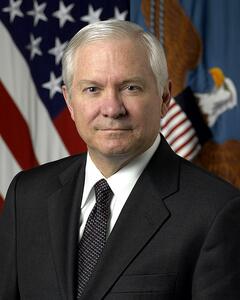
Barbara A. Perry
I’m going to turn things over to my colleague Mike Nelson. Since he led the [George W. Bush] 43 interview with you, he’s going to be our leader today.
Mike Nelson
It’s so good to be with you again, Secretary Gates. Since you’ve done the [George H. W.] Bush 41 and Bush 43 interviews, we can skip over a lot of what we usually spend time doing at the outset, the autobiographical material. I would like to go back over highlights of your previous career with this in mind: how each of the experiences you had in the past shaped or influenced in any way your experience as President [Barack] Obama’s Secretary of Defense.
If you would, think about these as I tick them off. By the way, I was surprised when I met you to find out there’s only one Bob Gates. For a crew like this, I assumed there were three or four people operating under the name Robert Gates. [laughter] It turns out it’s just you. You are a credentialed scholar of Russian and Soviet studies. You’ve been an intelligence analyst with the CIA [Central Intelligence Agency], eventually rising to Director, an Air Force Officer, a National Security Council staff member, and eventually Deputy National Security Advisor. You’ve been Dean and President of a major university, Texas A&M. You were a member of the Iraq Study Group, which is pertinent, I think, to this. You were President George W. Bush’s Secretary of Defense.
I wonder, as you think back on this wide range of experiences, if any thoughts come to mind about how each of them affected who you were when you became Obama’s Secretary of Defense, and how you led the Defense Department at that time.
Robert Gates
Each of those experiences was a learning process for me. Over the years, first of all, spending almost nine years on the NSC [National Security Council], under four different Presidents, I gained a pretty good insight into how the White House works and relationships between the White House and the Cabinet, and, in essence, how to get stuff done at the White House, which was critically important when I became Secretary of Defense.
The same thing was true in the early ’80s, when I was Deputy Director for Intelligence at CIA, and started testifying in front of the Congress. I was learning how to deal with Congress, how to be nonpartisan, to have the patience to testify in front of those people and figure out how to get things done with them when we’re not in front of the television cameras.
It’s a little bit like I told David Petraeus when I sent him to Iraq in early 2007: “Iraq is your battle space; Washington is my battle space. And we each know our battlefields.” The experiences, learning how to maneuver and operate within the White House complex, and then figuring out how to deal successfully with Congress over a protracted period of time in different jobs, really laid the groundwork for—I would say immodestly—the successes that I had as Secretary of Defense.
Each of them was a learning experience. My experiences along the way—leading the Intelligence Community, leading Texas A&M—I ended up leading four very different, very large institutions, all of which were in a process of dramatic change.
I became Director of Central Intelligence six weeks before the collapse of the Soviet Union, and the challenge was how I could reorient this entire behemoth of an Intelligence Community away from a singular concentration on the Soviet Union and the Cold War to a very different and more complex world.
When I became President of Texas A&M, my job was to implement an aspirational set of standards they had created to try to bring Texas A&M to be one of the top 20 public universities in the country; ironically, they achieved that just in 2020. That involved dramatic change, and in four and a half years I added 450 tenured, tenure-track faculty. I increased the diversity of the student body. When I arrived, it was a little over 10 percent; three years after I left it was 27-plus percent. There were a lot of changes in the faculty, the student body, and the curriculum, moving it into a new era.
Then I led Defense, and then I led the Boy Scouts. When I was national president of the Boy Scouts, we moved to allow gay leaders, gay kids, and so on. Four institutions in the middle of dramatic change. The lessons I learned along the way in how you lead change in big bureaucracies—particularly at the Intelligence Community and then at Texas A&M—played a big role in the way I led change and imposed changes at the Department of Defense.
Nelson
These might be stretches, but I know that your first stint on the National Security Council staff you resigned after [Jimmy] Carter was elected. But then, after a hiatus, you were brought back in. I wonder if the experience of having served on a Republican President’s staff and then on a Democratic President’s staff, although not continuously, somehow might have prepared you for what you did as Secretary of Defense.
Gates
Oh, sure. The funny thing is when we closed up shop in December of 1976, in the Soviet and European office of the NSC we had probably 30, maybe 35 file drawers full of documents. By the time we were finished sending [Richard] Nixon’s and [Gerald] Ford’s stuff to their libraries, I think we left half of one drawer for the incoming Carter administration.
One of the things I saw firsthand was the discontinuity between administrations, the lack of institutional memory, and the complete turnover of people; all the lessons had to be learned all over again. I always thought, for example, that the executive secretary of the National Security Council ought to be a career public servant, like the permanent civil secretary in the British Cabinet, so that you had some continuity, and even knew where the documents were.
A new administration comes in, and all the correspondence between the previous President of the United States and the leader of the Soviet Union or China disappears, so you have to go to a Presidential library to figure out what are the commitments, how does the other side operate, how do they negotiate. All that stuff was very complex, and we had to research it.
That was one impact of it, but how I got back was kind of an interesting story. I really didn’t know [Zbigniew] Brzezinski. I tell this story to young people in particular. I’d only been gone for four months, and I got a call from David Aaron, Brzezinski’s deputy, asking me to come down for an interview. Apparently what had happened, Brzezinski had come out of his office railing about how there wasn’t anybody there who’d know how to make anything work. A secretary in the front office, one of the permanent staff, said, “I think I know somebody who can help you, who knows how to make stuff happen.”
That’s how I ended up back in Brzezinski’s office. When he talked to me, he was that honest. He said, “I’ve fired everybody who knows how to make anything work, and I’m told you can make stuff work. Will you come down as a special assistant?” I had been polite and treated this young secretary with respect, but we weren’t friends. She was just there in the front office during the Ford administration. She was the one who piped up and said, “I think I know somebody who can help you.” So I tell young people, “You never know who’s going to be the person who makes a dramatic change in your life that you might never suspect. That’s why it’s pretty important to treat everybody with respect and dignity because you never know. Maybe that messenger kid in the office is actually the nephew of the CEO [chief executive officer].” [laughter]
That’s how I got back to the NSC. Where I was able to be helpful in Brzezinski’s office was that I had the institutional memory of the previous three and a half or four years.
Nelson
Was there any awkwardness coming back in a Democratic administration?
Gates
No, not really, and I think partly it’s because I had a PhD in Soviet affairs, and that appealed to Brzezinski and his academic background. I was on detail from CIA, so I was assumed to be apolitical. Both times that I first went down to NSC—first time under Nixon and then under Carter—my bosses at CIA saw no value in it and objected to the assignment, and basically told me when I left the Agency, “There probably won’t be a job for you when you want to come back.” Go figure. [laughter] There was really no awkwardness at all because I had a lot of respect for Brzezinski. He was, for all practical purposes, pretty apolitical. Zbig didn’t get very involved. It was kind of like Brent [Scowcroft]: he didn’t really get involved in the domestic politics kinds of things.
Nelson
Just one last thing about your pre-Obama years. The concern you showed while you were Secretary of Defense for the welfare of the men and women in uniform, was that in any way informed by your time—which not many policy makers have anymore—as an Air Force lieutenant?
Gates
Sure. One thing that was always appealing when I’d be talking to enlisted people and groups would be—I’d say, “I was a second lieutenant in the Air Force, and between my sergeant and me we did my job pretty well.” [laughter] That always went down well.
I’d been at the bottom of the totem pole. I’d seen the bureaucracy. I’d seen the frustrations that people in uniform have trying to deal with different things. I was in the Strategic Air Command at the height of Vietnam, and we had no money. We couldn’t even get light bulbs on Whiteman Air Force Base because everything was going to Vietnam. I knew we were in trouble when we started losing white-haired lieutenant colonels who were going over to fly cargo airplanes so the younger pilots could fly the jets, fly the fighters. So yes, that made a difference.
Another big piece of that sympathy and eagerness to help the younger troops was also in part my experience at Texas A&M, where I set myself up as the ombudsman for students. I tried to engage with them a lot and tried to help and be a buffer, tried to mitigate the consequences of higher education bureaucracy. Sometimes it was just explaining things, and sometimes somebody made a stupid decision that had a negative impact on students. I think over time, I actually had an impact.
On my last day in the office, when I left, 10,000 kids turned out to say goodbye, so I guess that says something. Once a month, I’d go in front of the student senate—no holds barred, ask me anything you want—and same thing with the faculty senate. I really had a great relationship. All the usual complaints about higher education, I don’t have any. I never had a problem with the faculty, I never had a problem with the students, and we got a lot of stuff done.
But I think the desire to be helpful to the young people under my care or charge did start because I’d been there, and same at CIA: I’d been at the bottom. I started as a GS-8 [low rank in the government service pay scale], so I knew what it was like to be at the bottom of the heap.
I remember on my interim assignment, before going into the Air Force, my GS-11 boss was walking me down to the seventh floor of the Agency, where all the deputy directors’ offices were, and the DCI [Director of Central Intelligence] and DDCI [Deputy Director of Central Intelligence] and so on. We were literally tiptoeing and praying that no one would pop out of their office and say, “What are you two doing up here?” [laughter] Of course, I had no idea in 1966 that eventually I’d occupy most of those offices.
Nelson
Can we turn now to the Obama experience, knowing how thoroughly you covered the two Bush Presidencies in those previous oral histories? What impressions had you formed of Obama before and during the 2008 election campaign, especially as it came to seem more likely that he would be elected?
Gates
I don’t think I had a strong impression. I had committed to stay at Texas A&M for seven years, which would have gotten us back up here to the Northwest in the summer of 2009. When I agreed to become Secretary under President Bush, my one weak—and I admit it was a very weak—justification to my wife was, “At least we’ll get home six months earlier than if we’d stayed at Texas A&M.”
Gordon England, the Deputy Secretary, a couple of months into my tenure had given me a countdown clock that showed exactly the number of days, hours, minutes, and seconds until noon, January 20, 2009. I carried that clock with me all the time, and if anybody asked me if I was having a good time or if I was enjoying the job or if I wanted to stay, I’d just pull the clock out and show it to them. I had no idea that I might stay.
So in all honesty, I didn’t pay that much attention to the campaign or to Obama. I thought, obviously, he was eloquent. By that time I wasn’t a spring chicken, and it seemed to me, having worked for seven other Presidents, that he seemed very young and inexperienced to become President of the United States. Other than that, I really didn’t have a strong impression one way or another.
I thought his election was a good thing for the country, and I told my expanded family that I thought it was a great day for America. I can’t remember for sure, but I’m pretty sure I voted for [John] McCain, because I had been an admirer of his for a long time, and he had been helpful to me as Secretary. But McCain, as you well know, was very mercurial, and when I was Secretary under President Bush, I never knew whether McCain’s line in a hearing would be that I was an idiot or that I was the greatest Secretary of Defense in American history. [laughter] It could go either way. As somebody once told me, it all depended on how much caffeine he’d had that morning. [laughter] I really didn’t have any strong feelings one way or the other about Obama.
Spencer Bakich
You didn’t have, necessarily, a strong or fixed perception or opinion of Barack Obama. What about his choice for Vice President? Before you took the job, did you have any particular feelings about [Joseph R.] Joe Biden [Jr.]?
Gates
If I had, they were ambivalent. I thought that his choice of Biden made sense in that Obama had basically no experience in foreign policy and national security policy, and Biden had chaired the Foreign Relations Committee for a long time and was pretty knowledgeable. I thought that he would be an asset to Obama in terms of having somebody with some foreign policy experience.
Of course, the flip side of that was I thought he’d been wrong on a lot of stuff. [laughs] He’d been public about how he thought the fall of the Shah [Mohammad Reza Pahlavi] was a good thing for the people of Iran; he had opposed virtually all of [Ronald] Reagan’s defense initiatives, from ICBMs [intercontinental ballistic missiles] to missile defense and everything else. He’d voted the wrong way, as far as I was concerned, on the First Gulf War, and probably on the Second Gulf War, as well.
I didn’t know Biden well. We were acquainted, but I really never testified in front of his committee; my testimony, until I became Secretary, had always been in front of the Intelligence Committees and the Appropriations Committee. I’d not had any exchanges with him, so, to the extent we had any relationship, it was a very cordial one and always remained a cordial one. I thought he had gotten a lot of things wrong, but I also thought he would be an asset for Obama.
Perry
As long as we’re talking about running mates in 2008, and we’re having this interview on April 12, 2022, just after Sarah Palin has tossed her hat in the ring for the Republican primary for an open congressional seat in Alaska, did you have any thoughts about Senator McCain’s running mate in 2008?
Gates
I thought he’d made a gigantic mistake. One other story about the summer of 2008 that I had always considered a fluke until Obama’s book came out: In the summer of 2008, midsummer, I got a call from Senate Majority Leader Harry Reid, asking me just out of the blue, “Have you ever taken a public stand on abortion?” I said, “What?” [laughter] He asked me again. I said, “No.” He said, “That’s good. That’s good.” Then he asked me a couple of other questions. He said, “I’m going to suggest to Obama that he choose you as his running mate.” I just laughed out loud. [laughs] I said, “You must be kidding.” He said, “No, I’m not kidding.”
We hung up, and I stared at the phone in disbelief. I didn’t know whether to laugh or cry. Sure enough, in Obama’s book he says Harry Reid called him and suggested that he take me as his running mate, which I thought was one of the most bizarre things I’d ever heard.
Nelson
You were contacted by Senator [John] Jack Reed on Obama’s behalf about a month before the election. I want to hear a little bit about that. But before that, had you gotten any indication from McCain or any of the McCain people that he might want to keep you on as Secretary of Defense if he were elected?
Gates
Actually, during the summer of 2008 there were press articles suggesting that either McCain or Obama, whichever was elected, might want to keep me on for a year or so—or there wasn’t even a time frame—to provide some continuity because we were in the middle of two wars. There was speculation in the press coming out of both the McCain and the Obama camps.
Actually, Jack Reed first called me, probably in July. He and Obama were going on a trip, I think to Iraq, and were going to have a lot of plane time together. I don’t know whether Jack was calling at Obama’s behest or whether at this stage this was all Jack. He said, “If Obama is elected, would you consider staying on?” I said, “Well, of course I would consider it.” That was the end of the conversation. I may have said at that point, “Let’s wait until the election.” Then he called me, as you note, in October, and it was much more serious. He said, “Would you be willing to have a conversation with Obama about staying on?” I said, “Well, Jack, I can’t do that before the election. I couldn’t do that. I still work for President Bush.” Then he called me again and said, “Well, right after the election, would you be willing to have that conversation?” I said, “If he wins the election, of course I would have that conversation.”
I can’t remember the exact chronology, but I think in that call is when I said, “Why don’t I just put together some questions that we could discuss to make sure that it’s productive if we have that conversation?” He agreed, so I put together ten questions and arranged to have them delivered privately to Jack. I had Robert Rangel, my chief of staff, hand carry them up and hand them directly to Reed.
I got a call from Reed a few days later, and he said, “Barack read your list of questions and really liked them a lot. He wanted to know whether you wanted the answers in writing.” I said, “Jack, it’s not a test. [laughter] It’s to shape a conversation.” He said, “Oh, OK, OK.”
William J. Antholis
When I was at the NSC, I served on International Economic Affairs, and I have a question about this exact period of the transition when the financial crisis was happening. You mentioned it once or twice briefly and in passing, but I wonder if you’d just give us a few more thoughts from your perspective in the middle of the election in the fall of ’08. The crisis started happening and continued to unfold across the transition and well into the first couple years of office, before growth started to return. Could you tell us, just as a general matter, how you thought about that, given the two wars you were fighting and the range of issues that that could impact—everything from budgets to national security challenges—that it might present around the world.
Gates
Again, from my perspective, I was leaving government in four months, so I really wasn’t that focused on it, in all honesty. I was trying to put things in as good a shape as I could for whoever was going to be elected President, and planning my return to the Pacific Northwest, so I can’t honestly say that it weighed much on my mind.
However, one of the questions that I posed to Obama had to do with the Defense budget. I came away pretty confident from the firehouse meeting that he would not impose consequential cuts to the Defense Department for at least a couple of years, in no small part because Defense jobs were important right then, and the last thing you wanted to do was start carving up jobs across the country that benefited from Defense contracts.
Once it was clear I was going to remain as Secretary, it became a very high priority, because I was convinced that while Obama had pretty much promised me he wouldn’t mess with the Defense budget for the first two years, things could get serious after that. So I rather naïvely thought that if the Defense Department could demonstrate that it could get its own house in order, perhaps we could get out in front of what I saw as a budgetary train wreck coming for Defense.
For most of my predecessors, if they were lucky, they cut one or two major Defense programs. My favorite example is Dick Cheney, who, as Secretary, cut two programs: one was the A-12 combat jet. The litigation for cutting that program ended while I was Secretary, 20 years after Dick had made the decision. The other program he cut was the Osprey, which, as you know, is still flying. In fact, the Marine Corps on his last day in office flew it right over the Naval Observatory. [laughter] Nothing subtle about the Marines.
That was why in the spring of 2009, when Obama was brand-new in the White House—he’d been President for only three or four months—I had 40 or 50 meetings over a period of three months. We cut 36 major programs. If they’d been built, the completion would have cost $330 billion. We got them all through: we got 33 through that year, in 2009, and the other three we picked up in 2010.
It really was pretty extraordinary, and I think one of the reasons it was successful is that—because I included the military intimately in the process, in all these meetings—to the best of my knowledge, I didn’t have a single general or admiral or somebody from the services going around me to the Congress to leak what was being done and to try to undercut it.
So we were successful, and, to your point, it was all in anticipation that because of the economic crisis, the Defense budget was going to be a big target for the 2011 fiscal year budget. That was the same reason I picked up the next year, in the spring of 2010, the efficiencies exercise, where we identified $180 billion in overhead cuts. We’ll come back to that later because it has bigger ramifications.
I really changed gears pretty dramatically when it was clear I was going to stay on under Obama. I didn’t mess with the Defense Department, with the budgets and procurement and acquisition and all of that, while I was working for President Bush. When I became Secretary, we were in the middle of two wars and we were losing them both, so my focus was entirely on the wars. To the extent I got involved in the budgets, it was making sure that we had enough money to do what we needed to do to turn things around in the wars.
When Obama asked me to stay, I decided, OK, I’m going to take this building on. The truth is, having fired a bunch of people during the Bush administration, let’s just say there was credibility to what I wanted to do in the Department of Defense that probably wouldn’t have happened to a brand-new Secretary, so I don’t discount the fear factor. [laughter] I’d been in the job two months when, over the Walter Reed Hospital scandal, I fired the Secretary of the Army, the Surgeon General of the Army, and the commander of the hospital, and a year later, on the same day, fired the Chief of Staff of the Air Force and the Secretary of the Air Force for negligence on the nuclear program. People knew I was serious, and that we were going to make these moves. Both President Bush and President Obama were very supportive.
The thing that was so staggering about what I did was that people get fired in Washington all the time, for scandals and for personal misbehavior of various kinds. Nobody at a senior level in Washington ever gets fired because they’re not doing their job well enough, so the notion that you could get fired for incompetence as a senior government official was a terrifying revelation to people. [laughter] It had the desired impact.
But when it came to these budgetary issues, and the cuts that I made in these programs—they were dumb programs. As I wrote in Duty[: Memoirs of a Secretary at War], most of them couldn’t even pass the giggle test. My favorite—I’ll just give you one example—was the chemical laser. This was a program that was part of the missile defense initiative. It was to be a weapon to destroy enemy ballistic missiles in the boost phase, right after they come off the pad. This involved building 20 747s at a cost of a billion dollars each, and each would have a chemical laser that would conduct these attacks. There was only one problem: the chemical laser had a range of only 60 miles, so a 747 was going to have to orbit within 60 miles of the test ranges in the Soviet Union, or in Russia, in China, North Korea, Iran—big, slow, fat targets. And oh, by the way, it was also going to cost $100 million a year to operate each one of them, so I cut that. You couldn’t believe the howls from the Congress. The rest of them were kind of in that vein.
But I could not have been successful if Obama had not been willing, essentially, to make it clear that he would veto an appropriations bill that came to him with any of those systems on it. His standing behind me was critically important to that entire initiative, and that’s all tied to the economic crisis and the budget, all in the very first months of his administration.
Bakich
Is it fair to say, then, that as you were Secretary of Defense under Bush, these various programs weren’t necessarily things that rose to the top of your agenda, obviously because of the wars going on. But was it really the Great Recession that drove you to implement these budgetary reforms?
Gates
It was my conviction that after these two wars—in significant part because of the economic crisis—the Defense budget in the third year was going to come under enormous pressure. My hope was to preempt that by showing that we could be responsible and be tough on ourselves. That was a naïve premise, but I still did it.
Nelson
Very few people have served in cabinets for Presidents of different parties, and none have done so in the same job, much less in the Defense Department. I wonder: your reading of history or maybe conversations you had with James Schlesinger? Was there anybody you could talk about or think about the unique challenges of staying in the same position, an inner Cabinet position, from one President to a second President of the opposite party?
Gates
No. No, and I got a lot of advice from people, including some people I knew well and respected a lot. As an example, a lot of that advice was that I had to fire all of [Donald] Rumsfeld’s people. This was when I joined the Bush administration, at the very beginning, and it was that I fire everybody in the E-ring. There were newspaper stories about how there would be a huge purge of Rumsfeld appointees and so on.
I probably could have done whatever I wanted, but I think the smartest decision I ever made was the first decision I made: to walk into the building completely alone, not even bringing an assistant or a secretary or anybody. I wanted to send a signal that I didn’t think the building was the problem—The problem was the leadership—and that I had confidence that everybody could do their job until they proved otherwise. I think it saved a lot of angst, a lot of worry and disruption, by people knowing that I wasn’t coming after their jobs.
The other thing, for me, was that I didn’t have time to go through a confirmation process for a whole bunch of people across the department. It was far better to go the way I did and deal with the team I had. Then, if I needed to make changes along the way, to do so—and I did, over time. I think that was really, really important.
The same issues, in a way, came up when Obama asked me to stay. I told him, “Look, this has to be your Department of Defense. I realize that the civilians pretty much all have to go. I don’t have a big enough Rolodex to make suggestions for these people, and, frankly, I have a full-time job, so let’s work this out.” I sketched the outline with Obama and then filled in the details with John Podesta. I said, “First of all, there are three or four people I’d actually like to have stay in senior positions.” I mentioned Mike Donley of the Air Force, [Preston M., III] Pete Geren, Secretary of the Army, and Jim Clapper, who was Under Secretary for Intelligence. That was about it.
The other deal I did that I think was unique in modern American history is I got Obama to agree that, with a handful of exceptions—my deputy, the Under Secretary for policy, with literally very few exceptions—all the Republican appointees who were in office would remain in office until their Obama-appointed successors were confirmed, so we had no gaps in capability and in management and leadership of the department. That had not been done before, and there’s a lot to commend it, frankly, in terms of continuity and keeping things moving in the right direction.
The deal I cut was, “You send me nominees for these jobs. You come up with the nominees. I’ll interview them, because it’s essential that they know I had a role in hiring them, and therefore I can fire them. They need to know I can fire them, and the only way to do that is if the final step in their process is to come interview with me.” In the whole process of the whole team, there were only one or two people I sent back. I said, “I don’t care about their politics. All I care about is whether they’re competent. Can they do the job?” With one or two exceptions, it actually worked out quite well.
Nelson
Your learning curve about Obama must have been awfully steep at that point. What does it say about him that he was willing—in the area in which he was least experienced—to bring in a Secretary of Defense from a Republican administration—and, for that matter, his main rival within the Democratic Party, Hillary Clinton, for Secretary of State? What did that tell you about him?
Gates
It demonstrated an understanding of the need to have strong people around him. We may have ended up being a little stronger than he wanted. I heard when the time came to appoint a new team for the second term, the theme, particularly in the West Wing staff, was, “No more Clintons or Gateses in the Cabinet.” [laughter] That was probably mostly coming from Biden. But I think it showed character. It showed an understanding of what he needed. I think in my case a big piece of it was, I have a historic crisis on my hands with the economy; I really don’t want to have to worry about the national security stuff and the military stuff. I have these wars going on, and I’m going to have to be engaged, but I don’t want a neophyte in there at the same time I’m trying to rescue the American economy.
I think he got a lot of reinforcement from Democratic Senators on the Hill whom he respected, like Reid, who said, “This guy is not political, and he’s doing a hell of a job as Secretary of Defense. This is one area you don’t need to worry about.” But he had a longer view, so when he and I had our meeting in the firehouse, we got to the end, and I said, “If you want me to stay, I’ll stay.” He said, “Great.” I said, “Shall we say publicly about a year?” He said, “Let’s just not say anything publicly.”
The way I like to put it is that when I said, “How about I stay about a year,” I put a period on that sentence and he put a comma. [laughter] It became clear pretty quickly that he wanted me to stay, even as we began to have disagreements in early 2011. He’d already signed Leon [Panetta] up to become Secretary, and the other changes that were going to be made, and literally a week before we went into the East Room, we talked privately, and he said, “Hillary says I’m not being tough enough on you. Are you sure you won’t change your mind and stay? I’d like you to stay at least till the end of the first term, and maybe even to the second.”
I just looked at him and said, “Mr. President, don’t even go there.”
Nelson
Did you have any concerns about whom he might appoint as Secretary of Defense if you turned the job down?
Gates
No, not then, not in 2008. I was going to leave in a year. At the end of a year, he said, “Stay another year.” I said OK. Then in the fall of that second year I said, “I really need to go next summer. I’m really exhausted.” I was Secretary for four and a half years, and we were at war every single day I was Secretary, so I was really spent.
Somebody did the math for me at one point: I don’t think there was any other Secretary or Secretary of War who was in the job that long in two major wars. There were only four Secretaries who were in the job longer than I was: Rumsfeld and [Robert] McNamara, who basically had to resign in disgrace; [Caspar] Weinberger, who was indicted; and Charles E. Wilson in the [Dwight] Eisenhower administration. I saw no precedents I wanted to emulate.
The sad thing is I’ve been gone 11 years this July, and Lloyd Austin is the 11th Secretary or acting Secretary.
Nelson
Did you have some concerns about how he would choose—
Gates
He said, “I have no idea who I would turn to if you left.” This was in 2010, so I realized the only way I was going to get the hell out of there was to find somebody, [laughter] and Leon was my candidate.
Obama was actually skeptical when I first raised it. I said, “Look, you’re going to face all these budgetary issues for Defense. Leon has all that experience on the Hill and in the OMB [Office of Management and Budget]. Leon’s popular with the troops at CIA, so he’ll care about the troops. He doesn’t need any catch-up on what’s going on in the world. He’s been in the Situation Room for all these meetings, and he’s already a part of the team.” Obama’s concern was, “Isn’t he too old?” I said, “Well, Mr. President, first of all, you’re only talking about a year and a half until you can appoint somebody for a full term.”
One of my arguments for getting out when I did, and for Leon, was, “The closer to the fall of 2011 you get, the harder it’s going to be for you to get somebody of quality to come in and take this job, because they may be thinking they’re going to be taking it for only a year. “You’re not going to get a quality person to come in for 18 months, from the outside, fresh. It’ll take him six months to get up to speed, if not longer. Leon can just move right into the chair, and then when the second term begins, you can turn to somebody else.”
One of the things, in retrospect, that I find mildly amusing is that when all was said and done, I ended up being Obama’s longest-serving Secretary of Defense, [laughter] because there would be three more after me.
Nelson
I have a question about the transition process. Again, it would seem from the outside intrinsically awkward to have transition team members from the other party coming in, you staying, them making their reports. The typical theory of a transition team and their report is, “These guys have been screwing up, and here’s what we’re going to do differently.” I wonder about the awkwardness attendant in that—or was it awkward?
Gates
I thought it was hilarious. There were only four people in the department who knew I was staying: Robert Rangel, my chief of staff; my senior military assistant; and my confidential Assistant Secretary—and Mike Mullen.
I said, “We’re just going to do business as usual. We’re going to have a regular transition. We’re going to have the team come in.” We were lucky in that we had two mature, sensible people heading it. Michèle Flournoy was one, and I can’t remember the name of the guy. They were sensible people, but I write in the book that every transition is essentially a hostile takeover, even when you go from a Republican President, like Reagan, to another Republican President, like Bush 41, and particularly when people who worked hard for President Reagan are getting fired because they’re not going to be kept on under Bush.
You can imagine the differences between Bush 43 and Obama. I said, “We’re just going to play this straight but all the transition stuff has to work through Robert Rangel and through Mullen, so we can keep an eye on it.” There was a certain element of the hostile takeover aspect to it, but they were pretty sensible, and then a few weeks later when Obama made the announcement, I said, “Let’s go forward with the transition, and then let me read the books. Let me read them before they go to the President-elect and his team.”
I tried to play it straight, and they gave me the books, their report, and I went through it, and I decided not to change anything in it or even to write a memo dissenting from various things. I just let it go straight, I guess partly because I felt that they had made some good points, and there were some things that actually became a part of my agenda as Obama’s Secretary. But while it was still a secret that I was staying, it was, as you say, awkward, but also I had a few good laughs over it. [laughter]
Nelson
Could you compare this transition to the transition from Bush 41 to [William J.] Clinton, when you were CIA Director?
Gates
The 43 [George W. Bush] to 44 [Barack Obama] transition was probably the best and smoothest in history. Bush 43 really focused a lot on making it smooth and facilitating things as much as possible. I’m probably telling a story out of school here, but [Stephen] Steve Hadley’s been in charge of a project to declassify and edit and put together the two dozen or so transition papers that the 43 administration handed over to the Obama administration. It was really an extremely well-organized, thorough, and nonantagonistic process, much more than anything I had ever seen before, including from Bush 41 to Clinton.
Perry
Could I ask you about Secretary Clinton? You write about the fact that you both got along so well, and that it was often unusual in American history, where the SecDef [Secretary of Defense] and the Secretary of State sometimes wouldn’t even speak to each other, and you had seen examples of that. What did you know or think about her before working so closely with her in the administration? How did that relationship develop in such a positive direction?
Gates
I don’t think I’d ever said anything critical of her, but I have to tell you—and I think I wrote about this in Duty—my impression of her was not a positive one. It was based on what I’d read in the newspapers, and so on, so, frankly, I didn’t have a very high opinion of her.
Nelson
What was your opinion of her?
Gates
I thought that she had tried to assume too much of a policy role as First Lady. She struck me as kind of overbearing. But this was all based on what I was reading in the newspapers, so what I write in the book is that as soon as I started to work with her, I realized—or I came to the conclusion—that I had had a totally wrong impression of her. I did a 180 and became a big fan.
You have the chronology: I called her up after we’d been announced, and I gave her the background. I said, “Look, for most of my career, Secretaries of State and Defense have not gotten along. There was [George] Shultz and Weinberger; there was [Henry] Kissinger and Schlesinger; needless to say, [Colin] Powell and Rumsfeld. More often than not, that relationship has been a bad one. “But I’ve had a great relationship with [Condoleezza] Condi Rice, and we are old friends. When the principals get along and work together, and people know they can’t be played against each other, it has an enormous trickle-down effect, not only within those two departments, but within the entire government, in the entire national security arena.”
I’d only been Secretary for six weeks or two months, and Hadley turned to me at one point and said, “You can’t believe how much better you have made it for the President by your presence.” It had to do with these personal relationships. I invited Hillary to lunch at the Pentagon, and I described this historical situation and how Condi and I had gotten along. I said that I thought the President would be well served if she and I had that kind of close working relationship, and that if any issues ever came up, she should just pick up the phone and call, and we would talk together. I said, “Where we can, we should align our positions.”
The truth is, until the intervention in Libya, I’m not sure Hillary and I ever disagreed on a policy issue. I think the White House became quite resentful of the fact that she and I were colluding. [laughter]
Bakich
How receptive was she in that lunch meeting? What was her temperament like?
Gates
She was totally onboard from the very first minute. She said, “That sounds exactly right.” I told her, “Condi and I had a deal that had a big effect early in our time working together.”
Your staffs—particularly if you have too many staff—always want to set your hair on fire about some problem, and usually it’s some depredation being carried out by another department, some horrible act. They’ll come in and say, “Secretary Rice is doing such and such, and this is where it’s all wrong, and blah, blah, blah.” Condi and I would orchestra these things. I would say, “Gee, that doesn’t sound like anything Condi and I have ever talked about. You sit right there and let me call her, and we’ll see.” [laughter]
I’d call her and say, “Condi, I’m being told that you said—” She’d just howl with laughter: “Actually, no, I took the opposite position.” Then I’d hang up and turn and say, “That was not a career-enhancing experience for you. Don’t you ever try to set me against my Cabinet colleague like that again.” The word gets around that that doesn’t play. It works in both departments, and it made a big difference.
Perry
Where did your ability to read people come from?
Gates
That’s a good question. I don’t know. It’s one of the things I worry about with the younger generation right now, because they spend so much time in front of screens that they don’t know how to read people. They don’t know how to read confusion or fear, and I think it contributes to a lot of problems.
Frankly, I think COVID and masking and remote work have only aggravated that. I think it’s just experience over the years. Certainly, it’s critically important to be able to read people in dealing with Congress. I had a very senior woman working for me when I was Director of Central Intelligence; she was very senior—she was a GS-18. But I couldn’t promote her further because she had no ability to read people. When she’d go up to the Hill to testify, she would just antagonize everybody. She couldn’t see that she was ticking them off in the way she was doing things.
I don’t know where it came from. Some of the younger people in the Obama White House West Wing would get annoyed by the fact that I would keep silent in a lot of meetings, and then only weigh in toward the end, or at the end. It’s because I’m a big fan of listening. That gives you the opportunity to read people, and it also gives you the opportunity to read the room. I would—based on the conversation in the Situation Room—rewrite my talking points, or what I intended to say, often in the middle of a meeting, because of what I was hearing, both because it was maybe a substantive point I liked, but also I was changing tactics in terms of how to get the outcome I wanted.
Bakich
Did you get the sense that the President operated along those same patterns that you just described?
Gates
President Obama probably went into almost every meeting knowing what he was going to do and having made up his mind. He was pretty confident that he was smarter than everybody else in the room.
Perry
Was he?
Gates
Of the eight Presidents I worked for, probably the two highest IQs were Jimmy Carter and Barack Obama. That didn’t make them the best Presidents. The Presidents I admire the most—and it would include both Reagan and Bush 41—clearly thought they were pretty smart. But they surrounded themselves with very strong people and really would listen and then integrate what they heard into their own decision making.
Sometimes they’d do something that nobody agreed with. Bush 43 did that with the surge. I give Obama credit that, given his self-confidence, he was still willing to surround himself with pretty strong people, people who had strongly held views. So it was kind of a combination. I resist the notion of smartest man in the room, because I always figure it’s a very dangerous thing to have a person in charge feel like he or she is the smartest person in the room, because then you tend to be disdainful of other points of view.
Bakich
It’s interesting listening to you describe the President this way. Joe Biden came to you—You wrote this in Duty—and pulled you aside and said, “Be careful of what you say, because what you say will influence what the President decides.” I’m curious: was he willing to listen before the meetings or in sidebars, but maybe not during a meeting itself?
Gates
He differentiated in the way that he treated people during meetings. He was very respectful of me and of Hillary and of Leon. He was pretty respectful of Mike Mullen. But he could be very cutting to the Vice President—the two I remember most vividly were the Vice President and Richard Holbrooke. It was as though the President really didn’t have much patience for either one of them. On more than one occasion, the Vice President would start to say, “Well, Mr. President, I think—” and Obama would just cut him off and say, “I already know what you think, Joe.” Part of it was, shall I say, the loquaciousness of both of those men. [laughter] Obama had very limited patience for that sort of thing.
Perry
In the movie Statecraft [: The Bush 41 Team] you said, “A President doesn’t need to get consensus.” Can you talk about that in light of what we’ve just said about Obama and his style of leadership?
Gates
Having consensus as your objective is a mistake, because then that limits the options you’re going to get, or you get options or solutions that have all the sharp edges rounded off, and you end up with the lowest common denominator.
The way I ran the deputies committee in the first Bush administration was that my job was not to achieve a consensus, but rather to strip the issue down to the bare bones, strip away all of the bureaucratic bullshit, strip away all of the false arguments and the political maneuvering and all of that, and get right down to What’s the critical issue that the President has to decide? What’s your principal’s view of that option?
It was to avoid a consensus, actually, and cut away all of that stuff, and get it down to the essence of, What is the real decision the President has to make? not something that’s been ginned up by the bureaucracy. I never had consensus as an objective. I’d say, “Go back. Here’s the issue. Find out what your principal thinks, and get back to me by five o’clock tonight. I’ll have a Presidential decision for you tomorrow morning.”
One time we had a big argument about what Bush wanted. It was fairly early in the administration. I said, “Well, hell, I’ll just go ask him.” [laughter] Everybody was sitting in the Situation Room. I went upstairs and walked in; Scowcroft and I and [John] Sununu really were the only three who had walk-in privileges on 41. I told him what the issue was and said, “Everybody wants to know what you think.” He told me, and I went back down: “Here’s what the President thinks.” First of all, it set the stage that they knew that I had that kind of access and could get an answer. We got things done, and part of the reason was that we didn’t try to go after a consensus.
Obama had no interest in a consensus. Bush was willing to hear different points of view, but one difference between them was that Obama was aggressive in seeking alternative points of view. Unlike Bush, he not only would go around the table—and in Bush’s case it was, “If you want to speak, speak”—but Obama would call on everybody.
It was like a classroom. I don’t care whether you hold your hand up; you’re going to get called on. Then he’d go around the back bench. In the case of what to do about [Hosni] Mubarak—and, to a considerable extent, Libya—he did what the back bench recommended, not what the principals wanted to do.
Antholis
Partly through our repeated interviews with Vice President [Richard] Cheney—then Defense Secretary Cheney—in the 41 administration, we got, from his perspective, the Ur-story, the creation myth of the deputies council: that it came out of the failed coup in Panama in the fall of ’89, one month before the fall of the Berlin Wall. That may or may not be true, but if it is, you were then deputy at the creation of the deputies committee. You’ve watched the evolution of that over nearly 30 years.
Can you talk a little bit about how it functioned in the Obama years? I’ve heard a lot about it from friends and colleagues. [James] Jim Steinberg—and I say this hoping that you’ll feel free to say whatever you want—was my first boss in Government and Policy Planning at the State Department. [Thomas] Tom Donilon was on the board of the Miller Center. I know a number of those deputies.
I’d love to hear your thoughts about how well it worked, first in terms of framing the decisions, as you described it, that needed to be made, but also the nature of that group, the collegiality of that group.
Gates
First of all, on the origin of the deputies committee, Scowcroft and I designed that before the administration ever started. We established that structure. There had been similar kinds of structures in all the previous administrations; they had different names, and I participated in them. And Cheney is correct to this extent: the deputies committee basically, in the initial months, was managing these various policy reviews that Bush had inaugurated.
I think there was a crisis earlier than the Panama coup, but we didn’t handle it very well, and that was when the President assigned the deputies committee the crisis management role, in addition to the other things it was doing. There were actually a couple of different problems in Panama. The first thing that changed from the plan that Scowcroft and I put together was [James] Baker didn’t want [Lawrence] Eagleburger to be a member of the deputies committee. He wanted Larry to run the State Department. My criterion—what I told Scowcroft and the President—was that it was important that the person, whoever it is, be very close to Baker, and can walk in Baker’s door without knocking. That ended up being Bob Kimmitt, the Under Secretary for Policy.
The question then became, who at Defense? Dick had the same attitude. He wanted Don Atwood to run the Department, and he wanted Paul Wolfowitz, who was the Under Secretary for Policy, to be his guy. Again, I didn’t care as long as Paul could get to Cheney on a moment’s notice. The chemistry among the members of the committee was very important.
Another thing that was important was, first of all, I never tried to get a consensus, but here are a couple of other very mundane but important aspects. First, I never let a meeting go over an hour; second, I never let a meeting end without an action. If we had a proposal, the idea was they would get a Presidential decision the next day, so nobody ever felt that they were wasting their time in a deputies committee meeting. We went boom, boom, boom.
That was the core group, along with [Richard] Dick Kerr from CIA, the Deputy Director of Central Intelligence, and the Vice Chairman of the Joint Chiefs. That was the core group, but it would expand beyond that. By the time of the First Gulf War, we were getting Presidential decisions so fast that we started getting requests from all over the government to bring an issue to the deputies committee because that was the fastest way anybody had ever seen the government operate to get Presidential decisions. We even got a request from the Post Office once.
The way it operated mattered a lot, and it was one of the reasons the process failed in the Clinton administration, and didn’t operate very well for the first part of the Obama administration. In the Clinton administration, the meetings would go on forever, and there would be no conclusion; there’d be no action. It was just basically a long bull session.
The problem that Jim Jones had in the Obama administration was that Jim was basically an outsider in the West Wing. He was not an intimate of Obama’s like everybody else in the West Wing. He hadn’t been in the campaign. He was significantly older than everybody else in the West Wing. I’d go in as Secretary early in the administration, have a meeting with Obama, and we’d come out of the meeting, and Jim Jones would tell me he’d never seen the talking points the President was using. They’d been fed to him independently by Denis McDonough or by Donilon or somebody like this. This was a violation of the chain of command Jim Jones totally couldn’t accept or tolerate.
There was no clear chain of command, if you will, and it was a totally different environment than Jim had ever operated in. People were just bypassing him all the time, going to the President. It was a very disorganized kind of process, and he was very frustrated and struggled with it a lot. More than once he told Hillary and me that he didn’t see how he could stay on.
My sense was that when Jim left and Donilon became National Security Advisor—I’d had a lot of issues with Donilon when he was the Deputy, and during the Haiti earthquake problem, I really became quite angry at him. But at one point—and I’ve always given Tom a huge amount of credit for this—he came over to the Pentagon to see me and basically said, “I’ve gotten off onto the wrong foot with you. What can I do?”
Actually our relationship changed dramatically after he did that. I was very impressed that he was willing to do that, and I was really glad when he became National Security Advisor. Then the system really began to click, and I had the feeling that while Tom was National Security Advisor, the process worked in a more organized and more thorough way.
Perry
What did you tell him when he said, “What can I do to get us back on the right foot?”
Gates
Well, one of my concerns was that Tom had been very close to Biden, and I felt like Tom was very antagonistic toward the Defense Department. Whether it was a liberal Democrat always being skeptical, or whether it was more personal with Tom, I really didn’t know the answer to that. But what had really ripped it for me was him criticizing the commander of Southern Command over the speed with which we were getting aid to Haiti. He did it in the Oval Office in front of the President and the Vice President and a bunch of other people from the administration. I found that intolerable, and I think he knew it, so he brought the peace pipe over.
Bakich
Can you please describe to me the relationship between the deputies committee and the Policy Coordinating Committees [PCC] in Bush 41?
Gates
The PCCs essentially were the Assistant Secretaries who would then do the papers that would come to the deputies committee.
Bakich
A support role?
Gates
Yes. There were four tiers: the NSC, the principals committee [PC], the deputies committee, and the PCCs. In the Bush 41 administration, the principals actually very rarely met. One of the things that happened by the end of the first year in the Bush administration is that all of the principals, including Baker and Cheney, had come to really trust the deputies committee: we weren’t trying to go beyond our mandate; we weren’t trying to usurp their role in the decision-making process. Because they so trusted us, the principals actually very rarely met, and mostly on things like arms control, where there were some real differences among the principals.
One of your questions later is about Cabinet meetings. I will tell you, broadly speaking, from multiple administrations: complete waste of time, complete Potemkin villages. It’s always to have some publicity PR [public relations] stunt, or maybe to have the Director of OMB brief the budget, a “You’re all going to suffer” kind of session. But nothing of any consequence ever gets done in a Cabinet meeting.
Nelson
We’ll see you again in 20 minutes.
[BREAK]
Bakich
I spent a good deal of time with Duty over the last three weeks, and there are a couple of things that are particularly interesting: the way you describe Obama 101, learning how to interact with the President, to influence the President, to give him the advice he needs to push policy in particular directions. Could you comment on what that was like for you? Did you engage in a systematic effort to learn how the boss wanted you to operate, or was it more of an intuitive kind of approach that you knew you had to engage in but felt him out over time?
Gates
I think it was both. Mike Mullen and I did it together. The main aspect of it was meeting with people who knew Obama pretty well, or who had worked with him. The truth is some of them claimed to know him better than they did. That never happens with a President. [laughter]
We did a little reading. Somebody told me at one point that to understand Obama, you really had to read his book. Well, I didn’t read his book. [laughter] It was mainly just talking to other people, people who had been a part of the campaign, people who claimed to have known him. It was just try to get a feel for how he conducts a meeting, how he makes decisions, things like that.
Bakich
In light of that, then, I’d like to take you to January ’09, very early on. You wrote in Duty all about the timetable and the drawdown in Iraq. Two things stand out: number one, you presented the President with a modified drawdown schedule—I believe it was a matter of a few months, nine months or something like that—and the President and you essentially worked on this and you came to an agreement. The President said that was doable; it was also politically sound.
But at the same time, you also wrote that the PCs and the DCs were continuing to meet about the drawdown schedule. That struck me as interesting: that the wheels of the interagency process would continue to move along, even though the decision had already been made. Then you moved on in the book, and I wonder if you have any more to say about that process.
Gates
It was not the only time that Obama and I cut a deal and then let the process go on and then come out the way we’d agreed. There were times where I felt it was important that he and I reach an understanding of what the best approach was.
Another example of this was very early in the process, in the fall of 2009, when I basically put my compromise on the table for the troop level, and it was worked out between him and me, in private. I said, “Here’s a way to square this circle.” Then the process went on, and then he made a decision.
Yes, on the timetable, he was feeling his way. He had no experience with the military. Biden was always, as I wrote in the book, pushing him that the military was trying to box him in, trying to jam him, trying to screw him, et cetera. This had not been a contentious issue between us when we did our meeting in the firehall, because, in my view, the exit strategy from Iraq had already been established by Bush in the strategic agreement with the Iraqis. Now we were just nattering around the edges of the timetable, and really it had more to do with the needs of the commander wanting just a few more months.
I think Obama had said he was going to have everybody out in 16 months, and I think the commander wanted 22 months, or something like that. We ended up basically splitting the difference: I think the ultimate decision was 19 months. But it really was just a way to avoid a contentious matter right out of the box. I went in and said, “We can save each other a lot of grief here if you and I can just reach an understanding.”
Nelson
I looked back through the interview that Jeff Engel and I did with you in 2013, which was on the eve of the publication of Duty, and we didn’t have the benefit of that book. There are some quotations in that book that I want to read to you now and ask you to elaborate on a little bit. I have four here.
First, “Hillary and I had a problem in common with the White House’s determination to run everything. I didn’t have that problem so much with Hadley and Rice.” Who in the Obama White House was determined to run everything? Can you give any examples? Did they, in fact, run everything?
Gates
Well, they wanted to. It was the domestic political advisors. It was not so much Jim Jones, because Jim, having led the Marine Corps, knew about big organizations and micromanagement. It was more Donilon and Denis McDonough and people like Ben Rhodes, and a lot of staffers in the West Wing, and I would say when it came to the wars, particularly Doug Lute.
Doug’s an interesting character. Mike Mullen and I basically had to twist his arm to get him to take the White House job under Bush, and as long as Steve Hadley was National Security Advisor, we had no problems at all with Doug and worked very productively with him. He’s a good guy. But we had a lot of problems with him in the Obama administration, second-guessing the commanders.
I wrote in Duty about my visit to Afghanistan—I don’t remember when it was, which administration—but there was a direct line in the JSOC [Joint Special Operations Command] command post in Bagram to the White House, to Doug Lute. I turned to the commander and said, “Pull that out, right now, while I’m standing here.”
When I was on the NSC, if I had tried to call a four-star general, Kissinger would have had my ass in about half an hour. These guys were reaching out to commanders in the field. I ultimately told the commanders, Jim Mattis and others, “You get a call from the White House, you tell them to go to hell and tell them I said so, and if they have a problem, to call me.” This was a problem, them reaching out directly to commanders, and it was a source of real friction.
Nelson
Did it get resolved?
Gates
No, not entirely. That was one of the things that was part of the peace deal between me and Donilon.
Nelson
There’s another quote in which you were reflecting on the Iran-Contra matter, and you said, “Iran-Contra showed the extraordinary dangers of the White House staff and NSC having an operational role of any kind, which is one of the reasons why I pushed back so hard in the Obama administration against that very thing.”
Were there instances in which staff and NSC were playing or trying to play an operational role in Obama’s Presidency?
Gates
Yes, apropos of what I was just saying. Another example was during the Haiti relief operation. They sent Denis McDonough down to Haiti basically to second-guess the Southern Command commanders on the ground. It just made me crazy.
Nelson
Who would have sent him down there?
Gates
The White House did; the President sent him.
Nelson
The President did.
Gates
Yes.
Nelson
Did you talk to the President about—?
Gates
Yes.
Nelson
How did he respond?
Gates
I kind of got a nod. [laughter] I didn’t get a commitment.
Nelson
By the way, in that interview, because Obama was still President, the name “Obama” came up 50 times in the Bush 43 interview. I quote: “There are so many examples I can think of from both the Bush and Obama administrations where they allowed themselves this demand on the part of the White House communications to force a response to everything.” Any examples of that where the communications office was, in effect, wanting you to communicate prematurely or inappropriately or—?
Gates
Oh, the PR people always wanted me out. It wasn’t like I was reluctant to go in front of the press, unlike any of my successors. Every Friday that I was in town I had a press conference, even if I didn’t have an agenda. Every single Friday Mike Mullen and I went out, and if he wasn’t there, then General [James] Cartwright. I did a lot of interviews, but it was never enough for them. Particularly—as I would put it very graphically—when they’d get their ass in a crack they really wanted me out there [laughter] to get them out of trouble, or to vouch for something, or defend something.
Sometimes it just seemed to me that less is more, and my attitude was if you go on the shows all the time, nobody’s going to want you on the shows, and nobody’s going to watch you on the shows. When I would go on the shows, the ratings would go up, because I didn’t go out all that often.
The interesting deal—I think it had to do with defending the Libyan decision, which, of course, was rather difficult for me since the critics were making all the arguments I’d made—I was on a plane coming back from a long overseas trip, and I was exhausted. I was getting home late on a Friday night. I’d already agreed to do two talk shows on Sunday morning. I had turned down a third; the White House PR people wanted me to do a third with [Jacob] Jake Tapper, and I said no. I told them absolutely not. [William] Bill Daley called me on the plane to really put the squeeze on me to do the third show.
One of the problems I’d been dealing with was that we’d gone into the Libyan thing, and it had already cost the Department almost a billion dollars. I was in negotiations with OMB in terms of how we were going to get reimbursed for that, so I told Bill Daley, “Here’s the deal, Bill: OMB works for you and the President. If you get the money from OMB to reimburse us our billion dollars, I’ll do Jake Tapper.” [laughter]
He said, “Gee, you drive a hard bargain. I thought it’d cost me a bottle of vodka.” I said, “I’m not that easy, Daley.” So he agreed. Of course, the end of the story is I didn’t get the billion dollars, but anyway, that was the deal we cut. They have no sense of perspective or proportion in the White House public affairs operations, and I’ve seen it in every administration. Most of them do a really poor job.
Nelson
When they would ask you to do a show, would they also want you to say certain things and tell you what they were?
Gates
No, they were never that crass about it, because, first of all, they knew what the reaction would be. No, they were more, “Would you go out and explain the President’s policy, why the President made this decision?” It was more that way.
Nelson
Did you ever find that communicating too much or too soon would create problems for policymaking?
Gates
The biggest problem for policy making really is leaks, not so much when you went out publicly with something. My favorite example is when the [Osama] bin Laden raid was over, we were still at the table, and I told everybody, “Look, we use these techniques every single night in Afghanistan. If we go out and talk about the details of how we did this operation, it’s going to cost Americans their lives. So it’s enough to say we killed him, and that’s all you need to say. Not a word about how we did the operation.” Well, it was five hours before the leaks started coming out of the White House and CIA. Basically, people just couldn’t wait to brag. Ultimately the only thing that never leaked were the pictures of the dead bin Laden.
I’m going to be very graphic here, and I apologize for it, but I went in to see Donilon the next day, and I said, “Tom, I have a great idea for a new communications strategy with respect to the bin Laden raid.” He got very serious and said, “Really? What is it?” I said, “Hey, Tom, how about we just all shut the fuck up?” [laughter]
Nelson
If you’d said that to Rahm Emanuel, he wouldn’t have blinked an eye.
Last quote. Here you were talking about Iraq and Afghanistan, and you said, “Under Bush and Obama, the political aspirations and articulated goals I thought were pipe dreams. They were talking about the work of generations. It was the same issues I had with the Obama administration’s attitude toward the Arab revolutions.” What problems did it cause to have Presidents offering grand visions of rule of law and democratic society and all that?
Gates
I wrote probably most graphically about it in Exercise of Power. What I argued in that book is that we should have left Afghanistan in January of 2002. We had won. The Taliban were gone, had been pushed into Pakistan. Bin Laden was on the run. There was an internationally recognized government that had been formed by the Bonn Agreement late the previous year, and several dozen countries were promising military and economic assistance. You had all of the different warlords and factions basically working together in putting together the Bonn Agreement. The only outliers were the Taliban, and there was no guarantee of what would come after that. But if there was a moment when we could have left having achieved our military and our strategic objectives, that was it.
It was the decision to make Afghanistan a better place that then led to the next 18 years of war. I quoted Rumsfeld in Exercise of Power: Rumsfeld’s memos and calls to Bush basically saying that there’d been no democracy in all of Iraq’s history for 4,000 years; that it requires institutions, it requires an understanding of the importance of compromise, it requires the rule of law, and these things could not be accomplished in the time frame we had available to us.
My view was that both wars had been prolonged by excessive ambition. I testified early on in the Bush administration: “If we try to make Afghanistan into some Central Asian Valhalla, we will fail.” In my interview with Bush I told him that I thought our goals were too ambitious in both Iraq and Afghanistan. It was a pretty consistent view through the entirety of my time as Secretary.
Nelson
How about with Obama and the Arab Spring, the Libya intervention? Were there moments in the Obama Presidency when you had the same specific frustration?
Gates
Well, we didn’t know how the Arab Spring would turn out. My problem was less the response to the Arab Spring than it was to the way we treated Mubarak. My attitude was that the willingness of the administration to throw Mubarak under the bus sent two signals to the rest of the region. The first was you can be a friend and ally of the United States for 30 years, and at the first opportunity, we’ll throw you under the bus. The second was to send the message to the rest of the Arab authoritarians that if you get into trouble, the best answer is just to shoot everybody; otherwise, you’re going to end up in the dock. It ensured that others, like [Bashar] Assad, would respond the way they did when they were challenged.
So my concern really wasn’t the idealism of the Arab Spring. I think we all hoped that what would happen at Tahrir Square would lead to reform, and the truth is, it did. By February, Mubarak had promised not to run again. He’d promised his son would not run. He had promised to give up the Presidency. He promised to appoint a Vice President and to leave office the following winter.
What iced it, as far as I was concerned, was the debate about what the President was going to say. My editorial fix was that the public statement by the President should be that it was important for Mubarak to leave sooner rather than later, but with the understanding that that meant the next few months. He was on that glide path anyway.
But Ben Rhodes and Samantha Power and Susan Rice persuaded the President to say that he needed to leave immediately, and immediately meant yesterday. That’s what he told Mubarak on the phone that night and what he gave to the press. I thought that was a huge mistake. And, by the way, I was not the only one who felt that way. Virtually every other senior person on Obama’s team believed exactly the same thing. This was one instance where Biden and Clinton and I and the Chairman and the DNI [Director of National Intelligence] and the Director of CIA and the Chief of Staff of the White House all thought that the formulation that I’d put on the table was the right one.
Nelson
What does it say about President Obama that he listened to young White House staff people and not to his senior leadership?
Gates
I think it was the viewpoint of a young President. First of all, I think there was a feeling on the part of his more liberal advisors inside the White House that he had been very slow to respond to the Arab Spring, that he hadn’t reacted quickly enough and supportively enough. I think they thought this was a chance to perhaps remedy that situation. I think this appealed to Obama’s idealism and his need to get back in front of this movement, if you will.
Nelson
You’ve spoken of this with such clarity and such heartfelt intensity. Did you ever consider, on this issue or any other, resigning, at least in private protest?
Gates
No. I’ve thought about that, and as I’ve looked back on it—and you never know—two things came up that would have probably led to my resignation. One of the aspects of the efficiencies exercise was that I got Obama’s agreement, and the director of OMB’s agreement, that of the $180 billion target for cutting overhead, we would hand back to the Treasury the $80 billion identified in the Department of Defense writ large—the fourth estate, if you will.
But for the $100 billion that the services had come up with in overhead cuts, the deal I cut was that if they could make a strong case for where some portion of that money that they had identified as overhead could be reinvested in weapons capabilities, in true military capabilities, they could have the money back. I think that was one of the reasons the services were incentivized to be as effective as they were: this was the first budget exercise anybody had ever been through that said that at the end of the process, if you have a way that this can be made to make us stronger, you’ll actually get the money back.
I can’t remember who the OMB Director was at the time; this was in the spring of 2011. Basically, Obama double-crossed me. He basically said, “We want it all.” I was in the position of having told the service chiefs, “Here’s the deal that the President agreed to,” and then having to go back to them and say, “It’s not going to happen.”
I’d cut $330 billion in programs in the spring of ’09, $180 billion in the spring of 2010, so I basically cut $500 billion out of the budget. In that spring of 2011, Obama basically said, “Great that you’ve done this. Do it again. Cut another $500 billion over a period of time.” I thought that was just outrageous. We’d put a lot of effort in the Pentagon into showing we were responsible, and it was kind of ancient history. If I had not been leaving in a couple of months, I might have resigned over that—probably would have resigned.
If I didn’t resign over that, I probably would have resigned over sequestration in the fall, because of the consequences to the forces. But when you’re in a senior position like that, you really have to be very cautious about resignation, because most of the time resignation is a one-day story, and have you accomplished anything? If it were a matter of being honest, if it were a matter of some of the things that my successors faced under President [Donald J.] Trump, that threshold would have probably been different for me. But over a policy issue where it’s a policy decision, not a question of putting the nation at risk, or putting the Constitution at risk, or a matter of ethical behavior or anything like that, the reason Presidents are Presidents is that they get elected to make those decisions. People need to be very cautious, particularly about throwing around either the reality or the threat of resignation.
Of course, my favorite example of this is [Alexander] Al Haig. Al Haig tried to resign about every other week under President Reagan and was really surprised the day he offered his resignation and Reagan picked it up and said, “Fine. Bye, Al.” [laughter]
Bakich
Speaking of Obama’s idealism, specifically with respect to Mubarak, did you see any of that idealism as he thought about war aims in Afghanistan?
Gates
The thing that puzzled me was that, for all of the things that I had to say about narrowing our objectives, being less ambitious, and so on, both the [Bruce] Riedel report and his final decision in 2009 were basically reinforcement of decisions to a full-scale counterinsurgency and nation building. They both talked about surging civilian capabilities. They talked about democracy and getting rid of corruption and things like that that really were detached from our military objectives. I never did quite understand that, to tell you the truth.
Nelson
You didn’t have to undergo another confirmation process, did you?
Gates
No. That would have iced the decision.
Nelson
Are there things we benefit from when nominees go through the confirmation process—“we” meaning the larger political system? Are there things we suffer from because of the confirmation process?
Gates
The thing that the confirmation process does—particularly for jobs like Secretary of Defense, Secretary of State—is it allows the Senate, and the political system more broadly, to gauge the quality and strength of the individuals who are being put forward. Do they have the common sense, the experience, the knowledge to be able to take on these responsibilities?
The problem is—and it usually doesn’t happen with those two Cabinet secretaries, State and Defense—the problem with others is that the confirmation process can deter quality people from being willing to participate in the process. Most people go through without much trouble, but if you happen by chance to be one of those who gets caught up—It used to be, when I first went into government, if you had an ugly confirmation process—the newspapers, the press, go into everything you ever did, particularly for the more prominent positions—you basically were putting yourself at risk. But now the aggressiveness of the media and of the Members of Congress is such that—with no holds barred—you put everything that you care most about in the world at risk.
If you’ve ever had an ugly divorce, if you’ve ever had a child who had a problem—a drug problem or a problem with crime—you put your business partners at risk, you put your friends at risk, because anybody who’s been in your circle who has a problem or is problematic becomes fair game. If you’ve had a successful life, if you have a certain reputation—not to mention the fact you get to expose every dime you ever made, or didn’t make—There’s a total loss of privacy. All of that, which is extraneous to whether you can do the job—The question is whether you can pass the FBI [Federal Bureau of Investigation] examination, not whether everybody you know can. It’s become a real deterrent to successful people being willing to take on these jobs.
I had a very rough confirmation hearing to be DCI, two of them, as a matter of fact. Somebody asked me this same question, and my response was, “If I’m not tough enough to deal with the Senate Select Committee on Intelligence, I’m sure as hell not tough enough to deal with the KGB.” [laughter]
Nelson
I teach a Presidency course to students, and they are excessively interested in the concept of the designated survivor. You were the designated survivor on January 20, 2009. What does that role entail? What do you do during that time? Where are you, and what does it mean to be designated survivor?
Gates
It was one of my most brilliant achievements as Secretary of Defense. I have worked for eight Presidents, and I will proudly tell you I have never attended a single inauguration. [laughter] I have avoided them like the plague. Going up there and freezing my ass off for four hours just didn’t appeal.
The whole purpose of the designated survivor is that if somebody does a 9/11 on the Capitol Building during a ceremony like that, there’s somebody left to run the government. It’s not any more complicated than that. Usually it ends up—for the State of the Union or other things—being one of the more obscure Cabinet officers, and not, as you referred to it earlier, the inner Cabinet.
This is a digression. I was walking out of the White House one morning with Condi Rice after a meeting, and a very nice man went past. Condi and I got out to the street, and I said, “That was a nice guy. Who was he?” She turned to me and said, “Bob, that would be Mike Leavitt, the Secretary of Health and Human Services.” I said, “Oh.” [laughter] I didn’t even know most of the Cabinet when I was in the Bush administration.
The inauguration: my achievement was, first of all, I went to Steve Hadley and said, “Hadley, there’s no one better equipped to be the designed survivor for the inauguration than I am, because I will be the only Bush appointee left in town who is confirmed at noon on January 20.” Then I went to John Podesta and said, “John, I’m going to be the only Obama confirmed official in government at noon on January 20, so who better to be the designated survivor?”
They were expecting something like two million people at the inauguration. I helicoptered from the Pentagon to Andrews and then flew down to Norfolk. I had a nice dinner out the night before the inauguration, and I woke up nice and toasty the next morning. I had a nice breakfast, went over and toured the [USS] George H. W. Bush aircraft carrier, and had lunch with some of the crew. Then that evening I helicoptered back to Washington. It was a perfect way to spend the inauguration. But I had to persuade two administrations that it was a great idea.
Perry
I have a question about the famous label for President Obama, “No Drama Obama.” You’ve talked a little bit about his personality and his leadership style, but setting history right on that label, can you tell us whether it’s accurate?
Gates
Yes, I think so. I never saw him lose his cool. In the two and a half years that I worked for him, he got really angry with me only once. I probably gave him occasion to more than that. It was on Don’t Ask, Don’t Tell.
My challenge as we went into 2010 was that I was juggling three branches of government. The President wanted to get it done and get it done fast, and was willing to sign, and under pressure, to just do it by Executive order. I told him I thought that would be a catastrophic mistake because it would have no legitimacy with the force, with the troops. It would just be fulfilling a campaign pledge. I said, “The law was established by the Congress; the Congress needs to fix the law.” There were a lot of Republicans on the Hill who were opposed to changing the law, a lot of Democrats—and particularly more liberal Democrats—who were insistent on changing the law.
Then we had the judicial branch: we had a federal district judge in California who declared the law unconstitutional immediately, so as of that moment, the law was not in effect. We had done nothing to train, nothing to prepare, nothing to get ready in any way, shape, or form for this big change. To correct that, we had to get a stay from the Ninth Circuit. The President called me in and basically wanted to cut a deal with me: he would be willing to have the Justice Department get the stay from the Ninth Circuit, but only if I agreed not to enforce the law.
My general counsel was Jeh Johnson, and we’d been going back and forth on this a bit. Jeh had done his homework and basically said, “What the President is asking you not to enforce is, in fact, the most unambiguous, most directive part of the law. If these circumstances are established, you have no choice but to take these actions,” so I told the President I couldn’t do that. I said, “You’re the Constitutional lawyer, but as far as I’m concerned, I don’t have a choice: there’s law or no law. There’s not a gray area here, and I’m obligated to do that.” He was really angry.
Perry
How did that manifest?
Gates
He came back very strongly saying he thought I was wrong, that I had it wrong, that Jeh had it wrong. But then he said, “I won’t force you to do something you think is wrong,” and that ended the meeting on a very cold note. He had the sniffles and kind of a raspy voice, and as I went out, I thought I would make some kind of a nice gesture, and I said, “Are you catching a cold?” He basically dismissed me. He didn’t want to be nice.
Then we did it my way, and the result was we implemented it and, as far as I know, to this day there’s not been an incident, because we were properly prepared. The thing that surprised people—and which actually gave me the ammunition to turn enough Republicans around on the Hill—was the survey of the force that I directed, and that General Carter Ham and Jeh Johnson oversaw, in addition to a lot of focus groups and so on. They came in and said, “We want to survey 200,000 members of the force to see what they think about this change.” I said, “Make it 400,000.” So we surveyed 400,000 active duty and Reserve and Guard members, and 150,000 military spouses.
The activists who were pressuring Obama thought this was all a dodge just to delay, but, in fact, it provided exactly what was needed to make the change happen, because the surveys showed that something like two-thirds to three-quarters—closer to three-quarters—of the force thought that getting rid of Don’t Ask, Don’t Tell would either not negatively affect the force or would actually make it better. With that information in hand, we were able to persuade a bunch of Republicans, and we got it done.
It was a huge change, and it went very smoothly. But you talk about being the meat in the sandwich. I had all three branches of government trying to force my hand, and trying to figure out how to do this right was, shall we say, a challenge. That’s the only time that Obama got visibly angry with me, and I would say where there was some drama.
Bakich
How concerned were you about the results of that survey before they came in?
Gates
We really didn’t know. One of my concerns—and what I kept telling everybody—was this: “We actually don’t have a clue what our military thinks about this. What we have are anecdotes, probably most of them from officers clubs and NCO [noncommissioned officer] club bars over beers and drinks. All we have are random anecdotes. We don’t know what people really think.” I honestly didn’t know.
When Jeh came in to give me preliminary results—as the results started to come in from the review—I was enormously relieved. The criticism from the Republicans was, “Since when does the force get to vote on things?” My response was, “You know, I’ve led change in really big organizations before, and I know how to do this, in contrast to you”—I didn’t say that—[laughter] “and one piece of leading change is having enough respect for the people who are going to be affected by the change to seek their views, because we’re going to have to do this. But if we’re going to do it, better that we know what we’re dealing with, where the biggest problems are, what the biggest issues are that we’re going to need to prepare to deal with.” The survey wasn’t so much to get a yes/no vote or sense of the force, but to help us pinpoint what the real problem areas were going to be so we could anticipate them and deal with them in our training and policies.
Perry
One of the most compelling pieces in this story in the briefing book was when you were confronted, I think it was in Afghanistan, by a young Marine who said, “I’ve signed up for the Marine Corps because it had certain values, and now this change in policy about gays in the military runs counter to my values and the values I thought the Marine Corps had.” I loved your response to him. Had you played that out, in case you ever encountered that one-to-one? Because you were, as we’ve said all through today’s conversation, always out and about speaking to enlisted men and women in the military. That just came to you when he—?
Gates
Completely spontaneous. Remind me what I said. [laughs]
Perry
You said, “Look, when you sign up to go into the military, you don’t get to bring your values to the fore. It’s the military’s values, and now, yes, the military’s values have changed.”
Gates
The final exchange then was something to the effect of, “Well, can I leave?” And I said, “Nope.” [laughter]
Nelson
Again, you’d been an Air Force officer back in the day, at a time when the policy toward gays was even more draconian. Had you seen anything during that time that colored your response as Secretary of Defense later on?
Gates
No. It was my experience at CIA. When I was Deputy Director of Central Intelligence, there was a case brought to me of a woman in the clandestine service who had served 20-some years in the Agency, and it had come out in her reinvestigation process that the Agency does with everybody that she was gay. The question was whether to fire her. That seemed to me to be incredibly unfair, so the deal I cut with her was that as long as she came out to her family and couldn’t be blackmailed, she could stay until she was eligible to retire. And that’s what happened.
The causative factor was we were being shut out of campuses for recruitment because of our anti-gay policies. Then in 1992, when I became Director, I called in the director of security and the director of counterintelligence, and I charged them both. I said, “I want you to go back 20 years, and I want you to identify every person who worked for the American government who betrayed the government and worked for a foreign intelligence service. What prompted them to work for the other side? Was it drugs? Sex? Blackmail?”
They went back 20 years and found 80 cases, in every department of government—CIA, NSA [National Security Agency], FBI, White House, you name it. Everybody got a piece of the action. Of those 80 cases, for every single one of them the motive was money. We were looking at all the wrong stuff, so I said, “OK, we’re going to change our policy toward gays. As long as somebody is out and cannot be blackmailed, they will be treated like every other applicant or every other employee.” Right at a year before Don’t Ask, Don’t Tell, I changed the policy at CIA, and there was no muss, no fuss. Nobody knew about it. It just happened. We just did it.
You never know whether that kind of thing sticks, but years and years later—maybe ten years later—I saw a little tiny thing in the New York Times: the CIA had observed Gay Pride Week. And I thought, Holy cow, it really stayed.
I went to the Congress with this evidence in hand, and I asked the Senate Intelligence Committee for legislation that would allow me during their reinvestigation process to look at people’s credit cards, bank accounts, and financial status. They turned me down. That was too big an invasion of privacy. Six months later, we caught Aldrich Ames, and it was all about the money with him. Then the Senate Select Committee, in its infinite wisdom, criticized the Agency because we didn’t have the right kinds of questions in the reinvestigation, and voted legislation that allowed us to do those things.
Not that any of that would make one cynical. [laughter]
Bakich
So the survey turned out roughly 75/25. Had you thought about an alternative scenario of 25/75? How would that have changed, or had you thought about how you would deal with the President, with the Congress, with the courts, with the force, if that survey had come out differently, maybe, perhaps, more in line with the Marine that Barbara was referencing?
Gates
I obviously had thought about what we would do, and I felt that I had a commitment to move forward. I would argue that the survey accomplished its purpose: it let us know where the force was and what the challenges were that we were going to have to deal with in trying to implement a change in the policy and the law, and pinpoint the specific issues that caused the greatest anxiety or the greatest concern.
When I actually became Secretary, I was opposed to changing the law, despite what I’d done at CIA. It was because of the Navy. If you tour a ship, a warship, the living circumstances of those sailors are so small and so intimate, and you’re dealing with a bunch of 18- to 20- or 21-year-olds—It seemed to me that having a gay person in there would be so disruptive and so complicating to the relationships that you have to have in that close a setting that I was very concerned about it.
So I have to say I was both surprised and relieved by the outcome of the survey. But I also understood from Obama that he was going to let me move forward in my way, very reluctantly, but we were going to move forward.
Nelson
Various times in Duty, and in this interview, you’ve referred to Jeh Johnson as an extraordinary lawyer. Could you elaborate on that? Now, obviously, he’s gone on to other, bigger things. What is it that made him of such value to you as Secretary of Defense?
Gates
He would give me straightforward, concise answers to questions, and he was very clear in his thinking, and he was unambiguous about things. Sometimes there are gray areas, and he would be obviously involved in those, or recognize those. I worked with a lot of government lawyers over the years, and a lot of lawyers in general, and it was Jeh’s common-sense approach to the law. When I left, I told Obama he ought to make him Eric Holder’s successor as AG [Attorney General]. It was that clarity of thought and the common sense that Jeh brought to it, and a good sense of humor and perspective. All those things really made him very special.
My other Pentagon lawyer story is when I first became Secretary, I asked the general counsel of the department for a memo that outlined for me what level of cyberattack would constitute an act of war. I was still waiting for that memo four and a half years later. [laughter]
Nelson
Well, presumably when you had that ill-tempered conversation with Obama about Don’t Ask, Don’t Tell, he had lawyers in the White House counsel’s office or the Office of Legal Counsel who were telling him—
Gates
Well, he’s a lawyer.
Nelson
—he did have the ability to do that. Is that right?
Gates
Oh, presumably, yes. They’re not inclined to tell the President they disagree with him.
Perry
Can I just follow up on Presidential personality and character traits, along those lines? We’ve obviously now heard about Obama in this one instance. There’s a book by a political scientist, James David Barber at Duke, called Presidential Character. He defines that as what life had stamped upon a person who becomes President. Several things come to mind. One is we know there are Presidents who famously had very short fuses and would explode into white-hot anger. I think of Bill Clinton as an example. John Kennedy had a pretty bad temper. But people would say they would come back to be very balanced quite quickly after that. I wonder if you have a sense about Presidential personalities along those lines.
Gates
I was very fortunate in that the Presidents I worked for, except for Nixon, were not given to that kind of behavior. I never saw George Bush fly off the handle. I never saw Gerry Ford, Carter, Reagan, or George H. W. Bush fly off the handle. I spent a lot of time with 41, 43, and 44, and even when we had this contretemps over Don’t Ask, Don’t Tell, Obama didn’t fly off the handle. He was just icy. You could tell he was pissed off, big time, but he didn’t swear. And I never saw that with either of the Bushes, either.
Perry
You mentioned the importance of Obama being elected as the first black President. In this area of Don’t Ask, Don’t Tell, and your fears about how this would, especially in the Navy, have an impact on morale and living conditions, did he ever bring up race and the desegregation of the military?
In addition to that, he was young and he was inexperienced as you saw him going into the 2008 race, but he did have a pretty global experience, from his mother, and living abroad. Did you see that come to the fore either on race or global experience?
Gates
No. The one thing that was clear with Don’t Ask, Don’t Tell—and actually it’s the only issue—in fact, I contrasted this, I think, in Duty—was he made sure he saw it as a civil rights issue.
One of the criticisms I have was that he never showed any passion with respect to Afghanistan, to a war he was leading, no passion of commitment like I saw with 43. The only place I saw him act with real passion was Don’t Ask, Don’t Tell, but it was because he saw it as a civil rights issue, and a moral issue, not as a policy issue.
Perry
That’s interesting about his view of Afghanistan, because as we saw as everything collapsed in August of 2021, with the U.S. pulling out, many people, especially women, were very passionate about what was going to happen to women there, or to religious minorities and tribal minorities. But you didn’t see that rise up in him about that war?
Gates
Not even when he talked to troops.
Antholis
If I can follow up on that with a question about Vice President Biden, on that same topic, Afghanistan. In the book you described your transition meeting with him where you gave him the two models of being a Vice President: the George H. W. Bush model as Vice President to Reagan, and the Cheney model as Vice President to Bush 43. You named a number of different places in the policy discussion, and you said you told him to follow the Bush model, not the Cheney model. But he did the exact opposite, you said: he followed the Cheney model to a T.
Vice President Biden was known for his passion, including on foreign affairs issues, and he then, as you said, followed the Cheney model by expressing his views on those matters. You pointed out a number of places where he had a different point of view on things, but I’m curious—particularly given the importance of his role as Vice President. You said before that President Obama would often cut him off: do you have an assessment of what kind of influence he had during your time there?
Gates
I honestly don’t know the answer to that question because I don’t know what they discussed in private. I don’t know the degree to which on some issues Biden agreed to be a foil in order to provoke debate in front of the President. Those are a couple of uncertainties.
The interesting thing—and I’ve told people this—I stand by my comments about Biden and his strategic mistakes. If I had one thing to change about Duty eight years later, it would be to clarify that actually during the Obama administration, the only major issue on which we disagreed was Afghanistan. It was a big disagreement on a big issue, but when it came to Russia or Libya or dealing with China or Mubarak or any of these issues, he and I really agreed most of the time. Afghanistan was no small thing, by any means, but on most of these issues, we were in agreement. But as much as anything, I think it was just that the President’s treatment of Biden in those meetings was just his impatience with somebody going on and on.
Bakich
It’s interesting that you mention the disagreement between you and Biden. I found it fascinating as you were laying out in the book a particular strategic course of action, Biden slipped you a note or pulled you aside and said, “I’ve been trying to articulate exactly that point the entire time.” I wonder: was it perhaps the Vice President’s inability to articulate something that was very close to your position, or was there a fundamental disagreement from the get-go? I was confused about that.
Gates
Well, a couple of things. First of all, the gap between what I was recommending and what Biden was recommending was actually tactical, not strategic. Now the arguments are so oversimplified. Biden was not arguing for pulling out or even a reduction in forces. Biden was actually arguing for 10,000 to 20,000 more troops than we already had there—and we already had 68,000—and I was arguing for 30,000. So if you took his 20 and my 30, the difference was between 90,000 and 100,000 troops.
Biden wanted to call his counterterrorism, but that was not any counterterrorism strategy that anybody could recognize, but 90,000 or 100,000 wasn’t enough for a fully staffed counterinsurgency, if you will. I can’t remember whether it’s in Duty or in Exercise of Power, but I took some responsibility for having not reached out more to Biden, and maybe go visit at his house. I did that once or twice, but I should have done more to see if we couldn’t bridge where we were. At the end of the day, it was between 10,000 or 20,000 or 30,000 additional troops, and I had as big a problem with the expansive definition of what they would do as he did, going back to your point. That’s one place where I have felt, in retrospect, I could have done a better job, and it was really up to me to try to do it.
Antholis
Before you said there were a whole lot of young people in the Obama administration. You’d been around and seen it before. There were people like Leon, Secretary Clinton, Biden, who’d been around on the Hill. Was there a “coalition of the wise” [laughter] versus the young?
Gates
No, never anything that clear. In fact, in the end, Hillary ended up siding with the younger folks on Libya, and that was probably decisive for Obama. He hated that decision. He told me one time it was 51–49. He described it as a particularly disgusting kind of sandwich. [laughter]
Perry
Thank you so much for this amazing opening. We have a few more hours, I believe, with you next week.
Nelson
Thank you, Mr. Secretary.
Bakich
Thanks, sir.
[END OF TRANSCRIPT]