Transcript
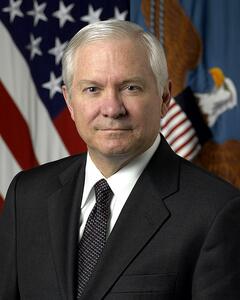
Spencer Bakich
Good morning, Secretary Gates. We’re grateful to you for agreeing to a second interview. Perhaps in our first order of business today we can talk about the [Barack] Obama administration’s approach to Afghanistan, the ebbs and flows of the discussions that you folks had over the term of your Secretaryship. Perhaps a good place to start would be to get your reflections on how you assessed the strategy, the approach, that the administration inherited from the [George W.] Bush administration.
Robert Gates
In the Bush administration, the NSC [National Security Council] had done a review of Afghanistan and where we were, and it involved an acknowledgment that because of the surge in Iraq, we had not been able to provide much additional in the way of forces to Afghanistan, and things weren’t going well.
The Bush administration received a request from the commander in Afghanistan for an additional 30,000 troops. This was late in the fall of 2008; in fact, while we were still working on that request, Obama was elected. I can’t even remember whose idea it was—whether it was mine or somebody else’s—but it seemed appropriate to communicate—I know Jim Jones had already been named National Security Advisor, so this had to be in December.
[Stephen] Steve Hadley, with the President’s approval, reached out to Jones and gave him a choice: either Bush could take the heat for meeting the troop request and ordering it, or we were willing to wait until the new President came in and let him make the decision. The word came back through Jones that Obama wanted to make that decision, so we held off on the requested deployment. By that time we had begun drawing down the surge in Iraq, so we knew that within months we would be in a position to send additional troops to Afghanistan.
Bakich
So for that troop request from General [David] McKiernan, as you understood it, what specific types of problems or objectives were those 30,000 designed to solve?
Gates
The key—because it really became an element of the timing—was to reinforce the forces that were already there with the Afghans for the summer fighting season, but just as importantly, to provide enhanced security for the election in Afghanistan that was to take place, as I recall, in August.
Bakich
So then, over time—you wrote in Duty—that 30,000 seemed to be, at least for the administration, something significant. But there was some back-and-forth about whether the approval of 30,000 in the short run was going to be necessary, or a paring back. Was there a lot of give-and take-in determining how many to send early on?
Gates
In anticipation of that request—or because of that request that was on the table when the administration took office—Before approving it, Obama wanted to have a thorough review of our Afghan policy and strategy to see if we were on the right track and if those troops were necessary.
That review was led by Bruce Riedel. I’d known Riedel at CIA [Central Intelligence Agency]. He was a former CIA analyst and a superb Middle East analyst. I had a lot of confidence in Riedel and was confident he would do a good job. As I recall, overseeing that effort were Michèle Flournoy from Defense and [Richard] Holbrooke from State. Then—and I’m probably getting ahead of the story here—we came to Obama and said, “We actually need a decision on those forces before Riedel completes his study.” Of course, this totally upended everything with the administration. It angered [Joseph R.] Biden [Jr.]—This was when Biden was quoted as telling Obama that the military was trying to box him in, to jam him, to bully him, take advantage of him, et cetera. But from the military’s standpoint, the issue was a simple one of logistics. If you needed to get troops to Afghanistan by the summer in order for them to be there for the fighting season and also to enhance election security, you needed a decision in February.
Riedel’s report was supposed to take about 60 days, so it wouldn’t be done until late March. There were a number in the administration and in the White House who didn’t understand why the rush before the Riedel report was done. Frankly, it got the relationship between the military and the White House off on the wrong track. It wasn’t actually so much with Obama personally as with everybody else—maybe to a degree with Obama, but Mike Mullen and I spent a lot of time explaining to him the facts of life in terms of how long it takes to mobilize troops, get them ready to deploy, and then get them and their equipment in theater.
In parallel with that, Tom Donilon led a deputies committee scrub of the request for 30,000. It was reduced ultimately to 17,000, because, as they scrubbed it, it became pretty clear that that’s all we could get into the theater before the election. The other 13,000 of the 30,000 simply couldn’t be ready to go in time, so as they did that scrub, it reduced the number to 17,000.
That was the decision that came to the President, but because of having to have a decision fast, because of the logistics—and preceding the outcome of the Riedel review—it created a lot of ill will, and affected the chemistry between the White House staff and the military. I don’t think Hillary Clinton had a problem with it. Hillary was always pretty supportive of going forward with whatever the military was recommending in Afghanistan. It was really more the White House staff than anybody else.
Mike Nelson
Where were you in all this? If there is tension between the military and the White House, where is the Secretary of Defense?
Gates
I recognized the problem that making a decision that early on that size of deployment was a tough thing to present the President with so early and before the completion of the review. At the same time, I was in there pitching, along with Mullen, about why we had to do it, and if he wanted to have any influence at all on the election, or to make sure the election actually took place, we had to get those troops moving. I was very supportive. I had no problem at all with the reduced number. I thought the scrub was a good idea, a good thing to have done, but I was quite supportive of moving forward, for the reasons that McKiernan had outlined late in the Bush administration. At the same time, I was spending a lot of time [laughs] in the Oval Office explaining why we had to do what we had to do.
Bakich
Did you, at the time, have second thoughts, notwithstanding the talents of Bruce Riedel? Did you ever think it would have been wiser to have that review in house, perhaps make it a DC [deputies committee]-led initiative?
Gates
No. It was under the auspices of the DC, and it was overseen by senior people at State and Defense who were very close to their principals, so I had no problems with that at all. The truth is it probably got done a lot faster by putting it in the hands of Riedel than trying to work it through the regular bureaucracy.
Bakich
So the report came back, and in many respects it seemed to be much bigger in its diagnosis of the challenges and the scoping of the mission than perhaps the White House had been expecting, or at least the President and some of his key advisors and staff in the White House?
Gates
Yes. Here I’d started out with Bush in our early November meeting at his ranch, in my “job interview,” telling him I thought we had to narrow our objectives in Afghanistan. I argued all along that we needed to narrow our objectives—for all the reasons we talked about in our last conversation here—not try to build some kind of Central Asian Valhalla, narrowing our objectives to things that we could actually get done.
Then here came Riedel’s report recommending a fully resourced counterinsurgency. There was a lot of emphasis on additional civilian capabilities and on making the government less corrupt and ministries more efficient and responsive and so on. I can’t remember for sure—I haven’t gone back and looked at my book—but I think I was pretty clear to Obama that I thought that was a reaffirmation of nation building and was overly ambitious. But I thought the military recommendations were on the right path, and that was my lane, and I said that I supported the recommendations in the report.
Bakich
What did you get from the President about the scoping of the objectives from the Riedel report? Was he similarly concerned?
Gates
It’s hard for me to remember, and it’s been long enough since I’ve read his book that I don’t remember very well. I don’t recall him objecting. He asked a lot of questions, because he always did, but I don’t recall that he had any specific objections, and I think he basically accepted the Riedel report, probably in no small part because his own National Security Advisor had commissioned the report, and both the Secretary of Defense and the Secretary of State were onboard.
Bakich
So this term, “Afghanistan good enough”—is that something you used with the President?
Gates
Yes. I used it with both Bush and Obama. It captured everything I’d been saying: we needed to narrow our objectives. It flowed from [David] Petraeus’s experience in Iraq: as we improved the security situation pretty dramatically in Iraq and began to transfer missions to the Iraqis, my point—both with the Congress and with the administration and in the theater—was better that the Afghans do it themselves, even if they’re only half as good as we are, than to have us do it all. We had to begin the transition to them and give them the responsibility for carrying out some of these missions. We didn’t need to have all the bells and whistles of things that we insisted on having if we were doing it. That’s when I coined the phrase, “Afghan good enough.”
Bakich
So as the report came in, as the administration was beginning to think about how it was going to approach Afghanistan, you grew increasingly concerned—or maybe you had already been concerned—with the overall command performance in Afghanistan, specifically General McKiernan. I’m curious: you mentioned in the book that there wasn’t anything specific that McKiernan did or didn’t do, but you were concerned about his flexibility.
Gates
It really started with reports coming back to me from visits by both Admiral Mullen and by Michèle Flournoy. There was one specific thing that troubled me a lot, in addition to some of the things they brought back: the job of the ISAF [International Security Assistance Force] was not only a military job but it was also a diplomatic job.
Half the NATO [North Atlantic Treaty Organization] countries had troops deployed there, along with Australians and others, so he had ambassadors in Kabul from all those countries wanting to see him. Every time a Foreign Minister or a Defense Minister from those dozen or 15 countries would come through Kabul, he had to see them. He was dealing with the politicians in the Afghan government and dealing with [Hamid] Karzai all the time.
He was probably taking at least half his time doing diplomatic things, so I wanted to appoint a deputy commander who basically would run the military campaign, who would be full-time paying attention to the military campaign, reporting to the commander. Dave didn’t want any part of that. He resisted it firmly, and I felt firmly that it was something that needed to be done so that we had a commander who wasn’t spending half his time sipping tea. He resisted that.
There were some other smaller structural issues that concerned me, and there were also some larger structural issues that I had issues with in Command and Control. For example, the Marine contingent in the south, in many respects, didn’t report to him; it reported back to CENTCOM [Central Command]. Then there were different reporting lines for some of the SOF [Special Operations Forces] units. There was no unity of command.
One of the things I wrote about in the book was that I was a year and a half late coming to the realization—or taking action to correct—this divided command: the fact that the ISAF commander didn’t have control of all the U.S. forces under his command. There was a lot of resistance to that, as well. It was the Command and Control problem; it was the need for a full-time commander. I didn’t think Dave saw the need for those things.
There were some other things I can’t remember that Flournoy and Mullen brought back to me that led me to believe I’d made a mistake in naming Dave. His whole experience had been mainly in Europe and preparing to fight the Soviets. He was a great commander and a good general, and when his name had come up—This was a basic flaw I wrote about eventually in Duty—The military had a structure where, instead of putting forward who they thought would be the best commander, it was, “Whose turn was it to be in command next?” McKiernan’s number came up, and he was recommended by Mullen and by George Casey. Everybody I talked to thought he was a fine general and would do a great job.
In World War II, [George] Marshall moved generals around all the time; being relieved in one place, a lot of generals would go on to great success someplace else. But today’s army has moved in a direction where if you’re relieved of one assignment, it’s basically a career ender, so in relieving McKiernan I, in fact, was ending his career. I’ve always been a big believer in doing these things face-to-face, so I flew to Afghanistan for the sole purpose of sitting down with McKiernan and telling him I was going to relieve him. He responded with extraordinary class, and, in fact, in his retirement ceremony, to my astonishment, said publicly that I was the best Secretary of Defense he’d ever worked for. That made me feel doubly worse. [laughter]
As far as I was concerned, I told Obama, “This one’s on me.” When Bush and I picked Petraeus, we moved him ahead of a number of other people because we thought he was the best person to run this operation in Iraq. I should have done the same thing in Afghanistan when McKiernan was appointed.
Bakich
Do you attribute in any way the difference in tapping Petraeus versus the way you tapped McKiernan to the way Iraq sucked all the oxygen out of the room, that Iraq took bandwidth, Iraq took resources, Iraq took the attention of policy makers? Is there something to be said for that?
Gates
I don’t think so. By that time, the Bush administration had gotten things well enough under control in Baghdad that we really had turned our attention to Afghanistan, hence the review in the Bush administration and the recommendation for additional forces.
The only thing that confronted me was—as I told my wife when I was going up for confirmation—“They want me to be Secretary of Defense. Bush has just lost control of both Houses of Congress, and we’re in the middle of two wars, both of which we’re losing. What could possibly go wrong?” [laughter] We were at war every single day I was Secretary, which is kind of the point of Duty. But I don’t think—by the time we were dealing with either appointing McKiernan or relieving him—that Iraq had had an impact.
Barbara A. Perry
This is a follow-up to your description of civil/military relations: your example of the World War II culture of the military, how generals were moved around and put in the best place they could go, and then your description of the difference in how the Army was operating at this time. It sounds like you and the President were able to move around that culture to get David Petraeus moved up ahead of some people who were ahead of him. Is there a way for the Secretary of Defense, except on a case-by-case basis such as that, to shape how the Army’s culture has developed, or do you just have to go with it and try to work around it as best you can?
Gates
Change in culture of that kind takes a long time. Going back to a point I made in our last session, I’ve been gone 11 years, and Lloyd Austin is the 11th Secretary or Acting Secretary of Defense. There’s no way you can change the culture of the building with people who last a year or two, or even three. The Secretary just has to take it on himself to say, “I don’t think this is the right guy.”
The truth is the Chief of Staff of the Army might push back, but if you say, “I’m not going to appoint him,” they’ll go find the person you’re looking for. They’ll push back, but they will also salute and do what you tell them to do. That’s why I say that one’s on me.
Stefanie Georgakis Abbott
How did President Obama respond when you went to him and said, “This one’s on me”? What was his reaction? What was that conversation like?
Gates
He understood. And I will say this about Bush and Obama: I think they both were impressed by my willingness to make senior-level changes if I felt they were needed. Very, very few of my predecessors were willing to do that, particularly absent some kind of a scandal or dustup of some kind, but not just whether it was not the right person or they were not doing their job well enough. They never second-guessed me, and at that level they’re all Presidential appointees; I never had either one of them even question my decision to make a change.
I told Obama, “Look, I recommended this guy to President Bush because he was recommended to me by Casey and Mullen. But I’ve decided that I made a mistake in accepting that recommendation. Dave is a great person and a great general, but he’s not the right man for this job.” I don’t recall Obama ever second-guessing me or saying anything about it.
Bakich
I don’t know if this is necessarily the right time to ask this question, but I’ll go ahead and do it anyway: the recommendation that you and Secretary Clinton made to not have Doug Lute remain on the NSS [National Security Strategy], though, didn’t necessarily carry water.
Gates
Hillary and I never understood that. It’s pretty rare for somebody in that kind of position to survive having both the Secretary of State and the Secretary of Defense calling for him to be fired, but despite all of our complaints to Jim Jones and then to Donilon—and I think we both raised it at one time or another with Obama—it was clear that Obama wanted to keep him, whatever the chemistry between them, whether—
Ironically, Mike Mullen and I basically had to twist Doug’s arm hard to get him to take the job in the Bush administration; he saw it as diminishing his chances of ever getting a fourth star. And he was very easy to work with in the Bush administration. We had a very collaborative relationship. When he stayed on under Obama, the character of it changed, and Lute became much more of an adversary of the Pentagon. We were getting a lot of information about him raising doubts and questions in front of the President and Donilon about the military being unwilling to bend to the President, being unwilling to come up with all the options that the President was looking for. It became a very adversarial relationship.
I’m trying to read motives into Obama, which is probably a mistake, but I suspect Obama—probably at Biden’s urging—thought that Lute was valuable to have in house to push back against the Pentagon, to give them an independent military assessment of things that were going on.
Perry
Do you know, though, why Lute changed?
Gates
I think it ended up being one of these reciprocal things: the longer he was at the White House, the less likely it was he was going to get a fourth star. And the more he began to question the military, the less likely it was he was going to get a fourth star. So he basically reached the point where he had nothing to lose by being an opponent, if you will, of what the military was coming up with and what the military was doing.
Perry
There’s a description political scientists use for another possible answer—that sounds like, certainly, a plausible one—the person “goes native.” He stayed too long in the White House culture. Could that have been part of it? Did you ever see that happen with others?
Gates
Oh, yes. I saw it happen all the time, and in some ways it started to happen to me. I was there through the end of the [Richard] Nixon administration, then all of the [Gerald] Ford administration, and three of the four years of the [Jimmy] Carter administration. Hell, when I went back to CIA, I thought I ought to be running the show.
After you’ve been hobnobbing with the President and the Joint Chiefs of Staff and the National Security Advisor, writing letters for the President to sign and talking papers for him to use with foreign leaders, going back to a cubicle in your home agency—whether you’re a lieutenant general or a CIA analyst—you’re thinking, What am I doing this chicken-shit stuff for after what I’ve been doing? It’s one reason why I’ve always thought—based on my own experience as well as watching others—there ought to be term limits for people from government agencies who are sent to the NSC or White House as staffers, because they get ruined, and it’s very hard for them to integrate back into their home agency if they have spent several years at the White House.
A perfect example is [Oliver] Ollie North. John Poindexter was another example, [Robert] Bud McFarlane. These guys all stayed too long. It does happen to people, certainly, but it was interesting that that transition for Doug seemed to me to take place within the space of about three or four months.
Bakich
How long did it take for General [Stanley] McChrystal’s name to come up as a potential replacement for General McKiernan?
Gates
I don’t think very long at all. We knew about McChrystal and what he had been doing in Afghanistan and how he had taken things to a new level in terms of the effectiveness of JSOC [Joint Special Operations Command] and the special operators and so on. I don’t remember exactly, but I suspect that Petraeus was a strong advocate as the CENTCOM commander of McChrystal. My recollection is that there was a general view that he was the right guy, and in contrast to McKiernan, this was his kind of war; he knew how to fight this kind of war.
Bakich
With the requisite diplomatic skills to go along with the hard-edged war-fighting capability.
Gates
One of the things that commended him to me was that there was more of a focus on the military skills and a little less on the diplomatic. He was OK on the diplomatic side—no concerns and no issues—but McKiernan had gotten used to the diplomatic side as head of U.S. Army Europe, because he was dealing with the Europeans all the time.
McChrystal was less experienced on the diplomatic side—That was not his strength—but he did fine in that regard. And I would say he’s the one commander Karzai totally trusted, and, jumping ahead, when it became clear that Obama was very likely to fire McChrystal, Karzai actually called me in person to plead McChrystal’s case.
Nelson
It sounds like the idea of having a deputy commander who would divide the labor, so to speak, with the commander, fell by the wayside?
Gates
No, actually, [David] Rod Rodriguez was appointed to that job.
Nelson
With that division of labor, one diplomatic and one military?
Gates
McChrystal still had to do some of the diplomatic, but I think he had more of a say in the shaping of the strategy and the tactics than Dave McKiernan had.
Bakich
So after General McChrystal was tapped and named the commander, you requested of him a 60-day review of strategy, top to bottom, although you say you rue the day that you asked for that. [laughter]
Gates
No kidding. I thought that with a new commander, ironically, it would improve the relationship with the White House to have a fresh look at the whole strategy to see if we were on the mark, and if we were accomplishing the mission. This is a piece I don’t think Lute and the White House ever fully grasped: when Riedel finished his report, and the deputies committee, taking that report, essentially endorsed it as a fully resourced counterinsurgency, that then became the new mission for the military.
What Lute should have understood, as a military guy, was that once you’ve redefined the mission, or you’ve given clarity to the mission, the military is going to go determine what resources are required to accomplish the mission they’ve been given by the President. That’s what, in essence, McChrystal went off to do: where are we? What do I need to accomplish the mission the President gave us in March with his approval of the Riedel report?
In all honesty, when I told Obama in March—or when he approved the 17,000—I said, “I won’t be back to you before the end of the year, and we’ll just see how this goes in terms of the strategy, with the added 17,000 troops.” The last thing I expected was to end up with a report in my hands that said we needed another 40,000 troops—actually, option one was 80,000 troops—and that just wasn’t going to happen. Anyway, I had no idea where it would come out.
Bakich
It’s a really interesting way that you framed it. Once the Riedel report was blessed, the American mission in Afghanistan was counterinsurgency, and McChrystal—
Gates
A fully resourced counterinsurgency.
Bakich
—and McChrystal ultimately said, “I agree with the mission statement; the problem is we’re woefully underresourcing a counterinsurgency.”
Gates
Yes. And, by the way, an important piece of the Riedel thing was that the civilian side was never adequately resourced. Lute was so busy micromanaging the military side of it that they didn’t pay nearly enough attention to what was required on the civilian side. Neither did Tom Donilon. The civilian side was never adequately resourced, and the truth of the matter is the State Department didn’t even have the resources to be able to fulfill the requirement.
There were a number of different sticking points. For one thing, unlike the military, the Secretary of State couldn’t make Foreign Service officers go to Afghanistan. Frankly, in all my years in government, I’d never realized how little power the Secretary of State had with respect to the Foreign Service. I thought it would be like the military or CIA: people say, “We need you to go to X,” and you salute and go. But that wasn’t the case. Both Condi [Condoleezza Rice] and Hillary had a tough time rousing the number of people.
Another source of difficulty was I did a survey in the Department of Defense and came up with a couple of thousand people who had some, if not all, of the experience and training needed to do some of the State Department tasks. I’m talking about civilians, not military. I offered them to Hillary, and nothing ever came of it. The line that came back from State was, “Well, they’re not really fully trained and prepared to do this.” My reaction was, “If they’re only half as good, and I get you 500 people, that’s 250 people you don’t have now.” They never took a single person. We were just so screwed up as a government. I wrote about Tom Vilsack calling me and offering 70 ag [agriculture] experts to go from the Department of Agriculture. He had the people identified, but he had no money to send them. I couldn’t provide the money to send them, so they never went.
There were just all kinds of things like that. There were never enough civilians, and most of the civilians who did go ended up staying within the confines of the Embassy compound in Kabul. They weren’t out in the field. I compared the way we were structured in Afghanistan to one of those late 19th-century bicycles: it had one gigantic front wheel—that was the Defense Department—and two tiny little back wheels, and that was the civilian side. It was all out of balance.
Perry
What would the difference have been if there had been a modern bicycle with two wheels of the same size?
Gates
Given the ambitions of the strategy, it probably wouldn’t have made much difference. But if we had narrowed the strategy and focused on just two or three ministries—Defense, Interior, and Finance—and if we had focused on specific provincial leaders and provincial centers, and we adequately had advisors in those specific places, it might have made a big difference.
But even if they had been able to get significantly more people, the scope of the ambition of the strategy was so great—I think greater than the President understood, in all honesty. I don’t think the White House fully understood the magnitude of what the President had approved. Biden may have understood it because he was just opposed to sending any more troops. But I don’t think the others in the White House, including Lute, understood that when McChrystal looked at what the President had decided, certain things followed automatically.
Perry
So was it somewhere in the objectives between “Afghanistan Good Enough” and, as David Petraeus said, “Afghanistan becomes Switzerland”? Somewhere in between where we were trying to be, was it just never going to be able to happen, even if we had put all the resources at the command of the United States in both military and civil numbers, just because of Afghanistan being what it was?
Gates
The way I framed it for Obama several times—including a couple of very personal, very private memos to him—was that our objective should have been limited to an Afghan government that could defend itself against the Taliban and prevent al-Qaeda from returning, period. That was an achievable mission, and that’s what we should have been focused on. Once the security situation had improved in the county, then the rest would be the work of a generation or two. That’s what we needed to do, and the record is clear in the memos I sent him that that’s what I thought we ought to do. We never were able to pare it to the bone like that.
Bakich
Within that narrowing of the scope, and reflecting on your determination to think and stay within the lane or the confines of the military component, what were you looking for the civilians to provide? What kind of capacity?
Gates
The strategy was to help them develop a less corrupt government that paid more attention to the needs of the people. Some of the objectives were, for example, providing an improved health care system that had some kind of a clinic or medical capability within a day’s walk for the Afghans; trying to wean them away from drug production to regular agricultural production; improving their herds, things like that. These all require very highly specialized people, but the problem was that the civilian side—I’ve written about this a lot—never got its act together.
First of all, there were probably 50 to 100 NGOs [nongovernmental organizations] active in Afghanistan, in addition to a couple of dozen countries, on the civilian side, the development assistance, these civilian projects. Nobody knew what each other was doing. You would have the Danes in one province and the Brits in the next province, and they weren’t sharing what they were doing. You might have a road in one province coming up to the border of another province, and the other province road comes here, [gestures, laughing] because nobody’s talking to each other.
That was why I so strongly supported the appointment of Kai Eide as the UN [United Nations] Representative. I told Kai, “I’ll give you people, and I’ll give you computers and everything. You have to figure out a way to have a central database so we know who’s doing what and what’s working and what’s not working.” We never got to first base on that effort. Eide worked at it but had no ability or authority to compel anybody to cooperate with him.
The same thing was true for the U.S.: all too often for our projects we told the Afghans what we were going to do instead of asking them what they needed. We’d build a schoolhouse, but nobody thought about where the hell they were going to get a teacher. We just had all of these white elephant projects, because they hadn’t been thought through long term, and there was no cohesive or coherent strategy across provinces or districts on how to get these things done and what the Afghans wanted or needed.
Sometimes all they needed was an all-weather road, or a well, or something like that. I was sympathetic with Karzai’s complaint that he didn’t know what was going on in his own country. We didn’t know what was going on, so why should he? The role of the civilians was in all of these development assistance projects, in addition to helping them with governance and finance. I think it was just unrealistic.
Hillary and I talked about it in the Situation Room. Nobody was willing to take action to address the problem we identified, which was the degree to which we were the source of corruption. With the billions and billions of dollars washing through that country—a lot of it in cash—it was sticking to a lot of fingers. That was American government money, or military money, or civilian money.
And what’s worse—Hell, we were one of those suborning these officials. We were paying them on the side, and then we’d go in and complain to them about corruption, that some provincial leader had sticky fingers. We’re talking to a guy who we’re paying millions of dollars, and they have to sit there and wonder, What the hell are these people smoking? [laughter]
Nelson
When you told the President that you thought the 17,000 was going to be enough, you didn’t expect to be back with another request that year. Didn’t the appointment of General McChrystal make it clear that that wasn’t a promise you were going to be able to keep?
Gates
No, because I thought that McChrystal was going to bring a focus and a change of tactics to the fight that would put us in a better position. Nobody was telling me when we appointed him—and he didn’t, when he got his appointment—that he thought a bunch of new troops were going to be needed.
Nelson
It didn’t take long, though, before he was asking for several multiples of 10,000. When did you become aware that was in the pipeline?
Gates
I can’t remember exactly when he showed up, but I think it was early summer. I gave him a task on this review before he ever went out. I said, “You need to take a look top to bottom and see what needs to be fixed.”
There were a bunch of things, tactically. I was very concerned about the way we were treating Afghan civilians. Our convoys would barrel down the road and scatter people and their flocks, people having to jump out of the way, being pretty disrespectful. I got enough anecdotes about stuff like that that I was concerned. A set of rules about how to treat civilians and how to avoid innocent civilian casualties was put in place at the top. But because every commander at a subordinate level wants to operate well within those rules, if the rule is 100 percent, or if what’s asked for is, let’s say, 50 percent of something, then the next commander will make sure it’s 60, and then the commander below him will make it 70. So we were beginning to have a morale problem with our troops, because they felt like they were being exposed to much greater danger because of these rules.
There were a bunch of things like that, in addition to the progress of the strategy the President had approved in March, that I wanted McChrystal to take a look at.
Nelson
It’s interesting that the way this culminated was eventually Obama said, “Here are the resources you have, and here’s how long you’re going to have them. You make it work.” That was what led to the West Point speech, wasn’t it?
Gates
Well, yes, that skips a lot. [laughter] Mullen came back from a trip and hustled into my office almost right off the plane and said, “I have some bad news for you: McChrystal’s going to ask for 40,000 more troops.” I said, “Holy shit! Where did that come from?” [laughter] I was totally flummoxed by the size of that request. When I got that word, I made a secret trip to an airfield outside NATO headquarters in Belgium to hear from McChrystal directly and also to let him know why I thought that was an impossible ask, and why I didn’t even agree with it myself.
The one mildly amusing thing I pointed out in the book was that, at this small base in Belgium, we had a very plain conference room. We had all these four-stars in uniform—McChrystal, the Supreme Allied Commander in Europe, the commander of CENTCOM. There were probably half a dozen or eight four-stars in the room. I think the most junior staffer was a three-star. The poor enlisted guys who were trying to serve coffee were just overwhelmed by the presence of all these stars, [laughter] and the person they totally ignored was the white-haired guy in a blue blazer sitting at the top of the table. They didn’t know him from Adam’s off ox, and here were all these four-stars that had to be taken care of.
We went through it, and I laid out a lot of problems to McChrystal in that meeting. First of all, I’d always had issues with the size of our footprint, and what could you do with 40,000 more that you couldn’t do with the nearly 70,000 who were already authorized? Once the 17,000 were there, that brought us to 68,000 troops. I went through the footprint issue. I went through a whole bunch of issues related to Afghanistan.
Then I started in on the problems that this would cause in Washington, and why I thought it was highly unlikely I would be able to get anything like what he was asking for. We went back and forth, and he talked about why the footprint really wasn’t as important as I thought. I made no decisions and made no commitments in that meeting in Belgium. That was really information-gathering for me. Then when I came back, I had to tell Obama what was in the works, and he was as flabbergasted as I was. I said, “Look, I’m not making a recommendation to you at this point—I need to go through this—but I need you to know it’s floating out there,” because I didn’t want him to be surprised by a leak.
Then some things happened that really complicated my life. One thing that was helpful to me: Fred Kagan did an article that compared what we were doing, and why it was so different than previous conquerors, particularly the Soviets. I knew these things intellectually, because I’d been involved in the war in Afghanistan—I’d been the quartermaster at CIA as Deputy Director for the Afghan effort, beginning in 1986 to the end. But the fact that under the Soviets, five million Afghans had to flee the country; the Soviets had tried to bring about a social revolution by moving people out of the rural areas into the cities because they were easier to control that way; the terror, and the fact that they’d killed a million or more Afghans and littered the country with mines and things like that; and the difference between the way our soldiers behaved and the way the Soviet soldiers had behaved. It really was a powerful influence on me in terms of my concern about the footprint and the differences. I still had all the other issues.
At the same time, we were having all these meetings in the White House—I think there were nine altogether, and the shortest one was two hours. They just went on and on, and every time we’d finish, I’d think we’d answered all the questions, and then a whole new battery of questions would come up. It was sort of a Chinese water torture.
Then some public things happened that really, as I said, complicated my life, not just with the White House staff, but with the President. One was a speech McChrystal gave in London that, in essence, said, “The only way this works is if I get the troops I requested.” Then Petraeus gave an interview to Michael Gerson, the columnist, that was made all the worse by the fact that Gerson had been a speechwriter for Bush. Petraeus said the same thing: the President has to approve this; we have to have this. Then Mullen said the same thing in a congressional hearing.
The only one that was justifiable was Mullen, because when you testify in front of Congress, you have to tell them what you really think if you’re wearing a uniform. They make you commit to that as part of your confirmation process: what is your personal, professional opinion? All this stuff drove the White House nuts. Biden was beside himself, and I think every time he talked to the President, he was hammering the Pentagon. I can’t tell you how many times I sat on the couch in the Oval Office, reassuring Obama that this wasn’t an orchestrated campaign, that I’d remonstrated with Petraeus and with McChrystal. Mullen had had no choice but to answer the way he did.
I’m not sure I ever did convince him. Obama wrote about this in his book, and it’s pretty clear I never did convince him that this wasn’t an orchestrated effort by the military to box him in. Of course, Biden was hammering that point every single day. Sometimes these meetings in the Situation Room would get a little bit on the acrimonious side, as well.
So the examination of McChrystal’s recommendations was very difficult, and it was in the course of that that I wrote yet another memo to the President. A lot of what’s been written suggests that Biden was arguing to not have any increase in troops at all, and, in fact, maybe we should draw down some. In fact, Biden was proposing a counterterrorism strategy that would have added 10,000 or 20,000 troops, depending on his mood during a given meeting. We weren’t talking about staying at 68,000 or going lower; we were talking about a minimum of going up another 10,000. Sometimes Biden would propose 10,000 for counterterrorism and 10,000 more for training of Afghan troops.
At one point, if you took his top limit and what I was proposing, it was a difference of 10,000 troops, which was not that big a deal. As I wrote in the book, I probably should have been more aggressive in seeking him out and seeing if we couldn’t bridge that difference. We sat next to each other for all these meetings, and it was in the course of these meetings that he passed me a note that said, “Be careful what you recommend to the President, because he’s going to do what you say.”
My recommendation to the President—which, frankly, almost nobody agreed with—was more than the White House wanted. It was less than the military wanted; but it seemed to me that if we did 30,000 and then the President asked the allies to put in another 7,000 or 8,000, we’d be pretty much where McChrystal had asked in terms of what he needed to do the job. And that’s where we ended up.
I submitted the memo recommending that compromise while this whole process was still playing out, so in a way Obama and I sort of agreed—informally at least—what the number should be long before the recommendations came down, or it came to a vote, if you will, in the Situation Room. But in that same memo, I talked about the importance of narrowing the mission to what I just said a few minutes ago: be able to keep the Taliban at bay, keep control of the country, and keep al-Qaeda out, period. The irony is when the final decision was made, there was still another add for civilians, more civilian stuff.
Then the endgame, as you well know—Obama basically said, “I will agree to the 30,000, plus whatever the allies can do, but I’m going to start withdrawing in 2014.” Now, I’d argued against deadlines all during the Bush administration and up to that point in the Obama administration, because it basically just tells the other side how long they have to wait, but there were already complaints about endless war, and I could see Obama’s point. My response to McChrystal and to the military was, “Look, with 100,000 troops, if we can’t bring the Afghans to a point where they can accomplish in five years the security objectives that I’ve outlined, we never will. The President has given us five years to make this work, and if the Taliban think they can outlast us, fine, but we’re going to be coming after them hammer and tongs.” McChrystal was there killing people every night and every day.
I was willing to support that, but just to drive the nail in—and I suppose because of all the military chatter in the press—Obama called us in, me and Mullen and Petraeus and McChrystal. I don’t remember who else, but there were four or five of us. We were seated in the Oval Office. We had this discussion: “Are you guys onboard with the decision that I’ve made?” Everybody said yes. Then he went around the room, starting with Mullen, who was seated on his left on the couch, and he pointed to each individual. “Are you onboard with this? Are you onboard with this?” McChrystal, Petraeus, and ultimately me.
Then Biden piped up and said, “And you can consider that an order.” Obama said, “Yes, that’s an order.” That was a big mistake. I think in the four and a half years I was Secretary, I never told anybody once, “That’s an order.” It’s just implicit in the American military. If you say, “This is my decision,” people go off and do it. Colin Powell wrote about that in his book, about how you never give an order like that. It’s not the military way.
It was in that discussion with all these leaks, these public statements, that Obama turned to Mullen and me and said, “Why this insubordination? Is it because I’m so young? Because I never served in the military? Do they disrespect me?” That was a pretty tough conversation. Of course, I gave him all the appropriate assurances and went through my litany, again, about this isn’t a cabal; this isn’t people orchestrating opposition or anything. All of that led to the speech at West Point.
William J. Antholis
I have so many questions, but I don’t want to divert. The one thing I would ask as a way of dialing back, you were starting to get at. You were managing up to someone who was very policy-focused and specific in his interests on different pieces of it, but you also had an issue of trust—him trusting you, and you trusting him. I wonder—particularly with hindsight and now a decade of looking back at these kinds of decisions—how conscious were you of that, of both his policy specificity but the general relationship that you had and were trying to manage?
Gates
I never doubted—based on his memoir and other things that I’ve read—that he trusted me. As he wrote in his memoir, he felt on a number of occasions that I was trying to manage him, and that’s probably true. [laughs] But I never doubted his trust in me. Had I, I probably would have left. If he had lost trust in me, I think he would have caused me to leave. But there were a lot of negative forces at work, particularly in the White House. Hillary couldn’t have been more supportive. Hillary was supportive of McChrystal’s 40,000, and she only supported the 30,000 because I recommended it. She made that very explicit in the Situation Room: she was all in for McChrystal’s 40,000.
Of course, it’s a totally different subject, but she had a very difficult relationship with the White House, in terms of personnel at the State Department, in terms of a lot of different things. She had a lot more problems with the White House, frankly, than I did. She was very supportive. I never had any doubts about Obama’s trust.
Perry
He did say, very diplomatically, after praising you in his memoir, that he had to think about the politics of all of this. And we are talking about a first-term President who hoped to run again and be reelected. Is that fair, that he had more burdens there?
Gates
Yes, totally, and at times I would say, “I know you have other issues.” I was particularly mindful of that on Don’t Ask, Don’t Tell, of the domestic politics at work inside the Democratic Party. Even as we differed on some things, I would try to take steps that gave him some ammunition to use with the activists: elevating the level at which an action could be taken against a gay service member, for example. By the time I was done, the only person who could take an action against a gay service member was the Secretary of the service. I’d elevated it from the unit commander to the Secretary of the service.
The numbers dropped over the space of a year from something like 13,000 against whom action was being taken, down to a hundred or fewer; it was almost not done at all. That was my effort, acting as I thought I could within the law, to make it easier on Obama to go back and say, “Look, we’re making this harder and harder to do, and on the path to getting rid of it altogether.” I’d been around the White House long enough to know that every single foreign policy decision has a domestic political aspect.
As I wrote in Duty, I thought that in the Obama administration, those domestic political issues were more evident in the discussions in the Situation Room than they had been in previous administrations that I’d worked for. Biden would bring them up more often than the President would. With the second tranche of troops in late 2009, Biden said, “Congress will never go for it. Congress will never buy it. They’ll be totally against it.”
One of the few things that he and [Richard] Cheney had in common is they both would say the base won’t buy it—Cheney would say the Republican base, or Biden would say that Democrats won’t buy it. On every occasion that I remember, they were both wrong. To a firm decision by a President, the President going all in on it, the Congress will bow, because they refuse to take responsibility for denying something the President says is in the national security interest. They hate taking responsibility for things, so if the President’s steadfast, he will get his way. I was right in those respects.
Another one was the cost. How could I explain spending another $40 billion, or $50 billion, when we had all these other needs? I was also mindful all this time that he was managing a gigantic economic crisis in the United States at the same time. Yes, I was mindful of all those things, and where I could, I tried to help him.
Perry
Based on your very close analysis and observations of then Vice President Biden’s persona and personality, what prompted him to make the comment, “That’s an order” or “This is an order”?
Gates
I think it was just his attitude toward the military in general. This began back in February when he was coming back from a trip overseas and was told about the desire to get these 17,000 troops moving. That’s when he was telling the President, “They’re trying to jam you; they’re trying to box you in.” He had a negative attitude toward the military from the very beginning.
Bakich
In December of 2009, after the decision had been made, you made a trip to Afghanistan, and you had an opportunity to meet with somebody who also had domestic politics on his mind: Hamid Karzai. From that trip in particular, did you learn anything new about Karzai? Did you get an insight into how he was thinking the future was going to unfold?
Gates
Particularly on the Washington front, I probably had the best relationship with Karzai of anybody. Everybody else would go in with a list of demands or requests or concerns, and I would always start the conversation asking him about his young son. Then I would say, “What can I do for you? What’s on your mind?” And it was off to the races.
The problem, in my view, was Karzai never went public with a major issue between us and him and his government until after he had raised it privately many, many times with Americans coming to see him. The whole issue of civilian casualties, the use of dogs, night attacks: these things were all on his mind, and they all, in my view—his not knowing what was going on in his own country in terms of projects and various other things—every one of those that he raised with me I took back to Washington, because I thought he had a point. I think he understood that I was probably his only advocate who didn’t wear a uniform in the government, so I had a pretty good relationship. One time we were talking about one of these issues, and he said, “Look, I know I have many, many flaws, but I know my country.” I said, “Yes, you do, and we don’t.”
Bakich
Did you ever talk to General McChrystal about night raids? He was the master of night raids. Was that anything he was going to bend on?
Gates
No. No. I understood Karzai’s point, but that didn’t mean I agreed with him. But the use of dogs, the civilian casualties—The civilian casualties in particular: we had a process that just guaranteed it was always a problem for us. Every time there was a civilian casualty incident, or we thought there had been civilian casualties, or they alleged there had been civilian casualties, we would go through a long investigation before we paid the family any compensation. And the way bureaucracies go, each investigation would take months, so it just would build the anger over these incidents, whether they had happened or not, so, much to the chagrin of the commander at the time—and I don’t remember if it was McKiernan or McChrystal or whoever—I said, “Look, we’re going to change the policy. If there’s been an allegation of a civilian casualty, just pay the family. The cost to us in terms of strategic communications far outweighs the pittance of money that we’re going to give this family, so just pay them and be done with it.”
Of course, they didn’t like the idea. First of all, that kind of acknowledges that we did it, and sometimes we didn’t. But I said, “The cost is too high among the population for us not to do it.” That was an instance where I basically overruled the commander in the field. But there were some areas where I really thought Karzai had good points, and I brought them back to Washington. We had a good relationship, good enough that, as I mentioned earlier, he felt comfortable calling me to basically ask that McChrystal be saved.
Bakich
Finally, how concerned were you at that press conference when there was a bit of daylight between you and him on when the security transition would actually take effect? I believe he was trying to think in terms of 15 to 20 years, [laughter] and you were thinking in terms of two.
Gates
Yes. I don’t remember what I said, but let’s just say that in every press conference with Karzai, I had to be on my toes for the unexpected. [laughter] He never had a script.
[BREAK]
Bakich
With respect to Afghanistan, there are three topics that would naturally lend themselves to your consideration: General McChrystal’s relief; the [Osama] bin Laden raid; and then the discussions and review that came toward the end about withdrawing the surge and reevaluating the strategy. That’s in Afghanistan. We have whatever you’d like to say about China and Russia, at interesting times, and then perhaps Libya. I give that to you as a menu of options: if there’s something there you think is particularly important, it’s your oral history, so we would definitely like to take your lead.
Gates
Let’s just try and go through them all.
Bakich
We’ve come to June 21, 2010, when Rolling Stone’s publication of General McChrystal’s and his staff’s comments came out. I can only imagine that this was filtered through the White House in the worst possible way, so I wonder if you could tell us how you heard about this and what your initial reaction was.
Gates
Mike Mullen called me, and said, “There’s this Rolling Stone article out, and it’s a real problem. It has McChrystal saying things about Biden, and so on. It’s pretty ugly. I’ll bring it up to you.” He brought it up, and I read through it and realized it was a disaster. I can’t remember whether McChrystal called me or I called him—I just don’t remember—and the unexpurgated version of the conversation was pretty simple, from my end. It’s one of the few times when I ever swore at somebody. In fact, I think it may be the only time I ever swore at anybody in the four and a half years I was Secretary. I said, “Stan, what the fuck were you thinking?” All I got was, “No excuses, sir.” It was like he was a cadet back at West Point: “No excuses.” I said, “Stan, give me some. The White House is going to erupt over this. It’s going to be crazy. Just help me understand. Give me something that I can use to defend you, or to help explain this.” Nothing, no excuses.
I hung up, and then I got a call from Biden, basically saying, “I understand how these things happen.” He was very conciliatory, very generous, and he wanted to assure me that he had not raised Cain with the President about it, had not created an issue, had not wanted to do that and had not. I went in to see Obama alone the next day, and we talked about it, and I once again tried to get something out of McChrystal that would help me defend him.
I said to the President, “Stan is not offering any excuses. We don’t exactly know what happened, but I understand how upset people are, and it’s completely justifiable. I think you ought to recall him and chew his ass out, warn him that if it ever happens again he’ll be relieved, and let him go back to fight the war. Because if he leaves, if he’s relieved, I think we lose the war. I can’t think of anybody who can replace him who doesn’t have a long startup time in figuring out what’s going on in Afghanistan, and we can’t afford to lose four or five months,” at which point he told me that Biden was over the top on this, that he was outraged. Clearly Biden had lied to me about not talking to the President and not being angry. He said, “Biden’s been all over me about this.”
I’ve always suspected there were those in the White House, including Biden, who saw this as an opportunity for Obama to prove that he could stand up to the military, that he was truly Commander in Chief and was willing to make really tough decisions, and to show the military who was boss. Whatever the case, Obama then said, “What about Petraeus?” I said, “You know, he’s the one guy who could do this. He’s the one guy who could take this over without any lag time and continue to push the strategy forward, push the effort forward.” He said, “Well, I think I’m going to have to relieve him.” I said, “I understand.”
Bakich
As you were thinking about the possibility of Petraeus coming along, did you see the job of being commander in Afghanistan, ISAF commander, commander of American forces in Afghanistan, as being a more difficult, more taxing job, requiring greater range of skill sets, than, say, CENTCOM commander?
Gates
Yes. Well, I’m not sure I’d put it that way. I would say the need in Afghanistan was more urgent. I needed him more in Afghanistan than I needed him in Tampa, to keep the momentum of what McChrystal had started moving forward. I also had in mind the morale of the people in Afghanistan because McChrystal was so highly respected, and it was important to put a warrior they respected in as his replacement.
Bakich
Petraeus was clearly a known quantity to you; there was not a learning curve he had to go through. But I’m curious: how did you at the time think about Petraeus’s competencies, his up sides and his downs, as you were evaluating this option? What was your relationship with Petraeus like?
Gates
I had a really close relationship with Petraeus. He knew I had selected him. The President had suggested I look at him, but it was ultimately my decision to ask the President to appoint him as commander in Iraq. He knew he’d been jumped ahead of a bunch of peers, and we’d had a very close working relationship while he was in Iraq, and as CENTCOM commander. He’d been in the fight, but as CENTCOM commander, he also was the overseer of McChrystal, so he knew what was going on. He didn’t need to be briefed up. There was no lag time or catchup time for him to be on top of what was going on, what the strategy was, what McChrystal was doing, and so on. There really was no alternative.
Bakich
After Petraeus was tapped, or perhaps before it, did he give you any indication that he was planning to relax some of the rules of engagement with respect to targeted killings and the aggressiveness that he was going to pursue that mission?
Gates
No, that was after he became commander. I was hearing a lot, as I mentioned earlier, from our troops about the fact that they were being hamstrung and put at risk. It went back to if this is what the commander expects, then the next level is going to be a little more cautious, to make sure he’s well within the guideline, and then the commander below him will do the same, and so on. The way Petraeus dealt with that was he put out a set of guidelines that basically said, “Nobody is to fool with them. These are the guidelines: don’t do less; don’t do more. Do exactly what I’m saying,” trying to take away the flexibility of subordinate commanders to make the restrictions even more restrictive.
Bakich
Did you see a change in the effectiveness of the strategy with the change in commander?
Gates
Not particularly. Not that I can recall. There was a lot of continuity.
Bakich
At this point, then, as you were progressing through the surge forces as they were flowing in, you wrote and have spoken about how there was an early pushback by the Vice President—but also the White House staff and the NSS—to relitigate the surge decision relatively early.
Vice President Biden, in particular, was interesting on this, because, as you say, he was advocating for an increase in forces—less than you, but nevertheless an increase. But then by the time you got into the summer of 2010, there seemed to be a slight change in the calibration of who was looking to dial things back. The Vice President seemed to be moving into the camp where he wanted to pull things back. Did that pose a problem, from your perspective?
Gates
Mainly it was just a pain in the ass, and we always felt that Lute was driving this. I can’t remember, but one of the parts of the agreement was that we would evaluate how things were going once the troops got in. My recollection—and I may have this wrong—was that we would take another look at it in December, have a review of how we were doing, not to reopen the issue, but mainly to grade ourselves: How were we doing? But the NSS and Lute—probably supported by the Vice President—basically wanted to use that as an opportunity to relitigate the President’s decisions. It was very frustrating, and it was time consuming, but it didn’t produce anything.
Bakich
On the corruption issue, there seemed to be a determined effort by both you and Secretary Clinton to figure out ways that high-level corruption, mid-level corruption, low-level corruption could be dealt with. One of the sticking points, though, was the brick wall that was [Leon] Panetta. Could you clarify that? What were you hearing from the Director of the Central Intelligence Agency on the issue of keeping Afghan officials on the payroll?
Gates
That goes back to what I was talking about in terms of the earlier conversation on corruption and the responsibility the U.S. had for a lot of that corruption: the contrast between what we were saying and what we were doing. I’m sure under pressure from the clandestine service, Panetta was essentially making the case that these were sources and agents, and of value, and they needed to continue doing what they were doing.
Bakich
The ultimate review began, then, in January 2011. The topics on the table were the pace of the surge withdrawal, presence after 2014. At what point did the President’s hard cap of 101,000 troops enter the picture? Was that part of the initial surge decision, or did that emerge throughout the summer of 2010?
Gates
No, actually, my recollection is that when he made the original decision, as part of the negotiation I had—having been burned on the question of enablers before—I said, “I need some flexibility.” Part of the debate in the fall was that I had gone to him—The commanders really were short of med evac [medical evacuation] capabilities, some maintenance capabilities, some logistics capabilities, so I had fairly urgent requests from the commanders for probably 6,000 or 7,000 additional enablers, but there was just no give on Obama’s side on that, so when the final decision came down, it did have the caveat that there could be up to 10 percent wiggle room—that 30 could become 33, if you will—but that was it, and Obama made it very clear early on that that was the extent. That was it. The result was that, because we were operating under the cap, it required an enormous amount of bookkeeping in the Pentagon to stay below it, and sometimes we were sending less than whole units. It was a very complicated business.
For example, in the First Gulf War, [George H. W.] Bush 41 never put a number. Whatever the generals thought was necessary, Bush was going to approve. There’s a lot of controversy about [Donald] Rumsfeld’s decisions on troop levels in Iraq, and so on, but my impression is that as far as Bush was concerned, Rumsfeld could do what he wanted. If he wanted more, he could have more. But in this case we had a hard cap, and we spent an enormous amount of time and energy working to stay below it. There was a lot of resentment in the Pentagon over how much time that effort took, and, frankly, the gyrations we had to go through in terms of partial units and this, that, and the other thing to stay below.
Bakich
Did you ever talk about that cap with the President throughout the year?
Gates
Oh, yes.
Bakich
And you got no flexibility from him in subsequent decisions.
Gates
No, and I didn’t expect any.
Perry
We talked before lunch about the politics that always pressure a President, particularly domestic politics. We were now into 2011, and he was facing a run for reelection in 2012. As you said, in the earlier part of the administration, the first term was dealing with a massive financial meltdown. I feel certain that he didn’t raise that explicitly with you about the oncoming reelect, but I’ll ask you: did he? Or did you get that sense from other people in the White House? How did you deal with that?
Gates
No, I always felt that the hard line on this was coming out of the national security staff and pressure from Biden and Lute, that it really was less about domestic politics and more resentment, if you will, that the Pentagon won the argument in the fall of 2009.
Perry
You were not getting the sense of worry about how the American people were looking at this war, this endless war, perhaps?
Gates
No.
Nelson
Did it make any difference in your tenure as Obama’s Secretary of Defense that the Republicans took control of the House in 2010?
Gates
No, not really. I’ll just share one anecdote with you. The Republicans who took over the House Foreign Affairs Committee were, shall we say, more on the crazy side than any of the other committees I had to deal with—the Armed Services Committee, for example, or Appropriations. There was one hearing where—It was actually Condi’s committee, but they wanted to talk to Condi and me and Mullen.
We were sitting at the table—Condi’s on one side of me, I’m in the middle, and then Mullen—and the questions were so outrageous and so insulting. About half an hour from the end of the hearing—because we imposed a limit on how long the hearing could go—I turned to Condi and said, “Condi, I’m done. I’m not answering another question. [laughter] These people are idiots.” And I didn’t. For the last half of the hearing, if one of the Members addressed a question to me, I pointed either to Condi or to Mike. I shut down.
Antholis
It’s a terrific moment with the changing of the House at the midterms. Could you talk a little bit about that change in the Republican Party? In our last conversation, you talked about the moment during the transition when you were asked about your political affiliation, and you came up with a very nuanced answer: you were not registered in either party, but you always thought of yourself as a Republican. At this point, as the parties were polarizing—both parties, but particularly to what you just said about the Republican Party—were you thinking about your own political affiliation, and who and what you were? How were you thinking about the political parties and the state of the country?
Gates
No, not really. In fact, I would say the longer I was Secretary, the more I wanted no affiliation with any of them. [laughter]
Antholis
But really, truly now, as someone who had gone from being a career public servant to a statesman, who had run the two major defense and national security establishments other than the State Department, were you wondering whether the country was coming apart in an unhealthy way for our national security?
Gates
I had been seeing that for a long time. I saw it as a continuation—In my view, the breakdown really began with [Newton] Newt Gingrich in the early ’90s. I had watched from a distance, because, particularly under Bush 41, there was still a lot of bipartisanship and a lot of respect for the President. That didn’t mean people were going to agree with his policies, but there was a lot of respect on both sides of the aisle for him as a person and as President. I saw it really begin to get bad under [William J.] Bill Clinton, with Clinton and with Gingrich. For me, what I saw as Secretary was a progression of what I had been seeing for 13 years.
I will say this, and it’s perhaps an immodest thing to say. By the time the Republicans took the House in 2010, frankly, I was incredibly well treated by members of both parties the whole time I was Secretary. I never had to deal with this in a personal sense, and that probably shielded me a little bit or made it unnecessary for me to worry very much about it.
The people who ran my committees were sensible, thoughtful people, who were, I thought, mainly looking out for the interests of the country. They were very political, but in Armed Services when I became Secretary, it was John Warner and then Carl Levin and [John] McCain when the Republicans lost the Senate in 2006. It was [Isaac] Ike Skelton in the House, and it was [Theodore] Ted Stevens and [Daniel] Dan Inouye on Appropriations. I really was shielded from the real crazies in both parties, so it was not a big factor for me.
Perry
Those people you named are the old guard, now that we look back, right?
Gates
None of them could probably get the nomination of their party at this point.
Bakich
Probably now is a good time to draw our attention to the bin Laden raid. It’s clearly a topic that’s been written about extensively—You wrote about it in Duty. One of the interesting ways we can tackle this is—You were mightily concerned that any action to get bin Laden was going to have a catastrophic effect on our relations with Pakistan, and, then, of course, how that would relate to the Afghanistan war. Is this a reflection of just how badly the AFPAK [Afghanistan-Pakistan] initiative went, that Obama announced early on?
Gates
I was always pretty skeptical that we were going to make any headway with the Pakistanis in any meaningful way. I’d gone to see [Pervez] Musharraf right after I became Secretary and gave him a to-do list, and he never did anything on the list. The Pakistanis were clearly playing both sides of the street on a continuing basis.
Once the CIA concluded that they thought they had located him—and it was pretty iffy—the President went around the table at the end of that discussion to the CIA people, to the analysts who were there to be quizzed by us, and basically said, “So what is your estimate of the odds he is in that house?” It ranged from 40 percent to 80 percent. The President basically said, “It’s a 50/50 crapshoot any way you look at it.”
There were three options being considered. One was the raid, and I had total confidence in Admiral [William] McRaven and in the team. I guess I told the President that I was cautious, and the reason I was cautious was that I had been sitting in that same Situation Room exactly 30 years earlier for Operation Eagle Claw and saw a catastrophe happen. I was very open about it in the discussions in the Situation Room. I said, “Mr. President, I think one of the things you have valued of my being here is my experience, but in this case my experience may be an obstacle to your doing the right thing, because it may have made me too cautious. All I can think about is the failed raid on Son Tay in Vietnam, the failed raid, Operation Eagle Claw, and a couple of others that have gone wrong, and how rare it is that they go right, so I want to warn you: I think I’m being too cautious.”
The three options were the raid—which, again, I had no doubt could be carried out successfully. The second was a bombing raid, and, of course, the Air Force came up with options that basically involved dropping about 30 bombs, which would have leveled that part of Pakistan. And then a drone that would be very precisely targeted.
Nobody supported the bombing raid. General [James] Cartwright was probably the most ardent advocate of the drone, but it was untested, and there were concerns about it. But I thought that was the best option. Of course, the main reason that CIA and others wanted the raid was so they could collect all the intelligence at the site, and so they would have proof that they had killed him.
As the tradeoff, my view—at least through a good part of the discussions—was that you could balance the risk to the war in Afghanistan best with the drone strike. Yes, you wouldn’t have the proof you’d killed him, but you’d know eventually. But in the back of my head, I thought that was mainly for PR [public relations] purposes. They wanted to be able to brag that they’d gotten him, and they wanted to do it with confidence. I thought the drone was a way to kill him but do minimum damage to our relationship with Pakistan.
We had just had a CIA guy arrested in Pakistan. It took a lot of pressure and a lot of diplomatic coinage to get him out of the country, so the relationship was already on tenterhooks, and I was desperately concerned that they would shut down the pipeline from Karachi to Afghanistan and we would lose the war, in essence, overnight. That was my basic position.
After the final meeting, Michèle Flournoy and Mike Vickers came to see me and made a very compelling case for why we ought to go forward with the raid. I called Donilon and said, “You can tell the President I support the raid, so he can say it’s unanimous.” I don’t think Biden ever did do that, so he went on the record as the one person opposed to the raid. But I told Donilon that he could tell the President I was strongly supportive of the raid, and then, as they say, the rest is history.
Bakich
Was there a significant amount of diplomacy that you had to engage in—say, with General [Parvez] Kayani—after the raid?
Gates
Kayani, no, because Mike Mullen really had the relationship with Kayani. Mike spent a lot of time cultivating Kayani, so Mike was on the phone with him immediately after the raid, explaining what had happened, making the due apologies. Frankly, at least publicly, the reaction was not as severe as we had feared.
Bakich
Certainly that main supply route from Pakistan wasn’t negatively affected, or did you see friction there?
Gates
Every now and then they would just shut it down, but never for very much time.
Perry
At this point, did it cause you to begin to reassess the mission, knowing that last time we talked, last week, you had said, “Sometimes I thought maybe we should have just gotten out in January of 2002 when the Taliban was overthrown.” Now that Taliban was overthrown, bin Laden was gone, and certainly al-Qaeda degraded in Afghanistan, did you begin to think we should speed up the timetable, or now that we’ve made that the objective, let’s keep to the President’s timetable? Did it have any effect on how you were seeing the mission?
Gates
No. The death of bin Laden, particularly right in the moment, really had no bearing on what we were doing in Afghanistan. That was before we had been through all the intelligence materials and saw that he had continued to be active in providing operational guidance, but none of that really had anything to do with Afghanistan, so it really didn’t affect the war.
Bakich
Unless you have something in particular that you would like to add to the conversation about Afghanistan, I think we’ve done a fairly good job of getting through a lot of issues. I guess one way of segueing here is to ask: were relations with Russia about America’s military presence in Afghanistan at all a difficult relationship, on the mil-to-mil [military-to-military] side, or between you and the Defense Minister?
Gates
No. Actually I had the advantage during most of that period that Dmitry Medvedev was President of Russia, not [Vladimir] Putin. Putin had been President for about the first year and a half that I was Secretary, and we had a number of face-to-face encounters. But during this period, Medvedev was in charge, and, frankly, given the issues we were having with Russia over missile defense sites in Poland and Eastern Europe, I was a little stunned by the level of Russian cooperation.
While all this was going on, the Russians were allowing us to send military equipment across Russia on Russian railroads, and a hell of a lot of it. Even though they were creating problems for us at places like Kyrgyzstan with the Manas air field, they were letting us ship all this military equipment across Russia, which was really kind of extraordinary, and weren’t really giving us much of a problem at all, other than Manas.
With continuity, I knew relations with Russia were awful after the invasion of Georgia in August of ’08. I didn’t have any problem with the so-called reset. The business with the red button reconfirmed for me the dangers of using gimmicks in foreign policy, from [Oliver] Ollie North’s cake in the shape of a key, to a reset button that had the wrong translation on it, which I’m sure you’ve picked up on.
I felt about the Russian reset like I felt about Condi Rice’s initiatives with respect to North Korea: I didn’t see any harm in trying. I didn’t think it would work, but I saw no harm in trying. On Russia and China, the administration really was pretty much all on the same page. Afghanistan was really the only foreign policy issue on which there were significant differences of view within the administration.
But when it came to Russia, the only episode where there were real differences of view were when the FBI [Federal Bureau of Investigation] caught the sleeper cells in the United States. It really angered both Biden and Obama. It was like the FBI had gone out of their way to find something to screw up the relationship, because it was just before Obama was to meet with Medvedev. How do you handle this? Of course, the FBI and CIA wanted to make a big deal out of it, that they’d caught all these sleeper cells or identified all these sleeper cells.
I made a proposal that Obama and the group initially agreed to, and then after the meeting broke up I don’t know who—probably Biden and Hillary and some others—got him to change his mind. I wanted Obama, when he met with Medvedev, to hand him the list of people we’d identified as sleepers and tell him that it was hard to believe, in an era when they were trying to improve the relationship between the countries that he would allow that to go on. I wanted Obama to say that he was going to have to believe that Putin knew this was going on but hadn’t chosen to tell Medvedev, and therefore we held Medvedev blameless. It was an effort to try to split Medvedev and Putin. We would quietly then get these people out of the country, or Medvedev could pull them from the country. We’d leave it to Medvedev to get them out of the country.
Everybody thought they liked that, but then they went away, and it ended very quietly. The FBI basically wanted to do the perp [perpetrator] walk with all of them. [laughs] The only problem with that was there wasn’t any clarity that they’d done anything yet for which they could be arrested, because they were sleepers, so that was kind of a tough wrinkle. The FBI and CIA wanted to make a big deal of it, and it ended up being a very quiet exchange. In exchange for letting these people go home quietly, we got a couple of people out of Russia.
That’s the only episode in which there were real differences—and I had seen this before over more than 40 years. Every time there was a chance of improving the relationship, something would go wrong. There’d be a spy event; we’d discover that our Embassy was loaded with bugs; something would happen that would throw things off course. That’s how Obama and Biden saw this, and it was almost like they blamed the FBI for trying to screw up the relationship with the administration, so you had Biden and Obama wishing the whole thing would just go away, and the rest of the government figuring out how do we—with the FBI and CIA being the hardliners—and then Hillary and me in between. But that’s the only issue on Russia where there was really a difference within the administration.
Antholis
Can I ask you to dial back again? You started your career studying not just Russia, but the broader triangular relationship among the great powers. You were in an administration that kept talking about a pivot to Asia. I wonder if this is a good time to pivot a little bit, given how much time we have left: how were you viewing all of that, including Russia’s role in such a pivot, how that affected the broader geostrategic view of the administration and of the country?
Gates
The pivot came in the second term, after I left. The reality was the relationship with China really began to sour only after Xi Jinping came into power in 2013, so after my time. We were still dealing with Hu Jintao, and in January of 2011, Hu was going to come visit Washington in a couple, three weeks after my visit, and desperately wanted my visit to go smoothly, be full of pageantry, and make sure that the stage was set for a very successful visit to Washington, so the Chinese went out of their way.
They wanted me to go to the Great Wall, and they shut down the entire highway between Beijing and the Great Wall for my motorcade, and the banquets, and the whole shebang, military review, the whole works. The relationship with China still had not soured while I was Secretary. It really began in the second term with the advent of Xi Jinping.
Bakich
So with respect to China, do you have anything in particular to say about the Air-Sea Battle doctrine that came out in 2012–13?
Gates
My only concern relative to that—and I nearly had my head chopped off because of it—I had the temerity in a speech to the Navy League to suggest maybe we ought to rethink the mission of aircraft carriers. [laughter] You’d have thought I’d called for sinking them all. But that was really about it.
Perry
You mentioned your face-to-face meetings with Putin initially, and here you have a KGB person meeting with a CIA official. What were your assessments of him in those face-to-face meetings?
Gates
My first meeting with him was at the Munich Security Conference in February of 2007. That’s where he gave the speech basically blaming the West, and the United States specifically, for every wrong thing that had happened in the world that a lot of people are looking back on now. I think contemporaneously we saw it as a harangue, when in fact it was a harbinger.
There are two things about it that were vivid for me. One is, first of all, during his entire remarks, Putin was looking straight at me, because CIA, Department of Defense. He was also looking at the guy sitting to my left, John McCain. He got a very bad reception from the Europeans. The questioning was hostile. That was an audience that normally would have been very forgiving of a Russian leader and wanting to have good relations, but the questioning, because of what he had said, was pretty hostile.
When he finished, he came down off the stage. At the Security Conference, the first few rows of VIPs are all seated at long, narrow tables. I was at the front table on the left, on the aisle, with McCain next to me, and then Joe Lieberman and others. Right across the aisle was Putin, and then next to him, Angela Merkel; and next to Merkel, [Viktor] Yushchenko, the Ukrainian leader Putin tried to poison. When Merkel got up to speak, there was nobody between Yushchenko and Putin. And if looks could kill, the way Yushchenko looked at Putin—Putin never looking at him, just keeping his eyes straight ahead—was really quite extraordinary.
Putin came down off the stage when he finished, came straight to me, smiled, stuck out his hand, and invited me to Russia. I said, “OK, I’ll come.” But I went back—Bush, of course, had famously said that he looked into Putin’s eyes and glimpsed his soul or something. I went in the Oval Office right after my visit and said, “Well, Mr. President, I looked Putin in the eyes, and I saw a stone-cold killer.” I think he passed it off as some kind of old KBG/CIA thing.
Putin always treated me pretty respectfully, and I think it was because of the old KGB/CIA thing. I would push back on him because he’s basically a bully. Just one incident early on—again, this was in the Bush administration, actually, but it was characteristic of our relationship: we were talking about missile defense in Poland and Eastern Europe, and he had a map in front of him that showed the range arcs of Iranian ballistic missiles. It was all wrong, and it also looked like it had been done by a third grader with colored pencils and a compass. He pushed this map across the table at me and said, “This is the best estimate of our intelligence service on the range of Iranian missiles.” It was all wrong. I turned it around and pushed it right back across the table at him and said, “You need a new intelligence service.” He kind of smirked, like, OK, you caught me.
But, of course, by the time Obama was in office, Medvedev was President, so I didn’t have any further contact with Putin.
Bakich
Were there ever any conversations within the administration during the time when Medvedev was President, any discussion about who was in charge? Was there any doubt that Medvedev was speaking for the Russian government, or did you just work with the head of state?
Gates
Well, it was a little mixed. Most of us felt that Putin was still pulling the strings and still really making the decisions. But then there were a few decisions that Medvedev made that Putin publicly criticized. One of them was abstaining on the UN resolution on Libya. Putin went out publicly and said that it was a mistake, that this was the Crusaders all over again, and was very critical of that decision, so there were some places where Medvedev staked out a little independence, but pretty much I always thought that Putin was the guy really pulling the strings.
Perry
Before we turn to Libya, I have a question about a commentator I heard in the last few weeks—and here we are, in the spring of 2022, in the midst of the brutal aggression and invasion of Ukraine by the Russians. This commentator made not necessarily a criticism but just an observation: people were viewing Russia during the Obama administration through more of a regional lens, seeing it as an issue within the region. Maybe this goes to your point about the speech, now looking back: instead of being a harangue, it could have been a harbinger of what was to come. Do you have any thoughts about that, and about how Russia perhaps should have been viewed?
Gates
Of course, the speech in Munich was a couple of years before Obama came into office, but there’s no doubt, in my view, that the West has always dramatically underestimated the psychological impact of the collapse of the Soviet Union, because it was also the collapse of the Russian empire. Putin wasn’t kidding when he said he believed that it was the greatest geopolitical catastrophe of the 20th century. That collapse—and the determination to restore Russia as a great power, as a power to be dealt with—is and has always been at the forefront of Putin’s agenda from the minute he became President, so to have Obama dismiss him, dismiss Russia as a regional power, really had to gnaw at Putin. I can’t imagine how furious it would have made him and how determined to prove Obama wrong—that Russia was not a regional power; it was a global power, with all the nuclear weapons, and, by God, he would show the West that that was the case. Obama was pretty dismissive of Russia during his Presidency, and I think that clearly had an impact on Putin.
Bakich
We have about 15 minutes left, and we have all of the Arab Spring to talk about. [laughter] One of the things I think is interesting is comparing President Obama’s approach to Afghanistan. As you’ve said in your book and in our conversations, you doubted the sincerity or his fidelity to his own strategy; you were very skeptical about what he thought he could do in Afghanistan.
But when you got to the Arab Spring, when you got to Libya in particular, there was a much more forward-leaning President in terms of American values, certainly in Libya, the question of the use of force. Can you reflect on the two Obamas? Or maybe there was only one Obama, and I’m misperceiving the way he viewed these issues.
Gates
Obama, generally speaking, has to be regarded as very cautious as President. In fact, he was slow to tip to the Arab Spring, and particularly in reacting to what was going on in Tunisia. His younger staff—the Ben Rhodes, the Samantha Powers, the Susan Rices, and so on—were very critical of him being slow—no, not very critical. They basically advised him that he had been too cautious, too slow in reacting to what had happened in Tunisia. Therefore, when it started in Egypt, they said, “This is a place for you to catch up. This is a place for you to get out in front of events.” They were always talking about the arc of history. I’d lean over to Biden or to Hillary and say, “Yes, if we only knew where the arc of history went, we’d really be in good shape.” [laughter]
I think one reason he felt like he wanted to lean forward on Egypt was the criticism. It wasn’t just from his staff; there was a lot of criticism from progressives on the Hill and others: civil rights, human rights advocates, who thought he had been too cautious on Tunisia.
We were all on the same page when it came to trying to ensure that [Hosni] Mubarak and the Egyptian military didn’t take action against everybody at Tahrir Square. I was on the phone once a day for two weeks, and sometimes twice a day, with the Egyptian Defense Minister, Field Marshal [Mohamed] Tantawi, urging him not to use the military against the demonstrators at Tahrir Square. He was very sympathetic. He said, “We’re not going to use the army against our own people.” And they never did. They had that one day, but those were basically Interior Ministry thugs who had been sent—They weren’t regular Egyptian army.
Then the question became what position do you take toward Mubarak? At one point the administration asked Frank Wisner to go over. Frank had been the Ambassador to Egypt for several years and had great relationships with Mubarak and all these other people. He came back with his recommendation, which was for basically easing Mubarak out. In truth, then the issue kind of crystalized: Mubarak had finally, under pressure from us and others, had agreed not to run for reelection, had agreed not to allow his son to run for election, had agreed to appoint a Vice President, and basically had agreed to leave power that fall. I and others, Biden—in fact, most of the senior people around the table—thought that was a pretty good plan: a gradual transfer of power and democratization.
But there was pressure from the outside, as well as from the three people I mentioned on the inside, that Mubarak had to go immediately. We debated it a lot, and finally it came down to one meeting. The question was should Obama call Mubarak? And if he did call, what was the message? We all agreed that he should call, but I said that the talking point should be, “You need to leave sooner rather than later, and sooner means in the next few months.” The three back benchers and everybody around the table—the Vice President; Mullen; Bill Daley, the White House Chief of Staff; Donilon; Hillary—all agreed that that was the approach to take. The other three were arguing, “No, he has to go immediately, and immediately means yesterday.” That was the way Obama decided, and that’s what he did. But everybody in a senior position had disagreed with that decision. Then we all saw what happened later.
My position at the table was, “If you do that, you’re going to send two messages to every other authoritarian in the region. The first is, ‘Even if you’ve been a close ally of the United States for 30 years, this administration will throw you under the bus in a heartbeat.’ The second message to the authoritarians is, ‘Shoot first and ask questions later. Unless you want to end up in a jail cell like Mubarak, you bring the army out against those demonstrators.’” Those arguments did not prevail.
Bakich
Mindful of our time: Libya. Do you, in retrospect, see that as a successful operation; necessary at the time; failure; and/or unnecessary?
Gates
It was a mistake, and I made these arguments in the Situation Room. [Muammar] Gaddafi had given up his nuclear weapons program under pressure from the Bush administration and sanctions. He was not a threat to the United States or our allies. I was onboard with limited military action to prevent his ground troops from getting to Benghazi. But then the mission shifted and clearly went from a humanitarian effort to save lives in Benghazi to regime change.
As far as I was concerned, it totally undermined our position for the future with the Russians, because Medvedev’s willingness to abstain on the UN resolution authorizing the humanitarian effort—The Russians would always argue we’d pulled a bait-and-switch on them, that we’d morphed a humanitarian operation into regime change. We said, “Well, we’re just targeting command and control.” Well, command and control was any place Gaddafi might be, or that his generals might be. And the consequence of the way the Gaddafi regime disappeared, and the way he was killed, in my view, led directly to the civil war that goes on to this day, 11 years later.
I’ve always believed that it was a mistake. I argued it was a mistake at the time. And one of the most difficult things I had to do—especially since it had already been announced I was retiring—was going up to the Hill to defend a decision I had actually opposed.
Perry
I’m always looking for a good, solid working definition of “leadership.” I wonder if you might help in that realm, and maybe as a way to draw this to a close, since you began our conversations last week talking about your leadership of four very different institutions, but a good working definition of leadership in government, and apply it to President Obama. We’d be happy if you wanted to apply it to yourself.
Gates
[laughs] I have always differentiated between being a leader and being a manager. Every organization needs managers of every kind, but leadership is different. A leader, in the dictionary, is defined as one who shows the way, a guide, so for me, inherent in leadership is preparing for the future. If it’s one who shows the way, what that means is the path forward. How do you prepare and move an organization to reform, to change, to adapt to the future? For me, inherent in leadership is the notion of a vision of the future and being able to formulate a strategy for moving an organization or an entity into that future.
I believe I did that at all four institutions I led. I became Director of Central Intelligence six weeks before the collapse of the Soviet Union, and my task, as I saw it, was how to reorient the entire American intelligence community away from its singular focus on the Soviet Union for 45 years to a very different world that has many different kinds of challenges and threats.
At Texas A&M, they had set a goal of being a top-20 public university by the year 2020. They had, in a major effort by the university, put together what they called a dozen imperatives that were really just aspirational. It was my job to figure out how to move them forward. It had to do with the faculty. It had to do with diversity. It had to do with curriculum. In four and a half years, I added 450 tenured, tenure-track faculty to the university. Minority representation in the student body went from 10.8 or 9 percent when I became president to almost 30 percent three years after I left. And, by the way, in 2020, Texas A&M was number 20 on the list of public universities. [laughter]
The Boy Scouts was a matter of how to move the Boy Scouts into a new world that involved acceptance of gays, first the kids, and then the professionals, and the adult leaders.
Then, at Defense, it was first of all, how do we move forward on the two wars we were losing when I became Secretary. I hadn’t really paid much attention to the Pentagon itself in the Bush administration. I was only going to be there for two years, and it was all about how to get the wars in a better place before the Presidential election in 2008 so that the next President doesn’t do something rash and contrary to our interests.
In the Obama administration, I saw a budgetary train wreck coming. How do we better position the Pentagon to defend ourselves in that train wreck and make sure that the Obama administration and its successors do the right thing? So the cutting of 36 major procurement programs in the spring of 2009. My predecessors, if they were lucky, had been able to cut one or two programs; then I cut all 36. The next year, showing that we could cut overhead; in three months of work, we identified $180 billion in overhead that could be cut. It was about repositioning the Pentagon for a different world and a different budgetary environment.
So my view of leadership is really how to lead change in institutions. I would say that in some ways each President has had successes in that arena. Who remembers that Richard Nixon created EPA [Environmental Protection Agency]; George H. W. Bush, the Americans with Disabilities Act? Obama with Obamacare? I thought Obama was more of a leader in the context I just described, in domestic affairs, than he was in foreign affairs and national security affairs.
Antholis
I was enraptured with your final answer there, [laughter] particularly the series of different institutions you’ve led and the series of Presidents you’ve watched. We’re appreciative for not just your leadership but your managing up in all of those Presidents. So, Secretary Gates, we all want to thank you.
Gates
I’m happy to do it.
[END OF TRANSCRIPT]