Transcript
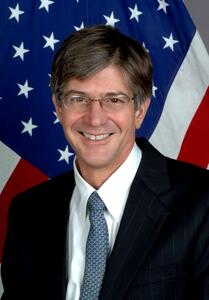
Russell L. Riley
Jim, thank you for making time for us again.
James Steinberg
No problem.
Riley
First, I understand congratulations are in order.
Steinberg
Thank you.
Riley
You’ve got something new on the agenda coming up pretty soon?
Steinberg
Pretty soon, yes.
Riley
January, is that right?
Steinberg
Well, I technically start on November 1st, but I’m going to be splitting my time, because it’s still midsemester here and I have classes. For the rest of this calendar year I’ll be spending half my time in Syracuse and half my time at Johns Hopkins, and then full time on January 1st.
Riley
Very good. Well, congratulations.
Steinberg
Thank you.
Riley
We’re excited for the prospects for you, and doubly appreciative of your time, given that you’re probably juggling two jobs now, rather than just one.
Steinberg
There is a bit of that.
Riley
So, thanks. I understand we’re good until one o’clock. Is that correct?
Steinberg
Noon would be good.
Riley
Noon is good. OK. With that being so, we will take a break at about the halfway mark. If anyone needs one before then, just exit and we’ll pick back up from there, OK?
Steinberg
Great.
[Conversation about background noise]
Riley
All right, Jim. We got a rough copy of the transcript from the first session, and I went back through that just to refresh my memory about what we had talked about. There were a couple of places where I thought, with your permission, I would go back and ask you about some elaboration. I thought we missed an opportunity in one or two places. You OK with that?
Steinberg
Yes, absolutely.
Riley
In talking about your earlier experience, you had indicated—The exact time frame on this I don’t recall—but you just said during this period you had a lot of interaction and you were friends with Paul Wolfowitz. It was clear that different people in the [George W.] Bush administration had different objectives vis-á-vis Iraq, and that Wolfowitz brought people to Washington for meetings with the Iraqi opposition.
Steinberg
Correct.
Riley
And that you attended some of those meetings. I’m wondering, given the historical importance of the Iraqi opposition, if you could tell us just a little bit more if you have any recollections about those meetings, who you were meeting with—
Steinberg
I don’t. It wasn’t [Ahmed] Chalabi. I know that.
Riley
It was not.
Steinberg
But there were other members of the opposition, and I can’t remember in whose homes. They were in various elegant Georgetown and Georgetown-esque homes, and there were dinners that were being convened for a chance to talk to people and to expose—I was at Brookings at the time—people who were considered to be opinion shapers, and I think especially there was a desire to reach out to Democrats to see about getting support.
Riley
OK. So there was nothing particularly noteworthy, then, beyond that?
Steinberg
No. It may have been deliberate or not whether it was not Chalabi, but they were very thoughtful Democratic voices who were making the case that this was an opportunity to throw off the yoke of oppression and to restore democracy. There were people in Iraq who were ready, and this was a plausible idea that there was an educated middle class prepared to provide progressive governance for Iraq.
Riley
OK, thanks. You had indicated that when you first had the meetings with Secretary [Hillary Rodham] Clinton about your portfolio and coming into the administration, it was a long conversation, and you met in their apartment in New York. I have two questions out of that. One is, if you have any specific recollections of that meeting. And second, you had indicated that you worked through with her questions about your role, and then volunteered, “We could go through each of the specific pieces, but I was very satisfied that she and I had a similar conception about that role.” I thought maybe I ought to go back to that and ask you if you wouldn’t talk a little bit more if you have recollections about those specific pieces so we’d have them in the interview.
Steinberg
All right, sure. As you know, when I agreed to take the job, when President-elect [Barack] Obama called me, I said the one thing that was going to be important to me was that I would have a seat on the Principals Committee. Even though I had been Deputy National Security Advisor in the Clinton administration, I sat on the Principals Committee as Deputy National Security Advisor. I was perfectly happy to be at State, but having the role was important to my sense that this was a valuable opportunity to have an impact on policy. The President said yes, but it needed to be something that the Secretary was comfortable with too, because it’s quite unusual. I don’t think there has been a Deputy Secretary of State who sat on the Principals Committee. So that was one thing we talked about. I said, “The President said this, but if you’re not comfortable with it, then that’s not going to be a good arrangement,” and she was comfortable with that.
We talked about whether there would be a substantive division of labor or not, and we agreed not, that it was not possible for the deputy to be the alter ego if there were some issues where he or she was not empowered, or knowledgeable, so we agreed it was not going to be that she would do the Middle East, I would do Africa, or whatever. That was not going to be the way in which we divided the roles.
We did discuss the fact that she was going to do a lot of travel, a lot of public-facing activity, and that meant that I would do less. I was comfortable with that because it was important to have somebody available in Washington for interagency and departmental management stuff, and I said that was fine, especially since I had small children. I was not looking to be the one who’s traveling around the globe, and I thought she was clearly a better face of America than I was, for many, many reasons. So that was agreed, again.
We talked about how we would manage morning staff meetings, which ones she would chair, which ones I would chair. Those were the main things, and that my focus would be on interagency and internal policy development. Again, on all of these issues we just went through the list, and because I had served in State, I knew how that worked. I had been very close to [N. Strobridge] Strobe Talbott when he was Deputy Secretary of State. I knew what the issues and questions were that come up in a relationship between a Deputy and the Secretary of State. But again, as I mentioned the last time, there was not anything on which there was any issue or things we had to work out.
We also talked about—which had less to do with my role—this issue of Special Envoys, and whether to have them, and for what portfolios. Again, both of us agreed on that, that there were many incredibly talented people with lots of diplomatic experience who would be an asset to the administration, that they were not likely to come in in institutional roles as Under Secretaries or Assistant Secretaries, given their stature and their past work, but they could be brought to bear, and they would not be something that undercut the Secretary’s authority but would actually extend her authority. We both had a similar view on that.
Barbara A. Perry
Between the two of you, did you start to name those people you thought would make proper Special—
Steinberg
I can’t remember whether it was at that meeting. It was certainly early on. There were a couple of people who were obvious. We began to think about names, and then we realized it’s clearly something that had to be discussed with the White House.
Perry
And one more drill-down, Jim. I went back and read the transcript, as well, from the first interview, and I mentioned that we’re also doing this project on Secretary Clinton’s four years as Secretary of State, particularly focusing on women, peace, and security. I noted in looking at her confirmation hearings in preparation for that project that she mentioned that piece of her portfolio and her interest at the end of her opening statement at the confirmation hearings. I’m trying to get a sense of her priorities as well. I’d asked you last time, and you talked a little bit about that project, but did she mention that to you in this conversation that we’re now talking about?
Steinberg
I don’t specifically recall. A lot of the focus was on repairing relations with traditional friends. She did talk about civil society. I do remember that, but I can’t remember specifically about whether it was women, but her own experience as First Lady, working with civil society organizations, the desire to find a more effective way to involve them, to engage them as part of our foreign policy and to involve them in the policy-making process, and the idea that we needed to think about that in not just state-to-state diplomacy. It’s possible that the issue of women in particular came up in that context; I just don’t specifically recall. But I do remember talking about this idea of having a strong set of linkages to civil society.
William J. Antholis
One follow-up, similar to that—In the last conversation we talked a little bit about your work with Kurt [Campbell] on the book about transitions, and we also talked about the roles of senior people in the Department. In that first set of meetings with her, on the one hand you said you deferred to Cheryl [Mills] on a lot of the broader appointments, but for the senior people, people particularly at the Under Secretary and Assistant Secretary level, you have such an extensive network. I say that somewhat with pride, being part of it, but in many ways you know a lot of the people that might be good candidates for these jobs a lot better than either Secretary Clinton or Cheryl Mills did. Just how important was that to you, given that you had done all of this work on transition stuff?
Steinberg
It was important. I’m pretty sure we did not discuss names in the first meeting. There was a second meeting where we did that. There were two long meetings before I moved to Washington and started taking on my own preparatory work for the job, and I’m pretty sure it was in the second meeting we started talking about names. It may well be that it was in that second meeting that we talked about Special Envoys, as well as senior Department people, so I’m pretty sure that not in the first meeting but the second meeting the name discussion began.
I had a number of people that I had a high regard for that I thought would be valuable to the administration, either at State or the White House. There’s a certain amount of institutional parochialism. I wanted to make the case to her that we should try to get in first to get the good people before the White House got them, understanding, of course, that we’re all on the same team, but we had some interest. And as you said, Bill, there were people that I knew that I had a lot of respect for. I’m sure in those first meetings we talked about Kurt Campbell, we talked about Phil Gordon, we talked about Dennis Ross, we talked about Anne-Marie [Slaughter], we talked about Bill Burns. I’m trying to think if I can remember any other specifics that we talked about—
Antholis
It’s a pretty good list.
Steinberg
—John Brennan, Rose Gottemoeller. You know all of these people, people that I had a regard for, most of whom had served in the Clinton administration, so she may well have known them, too, but I had a sense of some of the people that I thought we should have on the list. But having done that, I stepped out of the process and let her and the White House work those things through.
Antholis
Jim, this relates, now moving forward—to your own team as Deputy Secretary: I just got the email blast saying that [Bathsheba] Sheba Crocker was named to an ambassadorship. I can’t remember which one it was.
Steinberg
UN [United Nations] Geneva.
Antholis
Right. So how did you put your own team together? Tell us a little bit about that.
Steinberg
I was a strong believer that everybody in the Department—including the Secretary, but especially the Deputy Secretary—should primarily rely on the career people, and it was important to send a signal that those were the people you were going to use. There was the question of how many people for the inner staff were you going to bring in, so my going-in position was to rely heavily on career civil service and Foreign Service officers. I brought three people with me. One was Sheba, who was my chief of staff. Sheba had been my executive assistant, I guess was the title, at the White House, one of the three that I had. Every year and a half I went through one. It was a very hard job. But I brought in Sheba as my chief of staff.
I brought over Laura Updegrove, who had worked on the transition, who I had not known before the transition. She did a fabulous job of helping to organize the foreign policy transition, and I brought her over. Then I brought a former colleague of mine, Brendan Lavy, who had worked with me at the University of Texas. Sheba, as chief of staff, oversaw all of them, but for the standard portfolios, regional and functional.
All were career people—half were Foreign Service, half civil service, but career people—and they were outstanding. I later brought in, but not initially, somebody to work with me on speechwriting, Dan Kurtz-Phelan, who ended up going to Policy Planning after that. So from the outside it ended up being four, but on the substantive portfolios, just an outstanding group of mid- to early-career Foreign Service and civil service officers I’ve stayed in touch with most of them ever since. It’s just an outstanding group of people.
Riley
Anything else from earlier? All right, let me ask you a sort of macro question about the integration of Hillary Clinton and her team into an administration after she’s been an opposition candidate. She gets asked this question, I think, in one of the interviews abroad. There was some lack of understanding about how this could happen. So I’m curious—
Steinberg
I’m not sure why, by the way. If you look at the British system and the German system, there are often senior politicians from the party who have been rivals for the first position, so I don’t know who doesn’t find that easy. The Israeli Cabinet? This is actually much more common abroad, where Cabinet positions are filled by politicians, than in the United States, so I would have thought that foreigners would find this completely understandable, and it is only Americans who haven’t had much experience with this, although we’ve had many in history, if people actually do some study of history.
Riley
So, since those of us who are Americans are skeptical that this can work, enlighten us about how it did work. Were there obstacles to overcome? Were there tensions within the networks that manifest themselves during the first few months of the administration?
Steinberg
Having observed this in administrations that I served in, those of [Jimmy] Carter and [William J.] Clinton, and having watched other ones, no more so than if the Secretary of State had been somebody else. There were tensions between Colin Powell and the White House in the Bush administration. There are inevitably both personality and institutional issues. The State Department has a sense of its prerogatives; the White House has a different view. As these grow stronger and bigger, there are lots of tensions that develop there. But I would not say that any of them were related to the fact that she was previously a candidate. They were just the kinds of things that I’d seen between [Warren M.] Christopher and [Tony] Lake, and between [Cyrus] Vance and [Zbigniew] Brzezinski. I really don’t think this was an issue.
First of all, the issues that divided them in the campaign were not huge. Part of the problem of the campaign was for them to distinguish themselves from each other, because they shared so many things in common, which is why I think it wasn’t that difficult to make it work in the administration. It wasn’t a big ideological difference where you bring in somebody who has a strongly different point of view.
Secretary Clinton has a wonderful touch and a way of working with people, and she understood that President Obama was President and she wasn’t. It was never an issue. As you know, I teach history, so this is not like [William H.] Seward and [Abraham] Lincoln in the first couple of months, where Seward basically thought that Lincoln got the Presidency, but he should have gotten it, but he will be kind of the de facto President. I don’t think she ever felt that, and I don’t have any sense that President Obama ever worried about it.
Riley
Terrific, thank you. Any follow-ups on that?
Antholis
Yes. Jim, I want to come back to something you said in our first conversation, which, to remind future readers of this conversation, happened prior to the U.S. exit from Afghanistan, which was messy, to say the least. In that first part of the conversation you did say that that was an area that you spent less of your time on than some other areas, so there was no clear division, but this was one that you were a little less involved, partly because there was a Special Envoy, which was Ambassador [Richard] Holbrooke.
Looking back at that period, one thing that is quite clear is that there were some divisions in the Cabinet, particularly in the first term, about a surge, how long to stay, what was the objective, and all of that, and Vice President [Joseph R.] Biden [Jr.] keeps coming out as one person that pushed in a more aggressive direction to leave, with Secretary Clinton being more aggressive to stay. I’m just curious in those early days what you saw, how you participated in that, and your own reflections on that early period focus. I know it wasn’t your central area, but given the events of the last year it’s hard to not ask that question.
Steinberg
I mentioned before that since I had been fortunate enough to have a position on the Principals Committee, and was on the Deputies Committee, you can’t avoid it, so at that level I certainly was involved, and I was in all the meetings. There obviously were private meetings, but in all the formal meetings at both the deputies and the principals level, yes.
I wasn’t going to pretend that I was an expert on Afghanistan or the political situation in Afghanistan, or any of these things, so I focused very much on the external ramifications of the choices, most importantly in the region itself. If we were to go down the road of a small footprint, a narrow mission, and kind of an early departure, what would that mean for our relations with India, for Pakistan, Iran? How would other countries in the region see this? What would they do in response to this? That was a major focus, and then even more broadly than that, how would the broader world think about this? How would it seem to our European partners? How would it seem to the Russians, to the Chinese, to others?
My belief that we needed to keep the situation stable and not just focus narrowly on the counterterror mission, perhaps from over the horizon. My perspective had a lot to do with what I thought were the implications of the regional instability that would follow from our departure.
I was very worried about how it would stoke tensions between India and Pakistan, in particular India. I was very worried about the possibility of the Taliban taking over again, because there is a sense that the U.S. had never understood or responded heavily enough to India’s concern about terrorism emanating from Pakistan. I’d been dealing with that a lot, and the sense in India that we just didn’t take it serious enough, that we were coddling Pakistan. We were underestimating the threat from groups that were tolerated by Pakistan, potentially even supported by Pakistan, and that our departure from Afghanistan would create a vacuum that would be very threatening to India, that India would have to do things that would raise tensions with Pakistan, like the dangers of what it would do in Central Asia.
That was my main focus, and the reason why I believed we needed to have a larger presence and a more significantly stabilizing presence, because I thought collapse of the government and a Taliban takeover would have these broader implications, in addition to whatever it would do internally. In terms of specifically what was needed, how many, what their function was, that wasn’t my great expertise, and I wasn’t being looked to for that. It was more just the focus on the regional and broader implications of the choices that we had. That’s why I supported the position that the Secretary and Bob Gates took, because I thought that was really critical to that, for those purposes.
Riley
Other questions about Afghanistan? There’s probably more there. Well, one of the places where the administration has taken a lot of incoming retrospectively is Guantanamo. Was that something that was at all in your portfolio or on your plate?
Steinberg
Yes. I’ve often said that the one place where we failed to follow our own advice—in the book that Kurt and I wrote—was on Guantanamo, which was to not prematurely make decisions before you had figured out how you were going to do it and really understood the situation on the ground. It was understandable. We had a strong moral commitment to it. The President had taken strong positions during the campaign. It was the right thing to do. It was a blot on the American reputation, just a horrible thing, and it remains to this day.
But the problem was that announced the intent to close Guantanamo without a plan. We executed the aspiration, but we didn’t have a plan. To have a plan, you had to have a plan that was going to be achievable, which means you had to have the support of the military, of the Congress, of the states. If you’re going to transfer people—because we clearly were not going to be able to release everybody—nobody thought that—we assumed that we would be able to try them in civilian courts or at least have military courts on U.S. territory, and nobody ran the traps. So we announced it, then, Now what? As it turned out, of course, we had an aspiration but not a plan.
I spent a lot of time on this. I spent a lot of time working with the people who were trying to find foreign governments willing to take people for transfer, and working on their reeducation, repatriation programs that the Saudis and others were developing and the like. I didn’t deal directly with Congress; that really wasn’t my portfolio.
Of course it was the right thing to try to do, but we didn’t get it done, so when I teach policy, it isn’t successful unless you can get it implemented. In the late, great Colin Powell’s phrase, we got out over our skis on this one. The President could have said, “This is something I remain committed to do,” but we needed to have figured out a plausible, executable plan before we stuck our flag in the ground, because it’s costly to make these kinds of commitments and not be able to make them real.
Riley
Can you tell us a little bit more about any of your negotiations with foreign governments over trying to resolve the problem, getting them to take some of the people out of there?
Steinberg
It was an APB [all points bulletin] kind of effort. Everybody in the Department was talking to governments, as we were talking to governments about other things, to try to find anybody anywhere: Mongolia, [laughter] Africa, wherever. It just became a part of the diplomatic portfolio. Wherever you had an engagement, you’d say, “And, by the way, how about taking some Guantanamo prisoners? [laughter] What can we do to make this attractive to you?”
We were trying to take advantage of situations where we had good relations with countries that perhaps wanted to improve their relations with us. You want to be careful about not having a pure quid pro quo on these things, but there were clearly cases where we thought about countries that might have an interest in having some points on the good side of the United States who might do this. I think it was Dan Fried who was working on this full-time, but in any event, all of us had this in our portfolio when we did diplomatic engagements.
Perry
Did you have any takers?
Steinberg
Oh, yes, we did, and we got some people out. They were often to places that were pretty obscure. Didn’t they get somebody from one of the South Pacific islands who did it? [laughter] It was really kind of awkward, because once they got there it was very incongruous, but yes, we had takers. We had a first group. The first group of people were the countries that were most willing, and then it got harder over time, both because we took the ones who were the easiest to transfer first, the people who were pretty obviously not terribly threatening. It was both retrospective and prospective. You were looking for people who were not terribly guilty in the past, and not terribly threatening in the present.
There were a number of people who got swept up in the net who we were able to place early, because they were not significant. They weren’t masterminds. They weren’t people who directed plots. It was easier to get the people who were worried about justice being done to say, “Well, these aren’t terribly important,” and also because they were less likely to cause problems for the host country. So yes. I don’t remember the exact numbers, but we did have some early successes.
Antholis
Two follow-up questions on that, Jim. In your discussions with those other countries, how much was the reluctance the kind of thing that we would see in American states—“I don’t want to have a terrorist on my soil,” and how much was, “The domestic politics in my country are very hard because we feel that you Americans and the CIA [Central Intelligence Agency] abducted these people in some nefarious way.” Do you get a sense of that?
Steinberg
Oh, it was certainly more of the former. They had to have some sense that this was not going to cause problems for them. And we cared about that, too. We were very conscious that if we sent somebody to a third country, and they—as the expression was at the time—“returned to the fight,” that that would be very costly for us. Obviously it’s a black eye, but it’s also very costly. If they’re back and starting to kill people again, or harming Americans, that would be a mistake. It would be a terrible mistake to put people back out who were going to do this.
This is a deeper problem you’re not going to discuss here, but I was going to say it’s not totally different from the question of putting somebody on parole. You put somebody on parole and then you make that decision. Having lived through Willie Horton in the [Michael S.] Dukakis campaign, Bill knows you have some responsibility for those decisions.
So we took it seriously and understood that countries needed some reassurance that this was not threatening, but we needed some reassurance that they would hold them, that they wouldn’t just say, “Fine, we got our brownie points from the United States,” and they were going to just let them loose. That was as much of a concern, that we needed to be satisfied that they were really serious about either holding them indefinitely or undertaking serious programs of rehabilitation that would lead them to believe that it would be safe for them to return to an unfettered life.
Antholis
The second question is this. The discussion including your role about Afghanistan is part of a broader narrative of the Obama administration of the pivot, right? Of trying to get out of this deep engagement in the broad Middle East that happened during the Bush administration and paying attention to the growing challenge of China, which is something that you were quite central to. Would you say that the process of extraction took longer and was more complicated than you expected going in, or did you know that this was going to be sort of a long, hard slog of trying to figure out how to do this in a sustainable fashion?
Steinberg
I wasn’t an extractor, so I think the problem was it went too fast. [laughs] I think that “pivot” is the wrong way to think about our strategy. We needed to do more on East Asia, for sure, but that didn’t necessarily mean we needed to do less elsewhere. We were a big country that could do both, and we shouldn’t judge this in kind of a hydraulic sense, that there’s a finite amount, and if you want to do more on East Asia you have to do less someplace else.
We devote a significant amount of resources to foreign policy and national security and defense, but it’s still small compared to historic numbers in terms of our overall GDP [gross domestic product]. We could afford it, and we didn’t need to get out of Afghanistan because we needed those resources to be in East Asia, especially because what we needed to do in East Asia was not heavily resource intense. Maybe people think it is now, but it certainly wasn’t then.
I didn’t like the pivot as a way of thinking, because it implied you’re turning from one thing to another. When people pivot—My daughter plays softball—you turn from one direction to another, and I thought we had to be Janus and we had to look both ways. As it’s known, I was not in favor of a rapid withdrawal from Iraq, and I wasn’t in favor of a rapid withdrawal from Afghanistan, as much as I was in favor of doing a lot more in East Asia. There were clearly differences in the administration about that question, but for me, personally, we needed to do what was right. It wasn’t a question of just getting out, and that was clearly the issue in both Afghanistan and Iraq.
Riley
Jim, you’ve provided us one way of approaching a general set of questioning for you about the administration in the strategic leadership document we talked about last time that you spent a lot of time on, because there’s a set of strategic priorities listed in that document that gives us a road map for questioning you about what happened subsequently as a way of evaluating the administration. I’ve been thinking about turning to that as a way of framing our questions, rather than following a pure chronology. We can come back to the chronology—
Steinberg
Coincidentally, I’m getting ready to pack up my office in Syracuse, and I came across that document yesterday. I didn’t go back in detail and look at it, but it’s still there. I still have it.
Riley
Wonderful. Then I will draw your attention to it. There were five strategic priorities listed in the document, and what I’d like to do is to raise each of these with you as a way of getting you to reflect on the successes and/or failures of the administration in each of these priorities, and then to tell us about the extent to which your own portfolio overlapped with this. Now, the deficiency in this as an oral history exercise is there may be important things that weren’t a part of your activities on a daily basis. If that’s the case, just say, “I didn’t have much to do to with that,” but still, as an informed insider, it would be helpful for us to get your analysis and evaluation of the administration.
The first one was counterterrorism. What can you tell us about your sense of successes on counterterrorism, and to what extent is that something that’s a part of your daily portfolio?
Steinberg
The successes were good. I always tell my students that the test of a good policy is not always good outcomes, but it doesn’t hurt. [laughs]
The fact that there were no major terrorist attacks during this time was important, and I don’t think it’s by just good fortune; it’s because there was a sophisticated, well-developed set of strategies and institutions to deal with the problem. It was understood that this needed to be multidimensional; it couldn’t just be the kinetic take-out-the-terrorist thing.
It had to do with broader outreaches to engage public and other constituencies about the issue of radical extremism and the dangers that it posed as reflected in the President’s Cairo speech and some of the other efforts, the big initiative that Denis McDonough led on countering violent extremism at the White House and the like. There was a really great, talented team of people at the Counterterrorism Center, the White House, and the Pentagon who were working on these issues. The overall record and effort were excellent.
For me—and I’ll just say it, because this is just my piece of this history—the one place that was most contentious was dealing with the drone strikes and where that fit into the overall strategy. I have written about this. I have no problem with the use of lethal force against somebody who is in the process of or engaged in preparing terrorist activities. You’re entitled to use preventive force. It’s established as part of the law of war, and although these actions were abroad, as Justice [Robert] Jackson said, the Constitution’s not a suicide pact and you are allowed to do that.
The most visible case, which was the most heavily debated, was the [Anwar] al-Awlaki targeted killing, I was part of that decision, and was totally on board with this, and I think it was essential. He had done the Nigerian underwear bomber. He had been actively involved and plotted to kill Americans. You can stop that. You can protect Americans.
But there were broader areas, and I had concerns about the broader use of so-called “signature strikes,” when we were attacking individuals without knowing their individual identities and certainty about what they were doing. In these cases we were relying on signs of suspicious activities. I had concerns about that, because of both the danger that you would get somebody who was not responsible and the humanitarian law implications of that, but also for the reputational impacts.
We’ve seen this most recently in Afghanistan and the use of Pakistan. In these cases, I was not directly involved because that arena was treated as a war zone with decisions left to the military commander; it was part of the theater of war. But outside of Afghanistan, every one of those decisions was vetted by a group that I was a part of. I worked very closely with John Brennan, who shared my views about this, and we were able to keep within bounds the broader use of lethal force, but it was a tension that existed throughout.
With that small exception—not trivial, but it’s an exception—the counterterrorism effort was done well, and the overall effort was done in ways that were not excessively intrusive on civil liberties, that were sensitive to public opinion that had been just shattered for the United States in Islamic/Muslim countries, and yet was tactically effective.
Riley
Jim, your acceptance of things like drones—Did that same logic apply for things like interrogations?
Steinberg
Well, we weren’t doing interrogations for the most part. Early on, Justice and the White House developed some fairly significant constraints on interrogations, so we had a few cases where we picked up people, but they were not subject to torture or harsh interrogation methods. Indeed, I always felt good about that, because my strong conviction, and one of the things that I focused on in connection with the drone strikes, was that we always recognized that we had an absolute responsibility to capture rather than kill where we could, and we did that. I can think of a number of specific examples. I don’t know whether they’re public or classified or not, so I’m not going to talk about specific cases.
But there were a number of cases where those of us who cared about that persuaded the military and the intelligence agencies and Special Forces that they needed to undertake capture operations, if it was possible, because it allowed for the fact of interrogation. Interrogation is fine as long as it’s done humanely and within the laws of war.
Riley
OK. Well, the basis of the question was when you were describing your position on drones, it was whether they were used to prevent an impending attack, which sounds to me similar to the logic about the ticking time bomb.
Steinberg
But there are constraints, right? My personal opinion, and I have written about this, is that I don’t think you violate the laws of war or some broader principle of due process. Just like a police officer is entitled to kill a suspect in self-defense if they’re threatened or the individual threatens others, this is the same thing, but you do have a responsibility to try to capture if you can, and that has to be taken seriously. It can’t be just, Oh, too hard, or whatever. I think we had a pretty good track record.
Riley
Any follow-ups on this? All right. There’s a lot more to dig in there. Anything else you want to elaborate on with respect to counterterrorism? Yes, Bill, please.
Antholis
I do have one question here, Jim. A lot’s been written and said about the Obama administration, about the roles of the various agencies in the counterterrorism fight: State, Defense, the White House, in particular, CIA. Just broadly speaking, do you have a take retrospectively on how the administration approached it, the strengths and weaknesses, and whether there was overplay in one organization or another in the management of these issues?
Steinberg
That’s a very complicated story. I can’t talk about it in detail. What had evolved over time was a conflating of the Title 10 and the Title 52 authorities, and the idea that we’ll just mush it all together and between the two we have enough authority to do whatever we want to do. I had some concerns about that.
Ironically, because the CIA has a bad reputation, in some respects, and the Pentagon has a good reputation, there’s a tendency, given a choice about how to manage these kinds of operations and activities, to have the Pentagon do it. But interestingly enough, there’s more oversight of what the CIA does than there is of what the Pentagon does, both by other parts of the executive branch and by Congress, because if you use the CIA’s authorities, they have to be reported to Congress. They have to go through a process of Presidential findings and the like, so, in some ways, we had more transparency about what the Agency was doing on the operational side than we did on the battlefield, and especially the Title 10 authorities in the Afghanistan/Pakistan theater.
I was in a curious position, which most people find odd, which is that I believe a lot of it should be done through the Agency, and with the oversights and procedures that applied to Special Operations done by the Agency, as opposed to Special Operations done by Special Forces. But that was not the general view. The general view was that on the whole, the Pentagon Special Forces are well trained. They know how to do these things. It’s quicker, it’s chain of command, which I can understand the arguments for, but I was on the other side of that.
Also, there were times where we were just switching authorities in the middle of an operation when it became convenient. It would have been better to have a little bit more clarity about that. It’s a little bit pedantic, but I’m both a law professor and an international relations professor, so I cared a bit about those things. It was not a huge issue, but certainly for me I was probably more engaged on that than a lot of people.
Antholis
The concerns I remember at the time about the growing size and role of the NSC [National Security Council] staff on these kinds of—
Steinberg
Let me go back. Let me say one more thing. The other thing that concerned me about doing this all through the military was this idea of the Global War on Terrorism, that everything was a battlefield and that the operational activities in the military were justified everywhere.
I thought that was not a good thing. I was accepting of that idea, that in not just Afghanistan but in the frontier parts of Pakistan it really was a battlefield, and the battlefield rules and procedures should apply, but if we were going to countries that were far from that fight and still using this—I thought the use of the military, even though the Special Forces are amazing—General [William] McRaven and everything they did was fantastic. They’re amazingly good, but that doesn’t mean that it’s the right way to do it. That’s another reason why I was really reluctant about the Title 10 approach to those things. Sorry, that just came to me.
Antholis
Yes. Thoughts about the role and the appropriateness and the size of the NSC? This comes up time and again as an issue, particularly in this period, with the growth and the size of the NSC, but even the role. Often the NSC would defend it as saying, as you were saying before, these operations have become so complex that to sort out the responsibilities and who’s doing what, the White House needed a bigger role and concern. Did you—
Steinberg
Are you talking specifically about counterterrorism or are you talking about the broader—?
Antholis
Yes, counterterrorism, because, frankly—I’ll put it this way—that was the best defense of the growth of the NSC that I heard and saw during that period, [laughs] that these particular operations were complex.
Steinberg
There were a lot of other reasons why it was. This is a long-standing discussion, and I, having served in both, am a firm believer that we have taken too much away from the agencies and done too much at the White House. I understand why. You have many, many practical reasons why that’s attractive. One, the NSC is more nimble than the agencies because it’s smaller. It’s closer to the President, and closer to the President’s own kind of thinking. There’s more ability to interact with the President and know what he or she wants. And it has fewer classic bureaucratic behavioral concerns. It doesn’t favor one tool over another, one approach, whether it’s economic or diplomacy or military. They’re all strengths of the NSC, and you certainly need one, you need a competent—
But there is a danger, precisely because it’s so small, that if it has a huge amount of responsibility for operational activities it gets overwhelmed. And you have all these other people out there. What are they there for? You have the whole State Department and Treasury Department, and all these things, and the Commerce Department, out there to do these jobs. Maybe it’s because I was in State before I was in the White House, and I was back at State, that I do think too much is being done operationally in the White House. There’s not enough of a role given both on the policy development side and the operational side to the agencies.
It’s costly because it becomes self-fulfilling. What ends up happening is the agencies think, It’s not our responsibility. It’s the White House’s plan. We’ll do whatever they tell us. But they lose the habits of being creative and proactive.
I always cite my favorite example of doing this right back in the Clinton administration, when we were deciding how to execute Plan Colombia, and we decided that both the development of the plan and the implementation of the plan would be led by the State Department, by Tom Pickering, who had a lot of experience in the region as the Under Secretary for Political Affairs. He would lead the interagency process, not somebody at the White House. NSC would have participation in it, and the DoD [Department of Defense], DEA [Drug Enforcement Agency], and everybody else, but it was led by Tom from the State Department. I thought that ought to be done more.
You can go back through the history I’ve written about this. There was a time in which State did lead interagency task forces. If you go back to especially the [John F.] Kennedy and [Lyndon B.] Johnson administrations, there was a big effort to reempower State to play that kind of leading, coordinating role. I do think that there is a case to be made, and you feel it more strongly when you’re at State, probably, than when you’re—but even at the White House, I was a big advocate for keeping the operational responsibilities out in the agencies.
Riley
Jim, can I ask about your perceptions of the President himself in this area? I don’t know how often you’re in the company of the President during your time there. You might address that as well. But I’m curious. This is a man who had a lot of ambitions for his Presidency. Do you ever get the sense that he’s frustrated with the amount of time that he’s having to spend on counterterrorism and this cluster of issues because of the opportunity cost involved?
Steinberg
It would be speculation on my part to say that. There are some things that I got to see the President working closely on, but you’d have to talk to people like John Brennan and Tom Donilon about whether he felt that. It was not something he expressed in my presence. I could guess, but it would just totally be a guess, so it’s not appropriate for me to say.
Riley
OK. But you were having audiences with the President how often, would you say?
Steinberg
Not that often. I thought you were going to ask the broader question, which is the President liked to work with a small group of close advisors. He didn’t like the big meetings. He didn’t like the principals meetings. I was in them. You always had the feeling this was not how he wanted to do business, and one had the sense that he understood he needed to do that from time to time, but where he felt most comfortable and operated best was with the close group of people around him. Other than in the formal principals meetings and occasionally if the Secretary’s out of town and he had a visiting head of government, I would get to sit in on the meeting, but I had not an extended amount of contact with him, and he did most of his thinking within the group that he was closest with.
Riley
Right. And who would have been in that inner circle, in your point of view?
Steinberg
You’ve got to ask them, because I wasn’t. [laughter] I could guess but I—
Riley
OK. Well, I didn’t know whether there was a general sense at—
Steinberg
There was a general sense, but I’m not going to indulge it because it might not be true, right? That’s the danger. One thing I will tell you is that the worst thing—just ex cathedra—is people who weren’t present speculating about things that they think happened.
I’ll give you an instance, just for your own benefit. During the Clinton administration, when we were trying to figure out what to do after the embassy bombings, and we were considering a range of actions both in Sudan and Afghanistan, and without going into a lot of the specifics, there was a set of decisions about what to do, and then we did it, and there were some briefings to President Clinton, but the final decision was made by the President, with two people present in the room, [Samuel] Sandy Berger and myself. That’s when the President made the decision to use force against the suspected chemical plants.
After the decision, I got a call from a very respected reporter from the Post. She said, “I understand that the President decided to do this because of this reason.” I said, “Well, what led you to believe that?” And she said, “I talked to a senior official in the Pentagon.” I said, “Yes, but that senior official wasn’t there. I’m telling you why the President did it.”—I was authorized to do this—She said, “Well, I’m going with it anyway.” I said, “Why?” And she said, “Well, I’m just going to say, ‘Senior Pentagon official said that this is why the President did it.’” I said, “But I am telling you that senior official has no way of knowing that.” She still published it.
Anyway, I have a strong conviction that what ends up happening in many of these “tick-tock” stories is that people who don’t know opine on things that they don’t know about, and then that becomes part of the historical record.
I’ll give you another example: the New York Times story about a meeting that Jeff Bader and I had with senior Chinese officials. It was alleged that a senior Chinese official told us that China considered the South China Sea to be part of their core interests.
A reporter was going with this story, and called me up. “Well, we understand that So-and-So,” this China official, “told you that the South China Sea was part of China’s core interest.” I replied that it was not true; I was there. Jeff and I were there. We were the only ones there. Yet the Times still published it, and it is now considered to be historical fact, that this is what happened, even though the people who were there know it didn’t.
Riley
I understand, and that was a part of the predicate for my question, your own meetings with the President. The other predicate for this, since you invoked the Clinton experience, is that in listening to you talk about the counterterrorism piece, I was reminded of the oral history that we did with Tony Lake about Clinton, where he at one point in the interview said that he felt like at parts of the first year that every time he walked into the office Clinton was looking at him like he had a big B on his forehead for Bosnia.
The argument that Lake was making was that Clinton was getting frustrated by the vexing nature of the problem, and what it was requiring him to deal with when he would prefer to be doing other things. So the root of the question is, did you get a similar sense from President Obama, to the extent that you knew, and—
Steinberg
I don’t, but my point in recounting these episodes to you is that it sounds plausible to me but I have no idea, and so I don’t want to speculate. And I’m sure that there are people who actually know.
Riley
Thanks, Jim. I think the point that you make, more fundamentally, is absolutely crucial, and I appreciate it, because it’s an occupational hazard of doing oral history, and my colleagues and I, I won’t say we always do, but we’re mainly attentive to trying to figure out how authoritative can you be in addressing this. Barbara, I’m sorry, I’m rambling.
Perry
No, no. I’m not even sure how to ask this question, but I just have to, so indulge me. Jim, because you are a historian, and an expert on international relations, and a lawyer, and a practitioner, and you have just touched on the core—speaking of core interests. I don’t mean to have this be a self-serving, “Oh, don’t you think oral history is the best way to get to the facts, as people know them,” but I’m always trying to understand how that is, because we have purely historian colleagues who say, “It’s only the documentary evidence. We only rely on the documentary evidence.” Or a colleague who’s working with us on the Hillary Clinton project who says, “I don’t want any journalistic pieces in our briefing books. The journalism is all wrong. They make things up,” and you’ve just indicated some of that.
For the big picture of how we get to what happened, what are your thoughts about gathering the puzzle pieces, or the pieces of the mosaic, or whatever metaphor you want to use?
Steinberg
I’m a little with the historians on this balance, which is that I think the combination of the inevitability of self-serving recollection and just the imperfection of recollection makes retrospectives questionable. They’re valuable because they raise questions that need to be investigated, but they have to be taken with more than just a few grains of salt on their face.
Contemporary records are important, but I also tell my historian friends that, of course, the problem with that is that the documentary evidence is fragmentary, and if you find one piece that tends to support a proposition, there may be other pieces that either you haven’t found or don’t exist that support a different view. Neither in itself is definitive, and therefore it’s a question of looking at everything you have and trying to sort out the relative credibility. How was the documentary evidence created? Is there some reason to believe that it was complete, as opposed to fragmentary? In the contemporary documentation, does the person have a reason to record it in one way or the other?
All those questions have to be asked. It’s an ontological problem that’s not solvable, but I worry about oral histories, to be honest. I do believe that it’s very hard, and you have much more experience than I do, but I read them, and few people are willing to say, “I got this wrong.” It’s very difficult to do that in an oral history, so I think it has to be taken for what it is. As Bill knows, the tragedy is that we’re losing, dramatically, the contemporaneous documentation of history. I am the worst offender because I refuse to keep a documentary record about what I did. So when I describe events to you, I can’t prove it.
Antholis
For Barbara and Russell’s purposes, we’re interviewing somebody that uses the film Rashomon in his public policy classes to precisely get at the point that everybody has a different take. Maybe, Jim, that’s a good way of transitioning back to Russell’s really good framework of the Strategic Leadership document, but I’m going to jump ahead to the fifth item, given that we only have an hour and 50 minutes left, and I know it’s one that you care about.
We’ve done counterterrorism. The other three are nuclear nonproliferation, climate change, and the Middle East. Not that you don’t care about those, but, with Rashomon, jumping ahead to East Asia, since that was such an important part of your focus. So, again, let’s start with the broadest aperture here. Going into the administration, can you remember what you thought at the time? You helped us before in pivot being not the better analogy, but Janus-faced. You also mentioned Jeff Bader and your focus on what China’s strategic priorities were. Help us level set on where you thought things were at the beginning, and maybe a sense of what you hoped to accomplish and what you thought you accomplished in your time on this topic.
Steinberg
As you know, I’ve written extensively about this, and we could spend the next two weeks talking about it, so I’ll just sketch out a few things and you can decide on what you want to do. The perspective that we brought to this was that the Bush administration’s preoccupation with Afghanistan, Iraq, and counterterrorism led them to instrumentalize relations with everybody else in terms of this agenda.
It’s not that there weren’t aspects of the counterterrorism problem that touched on East Asia, and especially Southeast Asia. After all, some of the 9/11 [September 11, 2001, terrorist attacks] hijackers had been in Southeast Asia. And there were elements of al Qaeda that were present in southern Thailand and in Malaysia and Indonesia and the like, the Philippines. But for the most part, the only thing that the Bush administration was engaging on with countries in the region was on the counterterrorism agenda. You can see this in the Bush administration’s appeal to China. If you think about what happened in the first year of the Bush administration, they started off on quite a tough-on-China strategy in its first months, and President Bush wanted to tilt more toward Taiwan and do things, but after 9/11 the Bush administration did an about-face and started talks with China because China shared U.S. views on counterterrorism and Muslim extremism.
We certainly heard this from Southeast Asian countries, that officials from the Bush administration would come to Southeast Asia and the only thing they wanted to talk about was al Qaeda, as opposed to things that Southeast Asians were worried about. This is clearly not the top priority for them. Because so much was going on in Iraq and Afghanistan, Secretary [Condoleezza] Rice often skipped the ASEAN [Association of Southeast Asian Nations] regional forum meetings.
The President didn’t go to senior meetings with ASEAN people; the Bush administration had not chosen to join the East Asian Summit, which is this new forum that ASEAN created for the head-of-government level. They had talented people—Mike Green; Rich Armitage, who knew East Asia, but it was just that the senior people were not focused on this, and there was little policy focus on the evolution of that region.
So what we initially focused on was how do we show that East Asia is a priority for the United States; that we’re dealing with the region on its own terms and not on how it could help us with other agenda items; and that we care about the things that they care about, because it’s important to us that they care about these things. The early efforts, which ranged from the early high-level meetings and state visits to the decision to sign the Treaty of Amity and Cooperation with ASEAN and join the East Asia Summit were all about saying, “We’re here for you, and we care about the issues of the region, and not how you can help us do other things.”
That was the core of the initial strategy, which is just to say that East Asia is a priority for us. It’s an economic priority; it’s a political priority, a security priority, a climate priority, all these things. We sought to show East Asia as central to the big issues of the day, and that we needed to have a sustained high level of engagement with the leaders and with the people of the region.
That’s the basic frame, and within that, of course, there were individual strategies. What do you do vis-á-vis Japan? What do you do vis-á-vis Korea? What do you do vis-á-vis North Korea? What do you do vis-á-vis China? What do you do vis-á-vis the ASEAN countries? What do you do vis-á-vis Australia? But it was in that broader framework just to say that we’re going to be seen as resident in East Asia and being part of a conversation in East Asia about the issues and challenges and opportunities. That was true on the economic side, too, which is how we ended up getting involved in TPP [Trans-Pacific Partnership]. We joined the EAS [East Asia Summit] and we got involved in TPP negotiations. These were all part of saying, “We’re in this. This is us. We are a part of this region.”
Antholis
As you look back on the almost three years that you served, how much do you feel that there was a uniform approach shared across the administration on that? In other words, did you see tensions? Was there a team approach here, or was it less widely shared than you—
Steinberg
Having framed it the way I just framed it, I think it was a team approach. I think everybody agreed on that. Some got there faster than others. It took longer for the economic agencies to get on board for TPP than the political agencies who weren’t responsible for it, but we learned our lesson from the Asian Financial Crisis, and these issues were too important to leave to Treasury.
There was skepticism in the economic agencies and trade agencies initially about TPP, but the President was on board, and everybody came around on that. The military was having a hard time thinking about whether it could do more in East Asia because it was so operationally engaged in the Middle East, so it took a while for them to figure out what they were going to do. The core drivers of this strategy were State and the White House, but at the end of the day everybody was pretty much there. I don’t think there was a big set of tensions there.
Clearly what developed over time, and the one place there were tensions, was just how to deal with the China piece within the broader strategy. That’s been everybody’s focus subsequently, but on the basics I think it was pretty much a team approach. The President was clearly in on this. He attended the first section of the Strategic Economic Dialogue with China. He went to all the meetings. It was not easy in the Clinton administration to get the President to do this, but Obama always—people say—and again, I don’t want to speculate because I don’t know, but the fact of his historic connections to Indonesia made him more sensitive to this.
That’s certainly possible. But he always seemed in it and for it. He was willing to make the trips, and supported having Tarō Asō be the first head of government to come to the White House. He supported having the South Korean President as the first state visit. I saw that at that level. The leadership comes from the top. The President was pretty much there for it.
Antholis
Going back to what we were saying before about the challenges for each different historic approach to capturing this, do you think—as you stayed very current on the literature in this space, because you continued to write about it yourself—people have mostly captured this? What’s missing? One of the great things about oral history in our conversations with people is an opportunity to set the record straight. Is there anything that’s been left out of the account that you would want to share?
Steinberg
I don’t think there are any factual things. The problem here is things that are not documentable, unless you can do oral history in China, which would be great, and I’d welcome that. If you could find out what Hu Jintao was thinking in November and December of 2009 I’d like to know. I’m not sure he would tell you. But the deficiency of the factual record is on the Chinese side.
We have some sense—I certainly know a lot of the Chinese and have talked to the Chinese who were present in the key decisions on the Chinese side, but I think the facts are known on our side. The debate is about what was going on, which is, did we get China wrong, did we misunderstand China? But that’s not factual in terms of what we did. That’s pretty clear, what we did, every bit of it, from the President’s trip to Kurt’s negotiation of getting Chen [Guangcheng] out of the country. All the facts, I think, are not heavily disputed, but it’s more the evaluative thing where the debates as to whether we were wrong and misjudged China.
There is this question, I suppose it’s a factual question, about whether our policy was predicated on the inevitable liberalization within China. I think Ian Johnson has written the definitive piece on President Clinton’s view on that. I’ve written about it. It’s that not that we didn’t want liberalization to happen or hope it would happen, but the policy wasn’t predicated on it happening. But that’s more a debate about the Clinton administration than it is about Obama.
If we’re going back to have this oral history of the Clinton administration, yes, we could talk about what various people’s expectations are, but President Clinton spoke explicitly to this publicly, and I think that’s why Ian wrote his piece. The question is whether we made a mistake, which is the thing that’s now contentious and which all of us are writing about.
Riley
Barbara, anything on this?
Perry
Shall we dig in on the strategic reassurance concept, and that approach, Jim, to this China policy? As someone who is not an international relations specialist at all, are there historical parallels of the United States attempting, if not to be allies with a rising power—or a declining power, for that matter—but saying, “We know that we have some things in common; we know that in some things we won’t,” and having it come out successfully, where that other country is rising, in this instance? We don’t always share our common interests.
Steinberg
Right, and that’s really the key question. My view about this, which is embedded in the strategic assurance speech that I gave at the time, was that countries get into conflict for two reasons: either you get into conflict because you have fundamental conflicts, or alternatively you get into conflict because you fear that somebody might intend to have your interests, but you don’t know for sure, so you have to take precautionary measures that tend to reinforce the other side’s fear of what you’re going to do. It’s a “spiral,” in the world of IR [international relations] literature.
Often in situations like this you don’t know which it is. You don’t know whether the problem is that you have just fundamental differences that can’t be resolved, or it’s a question of uncertainty about the other’s intentions and how one operates under uncertainty. It’s important to try to clarify that. If the problem is misperception and spirals, then theoretically you can find a way to solve it, because you don’t have an underlying existential conflict. You try to do that, one, because if it’s successful, that’s great, but even if it’s not successful you’ve clarified that you really have a fundamental difference and you have to figure out what you do when you have a fundamental difference.
My argument was we need to sort this out vis-á-vis China and understand how many areas are real differences and in how many can an accommodation be made, that satisfies both sides. Of course the parallel is the Soviet Union. We tried to figure if we could we coexist, or whether this is a long twilight struggle till the death.
Different people had different views about this. The dominant theory of the [Richard M.] Nixon/[Henry A.] Kissinger administration was that the relationship could be managed if we could find ways to avoid these misperception problems. A lot of the work that was done in arms control and the Helsinki Agreement was to try to find a way to say, “Is it possible for the two sides to coexist?” The other view, more prevalent in the early Reagan administration, was that the two sides were irreconcilable, and one had to prevail.
That was the thinking behind my approach; not an assumption that we necessarily could solve the problem or reassure each other of our intentions, but that we needed to clarify how much of the tensions in the relationship were because of fundamentally inconsistent objectives and how much of it was because of the inherent difficulty of knowing what the other side’s intentions really are. There has been some suggestion that my speech was not approved by the White House. The White House did review it, but they didn’t pay much attention. Then as the relationship deteriorated, some in the administration didn’t want to be associated with it, so they claimed that no one had ever approved it in the first place. [laughter]
But I’m quite sure that the dominant approach of the first 12 months of the Obama administration was based on this view, which was shared by Jeff and me, and which was kind of the MO [modus operandi] of how we were dealing with China: let’s see if we can figure this out and see whether we can, in fact, coexist. Everybody understood—I’ve written about this—that the underlying basis of the relationship had to be reformulated now that China was a major player on the international stage.
The terms of the relationship had been developed in the 1970s, when China was very weak and the United States was strong, and basically China acquiesced into U.S. primacy in return for having a chance to achieve its own economic development, but by 2008 it’s different. China was very different. It was much closer to being a peer, had a more formidable military, a more formidable economy. So China wasn’t going to just accept U.S. dominance as the basis of the relationship going forward.
The first year was spent seeing if we could find a new way defining the terms on which the two of us co-exist. That dominated policy up until the Obama visit. That was a turning point, because the visit did not go well, and the question became why not: did that tell us something about what China’s intentions and expectations for the relationship? That’s when the divisions, I think, began to emerge in the administration, because there were many people who felt that what they were seeing from China in connection with this visit was a feisty China that didn’t have to play ball anymore and was going to push people around and do things its own way—South China Sea, Taiwan—and others who said, “Well, these are troubling, but the jury’s still out. We still need to work this.”
At that point I don’t think there was a sharp division. If you look at what the President said in the first SED [Strategic Economic Dialogue] in June of 2009, and the lead-up to the trip, there was a clear sense that we were going to test the proposition about whether we could find an accommodation where China would respect our role, and we would respect the fact that China needed a larger voice. After 2009, it has become less clear whether that was possible.
Antholis
Did you and Secretary Clinton share a perspective on this? Did you talk about what may have started out as a nuance but may have ended up having been a different perspective—
Steinberg
You’d have to ask her. If you look at her speeches about China in the first year, they were pretty consonant with what I was saying. The combination of the President’s trip, and then the contentious meeting in Hanoi between Secretary Clinton and Yang Jiechi, gave her second thoughts about all this, but I defer to her own view about what she thought was going on.
My impression was that we saw the issue and the challenge eye to eye, and if you look at her U.S. Institute of Peace speech, that seems pretty consonant with what I’ve just been describing. But I do think she soured on the prospect of constructive relations. Her experience of dealing with Chinese diplomats, and especially these encounters with Yang Jiechi, made her question whether that was possible, and she began to think that maybe our intentions were irreconcilable. Maybe China did have objectives that were fundamentally threatening to us. Again, that’s where the debate emerged, but it wasn’t the case until late 2009 going into 2010 that that kind of deepening skepticism about China really began to be an important factor in the internal debates.
Riley
Jim, I want to ask a question as a novice in this area. I’m curious about the dissenting voices on the perspective. I’m sensing that part of the reason the notion of a pivot might have taken off is that there was a sense among some people in the foreign policy community that the face was being turned in a different direction, and these would have been sort of the losers, the people who had developed their professional careers and their perspective on global politics apart from Asia, and they’re the losers in this new enterprise. Can—
Steinberg
No, because I’m an Asia guy, but I’m also a Middle East guy, but I don’t think it’s a question of our being a loser. It’s just a question of whether the problem was that we were overinvested in the Middle East, or was the problem that we were appropriately invested in the Middle East and underinvested in East Asia? I don’t think it’s winners or losers; it’s just the question of the diagnosis of where the U.S. interest was.
Riley
OK, but—
Steinberg
I don’t think there’s any doubt that the President thought we were overinvested in the Middle East. I think that’s right. That was the way he ran his campaign.
Riley
Right. But the way that you have styled this is overinvestment in the Middle East and therefore an underinvestment in Asia. I’m actually trying to pull the aperture further back to say are you at a historic moment where the Europhiles, for example, or the people who were interested in Latin America, for example, are trying to assert or reassert the centrality of their vision for American foreign policy, and they’re losing out because Asia now is the rising element in American thinking about foreign policy?
Steinberg
I hear what you’re saying. There was a clear feeling by some foreigners other than the East Asians that they were losing out, yes. And that was the problem with framing it as a pivot, because I don’t think that was the initial intention. Whether the problem was that nobody went to the trouble of reassuring the other U.S. partners that that wasn’t the intention, or whether it was the intention, I can’t answer.
Riley
OK. We’re at the point where I promised you a break. You want to take one?
Steinberg
That’s OK. Let’s just keep going.
Riley
All right. We’ll keep plowing ahead then. More on this? Barbara?
Perry
Well, it does relate, but it’s broader than Asia and China. In our previous interview, you talked a little bit about the QDDR [Quadrennial Diplomacy and Development Review], and that sets up a sense of running and organizing and operationally having people perform in slightly different ways in their positions in the State Department, particularly ambassadors as so-called CEOs [chief executive officers].
Could you speak a little bit more to that once we have you into the administration and the policies are moving forward? Are you seeing that happening? Is it a good thing? Are people happy to move toward this slightly different approach to their positions in the State Department and as ambassadors? If you want to relate that to East Asia and China or other places in the world, feel free to do that.
Steinberg
I don’t think it’s possible to answer this because the disruption of the [Donald J.] Trump administration is so consequential that there’s no way of knowing. Trump and [Michael R.] Pompeo decimated the State Department, both in terms of people, morale, the whole function, so you just can’t tell. It’s hard to know whether any of the things that the Secretary and others set out to do in the QDDR had good, positive, long-term effect, because of the intervening bombshells. The State Department isn’t working well, but it’s hard to tell whether it has anything to do with the QDDR.
Perry
But at the time that these decisions were being taken to have people perform in a slightly different way, or maybe a very different way, in real time, as you were seeing it—
Steinberg
Yes, but the problem is I can’t, because when was the QDDR finished? It was—
Perry
Yes. Ultimately it was ’16, but you had mentioned that you had participated in the discussions leading up to it.
Steinberg
Yes, but you’re asking me what the impact of it was, and I can’t judge. I can talk to you about what we were trying to do, but I can’t tell you whether it was successfully achieved or not.
Perry
Right. But in other words, then, the movement toward the goals of the QDDR, that movement was not happening during your time?
Steinberg
It was just finishing up by the time I left, so we had a blueprint that we’d agreed on, but it certainly hadn’t been implemented much by the time I left, so I think I’d have to say—
Riley
But there’s a predicate question to that, if I’m hearing Barbara correctly, and that is about the process itself in the creation of that revision, and what you can tell us. Again, from the outside, anytime you’ve got a review of policy like this, it’s important for us to understand the process that goes into it, what the important conflicts might have been in the construction of the document, and then maybe where you felt the energies were most going to be invested once it was adopted.
Steinberg
Yes. The first thing to say on this is I did not have a major role in the QDDR. It was run by Anne-Marie and by my two other Deputy Secretary counterparts, and, like all things, there are only so many things you can do. It had great people running it, so I was not in the boiler room of this process, and Anne-Marie, in particular, is the best person to talk about that.
My own sense, though, because I cared about it—It was obviously consequential—What was very clear to everybody is that the nature of what we do abroad had changed dramatically, especially after the Cold War. The State Department had taken on a set of operational responsibilities, which it was fully unprepared for in terms of the training of its people, the organization, the resourcing, everything. We’d seen this starting in the Balkans, and then clearly in Iraq and Afghanistan, this idea that “forward-deployed” State Department was becoming a fact of life, yet we just weren’t built for that. We were built for it at an age in which mostly what we did was high-level diplomacy—talking to foreign ministries and things like that—but not actually building police forces.
You had a little part of State, INL [Bureau of International Narcotics and Law Enforcement Affairs], that had some experience with this, because what they did was build police forces and things like that, and that was kind of a model for where we needed to go, but we needed to think holistically about the State Department being able to be a forward-deployed, operational agency with the skills of people who knew how to help build municipal councils and water systems and things. Because what had happened in both the Balkans and then Afghanistan/Iraq is that the military took all of this over because they knew how to do that and we did not.
That was probably the single biggest impulse behind the QDDR, and it meant thinking about what kinds of people we recruited, what kinds of training we gave them, what kind of resources we gave to programs, how we decided on resources for programs, or how we organized the various bureaus and agencies, and a lot that was good was done.
There were a lot of different views about precisely how to do this. I probably had a more radical view about what we needed to do to reform. I wasn’t responsible for having to negotiate this with everybody, so I understand why it ended up being somewhat more modest than I might have done. But that was the most important thing, and then a recognition that there were some other issues that just didn’t get the prominence that they needed—climate, energy, things like that that needed to have a more institutionalized role within the Department. Those, for me, were the two biggest parts of what was going on in the exercise. But again, I can’t judge. We came up with a good template to try to address those things, but I can’t judge how effective the implementation is.
Riley
OK.
Antholis
Is that a good transition point to talk about climate and oil dependency as one of the five strategic leadership points? I don’t want to jump ahead of where Barbara and Russell were going, but I have a particular interest in that area, Jim, and I’d love to hear your thoughts about what that was like inside State at the time of the early Obama administration.
Steinberg
So, since Bill is the unsung hero of the first effort to get the U.S. government to take this seriously as a foreign policy priority in the Clinton administration, I can certainly appreciate his interest in this. Climate is the overwhelmingly dominant challenge of our time, and unlike back in the Clinton administration, where people were just beginning to appreciate how comprehensive the implications were, by the time of the Obama administration it was indisputable, and everybody was on board for this. Even the military understood that this was having profound implications for the way the military operates and needed to think about the future.
By the time Obama took office, we’d lived through the first efforts during the Clinton administration, and we had some good leadership in the sense that our participation in Kyoto was dramatic and important and contributed to the outcome there, but of course then it failed. It failed domestically in the U.S. because we couldn’t get the Congress to go along, and it failed internationally because it wasn’t sustainable to have a framework that depended on the developed states to do all the early lifting and the developing states to aspirationally come on later. There was both a substantive set of challenges and an organizational set of challenges that had to be addressed.
It became a lot easier by the time Obama took office, because the salience of the issue had increased dramatically. You had all the IPCC [Intergovernmental Panel on Climate Change] reports. You had the clear recognition that Kyoto wasn’t going to work as a framework to deal with this problem. You got all the different parts of the government taking this very seriously, starting with the President himself.
One of the most dramatic moments of my time—I’m sorry I wasn’t physically present for it, but it must have been great—was the decision of the President and the Secretary to go to Copenhagen. Their intervention in Copenhagen was one of the best examples of high-level diplomacy I’ve ever seen in my life. Occasionally things like this matter, and it was the force of their presence and efforts that salvaged Copenhagen and, frankly, put the world on a path that ended up in Paris.
This was a great example of American leadership, and the tandem of the President and the Secretary, who really took this on. They were able to do it because they were well informed by agencies and departments that had worked hard on this and thought very hard about what needed to be done. There was a great interagency process that was being run about this that involved all the agencies, economic and political and the like.
This was impressive, and it reflected what happens when you set a priority and you organize yourself around a priority so that you can engage the considerable resources of the United States and make a difference. Who knows what would have happened if Copenhagen had failed? Maybe Paris still would have happened. But it shows the importance of American leadership and American engagement, and it shows the importance of good preparation and diplomacy to go with these things. That period of time, beginning with Copenhagen and culminating in Paris—If we may have finally engaged a mechanism internationally that allows us to start to make significant progress on this, it’s because of that, and because of the leadership of the individuals and the way in which it was an all-of-government buy-in to the need to do this.
Antholis
I should say we’ve already done, Barbara and Russell, ten hours of interviews with Todd [Stern]? At least. Todd’s taken us from Copenhagen to Paris, which has been fun. It was the last interview we did in person before COVID shut everything down 18 months ago.
From where you were sitting, in two regards, one, at State integrating this into the broader diplomatic agenda; and two, being married to somebody who’s over working at the White House on these issues, how did it affect your day-to-day? Were you nudging it up to the top of bilateral conversations with people? Were there interagency things that were so critical that you would get pulled in? Give us your take on the major existential challenge of our lives in addition to nuclear weapons.
Steinberg
Because Todd was doing so much of the diplomacy, talking to the Chinese, talking to various people, there wasn’t a huge amount more that was needed. This is one of these cases where you have somebody, and it’s why I actually still believe in this—When you empower somebody who’s senior and has the ear of the senior people, including the President and Secretary, that means the rest of us can focus on other priorities. The only thing that you worry about this, and I see a little bit of it happening now, frankly, is that if you have one person doing it and then nobody else is connected to it, people say, “Oh, that’s just John Kerry. That’s not really important.”
We certainly made it a point in all our conversations, but I wasn’t doing a lot of heavy lifting on this, because many great people were brought in, and everybody was doing this in a significant way. Shere [Sherburne Abbott]’s focus was on the problem of dealing with the domestic side, which was how do you make the energy transition happen in the United States, which was certainly not part of our portfolio, and which is the most critical thing, because if the United States was going to lead and make meaningful commitments, as we ultimately did with the President in Paris, you had to have some credibility to that.
We learned from Kyoto that if you make promises that you can’t keep, nobody’s going to pay attention to you. The ability of the United States both to make commitments and to be credible in making those commitments is really important. She was trying to figure out how you move to renewables and that sort of thing.
Antholis
Connecting it back to the last thread of conversation, the Chinese have come a long way since Copenhagen in how they’ve approached this diplomatically. That’s been a major transition point. During those three-plus years that you serve, did you see that starting to happen? You were engaging with the Chinese on a range of different issues. Presumably this was on the list of topics that you would raise with them, just reassuring that this was a national security priority for the U.S. Can you talk about that a little bit?
Steinberg
Yes, although my sense of it has less to do with the time when I was Deputy Secretary and more afterward. What ended up happening, and the thing that made the difference, is that the Chinese own internal assessment coming out of their own planning organizations and their scientific community was that this was going to be a problem for them, that they just couldn’t rely on coal. It was a short-term solution that had huge, collateral, negative impacts, and it wasn’t sustainable.
They began to see, just for self-interested reasons, that they had to rethink this, and that this wasn’t just the U.S. beating up on them to get an advantage, or was the United States wanting China to slow down its development in order to accomplish something so that rich Americans would not have to deal with sea level rise. They realized that they had to deal with this problem irrespective of the diplomatic pressure. Then they began to think, If we’re going to have to deal with this anyway, how do we turn this into a gain for us diplomatically? Then they began to see, We’re going to have to do it anyway. Rather than be seen as the obstacle to international agreement, let’s now say we’re going to be part of a solution.
It had to do much more with their own fundamental rethinking about China’s self-interest here and recognizing that they just couldn’t pursue the heavy industrialization, heavy dependence on the fossil fuels thing as a long-term strategy for China’s economic growth, and they’d reached the point where they had to think about the transition.
Riley
OK. I want to go back, and this takes us back to the first of those, back to counterterrorism. There was one follow-up on that that I didn’t get to, which was you were still in office after the [Osama] bin Laden raid?
Steinberg
I left shortly after. I was there during the bin Laden raid, but not for much longer. When was that? I have to remember when that was.
Antholis
I think bin Laden was April or May, and you left—
Perry
May of ’11.
Steinberg
Yes, so I was gone two months later, in July.
Riley
Do you have any reflections on that, whether it had any bearing on your job or what you’re picking up abroad?
Steinberg
It was a big boost for the United States that we could get this done. People admired it. This is the flip side of my earliest experiences in U.S. foreign policy, which was Desert One and the Iran hostage rescue effort. We paid a huge reputational cost for being incompetent and bungling. How could the U.S. not be able to pull off that kind of operation? The converse was here: people admired it, all daring, successful, and they got their man. Yes, it was a huge plus for the United States.
Antholis
I’m just curious if at the time you were there this question was being broached. One of the key points right up until today was did that raid essentially mark the point at which al Qaeda was so significantly degraded that we could separate the concern about al Qaeda from the broader concerns in Afghanistan about the Taliban and relations to Pakistan and all that?
Steinberg
I don’t think it had anything to do with al Qaeda. I’m not the world’s leading expert on this, but I was obviously involved in these things. Bin Laden had no operational role in al Qaeda. The price that he accepted for hiding out in Abbottabad was that he wasn’t going to have any operational role, because he couldn’t. The way we got him was because he had some contact, but they recognized, he recognized, that if he was going to sustain contact he was going to get found.
It was a great thing, it was important, and everybody involved in it gets credit for deciding to do it and executing it well, but other than the reputation for the United States being able do these kinds of things, I don’t think it had an impact on al Qaeda. Al Qaeda functionality had had little to do with whether bin Laden was in captivity, killed, or still sitting in Abbottabad.
Riley
Do you think the Pakistanis knew he was there?
Steinberg
[shrugs] Hard to imagine that somebody in ISI [Inter-Services Intelligence] didn’t, but I don’t know.
Riley
OK. The second of those strategic priorities was nuclear nonproliferation. Tell us about that.
Steinberg
It’s ironic how dramatically this whole issue has changed. For most of us who cut our teeth in foreign policy during the Cold War, we’ve never escaped the recognition of how dangerous nuclear weapons are. People forgot. It’s just really amazing how much they’ve forgotten when today they talk about nuclear modernization. But having lived through all of it, from duck-and-cover when I was a child to the Cuban missile crisis, and through all the scares during the ’73 Middle Eastern wars, for me nuclear weapons were still a uniquely dangerous problem. We had managed a reasonably secure set of arrangements with the Soviet Union that dramatically reduced the risk, but didn’t eliminate the risk, of deliberate nuclear war between the two superpowers.
The potential of more states getting nuclear weapons—and even worse, nonstate actors, terrorist groups—getting nuclear weapons was one of the greatest dangers facing mankind, because all the factors that had allowed us to stabilize the superpower competition are irrelevant if al Qaeda has them. They believe that they’re going to be rewarded in heaven, so you can’t deter them.
This threat of proliferation then became, along with climate, what could end life as we know it. And because the technologies were increasingly well known—and since fissile material was more available, especially as the Soviet Union started to fall apart—it had become the danger of it getting onto black markets and in the wrong people’s hands, that you step back and you say to yourself, What should be the priorities? And you say the priorities should be these things that could end life as we know it, which is why climate’s on the list and why nuclear weapons are on the list, and I would also say, by the way, bioweapons deserve to be on there as well.
That’s why it was critically important that we recognized that this was a huge, huge risk, a real risk, that we know that nonstate actors have tried to acquire these kinds of capabilities. We know that there are people like A. Q. [Abdul Qadeer] Khan, who could not be trusted to not do it.
Riley
He could be trusted not to now. I’m sorry. That was a bad joke.
Steinberg
No, it’s a good one. It’s an excellent joke. [laughter]
Yes, of course it should be a priority. Then the question is how do you do it. And the fact that you had the specific problems of Iran and North Korea that were looming there, and the dangers, the kinds of constraints that had applied to the U.S., the Soviet Union, wouldn’t necessarily apply vis-á-vis those states; the dangers that in the face of Iran and North Korea’s nuclear capabilities people would feel the need to preempt, and the danger of miscalculated preemption; the continued uncertainty about the management of the Pakistani stockpile, and both the operational side of what they would do with it in a crisis with India and also how secure was it because of ISI, and its connections to terrorist groups—Any accounting of what was really important had to have this in its top priorities. Then the question is how to address it.
That translates into the question about does the U.S. nuclear strategy impact the proliferation problem: are we able to get away with the idea that everybody else should not have nuclear weapons except us, and we can have as many as we want? Or is Article 6 of the CTBT [Comprehensive Test Ban Treaty] meaningful? Is the commitment of the nuclear weapon states to try to reduce and then eliminate nuclear weapons important to getting other countries to not acquire them?
IR theorists will argue about whether that makes any difference or not, and whether those who are pursuing nuclear weapons care whether we have them or not, or whether it’s just a talking point that they use to justify something that they would otherwise do. A case could be made that it’s just a talking point, that India and Pakistan didn’t get nuclear weapons because Russia and the U.S. had them; they got them because of their own situation, and even if we got rid of all of them, that doesn’t mean that they would. But there is a question of leadership, and a question about, even for us, the dangers of having nuclear weapons becoming a core part of our own national security strategy.
This is something that the President had a lot of interest in. He was very focused on it because of the Iran and North Korea problems, and of course it led to the Vienna speech, in which he made a pretty strong commitment to that. Then the question is what are we going to do. That then becomes part of the Nuclear Posture Review. That’s something I had a great deal of involvement in. We came up with a very, very modest answer to that question, in my view well beneath what we needed to do to demonstrate that we were serious about reducing our reliance on nuclear weapons.
I was never a fan of zero. With all due respect to your namesake, Bill Perry, I don’t think zero was credible or particularly desirable, but getting them out of the operational element of our strategy was quite possible, and to have them as a residual deterrent was quite possible, but we were never able to muster enough conviction behind that to get it done in the Nuclear Posture Review.
Riley
Is most of the pushback from that coming from Defense?
Steinberg
It’s a combination. It’s Defense in its own right and Defense looking over its shoulders at Congress. Congress is a big part of that, because there is a very significant part of Congress that has not bought into that agenda. The very fact that we were never able to ratify the CTBT tells you—We had a majority for it, but there were still very important voices that believed in nuclear weapons and thought they were really important. The irony is that what we’ve seen is that agenda just disappeared. We’re building new nukes, we’re building new delivery systems, and I don’t see much sign—I don’t know what the Biden administration’s doing, but the steam has gone out of that agenda, which I think is really unfortunate, because the problem is no less today than it was in 2009.
Riley
Yes, and during the course of this administration, where were the Europeans in this? Were they creating pressure to help or not in this instance?
Steinberg
It was largely an internal debate in the U.S. At the same time we were doing the Nuclear Posture Review, we were doing the New START [Strategic Arms Reduction Treaty] Agreement, so there was a Russian element to this as well, but the Europeans were not a significant factor. This was a question of how is the United States going to think about the role of nuclear weapons in our strategy. After the President’s speech, I started off—I took it seriously, and I thought that we were going to try to really rethink. The questions of no first use, all of those things I thought were on the table, and we just didn’t get very far.
Riley
But the question was borne out of my own reading. I’ve been reading Margaret Thatcher’s biography, and when [Ronald] Reagan was dealing with these issues, he was getting considerable heat from Thatcher over the zeroing out or the limitations because of the sense of the value, from her perspective, of nukes in their own security, and I didn’t know whether—
Steinberg
That was during the Cold War. We’re way past that. One, it’s Thatcher; and two is just the fact that everybody was surprised, and they weren’t sure that Reagan knew what he was doing. But the one thing I’m pretty confident about now is that even though the Russians are a big problem for the Europeans now, I don’t think people in Europe were thinking about dealing with this problem in terms of nuclear coupling. It’s a problem in Asia, and Asians are worried about it, so if you ask me would Asians care, yes, the Asians care.
The Asians worried about us moving to no first use in particular. And that’s why, by the way, I was not in favor of it: because of the destabilizing implications for our allies in the context of the North Korean nuclear program, it was not desirable to do it. It might lead our allies to acquire their own nuclear weapons. So as much as I favored a fairly ambitious agenda in terms of reducing the numbers and thinking about how to minimize the functionality, I did not favor no first use as an outcome of the nuclear posture because of the Asian allies, not because of the Europeans.
Riley
That’s really interesting. Thanks for that. Others?
Antholis
Barbara, you go, please.
Perry
No, no, you go ahead.
Antholis
Jim, there’s an almost asymmetrical agenda here, right? There are the things that you do toward state actors, even ones as unconventional as North Korea, but even India and Pakistan, and then there are the nonstate actors. When you’re in these policy decisions and discussions, there are two different sets of problems. How much of your time is being focused on one or the other? There are the broad policy issues around nonproliferation policy, treaties, stating U.S. policy. That doesn’t really deal as much with the nonstate actors and their ability to access this stuff, or if it does, it’s second and third order. I’m just curious—
Steinberg
It’s all part of a piece, so you’re driven to it. You worry a lot about Iran and North Korea, but I believe in both cases that it would be important to try to denuclearize North Korea and to get Iran not to have a bomb, but I also think, if you had to manage it, as we’ve learned with North Korea, you could manage it. The lesson of North Korea, by the way, is that you can manage it. It’s not the first, best outcome, but part of the reason why we haven’t solved the problem is because we have figured out that we can live with it if we have to, and that the cost of what it would seem to take to get rid of it in North Korea is a bigger price than the benefit we’d get from denuclearizing, withdrawing from Korea, and doing all those things.
But the problem with the nonstate actors is it can’t be managed, and if they get nuclear weapons, it’s a game-changer. We thought about it all the time. All the time. That was my nightmare. It was my nightmare from the late ’90s. And it was not a crazy, farfetched—It was a present, real terror. Beginning at the millennium, back then, when we were worried about what they might try to do, well before 9/11.
That’s why I say it’s all of a piece, which is that the formal part—the treaties—it’s still all connected to the question about how do you make sure that doesn’t happen? Because terrorists would use nuclear weapons if they had them. And can they get them? They could. The nonproliferation issue would exist and be important even if you didn’t have to worry about nonstate actors having it, but it’s an order-of-magnitude-different kind of worry.
Riley
Can I get you to elaborate on what both North Korea and Iran look like when you’re inside the United States government trying to plan foreign policy? We’re accustomed to dealing with rational actors, and there’s a different kind of rationality at play—
Steinberg
It’s the same kind of rationality. There’s not a different kind.
Riley
Then explain that to us, because—
Steinberg
I just finished teaching North Korea on Monday. Any account—Tom Schelling, game theory—These guys are completely rational, right? You just ask yourself, if you study game theory, if you’re a political scientist, and you understand the game “Chicken”—You understand how you win at the game Chicken. It’s not irrational.
You win at the game of Chicken by convincing the other side that you’re prepared to run the risk that the two cars are going to crash, and you believe that if you can convince the other side that you’re more likely to take that risk than they are, then the other side is going to blink. Now part of it is you say, Well, that’s crazy, because they might not blink, and the world will come to an end? Yes. But if you’re in their position, and you believe that the other side has got a lot more to lose than you do, it’s rational. The pure test of the rationality is that it works. Both regimes have survived.
Riley
Your sense is, then, that we have a pretty good bead on the leadership in both of those two countries?
Steinberg
I know North Korea much better than I know Iran. We have an extremely good bead on North Korea, but I don’t know how fragile it is, and whether the military secretly would like to get rid of Kim Jong-un. There is a level of things that you can’t know for sure, but North Koreans are pretty straightforward. We have a pretty good bead on the Iranians, too. Again, I’m not a specialist at the same level that I am on North Korea. And we understand the internal dynamics in Iran. There are different forces. These are not—
The what to do about it isn’t a question of just understanding them to know what to do about it. Because there are trade-offs on our policy options that are less dependent on whether we understand their objection, but are about how you evaluate different things for us. Let’s take North Korea, which I understand better. The question, again, for us is: are the risks of North Korea having nuclear weapons greater than the risk of what it would take to get them to get rid of them?
People have different views about that, and there’s no right answer. You’re just putting different values on different things. But I don’t think we have a disagreement about what it would take to get North Korea to do give up their nuclear weapons: They’re not going to denuclearize until we’re off the Korean Peninsula and the South Korean government looks sufficiently weak that they can be intimidated by the North. Then they won’t need it and they might be willing to give it up. If we were willing to do all those things, perhaps, but we’re not. So it’s not a question of how well we know them; it’s a question of what we think the consequences of them having it versus what it would take for them not to have it.
Riley
OK. Terrific, and thank you.
Antholis
Well, going back then to earlier in the Obama administration, just bring us into your colleagues on these issues: Secretary Clinton; the people at the White House that you were dealing with. Did you feel that you were in a community of people that roughly saw the world the same way? Did you feel that in your time there you were able to help shape a view and get some actions done on those issues? Or did you feel like you were battling fires every day and waking up with a fever dream about somebody getting something and not knowing if you could grasp at the ghost?
Steinberg
Well, this is what you do: you spend a lot of time on both issues, a lot of time at the deputies’ level on both, especially because we had crises. In North Korea, you’ve got to remember, we had two significant crises, the sinking of the Cheonan and the North Korean missile firing at Yeonpyeong. So we, in a couple of cases, came close to a hot war on the Korean Peninsula. These were places where broader policy and bigger strategy matter, but we also had spent a lot of time on the negotiation strategy. What are we prepared to do? How will we approach them? I spent a lot of time with Steve Bosworth and the team on that. So, yes, these were the kinds of things I spent a great deal of time on.
On the whole, there was pretty broad consensus about the strategy vis-á-vis both, and what risks we could tolerate, which risks we couldn’t tolerate. There was a sense that because the nuclear horse wasn’t out of the barn in Iran that we had a powerful incentive to try to not find ourselves in the situation we found ourselves in vis-á-vis North Korea.
That drove a lot of the policy there, which was that, one way or the other, preventing Iran from becoming nuclear capable was really critical, even though we had basically concluded—although we never wanted to quite say that we could live with the North Korean nuclear bomb, as long as we didn’t legitimize it—that the situation was more volatile at that point in the Middle East, not least of which because of the way the Israelis would have perceived Iran’s actually having a usable nuclear weapon. The strategies were different in the two cases, but they were certainly things that we spent immense amounts of time on, both in terms of the broad strategy and then, in the case of North Korea, in terms of managing the two hot crises.
Perry
This is a very thin slice of this whole discussion about North Korea, but it pops up on page seven of the timeline in the briefing book. I feel bound to ask it because historically we had not ever had a Secretary of State whose spouse was a former President while she was Secretary of State, and it was the instance of sending President Clinton to work on getting the release of the two American journalists who had crossed over the Chinese border into North Korea.
It says in the briefing book, and you can correct this if this is incorrect—It apparently comes from Mrs. Clinton’s memoir and the Bader book—but it says, “Steinberg, Jones, and Hillary Clinton support sending President Clinton on a single-issue humanitarian mission that would not include any negotiations.” Were you in on those conversations?
Steinberg
Absolutely. Just a lot of conversations. I’ve said this in many contexts, many times, but for all of us who are policy makers, inevitably how you approach problems is heavily shaped by your own prior experiences in government. The one that was most relevant to me, and would have even been relevant to President Clinton, was Haiti and Jimmy Carter’s mission to Haiti.
Then the other mission that Jimmy Carter undertook was to Korea, when he went to North Korea and brokered the deal. It was a very awkward situation because, all due respect to the great humanitarian contributions that President Carter has made, his general view was that anything is better than war, so just do whatever you can to avoid war, and his approach to negotiations is very much driven by that, with perhaps a less robust sense of the cost of the United States making concessions and giving bad actors benefits in response to bad behavior.
We didn’t want a replication. When Carter went during the Clinton administration, you had no control over him at all. He’s not going to listen to you. [laughter] We saw that with Carter. I was in the briefings with Carter before he went to Haiti and to Korea, and he just did whatever he wanted to do. He was a former President. He was beholden to nobody. He had a very strong conviction that he knew what the right thing to do was. Then he cuts deals, and it’s very hard to undo them. You could say, “We renounce it,” or, “We disavow it.” He said, “All right! I got a deal with Kim Il-sung!” [laughter] We’re all carrying the scars of former Presidents’ visits to bad actors, particularly in this case to North Korea.
We really want to get these journalists out. You just feel a responsibility to their families, and there’s just sometimes—We all talk about how we shouldn’t reward hostage taking, but anybody that’s got a family, you just think, What if it was a member of my family? So if the trip was going to be able to get them out, no problem with having President Clinton do that. The reason we felt good about sending President Clinton is because he’d been through it already with President Carter, so it seemed pretty reliable that he would share our view and that he would be a faithful executor of the idea that he was going to get these people out but he wasn’t going to negotiate on the substantive issues, and he did; it worked fine, and it was a great success.
Perry
There wasn’t any fear expressed by Secretary Clinton? I’m thinking back, for example, when she was named as the nominee, and there were some issues about the Clinton Foundation, for example, and whether that could have any impact—
Steinberg
Everybody saw this was a humanitarian mission. I don’t think anybody was worried about it.
Riley
And don’t forget Colin Powell was on that trip to Haiti, as well.
Steinberg
And Sam Nunn. All’s well that ended well in that case, because the coup makers in Haiti were such bad guys that they ultimately weren’t willing to get out of the country anyway.
Riley
Jim, the final strategic priority that we’ll circle back to is the Middle East. We’ve touched on it, mainly with respect to the two wars, but not so much Israel/Palestine. Take us back. How big a priority was that at the time? To what extent was it a motivating force for what you were doing? And what kind of progress was made or not made during the course of your years at State?
Steinberg
It’s so complicated. Obviously the conflict had been going on for a long time, and I was very, very involved in the Clinton administration with all this, first with Secretary Christopher—I traveled with him to the Middle East 30-plus times—and then slightly less day to day when I was at the White House, because Sandy did it and was very, very preoccupied with it.
We had some early successes in the [Yitzhak] Rabin and [Shimon] Peres era, and then all the challenges of dealing with the [Benjamin/“Bibi”] Netanyahu era. But there was a perception that during [Ehud] Olmert’s time they had come pretty close to something that might work. Even though all of us have been through this, and you didn’t want to be Pollyanna-ish about it, there might be some chance of something happening because of the Olmert ideas Olmert crashed and burned because of his own problems, but still there’s a substantive concept out there that maybe could provide a basis for a two-state solution that everybody could live with. People have been working very hard on the technical side of the security issues and how would you deal with the Jordan Valley.
Coming in we thought this is not guaranteed, by any means, but it’s seriously worth it, and the benefits of it would be large. At the same time, we’ve seen that Israel has been able to make progress with Arab states—the Abraham Accords—even without a Palestinian agreement, and most of us understood that many people overestimated the benefits of a Palestinian agreement.
I felt it wasn’t going to be quite as transformative as some people might have felt, but there were clearly very significant positive benefits to be had in terms of diplomacy, in terms of security, and certainly in terms of human rights and humanitarian issues. So I think we were serious. I think the Secretary was serious. I think the decision to ask George [Mitchell] to do it was a reflection of the seriousness. He’d brokered the Northern Ireland peace process. He knew something about how to do these things. I’d worked with him very closely on that. I had very high regard for that.
In the very early going there was some feeling that this might have some possibility, a long shot but some possibility, but then the politics in Israel hardened again; it just became very difficult, and the steam came out of it. George did his work; the Secretary made some efforts, had her meetings with Bibi. It was clearly that whatever Olmert was prepared to do, Bibi wasn’t, so then the air just went out.
Riley
Did you get the sense that the President had any special interest in this problem, or was this just on the menu at the time of things that a President would have to deal with?
Steinberg
Oh, I can’t answer that.
Riley
OK.
Steinberg
I could speculate, but I’m just not going to speculate. I don’t think it’s fair, because I didn’t have enough direct involvement with him about this. I’ve talked to George about it, and obviously I had a lot of involvement with George. George and I were very good friends. But I think anything I say would be kind of speculating.
Riley
Understood. Let me rephrase the question, and instead of Barack Obama put Hillary Clinton’s name in there.
Steinberg
She really cared. Yes, she really cared. I think ultimately she concluded that this was a dead end, and she wasn’t the kind of person who just—She wasn’t Sisyphean, but in the early going I think she thought there was a shot, and she put a lot of effort into it. She and Jake [Sullivan] and George put in a lot of effort.
Riley
At what point do you think the air—
Steinberg
I just think her repeated engagements with Prime Minister Netanyahu convinced her that he just wasn’t interested, and if he wasn’t interested, there’s nothing you could do. Some people have a fantasy that somehow you can do it over the objections of an Israeli Prime Minister, but the answer is no, you cannot. I think she used all her diplomatic skills and all her creativity and policy creativity to try to find a way to meet his concerns and objections, then finally could see that they were just all a smoke screen, that he just really wasn’t interested.
It’s reasonable to conclude that left to his own he really wanted a greater Israel that had full control over the West Bank, and really was not interested in the two-state solution. At that point, I think, she recognized there are only so many things a Secretary can do, and if there’s no hope of this then it’s not a particularly good use of their time.
Riley
OK, thank you.
Antholis
Jim, you mentioned the Northern Ireland experience, and I’m curious—also in the Clinton administration, at least Bosnia, and then Kosovo and other peace engagements—As you dove into this, do you remember thinking that you’d been around the block a few times on peace negotiations before, that there were lessons from your previous experiences that you were bringing into this? Or is every negotiation sui generis?
Steinberg
You do bring in lessons. For my sins I got involved—and the Secretary, to her credit, got involved—in trying to deal with the Nagorno-Karabakh situation, and we did try to use some of the lessons from that and from those two previous experiences. I at one point actually thought we had gotten pretty close by trying to find a way to engage Turkey, based on its own experiences in the Balkans, to get somewhere. You can talk to Phil Gordon about this. There was a moment of hope that then got dashed during the visits out to the region. But I’m trying to think if there were other—
We didn’t have a lot of classic peace negotiations of that sort, and I may be forgetting something. Nagorno-Karabakh comes to mind just because it was something that I did some of the negotiating on. I also, as you know, tried to revive some of the aspects of the Dayton Agreement, but that was a different situation because it was not a hot war type of situation.
Antholis
The Middle East is a much broader place, obviously, than the core Israel/Palestine set of issues, and I’m just curious to know how much of your own efforts and energies went beyond that, and how you think about those engagements now, looking back on it. Where were you focused in relationships with Saudi—
Steinberg
We haven’t talked about the Arab Spring, and the Arab Spring was a big deal. We were all very, very involved in that, and then, of course, Libya, which I was very, very involved in. Those were probably the biggest pieces for me, and Syria. I was probably slightly less involved with Syria because a lot of it happened just as I was leaving, but there was a lot, and I did some of it. I went to Bahrain.
We were all pretty heavily involved in trying to manage the Arab Spring, to try to find a way to make this a transformative moment, and to ride the waves of how do you support this very powerful and important movement that connects so strongly to American values, with managing the other range of interests we have and relationships that we have in the Middle East. I was very involved in the Egypt piece, and I was very involved in Bahrain, and, to some extent, a fair amount, in the Syria problem as well.
Antholis
I know how seriously you take speechwriting, including Presidents’ speeches, including watching them from the State Department side. Were you involved in the Cairo speech and the crafting and drafting of that?
Steinberg
No. The White House did not involve others in its speechwriting.
Antholis
Got it. No clearance, no heads up at the end of the day?
Steinberg
[shakes his head no] They may have been informally shared with individuals, but that wasn’t their MO.
Riley
So you didn’t have much interaction with Ben Rhodes?
Steinberg
Not much. I knew Ben. I knew him from the campaign quite well. But they did all that in the White House.
Perry
I was just going to say about the Arab Spring, I remember that we had Anne-Marie Slaughter come do a Battle Symposium lecture for us at the Miller Center not too long before she left the State Department. She was talking about civil society and that topic that you said that you had a little bit of a discussion with Mrs. Clinton before you both went into State Department.
I can remember specifically Anne-Marie talking about social media and the use of social media. We know, looking back at the Arab Spring, that that was an important piece of it. Did you think about that at all at the time that you were involved in what was happening in Libya and Syria and Bahrain, and what we know was happening in Iran, but with the Arab Spring? Looking back now from this perspective, any thoughts about that?
Steinberg
I’m a troglodyte when it comes to social media because I take policy formulation so seriously. The way we now engage in social media poses serious risks to the ability to do meaningful, thoughtful, planned, coordinated policy. People are just tweeting in the moment. And you don’t coordinate tweets. You can’t clear a tweet.
I get it: you have to do it. It’s the reality. I barely adapted to cable television and the 24-hour news cycle and trying to figure out how to do that. But we have a problem, which is that it’s very difficult for a government that is trying to have deliberative, thoughtful engagement on policy to then have to operate in an environment where people are tweeting policy, and the embassies are tweeting policy, and bureaus are tweeting policy, and Vice Presidents are tweeting policy. You hope that people understand the broad framework that the policies are operating in and craft their tweets and their Facebook posts and their Instagram and wherever they are in the context of that, but you don’t have the same level of control that we used to have when cables got cleared and memos got cleared and talking points got cleared.
It’s a challenge. It is what it is. I don’t like it, but there’s nothing I can do about it, and that’s something that’s raging against the storm. But it’s a problem. You feel the need to be in the mix, but as an institution, government is extremely bad at it, and runs a lot of risks in trying to do it. One is because of the lack of clearance/coordination. Part of it is because however many characters you get in these things is not a very sophisticated way to express policy and the like. People are adapting, and I’m not, and we will have to find ways to live with this.
Perry
That’s looking at it from our perspective, sending out material. Your thoughts about it coming from our enemies, coming from the Russians?
Steinberg
Well, the flip side is that you have to manage this, right? This is all going on out there, and you can’t not be in the mix, because disinformation is being done, things are going on, and it’s happening at the speed of social media, right? So you can’t not engage. My kind of fantasy—ignore it, pretend it’s not happening—isn’t an option, because people are manipulating, using, driving, so you need to find ways to be able to effectively operate in that environment, when this is the way in which events are unfolding and the way in which they communicate, they mobilize, they motivate, they threaten. Yes, it’s taking a whole new set of skills that are very important to being effective to operate today, and there are obviously people who are good at it.
There were a number of people around Secretary Clinton, younger people—Alec Ross and people like that—who knew how to do these things, Jared Cohen, who were incredibly important parts of the team because they understood this dynamic. They understood how powerful these forces are, how they worked, how they could be used both for good and evil. They were very important, and I have a lot of respect for them. They were sophisticated about the need to engage in this stuff and the importance of doing it in this context when the events are being driven by social media. I admire that.
The problem for me is just how do you, understanding that this is an environment that privileges people who are fast, quick, and nimble—But they’re operating at the speed of the moment, so it’s very hard to think about, well, the bad guys have just tweeted this or done that; how are we going to respond? If you try to organize an interagency meeting around it, there’ll be 52 iterations that this has moved past and you haven’t responded. It’s like cyberwarfare: we’re now in a world in which you have to respond before you think, and that’s very tough. The problem for nonstate actors and civil society is not tough, because that’s how they operate, so they can do that. That’s why they’re effective at this.
Antholis
Given that at some level you started your State Department career in INR [Bureau of Intelligence and Research], the bureau that does intelligence and research at the State Department, you’re now Deputy Secretary reading intelligence every day and watching the intelligence system. There are obviously the operational intelligence issues on the various areas of combat, but on these kinds of issues, on reading what’s happening on the ground in the Middle East, where was your confidence level on our intelligence collection and analysis during those years? How did you think about it, particularly given where you started?
Steinberg
This is another ten-hour conversation. A lot of it depends on where your expectations are that intelligence is going to provide. There are people, especially people in government, who are very focused on tactical intelligence because it just seems so useful. Knowing what the bad guy’s going to do, knowing what your friends are going to do, just anticipating things, getting prior notice of a terrorist attack or knowing what the negotiation position of somebody is going to be. Of course it would be great if you had it. It’s useful, and the more that you have the better. So you’re always grateful when people come up with it, and there’s always a demand to have a lot of it. You have to try, but you have to decide how much in resources you’re going to devote to it.
Then there’s strategic intelligence. Strategic intelligence is not mostly about collection; it’s mostly about sophisticated understanding of what’s going on and having the kinds of expertise that even if you don’t get the super-duper intercept, or have the well-placed informant or things like that, to understand what’s going on out there. That’s the part that I think we don’t do as well on, because it’s very hard to get the people who are the very best at this to be in government, especially in the intelligence community. Often the people who are very good at it are on the policy side, but then there’s the problem of policy makers doing their own analysis. Even if you try to be conscientious and objective, it becomes difficult. There’s a good reason why we separate the roles, but there are exceptions, and there are some very good people.
But the intelligence community tends to be overinvested in people who can read high-resolution satellite photographs and underinvested in people who can think about the dynamics of the politics and things like that. You’re always in a position, especially those of us who’ve done it a long time and have our own fairly deep expertise on a lot of these things, of being your own intelligence analyst. This is a little bit dangerous, trying to find ways to engage in conversation where you add value to it, but also recognize that you need to have your own assessments checked by others.
It’s best to have very high-level people like the NIOs [National Intelligence Officers] for things like this who are extremely good at it. Those are the people I tended to rely on most and look to for the synthetic intelligence, rather than the raw intelligence, the tactical intelligence. I think there’s a tendency to focus on the operational intelligence. It’s the hammer/nail problem.
Antholis
I wonder if you’d reflect, in general terms, on Secretary Clinton coming into this, how much experience from her time as First Lady, or in the Senate—I’m guessing in the Senate she’d had more experience starting to deal with intelligence than her time as First Lady, but what are your reflections on her own engagement with intelligence, particularly in the Middle East? And the second part would be on some very important decisions like what to do about [Hosni] Mubarak on intervening in Libya, her decision making in those places, including informed by the intelligence.
Steinberg
I can’t answer that, Bill. I don’t have a sense of it. I didn’t sit in in her briefings. I don’t know how she interacted with her briefers. As I said, I think that we sort of think of intelligence and PDBs [Presidential Daily Briefings] and all this stuff, but the question is where does the value-added come in from. For me, it is this synthetic intelligence stuff, so I just can’t tell how much she’s getting from the intelligence community as opposed to from her Assistant Secretary for the Near East. That’s a kind of ground knowledge, synthetic knowledge, synthetic intelligence that’s helping her inform this. She’s thinking about to deal with Mubarak; she can talk to Bill Burns, who knows this as much as anybody at the Agency.
So I can’t answer the question about intelligence and the technical sense of how she used it, how she engaged with it. You get a little sense when you sit in in somebody’s briefings how they do it, but I didn’t sit in these briefings.
Antholis
And on those big decisions, how involved were you? How connected were you in those conversations, how engaged in both the policy process and the diplomacy?
Steinberg
I was engaged in it. We had an understanding that I would be part of all of these things, and I was.
Antholis
And did you generally share her take on those two—? There were many things outside of the core Middle East peace process, but those two decisions, I think, in the Arab Awakening stand out, at least for me, as ones where there were internal debates in the administration where she had a—
Steinberg
We were on the same page for sure. The really good news—I do think toward the end she had become darker on China than I was at the time, which is maybe one area in which we had some difference, but she was great to work for. I can say this in every environment of our strategy. She was a fabulous person to work for—thoughtful, knowledgeable, serious, conscientious, funny, respectful of the views and solicitous of the opinions of others, so I was always included. I never felt blindsided, never felt excluded, and we had no significant difference. Even in the best of circumstances, you would anticipate you’d have some, but I was very fortunate that we just did not have differences of views on anything significant, and this was certainly one where we did not have differences of views.
Riley
Jim, let me come at this from a slightly different angle then. What significant do you think you got wrong?
Steinberg
[laughs] When you say “got wrong”—OK, so this is what I do as a teacher. What’s the definition of “getting it wrong”? For me, the definition of getting it wrong is: given everything you knew at the time, should you have made a different decision? It’s hard for me to say. Now that we know X, Y, and Z, and if you had known that at the time, would you have done something different? Maybe. But what does that prove? You don’t get the benefit of hindsight. The way you judge policy and policy makers is: given what they know or should have known, did they make a good and reasonable judgment at the time? Were there really bad decisions?
I would have kept more troops in Iraq for longer, but can I show that that would have made any significant difference? No, I can’t prove it. I can make a case for it. I told you I think we made a mistake in how we handled Guantanamo. That’s one I do think that, even knowing what we knew, we should have thought harder about that, and I do think that’s an ex ante one where we can be tagged with it because we had the benefit of our own advice that we just didn’t take in that case.
There are other things that didn’t pan out. The reset with Russia didn’t pan out. Was it a mistake? No, it wasn’t a mistake. Things got worse with China. Was it a mistake that we did what we did? No, it wasn’t a mistake. It was the right thing to do. And had we done something different—Had we announced a strategy of containment toward China in 2009, would that have made things better? I don’t know. I find the question, unless it’s offered very precisely in the way that I said, which is: knowing what was known or knowable at the time, do you believe that a wrong decision was made—Henry Kissinger has famously said most of these things are 51/49s, and if you want to say that you got the 49 instead of the 51, OK, that’s wrong.
The test for me is if it was boneheaded. If you can say to yourself, [laughter] Anybody who was looking at this thing carefully would never have done that. How could any thoughtful person have done that? By the way, occasionally things like that happen, and I can think of some administrations that have done it. We did some of those in the first year of the Clinton administration. We did some of those that fell into that category: the Harlan County in Haiti, for example, was boneheaded. You could say even at the time, to send an unarmed group of peacekeepers in there and then just think that they were going to intimidate the coup makers.
But even Rwanda, which is one of the great debates of all time, knowing what I know afterward, would I have done something different? Yes. Knowing what I knew at the time, and the risks and the prospects, I’m still not so sure. Everybody wants that to be the big mistake, or Somalia to be the big mistake. Could we have done things differently? Probably. But I don’t see these as things where if you could just put me back in time and say, “Set the table the same way—”
Riley
Did you have a good relationship with Samantha Power?
Steinberg
Yes. It’s funny, because I’ve known her for a long time, and I think her judgments on policy on Rwanda and Bosnia were wrong, but I think she’s come to see some of the reasons why we did what we did. She herself has kind of moderated her views on some of those things, now having been a policy maker and understanding.
This is my example of the problem of judging past policy. Rwanda’s a classic example, because some believe that if we’d just sent in 20 Marines that the genocide wouldn’t have happened. No, that’s what General [Roméo] Dallaire has said, but I’m deeply skeptical, after all, the genocidaires killed the Belgian peacemakers, remember? It’s not to say that should we have sent in the 82nd Airborne and stopped it. That might have stopped it, right? But what would have been the consequences if we had lost soldiers as part of that? The genocidaires were not going to just say, “Oh, they’re the Americans. We’re not going to kill them.” Maybe, maybe not. I just think that she’s come to understand that, so we’ve had great conversations about these things.
Riley
That’s a very typical view in the Clinton oral histories. A name that hasn’t come up yet is Joe Biden. How much interaction did you have with the Vice President?
Steinberg
Quite a bit. In the same way with the President, which is that it was mostly in the formal meetings, but he was in them. He went to all of them and he was an active participant. He was not reticent about sharing his views in the meetings. I did not have a lot of one-on-one with the Vice President, but it was a lot of seeing him in that context.
Perry
Could I ask a follow-up, as we come toward the end of our session, about Russell’s question? I so appreciated, Jim, your response, because I’ve been puzzling over it maybe since I knew about the Bay of Pigs, but also most recently because of the Afghanistan withdrawal, so I’m really going to zero in on your answer about if you set the table the same way at the time, with everything you knew, and consequences that you were puzzling out and gaming out, would you have done the same thing? Because this is what people are asking about Afghanistan and the withdrawal. But I’ll put it back to Benghazi, even though that tragedy happened after you had left. And I guess I’ll add one more element into it: it just seems like there are times when things are just going to go badly.
Steinberg
Yes.
Perry
There are going to be crises. There are going to be horrible things that happen—
Steinberg
Yes.
Perry
—and there’s nothing that could have stopped them.
Steinberg
Yes.
Perry
So then my next question over that is how, in your business as a practitioner, should it be handled? It probably brings in the social media part, but we can leave that aside. But just how do you handle that as an administration, as a State Department, as the person in your position?
Steinberg
So the first, most important thing is to be humble about what you can do and not oversell it. You want an example of another mistake? I’ll give you another mistake, a Clinton administration thing. This one I was on the right side of, but anyway. [laughter] When we announced at the beginning of the Kosovo operation that we would not use Guard forces, that was a mistake. Knowing what we knew at the time, that was the wrong thing to do. We did it because we didn’t want Congress to get upset about the possibility of ground troops, and we didn’t want Congress to start passing resolutions, but it sent a signal to [Slobodan] Milošević that we weren’t serious, and that our effort was kind of half-hearted.
I argued for not doing it, and I understand why they came down and did it, but that was a mistake, even by my definition of a mistake. Knowing what we knew at the time, and knowing how these things work, and having watched it in lots of different circumstances, you don’t do that, right? If you think that you’re not prepared to do everything necessary in order to succeed, then don’t start, because you might have to do more to avoid failure, because air power might work, but it might not, right? So you have to think this thing through. Don’t promise what you can’t deliver, and don’t make commitments that you aren’t sure you can live up to.
I’ll give you another one. A mistake from the Obama administration. Announcing a “red line” on Syria’s chemical weapons. We weren’t part of that; it was done from the White House. The red line was a mistake because of one of two things: either you believed it or you didn’t believe it. If you didn’t believe it, don’t announce it; and if you do believe it, act on it. You could make the case for either one of those two, but you can’t make the case for announcing the red line and then not doing it. So the first thing is to be humble, and to understand what you’re committing to. Don’t make promises when you’re only committed to half-hearted measures that may not produce the result, and then when you get called out on it—
This is one thing that I always quote. Vice President Biden, he always used to say in the meetings, time and time again, “Big countries don’t bluff.” So you don’t do that. The first thing you do, for all the reasons I said, if you can’t guarantee you’re going to follow through, don’t shake your fist. We do this all the time, and yet we have no conviction or commitment to the outcome, right? So that’s the first thing. You tailor the expectations to what you’re prepared to do or what you think you can get done. Because sometimes, as you said, you just can’t get it done. You could be the greatest superpower in the world but you can’t get things done. That’s the first thing.
The second thing you do is prepare for things not working. Think about plan B. What are you going to do if this doesn’t work? And think about it before you do it, because it doesn’t always work. And it’s not because it was the wrong decision, because you can’t know.
There are just uncertainties, so do what you think is the right thing to do, but have an idea what you’re going to do if it turns out it’s not. If you can’t figure out what you’re going to do if it doesn’t work, then it suggests to you what you’re proposing to do isn’t necessarily the right thing to do, unless you think God is on your side and going to make everything work out, which is what happened when Philip II decided to invade Britain. He thought God was going to save him. Everybody told him he was going to lose, but he figured God would take care of it.
So the second thing is that you plan for that, and you surround yourself with people who are going to tell you all the reasons why what you’re doing is not a good idea, because you want to be sure you have good arguments to respond to them.
Antholis
Jim, you tossed in there your praise of the Vice President’s line—now President Biden—that for all of your disagreements with the Vice President—Could you just share a few of those?
Steinberg
Oh, it’s Iraq and Afghanistan. They’re well known. He was not for extending in Iraq, and he was not for a larger presence in Afghanistan. It’s well known I just disagree with that. He had a philosophy, and I understand it, and by the way I don’t agree with it, but it was a coherent view of the problem. It just isn’t mine. I respect him for having it.
Antholis
I wanted to follow up on a piece of it, particularly through the lens, now looking back across not just the early Biden administration but the Trump administration, and the end of the Obama administration after you left, where Ben Rhodes captured this theory of the blob—conventional foreign policy, conventional national security community.
There is a sense in which Trump, Biden, and let’s just call it “later Obama” started to push against a more conventional wisdom, not to count you as part of the conventional wisdom, but a sense that, in many ways, they were reflecting an American public that was losing faith in really deep, complicated analysis, strategy, deployment. I wonder if you’d reflect on that. I don’t know if that was a coherent question, but I think the kinds of systematic, complex thinking and action that you’ve sketched from your career is consistent with a fairly elaborate, sophisticated national security establishment, and we’ve seen in the last seven or eight years a resistance to that. Is that a fair framing?
Steinberg
Yes, but they’re two different things. They’re just two different problems. One of the things I like immensely, that I really appreciated about President Obama, was that he questioned assumptions. He challenged assumptions, and that’s really important. I remember the first conversations we had about Iran during the campaign. He said, “Well, is it true that we can’t live with a nuclear Iran? Why not?” Yes, you should question assumptions, and it’s true that the foreign policy establishment has a set of stock assumptions that we operate on that from time to time you say, “Is that really true? Was it ever true? Was it true once and not true today?” He was very good at that, and it’s a law professorial skill, talent I admire. It forces everybody to say, OK., is this a shibboleth or is this something that is valid? Sometimes it is valid.
And this is the second part: just because people who have expertise think it doesn’t mean it’s wrong. We’ve got to the point now where we’ve gone from the ’50s and ’60s, when America worshipped expertise—rocket scientists and things like that—to the point now where it’s almost a liability to be an expert. People say, “Oh, he’s an expert; he must be an egghead, wrong, just has an agenda.” And [Anthony] Fauci. People are attacking Fauci because he knows something, right? That’s why it’s two different things.
It’s one thing to challenge assumptions and check them, but it’s another thing to just question authority because it’s an expert. We should respect expertise. That’s the problem now, the broader social problem, is that we’ve devalued expertise to the point where it’s now a liability. It’s like the ad: there’s one now with this person doing surgery because they watched a medical show. It’s—[laughter]
Perry
Learned about it on Facebook.
Steinberg
Stayed at a Holiday Inn, or whatever—
Antholis
Holiday Inn Express.
Riley
On that upbeat note, we are reaching our appointed hour, and I have to say that I wish I could take your class, Jim. I have learned a lot, and your analytic views on these questions are deeply impressive. Your students, wherever you’ve been, must have been very well trained after listening to your wisdom.
Steinberg
You’re kind. I do enjoy it, and it is the great virtue of the fact that we do have the opportunity for both, to be practitioners and teachers, because if you take both seriously, you benefit in each role from the other.
Antholis
Jim, let me just say in front of Barbara and Russell, one of the reasons that I’m really glad we had this time in this, and we now, since you’ll be only 113 miles away, can bring you down here. They now got to see where I learned almost everything I’ve learned in this world, so if for no other reason they get to see what a student of Jim Steinberg’s looks like, for good or bad, and we’ll just leave it at that.
Perry
Well, not everyone will get to take your class, Jim. We hope you’ll come down and give us some of your time and lecture to us, but another benefit—I’m biased here—of your oral history will be these lessons that you have imparted, as both a theorist and a practitioner. So we’re grateful for that, for the generations to follow—
Steinberg
Well, thank you. It’s been a pleasure for me, and I will be happy to come down and join you. It’s a lot easier to get in the car or the train from Washington to Charlottesville than from Syracuse.
Perry
Absolutely.
Riley
We’ll pair this one up with your earlier effort that we recorded down at Texas at some point, and as always, you’ll be the judge of when we can release this, but we hope sooner rather than later, although there’ll be a few years before the project is over. We’ll get this in process and to you. Good luck to you in the next position, and, again, thank you so much. It’s been really interesting, and I know you’re always busy but doubly busy now. Good luck with your transition.
Steinberg
Well, thank you. Great to talk with you all.
[END OF TRANSCRIPT]